


langfair
LangFair is a Python library for conducting use-case level LLM bias and fairness assessments
Stars: 146
LangFair is a Python library for bias and fairness assessments of large language models (LLMs). It offers a comprehensive framework for choosing bias and fairness metrics, demo notebooks, and a technical playbook. Users can tailor evaluations to their use cases with a Bring Your Own Prompts approach. The focus is on output-based metrics practical for governance audits and real-world testing.
README:






LangFair is a comprehensive Python library designed for conducting bias and fairness assessments of large language model (LLM) use cases. This repository includes a comprehensive framework for choosing bias and fairness metrics, along with demo notebooks and a technical playbook that discusses LLM bias and fairness risks, evaluation metrics, and best practices.
Explore our documentation site for detailed instructions on using LangFair.
Static benchmark assessments, which are typically assumed to be sufficiently representative, often fall short in capturing the risks associated with all possible use cases of LLMs. These models are increasingly used in various applications, including recommendation systems, classification, text generation, and summarization. However, evaluating these models without considering use-case-specific prompts can lead to misleading assessments of their performance, especially regarding bias and fairness risks.
LangFair addresses this gap by adopting a Bring Your Own Prompts (BYOP) approach, allowing users to tailor bias and fairness evaluations to their specific use cases. This ensures that the metrics computed reflect the true performance of the LLMs in real-world scenarios, where prompt-specific risks are critical. Additionally, LangFair's focus is on output-based metrics that are practical for governance audits and real-world testing, without needing access to internal model states.
We recommend creating a new virtual environment using venv before installing LangFair. To do so, please follow instructions here.
The latest version can be installed from PyPI:
pip install langfairBelow are code samples illustrating how to use LangFair to assess bias and fairness risks in text generation and summarization use cases. The below examples assume the user has already defined a list of prompts from their use case, prompts.
To generate responses, we can use LangFair's ResponseGenerator class. First, we must create a langchain LLM object. Below we use ChatVertexAI, but any of LangChain’s LLM classes may be used instead. Note that InMemoryRateLimiter is to used to avoid rate limit errors.
from langchain_google_vertexai import ChatVertexAI
from langchain_core.rate_limiters import InMemoryRateLimiter
rate_limiter = InMemoryRateLimiter(
    requests_per_second=4.5, check_every_n_seconds=0.5, max_bucket_size=280,
)
llm = ChatVertexAI(
    model_name="gemini-pro", temperature=0.3, rate_limiter=rate_limiter
)
We can use ResponseGenerator.generate_responses to generate 25 responses for each prompt, as is convention for toxicity evaluation.
from langfair.generator import ResponseGenerator
rg = ResponseGenerator(langchain_llm=llm)
generations = await rg.generate_responses(prompts=prompts, count=25)
responses = generations["data"]["response"]
duplicated_prompts = generations["data"]["prompt"] # so prompts correspond to responsesToxicity metrics can be computed with ToxicityMetrics. Note that use of torch.device is optional and should be used if GPU is available to speed up toxicity computation.
# import torch # uncomment if GPU is available
# device = torch.device("cuda") # uncomment if GPU is available
from langfair.metrics.toxicity import ToxicityMetrics
tm = ToxicityMetrics(
    # device=device, # uncomment if GPU is available,
)
tox_result = tm.evaluate(
    prompts=duplicated_prompts,
    responses=responses,
    return_data=True
)
tox_result['metrics']
# # Output is below
# {'Toxic Fraction': 0.0004,
# 'Expected Maximum Toxicity': 0.013845130120171235,
# 'Toxicity Probability': 0.01}Stereotype metrics can be computed with StereotypeMetrics.
from langfair.metrics.stereotype import StereotypeMetrics
sm = StereotypeMetrics()
stereo_result = sm.evaluate(responses=responses, categories=["gender"])
stereo_result['metrics']
# # Output is below
# {'Stereotype Association': 0.3172750176745329,
# 'Cooccurrence Bias': 0.44766333654278373,
# 'Stereotype Fraction - gender': 0.08}We can generate counterfactual responses with CounterfactualGenerator.
from langfair.generator.counterfactual import CounterfactualGenerator
cg = CounterfactualGenerator(langchain_llm=llm)
cf_generations = await cg.generate_responses(
    prompts=prompts, attribute='gender', count=25
)
male_responses = cf_generations['data']['male_response']
female_responses = cf_generations['data']['female_response']
Counterfactual metrics can be easily computed with CounterfactualMetrics.
from langfair.metrics.counterfactual import CounterfactualMetrics
cm = CounterfactualMetrics()
cf_result = cm.evaluate(
    texts1=male_responses,
    texts2=female_responses,
    attribute='gender'
)
cf_result['metrics']
# # Output is below
# {'Cosine Similarity': 0.8318708,
# 'RougeL Similarity': 0.5195852482361165,
# 'Bleu Similarity': 0.3278433712872481,
# 'Sentiment Bias': 0.0009947145187601957}To streamline assessments for text generation and summarization use cases, the AutoEval class conducts a multi-step process that completes all of the aforementioned steps with two lines of code.
from langfair.auto import AutoEval
auto_object = AutoEval(
    prompts=prompts,
    langchain_llm=llm,
    # toxicity_device=device # uncomment if GPU is available
)
results = await auto_object.evaluate()
results['metrics']
# # Output is below
# {'Toxicity': {'Toxic Fraction': 0.0004,
#   'Expected Maximum Toxicity': 0.013845130120171235,
#   'Toxicity Probability': 0.01},
#  'Stereotype': {'Stereotype Association': 0.3172750176745329,
#   'Cooccurrence Bias': 0.44766333654278373,
#   'Stereotype Fraction - gender': 0.08,
#   'Expected Maximum Stereotype - gender': 0.60355167388916,
#   'Stereotype Probability - gender': 0.27036},
#  'Counterfactual': {'male-female': {'Cosine Similarity': 0.8318708,
#    'RougeL Similarity': 0.5195852482361165,
#    'Bleu Similarity': 0.3278433712872481,
# 'Sentiment Bias': 0.0009947145187601957}}}Explore the following demo notebooks to see how to use LangFair for various bias and fairness evaluation metrics:
- Toxicity Evaluation: A notebook demonstrating toxicity metrics.
- Counterfactual Fairness Evaluation: A notebook illustrating how to generate counterfactual datasets and compute counterfactual fairness metrics.
- Stereotype Evaluation: A notebook demonstrating stereotype metrics.
-
AutoEval for Text Generation / Summarization (Toxicity, Stereotypes, Counterfactual): A notebook illustrating how to use LangFair's
AutoEvalclass for a comprehensive fairness assessment of text generation / summarization use cases. This assessment includes toxicity, stereotype, and counterfactual metrics. - Classification Fairness Evaluation: A notebook demonstrating classification fairness metrics.
- Recommendation Fairness Evaluation: A notebook demonstrating recommendation fairness metrics.
Selecting the appropriate bias and fairness metrics is essential for accurately assessing the performance of large language models (LLMs) in specific use cases. Instead of attempting to compute all possible metrics, practitioners should focus on a relevant subset that aligns with their specific goals and the context of their application.
Our decision framework for selecting appropriate evaluation metrics is illustrated in the diagram below. For more details, refer to our technical playbook.
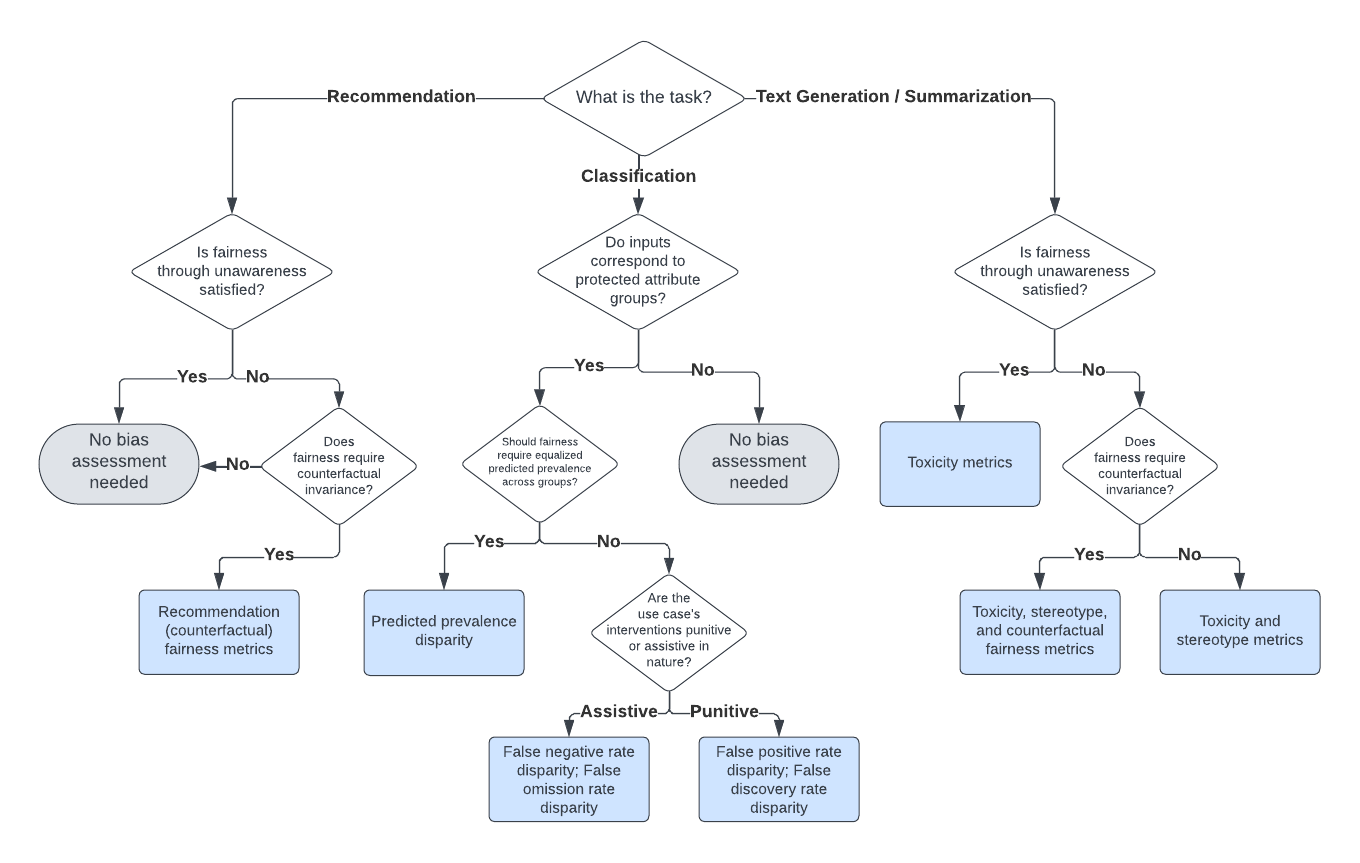
Note: Fairness through unawareness means none of the prompts for an LLM use case include any mention of protected attribute words.
Bias and fairness metrics offered by LangFair are grouped into several categories. The full suite of metrics is displayed below.
- Expected Maximum Toxicity (Gehman et al., 2020)
- Toxicity Probability (Gehman et al., 2020)
- Toxic Fraction (Liang et al., 2023)
- Strict Counterfactual Sentiment Parity (Huang et al., 2020)
- Weak Counterfactual Sentiment Parity (Bouchard, 2024)
- Counterfactual Cosine Similarity Score (Bouchard, 2024)
- Counterfactual BLEU (Bouchard, 2024)
- Counterfactual ROUGE-L (Bouchard, 2024)
- Stereotypical Associations (Liang et al., 2023)
- Co-occurrence Bias Score (Bordia & Bowman, 2019)
- Stereotype classifier metrics (Zekun et al., 2023, Bouchard, 2024)
- Jaccard Similarity (Zhang et al., 2023)
- Search Result Page Misinformation Score (Zhang et al., 2023)
- Pairwise Ranking Accuracy Gap (Zhang et al., 2023)
- Predicted Prevalence Rate Disparity (Feldman et al., 2015; Bellamy et al., 2018; Saleiro et al., 2019)
- False Negative Rate Disparity (Bellamy et al., 2018; Saleiro et al., 2019)
- False Omission Rate Disparity (Bellamy et al., 2018; Saleiro et al., 2019)
- False Positive Rate Disparity (Bellamy et al., 2018; Saleiro et al., 2019)
- False Discovery Rate Disparity (Bellamy et al., 2018; Saleiro et al., 2019)
A technical description and a practitioner's guide for selecting evaluation metrics is contained in this paper. If you use our evaluation approach, we would appreciate citations to the following paper:
@misc{bouchard2024actionableframeworkassessingbias,
      title={An Actionable Framework for Assessing Bias and Fairness in Large Language Model Use Cases},
      author={Dylan Bouchard},
      year={2024},
      eprint={2407.10853},
      archivePrefix={arXiv},
      primaryClass={cs.CL},
      url={https://arxiv.org/abs/2407.10853},
}
A high-level description of LangFair's functionality is contained in this paper. If you use LangFair, we would appreciate citations to the following paper:
@misc{bouchard2025langfairpythonpackageassessing,
      title={LangFair: A Python Package for Assessing Bias and Fairness in Large Language Model Use Cases},
      author={Dylan Bouchard and Mohit Singh Chauhan and David Skarbrevik and Viren Bajaj and Zeya Ahmad},
      year={2025},
      eprint={2501.03112},
      archivePrefix={arXiv},
      primaryClass={cs.CL},
      url={https://arxiv.org/abs/2501.03112},
}Please refer to our documentation site for more details on how to use LangFair.
The open-source version of LangFair is the culmination of extensive work carried out by a dedicated team of developers. While the internal commit history will not be made public, we believe it's essential to acknowledge the significant contributions of our development team who were instrumental in bringing this project to fruition:
Contributions are welcome. Please refer here for instructions on how to contribute to LangFair.
For Tasks:
Click tags to check more tools for each tasksFor Jobs:
Alternative AI tools for langfair
Similar Open Source Tools
langfair
LangFair is a Python library for bias and fairness assessments of large language models (LLMs). It offers a comprehensive framework for choosing bias and fairness metrics, demo notebooks, and a technical playbook. Users can tailor evaluations to their use cases with a Bring Your Own Prompts approach. The focus is on output-based metrics practical for governance audits and real-world testing.
Quantus
Quantus is a toolkit designed for the evaluation of neural network explanations. It offers more than 30 metrics in 6 categories for eXplainable Artificial Intelligence (XAI) evaluation. The toolkit supports different data types (image, time-series, tabular, NLP) and models (PyTorch, TensorFlow). It provides built-in support for explanation methods like captum, tf-explain, and zennit. Quantus is under active development and aims to provide a comprehensive set of quantitative evaluation metrics for XAI methods.
flow-prompt
Flow Prompt is a dynamic library for managing and optimizing prompts for large language models. It facilitates budget-aware operations, dynamic data integration, and efficient load distribution. Features include CI/CD testing, dynamic prompt development, multi-model support, real-time insights, and prompt testing and evolution.
xFinder
xFinder is a model specifically designed for key answer extraction from large language models (LLMs). It addresses the challenges of unreliable evaluation methods by optimizing the key answer extraction module. The model achieves high accuracy and robustness compared to existing frameworks, enhancing the reliability of LLM evaluation. It includes a specialized dataset, the Key Answer Finder (KAF) dataset, for effective training and evaluation. xFinder is suitable for researchers and developers working with LLMs to improve answer extraction accuracy.
probsem
ProbSem is a repository that provides a framework to leverage large language models (LLMs) for assigning context-conditional probability distributions over queried strings. It supports OpenAI engines and HuggingFace CausalLM models, and is flexible for research applications in linguistics, cognitive science, program synthesis, and NLP. Users can define prompts, contexts, and queries to derive probability distributions over possible completions, enabling tasks like cloze completion, multiple-choice QA, semantic parsing, and code completion. The repository offers CLI and API interfaces for evaluation, with options to customize models, normalize scores, and adjust temperature for probability distributions.
pywhyllm
PyWhy-LLM is an innovative library that integrates Large Language Models (LLMs) into the causal analysis process, empowering users with knowledge previously only available through domain experts. It seamlessly augments causal inference by suggesting potential confounders, relationships between variables, backdoor/frontdoor/iv sets, estimands, critiques of DAGs, latent confounders, and negative controls. The tool aims to enhance the causal analysis process by leveraging the capabilities of LLMs.
interpreto
Interpreto is an interpretability toolkit for large language models (LLMs) that provides a modular framework encompassing attribution methods, concept-based methods, and evaluation metrics. It includes various inference-based and gradient-based attribution methods for both classification and generation tasks. The toolkit also offers concept-based explanations to provide high-level interpretations of latent model representations through steps like concept discovery, interpretation, and concept-to-output attribution. Interpreto aims to enhance model interpretability and facilitate understanding of model decisions and outputs.
continuous-eval
Open-Source Evaluation for LLM Applications. `continuous-eval` is an open-source package created for granular and holistic evaluation of GenAI application pipelines. It offers modularized evaluation, a comprehensive metric library covering various LLM use cases, the ability to leverage user feedback in evaluation, and synthetic dataset generation for testing pipelines. Users can define their own metrics by extending the Metric class. The tool allows running evaluation on a pipeline defined with modules and corresponding metrics. Additionally, it provides synthetic data generation capabilities to create user interaction data for evaluation or training purposes.
Phi-3-Vision-MLX
Phi-3-MLX is a versatile AI framework that leverages both the Phi-3-Vision multimodal model and the Phi-3-Mini-128K language model optimized for Apple Silicon using the MLX framework. It provides an easy-to-use interface for a wide range of AI tasks, from advanced text generation to visual question answering and code execution. The project features support for batched generation, flexible agent system, custom toolchains, model quantization, LoRA fine-tuning capabilities, and API integration for extended functionality.
topicGPT
TopicGPT is a repository containing scripts and prompts for the paper 'TopicGPT: Topic Modeling by Prompting Large Language Models' (NAACL'24). The 'topicgpt_python' package offers functions to generate high-level and specific topics, refine topics, assign topics to input text, and correct generated topics. It supports various APIs like OpenAI, VertexAI, Azure, Gemini, and vLLM for inference. Users can prepare data in JSONL format, run the pipeline using provided scripts, and evaluate topic alignment with ground-truth labels.
Noema-Declarative-AI
Noema is a framework that enables developers to control a language model and choose the path it will follow. It integrates Python with llm's generations, allowing users to use LLM as a thought interpreter rather than a source of truth. Noema is built on llama.cpp and guidance's shoulders. It applies the declarative programming paradigm to a language model, providing a way to represent functions, descriptions, and transformations. Users can create subjects, think about tasks, and generate content through generators, selectors, and code generators. Noema supports ReAct prompting, visualization, and semantic Python functionalities, offering a versatile tool for automating tasks and guiding language models.
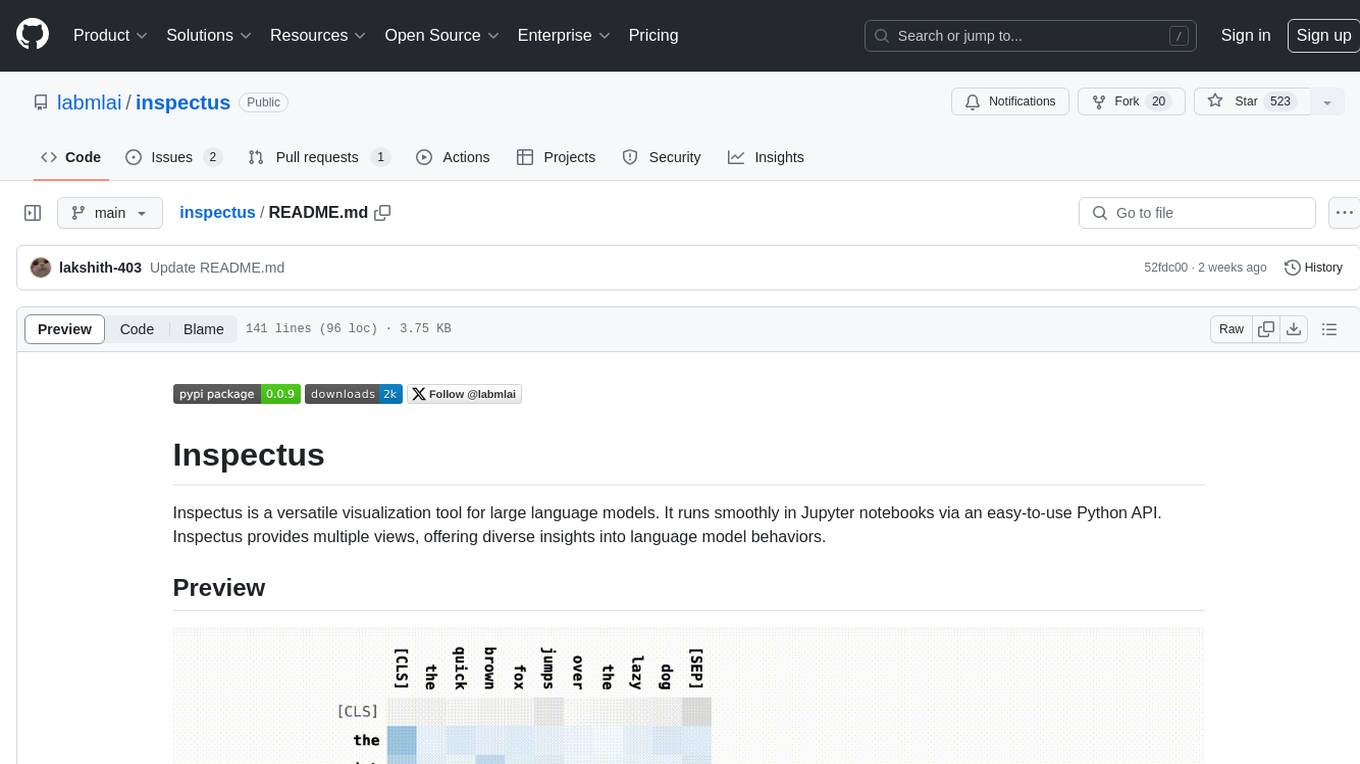
inspectus
Inspectus is a versatile visualization tool for large language models. It provides multiple views, including Attention Matrix, Query Token Heatmap, Key Token Heatmap, and Dimension Heatmap, to offer insights into language model behaviors. Users can interact with the tool in Jupyter notebooks through an easy-to-use Python API. Inspectus allows users to visualize attention scores between tokens, analyze how tokens focus on each other during processing, and explore the relationships between query and key tokens. The tool supports the visualization of attention maps from Huggingface transformers and custom attention maps, making it a valuable resource for researchers and developers working with language models.
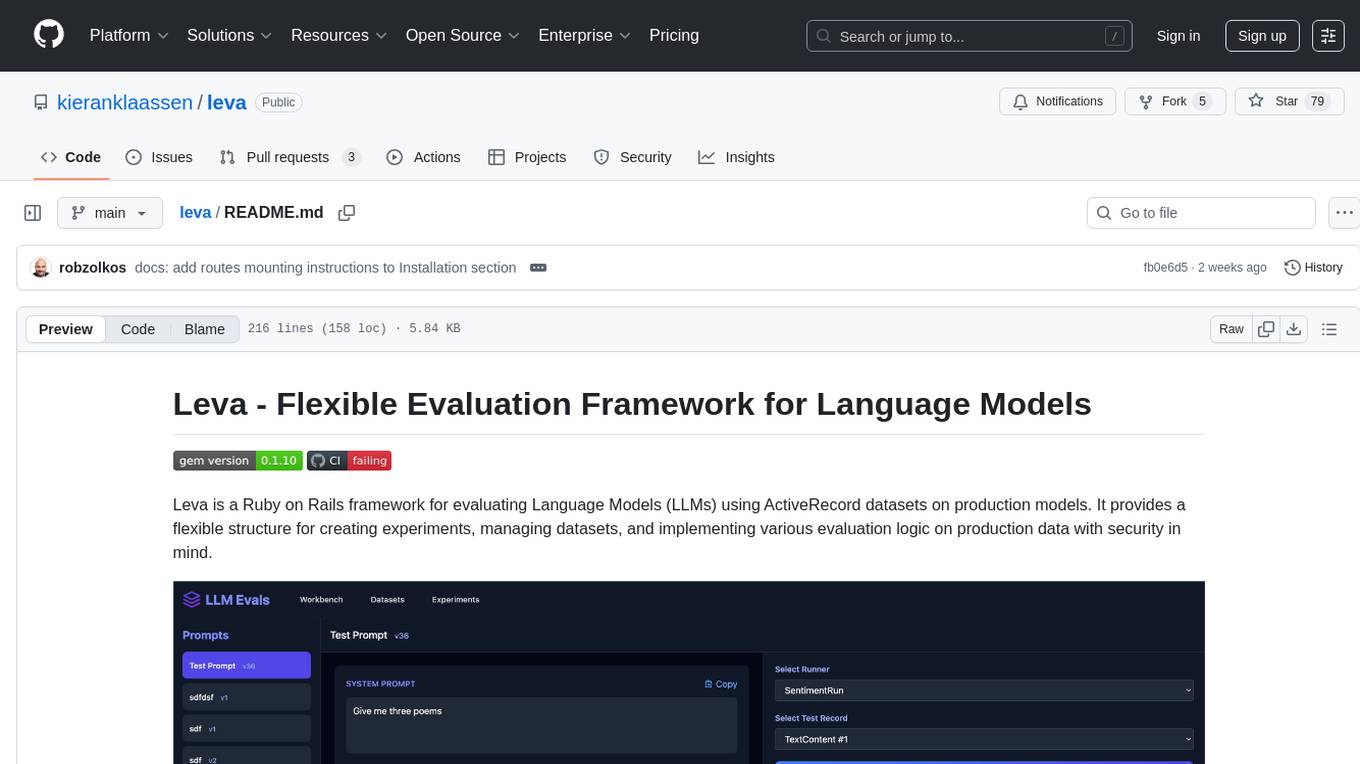
leva
Leva is a Ruby on Rails framework designed for evaluating Language Models (LLMs) using ActiveRecord datasets on production models. It offers a flexible structure for creating experiments, managing datasets, and implementing various evaluation logic on production data with security in mind. Users can set up datasets, implement runs and evals, run experiments with different configurations, use prompts, and analyze results. Leva's components include classes like Leva, Leva::BaseRun, and Leva::BaseEval, as well as models like Leva::Dataset, Leva::DatasetRecord, Leva::Experiment, Leva::RunnerResult, Leva::EvaluationResult, and Leva::Prompt. The tool aims to provide a comprehensive solution for evaluating language models efficiently and securely.
pywhy-llm
PyWhy-LLM is an innovative library that integrates Large Language Models (LLMs) into the causal analysis process, empowering users with knowledge previously only available through domain experts. It seamlessly augments existing causal inference processes by suggesting potential confounders, relationships between variables, backdoor sets, front door sets, IV sets, estimands, critiques of DAGs, latent confounders, and negative controls. By leveraging LLMs and formalizing human-LLM collaboration, PyWhy-LLM aims to enhance causal analysis accessibility and insight.
Trace
Trace is a new AutoDiff-like tool for training AI systems end-to-end with general feedback. It generalizes the back-propagation algorithm by capturing and propagating an AI system's execution trace. Implemented as a PyTorch-like Python library, users can write Python code directly and use Trace primitives to optimize certain parts, similar to training neural networks.
embodied-agents
Embodied Agents is a toolkit for integrating large multi-modal models into existing robot stacks with just a few lines of code. It provides consistency, reliability, scalability, and is configurable to any observation and action space. The toolkit is designed to reduce complexities involved in setting up inference endpoints, converting between different model formats, and collecting/storing datasets. It aims to facilitate data collection and sharing among roboticists by providing Python-first abstractions that are modular, extensible, and applicable to a wide range of tasks. The toolkit supports asynchronous and remote thread-safe agent execution for maximal responsiveness and scalability, and is compatible with various APIs like HuggingFace Spaces, Datasets, Gymnasium Spaces, Ollama, and OpenAI. It also offers automatic dataset recording and optional uploads to the HuggingFace hub.
For similar tasks
langfair
LangFair is a Python library for bias and fairness assessments of large language models (LLMs). It offers a comprehensive framework for choosing bias and fairness metrics, demo notebooks, and a technical playbook. Users can tailor evaluations to their use cases with a Bring Your Own Prompts approach. The focus is on output-based metrics practical for governance audits and real-world testing.
semantic-router
Semantic Router is a superfast decision-making layer for your LLMs and agents. Rather than waiting for slow LLM generations to make tool-use decisions, we use the magic of semantic vector space to make those decisions — _routing_ our requests using _semantic_ meaning.
hass-ollama-conversation
The Ollama Conversation integration adds a conversation agent powered by Ollama in Home Assistant. This agent can be used in automations to query information provided by Home Assistant about your house, including areas, devices, and their states. Users can install the integration via HACS and configure settings such as API timeout, model selection, context size, maximum tokens, and other parameters to fine-tune the responses generated by the AI language model. Contributions to the project are welcome, and discussions can be held on the Home Assistant Community platform.
luna-ai
Luna AI is a virtual streamer driven by a 'brain' composed of ChatterBot, GPT, Claude, langchain, chatglm, text-generation-webui, 讯飞星火, 智谱AI. It can interact with viewers in real-time during live streams on platforms like Bilibili, Douyin, Kuaishou, Douyu, or chat with you locally. Luna AI uses natural language processing and text-to-speech technologies like Edge-TTS, VITS-Fast, elevenlabs, bark-gui, VALL-E-X to generate responses to viewer questions and can change voice using so-vits-svc, DDSP-SVC. It can also collaborate with Stable Diffusion for drawing displays and loop custom texts. This project is completely free, and any identical copycat selling programs are pirated, please stop them promptly.
KULLM
KULLM (구름) is a Korean Large Language Model developed by Korea University NLP & AI Lab and HIAI Research Institute. It is based on the upstage/SOLAR-10.7B-v1.0 model and has been fine-tuned for instruction. The model has been trained on 8×A100 GPUs and is capable of generating responses in Korean language. KULLM exhibits hallucination and repetition phenomena due to its decoding strategy. Users should be cautious as the model may produce inaccurate or harmful results. Performance may vary in benchmarks without a fixed system prompt.

cria
Cria is a Python library designed for running Large Language Models with minimal configuration. It provides an easy and concise way to interact with LLMs, offering advanced features such as custom models, streams, message history management, and running multiple models in parallel. Cria simplifies the process of using LLMs by providing a straightforward API that requires only a few lines of code to get started. It also handles model installation automatically, making it efficient and user-friendly for various natural language processing tasks.
beyondllm
Beyond LLM offers an all-in-one toolkit for experimentation, evaluation, and deployment of Retrieval-Augmented Generation (RAG) systems. It simplifies the process with automated integration, customizable evaluation metrics, and support for various Large Language Models (LLMs) tailored to specific needs. The aim is to reduce LLM hallucination risks and enhance reliability.
Groma
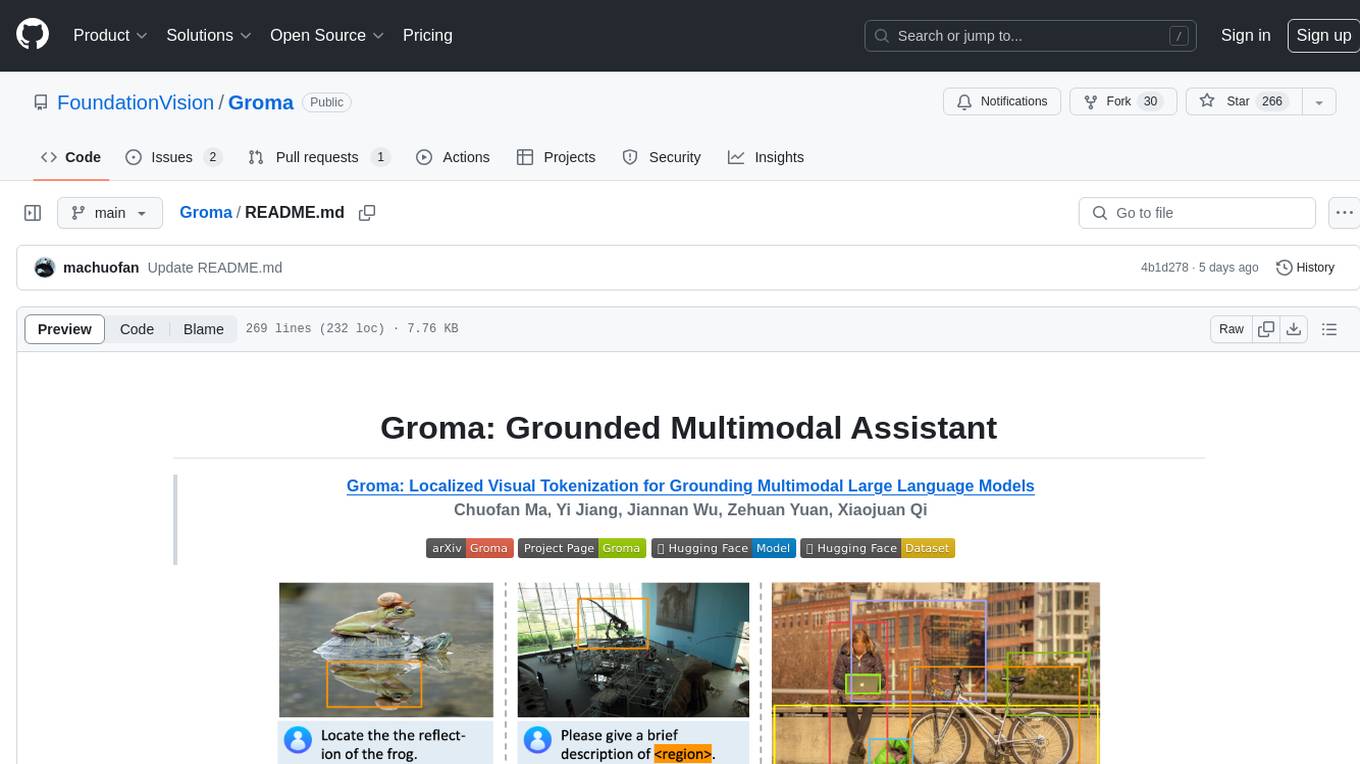
Groma is a grounded multimodal assistant that excels in region understanding and visual grounding. It can process user-defined region inputs and generate contextually grounded long-form responses. The tool presents a unique paradigm for multimodal large language models, focusing on visual tokenization for localization. Groma achieves state-of-the-art performance in referring expression comprehension benchmarks. The tool provides pretrained model weights and instructions for data preparation, training, inference, and evaluation. Users can customize training by starting from intermediate checkpoints. Groma is designed to handle tasks related to detection pretraining, alignment pretraining, instruction finetuning, instruction following, and more.
For similar jobs
responsible-ai-toolbox
Responsible AI Toolbox is a suite of tools providing model and data exploration and assessment interfaces and libraries for understanding AI systems. It empowers developers and stakeholders to develop and monitor AI responsibly, enabling better data-driven actions. The toolbox includes visualization widgets for model assessment, error analysis, interpretability, fairness assessment, and mitigations library. It also offers a JupyterLab extension for managing machine learning experiments and a library for measuring gender bias in NLP datasets.
fairlearn
Fairlearn is a Python package designed to help developers assess and mitigate fairness issues in artificial intelligence (AI) systems. It provides mitigation algorithms and metrics for model assessment. Fairlearn focuses on two types of harms: allocation harms and quality-of-service harms. The package follows the group fairness approach, aiming to identify groups at risk of experiencing harms and ensuring comparable behavior across these groups. Fairlearn consists of metrics for assessing model impacts and algorithms for mitigating unfairness in various AI tasks under different fairness definitions.
Open-Prompt-Injection
OpenPromptInjection is an open-source toolkit for attacks and defenses in LLM-integrated applications, enabling easy implementation, evaluation, and extension of attacks, defenses, and LLMs. It supports various attack and defense strategies, including prompt injection, paraphrasing, retokenization, data prompt isolation, instructional prevention, sandwich prevention, perplexity-based detection, LLM-based detection, response-based detection, and know-answer detection. Users can create models, tasks, and apps to evaluate different scenarios. The toolkit currently supports PaLM2 and provides a demo for querying models with prompts. Users can also evaluate ASV for different scenarios by injecting tasks and querying models with attacked data prompts.
aws-machine-learning-university-responsible-ai
This repository contains slides, notebooks, and data for the Machine Learning University (MLU) Responsible AI class. The mission is to make Machine Learning accessible to everyone, covering widely used ML techniques and applying them to real-world problems. The class includes lectures, final projects, and interactive visuals to help users learn about Responsible AI and core ML concepts.
AIF360
The AI Fairness 360 toolkit is an open-source library designed to detect and mitigate bias in machine learning models. It provides a comprehensive set of metrics, explanations, and algorithms for bias mitigation in various domains such as finance, healthcare, and education. The toolkit supports multiple bias mitigation algorithms and fairness metrics, and is available in both Python and R. Users can leverage the toolkit to ensure fairness in AI applications and contribute to its development for extensibility.
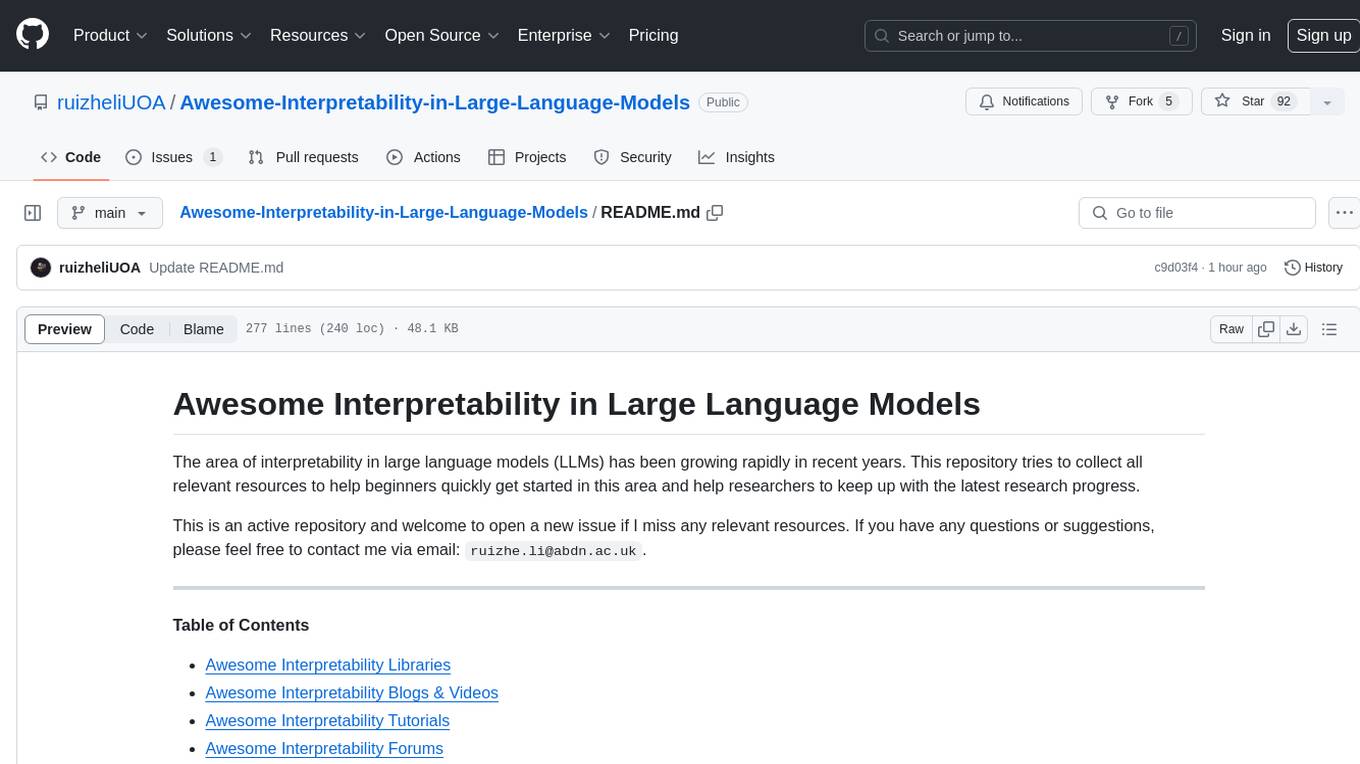
Awesome-Interpretability-in-Large-Language-Models
This repository is a collection of resources focused on interpretability in large language models (LLMs). It aims to help beginners get started in the area and keep researchers updated on the latest progress. It includes libraries, blogs, tutorials, forums, tools, programs, papers, and more related to interpretability in LLMs.
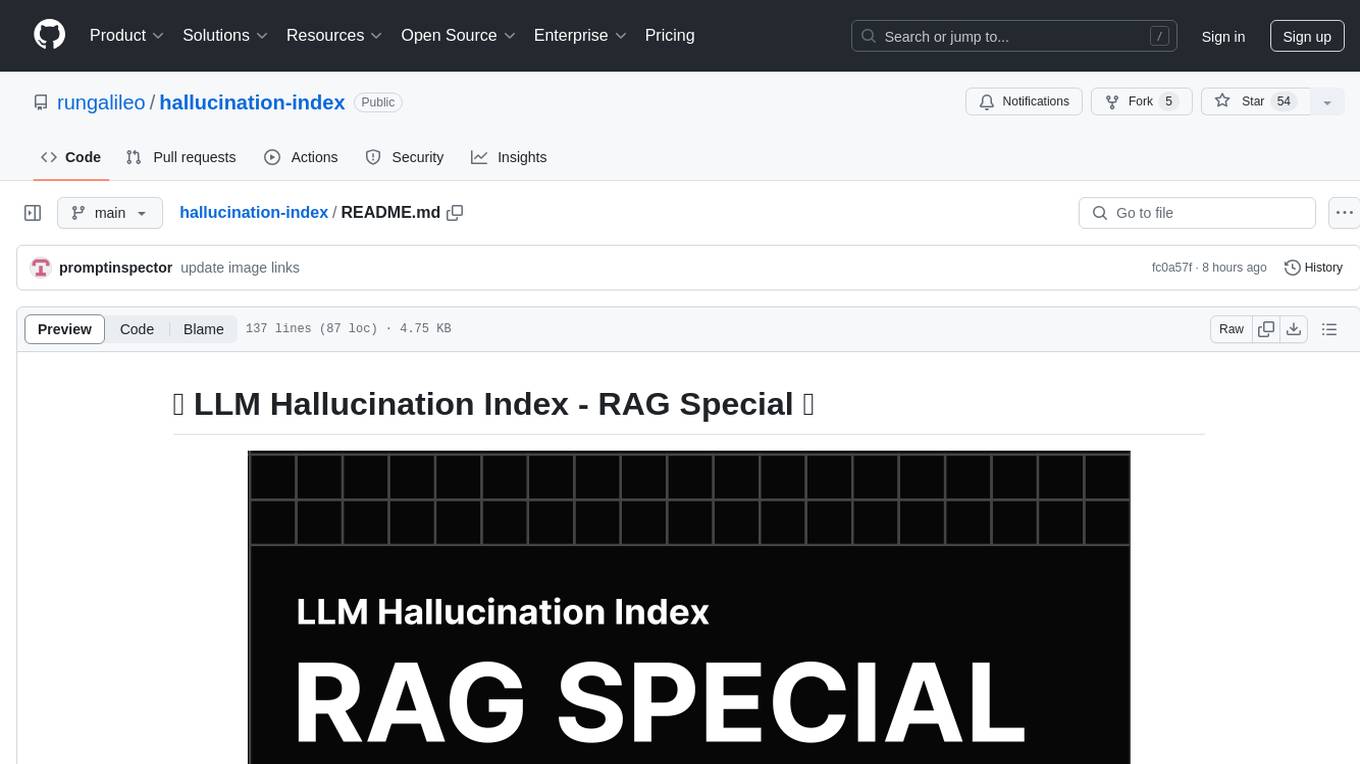
hallucination-index
LLM Hallucination Index - RAG Special is a comprehensive evaluation of large language models (LLMs) focusing on context length and open vs. closed-source attributes. The index explores the impact of context length on model performance and tests the assumption that closed-source LLMs outperform open-source ones. It also investigates the effectiveness of prompting techniques like Chain-of-Note across different context lengths. The evaluation includes 22 models from various brands, analyzing major trends and declaring overall winners based on short, medium, and long context insights. Methodologies involve rigorous testing with different context lengths and prompting techniques to assess models' abilities in handling extensive texts and detecting hallucinations.
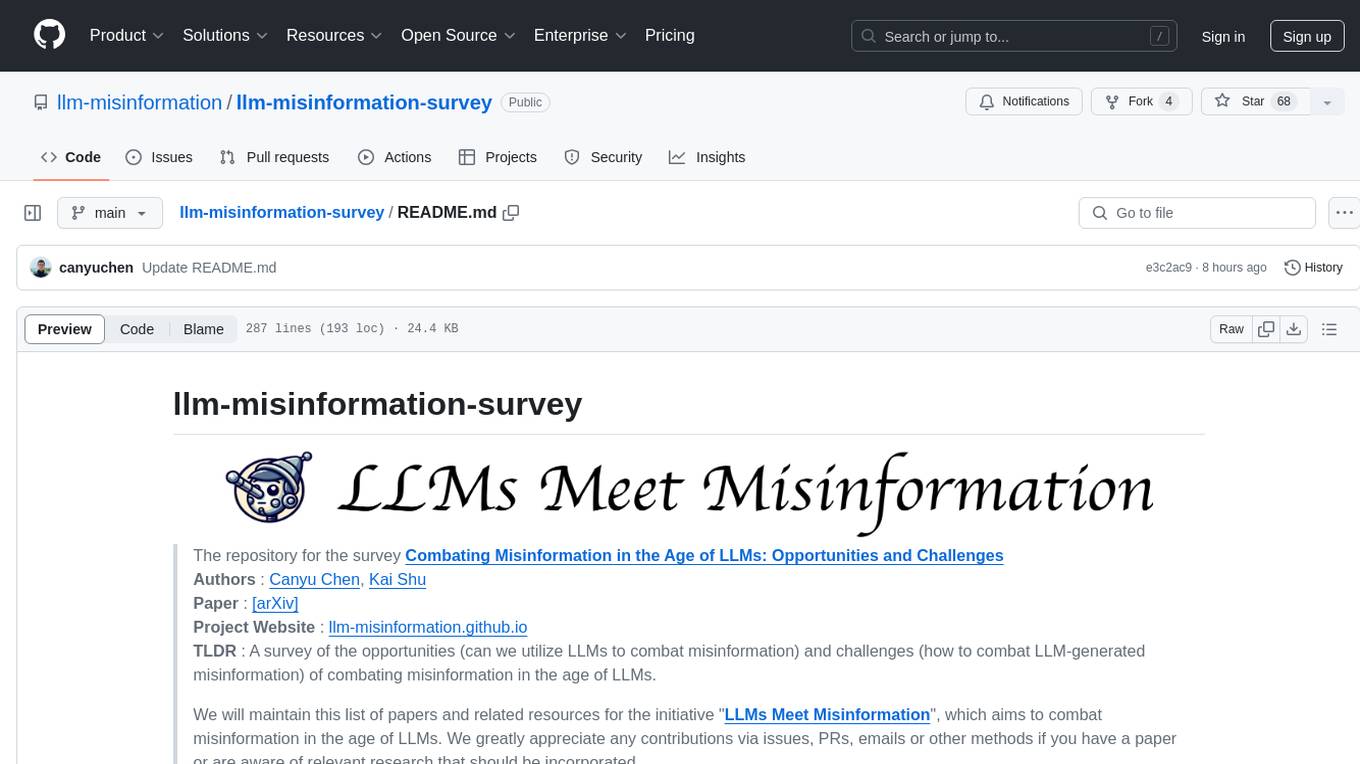
llm-misinformation-survey
The 'llm-misinformation-survey' repository is dedicated to the survey on combating misinformation in the age of Large Language Models (LLMs). It explores the opportunities and challenges of utilizing LLMs to combat misinformation, providing insights into the history of combating misinformation, current efforts, and future outlook. The repository serves as a resource hub for the initiative 'LLMs Meet Misinformation' and welcomes contributions of relevant research papers and resources. The goal is to facilitate interdisciplinary efforts in combating LLM-generated misinformation and promoting the responsible use of LLMs in fighting misinformation.