


aikit
🏗️ Fine-tune, build, and deploy open-source LLMs easily!
Stars: 508
AIKit is a comprehensive platform for hosting, deploying, building, and fine-tuning large language models (LLMs). It offers inference using LocalAI, extensible fine-tuning interface, and OCI packaging for distributing models. AIKit supports various models, multi-modal model and image generation, Kubernetes deployment, and supply chain security. It can run on AMD64 and ARM64 CPUs, NVIDIA GPUs, and Apple Silicon (experimental). Users can quickly get started with AIKit without a GPU and access pre-made models. The platform is OpenAI API compatible and provides easy-to-use configuration for inference and fine-tuning.
README:

AIKit is a comprehensive platform to quickly get started to host, deploy, build and fine-tune large language models (LLMs).
AIKit offers three main capabilities:
-
Inference: AIKit uses LocalAI, which supports a wide range of inference capabilities and formats. LocalAI provides a drop-in replacement REST API that is OpenAI API compatible, so you can use any OpenAI API compatible client, such as Kubectl AI, Chatbot-UI and many more, to send requests to open LLMs!
-
Fine-Tuning: AIKit offers an extensible fine-tuning interface. It supports Unsloth for fast, memory efficient, and easy fine-tuning experience.
-
OCI Packaging: Package models as OCI artifacts for distribution through any OCI-compliant registry. Supports CNCF ModelPack specification and generic artifact packaging.
👉 For full documentation, please see AIKit website!
- 🐳 No GPU, Internet access or additional tools needed except for Docker or Podman!
- 🤏 Minimal image size, resulting in less vulnerabilities and smaller attack surface with a custom chiseled image
- 🎵 Fine-tune support
- 📦 OCI packaging support for distributing models as OCI artifacts
- 🚀 Easy to use declarative configuration for inference and fine-tuning
- ✨ OpenAI API compatible to use with any OpenAI API compatible client
- 📸 Multi-modal model support
- 🖼️ Image generation support
- 🦙 Support for GGUF (
llama), GPTQ or EXL2 (exllama2), and GGML (llama-ggml) models - 🚢 Kubernetes deployment ready
- 📚 Supports multiple models with a single image
- 🖥️ Supports AMD64 and ARM64 CPUs and GPU-accelerated inferencing with NVIDIA GPUs
- 🔐 Ensure supply chain security with SBOMs, Provenance attestations, and signed images
- 🌈 Supports air-gapped environments with self-hosted, local, or any remote container registries to store model images for inference on the edge.
You can get started with AIKit quickly on your local machine without a GPU!
docker run -d --rm -p 8080:8080 ghcr.io/kaito-project/aikit/llama3.1:8bAfter running this, navigate to http://localhost:8080/chat to access the WebUI!
AIKit provides an OpenAI API compatible endpoint, so you can use any OpenAI API compatible client to send requests to open LLMs!
curl http://localhost:8080/v1/chat/completions -H "Content-Type: application/json" -d '{
    "model": "llama-3.1-8b-instruct",
    "messages": [{"role": "user", "content": "explain kubernetes in a sentence"}]
  }'
Output should be similar to:
That's it! 🎉 API is OpenAI compatible so this is a drop-in replacement for any OpenAI API compatible client.
AIKit comes with pre-made models that you can use out-of-the-box!
If it doesn't include a specific model, you can always create your own images, and host in a container registry of your choice!
[!NOTE] AIKit supports both AMD64 and ARM64 CPUs. You can run the same command on either architecture, and Docker will automatically pull the correct image for your CPU.
Depending on your CPU capabilities, AIKit will automatically select the most optimized instruction set.
| Model | Optimization | Parameters | Command | Model Name | License |
|---|---|---|---|---|---|
| 🦙 Llama 3.2 | Instruct | 1B | docker run -d --rm -p 8080:8080 ghcr.io/kaito-project/aikit/llama3.2:1b |
llama-3.2-1b-instruct |
Llama |
| 🦙 Llama 3.2 | Instruct | 3B | docker run -d --rm -p 8080:8080 ghcr.io/kaito-project/aikit/llama3.2:3b |
llama-3.2-3b-instruct |
Llama |
| 🦙 Llama 3.1 | Instruct | 8B | docker run -d --rm -p 8080:8080 ghcr.io/kaito-project/aikit/llama3.1:8b |
llama-3.1-8b-instruct |
Llama |
| 🦙 Llama 3.3 | Instruct | 70B | docker run -d --rm -p 8080:8080 ghcr.io/kaito-project/aikit/llama3.3:70b |
llama-3.3-70b-instruct |
Llama |
| Instruct | 8x7B | docker run -d --rm -p 8080:8080 ghcr.io/kaito-project/aikit/mixtral:8x7b |
mixtral-8x7b-instruct |
Apache | |
| Instruct | 14B | docker run -d --rm -p 8080:8080 ghcr.io/kaito-project/aikit/phi4:14b |
phi-4-14b-instruct |
MIT | |
| 🔡 Gemma 2 | Instruct | 2B | docker run -d --rm -p 8080:8080 ghcr.io/kaito-project/aikit/gemma2:2b |
gemma-2-2b-instruct |
Gemma |
| QwQ | 32B | docker run -d --rm -p 8080:8080 ghcr.io/kaito-project/aikit/qwq:32b |
qwq-32b |
Apache 2.0 | |
| ⌨️ Codestral 0.1 | Code | 22B | docker run -d --rm -p 8080:8080 ghcr.io/kaito-project/aikit/codestral:22b |
codestral-22b |
MNLP |
| 🤖 GPT-OSS | 20B | docker run -d --rm -p 8080:8080 ghcr.io/kaito-project/aikit/gpt-oss:20b |
gpt-oss-20b |
Apache 2.0 | |
| 🤖 GPT-OSS | 120B | docker run -d --rm -p 8080:8080 ghcr.io/kaito-project/aikit/gpt-oss:120b |
gpt-oss-120b |
Apache 2.0 |
[!NOTE] To enable GPU acceleration, please see GPU Acceleration.
Please note that only difference between CPU and GPU section is the
--gpus allflag in the command to enable GPU acceleration.
| Model | Optimization | Parameters | Command | Model Name | License |
|---|---|---|---|---|---|
| 🦙 Llama 3.2 | Instruct | 1B | docker run -d --rm --gpus all -p 8080:8080 ghcr.io/kaito-project/aikit/llama3.2:1b |
llama-3.2-1b-instruct |
Llama |
| 🦙 Llama 3.2 | Instruct | 3B | docker run -d --rm --gpus all -p 8080:8080 ghcr.io/kaito-project/aikit/llama3.2:3b |
llama-3.2-3b-instruct |
Llama |
| 🦙 Llama 3.1 | Instruct | 8B | docker run -d --rm --gpus all -p 8080:8080 ghcr.io/kaito-project/aikit/llama3.1:8b |
llama-3.1-8b-instruct |
Llama |
| 🦙 Llama 3.3 | Instruct | 70B | docker run -d --rm --gpus all -p 8080:8080 ghcr.io/kaito-project/aikit/llama3.3:70b |
llama-3.3-70b-instruct |
Llama |
| Instruct | 8x7B | docker run -d --rm --gpus all -p 8080:8080 ghcr.io/kaito-project/aikit/mixtral:8x7b |
mixtral-8x7b-instruct |
Apache | |
| Instruct | 14B | docker run -d --rm --gpus all -p 8080:8080 ghcr.io/kaito-project/aikit/phi4:14b |
phi-4-14b-instruct |
MIT | |
| 🔡 Gemma 2 | Instruct | 2B | docker run -d --rm --gpus all -p 8080:8080 ghcr.io/kaito-project/aikit/gemma2:2b |
gemma-2-2b-instruct |
Gemma |
| QwQ | 32B | docker run -d --rm --gpus all -p 8080:8080 ghcr.io/kaito-project/aikit/qwq:32b |
qwq-32b |
Apache 2.0 | |
| ⌨️ Codestral 0.1 | Code | 22B | docker run -d --rm --gpus all -p 8080:8080 ghcr.io/kaito-project/aikit/codestral:22b |
codestral-22b |
MNLP |
| 📸 Flux 1 Dev | Text to image | 12B | docker run -d --rm --gpus all -p 8080:8080 ghcr.io/kaito-project/aikit/flux1:dev |
flux-1-dev |
FLUX.1 [dev] Non-Commercial License |
| 🤖 GPT-OSS | 20B | docker run -d --rm --gpus all -p 8080:8080 ghcr.io/kaito-project/aikit/gpt-oss:20b |
gpt-oss-20b |
Apache 2.0 | |
| 🤖 GPT-OSS | 120B | docker run -d --rm --gpus all -p 8080:8080 ghcr.io/kaito-project/aikit/gpt-oss:120b |
gpt-oss-120b |
Apache 2.0 |
[!NOTE] To enable GPU acceleration on Apple Silicon, please see Podman Desktop documentation. For more information, please see GPU Acceleration.
Apple Silicon is an experimental runtime and it may change in the future. This runtime is specific to Apple Silicon only, and it will not work as expected on other architectures, including Intel Macs.
Only
ggufmodels are supported on Apple Silicon.
| Model | Optimization | Parameters | Command | Model Name | License |
|---|---|---|---|---|---|
| 🦙 Llama 3.2 | Instruct | 1B | podman run -d --rm --device /dev/dri -p 8080:8080 ghcr.io/kaito-project/aikit/applesilicon/llama3.2:1b |
llama-3.2-1b-instruct |
Llama |
| 🦙 Llama 3.2 | Instruct | 3B | podman run -d --rm --device /dev/dri -p 8080:8080 ghcr.io/kaito-project/aikit/applesilicon/llama3.2:3b |
llama-3.2-3b-instruct |
Llama |
| 🦙 Llama 3.1 | Instruct | 8B | podman run -d --rm --device /dev/dri -p 8080:8080 ghcr.io/kaito-project/aikit/applesilicon/llama3.1:8b |
llama-3.1-8b-instruct |
Llama |
| Instruct | 14B | podman run -d --rm --device /dev/dri -p 8080:8080 ghcr.io/kaito-project/aikit/applesilicon/phi4:14b |
phi-4-14b-instruct |
MIT | |
| 🔡 Gemma 2 | Instruct | 2B | podman run -d --rm --device /dev/dri -p 8080:8080 ghcr.io/kaito-project/aikit/applesilicon/gemma2:2b |
gemma-2-2b-instruct |
Gemma |
Want to contribute to AIKit? Check out our Contributing Guide for development setup, testing instructions, and contribution guidelines.
👉 For more information and how to fine tune models or create your own images, please see AIKit website!
For Tasks:
Click tags to check more tools for each tasksFor Jobs:
Alternative AI tools for aikit
Similar Open Source Tools
aikit
AIKit is a comprehensive platform for hosting, deploying, building, and fine-tuning large language models (LLMs). It offers inference using LocalAI, extensible fine-tuning interface, and OCI packaging for distributing models. AIKit supports various models, multi-modal model and image generation, Kubernetes deployment, and supply chain security. It can run on AMD64 and ARM64 CPUs, NVIDIA GPUs, and Apple Silicon (experimental). Users can quickly get started with AIKit without a GPU and access pre-made models. The platform is OpenAI API compatible and provides easy-to-use configuration for inference and fine-tuning.
aikit
AIKit is a one-stop shop to quickly get started to host, deploy, build and fine-tune large language models (LLMs). AIKit offers two main capabilities: Inference: AIKit uses LocalAI, which supports a wide range of inference capabilities and formats. LocalAI provides a drop-in replacement REST API that is OpenAI API compatible, so you can use any OpenAI API compatible client, such as Kubectl AI, Chatbot-UI and many more, to send requests to open-source LLMs! Fine Tuning: AIKit offers an extensible fine tuning interface. It supports Unsloth for fast, memory efficient, and easy fine-tuning experience.
beet
Beet is a collection of crates for authoring and running web pages, games and AI behaviors. It includes crates like `beet_flow` for scenes-as-control-flow bevy library, `beet_spatial` for spatial behaviors, `beet_ml` for machine learning, `beet_sim` for simulation tooling, `beet_rsx` for authoring tools for html and bevy, and `beet_router` for file-based router for web docs. The `beet` crate acts as a base crate that re-exports sub-crates based on feature flags, similar to the `bevy` crate structure.
ollama-gui
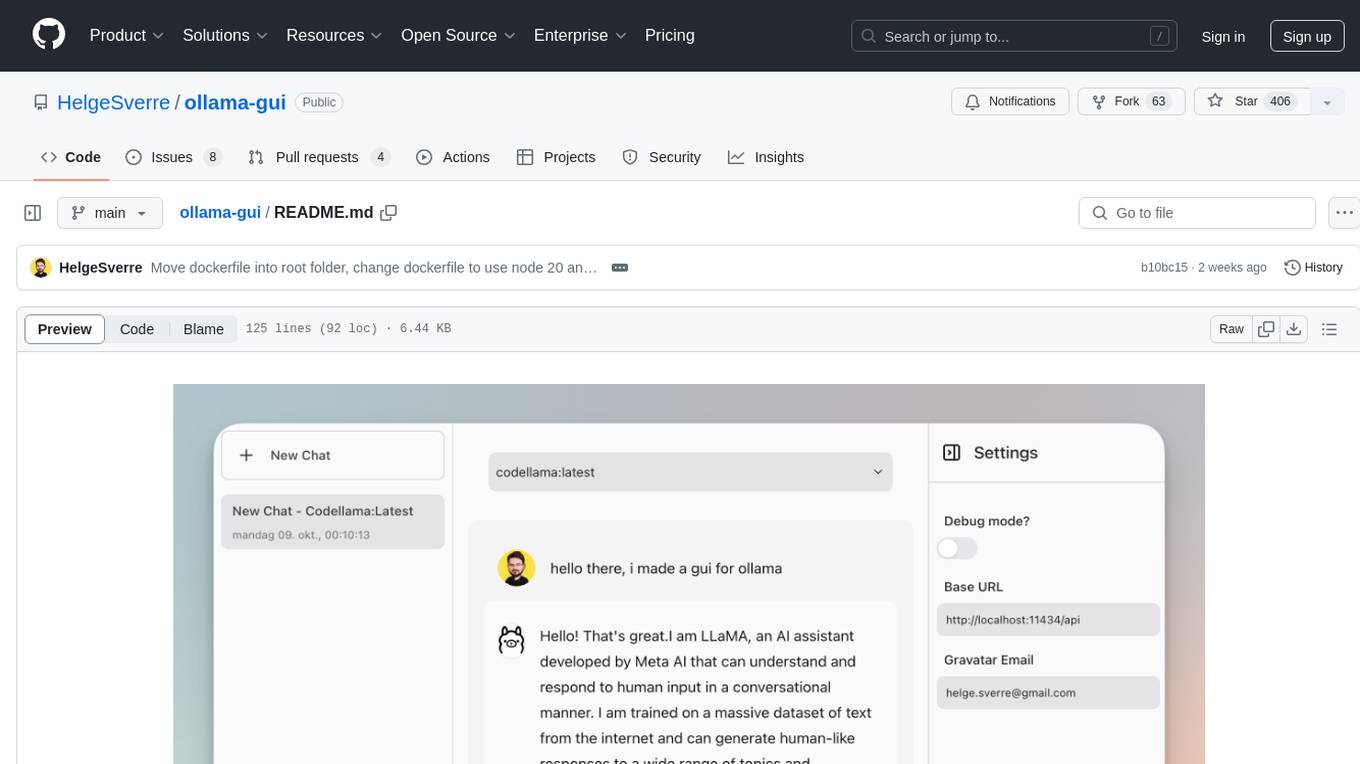
Ollama GUI is a web interface for ollama.ai, a tool that enables running Large Language Models (LLMs) on your local machine. It provides a user-friendly platform for chatting with LLMs and accessing various models for text generation. Users can easily interact with different models, manage chat history, and explore available models through the web interface. The tool is built with Vue.js, Vite, and Tailwind CSS, offering a modern and responsive design for seamless user experience.
GenAIComps
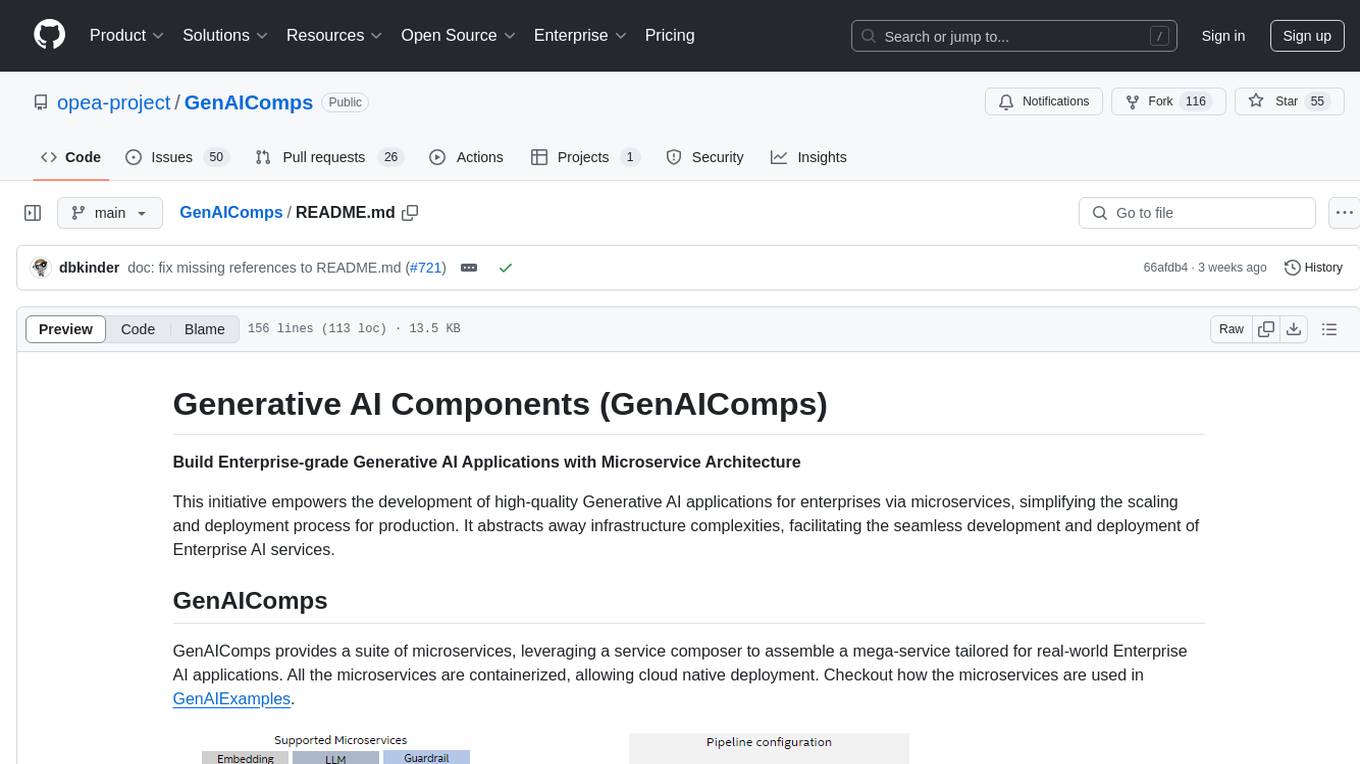
GenAIComps is an initiative aimed at building enterprise-grade Generative AI applications using a microservice architecture. It simplifies the scaling and deployment process for production, abstracting away infrastructure complexities. GenAIComps provides a suite of containerized microservices that can be assembled into a mega-service tailored for real-world Enterprise AI applications. The modular approach of microservices allows for independent development, deployment, and scaling of individual components, promoting modularity, flexibility, and scalability. The mega-service orchestrates multiple microservices to deliver comprehensive solutions, encapsulating complex business logic and workflow orchestration. The gateway serves as the interface for users to access the mega-service, providing customized access based on user requirements.
spiceai
Spice is a portable runtime written in Rust that offers developers a unified SQL interface to materialize, accelerate, and query data from any database, data warehouse, or data lake. It connects, fuses, and delivers data to applications, machine-learning models, and AI-backends, functioning as an application-specific, tier-optimized Database CDN. Built with industry-leading technologies such as Apache DataFusion, Apache Arrow, Apache Arrow Flight, SQLite, and DuckDB. Spice makes it fast and easy to query data from one or more sources using SQL, co-locating a managed dataset with applications or machine learning models, and accelerating it with Arrow in-memory, SQLite/DuckDB, or attached PostgreSQL for fast, high-concurrency, low-latency queries.
awsome-distributed-training
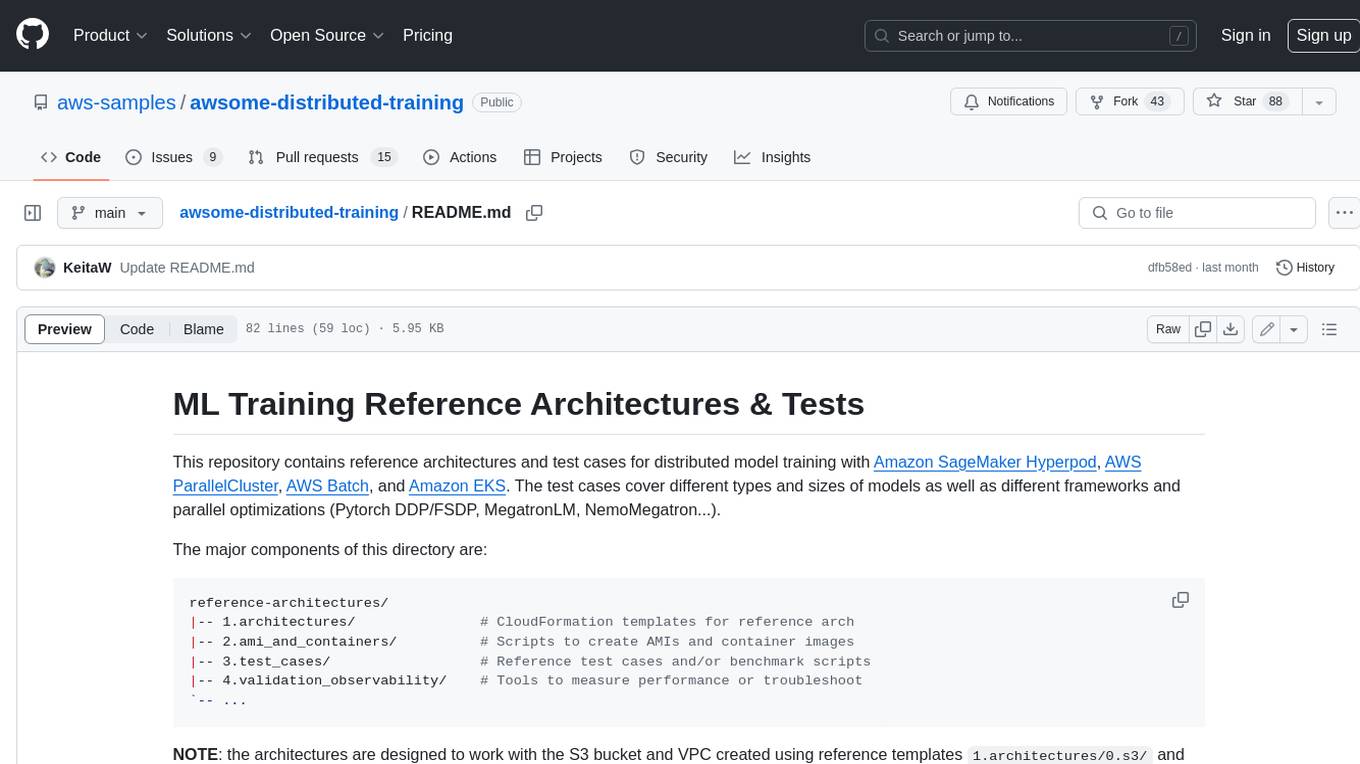
This repository contains reference architectures and test cases for distributed model training with Amazon SageMaker Hyperpod, AWS ParallelCluster, AWS Batch, and Amazon EKS. The test cases cover different types and sizes of models as well as different frameworks and parallel optimizations (Pytorch DDP/FSDP, MegatronLM, NemoMegatron...).
TinyLLM
TinyLLM is a project that helps build a small locally hosted language model with a web interface using consumer-grade hardware. It supports multiple language models, builds a local OpenAI API web service, and serves a Chatbot web interface with customizable prompts. The project requires specific hardware and software configurations for optimal performance. Users can run a local language model using inference servers like vLLM, llama-cpp-python, and Ollama. The Chatbot feature allows users to interact with the language model through a web-based interface, supporting features like summarizing websites, displaying news headlines, stock prices, weather conditions, and using vector databases for queries.
RVC_CLI
**RVC_CLI: Retrieval-based Voice Conversion Command Line Interface** This command-line interface (CLI) provides a comprehensive set of tools for voice conversion, enabling you to modify the pitch, timbre, and other characteristics of audio recordings. It leverages advanced machine learning models to achieve realistic and high-quality voice conversions. **Key Features:** * **Inference:** Convert the pitch and timbre of audio in real-time or process audio files in batch mode. * **TTS Inference:** Synthesize speech from text using a variety of voices and apply voice conversion techniques. * **Training:** Train custom voice conversion models to meet specific requirements. * **Model Management:** Extract, blend, and analyze models to fine-tune and optimize performance. * **Audio Analysis:** Inspect audio files to gain insights into their characteristics. * **API:** Integrate the CLI's functionality into your own applications or workflows. **Applications:** The RVC_CLI finds applications in various domains, including: * **Music Production:** Create unique vocal effects, harmonies, and backing vocals. * **Voiceovers:** Generate voiceovers with different accents, emotions, and styles. * **Audio Editing:** Enhance or modify audio recordings for podcasts, audiobooks, and other content. * **Research and Development:** Explore and advance the field of voice conversion technology. **For Jobs:** * Audio Engineer * Music Producer * Voiceover Artist * Audio Editor * Machine Learning Engineer **AI Keywords:** * Voice Conversion * Pitch Shifting * Timbre Modification * Machine Learning * Audio Processing **For Tasks:** * Convert Pitch * Change Timbre * Synthesize Speech * Train Model * Analyze Audio
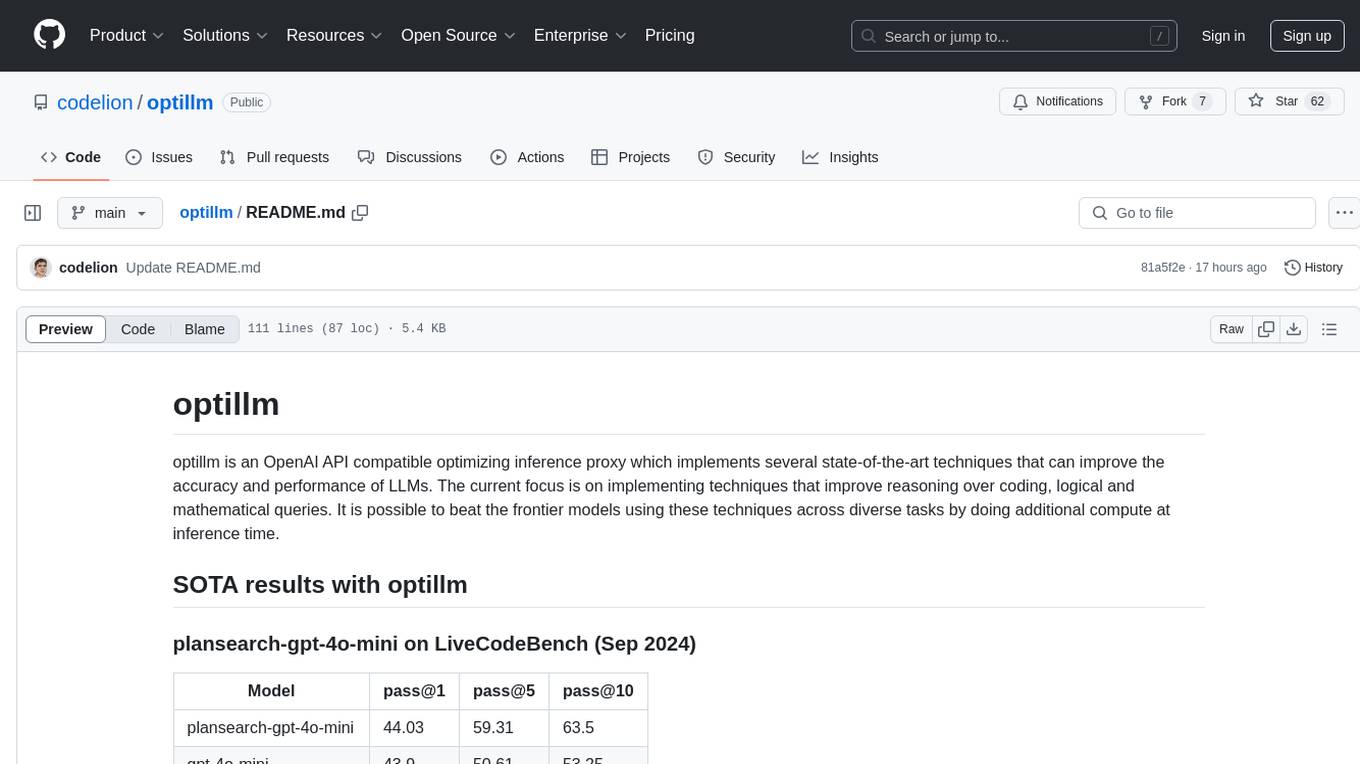
optillm
optillm is an OpenAI API compatible optimizing inference proxy implementing state-of-the-art techniques to enhance accuracy and performance of LLMs, focusing on reasoning over coding, logical, and mathematical queries. By leveraging additional compute at inference time, it surpasses frontier models across diverse tasks.
llava-docker
This Docker image for LLaVA (Large Language and Vision Assistant) provides a convenient way to run LLaVA locally or on RunPod. LLaVA is a powerful AI tool that combines natural language processing and computer vision capabilities. With this Docker image, you can easily access LLaVA's functionalities for various tasks, including image captioning, visual question answering, text summarization, and more. The image comes pre-installed with LLaVA v1.2.0, Torch 2.1.2, xformers 0.0.23.post1, and other necessary dependencies. You can customize the model used by setting the MODEL environment variable. The image also includes a Jupyter Lab environment for interactive development and exploration. Overall, this Docker image offers a comprehensive and user-friendly platform for leveraging LLaVA's capabilities.
RVC_CLI
RVC_CLI is a command line interface tool for retrieval-based voice conversion. It provides functionalities for installation, getting started, inference, training, UVR, additional features, and API integration. Users can perform tasks like single inference, batch inference, TTS inference, preprocess dataset, extract features, start training, generate index file, model extract, model information, model blender, launch TensorBoard, download models, audio analyzer, and prerequisites download. The tool is built on various projects like ContentVec, HIFIGAN, audio-slicer, python-audio-separator, RMVPE, FCPE, VITS, So-Vits-SVC, Harmonify, and others.
vscode-unify-chat-provider
The 'vscode-unify-chat-provider' repository is a tool that integrates multiple LLM API providers into VS Code's GitHub Copilot Chat using the Language Model API. It offers free tier access to mainstream models, perfect compatibility with major LLM API formats, deep adaptation to API features, best performance with built-in parameters, out-of-the-box configuration, import/export support, great UX, and one-click use of various models. The tool simplifies model setup, migration, and configuration for users, providing a seamless experience within VS Code for utilizing different language models.
agentic
Agentic is a standard AI functions/tools library optimized for TypeScript and LLM-based apps, compatible with major AI SDKs. It offers a set of thoroughly tested AI functions that can be used with favorite AI SDKs without writing glue code. The library includes various clients for services like Bing web search, calculator, Clearbit data resolution, Dexa podcast questions, and more. It also provides compound tools like SearchAndCrawl and supports multiple AI SDKs such as OpenAI, Vercel AI SDK, LangChain, LlamaIndex, Firebase Genkit, and Dexa Dexter. The goal is to create minimal clients with strongly-typed TypeScript DX, composable AIFunctions via AIFunctionSet, and compatibility with major TS AI SDKs.
hcaptcha-challenger
hCaptcha Challenger is a tool designed to gracefully face hCaptcha challenges using a multimodal large language model. It does not rely on Tampermonkey scripts or third-party anti-captcha services, instead implementing interfaces for 'AI vs AI' scenarios. The tool supports various challenge types such as image labeling, drag and drop, and advanced tasks like self-supervised challenges and Agentic Workflow. Users can access documentation in multiple languages and leverage resources for tasks like model training, dataset annotation, and model upgrading. The tool aims to enhance user experience in handling hCaptcha challenges with innovative AI capabilities.
apidash
API Dash is an open-source cross-platform API Client that allows users to easily create and customize API requests, visually inspect responses, and generate API integration code. It supports various HTTP methods, GraphQL requests, and multimedia API responses. Users can organize requests in collections, preview data in different formats, and generate code for multiple languages. The tool also offers dark mode support, data persistence, and various customization options.
For similar tasks
ai-on-gke
This repository contains assets related to AI/ML workloads on Google Kubernetes Engine (GKE). Run optimized AI/ML workloads with Google Kubernetes Engine (GKE) platform orchestration capabilities. A robust AI/ML platform considers the following layers: Infrastructure orchestration that support GPUs and TPUs for training and serving workloads at scale Flexible integration with distributed computing and data processing frameworks Support for multiple teams on the same infrastructure to maximize utilization of resources
ray
Ray is a unified framework for scaling AI and Python applications. It consists of a core distributed runtime and a set of AI libraries for simplifying ML compute, including Data, Train, Tune, RLlib, and Serve. Ray runs on any machine, cluster, cloud provider, and Kubernetes, and features a growing ecosystem of community integrations. With Ray, you can seamlessly scale the same code from a laptop to a cluster, making it easy to meet the compute-intensive demands of modern ML workloads.
labelbox-python
Labelbox is a data-centric AI platform for enterprises to develop, optimize, and use AI to solve problems and power new products and services. Enterprises use Labelbox to curate data, generate high-quality human feedback data for computer vision and LLMs, evaluate model performance, and automate tasks by combining AI and human-centric workflows. The academic & research community uses Labelbox for cutting-edge AI research.
djl
Deep Java Library (DJL) is an open-source, high-level, engine-agnostic Java framework for deep learning. It is designed to be easy to get started with and simple to use for Java developers. DJL provides a native Java development experience and allows users to integrate machine learning and deep learning models with their Java applications. The framework is deep learning engine agnostic, enabling users to switch engines at any point for optimal performance. DJL's ergonomic API interface guides users with best practices to accomplish deep learning tasks, such as running inference and training neural networks.
mlflow
MLflow is a platform to streamline machine learning development, including tracking experiments, packaging code into reproducible runs, and sharing and deploying models. MLflow offers a set of lightweight APIs that can be used with any existing machine learning application or library (TensorFlow, PyTorch, XGBoost, etc), wherever you currently run ML code (e.g. in notebooks, standalone applications or the cloud). MLflow's current components are:
* `MLflow Tracking
tt-metal
TT-NN is a python & C++ Neural Network OP library. It provides a low-level programming model, TT-Metalium, enabling kernel development for Tenstorrent hardware.
burn
Burn is a new comprehensive dynamic Deep Learning Framework built using Rust with extreme flexibility, compute efficiency and portability as its primary goals.
awsome-distributed-training
This repository contains reference architectures and test cases for distributed model training with Amazon SageMaker Hyperpod, AWS ParallelCluster, AWS Batch, and Amazon EKS. The test cases cover different types and sizes of models as well as different frameworks and parallel optimizations (Pytorch DDP/FSDP, MegatronLM, NemoMegatron...).
For similar jobs
llm-resource
llm-resource is a comprehensive collection of high-quality resources for Large Language Models (LLM). It covers various aspects of LLM including algorithms, training, fine-tuning, alignment, inference, data engineering, compression, evaluation, prompt engineering, AI frameworks, AI basics, AI infrastructure, AI compilers, LLM application development, LLM operations, AI systems, and practical implementations. The repository aims to gather and share valuable resources related to LLM for the community to benefit from.
LitServe
LitServe is a high-throughput serving engine designed for deploying AI models at scale. It generates an API endpoint for models, handles batching, streaming, and autoscaling across CPU/GPUs. LitServe is built for enterprise scale with a focus on minimal, hackable code-base without bloat. It supports various model types like LLMs, vision, time-series, and works with frameworks like PyTorch, JAX, Tensorflow, and more. The tool allows users to focus on model performance rather than serving boilerplate, providing full control and flexibility.
how-to-optim-algorithm-in-cuda
This repository documents how to optimize common algorithms based on CUDA. It includes subdirectories with code implementations for specific optimizations. The optimizations cover topics such as compiling PyTorch from source, NVIDIA's reduce optimization, OneFlow's elementwise template, fast atomic add for half data types, upsample nearest2d optimization in OneFlow, optimized indexing in PyTorch, OneFlow's softmax kernel, linear attention optimization, and more. The repository also includes learning resources related to deep learning frameworks, compilers, and optimization techniques.
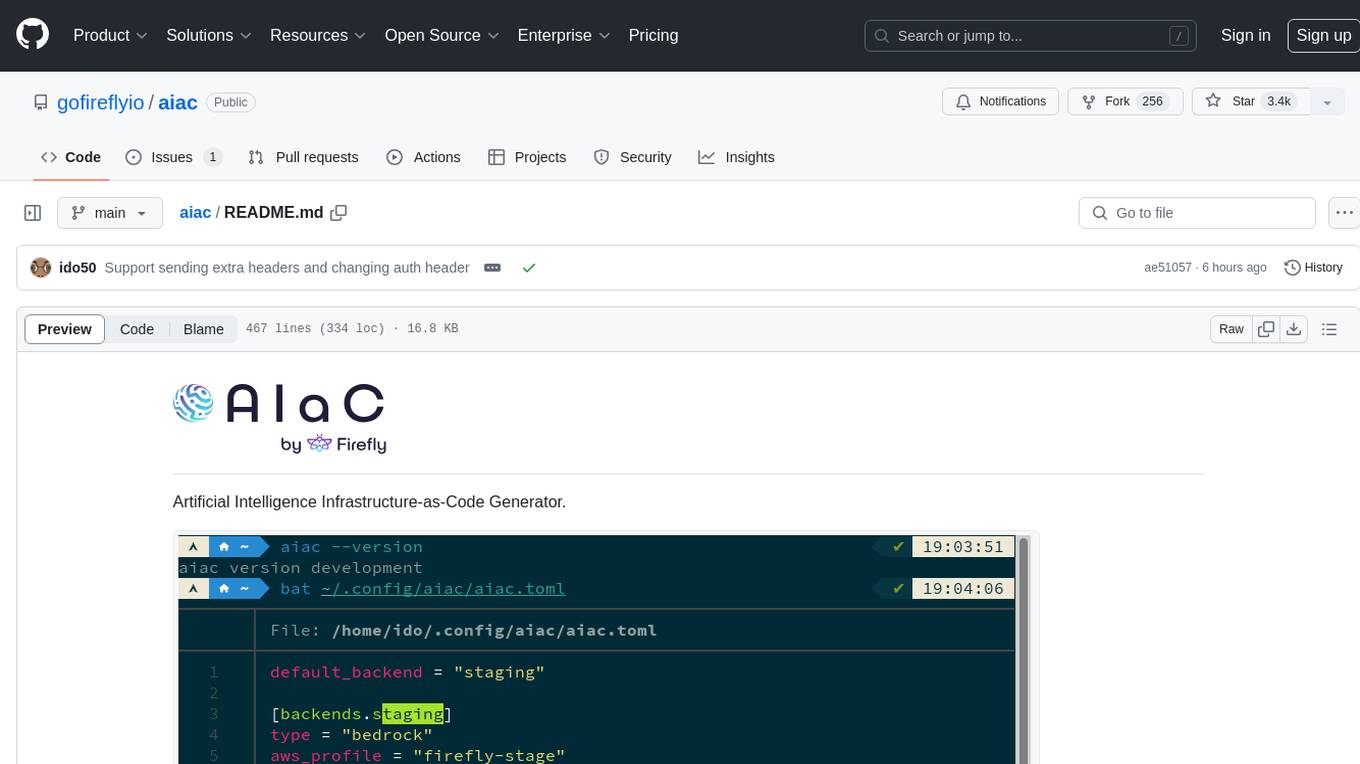
aiac
AIAC is a library and command line tool to generate Infrastructure as Code (IaC) templates, configurations, utilities, queries, and more via LLM providers such as OpenAI, Amazon Bedrock, and Ollama. Users can define multiple 'backends' targeting different LLM providers and environments using a simple configuration file. The tool allows users to ask a model to generate templates for different scenarios and composes an appropriate request to the selected provider, storing the resulting code to a file and/or printing it to standard output.
ENOVA
ENOVA is an open-source service for Large Language Model (LLM) deployment, monitoring, injection, and auto-scaling. It addresses challenges in deploying stable serverless LLM services on GPU clusters with auto-scaling by deconstructing the LLM service execution process and providing configuration recommendations and performance detection. Users can build and deploy LLM with few command lines, recommend optimal computing resources, experience LLM performance, observe operating status, achieve load balancing, and more. ENOVA ensures stable operation, cost-effectiveness, efficiency, and strong scalability of LLM services.
jina
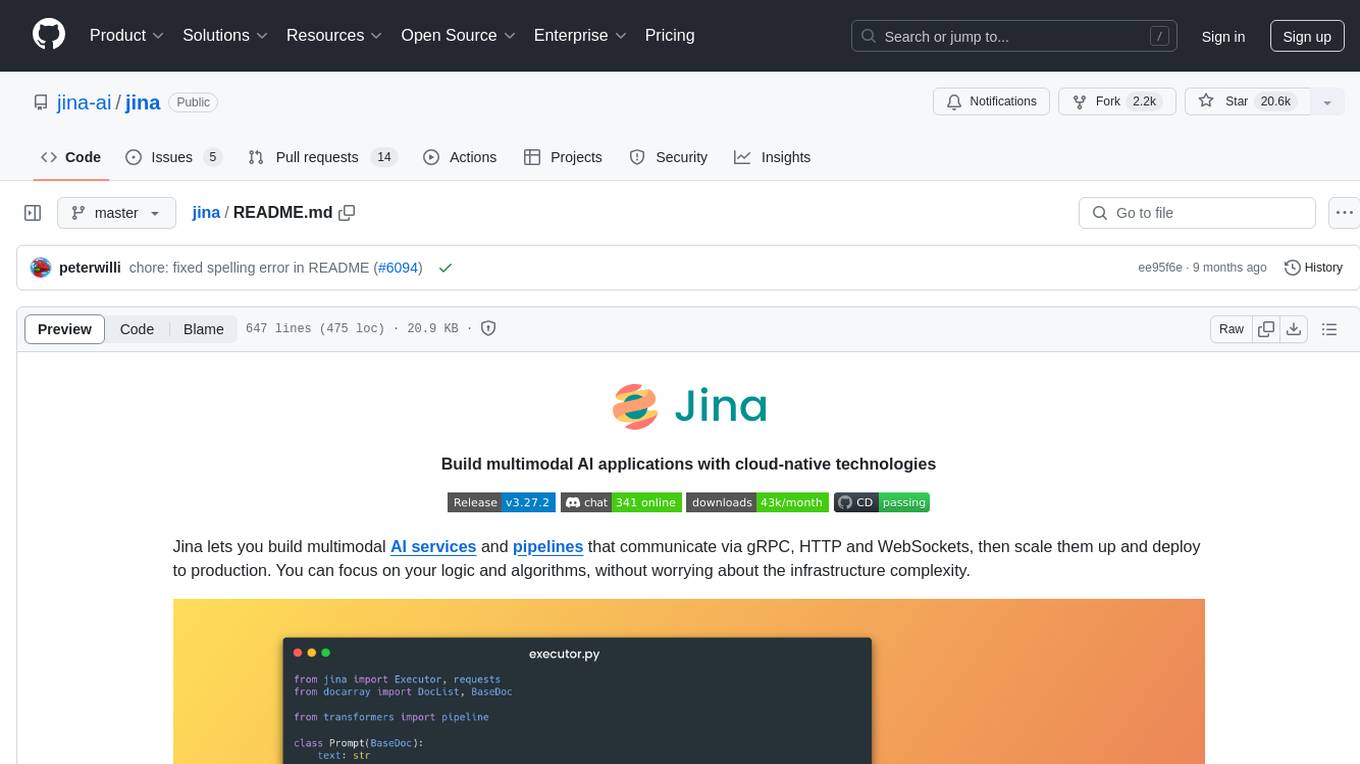
Jina is a tool that allows users to build multimodal AI services and pipelines using cloud-native technologies. It provides a Pythonic experience for serving ML models and transitioning from local deployment to advanced orchestration frameworks like Docker-Compose, Kubernetes, or Jina AI Cloud. Users can build and serve models for any data type and deep learning framework, design high-performance services with easy scaling, serve LLM models while streaming their output, integrate with Docker containers via Executor Hub, and host on CPU/GPU using Jina AI Cloud. Jina also offers advanced orchestration and scaling capabilities, a smooth transition to the cloud, and easy scalability and concurrency features for applications. Users can deploy to their own cloud or system with Kubernetes and Docker Compose integration, and even deploy to JCloud for autoscaling and monitoring.
vidur
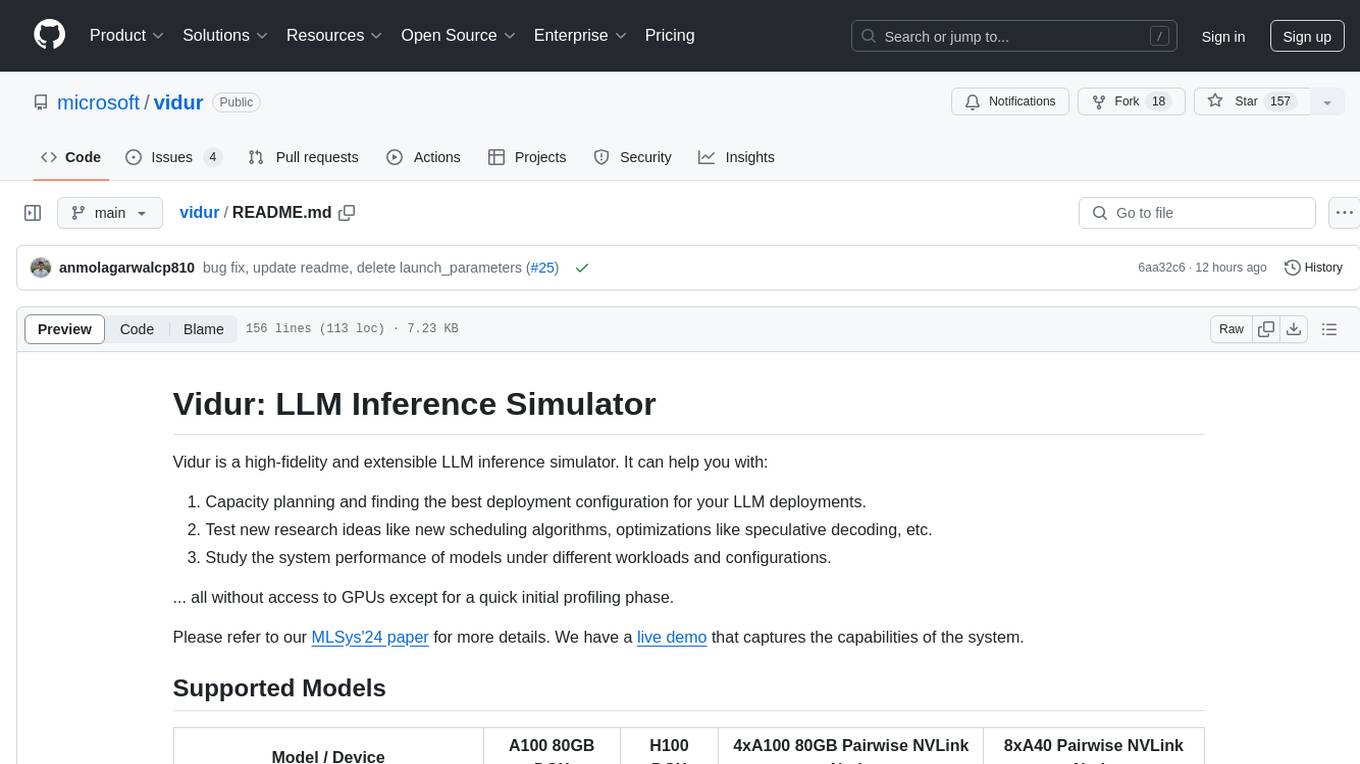
Vidur is a high-fidelity and extensible LLM inference simulator designed for capacity planning, deployment configuration optimization, testing new research ideas, and studying system performance of models under different workloads and configurations. It supports various models and devices, offers chrome trace exports, and can be set up using mamba, venv, or conda. Users can run the simulator with various parameters and monitor metrics using wandb. Contributions are welcome, subject to a Contributor License Agreement and adherence to the Microsoft Open Source Code of Conduct.
AI-System-School
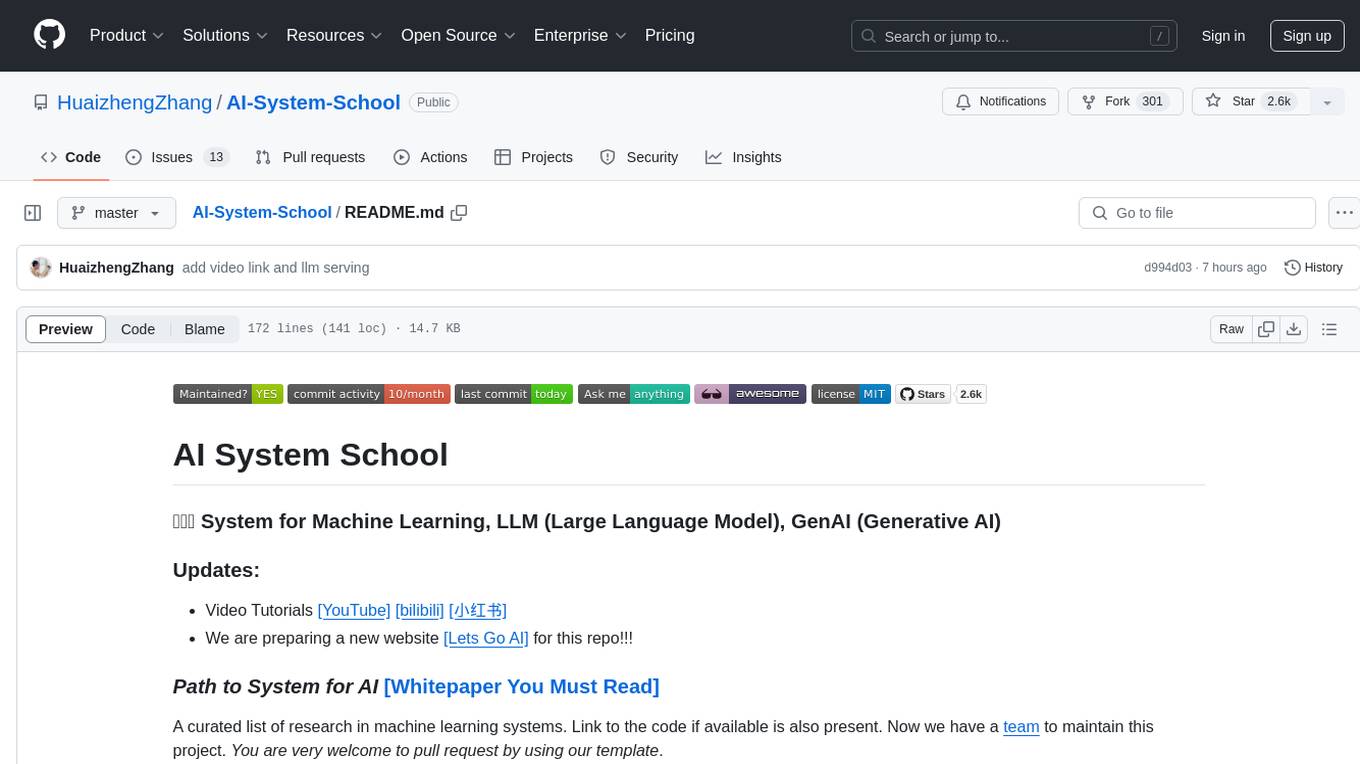
AI System School is a curated list of research in machine learning systems, focusing on ML/DL infra, LLM infra, domain-specific infra, ML/LLM conferences, and general resources. It provides resources such as data processing, training systems, video systems, autoML systems, and more. The repository aims to help users navigate the landscape of AI systems and machine learning infrastructure, offering insights into conferences, surveys, books, videos, courses, and blogs related to the field.
{
  // ...
    "model": "llama-3.1-8b-instruct",
    "choices": [
        {
            "index": 0,
            "finish_reason": "stop",
            "message": {
                "role": "assistant",
                "content": "Kubernetes is an open-source container orchestration system that automates the deployment, scaling, and management of applications and services, allowing developers to focus on writing code rather than managing infrastructure."
            }
        }
    ],
  // ...
}