


Antigravity-Workflow-System
🚀 A spec-driven workflow framework for AI-assisted development. Empowers prompt engineers to build production-ready software through structured PRD → Architecture → Task decomposition. Designed for Antigravity to enforce design-first principles and prevent architectural drift in vibe coding.
Stars: 88
Antigravity Workflow System is a structured workflow framework for Agentic AI assistants, addressing core pain points of the Vibe Coding era. It enforces architecture design first, tackles issues like architecture drift, spaghetti code, context amnesia, and lack of planning. The system includes workflows like `/genesis`, `/scout`, `/design-system`, `/challenge`, `/blueprint`, `/forge`, `/change`, `/explore`, and `/craft`, emphasizing versioned architecture, deep thinking first, and filesystem as memory. It requires the Antigravity environment with `.agent/workflows/` support and Sequential Thinking MCP Server for deep reasoning. Users can invoke workflows using the Slash Protocol or Intent Protocol, with a defined project structure under `.agent/` directory. Contributions are encouraged, and the system is licensed under MIT.
README:




A structured workflow framework for Agentic AI assistants, designed to solve the core pain points of the Vibe Coding era.
💡 TL;DR: Stop letting AI write spaghetti code. Force it to think like an architect first.
| Pain Point | The Problem | Our Solution |
|---|---|---|
| Architecture Drift | AI generates inconsistent patterns across the same codebase |
/genesis forces PRD & architecture design first |
| Spaghetti Code | AI lacks project context, writes code that doesn't fit | Tasks include constraints & acceptance criteria |
| Context Amnesia | New session = AI forgets all previous decisions |
.agent/rules/agents.md + versioned docs as persistent memory |
| Lack of Planning | Vibe Coding skips design, creates tech debt | Mandatory design-first workflow |
npm install -g @haaaiawd/anws
cd your-project
anws init
Requires Node.js ≥ 18.
Download the latest .zip from Releases, then copy .agent/ to your project root.
cd your-project
anws update
anws updateoverwrites all managed workflow/skill files to the latest version while preserving youragents.md. If theagents.mdtemplate has new content, anagents.md.newfile will be generated for you to merge manually.
Example Prompt: "I want to build a web-based macOS simulator, including Dock, top bar, and several system apps. Please start this new project from scratch according to the development process."
Deep Thinking & Architecture Design: The AI will automatically execute the /genesis workflow, thinking deeply about project requirements and producing the PRD and architecture design.

Interactive Requirement Alignment: The AI will ask follow-up questions for ambiguous requirements to ensure the design matches your intuition.

Autonomous Task Breakdown & Execution: The AI will autonomously call necessary Skills (e.g., spec-writer, task-planner, etc.) to complete documentation and task decomposition.

                    ┌─────────────────┐
                    │  Where are you? │
                    └────────┬────────┘
           ┌─────────────────┼─────────────────┐
           ▼                 ▼                 ▼
    ┌──────────┐      ┌──────────┐      ┌──────────┐
    │   New    │      │  Legacy  │      │ Existing │
    │ Project  │      │ Takeover │      │  Change  │
    └────┬─────┘      └────┬─────┘      └────┬─────┘
         │                 │                 │
         ▼                 ▼                 ▼
    /genesis          /scout        Tweak existing task?
         │                 │              /         \
         │                 │             /           \
         └────────┬────────┘     /change       /genesis
                  │            (modify only)  (new tasks)
                  ▼                │            │
           /design-system <--------+------------+
          (optional, recommended)
                  |
                  v
            /challenge
          (audit & review)
                  |
                  v
             /blueprint
                  |
                  v
               /forge
          (code delivery)
Don't "fix" architecture docs. Evolve them.
-
genesis/v1→genesis/v2on major changes - Full traceability of decisions
- No "it was always like this" mystery
AI must think before it writes.
- Workflows force multi-step reasoning via
sequentialthinking -
[!IMPORTANT]blocks as guardrails - No shallow, scan-and-output responses
Chat is ephemeral. Files are eternal.
-
AGENTS.md= AI's anchor - Architecture docs = persistent decisions
- New session recovery in 30 seconds
| Command | Purpose | Input | Output |
|---|---|---|---|
/genesis |
Start from zero, create PRD & architecture | Vague idea | PRD, Architecture, ADRs |
/scout |
Analyze legacy codebase risks | Existing code | Risk report, Gap analysis |
/design-system |
Detailed design for a system | Architecture | System Design doc |
/challenge |
Systemic 3-tier review & audit | Full Design Docs | Challenge Report (Graded) |
/blueprint |
Break architecture into tasks | PRD + Arch | TASKS.md (WBS) |
/forge |
Execute tasks — architecture to code | TASKS.md | Working code, verified |
/change |
Tweak existing tasks (no new tasks) | Minor tweak | Updated TASKS + Design files (modify only) |
/explore |
Deep research & brainstorm | Topic/Question | Exploration report |
/craft |
Create workflows/skills/prompts | Creation request | Workflow / Skill / Prompt docs |
⚠️ Important: This framework requires Antigravity environment with.agent/workflows/support.
| Environment | Status | Notes |
|---|---|---|
| Antigravity | ✅ Supported | Full workflow + skills support |
| Claude Code | ❌ No native workflow support | |
| Cursor | ❌ No workflow support | |
| GitHub Copilot | ❌ No workflow support |
What is Antigravity?
Antigravity is an Agentic AI coding environment that natively recognizes .agent/workflows/ directory and can execute slash commands like /genesis, /blueprint, etc.
This framework uses sequentialthinking for deep reasoning. Install it via MCP Store:
- Open Antigravity Editor
- Click "..." (three dots) in the sidebar → Additional Options
- Select MCP Servers
- Open MCP Store and search for
sequential-thinking - Click Add to install
💡 Without this, workflows still work, but deep thinking features will be limited.
Antigravity will automatically recognize the intent and trigger the appropriate workflow. You can use it in two ways:
Directly type the command in the chat or editor to trigger the workflow.
-
/genesis- Start project creation -
/scout- Analyze existing codebase -
/blueprint- Break down architecture into tasks
Just speak naturally. Antigravity will automatically select and run the right workflow.
-
"I want to start a new project for a todo app" → Triggers
/genesis -
"Help me understand this legacy code and its risks" → Triggers
/scout -
"I think there are gaps in this design, challenge it" → Triggers
/challenge -
"The architecture is ready, let's plan the tasks" → Triggers
/blueprint -
"Change the error message on the login page" → Triggers
/change(tweak existing task) -
"I need to add a back-to-top button" → Triggers
/genesis(requires new task)
your-project/
├── .agent/
│   ├── rules/
│   │   └── agents.md          # 🧠 AI's anchor point
│   ├── workflows/             # Workflow definitions
│   │   ├── genesis.md
│   │   ├── scout.md
│   │   ├── design-system.md
│   │   ├── challenge.md
│   │   ├── blueprint.md
│   │   ├── forge.md
│   │   ├── change.md
│   │   ├── explore.md
│   │   └── craft.md
│   │
│   └── skills/            # Reusable skills
│       ├── concept-modeler/
│       ├── spec-writer/
│       ├── task-planner/
│       └── ...
│
└── genesis/               # Versioned architecture docs
    ├── v1/
    │   ├── 01_PRD.md
    │   ├── 02_ARCHITECTURE.md
    │   ├── 03_ADR/
    │   ├── 05_TASKS.md
    │   └── 07_CHALLENGE_REPORT.md
    └── v2/                # New version on major changes
Contributions are welcome! Please read our contributing guidelines before submitting PRs.
MIT © 2026
Made for architects who code, and AIs who think.
🧠 "Good architecture isn't written. It's designed."
For Tasks:
Click tags to check more tools for each tasksFor Jobs:
Alternative AI tools for Antigravity-Workflow-System
Similar Open Source Tools
Antigravity-Workflow-System
Antigravity Workflow System is a structured workflow framework for Agentic AI assistants, addressing core pain points of the Vibe Coding era. It enforces architecture design first, tackles issues like architecture drift, spaghetti code, context amnesia, and lack of planning. The system includes workflows like `/genesis`, `/scout`, `/design-system`, `/challenge`, `/blueprint`, `/forge`, `/change`, `/explore`, and `/craft`, emphasizing versioned architecture, deep thinking first, and filesystem as memory. It requires the Antigravity environment with `.agent/workflows/` support and Sequential Thinking MCP Server for deep reasoning. Users can invoke workflows using the Slash Protocol or Intent Protocol, with a defined project structure under `.agent/` directory. Contributions are encouraged, and the system is licensed under MIT.
multi-agent-shogun
multi-agent-shogun is a system that runs multiple AI coding CLI instances simultaneously, orchestrating them like a feudal Japanese army. It supports Claude Code, OpenAI Codex, GitHub Copilot, and Kimi Code. The system allows you to command your AI army with zero coordination cost, enabling parallel execution, non-blocking workflow, cross-session memory, event-driven communication, and full transparency. It also features skills discovery, phone notifications, pane border task display, shout mode, and multi-CLI support.
room
Quoroom is an open research project focused on autonomous agent collectives. It allows users to run a swarm of AI agents that pursue goals autonomously, with a Queen strategizing, Workers executing tasks, and Quorum voting on decisions. The tool enables agents to learn new skills, modify their behavior, manage a crypto wallet, and rent cloud stations for additional compute power. The architecture is inspired by swarm intelligence research, emphasizing decentralized decision-making and emergent behavior from local interactions.
thepopebot
thepopebot is a self-evolving agent that operates through git commits, utilizing free cloud computing time from GitHub accounts. It modifies its own code through pull requests, ensuring auditability and reversibility. Users interact with the bot via web chat or Telegram, creating job branches that trigger Docker containers to perform tasks and open pull requests. Auto-merge handles the completion process, providing notifications upon task completion.
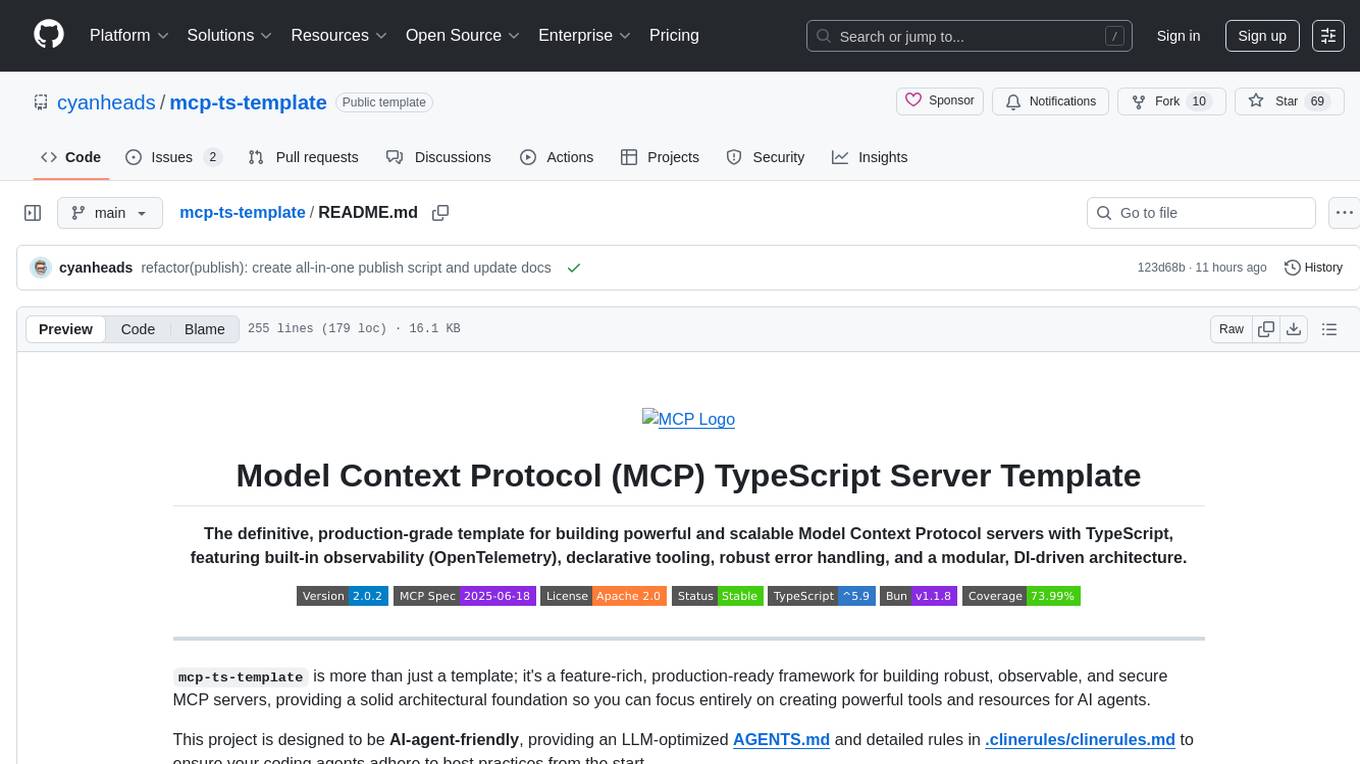
mcp-ts-template
The MCP TypeScript Server Template is a production-grade framework for building powerful and scalable Model Context Protocol servers with TypeScript. It features built-in observability, declarative tooling, robust error handling, and a modular, DI-driven architecture. The template is designed to be AI-agent-friendly, providing detailed rules and guidance for developers to adhere to best practices. It enforces architectural principles like 'Logic Throws, Handler Catches' pattern, full-stack observability, declarative components, and dependency injection for decoupling. The project structure includes directories for configuration, container setup, server resources, services, storage, utilities, tests, and more. Configuration is done via environment variables, and key scripts are available for development, testing, and publishing to the MCP Registry.
DeepTutor
DeepTutor is an AI-powered personalized learning assistant that offers a suite of modules for massive document knowledge Q&A, interactive learning visualization, knowledge reinforcement with practice exercise generation, deep research, and idea generation. The tool supports multi-agent collaboration, dynamic topic queues, and structured outputs for various tasks. It provides a unified system entry for activity tracking, knowledge base management, and system status monitoring. DeepTutor is designed to streamline learning and research processes by leveraging AI technologies and interactive features.
openlegion
OpenLegion is an AI agent framework designed for builders who need secure, isolated, and production-ready AI agents. Each agent runs in its own Docker container with API keys stored securely in a vault. The framework offers autonomous AI agent fleets with features like chat via Telegram, Discord, Slack, or WhatsApp, built-in cost controls, and 100+ LLM providers. It provides detailed security measures, production-grade cost control, deterministic multi-agent orchestration, autonomous agent actions, self-awareness, and self-improvement capabilities. OpenLegion is fully auditable, lightweight, and offers a real-time dashboard for fleet observability.
nono
nono is a secure, kernel-enforced capability shell for running AI agents and any POSIX style process. It leverages OS security primitives to create an environment where unauthorized operations are structurally impossible. It provides protections against destructive commands and securely stores API keys, tokens, and secrets. The tool is agent-agnostic, works with any AI agent or process, and blocks dangerous commands by default. It follows a capability-based security model with defense-in-depth, ensuring secure execution of commands and protecting sensitive data.
easyclaw
EasyClaw is a desktop application that simplifies the usage of OpenClaw, a powerful agent runtime, by providing a user-friendly interface for non-programmers. Users can write rules in plain language, configure multiple LLM providers and messaging channels, manage API keys, and interact with the agent through a local web panel. The application ensures data privacy by keeping all information on the user's machine and offers features like natural language rules, multi-provider LLM support, Gemini CLI OAuth, proxy support, messaging integration, token tracking, speech-to-text, file permissions control, and more. EasyClaw aims to lower the barrier of entry for utilizing OpenClaw by providing a user-friendly cockpit for managing the engine.
lihil
Lihil is a performant, productive, and professional web framework designed to make Python the mainstream programming language for web development. It is 100% test covered and strictly typed, offering fast performance, ergonomic API, and built-in solutions for common problems. Lihil is suitable for enterprise web development, delivering robust and scalable solutions with best practices in microservice architecture and related patterns. It features dependency injection, OpenAPI docs generation, error response generation, data validation, message system, testability, and strong support for AI features. Lihil is ASGI compatible and uses starlette as its ASGI toolkit, ensuring compatibility with starlette classes and middlewares. The framework follows semantic versioning and has a roadmap for future enhancements and features.
VT.ai
VT.ai is a multimodal AI platform that offers dynamic conversation routing with SemanticRouter, multi-modal interactions (text/image/audio), an assistant framework with code interpretation, real-time response streaming, cross-provider model switching, and local model support with Ollama integration. It supports various AI providers such as OpenAI, Anthropic, Google Gemini, Groq, Cohere, and OpenRouter, providing a wide range of core capabilities for AI orchestration.
frankenterm
A swarm-native terminal platform designed to replace legacy terminal workflows for massive AI agent orchestration. `ft` is a full terminal platform for agent swarms with first-class observability, deterministic eventing, policy-gated automation, and machine-native control surfaces. It offers perfect observability, intelligent detection, event-driven automation, Robot Mode API, lexical + hybrid search, and a policy engine for safe multi-agent control. The platform is actively expanding with concepts learned from Ghostty and Zellij, purpose-built subsystems for agent swarms, and integrations from other projects like `/dp/asupersync`, `/dp/frankensqlite`, and `/frankentui`.
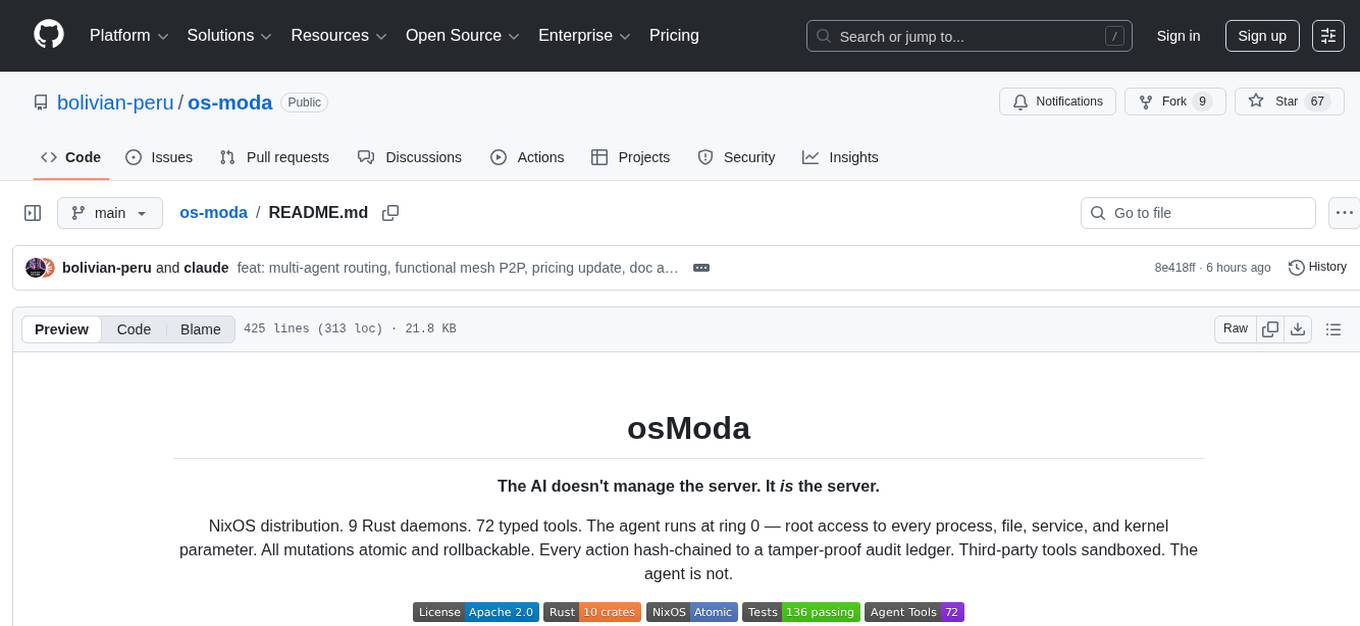
os-moda
osModa is a NixOS distribution with 9 Rust daemons and 72 typed tools, providing structured access to the entire OS without shell parsing. Every mutation is hash-chained, enabling atomic system state rollbacks. The agent runs at ring 0 with root access, ensuring tamper-proof audit logging. Third-party tools are sandboxed, while the agent is not. It offers structured system access, hash-chained audit ledger, FTS5 full-text memory search, ETH + SOL crypto signing, SafeSwitch deploys with auto-rollback, P2P encrypted mesh with hybrid post-quantum crypto, local voice, MCP server management, system learning and self-optimization, service discovery, emergency safety commands, Cloudflare Tunnel + Tailscale remote access, app process management with systemd-run, and 72 bridge tools.
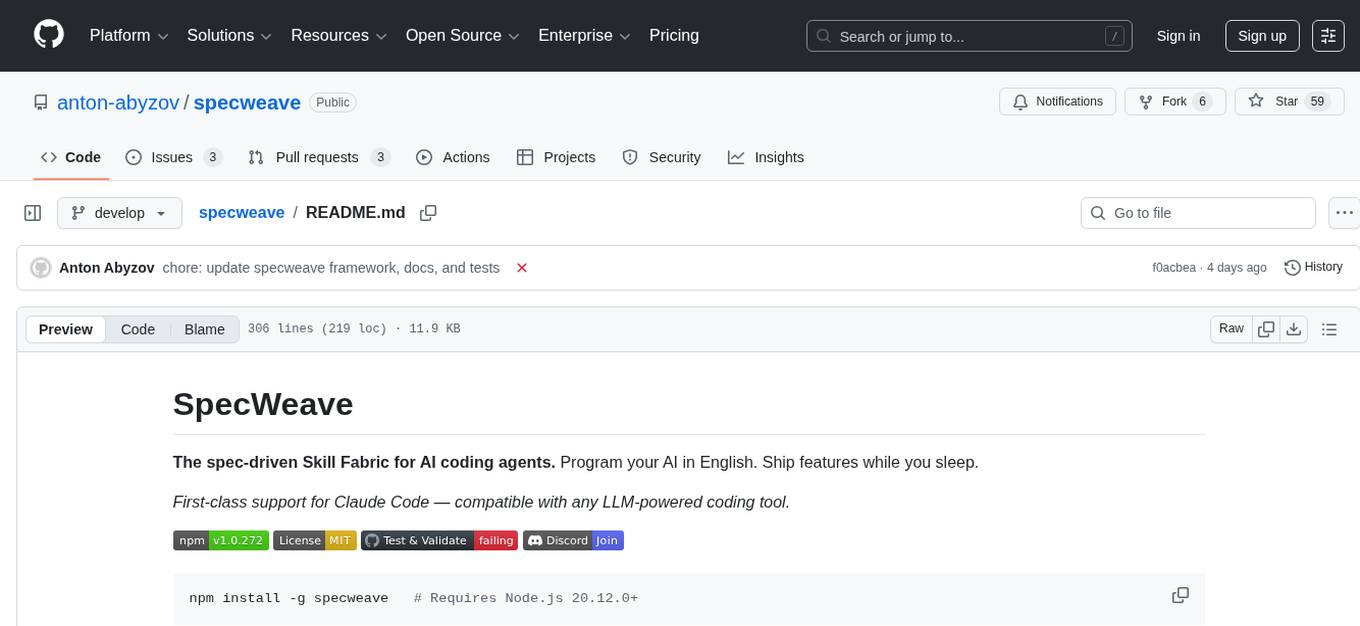
specweave
SpecWeave is a spec-driven Skill Fabric for AI coding agents that allows programming AI in English. It provides first-class support for Claude Code and offers reusable logic for controlling AI behavior. With over 100 skills out of the box, SpecWeave eliminates the need to learn Claude Code docs and handles various aspects of feature development. The tool enables users to describe what they want, and SpecWeave autonomously executes tasks, including writing code, running tests, and syncing to GitHub/JIRA. It supports solo developers, agent teams working in parallel, and brownfield projects, offering file-based coordination, autonomous teams, and enterprise-ready features. SpecWeave also integrates LSP Code Intelligence for semantic understanding of codebases and allows for extensible skills without forking.
mcp-prompts
mcp-prompts is a Python library that provides a collection of prompts for generating creative writing ideas. It includes a variety of prompts such as story starters, character development, plot twists, and more. The library is designed to inspire writers and help them overcome writer's block by offering unique and engaging prompts to spark creativity. With mcp-prompts, users can access a wide range of writing prompts to kickstart their imagination and enhance their storytelling skills.
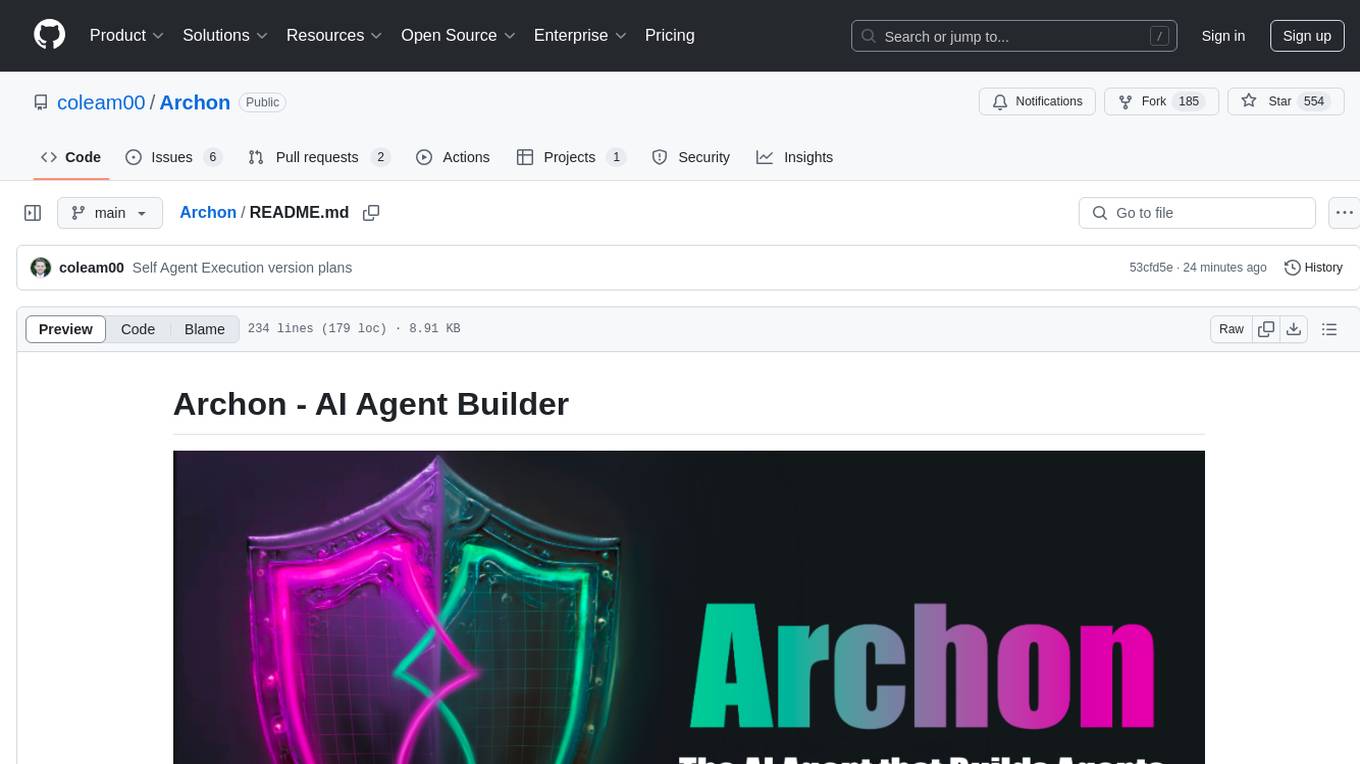
Archon
Archon is an AI meta-agent designed to autonomously build, refine, and optimize other AI agents. It serves as a practical tool for developers and an educational framework showcasing the evolution of agentic systems. Through iterative development, Archon demonstrates the power of planning, feedback loops, and domain-specific knowledge in creating robust AI agents.
For similar tasks
Antigravity-Workflow-System
Antigravity Workflow System is a structured workflow framework for Agentic AI assistants, addressing core pain points of the Vibe Coding era. It enforces architecture design first, tackles issues like architecture drift, spaghetti code, context amnesia, and lack of planning. The system includes workflows like `/genesis`, `/scout`, `/design-system`, `/challenge`, `/blueprint`, `/forge`, `/change`, `/explore`, and `/craft`, emphasizing versioned architecture, deep thinking first, and filesystem as memory. It requires the Antigravity environment with `.agent/workflows/` support and Sequential Thinking MCP Server for deep reasoning. Users can invoke workflows using the Slash Protocol or Intent Protocol, with a defined project structure under `.agent/` directory. Contributions are encouraged, and the system is licensed under MIT.
aicodeguide
AI Code Guide is a comprehensive guide that covers everything you need to know about using AI to help you code or even code for you. It provides insights into the changing landscape of coding with AI, new tools, editors, and practices. The guide aims to consolidate information on AI coding and AI-assisted code generation in one accessible place. It caters to both experienced coders looking to leverage AI tools and beginners interested in 'vibe coding' to build software products. The guide covers various topics such as AI coding practices, different ways to use AI in coding, recommended resources, tools for AI coding, best practices for structuring prompts, and tips for using specific tools like Claude Code.
bmalph
bmalph is a tool that bundles and installs two AI development systems, BMAD-METHOD for planning agents and workflows (Phases 1-3) and Ralph for autonomous implementation loop (Phase 4). It provides commands like `bmalph init` to install both systems, `bmalph upgrade` to update to the latest versions, `bmalph doctor` to check installation health, and `/bmalph-implement` to transition from BMAD to Ralph. Users can work through BMAD phases 1-3 with commands like BP, MR, DR, CP, VP, CA, etc., and then transition to Ralph for implementation.
AGiXT
AGiXT is a dynamic Artificial Intelligence Automation Platform engineered to orchestrate efficient AI instruction management and task execution across a multitude of providers. Our solution infuses adaptive memory handling with a broad spectrum of commands to enhance AI's understanding and responsiveness, leading to improved task completion. The platform's smart features, like Smart Instruct and Smart Chat, seamlessly integrate web search, planning strategies, and conversation continuity, transforming the interaction between users and AI. By leveraging a powerful plugin system that includes web browsing and command execution, AGiXT stands as a versatile bridge between AI models and users. With an expanding roster of AI providers, code evaluation capabilities, comprehensive chain management, and platform interoperability, AGiXT is consistently evolving to drive a multitude of applications, affirming its place at the forefront of AI technology.
aiexe
aiexe is a cutting-edge command-line interface (CLI) and graphical user interface (GUI) tool that integrates powerful AI capabilities directly into your terminal or desktop. It is designed for developers, tech enthusiasts, and anyone interested in AI-powered automation. aiexe provides an easy-to-use yet robust platform for executing complex tasks with just a few commands. Users can harness the power of various AI models from OpenAI, Anthropic, Ollama, Gemini, and GROQ to boost productivity and enhance decision-making processes.
claude.vim
Claude.vim is a Vim plugin that integrates Claude, an AI pair programmer, into your Vim workflow. It allows you to chat with Claude about what to build or how to debug problems, and Claude offers opinions, proposes modifications, or even writes code. The plugin provides a chat/instruction-centric interface optimized for human collaboration, with killer features like access to chat history and vimdiff interface. It can refactor code, modify or extend selected pieces of code, execute complex tasks by reading documentation, cloning git repositories, and more. Note that it is early alpha software and expected to rapidly evolve.
mistreevous
Mistreevous is a library written in TypeScript for Node and browsers, used to declaratively define, build, and execute behaviour trees for creating complex AI. It allows defining trees with JSON or a minimal DSL, providing in-browser editor and visualizer. The tool offers methods for tree state, stepping, resetting, and getting node details, along with various composite, decorator, leaf nodes, callbacks, guards, and global functions/subtrees. Version history includes updates for node types, callbacks, global functions, and TypeScript conversion.

project_alice
Alice is an agentic workflow framework that integrates task execution and intelligent chat capabilities. It provides a flexible environment for creating, managing, and deploying AI agents for various purposes, leveraging a microservices architecture with MongoDB for data persistence. The framework consists of components like APIs, agents, tasks, and chats that interact to produce outputs through files, messages, task results, and URL references. Users can create, test, and deploy agentic solutions in a human-language framework, making it easy to engage with by both users and agents. The tool offers an open-source option, user management, flexible model deployment, and programmatic access to tasks and chats.
For similar jobs
Awesome_Mamba
Awesome Mamba is a curated collection of groundbreaking research papers and articles on Mamba Architecture, a pioneering framework in deep learning known for its selective state spaces and efficiency in processing complex data structures. The repository offers a comprehensive exploration of Mamba architecture through categorized research papers covering various domains like visual recognition, speech processing, remote sensing, video processing, activity recognition, image enhancement, medical imaging, reinforcement learning, natural language processing, 3D recognition, multi-modal understanding, time series analysis, graph neural networks, point cloud analysis, and tabular data handling.
unilm
The 'unilm' repository is a collection of tools, models, and architectures for Foundation Models and General AI, focusing on tasks such as NLP, MT, Speech, Document AI, and Multimodal AI. It includes various pre-trained models, such as UniLM, InfoXLM, DeltaLM, MiniLM, AdaLM, BEiT, LayoutLM, WavLM, VALL-E, and more, designed for tasks like language understanding, generation, translation, vision, speech, and multimodal processing. The repository also features toolkits like s2s-ft for sequence-to-sequence fine-tuning and Aggressive Decoding for efficient sequence-to-sequence decoding. Additionally, it offers applications like TrOCR for OCR, LayoutReader for reading order detection, and XLM-T for multilingual NMT.
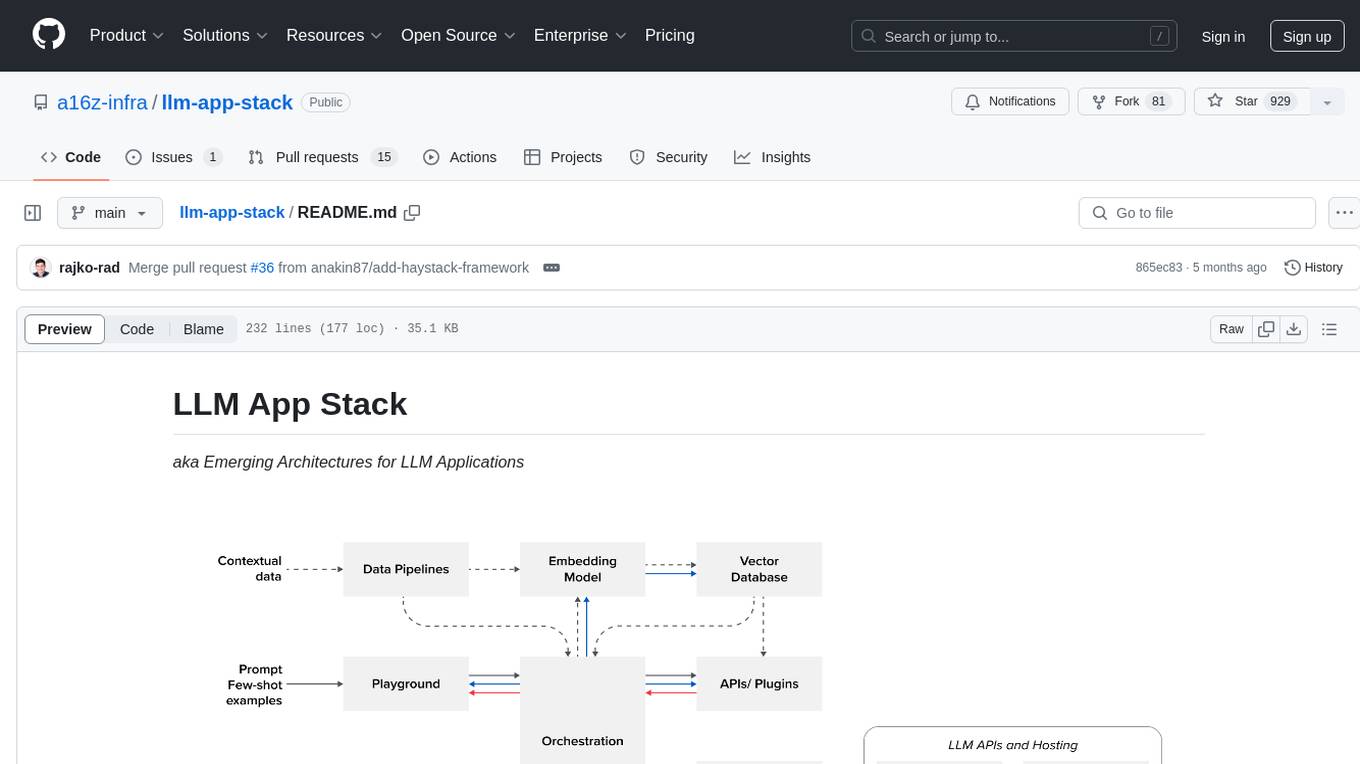
llm-app-stack
LLM App Stack, also known as Emerging Architectures for LLM Applications, is a comprehensive list of available tools, projects, and vendors at each layer of the LLM app stack. It covers various categories such as Data Pipelines, Embedding Models, Vector Databases, Playgrounds, Orchestrators, APIs/Plugins, LLM Caches, Logging/Monitoring/Eval, Validators, LLM APIs (proprietary and open source), App Hosting Platforms, Cloud Providers, and Opinionated Clouds. The repository aims to provide a detailed overview of tools and projects for building, deploying, and maintaining enterprise data solutions, AI models, and applications.
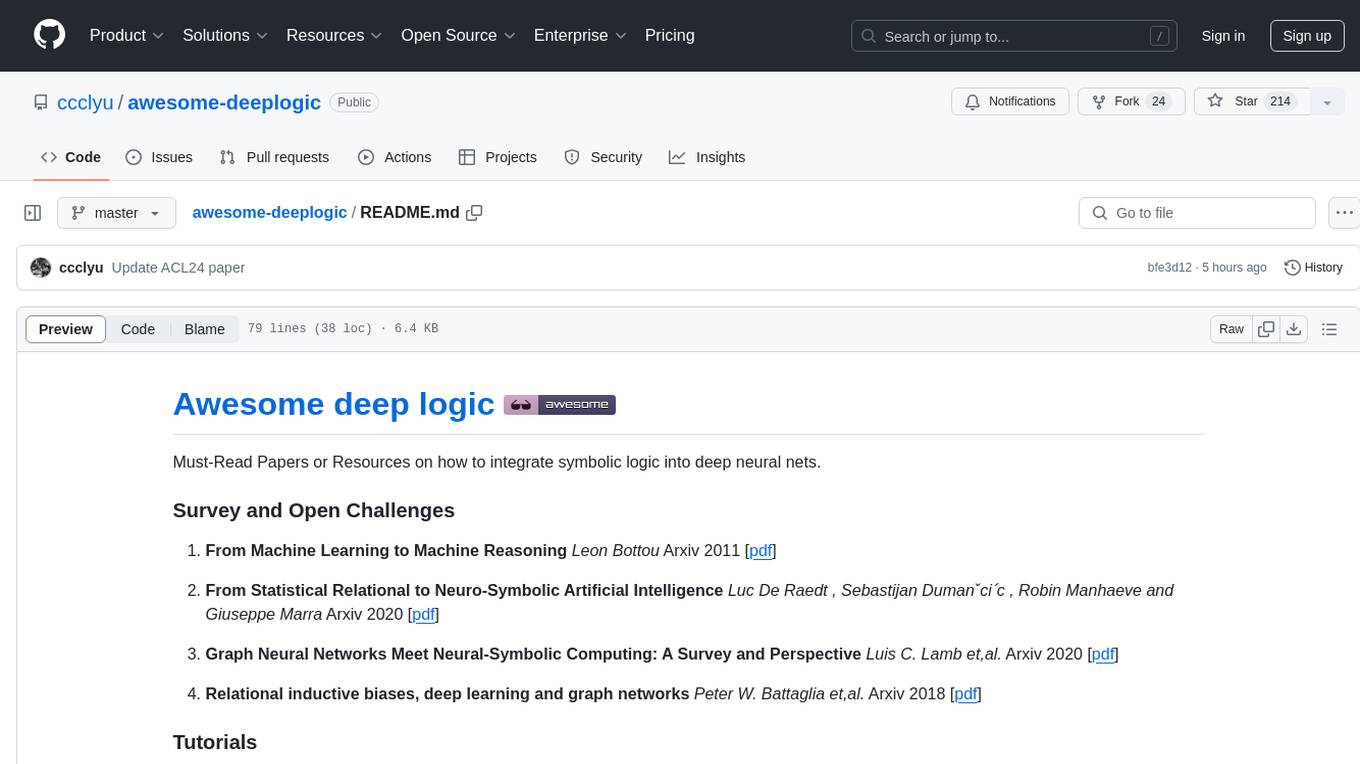
awesome-deeplogic
Awesome deep logic is a curated list of papers and resources focusing on integrating symbolic logic into deep neural networks. It includes surveys, tutorials, and research papers that explore the intersection of logic and deep learning. The repository aims to provide valuable insights and knowledge on how logic can be used to enhance reasoning, knowledge regularization, weak supervision, and explainability in neural networks.
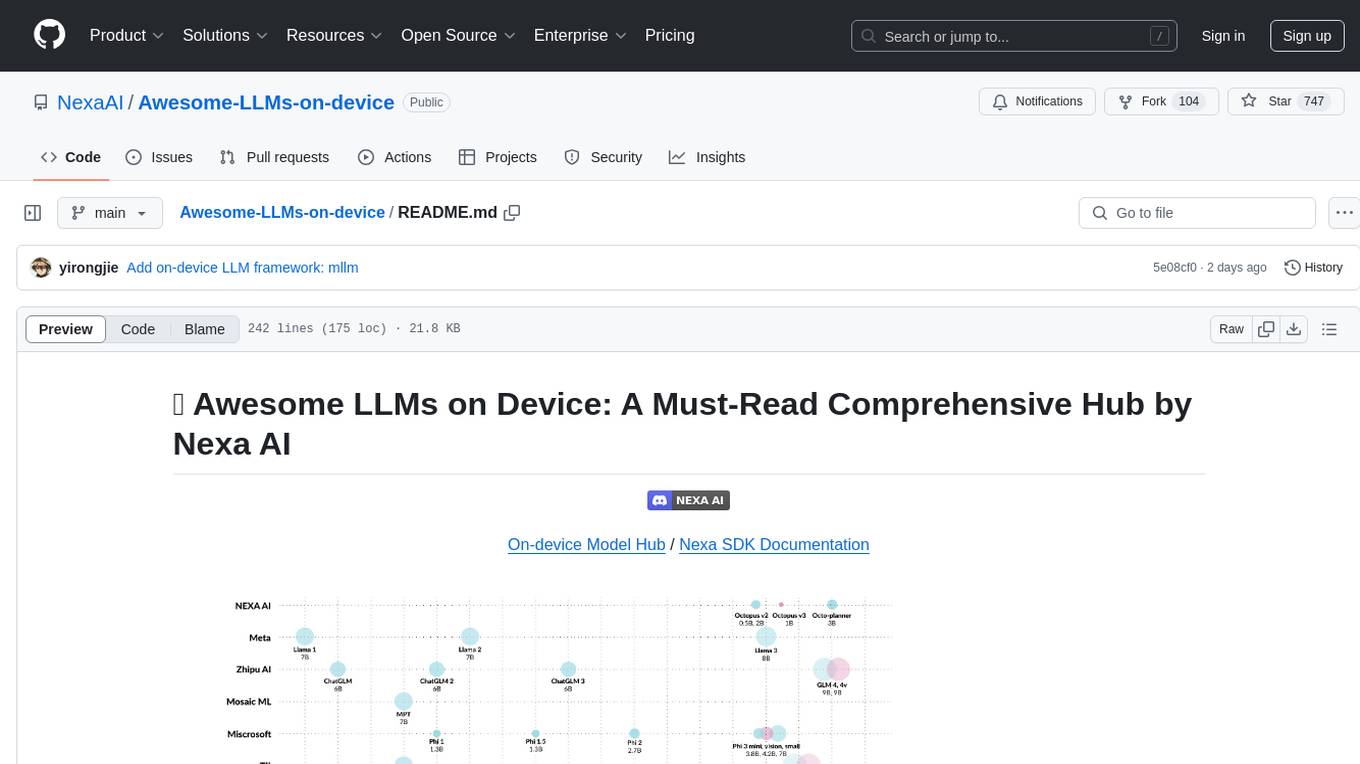
Awesome-LLMs-on-device
Welcome to the ultimate hub for on-device Large Language Models (LLMs)! This repository is your go-to resource for all things related to LLMs designed for on-device deployment. Whether you're a seasoned researcher, an innovative developer, or an enthusiastic learner, this comprehensive collection of cutting-edge knowledge is your gateway to understanding, leveraging, and contributing to the exciting world of on-device LLMs.
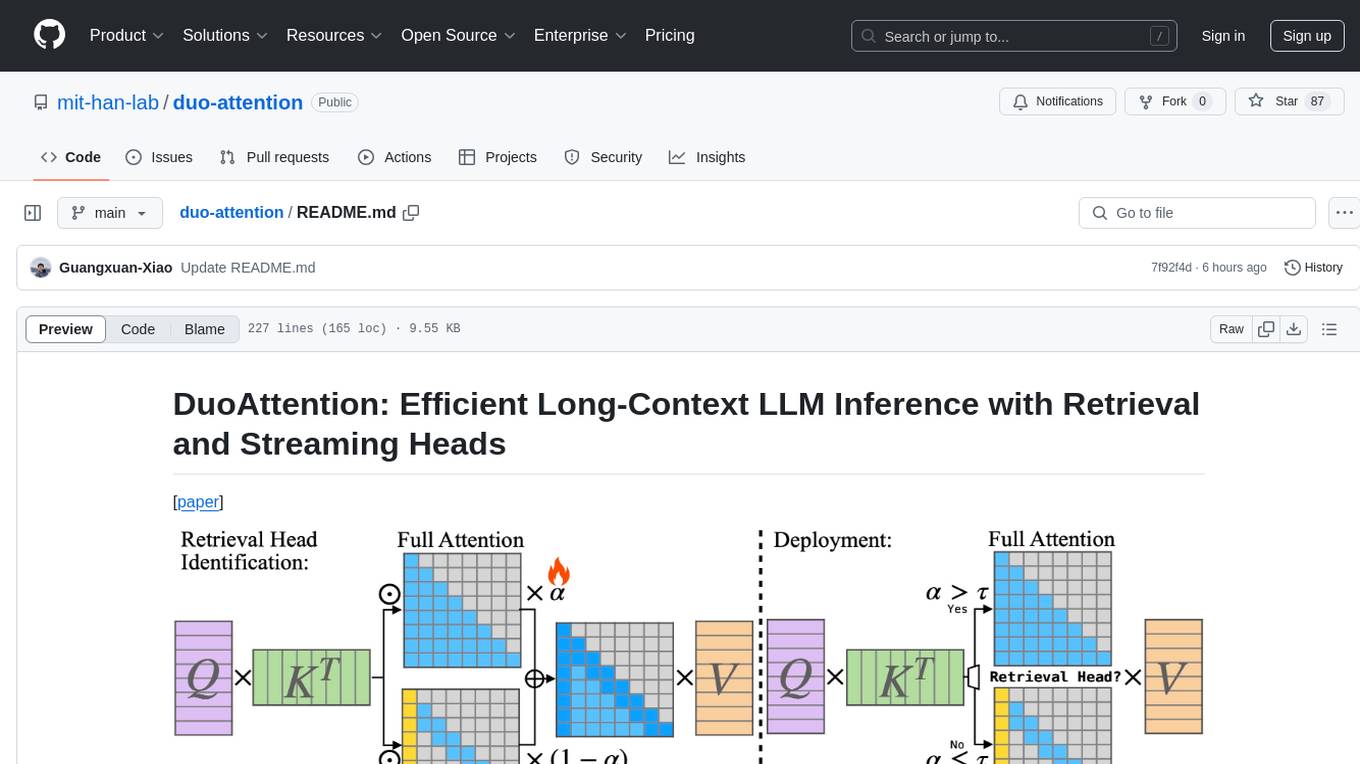
duo-attention
DuoAttention is a framework designed to optimize long-context large language models (LLMs) by reducing memory and latency during inference without compromising their long-context abilities. It introduces a concept of Retrieval Heads and Streaming Heads to efficiently manage attention across tokens. By applying a full Key and Value (KV) cache to retrieval heads and a lightweight, constant-length KV cache to streaming heads, DuoAttention achieves significant reductions in memory usage and decoding time for LLMs. The framework uses an optimization-based algorithm with synthetic data to accurately identify retrieval heads, enabling efficient inference with minimal accuracy loss compared to full attention. DuoAttention also supports quantization techniques for further memory optimization, allowing for decoding of up to 3.3 million tokens on a single GPU.
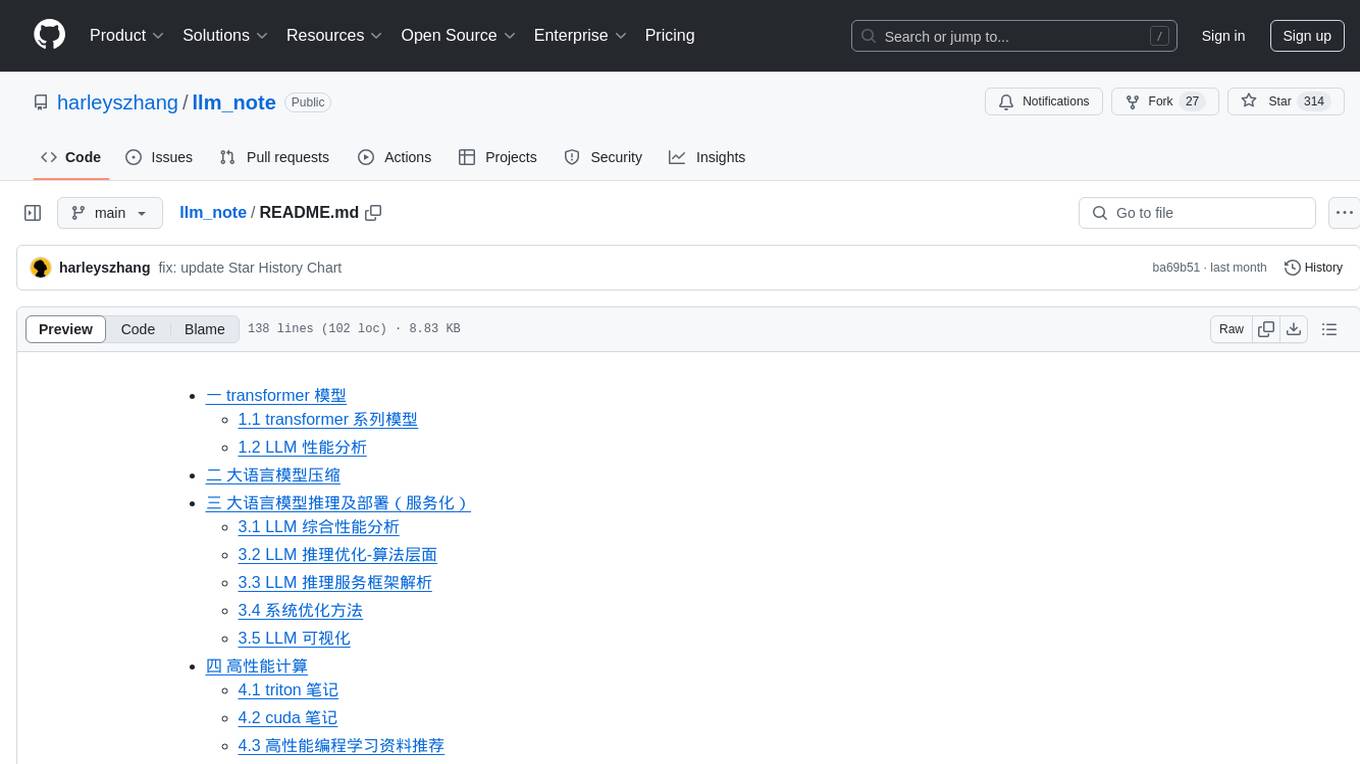
llm_note
LLM notes repository contains detailed analysis on transformer models, language model compression, inference and deployment, high-performance computing, and system optimization methods. It includes discussions on various algorithms, frameworks, and performance analysis related to large language models and high-performance computing. The repository serves as a comprehensive resource for understanding and optimizing language models and computing systems.
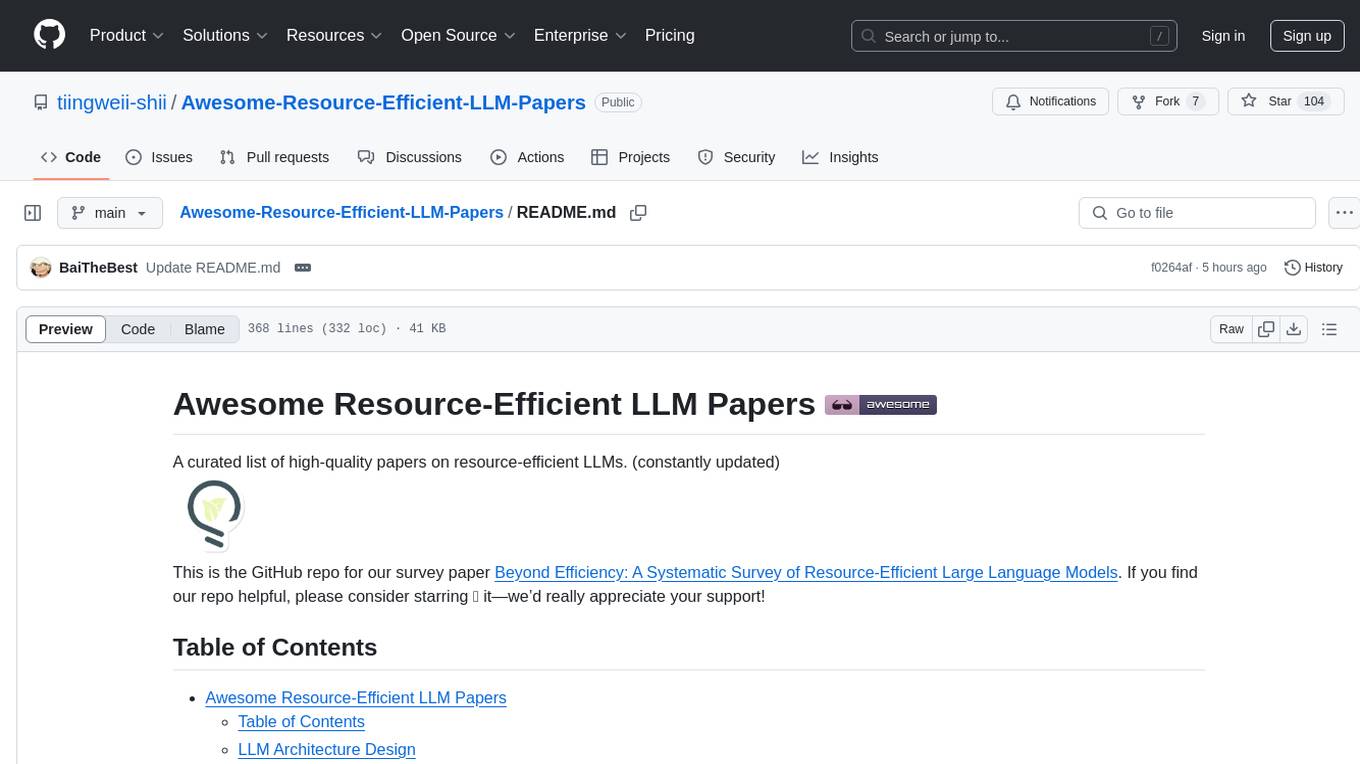
Awesome-Resource-Efficient-LLM-Papers
A curated list of high-quality papers on resource-efficient Large Language Models (LLMs) with a focus on various aspects such as architecture design, pre-training, fine-tuning, inference, system design, and evaluation metrics. The repository covers topics like efficient transformer architectures, non-transformer architectures, memory efficiency, data efficiency, model compression, dynamic acceleration, deployment optimization, support infrastructure, and other related systems. It also provides detailed information on computation metrics, memory metrics, energy metrics, financial cost metrics, network communication metrics, and other metrics relevant to resource-efficient LLMs. The repository includes benchmarks for evaluating the efficiency of NLP models and references for further reading.