


openlegion
Secure autonomous AI agent fleet platform — Docker-isolated, multi-provider, with built-in cost controls. OpenClaw alternative for production use.
Stars: 52
OpenLegion is an AI agent framework designed for builders who need secure, isolated, and production-ready AI agents. Each agent runs in its own Docker container with API keys stored securely in a vault. The framework offers autonomous AI agent fleets with features like chat via Telegram, Discord, Slack, or WhatsApp, built-in cost controls, and 100+ LLM providers. It provides detailed security measures, production-grade cost control, deterministic multi-agent orchestration, autonomous agent actions, self-awareness, and self-improvement capabilities. OpenLegion is fully auditable, lightweight, and offers a real-time dashboard for fleet observability.
README:






Autonomous AI agent fleets — isolated, auditable, and production-ready. Every agent runs in its own Docker container. API keys never leave the vault. Chat via Telegram, Discord, Slack, or WhatsApp. Built-in cost controls. 100+ LLM providers.
Quick Start · Full Setup Guide · Why Not OpenClaw? · Docs
https://github.com/user-attachments/assets/643f7e71-b8e7-4960-bc01-afa31b45b107
openlegion start→ inline setup → multiple agents running. Live cost tracking. No configuration files edited by hand. Connect Telegram, WhatsApp, Slack, and Discord.
- Quick Start
- Why Not OpenClaw?
- What It Does
- Architecture
- Mesh Host
- Agent Architecture
- Memory System
- Triggering & Automation
- Cost Tracking & Budgets
- Security Model
- CLI Reference
- Configuration
- MCP Tool Support
- Testing
- Dependencies
- Project Structure
- Design Principles
Requirements: Python 3.10+, Docker (running), an LLM API key (Anthropic / Moonshot / OpenAI)
macOS / Linux:
git clone https://github.com/openlegion-ai/openlegion.git && cd openlegion
./install.sh                     # checks deps, creates venv, makes CLI global
openlegion start                 # inline setup on first run, then launch agents
Windows (PowerShell):
git clone https://github.com/openlegion-ai/openlegion.git
cd openlegion
powershell -ExecutionPolicy Bypass -File install.ps1
openlegion start
First install downloads ~70 packages and takes 2-3 minutes. Subsequent installs are fast.
Need help? See the full setup guide for platform-specific instructions and troubleshooting.
# Add more agents later
openlegion agent add researcher

# Check status
openlegion status

# Run in background
openlegion start -d
openlegion chat researcher   # connect from another terminal
openlegion stop # clean shutdownOpenClaw is the most popular personal AI assistant framework — 200K+ GitHub stars, brilliant for single-user use. For production workloads and team deployments, it has documented problems:
- 42,000+ exposed instances with no authentication (Bitsight, Feb 2026)
- 341 malicious skills found stealing user data (Koi Security / The Hacker News)
- CVE-2026-25253: one-click remote code execution
- No per-agent cost controls — runaway spend is a real risk
- No deterministic routing — a CEO agent (LLM) decides what runs next
- API keys stored directly in agent config
OpenLegion was designed from day one assuming agents will be compromised.
| OpenClaw | OpenLegion | |
|---|---|---|
| API key storage | Agent config files | Vault proxy — agents never see keys |
| Agent isolation | Process-level | Docker container per agent + microVM option |
| Cost controls | None | Per-agent daily + monthly budget caps |
| Multi-agent routing | LLM CEO agent | Deterministic YAML DAG workflows |
| LLM providers | Broad | 100+ via LiteLLM with health-tracked failover |
| Test coverage | Minimal | 1385 tests including full Docker E2E |
| Codebase size | 430,000+ lines | ~22,000 lines — auditable in a day |
OpenLegion is an open-source autonomous AI agent framework for running multi-agent fleets in isolated Docker containers. Each agent gets its own memory, tools, schedule, and budget — coordinated through deterministic YAML workflows with no LLM routing layer.
Chat with your agent fleet via Telegram, Discord, Slack, WhatsApp, or CLI. Agents act autonomously via cron schedules, webhooks, heartbeat monitoring, and file watchers — without being prompted.
1385 tests passing across ~22,000 lines of application code. Fully auditable in a day. No LangChain. No Redis. No Kubernetes. No CEO agent. BSL License.
-
Security by architecture — every agent runs in an isolated Docker container (microVM when available). API keys live in the credential vault — agents call through a proxy and never handle credentials directly. Defense-in-depth with 6 security layers.
-
Production-grade cost control — per-agent LLM token tracking with enforced daily and monthly budget caps at the vault layer. Agents physically cannot spend what you haven't authorized. View live spend with
/costsin the REPL. -
Deterministic multi-agent orchestration — YAML-defined DAG workflows with step dependencies, conditions, retries, and failure handlers. No LLM decides what runs next. Predictable, debuggable, auditable.
-
Acts autonomously — cron schedules, heartbeat probes, webhook triggers, and file watchers let agents work without being prompted.
-
Self-aware and self-improving — agents understand their own permissions, budget, fleet topology, and system architecture via auto-generated
SYSTEM.mdand live runtime context. They learn from tool failures and user corrections, injecting past learnings into future sessions. -
Self-extends — agents write their own Python skills at runtime and hot-reload them. Agents can also spawn sub-agents for specialized work.
-
Multi-channel — connect agents to Telegram, Discord, Slack, and WhatsApp. Also accessible via CLI and API.
-
Real-time dashboard — web-based fleet observability at
/dashboardwith consolidated navigation, slide-over chat panels, keyboard command palette, grouped request traces, live event streaming, streaming broadcast with real-time per-agent responses, LLM prompt/response previews, agent management, agent identity editor (personality, instructions, preferences, heartbeat rules, memory, activity logs, learnings), cost charts, cron management, and embedded KasmVNC viewer for persistent browser agents. -
Tracks and caps spend — per-agent LLM cost tracking with daily and monthly budget enforcement.
-
Runs deterministic workflows — YAML-defined DAG workflows chain agents in sequence with conditions, retries, and failure handlers.
-
Fails over across providers — configurable model failover chains cascade across LLM providers with per-model health tracking and exponential cooldown.
-
Token-level streaming — real-time token-by-token LLM responses across CLI, dashboard, Telegram, Discord, and Slack with progressive message editing and graceful non-streaming fallback.
OpenLegion's architecture separates concerns across three trust zones: untrusted external input, sandboxed agent containers, and a trusted mesh host that holds credentials and coordinates the fleet. All inter-agent communication flows through the mesh — no agent has direct network access or peer-to-peer connections.
┌──────────────────────────────────────────────────────────────────────────┐
│                           User Interface                                │
│                                                                         │
│   CLI (click)          Webhooks            Cron Scheduler               │
│   - setup              - POST /webhook/    - "0 9 * * 1-5"             │
│   - start (REPL)         hook/{id}         - "every 30m"               │
│   - stop / status      - Trigger agents    - Heartbeat pattern          │
│   - agent add/list                                                      │
└──────────────┬──────────────────┬──────────────────┬────────────────────┘
               │                  │                  │
               ▼                  ▼                  ▼
┌──────────────────────────────────────────────────────────────────────────┐
│                         Mesh Host (FastAPI)                              │
│                         Port 8420 (default)                              │
│                                                                         │
│  ┌────────────┐ ┌─────────┐ ┌───────────┐ ┌────────────────────────┐   │
│  │ Blackboard │ │ PubSub  │ │  Message   │ │   Credential Vault     │   │
│  │ (SQLite)   │ │         │ │  Router    │ │   (API Proxy)          │   │
│  │            │ │ Topics, │ │            │ │                        │   │
│  │ Key-value, │ │ subs,   │ │ Permission │ │ LLM, Anthropic,       │   │
│  │ versioned, │ │ notify  │ │ enforced   │ │ OpenAI, Apollo,        │   │
│  │ TTL, GC    │ │         │ │ routing    │ │ Hunter, Brave Search   │   │
│  └────────────┘ └─────────┘ └───────────┘ └────────────────────────┘   │
│                                                                         │
│  ┌──────────────┐ ┌──────────────┐ ┌──────────────┐ ┌──────────────┐   │
│  │ Orchestrator │ │  Permission  │ │  Container   │ │    Cost      │   │
│  │              │ │  Matrix      │ │  Manager     │ │   Tracker    │   │
│  │ DAG executor,│ │              │ │              │ │              │   │
│  │ step deps,   │ │ Per-agent    │ │ Docker life- │ │ Per-agent    │   │
│  │ conditions,  │ │ ACLs, globs, │ │ cycle, nets, │ │ token/cost,  │   │
│  │ retry/fail   │ │ default deny │ │ volumes      │ │ budgets      │   │
│  └──────────────┘ └──────────────┘ └──────────────┘ └──────────────┘   │
└──────────────────────────────────────────────────────────────────────────┘
               │
               │  Docker Network (bridge / host)
               │
     ┌─────────┼──────────┬──────────────────────┐
     ▼         ▼          ▼                      ▼
┌─────────┐ ┌─────────┐ ┌─────────┐       ┌─────────┐
│ Agent A │ │ Agent B │ │ Agent C │  ...  │ Agent N │
│ :8401   │ │ :8402   │ │ :8403   │       │ :840N   │
└─────────┘ └─────────┘ └─────────┘       └─────────┘
  Each agent: isolated Docker container, own /data volume,
  own memory DB, own workspace, 512MB RAM, 0.5 CPU cap
| Level | Zone | Description |
|---|---|---|
| 0 | Untrusted | External input (webhooks, user prompts). Sanitized before reaching agents. |
| 1 | Sandboxed | Agent containers. Isolated filesystem, no external network, no credentials. |
| 2 | Trusted | Mesh host. Holds credentials, manages containers, routes messages. |
The mesh host is the central coordination layer. It runs on the host machine as a single FastAPI process.
SQLite-backed key-value store with versioning, TTL, and garbage collection.
Project agents' blackboard access is automatically scoped to projects/{name}/* —
agents use natural keys (e.g. tasks/research_abc123) while the MeshClient
transparently namespaces them under the project. Standalone agents have no
blackboard access.
| Namespace | Purpose | Example |
|---|---|---|
tasks/* |
Task assignments | tasks/research_abc123 |
context/* |
Shared agent context | context/prospect_acme |
signals/* |
Inter-agent signals | signals/research_complete |
history/* |
Append-only audit log | history/action_xyz |
Agents never hold API keys. All external API calls route through the mesh.
The vault uses a two-tier prefix system: OPENLEGION_SYSTEM_* for LLM
provider keys (never agent-accessible) and OPENLEGION_CRED_* for agent-tier
tool/service keys. Budget limits are enforced before dispatching LLM calls
and token usage is recorded after each response.
Configurable failover chains cascade across LLM providers transparently.
ModelHealthTracker applies exponential cooldown per model (transient errors:
60s → 300s → 1500s, billing/auth errors: 1h). Streaming failover is supported — if a connection fails mid-stream,
the next model in the chain picks up.
Every inter-agent operation is checked against per-agent ACLs:
{
  "researcher": {
    "can_message": ["orchestrator"],
    "can_publish": ["research_complete"],
    "can_subscribe": ["new_lead"],
    "blackboard_read": ["projects/myproject/*"],
    "blackboard_write": ["projects/myproject/*"],
    "allowed_apis": ["llm", "brave_search"],
    "allowed_credentials": ["brightdata_*"]
  }
}
Blackboard patterns use the projects/{name}/* namespace. When an agent joins a
project, it receives read/write access to that namespace. Standalone agents get
empty blackboard permissions.
Workflows are defined in YAML and executed as directed acyclic graphs:
name: prospect_pipeline
trigger: new_prospect
timeout: 600
steps:
  - id: research
    agent: research
    task_type: research_prospect
    input_from: trigger.payload
  - id: qualify
    agent: qualify
    task_type: qualify_lead
    depends_on: [research]
condition: "research.result.score >= 5"Each agent runs in an isolated Docker container with:
-
Image:
openlegion-agent:latest(Python 3.12, system tools, Playwright, Chromium, Camoufox, KasmVNC) - Network: Bridge with port mapping (macOS/Windows) or host network (Linux)
-
Volume:
openlegion_data_{agent_id}mounted at/data(agent names with spaces/special chars are sanitized) - Resources: 512MB RAM limit, 50% CPU quota
-
Security:
no-new-privileges, runs as non-rootagentuser (UID 1000) - Ports: 8400 (FastAPI), 6080 (KasmVNC for persistent browser)
Each agent container runs a FastAPI server with endpoints for task assignment, chat, status, capabilities, and results.
┌─────────────────────────────────────────────────────────────┐
│                    Agent Container                           │
│                                                              │
│  FastAPI Server (:8400)                                      │
│    POST /task    POST /chat    POST /chat/reset               │
│    GET /status   GET /result   GET /capabilities              │
│    GET /workspace  GET|PUT /workspace/{file}                  │
│    GET /heartbeat-context                                     │
│                                                              │
│  ┌──────────────────────────────────────────────────────┐    │
│  │                     AgentLoop                         │    │
│  │                                                       │    │
│  │  Task Mode: bounded 20-iteration loop                 │    │
│  │  Chat Mode: conversational with tool use              │    │
│  │                                                       │    │
│  │  Both: LLM call → tool execution → context mgmt      │    │
│  └──┬──────────┬──────────┬──────────┬──────────┬───────┘    │
│     │          │          │          │          │             │
│  ┌──▼───┐  ┌──▼───┐  ┌──▼──────┐ ┌─▼──────┐ ┌─▼─────────┐ │
│  │ LLM  │  │ Mesh │  │ Skill   │ │Work-   │ │ Context   │ │
│  │Client│  │Client│  │Registry │ │space   │ │ Manager   │ │
│  │(mesh │  │(HTTP)│  │(builtins│ │Manager │ │(token     │ │
│  │proxy)│  │      │  │+custom) │ │(/data/ │ │tracking,  │ │
│  └──────┘  └──────┘  └─────────┘ │workspace│ │compact)   │ │
│                                   └─────────┘ └───────────┘ │
└─────────────────────────────────────────────────────────────┘
Accepts a TaskAssignment from the orchestrator. Runs a bounded loop
(max 20 iterations) of decide → act → learn. Returns a TaskResult with
structured output and optional blackboard promotions.
Accepts a user message. On the first message, loads workspace context (PROJECT.md if in a project, AGENTS.md, SOUL.md, USER.md, MEMORY.md, SYSTEM.md) into the system prompt, injects a live Runtime Context block (permissions, budget, fleet, cron), and searches memory for relevant facts. Executes tool calls in a bounded loop (max 30 rounds) and runs context compaction when needed.
Both modes include automatic detection of stuck tool-call loops. A sliding
window tracks recent (tool_name, params_hash, result_hash) tuples and
escalates through three levels:
| Level | Trigger | Action |
|---|---|---|
| Warn | 3rd identical call | System message: "Try a different approach" |
| Block | 5th identical call | Tool skipped, error returned to agent |
| Terminate | 10th call with same params | Loop terminated with failure status |
Memory retrieval tools (memory_search, memory_recall) are exempt since
repeated searches are legitimate. Detection uses SHA-256 hashes of
canonicalized parameters and results over a 15-call sliding window.
| Tool | Purpose |
|---|---|
exec |
Shell command execution with timeout |
read_file |
Read file contents from /data
|
write_file |
Write/append file in /data
|
list_files |
List/glob files in /data
|
http_request |
HTTP GET/POST/PUT/DELETE/PATCH |
browser_navigate |
Open URL, extract page text (auto-recovers from dead CDP sessions) |
browser_snapshot |
Accessibility tree snapshot with element refs (e1, e2, ...) |
browser_screenshot |
Capture page screenshot |
browser_click |
Click element by ref or CSS selector |
browser_type |
Fill input by ref or CSS selector |
browser_evaluate |
Run JavaScript in page |
browser_reset |
Force-close browser and reconnect fresh (new IP for Bright Data) |
memory_search |
Hybrid search across workspace files and structured DB |
memory_save |
Save fact to workspace and structured memory DB |
memory_recall |
Semantic search over structured facts with category filtering |
web_search |
Search the web via DuckDuckGo (no API key) |
list_agents |
Discover agents in your project (standalone agents see only themselves) |
read_shared_state |
Read from the shared blackboard |
write_shared_state |
Write to the shared blackboard |
list_shared_state |
Browse blackboard entries by prefix |
publish_event |
Publish event to mesh pub/sub |
save_artifact |
Save deliverable file and register on blackboard |
update_workspace |
Update identity files (HEARTBEAT.md, USER.md) |
notify_user |
Send notification to user across all connected channels |
set_cron |
Schedule a recurring job |
set_heartbeat |
Enable autonomous monitoring with probes |
list_cron / remove_cron
|
Manage scheduled jobs |
create_skill |
Write a new Python skill at runtime |
list_custom_skills |
List all custom skills the agent has created |
reload_skills |
Hot-reload all skills |
spawn_agent |
Spawn an ephemeral sub-agent in a new container |
spawn_subagent |
Spawn a lightweight in-container subagent for parallel subtasks |
list_subagents |
List active subagents and their status |
vault_generate_secret |
Generate and store a random secret (returns opaque handle) |
vault_capture_from_page |
Capture text from browser element and store as credential |
vault_list / vault_status
|
List credential names or check if a credential exists |
introspect |
Query own runtime state: permissions, budget, fleet, cron, health |
read_agent_history |
Read another agent's conversation logs |
Custom skills are Python functions decorated with @skill, auto-discovered
from the agent's skills_dir at startup. Agents can also create new skills
at runtime and hot-reload them.
Agents also support MCP (Model Context Protocol) — any MCP-compatible tool server can be plugged in via config, giving agents access to databases, filesystems, APIs, and more without writing custom skills.
Five layers give agents persistent, self-improving memory:
Layer 5: Context Manager          ← Manages the LLM's context window
  │  Monitors token usage
  │  Proactive flush at 60% capacity
  │  Auto-compacts at 70% capacity
  │  Extracts facts before discarding messages
  │
Layer 4: Learnings                ← Self-improvement through failure tracking
  │  learnings/errors.md         (tool failures with context)
  │  learnings/corrections.md   (user corrections and preferences)
  │  Auto-injected into system prompt each session
  │
Layer 3: Workspace Files          ← Durable, human-readable storage
  │  AGENTS.md, SOUL.md, USER.md  (loaded into system prompt)
  │  SYSTEM.md                    (auto-generated architecture guide + runtime snapshot)
  │  MEMORY.md                    (curated long-term facts)
  │  HEARTBEAT.md                 (autonomous monitoring rules)
  │  memory/YYYY-MM-DD.md         (daily session logs)
  │  BM25 search across all files
  │
Layer 2: Structured Memory DB     ← Hierarchical vector database
  │  SQLite + sqlite-vec + FTS5
  │  Facts with embeddings (KNN similarity search)
  │  Auto-categorization with category-scoped search
  │  3-tier retrieval: categories → scoped facts → flat fallback
  │  Reinforcement scoring with access-count boost + recency decay
  │
Layer 1: Salience Tracking        ← Prioritizes important facts
     Access count, decay score, last accessed timestamp
     High-salience facts auto-surface in initial context
Before the context manager discards messages, it:
- Asks the LLM to extract important facts from the conversation
- Stores facts in both
MEMORY.mdand the structured memory DB - Summarizes the conversation
- Replaces message history with: summary + last 4 messages
Nothing is permanently lost during compaction.
Facts saved with memory_save are stored in both the workspace (daily log)
and the structured SQLite database. After a reset or restart, memory_recall
retrieves them via semantic search:
Session 1: User says "My cat's name is Whiskerino"
           Agent saves to daily log + structured DB

  ═══ Chat Reset ═══

Session 2: User asks "What is my cat's name?"
           Agent recalls "Whiskerino" via memory_recall
Agents act autonomously through trigger mechanisms running in the mesh host (not inside containers, so they survive container restarts).
Persistent cron jobs that dispatch messages to agents on a schedule. Agents
can schedule their own jobs using the set_cron tool.
Supports 5-field cron expressions (minute hour dom month dow), interval
shorthand (every 30m, every 2h), and state persisted to config/cron.json.
Cost-efficient autonomous monitoring. Heartbeat jobs run cheap deterministic probes first — disk usage, pending signals, pending tasks — and only dispatch to the agent (costing LLM tokens) when probes detect something actionable.
When a heartbeat fires, the agent receives enriched context: its HEARTBEAT.md rules, recent daily logs, probe alerts, and actual pending signal/task content — all in a single message. If HEARTBEAT.md is the default scaffold, no recent activity exists, and no probes triggered, the dispatch is skipped entirely (zero LLM cost).
This 5-stage architecture (scheduler → probes → context → policy → action) makes always-on agents economically viable.
Named webhook URLs that dispatch payloads to agents:
curl -X POST http://localhost:8420/webhook/hook/hook_a1b2c3d4 \
  -H "Content-Type: application/json" \
-d '{"event": "push", "repo": "myproject"}'Poll directories for new/modified files matching glob patterns. Uses polling (not inotify) for Docker volume compatibility.
File watchers are configured programmatically via the FileWatcher.watch() method,
specifying a directory path, glob pattern, target agent, and message template
(supports {filepath} and {filename} placeholders).
Every LLM call is tracked at the Credential Vault layer. Per-agent budgets
prevent runaway spend. View costs from the interactive REPL (/costs) or
configure budgets in config/agents.yaml:
agents:
  researcher:
    budget:
      daily_usd: 5.00
      monthly_usd: 100.00
When an agent exceeds its budget, the vault rejects LLM calls with an error instead of forwarding them to the provider.
Defense-in-depth with six layers:
| Layer | Mechanism | What It Prevents |
|---|---|---|
| Runtime isolation | Docker Sandbox microVMs when available; falls back to Docker containers | Agent escape, kernel exploits |
| Container hardening | Non-root user, no-new-privileges, memory/CPU limits | Privilege escalation, resource abuse |
| Credential separation | Vault holds keys, agents call via proxy | Key leakage, unauthorized API use |
| Permission enforcement | Per-agent ACLs for messaging, blackboard, pub/sub, APIs | Unauthorized data access |
| Input validation | Path traversal prevention, safe condition eval (no eval()), token budgets, iteration limits |
Injection, runaway loops |
| Unicode sanitization | Invisible character stripping at three choke points | Prompt injection via hidden Unicode |
OpenLegion supports two isolation levels:
| Docker Containers (default) | Docker Sandbox microVMs | |
|---|---|---|
| Isolation | Shared kernel, namespace separation | Own kernel per agent (hypervisor) |
| Escape risk | Kernel exploit could escape | Hypervisor boundary — much harder |
| Performance | Native speed | Near-native (Rosetta 2 on Apple Silicon) |
| Requirements | Any Docker install | Docker Desktop 4.58+ |
| Enable | openlegion start |
openlegion start --sandbox |
Docker containers (default) run agents as non-root with no-new-privileges, 512MB memory limit, 50% CPU cap, and no host filesystem access. This is secure for most use cases.
Docker Sandbox microVMs give each agent its own Linux kernel via Apple Virtualization.framework (macOS) or Hyper-V (Windows). Even if an agent achieves code execution, it's trapped inside a lightweight VM with no visibility into other agents or the host. Use this when running untrusted code or when compliance requires hypervisor isolation.
# Default: container isolation (works everywhere)
openlegion start

# Maximum security: microVM isolation (Docker Desktop 4.58+ required)
openlegion start --sandbox
Check compatibility: Run
docker sandbox version— if it returns a version number, your Docker Desktop supports sandboxes. If not, update Docker Desktop to 4.58+.
openlegion [--version]
├── start [--config PATH] [-d] [--sandbox]  # Start runtime + interactive REPL (inline setup on first run)
├── stop                                 # Stop all containers
├── chat <name> [--port PORT]            # Connect to a running agent
├── status [--port PORT]                 # Show agent status
│
├── agent
│   ├── add [name]                       # Add a new agent
│   ├── edit <name>                      # Edit agent settings (model, browser, budget)
│   ├── list                             # List configured agents
│   └── remove <name> [--yes]            # Remove an agent
│
├── skill
│   ├── install <repo_url> [--ref TAG]         # Install skill from git repo
│   ├── list                                    # List installed marketplace skills
│   └── remove <name> [--yes]                   # Remove an installed skill
│
├── project
│   ├── create <name>                          # Create a new project
│   ├── list                                    # List all projects and members
│   ├── delete <name> [--yes]                  # Delete a project
│   ├── add-agent <project> <agent>            # Add an agent to a project
│   ├── remove-agent <project> <agent>         # Remove an agent from a project
│   └── edit <name>                            # Edit project description
│
└── channels
    ├── add [telegram|discord|slack|whatsapp]  # Connect a messaging channel
    ├── list                                    # Show configured channels
    └── remove <name>                           # Disconnect a channel
@agent <message>                     Send message to a specific agent
/use <agent>                         Switch active agent
/agents                              List all running agents
/add                                 Add a new agent (hot-adds to running system)
/edit [name]                         Edit agent settings (model, browser, budget)
/remove [name]                       Remove an agent
/status                              Show agent health
/broadcast <msg>                     Send message to all agents
/steer <msg>                         Inject message into busy agent's context
/costs                               Show today's LLM spend + context usage + model health
/blackboard [list|get|set|del]       View/edit shared blackboard entries
/queue                               Show agent task queue status
/workflow [list|run]                 List or trigger workflows
/cron [list|del|pause|resume|run]    Manage cron jobs
/project [list|create|delete|...]    Manage multi-project namespaces
/debug [trace]                       Show recent request traces
/addkey <svc> [key]                  Add an API credential to the vault
/removekey [name]                    Remove a credential from the vault
/reset                               Clear conversation with active agent
/quit                                Exit and stop runtime

Aliases: /exit = /quit, /agents = /status
Templates are offered during first-run setup (via openlegion start):
| Template | Agents | Description |
|---|---|---|
starter |
assistant | Single general-purpose agent |
sales |
researcher, qualifier, outreach | Sales pipeline team |
devteam |
pm, engineer, reviewer | Software development team |
content |
researcher, writer, editor | Content creation team |
Each project has its own PROJECT.md stored in config/projects/{name}/project.md.
It is mounted into project member agents' containers and loaded into their system
prompts. Standalone agents (not in a project) do not receive any PROJECT.md.
# PROJECT.md

## What We're Building
SaaS platform for automated lead qualification

## Current Priority
Ship the email personalization pipeline this week

## Hard Constraints
- Budget: $50/day total across all agents
- No cold outreach to .edu or .gov domainsmesh:
host: "0.0.0.0"
port: 8420
llm:
default_model: "openai/gpt-4o-mini"
embedding_model: "text-embedding-3-small"Created automatically by openlegion start (inline setup) or openlegion agent add.
agents:
  researcher:
    role: "research"
    model: "openai/gpt-4.1-mini"
    skills_dir: "./skills/research"
    instructions: "You are a research specialist..."
    thinking: "medium"                   # off (default), low, medium, or high
    budget:
      daily_usd: 5.00
monthly_usd: 100.00Per-agent access control with glob patterns for blackboard paths and explicit allowlists for messaging, pub/sub, and API access.
DAG-based workflows with step dependencies, conditions, timeouts, retry policies, and failure handlers.
Managed automatically by openlegion start and openlegion channels add. You can also edit directly. Uses a two-tier prefix system:
# System tier — LLM provider keys (never accessible by agents)
OPENLEGION_SYSTEM_ANTHROPIC_API_KEY=sk-ant-...
OPENLEGION_SYSTEM_OPENAI_API_KEY=sk-...
OPENLEGION_SYSTEM_MOONSHOT_API_KEY=sk-...

# Agent tier — tool/service keys (access controlled per-agent)
OPENLEGION_CRED_BRAVE_SEARCH_API_KEY=BSA...

# Channel tokens
OPENLEGION_CRED_TELEGRAM_BOT_TOKEN=123456:ABC...
OPENLEGION_CRED_DISCORD_BOT_TOKEN=MTIz...
OPENLEGION_CRED_SLACK_BOT_TOKEN=xoxb-...
OPENLEGION_CRED_SLACK_APP_TOKEN=xapp-...
OPENLEGION_CRED_WHATSAPP_ACCESS_TOKEN=EAAx...
OPENLEGION_CRED_WHATSAPP_PHONE_NUMBER_ID=1234...

# Log format: "json" (default) or "text" (human-readable)
OPENLEGION_LOG_FORMAT=textopenlegion channels add telegram # prompts for bot token from @BotFather
openlegion channels add discord # prompts for bot token
openlegion channels add slack # prompts for bot + app tokens
openlegion channels add whatsapp # prompts for access token + phone ID
openlegion channels list # check what's connected
openlegion channels remove telegram # disconnectOn next openlegion start, a pairing code appears — send it to your bot to link.
OpenLegion supports the Model Context Protocol (MCP) — the emerging standard for LLM tool interoperability. Any MCP-compatible tool server can be plugged into an agent via config, with tools automatically discovered and exposed to the LLM alongside built-in skills.
Add mcp_servers to any agent in config/agents.yaml:
agents:
  researcher:
    role: "research"
    model: "openai/gpt-4.1-mini"
    mcp_servers:
      - name: filesystem
        command: mcp-server-filesystem
        args: ["/data"]
      - name: database
        command: mcp-server-sqlite
        args: ["--db", "/data/research.db"]
Each server is launched as a subprocess inside the agent container using stdio transport. Tools are discovered automatically via the MCP protocol and appear in the LLM's tool list alongside built-in skills.
- Agent container reads
MCP_SERVERSfrom environment (set by the runtime) -
MCPClientlaunches each server subprocess via stdio transport - MCP protocol handshake discovers available tools and their schemas
- Tools are registered in
SkillRegistrywith OpenAI function-calling format - LLM tool calls route through
MCPClient.call_tool()to the correct server - Name conflicts with built-in skills are resolved by prefixing (
mcp_{server}_{tool})
| Field | Type | Description |
|---|---|---|
name |
string | Server identifier (used for logging and conflict prefixes) |
command |
string | Command to launch the server |
args |
list | Command-line arguments (optional) |
env |
dict | Environment variables for the server process (optional) |
See the full MCP Integration Guide for advanced usage, custom server setup, and troubleshooting.
# Unit and integration tests (fast, no Docker needed)
pytest tests/ --ignore=tests/test_e2e.py --ignore=tests/test_e2e_chat.py \
  --ignore=tests/test_e2e_memory.py --ignore=tests/test_e2e_triggering.py

# E2E tests (requires Docker + API key)
pytest tests/test_e2e.py tests/test_e2e_chat.py \
  tests/test_e2e_memory.py tests/test_e2e_triggering.py

# Everything
pytest tests/| Category | Tests | What's Tested |
|---|---|---|
| Built-in Tools | 145 | exec, file, browser (Chrome + KasmVNC, screenshots, reset/recovery), memory, mesh, vault, introspect, path traversal, discovery |
| Dashboard | 104 | Fleet management, blackboard, costs, traces, queues, cron, settings, config, streaming broadcast, workspace proxy |
| Workspace | 68 | File scaffold, loading, BM25 search, daily logs, learnings, heartbeat, identity files, SYSTEM.md |
| Agent Loop | 67 | Task execution, tool calling, cancellation, tool memory, chat helpers, daily log enrichment, task logging |
| Credentials | 67 | Vault, API proxy, provider detection, two-tier system, credential lifecycle |
| CLI | 80 | Agent add/list/edit/remove, chat, REPL commands, cron management, version |
| Channels (base) | 47 | Abstract channel, commands, per-user routing, chunking, steer, debug, addkey normalization, parallel broadcast |
| Cron | 44 | Cron expressions, intervals, dispatch, persistence, enriched heartbeat, skip-LLM, concurrent mutations |
| Mesh | 42 | Blackboard, PubSub, MessageRouter, permissions |
| Integration | 42 | Multi-component mesh operations, notifications |
| Sanitization | 38 | Invisible Unicode stripping, bidi overrides, tag chars, zero-width |
| Discord Channel | 36 | Slash commands, message routing, pairing, chunking, embed formatting |
| Memory Store | 34 | SQLite ops, vector search, categories, hierarchical search, tool outcomes |
| Context Manager | 34 | Token estimation (tiktoken + model-aware), compaction, flushing, flush reset |
| Runtime Backend | 34 | DockerBackend, SandboxBackend, extra_env, name sanitization, detection, VNC allocation |
| Projects | 47 | Multi-project CRUD, config, agent membership, blackboard key scoping, cross-project permission isolation |
| Events | 31 | Event streaming, filtering, WebSocket, notification events |
| Traces | 30 | Trace recording, grouping, summaries, prompt preview extraction |
| Orchestrator | 32 | Workflows, conditions, retries, failures |
| Transcript | 24 | Transcript formatting, safety, round-trip fidelity |
| WhatsApp Channel | 22 | Cloud API, webhook verification, message chunking, non-text reply |
| Agent Server | 21 | Workspace API, heartbeat-context endpoint, content sanitization, file allowlist |
| Slack Channel | 21 | Socket Mode, thread routing, pairing, command translation |
| Skills | 20 | Discovery, execution, injection, MCP integration |
| Setup Wizard | 20 | Quickstart, full setup, API key validation, templates, inline setup, two-tier credentials |
| Marketplace | 20 | Install, manifest parsing, validation, path traversal, remove |
| Transport | 18 | HttpTransport, SandboxTransport, resolve_url |
| Dashboard Workspace | 17 | Workspace proxy endpoints, filename validation, transport forwarding, sanitization |
| Vault | 16 | Credential storage, budget enforcement, failover |
| Failover | 15 | Health tracking, chain cascade, cooldown |
| Loop Detector | 14 | Agent loop detection and intervention |
| Lanes | 13 | Per-agent FIFO task queues |
| Costs | 13 | Usage recording, budgets, vault integration, budget overrun warnings |
| Chat | 12 | Chat mode, streaming, workspace integration |
| Subagent | 11 | Spawn, depth/concurrent limits, TTL timeout, skill cloning, memory isolation |
| MCP Client | 10 | Tool discovery, routing, conflicts, lifecycle |
| Chat Workspace | 10 | Cross-session memory, corrections, learnings |
| Health Monitor | 8 | Ephemeral cleanup, TTL expiry, event emission, restart with missing config, parallel health checks |
| Types | 8 | Pydantic validation, serialization |
| MCP E2E | 7 | Real MCP protocol with live server subprocess |
| Webhooks | 7 | Add/remove, persistence, dispatch |
| File Watchers | 7 | Polling, dispatch, pattern matching |
| Memory Tools | 6 | memory_search, memory_save, memory_recall |
| Memory Integration | 6 | Vector search, cross-task recall, salience |
| E2E | 17 | Container health, workflow, chat, memory, triggering |
| Total | 1385 |
| Package | Purpose |
|---|---|
| fastapi | HTTP servers (mesh + agent) |
| uvicorn | ASGI server |
| httpx | Async HTTP client |
| pydantic | Data validation |
| litellm | Multi-provider LLM interface (100+ providers) |
| sqlite-vec | Vector search in SQLite |
| pyyaml | YAML config parsing |
| click | CLI framework |
| docker | Docker API client |
| python-dotenv |
.env file loading |
| playwright | Browser automation via CDP (in container only) |
| mcp | MCP tool server client (in container only, optional) |
| slack-bolt | Slack channel adapter (optional) |
Dev: pytest, pytest-asyncio, pytest-cov, ruff.
No LangChain. No Redis. No Kubernetes. Real-time web dashboard at /dashboard. Optional channels: python-telegram-bot, discord.py, slack-bolt.
src/
├── cli/
│   ├── main.py                         # Click commands and entry point
│   ├── config.py                       # Config loading, Docker helpers, agent management
│   ├── runtime.py                      # RuntimeContext — full lifecycle management
│   ├── repl.py                         # REPLSession — interactive command dispatch
│   ├── channels.py                     # ChannelManager — messaging channel lifecycle
│   └── formatting.py                   # Tool display, styled output, response rendering
├── agent/
│   ├── __main__.py                     # Container entry
│   ├── loop.py                         # Execution loop (task + chat)
│   ├── loop_detector.py                # Tool loop detection (warn/block/terminate)
│   ├── skills.py                       # Skill registry + discovery
│   ├── mcp_client.py                   # MCP server lifecycle + tool routing
│   ├── memory.py                       # Hierarchical memory (SQLite + sqlite-vec + FTS5)
│   ├── workspace.py                    # Persistent workspace + BM25 search
│   ├── context.py                      # Context manager (token tracking, compaction)
│   ├── llm.py                          # LLM client (routes through mesh proxy)
│   ├── mesh_client.py                  # Mesh HTTP client
│   ├── server.py                       # Agent FastAPI server
│   └── builtins/
│       ├── exec_tool.py                # Shell execution
│       ├── file_tool.py                # File I/O (read, write, list)
│       ├── http_tool.py                # HTTP requests
│       ├── browser_tool.py             # Playwright automation (Chrome + KasmVNC with on-demand CDP)
│       ├── web_search_tool.py          # Web search via DuckDuckGo
│       ├── memory_tool.py              # Memory search, save, recall
│       ├── mesh_tool.py                # Shared state, fleet awareness, artifacts
│       ├── vault_tool.py               # Credential vault operations
│       ├── skill_tool.py               # Runtime skill creation + hot-reload
│       ├── introspect_tool.py          # Live runtime state queries
│       └── subagent_tool.py            # Spawn in-process subagents
├── host/
│   ├── server.py                       # Mesh FastAPI server
│   ├── mesh.py                         # Blackboard, PubSub, MessageRouter
│   ├── orchestrator.py                 # Workflow DAG executor
│   ├── permissions.py                  # Permission matrix
│   ├── credentials.py                  # Credential vault + API proxy
│   ├── failover.py                     # Model health tracking + failover chains
│   ├── runtime.py                      # RuntimeBackend ABC + Docker/Sandbox backends
│   ├── transport.py                    # Transport ABC + Http/Sandbox transports
│   ├── containers.py                   # Backward-compat alias for DockerBackend
│   ├── cron.py                         # Cron scheduler + heartbeats
│   ├── webhooks.py                     # Named webhook endpoints
│   ├── watchers.py                     # File watchers (polling)
│   ├── costs.py                        # Cost tracking + budgets (SQLite)
│   ├── health.py                       # Health monitor + auto-restart
│   ├── lanes.py                        # Per-agent FIFO task queues
│   ├── traces.py                       # Request tracing + grouped summaries
│   └── transcript.py                   # Provider-specific transcript sanitization
├── shared/
│   ├── types.py                        # All Pydantic models (the contract)
│   ├── utils.py                        # ID generation, logging, sanitization
│   └── trace.py                        # Trace ID generation + correlation
├── channels/
│   ├── base.py                         # Abstract channel with unified UX
│   ├── telegram.py                     # Telegram adapter
│   ├── discord.py                      # Discord adapter
│   ├── slack.py                        # Slack adapter (Socket Mode)
│   ├── whatsapp.py                     # WhatsApp Cloud API adapter
│   └── webhook.py                      # Workflow trigger webhook adapter
├── dashboard/
│   ├── server.py                       # Dashboard FastAPI router + API
│   ├── events.py                       # EventBus for real-time streaming
│   ├── templates/index.html            # Dashboard UI (Alpine.js + Tailwind)
│   └── static/                         # CSS + JS assets
├── setup_wizard.py                    # Guided setup wizard
├── marketplace.py                     # Skill marketplace (git-based install/remove)
└── templates/
    ├── starter.yaml                    # Single-agent template
    ├── sales.yaml                      # Sales pipeline team
    ├── devteam.yaml                    # Dev team template
    └── content.yaml                    # Content creation team

config/
├── mesh.yaml                           # Framework settings
├── agents.yaml                         # Agent definitions (per-project)
├── permissions.json                    # Per-agent ACLs
├── projects/                           # Multi-project namespaces
└── workflows/                          # Workflow YAML definitions
| Principle | Rationale |
|---|---|
| Messages, not method calls | Agents communicate through HTTP/JSON. Never shared memory or direct invocation. |
| The mesh is the only door | No agent has network access except through the mesh. No agent holds credentials. |
| Private by default, shared by promotion | Agents keep knowledge private. Facts are explicitly promoted to the blackboard. |
| Explicit failure handling | Every workflow step declares what happens on failure. No silent error swallowing. |
| Small enough to audit | ~22,000 total lines. The entire codebase is auditable in a day. |
| Skills over features | New capabilities are agent skills, not mesh or orchestrator code. |
| SQLite for all state | Single-file databases. No external services. WAL mode for concurrent reads. |
| Zero vendor lock-in | LiteLLM supports 100+ providers. Markdown workspace files. No proprietary formats. |
OpenLegion.ai is source-available under the Business Source License 1.1 (BSL).
You may view, modify, and self-host the software.
You may NOT offer it as a competing hosted or SaaS product.
See LICENSE for details.
Looking for alternatives? OpenLegion is often compared to:
- OpenClaw — personal AI assistant, 200K+ stars, not designed for production security
- nanobot — ultra-lightweight Python agent (~4K lines), limited multi-agent support
- ZeroClaw — Rust-based AI agent runtime, extreme resource efficiency, early-stage
- NanoClaw — container-isolated, Claude-only, no cost tracking
- LangChain Agents — feature-rich but complex, heavy framework overhead
- CrewAI — multi-agent framework, no built-in container isolation or cost controls
- AutoGen — Microsoft's multi-agent framework, requires Azure/OpenAI, no self-hosting
OpenLegion differs from all of these in combining fleet orchestration, Docker isolation, credential vaulting, and cost enforcement in a single ~22,000 line auditable codebase.
Keywords: autonomous AI agents, multi-agent framework, LLM agent orchestration, self-hosted AI agents, Docker AI agents, OpenClaw alternative, AI agent security, agent cost tracking, Telegram AI bot, Python AI agent framework
For Tasks:
Click tags to check more tools for each tasksFor Jobs:
Alternative AI tools for openlegion
Similar Open Source Tools
openlegion
OpenLegion is an AI agent framework designed for builders who need secure, isolated, and production-ready AI agents. Each agent runs in its own Docker container with API keys stored securely in a vault. The framework offers autonomous AI agent fleets with features like chat via Telegram, Discord, Slack, or WhatsApp, built-in cost controls, and 100+ LLM providers. It provides detailed security measures, production-grade cost control, deterministic multi-agent orchestration, autonomous agent actions, self-awareness, and self-improvement capabilities. OpenLegion is fully auditable, lightweight, and offers a real-time dashboard for fleet observability.
room
Quoroom is an open research project focused on autonomous agent collectives. It allows users to run a swarm of AI agents that pursue goals autonomously, with a Queen strategizing, Workers executing tasks, and Quorum voting on decisions. The tool enables agents to learn new skills, modify their behavior, manage a crypto wallet, and rent cloud stations for additional compute power. The architecture is inspired by swarm intelligence research, emphasizing decentralized decision-making and emergent behavior from local interactions.
cordum
Cordum is a control plane for AI agents designed to close the Trust Gap by providing safety, observability, and control features. It allows teams to deploy autonomous agents with built-in governance mechanisms, including safety policies, workflow orchestration, job routing, observability, and human-in-the-loop approvals. The tool aims to address the challenges of deploying AI agents in production by offering visibility, safety rails, audit trails, and approval mechanisms for sensitive operations.
easyclaw
EasyClaw is a desktop application that simplifies the usage of OpenClaw, a powerful agent runtime, by providing a user-friendly interface for non-programmers. Users can write rules in plain language, configure multiple LLM providers and messaging channels, manage API keys, and interact with the agent through a local web panel. The application ensures data privacy by keeping all information on the user's machine and offers features like natural language rules, multi-provider LLM support, Gemini CLI OAuth, proxy support, messaging integration, token tracking, speech-to-text, file permissions control, and more. EasyClaw aims to lower the barrier of entry for utilizing OpenClaw by providing a user-friendly cockpit for managing the engine.
incidentfox
IncidentFox is an open-source AI SRE tool designed to assist in incident response by automatically investigating incidents, finding root causes, and suggesting fixes. It integrates with observability stack, infrastructure, and collaboration tools, forming hypotheses, collecting data, and reasoning through to find root causes. The tool is built for production on-call scenarios, handling log sampling, alert correlation, anomaly detection, and dependency mapping. IncidentFox is highly customizable, Slack-first, and works on various platforms like web UI, GitHub, PagerDuty, and API. It aims to reduce incident resolution time, alert noise, and improve knowledge retention for engineering teams.
Antigravity-Workflow-System
Antigravity Workflow System is a structured workflow framework for Agentic AI assistants, addressing core pain points of the Vibe Coding era. It enforces architecture design first, tackles issues like architecture drift, spaghetti code, context amnesia, and lack of planning. The system includes workflows like `/genesis`, `/scout`, `/design-system`, `/challenge`, `/blueprint`, `/forge`, `/change`, `/explore`, and `/craft`, emphasizing versioned architecture, deep thinking first, and filesystem as memory. It requires the Antigravity environment with `.agent/workflows/` support and Sequential Thinking MCP Server for deep reasoning. Users can invoke workflows using the Slash Protocol or Intent Protocol, with a defined project structure under `.agent/` directory. Contributions are encouraged, and the system is licensed under MIT.
thepopebot
thepopebot is a self-evolving agent that operates through git commits, utilizing free cloud computing time from GitHub accounts. It modifies its own code through pull requests, ensuring auditability and reversibility. Users interact with the bot via web chat or Telegram, creating job branches that trigger Docker containers to perform tasks and open pull requests. Auto-merge handles the completion process, providing notifications upon task completion.
starknet-agentic
Open-source stack for giving AI agents wallets, identity, reputation, and execution rails on Starknet. `starknet-agentic` is a monorepo with Cairo smart contracts for agent wallets, identity, reputation, and validation, TypeScript packages for MCP tools, A2A integration, and payment signing, reusable skills for common Starknet agent capabilities, and examples and docs for integration. It provides contract primitives + runtime tooling in one place for integrating agents. The repo includes various layers such as Agent Frameworks / Apps, Integration + Runtime Layer, Packages / Tooling Layer, Cairo Contract Layer, and Starknet L2. It aims for portability of agent integrations without giving up Starknet strengths, with a cross-chain interop strategy and skills marketplace. The repository layout consists of directories for contracts, packages, skills, examples, docs, and website.
multi-agent-shogun
multi-agent-shogun is a system that runs multiple AI coding CLI instances simultaneously, orchestrating them like a feudal Japanese army. It supports Claude Code, OpenAI Codex, GitHub Copilot, and Kimi Code. The system allows you to command your AI army with zero coordination cost, enabling parallel execution, non-blocking workflow, cross-session memory, event-driven communication, and full transparency. It also features skills discovery, phone notifications, pane border task display, shout mode, and multi-CLI support.
frankenterm
A swarm-native terminal platform designed to replace legacy terminal workflows for massive AI agent orchestration. `ft` is a full terminal platform for agent swarms with first-class observability, deterministic eventing, policy-gated automation, and machine-native control surfaces. It offers perfect observability, intelligent detection, event-driven automation, Robot Mode API, lexical + hybrid search, and a policy engine for safe multi-agent control. The platform is actively expanding with concepts learned from Ghostty and Zellij, purpose-built subsystems for agent swarms, and integrations from other projects like `/dp/asupersync`, `/dp/frankensqlite`, and `/frankentui`.
CoWork-OS
CoWork-OS is an open-source AI assistant platform designed for security-hardened, local-first runtime. It offers 30+ LLM providers, 14 messaging channels, and over 100 built-in skills. Users can create tasks, choose execution modes, monitor real-time execution, and approve actions. The platform emphasizes security, extensibility, and privacy by keeping data and API keys on the user's machine. CoWork-OS is suitable for individuals and teams looking for an independent AI assistant solution with advanced features and customizable workflows.
mcp-ts-template
The MCP TypeScript Server Template is a production-grade framework for building powerful and scalable Model Context Protocol servers with TypeScript. It features built-in observability, declarative tooling, robust error handling, and a modular, DI-driven architecture. The template is designed to be AI-agent-friendly, providing detailed rules and guidance for developers to adhere to best practices. It enforces architectural principles like 'Logic Throws, Handler Catches' pattern, full-stack observability, declarative components, and dependency injection for decoupling. The project structure includes directories for configuration, container setup, server resources, services, storage, utilities, tests, and more. Configuration is done via environment variables, and key scripts are available for development, testing, and publishing to the MCP Registry.
mimiclaw
MimiClaw is a pocket AI assistant that runs on a $5 chip, specifically designed for the ESP32-S3 board. It operates without Linux or Node.js, using pure C language. Users can interact with MimiClaw through Telegram, enabling it to handle various tasks and learn from local memory. The tool is energy-efficient, running on USB power 24/7. With MimiClaw, users can have a personal AI assistant on a chip the size of a thumb, making it convenient and accessible for everyday use.
VT.ai
VT.ai is a multimodal AI platform that offers dynamic conversation routing with SemanticRouter, multi-modal interactions (text/image/audio), an assistant framework with code interpretation, real-time response streaming, cross-provider model switching, and local model support with Ollama integration. It supports various AI providers such as OpenAI, Anthropic, Google Gemini, Groq, Cohere, and OpenRouter, providing a wide range of core capabilities for AI orchestration.
MakerAi
MakerAI Suite v3.3 is an AI ecosystem for Delphi that goes beyond just wrapping REST calls. It provides native, provider-specific components for direct access to each provider's API, along with a complete AI application ecosystem for building production-grade intelligent systems entirely in Delphi. The suite includes RAG pipelines with SQL-like query languages, autonomous agents with graph orchestration, MCP servers and clients, native ChatTools, FMX visual components, and a universal connector for switching providers at runtime without changing application code. MakerAI covers the full stack natively in Delphi, catering to both simple one-provider integrations and complex multi-agent, multi-provider systems.
nono
nono is a secure, kernel-enforced capability shell for running AI agents and any POSIX style process. It leverages OS security primitives to create an environment where unauthorized operations are structurally impossible. It provides protections against destructive commands and securely stores API keys, tokens, and secrets. The tool is agent-agnostic, works with any AI agent or process, and blocks dangerous commands by default. It follows a capability-based security model with defense-in-depth, ensuring secure execution of commands and protecting sensitive data.
For similar tasks
flowgen
FlowGen is a tool built for AutoGen, a great agent framework from Microsoft and a lot of contributors. It provides intuitive visual tools that streamline the construction and oversight of complex agent-based workflows, simplifying the process for creators and developers. Users can create Autoflows, chat with agents, and share flow templates. The tool is fully dockerized and supports deployment on Railway.app. Contributions to the project are welcome, and the platform uses semantic-release for versioning and releases.
agentok
Agentok Studio is a visual tool built for AutoGen, a cutting-edge agent framework from Microsoft and various contributors. It offers intuitive visual tools to simplify the construction and management of complex agent-based workflows. Users can create workflows visually as graphs, chat with agents, and share flow templates. The tool is designed to streamline the development process for creators and developers working on next-generation Multi-Agent Applications.
eternal-ai
Eternal AI is an open source AI protocol for fully onchain agents, enabling developers to create various types of onchain AI agents without middlemen. It operates on a decentralized infrastructure with state-of-the-art models and omnichain interoperability. The protocol architecture includes components like ai-kernel, decentralized-agents, decentralized-inference, decentralized-compute, agent-as-a-service, and agent-studio. Ongoing research projects include cuda-evm, nft-ai, and physical-ai. The system requires Node.js, npm, Docker Desktop, Go, and Ollama for installation. The 'eai' CLI tool allows users to create agents, fetch agent info, list agents, and chat with agents. Design principles focus on decentralization, trustlessness, production-grade quality, and unified agent interface. Featured integrations can be quickly implemented, and governance will be overseen by EAI holders in the future.
agent-shell
Agent-Shell is a native Emacs shell designed to interact with LLM agents powered by ACP (Agent Client Protocol). With Agent-Shell, users can chat with various ACP-driven agents like Gemini CLI, Claude Code, Auggie, Mistral Vibe, and more. The tool provides a seamless interface for communication and interaction with these agents within the Emacs environment.
openlegion
OpenLegion is an AI agent framework designed for builders who need secure, isolated, and production-ready AI agents. Each agent runs in its own Docker container with API keys stored securely in a vault. The framework offers autonomous AI agent fleets with features like chat via Telegram, Discord, Slack, or WhatsApp, built-in cost controls, and 100+ LLM providers. It provides detailed security measures, production-grade cost control, deterministic multi-agent orchestration, autonomous agent actions, self-awareness, and self-improvement capabilities. OpenLegion is fully auditable, lightweight, and offers a real-time dashboard for fleet observability.
experts
Experts.js is a tool that simplifies the creation and deployment of OpenAI's Assistants, allowing users to link them together as Tools to create a Panel of Experts system with expanded memory and attention to detail. It leverages the new Assistants API from OpenAI, which offers advanced features such as referencing attached files & images as knowledge sources, supporting instructions up to 256,000 characters, integrating with 128 tools, and utilizing the Vector Store API for efficient file search. Experts.js introduces Assistants as Tools, enabling the creation of Multi AI Agent Systems where each Tool is an LLM-backed Assistant that can take on specialized roles or fulfill complex tasks.
airavata
Apache Airavata is a software framework for executing and managing computational jobs on distributed computing resources. It supports local clusters, supercomputers, national grids, academic and commercial clouds. Airavata utilizes service-oriented computing, distributed messaging, and workflow composition. It includes a server package with an API, client SDKs, and a general-purpose UI implementation called Apache Airavata Django Portal.
GenAIComps
GenAIComps is an initiative aimed at building enterprise-grade Generative AI applications using a microservice architecture. It simplifies the scaling and deployment process for production, abstracting away infrastructure complexities. GenAIComps provides a suite of containerized microservices that can be assembled into a mega-service tailored for real-world Enterprise AI applications. The modular approach of microservices allows for independent development, deployment, and scaling of individual components, promoting modularity, flexibility, and scalability. The mega-service orchestrates multiple microservices to deliver comprehensive solutions, encapsulating complex business logic and workflow orchestration. The gateway serves as the interface for users to access the mega-service, providing customized access based on user requirements.
For similar jobs
sweep
Sweep is an AI junior developer that turns bugs and feature requests into code changes. It automatically handles developer experience improvements like adding type hints and improving test coverage.
teams-ai
The Teams AI Library is a software development kit (SDK) that helps developers create bots that can interact with Teams and Microsoft 365 applications. It is built on top of the Bot Framework SDK and simplifies the process of developing bots that interact with Teams' artificial intelligence capabilities. The SDK is available for JavaScript/TypeScript, .NET, and Python.
ai-guide
This guide is dedicated to Large Language Models (LLMs) that you can run on your home computer. It assumes your PC is a lower-end, non-gaming setup.
classifai
Supercharge WordPress Content Workflows and Engagement with Artificial Intelligence. Tap into leading cloud-based services like OpenAI, Microsoft Azure AI, Google Gemini and IBM Watson to augment your WordPress-powered websites. Publish content faster while improving SEO performance and increasing audience engagement. ClassifAI integrates Artificial Intelligence and Machine Learning technologies to lighten your workload and eliminate tedious tasks, giving you more time to create original content that matters.
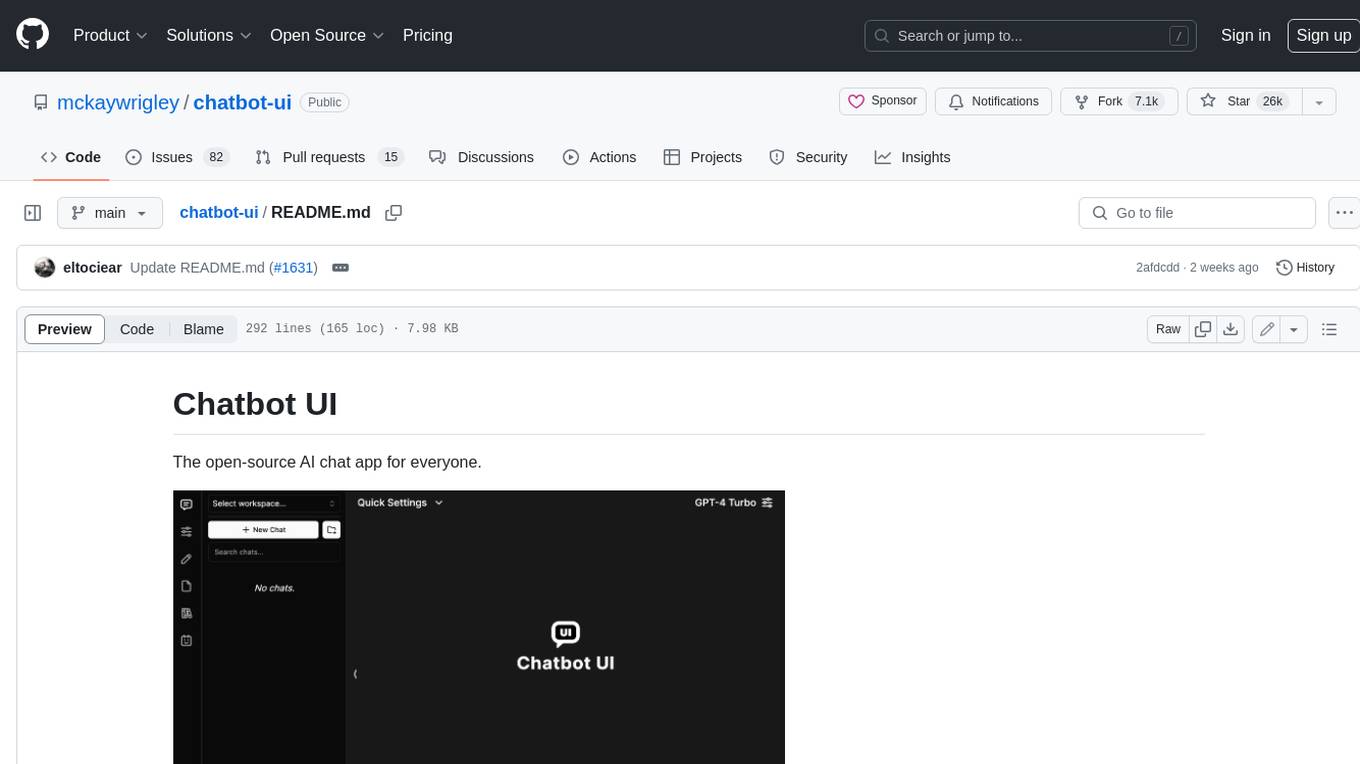
chatbot-ui
Chatbot UI is an open-source AI chat app that allows users to create and deploy their own AI chatbots. It is easy to use and can be customized to fit any need. Chatbot UI is perfect for businesses, developers, and anyone who wants to create a chatbot.
BricksLLM
BricksLLM is a cloud native AI gateway written in Go. Currently, it provides native support for OpenAI, Anthropic, Azure OpenAI and vLLM. BricksLLM aims to provide enterprise level infrastructure that can power any LLM production use cases. Here are some use cases for BricksLLM: * Set LLM usage limits for users on different pricing tiers * Track LLM usage on a per user and per organization basis * Block or redact requests containing PIIs * Improve LLM reliability with failovers, retries and caching * Distribute API keys with rate limits and cost limits for internal development/production use cases * Distribute API keys with rate limits and cost limits for students
uAgents
uAgents is a Python library developed by Fetch.ai that allows for the creation of autonomous AI agents. These agents can perform various tasks on a schedule or take action on various events. uAgents are easy to create and manage, and they are connected to a fast-growing network of other uAgents. They are also secure, with cryptographically secured messages and wallets.
griptape
Griptape is a modular Python framework for building AI-powered applications that securely connect to your enterprise data and APIs. It offers developers the ability to maintain control and flexibility at every step. Griptape's core components include Structures (Agents, Pipelines, and Workflows), Tasks, Tools, Memory (Conversation Memory, Task Memory, and Meta Memory), Drivers (Prompt and Embedding Drivers, Vector Store Drivers, Image Generation Drivers, Image Query Drivers, SQL Drivers, Web Scraper Drivers, and Conversation Memory Drivers), Engines (Query Engines, Extraction Engines, Summary Engines, Image Generation Engines, and Image Query Engines), and additional components (Rulesets, Loaders, Artifacts, Chunkers, and Tokenizers). Griptape enables developers to create AI-powered applications with ease and efficiency.