


agent-shell
A native Emacs buffer to interact with LLM agents powered by ACP
Stars: 669
Agent-Shell is a native Emacs shell designed to interact with LLM agents powered by ACP (Agent Client Protocol). With Agent-Shell, users can chat with various ACP-driven agents like Gemini CLI, Claude Code, Auggie, Mistral Vibe, and more. The tool provides a seamless interface for communication and interaction with these agents within the Emacs environment.
README:
#+TITLE: Emacs Agent Shell #+AUTHOR: Álvaro Ramírez
[[https://melpa.org/#/agent-shell][file:https://melpa.org/packages/agent-shell-badge.svg]]
![https://melpa.org/#/agent-shell][file:https://melpa.org/packages/agent-shell-badge.svg](https://melpa.org/#/agent-shell][file:https://melpa.org/packages/agent-shell-badge.svg)
👉 [[https://github.com/sponsors/xenodium][Support this work via GitHub Sponsors]] by [[https://github.com/xenodium][@xenodium]] (check out my [[https://xenodium.com][blog]])
[[file:agent-shell.png]]
- This project needs your funding
As you pay for those useful LLM tokens, consider [[https://github.com/sponsors/xenodium][sponsoring]] development and maintenance of this project. With your help, I can make this effort more [[https://github.com/sponsors/xenodium][sustainable]].
Thank you!
[[https://xenodium.com/][Alvaro]]
- agent-shell
A native Emacs shell to interact with LLM agents powered by ACP ([[https://agentclientprotocol.com][Agent Client Protocol]]).
With agent-shell, you can chat with the likes of Gemini CLI, Claude Code, Auggie, Mistral Vibe, or any other ACP-driven agent.
Watch on [[https://www.youtube.com/watch?v=R2Ucr3amgGg][YouTube]]
[[https://www.youtube.com/watch?v=R2Ucr3amgGg][file:yt.png]]
![https://www.youtube.com/watch?v=R2Ucr3amgGg][file:yt.png](https://www.youtube.com/watch?v=R2Ucr3amgGg][file:yt.png)
- News
- [[https://xenodium.com/agent-shell-0-25-updates][agent-shell 0.25 updates]].
- [[https://xenodium.com/agent-shell-016-improvements-melpa][agent-shell 0.17 improvements + MELPA]].
- [[https://xenodium.com/agent-shell-0-5-improvements][agent-shell 0.5 improvements]].
- [[https://xenodium.com/introducing-agent-shell][Introducing Emacs agent-shell (powered by ACP)]].
- [[https://xenodium.com/introducing-acpel][Introducing acp.el]].
- Related projects
=agent-shell= relies on [[https://github.com/xenodium/acp.el][acp.el]] to communicate with agents via ACP ([[https://agentclientprotocol.com/][Agent Client Protocol]]).
We now have a handful of additional packages to extend the =agent-shell= experience:
- [[https://github.com/nineluj/agent-review][agent-review]]: Code review interface for =agent-shell=.
- [[https://github.com/ultronozm/agent-shell-attention.el][agent-shell-attention.el]]: Mode-line attention tracker for =agent-shell=.
- [[https://github.com/jethrokuan/agent-shell-manager][agent-shell-manager]]: Tabulated view and management of =agent-shell= buffers.
- [[https://github.com/cmacrae/agent-shell-sidebar][agent-shell-sidebar]]: A sidebar add-on for =agent-shell=.
- [[https://github.com/ElleNajt/agent-shell-to-go][agent-shell-to-go]]: Interact with =agent-shell= sessions from your mobile or any other device via Slack.
- [[https://github.com/ElleNajt/meta-agent-shell][meta-agent-shell]]: Multi-agent coordination system for =agent-shell= with inter-agent communication, task tracking, and project-level dispatching.
- Icons
Thanks to [[https://github.com/lobehub/lobe-icons][Lobe Icons]] for the lovely icons.
- Setup
** External dependencies
*** Claude Code
For Anthropic's Claude Code, follow [[https://github.com/zed-industries/claude-code-acp][Zed's claude-code-acp instructions]], typically something like:
#+begin_src bash npm install -g @zed-industries/claude-code-acp #+end_src
Note: The =-g= flag is required to install the binary globally so it's available in your PATH. After installation, verify it's available by running =which claude-code-acp= in your terminal.
*** Codex
For OpenAI's Codex, install [[https://github.com/zed-industries/codex-acp][zed/codex-acp]] and ensure the codex-acp executable is in PATH.
*** Gemini CLI
For Google's [[https://github.com/google-gemini/gemini-cli][Gemini CLI]], be sure to get a recent release supporting the =--experimental-acp= flag.
*** Goose
For Goose CLI, install [[https://block.github.io/goose/docs/getting-started/installation][goose]] and ensure the goose executable is in PATH.
*** Cursor
For Cursor agent, install with:
#+begin_src bash npm install -g @blowmage/cursor-agent-acp #+end_src
See https://github.com/blowmage/cursor-agent-acp-npm for details.
*** Qwen Code
For Qwen Code, install with:
#+begin_src bash npm install -g @qwen-code/qwen-code@latest #+end_src
See https://github.com/QwenLM/qwen-code for details.
*** Auggie
For Auggie CLI, install with:
#+begin_src bash npm install -g @augmentcode/auggie #+end_src
See https://docs.augmentcode.com/cli/overview for details. *** Mistral Vibe
For Mistral Vibe, install with:
#+begin_src bash uv tool install mistral-vibe #+end_src
See https://github.com/mistralai/mistral-vibe for details.
*** Factory Droid
For Factory Droid, install the =droid-acp= client:
#+begin_src bash npm install -g droid-acp #+end_src
See https://github.com/yaonyan/droid-acp for details.
*** Pi
For Pi coding agent, install the =pi-acp= adapter:
#+begin_src bash npm install -g pi-acp #+end_src
See https://github.com/svkozak/pi-acp for details.
** Installation
=agent-shell= is powered by built-in =comint-shell=, via [[https://github.com/xenodium/shell-maker][shell-maker]], available on [[https://melpa.org/#/shell-maker][MELPA]].
Both [[https://melpa.org/#/agent-shell][agent-shell]] and its dependency [[https://melpa.org/#/acp][acp.el]] are now available on MELPA.
You can install via:
#+begin_src emacs-lisp (use-package agent-shell :ensure t :ensure-system-package ;; Add agent installation configs here ((claude . "brew install claude-code") (claude-code-acp . "npm install -g @zed-industries/claude-code-acp"))) #+end_src
This will automatically install the required dependencies ([[https://melpa.org/#/acp][acp.el]] and [[https://melpa.org/#/shell-maker][shell-maker]]).
*** Doom Emacs
If you are using Doom Emacs and would like to use the =package!= macro:
#+begin_src emacs-lisp (package! shell-maker) (package! acp) (package! agent-shell) #+end_src
Run =doom sync= and restart.
Include =require= before configuration:
#+begin_src emacs-lisp (require 'acp) (require 'agent-shell) ;; rest of config... #+end_src
** Configuration
Configure authentication for the agent providers you want to use.
*** Environment variables
Pass environment variables to the spawned agent process by customizing the agent-shell-*-environment variable with agent-shell-make-environment-variables. The helper accepts key/value pairs and exports them when the agent starts.
#+begin_src emacs-lisp (setq agent-shell-anthropic-claude-environment (agent-shell-make-environment-variables "ANTHROPIC_API_KEY" (auth-source-pass-get "secret" "anthropic-api-key") "HTTPS_PROXY" "http://proxy.example.com:8080")) #+end_src
**** Inheriting environment variables
By default, the agent process starts with a minimal environment. To inherit environment variables from the parent Emacs process, use the :inherit-env t parameter in agent-shell-make-environment-variables:
#+begin_src emacs-lisp (setenv "ANTHROPIC_API_KEY" (auth-source-pass-get "secret" "anthropic-api-key"))
(setq agent-shell-anthropic-claude-environment (agent-shell-make-environment-variables :inherit-env t)) #+end_src
This ensures that environment variables like PATH, HOME, and others from your Emacs session are available to the agent process, while still allowing you to override or add specific variables.
**** Loading environment variables from files
You can load environment variables from .env files using the :load-env parameter. This supports both single and multiple files:
#+begin_src emacs-lisp ;; Load from a single .env file (setq agent-shell-anthropic-claude-environment (agent-shell-make-environment-variables :load-env "~/.env" "CUSTOM_VAR" "custom_value"))
;; Load from multiple .env files (setq agent-shell-anthropic-claude-environment (agent-shell-make-environment-variables :load-env '("~/.env" ".env.local") :inherit-env t)) #+end_src
The .env files should contain variables in the format KEY=value, with one variable per line. Comments (lines starting with #) and empty lines are ignored.
*** Anthropic Claude
For login-based authentication (default):
#+begin_src emacs-lisp (setq agent-shell-anthropic-authentication (agent-shell-anthropic-make-authentication :login t)) #+end_src
For API key authentication:
#+begin_src emacs-lisp ;; With string (setq agent-shell-anthropic-authentication (agent-shell-anthropic-make-authentication :api-key "your-anthropic-api-key-here"))
;; With function (setq agent-shell-anthropic-authentication (agent-shell-anthropic-make-authentication :api-key (lambda () (auth-source-pass-get "secret" "anthropic-api-key")))) #+end_src
For alternative Anthropic-compatible API endpoints, configure via environment variables:
#+begin_src emacs-lisp (setq agent-shell-anthropic-claude-environment (agent-shell-make-environment-variables "ANTHROPIC_BASE_URL" "https://api.moonshot.cn/anthropic" "ANTHROPIC_MODEL" "kimi-k2-turbo-preview" "ANTHROPIC_SMALL_FAST_MODEL" "kimi-k2-turbo-preview")) #+end_src
*** Google Gemini
For login-based authentication (default):
#+begin_src emacs-lisp (setq agent-shell-google-authentication (agent-shell-google-make-authentication :login t)) #+end_src
For API key authentication:
#+begin_src emacs-lisp ;; With string (setq agent-shell-google-authentication (agent-shell-google-make-authentication :api-key "your-google-api-key-here"))
;; With function (setq agent-shell-google-authentication (agent-shell-google-make-authentication :api-key (lambda () (auth-source-pass-get "secret" "google-api-key")))) #+end_src
For Vertex AI authentication:
#+begin_src emacs-lisp (setq agent-shell-google-authentication (agent-shell-google-make-authentication :vertex-ai t)) #+end_src
*** OpenAI Codex
For login-based authentication (default):
#+begin_src emacs-lisp (setq agent-shell-openai-authentication (agent-shell-openai-make-authentication :login t)) #+end_src
For API key authentication:
#+begin_src emacs-lisp ;; With string (setq agent-shell-openai-authentication (agent-shell-openai-make-authentication :api-key "your-openai-api-key-here"))
;; With function (setq agent-shell-openai-authentication (agent-shell-openai-make-authentication :api-key (lambda () (auth-source-pass-get "secret" "openai-api-key")))) #+end_src
*** Goose
For OpenAI API key authentication:
#+begin_src emacs-lisp ;; With string (setq agent-shell-goose-authentication (agent-shell-make-goose-authentication :openai-api-key "your-openai-api-key-here"))
;; With function (setq agent-shell-goose-authentication (agent-shell-make-goose-authentication :openai-api-key (lambda () (auth-source-pass-get "secret" "openai-api-key")))) #+end_src
*** Qwen Code
For OAuth login-based authentication:
#+begin_src emacs-lisp (setq agent-shell-qwen-authentication (agent-shell-qwen-make-authentication :login t)) #+end_src
*** Auggie
For login-based authentication (default):
#+begin_src emacs-lisp (setq agent-shell-auggie-authentication (agent-shell-make-auggie-authentication :login t)) #+end_src
For no authentication (when using alternative authentication methods):
#+begin_src emacs-lisp (setq agent-shell-auggie-authentication (agent-shell-make-auggie-authentication :none t)) #+end_src
*** Mistral Vibe
For API key authentication:
#+begin_src emacs-lisp ;; With string (setq agent-shell-mistral-authentication (agent-shell-mistral-make-authentication :api-key "your-mistral-api-key-here"))
;; With function (reusing the API key configured in vibe) (setq agent-shell-mistral-authentication (agent-shell-mistral-make-authentication :api-key (lambda () (string-trim (shell-command-to-string "source ~/.vibe/.env; echo $MISTRAL_API_KEY"))))) #+end_src
*** Customizing Available Agents
By default, =agent-shell= includes configurations for all supported agents (Claude Code, Gemini CLI, Codex, Goose, Qwen Code, and Auggie). You can customize which agents are available through the =agent-shell-agent-configs= variable.
** Usage
*** Quick Start
=M-x agent-shell= - Start or reuse any of the known agents.
You can select and start any of the known agent shells (see =agent-shell-agent-configs=) via the =agent-shell= interactive command and enables reusing existing shells when available. With a prefix argument (=C-u M-x agent-shell=), it forces starting a new shell session, thus instantiating multiple agent shells.
*** Specific Agent Commands
Start a specific agent shell session directly:
- =M-x agent-shell-anthropic-start-claude-code= - Start a Claude Code agent session
- =M-x agent-shell-auggie-start-agent= - Start an Auggie agent session
- =M-x agent-shell-openai-start-codex= - Start a Codex agent session
- =M-x agent-shell-google-start-gemini= - Start a Gemini agent session
- =M-x agent-shell-goose-start-agent= - Start a Goose agent session
- =M-x agent-shell-cursor-start-agent= - Start a Cursor agent session
- =M-x agent-shell-mistral-start-vibe= - Start a Mistral Vibe agent session
- =M-x agent-shell-qwen-start= - Start a Qwen Code agent session
- =M-x agent-shell-droid-start-agent= - Start a Factory Droid agent session
- =M-x agent-shell-pi-start-agent= - Start a Pi coding agent session
*** Setting a default agent for all new shells
You can set a default agent to use for all new shells started via =agent-shell= like so:
#+begin_src emacs-lisp (setq agent-shell-preferred-agent-config (agent-shell-anthropic-make-claude-code-config)) #+end_src
*** Configuring MCP servers
You can configure MCP servers directly via =agent-shell=. This allows you to avoid having to repeat configurations across every agent that you use.
#+begin_src emacs-lisp (setq agent-shell-mcp-servers '(((name . "notion") (type . "http") (headers . []) (url . "https://mcp.notion.com/mcp")))) #+end_src
** Running agents in Devcontainers / Docker containers (Experimental)
=agent-shell= provides rudimentary support for running agents and shell commands in containers.
Use =agent-shell-container-command-runner= to prefix the command that starts the agent, or a shell command that should be run so it is executed inside the container.
*** Static command list
#+begin_src emacs-lisp (setq agent-shell-container-command-runner '("devcontainer" "exec" "--workspace-folder" ".")) #+end_src
*** Function-based configuration
For dynamic per-agent containers, provide a function that takes the current agent-shell buffer and returns the command list:
#+begin_src emacs-lisp (setq agent-shell-container-command-runner (lambda (buffer) (let ((config (agent-shell-get-config buffer))) (pcase (map-elt config :identifier) ('claude-code '("docker" "exec" "claude-dev" "--")) ('gemini-cli '("docker" "exec" "gemini-dev" "--")) (_ '("devcontainer" "exec" ".")))))) #+end_src
*** Per-session containers
You can use different containers for different shell sessions, even of the same agent type:
#+begin_src emacs-lisp (setq agent-shell-container-command-runner (lambda (buffer) ;; Different container based on project (if (string-match "project-a" (buffer-name buffer)) '("docker" "exec" "project-a-dev" "--") '("docker" "exec" "project-b-dev" "--")))) #+end_src
Note that any =:environment-variables= you may have passed to =acp-make-client= will not apply to the agent process running inside the container. It's expected to inject environment variables by means of your devcontainer configuration / Dockerfile.
Next, set an =agent-shell-path-resolver-function= that resolves container paths in the local working directory, and vice versa. Agent shell provides the =agent-shell--resolve-devcontainer-path= function for use with devcontainers specifically: it reads the =workspaceFolder= specified in =.devcontainer/devcontainer.json=, or uses the default value of =/workspaces/= otherwise.
#+begin_src emacs-lisp (setq agent-shell-path-resolver-function #'agent-shell--resolve-devcontainer-path) #+end_src
Note that this allows the agent to access files on your local file-system. While care has been taken to restrict access to files in the local working directory, it's probably possible for a malicious agent to circumvent this restriction.
Optional: to prevent the agent running inside the container to access your local file-system altogether and to have it read/modify files inside the container directly, in addition to setting the resolver function, disable the "read/write text file" client capabilities:
#+begin_src emacs-lisp (setq agent-shell-text-file-capabilities nil) #+end_src
*** Inhibiting minor modes during file writes
Some minor modes (for example, =aggressive-indent-mode=) can interfere with an agent's edits. Agent Shell can temporarily disable selected per-buffer minor modes while applying edits.
#+begin_src emacs-lisp (setopt agent-shell-write-inhibit-minor-modes '(aggressive-indent-mode)) #+end_src
All of the above settings can be applied on a per-project basis using [[https://www.gnu.org/software/emacs/manual/html_node/emacs/Directory-Variables.html][directory-local variables]].
** Key bindings
-
=RET= - Submits prompt.
-
=M-J= - Iserts newline.
-
=C-c C-c= - Interrupt current agent operation
-
=TAB and Shift-TAB= - Navigate interactive elements
To customize =RET= binding behaviour, you can use something like:
#+begin_src emacs-lisp :lexical no (use-package agent-shell :bind (:map agent-shell-mode-map ("RET" . newline) ("M-RET" . shell-maker-submit))) #+end_src
Or if you prefer C-c C-c to send and C-c C-k to interrupt, use the following:
#+begin_src emacs-lisp :lexical no (use-package agent-shell :bind (:map agent-shell-mode-map ("RET" . newline) ("C-c C-c" . shell-maker-submit) ("C-c C-k" . agent-shell-interrupt))) #+end_src
*** Evil
Evil users may want to rebind RET for inserting a new line in =insert
mode= and sending the prompt in =normal mode=.
Also, when viewing diffs (before accepting changes) it may be annoying
having to enter =insert mode= to send keys (y/n/p/q/etc). If this is
your case, you can make these buffers start in Emacs mode (you can
always go to Evil modes if you need to with C-z).
#+begin_src emacs-lisp
(use-package agent-shell
:config
;; Evil state-specific RET behavior: insert mode = newline, normal mode = send
(evil-define-key 'insert agent-shell-mode-map (kbd "RET") #'newline)
(evil-define-key 'normal agent-shell-mode-map (kbd "RET") #'comint-send-input)
;; Configure *agent-shell-diff* buffers to start in Emacs state
(add-hook 'diff-mode-hook
    (lambda ()
      (when (string-match-p "\\*agent-shell-diff\\*" (buffer-name))
	(evil-emacs-state)))))
#+end_src
- Customizations
#+BEGIN_SRC emacs-lisp :results table :colnames '("Custom variable" "Description") :exports results (let ((rows)) (mapatoms (lambda (symbol) (when (and (string-match "^agent-shell" (symbol-name symbol)) (custom-variable-p symbol)) (push `(,symbol ,(car (split-string (or (documentation-property symbol 'variable-documentation) (get (indirect-variable symbol) 'variable-documentation) (get symbol 'variable-documentation) "") "\n"))) rows)))) (sort rows (lambda (a b) (string< (symbol-name (car a)) (symbol-name (car b)))))) #+END_SRC
#+RESULTS: | Custom variable | Description | |-----------------------------------------------+---------------------------------------------------------------------------------| | agent-shell-agent-configs | The list of known agent configurations. | | agent-shell-anthropic-authentication | Configuration for Anthropic authentication. | | agent-shell-anthropic-claude-command | Command and parameters for the Anthropic Claude client. | | agent-shell-anthropic-claude-environment | Environment variables for the Anthropic Claude client. | | agent-shell-anthropic-default-model-id | Default Anthropic model ID. | | agent-shell-anthropic-default-session-mode-id | Default Anthropic session mode ID. | | agent-shell-auggie-authentication | Configuration for Auggie authentication. | | agent-shell-auggie-command | Command and parameters for the Auggie client. | | agent-shell-auggie-environment | Environment variables for the Auggie client. | | agent-shell-completion-mode-hook | Hook run after entering or leaving ‘agent-shell-completion-mode’. | | agent-shell-container-command-runner | Command prefix for executing commands in a container. | | agent-shell-context-sources | Sources to consider when determining M-x agent-shell automatic context. | | agent-shell-cursor-command | Command and parameters for the Cursor agent client. | | agent-shell-cursor-environment | Environment variables for the Cursor agent client. | | agent-shell-display-action | Display action for agent shell buffers. | | agent-shell-droid-authentication | Configuration for Factory Droid authentication. | | agent-shell-droid-command | Command and parameters for the Factory Droid ACP client. | | agent-shell-droid-environment | Environment variables for the Factory Droid ACP client. | | agent-shell-embed-file-size-limit | Maximum file size in bytes for embedding with ContentBlock::Resource. | | agent-shell-file-completion-enabled | Non-nil automatically enables file completion when starting shells. | | agent-shell-github-command | Command and parameters for the GitHub Copilot agent client. | | agent-shell-github-environment | Environment variables for the GitHub Copilot agent client. | | agent-shell-google-authentication | Configuration for Google authentication. | | agent-shell-google-gemini-command | Command and parameters for the Gemini client. | | agent-shell-google-gemini-environment | Environment variables for the Google Gemini client. | | agent-shell-goose-authentication | Configuration for Goose authentication. | | agent-shell-goose-command | Command and parameters for the Goose client. | | agent-shell-goose-environment | Environment variables for the Goose client. | | agent-shell-header-style | Style for agent shell buffer headers. | | agent-shell-highlight-blocks | Whether or not to highlight source blocks. | | agent-shell-mcp-servers | List of MCP servers to initialize when creating a new session. | | agent-shell-mistral-authentication | Configuration for Mistral AI authentication. | | agent-shell-mistral-command | Command and parameters for the Mistral Vibe client. | | agent-shell-mistral-default-model-id | Default Mistral AI model ID. | | agent-shell-mistral-default-session-mode-id | Default Mistral AI session mode ID. | | agent-shell-mistral-environment | Environment variables for the Mistral Vibe client. | | agent-shell-openai-authentication | Configuration for OpenAI authentication. | | agent-shell-openai-codex-command | Command and parameters for the OpenAI Codex client. | | agent-shell-openai-codex-environment | Environment variables for the OpenAI Codex client. | | agent-shell-opencode-authentication | Configuration for OpenCode authentication. | | agent-shell-opencode-command | Command and parameters for the OpenCode client. | | agent-shell-opencode-environment | Environment variables for the OpenCode client. | | agent-shell-path-resolver-function | Function for resolving remote paths on the local file-system, and vice versa. | | agent-shell-permission-icon | Icon displayed when shell commands require permission to execute. | | agent-shell-pi-command | Command and parameters for the Pi ACP client. | | agent-shell-pi-environment | Environment variables for the Pi client. | | agent-shell-prefer-viewport-interaction | Non-nil makes ‘agent-shell’ prefer viewport interaction over shell interaction. | | agent-shell-preferred-agent-config | Default agent to use for all new shells. | | agent-shell-qwen-authentication | Configuration for Qwen Code authentication. | | agent-shell-qwen-command | Command and parameters for the Qwen Code client. | | agent-shell-qwen-environment | Environment variables for the Qwen Code client. | | agent-shell-screenshot-command | The program to use for capturing screenshots. | | agent-shell-section-functions | Abnormal hook run after overlays are applied (experimental). | | agent-shell-show-busy-indicator | Non-nil to show the busy indicator animation in the header and mode line. | | agent-shell-show-config-icons | Whether to show icons in agent config selection. | | agent-shell-show-welcome-message | Non-nil to show welcome message. | | agent-shell-text-file-capabilities | Whether agents are initialized with read/write text file capabilities. | | agent-shell-thought-process-expand-by-default | Whether thought process sections should be expanded by default. | | agent-shell-thought-process-icon | Icon displayed during the AI’s thought process. | | agent-shell-tool-use-expand-by-default | Whether tool use sections should be expanded by default. | | agent-shell-transcript-file-path-function | Function to generate the full transcript file path. | | agent-shell-ui-mode-hook | Hook run after entering or leaving ‘agent-shell-ui-mode’. | | agent-shell-user-message-expand-by-default | Whether user message sections should be expanded by default. | | agent-shell-write-inhibit-minor-modes | List of minor mode commands to inhibit during ‘fs/write_text_file’ edits. |
- Commands #+BEGIN_SRC emacs-lisp :results table :colnames '("Binding" "Command" "Description") :exports results (let ((rows)) (mapatoms (lambda (symbol) (when (and (string-match "^agent-shell" (symbol-name symbol)) (commandp symbol)) (push `(,(string-join (seq-filter (lambda (symbol) (not (string-match "menu" symbol))) (mapcar (lambda (keys) (key-description keys)) (or (where-is-internal (symbol-function symbol) comint-mode-map nil nil (command-remapping 'comint-next-input)) (where-is-internal symbol agent-shell-mode-map nil nil (command-remapping symbol)) (where-is-internal (symbol-function symbol) agent-shell-mode-map nil nil (command-remapping symbol))))) " or ") ,(symbol-name symbol) ,(car (split-string (or (documentation symbol t) "") "\n"))) rows)))) (sort rows (lambda (a b) (string< (cadr a) (cadr b))))) #+END_SRC
#+RESULTS:
| Binding | Command | Description |
|-----------------+---------------------------------------------------------+-------------------------------------------------------------------------------|
| | agent-shell | Start or reuse an existing agent shell. |
| | agent-shell--display-buffer | Toggle agent SHELL-BUFFER display. |
| | agent-shell-anthropic-start-claude-code | Start an interactive Claude Code agent shell. |
| | agent-shell-auggie-start-agent | Start an interactive Auggie agent shell. |
| | agent-shell-clear-buffer | Clear the current shell buffer. |
| | agent-shell-completion-mode | Toggle agent shell completion with @ or / prefix. |
| | agent-shell-cursor-start-agent | Start an interactive Cursor agent shell. |
| C- | agent-shell-cycle-session-mode | Cycle through available session modes for the current agent-shell' session. | | | agent-shell-delete-interaction-at-point | Delete interaction (request and response) at point. | | | agent-shell-droid-start-agent | Start an interactive Factory Droid agent shell. | | | agent-shell-fakes-load-session | Load and replay a traffic session from file. | | | agent-shell-github-start-copilot | Start an interactive GitHub Copilot agent shell. | | | agent-shell-google-start-gemini | Start an interactive Gemini CLI agent shell. | | | agent-shell-goose-start-agent | Start an interactive Goose agent shell. | | | agent-shell-help-menu | Transient menu for agent-shell' commands. |
| | agent-shell-insert-file | Insert a file into agent-shell'. | | | agent-shell-insert-shell-command-output | Execute a shell command and insert output as a code block. | | C-c C-c | agent-shell-interrupt | Interrupt in-progress request and reject all pending permissions. | | | agent-shell-jump-to-latest-permission-button-row | Jump to the latest permission button row. | | | agent-shell-mistral-start-vibe | Start an interactive Mistral Vibe agent shell. | | | agent-shell-mode | Major mode for agent shell. | | | agent-shell-new-shell | Start a new agent shell. | | S-<return> | agent-shell-newline | Insert a newline, and move to left margin of the new line. | | C-<down> or M-n | agent-shell-next-input | Cycle forwards through input history. | | n or TAB | agent-shell-next-item | Go to next item. | | | agent-shell-next-permission-button | Jump to the next button. | | | agent-shell-open-transcript | Open the transcript file for the current agent-shell' buffer. |
| | agent-shell-openai-start-codex | Start an interactive Codex agent shell. |
| | agent-shell-opencode-start-agent | Start an interactive OpenCode agent shell. |
| C-c C-o | agent-shell-other-buffer | Switch to other associated buffer (viewport vs shell). |
| C- or M-p | agent-shell-previous-input | Cycle backwards through input history, saving input. |
| p or | agent-shell-previous-item | Go to previous item. |
| | agent-shell-previous-permission-button | Jump to the previous button. |
| | agent-shell-prompt-compose | Compose an agent-shell' prompt in a dedicated buffer. | | | agent-shell-queue-request | Queue or immediately send a request depending on shell busy state. | | | agent-shell-qwen-start | Start an interactive Qwen Code CLI agent shell. | | | agent-shell-remove-pending-request | Remove all pending requests or a specific request by REMOVE-INDEX. | | C-x x r | agent-shell-rename-buffer | Rename current shell buffer. | | | agent-shell-reset-logs | Reset all log buffers. | | | agent-shell-resume-pending-requests | Resume processing pending requests in the queue. | | | agent-shell-run-all-tests | Run all agent-shell tests in batch mode. | | M-r | agent-shell-search-history | Search previous input history. | | | agent-shell-send-current-file | Insert a file into agent-shell'. |
| | agent-shell-send-dwim | Send region or error at point to last accessed shell buffer in project. |
| | agent-shell-send-file | Insert a file into agent-shell'. | | | agent-shell-send-other-file | Prompt to send a file into agent-shell'. |
| | agent-shell-send-region | Send region to last accessed shell buffer in project. |
| | agent-shell-send-screenshot | Capture a screenshot and insert it into agent-shell'. | | C-c RET | agent-shell-set-session-mode | Set session mode (if any available). | | C-c C-v | agent-shell-set-session-model | Set session model. | | RET | agent-shell-submit | Submit current input. | | | agent-shell-toggle | Toggle agent shell display. | | | agent-shell-toggle-logging | Toggle logging. | | | agent-shell-ui-backward-block | Jump to the previous block. | | | agent-shell-ui-forward-block | Jump to the next block. | | | agent-shell-ui-mode | Minor mode for SUI block navigation. | | | agent-shell-ui-toggle-fragment-at-point | Toggle visibility of fragment body at point. | | | agent-shell-version | Show agent-shell' mode version. |
| | agent-shell-view-acp-logs | View agent shell ACP logs buffer. |
| | agent-shell-view-traffic | View agent shell traffic buffer. |
| | agent-shell-viewport-compose-cancel | Cancel prompt composition. |
| | agent-shell-viewport-compose-send | Send the viewport composed prompt to the agent shell. |
| | agent-shell-viewport-compose-send-and-kill | Send the viewport composed prompt to the agent shell and kill compose buffer. |
| | agent-shell-viewport-compose-send-and-wait-for-response | Send the viewport composed prompt and display response in viewport. |
| | agent-shell-viewport-cycle-session-mode | Cycle through available session modes. |
| | agent-shell-viewport-edit-mode | Major mode for composing agent shell prompts. |
| | agent-shell-viewport-interrupt | Interrupt active agent shell request. |
| | agent-shell-viewport-next-item | Go to next item. |
| | agent-shell-viewport-next-page | Show next interaction (request / response). |
| | agent-shell-viewport-previous-item | Go to previous item. |
| | agent-shell-viewport-previous-page | Show previous interaction (request / response). |
| | agent-shell-viewport-refresh | Refresh viewport buffer content with current item from shell. |
| | agent-shell-viewport-reply | Reply as a follow-up and compose another prompt/query. |
| | agent-shell-viewport-set-session-mode | Set session mode. |
| | agent-shell-viewport-set-session-model | Set session model. |
| | agent-shell-viewport-view-last | Display the last request/response interaction. |
| | agent-shell-viewport-view-mode | Major mode for viewing agent shell prompts (read-only). |
- Issues ** Can you add support for another agent?
Does the agent support ACP ([[https://agentclientprotocol.com][Agent Client Protocol]])? If so, =agent-shell= can likely support this agent. Some agents have ACP support built-in (like [[https://github.com/google-gemini/gemini-cli][gemini-cli]]). Others require a separate ACP package (like [[https://github.com/zed-industries/claude-code-acp][claude-code-acp]] for [[https://github.com/anthropics/claude-code][claude-code]]). When filing a feature request to add a new agent, please include a link to the project supporting [[https://agentclientprotocol.com][Agent Client Protocol]] (built-in or otherwise).
Agents without ACP support are out of scope for integrating with =agent-shell=. Having said that, if you do build an ACP layer like =claude-code-acp=, then =agent-shell= can work with it.
** =agent-shell= not behaving as expected?
Could be the agent itself missing an [[https://agentclientprotocol.com][Agent Client Protocol]] feature, =agent-shell= missing the feature, or both :) So which one is it? It's hard to tell unless we look at [[https://agentclientprotocol.com][Agent Client Protocol]] traffic between the two.
** How do I view/get [[https://agentclientprotocol.com][Agent Client Protocol]] traffic?
- =M-x agent-shell-toggle-logging= (make sure logging is ON).
- Reproduce the issue
- =M-x agent-shell-view-traffic=
Browse through traffic and see if you can spot the issue. For example, if you see a request sent by the agent asking for user permission, but =agent-shell= isn't surfacing this permission, it looks like perhaps =agent-shell= is missing a feature.
For example, here's what a [[https://agentclientprotocol.com/protocol/schema#session%2Frequest-permission][session/request_permission]] request would look like from the traffic viewer.
[[file:traffic.png]]
Sometimes including a traffic screenshot in an issue is enough. Other times including the full traffic is needed. From the traffic viewer, you can =M-x acp-traffic-save-to= to save as =.traffic=.
** Where should I file bug or feature request?
*** Agent issues or feature requests
If you're able to determine the agent is missing a feature (or a bug is present) in their [[https://agentclientprotocol.com][Agent Client Protocol]] implementation, please file an issue directly with the agent folks. For example:
- [[https://github.com/zed-industries/claude-code-acp][claude-code-acp]]: For Claude Code.
- [[https://github.com/zed-industries/codex-acp][codex-acp]]: For Codex.
- [[https://github.com/google-gemini/gemini-cli][Gemini CLI]].
- [[https://block.github.io/goose/docs/getting-started/installation][Goose]].
- [[https://github.com/QwenLM/qwen-code][Qwen Code]].
*** =agent-shell= issues or feature requests
Alternatively, if you noticed =agent-shell= is missing a feature (or has a bug), please [[https://github.com/xenodium/agent-shell/issues][file an agent-shell issue]].
*** Not sure where to file an issue?
File [[https://github.com/xenodium/agent-shell/issues][in agent-shell]], but please try to provide details, so I can determine whether =agent-shell= or the agent itself needs work. Traffic data would be very useful here. Provide a screenshot or a .traffic file if you think it'll help. See [[https://github.com/xenodium/agent-shell?tab=readme-ov-file#how-do-i-viewget-agent-client-protocol-traffic][how to get ACP traffic]].
- Contributing
** Before Contributing
Before implementing new features, please file a feature request first to discuss the proposal. This helps ensure alignment with the project's direction and prevents unnecessary work.
As the maintainer, I must be mindful of all features I accept since I inherit the code to maintain it. Some features may be better suited as separate packages (like [[https://github.com/cmacrae/agent-shell-sidebar][agent-shell-sidebar]]).
I'll gladly promote your package wherever possible.
** Style (or personal preference TBH)
There are lots of ways to accomplish things in elisp. While the following are merely personal preferences, as maintainer, it really simplifies things for me to try to limit the number of ways to accomplish things.
*** Maps (use alists)
This project relies on [[https://www.gnu.org/software/emacs/manual/html_node/elisp/Association-Lists.html][alists]] for much of its functionality. Sure, we can also use plists, hashtables, etc.
Unless we have a strong argument to use something else, please stick with =alists= (and =:= keywords).
#+begin_src emacs-lisp '((:species . "Cat") (:name . "Whiskers") (:age . 4) (:color . "Gray") (:favorite-toy . "Feather Wand")) #+end_src
*** seq.el
Accessing and working with lists? Please prefer =seq.el=, unless we have a strong argument to use an alternative.
#+begin_src emacs-lisp :lexical no (setq animals (list '((:species . "Cat") (:name . "Whiskers") (:age . 4) (:color . "Gray")) '((:species . "Dog") (:name . "Buddy") (:age . 6) (:color . "Brown"))))
(seq-first animals) #+end_src
*** map.el
Accessing and working with =alists=? Please prefer =map.el= unless we have a strong argument to use an alternative.
#+begin_src emacs-lisp :lexical no (setq animal (seq-first animals)) (map-elt animal :species) #+end_src
*** cl-lib (limited to =cl-defun=)
While I'm a fan of =cl-defun=, please limit =cl= usage to =cl-defun= if possible. Nothing against =cl-lib=. I'm just limiting the surface and number of idioms I need to keep in my head to maintain the codebase. Often, =seq.el= and =map.el= can do the job just fine.
=cl-defun=, on the other hand, please do! I'm a fan of named parameters (yay for self-documenting), so use =&key= if possible.
#+begin_src emacs-lisp :lexical no (cl-defun describe (&key animal) "Describe an ANIMAL, which is an alist of properties like :species, :name, :age, :color." (message "This is a %d-year-old %s %s named %s." (map-elt animal :age 0) (map-elt animal :color "Unknown Color") (map-elt animal :species "Unknown Species") (map-elt animal :name "Unnamed")))
(describe :animal '((:species . "Cat") (:name . "Whiskers") (:age . 4) (:color . "Gray"))) #+end_src
*** Code/feature consistency
Please try to look for a similar feature in the code base and replicate an existing pattern usage if possible.
*** Code Checks
Before submitting a PR, please run:
- =M-x checkdoc= - Ensures documentation consistency
- =M-x byte-compile-file= - Identifies compilation warnings
*** Tests
I'm aware, we're a bit light on tests, but we started adding some tests. If adding a new feature, please try to add tests.
Tests live under the tests directory:
#+begin_src bash ls tests/*tests.el #+end_src
#+RESULTS: | tests/agent-shell-anthropic-tests.el | | tests/agent-shell-tests.el |
*** Running tests
Opening any file under the =tests= directory will load the =agent-shell-run-all-tests= command.
Run tests with =M-x agent-shell-run-all-tests=.
- Contributors
#+HTML:
#+HTML:
#+HTML:
Made with [[https://contrib.rocks][contrib.rocks]].
For Tasks:
Click tags to check more tools for each tasksFor Jobs:
Alternative AI tools for agent-shell
Similar Open Source Tools
For similar tasks
flowgen
FlowGen is a tool built for AutoGen, a great agent framework from Microsoft and a lot of contributors. It provides intuitive visual tools that streamline the construction and oversight of complex agent-based workflows, simplifying the process for creators and developers. Users can create Autoflows, chat with agents, and share flow templates. The tool is fully dockerized and supports deployment on Railway.app. Contributions to the project are welcome, and the platform uses semantic-release for versioning and releases.
agentok
Agentok Studio is a visual tool built for AutoGen, a cutting-edge agent framework from Microsoft and various contributors. It offers intuitive visual tools to simplify the construction and management of complex agent-based workflows. Users can create workflows visually as graphs, chat with agents, and share flow templates. The tool is designed to streamline the development process for creators and developers working on next-generation Multi-Agent Applications.
eternal-ai
Eternal AI is an open source AI protocol for fully onchain agents, enabling developers to create various types of onchain AI agents without middlemen. It operates on a decentralized infrastructure with state-of-the-art models and omnichain interoperability. The protocol architecture includes components like ai-kernel, decentralized-agents, decentralized-inference, decentralized-compute, agent-as-a-service, and agent-studio. Ongoing research projects include cuda-evm, nft-ai, and physical-ai. The system requires Node.js, npm, Docker Desktop, Go, and Ollama for installation. The 'eai' CLI tool allows users to create agents, fetch agent info, list agents, and chat with agents. Design principles focus on decentralization, trustlessness, production-grade quality, and unified agent interface. Featured integrations can be quickly implemented, and governance will be overseen by EAI holders in the future.
agent-shell
Agent-Shell is a native Emacs shell designed to interact with LLM agents powered by ACP (Agent Client Protocol). With Agent-Shell, users can chat with various ACP-driven agents like Gemini CLI, Claude Code, Auggie, Mistral Vibe, and more. The tool provides a seamless interface for communication and interaction with these agents within the Emacs environment.
SuperAGI
SuperAGI is an open-source framework designed to build, manage, and run autonomous AI agents. It enables developers to create production-ready and scalable agents, extend agent capabilities with toolkits, and interact with agents through a graphical user interface. The framework allows users to connect to multiple Vector DBs, optimize token usage, store agent memory, utilize custom fine-tuned models, and automate tasks with predefined steps. SuperAGI also provides a marketplace for toolkits that enable agents to interact with external systems and third-party plugins.
letta
Letta is an open source framework for building stateful LLM applications. It allows users to build stateful agents with advanced reasoning capabilities and transparent long-term memory. The framework is white box and model-agnostic, enabling users to connect to various LLM API backends. Letta provides a graphical interface, the Letta ADE, for creating, deploying, interacting, and observing with agents. Users can access Letta via REST API, Python, Typescript SDKs, and the ADE. Letta supports persistence by storing agent data in a database, with PostgreSQL recommended for data migrations. Users can install Letta using Docker or pip, with Docker defaulting to PostgreSQL and pip defaulting to SQLite. Letta also offers a CLI tool for interacting with agents. The project is open source and welcomes contributions from the community.
AutoAgent
AutoAgent is a fully-automated and zero-code framework that enables users to create and deploy LLM agents through natural language alone. It is a top performer on the GAIA Benchmark, equipped with a native self-managing vector database, and allows for easy creation of tools, agents, and workflows without any coding. AutoAgent seamlessly integrates with a wide range of LLMs and supports both function-calling and ReAct interaction modes. It is designed to be dynamic, extensible, customized, and lightweight, serving as a personal AI assistant.
AgentUp
AgentUp is an active development tool that provides a developer-first agent framework for creating AI agents with enterprise-grade infrastructure. It allows developers to define agents with configuration, ensuring consistent behavior across environments. The tool offers secure design, configuration-driven architecture, extensible ecosystem for customizations, agent-to-agent discovery, asynchronous task architecture, deterministic routing, and MCP support. It supports multiple agent types like reactive agents and iterative agents, making it suitable for chatbots, interactive applications, research tasks, and more. AgentUp is built by experienced engineers from top tech companies and is designed to make AI agents production-ready, secure, and reliable.
For similar jobs
sweep
Sweep is an AI junior developer that turns bugs and feature requests into code changes. It automatically handles developer experience improvements like adding type hints and improving test coverage.
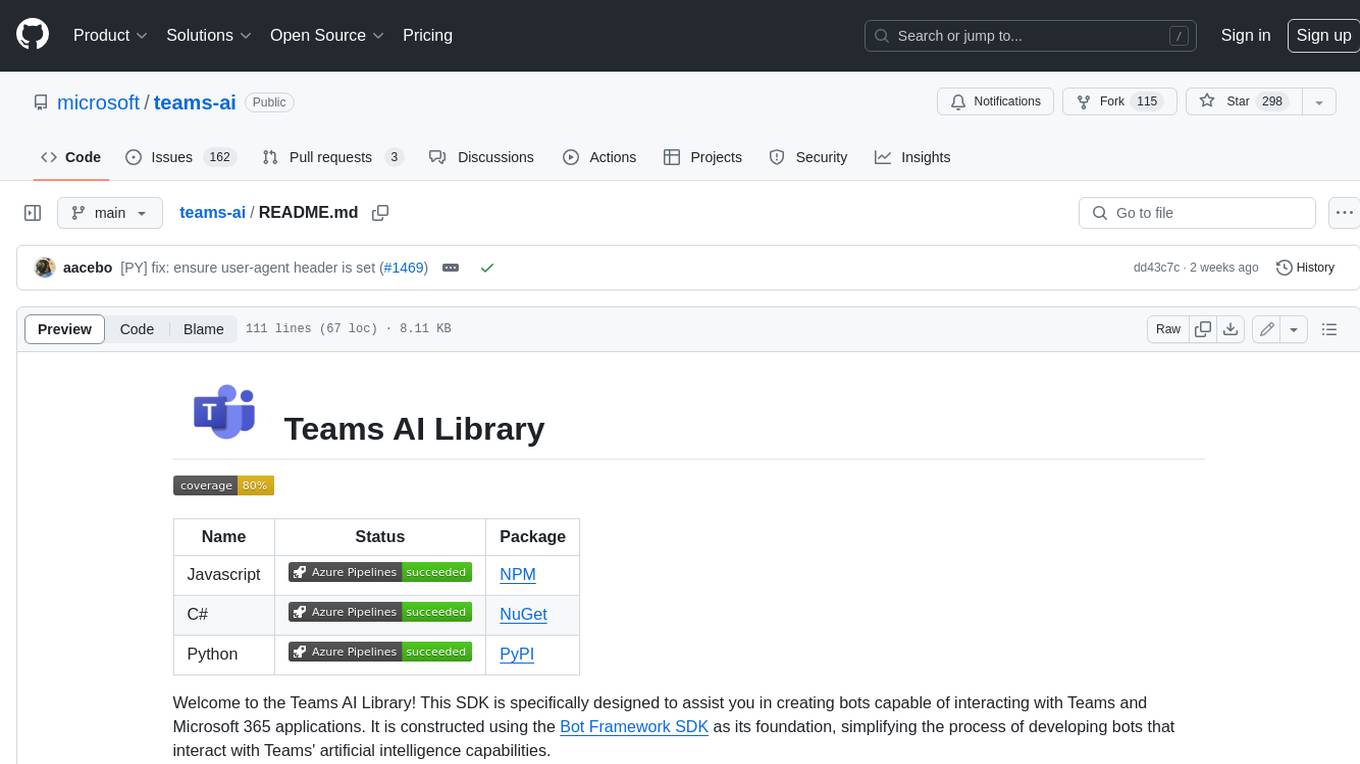
teams-ai
The Teams AI Library is a software development kit (SDK) that helps developers create bots that can interact with Teams and Microsoft 365 applications. It is built on top of the Bot Framework SDK and simplifies the process of developing bots that interact with Teams' artificial intelligence capabilities. The SDK is available for JavaScript/TypeScript, .NET, and Python.
ai-guide
This guide is dedicated to Large Language Models (LLMs) that you can run on your home computer. It assumes your PC is a lower-end, non-gaming setup.
classifai
Supercharge WordPress Content Workflows and Engagement with Artificial Intelligence. Tap into leading cloud-based services like OpenAI, Microsoft Azure AI, Google Gemini and IBM Watson to augment your WordPress-powered websites. Publish content faster while improving SEO performance and increasing audience engagement. ClassifAI integrates Artificial Intelligence and Machine Learning technologies to lighten your workload and eliminate tedious tasks, giving you more time to create original content that matters.
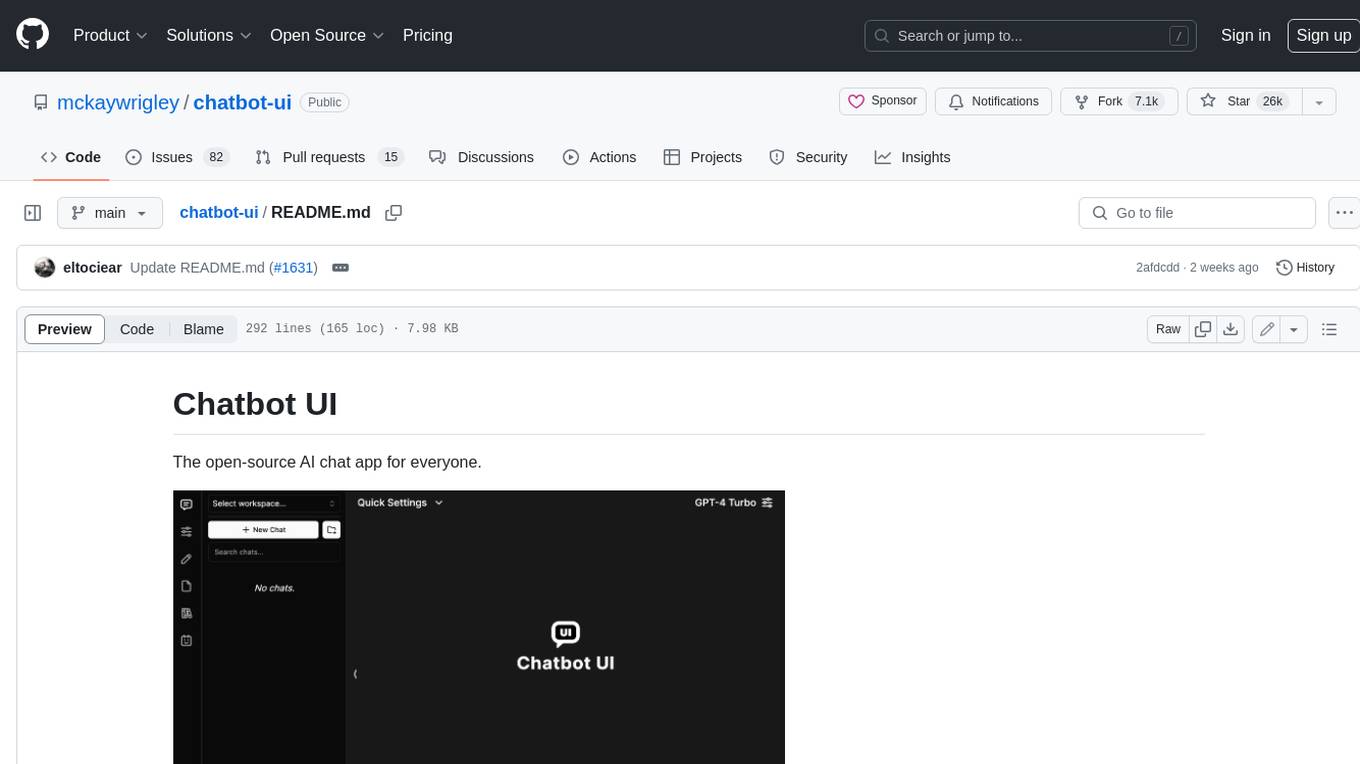
chatbot-ui
Chatbot UI is an open-source AI chat app that allows users to create and deploy their own AI chatbots. It is easy to use and can be customized to fit any need. Chatbot UI is perfect for businesses, developers, and anyone who wants to create a chatbot.
BricksLLM
BricksLLM is a cloud native AI gateway written in Go. Currently, it provides native support for OpenAI, Anthropic, Azure OpenAI and vLLM. BricksLLM aims to provide enterprise level infrastructure that can power any LLM production use cases. Here are some use cases for BricksLLM: * Set LLM usage limits for users on different pricing tiers * Track LLM usage on a per user and per organization basis * Block or redact requests containing PIIs * Improve LLM reliability with failovers, retries and caching * Distribute API keys with rate limits and cost limits for internal development/production use cases * Distribute API keys with rate limits and cost limits for students
uAgents
uAgents is a Python library developed by Fetch.ai that allows for the creation of autonomous AI agents. These agents can perform various tasks on a schedule or take action on various events. uAgents are easy to create and manage, and they are connected to a fast-growing network of other uAgents. They are also secure, with cryptographically secured messages and wallets.
griptape
Griptape is a modular Python framework for building AI-powered applications that securely connect to your enterprise data and APIs. It offers developers the ability to maintain control and flexibility at every step. Griptape's core components include Structures (Agents, Pipelines, and Workflows), Tasks, Tools, Memory (Conversation Memory, Task Memory, and Meta Memory), Drivers (Prompt and Embedding Drivers, Vector Store Drivers, Image Generation Drivers, Image Query Drivers, SQL Drivers, Web Scraper Drivers, and Conversation Memory Drivers), Engines (Query Engines, Extraction Engines, Summary Engines, Image Generation Engines, and Image Query Engines), and additional components (Rulesets, Loaders, Artifacts, Chunkers, and Tokenizers). Griptape enables developers to create AI-powered applications with ease and efficiency.