


llmxcpg
Source code for LLMxCPG paper
Stars: 111
LLMxCPG is a framework for vulnerability detection using Code Property Graphs (CPG) and Large Language Models (LLM). It involves a two-phase process: Slice Construction where an LLM generates queries for a CPG to extract a code slice, and Vulnerability Detection where another LLM classifies the code slice as vulnerable or safe. The repository includes implementations of baseline models, information on datasets, scripts for running models, prompt templates, query generation examples, and configurations for fine-tuning models.
README:
LLMxCPG: Context-Aware Vulnerability Detection Through Code Property Graph-Guided Large Language Models
- [2025.11] LLMxCPG wins the MENA CSAW Applied Research Competition (ARC) 2025.
- [2025.10] LLMxCPG is accepted to the MENA CSAW Applied Research Competition (ARC) 2025.
- [2025.08] LLMxCPG is presented at USENIX Security 2025.
This repository contains the source code for LLMxCPG, a framework for vulnerability detection using Code Property Graphs (CPG) and Large Language Models (LLM).
The core methodology involves a two-phase process:
-
Slice Construction: An LLM generates specific queries for a Code Property Graph to extract a minimal, relevant "slice" of code that may contain a vulnerability.
-
Vulnerability Detection: A second LLM analyzes the extracted code slice to classify it as either vulnerable or safe.
If you use this codebase in your research, please cite the associated paper:
@inproceedings{lekssays2025llmxcpg,
  title={$\{$LLMxCPG$\}$:$\{$Context-Aware$\}$ Vulnerability Detection Through Code Property $\{$Graph-Guided$\}$ Large Language Models},
  author={Lekssays, Ahmed and Mouhcine, Hamza and Tran, Khang and Yu, Ting and Khalil, Issa},
  booktitle={34th USENIX Security Symposium (USENIX Security 25)},
  pages={489--507},
  year={2025}
}
If you encounter any issues with our codebase, please open an issue in the repository. This is the most effective way for us to assist you.
.
├── baselines/      # Implementations of baseline models for comparison.
├── data/           # Information on datasets used.
├── inference/      # Scripts for running the LLMxCPG-Q and LLMxCPG-D models.
├── prompts/        # Prompt templates for query generation and classification.
├── queries/        # LLMxCPG-Q generation process and examples of generated CPGQL queries.
├── training/       # Scripts and configurations for fine-tuning the models.
└── README.md
Our finetuned models (i.e., LLMxCPG-Q and LLMxCPG-D) are available on Hugging Face at: 🤗 LLMxCPG Collection.
-
Docker
-
Python 3.8+
-
Joern - for CPG generation and querying (tested with v4.0.408)
-
Clone the repository:
git clone https://github.com/qcri/llmxcpg cd llmxcpg -
Install Python dependencies:
pip install -r requirements.txt
The models can be fine-tuned using the scripts provided in the training/ directory.
-
Query Generation Model (
LLMxCPG-Q): Fine-tuned fromQwen2.5-Coder-32B-Instruct. -
Detection Model (
LLMxCPG-D): Fine-tuned fromQwQ-32B-Preview.
The training process uses the Unsloth framework and employs Low-Rank Adaptation (LoRA) for efficient fine-tuning. Refer to the scripts and configurations in the training/ directory for details.
For Tasks:
Click tags to check more tools for each tasksFor Jobs:
Alternative AI tools for llmxcpg
Similar Open Source Tools
llmxcpg
LLMxCPG is a framework for vulnerability detection using Code Property Graphs (CPG) and Large Language Models (LLM). It involves a two-phase process: Slice Construction where an LLM generates queries for a CPG to extract a code slice, and Vulnerability Detection where another LLM classifies the code slice as vulnerable or safe. The repository includes implementations of baseline models, information on datasets, scripts for running models, prompt templates, query generation examples, and configurations for fine-tuning models.
LLM-as-HH
LLM-as-HH is a codebase that accompanies the paper ReEvo: Large Language Models as Hyper-Heuristics with Reflective Evolution. It introduces Language Hyper-Heuristics (LHHs) that leverage LLMs for heuristic generation with minimal manual intervention and open-ended heuristic spaces. Reflective Evolution (ReEvo) is presented as a searching framework that emulates the reflective design approach of human experts while surpassing human capabilities with scalable LLM inference, Internet-scale domain knowledge, and powerful evolutionary search. The tool can improve various algorithms on problems like Traveling Salesman Problem, Capacitated Vehicle Routing Problem, Orienteering Problem, Multiple Knapsack Problems, Bin Packing Problem, and Decap Placement Problem in both black-box and white-box settings.
MM-RLHF
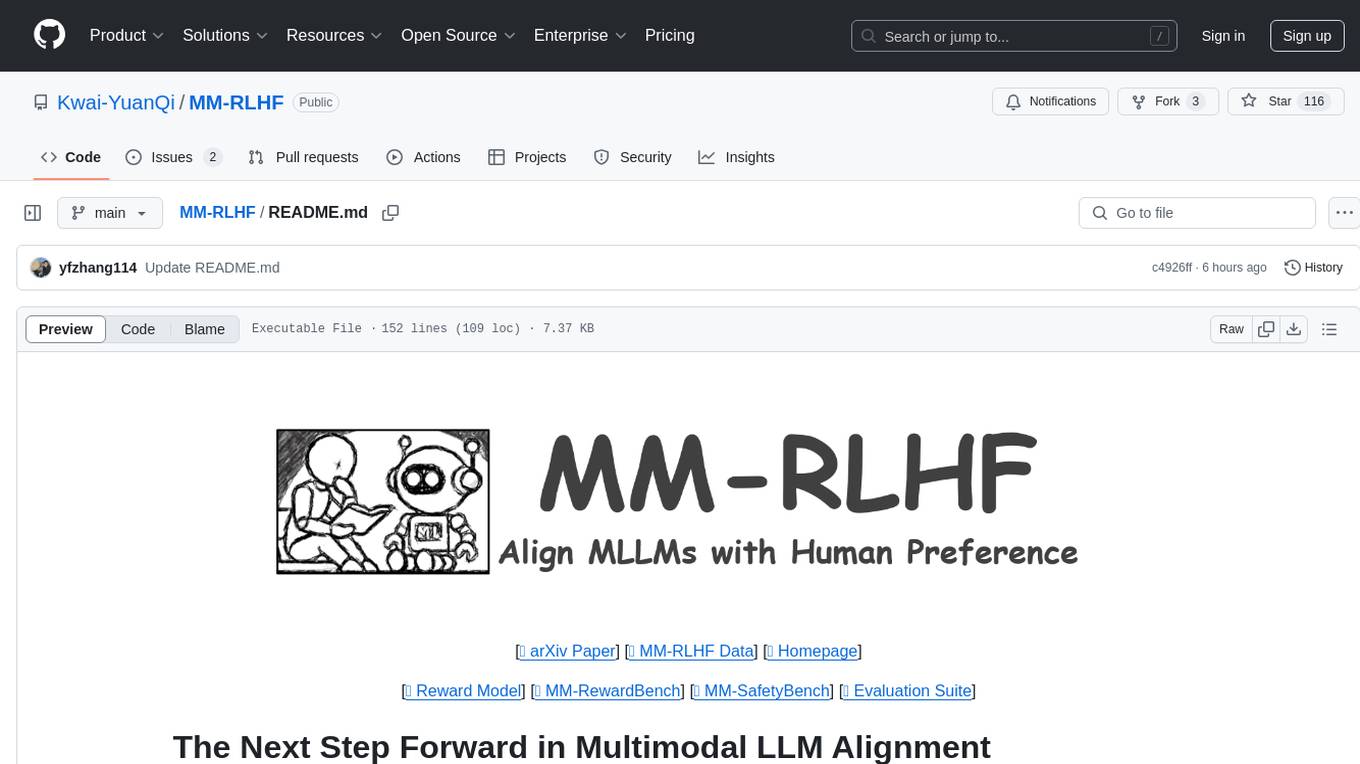
MM-RLHF is a comprehensive project for aligning Multimodal Large Language Models (MLLMs) with human preferences. It includes a high-quality MLLM alignment dataset, a Critique-Based MLLM reward model, a novel alignment algorithm MM-DPO, and benchmarks for reward models and multimodal safety. The dataset covers image understanding, video understanding, and safety-related tasks with model-generated responses and human-annotated scores. The reward model generates critiques of candidate texts before assigning scores for enhanced interpretability. MM-DPO is an alignment algorithm that achieves performance gains with simple adjustments to the DPO framework. The project enables consistent performance improvements across 10 dimensions and 27 benchmarks for open-source MLLMs.
BIRD-CRITIC-1
BIRD-CRITIC 1.0 is a SQL benchmark designed to evaluate the capability of large language models (LLMs) in diagnosing and solving user issues within real-world database environments. It comprises 600 tasks for development and 200 held-out out-of-distribution tests across 4 prominent open-source SQL dialects. The benchmark expands beyond simple SELECT queries to cover a wider range of SQL operations, reflecting actual application scenarios. An optimized execution-based evaluation environment is included for rigorous and efficient validation.
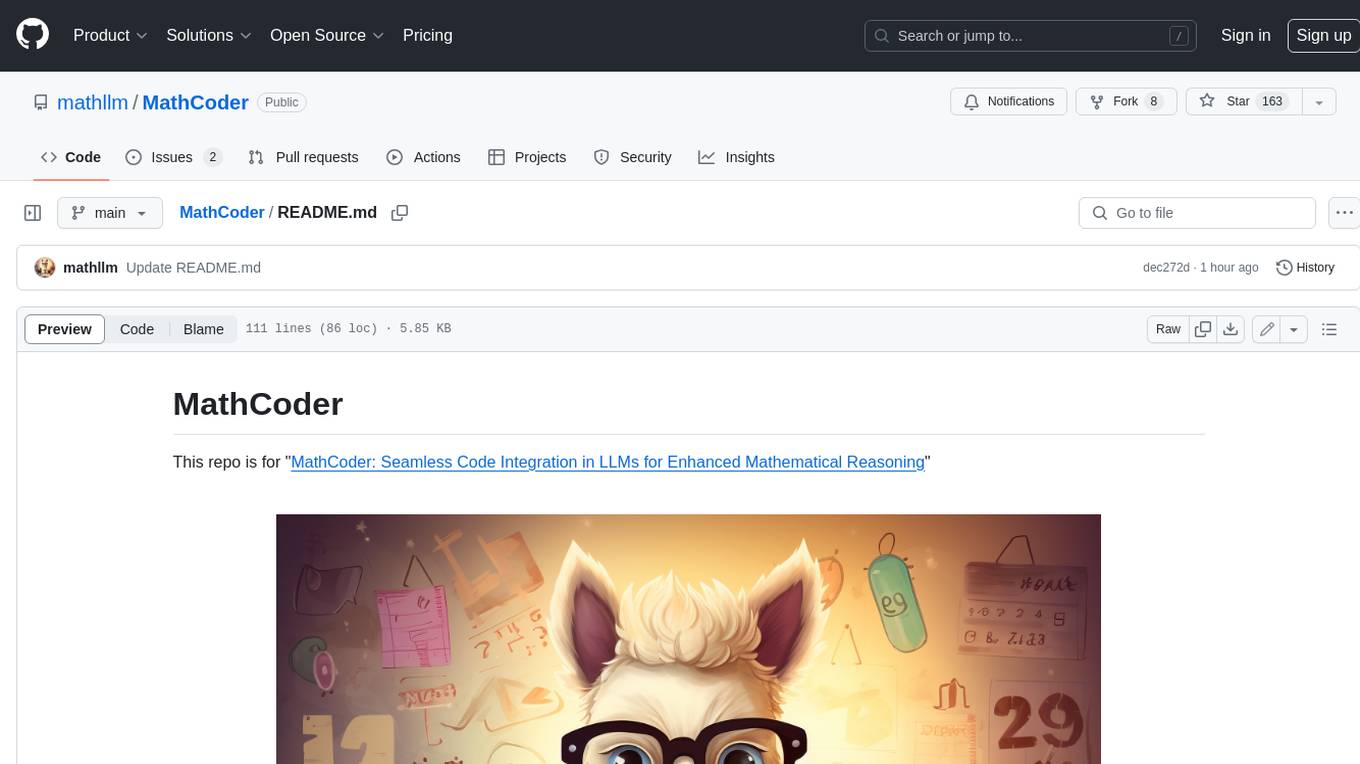
MathCoder
MathCoder is a repository focused on enhancing mathematical reasoning by fine-tuning open-source language models to use code for modeling and deriving math equations. It introduces MathCodeInstruct dataset with solutions interleaving natural language, code, and execution results. The repository provides MathCoder models capable of generating code-based solutions for challenging math problems, achieving state-of-the-art scores on MATH and GSM8K datasets. It offers tools for model deployment, inference, and evaluation, along with a citation for referencing the work.
MathVerse
MathVerse is an all-around visual math benchmark designed to evaluate the capabilities of Multi-modal Large Language Models (MLLMs) in visual math problem-solving. It collects high-quality math problems with diagrams to assess how well MLLMs can understand visual diagrams for mathematical reasoning. The benchmark includes 2,612 problems transformed into six versions each, contributing to 15K test samples. It also introduces a Chain-of-Thought (CoT) Evaluation strategy for fine-grained assessment of output answers.
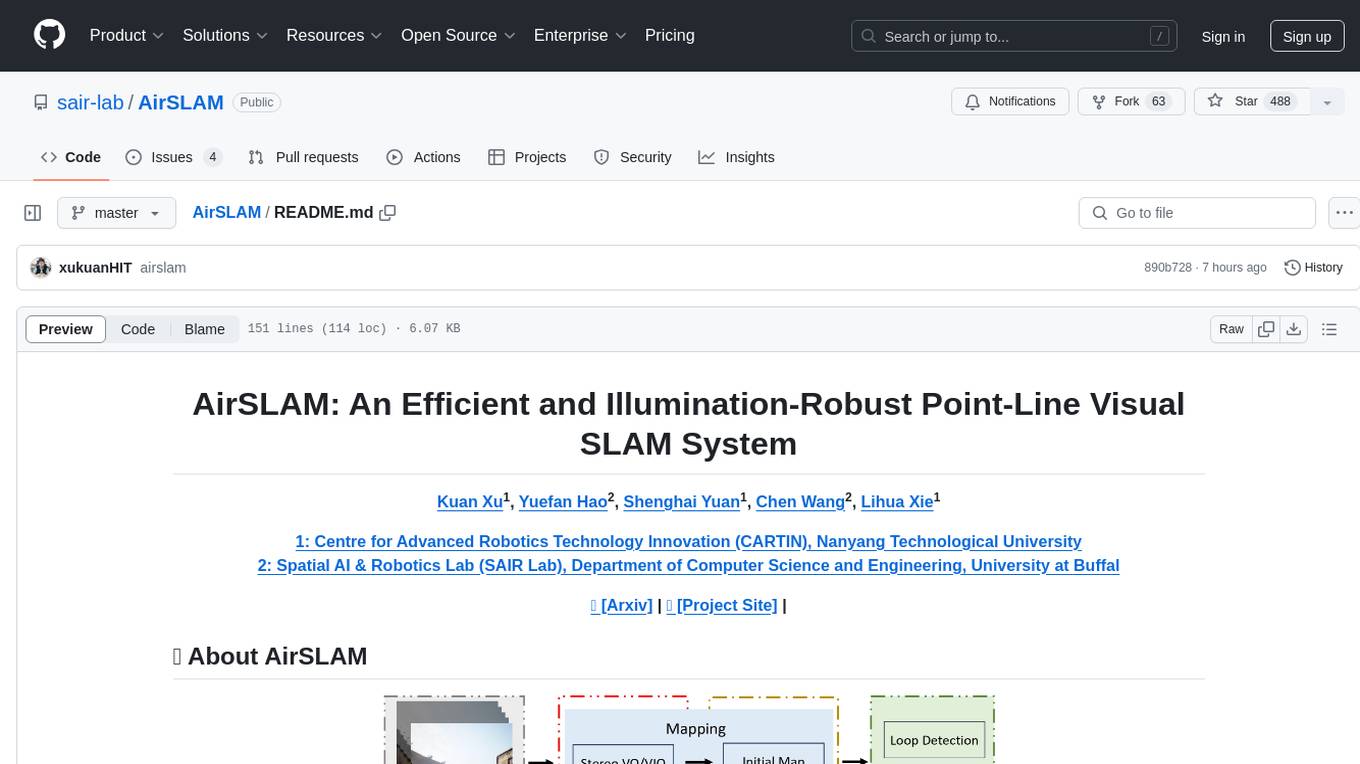
AirSLAM
AirSLAM is an efficient visual SLAM system designed to tackle short-term and long-term illumination challenges. It combines deep learning techniques with traditional optimization methods, featuring a unified CNN for keypoint and structural line extraction. The system includes a relocalization pipeline for map reuse, accelerated using C++ and NVIDIA TensorRT. Outperforming other SLAM systems in challenging environments, it runs at 73Hz on PC and 40Hz on embedded platforms.
crawl4ai
Crawl4AI is a powerful and free web crawling service that extracts valuable data from websites and provides LLM-friendly output formats. It supports crawling multiple URLs simultaneously, replaces media tags with ALT, and is completely free to use and open-source. Users can integrate Crawl4AI into Python projects as a library or run it as a standalone local server. The tool allows users to crawl and extract data from specified URLs using different providers and models, with options to include raw HTML content, force fresh crawls, and extract meaningful text blocks. Configuration settings can be adjusted in the `crawler/config.py` file to customize providers, API keys, chunk processing, and word thresholds. Contributions to Crawl4AI are welcome from the open-source community to enhance its value for AI enthusiasts and developers.

rl
TorchRL is an open-source Reinforcement Learning (RL) library for PyTorch. It provides pytorch and **python-first** , low and high level abstractions for RL that are intended to be **efficient** , **modular** , **documented** and properly **tested**. The code is aimed at supporting research in RL. Most of it is written in python in a highly modular way, such that researchers can easily swap components, transform them or write new ones with little effort.
Mercury
Mercury is a code efficiency benchmark designed for code synthesis tasks. It includes 1,889 programming tasks of varying difficulty levels and provides test case generators for comprehensive evaluation. The benchmark aims to assess the efficiency of large language models in generating code solutions.
EasyInstruct
EasyInstruct is a Python package proposed as an easy-to-use instruction processing framework for Large Language Models (LLMs) like GPT-4, LLaMA, ChatGLM in your research experiments. EasyInstruct modularizes instruction generation, selection, and prompting, while also considering their combination and interaction.
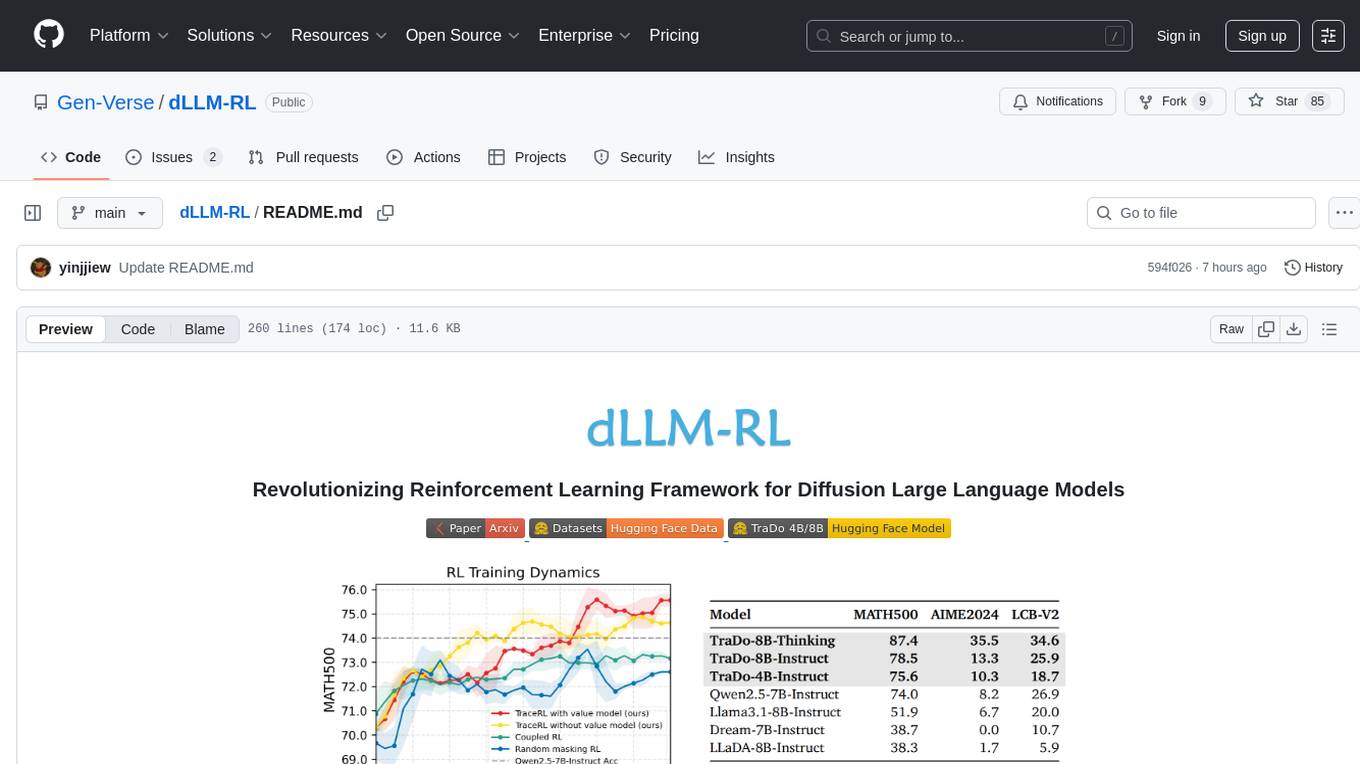
dLLM-RL
dLLM-RL is a revolutionary reinforcement learning framework designed for Diffusion Large Language Models. It supports various models with diverse structures, offers inference acceleration, RL training capabilities, and SFT functionalities. The tool introduces TraceRL for trajectory-aware RL and diffusion-based value models for optimization stability. Users can download and try models like TraDo-4B-Instruct and TraDo-8B-Instruct. The tool also provides support for multi-node setups and easy building of reinforcement learning methods. Additionally, it offers supervised fine-tuning strategies for different models and tasks.
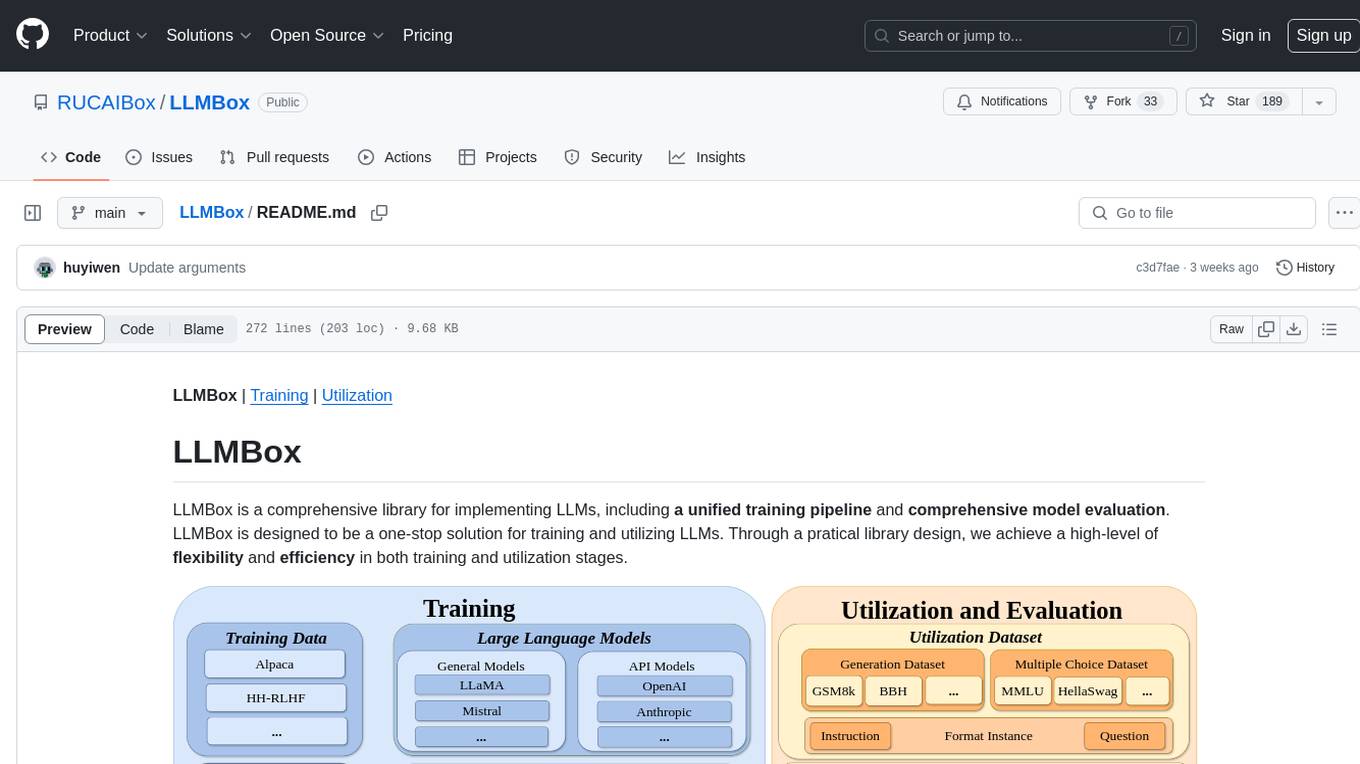
LLMBox
LLMBox is a comprehensive library designed for implementing Large Language Models (LLMs) with a focus on a unified training pipeline and comprehensive model evaluation. It serves as a one-stop solution for training and utilizing LLMs, offering flexibility and efficiency in both training and utilization stages. The library supports diverse training strategies, comprehensive datasets, tokenizer vocabulary merging, data construction strategies, parameter efficient fine-tuning, and efficient training methods. For utilization, LLMBox provides comprehensive evaluation on various datasets, in-context learning strategies, chain-of-thought evaluation, evaluation methods, prefix caching for faster inference, support for specific LLM models like vLLM and Flash Attention, and quantization options. The tool is suitable for researchers and developers working with LLMs for natural language processing tasks.
sdialog
SDialog is an MIT-licensed open-source toolkit for building, simulating, and evaluating LLM-based conversational agents end-to-end. It aims to bridge agent construction, user simulation, dialog generation, and evaluation in a single reproducible workflow, enabling the generation of reliable, controllable dialog systems or data at scale. The toolkit standardizes a Dialog schema, offers persona-driven multi-agent simulation with LLMs, provides composable orchestration for precise control over behavior and flow, includes built-in evaluation metrics, and offers mechanistic interpretability. It allows for easy creation of user-defined components and interoperability across various AI platforms.
holisticai
Holistic AI is an open-source library dedicated to assessing and improving the trustworthiness of AI systems. It focuses on measuring and mitigating bias, explainability, robustness, security, and efficacy in AI models. The tool provides comprehensive metrics, mitigation techniques, a user-friendly interface, and visualization tools to enhance AI system trustworthiness. It offers documentation, tutorials, and detailed installation instructions for easy integration into existing workflows.
CyberStrikeAI
CyberStrikeAI is an AI-native security testing platform built in Go that integrates 100+ security tools, an intelligent orchestration engine, role-based testing with predefined security roles, a skills system with specialized testing skills, and comprehensive lifecycle management capabilities. It enables end-to-end automation from conversational commands to vulnerability discovery, attack-chain analysis, knowledge retrieval, and result visualization, delivering an auditable, traceable, and collaborative testing environment for security teams. The platform features an AI decision engine with OpenAI-compatible models, native MCP implementation with various transports, prebuilt tool recipes, large-result pagination, attack-chain graph, password-protected web UI, knowledge base with vector search, vulnerability management, batch task management, role-based testing, and skills system.
For similar tasks
llmxcpg
LLMxCPG is a framework for vulnerability detection using Code Property Graphs (CPG) and Large Language Models (LLM). It involves a two-phase process: Slice Construction where an LLM generates queries for a CPG to extract a code slice, and Vulnerability Detection where another LLM classifies the code slice as vulnerable or safe. The repository includes implementations of baseline models, information on datasets, scripts for running models, prompt templates, query generation examples, and configurations for fine-tuning models.
watchtower
AIShield Watchtower is a tool designed to fortify the security of AI/ML models and Jupyter notebooks by automating model and notebook discoveries, conducting vulnerability scans, and categorizing risks into 'low,' 'medium,' 'high,' and 'critical' levels. It supports scanning of public GitHub repositories, Hugging Face repositories, AWS S3 buckets, and local systems. The tool generates comprehensive reports, offers a user-friendly interface, and aligns with industry standards like OWASP, MITRE, and CWE. It aims to address the security blind spots surrounding Jupyter notebooks and AI models, providing organizations with a tailored approach to enhancing their security efforts.
LLM-PLSE-paper
LLM-PLSE-paper is a repository focused on the applications of Large Language Models (LLMs) in Programming Language and Software Engineering (PL/SE) domains. It covers a wide range of topics including bug detection, specification inference and verification, code generation, fuzzing and testing, code model and reasoning, code understanding, IDE technologies, prompting for reasoning tasks, and agent/tool usage and planning. The repository provides a comprehensive collection of research papers, benchmarks, empirical studies, and frameworks related to the capabilities of LLMs in various PL/SE tasks.
invariant
Invariant Analyzer is an open-source scanner designed for LLM-based AI agents to find bugs, vulnerabilities, and security threats. It scans agent execution traces to identify issues like looping behavior, data leaks, prompt injections, and unsafe code execution. The tool offers a library of built-in checkers, an expressive policy language, data flow analysis, real-time monitoring, and extensible architecture for custom checkers. It helps developers debug AI agents, scan for security violations, and prevent security issues and data breaches during runtime. The analyzer leverages deep contextual understanding and a purpose-built rule matching engine for security policy enforcement.
OpenRedTeaming
OpenRedTeaming is a repository focused on red teaming for generative models, specifically large language models (LLMs). The repository provides a comprehensive survey on potential attacks on GenAI and robust safeguards. It covers attack strategies, evaluation metrics, benchmarks, and defensive approaches. The repository also implements over 30 auto red teaming methods. It includes surveys, taxonomies, attack strategies, and risks related to LLMs. The goal is to understand vulnerabilities and develop defenses against adversarial attacks on large language models.
Awesome-LLM4Cybersecurity
The repository 'Awesome-LLM4Cybersecurity' provides a comprehensive overview of the applications of Large Language Models (LLMs) in cybersecurity. It includes a systematic literature review covering topics such as constructing cybersecurity-oriented domain LLMs, potential applications of LLMs in cybersecurity, and research directions in the field. The repository analyzes various benchmarks, datasets, and applications of LLMs in cybersecurity tasks like threat intelligence, fuzzing, vulnerabilities detection, insecure code generation, program repair, anomaly detection, and LLM-assisted attacks.
quark-engine
Quark Engine is an AI-powered tool designed for analyzing Android APK files. It focuses on enhancing the detection process for auto-suggestion, enabling users to create detection workflows without coding. The tool offers an intuitive drag-and-drop interface for workflow adjustments and updates. Quark Agent, the core component, generates Quark Script code based on natural language input and feedback. The project is committed to providing a user-friendly experience for designing detection workflows through textual and visual methods. Various features are still under development and will be rolled out gradually.
vulnerability-analysis
The NVIDIA AI Blueprint for Vulnerability Analysis for Container Security showcases accelerated analysis on common vulnerabilities and exposures (CVE) at an enterprise scale, reducing mitigation time from days to seconds. It enables security analysts to determine software package vulnerabilities using large language models (LLMs) and retrieval-augmented generation (RAG). The blueprint is designed for security analysts, IT engineers, and AI practitioners in cybersecurity. It requires NVAIE developer license and API keys for vulnerability databases, search engines, and LLM model services. Hardware requirements include L40 GPU for pipeline operation and optional LLM NIM and Embedding NIM. The workflow involves LLM pipeline for CVE impact analysis, utilizing LLM planner, agent, and summarization nodes. The blueprint uses NVIDIA NIM microservices and Morpheus Cybersecurity AI SDK for vulnerability analysis.
For similar jobs
last_layer
last_layer is a security library designed to protect LLM applications from prompt injection attacks, jailbreaks, and exploits. It acts as a robust filtering layer to scrutinize prompts before they are processed by LLMs, ensuring that only safe and appropriate content is allowed through. The tool offers ultra-fast scanning with low latency, privacy-focused operation without tracking or network calls, compatibility with serverless platforms, advanced threat detection mechanisms, and regular updates to adapt to evolving security challenges. It significantly reduces the risk of prompt-based attacks and exploits but cannot guarantee complete protection against all possible threats.
aircrack-ng
Aircrack-ng is a comprehensive suite of tools designed to evaluate the security of WiFi networks. It covers various aspects of WiFi security, including monitoring, attacking (replay attacks, deauthentication, fake access points), testing WiFi cards and driver capabilities, and cracking WEP and WPA PSK. The tools are command line-based, allowing for extensive scripting and have been utilized by many GUIs. Aircrack-ng primarily works on Linux but also supports Windows, macOS, FreeBSD, OpenBSD, NetBSD, Solaris, and eComStation 2.
reverse-engineering-assistant
ReVA (Reverse Engineering Assistant) is a project aimed at building a disassembler agnostic AI assistant for reverse engineering tasks. It utilizes a tool-driven approach, providing small tools to the user to empower them in completing complex tasks. The assistant is designed to accept various inputs, guide the user in correcting mistakes, and provide additional context to encourage exploration. Users can ask questions, perform tasks like decompilation, class diagram generation, variable renaming, and more. ReVA supports different language models for online and local inference, with easy configuration options. The workflow involves opening the RE tool and program, then starting a chat session to interact with the assistant. Installation includes setting up the Python component, running the chat tool, and configuring the Ghidra extension for seamless integration. ReVA aims to enhance the reverse engineering process by breaking down actions into small parts, including the user's thoughts in the output, and providing support for monitoring and adjusting prompts.
AutoAudit
AutoAudit is an open-source large language model specifically designed for the field of network security. It aims to provide powerful natural language processing capabilities for security auditing and network defense, including analyzing malicious code, detecting network attacks, and predicting security vulnerabilities. By coupling AutoAudit with ClamAV, a security scanning platform has been created for practical security audit applications. The tool is intended to assist security professionals with accurate and fast analysis and predictions to combat evolving network threats.
aif
Arno's Iptables Firewall (AIF) is a single- & multi-homed firewall script with DSL/ADSL support. It is a free software distributed under the GNU GPL License. The script provides a comprehensive set of configuration files and plugins for setting up and managing firewall rules, including support for NAT, load balancing, and multirouting. It offers detailed instructions for installation and configuration, emphasizing security best practices and caution when modifying settings. The script is designed to protect against hostile attacks by blocking all incoming traffic by default and allowing users to configure specific rules for open ports and network interfaces.
watchtower
AIShield Watchtower is a tool designed to fortify the security of AI/ML models and Jupyter notebooks by automating model and notebook discoveries, conducting vulnerability scans, and categorizing risks into 'low,' 'medium,' 'high,' and 'critical' levels. It supports scanning of public GitHub repositories, Hugging Face repositories, AWS S3 buckets, and local systems. The tool generates comprehensive reports, offers a user-friendly interface, and aligns with industry standards like OWASP, MITRE, and CWE. It aims to address the security blind spots surrounding Jupyter notebooks and AI models, providing organizations with a tailored approach to enhancing their security efforts.
Academic_LLM_Sec_Papers
Academic_LLM_Sec_Papers is a curated collection of academic papers related to LLM Security Application. The repository includes papers sorted by conference name and published year, covering topics such as large language models for blockchain security, software engineering, machine learning, and more. Developers and researchers are welcome to contribute additional published papers to the list. The repository also provides information on listed conferences and journals related to security, networking, software engineering, and cryptography. The papers cover a wide range of topics including privacy risks, ethical concerns, vulnerabilities, threat modeling, code analysis, fuzzing, and more.
DeGPT
DeGPT is a tool designed to optimize decompiler output using Large Language Models (LLM). It requires manual installation of specific packages and setting up API key for OpenAI. The tool provides functionality to perform optimization on decompiler output by running specific scripts.