


codewalk
A native (really fast!!) cross-platform client for OpenCode
Stars: 102
CodeWalk is a native cross-platform client for OpenCode server mode, built with Flutter. It provides an AI chat interface for coding interactions, multi-server profile management, session lifecycle management, worktree management, speech-to-text input, and more. The project follows Clean Architecture with Flutter, Dart, Provider for state management, Dio for HTTP client, SharedPreferences for local storage, GetIt for dependency injection, and Material Design 3 for design system.
README:

A native (really fast!!) cross-platform client for OpenCode server mode. Built with Flutter, it provides a conversational interface for session-based AI coding interactions over HTTP APIs and streaming events.
- AI chat interface with streaming responses and realtime event sync (SSE)
- Multi-server profile management (add, edit, remove, switch, health checks)
- Multi-provider and model selection with variant/reasoning effort controls
- Session lifecycle (create, rename, archive, fork, share, delete)
- Project/workspace context switching with directory-scoped state isolation
- Worktree management (create, reset, delete)
- Image and PDF attachments with model capability gating
- Speech-to-text voice input
- Interactive permission and question prompts from the server
- Chat-first layout with responsive sidebar (mobile drawer, desktop split view)
- Desktop keyboard shortcuts (
Ctrl/Cmd + N,Ctrl/Cmd + R,Ctrl/Cmd + L,Esc) - Markdown rendering with syntax highlighting and text selection
- Material Design 3 theming
- Cross-platform: Linux, Windows, macOS, Web, Android
Install using the install.cat pattern:
-
Linux & macOS
curl -fsSL install.cat/verseles/codewalk | sh -
Windows (PowerShell)
irm install.cat/verseles/codewalk | iex
Run the same command again any time to update/reinstall to the latest GitHub release.
Installers automatically select the best artifact for your OS/CPU:
- Linux:
x64andarm64 - Windows:
x64andarm64(ARM64 falls back to x64 when needed) - macOS:
x64andarm64
Release assets are published per OS/architecture (no universal desktop archive).
-
Linux & macOS
curl -fsSL https://raw.githubusercontent.com/verseles/codewalk/main/uninstall.sh | sh -
Windows (PowerShell)
irm https://raw.githubusercontent.com/verseles/codewalk/main/uninstall.ps1 | iex
- Flutter SDK (>=3.8.1)
- Dart SDK
- An OpenCode-compatible server instance
- Platform toolchain for your target:
- Linux desktop:
clang,cmake,ninja,pkg-config - Windows desktop: build from a Windows host
- macOS desktop: build from a macOS host
- Linux desktop:
-
Install dependencies:
flutter pub get
-
Run the app (examples):
flutter run -d linux
flutter run -d chrome
flutter run -d android
-
Build artifacts (examples):
flutter build linux
flutter build web
make check      # deps + codegen + analyze + test
make android    # build arm64 APK
make precommit # check + android- Launch the app and open Settings from the sidebar
- Tap Add Server and run the Quick setup command in your terminal
- Keep the default
Server URL(http://127.0.0.1:4096) or set your server URL - Configure Basic Auth only if your server requires it
- Save and switch active/default profiles as needed
The project follows Clean Architecture with three layers: Domain, Data, and Presentation. Dependency injection via get_it, HTTP via dio, state management via provider.
For full technical details, see CODEBASE.md.
- Framework: Flutter
- Language: Dart
- State Management: Provider
- HTTP Client: Dio
- Local Storage: SharedPreferences
- Dependency Injection: GetIt
- Design System: Material Design 3
This project is dual-licensed:
- Open Source: GNU Affero General Public License v3.0 (AGPLv3) -- free for everyone.
- Commercial: A separate commercial license is available for organizations with annual revenue exceeding USD 500M that wish to use the software without AGPLv3 obligations.
CodeWalk is a fork of OpenMode, originally created by easychen. The original project is licensed under MIT.
Substantial modifications have been made since the fork, including licensing changes, code restructuring, rebranding, full English standardization, and documentation rewrites. All modifications are licensed under AGPLv3 (or the commercial license, where applicable).
See NOTICE for full attribution details.
For Tasks:
Click tags to check more tools for each tasksFor Jobs:
Alternative AI tools for codewalk
Similar Open Source Tools
codewalk
CodeWalk is a native cross-platform client for OpenCode server mode, built with Flutter. It provides an AI chat interface for coding interactions, multi-server profile management, session lifecycle management, worktree management, speech-to-text input, and more. The project follows Clean Architecture with Flutter, Dart, Provider for state management, Dio for HTTP client, SharedPreferences for local storage, GetIt for dependency injection, and Material Design 3 for design system.
aiaio
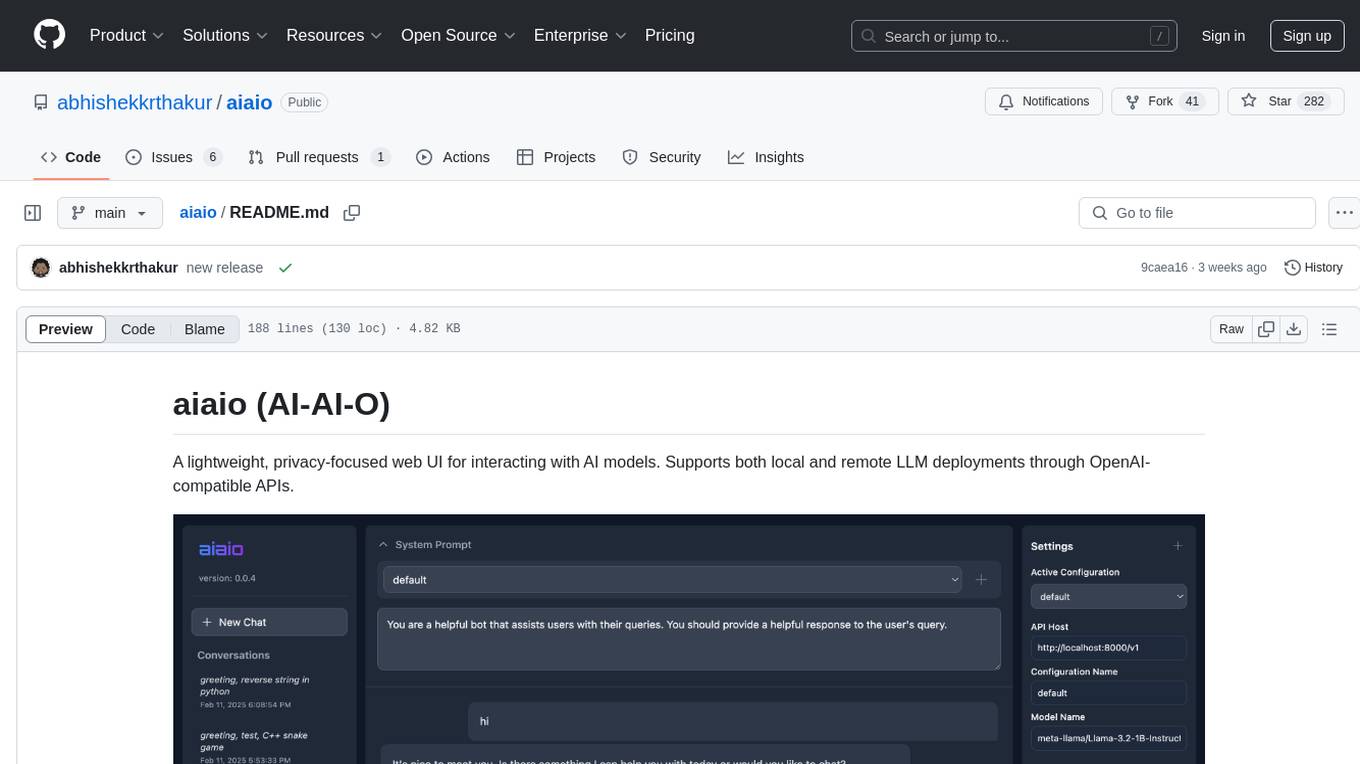
aiaio (AI-AI-O) is a lightweight, privacy-focused web UI for interacting with AI models. It supports both local and remote LLM deployments through OpenAI-compatible APIs. The tool provides features such as dark/light mode support, local SQLite database for conversation storage, file upload and processing, configurable model parameters through UI, privacy-focused design, responsive design for mobile/desktop, syntax highlighting for code blocks, real-time conversation updates, automatic conversation summarization, customizable system prompts, WebSocket support for real-time updates, Docker support for deployment, multiple API endpoint support, and multiple system prompt support. Users can configure model parameters and API settings through the UI, handle file uploads, manage conversations, and use keyboard shortcuts for efficient interaction. The tool uses SQLite for storage with tables for conversations, messages, attachments, and settings. Contributions to the project are welcome under the Apache License 2.0.
VibeSurf
VibeSurf is an open-source AI agentic browser that combines workflow automation with intelligent AI agents, offering faster, cheaper, and smarter browser automation. It allows users to create revolutionary browser workflows, run multiple AI agents in parallel, perform intelligent AI automation tasks, maintain privacy with local LLM support, and seamlessly integrate as a Chrome extension. Users can save on token costs, achieve efficiency gains, and enjoy deterministic workflows for consistent and accurate results. VibeSurf also provides a Docker image for easy deployment and offers pre-built workflow templates for common tasks.
BodhiApp
Bodhi App runs Open Source Large Language Models locally, exposing LLM inference capabilities as OpenAI API compatible REST APIs. It leverages llama.cpp for GGUF format models and huggingface.co ecosystem for model downloads. Users can run fine-tuned models for chat completions, create custom aliases, and convert Huggingface models to GGUF format. The CLI offers commands for environment configuration, model management, pulling files, serving API, and more.
qwery-core
Qwery is a platform for querying and visualizing data using natural language without technical knowledge. It seamlessly integrates with various datasources, generates optimized queries, and delivers outcomes like result sets, dashboards, and APIs. Features include natural language querying, multi-database support, AI-powered agents, visual data apps, desktop & cloud options, template library, and extensibility through plugins. The project is under active development and not yet suitable for production use.
gitdiagram
GitDiagram is a tool that turns any GitHub repository into an interactive diagram for visualization in seconds. It offers instant visualization, interactivity, fast generation, customization, and API access. The tool utilizes a tech stack including Next.js, FastAPI, PostgreSQL, Claude 3.5 Sonnet, Vercel, EC2, GitHub Actions, PostHog, and Api-Analytics. Users can self-host the tool for local development and contribute to its development. GitDiagram is inspired by Gitingest and has future plans to use larger context models, allow user API key input, implement RAG with Mermaid.js docs, and include font-awesome icons in diagrams.
backend.ai
Backend.AI is a streamlined, container-based computing cluster platform that hosts popular computing/ML frameworks and diverse programming languages, with pluggable heterogeneous accelerator support including CUDA GPU, ROCm GPU, TPU, IPU and other NPUs. It allocates and isolates the underlying computing resources for multi-tenant computation sessions on-demand or in batches with customizable job schedulers with its own orchestrator. All its functions are exposed as REST/GraphQL/WebSocket APIs.
company-research-agent
Agentic Company Researcher is a multi-agent tool that generates comprehensive company research reports by utilizing a pipeline of AI agents to gather, curate, and synthesize information from various sources. It features multi-source research, AI-powered content filtering, real-time progress streaming, dual model architecture, modern React frontend, and modular architecture. The tool follows an agentic framework with specialized research and processing nodes, leverages separate models for content generation, uses a content curation system for relevance scoring and document processing, and implements a real-time communication system via WebSocket connections. Users can set up the tool quickly using the provided setup script or manually, and it can also be deployed using Docker and Docker Compose. The application can be used for local development and deployed to various cloud platforms like AWS Elastic Beanstalk, Docker, Heroku, and Google Cloud Run.
Notate
Notate is a powerful desktop research assistant that combines AI-driven analysis with advanced vector search technology. It streamlines research workflow by processing, organizing, and retrieving information from documents, audio, and text. Notate offers flexible AI capabilities with support for various LLM providers and local models, ensuring data privacy. Built for researchers, academics, and knowledge workers, it features real-time collaboration, accessible UI, and cross-platform compatibility.
CrewAI-Studio
CrewAI Studio is an application with a user-friendly interface for interacting with CrewAI, offering support for multiple platforms and various backend providers. It allows users to run crews in the background, export single-page apps, and use custom tools for APIs and file writing. The roadmap includes features like better import/export, human input, chat functionality, automatic crew creation, and multiuser environment support.
chunkr
Chunkr is an open-source document intelligence API that provides a production-ready service for document layout analysis, OCR, and semantic chunking. It allows users to convert PDFs, PPTs, Word docs, and images into RAG/LLM-ready chunks. The API offers features such as layout analysis, OCR with bounding boxes, structured HTML and markdown output, and VLM processing controls. Users can interact with Chunkr through a Python SDK, enabling them to upload documents, process them, and export results in various formats. The tool also supports self-hosted deployment options using Docker Compose or Kubernetes, with configurations for different AI models like OpenAI, Google AI Studio, and OpenRouter. Chunkr is dual-licensed under the GNU Affero General Public License v3.0 (AGPL-3.0) and a commercial license, providing flexibility for different usage scenarios.
Visionatrix
Visionatrix is a project aimed at providing easy use of ComfyUI workflows. It offers simplified setup and update processes, a minimalistic UI for daily workflow use, stable workflows with versioning and update support, scalability for multiple instances and task workers, multiple user support with integration of different user backends, LLM power for integration with Ollama/Gemini, and seamless integration as a service with backend endpoints and webhook support. The project is approaching version 1.0 release and welcomes new ideas for further implementation.
OpenAlice
Open Alice is an AI trading agent that provides users with their own research desk, quant team, trading floor, and risk management, all running on their laptop 24/7. It is file-driven, reasoning-driven, and OS-native, allowing interactions with the operating system. Features include dual AI providers, crypto trading, securities trading, market analysis, cognitive state, event log, cron scheduling, evolution mode, and a web UI. The architecture includes providers, core components, extensions, tasks, and interfaces. Users can quickly start by setting up prerequisites, AI providers, crypto trading, securities trading, environment variables, and running the tool. Configuration files, project structure, and license information are also provided.
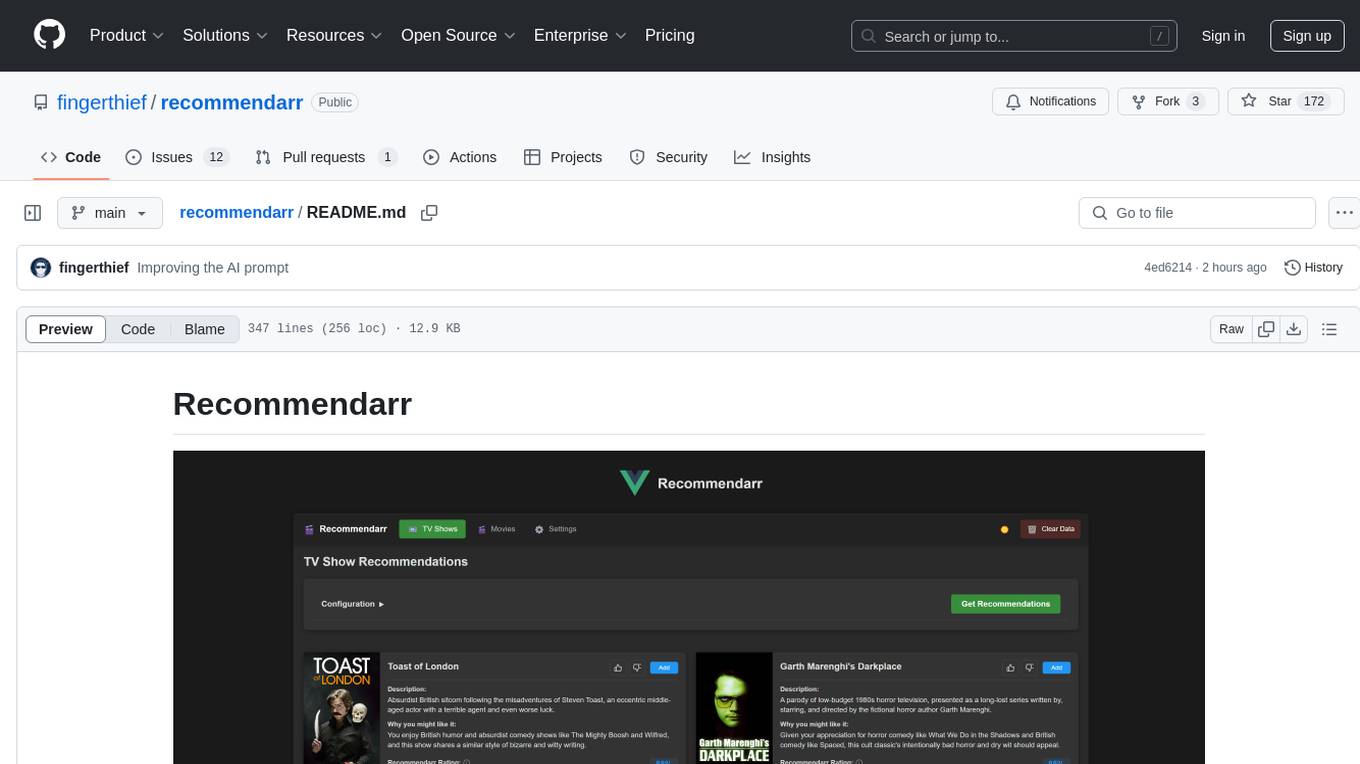
recommendarr
Recommendarr is a tool that generates personalized TV show and movie recommendations based on your Sonarr, Radarr, Plex, and Jellyfin libraries using AI. It offers AI-powered recommendations, media server integration, flexible AI support, watch history analysis, customization options, and dark/light mode toggle. Users can connect their media libraries and watch history services, configure AI service settings, and get personalized recommendations based on genre, language, and mood/vibe preferences. The tool works with any OpenAI-compatible API and offers various recommended models for different cost options and performance levels. It provides personalized suggestions, detailed information, filter options, watch history analysis, and one-click adding of recommended content to Sonarr/Radarr.
chat
Full-featured AI Chatbot Nuxt application with authentication, chat history, multiple pages, collapsible sidebar, keyboard shortcuts, light & dark mode, command palette and more. Built using Nuxt UI components and integrated with AI SDK v5 for a complete chat experience. Features include streaming AI messages, multiple model support via various AI providers, authentication via nuxt-auth-utils, chat history persistence using PostgreSQL database and Drizzle ORM, easy deploy to Vercel with zero configuration. The application is configured to use Vercel AI Gateway providing a unified API to access hundreds of AI models through a single endpoint with features like high reliability, spend monitoring, load balancing, and automatic retries and fallbacks between providers.
exo
Run your own AI cluster at home with everyday devices. Exo is experimental software that unifies existing devices into a powerful GPU, supporting wide model compatibility, dynamic model partitioning, automatic device discovery, ChatGPT-compatible API, and device equality. It does not use a master-worker architecture, allowing devices to connect peer-to-peer. Exo supports different partitioning strategies like ring memory weighted partitioning. Installation is recommended from source. Documentation includes example usage on multiple MacOS devices and information on inference engines and networking modules. Known issues include the iOS implementation lagging behind Python.
For similar tasks
codewalk
CodeWalk is a native cross-platform client for OpenCode server mode, built with Flutter. It provides an AI chat interface for coding interactions, multi-server profile management, session lifecycle management, worktree management, speech-to-text input, and more. The project follows Clean Architecture with Flutter, Dart, Provider for state management, Dio for HTTP client, SharedPreferences for local storage, GetIt for dependency injection, and Material Design 3 for design system.
geti-sdk
The Intel® Geti™ SDK is a python package that enables teams to rapidly develop AI models by easing the complexities of model development and enhancing collaboration between teams. It provides tools to interact with an Intel® Geti™ server via the REST API, allowing for project creation, downloading, uploading, deploying for local inference with OpenVINO, setting project and model configuration, launching and monitoring training jobs, and media upload and prediction. The SDK also includes tutorial-style Jupyter notebooks demonstrating its usage.
lms
The `lms` Command Line Tool for LM Studio is a powerful tool built with `lmstudio.js` that allows users to interact with LM Studio functionalities through the command line interface. It provides a wide range of commands for managing models, starting and stopping servers, creating projects, and streaming logs. Users can easily bootstrap the tool and access detailed information about each subcommand. The tool is designed to enhance the user experience and streamline workflows when working with LM Studio.
geti-sdk
The Intel® Geti™ SDK is a python package that enables teams to rapidly develop AI models by easing the complexities of model development and fostering collaboration. It provides tools to interact with an Intel® Geti™ server via the REST API, allowing for project creation, downloading, uploading, deploying for local inference with OpenVINO, configuration management, training job monitoring, media upload, and prediction. The repository also includes tutorial-style Jupyter notebooks demonstrating SDK usage.
modelence
Modelence is an all-in-one TypeScript framework for startups shipping production apps, aiming to eliminate boilerplate for standard web app features. It provides authentication, database setup, cron jobs, AI observability, and email functionalities. Modelence requires Node.js 20.20 or higher. Developers can create projects, install dependencies, and start the development server quickly. For local development, contributors can clone the repository, install dependencies, build the package, and test changes in a real application. Modelence offers examples for further guidance.
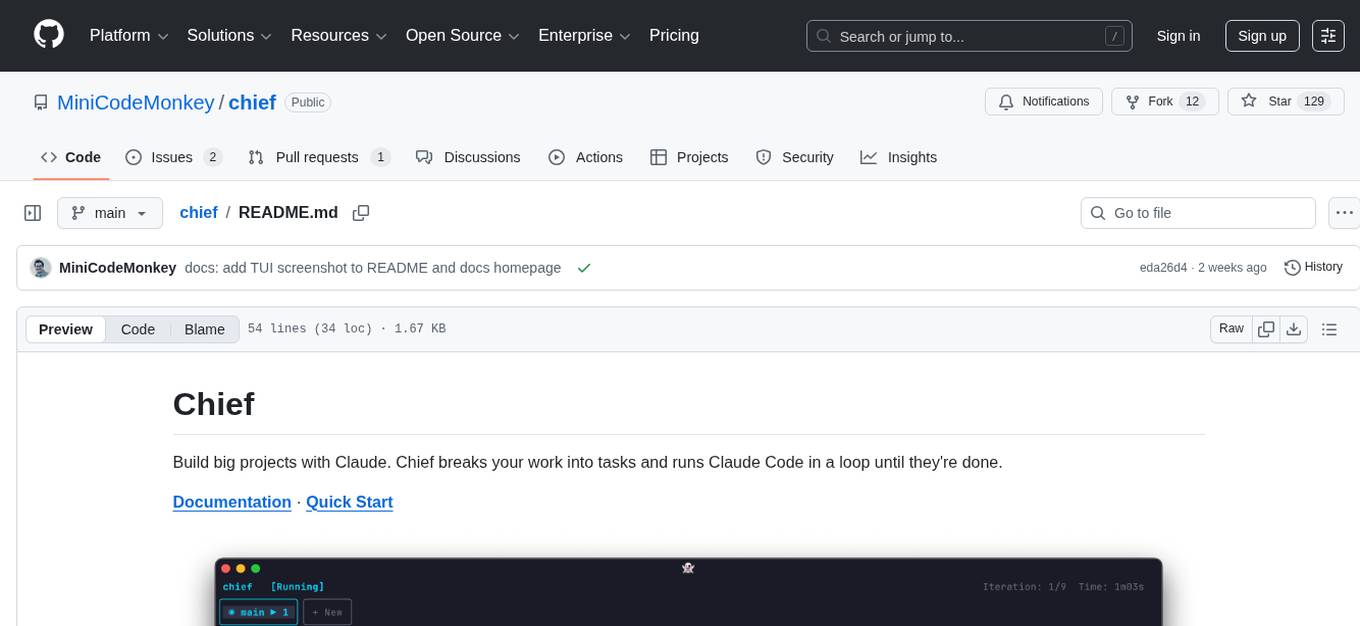
chief
Chief is a tool designed to help users build big projects by breaking work into tasks and running Claude Code in a loop until they're done. It allows users to describe their projects as a series of tasks, with Chief running Claude one task at a time and committing changes per task to maintain a clean git history. Chief is ideal for managing large projects efficiently and collaboratively.
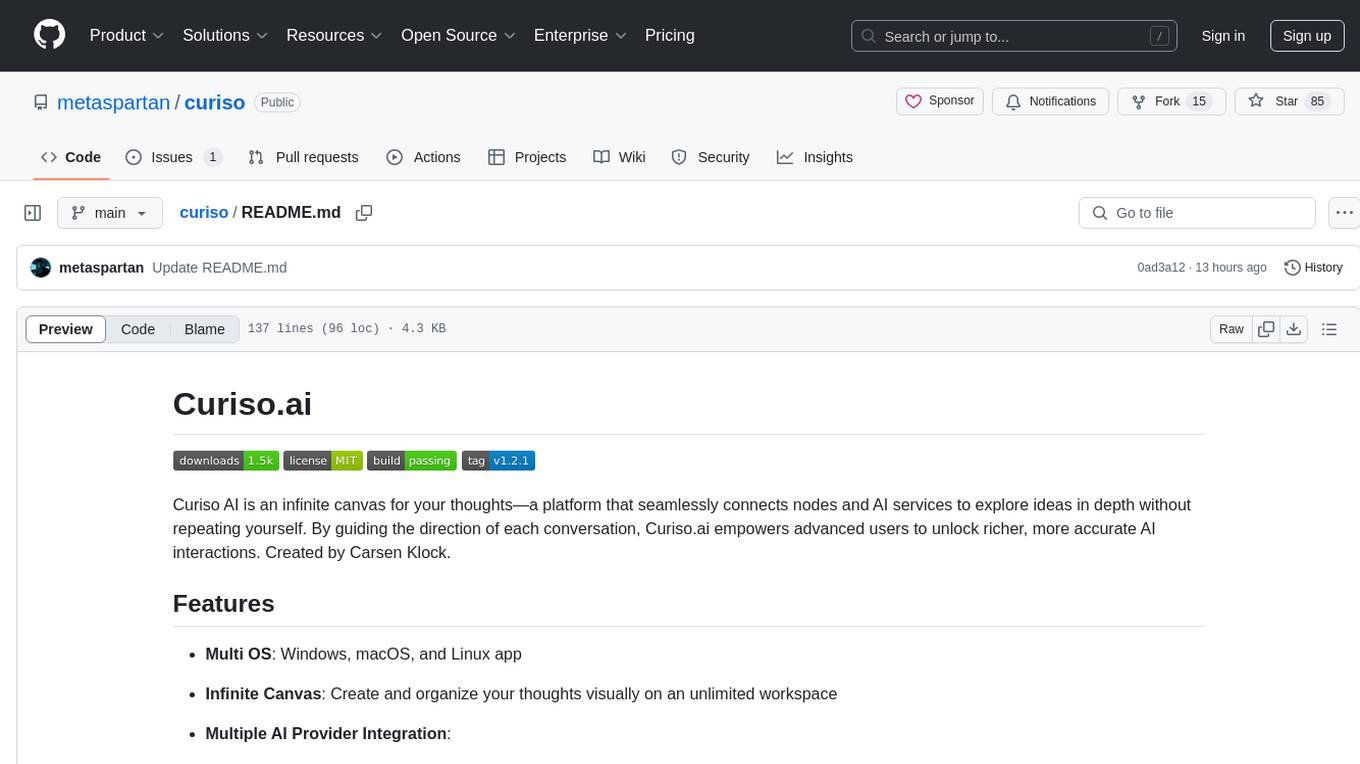
curiso
Curiso AI is an infinite canvas platform that connects nodes and AI services to explore ideas without repetition. It empowers advanced users to unlock richer AI interactions. Features include multi OS support, infinite canvas, multiple AI provider integration, local AI inference provider integration, custom model support, model metrics, RAG support, local Transformers.js embedding models, inference parameters customization, multiple boards, vision model support, customizable interface, node-based conversations, and secure local encrypted storage. Curiso also offers a Solana token for exclusive access to premium features and enhanced AI capabilities.
software-agent-sdk
The OpenHands Software Agent SDK is a set of Python and REST APIs for building agents that work with code. It allows users to perform one-off tasks, routine maintenance tasks, and major tasks involving multiple agents. Agents can use the local machine or run in ephemeral workspaces like Docker or Kubernetes. The SDK can also be used to create new developer experiences, powering tools like the OpenHands CLI and OpenHands Cloud.
For similar jobs
sweep
Sweep is an AI junior developer that turns bugs and feature requests into code changes. It automatically handles developer experience improvements like adding type hints and improving test coverage.
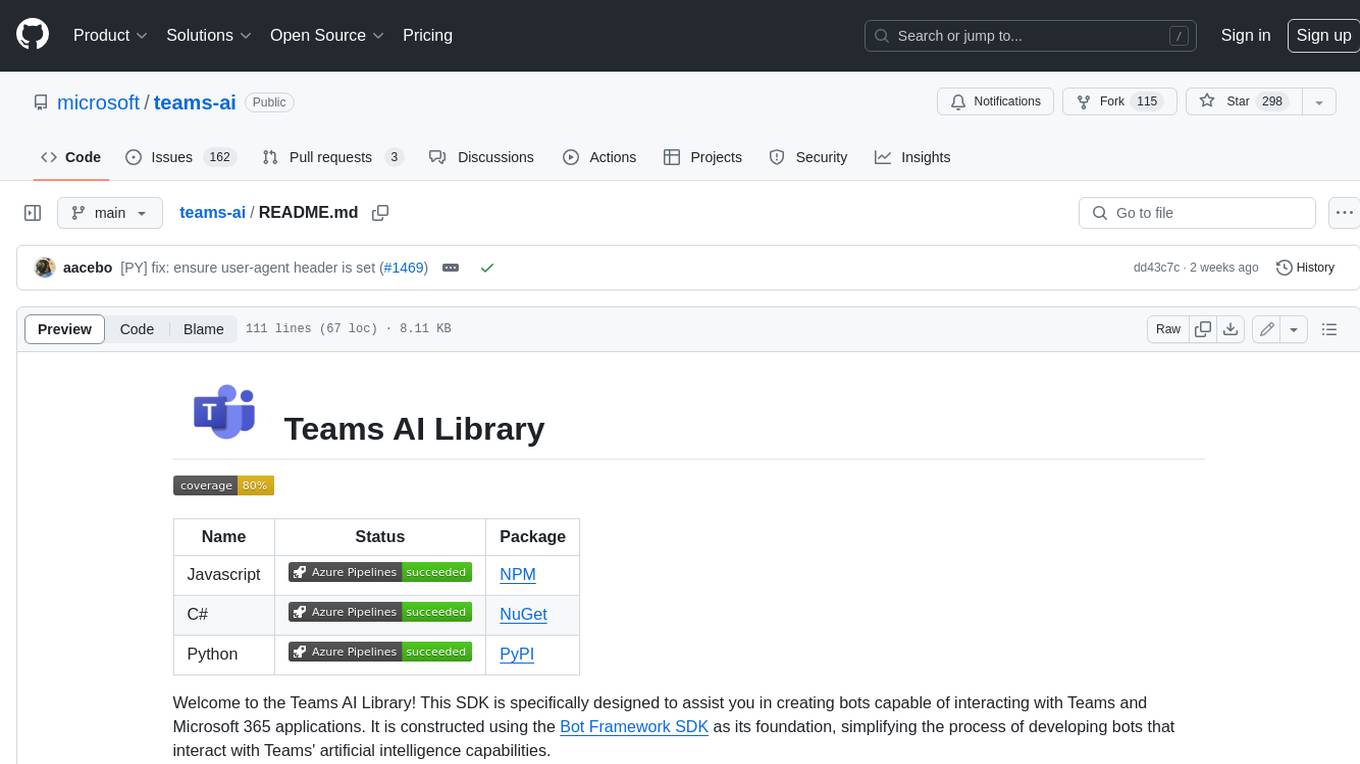
teams-ai
The Teams AI Library is a software development kit (SDK) that helps developers create bots that can interact with Teams and Microsoft 365 applications. It is built on top of the Bot Framework SDK and simplifies the process of developing bots that interact with Teams' artificial intelligence capabilities. The SDK is available for JavaScript/TypeScript, .NET, and Python.
ai-guide
This guide is dedicated to Large Language Models (LLMs) that you can run on your home computer. It assumes your PC is a lower-end, non-gaming setup.
classifai
Supercharge WordPress Content Workflows and Engagement with Artificial Intelligence. Tap into leading cloud-based services like OpenAI, Microsoft Azure AI, Google Gemini and IBM Watson to augment your WordPress-powered websites. Publish content faster while improving SEO performance and increasing audience engagement. ClassifAI integrates Artificial Intelligence and Machine Learning technologies to lighten your workload and eliminate tedious tasks, giving you more time to create original content that matters.
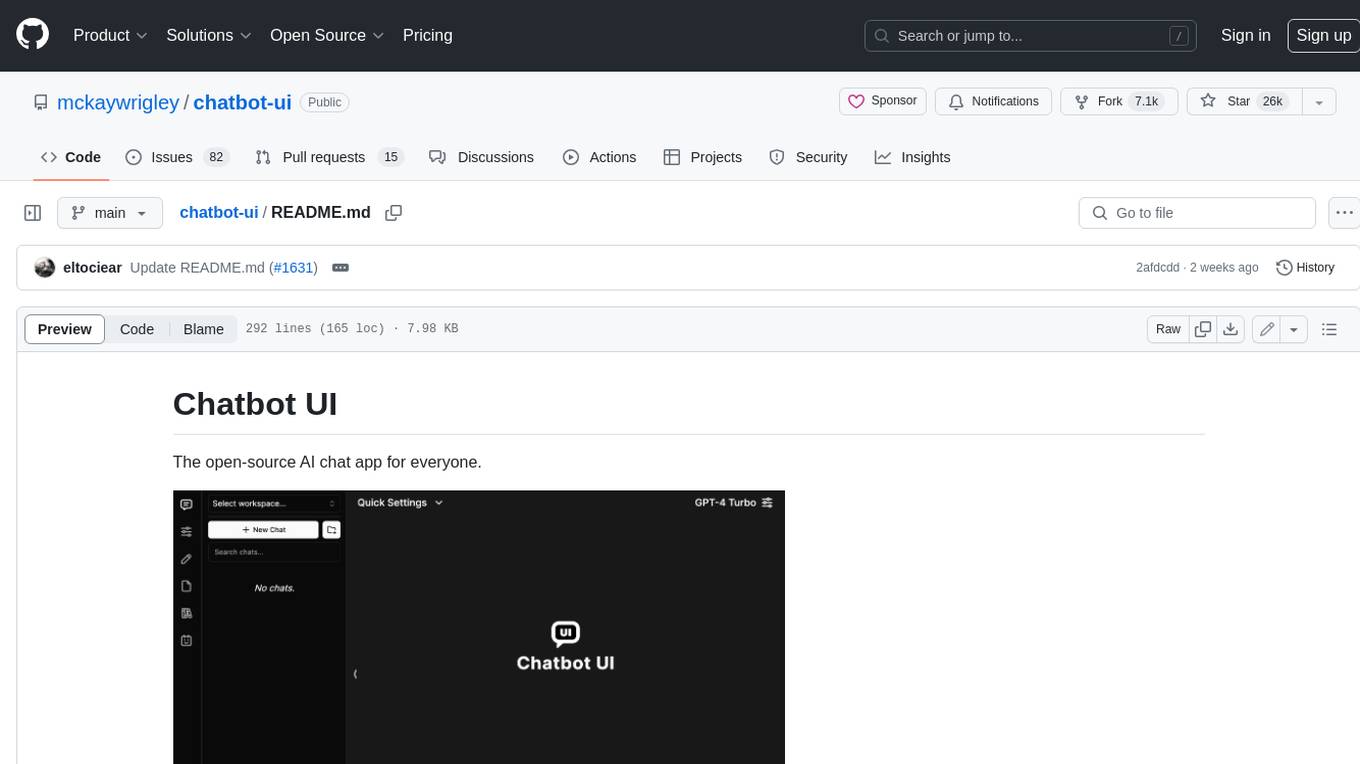
chatbot-ui
Chatbot UI is an open-source AI chat app that allows users to create and deploy their own AI chatbots. It is easy to use and can be customized to fit any need. Chatbot UI is perfect for businesses, developers, and anyone who wants to create a chatbot.
BricksLLM
BricksLLM is a cloud native AI gateway written in Go. Currently, it provides native support for OpenAI, Anthropic, Azure OpenAI and vLLM. BricksLLM aims to provide enterprise level infrastructure that can power any LLM production use cases. Here are some use cases for BricksLLM: * Set LLM usage limits for users on different pricing tiers * Track LLM usage on a per user and per organization basis * Block or redact requests containing PIIs * Improve LLM reliability with failovers, retries and caching * Distribute API keys with rate limits and cost limits for internal development/production use cases * Distribute API keys with rate limits and cost limits for students
uAgents
uAgents is a Python library developed by Fetch.ai that allows for the creation of autonomous AI agents. These agents can perform various tasks on a schedule or take action on various events. uAgents are easy to create and manage, and they are connected to a fast-growing network of other uAgents. They are also secure, with cryptographically secured messages and wallets.
griptape
Griptape is a modular Python framework for building AI-powered applications that securely connect to your enterprise data and APIs. It offers developers the ability to maintain control and flexibility at every step. Griptape's core components include Structures (Agents, Pipelines, and Workflows), Tasks, Tools, Memory (Conversation Memory, Task Memory, and Meta Memory), Drivers (Prompt and Embedding Drivers, Vector Store Drivers, Image Generation Drivers, Image Query Drivers, SQL Drivers, Web Scraper Drivers, and Conversation Memory Drivers), Engines (Query Engines, Extraction Engines, Summary Engines, Image Generation Engines, and Image Query Engines), and additional components (Rulesets, Loaders, Artifacts, Chunkers, and Tokenizers). Griptape enables developers to create AI-powered applications with ease and efficiency.