


OpenAlice
File-driven AI trading agent engine for crypto and securities markets
Stars: 293
Open Alice is an AI trading agent that provides users with their own research desk, quant team, trading floor, and risk management, all running on their laptop 24/7. It is file-driven, reasoning-driven, and OS-native, allowing interactions with the operating system. Features include dual AI providers, crypto trading, securities trading, market analysis, cognitive state, event log, cron scheduling, evolution mode, and a web UI. The architecture includes providers, core components, extensions, tasks, and interfaces. Users can quickly start by setting up prerequisites, AI providers, crypto trading, securities trading, environment variables, and running the tool. Configuration files, project structure, and license information are also provided.
README:

📖 Documentation · 🔴 Live Demo · MIT License
Your one-person Wall Street. Alice is an AI trading agent that gives you your own research desk, quant team, trading floor, and risk management — all running on your laptop 24/7.
- File-driven — Markdown defines persona and tasks, JSON defines config, JSONL stores conversations. Both humans and AI control Alice by reading and modifying files. The same read/write primitives that power vibe coding transfer directly to vibe trading. No database, no containers, just files.
- Reasoning-driven — every trading decision is based on continuous reasoning and signal mixing. Visit traderalice.com/live to see how Alice reasons in real time.
- OS-native — Alice can interact with your operating system. Search the web through your browser, send messages via Telegram, and connect to local devices.
- Dual AI provider — switch between Claude Code CLI and Vercel AI SDK at runtime, no restart needed
- Crypto trading — CCXT-based execution (Bybit, OKX, Binance, etc.) with a git-like wallet (stage, commit, push)
- Securities trading — Alpaca integration for US equities with the same wallet workflow
- Market analysis — technical indicators, news search, and price simulation via sandboxed tools
- Cognitive state — persistent "brain" with frontal lobe memory, emotion tracking, and commit history
- Event log — persistent append-only JSONL event log with real-time subscriptions and crash recovery
- Cron scheduling — event-driven cron system with AI-powered job execution and automatic delivery to the last-interacted channel
-
Evolution mode — two-tier permission system. Normal mode sandboxes the AI to
data/brain/; evolution mode gives full project access including Bash, enabling the agent to modify its own source code - Web UI — built-in local chat interface on port 3002, no Telegram account needed
graph LR
  subgraph Providers
    CC[Claude Code CLI]
    VS[Vercel AI SDK]
  end

  subgraph Core
    PR[ProviderRouter]
    AC[AgentCenter]
    E[Engine]
    TC[ToolCenter]
    S[Session Store]
    EL[Event Log]
    CR[Connector Registry]
  end

  subgraph Extensions
    AK[Analysis Kit]
    CT[Crypto Trading]
    ST[Securities Trading]
    BR[Brain]
    BW[Browser]
  end

  subgraph Tasks
    CRON[Cron Engine]
    HB[Heartbeat]
  end

  subgraph Interfaces
    WEB[Web UI]
    TG[Telegram]
    HTTP[HTTP API]
    MCP[MCP Server]
  end

  CC --> PR
  VS --> PR
  PR --> AC
  AC --> E
  E --> S
  TC -->|Vercel tools| VS
  TC -->|MCP tools| MCP
  AK --> TC
  CT --> TC
  ST --> TC
  BR --> TC
  BW --> TC
  CRON --> EL
  HB --> CRON
  EL --> CRON
  CR --> WEB & TG
  WEB --> E
  TG --> E
  HTTP --> E
  MCP --> E
Providers — interchangeable AI backends. Claude Code spawns claude -p as a subprocess; Vercel AI SDK runs a ToolLoopAgent in-process. ProviderRouter reads ai-provider.json on each call to select the active backend at runtime.
Core — Engine is a thin facade that delegates to AgentCenter, which routes all calls (both stateless and session-aware) through ProviderRouter. ToolCenter is a centralized tool registry — extensions register tools there, and it exports them in Vercel AI SDK and MCP formats. EventLog provides persistent append-only event storage (JSONL) with real-time subscriptions and crash recovery. ConnectorRegistry tracks which channel the user last spoke through.
Extensions — domain-specific tool sets registered in ToolCenter. Each extension owns its tools, state, and persistence.
Tasks — scheduled background work. CronEngine manages jobs and fires cron.fire events into the EventLog on schedule; a listener picks them up, runs them through the AI engine, and delivers replies via the ConnectorRegistry. Heartbeat is a periodic health-check that uses a structured response protocol (HEARTBEAT_OK / CHAT_NO / CHAT_YES).
Interfaces — external surfaces. Web UI for local chat, Telegram bot for mobile, HTTP for webhooks, MCP server for tool exposure. External agents can also converse with Alice via a separate MCP endpoint.
- Node.js 22+
- pnpm 10+
git clone https://github.com/TraderAlice/OpenAlice.git
cd OpenAlice
pnpm install
cp .env.example .env # then fill in your keysOpenAlice ships with two provider modes:
-
Vercel AI SDK (default) — runs the agent in-process. Supports any provider compatible with the Vercel AI SDK (Anthropic, OpenAI, Google, etc.). Swap the provider implementation in
src/providers/vercel-ai-sdk/to use your preferred model. Requires an API key for your chosen provider (e.g.ANTHROPIC_API_KEYfor Anthropic). -
Claude Code (file-driven mode) — spawns
claude -pas a subprocess, giving the agent full Claude Code capabilities. Requires Claude Code installed and authenticated on the host machine. No separate API key needed — uses your Claude Code login. To switch models, see how to change Claude Code's model.
Powered by CCXT. Defaults to Bybit demo trading. Configure the exchange and API keys in data/config/crypto.json and .env. Any CCXT-supported exchange can be used by modifying the provider implementation.
Powered by Alpaca. Supports paper and live trading — toggle via data/config/securities.json. Sign up at Alpaca and add your keys to .env. IBKR support is planned.
| Variable | Description |
|---|---|
ANTHROPIC_API_KEY |
API key for Vercel AI SDK provider (not needed if using Claude Code CLI) |
EXCHANGE_API_KEY |
Crypto exchange API key (optional) |
EXCHANGE_API_SECRET |
Crypto exchange API secret (optional) |
TELEGRAM_BOT_TOKEN |
Telegram bot token (optional) |
TELEGRAM_CHAT_ID |
Comma-separated chat IDs to allow (optional) |
ALPACA_API_KEY |
Alpaca API key for securities (optional) |
ALPACA_SECRET_KEY |
Alpaca secret key for securities (optional) |
pnpm dev        # start backend (port 3002) with watch mode
pnpm dev:ui     # start frontend dev server (port 5173) with hot reload
pnpm build      # production build (backend + UI)
pnpm test # run testsThe backend (port 3002) serves both the API and the built frontend from dist/ui/. During development, run pnpm dev:ui to start Vite's dev server on port 5173, which proxies API requests to port 3002 and provides hot module replacement.
| Port | What | When |
|---|---|---|
| 5173 | Vite dev server (hot reload) | pnpm dev:ui |
| 3002 | Backend API + built UI |
pnpm dev / pnpm build && node dist/main.js
|
Note: Port 3002 only serves the UI after
pnpm build(orpnpm build:ui). If you haven't built yet, use port 5173 for frontend development.
All config lives in data/config/ as JSON files with Zod validation. Missing files fall back to sensible defaults.
| File | Purpose |
|---|---|
engine.json |
Trading pairs, tick interval, HTTP/MCP ports, timeframe |
model.json |
AI model provider and model name |
agent.json |
Max agent steps, evolution mode toggle, Claude Code tool permissions |
crypto.json |
Allowed symbols, exchange provider (CCXT), demo trading flag |
securities.json |
Allowed symbols, broker provider (Alpaca), paper trading flag |
compaction.json |
Context window limits, auto-compaction thresholds |
heartbeat.json |
Heartbeat enable/disable, interval, active hours |
ai-provider.json |
Active AI provider (vercel-ai-sdk or claude-code), switchable at runtime |
Persona and heartbeat prompts use a default + user override pattern:
| Default (git-tracked) | User override (gitignored) |
|---|---|
data/default/persona.default.md |
data/brain/persona.md |
data/default/heartbeat.default.md |
data/brain/heartbeat.md |
On first run, defaults are auto-copied to the user override path. Edit the user files to customize without touching version control.
src/
  main.ts                    # Composition root — wires everything together
  core/
    engine.ts                # Thin facade, delegates to AgentCenter
    agent-center.ts          # Centralized AI agent management, owns ProviderRouter
    ai-provider.ts           # AIProvider interface + ProviderRouter (runtime switching)
    tool-center.ts           # Centralized tool registry (Vercel + MCP export)
    ai-config.ts             # Runtime provider config read/write
    session.ts               # JSONL session store + format converters
    compaction.ts            # Auto-summarize long context windows
    config.ts                # Zod-validated config loader
    event-log.ts             # Persistent append-only event log (JSONL)
    connector-registry.ts    # Last-interacted channel tracker
    media.ts                 # MediaAttachment extraction from tool outputs
    types.ts                 # Plugin, EngineContext interfaces
  providers/
    claude-code/             # Claude Code CLI subprocess wrapper
    vercel-ai-sdk/           # Vercel AI SDK ToolLoopAgent wrapper
  extension/
    analysis-kit/            # Market data, indicators, news, sandbox
    crypto-trading/          # CCXT integration, wallet, tools
    securities-trading/      # Alpaca integration, wallet, tools
    brain/                   # Cognitive state (memory, emotion)
    browser/                 # Browser automation bridge (via OpenClaw)
  connectors/
    web/                     # Web UI chat (Hono, SSE push)
    telegram/                # Telegram bot (grammY, polling, commands)
    mcp-ask/                 # MCP Ask connector (external agent conversation)
  task/
    cron/                    # Cron scheduling (engine, listener, AI tools)
    heartbeat/               # Periodic heartbeat with structured response protocol
  plugins/
    http.ts                  # HTTP health/status endpoint
    mcp.ts                   # MCP server for tool exposure
  openclaw/                  # Browser automation subsystem (frozen)
data/
  config/                    # JSON configuration files
  default/                   # Factory defaults (persona, heartbeat prompts)
  sessions/                  # JSONL conversation histories
  brain/                     # Agent memory and emotion logs
  crypto-trading/            # Crypto wallet commit history
  securities-trading/        # Securities wallet commit history
  cron/                      # Cron job definitions (jobs.json)
  event-log/                 # Persistent event log (events.jsonl)
docs/                        # Architecture documentation
For Tasks:
Click tags to check more tools for each tasksFor Jobs:
Alternative AI tools for OpenAlice
Similar Open Source Tools
OpenAlice
Open Alice is an AI trading agent that provides users with their own research desk, quant team, trading floor, and risk management, all running on their laptop 24/7. It is file-driven, reasoning-driven, and OS-native, allowing interactions with the operating system. Features include dual AI providers, crypto trading, securities trading, market analysis, cognitive state, event log, cron scheduling, evolution mode, and a web UI. The architecture includes providers, core components, extensions, tasks, and interfaces. Users can quickly start by setting up prerequisites, AI providers, crypto trading, securities trading, environment variables, and running the tool. Configuration files, project structure, and license information are also provided.
graphiti
Graphiti is a framework for building and querying temporally-aware knowledge graphs, tailored for AI agents in dynamic environments. It continuously integrates user interactions, structured and unstructured data, and external information into a coherent, queryable graph. The framework supports incremental data updates, efficient retrieval, and precise historical queries without complete graph recomputation, making it suitable for developing interactive, context-aware AI applications.
RooFlow
RooFlow is a VS Code extension that enhances AI-assisted development by providing persistent project context and optimized mode interactions. It reduces token consumption and streamlines workflow by integrating Architect, Code, Test, Debug, and Ask modes. The tool simplifies setup, offers real-time updates, and provides clearer instructions through YAML-based rule files. It includes components like Memory Bank, System Prompts, VS Code Integration, and Real-time Updates. Users can install RooFlow by downloading specific files, placing them in the project structure, and running an insert-variables script. They can then start a chat, select a mode, interact with Roo, and use the 'Update Memory Bank' command for synchronization. The Memory Bank structure includes files for active context, decision log, product context, progress tracking, and system patterns. RooFlow features persistent context, real-time updates, mode collaboration, and reduced token consumption.
codewalk
CodeWalk is a native cross-platform client for OpenCode server mode, built with Flutter. It provides an AI chat interface for coding interactions, multi-server profile management, session lifecycle management, worktree management, speech-to-text input, and more. The project follows Clean Architecture with Flutter, Dart, Provider for state management, Dio for HTTP client, SharedPreferences for local storage, GetIt for dependency injection, and Material Design 3 for design system.
lettabot
LettaBot is a personal AI assistant that operates across multiple messaging platforms including Telegram, Slack, Discord, WhatsApp, and Signal. It offers features like unified memory, persistent memory, local tool execution, voice message transcription, scheduling, and real-time message updates. Users can interact with LettaBot through various commands and setup wizards. The tool can be used for controlling smart home devices, managing background tasks, connecting to Letta Code, and executing specific operations like file exploration and internet queries. LettaBot ensures security through outbound connections only, restricted tool execution, and access control policies. Development and releases are automated, and troubleshooting guides are provided for common issues.
UCAgent
UCAgent is an AI-powered automated UT verification agent for chip design. It automates chip verification workflow, supports functional and code coverage analysis, ensures consistency among documentation, code, and reports, and collaborates with mainstream Code Agents via MCP protocol. It offers three intelligent interaction modes and requires Python 3.11+, Linux/macOS OS, 4GB+ memory, and access to an AI model API. Users can clone the repository, install dependencies, configure qwen, and start verification. UCAgent supports various verification quality improvement options and basic operations through TUI shortcuts and stage color indicators. It also provides documentation build and preview using MkDocs, PDF manual build using Pandoc + XeLaTeX, and resources for further help and contribution.
qwen-code
Qwen Code is an open-source AI agent optimized for Qwen3-Coder, designed to help users understand large codebases, automate tedious work, and expedite the shipping process. It offers an agentic workflow with rich built-in tools, a terminal-first approach with optional IDE integration, and supports both OpenAI-compatible API and Qwen OAuth authentication methods. Users can interact with Qwen Code in interactive mode, headless mode, IDE integration, and through a TypeScript SDK. The tool can be configured via settings.json, environment variables, and CLI flags, and offers benchmark results for performance evaluation. Qwen Code is part of an ecosystem that includes AionUi and Gemini CLI Desktop for graphical interfaces, and troubleshooting guides are available for issue resolution.
verifywise
VerifyWise is an open-source AI governance platform designed to help businesses harness the power of AI safely and responsibly. The platform ensures compliance and robust AI management without compromising on security. It offers additional products like MaskWise for data redaction, EvalWise for AI model evaluation, and FlagWise for security threat monitoring. VerifyWise simplifies AI governance for organizations, aiding in risk management, regulatory compliance, and promoting responsible AI practices. It features options for on-premises or private cloud hosting, open-source with AGPLv3 license, AI-generated answers for compliance audits, source code transparency, Docker deployment, user registration, role-based access control, and various AI governance tools like risk management, bias & fairness checks, evidence center, AI trust center, and more.
verifywise
Verifywise is a tool designed to help developers easily verify the correctness of their code. It provides a simple and intuitive interface for running various types of tests and checks on codebases, ensuring that the code meets quality standards and requirements. With Verifywise, developers can automate the verification process, saving time and effort in identifying and fixing potential issues in their code. The tool supports multiple programming languages and frameworks, making it versatile and adaptable to different project requirements. Whether you are working on a small personal project or a large-scale software development initiative, Verifywise can help you ensure the reliability and robustness of your codebase.
eairp
Next generation artificial intelligent ERP system. On the basis of ERP business, we have expanded GPT-3.5. Individually or company can fine-tune your model through our system. You can provide fully automated business form submission operations through your simple description, and you can chat, interact, and consult information with GPT. You can deploy through Docker to quickly start and use. Completely free project. Enginsh / 简体中文.
Shellsage
Shell Sage is an intelligent terminal companion and AI-powered terminal assistant that enhances the terminal experience with features like local and cloud AI support, context-aware error diagnosis, natural language to command translation, and safe command execution workflows. It offers interactive workflows, supports various API providers, and allows for custom model selection. Users can configure the tool for local or API mode, select specific models, and switch between modes easily. Currently in alpha development, Shell Sage has known limitations like limited Windows support and occasional false positives in error detection. The roadmap includes improvements like better context awareness, Windows PowerShell integration, Tmux integration, and CI/CD error pattern database.
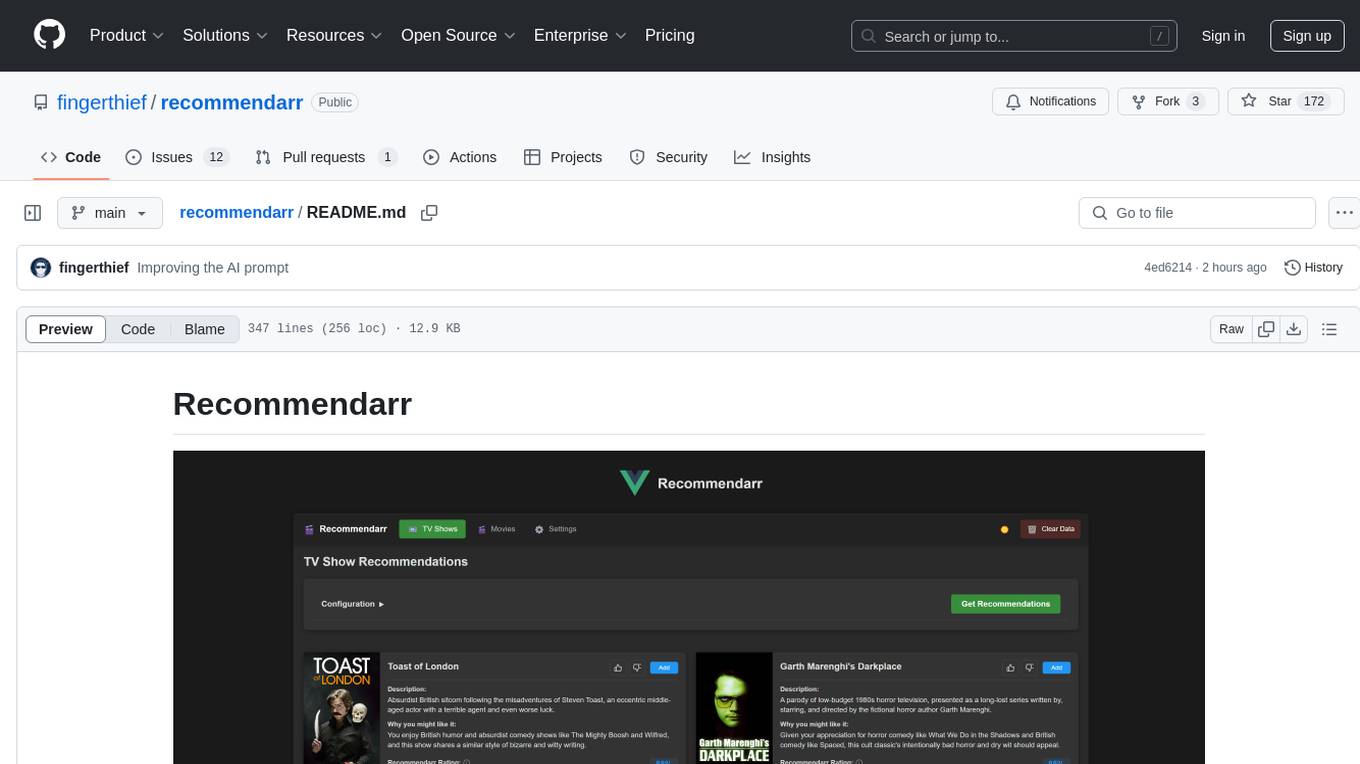
recommendarr
Recommendarr is a tool that generates personalized TV show and movie recommendations based on your Sonarr, Radarr, Plex, and Jellyfin libraries using AI. It offers AI-powered recommendations, media server integration, flexible AI support, watch history analysis, customization options, and dark/light mode toggle. Users can connect their media libraries and watch history services, configure AI service settings, and get personalized recommendations based on genre, language, and mood/vibe preferences. The tool works with any OpenAI-compatible API and offers various recommended models for different cost options and performance levels. It provides personalized suggestions, detailed information, filter options, watch history analysis, and one-click adding of recommended content to Sonarr/Radarr.
omlx
oMLX is a macOS application optimized for running Large Language Models (LLMs) efficiently on Apple Silicon devices. It offers features like continuous batching, SSD caching, multi-model serving, admin dashboard, and API compatibility. Users can manage LLMs directly from the menu bar, download models from HuggingFace, and utilize Claude Code optimization. The tool supports various model families and structured output formats, making it convenient for real coding work and model management.
chat
deco.chat is an open-source foundation for building AI-native software, providing developers, engineers, and AI enthusiasts with robust tools to rapidly prototype, develop, and deploy AI-powered applications. It empowers Vibecoders to prototype ideas and Agentic engineers to deploy scalable, secure, and sustainable production systems. The core capabilities include an open-source runtime for composing tools and workflows, MCP Mesh for secure integration of models and APIs, a unified TypeScript stack for backend logic and custom frontends, global modular infrastructure built on Cloudflare, and a visual workspace for building agents and orchestrating everything in code.
zcf
ZCF (Zero-Config Claude-Code Flow) is a tool that provides zero-configuration, one-click setup for Claude Code with bilingual support, intelligent agent system, and personalized AI assistant. It offers an interactive menu for easy operations and direct commands for quick execution. The tool supports bilingual operation with automatic language switching and customizable AI output styles. ZCF also includes features like BMad Workflow for enterprise-grade workflow system, Spec Workflow for structured feature development, CCR (Claude Code Router) support for proxy routing, and CCometixLine for real-time usage tracking. It provides smart installation, complete configuration management, and core features like professional agents, command system, and smart configuration. ZCF is cross-platform compatible, supports Windows and Termux environments, and includes security features like dangerous operation confirmation mechanism.
sim
Sim is a platform that allows users to build and deploy AI agent workflows quickly and easily. It provides cloud-hosted and self-hosted options, along with support for local AI models. Users can set up the application using Docker Compose, Dev Containers, or manual setup with PostgreSQL and pgvector extension. The platform utilizes technologies like Next.js, Bun, PostgreSQL with Drizzle ORM, Better Auth for authentication, Shadcn and Tailwind CSS for UI, Zustand for state management, ReactFlow for flow editor, Fumadocs for documentation, Turborepo for monorepo management, Socket.io for real-time communication, and Trigger.dev for background jobs.
For similar tasks
FinRobot
FinRobot is an open-source AI agent platform designed for financial applications using large language models. It transcends the scope of FinGPT, offering a comprehensive solution that integrates a diverse array of AI technologies. The platform's versatility and adaptability cater to the multifaceted needs of the financial industry. FinRobot's ecosystem is organized into four layers, including Financial AI Agents Layer, Financial LLMs Algorithms Layer, LLMOps and DataOps Layers, and Multi-source LLM Foundation Models Layer. The platform's agent workflow involves Perception, Brain, and Action modules to capture, process, and execute financial data and insights. The Smart Scheduler optimizes model diversity and selection for tasks, managed by components like Director Agent, Agent Registration, Agent Adaptor, and Task Manager. The tool provides a structured file organization with subfolders for agents, data sources, and functional modules, along with installation instructions and hands-on tutorials.
AirdropsBot2024
AirdropsBot2024 is an efficient and secure solution for automated trading and sniping of coins on the Solana blockchain. It supports multiple chain networks such as Solana, BTC, and Ethereum. The bot utilizes premium APIs and Chromedriver to automate trading operations through web interfaces of popular exchanges. It offers high-speed data analysis, in-depth market analysis, support for major exchanges, complete security and control, data visualization, advanced notification options, flexibility and adaptability in trading strategies, and profile management.
gpt-bitcoin
The gpt-bitcoin repository is focused on creating an automated trading system for Bitcoin using GPT AI technology. It provides different versions of trading strategies utilizing various data sources such as OHLCV, Moving Averages, RSI, Stochastic Oscillator, MACD, Bollinger Bands, Orderbook Data, news data, fear/greed index, and chart images. Users can set up the system by creating a .env file with necessary API keys and installing required dependencies. The repository also includes instructions for setting up the environment on local machines and AWS EC2 Ubuntu servers. The future plan includes expanding the system to support other cryptocurrency exchanges like Bithumb, Binance, Coinbase, OKX, and Bybit.
ai-hedge-fund
AI Hedge Fund is a proof of concept for an AI-powered hedge fund that explores the use of AI to make trading decisions. The project is for educational purposes only and simulates trading decisions without actual trading. It employs agents like Market Data Analyst, Valuation Agent, Sentiment Agent, Fundamentals Agent, Technical Analyst, Risk Manager, and Portfolio Manager to gather and analyze data, calculate risk metrics, and make trading decisions.
PredictorLLM
PredictorLLM is an advanced trading agent framework that utilizes large language models to automate trading in financial markets. It includes a profiling module to establish agent characteristics, a layered memory module for retaining and prioritizing financial data, and a decision-making module to convert insights into trading strategies. The framework mimics professional traders' behavior, surpassing human limitations in data processing and continuously evolving to adapt to market conditions for superior investment outcomes.
tradecat
TradeCat is a comprehensive data analysis and trading platform designed for cryptocurrency, stock, and macroeconomic data. It offers a wide range of features including multi-market data collection, technical indicator modules, AI analysis, signal detection engine, Telegram bot integration, and more. The platform utilizes technologies like Python, TimescaleDB, TA-Lib, Pandas, NumPy, and various APIs to provide users with valuable insights and tools for trading decisions. With a modular architecture and detailed documentation, TradeCat aims to empower users in making informed trading decisions across different markets.
OpenAlice
Open Alice is an AI trading agent that provides users with their own research desk, quant team, trading floor, and risk management, all running on their laptop 24/7. It is file-driven, reasoning-driven, and OS-native, allowing interactions with the operating system. Features include dual AI providers, crypto trading, securities trading, market analysis, cognitive state, event log, cron scheduling, evolution mode, and a web UI. The architecture includes providers, core components, extensions, tasks, and interfaces. Users can quickly start by setting up prerequisites, AI providers, crypto trading, securities trading, environment variables, and running the tool. Configuration files, project structure, and license information are also provided.
LLM-TradeBot
LLM-TradeBot is an Intelligent Multi-Agent Quantitative Trading Bot based on the Adversarial Decision Framework (ADF). It achieves high win rates and low drawdown in automated futures trading through market regime detection, price position awareness, dynamic score calibration, and multi-layer physical auditing. The bot prioritizes judging 'IF we should trade' before deciding 'HOW to trade' and offers features like multi-agent collaboration, agent configuration, agent chatroom, AUTO1 symbol selection, multi-LLM support, multi-account trading, async concurrency, CLI headless mode, test/live mode toggle, safety mechanisms, and full-link auditing. The system architecture includes a multi-agent architecture with various agents responsible for different tasks, a four-layer strategy filter, and detailed data flow diagrams. The bot also supports backtesting, full-link data auditing, and safety warnings for users.
For similar jobs
weave
Weave is a toolkit for developing Generative AI applications, built by Weights & Biases. With Weave, you can log and debug language model inputs, outputs, and traces; build rigorous, apples-to-apples evaluations for language model use cases; and organize all the information generated across the LLM workflow, from experimentation to evaluations to production. Weave aims to bring rigor, best-practices, and composability to the inherently experimental process of developing Generative AI software, without introducing cognitive overhead.
agentcloud
AgentCloud is an open-source platform that enables companies to build and deploy private LLM chat apps, empowering teams to securely interact with their data. It comprises three main components: Agent Backend, Webapp, and Vector Proxy. To run this project locally, clone the repository, install Docker, and start the services. The project is licensed under the GNU Affero General Public License, version 3 only. Contributions and feedback are welcome from the community.
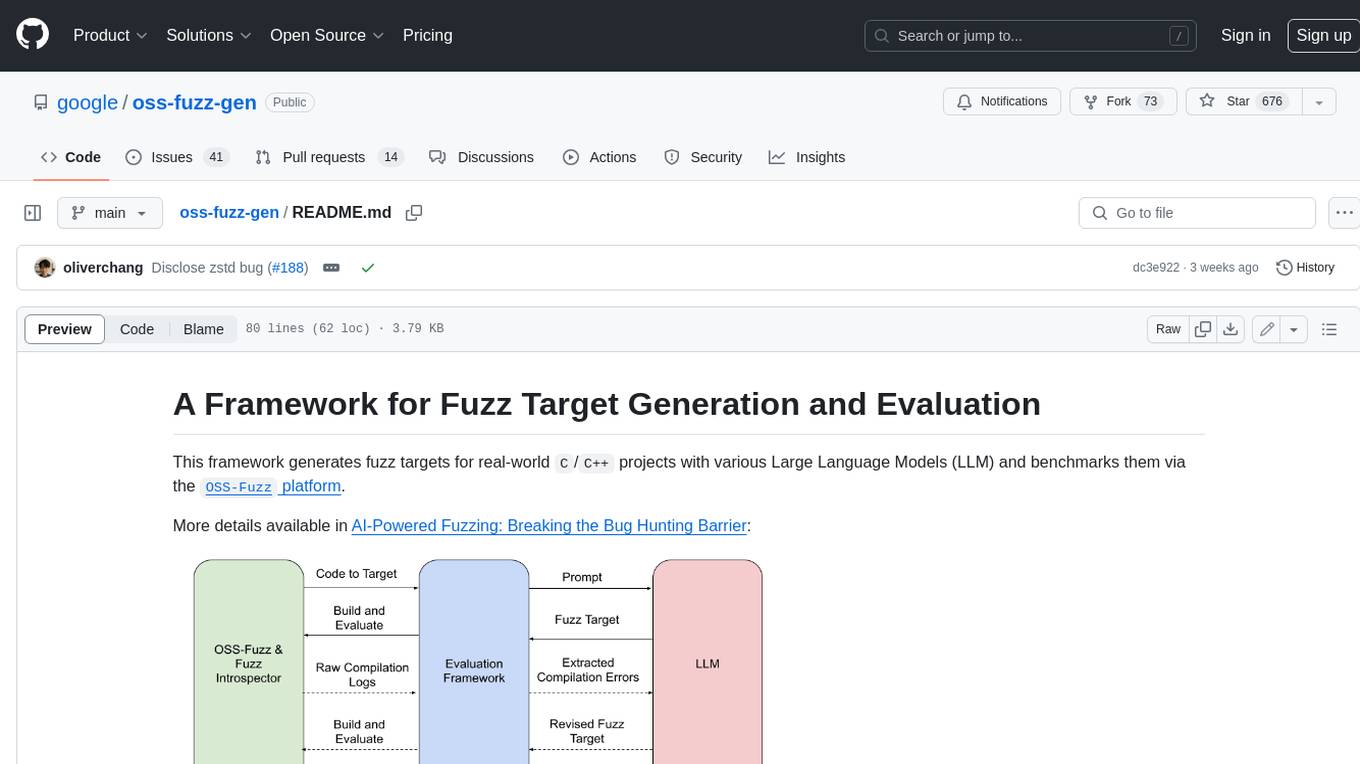
oss-fuzz-gen
This framework generates fuzz targets for real-world `C`/`C++` projects with various Large Language Models (LLM) and benchmarks them via the `OSS-Fuzz` platform. It manages to successfully leverage LLMs to generate valid fuzz targets (which generate non-zero coverage increase) for 160 C/C++ projects. The maximum line coverage increase is 29% from the existing human-written targets.
LLMStack
LLMStack is a no-code platform for building generative AI agents, workflows, and chatbots. It allows users to connect their own data, internal tools, and GPT-powered models without any coding experience. LLMStack can be deployed to the cloud or on-premise and can be accessed via HTTP API or triggered from Slack or Discord.
VisionCraft
The VisionCraft API is a free API for using over 100 different AI models. From images to sound.
kaito
Kaito is an operator that automates the AI/ML inference model deployment in a Kubernetes cluster. It manages large model files using container images, avoids tuning deployment parameters to fit GPU hardware by providing preset configurations, auto-provisions GPU nodes based on model requirements, and hosts large model images in the public Microsoft Container Registry (MCR) if the license allows. Using Kaito, the workflow of onboarding large AI inference models in Kubernetes is largely simplified.
PyRIT
PyRIT is an open access automation framework designed to empower security professionals and ML engineers to red team foundation models and their applications. It automates AI Red Teaming tasks to allow operators to focus on more complicated and time-consuming tasks and can also identify security harms such as misuse (e.g., malware generation, jailbreaking), and privacy harms (e.g., identity theft). The goal is to allow researchers to have a baseline of how well their model and entire inference pipeline is doing against different harm categories and to be able to compare that baseline to future iterations of their model. This allows them to have empirical data on how well their model is doing today, and detect any degradation of performance based on future improvements.
Azure-Analytics-and-AI-Engagement
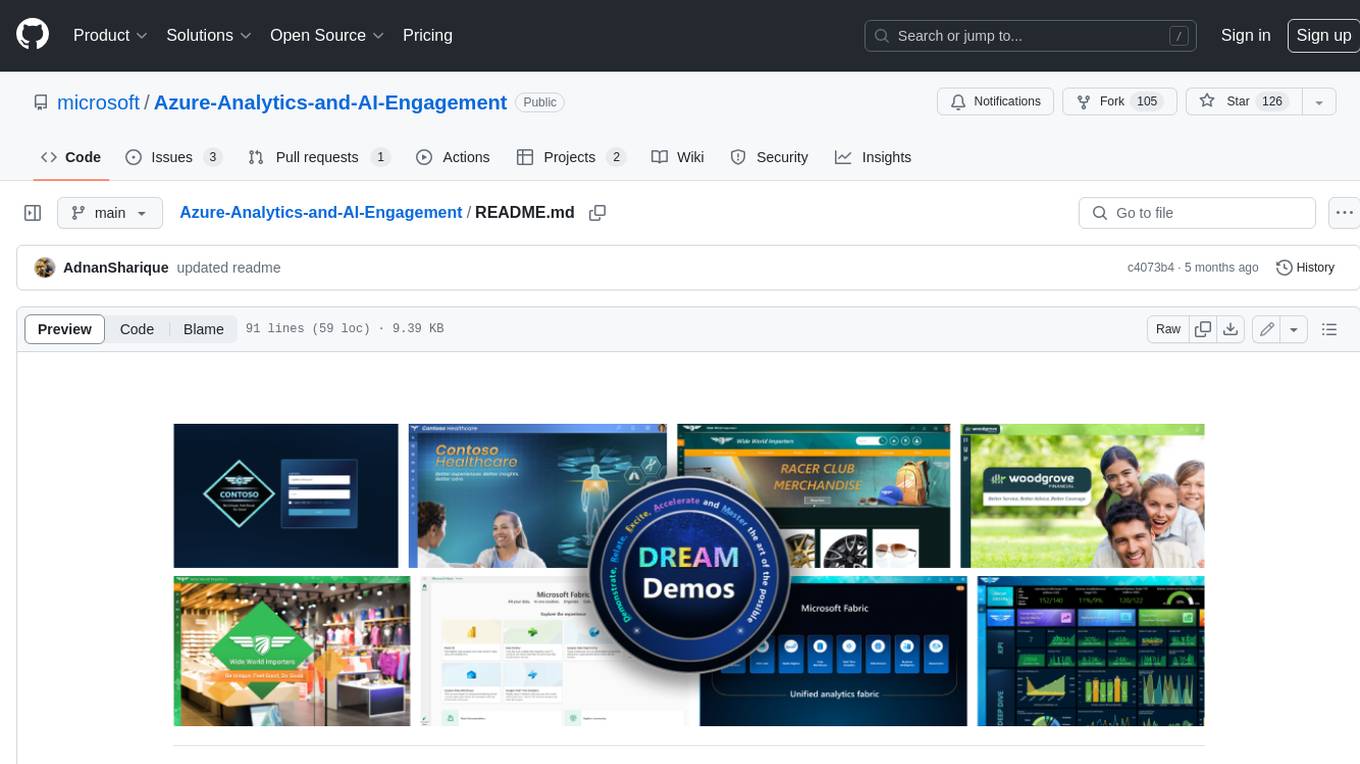
The Azure-Analytics-and-AI-Engagement repository provides packaged Industry Scenario DREAM Demos with ARM templates (Containing a demo web application, Power BI reports, Synapse resources, AML Notebooks etc.) that can be deployed in a customer’s subscription using the CAPE tool within a matter of few hours. Partners can also deploy DREAM Demos in their own subscriptions using DPoC.