


MCP-Nest
A NestJS module to effortlessly create Model Context Protocol (MCP) servers for exposing AI tools, resources, and prompts.
Stars: 577
A NestJS module to effortlessly expose tools, resources, and prompts for AI using the Model Context Protocol (MCP). It allows defining tools, resources, and prompts in a familiar NestJS way, supporting multi-transport, tool validation, interactive tool calls, request context access, fine-grained authorization, resource serving, dynamic resources, prompt templates, guard-based authentication, dependency injection, server mutation, and instrumentation. It provides features for building ChatGPT widgets and MCP apps.
README:





A NestJS module to effortlessly expose tools, resources, and prompts for AI, from your NestJS applications using the Model Context Protocol (MCP).
With @rekog/mcp-nest you define tools, resources, and prompts in a way that's familiar in NestJS and leverage the full power of dependency injection to utilize your existing codebase in building complex enterprise ready MCP servers.
- 🚀 Multi-Transport Support: HTTP+SSE, Streamable HTTP, and STDIO
- 🔧 Tools: Expose NestJS methods as MCP tools with automatic discovery and Zod validation
- 🛠️ Elicitation: Interactive tool calls with user input elicitation
- 🌐 HTTP Request Access: Full access to request context within MCP handlers
- 🔐 Per-Tool Authorization: Implement fine-grained authorization for tools
- 📁 Resources: Serve content and data through MCP resource system
- 📚 Resource Templates: Dynamic resources with parameterized URIs
- 💬 Prompts: Define reusable prompt templates for AI interactions
- 🔐 Guard-based Authentication: Guard-based security with OAuth support
- 🏠 Built-in Authorization Server — Using the built-in Authorization Server for easy setups. (Beta)
- 🌐 External Authorization Server — Securing your MCP server with an external authorization server (Keycloak, Auth0, etc).
- 💉 Dependency Injection: Leverage NestJS DI system throughout MCP components
- 🔍 Server mutation and instrumentation — Mutate the underlying mcp server for custom logic or instrumentation purposes.
Are you interested to build ChatGPT widgets (with the OpenAI SDK) or MCP apps?
Find out how to do that with @rekog/MCP-Nest in this repository MCP-Nest-Samples
npm install @rekog/mcp-nest @modelcontextprotocol/sdk zod@^4If you use the built-in authorization server with the TypeORM store, install the following optional peer dependencies:
npm install @nestjs/typeorm typeorm// app.module.ts
import { Module } from '@nestjs/common';
import { McpModule } from '@rekog/mcp-nest';
import { GreetingTool } from './greeting.tool';
@Module({
imports: [
McpModule.forRoot({
name: 'my-mcp-server',
version: '1.0.0',
}),
],
providers: [GreetingTool],
})
export class AppModule {}// greeting.tool.ts
import { Injectable } from '@nestjs/common';
import { Tool, Context } from '@rekog/mcp-nest';
import { z } from 'zod';
@Injectable()
export class GreetingTool {
@Tool({
name: 'greeting-tool',
description: 'Returns a greeting with progress updates',
parameters: z.object({
name: z.string().default('World'),
}),
})
async sayHello({ name }, context: Context) {
await context.reportProgress({ progress: 50, total: 100 });
return `Hello, ${name}!`;
}
}- Tools Guide - Define and expose NestJS methods as MCP tools
- Discovery and Registration of Tools - Automatic discovery and manual registration of tools
- Dynamic Tools Guide - Register tools programmatically at runtime
- Resources Guide - Serve static and dynamic content
- Resource Templates Guide - Create parameterized resources
- Prompts Guide - Build reusable prompt templates
- Built-in Authorization Server - Secure your MCP server with built-in OAuth
- External Authorization Server - Securing your MCP server with an external authorization server (Keycloak, Auth0, etc)
- Server examples - MCP servers examples (Streamable HTTP, HTTP, and STDIO) and with Fastify support
The playground directory contains working examples for all features.
Refer to playground/README.md for details.
For Tasks:
Click tags to check more tools for each tasksFor Jobs:
Alternative AI tools for MCP-Nest
Similar Open Source Tools
MCP-Nest
A NestJS module to effortlessly expose tools, resources, and prompts for AI using the Model Context Protocol (MCP). It allows defining tools, resources, and prompts in a familiar NestJS way, supporting multi-transport, tool validation, interactive tool calls, request context access, fine-grained authorization, resource serving, dynamic resources, prompt templates, guard-based authentication, dependency injection, server mutation, and instrumentation. It provides features for building ChatGPT widgets and MCP apps.
CyberStrikeAI
CyberStrikeAI is an AI-native security testing platform built in Go that integrates 100+ security tools, an intelligent orchestration engine, role-based testing with predefined security roles, a skills system with specialized testing skills, and comprehensive lifecycle management capabilities. It enables end-to-end automation from conversational commands to vulnerability discovery, attack-chain analysis, knowledge retrieval, and result visualization, delivering an auditable, traceable, and collaborative testing environment for security teams. The platform features an AI decision engine with OpenAI-compatible models, native MCP implementation with various transports, prebuilt tool recipes, large-result pagination, attack-chain graph, password-protected web UI, knowledge base with vector search, vulnerability management, batch task management, role-based testing, and skills system.
sdk-typescript
Strands Agents - TypeScript SDK is a lightweight and flexible SDK that takes a model-driven approach to building and running AI agents in TypeScript/JavaScript. It brings key features from the Python Strands framework to Node.js environments, enabling type-safe agent development for various applications. The SDK supports model agnostic development with first-class support for Amazon Bedrock and OpenAI, along with extensible architecture for custom providers. It also offers built-in MCP support, real-time response streaming, extensible hooks, and conversation management features. With tools for interaction with external systems and seamless integration with MCP servers, the SDK provides a comprehensive solution for developing AI agents.
docs-mcp-server
The docs-mcp-server repository contains the server-side code for the documentation management system. It provides functionalities for managing, storing, and retrieving documentation files. Users can upload, update, and delete documents through the server. The server also supports user authentication and authorization to ensure secure access to the documentation system. Additionally, the server includes APIs for integrating with other systems and tools, making it a versatile solution for managing documentation in various projects and organizations.
indexify
Indexify is an open-source engine for building fast data pipelines for unstructured data (video, audio, images, and documents) using reusable extractors for embedding, transformation, and feature extraction. LLM Applications can query transformed content friendly to LLMs by semantic search and SQL queries. Indexify keeps vector databases and structured databases (PostgreSQL) updated by automatically invoking the pipelines as new data is ingested into the system from external data sources. **Why use Indexify** * Makes Unstructured Data **Queryable** with **SQL** and **Semantic Search** * **Real-Time** Extraction Engine to keep indexes **automatically** updated as new data is ingested. * Create **Extraction Graph** to describe **data transformation** and extraction of **embedding** and **structured extraction**. * **Incremental Extraction** and **Selective Deletion** when content is deleted or updated. * **Extractor SDK** allows adding new extraction capabilities, and many readily available extractors for **PDF**, **Image**, and **Video** indexing and extraction. * Works with **any LLM Framework** including **Langchain**, **DSPy**, etc. * Runs on your laptop during **prototyping** and also scales to **1000s of machines** on the cloud. * Works with many **Blob Stores**, **Vector Stores**, and **Structured Databases** * We have even **Open Sourced Automation** to deploy to Kubernetes in production.
crawl4ai
Crawl4AI is a powerful and free web crawling service that extracts valuable data from websites and provides LLM-friendly output formats. It supports crawling multiple URLs simultaneously, replaces media tags with ALT, and is completely free to use and open-source. Users can integrate Crawl4AI into Python projects as a library or run it as a standalone local server. The tool allows users to crawl and extract data from specified URLs using different providers and models, with options to include raw HTML content, force fresh crawls, and extract meaningful text blocks. Configuration settings can be adjusted in the `crawler/config.py` file to customize providers, API keys, chunk processing, and word thresholds. Contributions to Crawl4AI are welcome from the open-source community to enhance its value for AI enthusiasts and developers.
tingly-box
Tingly Box is a tool that helps in deciding which model to call, compressing context, and routing requests efficiently. It offers secure, reliable, and customizable functional extensions. With features like unified API, smart routing, context compression, auto API translation, blazing fast performance, flexible authentication, visual control panel, and client-side usage stats, Tingly Box provides a comprehensive solution for managing AI models and tokens. It supports integration with various IDEs, CLI tools, SDKs, and AI applications, making it versatile and easy to use. The tool also allows seamless integration with OAuth providers like Claude Code, enabling users to utilize existing quotas in OpenAI-compatible tools. Tingly Box aims to simplify AI model management and usage by providing a single endpoint for multiple providers with minimal configuration, promoting seamless integration with SDKs and CLI tools.
zotero-mcp
Zotero MCP is an open-source project that integrates AI capabilities with Zotero using the Model Context Protocol. It consists of a Zotero plugin and an MCP server, enabling AI assistants to search, retrieve, and cite references from Zotero library. The project features a unified architecture with an integrated MCP server, eliminating the need for a separate server process. It provides features like intelligent search, detailed reference information, filtering by tags and identifiers, aiding in academic tasks such as literature reviews and citation management.
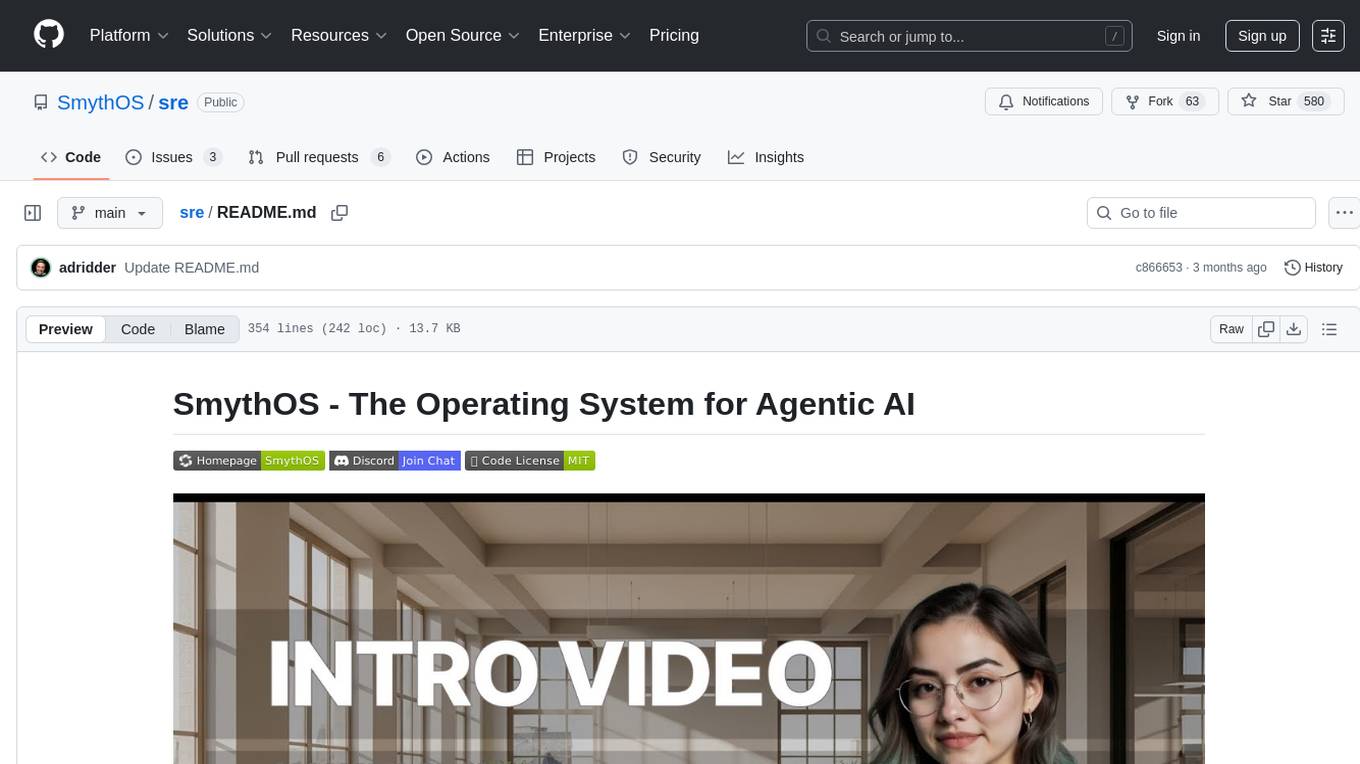
sre
SmythOS is an operating system designed for building, deploying, and managing intelligent AI agents at scale. It provides a unified SDK and resource abstraction layer for various AI services, making it easy to scale and flexible. With an agent-first design, developer-friendly SDK, modular architecture, and enterprise security features, SmythOS offers a robust foundation for AI workloads. The system is built with a philosophy inspired by traditional operating system kernels, ensuring autonomy, control, and security for AI agents. SmythOS aims to make shipping production-ready AI agents accessible and open for everyone in the coming Internet of Agents era.
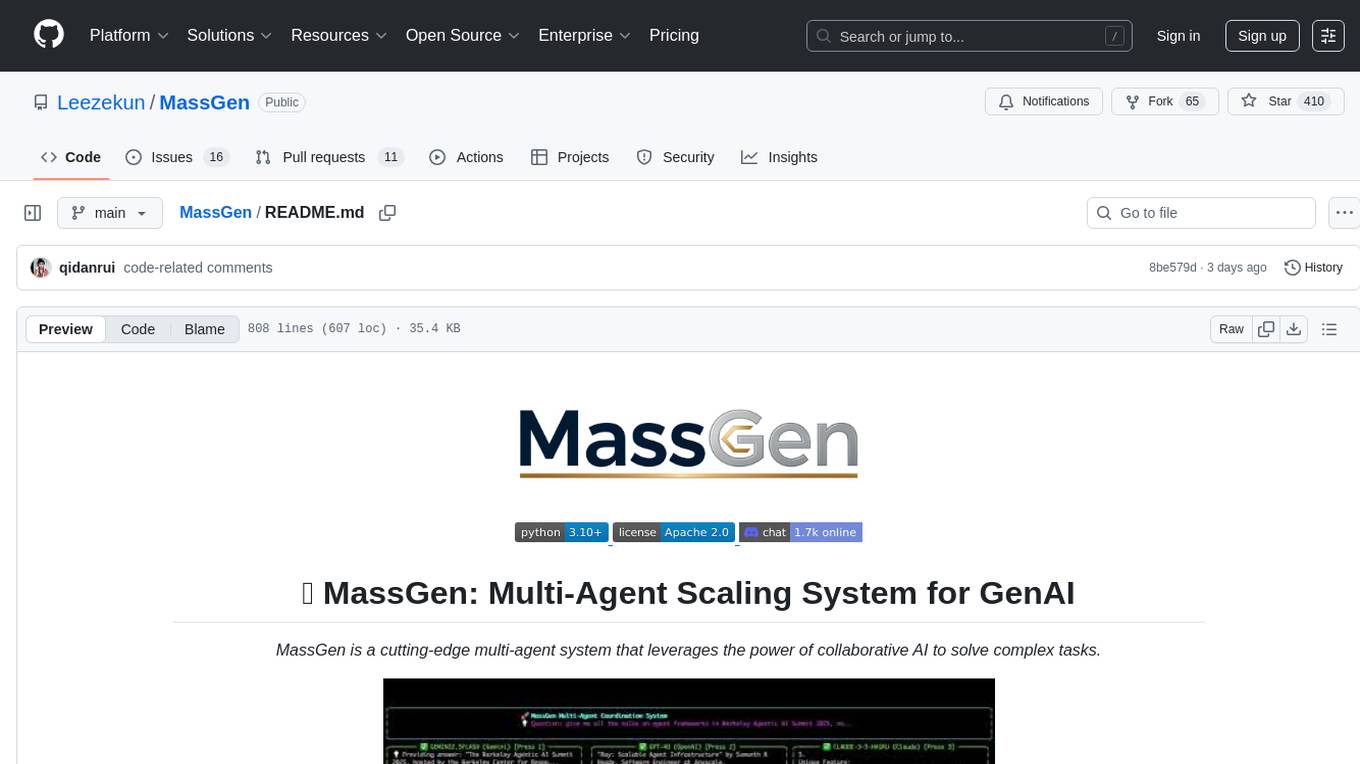
MassGen
MassGen is a cutting-edge multi-agent system that leverages the power of collaborative AI to solve complex tasks. It assigns a task to multiple AI agents who work in parallel, observe each other's progress, and refine their approaches to converge on the best solution to deliver a comprehensive and high-quality result. The system operates through an architecture designed for seamless multi-agent collaboration, with key features including cross-model/agent synergy, parallel processing, intelligence sharing, consensus building, and live visualization. Users can install the system, configure API settings, and run MassGen for various tasks such as question answering, creative writing, research, development & coding tasks, and web automation & browser tasks. The roadmap includes plans for advanced agent collaboration, expanded model, tool & agent integration, improved performance & scalability, enhanced developer experience, and a web interface.
AIClient-2-API
AIClient-2-API is a versatile and lightweight API proxy designed for developers, providing ample free API request quotas and comprehensive support for various mainstream large models like Gemini, Qwen Code, Claude, etc. It converts multiple backend APIs into standard OpenAI format interfaces through a Node.js HTTP server. The project adopts a modern modular architecture, supports strategy and adapter patterns, comes with complete test coverage and health check mechanisms, and is ready to use after 'npm install'. By easily switching model service providers in the configuration file, any OpenAI-compatible client or application can seamlessly access different large model capabilities through the same API address, eliminating the hassle of maintaining multiple sets of configurations for different services and dealing with incompatible interfaces.
layra
LAYRA is the world's first visual-native AI automation engine that sees documents like a human, preserves layout and graphical elements, and executes arbitrarily complex workflows with full Python control. It empowers users to build next-generation intelligent systems with no limits or compromises. Built for Enterprise-Grade deployment, LAYRA features a modern frontend, high-performance backend, decoupled service architecture, visual-native multimodal document understanding, and a powerful workflow engine.
hayhooks
Hayhooks is a tool that simplifies the deployment and serving of Haystack pipelines as REST APIs. It allows users to wrap their pipelines with custom logic and expose them via HTTP endpoints, including OpenAI-compatible chat completion endpoints. With Hayhooks, users can easily convert their Haystack pipelines into API services with minimal boilerplate code.
figma-console-mcp
Figma Console MCP is a Model Context Protocol server that bridges design and development, giving AI assistants complete access to Figma for extraction, creation, and debugging. It connects AI assistants like Claude to Figma, enabling plugin debugging, visual debugging, design system extraction, design creation, variable management, real-time monitoring, and three installation methods. The server offers 53+ tools for NPX and Local Git setups, while Remote SSE provides read-only access with 16 tools. Users can create and modify designs with AI, contribute to projects, or explore design data. The server supports authentication via personal access tokens and OAuth, and offers tools for navigation, console debugging, visual debugging, design system extraction, design creation, design-code parity, variable management, and AI-assisted design creation.
alphora
Alphora is a full-stack framework for building production AI agents, providing agent orchestration, prompt engineering, tool execution, memory management, streaming, and deployment with an async-first, OpenAI-compatible design. It offers features like agent derivation, reasoning-action loop, async streaming, visual debugger, OpenAI compatibility, multimodal support, tool system with zero-config tools and type safety, prompt engine with dynamic prompts, memory and storage management, sandbox for secure execution, deployment as API, and more. Alphora allows users to build sophisticated AI agents easily and efficiently.
Dive
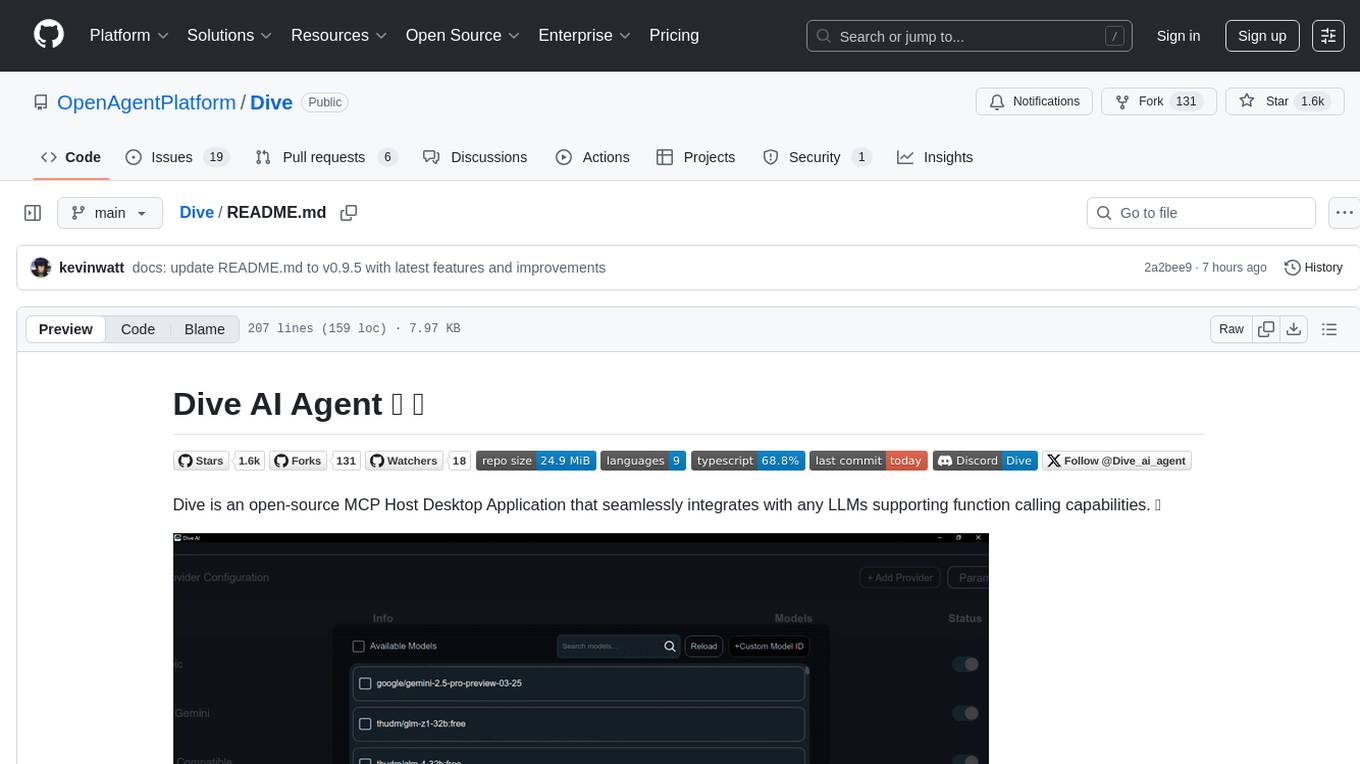
Dive is an open-source MCP Host Desktop Application that seamlessly integrates with any LLMs supporting function calling capabilities. It offers universal LLM support, cross-platform compatibility, model context protocol for AI agent integration, OAP cloud integration, dual architecture for optimal performance, multi-language support, advanced API management, granular tool control, custom instructions, auto-update mechanism, and more. Dive provides a user-friendly interface for managing multiple AI models and tools, with recent updates introducing major architecture changes, new features, improvements, and platform availability. Users can easily download and install Dive on Windows, MacOS, and Linux, and set up MCP tools through local servers or OAP cloud services.
For similar tasks
mcp-go
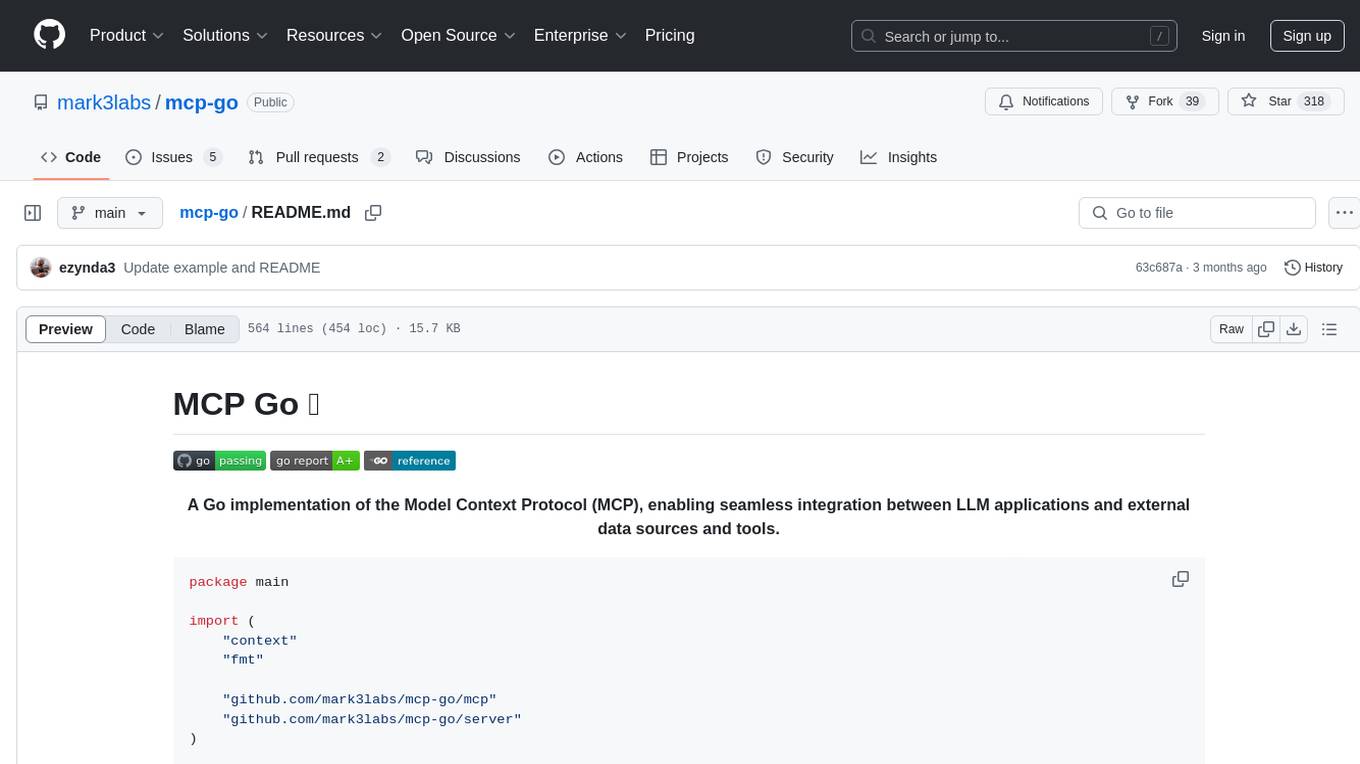
MCP Go is a Go implementation of the Model Context Protocol (MCP), facilitating seamless integration between LLM applications and external data sources and tools. It handles complex protocol details and server management, allowing developers to focus on building tools. The tool is designed to be fast, simple, and complete, aiming to provide a high-level and easy-to-use interface for developing MCP servers. MCP Go is currently under active development, with core features working and advanced capabilities in progress.
mcp-for-beginners
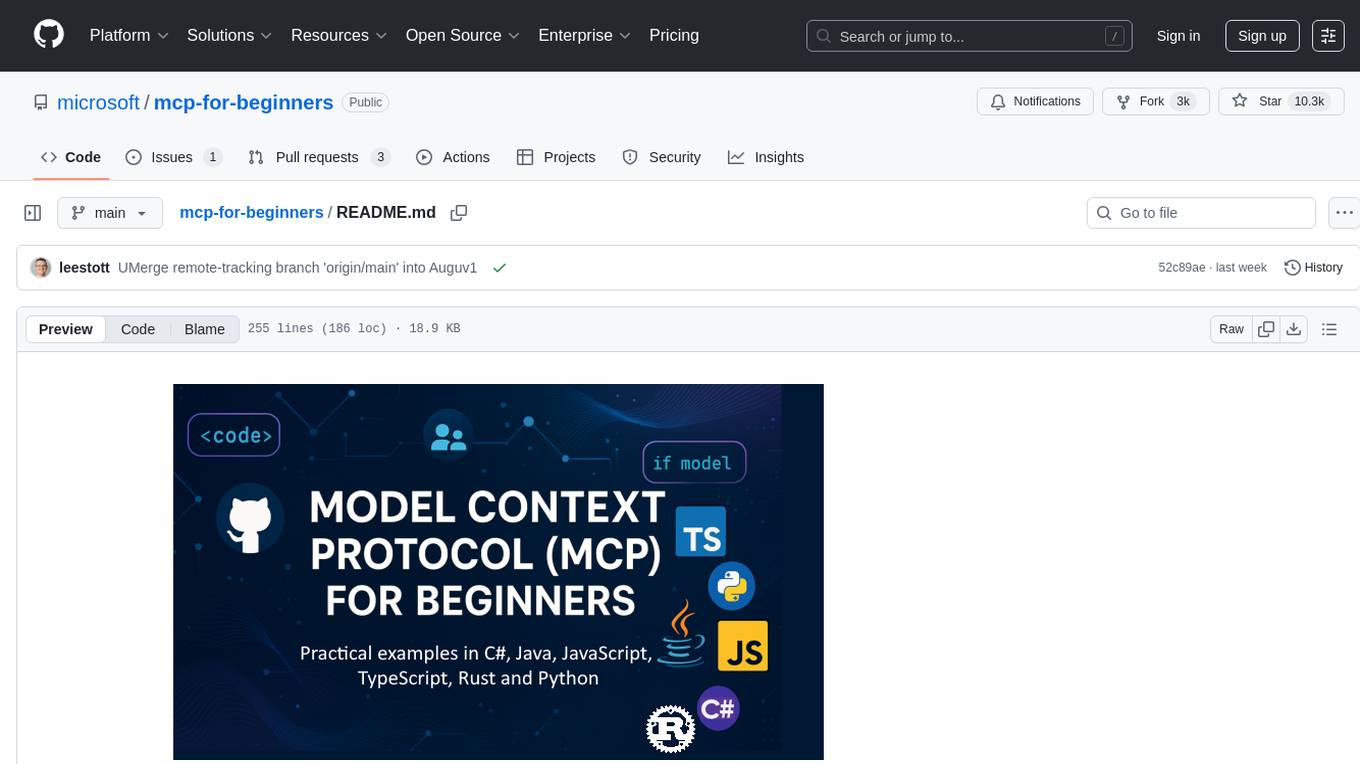
The Model Context Protocol (MCP) Curriculum for Beginners is an open-source framework designed to standardize interactions between AI models and client applications. It offers a structured learning path with practical coding examples and real-world use cases in popular programming languages like C#, Java, JavaScript, Rust, Python, and TypeScript. Whether you're an AI developer, system architect, or software engineer, this guide provides comprehensive resources for mastering MCP fundamentals and implementation strategies.
MCP-Nest
A NestJS module to effortlessly expose tools, resources, and prompts for AI using the Model Context Protocol (MCP). It allows defining tools, resources, and prompts in a familiar NestJS way, supporting multi-transport, tool validation, interactive tool calls, request context access, fine-grained authorization, resource serving, dynamic resources, prompt templates, guard-based authentication, dependency injection, server mutation, and instrumentation. It provides features for building ChatGPT widgets and MCP apps.
ollama-ex
Ollama is a powerful tool for running large language models locally or on your own infrastructure. It provides a full implementation of the Ollama API, support for streaming requests, and tool use capability. Users can interact with Ollama in Elixir to generate completions, chat messages, and perform streaming requests. The tool also supports function calling on compatible models, allowing users to define tools with clear descriptions and arguments. Ollama is designed to facilitate natural language processing tasks and enhance user interactions with language models.
llm_agents
LLM Agents is a small library designed to build agents controlled by large language models. It aims to provide a better understanding of how such agents work in a concise manner. The library allows agents to be instructed by prompts, use custom-built components as tools, and run in a loop of Thought, Action, Observation. The agents leverage language models to generate Thought and Action, while tools like Python REPL, Google search, and Hacker News search provide Observations. The library requires setting up environment variables for OpenAI API and SERPAPI API keys. Users can create their own agents by importing the library and defining tools accordingly.
kagent
Kagent is a Kubernetes native framework for building AI agents, designed to be easy to understand and use. It provides a flexible and powerful way to build, deploy, and manage AI agents in Kubernetes. The framework consists of agents, tools, and model configurations defined as Kubernetes custom resources, making them easy to manage and modify. Kagent is extensible, flexible, observable, declarative, testable, and has core components like a controller, UI, engine, and CLI.
AgentFly
AgentFly is an extensible framework for building LLM agents with reinforcement learning. It supports multi-turn training by adapting traditional RL methods with token-level masking. It features a decorator-based interface for defining tools and reward functions, enabling seamless extension and ease of use. To support high-throughput training, it implemented asynchronous execution of tool calls and reward computations, and designed a centralized resource management system for scalable environment coordination. A suite of prebuilt tools and environments are provided.
bellman
Bellman is a unified interface to interact with language and embedding models, supporting various vendors like VertexAI/Gemini, OpenAI, Anthropic, VoyageAI, and Ollama. It consists of a library for direct interaction with models and a service 'bellmand' for proxying requests with one API key. Bellman simplifies switching between models, vendors, and common tasks like chat, structured data, tools, and binary input. It addresses the lack of official SDKs for major players and differences in APIs, providing a single proxy for handling different models. The library offers clients for different vendors implementing common interfaces for generating and embedding text, enabling easy interchangeability between models.
For similar jobs
sweep
Sweep is an AI junior developer that turns bugs and feature requests into code changes. It automatically handles developer experience improvements like adding type hints and improving test coverage.
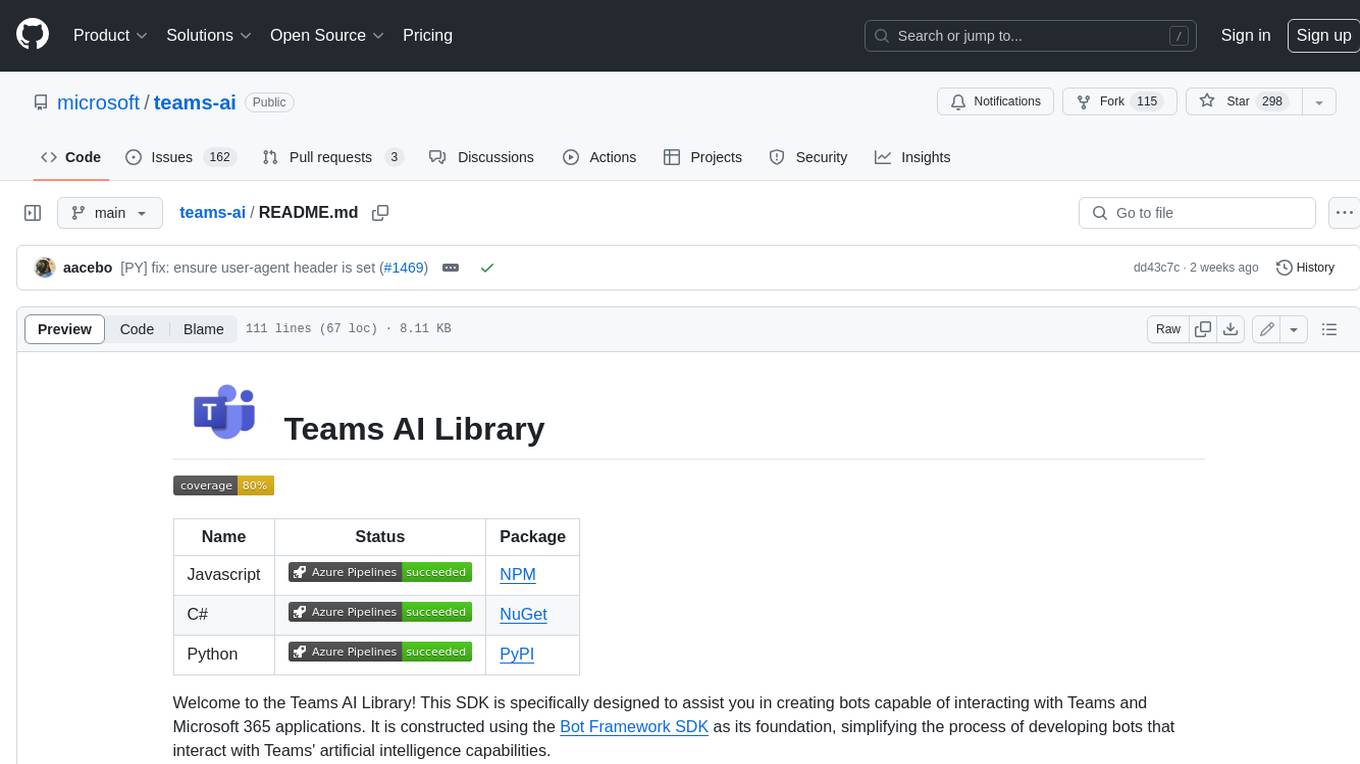
teams-ai
The Teams AI Library is a software development kit (SDK) that helps developers create bots that can interact with Teams and Microsoft 365 applications. It is built on top of the Bot Framework SDK and simplifies the process of developing bots that interact with Teams' artificial intelligence capabilities. The SDK is available for JavaScript/TypeScript, .NET, and Python.
ai-guide
This guide is dedicated to Large Language Models (LLMs) that you can run on your home computer. It assumes your PC is a lower-end, non-gaming setup.
classifai
Supercharge WordPress Content Workflows and Engagement with Artificial Intelligence. Tap into leading cloud-based services like OpenAI, Microsoft Azure AI, Google Gemini and IBM Watson to augment your WordPress-powered websites. Publish content faster while improving SEO performance and increasing audience engagement. ClassifAI integrates Artificial Intelligence and Machine Learning technologies to lighten your workload and eliminate tedious tasks, giving you more time to create original content that matters.
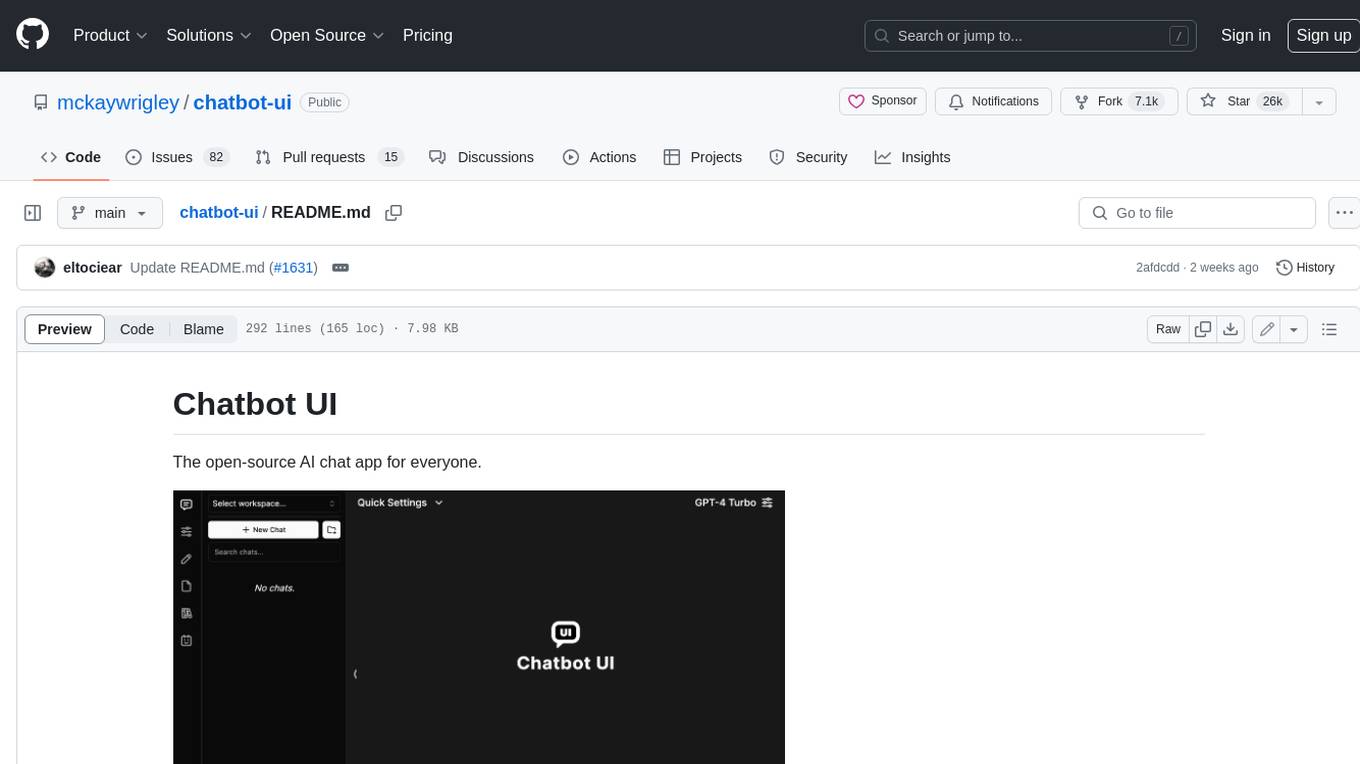
chatbot-ui
Chatbot UI is an open-source AI chat app that allows users to create and deploy their own AI chatbots. It is easy to use and can be customized to fit any need. Chatbot UI is perfect for businesses, developers, and anyone who wants to create a chatbot.
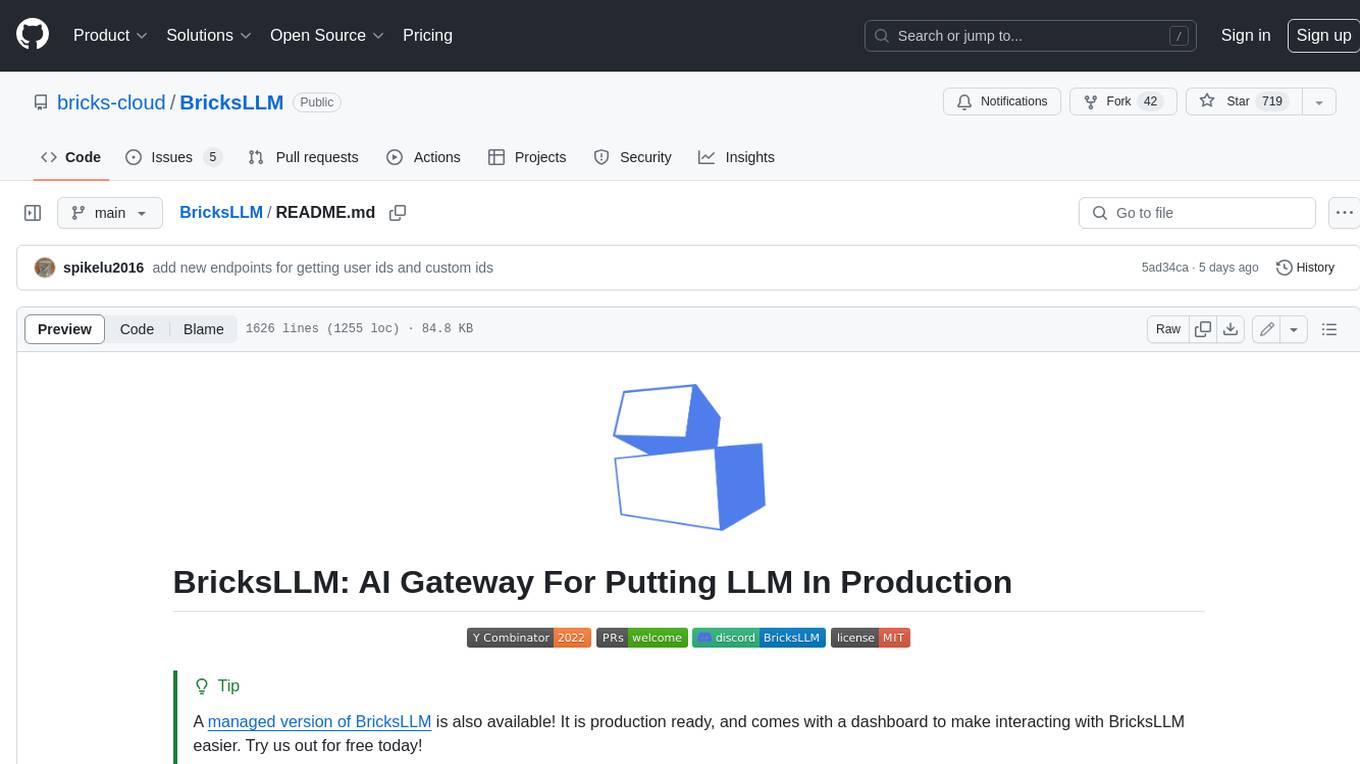
BricksLLM
BricksLLM is a cloud native AI gateway written in Go. Currently, it provides native support for OpenAI, Anthropic, Azure OpenAI and vLLM. BricksLLM aims to provide enterprise level infrastructure that can power any LLM production use cases. Here are some use cases for BricksLLM: * Set LLM usage limits for users on different pricing tiers * Track LLM usage on a per user and per organization basis * Block or redact requests containing PIIs * Improve LLM reliability with failovers, retries and caching * Distribute API keys with rate limits and cost limits for internal development/production use cases * Distribute API keys with rate limits and cost limits for students
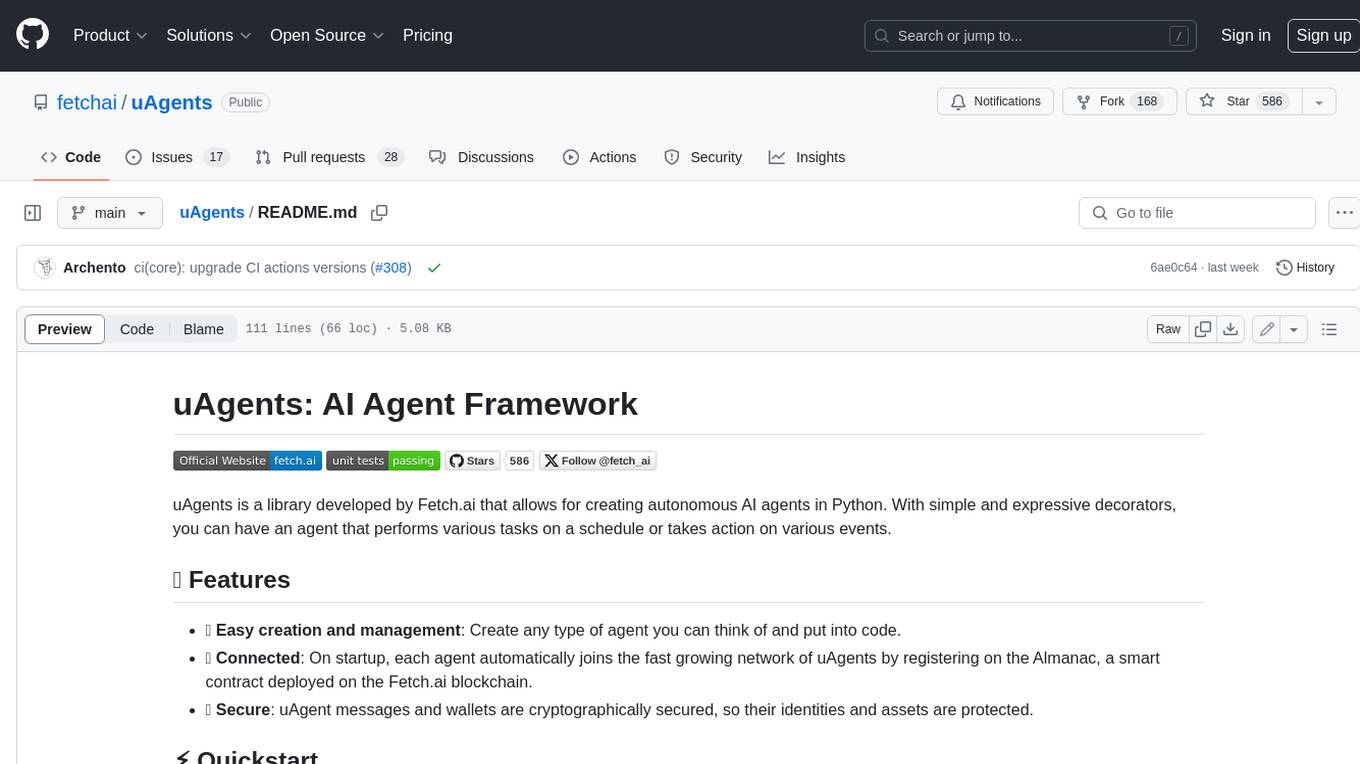
uAgents
uAgents is a Python library developed by Fetch.ai that allows for the creation of autonomous AI agents. These agents can perform various tasks on a schedule or take action on various events. uAgents are easy to create and manage, and they are connected to a fast-growing network of other uAgents. They are also secure, with cryptographically secured messages and wallets.
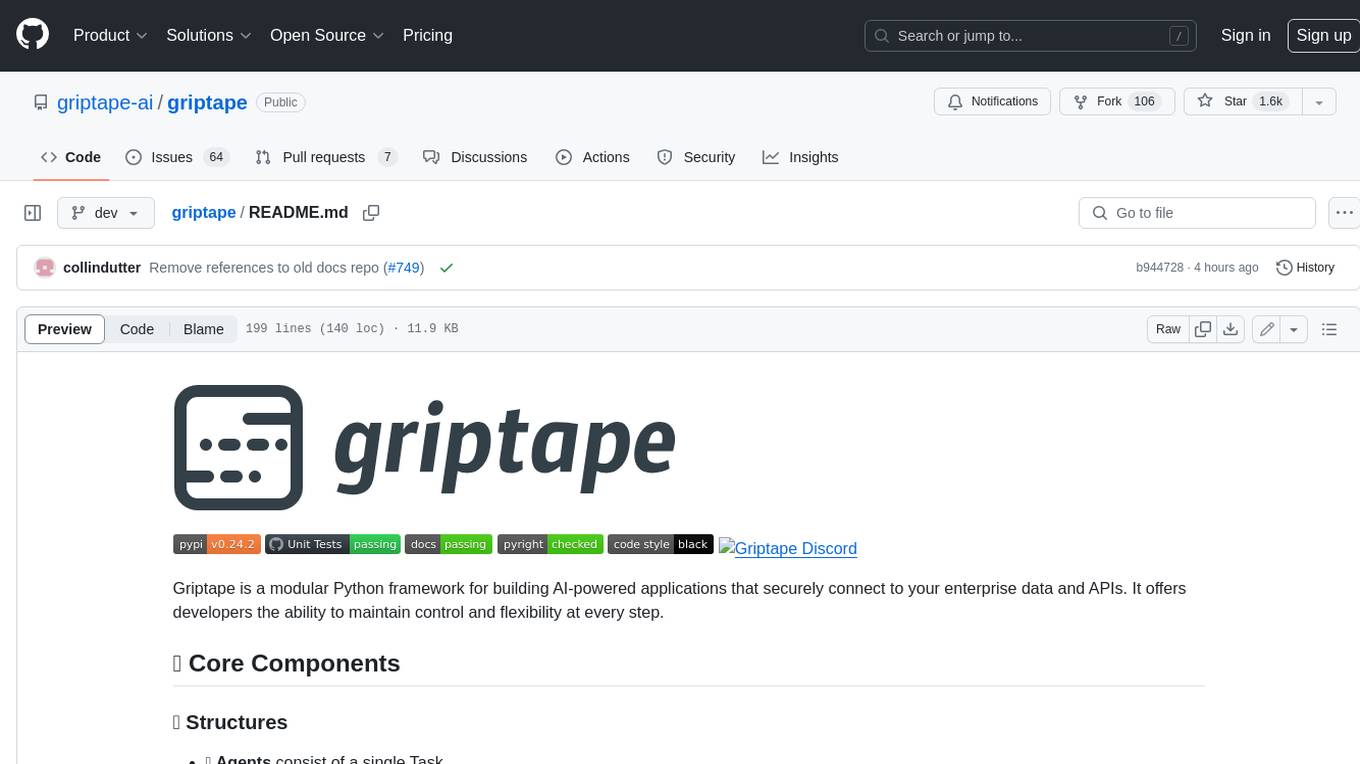
griptape
Griptape is a modular Python framework for building AI-powered applications that securely connect to your enterprise data and APIs. It offers developers the ability to maintain control and flexibility at every step. Griptape's core components include Structures (Agents, Pipelines, and Workflows), Tasks, Tools, Memory (Conversation Memory, Task Memory, and Meta Memory), Drivers (Prompt and Embedding Drivers, Vector Store Drivers, Image Generation Drivers, Image Query Drivers, SQL Drivers, Web Scraper Drivers, and Conversation Memory Drivers), Engines (Query Engines, Extraction Engines, Summary Engines, Image Generation Engines, and Image Query Engines), and additional components (Rulesets, Loaders, Artifacts, Chunkers, and Tokenizers). Griptape enables developers to create AI-powered applications with ease and efficiency.