


json-io
Convert Java to JSON/TOON and back. Supports complex object graphs, cyclic references, and TOON format for 40-50% LLM token savings
Stars: 369
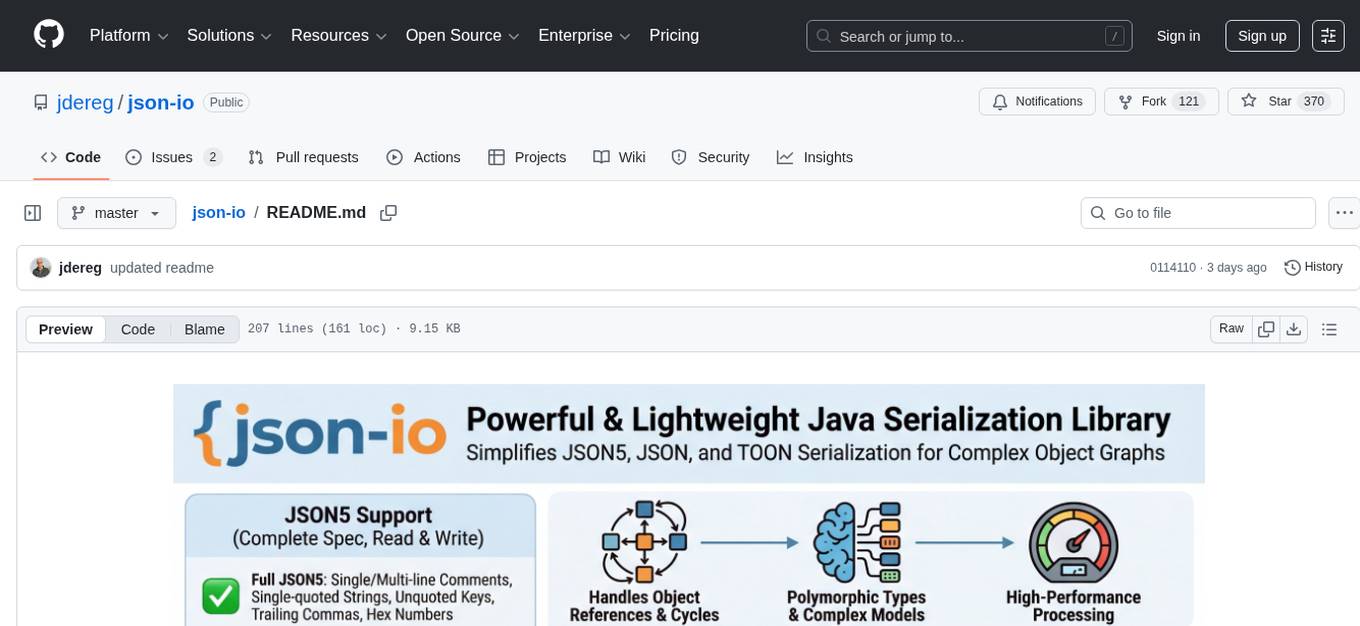
json-io is a powerful and lightweight Java library that simplifies JSON5, JSON, and TOON serialization and deserialization while handling complex object graphs with ease. It preserves object references, handles polymorphic types, and maintains cyclic relationships in data structures. It offers full JSON5 support, TOON read/write capabilities, and is compatible with JDK 1.8 through JDK 24. The library is built with a focus on correctness over speed, providing extensive configuration options and two modes for data representation. json-io is designed for developers who require advanced serialization features and support for various Java types without external dependencies.
README:

Infographic by Guillaume Laforge







json-io is a powerful and lightweight Java library that simplifies JSON5, JSON, and TOON serialization and deserialization while handling complex object graphs with ease. Unlike basic JSON parsers, json-io preserves object references, handles polymorphic types, and maintains cyclic relationships in your data structures.
- Key Features
- Why json-io?
- Installation
- Quick Start
- Spring Boot Integration
- Supported Types
- Documentation
- Release Info
- Full JSON5 support including single-line and multi-line comments, single-quoted strings, unquoted object keys, trailing commas, and more — while remaining fully backward compatible with standard JSON (RFC 8259)
- TOON read/write — Token-Oriented Object Notation for LLM-optimized serialization (~40-50% fewer tokens than JSON)
- Preserves object references and handles cyclic relationships (use
cycleSupport(false)for ~35-40% faster writes on acyclic data) - forJSON/JSON5. - Supports polymorphic types and complex object graphs
- Zero external dependencies (other than java-util)
- Fully compatible with both JPMS and OSGi environments
- Lightweight (
json-io.jaris ~330K,java-utilis ~700K) - Compatible with JDK 1.8 through JDK 24
- The library is built with the
-parameterscompiler flag. Parameter names are now retained for tasks such as constructor discovery. - Optional unsafe mode for deserializing package-private classes, inner classes, and classes without accessible constructors (opt-in for security)
- Extensive configuration options via
ReadOptionsBuilderandWriteOptionsBuilder - Two modes: typed Java objects (
toJava()) or class-independent Maps (toMaps()) - Parse JSON with unknown class references into a Map-of-Maps representation without requiring classes on classpath
- Featured on json.org
| Capability | json-io | Jackson/Gson |
|---|---|---|
| Object graph cycles | Full support (@id/@ref) |
None |
| Polymorphic types | Automatic (@type when needed) |
Requires annotations |
| Configuration | Zero-config default | Annotation-heavy |
| Dependencies | java-util (~1MB total) | Multiple JARs (~2.5MB+) |
Trade-off: json-io prioritizes correctness over speed. It preserves graph shape and Java type semantics—handling cycles, references, and polymorphism that break other serializers. Jackson/Gson are faster for simple DTOs, but json-io handles what they cannot.
Performance tip: Use cycleSupport(false) for ~35-40% faster writes when you know your object graph is acyclic.
| Capability | json-io | JToon |
|---|---|---|
| Built-in types | 60+ | ~15 |
| Map key types | Any serializable type | Strings only |
| EnumSet support | Yes | No |
| Dependencies | java-util only | Jackson |
| Status | Stable, production-ready | Beta (v1.x.x) |
json-io's TOON implementation offers comprehensive Java type coverage while JToon focuses on basic types with Jackson integration.
- Annotations — Custom serialization control via annotations
To include in your project:
Replace
LATEST_VERSIONwith the version shown here:

Gradle
implementation 'com.cedarsoftware:json-io:LATEST_VERSION'Maven
<dependency>
  <groupId>com.cedarsoftware</groupId>
  <artifactId>json-io</artifactId>
  <version>LATEST_VERSION</version>
</dependency>json-io provides a Spring Boot starter for seamless integration with Spring MVC and WebFlux applications.
Add the dependency:
<dependency>
  <groupId>com.cedarsoftware</groupId>
  <artifactId>json-io-spring-boot-starter</artifactId>
  <version>LATEST_VERSION</version>
</dependency>
Your REST controllers now support JSON, JSON5, and TOON formats via content negotiation:
@RestController
public class ApiController {
    @GetMapping("/data")
    public MyData getData() {
        return myData;  // Returns JSON, JSON5, or TOON based on Accept header
    }
}// JSON
String json = JsonIo.toJson(myObject);
MyClass obj = JsonIo.toJava(json).asClass(MyClass.class);
// TOON (~40% fewer tokens than JSON)
String toon = JsonIo.toToon(myObject, writeOptions);
MyClass obj = JsonIo.fromToon(toon, readOptions).asClass(MyClass.class);Request TOON format for LLM applications: Accept: application/vnd.toon
Also supports WebFlux and WebClient for reactive applications.
See the Spring Integration Guide for configuration options, WebFlux usage, customizers, and Jackson coexistence modes.
json-io handles your business objects, DTOs, and Records automatically—no annotations required. It also provides optimized handling for these built-in types:
| Category | Types |
|---|---|
| Primitives |
byte, short, int, long, float, double, boolean, char + wrappers |
| Numbers |
BigInteger, BigDecimal, AtomicInteger, AtomicLong, AtomicBoolean
|
| Date/Time |
Date, Calendar, Instant, LocalDate, LocalTime, LocalDateTime, ZonedDateTime, OffsetDateTime, OffsetTime, Duration, Period, Year, YearMonth, MonthDay, TimeZone, ZoneId, ZoneOffset, java.sql.Date, Timestamp
|
| Strings |
String, StringBuffer, StringBuilder, char[], CharBuffer
|
| Binary |
byte[], ByteBuffer, BitSet
|
| IDs |
UUID, URI, URL, Class, Locale, Currency, Pattern, File, Path
|
| Geometric |
Color, Dimension, Point, Rectangle, Insets
|
| Other |
Enum (any), Throwable, all Collection, Map, EnumSet, and array types |
See the complete type comparison showing json-io's comprehensive support vs other TOON implementations.
| Bundling | JPMS & OSGi |
| Java | JDK 1.8+ (multi-release JAR with module-info.class) |
| Package | com.cedarsoftware.io |
API — Static methods on JsonIo: toJson(), toJava(), toMaps(), toToon(), fromToon(), formatJson(), deepCopy()
Configure via ReadOptionsBuilder and WriteOptionsBuilder. Use ClassFactory for difficult-to-instantiate classes.
json-io uses java.util.logging to minimize dependencies. See the user guide to route logs to SLF4J or Log4j 2.
For useful Java utilities, check out java-util
For Tasks:
Click tags to check more tools for each tasksFor Jobs:
Alternative AI tools for json-io
Similar Open Source Tools
json-io
json-io is a powerful and lightweight Java library that simplifies JSON5, JSON, and TOON serialization and deserialization while handling complex object graphs with ease. It preserves object references, handles polymorphic types, and maintains cyclic relationships in data structures. It offers full JSON5 support, TOON read/write capabilities, and is compatible with JDK 1.8 through JDK 24. The library is built with a focus on correctness over speed, providing extensive configuration options and two modes for data representation. json-io is designed for developers who require advanced serialization features and support for various Java types without external dependencies.
adk-rust
ADK-Rust is a comprehensive and production-ready Rust framework for building AI agents. It features type-safe agent abstractions with async execution and event streaming, multiple agent types including LLM agents, workflow agents, and custom agents, realtime voice agents with bidirectional audio streaming, a tool ecosystem with function tools, Google Search, and MCP integration, production features like session management, artifact storage, memory systems, and REST/A2A APIs, and a developer-friendly experience with interactive CLI, working examples, and comprehensive documentation. The framework follows a clean layered architecture and is production-ready and actively maintained.
docutranslate
Docutranslate is a versatile tool for translating documents efficiently. It supports multiple file formats and languages, making it ideal for businesses and individuals needing quick and accurate translations. The tool uses advanced algorithms to ensure high-quality translations while maintaining the original document's formatting. With its user-friendly interface, Docutranslate simplifies the translation process and saves time for users. Whether you need to translate legal documents, technical manuals, or personal letters, Docutranslate is the go-to solution for all your document translation needs.
mcp-ui
mcp-ui is a collection of SDKs that bring interactive web components to the Model Context Protocol (MCP). It allows servers to define reusable UI snippets, render them securely in the client, and react to their actions in the MCP host environment. The SDKs include @mcp-ui/server (TypeScript) for generating UI resources on the server, @mcp-ui/client (TypeScript) for rendering UI components on the client, and mcp_ui_server (Ruby) for generating UI resources in a Ruby environment. The project is an experimental community playground for MCP UI ideas, with rapid iteration and enhancements.
mcp-devtools
MCP DevTools is a high-performance server written in Go that replaces multiple Node.js and Python-based servers. It provides access to essential developer tools through a unified, modular interface. The server is efficient, with minimal memory footprint and fast response times. It offers a comprehensive tool suite for agentic coding, including 20+ essential developer agent tools. The tool registry allows for easy addition of new tools. The server supports multiple transport modes, including STDIO, HTTP, and SSE. It includes a security framework for multi-layered protection and a plugin system for adding new tools.
atlas-mcp-server
ATLAS (Adaptive Task & Logic Automation System) is a high-performance Model Context Protocol server designed for LLMs to manage complex task hierarchies. Built with TypeScript, it features ACID-compliant storage, efficient task tracking, and intelligent template management. ATLAS provides LLM Agents task management through a clean, flexible tool interface. The server implements the Model Context Protocol (MCP) for standardized communication between LLMs and external systems, offering hierarchical task organization, task state management, smart templates, enterprise features, and performance optimization.
augustus
Augustus is a Go-based LLM vulnerability scanner designed for security professionals to test large language models against a wide range of adversarial attacks. It integrates with 28 LLM providers, covers 210+ adversarial attacks including prompt injection, jailbreaks, encoding exploits, and data extraction, and produces actionable vulnerability reports. The tool is built for production security testing with features like concurrent scanning, rate limiting, retry logic, and timeout handling out of the box.
flyte-sdk
Flyte 2 SDK is a pure Python tool for type-safe, distributed orchestration of agents, ML pipelines, and more. It allows users to write data pipelines, ML training jobs, and distributed compute in Python without any DSL constraints. With features like async-first parallelism and fine-grained observability, Flyte 2 offers a seamless workflow experience. Users can leverage core concepts like TaskEnvironments for container configuration, pure Python workflows for flexibility, and async parallelism for distributed execution. Advanced features include sub-task observability with tracing and remote task execution. The tool also provides native Jupyter integration for running and monitoring workflows directly from notebooks. Configuration and deployment are made easy with configuration files and commands for deploying and running workflows. Flyte 2 is licensed under the Apache 2.0 License.
mcp-context-forge
MCP Context Forge is a powerful tool for generating context-aware data for machine learning models. It provides functionalities to create diverse datasets with contextual information, enhancing the performance of AI algorithms. The tool supports various data formats and allows users to customize the context generation process easily. With MCP Context Forge, users can efficiently prepare training data for tasks requiring contextual understanding, such as sentiment analysis, recommendation systems, and natural language processing.
rust-genai
genai is a multi-AI providers library for Rust that aims to provide a common and ergonomic single API to various generative AI providers such as OpenAI, Anthropic, Cohere, Ollama, and Gemini. It focuses on standardizing chat completion APIs across major AI services, prioritizing ergonomics and commonality. The library initially focuses on text chat APIs and plans to expand to support images, function calling, and more in the future versions. Version 0.1.x will have breaking changes in patches, while version 0.2.x will follow semver more strictly. genai does not provide a full representation of a given AI provider but aims to simplify the differences at a lower layer for ease of use.
paperbanana
PaperBanana is an automated academic illustration tool designed for AI scientists. It implements an agentic framework for generating publication-quality academic diagrams and statistical plots from text descriptions. The tool utilizes a two-phase multi-agent pipeline with iterative refinement, Gemini-based VLM planning, and image generation. It offers a CLI, Python API, and MCP server for IDE integration, along with Claude Code skills for generating diagrams, plots, and evaluating diagrams. PaperBanana is not affiliated with or endorsed by the original authors or Google Research, and it may differ from the original system described in the paper.
code-graph-rag
Graph-Code is an accurate Retrieval-Augmented Generation (RAG) system that analyzes multi-language codebases using Tree-sitter. It builds comprehensive knowledge graphs, enabling natural language querying of codebase structure and relationships, along with editing capabilities. The system supports various languages, uses Tree-sitter for parsing, Memgraph for storage, and AI models for natural language to Cypher translation. It offers features like code snippet retrieval, advanced file editing, shell command execution, interactive code optimization, reference-guided optimization, dependency analysis, and more. The architecture consists of a multi-language parser and an interactive CLI for querying the knowledge graph.
agentops
AgentOps is a toolkit for evaluating and developing robust and reliable AI agents. It provides benchmarks, observability, and replay analytics to help developers build better agents. AgentOps is open beta and can be signed up for here. Key features of AgentOps include: - Session replays in 3 lines of code: Initialize the AgentOps client and automatically get analytics on every LLM call. - Time travel debugging: (coming soon!) - Agent Arena: (coming soon!) - Callback handlers: AgentOps works seamlessly with applications built using Langchain and LlamaIndex.
ruler
Ruler is a tool designed to centralize AI coding assistant instructions, providing a single source of truth for managing instructions across multiple AI coding tools. It helps in avoiding inconsistent guidance, duplicated effort, context drift, onboarding friction, and complex project structures by automatically distributing instructions to the right configuration files. With support for nested rule loading, Ruler can handle complex project structures with context-specific instructions for different components. It offers features like centralised rule management, nested rule loading, automatic distribution, targeted agent configuration, MCP server propagation, .gitignore automation, and a simple CLI for easy configuration management.
onnxruntime-server
ONNX Runtime Server is a server that provides TCP and HTTP/HTTPS REST APIs for ONNX inference. It aims to offer simple, high-performance ML inference and a good developer experience. Users can provide inference APIs for ONNX models without writing additional code by placing the models in the directory structure. Each session can choose between CPU or CUDA, analyze input/output, and provide Swagger API documentation for easy testing. Ready-to-run Docker images are available, making it convenient to deploy the server.
pixeltable
Pixeltable is a Python library designed for ML Engineers and Data Scientists to focus on exploration, modeling, and app development without the need to handle data plumbing. It provides a declarative interface for working with text, images, embeddings, and video, enabling users to store, transform, index, and iterate on data within a single table interface. Pixeltable is persistent, acting as a database unlike in-memory Python libraries such as Pandas. It offers features like data storage and versioning, combined data and model lineage, indexing, orchestration of multimodal workloads, incremental updates, and automatic production-ready code generation. The tool emphasizes transparency, reproducibility, cost-saving through incremental data changes, and seamless integration with existing Python code and libraries.
For similar tasks
json-io
json-io is a powerful and lightweight Java library that simplifies JSON5, JSON, and TOON serialization and deserialization while handling complex object graphs with ease. It preserves object references, handles polymorphic types, and maintains cyclic relationships in data structures. It offers full JSON5 support, TOON read/write capabilities, and is compatible with JDK 1.8 through JDK 24. The library is built with a focus on correctness over speed, providing extensive configuration options and two modes for data representation. json-io is designed for developers who require advanced serialization features and support for various Java types without external dependencies.
atomic_agents
Atomic Agents is a modular and extensible framework designed for creating powerful applications. It follows the principles of Atomic Design, emphasizing small and single-purpose components. Leveraging Pydantic for data validation and serialization, the framework offers a set of tools and agents that can be combined to build AI applications. It depends on the Instructor package and supports various APIs like OpenAI, Cohere, Anthropic, and Gemini. Atomic Agents is suitable for developers looking to create AI agents with a focus on modularity and flexibility.
atomic-agents
The Atomic Agents framework is a modular and extensible tool designed for creating powerful applications. It leverages Pydantic for data validation and serialization. The framework follows the principles of Atomic Design, providing small and single-purpose components that can be combined. It integrates with Instructor for AI agent architecture and supports various APIs like Cohere, Anthropic, and Gemini. The tool includes documentation, examples, and testing features to ensure smooth development and usage.
yek
Yek is a fast Rust-based tool designed to read text-based files in a repository or directory, chunk them, and serialize them for Large Language Models (LLM) consumption. It utilizes .gitignore rules to skip unwanted files, Git history to infer important files, and additional ignore patterns. Yek splits content into chunks based on token count or byte size, supports processing multiple directories, and can stream content when output is piped. It is configurable via a 'yek.toml' file and prioritizes important files at the end of the output.
For similar jobs
resonance
Resonance is a framework designed to facilitate interoperability and messaging between services in your infrastructure and beyond. It provides AI capabilities and takes full advantage of asynchronous PHP, built on top of Swoole. With Resonance, you can: * Chat with Open-Source LLMs: Create prompt controllers to directly answer user's prompts. LLM takes care of determining user's intention, so you can focus on taking appropriate action. * Asynchronous Where it Matters: Respond asynchronously to incoming RPC or WebSocket messages (or both combined) with little overhead. You can set up all the asynchronous features using attributes. No elaborate configuration is needed. * Simple Things Remain Simple: Writing HTTP controllers is similar to how it's done in the synchronous code. Controllers have new exciting features that take advantage of the asynchronous environment. * Consistency is Key: You can keep the same approach to writing software no matter the size of your project. There are no growing central configuration files or service dependencies registries. Every relation between code modules is local to those modules. * Promises in PHP: Resonance provides a partial implementation of Promise/A+ spec to handle various asynchronous tasks. * GraphQL Out of the Box: You can build elaborate GraphQL schemas by using just the PHP attributes. Resonance takes care of reusing SQL queries and optimizing the resources' usage. All fields can be resolved asynchronously.
aiogram_bot_template
Aiogram bot template is a boilerplate for creating Telegram bots using Aiogram framework. It provides a solid foundation for building robust and scalable bots with a focus on code organization, database integration, and localization.
pluto
Pluto is a development tool dedicated to helping developers **build cloud and AI applications more conveniently** , resolving issues such as the challenging deployment of AI applications and open-source models. Developers are able to write applications in familiar programming languages like **Python and TypeScript** , **directly defining and utilizing the cloud resources necessary for the application within their code base** , such as AWS SageMaker, DynamoDB, and more. Pluto automatically deduces the infrastructure resource needs of the app through **static program analysis** and proceeds to create these resources on the specified cloud platform, **simplifying the resources creation and application deployment process**.
pinecone-ts-client
The official Node.js client for Pinecone, written in TypeScript. This client library provides a high-level interface for interacting with the Pinecone vector database service. With this client, you can create and manage indexes, upsert and query vector data, and perform other operations related to vector search and retrieval. The client is designed to be easy to use and provides a consistent and idiomatic experience for Node.js developers. It supports all the features and functionality of the Pinecone API, making it a comprehensive solution for building vector-powered applications in Node.js.
aiohttp-pydantic
Aiohttp pydantic is an aiohttp view to easily parse and validate requests. You define using function annotations what your methods for handling HTTP verbs expect, and Aiohttp pydantic parses the HTTP request for you, validates the data, and injects the parameters you want. It provides features like query string, request body, URL path, and HTTP headers validation, as well as Open API Specification generation.
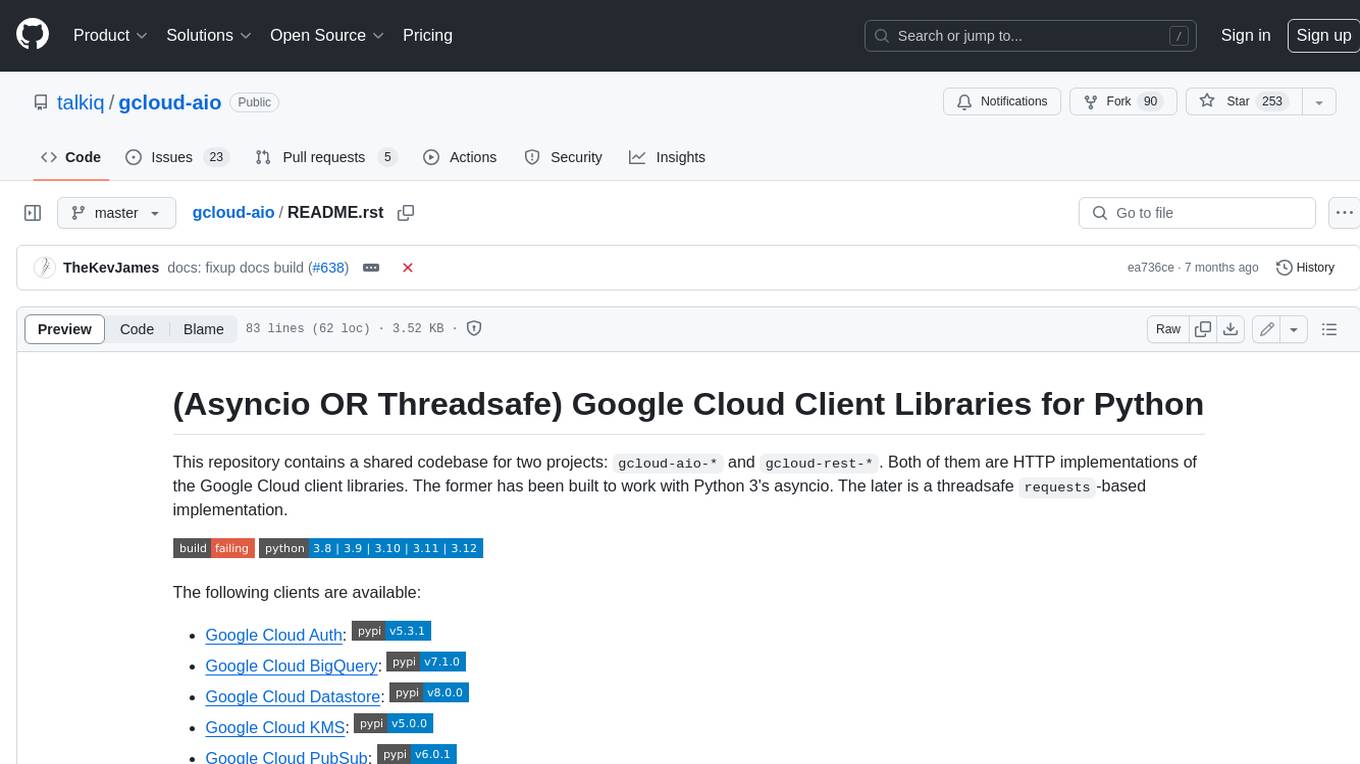
gcloud-aio
This repository contains shared codebase for two projects: gcloud-aio and gcloud-rest. gcloud-aio is built for Python 3's asyncio, while gcloud-rest is a threadsafe requests-based implementation. It provides clients for Google Cloud services like Auth, BigQuery, Datastore, KMS, PubSub, Storage, and Task Queue. Users can install the library using pip and refer to the documentation for usage details. Developers can contribute to the project by following the contribution guide.
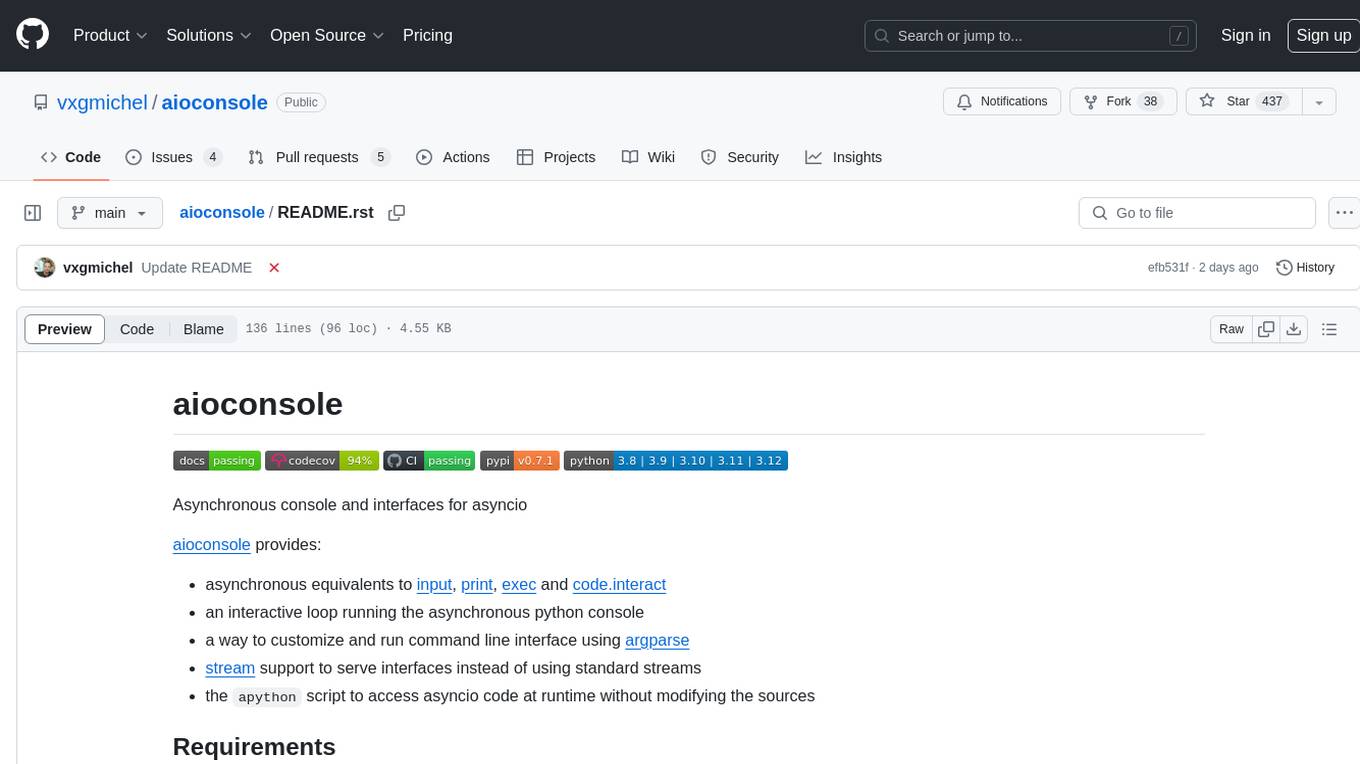
aioconsole
aioconsole is a Python package that provides asynchronous console and interfaces for asyncio. It offers asynchronous equivalents to input, print, exec, and code.interact, an interactive loop running the asynchronous Python console, customization and running of command line interfaces using argparse, stream support to serve interfaces instead of using standard streams, and the apython script to access asyncio code at runtime without modifying the sources. The package requires Python version 3.8 or higher and can be installed from PyPI or GitHub. It allows users to run Python files or modules with a modified asyncio policy, replacing the default event loop with an interactive loop. aioconsole is useful for scenarios where users need to interact with asyncio code in a console environment.
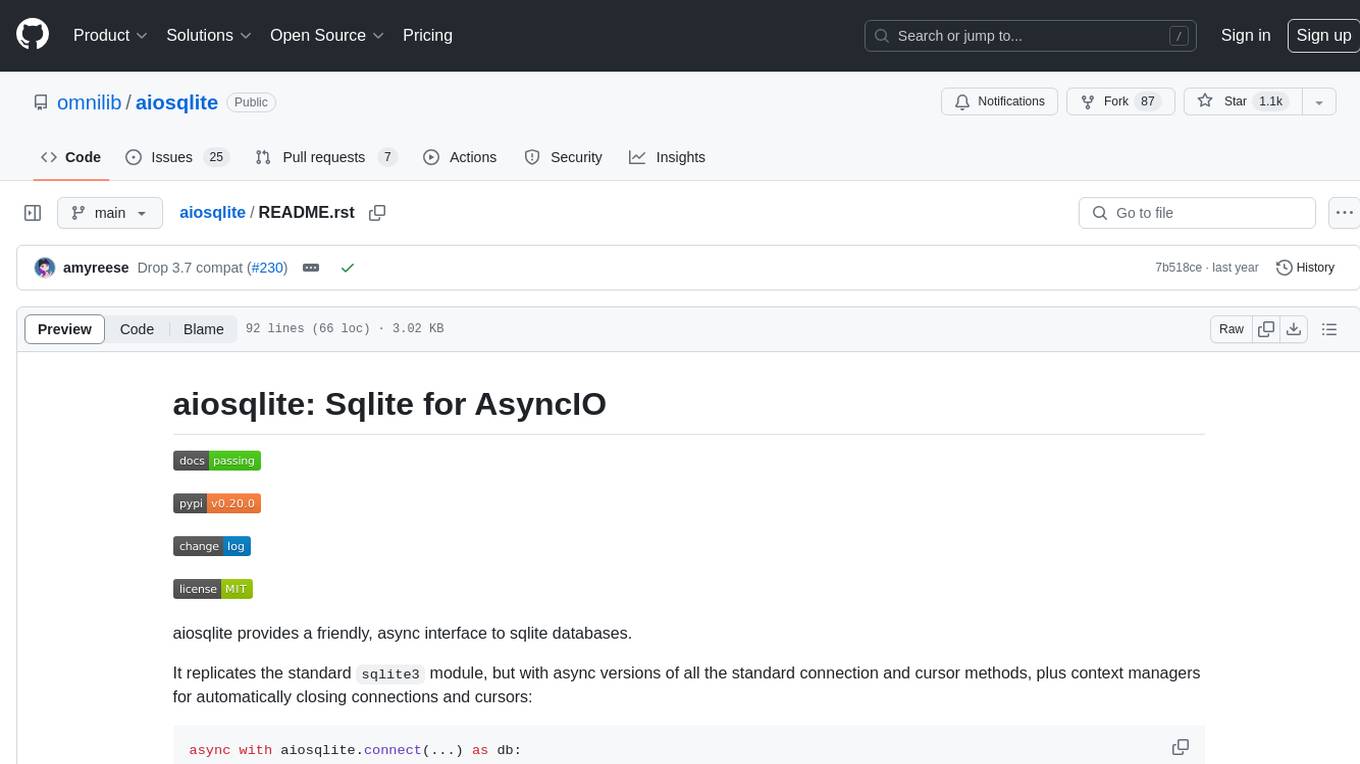
aiosqlite
aiosqlite is a Python library that provides a friendly, async interface to SQLite databases. It replicates the standard sqlite3 module but with async versions of all the standard connection and cursor methods, along with context managers for automatically closing connections and cursors. It allows interaction with SQLite databases on the main AsyncIO event loop without blocking execution of other coroutines while waiting for queries or data fetches. The library also replicates most of the advanced features of sqlite3, such as row factories and total changes tracking.