


aligner
[NeurIPS 2024 Oral] Aligner: Efficient Alignment by Learning to Correct
Stars: 138
Aligner is a model-agnostic alignment tool designed to efficiently correct responses from large language models. It redistributes initial answers to align with human intentions, improving performance across various LLMs. The tool can be applied with minimal training, enhancing upstream models and reducing hallucination. Aligner's 'copy and correct' method preserves the base structure while enhancing responses. It achieves significant performance improvements in helpfulness, harmlessness, and honesty dimensions, with notable success in boosting Win Rates on evaluation leaderboards.
README:
This repository contains the source code for our NeurIPS 2024 paper Aligner: Efficient Alignment by Learning to Correct.
Jiaming Ji*, Boyuan Chen*, Hantao Lou, Donghai Hong, Borong Zhang, Xuehai Pan, Juntao Dai, Tianyi Qiu and Yaodong Yang
Work done by PKU-Alignment Team
With the rapid development of large language models (LLMs) and ever-evolving practical requirements, finding an efficient and effective alignment method has never been more critical. However, the tension between the complexity of current alignment methods and the need for rapid iteration in deployment scenarios necessitates the development of a model-agnostic alignment approach that can operate under these constraints. In this paper, we introduce Aligner, a novel and simple alignment paradigm that learns the correctional residuals between preferred and dispreferred answers using a small model. Designed as a model-agnostic, plug-and-play module, Aligner can be directly applied to various open-source and API-based models with only one-off training, making it suitable for rapid iteration. Notably, Aligner can be applied to any powerful, large-scale upstream models. Moreover, it can even iteratively bootstrap the upstream models using corrected responses as synthetic human preference data, breaking through the model's performance ceiling. Our experiments demonstrate performance improvements by deploying the same Aligner model across 11 different LLMs, evaluated on the 3H dimensions (helpfulness, harmlessness, and honesty). Specifically, Aligner-7B has achieved an average improvement of 68.9% in helpfulness and 22.8% in harmlessness across the tested LLMs while also effectively reducing hallucination. In the Alpaca-Eval leaderboard, stacking Aligner-2B on GPT-4 Turbo improved its LC Win Rate from 55.0% to 58.3%, surpassing GPT-4 Omni's 57.5% Win Rate (community report).
See our website for more details : https://pku-aligner.github.io/
Please cite our work if you find it useful and meaningful.
@inproceedings{ji2024aligner,
  title={Aligner: Efficient Alignment by Learning to Correct},
  author={Jiaming Ji and Boyuan Chen and Hantao Lou and Donghai Hong and Borong Zhang and Xuehai Pan and Tianyi Qiu and Juntao Dai and Yaodong Yang},
  booktitle={The Thirty-eighth Annual Conference on Neural Information Processing Systems},
  year={2024},
  url={https://openreview.net/forum?id=kq166jACVP}
}- Aligner: Efficient Alignment by Learning to Correct
- Installation
- Training
- Dataset & Models
- Acknowledgment
As a plug-and-play module Aligner stack upon an upstream LLM. The Aligner redistributes initial answers from the upstream model into more helpful and harmless answers, thus aligning the composed LLM responses with human intentions.

Like a residual block that adds modifications via a shortcut without altering the base structure, the Aligner employs a copy and correct method to improve the original answer. This analogy highlights the Aligner's dual role in preserving the parameter of the upstream model while enhancing it to align with desired outcomes.

It is shown that Aligner achieves significant performances in all the settings. All assessments in this table were conducted based on integrating various models with Aligners to compare with the original models to quantify the percentage increase in the 3H standard. When integrated and assessed in conjunction with various upstream models, the Aligner requires only a single training session (i.e., the Aligner can operate in a zero-shot manner and enhance the performance of all upstream models.)

For more details, please refer to our website
Clone the source code from GitHub:
git clone https://github.com/cby-pku/aligner.git
cd aligner
Native Runner: Setup a conda environment using conda / mamba:
conda env create --file conda-recipe.yaml # or `mamba env create --file conda-recipe.yaml`aligner supports a complete pipeline for Aligner residual correction training.
- Follow the instructions in section Installation to setup the training environment properly.
conda activate aligner
export WANDB_API_KEY="..." # your W&B API key here- Supervised Fine-Tuning (SFT)
bash scripts/sft-correction.sh \
    --train_datasets <your-correction-dataset> \
    --model_name_or_path <your-model-name-or-checkpoint-path> \
    --output_dir output/sft
NOTE:
- You may need to update some of the parameters in the script according to your machine setup, such as the number of GPUs for training, the training batch size, etc.
- Your dataset format should be consistent with aligner/template-dataset.json
- For the reproduction of more alignment training methods such as DPO or RLHF, please refer to the Align-Anything or Safe-RLHF repository.
You can register a new dataset by following the instructions in the aligner/training/datasets/raw/correction.py file.
And you can also design your own user prompt to develop for more specifc Aligners, such as Instruct-Aligner.
Notice that the whole system prompt is start with BEGINNING OF CONVERSATION: , you can refer to aligner/training/configs/constants.py for details.
We have open-sourced a 20K training dataset and a 7B Aligner model. Further dataset and models will come soon.
This repository benefits from LLaMA, Stanford Alpaca, DeepSpeed, DeepSpeed-Chat and Safe-RLHF.
Thanks for their wonderful works and their efforts to further promote LLM research. Aligner and its related assets are built and open-sourced with love and respect ❤️.
This work is supported and funded by the Peking University.

|
Aligner is released under Apache License 2.0.
For Tasks:
Click tags to check more tools for each tasksFor Jobs:
Alternative AI tools for aligner
Similar Open Source Tools
aligner
Aligner is a model-agnostic alignment tool designed to efficiently correct responses from large language models. It redistributes initial answers to align with human intentions, improving performance across various LLMs. The tool can be applied with minimal training, enhancing upstream models and reducing hallucination. Aligner's 'copy and correct' method preserves the base structure while enhancing responses. It achieves significant performance improvements in helpfulness, harmlessness, and honesty dimensions, with notable success in boosting Win Rates on evaluation leaderboards.
aligner
Aligner is a model-agnostic alignment tool that learns correctional residuals between preferred and dispreferred answers using a small model. It can be directly applied to various open-source and API-based models with only one-off training, suitable for rapid iteration and improving model performance. Aligner has shown significant improvements in helpfulness, harmlessness, and honesty dimensions across different large language models.
CoLLM
CoLLM is a novel method that integrates collaborative information into Large Language Models (LLMs) for recommendation. It converts recommendation data into language prompts, encodes them with both textual and collaborative information, and uses a two-step tuning method to train the model. The method incorporates user/item ID fields in prompts and employs a conventional collaborative model to generate user/item representations. CoLLM is built upon MiniGPT-4 and utilizes pretrained Vicuna weights for training.
bocoel
BoCoEL is a tool that leverages Bayesian Optimization to efficiently evaluate large language models by selecting a subset of the corpus for evaluation. It encodes individual entries into embeddings, uses Bayesian optimization to select queries, retrieves from the corpus, and provides easily managed evaluations. The tool aims to reduce computation costs during evaluation with a dynamic budget, supporting models like GPT2, Pythia, and LLAMA through integration with Hugging Face transformers and datasets. BoCoEL offers a modular design and efficient representation of the corpus to enhance evaluation quality.
R1-Searcher
R1-searcher is a tool designed to incentivize the search capability in large reasoning models (LRMs) via reinforcement learning. It enables LRMs to invoke web search and obtain external information during the reasoning process by utilizing a two-stage outcome-supervision reinforcement learning approach. The tool does not require instruction fine-tuning for cold start and is compatible with existing Base LLMs or Chat LLMs. It includes training code, inference code, model checkpoints, and a detailed technical report.
Woodpecker
Woodpecker is a tool designed to correct hallucinations in Multimodal Large Language Models (MLLMs) by introducing a training-free method that picks out and corrects inconsistencies between generated text and image content. It consists of five stages: key concept extraction, question formulation, visual knowledge validation, visual claim generation, and hallucination correction. Woodpecker can be easily integrated with different MLLMs and provides interpretable results by accessing intermediate outputs of the stages. The tool has shown significant improvements in accuracy over baseline models like MiniGPT-4 and mPLUG-Owl.
OREAL
OREAL is a reinforcement learning framework designed for mathematical reasoning tasks, aiming to achieve optimal performance through outcome reward-based learning. The framework utilizes behavior cloning, reshaping rewards, and token-level reward models to address challenges in sparse rewards and partial correctness. OREAL has achieved significant results, with a 7B model reaching 94.0 pass@1 accuracy on MATH-500 and surpassing previous 32B models. The tool provides training tutorials and Hugging Face model repositories for easy access and implementation.
baal
Baal is an active learning library that supports both industrial applications and research use cases. It provides a framework for Bayesian active learning methods such as Monte-Carlo Dropout, MCDropConnect, Deep ensembles, and Semi-supervised learning. Baal helps in labeling the most uncertain items in the dataset pool to improve model performance and reduce annotation effort. The library is actively maintained by a dedicated team and has been used in various research papers for production and experimentation.
PromptAgent
PromptAgent is a repository for a novel automatic prompt optimization method that crafts expert-level prompts using language models. It provides a principled framework for prompt optimization by unifying prompt sampling and rewarding using MCTS algorithm. The tool supports different models like openai, palm, and huggingface models. Users can run PromptAgent to optimize prompts for specific tasks by strategically sampling model errors, generating error feedbacks, simulating future rewards, and searching for high-reward paths leading to expert prompts.
uncheatable_eval
Uncheatable Eval is a tool designed to assess the language modeling capabilities of LLMs on real-time, newly generated data from the internet. It aims to provide a reliable evaluation method that is immune to data leaks and cannot be gamed. The tool supports the evaluation of Hugging Face AutoModelForCausalLM models and RWKV models by calculating the sum of negative log probabilities on new texts from various sources such as recent papers on arXiv, new projects on GitHub, news articles, and more. Uncheatable Eval ensures that the evaluation data is not included in the training sets of publicly released models, thus offering a fair assessment of the models' performance.
Instruct2Act
Instruct2Act is a framework that utilizes Large Language Models to map multi-modal instructions to sequential actions for robotic manipulation tasks. It generates Python programs using the LLM model for perception, planning, and action. The framework leverages foundation models like SAM and CLIP to convert high-level instructions into policy codes, accommodating various instruction modalities and task demands. Instruct2Act has been validated on robotic tasks in tabletop manipulation domains, outperforming learning-based policies in several tasks.
MegatronApp
MegatronApp is a toolchain built around the Megatron-LM training framework, offering performance tuning, slow-node detection, and training-process visualization. It includes modules like MegaScan for anomaly detection, MegaFBD for forward-backward decoupling, MegaDPP for dynamic pipeline planning, and MegaScope for visualization. The tool aims to enhance large-scale distributed training by providing valuable capabilities and insights.
kafka-ml
Kafka-ML is a framework designed to manage the pipeline of Tensorflow/Keras and PyTorch machine learning models on Kubernetes. It enables the design, training, and inference of ML models with datasets fed through Apache Kafka, connecting them directly to data streams like those from IoT devices. The Web UI allows easy definition of ML models without external libraries, catering to both experts and non-experts in ML/AI.
knowledge-graph-of-thoughts
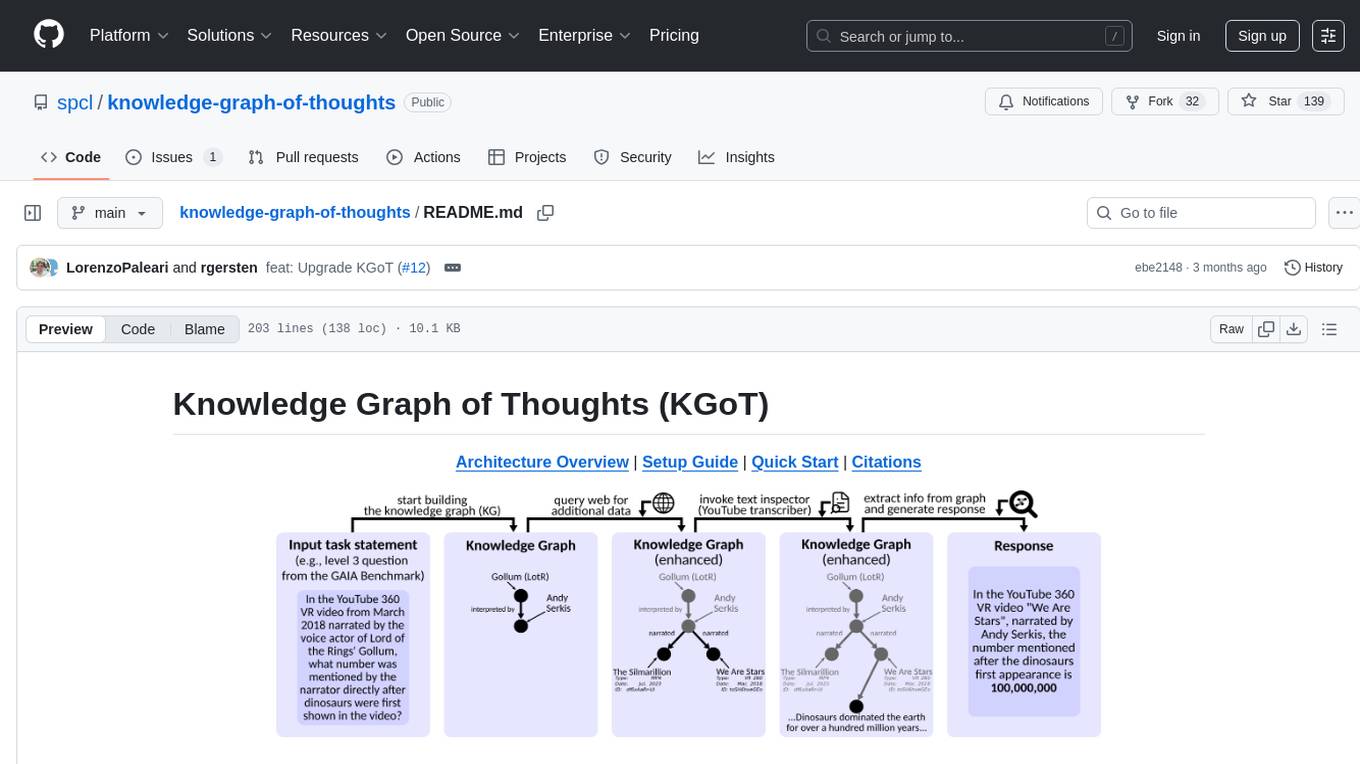
Knowledge Graph of Thoughts (KGoT) is an innovative AI assistant architecture that integrates LLM reasoning with dynamically constructed knowledge graphs (KGs). KGoT extracts and structures task-relevant knowledge into a dynamic KG representation, iteratively enhanced through external tools such as math solvers, web crawlers, and Python scripts. Such structured representation of task-relevant knowledge enables low-cost models to solve complex tasks effectively. The KGoT system consists of three main components: the Controller, the Graph Store, and the Integrated Tools, each playing a critical role in the task-solving process.
BitMat
BitMat is a Python package designed to optimize matrix multiplication operations by utilizing custom kernels written in Triton. It leverages the principles outlined in the "1bit-LLM Era" paper, specifically utilizing packed int8 data to enhance computational efficiency and performance in deep learning and numerical computing tasks.
gepa
GEPA (Genetic-Pareto) is a framework for optimizing arbitrary systems composed of text components like AI prompts, code snippets, or textual specs against any evaluation metric. It employs LLMs to reflect on system behavior, using feedback from execution and evaluation traces to drive targeted improvements. Through iterative mutation, reflection, and Pareto-aware candidate selection, GEPA evolves robust, high-performing variants with minimal evaluations, co-evolving multiple components in modular systems for domain-specific gains. The repository provides the official implementation of the GEPA algorithm as proposed in the paper titled 'GEPA: Reflective Prompt Evolution Can Outperform Reinforcement Learning'.
For similar tasks
aligner
Aligner is a model-agnostic alignment tool designed to efficiently correct responses from large language models. It redistributes initial answers to align with human intentions, improving performance across various LLMs. The tool can be applied with minimal training, enhancing upstream models and reducing hallucination. Aligner's 'copy and correct' method preserves the base structure while enhancing responses. It achieves significant performance improvements in helpfulness, harmlessness, and honesty dimensions, with notable success in boosting Win Rates on evaluation leaderboards.
Awesome-Model-Merging-Methods-Theories-Applications
A comprehensive repository focusing on 'Model Merging in LLMs, MLLMs, and Beyond', providing an exhaustive overview of model merging methods, theories, applications, and future research directions. The repository covers various advanced methods, applications in foundation models, different machine learning subfields, and tasks like pre-merging methods, architecture transformation, weight alignment, basic merging methods, and more.
optillm
optillm is an OpenAI API compatible optimizing inference proxy implementing state-of-the-art techniques to enhance accuracy and performance of LLMs, focusing on reasoning over coding, logical, and mathematical queries. By leveraging additional compute at inference time, it surpasses frontier models across diverse tasks.

llm-structured-output
This repository contains a library for constraining LLM generation to structured output, enforcing a JSON schema for precise data types and property names. It includes an acceptor/state machine framework, JSON acceptor, and JSON schema acceptor for guiding decoding in LLMs. The library provides reference implementations using Apple's MLX library and examples for function calling tasks. The tool aims to improve LLM output quality by ensuring adherence to a schema, reducing unnecessary output, and enhancing performance through pre-emptive decoding. Evaluations show performance benchmarks and comparisons with and without schema constraints.
HookPHP
HookPHP is an open-source project that provides a PHP extension for hooking into various aspects of PHP applications. It allows developers to easily extend and customize the behavior of their PHP applications by providing hooks at key points in the execution flow. With HookPHP, developers can efficiently add custom functionality, modify existing behavior, and enhance the overall performance of their PHP applications. The project is licensed under the MIT license, making it accessible for developers to use and contribute to.
ai-gateway
Envoy AI Gateway is an open source project that utilizes Envoy Gateway to manage request traffic from application clients to Generative AI services. The project aims to provide a seamless and efficient solution for handling communication between clients and AI services. It is designed to enhance the performance and scalability of AI applications by leveraging the capabilities of Envoy Gateway. The project welcomes contributions from the community and encourages collaboration to further develop and improve the functionality of the AI Gateway.
llm-self-correction-papers
This repository contains a curated list of papers focusing on the self-correction of large language models (LLMs) during inference. It covers various frameworks for self-correction, including intrinsic self-correction, self-correction with external tools, self-correction with information retrieval, and self-correction with training designed specifically for self-correction. The list includes survey papers, negative results, and frameworks utilizing reinforcement learning and OpenAI o1-like approaches. Contributions are welcome through pull requests following a specific format.
together-cookbook
The Together Cookbook is a collection of code and guides designed to help developers build with open source models using Together AI. The recipes provide examples on how to chain multiple LLM calls, create agents that route tasks to specialized models, run multiple LLMs in parallel, break down tasks into parallel subtasks, build agents that iteratively improve responses, perform LoRA fine-tuning and inference, fine-tune LLMs for repetition, improve summarization capabilities, fine-tune LLMs on multi-step conversations, implement retrieval-augmented generation, conduct multimodal search and conditional image generation, visualize vector embeddings, improve search results with rerankers, implement vector search with embedding models, extract structured text from images, summarize and evaluate outputs with LLMs, generate podcasts from PDF content, and get LLMs to generate knowledge graphs.
For similar jobs
sweep
Sweep is an AI junior developer that turns bugs and feature requests into code changes. It automatically handles developer experience improvements like adding type hints and improving test coverage.
teams-ai
The Teams AI Library is a software development kit (SDK) that helps developers create bots that can interact with Teams and Microsoft 365 applications. It is built on top of the Bot Framework SDK and simplifies the process of developing bots that interact with Teams' artificial intelligence capabilities. The SDK is available for JavaScript/TypeScript, .NET, and Python.
ai-guide
This guide is dedicated to Large Language Models (LLMs) that you can run on your home computer. It assumes your PC is a lower-end, non-gaming setup.
classifai
Supercharge WordPress Content Workflows and Engagement with Artificial Intelligence. Tap into leading cloud-based services like OpenAI, Microsoft Azure AI, Google Gemini and IBM Watson to augment your WordPress-powered websites. Publish content faster while improving SEO performance and increasing audience engagement. ClassifAI integrates Artificial Intelligence and Machine Learning technologies to lighten your workload and eliminate tedious tasks, giving you more time to create original content that matters.
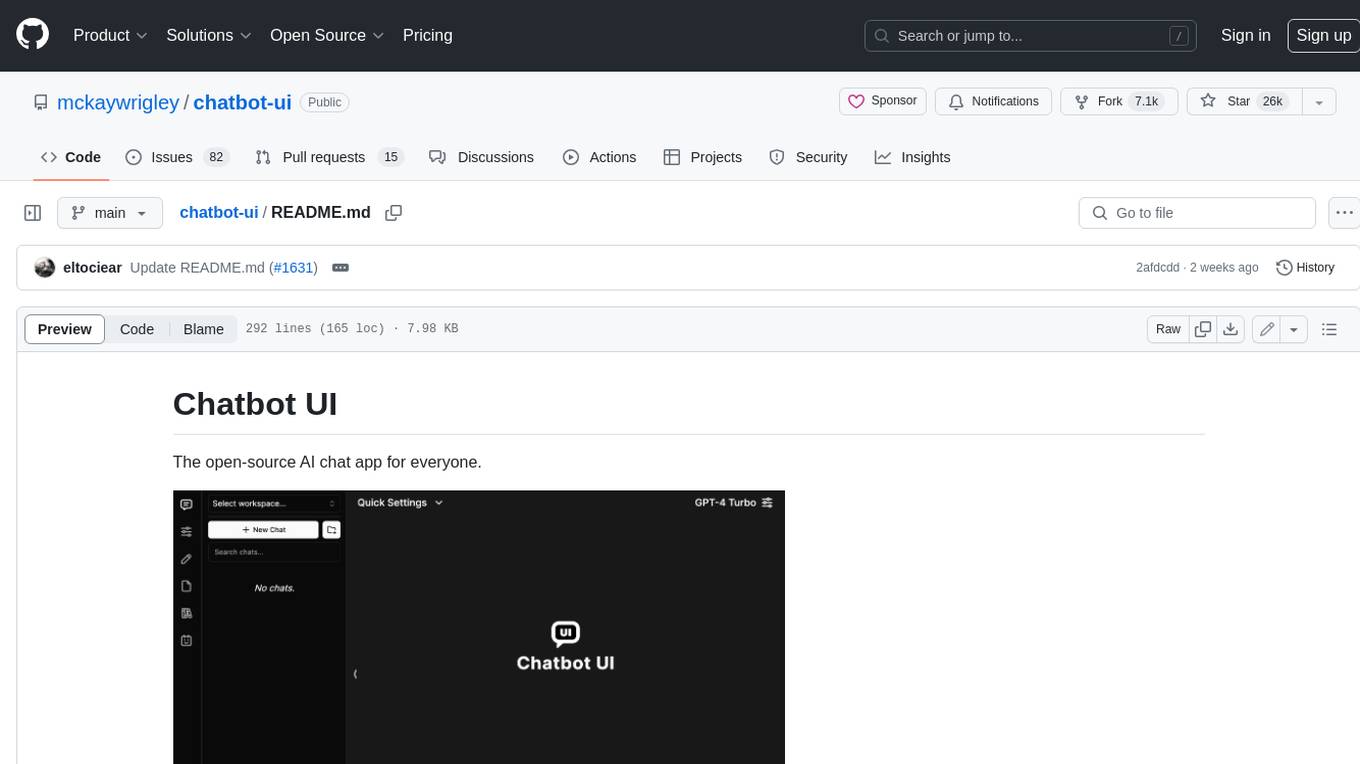
chatbot-ui
Chatbot UI is an open-source AI chat app that allows users to create and deploy their own AI chatbots. It is easy to use and can be customized to fit any need. Chatbot UI is perfect for businesses, developers, and anyone who wants to create a chatbot.
BricksLLM
BricksLLM is a cloud native AI gateway written in Go. Currently, it provides native support for OpenAI, Anthropic, Azure OpenAI and vLLM. BricksLLM aims to provide enterprise level infrastructure that can power any LLM production use cases. Here are some use cases for BricksLLM: * Set LLM usage limits for users on different pricing tiers * Track LLM usage on a per user and per organization basis * Block or redact requests containing PIIs * Improve LLM reliability with failovers, retries and caching * Distribute API keys with rate limits and cost limits for internal development/production use cases * Distribute API keys with rate limits and cost limits for students
uAgents
uAgents is a Python library developed by Fetch.ai that allows for the creation of autonomous AI agents. These agents can perform various tasks on a schedule or take action on various events. uAgents are easy to create and manage, and they are connected to a fast-growing network of other uAgents. They are also secure, with cryptographically secured messages and wallets.
griptape
Griptape is a modular Python framework for building AI-powered applications that securely connect to your enterprise data and APIs. It offers developers the ability to maintain control and flexibility at every step. Griptape's core components include Structures (Agents, Pipelines, and Workflows), Tasks, Tools, Memory (Conversation Memory, Task Memory, and Meta Memory), Drivers (Prompt and Embedding Drivers, Vector Store Drivers, Image Generation Drivers, Image Query Drivers, SQL Drivers, Web Scraper Drivers, and Conversation Memory Drivers), Engines (Query Engines, Extraction Engines, Summary Engines, Image Generation Engines, and Image Query Engines), and additional components (Rulesets, Loaders, Artifacts, Chunkers, and Tokenizers). Griptape enables developers to create AI-powered applications with ease and efficiency.