


z-ai-sdk-python
The official Python SDK for Z.ai's large model open interface, making it easier for developers to call Z.ai's open APIs.
Stars: 72
Z.ai Open Platform Python SDK is the official Python SDK for Z.ai's large model open interface, providing developers with easy access to Z.ai's open APIs. The SDK offers core features like chat completions, embeddings, video generation, audio processing, assistant API, and advanced tools. It supports various functionalities such as speech transcription, text-to-video generation, image understanding, and structured conversation handling. Developers can customize client behavior, configure API keys, and handle errors efficiently. The SDK is designed to simplify AI interactions and enhance AI capabilities for developers.
README:


中文文档 | English
Z.ai Open Platform The official Python SDK for Z.ai's large model open interface, making it easier for developers to call Z.ai's open APIs.
-
Standard Chat: Create chat completions with various models including
glm-4.7 - Streaming Support: Real-time streaming responses for interactive applications
- Tool Calling: Function calling capabilities for enhanced AI interactions
-
Character Role-Playing: Support for character-based conversations with
charglm-3model - Multimodal Chat: Image understanding capabilities with vision models
- Text Embeddings: Generate high-quality vector embeddings for text
- Configurable Dimensions: Customizable embedding dimensions
- Batch Processing: Support for multiple inputs in a single request
- Text-to-Video: Generate videos from text prompts
- Image-to-Video: Create videos from image inputs
- Customizable Parameters: Control quality, duration, FPS, and size
- Audio Support: Optional audio generation for videos
- Speech Transcription: Convert audio files to text
- Multiple Formats: Support for various audio file formats
- Conversation Management: Structured conversation handling
- Streaming Conversations: Real-time assistant interactions
- Metadata Support: Rich conversation context and user information
- Web Search: Integrated web search capabilities
- File Management: Upload, download, and manage files
- Batch Operations: Efficient batch processing for multiple requests
- Content Moderation: Built-in content safety and moderation
- Image Generation: AI-powered image creation
- Python: 3.8+
- Package Manager: pip
pip install zai-sdk- Python Versions: 3.8, 3.9, 3.10, 3.11, 3.12
- Async Support: Full async/await compatibility
- Cross-platform: Windows, macOS, Linux support
| Package | Version | Purpose |
|---|---|---|
httpx |
>=0.23.0 |
HTTP client for API requests |
pydantic |
>=1.9.0,<3.0.0 |
Data validation and serialization |
typing-extensions |
>=4.0.0 |
Enhanced type hints support |
cachetools |
>=4.2.2 |
Caching utilities |
pyjwt |
>=2.8.0 |
JSON Web Token (JWT) handling |
- Overseas regions: Visit Z.ai Open Platform to get your API key
- Mainland China regions: Visit Zhipu AI Open Platform to get your API key
-
Mainland China regions:
https://open.bigmodel.cn/api/paas/v4/ -
Overseas regions:
https://api.z.ai/api/paas/v4/
- Create client with API key
- Call the corresponding API methods
For complete examples, please refer to the open platform API Reference and User Guide, and remember to replace with your own API key.
from zai import ZaiClient, ZhipuAiClient

# For Overseas users, create the ZaiClient
client = ZaiClient(api_key="your-api-key")

# For Chinese users, create the ZhipuAiClient
client = ZhipuAiClient(api_key="your-api-key")

# Create chat completion
response = client.chat.completions.create(
    model="glm-5",
    messages=[
        {"role": "user", "content": "Hello, Z.ai!"}
    ]
)
print(response.choices[0].message.content)The SDK supports multiple ways to configure API keys:
export ZAI_API_KEY="your-api-key"
export ZAI_BASE_URL="https://api.z.ai/api/paas/v4/" # Optionalfrom zai import ZaiClient, ZhipuAiClient
client = ZaiClient(
api_key="your-api-key",
base_url="https://api.z.ai/api/paas/v4/" # Optional
)
# if you want to use Zhipu's domain service
zhipu_client = ZhipuAiClient(
api_key="your-api-key",
base_url="https://open.bigmodel.cn/api/paas/v4/" # Optional
)Customize client behavior with additional parameters:
from zai import ZaiClient
import httpx

client = ZaiClient(
    api_key="your-api-key",
    timeout=httpx.Timeout(timeout=300.0, connect=8.0),  # Request timeout
    max_retries=3,  # Retry attempts
    base_url="https://api.z.ai/api/paas/v4/"  # Custom API endpoint
)from zai import ZaiClient
# Initialize client
client = ZaiClient(api_key="your-api-key")
# Create chat completion
response = client.chat.completions.create(
model='glm-4.7',
messages=[
{'role': 'system', 'content': 'You are a helpful assistant.'},
{'role': 'user', 'content': 'Tell me a story about AI.'},
],
stream=True,
)
for chunk in response:
if chunk.choices[0].delta.content:
print(chunk.choices[0].delta.content, end='')from zai import ZaiClient
# Initialize client
client = ZaiClient(api_key="your-api-key")
# Create chat completion
response = client.chat.completions.create(
model='glm-4.7',
messages=[
{'role': 'system', 'content': 'You are a helpful assistant.'},
{'role': 'user', 'content': 'What is artificial intelligence?'},
],
tools=[
{
'type': 'web_search',
'web_search': {
'search_query': 'What is artificial intelligence?',
'search_result': True,
},
}
],
temperature=0.5,
max_tokens=2000,
)
print(response)from zai import ZaiClient
import base64
def encode_image(image_path):
"""Encode image to base64 format"""
with open(image_path, 'rb') as image_file:
return base64.b64encode(image_file.read()).decode('utf-8')
client = ZaiClient(api_key="your-api-key")
base64_image = encode_image('examples/test_multi_modal.jpeg')
response = client.chat.completions.create(
model='glm-4.6v',
messages=[
{
'role': 'user',
'content': [
{'type': 'text', 'text': "What's in this image?"},
{'type': 'image_url', 'image_url': {'url': f'data:image/jpeg;base64,{base64_image}'}},
],
}
],
temperature=0.5,
max_tokens=2000,
)
print(response)from zai import ZaiClient
client = ZaiClient(api_key="your-api-key")
# Generate video
response = client.videos.generations(
model="cogvideox-3",
prompt="A cat is playing with a ball.",
quality="quality", # Output mode, "quality" for quality priority, "speed" for speed priority
with_audio=True, # Whether to include audio
size="1920x1080", # Video resolution, supports up to 4K (e.g., "3840x2160")
fps=30, # Frame rate, can be 30 or 60
max_wait_time=300, # Maximum wait time (seconds)
)
print(response)
# Get video result
result = client.videos.retrieve_videos_result(id=response.id)
print(result)The SDK provides comprehensive error handling:
from zai import ZaiClient
import zai

client = ZaiClient(api_key="your-api-key")

try:
    response = client.chat.completions.create(
        model="glm-5",
        messages=[
            {"role": "user", "content": "Hello, Z.ai!"}
        ]
    )
    print(response.choices[0].message.content)

except zai.core.APIStatusError as err:
    print(f"API Status Error: {err}")
except zai.core.APITimeoutError as err:
    print(f"Request Timeout: {err}")
except Exception as err:
print(f"Unexpected Error: {err}")| Status Code | Error Type | Description |
|---|---|---|
| 400 | APIRequestFailedError |
Invalid request parameters |
| 401 | APIAuthenticationError |
Authentication failed |
| 429 | APIReachLimitError |
Rate limit exceeded |
| 500 | APIInternalError |
Internal server error |
| 503 | APIServerFlowExceedError |
Server overloaded |
| N/A | APIStatusError |
General API error |
For detailed version history and update information, please see Release-Note.md.
This project is licensed under the MIT License - see the LICENSE file for details.
Contributions are welcome! Please feel free to submit a Pull Request.
For questions and technical support, please visit Z.ai Open Platform or check our documentation.
For feedback and support, please contact us at: [email protected]
For Tasks:
Click tags to check more tools for each tasksFor Jobs:
Alternative AI tools for z-ai-sdk-python
Similar Open Source Tools
z-ai-sdk-python
Z.ai Open Platform Python SDK is the official Python SDK for Z.ai's large model open interface, providing developers with easy access to Z.ai's open APIs. The SDK offers core features like chat completions, embeddings, video generation, audio processing, assistant API, and advanced tools. It supports various functionalities such as speech transcription, text-to-video generation, image understanding, and structured conversation handling. Developers can customize client behavior, configure API keys, and handle errors efficiently. The SDK is designed to simplify AI interactions and enhance AI capabilities for developers.
alphora
Alphora is a full-stack framework for building production AI agents, providing agent orchestration, prompt engineering, tool execution, memory management, streaming, and deployment with an async-first, OpenAI-compatible design. It offers features like agent derivation, reasoning-action loop, async streaming, visual debugger, OpenAI compatibility, multimodal support, tool system with zero-config tools and type safety, prompt engine with dynamic prompts, memory and storage management, sandbox for secure execution, deployment as API, and more. Alphora allows users to build sophisticated AI agents easily and efficiently.
dexto
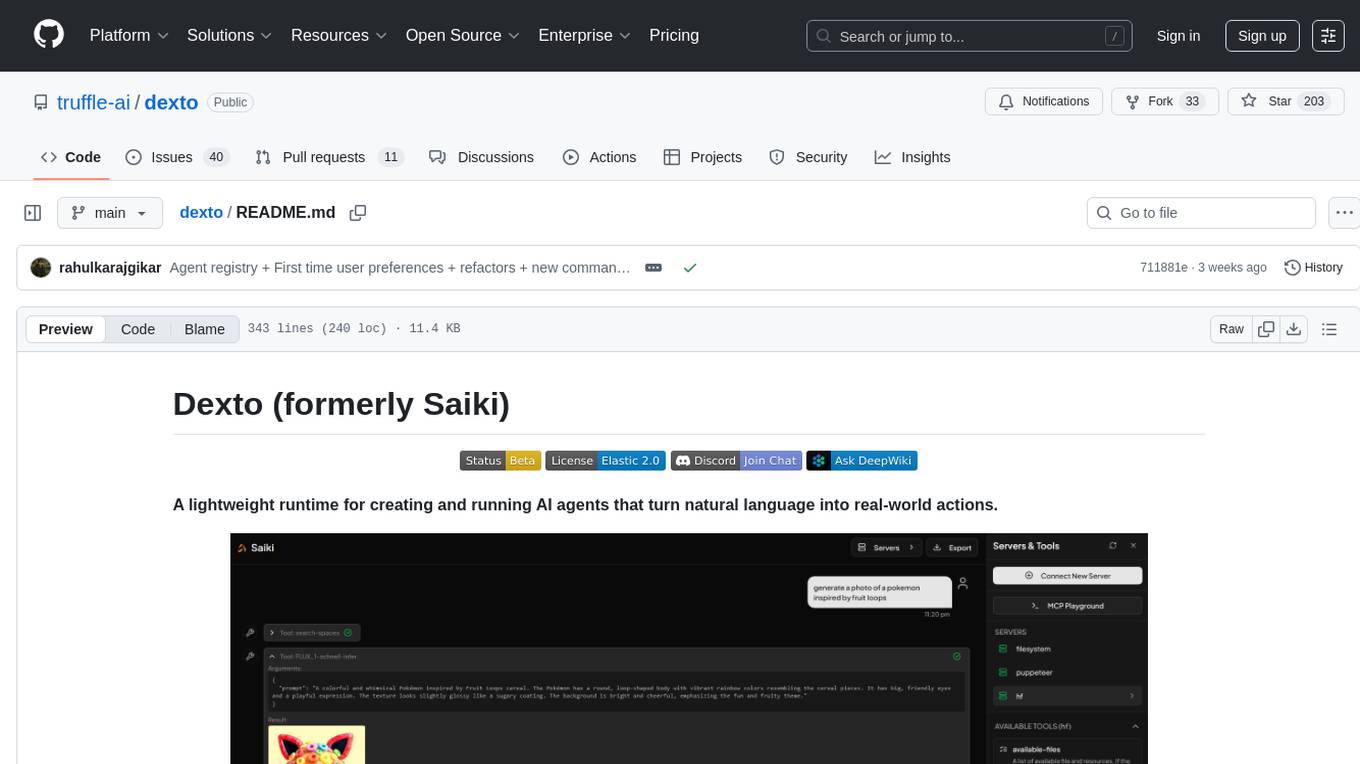
Dexto is a lightweight runtime for creating and running AI agents that turn natural language into real-world actions. It serves as the missing intelligence layer for building AI applications, standalone chatbots, or as the reasoning engine inside larger products. Dexto features a powerful CLI and Web UI for running AI agents, supports multiple interfaces, allows hot-swapping of LLMs from various providers, connects to remote tool servers via the Model Context Protocol, is config-driven with version-controlled YAML, offers production-ready core features, extensibility for custom services, and enables multi-agent collaboration via MCP and A2A.
flyte-sdk
Flyte 2 SDK is a pure Python tool for type-safe, distributed orchestration of agents, ML pipelines, and more. It allows users to write data pipelines, ML training jobs, and distributed compute in Python without any DSL constraints. With features like async-first parallelism and fine-grained observability, Flyte 2 offers a seamless workflow experience. Users can leverage core concepts like TaskEnvironments for container configuration, pure Python workflows for flexibility, and async parallelism for distributed execution. Advanced features include sub-task observability with tracing and remote task execution. The tool also provides native Jupyter integration for running and monitoring workflows directly from notebooks. Configuration and deployment are made easy with configuration files and commands for deploying and running workflows. Flyte 2 is licensed under the Apache 2.0 License.
browser4
Browser4 is a lightning-fast, coroutine-safe browser designed for AI integration with large language models. It offers ultra-fast automation, deep web understanding, and powerful data extraction APIs. Users can automate the browser, extract data at scale, and perform tasks like summarizing products, extracting product details, and finding specific links. The tool is developer-friendly, supports AI-powered automation, and provides advanced features like X-SQL for precise data extraction. It also offers RPA capabilities, browser control, and complex data extraction with X-SQL. Browser4 is suitable for web scraping, data extraction, automation, and AI integration tasks.
ai-real-estate-assistant
AI Real Estate Assistant is a modern platform that uses AI to assist real estate agencies in helping buyers and renters find their ideal properties. It features multiple AI model providers, intelligent query processing, advanced search and retrieval capabilities, and enhanced user experience. The tool is built with a FastAPI backend and Next.js frontend, offering semantic search, hybrid agent routing, and real-time analytics.
Neosgenesis
Neogenesis System is an advanced AI decision-making framework that enables agents to 'think about how to think'. It implements a metacognitive approach with real-time learning, tool integration, and multi-LLM support, allowing AI to make expert-level decisions in complex environments. Key features include metacognitive intelligence, tool-enhanced decisions, real-time learning, aha-moment breakthroughs, experience accumulation, and multi-LLM support.
LocalAGI
LocalAGI is a powerful, self-hostable AI Agent platform that allows you to design AI automations without writing code. It provides a complete drop-in replacement for OpenAI's Responses APIs with advanced agentic capabilities. With LocalAGI, you can create customizable AI assistants, automations, chat bots, and agents that run 100% locally, without the need for cloud services or API keys. The platform offers features like no-code agents, web-based interface, advanced agent teaming, connectors for various platforms, comprehensive REST API, short & long-term memory capabilities, planning & reasoning, periodic tasks scheduling, memory management, multimodal support, extensible custom actions, fully customizable models, observability, and more.
VimLM
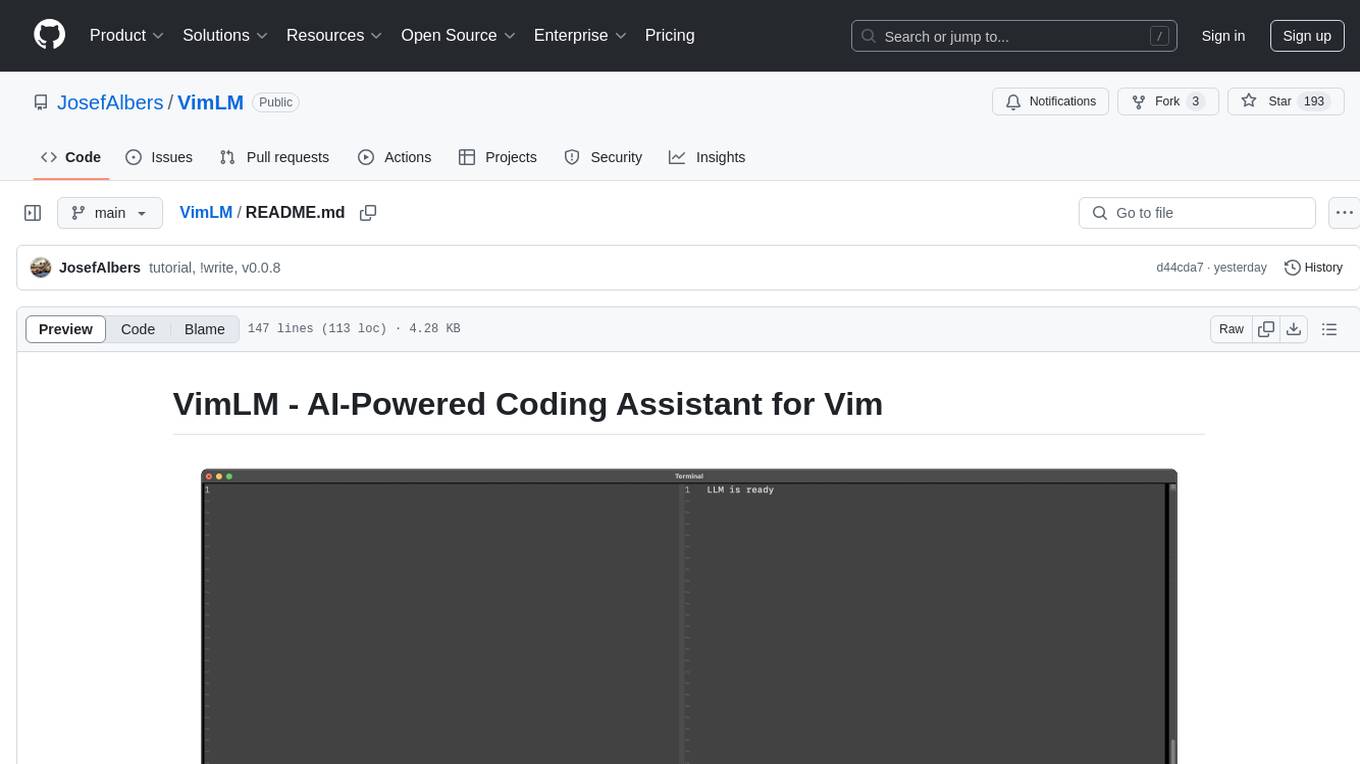
VimLM is an AI-powered coding assistant for Vim that integrates AI for code generation, refactoring, and documentation directly into your Vim workflow. It offers native Vim integration with split-window responses and intuitive keybindings, offline first execution with MLX-compatible models, contextual awareness with seamless integration with codebase and external resources, conversational workflow for iterating on responses, project scaffolding for generating and deploying code blocks, and extensibility for creating custom LLM workflows with command chains.
Groq2API
Groq2API is a REST API wrapper around the Groq2 model, a large language model trained by Google. The API allows you to send text prompts to the model and receive generated text responses. The API is easy to use and can be integrated into a variety of applications.
botserver
General Bots is a self-hosted AI automation platform and LLM conversational platform focused on convention over configuration and code-less approaches. It serves as the core API server handling LLM orchestration, business logic, database operations, and multi-channel communication. The platform offers features like multi-vendor LLM API, MCP + LLM Tools Generation, Semantic Caching, Web Automation Engine, Enterprise Data Connectors, and Git-like Version Control. It enforces a ZERO TOLERANCE POLICY for code quality and security, with strict guidelines for error handling, performance optimization, and code patterns. The project structure includes modules for core functionalities like Rhai BASIC interpreter, security, shared types, tasks, auto task system, file operations, learning system, and LLM assistance.
Bindu
Bindu is an operating layer for AI agents that provides identity, communication, and payment capabilities. It delivers a production-ready service with a convenient API to connect, authenticate, and orchestrate agents across distributed systems using open protocols: A2A, AP2, and X402. Built with a distributed architecture, Bindu makes it fast to develop and easy to integrate with any AI framework. Transform any agent framework into a fully interoperable service for communication, collaboration, and commerce in the Internet of Agents.
superagent
Superagent is an open-source AI assistant framework and API that allows developers to add powerful AI assistants to their applications. These assistants use large language models (LLMs), retrieval augmented generation (RAG), and generative AI to help users with a variety of tasks, including question answering, chatbot development, content generation, data aggregation, and workflow automation. Superagent is backed by Y Combinator and is part of YC W24.
node-sdk
The ChatBotKit Node SDK is a JavaScript-based platform for building conversational AI bots and agents. It offers easy setup, serverless compatibility, modern framework support, customizability, and multi-platform deployment. With capabilities like multi-modal and multi-language support, conversation management, chat history review, custom datasets, and various integrations, this SDK enables users to create advanced chatbots for websites, mobile apps, and messaging platforms.
mcp-ui
mcp-ui is a collection of SDKs that bring interactive web components to the Model Context Protocol (MCP). It allows servers to define reusable UI snippets, render them securely in the client, and react to their actions in the MCP host environment. The SDKs include @mcp-ui/server (TypeScript) for generating UI resources on the server, @mcp-ui/client (TypeScript) for rendering UI components on the client, and mcp_ui_server (Ruby) for generating UI resources in a Ruby environment. The project is an experimental community playground for MCP UI ideas, with rapid iteration and enhancements.
sparrow
Sparrow is an innovative open-source solution for efficient data extraction and processing from various documents and images. It seamlessly handles forms, invoices, receipts, and other unstructured data sources. Sparrow stands out with its modular architecture, offering independent services and pipelines all optimized for robust performance. One of the critical functionalities of Sparrow - pluggable architecture. You can easily integrate and run data extraction pipelines using tools and frameworks like LlamaIndex, Haystack, or Unstructured. Sparrow enables local LLM data extraction pipelines through Ollama or Apple MLX. With Sparrow solution you get API, which helps to process and transform your data into structured output, ready to be integrated with custom workflows. Sparrow Agents - with Sparrow you can build independent LLM agents, and use API to invoke them from your system. **List of available agents:** * **llamaindex** - RAG pipeline with LlamaIndex for PDF processing * **vllamaindex** - RAG pipeline with LLamaIndex multimodal for image processing * **vprocessor** - RAG pipeline with OCR and LlamaIndex for image processing * **haystack** - RAG pipeline with Haystack for PDF processing * **fcall** - Function call pipeline * **unstructured-light** - RAG pipeline with Unstructured and LangChain, supports PDF and image processing * **unstructured** - RAG pipeline with Weaviate vector DB query, Unstructured and LangChain, supports PDF and image processing * **instructor** - RAG pipeline with Unstructured and Instructor libraries, supports PDF and image processing. Works great for JSON response generation
For similar tasks
tafrigh
Tafrigh is a tool for transcribing visual and audio content into text using advanced artificial intelligence techniques provided by OpenAI and wit.ai. It allows direct downloading of content from platforms like YouTube, Facebook, Twitter, and SoundCloud, and provides various output formats such as txt, srt, vtt, csv, tsv, and json. Users can install Tafrigh via pip or by cloning the GitHub repository and using Poetry. The tool supports features like skipping transcription if output exists, specifying playlist items, setting download retries, using different Whisper models, and utilizing wit.ai for transcription. Tafrigh can be used via command line or programmatically, and Docker images are available for easy usage.
z-ai-sdk-python
Z.ai Open Platform Python SDK is the official Python SDK for Z.ai's large model open interface, providing developers with easy access to Z.ai's open APIs. The SDK offers core features like chat completions, embeddings, video generation, audio processing, assistant API, and advanced tools. It supports various functionalities such as speech transcription, text-to-video generation, image understanding, and structured conversation handling. Developers can customize client behavior, configure API keys, and handle errors efficiently. The SDK is designed to simplify AI interactions and enhance AI capabilities for developers.
cog-comfyui
Cog-comfyui allows users to run ComfyUI workflows on Replicate. ComfyUI is a visual programming tool for creating and sharing generative art workflows. With cog-comfyui, users can access a variety of pre-trained models and custom nodes to create their own unique artworks. The tool is easy to use and does not require any coding experience. Users simply need to upload their API JSON file and any necessary input files, and then click the "Run" button. Cog-comfyui will then generate the output image or video file.
biniou
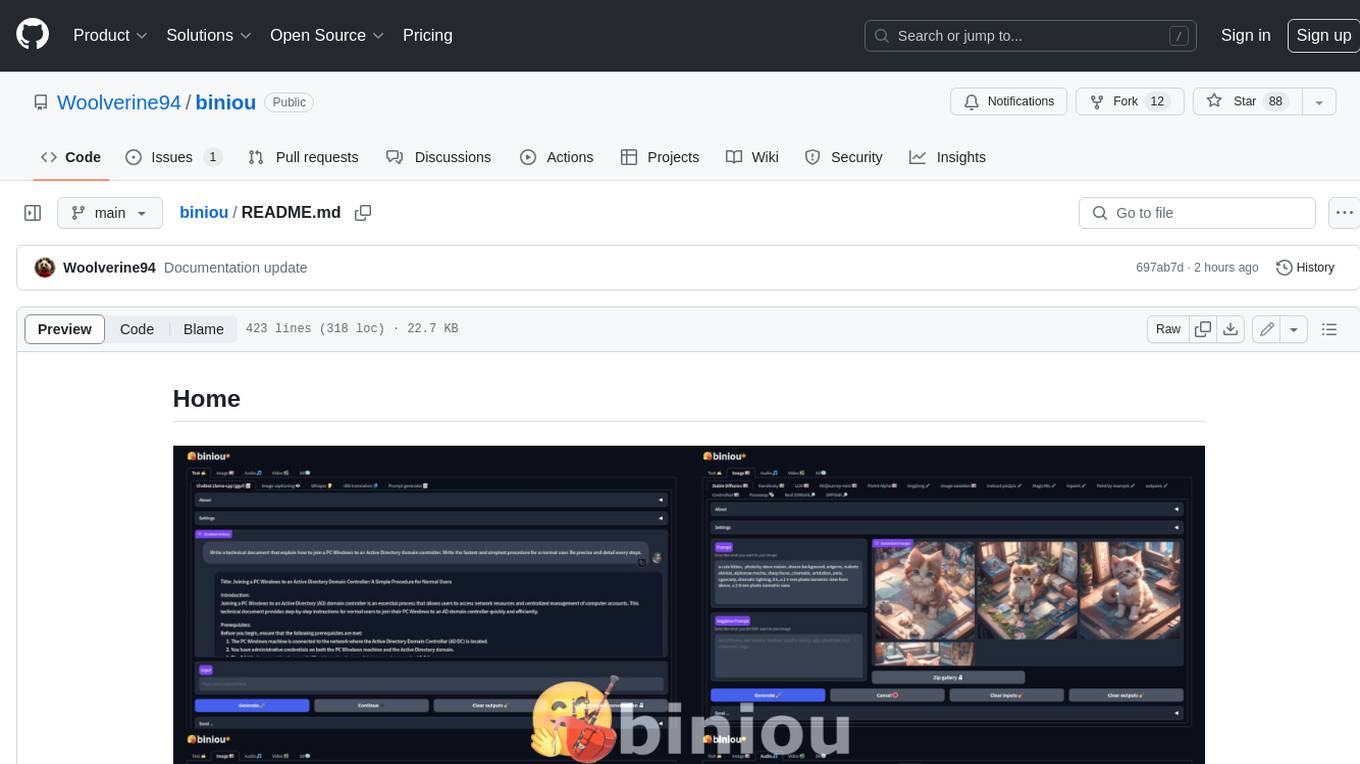
biniou is a self-hosted webui for various GenAI (generative artificial intelligence) tasks. It allows users to generate multimedia content using AI models and chatbots on their own computer, even without a dedicated GPU. The tool can work offline once deployed and required models are downloaded. It offers a wide range of features for text, image, audio, video, and 3D object generation and modification. Users can easily manage the tool through a control panel within the webui, with support for various operating systems and CUDA optimization. biniou is powered by Huggingface and Gradio, providing a cross-platform solution for AI content generation.
Awesome-Colorful-LLM
Awesome-Colorful-LLM is a meticulously assembled anthology of vibrant multimodal research focusing on advancements propelled by large language models (LLMs) in domains such as Vision, Audio, Agent, Robotics, and Fundamental Sciences like Mathematics. The repository contains curated collections of works, datasets, benchmarks, projects, and tools related to LLMs and multimodal learning. It serves as a comprehensive resource for researchers and practitioners interested in exploring the intersection of language models and various modalities for tasks like image understanding, video pretraining, 3D modeling, document understanding, audio analysis, agent learning, robotic applications, and mathematical research.
omniscient
Omniscient is an advanced AI Platform offered as a SaaS, empowering projects with cutting-edge artificial intelligence capabilities. Seamlessly integrating with Next.js 14, React, Typescript, and APIs like OpenAI and Replicate, it provides solutions for code generation, conversation simulation, image creation, music composition, and video generation.
so-vits-models
This repository collects various LLM, AI-related models, applications, and datasets, including LLM-Chat for dialogue models, LLMs for large models, so-vits-svc for sound-related models, stable-diffusion for image-related models, and virtual-digital-person for generating videos. It also provides resources for deep learning courses and overviews, AI competitions, and specific AI tasks such as text, image, voice, and video processing.
jimeng-free-api-all
Jimeng AI Free API is a reverse-engineered API server that encapsulates Jimeng AI's image and video generation capabilities into OpenAI-compatible API interfaces. It supports the latest jimeng-5.0-preview, jimeng-4.6 text-to-image models, Seedance 2.0 multi-image intelligent video generation, zero-configuration deployment, and multi-token support. The API is fully compatible with OpenAI API format, seamlessly integrating with existing clients and supporting multiple session IDs for polling usage.
For similar jobs
promptflow
**Prompt flow** is a suite of development tools designed to streamline the end-to-end development cycle of LLM-based AI applications, from ideation, prototyping, testing, evaluation to production deployment and monitoring. It makes prompt engineering much easier and enables you to build LLM apps with production quality.
deepeval
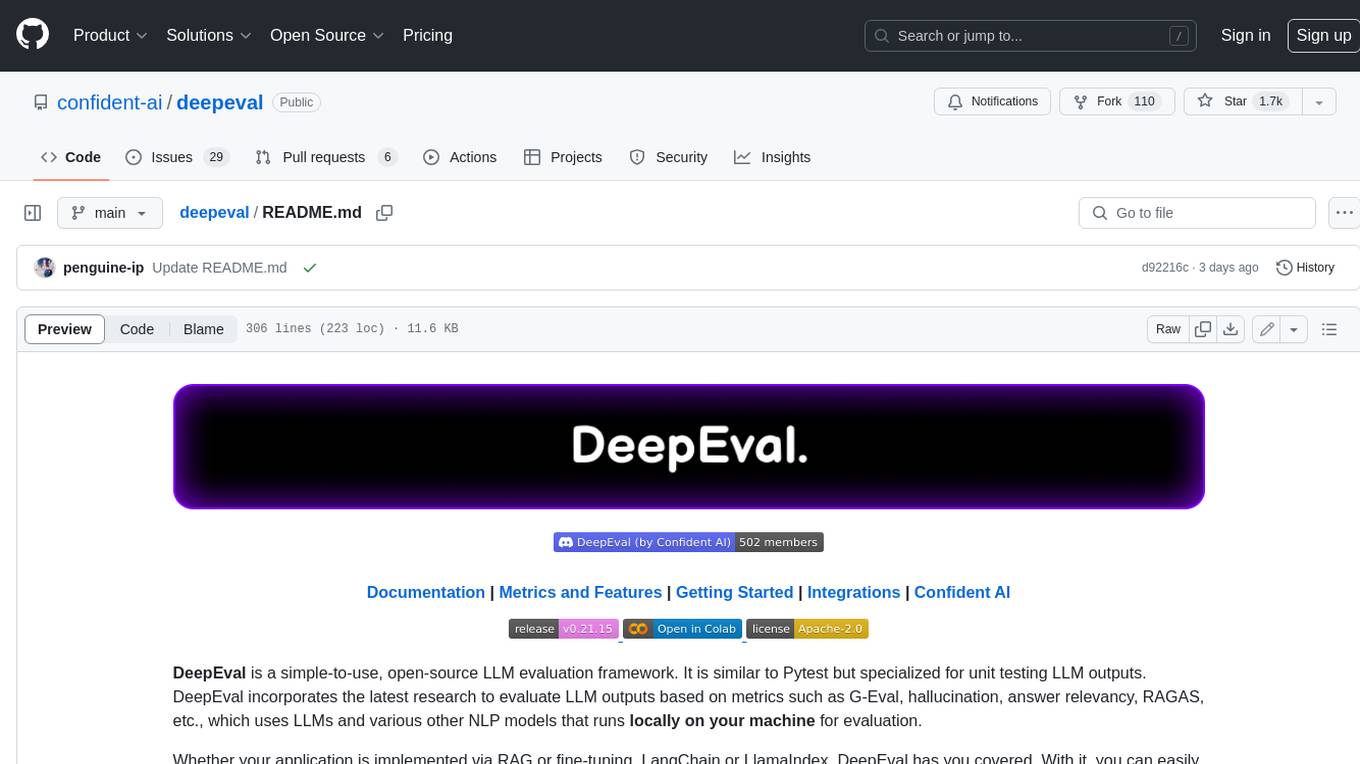
DeepEval is a simple-to-use, open-source LLM evaluation framework specialized for unit testing LLM outputs. It incorporates various metrics such as G-Eval, hallucination, answer relevancy, RAGAS, etc., and runs locally on your machine for evaluation. It provides a wide range of ready-to-use evaluation metrics, allows for creating custom metrics, integrates with any CI/CD environment, and enables benchmarking LLMs on popular benchmarks. DeepEval is designed for evaluating RAG and fine-tuning applications, helping users optimize hyperparameters, prevent prompt drifting, and transition from OpenAI to hosting their own Llama2 with confidence.
MegaDetector
MegaDetector is an AI model that identifies animals, people, and vehicles in camera trap images (which also makes it useful for eliminating blank images). This model is trained on several million images from a variety of ecosystems. MegaDetector is just one of many tools that aims to make conservation biologists more efficient with AI. If you want to learn about other ways to use AI to accelerate camera trap workflows, check out our of the field, affectionately titled "Everything I know about machine learning and camera traps".
leapfrogai
LeapfrogAI is a self-hosted AI platform designed to be deployed in air-gapped resource-constrained environments. It brings sophisticated AI solutions to these environments by hosting all the necessary components of an AI stack, including vector databases, model backends, API, and UI. LeapfrogAI's API closely matches that of OpenAI, allowing tools built for OpenAI/ChatGPT to function seamlessly with a LeapfrogAI backend. It provides several backends for various use cases, including llama-cpp-python, whisper, text-embeddings, and vllm. LeapfrogAI leverages Chainguard's apko to harden base python images, ensuring the latest supported Python versions are used by the other components of the stack. The LeapfrogAI SDK provides a standard set of protobuffs and python utilities for implementing backends and gRPC. LeapfrogAI offers UI options for common use-cases like chat, summarization, and transcription. It can be deployed and run locally via UDS and Kubernetes, built out using Zarf packages. LeapfrogAI is supported by a community of users and contributors, including Defense Unicorns, Beast Code, Chainguard, Exovera, Hypergiant, Pulze, SOSi, United States Navy, United States Air Force, and United States Space Force.
llava-docker
This Docker image for LLaVA (Large Language and Vision Assistant) provides a convenient way to run LLaVA locally or on RunPod. LLaVA is a powerful AI tool that combines natural language processing and computer vision capabilities. With this Docker image, you can easily access LLaVA's functionalities for various tasks, including image captioning, visual question answering, text summarization, and more. The image comes pre-installed with LLaVA v1.2.0, Torch 2.1.2, xformers 0.0.23.post1, and other necessary dependencies. You can customize the model used by setting the MODEL environment variable. The image also includes a Jupyter Lab environment for interactive development and exploration. Overall, this Docker image offers a comprehensive and user-friendly platform for leveraging LLaVA's capabilities.

carrot
The 'carrot' repository on GitHub provides a list of free and user-friendly ChatGPT mirror sites for easy access. The repository includes sponsored sites offering various GPT models and services. Users can find and share sites, report errors, and access stable and recommended sites for ChatGPT usage. The repository also includes a detailed list of ChatGPT sites, their features, and accessibility options, making it a valuable resource for ChatGPT users seeking free and unlimited GPT services.
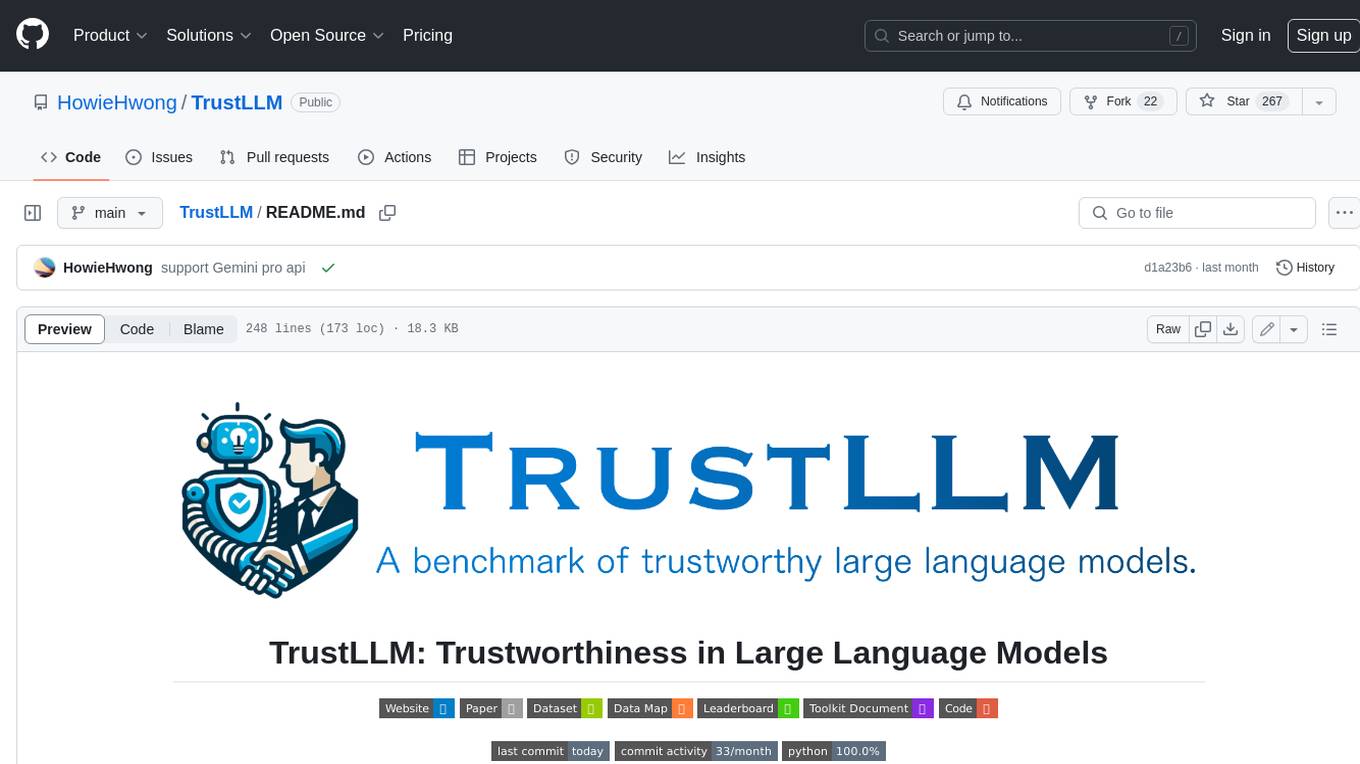
TrustLLM
TrustLLM is a comprehensive study of trustworthiness in LLMs, including principles for different dimensions of trustworthiness, established benchmark, evaluation, and analysis of trustworthiness for mainstream LLMs, and discussion of open challenges and future directions. Specifically, we first propose a set of principles for trustworthy LLMs that span eight different dimensions. Based on these principles, we further establish a benchmark across six dimensions including truthfulness, safety, fairness, robustness, privacy, and machine ethics. We then present a study evaluating 16 mainstream LLMs in TrustLLM, consisting of over 30 datasets. The document explains how to use the trustllm python package to help you assess the performance of your LLM in trustworthiness more quickly. For more details about TrustLLM, please refer to project website.
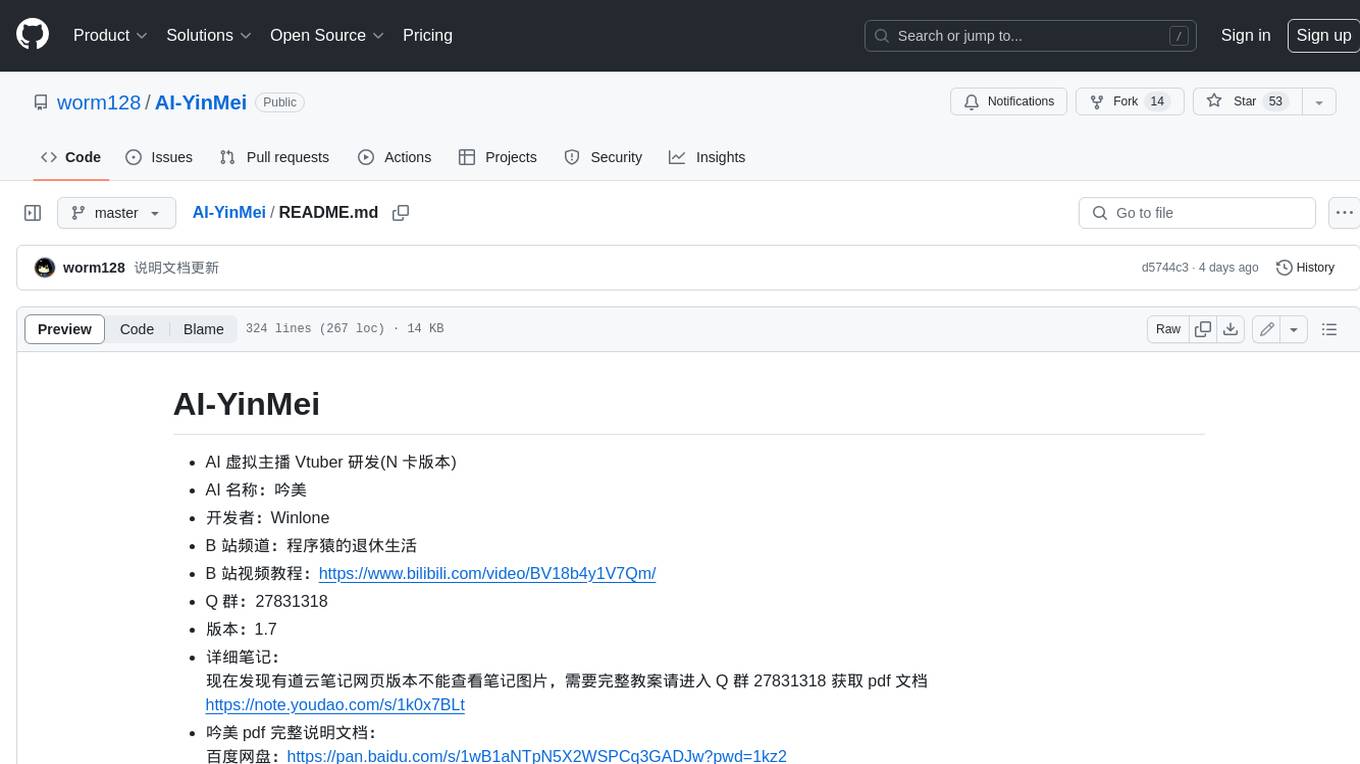
AI-YinMei
AI-YinMei is an AI virtual anchor Vtuber development tool (N card version). It supports fastgpt knowledge base chat dialogue, a complete set of solutions for LLM large language models: [fastgpt] + [one-api] + [Xinference], supports docking bilibili live broadcast barrage reply and entering live broadcast welcome speech, supports Microsoft edge-tts speech synthesis, supports Bert-VITS2 speech synthesis, supports GPT-SoVITS speech synthesis, supports expression control Vtuber Studio, supports painting stable-diffusion-webui output OBS live broadcast room, supports painting picture pornography public-NSFW-y-distinguish, supports search and image search service duckduckgo (requires magic Internet access), supports image search service Baidu image search (no magic Internet access), supports AI reply chat box [html plug-in], supports AI singing Auto-Convert-Music, supports playlist [html plug-in], supports dancing function, supports expression video playback, supports head touching action, supports gift smashing action, supports singing automatic start dancing function, chat and singing automatic cycle swing action, supports multi scene switching, background music switching, day and night automatic switching scene, supports open singing and painting, let AI automatically judge the content.