


huf
Multi Model Multi Agent Framework build using Frappe Framework. Out of the box support for 500+ models and 100s of tools. Can automate ERPNext and Frappe App out of the box.
Stars: 59
HUF is an AI-native engine designed to centralize intelligence and execution into a single engine, enabling AI to operate inside real business systems. It offers multi-provider AI connectivity, intelligent tools, knowledge grounding, event-driven execution, visual workflow builder, full auditability, and cost control. HUF can be used as AI infrastructure for products, internal intelligence platform, automation & orchestration engine, embedded AI layer for SaaS, and enterprise AI control plane. Core capabilities include agent system, knowledge management, trigger system, visual flow builder, and observability. The tech stack includes Frappe Framework, Python 3.10+, LiteLLM, SQLite FTS5, React 18, TypeScript, Tailwind CSS, and MariaDB.
README:
The AI-native engine for building intelligent, action-oriented systems.
HUF sits at the intersection of knowledge, automation, and tools—enabling AI to understand business context and execute real work safely, auditably, and at scale.
Documentation | Report Issue | Discussions
Note: HUF is actively being migrated from an existing implementation. Not recommended for production use at this stage.
AI adoption inside organizations is fragmented:
- Knowledge lives in too many places — scattered across docs, databases, and people's heads
- Automation is rigid and rule-based — breaks on edge cases, requires constant maintenance
- AI tools operate in isolation — each team rebuilds similar assistants
- Costs, behavior, and risk are hard to control — no visibility, no governance
HUF exists to centralize intelligence and execution into a single engine—so AI can be trusted to operate inside real business systems.
HUF is designed to be the core AI layer inside an organization or product, not a surface-level chatbot or a single-purpose assistant.
One engine. Multiple ways to use it.
| Capability | What it enables |
|---|---|
| Multi-Provider AI | Connect to OpenAI, Anthropic, Google, Mistral, and 100+ providers through a unified interface |
| Intelligent Tools | Give AI the ability to read, write, and act on your business data |
| Knowledge Grounding | RAG-powered context from your docs, files, and URLs |
| Event-Driven Execution | Trigger agents on document events, schedules, or webhooks |
| Visual Workflow Builder | Design complex automations with drag-and-drop flows (WIP) |
| Full Auditability | Every run, every tool call, every token—logged and traceable |
| Cost Control | Track usage and spending across models and teams |
Use HUF as the backend AI engine for products that need intelligence, automation, and integration.
Ideal for:
- AI-first startups building on Frappe/ERPNext
- SaaS products adding AI capabilities
- Platforms that need agent orchestration, cost control, and auditability
HUF handles reasoning, knowledge, tool execution, and governance—so product teams can focus on user experience.
Use HUF to power internal AI experiences grounded in company knowledge.
Build:
- Internal chat systems that know your business
- Role-based assistants for Ops, HR, Sales, Support
- Knowledge discovery and employee onboarding tools
Replace disconnected internal AI tools with a single, governed intelligence layer.
Use HUF to build AI-driven workflows that reason and act across systems.
Suited for:
- Multi-step processes that span departments
- Cross-tool automation with conditional logic
- Intelligent approvals, routing, and escalations
Unlike traditional automation, HUF adapts to context instead of breaking on edge cases.
Use HUF to embed AI directly into products without building custom infrastructure.
Enable:
- In-app copilots and assistants
- Customer-facing AI features
- Vertical AI capabilities with clear permission boundaries
HUF provides a shared AI backend with cost, behavior, and access controls built in.
Use HUF as a governed control layer for AI across the organization.
Critical for:
- Cost management and budget allocation
- Auditability and compliance requirements
- Tool and model governance
- Responsible AI deployment at scale
Give leadership visibility and control without slowing down teams.
Create AI agents with custom instructions, connect them to any LLM provider, and equip them with tools to take action:
- CRUD Operations — Read, create, update, delete documents
- Custom Functions — Connect any Python function as a tool
- HTTP Requests — Call external APIs and services
- Agent Chaining — Agents can trigger other agents
- MCP Integration — Connect to external tool providers (Gmail, GitHub, Slack, etc.)
Ground AI responses in your actual business knowledge:
- Multiple Input Types — Files, text, URLs
- Automatic Chunking — Intelligent text segmentation
- Fast Search — BM25-powered retrieval via SQLite FTS5
- Flexible Injection — Mandatory context or on-demand search
Run agents automatically based on events:
-
Document Events —
after_insert,on_submit,on_cancel, and more - Schedules — Hourly, daily, weekly, monthly, yearly intervals
- Webhooks — HTTP endpoints with authentication
- Conditional Logic — Python expressions to control execution
Design complex workflows with a modern React-based interface:
- Drag-and-Drop Canvas — Build flows visually
- Node Types — Triggers, actions, utilities, conditions
- Real-Time Editing — See changes instantly
- App Integrations — Gmail, Calendar, Slack, Notion, HubSpot
Full visibility into what your AI is doing:
- Agent Runs — Status, prompt, response, token usage, cost
- Conversations — Complete chat history with context
- Tool Calls — Every tool invocation with arguments and results
- Feedback System — Capture user ratings for quality improvement
git clone https://github.com/tridz-dev/huf.git
cd huf/docker
docker compose up
Open http://localhost:8000 and login:
- User: Administrator
- Password: admin
bench get-app [email protected]:tridz-dev/huf.git
bench install-app huf
bench setup requirements
bench restart┌─────────────────────────────────────────────────────────────────┐
│ HUF Engine │
├─────────────────────────────────────────────────────────────────┤
│ │
│ ┌──────────────┐ ┌──────────────┐ ┌────────────────┐ │
│ │ Agents │ │ Knowledge │ │ Triggers │ │
│ │ │ │ │ │ │ │
│ │ Instructions │ │ RAG/FTS5 │ │ Events │ │
│ │ Tools │ │ Chunking │ │ Schedules │ │
│ │ Parameters │ │ Retrieval │ │ Webhooks (WIP) │ │
│ └──────┬───────┘ └──────┬───────┘ └──────┬─────────┘ │
│ │ │ │ │
│ └────────────────┬┴─────────────────┘ │
│ │ │
│ ┌───────────────────────▼───────────────────────────────────┐ │
│ │ Execution Layer │ │
│ │ │ │
│ │ LiteLLM (100+ providers) │ Tool System │ MCP Client │ │
│ └───────────────────────────────────────────────────────────┘ │
│ │
│ ┌────────────────────────────────────────────────────────────┐ │
│ │ Observability │ │
│ │ │ │
│ │ Runs │ Conversations │ Messages │ Tool Calls │ Costs │ │
│ └────────────────────────────────────────────────────────────┘ │
│ │
└─────────────────────────────────────────────────────────────────┘
│
┌─────────────────────┼─────────────────────┐
▼ ▼ ▼
┌─────────┐ ┌─────────┐ ┌───────────────┐
│ Chat │ │ API │ │ Flows │
│ UI │ │ Endpoint│ │ Builder (WIP) │
└─────────┘ └─────────┘ └───────────────┘
| Layer | Technology |
|---|---|
| Backend | Frappe Framework, Python 3.10+ |
| AI Integration | LiteLLM |
| Knowledge | SQLite FTS5 (LlamaIndex) & multiple VectorDBs WIP. |
| Frontend | React 18, TypeScript, Tailwind CSS |
| Flow Builder | React Flow / XYFlow |
| Database | MariaDB |
- Full Documentation — Guides, tutorials, and API reference
- AGENTS.md — Technical context for AI agents. Adopts the agents.md standard.
- CLAUDE.md — Defines coding standards, review criteria, and project-specific rules. Claude reads this file during runs and follows your conventions.
MIT License — see LICENSE for details.
Built for teams who want AI that actually works.
For Tasks:
Click tags to check more tools for each tasksFor Jobs:
Alternative AI tools for huf
Similar Open Source Tools
huf
HUF is an AI-native engine designed to centralize intelligence and execution into a single engine, enabling AI to operate inside real business systems. It offers multi-provider AI connectivity, intelligent tools, knowledge grounding, event-driven execution, visual workflow builder, full auditability, and cost control. HUF can be used as AI infrastructure for products, internal intelligence platform, automation & orchestration engine, embedded AI layer for SaaS, and enterprise AI control plane. Core capabilities include agent system, knowledge management, trigger system, visual flow builder, and observability. The tech stack includes Frappe Framework, Python 3.10+, LiteLLM, SQLite FTS5, React 18, TypeScript, Tailwind CSS, and MariaDB.
koog
Koog is a Kotlin-based framework for building and running AI agents entirely in idiomatic Kotlin. It allows users to create agents that interact with tools, handle complex workflows, and communicate with users. Key features include pure Kotlin implementation, MCP integration, embedding capabilities, custom tool creation, ready-to-use components, intelligent history compression, powerful streaming API, persistent agent memory, comprehensive tracing, flexible graph workflows, modular feature system, scalable architecture, and multiplatform support.
foundationallm
FoundationaLLM is a platform designed for deploying, scaling, securing, and governing generative AI in enterprises. It allows users to create AI agents grounded in enterprise data, integrate REST APIs, experiment with various large language models, centrally manage AI agents and their assets, deploy scalable vectorization data pipelines, enable non-developer users to create their own AI agents, control access with role-based access controls, and harness capabilities from Azure AI and Azure OpenAI. The platform simplifies integration with enterprise data sources, provides fine-grain security controls, scalability, extensibility, and addresses the challenges of delivering enterprise copilots or AI agents.
tools
Strands Agents Tools is a community-driven project that provides a powerful set of tools for your agents to use. It bridges the gap between large language models and practical applications by offering ready-to-use tools for file operations, system execution, API interactions, mathematical operations, and more. The tools cover a wide range of functionalities including file operations, shell integration, memory storage, web infrastructure, HTTP client, Slack client, Python execution, mathematical tools, AWS integration, image and video processing, audio output, environment management, task scheduling, advanced reasoning, swarm intelligence, dynamic MCP client, parallel tool execution, browser automation, diagram creation, RSS feed management, and computer automation.
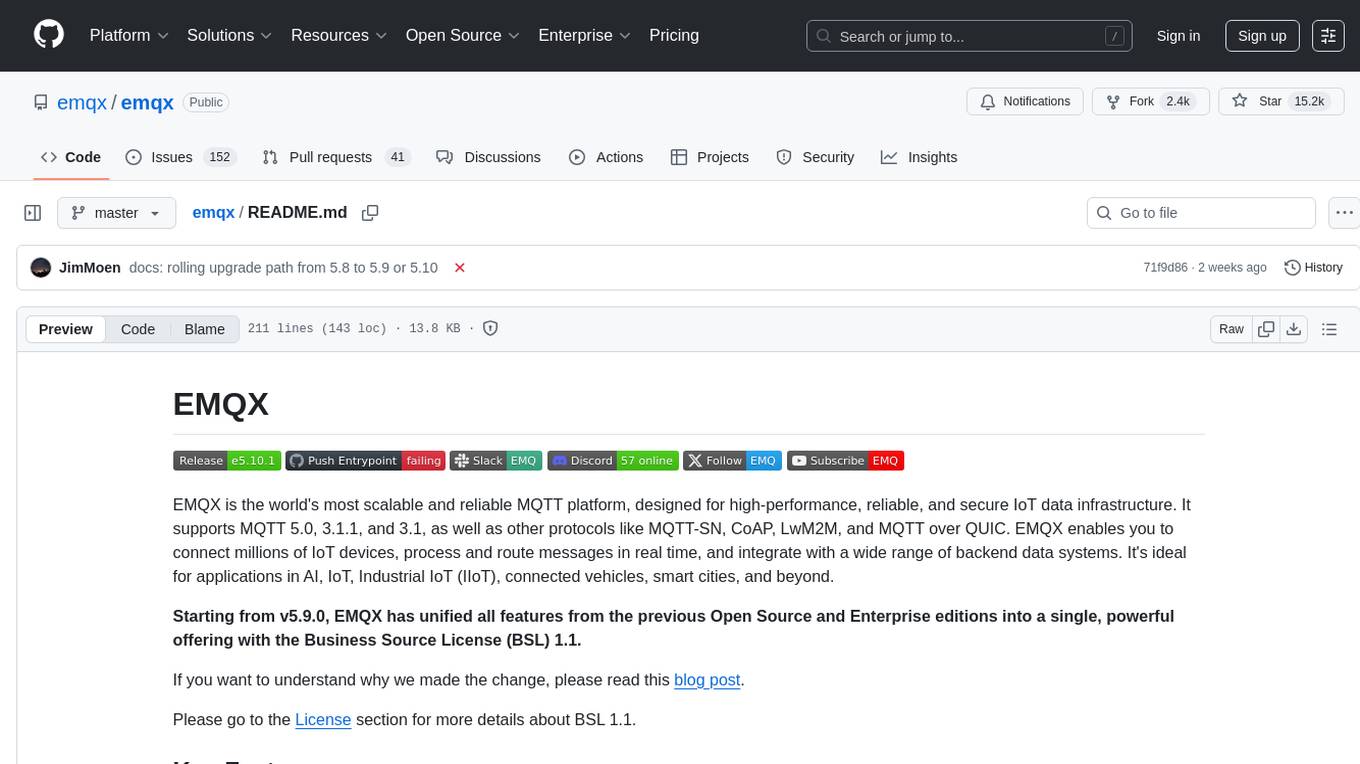
emqx
EMQX is a highly scalable and reliable MQTT platform designed for IoT data infrastructure. It supports various protocols like MQTT 5.0, 3.1.1, and 3.1, as well as MQTT-SN, CoAP, LwM2M, and MQTT over QUIC. EMQX allows connecting millions of IoT devices, processing messages in real time, and integrating with backend data systems. It is suitable for applications in AI, IoT, IIoT, connected vehicles, smart cities, and more. The tool offers features like massive scalability, powerful rule engine, flow designer, AI processing, robust security, observability, management, extensibility, and a unified experience with the Business Source License (BSL) 1.1.
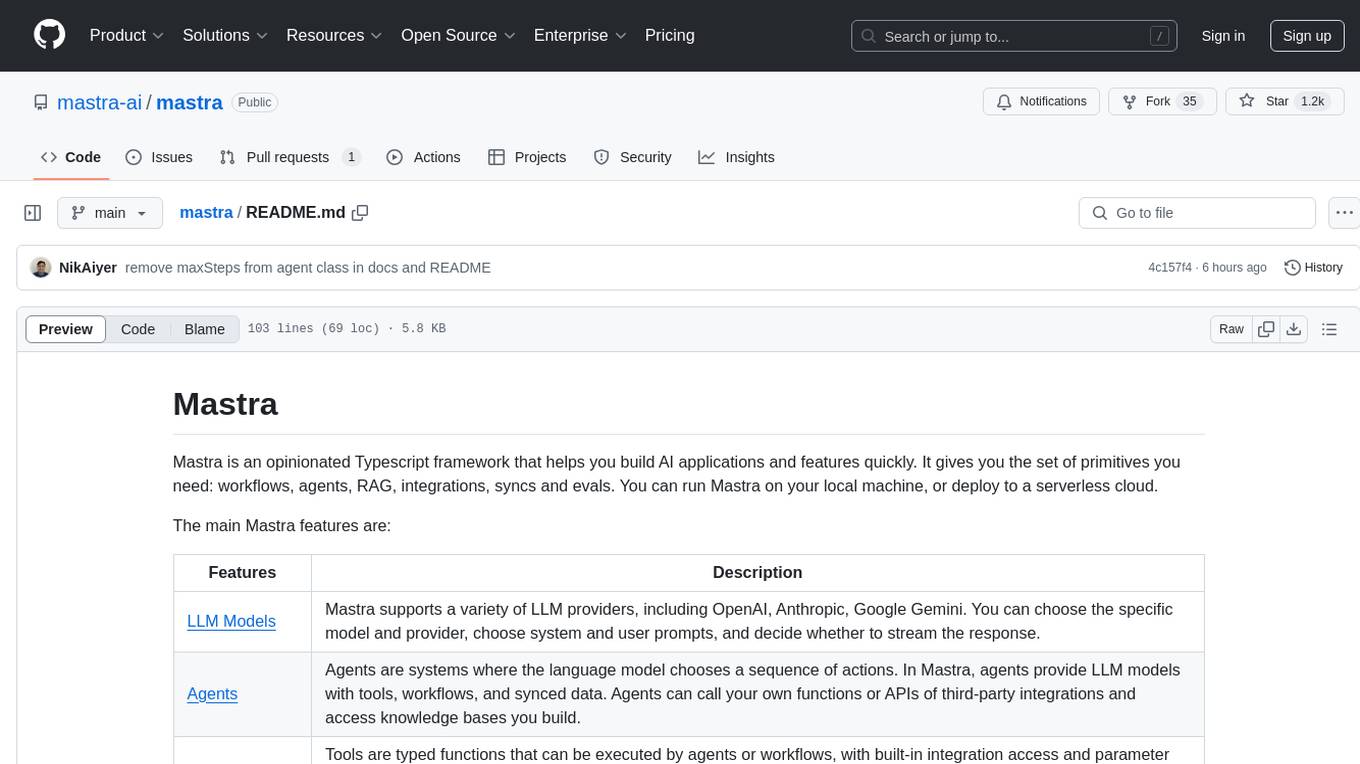
mastra
Mastra is an opinionated Typescript framework designed to help users quickly build AI applications and features. It provides primitives such as workflows, agents, RAG, integrations, syncs, and evals. Users can run Mastra locally or deploy it to a serverless cloud. The framework supports various LLM providers, offers tools for building language models, workflows, and accessing knowledge bases. It includes features like durable graph-based state machines, retrieval-augmented generation, integrations, syncs, and automated tests for evaluating LLM outputs.
genkit
Firebase Genkit (beta) is a framework with powerful tooling to help app developers build, test, deploy, and monitor AI-powered features with confidence. Genkit is cloud optimized and code-centric, integrating with many services that have free tiers to get started. It provides unified API for generation, context-aware AI features, evaluation of AI workflow, extensibility with plugins, easy deployment to Firebase or Google Cloud, observability and monitoring with OpenTelemetry, and a developer UI for prototyping and testing AI features locally. Genkit works seamlessly with Firebase or Google Cloud projects through official plugins and templates.
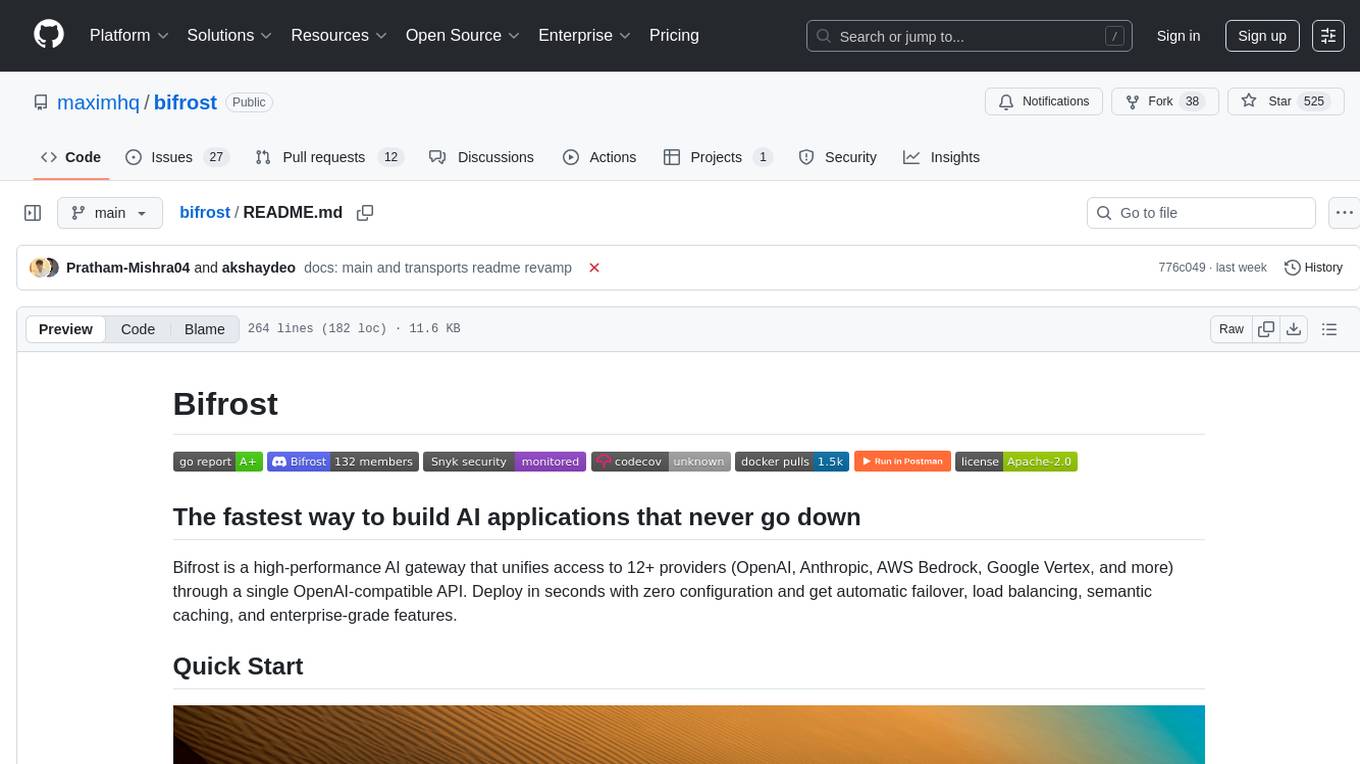
bifrost
Bifrost is a high-performance AI gateway that unifies access to multiple providers through a single OpenAI-compatible API. It offers features like automatic failover, load balancing, semantic caching, and enterprise-grade functionalities. Users can deploy Bifrost in seconds with zero configuration, benefiting from its core infrastructure, advanced features, enterprise and security capabilities, and developer experience. The repository structure is modular, allowing for maximum flexibility. Bifrost is designed for quick setup, easy configuration, and seamless integration with various AI models and tools.
runhouse
Runhouse is a tool that allows you to build, run, and deploy production-quality AI apps and workflows on your own compute. It provides simple, powerful APIs for the full lifecycle of AI development, from research to evaluation to production to updates to scaling to management, and across any infra. By automatically packaging your apps into scalable, secure, and observable services, Runhouse can also turn otherwise redundant AI activities into common reusable components across your team or company, which improves cost, velocity, and reproducibility.
hexstrike-ai
HexStrike AI is an advanced AI-powered penetration testing MCP framework with 150+ security tools and 12+ autonomous AI agents. It features a multi-agent architecture with intelligent decision-making, vulnerability intelligence, and modern visual engine. The platform allows for AI agent connection, intelligent analysis, autonomous execution, real-time adaptation, and advanced reporting. HexStrike AI offers a streamlined installation process, Docker container support, 250+ specialized AI agents/tools, native desktop client, advanced web automation, memory optimization, enhanced error handling, and bypassing limitations.
odoo-llm
This repository provides a comprehensive framework for integrating Large Language Models (LLMs) into Odoo. It enables seamless interaction with AI providers like OpenAI, Anthropic, Ollama, and Replicate for chat completions, text embeddings, and more within the Odoo environment. The architecture includes external AI clients connecting via `llm_mcp_server` and Odoo AI Chat with built-in chat interface. The core module `llm` offers provider abstraction, model management, and security, along with tools for CRUD operations and domain-specific tool packs. Various AI providers, infrastructure components, and domain-specific tools are available for different tasks such as content generation, knowledge base management, and AI assistants creation.
ai-manus
AI Manus is a general-purpose AI Agent system that supports running various tools and operations in a sandbox environment. It offers deployment with minimal dependencies, supports multiple tools like Terminal, Browser, File, Web Search, and messaging tools, allocates separate sandboxes for tasks, manages session history, supports stopping and interrupting conversations, file upload and download, and is multilingual. The system also provides user login and authentication. The project primarily relies on Docker for development and deployment, with model capability requirements and recommended Deepseek and GPT models.
adk-java
Agent Development Kit (ADK) for Java is an open-source toolkit designed for developers to build, evaluate, and deploy sophisticated AI agents with flexibility and control. It allows defining agent behavior, orchestration, and tool use directly in code, enabling robust debugging, versioning, and deployment anywhere. The toolkit offers a rich tool ecosystem, code-first development approach, and support for modular multi-agent systems, making it ideal for creating advanced AI agents integrated with Google Cloud services.
holmesgpt
HolmesGPT is an open-source DevOps assistant powered by OpenAI or any tool-calling LLM of your choice. It helps in troubleshooting Kubernetes, incident response, ticket management, automated investigation, and runbook automation in plain English. The tool connects to existing observability data, is compliance-friendly, provides transparent results, supports extensible data sources, runbook automation, and integrates with existing workflows. Users can install HolmesGPT using Brew, prebuilt Docker container, Python Poetry, or Docker. The tool requires an API key for functioning and supports OpenAI, Azure AI, and self-hosted LLMs.
Sage
Sage is a production-ready, modular, and intelligent multi-agent orchestration framework for complex problem solving. It intelligently breaks down complex tasks into manageable subtasks through seamless agent collaboration. Sage provides Deep Research Mode for comprehensive analysis and Rapid Execution Mode for quick task completion. It offers features like intelligent task decomposition, agent orchestration, extensible tool system, dual execution modes, interactive web interface, advanced token tracking, rich configuration, developer-friendly APIs, and robust error recovery mechanisms. Sage supports custom workflows, multi-agent collaboration, custom agent development, agent flow orchestration, rule preferences system, message manager for smart token optimization, task manager for comprehensive state management, advanced file system operations, advanced tool system with plugin architecture, token usage & cost monitoring, and rich configuration system. It also includes real-time streaming & monitoring, advanced tool development, error handling & reliability, performance monitoring, MCP server integration, and security features.
helix
HelixML is a private GenAI platform that allows users to deploy the best of open AI in their own data center or VPC while retaining complete data security and control. It includes support for fine-tuning models with drag-and-drop functionality. HelixML brings the best of open source AI to businesses in an ergonomic and scalable way, optimizing the tradeoff between GPU memory and latency.
For similar tasks
autogen
AutoGen is a framework that enables the development of LLM applications using multiple agents that can converse with each other to solve tasks. AutoGen agents are customizable, conversable, and seamlessly allow human participation. They can operate in various modes that employ combinations of LLMs, human inputs, and tools.
tracecat
Tracecat is an open-source automation platform for security teams. It's designed to be simple but powerful, with a focus on AI features and a practitioner-obsessed UI/UX. Tracecat can be used to automate a variety of tasks, including phishing email investigation, evidence collection, and remediation plan generation.
ciso-assistant-community
CISO Assistant is a tool that helps organizations manage their cybersecurity posture and compliance. It provides a centralized platform for managing security controls, threats, and risks. CISO Assistant also includes a library of pre-built frameworks and tools to help organizations quickly and easily implement best practices.
ck
Collective Mind (CM) is a collection of portable, extensible, technology-agnostic and ready-to-use automation recipes with a human-friendly interface (aka CM scripts) to unify and automate all the manual steps required to compose, run, benchmark and optimize complex ML/AI applications on any platform with any software and hardware: see online catalog and source code. CM scripts require Python 3.7+ with minimal dependencies and are continuously extended by the community and MLCommons members to run natively on Ubuntu, MacOS, Windows, RHEL, Debian, Amazon Linux and any other operating system, in a cloud or inside automatically generated containers while keeping backward compatibility - please don't hesitate to report encountered issues here and contact us via public Discord Server to help this collaborative engineering effort! CM scripts were originally developed based on the following requirements from the MLCommons members to help them automatically compose and optimize complex MLPerf benchmarks, applications and systems across diverse and continuously changing models, data sets, software and hardware from Nvidia, Intel, AMD, Google, Qualcomm, Amazon and other vendors: * must work out of the box with the default options and without the need to edit some paths, environment variables and configuration files; * must be non-intrusive, easy to debug and must reuse existing user scripts and automation tools (such as cmake, make, ML workflows, python poetry and containers) rather than substituting them; * must have a very simple and human-friendly command line with a Python API and minimal dependencies; * must require minimal or zero learning curve by using plain Python, native scripts, environment variables and simple JSON/YAML descriptions instead of inventing new workflow languages; * must have the same interface to run all automations natively, in a cloud or inside containers. CM scripts were successfully validated by MLCommons to modularize MLPerf inference benchmarks and help the community automate more than 95% of all performance and power submissions in the v3.1 round across more than 120 system configurations (models, frameworks, hardware) while reducing development and maintenance costs.
zenml
ZenML is an extensible, open-source MLOps framework for creating portable, production-ready machine learning pipelines. By decoupling infrastructure from code, ZenML enables developers across your organization to collaborate more effectively as they develop to production.
clearml
ClearML is a suite of tools designed to streamline the machine learning workflow. It includes an experiment manager, MLOps/LLMOps, data management, and model serving capabilities. ClearML is open-source and offers a free tier hosting option. It supports various ML/DL frameworks and integrates with Jupyter Notebook and PyCharm. ClearML provides extensive logging capabilities, including source control info, execution environment, hyper-parameters, and experiment outputs. It also offers automation features, such as remote job execution and pipeline creation. ClearML is designed to be easy to integrate, requiring only two lines of code to add to existing scripts. It aims to improve collaboration, visibility, and data transparency within ML teams.
devchat
DevChat is an open-source workflow engine that enables developers to create intelligent, automated workflows for engaging with users through a chat panel within their IDEs. It combines script writing flexibility, latest AI models, and an intuitive chat GUI to enhance user experience and productivity. DevChat simplifies the integration of AI in software development, unlocking new possibilities for developers.
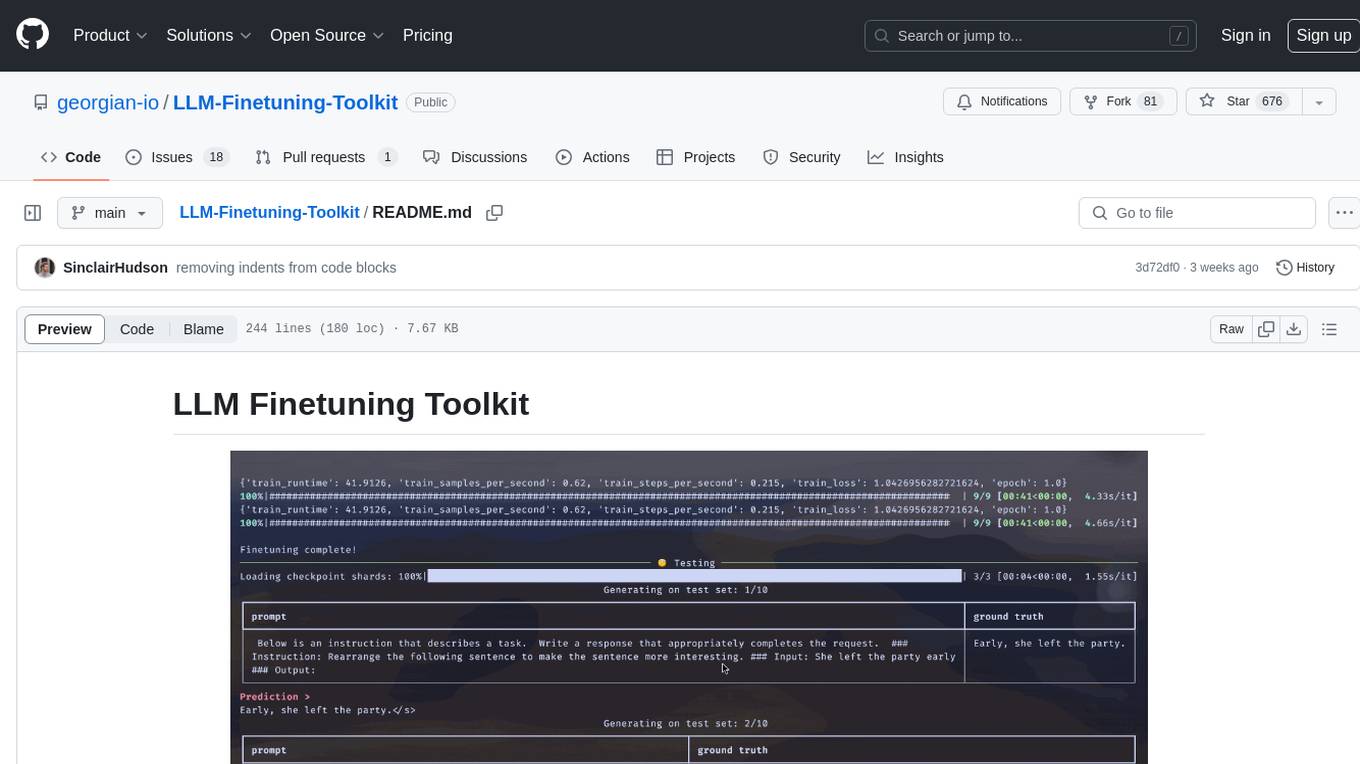
LLM-Finetuning-Toolkit
LLM Finetuning toolkit is a config-based CLI tool for launching a series of LLM fine-tuning experiments on your data and gathering their results. It allows users to control all elements of a typical experimentation pipeline - prompts, open-source LLMs, optimization strategy, and LLM testing - through a single YAML configuration file. The toolkit supports basic, intermediate, and advanced usage scenarios, enabling users to run custom experiments, conduct ablation studies, and automate fine-tuning workflows. It provides features for data ingestion, model definition, training, inference, quality assurance, and artifact outputs, making it a comprehensive tool for fine-tuning large language models.
For similar jobs
Awesome_Mamba
Awesome Mamba is a curated collection of groundbreaking research papers and articles on Mamba Architecture, a pioneering framework in deep learning known for its selective state spaces and efficiency in processing complex data structures. The repository offers a comprehensive exploration of Mamba architecture through categorized research papers covering various domains like visual recognition, speech processing, remote sensing, video processing, activity recognition, image enhancement, medical imaging, reinforcement learning, natural language processing, 3D recognition, multi-modal understanding, time series analysis, graph neural networks, point cloud analysis, and tabular data handling.
unilm
The 'unilm' repository is a collection of tools, models, and architectures for Foundation Models and General AI, focusing on tasks such as NLP, MT, Speech, Document AI, and Multimodal AI. It includes various pre-trained models, such as UniLM, InfoXLM, DeltaLM, MiniLM, AdaLM, BEiT, LayoutLM, WavLM, VALL-E, and more, designed for tasks like language understanding, generation, translation, vision, speech, and multimodal processing. The repository also features toolkits like s2s-ft for sequence-to-sequence fine-tuning and Aggressive Decoding for efficient sequence-to-sequence decoding. Additionally, it offers applications like TrOCR for OCR, LayoutReader for reading order detection, and XLM-T for multilingual NMT.
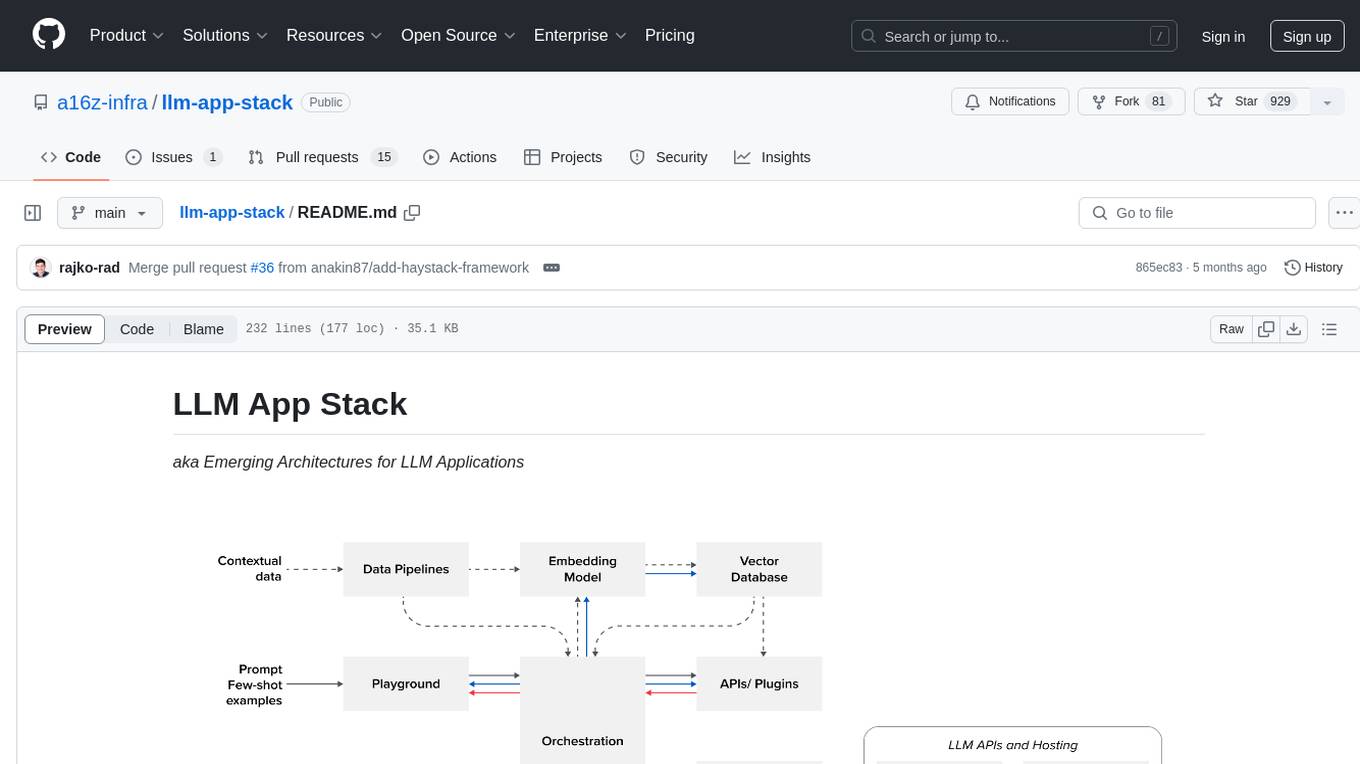
llm-app-stack
LLM App Stack, also known as Emerging Architectures for LLM Applications, is a comprehensive list of available tools, projects, and vendors at each layer of the LLM app stack. It covers various categories such as Data Pipelines, Embedding Models, Vector Databases, Playgrounds, Orchestrators, APIs/Plugins, LLM Caches, Logging/Monitoring/Eval, Validators, LLM APIs (proprietary and open source), App Hosting Platforms, Cloud Providers, and Opinionated Clouds. The repository aims to provide a detailed overview of tools and projects for building, deploying, and maintaining enterprise data solutions, AI models, and applications.
awesome-deeplogic
Awesome deep logic is a curated list of papers and resources focusing on integrating symbolic logic into deep neural networks. It includes surveys, tutorials, and research papers that explore the intersection of logic and deep learning. The repository aims to provide valuable insights and knowledge on how logic can be used to enhance reasoning, knowledge regularization, weak supervision, and explainability in neural networks.
Awesome-LLMs-on-device
Welcome to the ultimate hub for on-device Large Language Models (LLMs)! This repository is your go-to resource for all things related to LLMs designed for on-device deployment. Whether you're a seasoned researcher, an innovative developer, or an enthusiastic learner, this comprehensive collection of cutting-edge knowledge is your gateway to understanding, leveraging, and contributing to the exciting world of on-device LLMs.
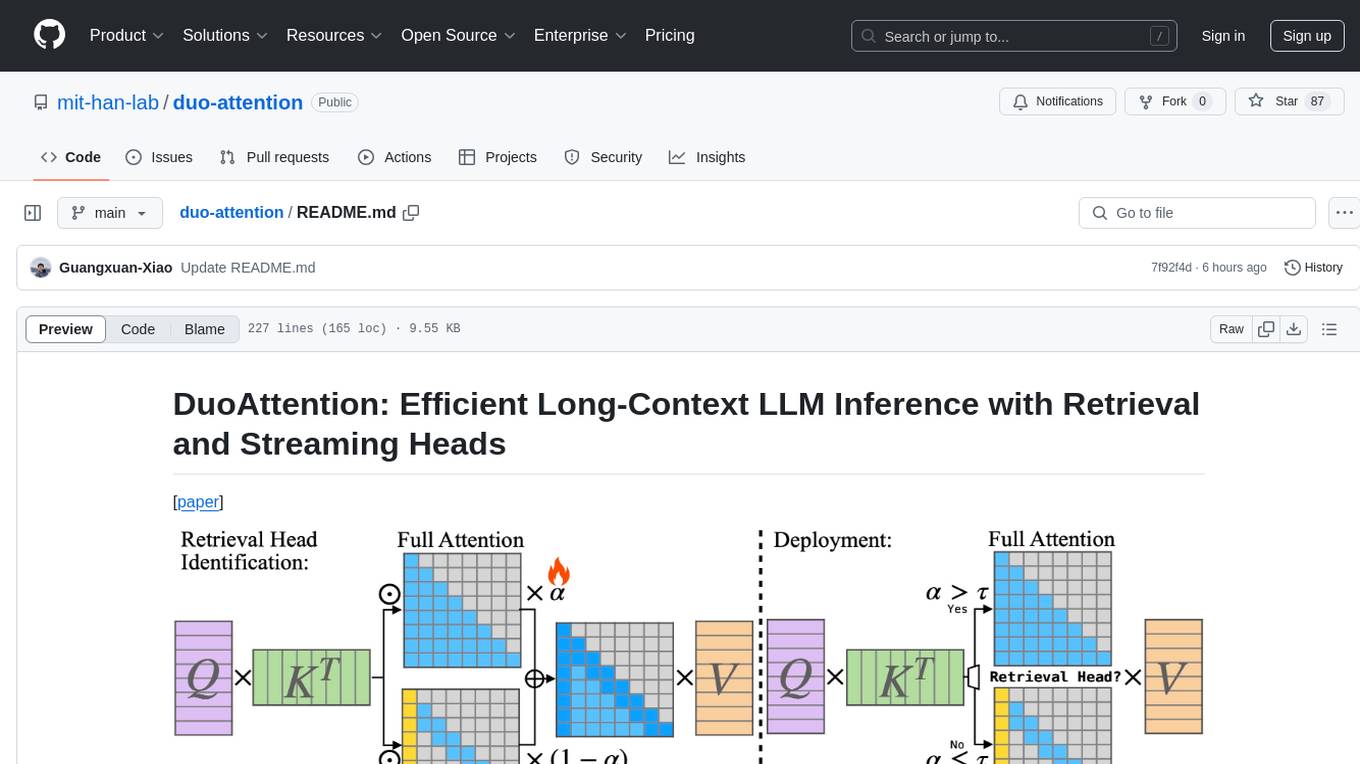
duo-attention
DuoAttention is a framework designed to optimize long-context large language models (LLMs) by reducing memory and latency during inference without compromising their long-context abilities. It introduces a concept of Retrieval Heads and Streaming Heads to efficiently manage attention across tokens. By applying a full Key and Value (KV) cache to retrieval heads and a lightweight, constant-length KV cache to streaming heads, DuoAttention achieves significant reductions in memory usage and decoding time for LLMs. The framework uses an optimization-based algorithm with synthetic data to accurately identify retrieval heads, enabling efficient inference with minimal accuracy loss compared to full attention. DuoAttention also supports quantization techniques for further memory optimization, allowing for decoding of up to 3.3 million tokens on a single GPU.
llm_note
LLM notes repository contains detailed analysis on transformer models, language model compression, inference and deployment, high-performance computing, and system optimization methods. It includes discussions on various algorithms, frameworks, and performance analysis related to large language models and high-performance computing. The repository serves as a comprehensive resource for understanding and optimizing language models and computing systems.
Awesome-Resource-Efficient-LLM-Papers
A curated list of high-quality papers on resource-efficient Large Language Models (LLMs) with a focus on various aspects such as architecture design, pre-training, fine-tuning, inference, system design, and evaluation metrics. The repository covers topics like efficient transformer architectures, non-transformer architectures, memory efficiency, data efficiency, model compression, dynamic acceleration, deployment optimization, support infrastructure, and other related systems. It also provides detailed information on computation metrics, memory metrics, energy metrics, financial cost metrics, network communication metrics, and other metrics relevant to resource-efficient LLMs. The repository includes benchmarks for evaluating the efficiency of NLP models and references for further reading.