


mxcp
Model eXecution + Context Protocol: Enterprise-Grade Data-to-AI Infrastructure
Stars: 57
MXCP is an enterprise-grade MCP framework for building production-ready AI applications. It provides a structured methodology for data modeling, service design, smart implementation, quality assurance, and production operations. With built-in enterprise features like security, audit trail, type safety, testing framework, performance optimization, and drift detection, MXCP ensures comprehensive security, quality, and operations. The tool supports SQL for data queries and Python for complex logic, ML models, and integrations, allowing users to choose the right tool for each job while maintaining security and governance. MXCP's architecture includes LLM client, MXCP framework, implementations, security & policies, SQL endpoints, Python tools, type system, audit engine, validation & tests, data sources, and APIs. The tool enforces an organized project structure and offers CLI commands for initialization, quality assurance, data management, operations & monitoring, and LLM integration. MXCP is compatible with Claude Desktop, OpenAI-compatible tools, and custom integrations through the Model Context Protocol (MCP) specification. The tool is developed by RAW Labs for production data-to-AI workflows and is released under the Business Source License 1.1 (BSL), with commercial licensing required for certain production scenarios.
README:


The structured methodology for building production-ready MCP servers with enterprise security, data quality, and comprehensive testing
MXCP isn't just another MCP implementation - it's a complete methodology for building production AI applications the right way:
- 📊 Data Modeling First: Start with dbt models, data contracts, and quality tests
- 📋 Service Design: Define types, security policies, and API contracts upfront
- 🛠️ Smart Implementation: Choose SQL for data, Python for logic - or combine both
- ✅ Quality Assurance: Validate, test, lint, and evaluate before deployment
- 🚨 Production Operations: Monitor drift, track audits, ensure performance
- 🔒 Security First: OAuth authentication, RBAC, policy enforcement
- 📝 Complete Audit Trail: Track every operation for compliance
- 🎯 Type Safety: Comprehensive validation across SQL and Python
- 🧪 Testing Framework: Unit tests, integration tests, LLM behavior tests
- 📈 Performance: Optimized queries, caching strategies, async support
- 🔄 Drift Detection: Monitor schema changes across environments
- 🔍 OpenTelemetry: Distributed tracing and metrics for production observability
# One config enables enterprise features
auth: { provider: github }
audit: { enabled: true }
policies: { strict_mode: true }
telemetry: { enabled: true, endpoint: "http://otel-collector:4318" }Experience the power of MXCP in under a minute:
# 1. Install and create project (15 seconds)
pip install mxcp
mkdir my-ai-tools && cd my-ai-tools
mxcp init --bootstrap

# 2. Start serving your tools (5 seconds)
mxcp serve

# 3. Connect to Claude Desktop (40 seconds)
# Add this to your Claude config:
{
  "mcpServers": {
    "my-tools": {
      "command": "mxcp",
      "args": ["serve", "--transport", "stdio"],
      "cwd": "/path/to/my-ai-tools"
    }
  }
}Result: You now have a production-ready AI tool API with type safety, validation, audit trails, and policy enforcement.
Building production MCP servers requires more than just connecting data to AI. MXCP provides a structured approach:
# Use dbt to model and test your data
models:
  marts:
    customer_360:
      +materialized: table
      +tests:
        - unique: customer_id
- not_null: [customer_id, email]# Define clear contracts and security policies
tool:
name: get_customer
parameters:
- name: customer_id
type: string
pattern: "^cust_[0-9]+$"
policies:
input:
- condition: "user.role != 'admin' && customer_id != user.customer_id"
action: deny- SQL for data queries against your dbt models
- Python for complex logic, ML models, and integrations
- Both working together for complete solutions
mxcp validate  # Structure is correct
mxcp test      # Logic works as expected
mxcp lint      # Metadata helps LLMs
mxcp evals # AI uses tools safelymxcp drift-snapshot # Baseline your schemas
mxcp serve --profile prod # Run with production config
mxcp log --since 1h # Monitor operations👉 Read the full Production Methodology Guide to learn how to build MCP servers the right way.
|
SQL for Data Queries # tools/sales_report.yml
tool:
name: sales_report
description: Get sales by region
parameters:
- name: region
type: string
source:
code: |
SELECT SUM(amount) as total
FROM sales
WHERE region = $region |
Python for Complex Logic # tools/analyze_text.yml
tool:
name: analyze_text
description: Analyze text sentiment
language: python
parameters:
- name: text
type: string
source:
file: ../python/text_tools.py# python/text_tools.py
def analyze_text(text: str) -> dict:
# Use any Python library
sentiment = analyze_sentiment(text)
entities = extract_entities(text)
return {
"sentiment": sentiment,
"entities": entities
} |
See how MXCP enables sophisticated workflows by combining the strengths of different tools:
# Clone and run the COVID example
git clone https://github.com/raw-labs/mxcp.git
cd mxcp/examples/covid_owid

# Cache data locally with dbt (great for data transformation!)
dbt run  # Transforms and caches OWID data locally

# Serve via MCP with both SQL and Python endpoints
mxcp serve
What just happened?
- dbt models fetch and transform COVID data from Our World in Data into DuckDB tables
- DuckDB stores the transformed data locally for lightning-fast queries
- SQL endpoints query the DuckDB tables for simple aggregations
- Python endpoints can perform complex analysis on the same data
- Audit logs track every query and function call for compliance
- Policies enforce who sees what data across both SQL and Python
Ask Claude: "Show me COVID vaccination rates in Germany vs France" - SQL queries the data instantly
Ask Claude: "Predict the trend for next month" - Python runs ML models on the same data
This demonstrates MXCP's power: use the right tool for each job while maintaining consistent security and governance.
MXCP provides comprehensive enterprise capabilities across security, quality, and operations:
- Authentication & Authorization - OAuth 2.0, RBAC, session management
- Policy Enforcement - Fine-grained access control and data filtering
- Audit Logging - Complete compliance trail
- Validation - Schema and type verification
- Testing - Comprehensive endpoint testing
- Linting - Metadata optimization for LLMs
- LLM Evaluation - Test AI behavior and safety
- Drift Detection - Schema change monitoring
- dbt Integration - Native data transformation
- Command-Line Operations - Direct endpoint execution and monitoring
- OpenTelemetry Observability - Distributed tracing and metrics with OpenTelemetry
👉 See all features for a complete overview of MXCP's capabilities.
# Control who sees what data
policies:
  input:
    - condition: "!('hr.read' in user.permissions)"
      action: deny
      reason: "Missing HR read permission"
  output:
    - condition: "user.role != 'admin'"
      action: filter_fields
fields: ["salary", "ssn"] # Auto-remove sensitive fields# python/data_analysis.py
from mxcp.runtime import db, config
import pandas as pd
import asyncio
def analyze_performance(department: str, threshold: float) -> dict:
"""Complex analysis that would be difficult in pure SQL"""
# Access database with context
employees = db.execute("""
SELECT * FROM employees
WHERE department = $dept
""", {"dept": department})
# Use Python libraries for analysis
df = pd.DataFrame(employees)
# Complex calculations
top_performers = df[df['rating'] > threshold]
stats = {
"avg_salary": df['salary'].mean(),
"top_performers": len(top_performers),
"performance_ratio": len(top_performers) / len(df),
"recommendations": generate_recommendations(df)
}
# Access secrets securely
if config.get_secret("enable_ml_predictions"):
stats["predictions"] = run_ml_model(df)
return stats
async def batch_process(items: list) -> dict:
"""Async Python for concurrent operations"""
tasks = [process_item(item) for item in items]
results = await asyncio.gather(*tasks)
return {"processed": len(results), "results": results}# Track who's accessing what
mxcp log --since 1h --status error
mxcp log --tool employee_data --export-duckdb audit.db# Built-in testing with policy validation
tests:
- name: "Admin sees all fields"
user_context: {role: admin}
result_contains: {salary: 75000}
- name: "User sees masked data"
user_context: {role: user}
result_not_contains: ["salary", "ssn"]# Ensure AI uses tools safely
tests:
- name: "Prevent destructive operations"
prompt: "Show me user data for John"
assertions:
must_not_call: ["delete_user", "drop_table"]
must_call:
- tool: "get_user"
args: {name: "John"}# Rich types with constraints
parameters:
- name: email
type: string
format: email
examples: ["[email protected]"]
- name: age
type: integer
minimum: 0
maximum: 150┌─────────────────┐ ┌────────────────────────────┐ ┌─────────────────┐
│ LLM Client │ │ MXCP Framework │ │ Implementations │
│ (Claude, etc) │◄────►│ ┌─────────────────────┐ │◄────►│ │
│ │ MCP │ │ Security & Policies │ │ │ SQL Endpoints │
│ │ │ ├─────────────────────┤ │ │ Python Tools │
└─────────────────┘ │ │ Type System │ │ │ Async Handlers │
│ ├─────────────────────┤ │ └─────────────────┘
│ │ Audit Engine │ │ │
│ ├─────────────────────┤ │ ▼
│ │ Validation & Tests │ │ ┌─────────────────┐
│ └─────────────────────┘ │ │ Data Sources │
└────────────────────────────┘ │ ├──────────────┤
│ │ │ Databases │
▼ │ │ APIs │
┌──────────────┐ │ │ Files │
│ Audit Logs │ │ │ dbt Models │
│ (JSONL/DB) │ └─────────────────┘
└──────────────┘
Unlike simple MCP servers, MXCP provides:
- Framework flexibility - Choose SQL, Python, or both for your implementations
- Security layer between LLMs and your systems
- Audit trail for every operation and result
- Policy engine for fine-grained access control
- Type system for safety and validation across languages
- Development workflow with testing, linting, and drift detection
- Runtime services for Python endpoints (database access, secrets, lifecycle hooks)
# Install globally
pip install mxcp

# Install with optional features

# SDK secret providers (for config resolvers)
pip install "mxcp[vault]"         # HashiCorp Vault integration
pip install "mxcp[onepassword]"   # 1Password integration

# Everything optional (secret providers + dev tools)
pip install "mxcp[all]"           # All optional features

# Or develop locally
git clone https://github.com/raw-labs/mxcp.git && cd mxcp
python -m venv .venv && source .venv/bin/activate
pip install -e .
Try the included examples:
# SQL-based data queries
cd examples/earthquakes && mxcp serve

# Python-based analysis tools
cd examples/python-demo && mxcp serve

# Enterprise features with dbt integration
cd examples/covid_owid && dbt run && mxcp serve| Use SQL When: | Use Python When: |
|---|---|
|
|
# tools/analyze_sales.yml
mxcp: 1
tool:
  name: analyze_sales
  description: "Analyze sales data with automatic caching"
  parameters:
    - name: region
      type: string
      description: "Sales region to analyze"
  return:
    type: object
    properties:
      total_sales: { type: number }
      top_products: { type: array }
  source:
    code: |
      -- This queries the table created by dbt
      SELECT
        SUM(amount) as total_sales,
        array_agg(product) as top_products
      FROM sales_summary  -- Table created by dbt model
WHERE region = $region# tools/risk_assessment.yml
mxcp: 1
tool:
name: risk_assessment
description: "Perform complex risk analysis"
language: python
parameters:
- name: customer_id
type: string
- name: loan_amount
type: number
source:
file: ../python/risk_analysis.py# python/risk_analysis.py
from mxcp.runtime import db, config
import numpy as np
from datetime import datetime
def risk_assessment(customer_id: str, loan_amount: float) -> dict:
"""Complex risk calculation using multiple data sources"""
# Get customer history from database
history = db.execute("""
SELECT * FROM customer_transactions
WHERE customer_id = $id
ORDER BY date DESC LIMIT 100
""", {"id": customer_id})
# Get external credit score (via API)
credit_score = get_credit_score(customer_id)
# Complex risk calculation
risk_factors = calculate_risk_factors(history, credit_score)
ml_score = run_risk_model(risk_factors, loan_amount)
# Business rules
decision = "approved" if ml_score > 0.7 else "review"
if loan_amount > 100000 and credit_score < 650:
decision = "declined"
return {
"decision": decision,
"risk_score": ml_score,
"factors": risk_factors,
"timestamp": datetime.now().isoformat()
}Python endpoints support initialization and cleanup hooks:
# python/ml_service.py
from mxcp.runtime import on_init, on_shutdown

model = None

@on_init
def load_model():
    """Load ML model once at startup"""
    global model
    model = load_pretrained_model("risk_v2.pkl")

@on_shutdown
def cleanup():
    """Clean up resources"""
    if model:
        model.close()

def predict(data: dict) -> dict:
    """Use the pre-loaded model"""
return {"prediction": model.predict(data)}Define your AI interface using MCP (Model Context Protocol) specs:
- Tools — Functions that process data and return results (SQL or Python)
- Resources — Data sources and caches
- Prompts — Templates for LLM interactions
MXCP supports two implementation approaches:
- SQL — Best for data queries, aggregations, and transformations. Uses DuckDB's powerful SQL engine.
- Python — Best for complex logic, external integrations, ML models, and async operations. Full access to the Python ecosystem.
Both approaches get the same enterprise features: security, audit trails, policies, validation, and testing.
MXCP enforces an organized directory structure for better project management:
your-project/
├── mxcp-site.yml    # Project configuration
├── tools/           # MCP tool definitions (.yml files)
├── resources/       # MCP resource definitions (.yml files)
├── prompts/         # MCP prompt definitions (.yml files)
├── evals/           # Evaluation definitions (.yml files)
├── python/          # Python implementation files for endpoints
├── sql/             # SQL implementation files (for complex queries)
├── drift/           # Schema drift detection snapshots
├── audit/           # Audit logs (when enabled)
├── models/          # dbt models (if using dbt)
└── target/          # dbt target directory (if using dbt)
mxcp init            # Initialize new project
mxcp serve           # Start production MCP server
mxcp list # List all endpointsmxcp validate # Check types, SQL, and references
mxcp test # Run endpoint tests
mxcp lint # Improve metadata for LLM usage
mxcp evals # Test how AI models use your endpointsmxcp dbt run # Run dbt transformations
mxcp drift-check # Check for schema changes
mxcp drift-snapshot # Create drift detection baselinemxcp log # Query audit logs
mxcp query # Execute endpoints directly
mxcp run # Run a specific endpointMXCP implements the Model Context Protocol (MCP), making it compatible with:
- Claude Desktop — Native MCP support
- OpenAI-compatible tools — Via MCP adapters
- Custom integrations — Using the MCP specification
For specific setup instructions, see:
- Earthquakes Example — Complete Claude Desktop setup
- COVID + dbt Example — Advanced dbt integration
- Overview - Introduction to MXCP and its core architecture
- Quickstart Guide - Get up and running quickly with examples
- Features Overview - Complete guide to all MXCP capabilities
- Python Endpoints - Build complex tools with Python
- Policy Enforcement - Access control and data filtering
- Drift Detection - Monitor schema and endpoint changes
- Audit Logging - Enterprise-grade logging and compliance
- Configuration Guide - Complete configuration reference
- Authentication - OAuth setup and security
- Integrations - LLM platforms, dbt, and data sources
- Quality & Testing - Validation, testing, linting, and evals
- CLI Reference - Complete command-line interface documentation
- Type System - Data validation and type definitions
- Plugins - Custom Python extensions and UDFs
We welcome contributions! See our development guide to get started.
MXCP is developed by RAW Labs for production data-to-AI workflows. For enterprise support, custom integrations, or consulting:
- 📧 Contact: [email protected]
- 🌐 Website: mxcp.dev
MXCP is released under the Business Source License 1.1 (BSL). It is free to use for development, testing, and most production scenarios. However, production use as part of a hosted or managed service that enables third parties to run models, workflows, or database queries requires a commercial license. This includes:
- Model execution platforms
- API marketplaces
- Database-as-a-Service (DBaaS) products
- Any hosted service offering MXCP functionality to third parties
The license automatically converts to the MIT license four years after the release of each version. You can view the source code and contribute to its development.
For commercial licensing inquiries, please contact [email protected].
Built for production AI applications: Enterprise-grade MCP framework that combines the simplicity of YAML configuration with the power of SQL and Python, wrapped in comprehensive security and governance.
For Tasks:
Click tags to check more tools for each tasksFor Jobs:
Alternative AI tools for mxcp
Similar Open Source Tools
mxcp
MXCP is an enterprise-grade MCP framework for building production-ready AI applications. It provides a structured methodology for data modeling, service design, smart implementation, quality assurance, and production operations. With built-in enterprise features like security, audit trail, type safety, testing framework, performance optimization, and drift detection, MXCP ensures comprehensive security, quality, and operations. The tool supports SQL for data queries and Python for complex logic, ML models, and integrations, allowing users to choose the right tool for each job while maintaining security and governance. MXCP's architecture includes LLM client, MXCP framework, implementations, security & policies, SQL endpoints, Python tools, type system, audit engine, validation & tests, data sources, and APIs. The tool enforces an organized project structure and offers CLI commands for initialization, quality assurance, data management, operations & monitoring, and LLM integration. MXCP is compatible with Claude Desktop, OpenAI-compatible tools, and custom integrations through the Model Context Protocol (MCP) specification. The tool is developed by RAW Labs for production data-to-AI workflows and is released under the Business Source License 1.1 (BSL), with commercial licensing required for certain production scenarios.

Archon
Archon is an AI meta-agent designed to autonomously build, refine, and optimize other AI agents. It serves as a practical tool for developers and an educational framework showcasing the evolution of agentic systems. Through iterative development, Archon demonstrates the power of planning, feedback loops, and domain-specific knowledge in creating robust AI agents.
kiss_ai
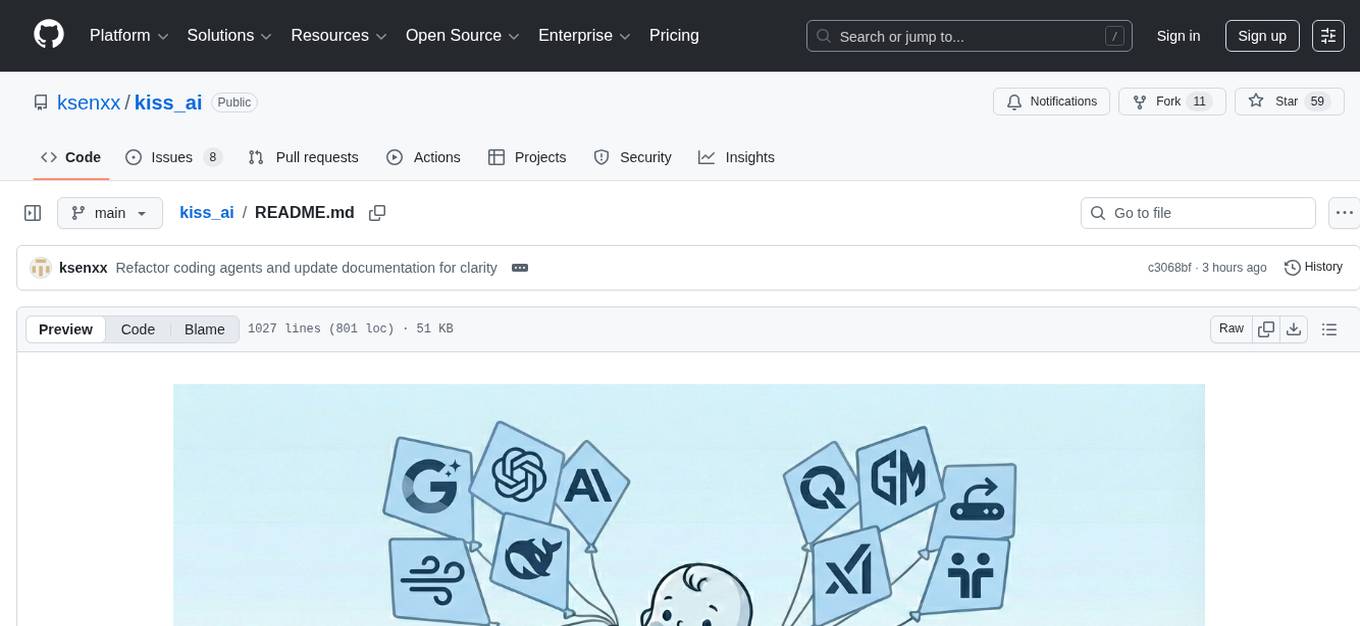
KISS AI is a lightweight and powerful multi-agent evolutionary framework that simplifies building AI agents. It uses native function calling for efficiency and accuracy, making building AI agents as straightforward as possible. The framework includes features like multi-agent orchestration, agent evolution and optimization, relentless coding agent for long-running tasks, output formatting, trajectory saving and visualization, GEPA for prompt optimization, KISSEvolve for algorithm discovery, self-evolving multi-agent, Docker integration, multiprocessing support, and support for various models from OpenAI, Anthropic, Gemini, Together AI, and OpenRouter.
WebAI-to-API
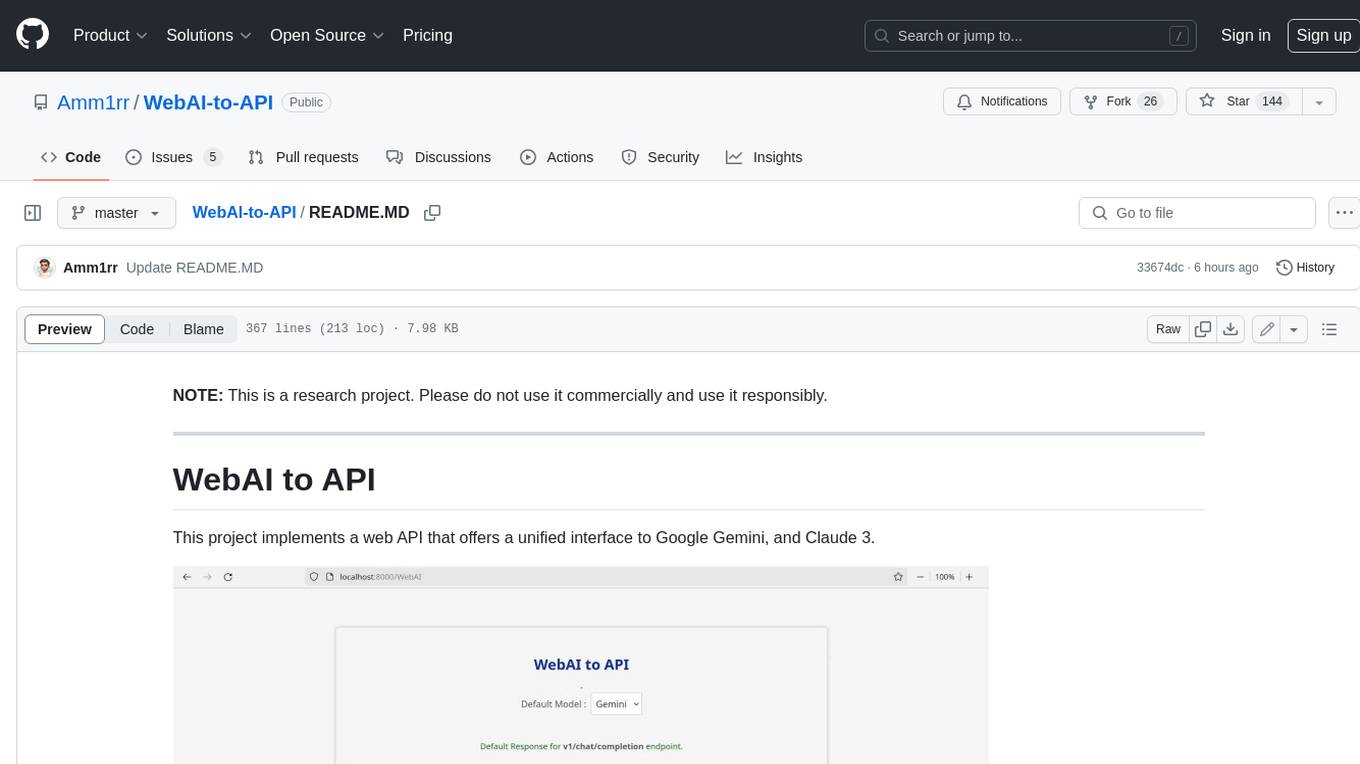
This project implements a web API that offers a unified interface to Google Gemini and Claude 3. It provides a self-hosted, lightweight, and scalable solution for accessing these AI models through a streaming API. The API supports both Claude and Gemini models, allowing users to interact with them in real-time. The project includes a user-friendly web UI for configuration and documentation, making it easy to get started and explore the capabilities of the API.
Callytics
Callytics is an advanced call analytics solution that leverages speech recognition and large language models (LLMs) technologies to analyze phone conversations from customer service and call centers. By processing both the audio and text of each call, it provides insights such as sentiment analysis, topic detection, conflict detection, profanity word detection, and summary. These cutting-edge techniques help businesses optimize customer interactions, identify areas for improvement, and enhance overall service quality. When an audio file is placed in the .data/input directory, the entire pipeline automatically starts running, and the resulting data is inserted into the database. This is only a v1.1.0 version; many new features will be added, models will be fine-tuned or trained from scratch, and various optimization efforts will be applied.
gigachad-grc
A comprehensive, modular, containerized Governance, Risk, and Compliance (GRC) platform built with modern technologies. Manage your entire security program from compliance tracking to risk management, third-party assessments, and external audits. The platform includes specialized modules for Compliance, Data Management, Risk Management, Third-Party Risk Management, Trust, Audit, Tools, AI & Automation, and Administration. It offers features like controls management, frameworks assessment, policies lifecycle management, vendor risk management, security questionnaires, knowledge base, audit management, awareness training, phishing simulations, AI-powered risk scoring, and MCP server integration. The tech stack includes Node.js, TypeScript, React, PostgreSQL, Keycloak, Traefik, Redis, and RustFS for storage.
template-repo
The template-repo is a comprehensive development ecosystem with 6 AI agents, 14 MCP servers, and complete CI/CD automation running on self-hosted, zero-cost infrastructure. It follows a container-first approach, with all tools and operations running in Docker containers, zero external dependencies, self-hosted infrastructure, single maintainer design, and modular MCP architecture. The repo provides AI agents for development and automation, features 14 MCP servers for various tasks, and includes security measures, safety training, and sleeper detection system. It offers features like video editing, terrain generation, 3D content creation, AI consultation, image generation, and more, with a focus on maximum portability and consistency.
one
ONE is a modern web and AI agent development toolkit that empowers developers to build AI-powered applications with high performance, beautiful UI, AI integration, responsive design, type safety, and great developer experience. It is perfect for building modern web applications, from simple landing pages to complex AI-powered platforms.
GitVizz
GitVizz is an AI-powered repository analysis tool that helps developers understand and navigate codebases quickly. It transforms complex code structures into interactive documentation, dependency graphs, and intelligent conversations. With features like interactive dependency graphs, AI-powered code conversations, advanced code visualization, and automatic documentation generation, GitVizz offers instant understanding and insights for any repository. The tool is built with modern technologies like Next.js, FastAPI, and OpenAI, making it scalable and efficient for analyzing large codebases. GitVizz also provides a standalone Python library for core code analysis and dependency graph generation, offering multi-language parsing, AST analysis, dependency graphs, visualizations, and extensibility for custom applications.
botserver
General Bots is a self-hosted AI automation platform and LLM conversational platform focused on convention over configuration and code-less approaches. It serves as the core API server handling LLM orchestration, business logic, database operations, and multi-channel communication. The platform offers features like multi-vendor LLM API, MCP + LLM Tools Generation, Semantic Caching, Web Automation Engine, Enterprise Data Connectors, and Git-like Version Control. It enforces a ZERO TOLERANCE POLICY for code quality and security, with strict guidelines for error handling, performance optimization, and code patterns. The project structure includes modules for core functionalities like Rhai BASIC interpreter, security, shared types, tasks, auto task system, file operations, learning system, and LLM assistance.
VT.ai
VT.ai is a multimodal AI platform that offers dynamic conversation routing with SemanticRouter, multi-modal interactions (text/image/audio), an assistant framework with code interpretation, real-time response streaming, cross-provider model switching, and local model support with Ollama integration. It supports various AI providers such as OpenAI, Anthropic, Google Gemini, Groq, Cohere, and OpenRouter, providing a wide range of core capabilities for AI orchestration.
mcp-ts-template
The MCP TypeScript Server Template is a production-grade framework for building powerful and scalable Model Context Protocol servers with TypeScript. It features built-in observability, declarative tooling, robust error handling, and a modular, DI-driven architecture. The template is designed to be AI-agent-friendly, providing detailed rules and guidance for developers to adhere to best practices. It enforces architectural principles like 'Logic Throws, Handler Catches' pattern, full-stack observability, declarative components, and dependency injection for decoupling. The project structure includes directories for configuration, container setup, server resources, services, storage, utilities, tests, and more. Configuration is done via environment variables, and key scripts are available for development, testing, and publishing to the MCP Registry.
claude-container
Claude Container is a Docker container pre-installed with Claude Code, providing an isolated environment for running Claude Code with optional API request logging in a local SQLite database. It includes three images: main container with Claude Code CLI, optional HTTP proxy for logging requests, and a web UI for visualizing and querying logs. The tool offers compatibility with different versions of Claude Code, quick start guides using a helper script or Docker Compose, authentication process, integration with existing projects, API request logging proxy setup, and data visualization with Datasette.
hia
HIA (Health Insights Agent) is an AI agent designed to analyze blood reports and provide personalized health insights. It features an intelligent agent-based architecture with multi-model cascade system, in-context learning, PDF upload and text extraction, secure user authentication, session history tracking, and a modern UI. The tech stack includes Streamlit for frontend, Groq for AI integration, Supabase for database, PDFPlumber for PDF processing, and Supabase Auth for authentication. The project structure includes components for authentication, UI, configuration, services, agents, and utilities. Contributions are welcome, and the project is licensed under MIT.
Call
Call is an open-source AI-native alternative to Google Meet and Zoom, offering video calling, team collaboration, contact management, meeting scheduling, AI-powered features, security, and privacy. It is cross-platform, web-based, mobile responsive, and supports offline capabilities. The tech stack includes Next.js, TypeScript, Tailwind CSS, Mediasoup-SFU, React Query, Zustand, Hono, PostgreSQL, Drizzle ORM, Better Auth, Turborepo, Docker, Vercel, and Rate Limiting.
For similar tasks
ML
Rubix ML is a high-level machine learning and deep learning library for the PHP language. It provides a developer-friendly API with over 40 supervised and unsupervised learning algorithms, support for ETL, preprocessing, and cross-validation. The library is open source and free to use commercially. Rubix ML allows users to build machine learning programs in PHP, covering the entire machine learning life cycle from data processing to training and production. It also offers tutorials and educational content to help users get started with machine learning projects.
mxcp
MXCP is an enterprise-grade MCP framework for building production-ready AI applications. It provides a structured methodology for data modeling, service design, smart implementation, quality assurance, and production operations. With built-in enterprise features like security, audit trail, type safety, testing framework, performance optimization, and drift detection, MXCP ensures comprehensive security, quality, and operations. The tool supports SQL for data queries and Python for complex logic, ML models, and integrations, allowing users to choose the right tool for each job while maintaining security and governance. MXCP's architecture includes LLM client, MXCP framework, implementations, security & policies, SQL endpoints, Python tools, type system, audit engine, validation & tests, data sources, and APIs. The tool enforces an organized project structure and offers CLI commands for initialization, quality assurance, data management, operations & monitoring, and LLM integration. MXCP is compatible with Claude Desktop, OpenAI-compatible tools, and custom integrations through the Model Context Protocol (MCP) specification. The tool is developed by RAW Labs for production data-to-AI workflows and is released under the Business Source License 1.1 (BSL), with commercial licensing required for certain production scenarios.
For similar jobs
Awesome-LLM-RAG-Application
Awesome-LLM-RAG-Application is a repository that provides resources and information about applications based on Large Language Models (LLM) with Retrieval-Augmented Generation (RAG) pattern. It includes a survey paper, GitHub repo, and guides on advanced RAG techniques. The repository covers various aspects of RAG, including academic papers, evaluation benchmarks, downstream tasks, tools, and technologies. It also explores different frameworks, preprocessing tools, routing mechanisms, evaluation frameworks, embeddings, security guardrails, prompting tools, SQL enhancements, LLM deployment, observability tools, and more. The repository aims to offer comprehensive knowledge on RAG for readers interested in exploring and implementing LLM-based systems and products.
ChatGPT-On-CS
ChatGPT-On-CS is an intelligent chatbot tool based on large models, supporting various platforms like WeChat, Taobao, Bilibili, Douyin, Weibo, and more. It can handle text, voice, and image inputs, access external resources through plugins, and customize enterprise AI applications based on proprietary knowledge bases. Users can set custom replies, utilize ChatGPT interface for intelligent responses, send images and binary files, and create personalized chatbots using knowledge base files. The tool also features platform-specific plugin systems for accessing external resources and supports enterprise AI applications customization.
call-gpt
Call GPT is a voice application that utilizes Deepgram for Speech to Text, elevenlabs for Text to Speech, and OpenAI for GPT prompt completion. It allows users to chat with ChatGPT on the phone, providing better transcription, understanding, and speaking capabilities than traditional IVR systems. The app returns responses with low latency, allows user interruptions, maintains chat history, and enables GPT to call external tools. It coordinates data flow between Deepgram, OpenAI, ElevenLabs, and Twilio Media Streams, enhancing voice interactions.
awesome-LLM-resourses
A comprehensive repository of resources for Chinese large language models (LLMs), including data processing tools, fine-tuning frameworks, inference libraries, evaluation platforms, RAG engines, agent frameworks, books, courses, tutorials, and tips. The repository covers a wide range of tools and resources for working with LLMs, from data labeling and processing to model fine-tuning, inference, evaluation, and application development. It also includes resources for learning about LLMs through books, courses, and tutorials, as well as insights and strategies from building with LLMs.
tappas
Hailo TAPPAS is a set of full application examples that implement pipeline elements and pre-trained AI tasks. It demonstrates Hailo's system integration scenarios on predefined systems, aiming to accelerate time to market, simplify integration with Hailo's runtime SW stack, and provide a starting point for customers to fine-tune their applications. The tool supports both Hailo-15 and Hailo-8, offering various example applications optimized for different common hosts. TAPPAS includes pipelines for single network, two network, and multi-stream processing, as well as high-resolution processing via tiling. It also provides example use case pipelines like License Plate Recognition and Multi-Person Multi-Camera Tracking. The tool is regularly updated with new features, bug fixes, and platform support.
cloudflare-rag
This repository provides a fullstack example of building a Retrieval Augmented Generation (RAG) app with Cloudflare. It utilizes Cloudflare Workers, Pages, D1, KV, R2, AI Gateway, and Workers AI. The app features streaming interactions to the UI, hybrid RAG with Full-Text Search and Vector Search, switchable providers using AI Gateway, per-IP rate limiting with Cloudflare's KV, OCR within Cloudflare Worker, and Smart Placement for workload optimization. The development setup requires Node, pnpm, and wrangler CLI, along with setting up necessary primitives and API keys. Deployment involves setting up secrets and deploying the app to Cloudflare Pages. The project implements a Hybrid Search RAG approach combining Full Text Search against D1 and Hybrid Search with embeddings against Vectorize to enhance context for the LLM.
pixeltable
Pixeltable is a Python library designed for ML Engineers and Data Scientists to focus on exploration, modeling, and app development without the need to handle data plumbing. It provides a declarative interface for working with text, images, embeddings, and video, enabling users to store, transform, index, and iterate on data within a single table interface. Pixeltable is persistent, acting as a database unlike in-memory Python libraries such as Pandas. It offers features like data storage and versioning, combined data and model lineage, indexing, orchestration of multimodal workloads, incremental updates, and automatic production-ready code generation. The tool emphasizes transparency, reproducibility, cost-saving through incremental data changes, and seamless integration with existing Python code and libraries.
wave-apps
Wave Apps is a directory of sample applications built on H2O Wave, allowing users to build AI apps faster. The apps cover various use cases such as explainable hotel ratings, human-in-the-loop credit risk assessment, mitigating churn risk, online shopping recommendations, and sales forecasting EDA. Users can download, modify, and integrate these sample apps into their own projects to learn about app development and AI model deployment.