


gigachad-grc
Open-source GRC platform for modern security teams. Manage compliance (SOC 2, ISO 27001, HIPAA), risk registers, vendor assessments, and audits—all in one place. AI-powered, containerized, enterprise-ready.
Stars: 75
A comprehensive, modular, containerized Governance, Risk, and Compliance (GRC) platform built with modern technologies. Manage your entire security program from compliance tracking to risk management, third-party assessments, and external audits. The platform includes specialized modules for Compliance, Data Management, Risk Management, Third-Party Risk Management, Trust, Audit, Tools, AI & Automation, and Administration. It offers features like controls management, frameworks assessment, policies lifecycle management, vendor risk management, security questionnaires, knowledge base, audit management, awareness training, phishing simulations, AI-powered risk scoring, and MCP server integration. The tech stack includes Node.js, TypeScript, React, PostgreSQL, Keycloak, Traefik, Redis, and RustFS for storage.
README:



A comprehensive, modular, containerized Governance, Risk, and Compliance (GRC) platform built with modern technologies. Manage your entire security program from compliance tracking to risk management, third-party assessments, and external audits.
You only need one thing: Docker Desktop
| Platform | Install Docker |
|---|---|
| macOS | Download for Mac (Apple Silicon or Intel) |
| Windows | Download for Windows (requires WSL 2) |
| Linux | curl -fsSL https://get.docker.com | sh |
No Node.js, npm, or other development tools required!
git clone https://github.com/grcengineering/gigachad-grc.git
cd gigachad-grc
./start.sh
Windows Users:
start.batThat's it! Your browser opens to http://localhost:3000 — click "Dev Login" to access.
First time? Initial build takes 3-5 minutes. Subsequent starts are ~30 seconds.
| Command | Description |
|---|---|
./start.sh |
Start the platform |
./start.sh stop |
Stop all services |
./start.sh logs |
View live logs |
./start.sh status |
Check service health |
📖 Complete Getting Started Guide — Step-by-step instructions with screenshots, troubleshooting, and system requirements.
For developers who prefer more control:
./init.sh demo    # Interactive demo setup with sample data
./init.sh dev     # Local development mode (requires Node.js 20+)
make help         # See all Makefile commands
Try in your browser (no installation):

➡️ See the Demo & Sandbox Guide for detailed walkthrough with sample data.
| Document | Description |
|---|---|
| Getting Started Guide | Start here! Complete setup guide for all skill levels |
| Quick Start Guide | Fast-track setup for experienced users |
| Demo & Sandbox | Try with sample data, one-click demo setup |
| Troubleshooting | Common issues and solutions |
| Document | Description |
|---|---|
| Architecture Guide | System architecture, API gateway, microservices, network topology |
| API Reference | Complete API documentation with endpoints, authentication, examples |
| Configuration Reference | Environment variables, service configuration, Traefik, database |
| Development Guide | Local setup, project structure, coding standards, testing |
| Deployment Guide | Production deployment, CI/CD, monitoring, backups |
| Upgrade Guide | Upgrading between versions, migration steps |
| Document | Description |
|---|---|
| Security Policy | Security vulnerability reporting and policies |
| Security Audit | Dependency audit findings, vulnerability status, remediation |
| Security Model | Comprehensive security architecture, authentication, authorization, and hardening |
| Permissions Matrix | Role-based access control and permission definitions |
| MCP Credential Security | Secure handling of MCP server credentials |
| Document | Description |
|---|---|
| Environment Configuration | Detailed environment variable reference |
| Module Configuration | Enable/disable platform modules |
| Production Deployment | Production-ready deployment checklist |
| Document | Description |
|---|---|
| Platform Review | Comprehensive platform capabilities overview |
| Help Center | User guides and how-to documentation |
| MCP Quick Start | Getting started with MCP server integration |
| Document | Description |
|---|---|
| Stability Audit Phase 1 | Phase 1 stability audit findings and fixes |
| Stability Audit Phase 2 | Phase 2 stability audit findings and fixes |
- API Gateway: Traefik v3.0 - Configuration Details
- Authentication: Keycloak OAuth 2.0 - Setup Guide
- Database: PostgreSQL 16 - Schema Details
- Monitoring: Prometheus + Grafana - Setup Guide
- AI Integration: OpenAI/Anthropic - AI Configuration
GigaChad GRC is a complete enterprise GRC solution organized into specialized modules, each handling a critical aspect of your compliance and risk management program:
- Compliance: Controls, frameworks, policies, and evidence management
- Data Management: Evidence library, policies, assets, and integrations
- Risk Management: Risk register, scenarios, heatmaps, and treatment tracking
- Third-Party Risk (TPRM): Vendor management, assessments, and contracts
- Trust: Security questionnaires, knowledge base, and public trust center
- Audit: Internal and external compliance audits with auditor portal
- Tools: Awareness training, security education programs
- AI & Automation: AI-powered risk scoring, categorization, smart search, and MCP server integration
- Administration: User management, permissions, audit logs, and settings
Complete lifecycle management for security controls across all frameworks.
Features:
- Control library with pre-loaded SOC 2 and ISO 27001 controls
- Implementation status tracking (Not Started, In Progress, Implemented, Validated)
- Testing history with evidence collection
- Control owners and assignment
- Evidence linking and attachment
- Test scheduling and reminders
- Control effectiveness scoring
- Cross-framework mapping
API Endpoints:
-
GET/POST /api/controls- List and create controls -
GET/PATCH/DELETE /api/controls/:id- Manage individual controls -
GET /api/controls/:id/evidence- View linked evidence -
POST /api/controls/:id/test- Record testing activities
Framework readiness assessment and gap analysis for major compliance standards.
Pre-loaded Frameworks:
- SOC 2 Type II (Trust Services Criteria)
- ISO 27001:2022 (with Annex A controls)
- NIST CSF 2.0 (ready)
- PCI DSS (ready)
- HIPAA (ready)
- Custom frameworks
Features:
- Real-time readiness scoring
- Gap analysis with prioritized recommendations
- Control mapping across frameworks
- Implementation roadmaps
- Evidence collection per requirement
- Compliance status dashboards
- Framework comparison and overlap analysis
API Endpoints:
-
GET /api/frameworks- List all frameworks -
GET /api/frameworks/:id- Framework details with requirements -
GET /api/frameworks/:id/readiness- Calculate readiness score -
POST /api/frameworks/:id/assess- Submit control assessments
Centralized repository for all compliance evidence with intelligent organization.
Features:
- Multi-backend storage (Local, RustFS/S3, Azure Blob)
- Document versioning and history
- Evidence types (Policy, Procedure, Screenshot, Report, Log, Certificate)
- Control linking with many-to-many relationships
- Automated retention policies
- Full-text search and filtering
- Collection dates and validity periods
- Evidence review workflows
API Endpoints:
-
GET/POST /api/evidence- List and upload evidence -
GET/DELETE /api/evidence/:id- Manage evidence items -
GET /api/evidence/:id/download- Download evidence files
Policy lifecycle management with versioning and approval workflows.
Features:
- Policy document management with versions
- Approval workflows (Draft → Review → Approved → Published)
- Review scheduling and reminders
- Control linking
- Policy effectiveness tracking
- Document history and audit trail
- Policy categories and tagging
API Endpoints:
-
GET/POST /api/policies- List and create policies -
GET /api/policies/:id- Policy details -
POST /api/policies/:id/approve- Approve policy version -
GET /api/policies/:id/versions- Version history
IT asset inventory with security metadata and classification.
Features:
- Asset inventory management (Hardware, Software, Data, People, Services)
- Criticality classification (Critical, High, Medium, Low)
- Data sensitivity classification (Public, Internal, Confidential, Restricted)
- Asset owner assignment
- Risk and control linking
- Business process association
- Asset lifecycle tracking (Active, Retired, Decommissioned)
- Custom metadata and tagging
API Endpoints:
-
GET/POST /api/assets- List and create assets -
GET/PATCH/DELETE /api/assets/:id- Manage individual assets -
POST /api/assets/:id/link- Link assets to risks/controls
External tool integrations for automated evidence collection.
Supported Integrations:
- AWS: S3 bucket configs, IAM policies, EC2 security groups, VPC flow logs, Config rules
- Azure: Resource inventory, security center findings, compliance policies
- GitHub: Branch protection rules, Dependabot alerts, secrets scanning, code scanning
- Okta: MFA enrollment, password policies, inactive users, admin access logs
- Google Workspace: User MFA status, admin roles, Drive sharing settings
- Jamf: Device encryption status, OS versions, security patch compliance
Features:
- Scheduled evidence collection (hourly, daily, weekly)
- Credential management with encryption
- Collection history and status tracking
- Automatic evidence upload to library
- Integration health monitoring
API Endpoints:
-
GET/POST /api/integrations- Integration management -
POST /api/integrations/:id/test- Test connection -
POST /api/integrations/:id/collect- Trigger manual collection
Complete enterprise risk management with quantitative and qualitative approaches.
Executive overview of organizational risk posture.
Metrics:
- Total risks by severity
- Risk trend analysis
- Treatment status
- High-priority risks
- Risk appetite vs. actual
- Top risk categories
Central repository for all identified risks with comprehensive tracking.
Features:
- Risk identification and documentation
- Likelihood and impact scoring (1-5 scale)
- Inherent vs. residual risk calculation
- Risk owners and accountability
- Treatment plans (Accept, Mitigate, Transfer, Avoid)
- Status tracking (Identified → Assessed → Treated → Monitored)
- Control linking and effectiveness
- Risk categories and tagging
Risk Scoring:
- Quantitative: Likelihood × Impact (1-25 scale)
- Qualitative: Low, Medium, High, Critical
- Customizable risk matrices
- Automated risk level calculations
Visual risk matrix showing risk distribution by likelihood and impact.
Features:
- Interactive heat map visualization
- Risk clustering by category
- Drill-down to risk details
- Filter by status, owner, category
- Export to PDF/PNG
Scenario-based risk modeling and planning.
Features:
- Threat scenario modeling
- Impact analysis
- Mitigation strategy planning
- Scenario libraries (Cyber attacks, Data breaches, Disasters)
Personal task list for assigned risks and actions.
Features:
- Assigned risks requiring action
- Overdue treatment plans
- Upcoming risk reviews
- Evidence collection tasks
Comprehensive risk reporting and analytics.
Report Types:
- Executive risk summary
- Risk register report
- Treatment effectiveness
- Risk trend analysis
- Control effectiveness
- Custom reports with filters
API Endpoints:
-
GET/POST /api/risks- List and create risks -
GET/PATCH /api/risks/:id- Manage risks -
POST /api/risks/:id/assess- Update risk assessment -
GET /api/risk-dashboard- Dashboard statistics -
GET /api/risk-heatmap- Heatmap data
Complete vendor risk management lifecycle.
Centralized vendor database with risk profiles.
Features:
- Vendor contact information
- Risk tier classification (Critical, High, Medium, Low)
- Vendor categories (Cloud, SaaS, Consultant, etc.)
- Vendor status (Active, Under Review, Offboarded)
- Due diligence documentation
- Vendor lifecycle tracking
- Relationship owners
Security assessments and questionnaires for vendors.
Assessment Types:
- Initial due diligence
- Annual reviews
- Incident-triggered assessments
- Ad-hoc assessments
Features:
- Customizable questionnaire templates
- Assessment scoring and risk rating
- Finding tracking and remediation
- Evidence collection from vendors
- Assessment history and trends
- Approval workflows
Contract lifecycle management for vendor relationships.
Features:
- Contract metadata (dates, value, terms)
- SLA tracking
- Renewal reminders
- Contract document storage
- Amendment history
- Contract status (Draft, Active, Expiring, Expired)
- Vendor linking
API Endpoints:
-
GET/POST /api/vendors- Vendor management -
GET/POST /api/assessments- Assessment workflows -
GET/POST /api/contracts- Contract management
Build and maintain customer trust through transparency and responsiveness.
Security questionnaire response management system.
Features:
- Questionnaire templates (SOC 2, ISO 27001, Custom)
- Question bank with reusable answers
- Response history and versioning
- Customer portal for submission
- Approval workflows
- Evidence attachment
- Auto-population from knowledge base
Centralized security knowledge repository for consistent responses.
Features:
- Question and answer library
- Categories and tagging
- Search and filtering
- Version control
- Approval workflows
- Control/policy linking
- Confidence scoring
Use Cases:
- Pre-populate questionnaire responses
- Sales engineering reference
- Customer FAQ
- Internal training
Public-facing security and compliance transparency portal.
Features:
- Customizable branding (logo, colors, description)
- Section-based content management:
- Overview: Company security commitment
- Certifications & Compliance: Frameworks and certifications
- Security Controls: Technical and operational controls
- Policies & Documentation: Security policies
- Security Updates: News and incident communications
- Contact: Security team contact information
- Publish/draft workflow
- Preview mode before publishing
- SEO-friendly public URLs
- Responsive design
API Endpoints:
-
GET/POST /api/questionnaires- Questionnaire management -
GET/POST /api/knowledge-base- Knowledge base entries -
GET/PATCH /api/trust-center/config- Trust center configuration -
GET/POST /api/trust-center/content- Content management -
GET /api/trust-center/public- Public trust center view
Comprehensive audit management for internal and external compliance audits.
Central audit management with support for multiple audit types.
Audit Types:
- Internal audits
- External audits (SOC 2, ISO 27001)
- Surveillance audits
- Certification audits
Features:
- Audit planning and scoping
- Framework selection (SOC 2, ISO 27001, HIPAA, PCI DSS)
- Audit team management
- External auditor information tracking
- Timeline tracking (planned vs. actual)
- Audit status workflow (Planning → Fieldwork → Testing → Reporting → Completed)
- Finding aggregation and statistics
- Portal access for external auditors
- FieldGuide integration ready
Auditor Portal:
- Secure access code generation
- Temporary access with expiration
- Document request submission
- Evidence review interface
- Comment threads on requests
Evidence and documentation request tracking.
Request Categories:
- Control documentation
- Policy review
- Evidence collection
- Interviews
- System access
- Walkthroughs
Features:
- Request assignment to internal team
- Priority levels (Low, Medium, High, Critical)
- Due date tracking with overdue alerts
- Status workflow (Open → In Progress → Submitted → Under Review → Approved)
- Evidence attachment
- Comment threads
- Clarification requests
- Control/requirement linking
Audit finding and observation management.
Finding Types:
- Control deficiencies
- Documentation gaps
- Process issues
- Compliance gaps
Features:
- Severity classification (Critical, High, Medium, Low, Observation)
- Root cause analysis
- Impact assessment
- Remediation planning
- Remediation owner assignment
- Target and actual completion dates
- Management response tracking
- Status tracking (Open → Remediation Planned → In Progress → Resolved)
- Control/requirement linking
- Test Results: Control testing with sampling methodologies
- Meetings: Audit kickoffs, status updates, interviews, closing meetings
- Activity Log: Complete audit trail of all actions
- Dashboard: Real-time audit statistics and progress
API Endpoints:
-
GET/POST /api/audits- Audit management -
GET /api/audits/dashboard- Audit statistics -
POST /api/audits/:id/portal/enable- Enable auditor portal -
GET/POST /api/audit-requests- Request management -
POST /api/audit-requests/:id/comments- Discussion threads -
GET/POST /api/audit-findings- Finding management
FieldGuide Integration:
- OAuth 2.0 authentication with FieldGuide
- Bi-directional sync with FieldGuide platform
- Audit data synchronization
- Request mapping with automatic updates
- Evidence sharing between platforms
- Webhook support for real-time updates
- Conflict resolution for simultaneous edits
- Sync history and audit logging
FieldGuide API Endpoints:
-
GET /api/fieldguide/connect- Initiate OAuth connection -
GET /api/fieldguide/callback- OAuth callback handler -
POST /api/fieldguide/sync- Trigger bi-directional sync -
POST /api/fieldguide/webhooks- Webhook receiver
Comprehensive security awareness training program management.
Features:
- Training course management (Security Basics, Phishing Awareness, Data Protection, etc.)
- Training assignment to users and groups
- Progress tracking and completion status
- Quiz engine with multiple question types
- Certificate generation upon completion
- Compliance tracking for required training
- Training content management
Quiz Engine:
- Multiple choice, true/false, and multi-select questions
- Configurable passing scores
- Question randomization
- Answer explanations
- Retake policies
Certificate Features:
- Automatic generation on course completion
- PDF download
- Unique certificate IDs for verification
- Expiration dates for recurring training
API Endpoints:
-
GET/POST /api/training/courses- Course management -
GET/POST /api/training/assignments- Assign training -
POST /api/training/:courseId/quiz- Take quiz -
GET /api/training/:courseId/certificate- Download certificate
Security awareness through realistic phishing simulations.
Campaign Features:
- Campaign creation with templates
- Target group selection
- Scheduling (immediate, scheduled, recurring)
- Email template customization
- Landing page configuration
- Real-time tracking and analytics
Analytics & Reporting:
- Click rates by department
- Report rates
- Training completion correlation
- Historical trend analysis
- User risk scoring
- Department benchmarking
Template Library:
- Pre-built phishing templates (Credential harvesting, Malware, Gift card scams, etc.)
- Custom template creation
- Template difficulty ratings
- Industry-specific templates
API Endpoints:
-
GET/POST /api/phishing/campaigns- Campaign management -
GET /api/phishing/campaigns/:id/analytics- Campaign analytics -
GET/POST /api/phishing/templates- Template management -
POST /api/phishing/report- User phishing report submission
Enterprise AI capabilities and MCP (Model Context Protocol) server integration for intelligent GRC operations.
AI-powered features using GPT-5 (OpenAI) or Claude Opus 4.5 (Anthropic).
Supported AI Providers:
- OpenAI: GPT-5 (Most Capable), GPT-5 Mini, o3 (Advanced Reasoning), o3-mini
- Anthropic: Claude Opus 4.5 (Most Capable), Claude Sonnet 4, Claude 3.5 Sonnet, Claude 3.5 Haiku
AI Features:
- Risk Scoring: AI-suggested risk likelihood and impact with rationale
- Auto-Categorization: Automatic categorization and tagging of controls, risks, policies
- Smart Search: Natural language search across all GRC modules
- Policy Drafting: Generate policy drafts based on requirements and context
- Control Suggestions: AI-recommended controls for risks and compliance requirements
Model Context Protocol servers for automated GRC workflows.
Available MCP Servers:
-
grc-evidence: Automated evidence collection from cloud providers and security tools
- AWS (S3, IAM, EC2, VPC, Config)
- Azure resources
- GitHub (branch protection, secrets scanning, Dependabot)
- Okta (MFA status, password policies, inactive users)
- Google Workspace (user MFA, admin roles, sharing settings)
- Jamf (device encryption, OS versions, security patches)
- Vulnerability scanning integration
- Screenshot capture for visual evidence
-
grc-compliance: Automated compliance checking and reporting
- Control testing automation
- Policy validation against requirements
- Compliance report generation
- Framework-specific checks (SOC 2, ISO 27001, HIPAA, GDPR)
-
grc-ai-assistant: AI-powered GRC operations
- Deep risk analysis with contextual understanding
- Control recommendations based on risks and requirements
- Policy document drafting
- Automatic requirement mapping
- Finding explanation in plain language
- Remediation prioritization
- Compliance gap analysis
- Vendor risk assessment
API Endpoints:
-
GET /api/ai/config- Get AI configuration -
POST /api/ai/risk-scoring- AI risk scoring suggestions -
POST /api/ai/categorize- Auto-categorization -
POST /api/ai/search- Smart natural language search -
GET /api/mcp/servers- List active MCP servers -
POST /api/mcp/tools/call- Execute MCP tool -
POST /api/mcp/workflows- Manage MCP workflows
User account and access control management via Keycloak.
Features:
- User provisioning and deactivation
- Role assignment (Admin, Compliance Manager, Auditor, Viewer)
- SSO integration via Keycloak
- Multi-factor authentication
- Session management
Role-based access control and permission groups.
Default Roles:
- Admin: Full system access
- Compliance Manager: Manage controls, evidence, frameworks
- Risk Manager: Manage risks and treatments
- Auditor: Read-only access to controls and evidence
- Viewer: Limited read access
Complete system audit trail for compliance and forensics.
Tracked Events:
- User actions (login, logout, changes)
- Entity changes (create, update, delete)
- Access attempts
- Configuration changes
- Evidence uploads/downloads
- Approval actions
Features:
- Search and filtering
- Export to CSV
- Date range queries
- User activity reports
- Change history with before/after values
Risk management system configuration.
Settings:
- Risk scoring methodology
- Likelihood definitions (1-5)
- Impact definitions (1-5)
- Risk appetite thresholds
- Risk categories
- Treatment options
- Review frequencies
The main dashboard provides an executive overview of your entire GRC program:
Compliance Metrics:
- Overall compliance score
- Control implementation status
- Framework readiness percentages
- Evidence collection status
- Upcoming control tests
Risk Metrics:
- Risk distribution by severity
- High-priority risks requiring attention
- Risk treatment progress
- Top risk categories
Audit Metrics:
- Active audits
- Open audit requests
- Pending findings
- Upcoming audit activities
Recent Activity:
- Control updates
- Evidence uploads
- Risk assessments
- Audit progress
- Policy approvals
┌───────────────────────────────────────────────────────────────────────┐
│                           Traefik Gateway                              │
│                           (API Routing)                                │
├──────────┬──────────┬──────────┬──────────┬──────────┬──────────┬────┤
│ Controls │Frameworks│ Policies │   TPRM   │  Trust   │  Audit   │ UI │
│  :3001   │  :3002   │  :3004   │  :3005   │  :3006   │  :3007   │:5173
├──────────┴──────────┴──────────┴──────────┴──────────┴──────────┴────┤
│                          Shared Library                                │
│          (Prisma Schema, Types, Auth, Storage, Events)                 │
├──────────┬──────────┬──────────┬──────────────────────────────────────┤
│PostgreSQL│  Redis   │ Keycloak │              RustFS                  │
│  :5433   │  :6380   │  :8080   │         :9000 / :9001                │
│(Database)│ (Cache)  │  (Auth)  │    (S3-Compatible Storage)           │
└──────────┴──────────┴──────────┴──────────────────────────────────────┘

Frontend (React + Vite)
    ↓
Traefik (API Gateway)
    ↓
Microservices Layer:
  - Controls Service (NestJS) → Controls + Evidence + Audit Logging
  - Frameworks Service (NestJS) → Frameworks + Risk Management
  - Policies Service (NestJS) → Policy Lifecycle
  - TPRM Service (NestJS) → Vendors + Assessments + Contracts
  - Trust Service (NestJS) → Questionnaires + Knowledge Base + Trust Center
  - Audit Service (NestJS) → Audit Management + Auditor Portal
    ↓
Infrastructure Layer:
  - PostgreSQL (Single database, multi-tenant schema)
  - Redis (Caching + Session Management)
  - Keycloak (SSO + RBAC)
  - RustFS (S3-compatible object storage - https://github.com/rustfs/rustfs)
- Backend: Node.js + TypeScript with NestJS
- Frontend: React + TypeScript with Vite, TailwindCSS
- Database: PostgreSQL with Prisma ORM
- Authentication: Keycloak (SSO, RBAC)
- API Gateway: Traefik
- Cache/Events: Redis
- Storage: RustFS (S3-compatible, Apache 2.0 - https://github.com/rustfs/rustfs)
- Containers: Docker with Docker Compose
- Docker and Docker Compose
- Node.js 20+ (for local development)
git clone https://github.com/grcengineering/gigachad-grc.git
cd gigachad-grc
./init.sh demo
This single command:
- Generates secure secrets and creates
.env - Starts all infrastructure (PostgreSQL, Redis, Keycloak, RustFS)
- Builds and starts all backend services
- Starts the frontend and opens your browser
Login: Click "Dev Login" - no password needed!
make demo      # One-click demo
make dev       # Development setup
make up        # Start containers
make down      # Stop containers
make logs      # View logs
make help # See all commandsIf you prefer manual control:
# 1. Create environment
cp env.example .env

# 2. Start infrastructure
docker compose up -d postgres redis keycloak rustfs

# 3. Start services
docker compose up -d

# 4. Access the app
open http://localhost:3000- Frontend: http://localhost:3000 (or :5173 in dev)
- Keycloak Admin: http://localhost:8080 (admin/admin)
- API Docs: http://localhost:3001/api/docs
- RustFS Console: http://localhost:9001 (rustfsadmin/rustfsadmin)
GigaChad GRC includes comprehensive built-in tools for ensuring production readiness:
Before deploying to production, run the validation script to check all configuration:
# Basic validation
npm run validate:production

# Strict mode (exit non-zero on warnings)
npm run validate:production:strict
The script validates:
- Security configuration (encryption keys, passwords, auth mode)
- Database connections and SSL
- Backup configuration
- Authentication setup (Keycloak)
- Network/CORS settings
Administrators can view real-time system health in Settings > Organization Settings > System Health:
- System Health Banner: Displays critical warnings for security issues, backup problems, and misconfigurations
- Production Readiness Score: 0-100 score indicating deployment readiness
- Setup Wizard: Guided configuration for new installations
When running with Docker, the entrypoint script provides:
| Feature | Environment Variable | Description |
|---|---|---|
| Auto-backup scheduling | AUTO_BACKUP_ENABLED=true |
Schedules daily backups via cron |
| Database migrations | AUTO_MIGRATE=true |
Runs migrations on startup |
| Dependency wait | WAIT_FOR_DB=true |
Waits for PostgreSQL before starting |
| Config warnings | Always enabled | Logs warnings for production misconfigurations |
All critical data is stored in Docker named volumes that survive container restarts:
| Data Type | Volume | Survives Crash |
|---|---|---|
| Database | postgres_data |
✅ Yes |
| Evidence Files | rustfs_data |
✅ Yes |
| Cache/Sessions | redis_data |
✅ Yes |
| Metrics | prometheus_data |
✅ Yes |
Important: Running docker-compose down -v will delete volumes. Always run backups before maintenance.
# Create backup (stored in /backups/gigachad-grc/)
npm run backup

# Restore from backup
npm run restore /path/to/backup.tar.gz
For detailed resilience documentation, see System Health Guide.
gigachad-grc/
├── services/
│   ├── shared/               # Shared TypeScript library
│   │   ├── src/
│   │   │   ├── types/        # Type definitions
│   │   │   ├── auth/         # Auth middleware
│   │   │   ├── storage/      # Storage abstraction
│   │   │   ├── events/       # Event bus
│   │   │   ├── utils/        # Utilities
│   │   │   └── logger/       # Logging
│   │   └── prisma/           # Unified database schema (all modules)
│   │       └── schema.prisma # Single source of truth
│   │
│   ├── controls/             # Controls + Evidence + Audit Logging
│   │   ├── src/
│   │   │   ├── controls/     # Control management
│   │   │   ├── evidence/     # Evidence library
│   │   │   ├── audit/        # Activity audit logging
│   │   │   └── testing/      # Control testing
│   │   ├── Dockerfile
│   │   └── package.json
│   │
│   ├── frameworks/           # Frameworks + Risk Management
│   │   ├── src/
│   │   │   ├── frameworks/   # Framework assessments
│   │   │   ├── risks/        # Risk register
│   │   │   ├── scenarios/    # Risk scenarios
│   │   │   └── treatments/   # Risk treatments
│   │   ├── Dockerfile
│   │   └── package.json
│   │
│   ├── policies/             # Policy Lifecycle Management
│   │   ├── src/
│   │   │   ├── policies/     # Policy CRUD
│   │   │   ├── versions/     # Version control
│   │   │   └── approvals/    # Approval workflows
│   │   ├── Dockerfile
│   │   └── package.json
│   │
│   ├── tprm/                 # Third-Party Risk Management
│   │   ├── src/
│   │   │   ├── vendors/      # Vendor management
│   │   │   ├── assessments/  # Security assessments
│   │   │   └── contracts/    # Contract lifecycle
│   │   ├── Dockerfile
│   │   └── package.json
│   │
│   ├── trust/                # Trust & Transparency
│   │   ├── src/
│   │   │   ├── questionnaires/  # Security questionnaires
│   │   │   ├── knowledge-base/  # Q&A repository
│   │   │   └── trust-center/    # Public trust portal
│   │   ├── Dockerfile
│   │   └── package.json
│   │
│   └── audit/                # Audit Management (NEW)
│       ├── src/
│       │   ├── audits/       # Audit orchestration
│       │   ├── requests/     # Evidence requests
│       │   ├── findings/     # Audit findings
│       │   ├── evidence/     # Audit evidence
│       │   ├── portal/       # External auditor portal
│       │   └── fieldguide/   # FieldGuide integration
│       ├── Dockerfile
│       └── package.json
│
├── frontend/                 # React SPA
│   ├── src/
│   │   ├── pages/            # Page components
│   │   │   ├── Controls.tsx
│   │   │   ├── Frameworks.tsx
│   │   │   ├── Risks.tsx
│   │   │   ├── Vendors.tsx
│   │   │   ├── Questionnaires.tsx
│   │   │   ├── Audits.tsx    # NEW
│   │   │   └── ...
│   │   ├── components/       # Reusable components
│   │   ├── contexts/         # React contexts (Auth)
│   │   └── lib/              # Utilities and API clients
│   └── package.json
│
├── auth/                     # Keycloak configuration
│   └── realm-export.json     # Pre-configured realm
│
├── gateway/                  # Traefik configuration
│   └── traefik.yml
│
├── database/
│   ├── init/                 # Database initialization
│   └── seeds/                # Seed data (frameworks, controls)
│
├── docker-compose.yml        # Production compose
├── docker-compose.dev.yml    # Development overrides
├── .env.example              # Environment template
└── README.md                 # This file
Each microservice runs on its own port with Swagger API documentation:
| Service | Port | Swagger Docs | Description |
|---|---|---|---|
| Frontend | 5173 | N/A | React SPA (Vite dev server) |
| Controls | 3001 | http://localhost:3001/api/docs | Controls, Evidence, Testing |
| Frameworks | 3002 | http://localhost:3002/api/docs | Frameworks, Risk Management |
| Policies | 3004 | http://localhost:3004/api/docs | Policy Lifecycle Management |
| TPRM | 3005 | http://localhost:3005/api/docs | Vendor Risk Management |
| Trust | 3006 | http://localhost:3006/api/docs | Questionnaires, KB, Trust Center |
| Audit | 3007 | http://localhost:3007/api/docs | Audit Management |
| PostgreSQL | 5433 | N/A | Primary database |
| Redis | 6380 | N/A | Cache & sessions |
| Keycloak | 8080 | http://localhost:8080 | Auth & SSO (admin/admin) |
| Traefik | 80/443 | http://localhost:8090 | API Gateway dashboard |
| RustFS API | 9000 | N/A | S3-compatible object storage API |
| RustFS Console | 9001 | http://localhost:9001 | Storage admin UI (rustfsadmin/rustfsadmin) |
| Variable | Description | Default |
|---|---|---|
POSTGRES_USER |
Database user | grc |
POSTGRES_PASSWORD |
Database password | grc_secret |
POSTGRES_DB |
Database name | gigachad_grc |
REDIS_PASSWORD |
Redis password | redis_secret |
KEYCLOAK_ADMIN |
Keycloak admin user | admin |
KEYCLOAK_ADMIN_PASSWORD |
Keycloak admin password | admin |
MINIO_ROOT_USER |
RustFS/S3 root user | rustfsadmin |
MINIO_ROOT_PASSWORD |
RustFS/S3 root password | (secure password) |
STORAGE_TYPE |
Storage backend (local/s3/minio) | s3 |
The platform supports multiple storage backends:
Local Storage:
STORAGE_TYPE=local
LOCAL_STORAGE_PATH=./storage
RustFS/S3 (Recommended):
# RustFS is a high-performance, Apache 2.0 licensed S3-compatible storage
# https://github.com/rustfs/rustfs
STORAGE_TYPE=s3
S3_ENDPOINT=rustfs
S3_PORT=9000
S3_ACCESS_KEY=rustfsadmin
S3_SECRET_KEY=your_secure_password
S3_BUCKET=grc-evidenceEach service is designed to run independently. To extract a module:
- Copy the service directory
- Update the
DATABASE_URLin the service's environment - Run migrations:
npm run prisma:migrate - Build and run:
docker build -t my-service . && docker run my-service
- All passwords should be changed in production
- Enable TLS/SSL for all services
- Configure Keycloak for production use
- Use proper secrets management
- Review and harden Docker images
- Images should be pulled from Docker Hub's Hardened Images
This project is licensed under the Elastic License 2.0 (ELv2).
- Use internally at your company for commercial purposes
- Modify the software for your own use
- Self-host on your own infrastructure
- Contribute improvements back to the project
- Offer this software as a hosted/managed service to third parties
- Sell the software or derivatives to others
- Create a competing commercial GRC product based on this code
- Remove or obscure license/copyright notices
See the LICENSE file for the complete license terms.
For commercial licensing inquiries (e.g., to offer as a managed service), please contact the project maintainers.
We welcome contributions! Please read our Contributing Guide to get started.
By contributing, you agree that your contributions will be licensed under the same Elastic License 2.0. Please also review our Code of Conduct.
Quick Start:
- Fork the repository
- Create a feature branch (
git checkout -b feature/amazing-feature) - Make your changes following our coding standards
- Run tests (
npm test) - Submit a pull request
- Documentation: Check the docs folder for guides and references
- Issues: Use the GitHub issue tracker for bugs and feature requests
- Security: Report vulnerabilities privately via GitHub Security Advisories
- Discussions: Use GitHub Discussions for questions and ideas
For Tasks:
Click tags to check more tools for each tasksFor Jobs:
Alternative AI tools for gigachad-grc
Similar Open Source Tools
gigachad-grc
A comprehensive, modular, containerized Governance, Risk, and Compliance (GRC) platform built with modern technologies. Manage your entire security program from compliance tracking to risk management, third-party assessments, and external audits. The platform includes specialized modules for Compliance, Data Management, Risk Management, Third-Party Risk Management, Trust, Audit, Tools, AI & Automation, and Administration. It offers features like controls management, frameworks assessment, policies lifecycle management, vendor risk management, security questionnaires, knowledge base, audit management, awareness training, phishing simulations, AI-powered risk scoring, and MCP server integration. The tech stack includes Node.js, TypeScript, React, PostgreSQL, Keycloak, Traefik, Redis, and RustFS for storage.
hia
HIA (Health Insights Agent) is an AI agent designed to analyze blood reports and provide personalized health insights. It features an intelligent agent-based architecture with multi-model cascade system, in-context learning, PDF upload and text extraction, secure user authentication, session history tracking, and a modern UI. The tech stack includes Streamlit for frontend, Groq for AI integration, Supabase for database, PDFPlumber for PDF processing, and Supabase Auth for authentication. The project structure includes components for authentication, UI, configuration, services, agents, and utilities. Contributions are welcome, and the project is licensed under MIT.
template-repo
The template-repo is a comprehensive development ecosystem with 6 AI agents, 14 MCP servers, and complete CI/CD automation running on self-hosted, zero-cost infrastructure. It follows a container-first approach, with all tools and operations running in Docker containers, zero external dependencies, self-hosted infrastructure, single maintainer design, and modular MCP architecture. The repo provides AI agents for development and automation, features 14 MCP servers for various tasks, and includes security measures, safety training, and sleeper detection system. It offers features like video editing, terrain generation, 3D content creation, AI consultation, image generation, and more, with a focus on maximum portability and consistency.

Archon
Archon is an AI meta-agent designed to autonomously build, refine, and optimize other AI agents. It serves as a practical tool for developers and an educational framework showcasing the evolution of agentic systems. Through iterative development, Archon demonstrates the power of planning, feedback loops, and domain-specific knowledge in creating robust AI agents.
VT.ai
VT.ai is a multimodal AI platform that offers dynamic conversation routing with SemanticRouter, multi-modal interactions (text/image/audio), an assistant framework with code interpretation, real-time response streaming, cross-provider model switching, and local model support with Ollama integration. It supports various AI providers such as OpenAI, Anthropic, Google Gemini, Groq, Cohere, and OpenRouter, providing a wide range of core capabilities for AI orchestration.
DeepTutor
DeepTutor is an AI-powered personalized learning assistant that offers a suite of modules for massive document knowledge Q&A, interactive learning visualization, knowledge reinforcement with practice exercise generation, deep research, and idea generation. The tool supports multi-agent collaboration, dynamic topic queues, and structured outputs for various tasks. It provides a unified system entry for activity tracking, knowledge base management, and system status monitoring. DeepTutor is designed to streamline learning and research processes by leveraging AI technologies and interactive features.
multi-agent-shogun
multi-agent-shogun is a system that runs multiple AI coding CLI instances simultaneously, orchestrating them like a feudal Japanese army. It supports Claude Code, OpenAI Codex, GitHub Copilot, and Kimi Code. The system allows you to command your AI army with zero coordination cost, enabling parallel execution, non-blocking workflow, cross-session memory, event-driven communication, and full transparency. It also features skills discovery, phone notifications, pane border task display, shout mode, and multi-CLI support.
bifrost
Bifrost is a high-performance AI gateway that unifies access to multiple providers through a single OpenAI-compatible API. It offers features like automatic failover, load balancing, semantic caching, and enterprise-grade functionalities. Users can deploy Bifrost in seconds with zero configuration, benefiting from its core infrastructure, advanced features, enterprise and security capabilities, and developer experience. The repository structure is modular, allowing for maximum flexibility. Bifrost is designed for quick setup, easy configuration, and seamless integration with various AI models and tools.
aiconfigurator
The `aiconfigurator` tool assists in finding a strong starting configuration for disaggregated serving in AI deployments. It helps optimize throughput at a given latency by evaluating thousands of configurations based on model, GPU count, and GPU type. The tool models LLM inference using collected data for a target machine and framework, running via CLI and web app. It generates configuration files for deployment with Dynamo, offering features like customized configuration, all-in-one automation, and tuning with advanced features. The tool estimates performance by breaking down LLM inference into operations, collecting operation execution times, and searching for strong configurations. Supported features include models like GPT and operations like attention, KV cache, GEMM, AllReduce, embedding, P2P, element-wise, MoE, MLA BMM, TRTLLM versions, and parallel modes like tensor-parallel and pipeline-parallel.
claude-code-settings
A repository collecting best practices for Claude Code settings and customization. It provides configuration files for customizing Claude Code's behavior and building an efficient development environment. The repository includes custom agents and skills for specific domains, interactive development workflow features, efficient development rules, and team workflow with Codex MCP. Users can leverage the provided configuration files and tools to enhance their development process and improve code quality.
astrsk
astrsk is a tool that pushes the boundaries of AI storytelling by offering advanced AI agents, customizable response formatting, and flexible prompt editing for immersive roleplaying experiences. It provides complete AI agent control, a visual flow editor for conversation flows, and ensures 100% local-first data storage. The tool is true cross-platform with support for various AI providers and modern technologies like React, TypeScript, and Tailwind CSS. Coming soon features include cross-device sync, enhanced session customization, and community features.
nono
nono is a secure, kernel-enforced capability shell for running AI agents and any POSIX style process. It leverages OS security primitives to create an environment where unauthorized operations are structurally impossible. It provides protections against destructive commands and securely stores API keys, tokens, and secrets. The tool is agent-agnostic, works with any AI agent or process, and blocks dangerous commands by default. It follows a capability-based security model with defense-in-depth, ensuring secure execution of commands and protecting sensitive data.
vibe-remote
Vibe Remote is a tool that allows developers to code using AI agents through Slack or Discord, eliminating the need for a laptop or IDE. It provides a seamless experience for coding tasks, enabling users to interact with AI agents in real-time, delegate tasks, and monitor progress. The tool supports multiple coding agents, offers a setup wizard for easy installation, and ensures security by running locally on the user's machine. Vibe Remote enhances productivity by reducing context-switching and enabling parallel task execution within isolated workspaces.
aegra
Aegra is a self-hosted AI agent backend platform that provides LangGraph power without vendor lock-in. Built with FastAPI + PostgreSQL, it offers complete control over agent orchestration for teams looking to escape vendor lock-in, meet data sovereignty requirements, enable custom deployments, and optimize costs. Aegra is Agent Protocol compliant and perfect for teams seeking a free, self-hosted alternative to LangGraph Platform with zero lock-in, full control, and compatibility with existing LangGraph Client SDK.
pluely
Pluely is a versatile and user-friendly tool for managing tasks and projects. It provides a simple interface for creating, organizing, and tracking tasks, making it easy to stay on top of your work. With features like task prioritization, due date reminders, and collaboration options, Pluely helps individuals and teams streamline their workflow and boost productivity. Whether you're a student juggling assignments, a professional managing multiple projects, or a team coordinating tasks, Pluely is the perfect solution to keep you organized and efficient.
For similar tasks
gigachad-grc
A comprehensive, modular, containerized Governance, Risk, and Compliance (GRC) platform built with modern technologies. Manage your entire security program from compliance tracking to risk management, third-party assessments, and external audits. The platform includes specialized modules for Compliance, Data Management, Risk Management, Third-Party Risk Management, Trust, Audit, Tools, AI & Automation, and Administration. It offers features like controls management, frameworks assessment, policies lifecycle management, vendor risk management, security questionnaires, knowledge base, audit management, awareness training, phishing simulations, AI-powered risk scoring, and MCP server integration. The tech stack includes Node.js, TypeScript, React, PostgreSQL, Keycloak, Traefik, Redis, and RustFS for storage.
AutoAudit
AutoAudit is an open-source large language model specifically designed for the field of network security. It aims to provide powerful natural language processing capabilities for security auditing and network defense, including analyzing malicious code, detecting network attacks, and predicting security vulnerabilities. By coupling AutoAudit with ClamAV, a security scanning platform has been created for practical security audit applications. The tool is intended to assist security professionals with accurate and fast analysis and predictions to combat evolving network threats.
hound
Hound is a security audit automation pipeline for AI-assisted code review that mirrors how expert auditors think, learn, and collaborate. It features graph-driven analysis, sessionized audits, provider-agnostic models, belief system and hypotheses, precise code grounding, and adaptive planning. The system employs a senior/junior auditor pattern where the Scout actively navigates the codebase and annotates knowledge graphs while the Strategist handles high-level planning and vulnerability analysis. Hound is optimized for small-to-medium sized projects like smart contract applications and is language-agnostic.
explain-openclaw
Explain OpenClaw is a comprehensive documentation repository for the OpenClaw framework, a self-hosted AI assistant platform. It covers various aspects such as plain English explanations, technical architecture, deployment scenarios, privacy and safety measures, security audits, worst-case security scenarios, optimizations, and AI model comparisons. The repository serves as a living knowledge base with beginner-friendly explanations and detailed technical insights for contributors.
For similar jobs
ciso-assistant-community
CISO Assistant is a tool that helps organizations manage their cybersecurity posture and compliance. It provides a centralized platform for managing security controls, threats, and risks. CISO Assistant also includes a library of pre-built frameworks and tools to help organizations quickly and easily implement best practices.
gigachad-grc
A comprehensive, modular, containerized Governance, Risk, and Compliance (GRC) platform built with modern technologies. Manage your entire security program from compliance tracking to risk management, third-party assessments, and external audits. The platform includes specialized modules for Compliance, Data Management, Risk Management, Third-Party Risk Management, Trust, Audit, Tools, AI & Automation, and Administration. It offers features like controls management, frameworks assessment, policies lifecycle management, vendor risk management, security questionnaires, knowledge base, audit management, awareness training, phishing simulations, AI-powered risk scoring, and MCP server integration. The tech stack includes Node.js, TypeScript, React, PostgreSQL, Keycloak, Traefik, Redis, and RustFS for storage.
PyRIT
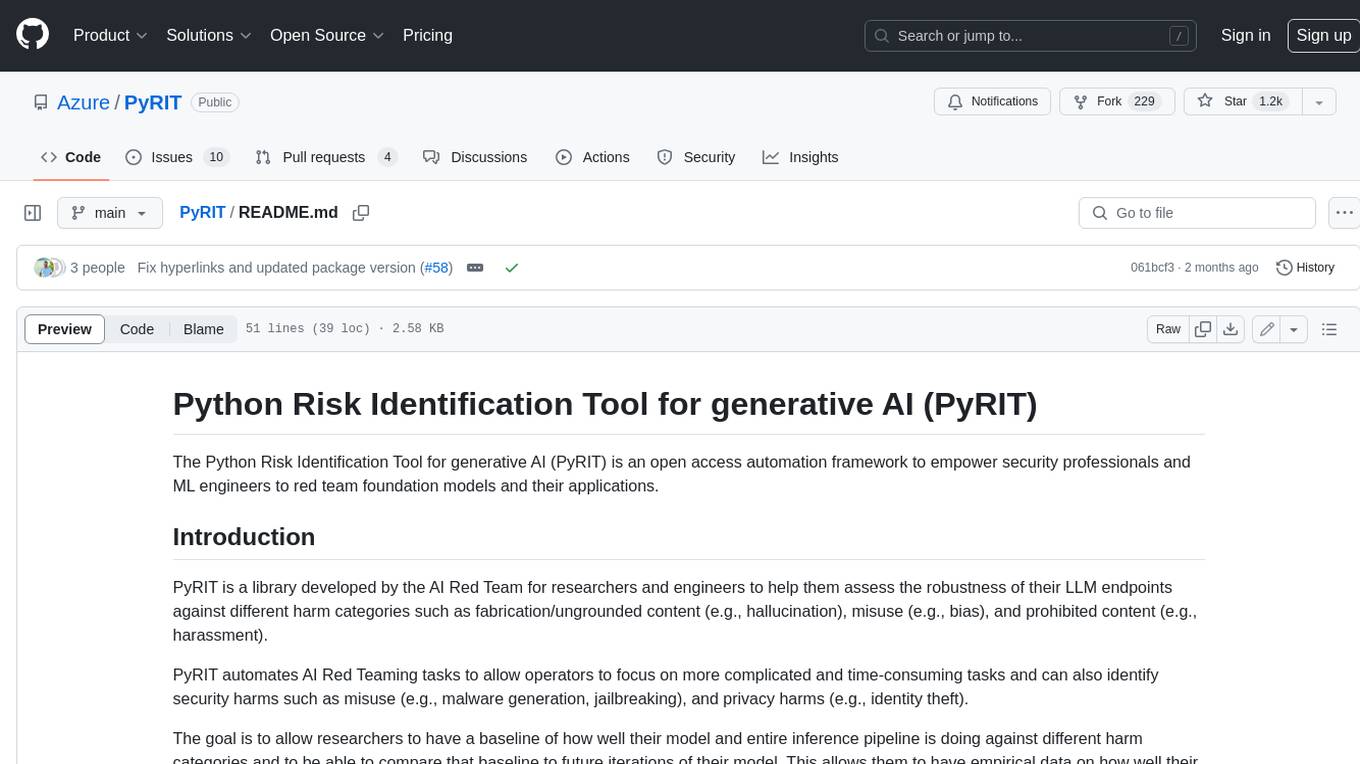
PyRIT is an open access automation framework designed to empower security professionals and ML engineers to red team foundation models and their applications. It automates AI Red Teaming tasks to allow operators to focus on more complicated and time-consuming tasks and can also identify security harms such as misuse (e.g., malware generation, jailbreaking), and privacy harms (e.g., identity theft). The goal is to allow researchers to have a baseline of how well their model and entire inference pipeline is doing against different harm categories and to be able to compare that baseline to future iterations of their model. This allows them to have empirical data on how well their model is doing today, and detect any degradation of performance based on future improvements.
zillionare
This repository contains a collection of articles and tutorials on quantitative finance, including topics such as machine learning, statistical arbitrage, and risk management. The articles are written in a clear and concise style, and they are suitable for both beginners and experienced practitioners. The repository also includes a number of Jupyter notebooks that demonstrate how to use Python for quantitative finance.
emerging-trajectories
Emerging Trajectories is an open source library for tracking and saving forecasts of political, economic, and social events. It provides a way to organize and store forecasts, as well as track their accuracy over time. This can be useful for researchers, analysts, and anyone else who wants to keep track of their predictions.
www-project-ai-security-and-privacy-guide
The OWASP AI Exchange and OWASP AI security and privacy guide are initiatives to collect and present the state of the art on AI threats, controls, security, and privacy through community collaboration. The AI Exchange is a living set of documents that collect AI threats and controls from collaboration between experts worldwide. The AI Security and Privacy Guide project has a security part that links directly to the AI Exchange, and a privacy part.
finagg
finagg is a Python package that provides implementations of popular and free financial APIs, tools for aggregating historical data from those APIs into SQL databases, and tools for transforming aggregated data into features useful for analysis and AI/ML. It offers documentation, installation instructions, and basic usage examples for exploring various financial APIs and features. Users can install recommended datasets from 3rd party APIs into a local SQL database, access Bureau of Economic Analysis (BEA) data, Federal Reserve Economic Data (FRED), Securities and Exchange Commission (SEC) filings, and more. The package also allows users to explore raw data features, install refined data features, and perform refined aggregations of raw data. Configuration options for API keys, user agents, and data locations are provided, along with information on dependencies and related projects.
jupyter-quant
Jupyter Quant is a dockerized environment tailored for quantitative research, equipped with essential tools like statsmodels, pymc, arch, py_vollib, zipline-reloaded, PyPortfolioOpt, numpy, pandas, sci-py, scikit-learn, yellowbricks, shap, optuna, ib_insync, Cython, Numba, bottleneck, numexpr, jedi language server, jupyterlab-lsp, black, isort, and more. It does not include conda/mamba and relies on pip for package installation. The image is optimized for size, includes common command line utilities, supports apt cache, and allows for the installation of additional packages. It is designed for ephemeral containers, ensuring data persistence, and offers volumes for data, configuration, and notebooks. Common tasks include setting up the server, managing configurations, setting passwords, listing installed packages, passing parameters to jupyter-lab, running commands in the container, building wheels outside the container, installing dotfiles and SSH keys, and creating SSH tunnels.