


maxun
✨ The open-source no-code platform for web scraping, crawling, search and AI data extraction • Turn websites into structured APIs in minutes ✨
Stars: 15134
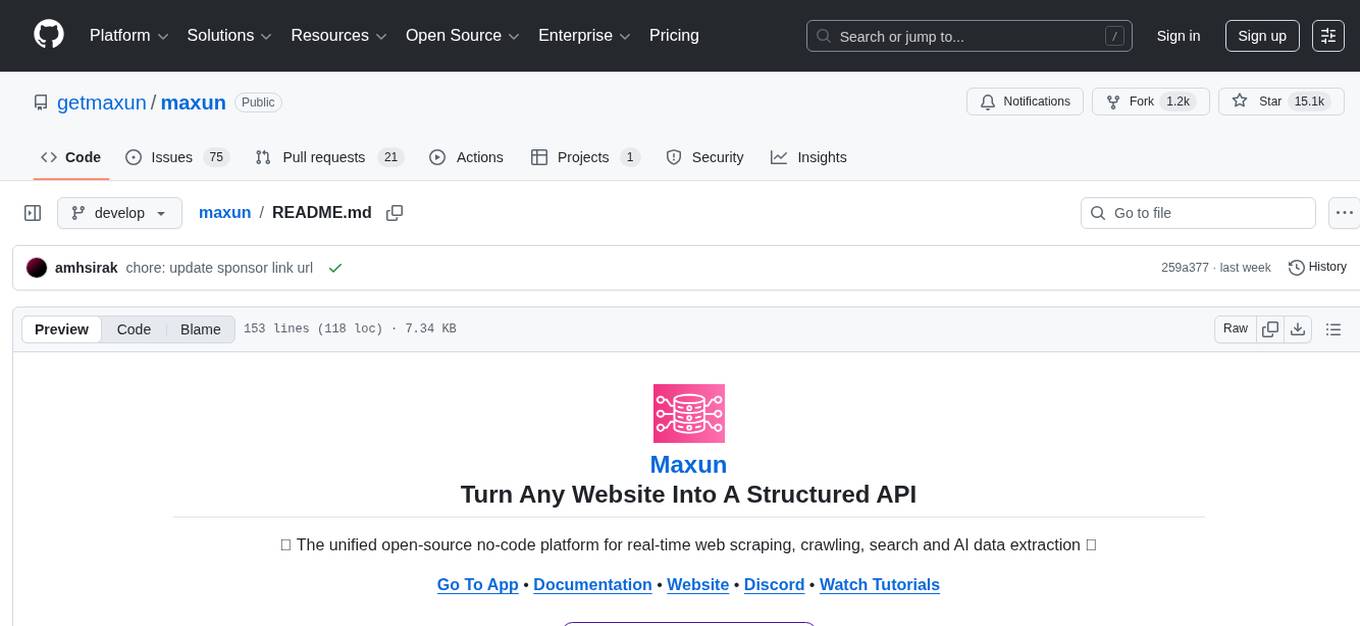
Maxun is an open-source no-code web data platform for turning the web into structured, reliable data. It supports extraction, crawling, scraping, and search — designed to scale from simple use cases to complex, automated workflows. Maxun robots are automated tools that help collect data from websites without writing any code. There are four types of robots, each designed for a different job. The platform offers a unified open-source no-code solution for real-time web scraping, crawling, search, and AI data extraction.
README:

✨ The unified open-source no-code platform for real-time web scraping, crawling, search and AI data extraction ✨
Go To App •
Documentation •
Website •
Discord •
Watch Tutorials
Maxun is an open-source no-code web data platform for turning the web into structured, reliable data. It supports extraction, crawling, scraping, and search — designed to scale from simple use cases to complex, automated workflows.
-
Extract – Emulate real user behavior and collect structured data from any website.
- Recorder Mode - Record your actions as you browse; Maxun turns them into a reusable extraction robot.
- AI Mode - Describe what you want in natural language and let LLM-powered extraction do the rest.
-
Scrape – Convert full webpages into clean Markdown or HTML and capture screenshots.
-
Crawl - Crawl entire websites and extract content from every relevant page, with full control over scope and discovery.
-
Search - Run automated web searches to discover or scrape results, with support for time-based filters.
-
SDK – A complete developer toolkit for scraping, extraction, scheduling, and end-to-end data automation.
Maxun robots are automated tools that help you collect data from websites without writing any code. Think of them as your personal web assistants that can navigate websites, extract information, and organize data just like you would manually - but faster and more efficiently.
There are four types of robots, each designed for a different job.
Extract emulates real user behavior and captures structured data.
- Recorder Mode - Record your actions as you browse; Maxun turns them into a reusable extraction robot.
https://github.com/user-attachments/assets/recorder-mode-demo-video
- AI Mode - Describe what you want in natural language and let LLM-powered extraction do the rest.
https://github.com/user-attachments/assets/f714e860-58d6-44ed-bbcd-c9374b629384
Learn more here.
Scrape converts full webpages into clean Markdown, HTML and can capture screenshots. Ideal for AI workflows, agents, and document processing.
Learn more here.
Crawl entire websites and extract content from every relevant page, with full control over scope and discovery.
Learn more here.
Run automated web searches to discover or scrape results, with support for time-based filters.
Learn more here.
The simplest & fastest way to get started is to use the hosted version: https://app.maxun.dev. You can self-host if you prefer!
Maxun can run locally with or without Docker
- Self Host Maxun With Docker & Portainer
- Upgrade Maxun With Docker Compose Setup
- Upgrade Maxun Without Docker Compose Setup
|
TestMu AI The Native AI-Agentic Cloud Platform to Supercharge Quality Engineering. Test Intelligently and Ship Faster. |
- ✨ Extract Data With No-Code – Point and click interface
- ✨ LLM-Powered Extraction – Describe what you want; use LLMs to scrape structured data
- ✨ Developer SDK – Programmatic extraction, scheduling, and robot management
- ✨ Handle Pagination & Scrolling – Automatic navigation
- ✨ Run Robots On Schedules – Set it and forget it
- ✨ Turn Websites to APIs – RESTful endpoints from any site
- ✨ Turn Websites to Spreadsheets – Direct data export to Google Sheets & Airtable
- ✨ Adapt To Website Layout Changes – Auto-recovery from site updates
- ✨ Extract Behind Login – Handle authentication seamlessly
- ✨ Integrations – Connect with your favorite tools
- ✨ MCP Support – Model Context Protocol integration
- ✨ LLM-Ready Data – Clean Markdown for AI applications
- ✨ Self-Hostable – Full control over your infrastructure
- ✨ Open Source – Transparent and community-driven
Maxun can be used for various use-cases, including lead generation, market research, content aggregation and more. View demos here: https://www.maxun.dev/usecases
This project is in early stages of development. Your feedback is very important for us - we're actively working on improvements.
This project is licensed under AGPLv3.
We believe in fair and responsible use of open source. If you rely on this project commercially, please consider contributing back or supporting its development.
Star the repository, contribute if you love what we’re building, or sponsor us.
Thank you to the combined efforts of everyone who contributes!
For Tasks:
Click tags to check more tools for each tasksFor Jobs:
Alternative AI tools for maxun
Similar Open Source Tools
maxun
Maxun is an open-source no-code web data platform for turning the web into structured, reliable data. It supports extraction, crawling, scraping, and search — designed to scale from simple use cases to complex, automated workflows. Maxun robots are automated tools that help collect data from websites without writing any code. There are four types of robots, each designed for a different job. The platform offers a unified open-source no-code solution for real-time web scraping, crawling, search, and AI data extraction.
rowboat
Rowboat is a tool that allows users to build AI agents instantly with natural language, connect tools with one-click integrations, power workflows with knowledge by adding documents for RAG, automate workflows by setting up triggers and actions, and deploy anywhere via API or SDK. Users can access a hosted version to start building agents right away. The tool provides features such as native RAG support, custom LLM providers, tools & triggers for automation, and API & SDK integration. Users can refer to the documentation to learn how to start building agents with Rowboat.
refact-vscode
Refact.ai is an open-source AI coding assistant that boosts developer's productivity. It supports 25+ programming languages and offers features like code completion, AI Toolbox for code explanation and refactoring, integrated in-IDE chat, and self-hosting or cloud version. The Enterprise plan provides enhanced customization, security, fine-tuning, user statistics, efficient inference, priority support, and access to 20+ LLMs for up to 50 engineers per GPU.
DevoxxGenieIDEAPlugin
Devoxx Genie is a Java-based IntelliJ IDEA plugin that integrates with local and cloud-based LLM providers to aid in reviewing, testing, and explaining project code. It supports features like code highlighting, chat conversations, and adding files/code snippets to context. Users can modify REST endpoints and LLM parameters in settings, including support for cloud-based LLMs. The plugin requires IntelliJ version 2023.3.4 and JDK 17. Building and publishing the plugin is done using Gradle tasks. Users can select an LLM provider, choose code, and use commands like review, explain, or generate unit tests for code analysis.
rocketnotes
Rocketnotes is a web-based Markdown note taking app with LLM-powered text completion, chat and semantic search. It utilizes a 100% serverless RAG pipeline build with langchain, sentence-transformers, faiss and OpenAI or Anthropic API.
refact
This repository contains Refact WebUI for fine-tuning and self-hosting of code models, which can be used inside Refact plugins for code completion and chat. Users can fine-tune open-source code models, self-host them, download and upload Lloras, use models for code completion and chat inside Refact plugins, shard models, host multiple small models on one GPU, and connect GPT-models for chat using OpenAI and Anthropic keys. The repository provides a Docker container for running the self-hosted server and supports various models for completion, chat, and fine-tuning. Refact is free for individuals and small teams under the BSD-3-Clause license, with custom installation options available for GPU support. The community and support include contributing guidelines, GitHub issues for bugs, a community forum, Discord for chatting, and Twitter for product news and updates.
weam
Weam is an open source platform designed to help teams systematically adopt AI. It provides a production-ready stack with Next.js frontend and Node.js/Python backend, allowing for immediate deployment and use. Weam connects to major LLM providers, enabling easy access to the latest AI models. The platform organizes AI interactions into 'Brains' for different departments, offering customization and expansion options. Features include chat system, productivity tools, sharing & access controls, prompt library, AI agents, RAG, MCP, enterprise features, pre-built automations, and upcoming AI app solutions. Weam is free, open source, and scalable to meet growing needs.
zenml
ZenML is an extensible, open-source MLOps framework for creating portable, production-ready machine learning pipelines. By decoupling infrastructure from code, ZenML enables developers across your organization to collaborate more effectively as they develop to production.
kollektiv
Kollektiv is a Retrieval-Augmented Generation (RAG) system designed to enable users to chat with their favorite documentation easily. It aims to provide LLMs with access to the most up-to-date knowledge, reducing inaccuracies and improving productivity. The system utilizes intelligent web crawling, advanced document processing, vector search, multi-query expansion, smart re-ranking, AI-powered responses, and dynamic system prompts. The technical stack includes Python/FastAPI for backend, Supabase, ChromaDB, and Redis for storage, OpenAI and Anthropic Claude 3.5 Sonnet for AI/ML, and Chainlit for UI. Kollektiv is licensed under a modified version of the Apache License 2.0, allowing free use for non-commercial purposes.
nexent
Nexent is a powerful tool for analyzing and visualizing network traffic data. It provides comprehensive insights into network behavior, helping users to identify patterns, anomalies, and potential security threats. With its user-friendly interface and advanced features, Nexent is suitable for network administrators, cybersecurity professionals, and anyone looking to gain a deeper understanding of their network infrastructure.
tuff
Tuff is a local-first, AI-native, and infinitely extensible desktop command center designed to enhance workflow efficiency. It offers a seamless integration of core utilities, AI-powered search, contextual intelligence, and extensibility through custom plugins. With a beautiful UI design, rich functionality, simple operations, and a focus on security and reliability, Tuff provides users with a cross-platform desktop software that is easy to use and offers a good user experience.
obsidian-llmsider
LLMSider is an AI assistant plugin for Obsidian that offers flexible multi-model support, deep workflow integration, privacy-first design, and a professional tool ecosystem. It provides comprehensive AI capabilities for personal knowledge management, from intelligent writing assistance to complex task automation, making AI a capable assistant for thinking and creating while ensuring data privacy.
gptme
Personal AI assistant/agent in your terminal, with tools for using the terminal, running code, editing files, browsing the web, using vision, and more. A great coding agent that is general-purpose to assist in all kinds of knowledge work, from a simple but powerful CLI. An unconstrained local alternative to ChatGPT with 'Code Interpreter', Cursor Agent, etc. Not limited by lack of software, internet access, timeouts, or privacy concerns if using local models.
plandex
Plandex is an open source, terminal-based AI coding engine designed for complex tasks. It uses long-running agents to break up large tasks into smaller subtasks, helping users work through backlogs, navigate unfamiliar technologies, and save time on repetitive tasks. Plandex supports various AI models, including OpenAI, Anthropic Claude, Google Gemini, and more. It allows users to manage context efficiently in the terminal, experiment with different approaches using branches, and review changes before applying them. The tool is platform-independent and runs from a single binary with no dependencies.
actionbook
Actionbook is a browser action engine designed for AI agents, providing up-to-date action manuals and DOM structure to enable instant website operations without guesswork. It offers faster execution, token savings, resilient automation, and universal compatibility, making it ideal for building reliable browser agents. Actionbook integrates seamlessly with AI coding assistants and offers three integration methods: CLI, MCP Server, and JavaScript SDK. The tool is well-documented and actively developed in a monorepo setup using pnpm workspaces and Turborepo.
neptune-client
Neptune is a scalable experiment tracker for teams training foundation models. Log millions of runs, effortlessly monitor and visualize model training, and deploy on your infrastructure. Track 100% of metadata to accelerate AI breakthroughs. Log and display any framework and metadata type from any ML pipeline. Organize experiments with nested structures and custom dashboards. Compare results, visualize training, and optimize models quicker. Version models, review stages, and access production-ready models. Share results, manage users, and projects. Integrate with 25+ frameworks. Trusted by great companies to improve workflow.
For similar tasks
genaiscript
GenAIScript is a scripting environment designed to facilitate file ingestion, prompt development, and structured data extraction. Users can define metadata and model configurations, specify data sources, and define tasks to extract specific information. The tool provides a convenient way to analyze files and extract desired content in a structured format. It offers a user-friendly interface for working with data and automating data extraction processes, making it suitable for various data processing tasks.
AutoNode
AutoNode is a self-operating computer system designed to automate web interactions and data extraction processes. It leverages advanced technologies like OCR (Optical Character Recognition), YOLO (You Only Look Once) models for object detection, and a custom site-graph to navigate and interact with web pages programmatically. Users can define objectives, create site-graphs, and utilize AutoNode via API to automate tasks on websites. The tool also supports training custom YOLO models for object detection and OCR for text recognition on web pages. AutoNode can be used for tasks such as extracting product details, automating web interactions, and more.
oxylabs-mcp
The Oxylabs MCP Server acts as a bridge between AI models and the web, providing clean, structured data from any site. It enables scraping of URLs, rendering JavaScript-heavy pages, content extraction for AI use, bypassing anti-scraping measures, and accessing geo-restricted web data from 195+ countries. The implementation utilizes the Model Context Protocol (MCP) to facilitate secure interactions between AI assistants and web content. Key features include scraping content from any site, automatic data cleaning and conversion, bypassing blocks and geo-restrictions, flexible setup with cross-platform support, and built-in error handling and request management.
maxun
Maxun is an open-source no-code web data platform for turning the web into structured, reliable data. It supports extraction, crawling, scraping, and search — designed to scale from simple use cases to complex, automated workflows. Maxun robots are automated tools that help collect data from websites without writing any code. There are four types of robots, each designed for a different job. The platform offers a unified open-source no-code solution for real-time web scraping, crawling, search, and AI data extraction.
crawl4ai
Crawl4AI is a powerful and free web crawling service that extracts valuable data from websites and provides LLM-friendly output formats. It supports crawling multiple URLs simultaneously, replaces media tags with ALT, and is completely free to use and open-source. Users can integrate Crawl4AI into Python projects as a library or run it as a standalone local server. The tool allows users to crawl and extract data from specified URLs using different providers and models, with options to include raw HTML content, force fresh crawls, and extract meaningful text blocks. Configuration settings can be adjusted in the `crawler/config.py` file to customize providers, API keys, chunk processing, and word thresholds. Contributions to Crawl4AI are welcome from the open-source community to enhance its value for AI enthusiasts and developers.
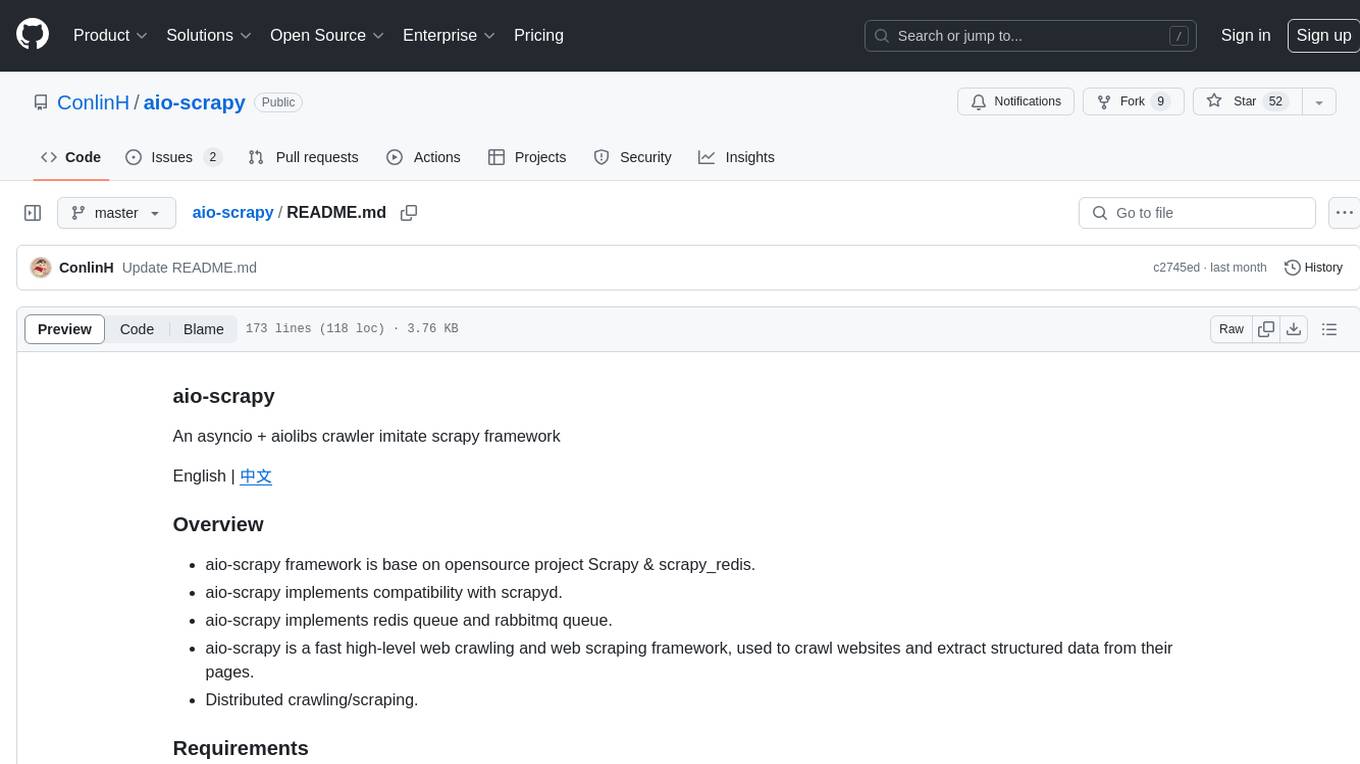
aio-scrapy
Aio-scrapy is an asyncio-based web crawling and web scraping framework inspired by Scrapy. It supports distributed crawling/scraping, implements compatibility with scrapyd, and provides options for using redis queue and rabbitmq queue. The framework is designed for fast extraction of structured data from websites. Aio-scrapy requires Python 3.9+ and is compatible with Linux, Windows, macOS, and BSD systems.
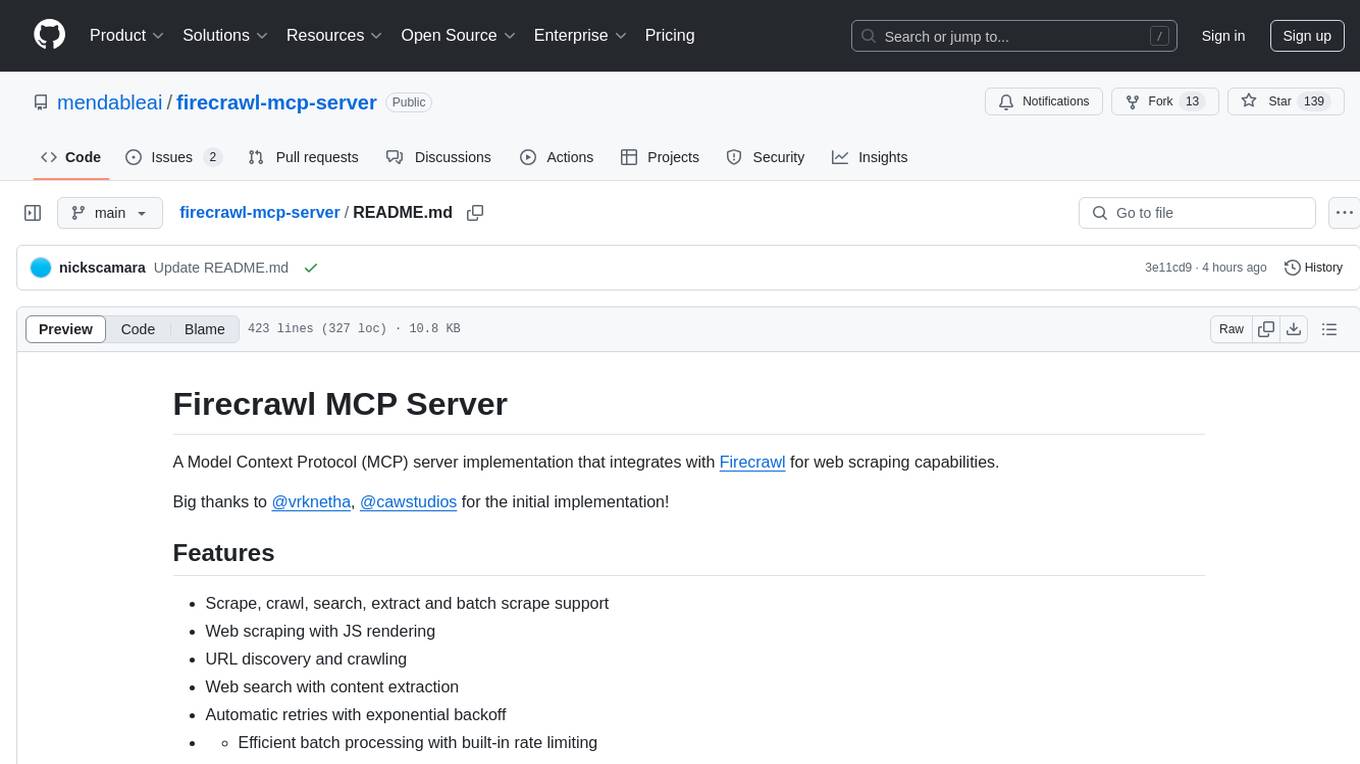
firecrawl-mcp-server
Firecrawl MCP Server is a Model Context Protocol (MCP) server implementation that integrates with Firecrawl for web scraping capabilities. It supports features like scrape, crawl, search, extract, and batch scrape. It provides web scraping with JS rendering, URL discovery, web search with content extraction, automatic retries with exponential backoff, credit usage monitoring, comprehensive logging system, support for cloud and self-hosted FireCrawl instances, mobile/desktop viewport support, and smart content filtering with tag inclusion/exclusion. The server includes configurable parameters for retry behavior and credit usage monitoring, rate limiting and batch processing capabilities, and tools for scraping, batch scraping, checking batch status, searching, crawling, and extracting structured information from web pages.
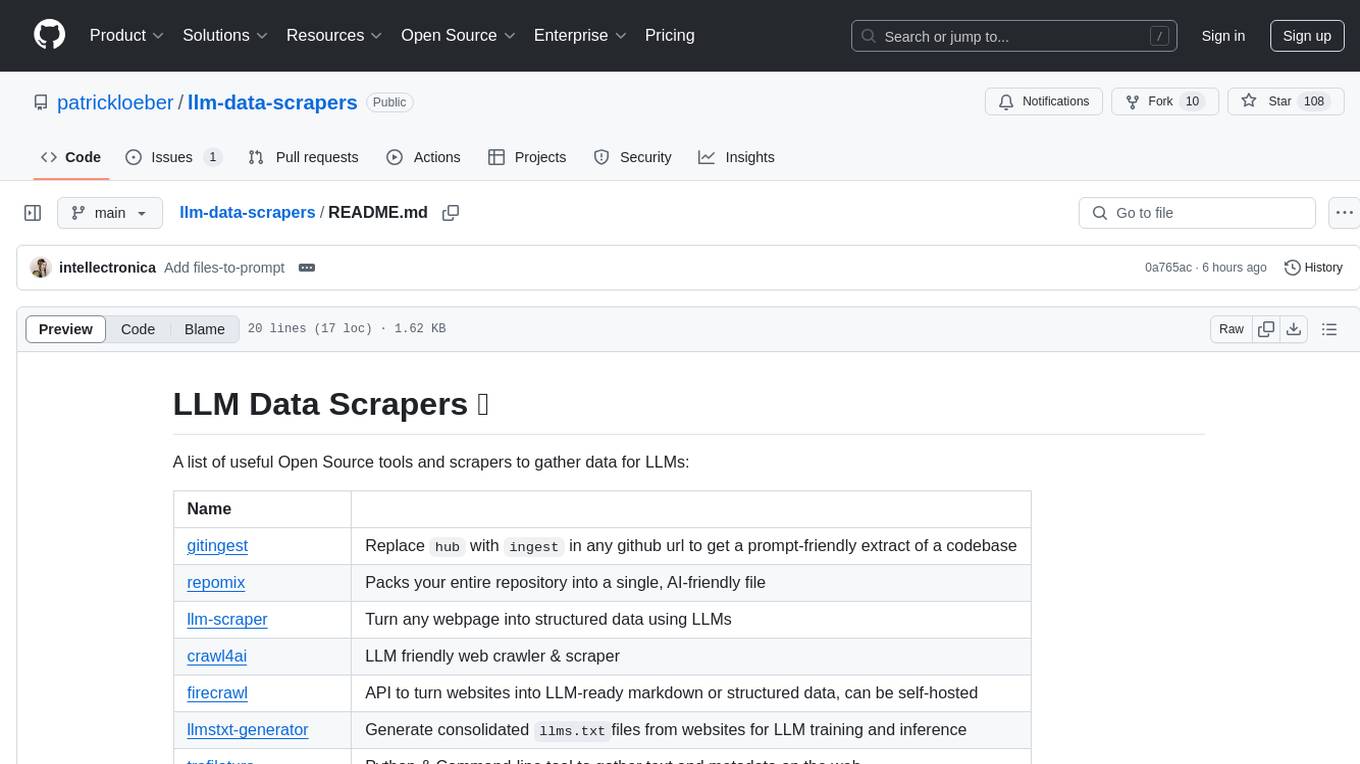
llm-data-scrapers
LLM Data Scrapers is a collection of open source tools and scrapers designed to gather data for Large Language Models (LLMs). The repository includes various tools such as gitingest for extracting codebases, repomix for packing repositories into AI-friendly files, llm-scraper for converting webpages into structured data, crawl4ai for web crawling, and firecrawl for turning websites into LLM-ready markdown or structured data. Additionally, the repository offers tools like llmstxt-generator for generating training data, trafilatura for gathering web text and metadata, RepoToTextForLLMs for fetching repo content, marker for converting PDFs, reader for converting URLs to LLM-friendly inputs, and files-to-prompt for concatenating files into prompts for LLMs.
For similar jobs
sweep
Sweep is an AI junior developer that turns bugs and feature requests into code changes. It automatically handles developer experience improvements like adding type hints and improving test coverage.
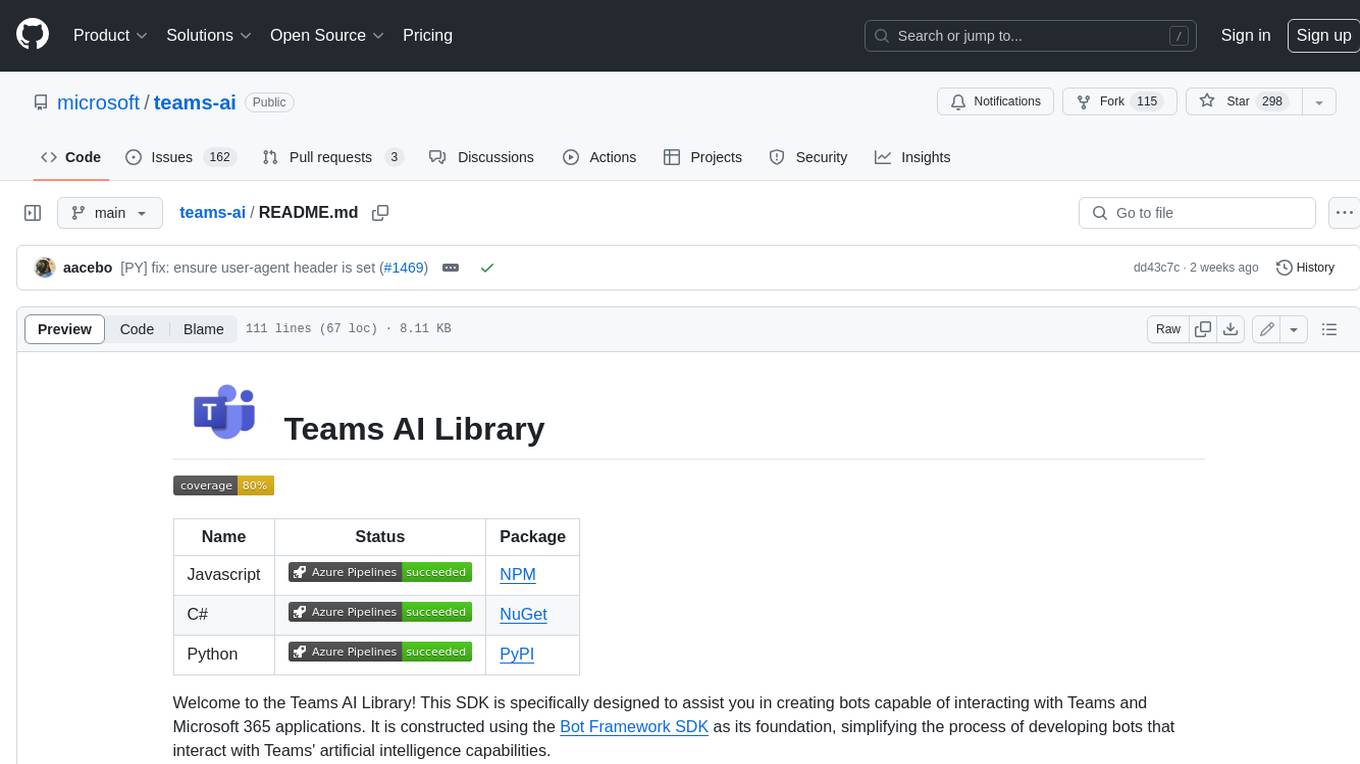
teams-ai
The Teams AI Library is a software development kit (SDK) that helps developers create bots that can interact with Teams and Microsoft 365 applications. It is built on top of the Bot Framework SDK and simplifies the process of developing bots that interact with Teams' artificial intelligence capabilities. The SDK is available for JavaScript/TypeScript, .NET, and Python.
ai-guide
This guide is dedicated to Large Language Models (LLMs) that you can run on your home computer. It assumes your PC is a lower-end, non-gaming setup.
classifai
Supercharge WordPress Content Workflows and Engagement with Artificial Intelligence. Tap into leading cloud-based services like OpenAI, Microsoft Azure AI, Google Gemini and IBM Watson to augment your WordPress-powered websites. Publish content faster while improving SEO performance and increasing audience engagement. ClassifAI integrates Artificial Intelligence and Machine Learning technologies to lighten your workload and eliminate tedious tasks, giving you more time to create original content that matters.
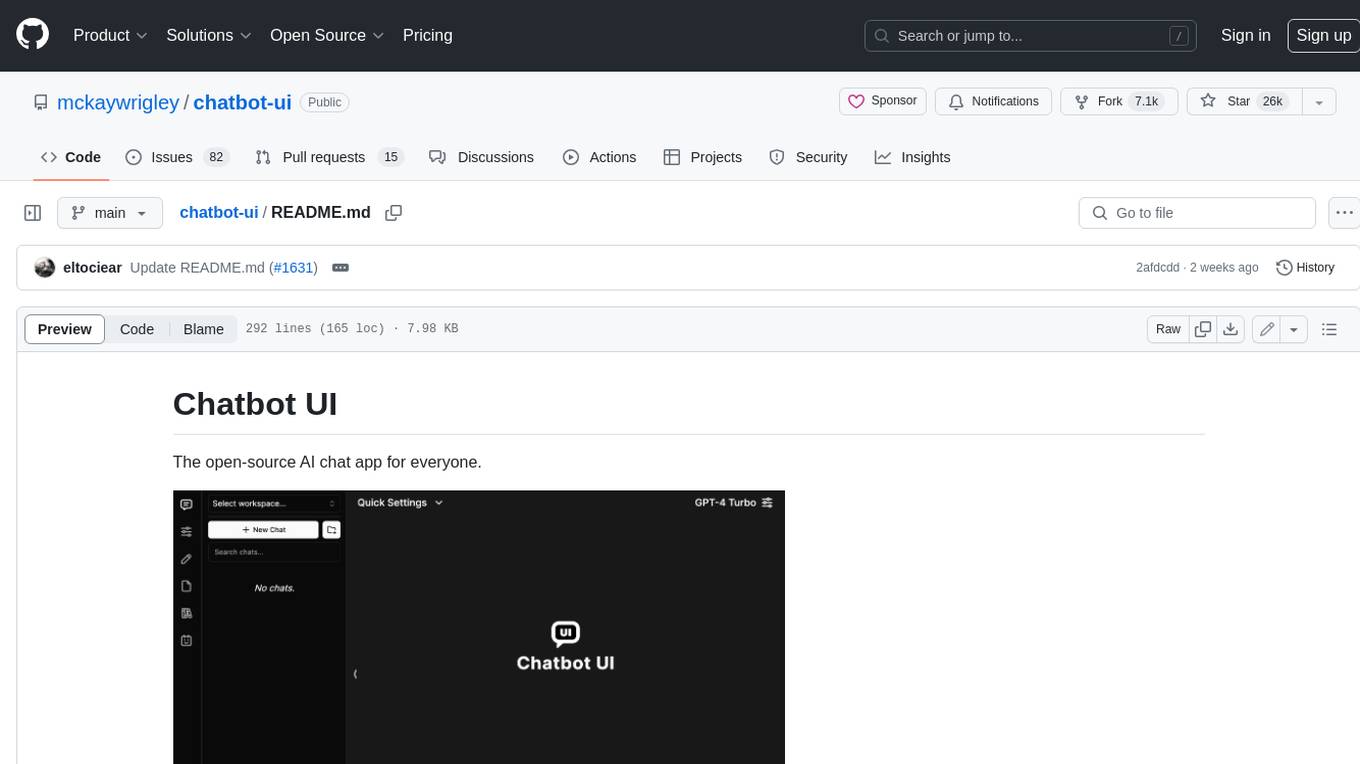
chatbot-ui
Chatbot UI is an open-source AI chat app that allows users to create and deploy their own AI chatbots. It is easy to use and can be customized to fit any need. Chatbot UI is perfect for businesses, developers, and anyone who wants to create a chatbot.
BricksLLM
BricksLLM is a cloud native AI gateway written in Go. Currently, it provides native support for OpenAI, Anthropic, Azure OpenAI and vLLM. BricksLLM aims to provide enterprise level infrastructure that can power any LLM production use cases. Here are some use cases for BricksLLM: * Set LLM usage limits for users on different pricing tiers * Track LLM usage on a per user and per organization basis * Block or redact requests containing PIIs * Improve LLM reliability with failovers, retries and caching * Distribute API keys with rate limits and cost limits for internal development/production use cases * Distribute API keys with rate limits and cost limits for students
uAgents
uAgents is a Python library developed by Fetch.ai that allows for the creation of autonomous AI agents. These agents can perform various tasks on a schedule or take action on various events. uAgents are easy to create and manage, and they are connected to a fast-growing network of other uAgents. They are also secure, with cryptographically secured messages and wallets.
griptape
Griptape is a modular Python framework for building AI-powered applications that securely connect to your enterprise data and APIs. It offers developers the ability to maintain control and flexibility at every step. Griptape's core components include Structures (Agents, Pipelines, and Workflows), Tasks, Tools, Memory (Conversation Memory, Task Memory, and Meta Memory), Drivers (Prompt and Embedding Drivers, Vector Store Drivers, Image Generation Drivers, Image Query Drivers, SQL Drivers, Web Scraper Drivers, and Conversation Memory Drivers), Engines (Query Engines, Extraction Engines, Summary Engines, Image Generation Engines, and Image Query Engines), and additional components (Rulesets, Loaders, Artifacts, Chunkers, and Tokenizers). Griptape enables developers to create AI-powered applications with ease and efficiency.