


nexent
Nexent is a zero-code platform for auto-generating agents — no orchestration, no complex drag-and-drop required. Nexent also offers powerful capabilities for agent running control, data processing and MCP tools.
Stars: 4119
Nexent is a powerful tool for analyzing and visualizing network traffic data. It provides comprehensive insights into network behavior, helping users to identify patterns, anomalies, and potential security threats. With its user-friendly interface and advanced features, Nexent is suitable for network administrators, cybersecurity professionals, and anyone looking to gain a deeper understanding of their network infrastructure.
README:







Nexent is a zero-code platform for auto-generating agents — no orchestration, no complex drag-and-drop required, using pure language to develop any agent you want. Built on the MCP ecosystem with rich tool integration, Nexent also provides various built-in agents to meet your intelligent service needs in different scenarios such as work, travel, and daily life. Nexent offers powerful capabilities for agent running control, multi-agent collaboration, data processing and knowledge tracing, multimodal dialogue, and batch scaling.
One prompt. Endless reach.
🌐 Visit our official website

https://github.com/user-attachments/assets/db6b7f5a-9ee8-4327-ae6f-c5af896126b4
| Resource | Minimum |
|---|---|
| CPU | 2 cores |
| RAM | 6 GiB |
| Software | Docker & Docker Compose installed |
git clone https://github.com/ModelEngine-Group/nexent.git
cd nexent/docker
cp .env.example .env # fill only necessary configs
bash deploy.sh
When the containers are running, open http://localhost:3000 in your browser and follow the setup wizard.
If you want to go fast, go alone; if you want to go far, go together.
We have released Nexent v1, and the platform is now relatively stable. However, there may still be some bugs, and we are continuously improving and adding new features. Stay tuned: we will announce v2.0 soon!
- 🗺️ Check our Feature Map to explore current and upcoming features.
- 🔍 Try the current build and leave ideas or bugs in the Issues tab.
- 🐛 Check our Known Issues page for the latest issue status and solutions.
Rome wasn't built in a day.
If our vision speaks to you, jump in via the Contribution Guide and shape Nexent with us.
Early contributors won't go unnoticed: from special badges and swag to other tangible rewards, we're committed to thanking the pioneers who help bring Nexent to life.
Most of all, we need visibility. Star ⭐ and watch the repo, share it with friends, and help more developers discover Nexent — your click brings new hands to the project and keeps the momentum growing.
- Browse the Documentation for more information.
- Join our Discord community to chat with other developers and get help!
- Conntact us by Wechat, find our QR Code in our website
1 Smart agent prompt generation
Turn plain language into runnable prompts. Nexent automatically chooses the right tools and plans the best action path for every request.

2 Scalable data process engine
Process 20+ data formats with fast OCR and table structure extraction, scaling smoothly from a single process to large-batch pipelines.

3 Personal-grade knowledge base
Import files in real time, auto-summarise them, and let agents access both personal and global knowledge instantly, also knowing what it can get from each knowledge base.

4 Internet knowledge search
Connect to 5+ web search providers so agents can mix fresh internet facts with your private data.

5 Knowledge-level traceability
Serve answers with precise citations from web and knowledge-base sources, making every fact verifiable.

6 Multimodal understanding & dialogue
Speak, type, files, or show images. Nexent understands voice, text, and pictures, and can even generate new images on demand.

7 MCP tool ecosystem
Drop in or build Python plug-ins that follow the MCP spec; swap models, tools, and chains without touching core code.

Check our MCP Ecosystem page for detailed information about the MCP tool ecosystem, including community hubs, recommended tools, and integration guides.
Check our Model Providers page for detailed model configuration guides and recommended provider information.
Want to build from source or add new features? Check the Contribution Guide for step-by-step instructions.
Prefer to run Nexent from source code? Follow our Developer Guide for detailed setup instructions and customization options.
Nexent is licensed under the MIT with additional conditions. Please read the LICENSE file for details.
For Tasks:
Click tags to check more tools for each tasksFor Jobs:
Alternative AI tools for nexent
Similar Open Source Tools
nexent
Nexent is a powerful tool for analyzing and visualizing network traffic data. It provides comprehensive insights into network behavior, helping users to identify patterns, anomalies, and potential security threats. With its user-friendly interface and advanced features, Nexent is suitable for network administrators, cybersecurity professionals, and anyone looking to gain a deeper understanding of their network infrastructure.

langwatch
LangWatch is a monitoring and analytics platform designed to track, visualize, and analyze interactions with Large Language Models (LLMs). It offers real-time telemetry to optimize LLM cost and latency, a user-friendly interface for deep insights into LLM behavior, user analytics for engagement metrics, detailed debugging capabilities, and guardrails to monitor LLM outputs for issues like PII leaks and toxic language. The platform supports OpenAI and LangChain integrations, simplifying the process of tracing LLM calls and generating API keys for usage. LangWatch also provides documentation for easy integration and self-hosting options for interested users.
meilisearch
Meilisearch is a lightning-fast search engine that seamlessly integrates into apps, websites, and workflows. It offers features like hybrid search, search-as-you-type, typo tolerance, filtering, sorting, synonym support, geosearch, extensive language support, security management, multi-tenancy, RESTful API, AI-readiness, easy installation, deployment, and maintenance.
countly-server
Countly is a privacy-first, AI-ready analytics and customer engagement platform built for organizations that require full data ownership and deployment flexibility. It can be deployed on-premises or in a private cloud, giving complete control over data, infrastructure, compliance, and security. Teams use Countly to understand user behavior across mobile, web, desktop, and connected devices, optimize product and customer experiences in real time, and automate and personalize customer engagement across channels. With flexible data tracking, customizable dashboards, and a modular plugin-based architecture, Countly scales with the product while ensuring long-term autonomy and zero vendor lock-in. Built for privacy, designed for flexibility, and ready for AI-driven innovation.
codegate
CodeGate is a local gateway that enhances the safety of AI coding assistants by ensuring AI-generated recommendations adhere to best practices, safeguarding code integrity, and protecting individual privacy. Developed by Stacklok, CodeGate allows users to confidently leverage AI in their development workflow without compromising security or productivity. It works seamlessly with coding assistants, providing real-time security analysis of AI suggestions. CodeGate is designed with privacy at its core, keeping all data on the user's machine and offering complete control over data.
beeai
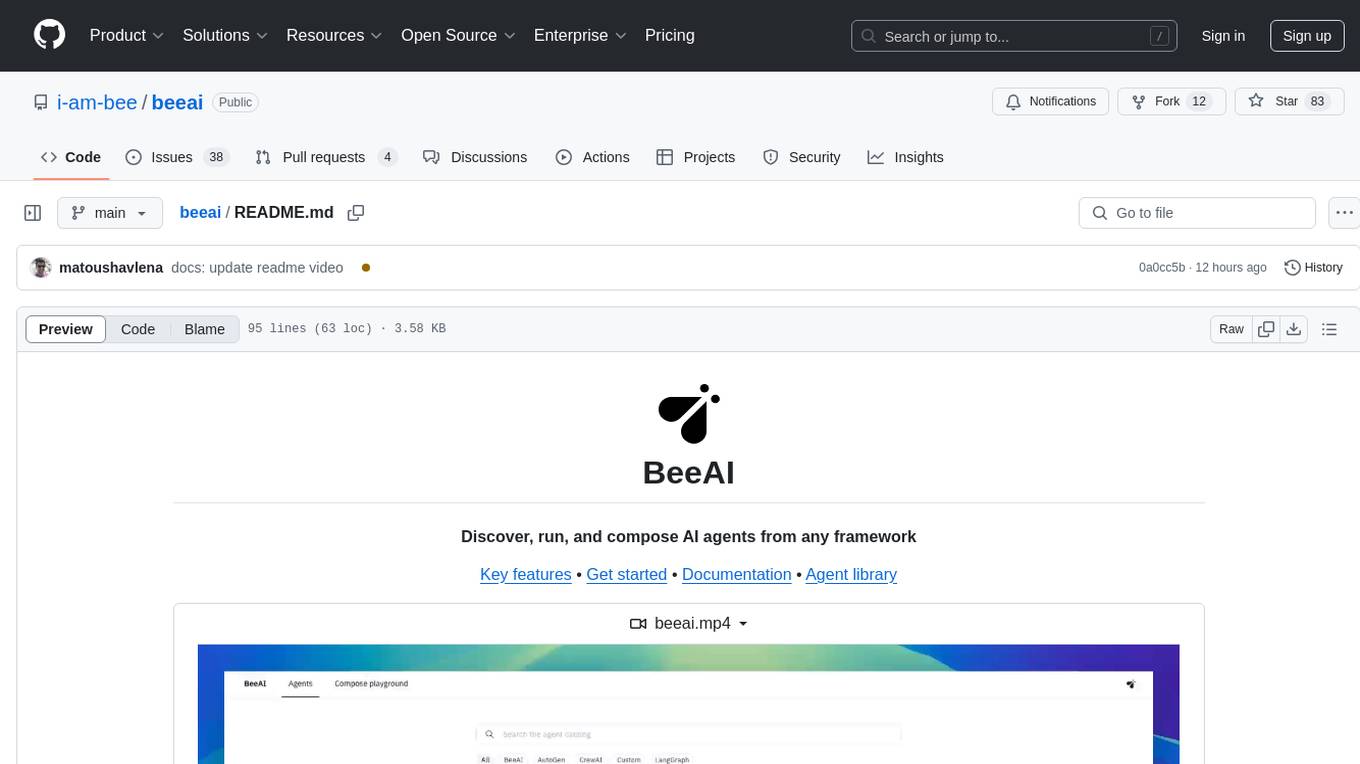
BeeAI is an open platform that helps users discover, run, and compose AI agents from any framework and language. It offers a framework-agnostic approach, allowing seamless integration of AI agents regardless of the language or platform. Users can build complex workflows using simple building blocks, explore a catalog of powerful agents with integrated search, and benefit from the BeeAI ecosystem with first-class support for Python and TypeScript agent developers.
refact
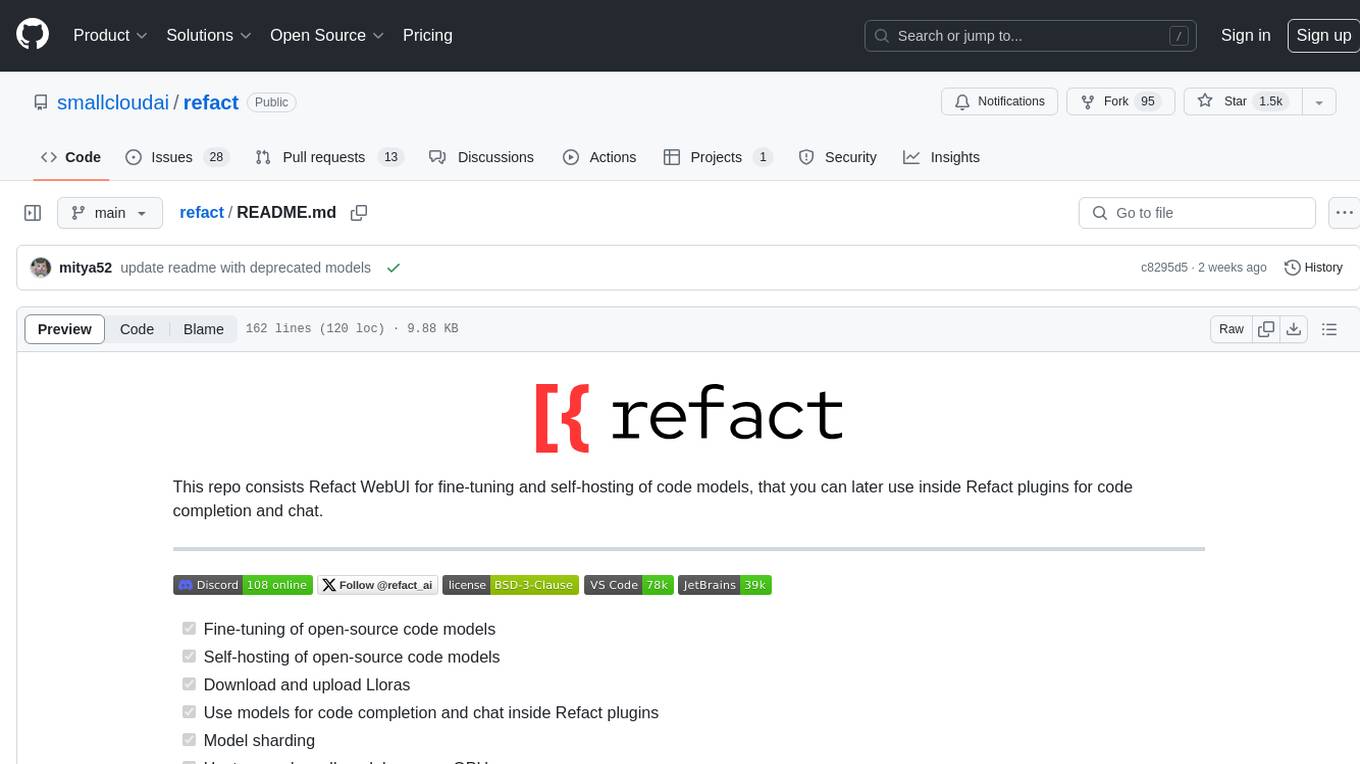
This repository contains Refact WebUI for fine-tuning and self-hosting of code models, which can be used inside Refact plugins for code completion and chat. Users can fine-tune open-source code models, self-host them, download and upload Lloras, use models for code completion and chat inside Refact plugins, shard models, host multiple small models on one GPU, and connect GPT-models for chat using OpenAI and Anthropic keys. The repository provides a Docker container for running the self-hosted server and supports various models for completion, chat, and fine-tuning. Refact is free for individuals and small teams under the BSD-3-Clause license, with custom installation options available for GPU support. The community and support include contributing guidelines, GitHub issues for bugs, a community forum, Discord for chatting, and Twitter for product news and updates.
weam
Weam is an open source platform designed to help teams systematically adopt AI. It provides a production-ready stack with Next.js frontend and Node.js/Python backend, allowing for immediate deployment and use. Weam connects to major LLM providers, enabling easy access to the latest AI models. The platform organizes AI interactions into 'Brains' for different departments, offering customization and expansion options. Features include chat system, productivity tools, sharing & access controls, prompt library, AI agents, RAG, MCP, enterprise features, pre-built automations, and upcoming AI app solutions. Weam is free, open source, and scalable to meet growing needs.
enterprise-commerce
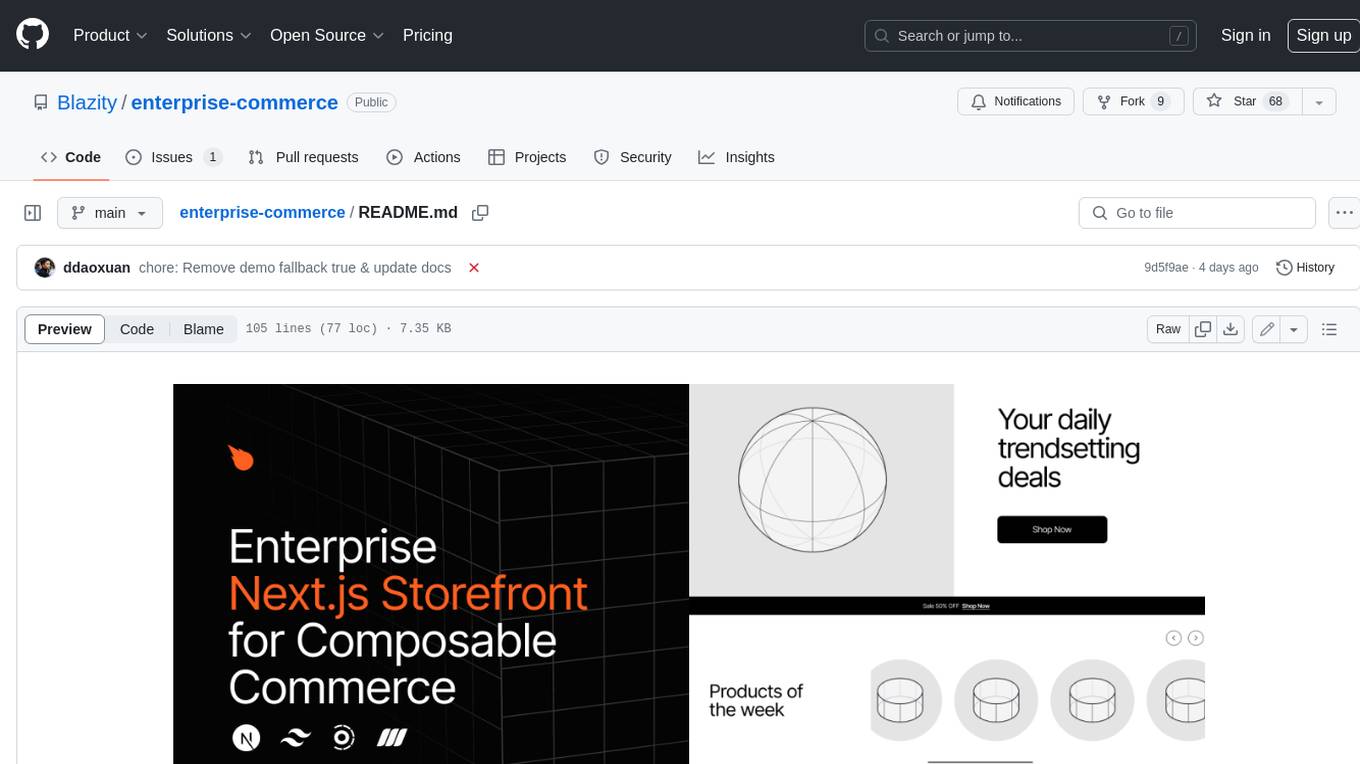
Enterprise Commerce is a Next.js commerce starter that helps you launch your high-performance Shopify storefront in minutes, not weeks. It leverages the power of Vector Search and AI to deliver a superior online shopping experience without the development headaches.
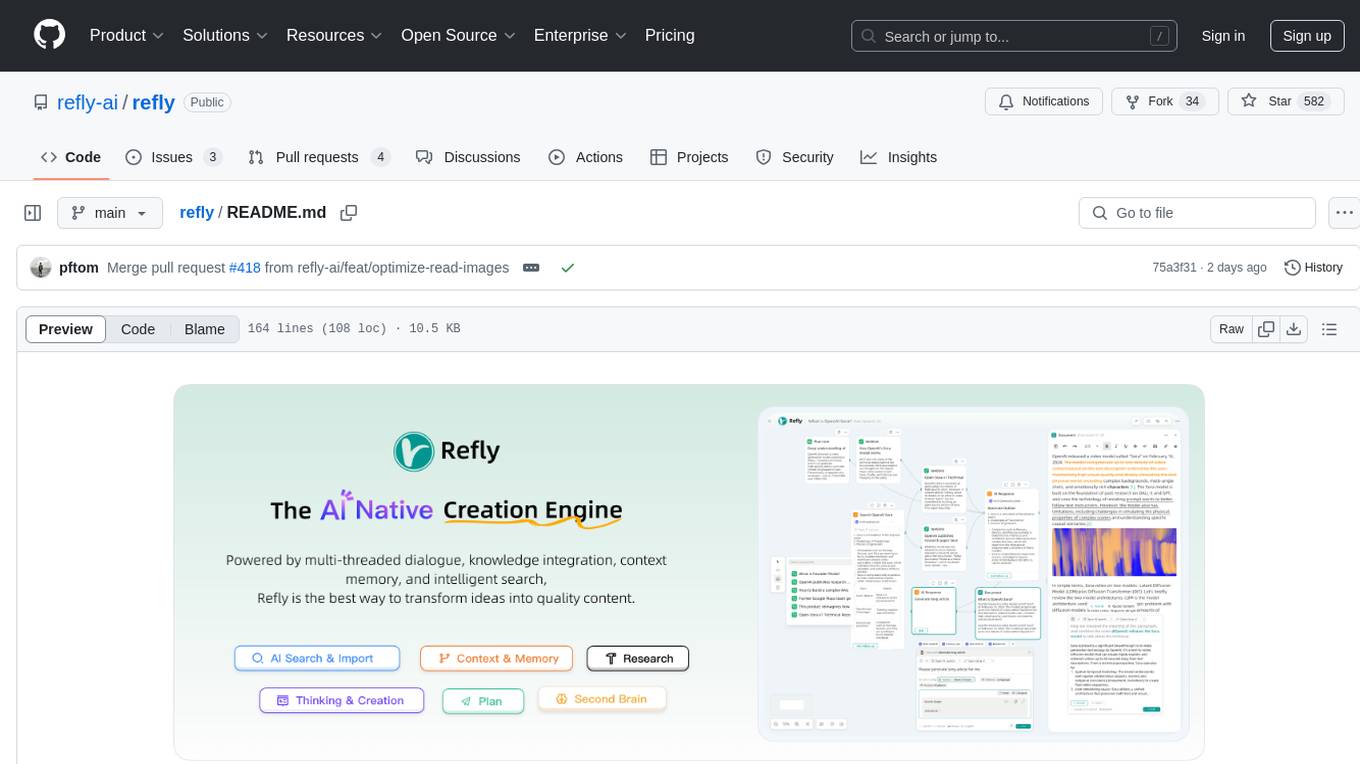
refly
Refly.AI is an open-source AI-native creation engine that empowers users to transform ideas into production-ready content. It features a free-form canvas interface with multi-threaded conversations, knowledge base integration, contextual memory, intelligent search, WYSIWYG AI editor, and more. Users can leverage AI-powered capabilities, context memory, knowledge base integration, quotes, and AI document editing to enhance their content creation process. Refly offers both cloud and self-hosting options, making it suitable for individuals, enterprises, and organizations. The tool is designed to facilitate human-AI collaboration and streamline content creation workflows.
beeai-platform
BeeAI is an open-source platform that simplifies the discovery, running, and sharing of AI agents across different frameworks. It addresses challenges such as framework fragmentation, deployment complexity, and discovery issues by providing a standardized platform for individuals and teams to access agents easily. With features like a centralized agent catalog, framework-agnostic interfaces, containerized agents, and consistent user experiences, BeeAI aims to streamline the process of working with AI agents for both developers and teams.
kitops
KitOps is a CNCF open standards project for packaging, versioning, and securely sharing AI/ML projects. It provides a unified solution for packaging, versioning, and managing assets in security-conscious enterprises, governments, and cloud operators. KitOps elevates AI artifacts to first-class, governed assets through ModelKits, which are tamper-proof, signable, and compatible with major container registries. The tool simplifies collaboration between data scientists, developers, and SREs, ensuring reliable and repeatable workflows for both development and operations. KitOps supports packaging for various types of models, including large language models, computer vision models, multi-modal models, predictive models, and audio models. It also facilitates compliance with the EU AI Act by offering tamper-proof, signable, and auditable ModelKits.
zero-true
Zero-True is a Python and SQL reactive computational notebook designed for building and collaborating on data-driven applications. It offers an integrated and simple environment with transparent updates, dynamic and interactive UI rendering, fast prototyping capabilities, and open-source community contributions. Users can create rich, reactive apps with ease and publish them confidently. Zero-True aims to improve data accessibility and foster collaboration among users.
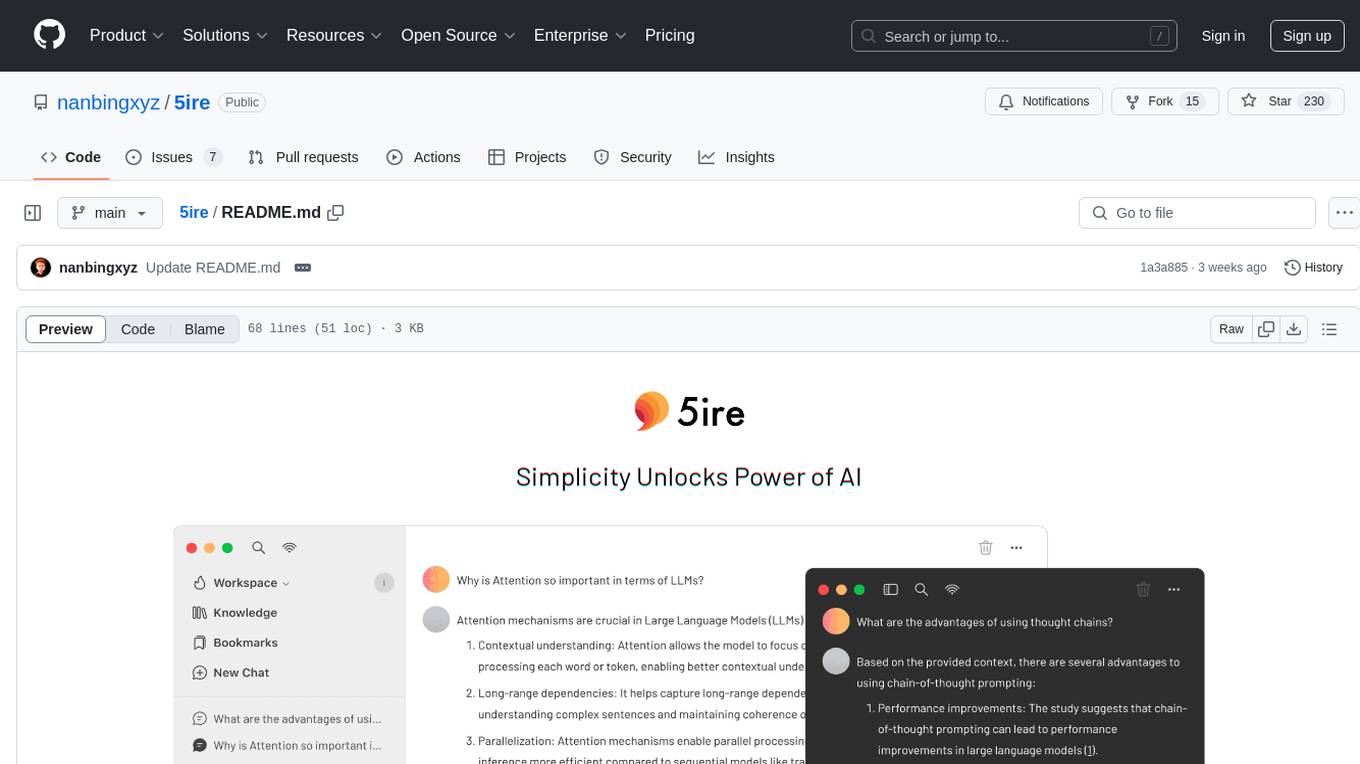
5ire
5ire is a cross-platform desktop client that integrates a local knowledge base for multilingual vectorization, supports parsing and vectorization of various document formats, offers usage analytics to track API spending, provides a prompts library for creating and organizing prompts with variable support, allows bookmarking of conversations, and enables quick keyword searches across conversations. It is licensed under the GNU General Public License version 3.
rowboat
Rowboat is a tool that allows users to build AI agents instantly with natural language, connect tools with one-click integrations, power workflows with knowledge by adding documents for RAG, automate workflows by setting up triggers and actions, and deploy anywhere via API or SDK. Users can access a hosted version to start building agents right away. The tool provides features such as native RAG support, custom LLM providers, tools & triggers for automation, and API & SDK integration. Users can refer to the documentation to learn how to start building agents with Rowboat.
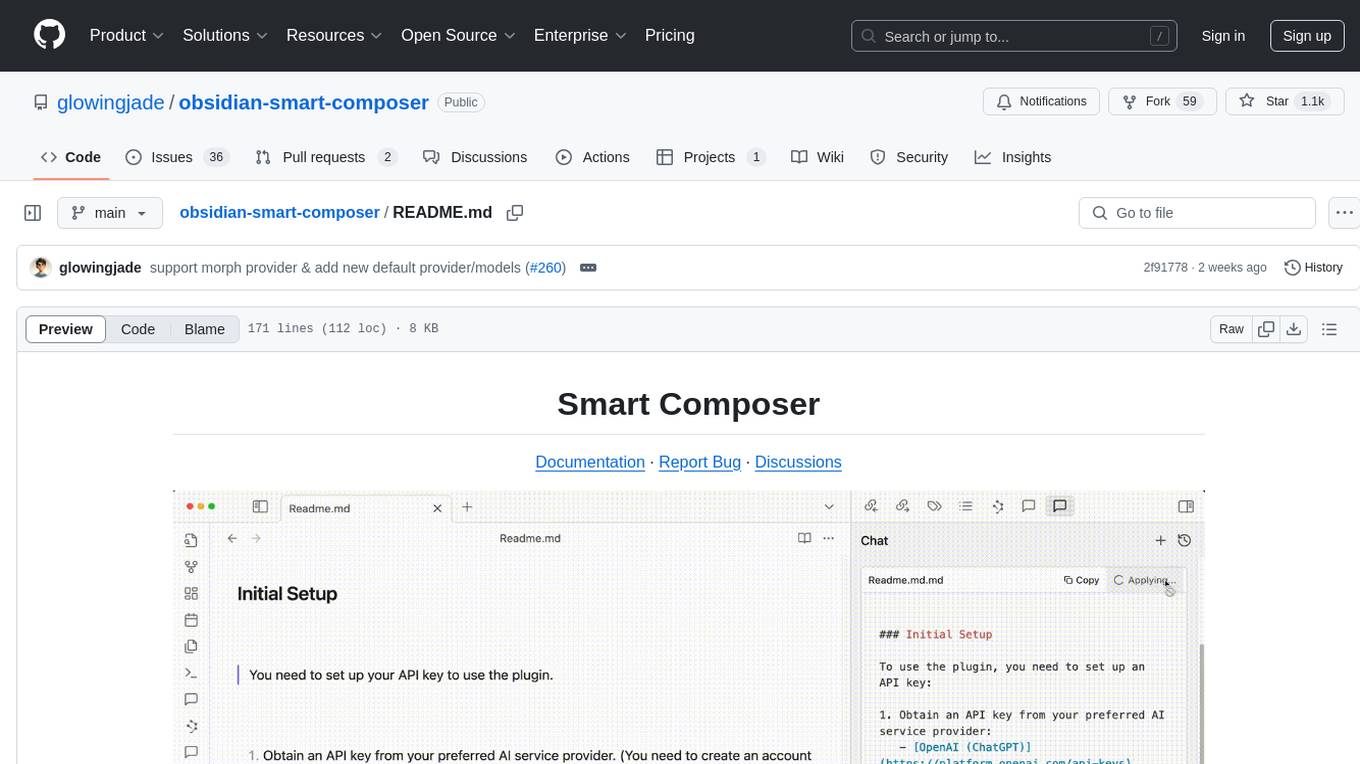
obsidian-smart-composer
Smart Composer is an Obsidian plugin that enhances note-taking and content creation by integrating AI capabilities. It allows users to efficiently write by referencing their vault content, providing contextual chat with precise context selection, multimedia context support for website links and images, document edit suggestions, and vault search for relevant notes. The plugin also offers features like custom model selection, local model support, custom system prompts, and prompt templates. Users can set up the plugin by installing it through the Obsidian community plugins, enabling it, and configuring API keys for supported providers like OpenAI, Anthropic, and Gemini. Smart Composer aims to streamline the writing process by leveraging AI technology within the Obsidian platform.
For similar tasks
nexent
Nexent is a powerful tool for analyzing and visualizing network traffic data. It provides comprehensive insights into network behavior, helping users to identify patterns, anomalies, and potential security threats. With its user-friendly interface and advanced features, Nexent is suitable for network administrators, cybersecurity professionals, and anyone looking to gain a deeper understanding of their network infrastructure.
ferret-scan
Ferret is a security scanner designed for AI assistant configurations. It detects prompt injections, credential leaks, jailbreak attempts, and malicious patterns in AI CLI setups. The tool aims to prevent security issues by identifying threats specific to AI CLI structures that generic scanners might miss. Ferret uses threat intelligence with a local indicator database by default and offers advanced features like IDE integrations, behavior analysis, marketplace security analysis, AI-powered rules, sandboxing integration, and compliance frameworks assessment. It supports various AI CLIs and provides detailed findings and remediation suggestions for detected issues.
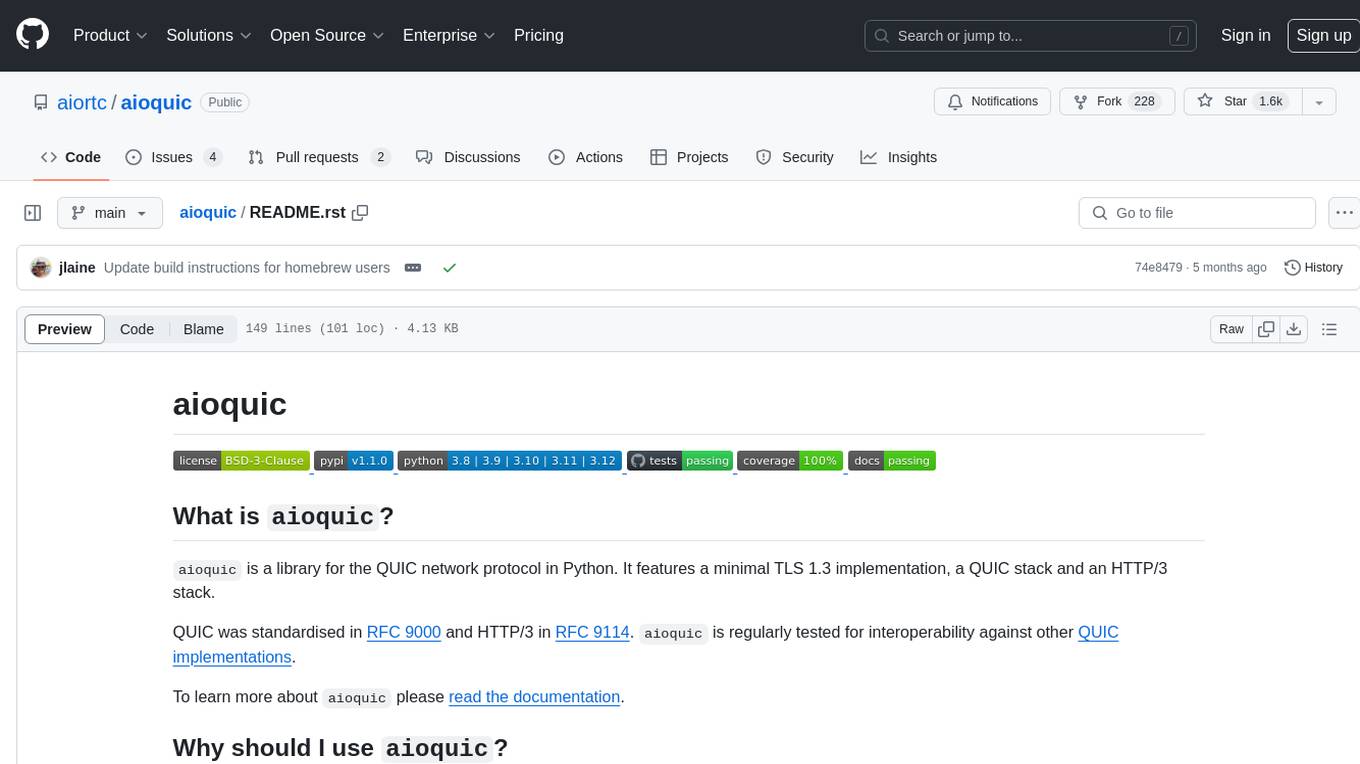
aioquic
aioquic is a Python library for the QUIC network protocol, featuring a minimal TLS 1.3 implementation, a QUIC stack, and an HTTP/3 stack. It is designed to be embedded into Python client and server libraries supporting QUIC and HTTP/3, with IPv4 and IPv6 support, connection migration, NAT rebinding, logging TLS traffic secrets and QUIC events, server push, WebSocket bootstrapping, and datagram support. The library follows the 'bring your own I/O' pattern for QUIC and HTTP/3 APIs, making it testable and integrable with different concurrency models.
For similar jobs
ciso-assistant-community
CISO Assistant is a tool that helps organizations manage their cybersecurity posture and compliance. It provides a centralized platform for managing security controls, threats, and risks. CISO Assistant also includes a library of pre-built frameworks and tools to help organizations quickly and easily implement best practices.
PurpleLlama
Purple Llama is an umbrella project that aims to provide tools and evaluations to support responsible development and usage of generative AI models. It encompasses components for cybersecurity and input/output safeguards, with plans to expand in the future. The project emphasizes a collaborative approach, borrowing the concept of purple teaming from cybersecurity, to address potential risks and challenges posed by generative AI. Components within Purple Llama are licensed permissively to foster community collaboration and standardize the development of trust and safety tools for generative AI.
vpnfast.github.io
VPNFast is a lightweight and fast VPN service provider that offers secure and private internet access. With VPNFast, users can protect their online privacy, bypass geo-restrictions, and secure their internet connection from hackers and snoopers. The service provides high-speed servers in multiple locations worldwide, ensuring a reliable and seamless VPN experience for users. VPNFast is easy to use, with a user-friendly interface and simple setup process. Whether you're browsing the web, streaming content, or accessing sensitive information, VPNFast helps you stay safe and anonymous online.
taranis-ai
Taranis AI is an advanced Open-Source Intelligence (OSINT) tool that leverages Artificial Intelligence to revolutionize information gathering and situational analysis. It navigates through diverse data sources like websites to collect unstructured news articles, utilizing Natural Language Processing and Artificial Intelligence to enhance content quality. Analysts then refine these AI-augmented articles into structured reports that serve as the foundation for deliverables such as PDF files, which are ultimately published.
NightshadeAntidote
Nightshade Antidote is an image forensics tool used to analyze digital images for signs of manipulation or forgery. It implements several common techniques used in image forensics including metadata analysis, copy-move forgery detection, frequency domain analysis, and JPEG compression artifacts analysis. The tool takes an input image, performs analysis using the above techniques, and outputs a report summarizing the findings.
h4cker
This repository is a comprehensive collection of cybersecurity-related references, scripts, tools, code, and other resources. It is carefully curated and maintained by Omar Santos. The repository serves as a supplemental material provider to several books, video courses, and live training created by Omar Santos. It encompasses over 10,000 references that are instrumental for both offensive and defensive security professionals in honing their skills.
AIMr
AIMr is an AI aimbot tool written in Python that leverages modern technologies to achieve an undetected system with a pleasing appearance. It works on any game that uses human-shaped models. To optimize its performance, users should build OpenCV with CUDA. For Valorant, additional perks in the Discord and an Arduino Leonardo R3 are required.
admyral
Admyral is an open-source Cybersecurity Automation & Investigation Assistant that provides a unified console for investigations and incident handling, workflow automation creation, automatic alert investigation, and next step suggestions for analysts. It aims to tackle alert fatigue and automate security workflows effectively by offering features like workflow actions, AI actions, case management, alert handling, and more. Admyral combines security automation and case management to streamline incident response processes and improve overall security posture. The tool is open-source, transparent, and community-driven, allowing users to self-host, contribute, and collaborate on integrations and features.