


runtime
Runtime for building and managing AI agents and Workflows. Easy to learn, fast to build, High Performance, Reliable by design, Intuitive UI, Production Ready.
Stars: 184
Exosphere is a lightweight runtime designed to make AI agents resilient to failure and enable infinite scaling across distributed compute. It provides a powerful foundation for building and orchestrating AI applications with features such as lightweight runtime, inbuilt failure handling, infinite parallel agents, dynamic execution graphs, native state persistence, and observability. Whether you're working on data pipelines, AI agents, or complex workflow orchestrations, Exosphere offers the infrastructure backbone to make your AI applications production-ready and scalable.
README:








Exosphere is a lightweight runtime to make AI agents resilient to failure and infinite scaling across distributed compute. With a few changes to your existing agent code, take your agent from demo to deployment.
Exosphere provides a powerful foundation for building and orchestrating AI applications with these key capabilities:
| Feature | Description |
|---|---|
| Lightweight Runtime | Execute workflows reliably with minimal overhead across distributed infrastructure using a state-based execution model. |
| Inbuilt Failure Handling | Built-in retry policies with exponential backoff and jitter strategies for resilient, production-grade execution. |
| Infinite Parallel Agents | Scale to unlimited parallel agents with automatic load distribution and dynamic fanout at runtime. |
| Dynamic Execution Graphs | Durable execution designed for agentic flows with node-based control of execution. |
| Native State Persistence | Persist workflow state across restarts and failures with graph-level key-value storage. |
| Observability | Visual monitoring, debugging, and management of workflows with real-time execution tracking. |
Whether you're building data pipelines, AI agents, or complex workflow orchestrations, Exosphere provides the infrastructure backbone to make your AI applications production-ready and scalable.
| Step | Description |
|---|---|
| Getting Started | Get the Exosphere State Manager and Dashboard running locally for development. |
| Run Your First Node | Create your first node and register it with the Exosphere runtime. |
| Trigger Agent | Learn how to trigger your agent workflows and manage execution flows. |
| Deploy and Monitor | Deploy your agents and monitor their execution with the visual dashboard. |

Exosphere is built on a flexible, node-based architecture that makes it easy to create complex workflows:

| Component | Description |
|---|---|
| Nodes | Atomic, reusable units of work that can be AI agents, API calls, data processors, or any custom logic |
| Runtime | The execution environment that manages and orchestrates your nodes |
| State Manager | Handles persistent state across workflow executions |
| Dashboard | Visual interface for monitoring and managing workflows |
| Graphs | Define the flow and dependencies between nodes |

| Concept | Description |
|---|---|
| Fanout | Distribute work across multiple parallel instances of a node |
| Unite | Combine results from multiple parallel executions |
| Signals | Inter-node communication and event handling |
| Retry Policy | Configurable failure handling and recovery |
| Store | Persistent storage for workflow state and data |
| Triggers | Automatic scheduling with cron expressions |
| Resource | Notes |
|---|---|
| Getting Started Guide | Complete walkthrough for new users |
| Docker Compose Setup | Run Exosphere locally in minutes |
| Architecture Guide | Understand core concepts like fanout and unite |
| YouTube Walkthroughs | Step-by-step demos on Exosphere with sample code |
| Featured Projects | Templates on common projects, pull and run |
| Resource | Description |
|---|---|
| Official Documentation | Complete reference and tutorials |
| Discord Community | Get help and connect with other developers |
| GitHub Issues | Report bugs and request features |
| PyPI Package | Latest stable releases |
We believe that humanity would not have been able to achieve the level of innovation and progress we have today without the support of open source and community. We want to be a part of this movement.
Please feel free to reach out to us at [email protected]. Let's push the boundaries of possibilities for humanity together.
Exosphere follows a predictable, calendar-based release process:
| Aspect | Description |
|---|---|
| Monthly Releases | A new stable version ships at the end of every month |
| Issue and PR Labelling | Work intended for a release is tagged YYYY:Mon (e.g., 2026:Jan). Filter by this label in GitHub to see exactly what is planned |
| Living Roadmap | The collection of items carrying the current month's label is our public roadmap. Follow along in GitHub Projects to track progress in real time |
We welcome community contributions. For guidelines, refer to our CONTRIBUTING.md.
Thanks to our awesome contributors!
For Tasks:
Click tags to check more tools for each tasksFor Jobs:
Alternative AI tools for runtime
Similar Open Source Tools
runtime
Exosphere is a lightweight runtime designed to make AI agents resilient to failure and enable infinite scaling across distributed compute. It provides a powerful foundation for building and orchestrating AI applications with features such as lightweight runtime, inbuilt failure handling, infinite parallel agents, dynamic execution graphs, native state persistence, and observability. Whether you're working on data pipelines, AI agents, or complex workflow orchestrations, Exosphere offers the infrastructure backbone to make your AI applications production-ready and scalable.
netdata
Netdata is an open-source, real-time infrastructure monitoring platform that provides instant insights, zero configuration deployment, ML-powered anomaly detection, efficient monitoring with minimal resource usage, and secure & distributed data storage. It offers real-time, per-second updates and clear insights at a glance. Netdata's origin story involves addressing the limitations of existing monitoring tools and led to a fundamental shift in infrastructure monitoring. It is recognized as the most energy-efficient tool for monitoring Docker-based systems according to a study by the University of Amsterdam.
camel
CAMEL is an open-source library designed for the study of autonomous and communicative agents. We believe that studying these agents on a large scale offers valuable insights into their behaviors, capabilities, and potential risks. To facilitate research in this field, we implement and support various types of agents, tasks, prompts, models, and simulated environments.
rhesis
Rhesis is a comprehensive test management platform designed for Gen AI teams, offering tools to create, manage, and execute test cases for generative AI applications. It ensures the robustness, reliability, and compliance of AI systems through features like test set management, automated test generation, edge case discovery, compliance validation, integration capabilities, and performance tracking. The platform is open source, emphasizing community-driven development, transparency, extensible architecture, and democratizing AI safety. It includes components such as backend services, frontend applications, SDK for developers, worker services, chatbot applications, and Polyphemus for uncensored LLM service. Rhesis enables users to address challenges unique to testing generative AI applications, such as non-deterministic outputs, hallucinations, edge cases, ethical concerns, and compliance requirements.
mage-ai
Mage is an open-source data pipeline tool for transforming and integrating data. It offers an easy developer experience, engineering best practices built-in, and data as a first-class citizen. Mage makes it easy to build, preview, and launch data pipelines, and provides observability and scaling capabilities. It supports data integrations, streaming pipelines, and dbt integration.
unoplat-code-confluence
Unoplat-CodeConfluence is a universal code context engine that aims to extract, understand, and provide precise code context across repositories tied through domains. It combines deterministic code grammar with state-of-the-art LLM pipelines to achieve human-like understanding of codebases in minutes. The tool offers smart summarization, graph-based embedding, enhanced onboarding, graph-based intelligence, deep dependency insights, and seamless integration with existing development tools and workflows. It provides a precise context API for knowledge engine and AI coding assistants, enabling reliable code understanding through bottom-up code summarization, graph-based querying, and deep package and dependency analysis.
nuitrack-sdk
Nuitrack™ is an ultimate 3D body tracking solution developed by 3DiVi Inc. It enables body motion analytics applications for virtually any widespread depth sensors and hardware platforms, supporting a wide range of applications from real-time gesture recognition on embedded platforms to large-scale multisensor analytical systems. Nuitrack provides highly-sophisticated 3D skeletal tracking, basic facial analysis, hand tracking, and gesture recognition APIs for UI control. It offers two skeletal tracking engines: classical for embedded hardware and AI for complex poses, providing a human-centric spatial understanding tool for natural and intelligent user engagement.
SimAI
SimAI is the industry's first full-stack, high-precision simulator for AI large-scale training. It provides detailed modeling and simulation of the entire LLM training process, encompassing framework, collective communication, network layers, and more. This comprehensive approach offers end-to-end performance data, enabling researchers to analyze training process details, evaluate time consumption of AI tasks under specific conditions, and assess performance gains from various algorithmic optimizations.
buffer-of-thought-llm
Buffer of Thoughts (BoT) is a thought-augmented reasoning framework designed to enhance the accuracy, efficiency, and robustness of large language models (LLMs). It introduces a meta-buffer to store high-level thought-templates distilled from problem-solving processes, enabling adaptive reasoning for efficient problem-solving. The framework includes a buffer-manager to dynamically update the meta-buffer, ensuring scalability and stability. BoT achieves significant performance improvements on reasoning-intensive tasks and demonstrates superior generalization ability and robustness while being cost-effective compared to other methods.
parallax
Parallax is a fully decentralized inference engine developed by Gradient. It allows users to build their own AI cluster for model inference across distributed nodes with varying configurations and physical locations. Core features include hosting local LLM on personal devices, cross-platform support, pipeline parallel model sharding, paged KV cache management, continuous batching for Mac, dynamic request scheduling, and routing for high performance. The backend architecture includes P2P communication powered by Lattica, GPU backend powered by SGLang and vLLM, and MAC backend powered by MLX LM.
inference
Xorbits Inference (Xinference) is a powerful and versatile library designed to serve language, speech recognition, and multimodal models. With Xorbits Inference, you can effortlessly deploy and serve your or state-of-the-art built-in models using just a single command. Whether you are a researcher, developer, or data scientist, Xorbits Inference empowers you to unleash the full potential of cutting-edge AI models.
awesome-generative-ai-data-scientist
A curated list of 50+ resources to help you become a Generative AI Data Scientist. This repository includes resources on building GenAI applications with Large Language Models (LLMs), and deploying LLMs and GenAI with Cloud-based solutions.
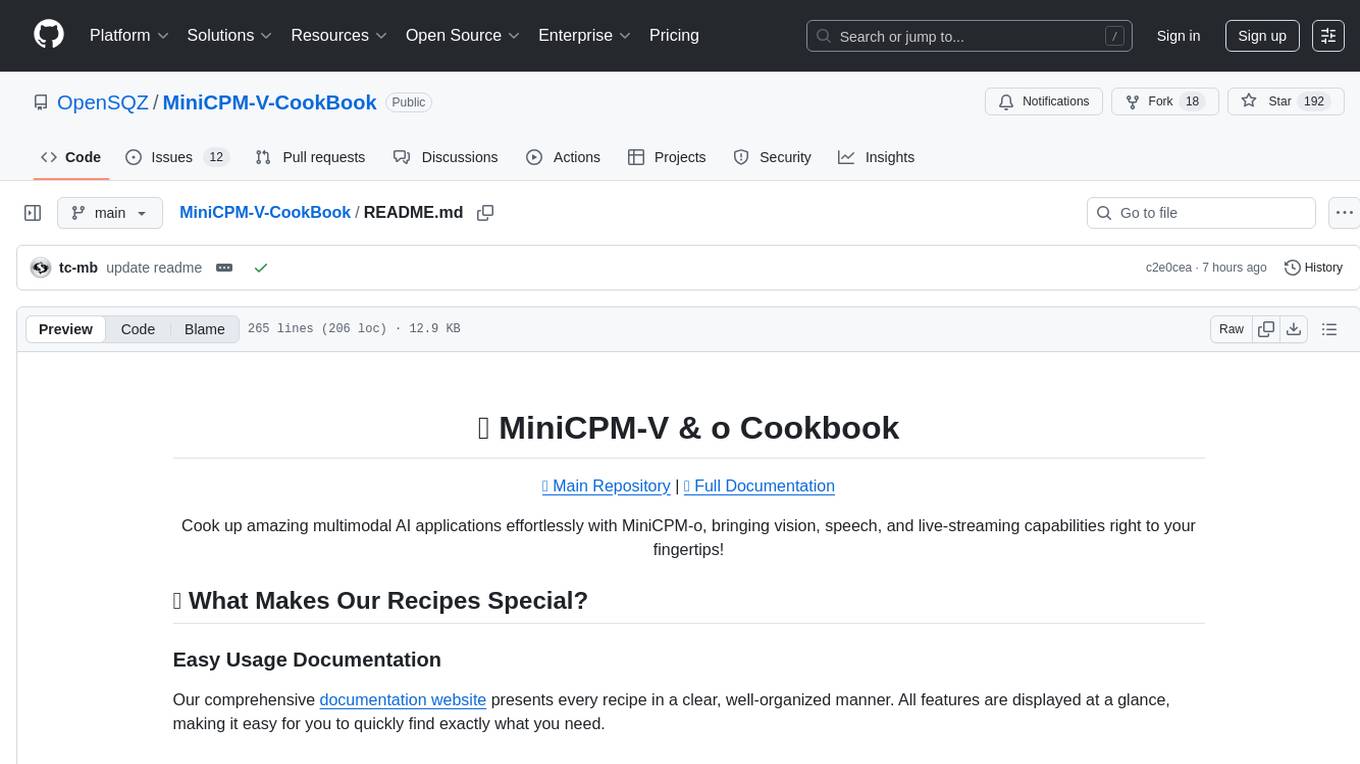
MiniCPM-V-CookBook
MiniCPM-V & o Cookbook is a comprehensive repository for building multimodal AI applications effortlessly. It provides easy-to-use documentation, supports a wide range of users, and offers versatile deployment scenarios. The repository includes live demonstrations, inference recipes for vision and audio capabilities, fine-tuning recipes, serving recipes, quantization recipes, and a framework support matrix. Users can customize models, deploy them efficiently, and compress models to improve efficiency. The repository also showcases awesome works using MiniCPM-V & o and encourages community contributions.
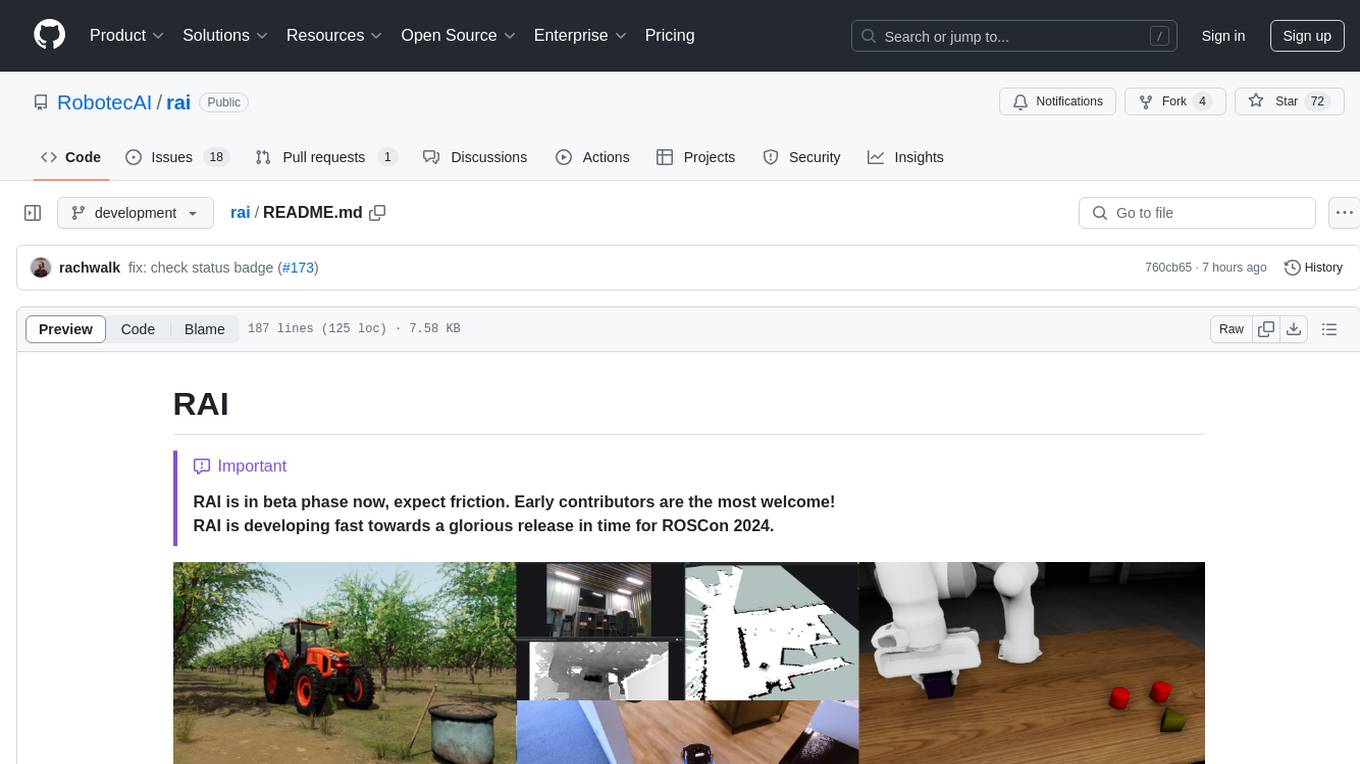
rai
RAI is a framework designed to bring general multi-agent system capabilities to robots, enhancing human interactivity, flexibility in problem-solving, and out-of-the-box AI features. It supports multi-modalities, incorporates an advanced database for agent memory, provides ROS 2-oriented tooling, and offers a comprehensive task/mission orchestrator. The framework includes features such as voice interaction, customizable robot identity, camera sensor access, reasoning through ROS logs, and integration with LangChain for AI tools. RAI aims to support various AI vendors, improve human-robot interaction, provide an SDK for developers, and offer a user interface for configuration.
agents-towards-production
Agents Towards Production is an open-source playbook for building production-ready GenAI agents that scale from prototype to enterprise. Tutorials cover stateful workflows, vector memory, real-time web search APIs, Docker deployment, FastAPI endpoints, security guardrails, GPU scaling, browser automation, fine-tuning, multi-agent coordination, observability, evaluation, and UI development.
Streamline-Analyst
Streamline Analyst is a cutting-edge, open-source application powered by Large Language Models (LLMs) designed to revolutionize data analysis. This Data Analysis Agent effortlessly automates tasks such as data cleaning, preprocessing, and complex operations like identifying target objects, partitioning test sets, and selecting the best-fit models based on your data. With Streamline Analyst, results visualization and evaluation become seamless. It aims to expedite the data analysis process, making it accessible to all, regardless of their expertise in data analysis. The tool is built to empower users to process data and achieve high-quality visualizations with unparalleled efficiency, and to execute high-performance modeling with the best strategies. Future enhancements include Natural Language Processing (NLP), neural networks, and object detection utilizing YOLO, broadening its capabilities to meet diverse data analysis needs.
For similar tasks
runtime
Exosphere is a lightweight runtime designed to make AI agents resilient to failure and enable infinite scaling across distributed compute. It provides a powerful foundation for building and orchestrating AI applications with features such as lightweight runtime, inbuilt failure handling, infinite parallel agents, dynamic execution graphs, native state persistence, and observability. Whether you're working on data pipelines, AI agents, or complex workflow orchestrations, Exosphere offers the infrastructure backbone to make your AI applications production-ready and scalable.
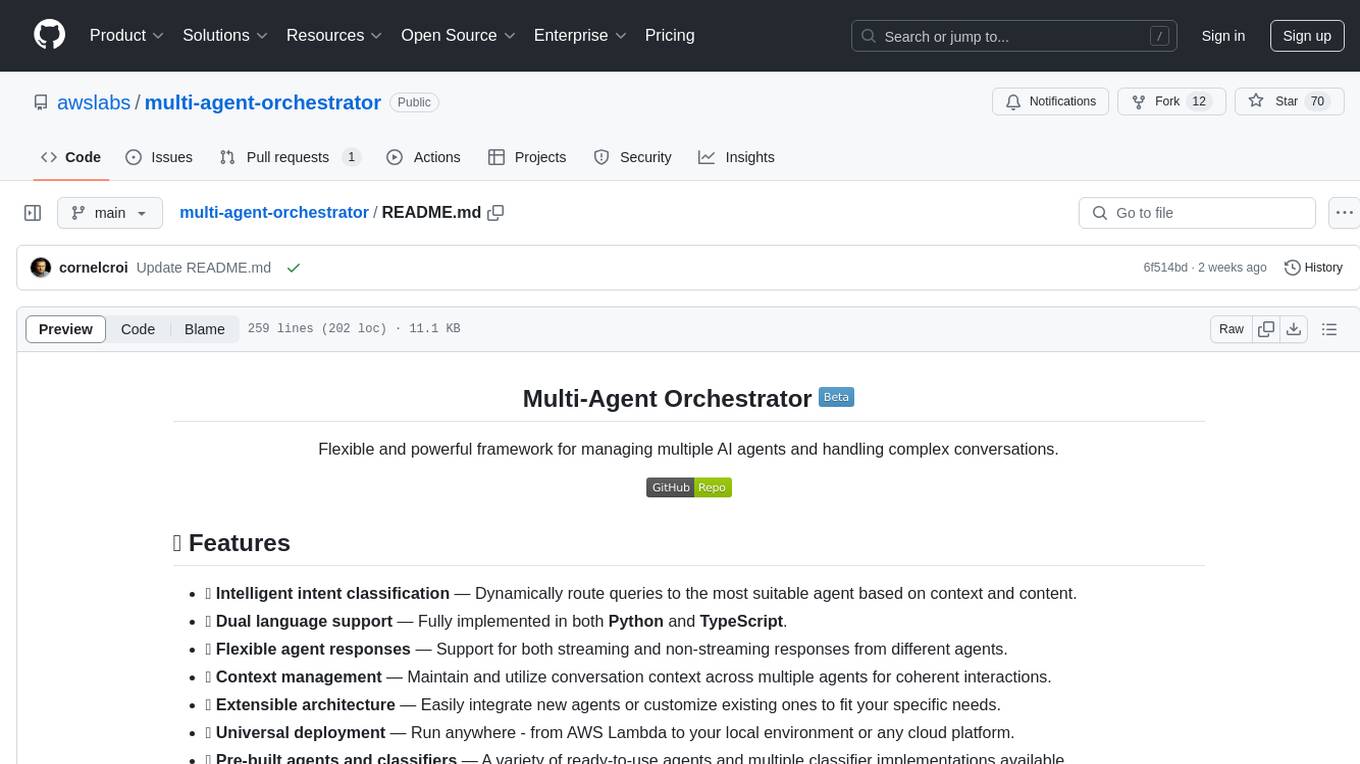
multi-agent-orchestrator
Multi-Agent Orchestrator is a flexible and powerful framework for managing multiple AI agents and handling complex conversations. It intelligently routes queries to the most suitable agent based on context and content, supports dual language implementation in Python and TypeScript, offers flexible agent responses, context management across agents, extensible architecture for customization, universal deployment options, and pre-built agents and classifiers. It is suitable for various applications, from simple chatbots to sophisticated AI systems, accommodating diverse requirements and scaling efficiently.
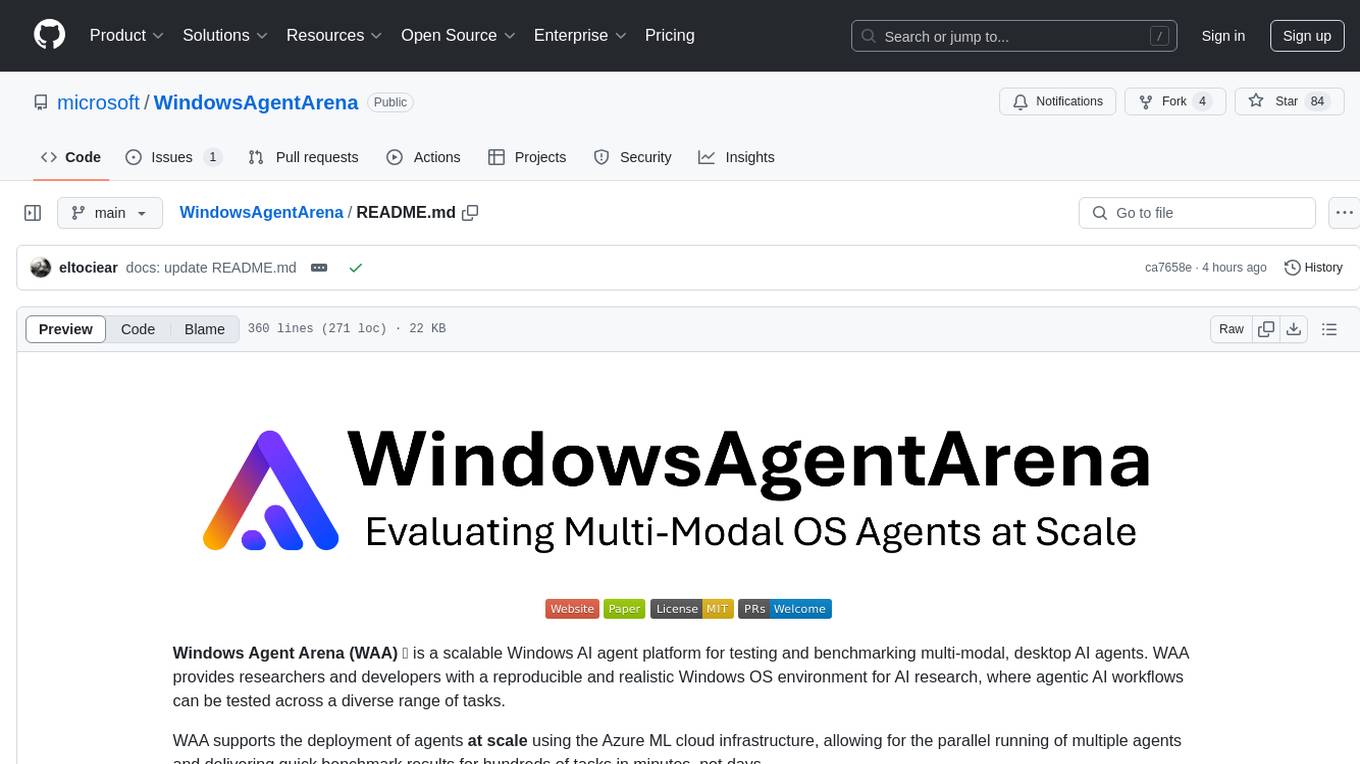
WindowsAgentArena
Windows Agent Arena (WAA) is a scalable Windows AI agent platform designed for testing and benchmarking multi-modal, desktop AI agents. It provides researchers and developers with a reproducible and realistic Windows OS environment for AI research, enabling testing of agentic AI workflows across various tasks. WAA supports deploying agents at scale using Azure ML cloud infrastructure, allowing parallel running of multiple agents and delivering quick benchmark results for hundreds of tasks in minutes.
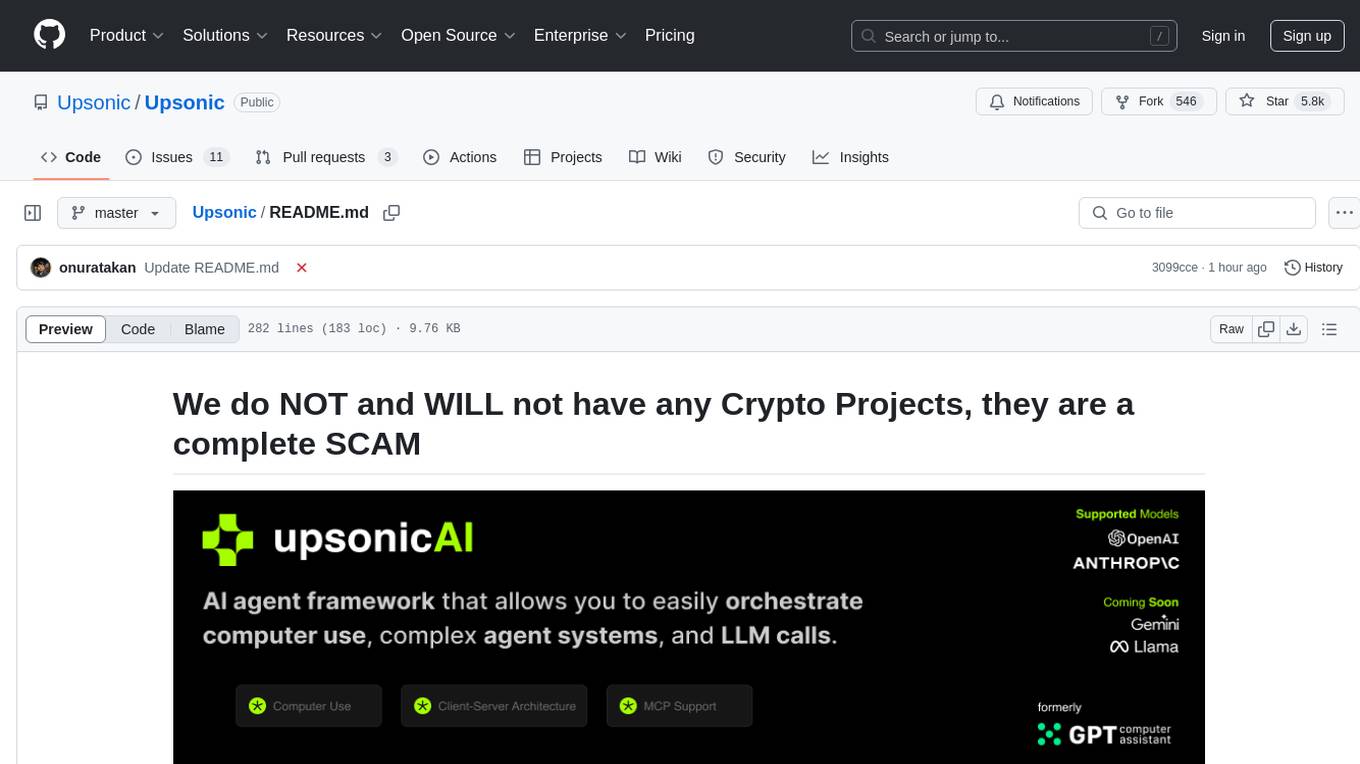
Upsonic
Upsonic offers a cutting-edge enterprise-ready framework for orchestrating LLM calls, agents, and computer use to complete tasks cost-effectively. It provides reliable systems, scalability, and a task-oriented structure for real-world cases. Key features include production-ready scalability, task-centric design, MCP server support, tool-calling server, computer use integration, and easy addition of custom tools. The framework supports client-server architecture and allows seamless deployment on AWS, GCP, or locally using Docker.
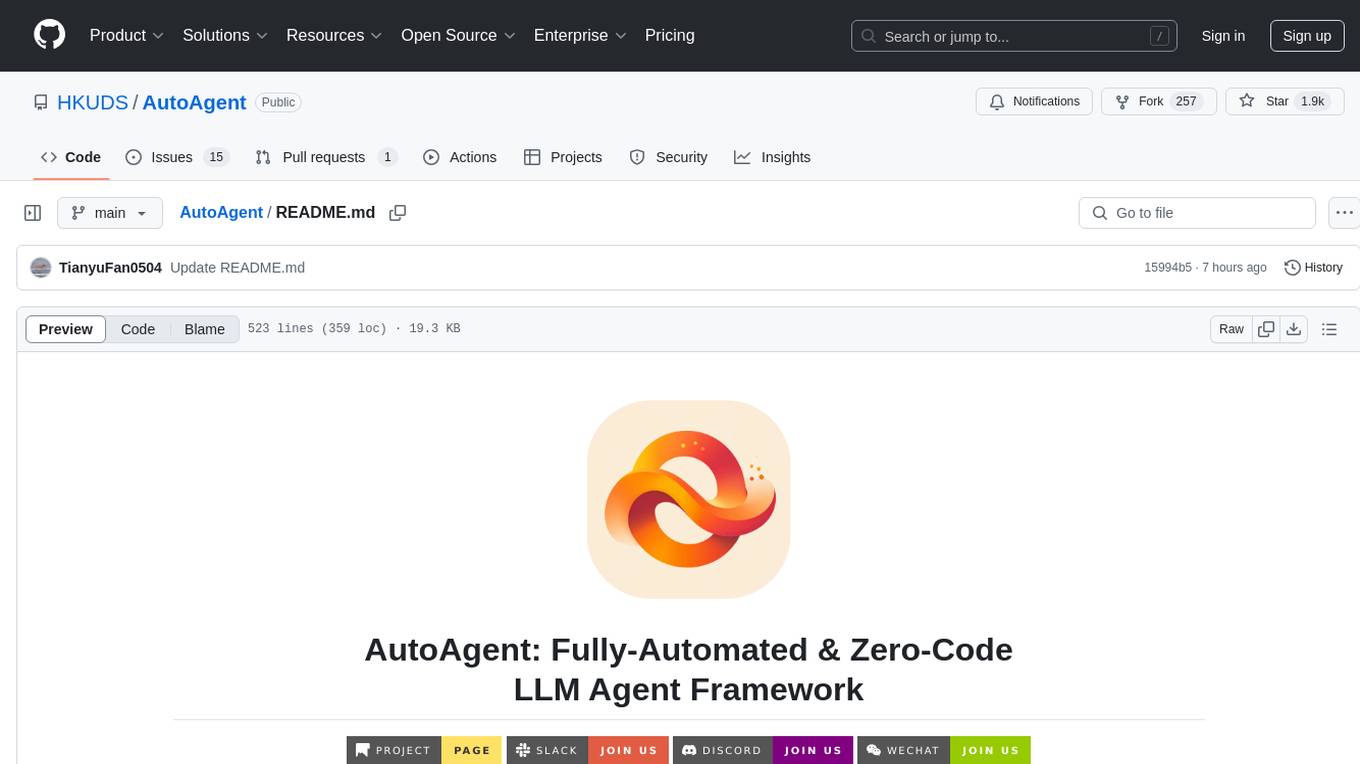
AutoAgent
AutoAgent is a fully-automated and zero-code framework that enables users to create and deploy LLM agents through natural language alone. It is a top performer on the GAIA Benchmark, equipped with a native self-managing vector database, and allows for easy creation of tools, agents, and workflows without any coding. AutoAgent seamlessly integrates with a wide range of LLMs and supports both function-calling and ReAct interaction modes. It is designed to be dynamic, extensible, customized, and lightweight, serving as a personal AI assistant.
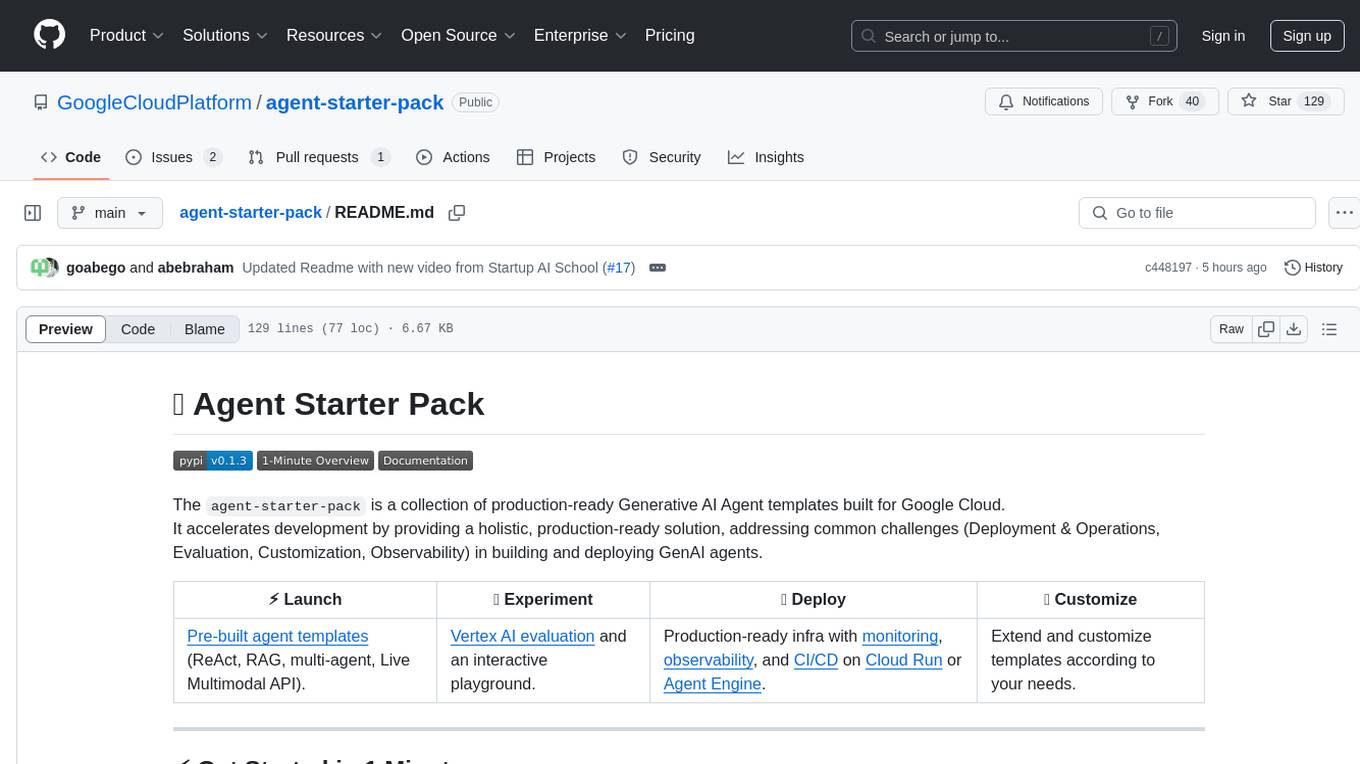
agent-starter-pack
The agent-starter-pack is a collection of production-ready Generative AI Agent templates built for Google Cloud. It accelerates development by providing a holistic, production-ready solution, addressing common challenges in building and deploying GenAI agents. The tool offers pre-built agent templates, evaluation tools, production-ready infrastructure, and customization options. It also provides CI/CD automation and data pipeline integration for RAG agents. The starter pack covers all aspects of agent development, from prototyping and evaluation to deployment and monitoring. It is designed to simplify project creation, template selection, and deployment for agent development on Google Cloud.
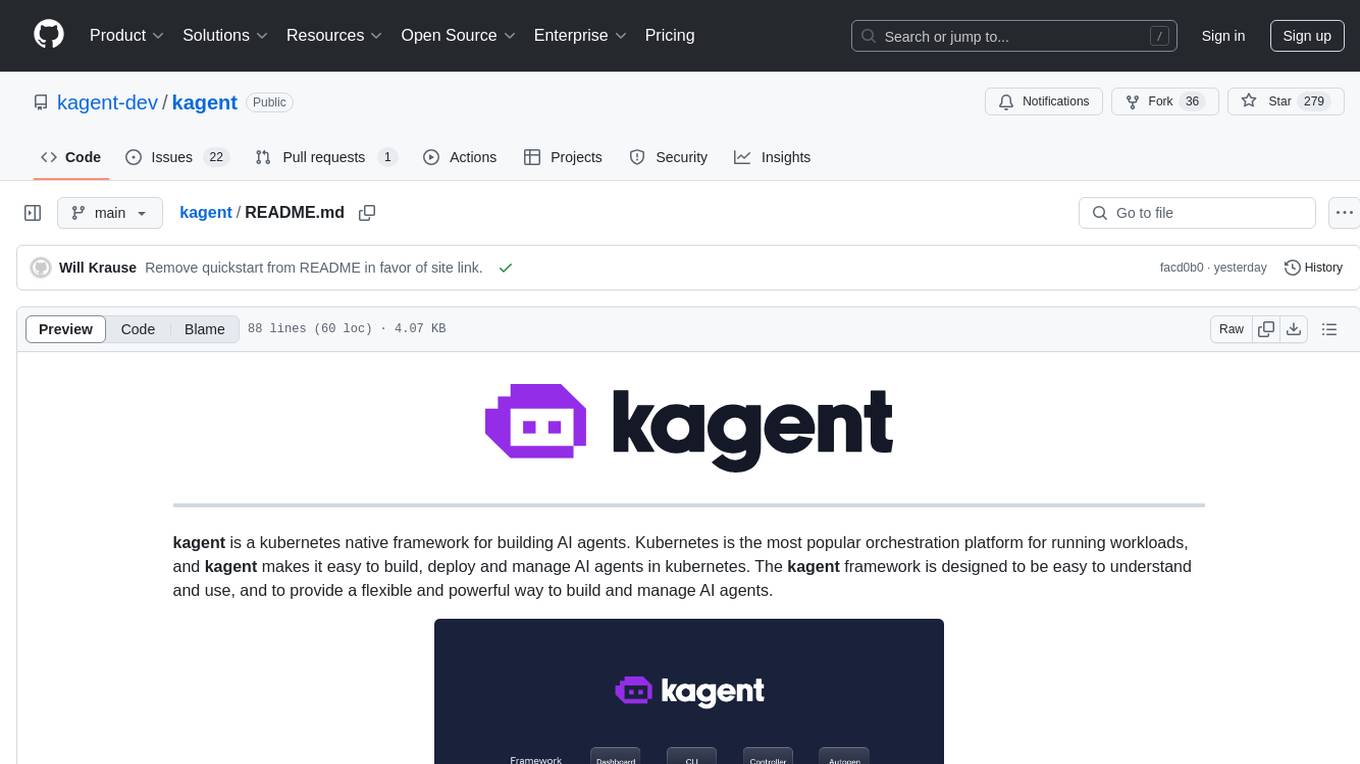
kagent
Kagent is a Kubernetes native framework for building AI agents, designed to be easy to understand and use. It provides a flexible and powerful way to build, deploy, and manage AI agents in Kubernetes. The framework consists of agents, tools, and model configurations defined as Kubernetes custom resources, making them easy to manage and modify. Kagent is extensible, flexible, observable, declarative, testable, and has core components like a controller, UI, engine, and CLI.

motia
Motia is an AI agent framework designed for software engineers to create, test, and deploy production-ready AI agents quickly. It provides a code-first approach, allowing developers to write agent logic in familiar languages and visualize execution in real-time. With Motia, developers can focus on business logic rather than infrastructure, offering zero infrastructure headaches, multi-language support, composable steps, built-in observability, instant APIs, and full control over AI logic. Ideal for building sophisticated agents and intelligent automations, Motia's event-driven architecture and modular steps enable the creation of GenAI-powered workflows, decision-making systems, and data processing pipelines.
For similar jobs
sweep
Sweep is an AI junior developer that turns bugs and feature requests into code changes. It automatically handles developer experience improvements like adding type hints and improving test coverage.
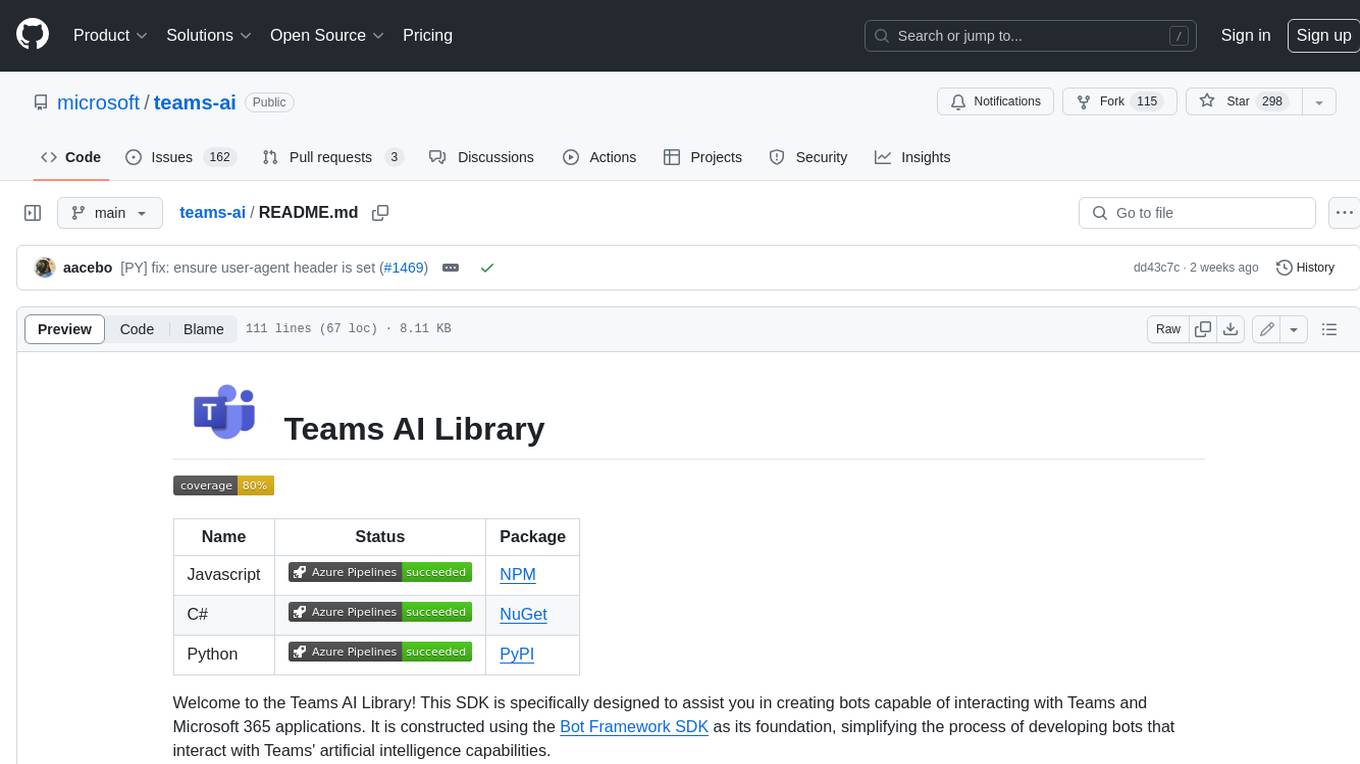
teams-ai
The Teams AI Library is a software development kit (SDK) that helps developers create bots that can interact with Teams and Microsoft 365 applications. It is built on top of the Bot Framework SDK and simplifies the process of developing bots that interact with Teams' artificial intelligence capabilities. The SDK is available for JavaScript/TypeScript, .NET, and Python.
ai-guide
This guide is dedicated to Large Language Models (LLMs) that you can run on your home computer. It assumes your PC is a lower-end, non-gaming setup.
classifai
Supercharge WordPress Content Workflows and Engagement with Artificial Intelligence. Tap into leading cloud-based services like OpenAI, Microsoft Azure AI, Google Gemini and IBM Watson to augment your WordPress-powered websites. Publish content faster while improving SEO performance and increasing audience engagement. ClassifAI integrates Artificial Intelligence and Machine Learning technologies to lighten your workload and eliminate tedious tasks, giving you more time to create original content that matters.
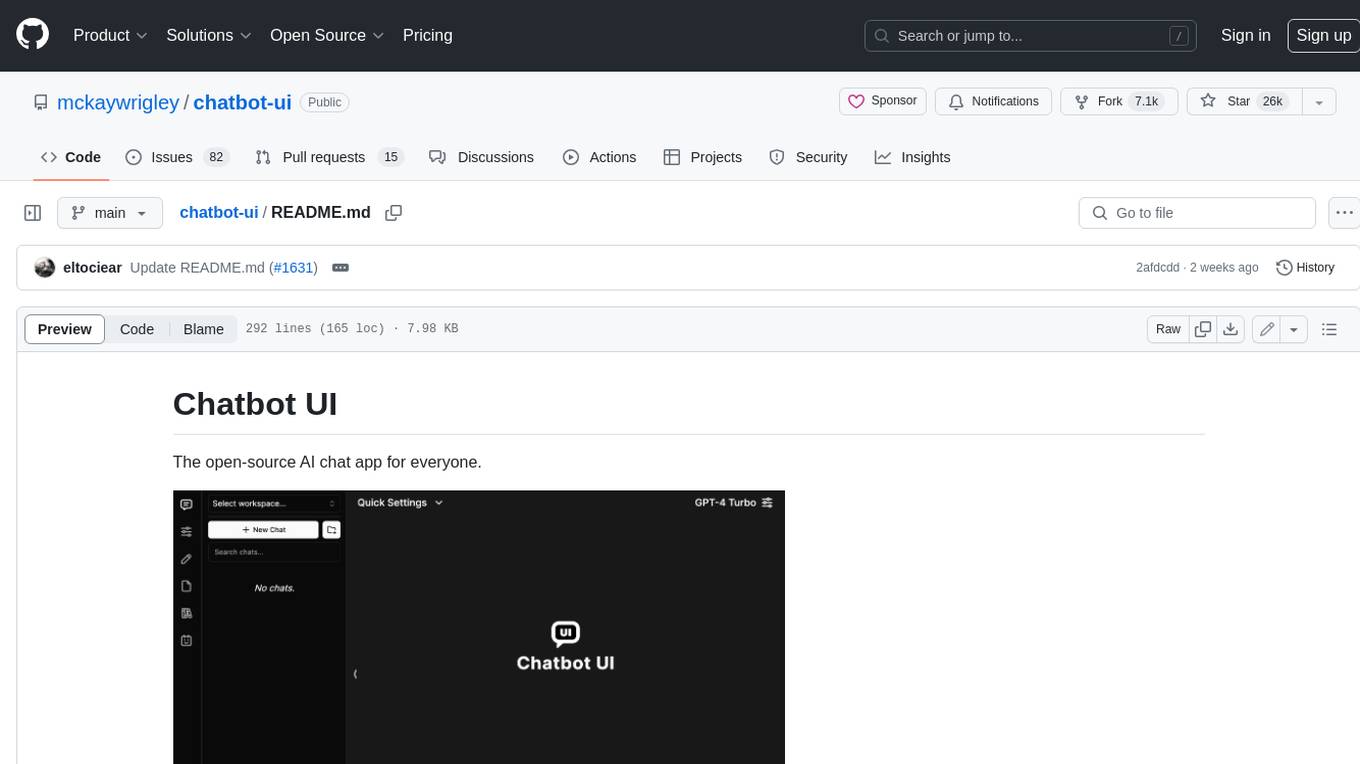
chatbot-ui
Chatbot UI is an open-source AI chat app that allows users to create and deploy their own AI chatbots. It is easy to use and can be customized to fit any need. Chatbot UI is perfect for businesses, developers, and anyone who wants to create a chatbot.
BricksLLM
BricksLLM is a cloud native AI gateway written in Go. Currently, it provides native support for OpenAI, Anthropic, Azure OpenAI and vLLM. BricksLLM aims to provide enterprise level infrastructure that can power any LLM production use cases. Here are some use cases for BricksLLM: * Set LLM usage limits for users on different pricing tiers * Track LLM usage on a per user and per organization basis * Block or redact requests containing PIIs * Improve LLM reliability with failovers, retries and caching * Distribute API keys with rate limits and cost limits for internal development/production use cases * Distribute API keys with rate limits and cost limits for students
uAgents
uAgents is a Python library developed by Fetch.ai that allows for the creation of autonomous AI agents. These agents can perform various tasks on a schedule or take action on various events. uAgents are easy to create and manage, and they are connected to a fast-growing network of other uAgents. They are also secure, with cryptographically secured messages and wallets.
griptape
Griptape is a modular Python framework for building AI-powered applications that securely connect to your enterprise data and APIs. It offers developers the ability to maintain control and flexibility at every step. Griptape's core components include Structures (Agents, Pipelines, and Workflows), Tasks, Tools, Memory (Conversation Memory, Task Memory, and Meta Memory), Drivers (Prompt and Embedding Drivers, Vector Store Drivers, Image Generation Drivers, Image Query Drivers, SQL Drivers, Web Scraper Drivers, and Conversation Memory Drivers), Engines (Query Engines, Extraction Engines, Summary Engines, Image Generation Engines, and Image Query Engines), and additional components (Rulesets, Loaders, Artifacts, Chunkers, and Tokenizers). Griptape enables developers to create AI-powered applications with ease and efficiency.