


parallax
Parallax is a distributed model serving framework that lets you build your own AI cluster anywhere
Stars: 1108
Parallax is a fully decentralized inference engine developed by Gradient. It allows users to build their own AI cluster for model inference across distributed nodes with varying configurations and physical locations. Core features include hosting local LLM on personal devices, cross-platform support, pipeline parallel model sharding, paged KV cache management, continuous batching for Mac, dynamic request scheduling, and routing for high performance. The backend architecture includes P2P communication powered by Lattica, GPU backend powered by SGLang and vLLM, and MAC backend powered by MLX LM.
README:

Trusted by Partners






| Gradient | Blog | X(Twitter)(Gradient) | X(Twitter)(Parallax) | Discord | Arxiv
- [2026/2] 🦞 Parallax now supports OpenClaw integration! See Docs
- [2025/10] 🔥 Parallax won #1 Product of The Day on Product Hunt!
- [2025/10] 🔥 Parallax version 0.0.1 has been released!
A fully decentralized inference engine developed by Gradient. Parallax lets you build your own AI cluster for model inference onto a set of distributed nodes despite their varying configuration and physical location. Its core features include:
- Host local LLM on personal devices
- Cross-platform support
- Pipeline parallel model sharding
- Paged KV cache management & continuous batching for Mac
- Dynamic request scheduling and routing for high performance
The backend architecture:
- P2P communication powered by Lattica
- GPU backend powered by SGLang and vLLM
- MAC backend powered by MLX LM
We warmly welcome contributions of all kinds! For guidelines on how to get involved, please refer to our Contributing Guide.
| Provider | HuggingFace Collection | Blog | Description | |
|---|---|---|---|---|
| DeepSeek | Deepseek |
DeepSeek-V3.2 DeepSeek-R1 |
Deep Seek AI Launches Revolutionary Language Model | Deep Seek AI is proud to announce the launch of our latest language model, setting new standards in natural language processing and understanding. This breakthrough represents a significant step forward in AI technology, offering unprecedented capabilities in text generation, comprehension, and analysis. |
| MiniMax-M2 | MiniMax AI |
MiniMax-M2 MiniMax-M2.1 |
MiniMax M2.1: Significantly Enhanced Multi-Language Programming | MiniMax-M2.1 is an enhanced sparse MoE model (230B parameters, 10B active) built for advanced coding and agentic workflows. It offers state-of-the-art intelligence, delivering efficient, reliable tool use and strong multi-step reasoning. |
| GLM | Z AI |
GLM-4.7 GLM-4.7-Flash |
GLM-4.7: Advancing the Coding Capability | "GLM" is an advanced large language model series from Z AI, including GLM-4.6 and GLM-4.7. These models feature long-context support, strong coding and reasoning performance, enhanced tool-use and agent integration, and competitive results across leading open-source benchmarks. |
| Kimi-K2 | Moonshot AI | Kimi-K2 | Kimi K2: Open Agentic Intelligence | "Kimi-K2" is Moonshot AI's Kimi-K2 model family, including Kimi-K2-Base, Kimi-K2-Instruct and Kimi-K2-Thinking. Kimi K2 Thinking is a state-of-the-art open-source agentic model designed for deep, step-by-step reasoning and dynamic tool use. It features native INT4 quantization and a 256k context window for fast, memory-efficient inference. Uniquely stable in long-horizon tasks, Kimi K2 enables reliable autonomous workflows with consistent performance across hundreds of tool calls. |
| Qwen | Qwen |
Qwen3-Next Qwen3 Qwen2.5 |
Qwen3-Next: Towards Ultimate Training & Inference Efficiency | The Qwen series is a family of large language models developed by Alibaba's Qwen team. It includes multiple generations such as Qwen2.5, Qwen3, and Qwen3-Next, which improve upon model architecture, efficiency, and capabilities. The models are available in various sizes and instruction-tuned versions, with support for cutting-edge features like long context and quantization. Suitable for a wide range of language tasks and open-source use cases. |
| gpt-oss | OpenAI |
gpt-oss gpt-oss-safeguard |
Introducing gpt-oss-safeguard | gpt-oss are OpenAI’s open-weight GPT models (20B & 120B). The gpt-oss-safeguard variants are reasoning-based safety classification models: developers provide their own policy at inference, and the model uses chain-of-thought to classify content and explain its reasoning. This allows flexible, policy-driven moderation in complex or evolving domains, with open weights under Apache 2.0. |
| Meta Llama 3 | Meta |
Meta Llama 3 Llama 3.1 Llama 3.2 Llama 3.3 |
Introducing Meta Llama 3: The most capable openly available LLM to date | "Meta Llama 3" is Meta's third-generation Llama model, available in sizes such as 8B and 70B parameters. Includes instruction-tuned and quantized (e.g., FP8) variants. |
For Tasks:
Click tags to check more tools for each tasksFor Jobs:
Alternative AI tools for parallax
Similar Open Source Tools
parallax
Parallax is a fully decentralized inference engine developed by Gradient. It allows users to build their own AI cluster for model inference across distributed nodes with varying configurations and physical locations. Core features include hosting local LLM on personal devices, cross-platform support, pipeline parallel model sharding, paged KV cache management, continuous batching for Mac, dynamic request scheduling, and routing for high performance. The backend architecture includes P2P communication powered by Lattica, GPU backend powered by SGLang and vLLM, and MAC backend powered by MLX LM.
lobe-chat
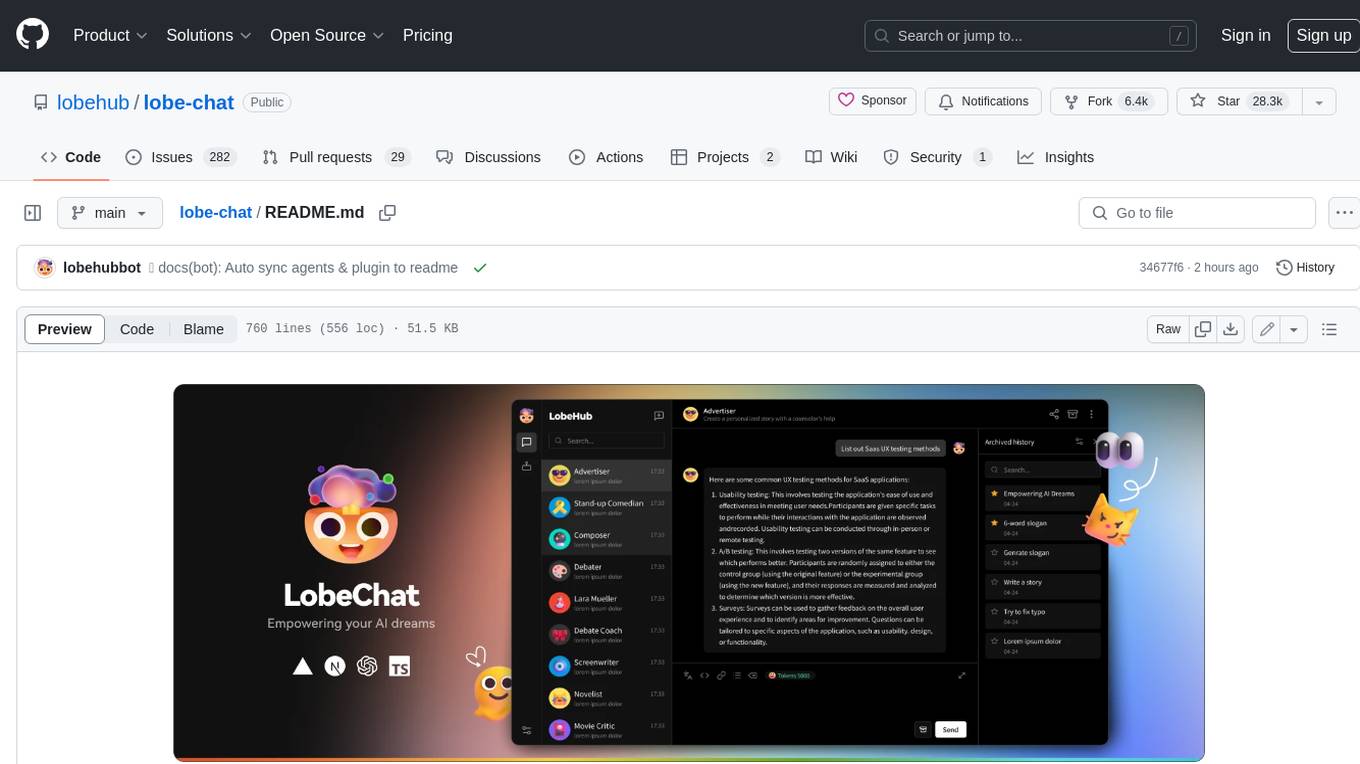
Lobe Chat is an open-source, modern-design ChatGPT/LLMs UI/Framework. Supports speech-synthesis, multi-modal, and extensible ([function call][docs-functionc-call]) plugin system. One-click **FREE** deployment of your private OpenAI ChatGPT/Claude/Gemini/Groq/Ollama chat application.
inference
Xorbits Inference (Xinference) is a powerful and versatile library designed to serve language, speech recognition, and multimodal models. With Xorbits Inference, you can effortlessly deploy and serve your or state-of-the-art built-in models using just a single command. Whether you are a researcher, developer, or data scientist, Xorbits Inference empowers you to unleash the full potential of cutting-edge AI models.
rai
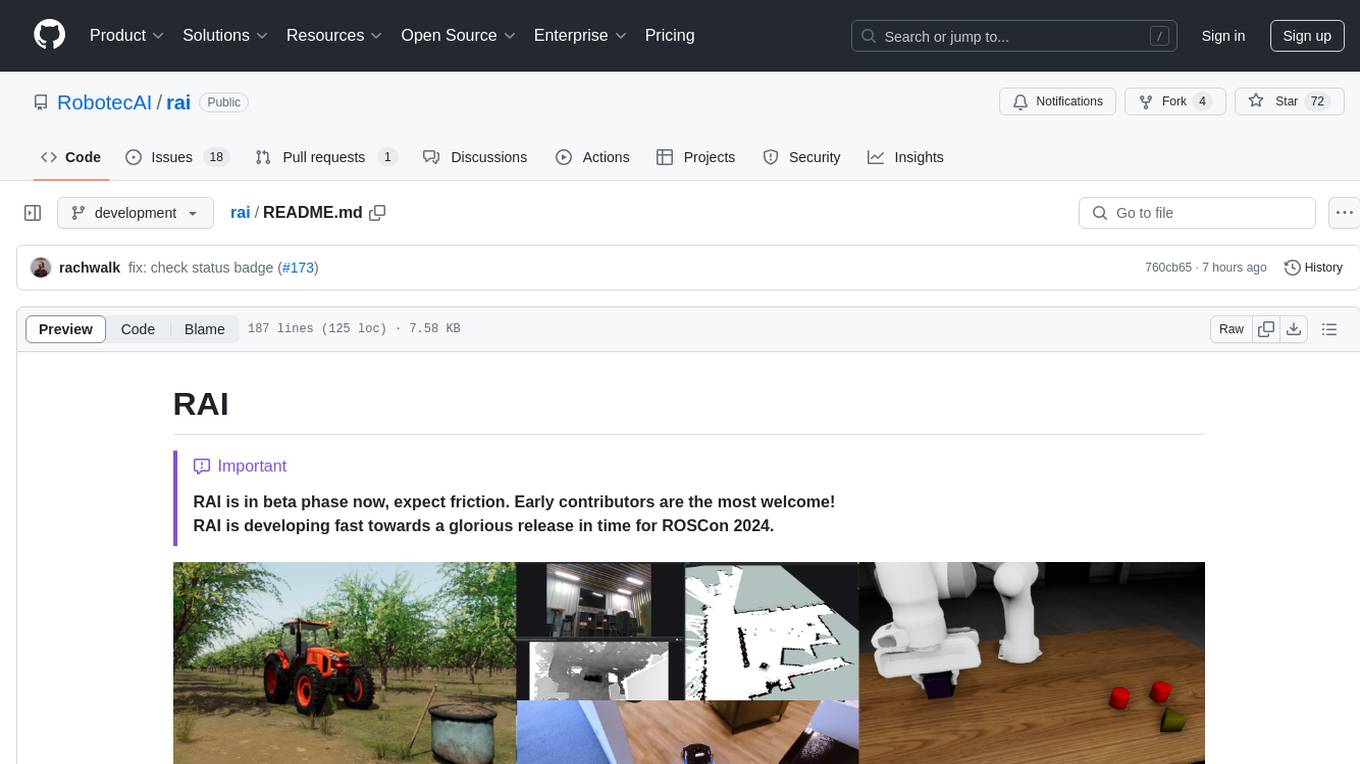
RAI is a framework designed to bring general multi-agent system capabilities to robots, enhancing human interactivity, flexibility in problem-solving, and out-of-the-box AI features. It supports multi-modalities, incorporates an advanced database for agent memory, provides ROS 2-oriented tooling, and offers a comprehensive task/mission orchestrator. The framework includes features such as voice interaction, customizable robot identity, camera sensor access, reasoning through ROS logs, and integration with LangChain for AI tools. RAI aims to support various AI vendors, improve human-robot interaction, provide an SDK for developers, and offer a user interface for configuration.
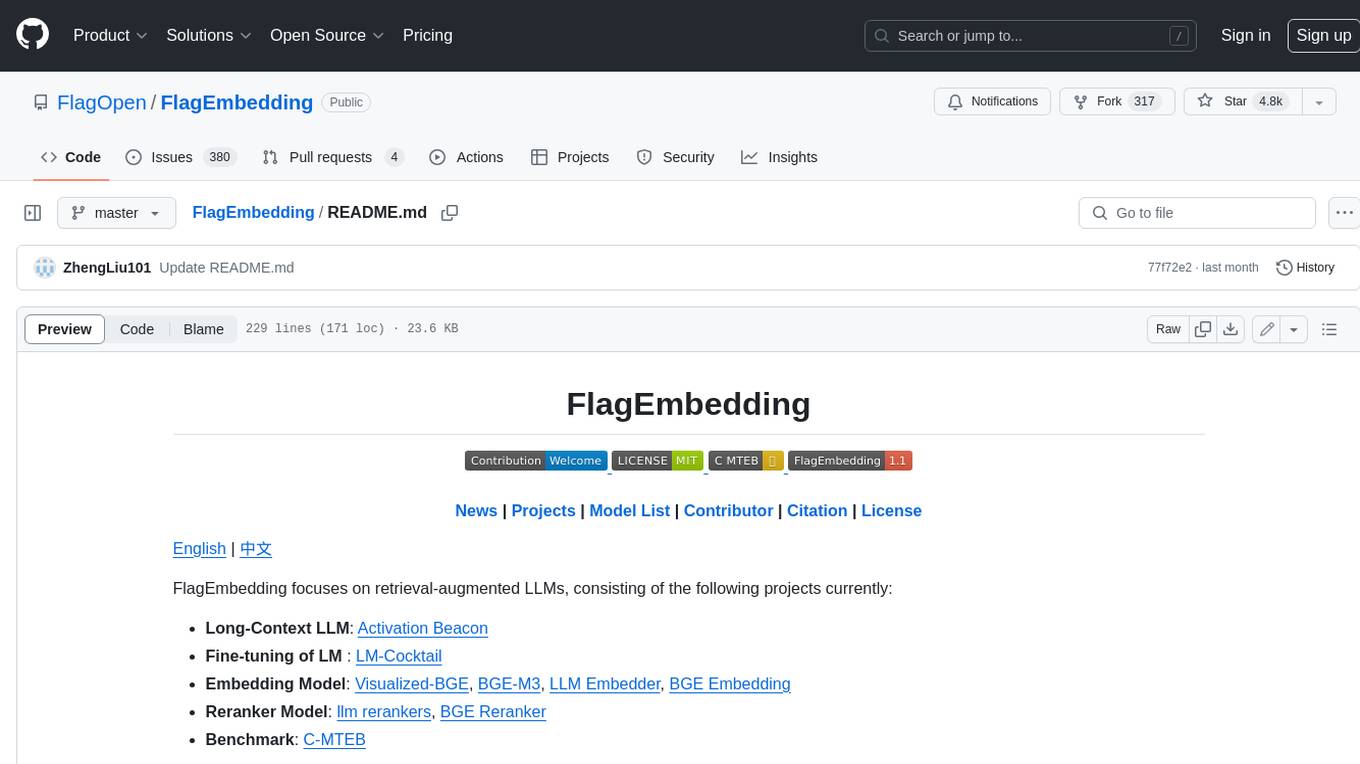
FlagEmbedding
FlagEmbedding focuses on retrieval-augmented LLMs, consisting of the following projects currently: * **Long-Context LLM** : Activation Beacon * **Fine-tuning of LM** : LM-Cocktail * **Embedding Model** : Visualized-BGE, BGE-M3, LLM Embedder, BGE Embedding * **Reranker Model** : llm rerankers, BGE Reranker * **Benchmark** : C-MTEB
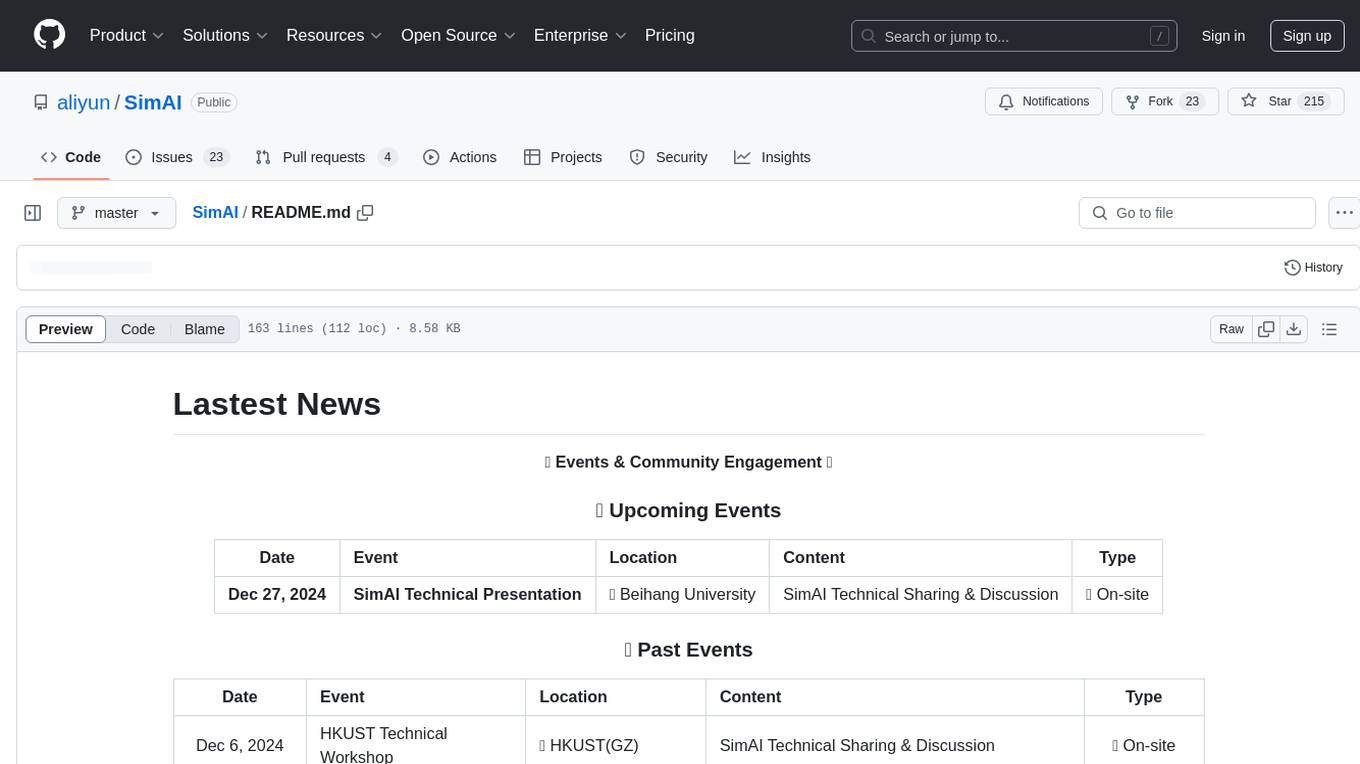
SimAI
SimAI is the industry's first full-stack, high-precision simulator for AI large-scale training. It provides detailed modeling and simulation of the entire LLM training process, encompassing framework, collective communication, network layers, and more. This comprehensive approach offers end-to-end performance data, enabling researchers to analyze training process details, evaluate time consumption of AI tasks under specific conditions, and assess performance gains from various algorithmic optimizations.
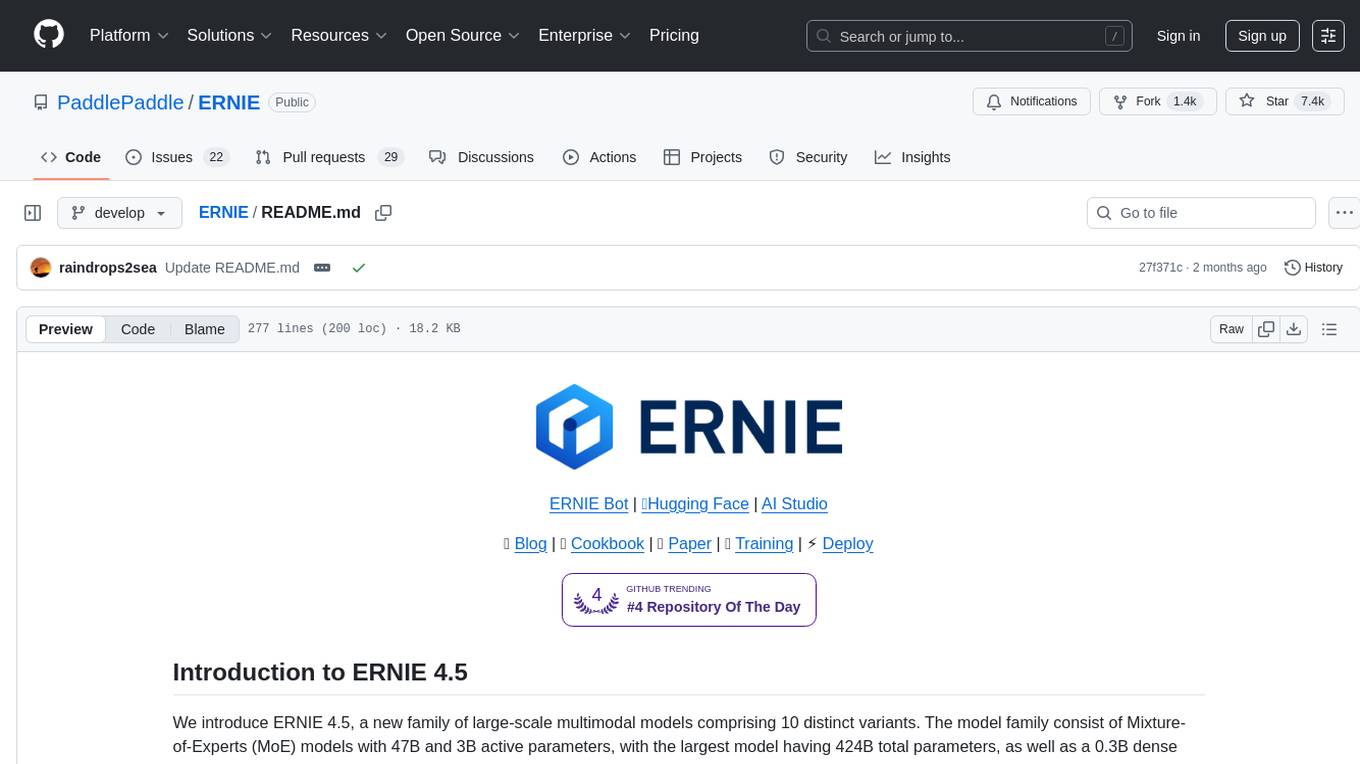
ERNIE
ERNIE 4.5 is a family of large-scale multimodal models with 10 distinct variants, including Mixture-of-Experts (MoE) models with 47B and 3B active parameters. The models feature a novel heterogeneous modality structure supporting parameter sharing across modalities while allowing dedicated parameters for each individual modality. Trained with optimal efficiency using PaddlePaddle deep learning framework, ERNIE 4.5 models achieve state-of-the-art performance across text and multimodal benchmarks, enhancing multimodal understanding without compromising performance on text-related tasks. The open-source development toolkits for ERNIE 4.5 offer industrial-grade capabilities, resource-efficient training and inference workflows, and multi-hardware compatibility.
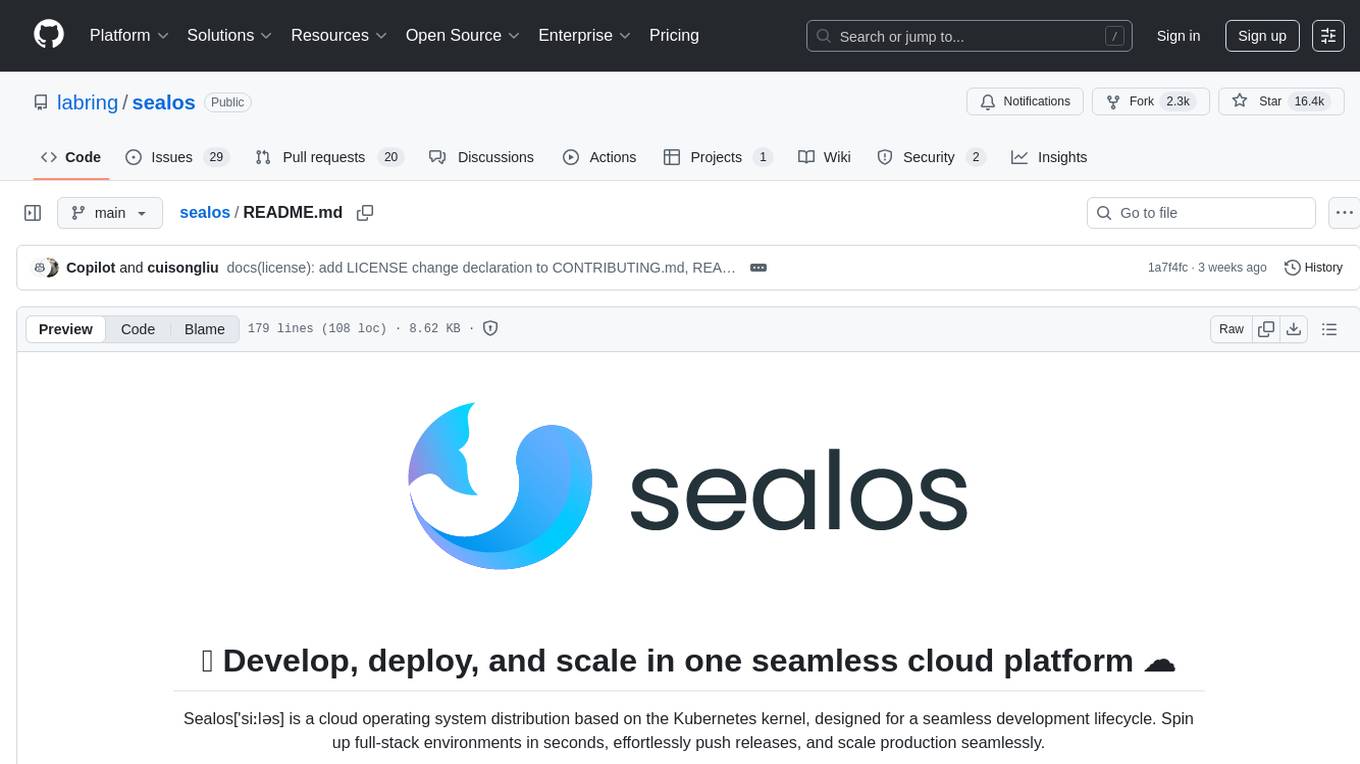
sealos
Sealos is a cloud operating system distribution based on the Kubernetes kernel, designed for a seamless development lifecycle. It allows users to spin up full-stack environments in seconds, effortlessly push releases, and scale production seamlessly. With core features like easy application management, quick database creation, and cloud universality, Sealos offers efficient and economical cloud management with high universality and ease of use. The platform also emphasizes agility and security through its multi-tenancy sharing model. Sealos is supported by a community offering full documentation, Discord support, and active development roadmap.
agents-towards-production
Agents Towards Production is an open-source playbook for building production-ready GenAI agents that scale from prototype to enterprise. Tutorials cover stateful workflows, vector memory, real-time web search APIs, Docker deployment, FastAPI endpoints, security guardrails, GPU scaling, browser automation, fine-tuning, multi-agent coordination, observability, evaluation, and UI development.
fAIr
fAIr is an open AI-assisted mapping service developed by the Humanitarian OpenStreetMap Team (HOT) to improve mapping efficiency and accuracy for humanitarian purposes. It uses AI models, specifically computer vision techniques, to detect objects like buildings, roads, waterways, and trees from satellite and UAV imagery. The service allows OSM community members to create and train their own AI models for mapping in their region of interest and ensures models are relevant to local communities. Constant feedback loop with local communities helps eliminate model biases and improve model accuracy.
kubesphere
KubeSphere is a distributed operating system for cloud-native application management, using Kubernetes as its kernel. It provides a plug-and-play architecture, allowing third-party applications to be seamlessly integrated into its ecosystem. KubeSphere is also a multi-tenant container platform with full-stack automated IT operation and streamlined DevOps workflows. It provides developer-friendly wizard web UI, helping enterprises to build out a more robust and feature-rich platform, which includes most common functionalities needed for enterprise Kubernetes strategy.
PhiCookBook
Phi Cookbook is a repository containing hands-on examples with Microsoft's Phi models, which are a series of open source AI models developed by Microsoft. Phi is currently the most powerful and cost-effective small language model with benchmarks in various scenarios like multi-language, reasoning, text/chat generation, coding, images, audio, and more. Users can deploy Phi to the cloud or edge devices to build generative AI applications with limited computing power.
superduperdb
SuperDuperDB is a Python framework for integrating AI models, APIs, and vector search engines directly with your existing databases, including hosting of your own models, streaming inference and scalable model training/fine-tuning. Build, deploy and manage any AI application without the need for complex pipelines, infrastructure as well as specialized vector databases, and moving our data there, by integrating AI at your data's source: - Generative AI, LLMs, RAG, vector search - Standard machine learning use-cases (classification, segmentation, regression, forecasting recommendation etc.) - Custom AI use-cases involving specialized models - Even the most complex applications/workflows in which different models work together SuperDuperDB is **not** a database. Think `db = superduper(db)`: SuperDuperDB transforms your databases into an intelligent platform that allows you to leverage the full AI and Python ecosystem. A single development and deployment environment for all your AI applications in one place, fully scalable and easy to manage.
cherry-studio
Cherry Studio is a desktop client that supports multiple LLM providers on Windows, Mac, and Linux. It offers diverse LLM provider support, AI assistants & conversations, document & data processing, practical tools integration, and enhanced user experience. The tool includes features like support for major LLM cloud services, AI web service integration, local model support, pre-configured AI assistants, document processing for text, images, and more, global search functionality, topic management system, AI-powered translation, and cross-platform support with ready-to-use features and themes for a better user experience.
lerobot
LeRobot is a state-of-the-art AI library for real-world robotics in PyTorch. It aims to provide models, datasets, and tools to lower the barrier to entry to robotics, focusing on imitation learning and reinforcement learning. LeRobot offers pretrained models, datasets with human-collected demonstrations, and simulation environments. It plans to support real-world robotics on affordable and capable robots. The library hosts pretrained models and datasets on the Hugging Face community page.
lightllm
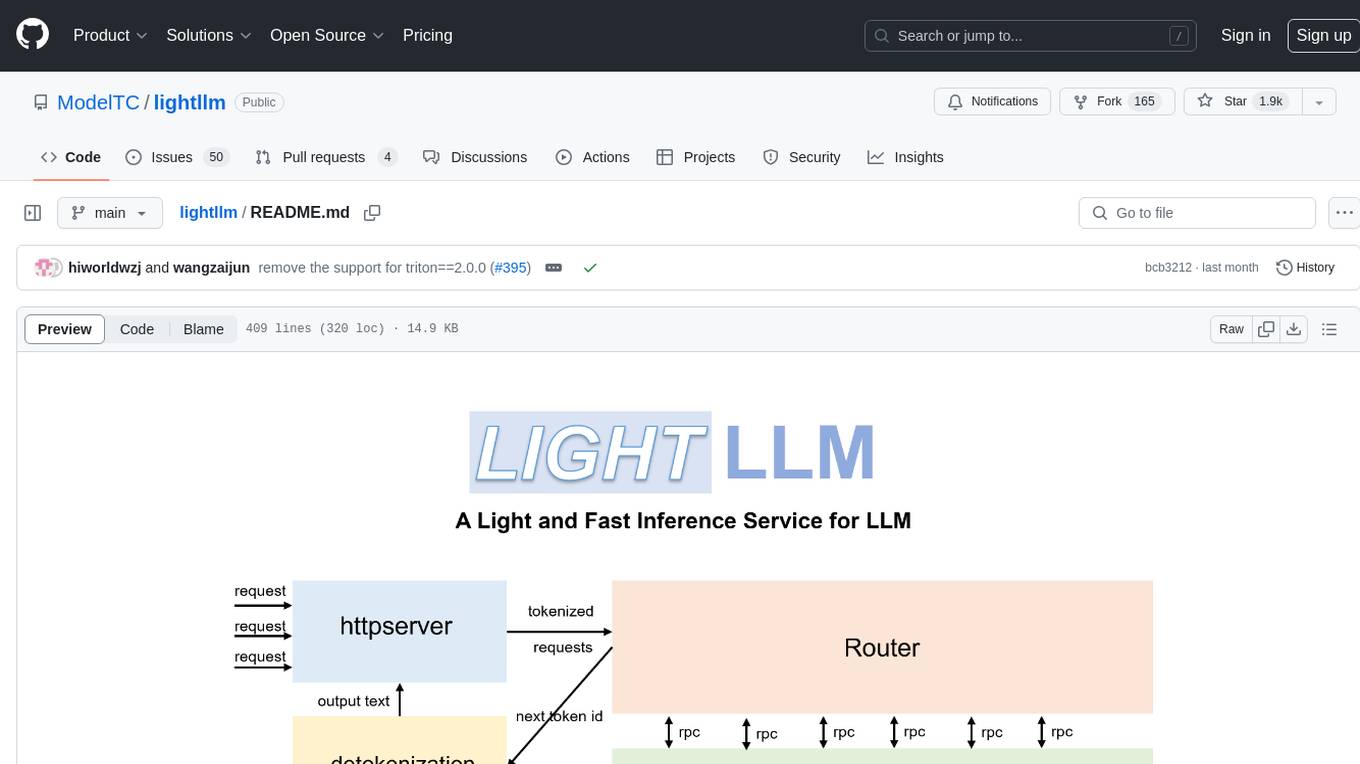
LightLLM is a Python-based LLM (Large Language Model) inference and serving framework known for its lightweight design, scalability, and high-speed performance. It offers features like tri-process asynchronous collaboration, Nopad for efficient attention operations, dynamic batch scheduling, FlashAttention integration, tensor parallelism, Token Attention for zero memory waste, and Int8KV Cache. The tool supports various models like BLOOM, LLaMA, StarCoder, Qwen-7b, ChatGLM2-6b, Baichuan-7b, Baichuan2-7b, Baichuan2-13b, InternLM-7b, Yi-34b, Qwen-VL, Llava-7b, Mixtral, Stablelm, and MiniCPM. Users can deploy and query models using the provided server launch commands and interact with multimodal models like QWen-VL and Llava using specific queries and images.
For similar tasks
parallax
Parallax is a fully decentralized inference engine developed by Gradient. It allows users to build their own AI cluster for model inference across distributed nodes with varying configurations and physical locations. Core features include hosting local LLM on personal devices, cross-platform support, pipeline parallel model sharding, paged KV cache management, continuous batching for Mac, dynamic request scheduling, and routing for high performance. The backend architecture includes P2P communication powered by Lattica, GPU backend powered by SGLang and vLLM, and MAC backend powered by MLX LM.
aiocache
Aiocache is an asyncio cache library that supports multiple backends such as memory, redis, and memcached. It provides a simple interface for functions like add, get, set, multi_get, multi_set, exists, increment, delete, clear, and raw. Users can easily install and use the library for caching data in Python applications. Aiocache allows for easy instantiation of caches and setup of cache aliases for reusing configurations. It also provides support for backends, serializers, and plugins to customize cache operations. The library offers detailed documentation and examples for different use cases and configurations.
modelbench
ModelBench is a tool for running safety benchmarks against AI models and generating detailed reports. It is part of the MLCommons project and is designed as a proof of concept to aggregate measures, relate them to specific harms, create benchmarks, and produce reports. The tool requires LlamaGuard for evaluating responses and a TogetherAI account for running benchmarks. Users can install ModelBench from GitHub or PyPI, run tests using Poetry, and create benchmarks by providing necessary API keys. The tool generates static HTML pages displaying benchmark scores and allows users to dump raw scores and manage cache for faster runs. ModelBench is aimed at enabling users to test their own models and create tests and benchmarks.
llm-d-kv-cache-manager
Efficiently caching Key & Value (KV) tensors is crucial for optimizing LLM inference. Reusing the KV-Cache significantly improves Time To First Token (TTFT) and overall throughput, maximizing system resource-utilization. `llm-d-kv-cache-manager` is a pluggable service enabling KV-Cache Aware Routing for vLLM-based serving platforms, with a high-performance KV-Cache Indexer component tracking KV-Block locality across vLLM pods. It provides intelligent routing for optimal KV-cache-aware placement decisions.
semantic-router
Semantic Router is a superfast decision-making layer for your LLMs and agents. Rather than waiting for slow LLM generations to make tool-use decisions, we use the magic of semantic vector space to make those decisions — _routing_ our requests using _semantic_ meaning.
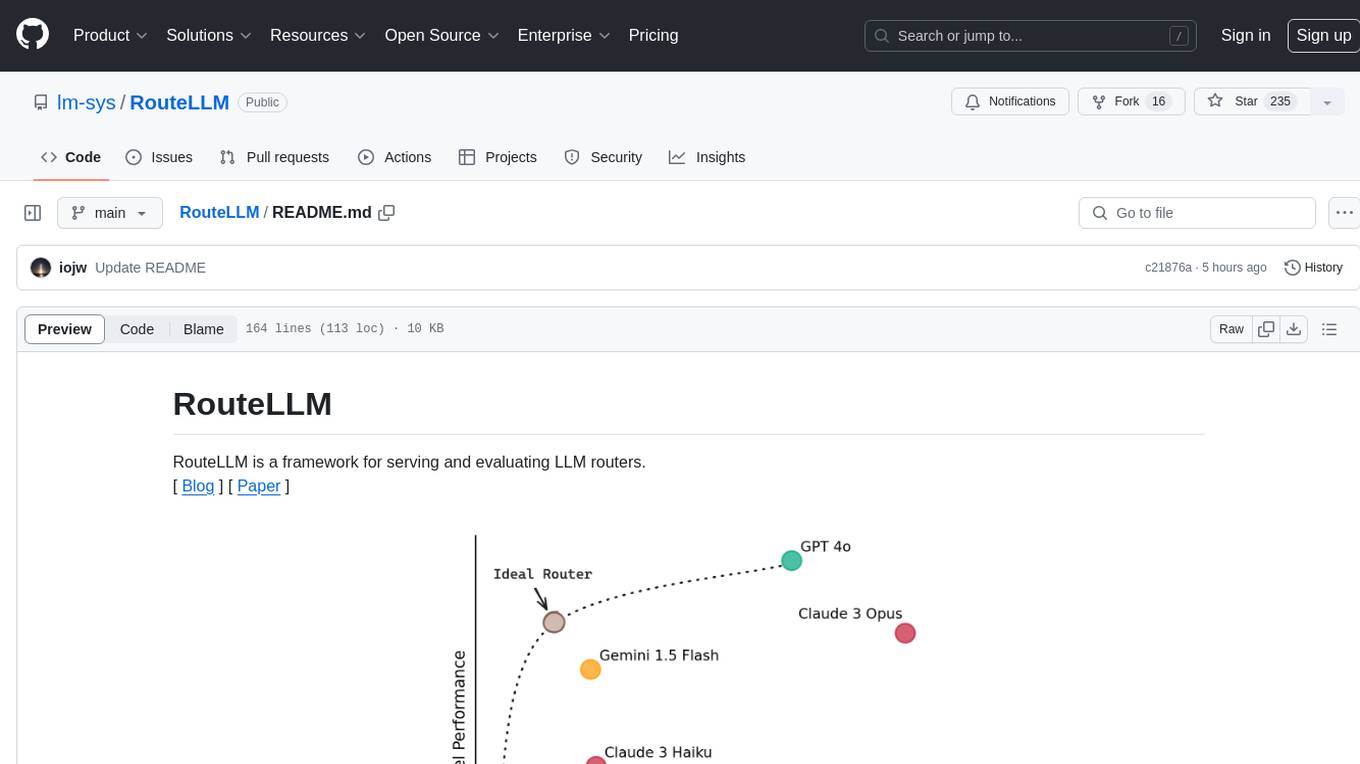
RouteLLM
RouteLLM is a framework for serving and evaluating LLM routers. It allows users to launch an OpenAI-compatible API that routes requests to the best model based on cost thresholds. Trained routers are provided to reduce costs while maintaining performance. Users can easily extend the framework, compare router performance, and calibrate cost thresholds. RouteLLM supports multiple routing strategies and benchmarks, offering a lightweight server and evaluation framework. It enables users to evaluate routers on benchmarks, calibrate thresholds, and modify model pairs. Contributions for adding new routers and benchmarks are welcome.
DeepAI
DeepAI is a proxy server that enhances the interaction experience of large language models (LLMs) by integrating the 'thinking chain' process. It acts as an intermediary layer, receiving standard OpenAI API compatible requests, using independent 'thinking services' to generate reasoning processes, and then forwarding the enhanced requests to the LLM backend of your choice. This ensures that responses are not only generated by the LLM but also based on pre-inference analysis, resulting in more insightful and coherent answers. DeepAI supports seamless integration with applications designed for the OpenAI API, providing endpoints for '/v1/chat/completions' and '/v1/models', making it easy to integrate into existing applications. It offers features such as reasoning chain enhancement, flexible backend support, API key routing, weighted random selection, proxy support, comprehensive logging, and graceful shutdown.
Toolify
Toolify is a middleware proxy that empowers Large Language Models (LLMs) and OpenAI API interfaces by enabling function calling capabilities. It acts as an intermediary between applications and LLM APIs, injecting prompts and parsing tool calls from the model's response. Key features include universal function calling, multiple function calls support, flexible initiation, compatibility with
For similar jobs
weave
Weave is a toolkit for developing Generative AI applications, built by Weights & Biases. With Weave, you can log and debug language model inputs, outputs, and traces; build rigorous, apples-to-apples evaluations for language model use cases; and organize all the information generated across the LLM workflow, from experimentation to evaluations to production. Weave aims to bring rigor, best-practices, and composability to the inherently experimental process of developing Generative AI software, without introducing cognitive overhead.
LLMStack
LLMStack is a no-code platform for building generative AI agents, workflows, and chatbots. It allows users to connect their own data, internal tools, and GPT-powered models without any coding experience. LLMStack can be deployed to the cloud or on-premise and can be accessed via HTTP API or triggered from Slack or Discord.
VisionCraft
The VisionCraft API is a free API for using over 100 different AI models. From images to sound.
kaito
Kaito is an operator that automates the AI/ML inference model deployment in a Kubernetes cluster. It manages large model files using container images, avoids tuning deployment parameters to fit GPU hardware by providing preset configurations, auto-provisions GPU nodes based on model requirements, and hosts large model images in the public Microsoft Container Registry (MCR) if the license allows. Using Kaito, the workflow of onboarding large AI inference models in Kubernetes is largely simplified.
PyRIT
PyRIT is an open access automation framework designed to empower security professionals and ML engineers to red team foundation models and their applications. It automates AI Red Teaming tasks to allow operators to focus on more complicated and time-consuming tasks and can also identify security harms such as misuse (e.g., malware generation, jailbreaking), and privacy harms (e.g., identity theft). The goal is to allow researchers to have a baseline of how well their model and entire inference pipeline is doing against different harm categories and to be able to compare that baseline to future iterations of their model. This allows them to have empirical data on how well their model is doing today, and detect any degradation of performance based on future improvements.
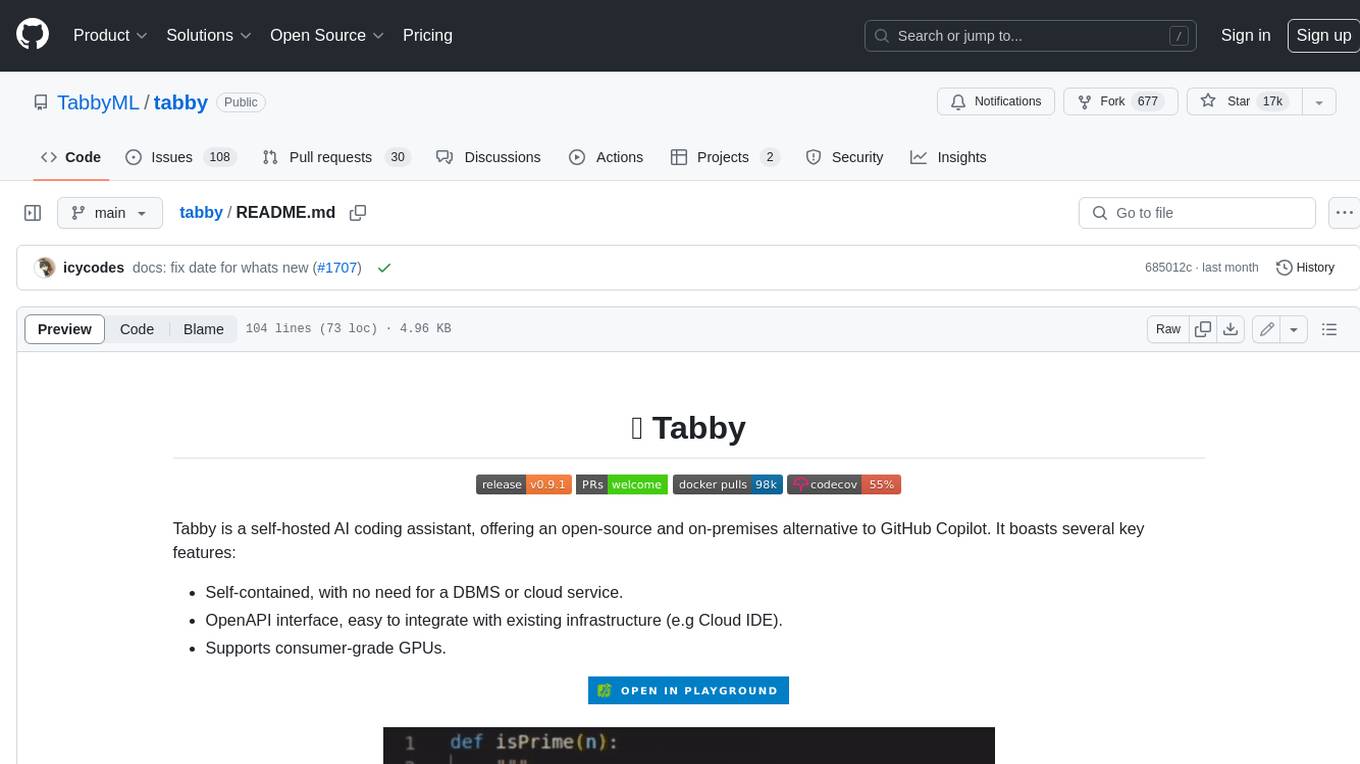
tabby
Tabby is a self-hosted AI coding assistant, offering an open-source and on-premises alternative to GitHub Copilot. It boasts several key features: * Self-contained, with no need for a DBMS or cloud service. * OpenAPI interface, easy to integrate with existing infrastructure (e.g Cloud IDE). * Supports consumer-grade GPUs.
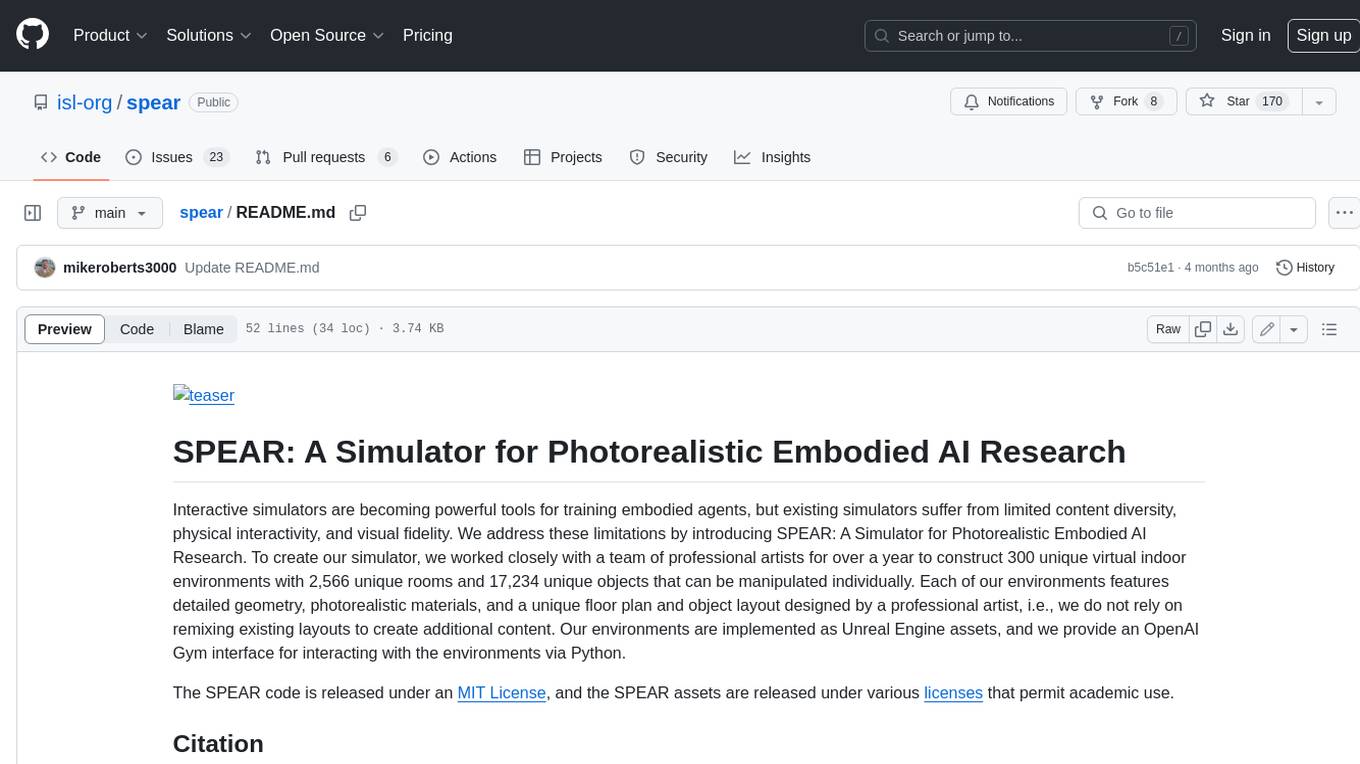
spear
SPEAR (Simulator for Photorealistic Embodied AI Research) is a powerful tool for training embodied agents. It features 300 unique virtual indoor environments with 2,566 unique rooms and 17,234 unique objects that can be manipulated individually. Each environment is designed by a professional artist and features detailed geometry, photorealistic materials, and a unique floor plan and object layout. SPEAR is implemented as Unreal Engine assets and provides an OpenAI Gym interface for interacting with the environments via Python.
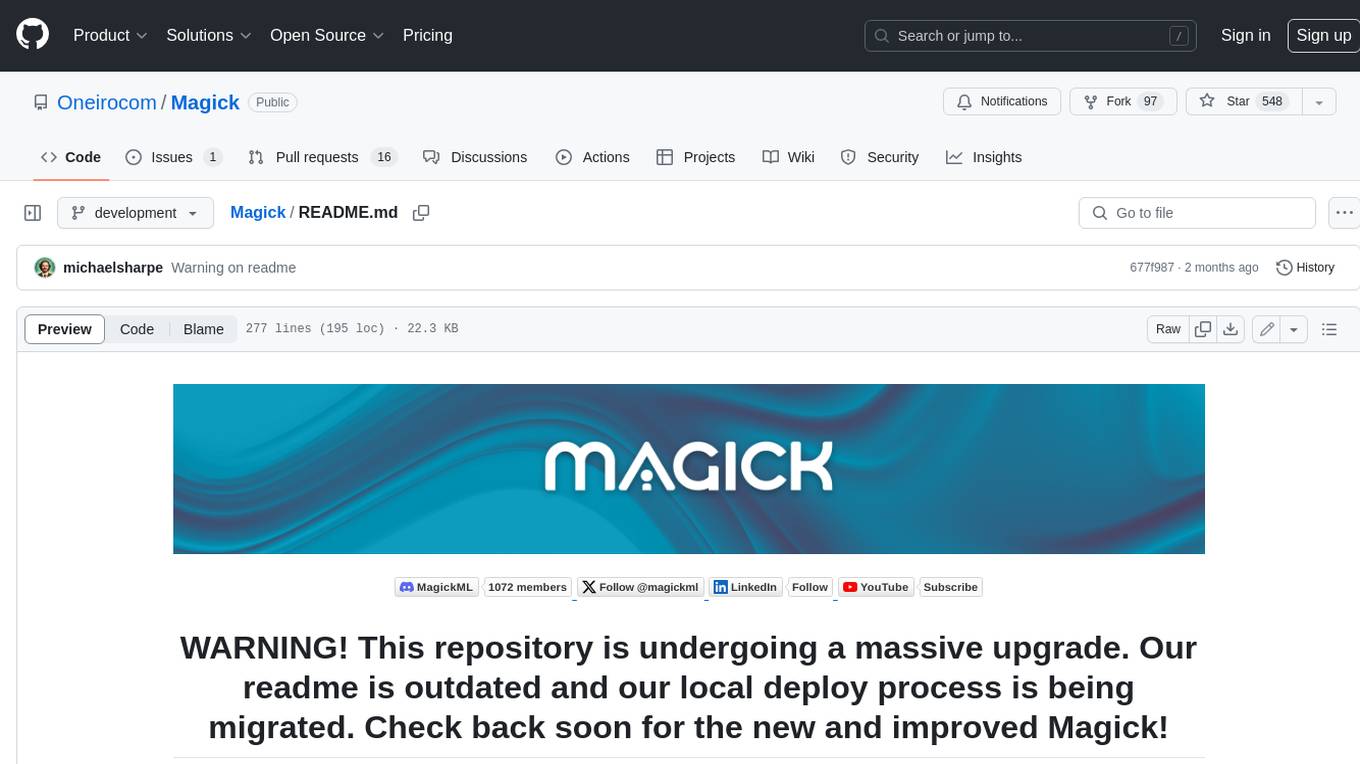
Magick
Magick is a groundbreaking visual AIDE (Artificial Intelligence Development Environment) for no-code data pipelines and multimodal agents. Magick can connect to other services and comes with nodes and templates well-suited for intelligent agents, chatbots, complex reasoning systems and realistic characters.