


aioreactive
Async/await reactive tools for Python 3.10+
Stars: 379
Aioreactive is a Python library that brings ReactiveX functionality to asyncio using async and await. It is built on the Expression functional library and aims to provide a simple, clean, and async-based approach to reactive programming in Python. The library supports Python 3.10+ and focuses on using plain old functions for operators, running on the asyncio event loop, and providing implicit synchronous back-pressure for event processing.
README:





NEWS: Project rebooted Nov. 2020. Rebuilt using Expression.
Aioreactive is RxPY for asyncio. It's an asynchronous and reactive Python library for asyncio using async and await. Aioreactive is built on the Expression functional library and, integrates naturally with the Python language.
aioreactive is the unification of RxPY and reactive programming with asyncio using async and await.
- Python 3.10+ only. We have a hard dependency Expression v5.
- All operators and tools are implemented as plain old functions.
- Everything is
async. Sending values is async, subscribing to observables is async. Disposing subscriptions is async. - One scheduler to rule them all. Everything runs on the asyncio base event-loop.
- No multi-threading. Only async and await with concurrency using
asyncio. Threads are hard, and in many cases it doesn’t make sense to
use multi-threading in Python applications. If you need to use threads
you may wrap them with
concurrent.futuresand compose them into the chain withflat_map()or similar. Seeparallel.pyfor an example. - Simple, clean and use few abstractions. Try to align with the itertools package, and reuse as much from the Python standard library as possible.
- Support type hints and static type checking using Pylance.
- Implicit synchronous back-pressure ™. Producers of events will simply be awaited until the event can be processed by the down-stream consumers.
With aioreactive you subscribe observers to observables, and the key abstractions of aioreactive can be seen in this single line of code:
subscription = await observable.subscribe_async(observer)The difference from RxPY can be seen with the await expression.
Aioreactive is built around the asynchronous duals, or opposites of the
AsyncIterable and AsyncIterator abstract base classes. These async
classes are called AsyncObservable and AsyncObserver.
AsyncObservable is a producer of events. It may be seen as the dual or
opposite of AsyncIterable and provides a single setter method called
subscribe_async() that is the dual of the __aiter__() getter method:
from abc import ABC, abstractmethod

class AsyncObservable(ABC):
    @abstractmethod
    async def subscribe_async(self, observer):
        return NotImplemented
AsyncObserver is a consumer of events and is modeled after the
so-called consumer interface, the
enhanced generator interface in
PEP-342 and async
generators in PEP-525. It
is the dual of the AsyncIterator __anext__() method, and expands to
three async methods asend(), that is the opposite of __anext__(),
athrow() that is the opposite of an raise Exception() and aclose()
that is the opposite of raise StopAsyncIteration:
from abc import ABC, abstractmethod

class AsyncObserver(ABC):
    @abstractmethod
    async def asend(self, value):
        return NotImplemented

    @abstractmethod
    async def athrow(self, error):
        return NotImplemented

    @abstractmethod
    async def aclose(self):
return NotImplementedAn observable becomes hot and starts streaming items by using the
subscribe_async() method. The subscribe_async() method takes an
observable and returns a disposable subscription. So the
subscribe_async() method is used to attach a observer to the
observable.
async def asend(value):
    print(value)

disposable = await subscribe_async(source, AsyncAnonymousObserver(asend))
AsyncAnonymousObserver is an anonymous observer that constructs an
AsyncObserver out of plain async functions, so you don't have to
implement a new named observer every time you need one.
The subscription returned by subscribe_async() is disposable, so to
unsubscribe you need to await the dispose_async() method on the
subscription.
await subscription.dispose_async()Even more interesting, with to_async_iterable you can flip around from
AsyncObservable to an AsyncIterable and use async-for to consume
the stream of events.
import aioreactive as rx

xs = rx.from_iterable([1, 2, 3])
async for x in xs:
    print(x)
They effectively transform us from an async push model to an async pull
model, and lets us use the awesome new language features such as async for and async-with. We do this without any queueing, as a push by the
AsyncObservable will await the pull by the `AsyncIterator. This
effectively applies so-called "back-pressure" up the subscription as the
producer will await the iterator to pick up the item send.
The for-loop may be wrapped with async-with to control the lifetime of the subscription:
import aioreactive as rx

xs = rx.from_iterable([1, 2, 3])
result = []

obv = rx.AsyncIteratorObserver(xs)
async with await xs.subscribe_async(obv) as subscription:
    async for x in obv:
        result.append(x)

assert result == [1, 2, 3]An async stream is both an async observer and an async observable. Aioreactive lets you create streams explicitly.
import aioreactive as rx

stream = AsyncSubject()  # Alias for AsyncMultiStream

sink = rx.AsyncAnonymousObserver()
await stream.subscribe_async(sink)
await stream.asend(42)
You can create streams directly from AsyncMultiStream or
AsyncSingleStream. AsyncMultiStream supports multiple observers, and
is hot in the sense that it will drop any event that is sent if there
are currently no observers attached. AsyncSingleStream on the other
hand supports a single observer, and is cold in the sense that it will
await any producer until there is an observer attached.
The Rx operators in aioreactive are all plain old functions. You can apply them to an observable and compose it into a transformed, filtered, aggregated or combined observable. This transformed observable can be streamed into an observer.
Observable -> Operator -> Operator -> Operator -> Observer
Aioreactive contains many of the same operators as you know from RxPY. Our goal is not to implement them all, but to provide the most essential ones.
- concat -- Concatenates two or more observables.
- choose -- Filters and/or transforms the observable.
- choose_asnc -- Asynchronously filters and/or transforms the observable.
- debounce -- Throttles an observable.
- delay -- delays the items within an observable.
- distinct_until_changed -- an observable with continuously distinct values.
- filter -- filters an observable.
- filteri -- filters an observable with index.
- flat_map -- transforms an observable into a stream of observables and flattens the resulting observable.
- flat_map_latest -- transforms an observable into a stream of observables and flattens the resulting observable by producing values from the latest observable.
- from_iterable -- Create an observable from an (async) iterable.
- subscribe -- Subscribes an observer to an observable. Returns a subscription.
- map -- transforms an observable.
- mapi -- transforms an observable with index.
- map_async -- transforms an observable asynchronously.
- mapi_async -- transforms an observable asynchronously with index.
- merge_inner -- Merges an observable of observables.
- merge -- Merge one observable with another observable.
- merge_seq -- Merge a sequence of observables.
- run -- Awaits the future returned by subscribe. Returns when the subscription closes.
- slice -- Slices an observable.
- skip -- Skip items from the start of the observable stream.
- skip_last -- Skip items from the end of the observable stream.
- starfilter -- Filters an observable with a predicate and spreads the arguments.
- starmap -- Transforms and async observable and spreads the arguments to the mapper.
- switch_latest -- Merges the latest stream in an observable of streams.
- take -- Take a number of items from the start of the observable stream.
- take_last -- Take a number of items from the end of the observable stream.
- unit -- Converts a value or future to an observable.
- with_latest_from -- Combines two observables into one.
With aioreactive you can choose to program functionally with plain old functions, or object-oriented with classes and methods. Aioreactive supports both method chaining or forward pipe programming styles.
AsyncObservable may compose operators using forward pipelining with
the pipe operator provided by the amazing
Expression library. This works
by having the operators partially applied with their arguments before
being given the source stream as the last curried argument.
ys = pipe(xs, filter(predicate), map(mapper), flat_map(request))Longer pipelines may break lines as for binary operators:
import aioreactve as rx

async def main():
    stream = rx.AsyncSubject()
    obv = rx.AsyncIteratorObserver()

    xs = pipe(
        stream,
        rx.map(lambda x: x["term"]),
        rx.filter(lambda text: len(text) > 2),
        rx.debounce(0.75),
        rx.distinct_until_changed(),
        rx.map(search_wikipedia),
        rx.switch_latest(),
    )

    async with xs.subscribe_async(obv) as ys
        async for value in obv:
            print(value)
AsyncObservable also supports slicing using the Python slice notation.
@pytest.mark.asyncio
async def test_slice_special():
    xs = rx.from_iterable([1, 2, 3, 4, 5])
    values = []

    async def asend(value):
        values.append(value)

    ys = xs[1:-1]

    result = await run(ys, AsyncAnonymousObserver(asend))

    assert result == 4
assert values == [2, 3, 4]An alternative to pipelining is to use the classic and fluent method chaining as we know from ReactiveX.
An AsyncObservable created from class methods such as
AsyncRx.from_iterable() returns a AsyncChainedObservable.
where we may use methods such as .filter() and .map().
from aioreactive import AsyncRx

@pytest.mark.asyncio
async def test_observable_simple_pipe():
    xs = AsyncRx.from_iterable([1, 2, 3])
    result = []

    async def mapper(value):
        await asyncio.sleep(0.1)
        return value * 10

    async def predicate(value):
        await asyncio.sleep(0.1)
        return value > 1

    ys = xs.filter(predicate).map(mapper)

    async def on_next(value):
        result.append(value)

    subscription = await ys.subscribe_async(AsyncAnonymousObserver(on_next))
    await subsubscription
assert result == [20, 30]Aioreactive also provides a virtual time event loop
(VirtualTimeEventLoop) that enables you to write asyncio unit-tests
that run in virtual time. Virtual time means that time is emulated, so
tests run as quickly as possible even if they sleep or awaits long-lived
operations. A test using virtual time still gives the same result as it
would have done if it had been run in real-time.
For example the following test still gives the correct result even if it takes 0 seconds to run:
@pytest.fixture()
def event_loop():
    loop = VirtualTimeEventLoop()
    yield loop
    loop.close()

@pytest.mark.asyncio
async def test_call_later():
    result = []

    def action(value):
        result.append(value)

    loop = asyncio.get_event_loop()
    loop.call_later(10, partial(action, 1))
    loop.call_later(1, partial(action, 2))
    loop.call_later(5, partial(action, 3))
    await asyncio.sleep(10)
    assert result == [2, 3, 1]
The aioreactive testing module provides a test AsyncSubject that may
delay sending values, and a test AsyncTestObserver that records all
events. These two classes helps you with testing in virtual time.
@pytest.fixture()
def event_loop():
    loop = VirtualTimeEventLoop()
    yield loop
    loop.close()

@pytest.mark.asyncio
async def test_delay_done():
    xs = AsyncTestSubject()  # Test stream

    ys = pipe(xs, rx.delay(1.0))
    obv = AsyncTestObserver()  # Test AsyncAnonymousObserver
    async with await ys.subscribe_async(obv):
        await xs.asend_later(0, 10)
        await xs.asend_later(1.0, 20)
        await xs.aclose_later(1.0)
        await obv

    assert obv.values == [
        (ca(1), OnNext(10)),
        (ca(2), OnNext(20)),
        (ca(3), OnCompleted()),
]AsyncIterable and AsyncObservable are closely related (in fact they
are duals). AsyncIterable is an async iterable (pull) world, while
AsyncObservable is an async reactive (push) based world. There are
many operations such as map() and filter() that may be simpler to
implement using AsyncIterable, but once we start to include time, then
AsyncObservable really starts to shine. Operators such as delay()
makes much more sense for AsyncObservable than for AsyncIterable.
However, aioreactive makes it easy for you to flip-around to async iterable just before you need to consume the stream, thus giving you the best of both worlds.
Aioreactive will not replace RxPY.
RxPY is an implementation of Observable. Aioreactive is an
implementation of AsyncObservable.
Rx and RxPY has hundreds of different query operators, and we currently have no plans to implementing all of them for aioreactive.
Many ideas from aioreactive have already been ported back into "classic" RxPY.
Aioreactive was inspired by:
- AsyncRx - Aioreactive is a direct port of AsyncRx from F#.
- Expression - Functional programming for Python.
- Is it really Pythonic to continue using LINQ operators instead of plain old functions?
- Reactive Extensions (Rx) and RxPY.
- Dart Streams
- Underscore.js.
- itertools and functools.
- dbrattli/OSlash
- kriskowal/q.
The MIT License (MIT) Copyright (c) 2016 Børge Lanes, Dag Brattli.
For Tasks:
Click tags to check more tools for each tasksFor Jobs:
Alternative AI tools for aioreactive
Similar Open Source Tools
aioreactive
Aioreactive is a Python library that brings ReactiveX functionality to asyncio using async and await. It is built on the Expression functional library and aims to provide a simple, clean, and async-based approach to reactive programming in Python. The library supports Python 3.10+ and focuses on using plain old functions for operators, running on the asyncio event loop, and providing implicit synchronous back-pressure for event processing.
MiniAgents
MiniAgents is an open-source Python framework designed to simplify the creation of multi-agent AI systems. It offers a parallelism and async-first design, allowing users to focus on building intelligent agents while handling concurrency challenges. The framework, built on asyncio, supports LLM-based applications with immutable messages and seamless asynchronous token and message streaming between agents.
crb
CRB (Composable Runtime Blocks) is a unique framework that implements hybrid workloads by seamlessly combining synchronous and asynchronous activities, state machines, routines, the actor model, and supervisors. It is ideal for building massive applications and serves as a low-level framework for creating custom frameworks, such as AI-agents. The core idea is to ensure high compatibility among all blocks, enabling significant code reuse. The framework allows for the implementation of algorithms with complex branching, making it suitable for building large-scale applications or implementing complex workflows, such as AI pipelines. It provides flexibility in defining structures, implementing traits, and managing execution flow, allowing users to create robust and nonlinear algorithms easily.
mosec
Mosec is a high-performance and flexible model serving framework for building ML model-enabled backend and microservices. It bridges the gap between any machine learning models you just trained and the efficient online service API. * **Highly performant** : web layer and task coordination built with Rust 🦀, which offers blazing speed in addition to efficient CPU utilization powered by async I/O * **Ease of use** : user interface purely in Python 🐍, by which users can serve their models in an ML framework-agnostic manner using the same code as they do for offline testing * **Dynamic batching** : aggregate requests from different users for batched inference and distribute results back * **Pipelined stages** : spawn multiple processes for pipelined stages to handle CPU/GPU/IO mixed workloads * **Cloud friendly** : designed to run in the cloud, with the model warmup, graceful shutdown, and Prometheus monitoring metrics, easily managed by Kubernetes or any container orchestration systems * **Do one thing well** : focus on the online serving part, users can pay attention to the model optimization and business logic
aiorun
aiorun is a Python package that provides a `run()` function as the starting point of your `asyncio`-based application. The `run()` function handles everything needed during the shutdown sequence of the application, such as creating a `Task` for the given coroutine, running the event loop, adding signal handlers for `SIGINT` and `SIGTERM`, cancelling tasks, waiting for the executor to complete shutdown, and closing the loop. It automates standard actions for asyncio apps, eliminating the need to write boilerplate code. The package also offers error handling options and tools for specific scenarios like TCP server startup and smart shield for shutdown.
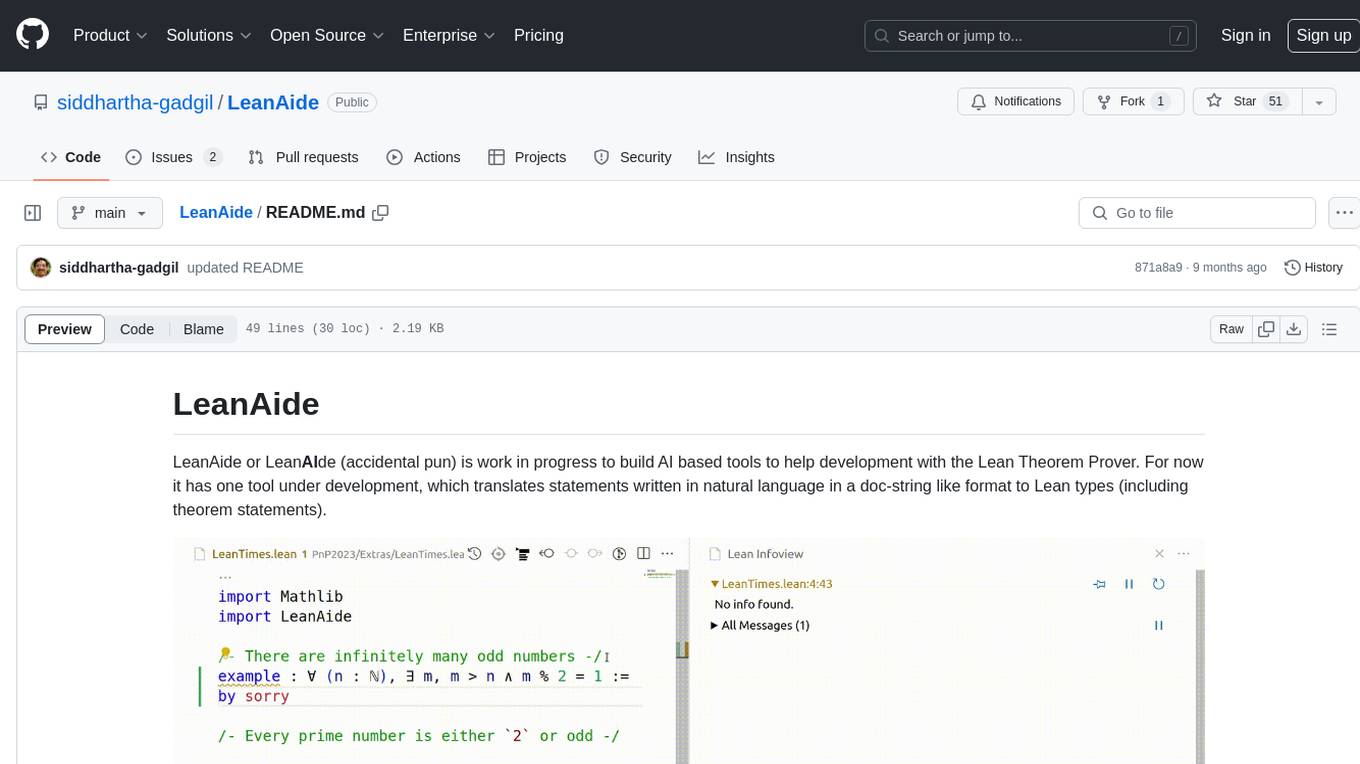
LeanAide
LeanAide is a work in progress AI tool designed to assist with development using the Lean Theorem Prover. It currently offers a tool that translates natural language statements to Lean types, including theorem statements. The tool is based on GPT 3.5-turbo/GPT 4 and requires an OpenAI key for usage. Users can include LeanAide as a dependency in their projects to access the translation functionality.

generative-models
Generative Models by Stability AI is a repository that provides various generative models for research purposes. It includes models like Stable Video 4D (SV4D) for video synthesis, Stable Video 3D (SV3D) for multi-view synthesis, SDXL-Turbo for text-to-image generation, and more. The repository focuses on modularity and implements a config-driven approach for building and combining submodules. It supports training with PyTorch Lightning and offers inference demos for different models. Users can access pre-trained models like SDXL-base-1.0 and SDXL-refiner-1.0 under a CreativeML Open RAIL++-M license. The codebase also includes tools for invisible watermark detection in generated images.
Numpy.NET
Numpy.NET is the most complete .NET binding for NumPy, empowering .NET developers with extensive functionality for scientific computing, machine learning, and AI. It provides multi-dimensional arrays, matrices, linear algebra, FFT, and more via a strong typed API. Numpy.NET does not require a local Python installation, as it uses Python.Included to package embedded Python 3.7. Multi-threading must be handled carefully to avoid deadlocks or access violation exceptions. Performance considerations include overhead when calling NumPy from C# and the efficiency of data transfer between C# and Python. Numpy.NET aims to match the completeness of the original NumPy library and is generated using CodeMinion by parsing the NumPy documentation. The project is MIT licensed and supported by JetBrains.
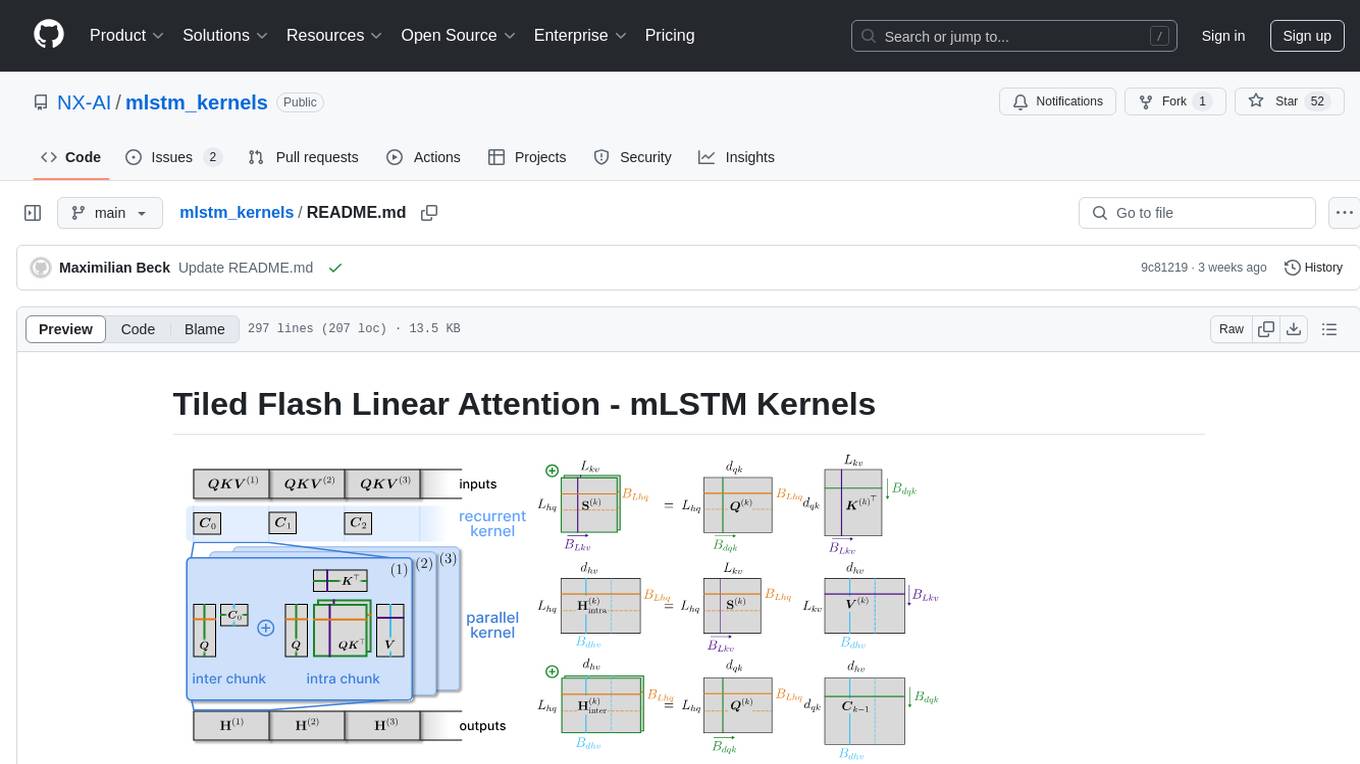
mlstm_kernels
This repository provides fast and efficient mLSTM training and inference Triton kernels built on Tiled Flash Linear Attention (TFLA). It includes implementations in JAX, PyTorch, and Triton, with chunkwise, parallel, and recurrent kernels for mLSTM. The repository also contains a benchmark library for runtime benchmarks and full mLSTM Huggingface models.
probsem
ProbSem is a repository that provides a framework to leverage large language models (LLMs) for assigning context-conditional probability distributions over queried strings. It supports OpenAI engines and HuggingFace CausalLM models, and is flexible for research applications in linguistics, cognitive science, program synthesis, and NLP. Users can define prompts, contexts, and queries to derive probability distributions over possible completions, enabling tasks like cloze completion, multiple-choice QA, semantic parsing, and code completion. The repository offers CLI and API interfaces for evaluation, with options to customize models, normalize scores, and adjust temperature for probability distributions.
x-lstm
This repository contains an unofficial implementation of the xLSTM model introduced in Beck et al. (2024). It serves as a didactic tool to explain the details of a modern Long-Short Term Memory model with competitive performance against Transformers or State-Space models. The repository also includes a Lightning-based implementation of a basic LLM for multi-GPU training. It provides modules for scalar-LSTM and matrix-LSTM, as well as an xLSTM LLM built using Pytorch Lightning for easy training on multi-GPUs.
sieves
sieves is a library for zero- and few-shot NLP tasks with structured generation, enabling rapid prototyping of NLP applications without the need for training. It simplifies NLP prototyping by bundling capabilities into a single library, providing zero- and few-shot model support, a unified interface for structured generation, built-in tasks for common NLP operations, easy extendability, document-based pipeline architecture, caching to prevent redundant model calls, and more. The tool draws inspiration from spaCy and spacy-llm, offering features like immediate inference, observable pipelines, integrated tools for document parsing and text chunking, ready-to-use tasks such as classification, summarization, translation, and more, persistence for saving and loading pipelines, distillation for specialized model creation, and caching to optimize performance.
mirage
Mirage Persistent Kernel (MPK) is a compiler and runtime system that automatically transforms LLM inference into a single megakernel—a fused GPU kernel that performs all necessary computation and communication within a single kernel launch. This end-to-end GPU fusion approach reduces LLM inference latency by 1.2× to 6.7×, all while requiring minimal developer effort.
ActionWeaver
ActionWeaver is an AI application framework designed for simplicity, relying on OpenAI and Pydantic. It supports both OpenAI API and Azure OpenAI service. The framework allows for function calling as a core feature, extensibility to integrate any Python code, function orchestration for building complex call hierarchies, and telemetry and observability integration. Users can easily install ActionWeaver using pip and leverage its capabilities to create, invoke, and orchestrate actions with the language model. The framework also provides structured extraction using Pydantic models and allows for exception handling customization. Contributions to the project are welcome, and users are encouraged to cite ActionWeaver if found useful.
mentals-ai
Mentals AI is a tool designed for creating and operating agents that feature loops, memory, and various tools, all through straightforward markdown syntax. This tool enables you to concentrate solely on the agent’s logic, eliminating the necessity to compose underlying code in Python or any other language. It redefines the foundational frameworks for future AI applications by allowing the creation of agents with recursive decision-making processes, integration of reasoning frameworks, and control flow expressed in natural language. Key concepts include instructions with prompts and references, working memory for context, short-term memory for storing intermediate results, and control flow from strings to algorithms. The tool provides a set of native tools for message output, user input, file handling, Python interpreter, Bash commands, and short-term memory. The roadmap includes features like a web UI, vector database tools, agent's experience, and tools for image generation and browsing. The idea behind Mentals AI originated from studies on psychoanalysis executive functions and aims to integrate 'System 1' (cognitive executor) with 'System 2' (central executive) to create more sophisticated agents.
py-vectara-agentic
The `vectara-agentic` Python library is designed for developing powerful AI assistants using Vectara and Agentic-RAG. It supports various agent types, includes pre-built tools for domains like finance and legal, and enables easy creation of custom AI assistants and agents. The library provides tools for summarizing text, rephrasing text, legal tasks like summarizing legal text and critiquing as a judge, financial tasks like analyzing balance sheets and income statements, and database tools for inspecting and querying databases. It also supports observability via LlamaIndex and Arize Phoenix integration.
For similar tasks
aioreactive
Aioreactive is a Python library that brings ReactiveX functionality to asyncio using async and await. It is built on the Expression functional library and aims to provide a simple, clean, and async-based approach to reactive programming in Python. The library supports Python 3.10+ and focuses on using plain old functions for operators, running on the asyncio event loop, and providing implicit synchronous back-pressure for event processing.
LakeSoul
LakeSoul is a cloud-native Lakehouse framework that supports scalable metadata management, ACID transactions, efficient and flexible upsert operation, schema evolution, and unified streaming & batch processing. It supports multiple computing engines like Spark, Flink, Presto, and PyTorch, and computing modes such as batch, stream, MPP, and AI. LakeSoul scales metadata management and achieves ACID control by using PostgreSQL. It provides features like automatic compaction, table lifecycle maintenance, redundant data cleaning, and permission isolation for metadata.
For similar jobs
resonance
Resonance is a framework designed to facilitate interoperability and messaging between services in your infrastructure and beyond. It provides AI capabilities and takes full advantage of asynchronous PHP, built on top of Swoole. With Resonance, you can: * Chat with Open-Source LLMs: Create prompt controllers to directly answer user's prompts. LLM takes care of determining user's intention, so you can focus on taking appropriate action. * Asynchronous Where it Matters: Respond asynchronously to incoming RPC or WebSocket messages (or both combined) with little overhead. You can set up all the asynchronous features using attributes. No elaborate configuration is needed. * Simple Things Remain Simple: Writing HTTP controllers is similar to how it's done in the synchronous code. Controllers have new exciting features that take advantage of the asynchronous environment. * Consistency is Key: You can keep the same approach to writing software no matter the size of your project. There are no growing central configuration files or service dependencies registries. Every relation between code modules is local to those modules. * Promises in PHP: Resonance provides a partial implementation of Promise/A+ spec to handle various asynchronous tasks. * GraphQL Out of the Box: You can build elaborate GraphQL schemas by using just the PHP attributes. Resonance takes care of reusing SQL queries and optimizing the resources' usage. All fields can be resolved asynchronously.
aiogram_bot_template
Aiogram bot template is a boilerplate for creating Telegram bots using Aiogram framework. It provides a solid foundation for building robust and scalable bots with a focus on code organization, database integration, and localization.
pluto
Pluto is a development tool dedicated to helping developers **build cloud and AI applications more conveniently** , resolving issues such as the challenging deployment of AI applications and open-source models. Developers are able to write applications in familiar programming languages like **Python and TypeScript** , **directly defining and utilizing the cloud resources necessary for the application within their code base** , such as AWS SageMaker, DynamoDB, and more. Pluto automatically deduces the infrastructure resource needs of the app through **static program analysis** and proceeds to create these resources on the specified cloud platform, **simplifying the resources creation and application deployment process**.
pinecone-ts-client
The official Node.js client for Pinecone, written in TypeScript. This client library provides a high-level interface for interacting with the Pinecone vector database service. With this client, you can create and manage indexes, upsert and query vector data, and perform other operations related to vector search and retrieval. The client is designed to be easy to use and provides a consistent and idiomatic experience for Node.js developers. It supports all the features and functionality of the Pinecone API, making it a comprehensive solution for building vector-powered applications in Node.js.
aiohttp-pydantic
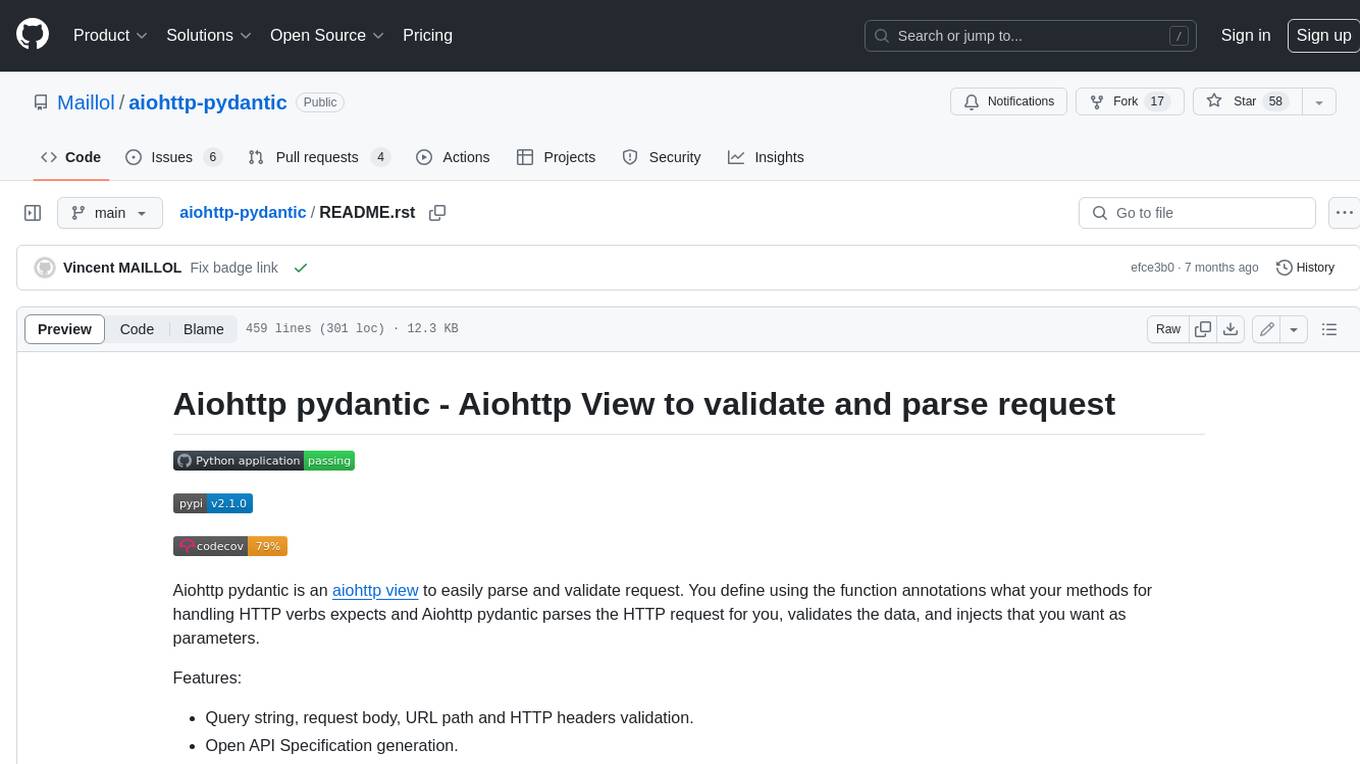
Aiohttp pydantic is an aiohttp view to easily parse and validate requests. You define using function annotations what your methods for handling HTTP verbs expect, and Aiohttp pydantic parses the HTTP request for you, validates the data, and injects the parameters you want. It provides features like query string, request body, URL path, and HTTP headers validation, as well as Open API Specification generation.
gcloud-aio
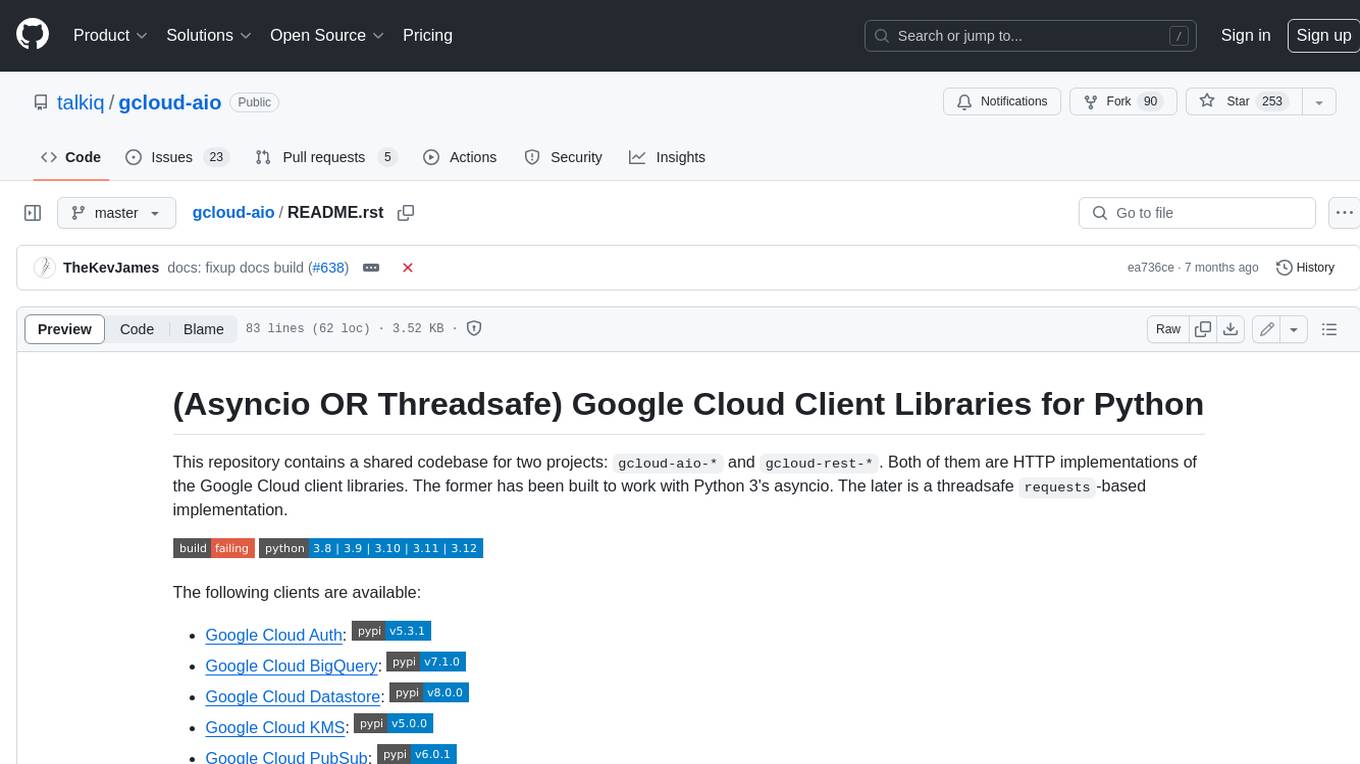
This repository contains shared codebase for two projects: gcloud-aio and gcloud-rest. gcloud-aio is built for Python 3's asyncio, while gcloud-rest is a threadsafe requests-based implementation. It provides clients for Google Cloud services like Auth, BigQuery, Datastore, KMS, PubSub, Storage, and Task Queue. Users can install the library using pip and refer to the documentation for usage details. Developers can contribute to the project by following the contribution guide.
aioconsole
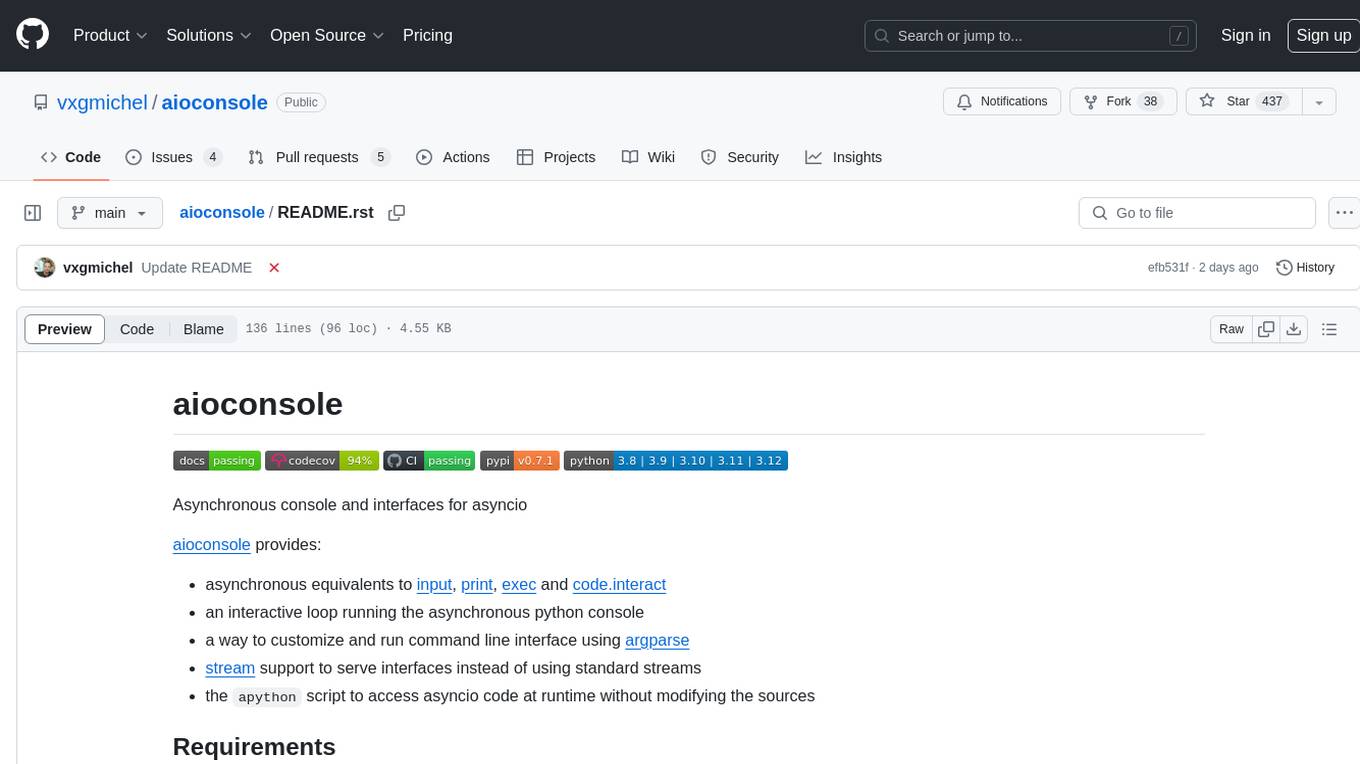
aioconsole is a Python package that provides asynchronous console and interfaces for asyncio. It offers asynchronous equivalents to input, print, exec, and code.interact, an interactive loop running the asynchronous Python console, customization and running of command line interfaces using argparse, stream support to serve interfaces instead of using standard streams, and the apython script to access asyncio code at runtime without modifying the sources. The package requires Python version 3.8 or higher and can be installed from PyPI or GitHub. It allows users to run Python files or modules with a modified asyncio policy, replacing the default event loop with an interactive loop. aioconsole is useful for scenarios where users need to interact with asyncio code in a console environment.
aiosqlite
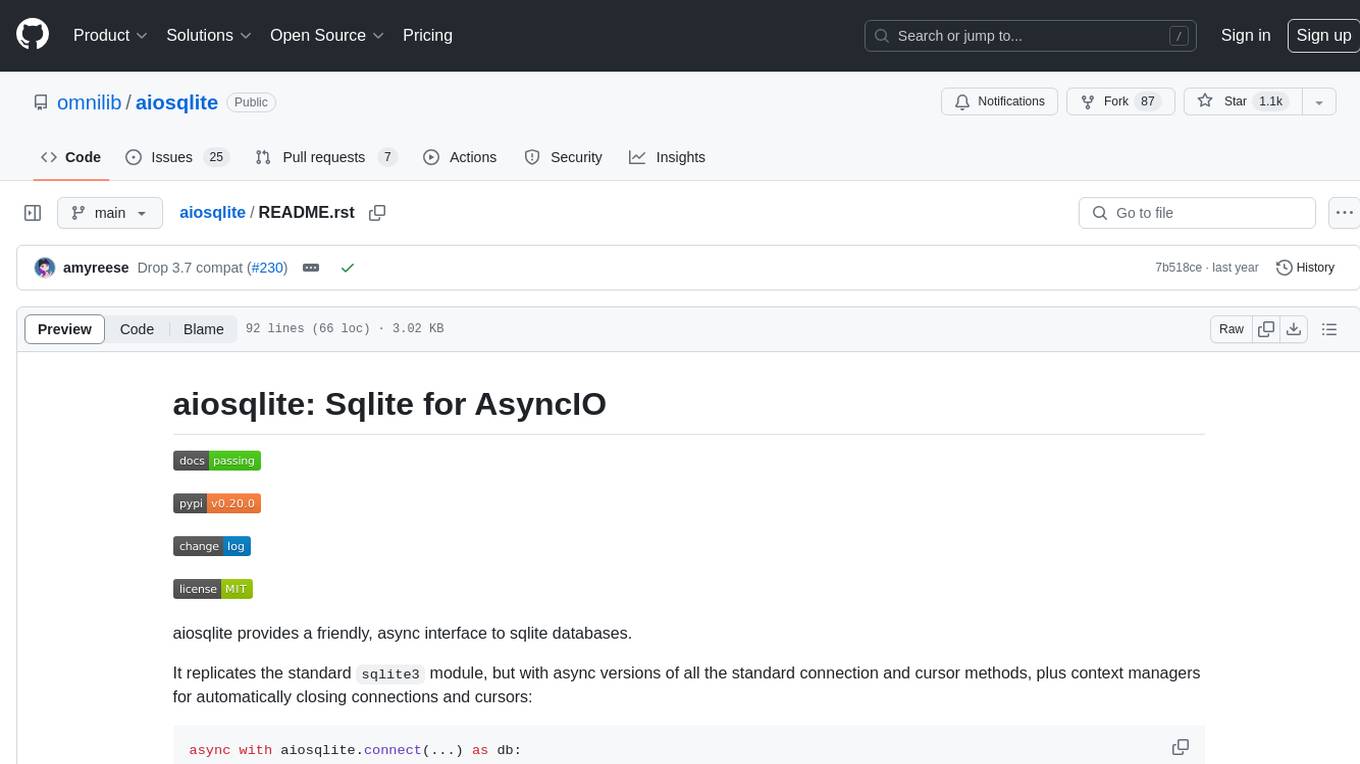
aiosqlite is a Python library that provides a friendly, async interface to SQLite databases. It replicates the standard sqlite3 module but with async versions of all the standard connection and cursor methods, along with context managers for automatically closing connections and cursors. It allows interaction with SQLite databases on the main AsyncIO event loop without blocking execution of other coroutines while waiting for queries or data fetches. The library also replicates most of the advanced features of sqlite3, such as row factories and total changes tracking.