


LLM-Finetune
大语言模型微调,Qwen2VL、Qwen2、GLM4指令微调
Stars: 286
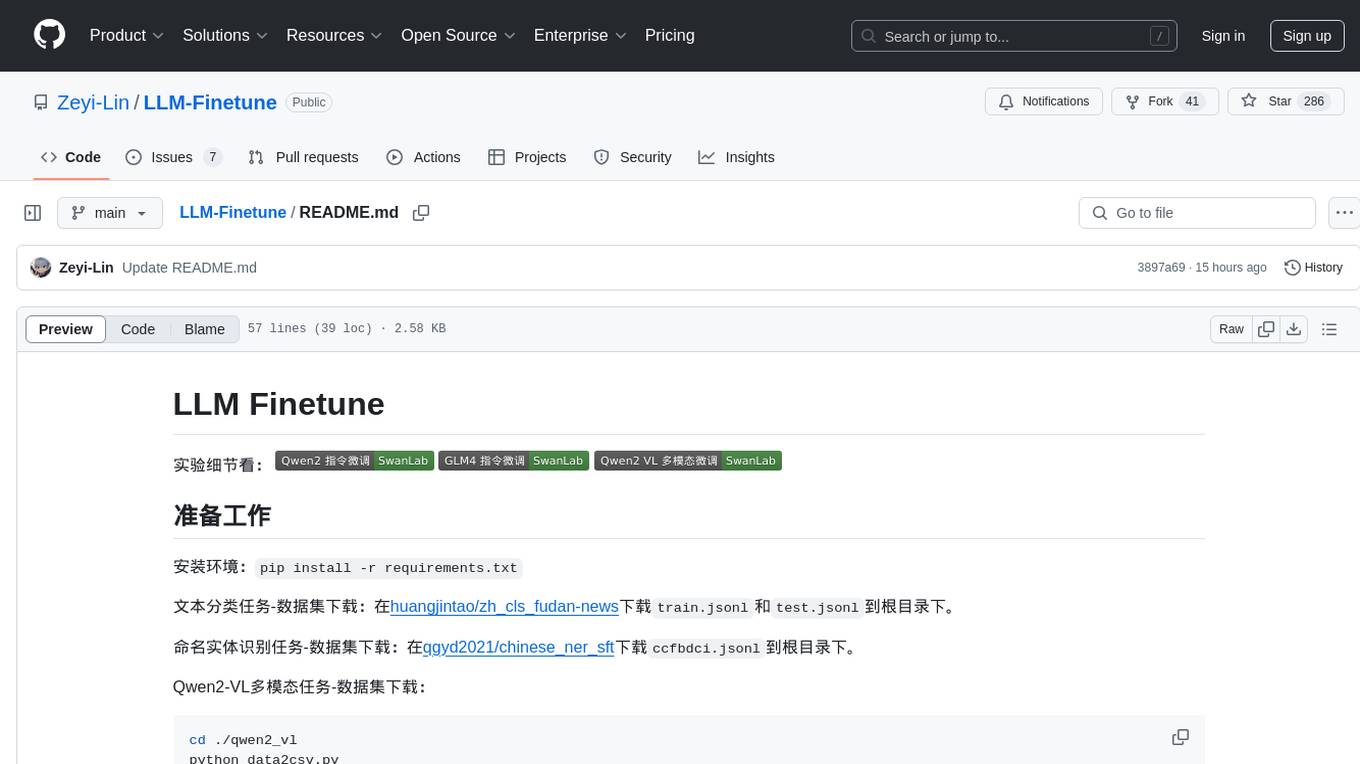
LLM-Finetune is a repository for fine-tuning language models for various NLP tasks such as text classification and named entity recognition. It provides instructions and scripts for training and inference using models like Qwen2-VL and GLM4. The repository also includes datasets for tasks like text classification, named entity recognition, and multimodal tasks. Users can easily prepare the environment, download datasets, train models, and perform inference using the provided scripts and notebooks. Additionally, the repository references SwanLab, an AI training record, analysis, and visualization tool.
README:
实验细节看:


安装环境:pip install -r requirements.txt
文本分类任务-数据集下载:在huangjintao/zh_cls_fudan-news下载train.jsonl和test.jsonl到根目录下。
命名实体识别任务-数据集下载:在qgyd2021/chinese_ner_sft下载ccfbdci.jsonl到根目录下。
Qwen2-VL多模态任务-数据集下载:
cd ./qwen2_vl
python data2csv.py
python csv2json.py| 模型 | 任务 | 运行命令 | Notebook | 文章 |
|---|---|---|---|---|
| Qwen2-VL-2b | 多模态微调 | 进入qwen2_vl目录,运行python train_qwen2_vl.py | wait | 知乎 |
| Qwen2-1.5b | 指令微调-文本分类 | python train_qwen2.py | Jupyter Notebook | 知乎 |
| Qwen2-1.5b | 指令微调-命名实体识别 | python train_qwen2_ner.py | Jupyter Notebook | 知乎 |
| GLM4-9b | 指令微调-文本分类 | python train_glm4.py | Jupyter Notebook | 知乎 |
| GLM4-9b | 指令微调-命名实体识别 | python train_glm4_ner.py | Jupyter Notebook | 知乎 |
Qwen2系列:
python predict_qwen2.pyQwen2-VL系列:
cd ./qwen2_vl
python predict_qwen2_vl.py
GLM4系列:
python predict_glm4.py- SwanLab:AI训练记录、分析与可视化工具
For Tasks:
Click tags to check more tools for each tasksFor Jobs:
Alternative AI tools for LLM-Finetune
Similar Open Source Tools
LLM-Finetune
LLM-Finetune is a repository for fine-tuning language models for various NLP tasks such as text classification and named entity recognition. It provides instructions and scripts for training and inference using models like Qwen2-VL and GLM4. The repository also includes datasets for tasks like text classification, named entity recognition, and multimodal tasks. Users can easily prepare the environment, download datasets, train models, and perform inference using the provided scripts and notebooks. Additionally, the repository references SwanLab, an AI training record, analysis, and visualization tool.
hcaptcha-challenger
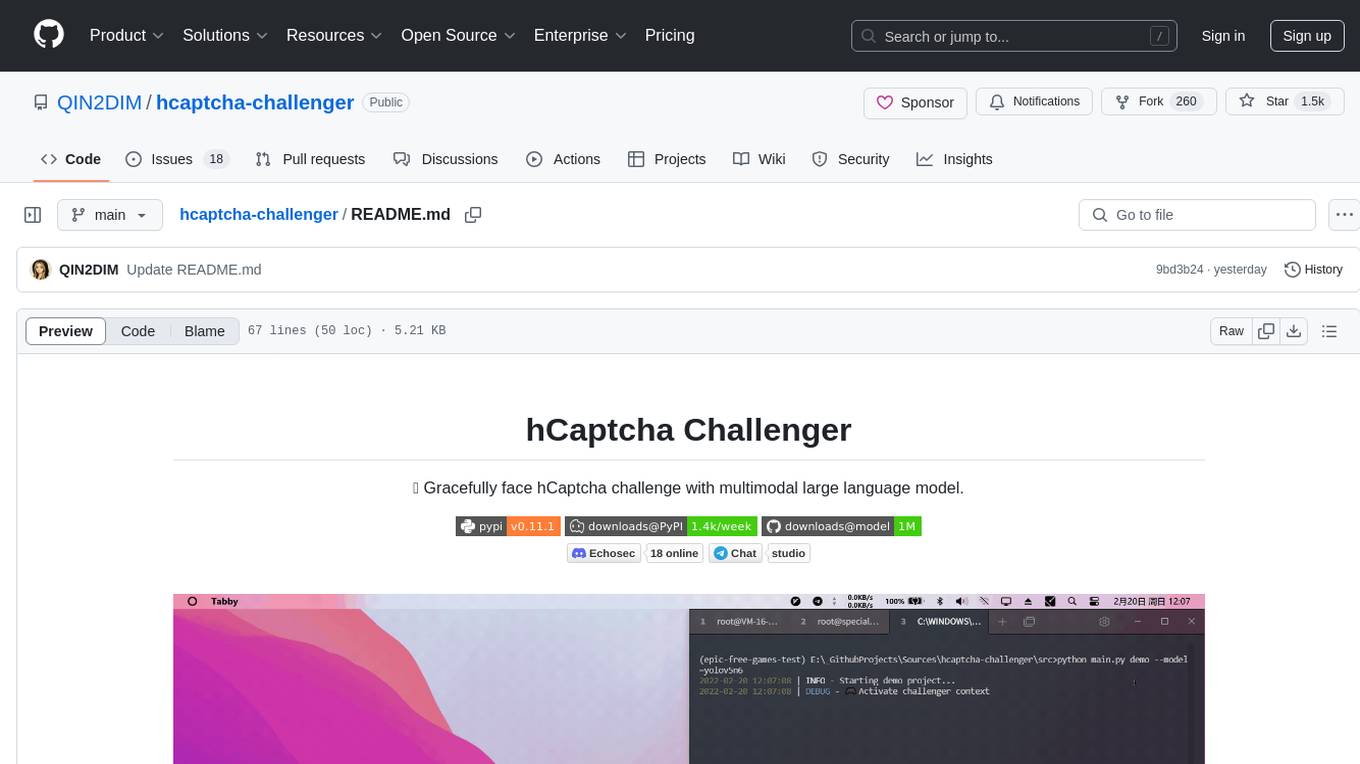
hCaptcha Challenger is a tool designed to gracefully face hCaptcha challenges using a multimodal large language model. It does not rely on Tampermonkey scripts or third-party anti-captcha services, instead implementing interfaces for 'AI vs AI' scenarios. The tool supports various challenge types such as image labeling, drag and drop, and advanced tasks like self-supervised challenges and Agentic Workflow. Users can access documentation in multiple languages and leverage resources for tasks like model training, dataset annotation, and model upgrading. The tool aims to enhance user experience in handling hCaptcha challenges with innovative AI capabilities.
Awesome-LLM-Constrained-Decoding
Awesome-LLM-Constrained-Decoding is a curated list of papers, code, and resources related to constrained decoding of Large Language Models (LLMs). The repository aims to facilitate reliable, controllable, and efficient generation with LLMs by providing a comprehensive collection of materials in this domain.
agents
The 'agents' repository is a comprehensive collection of 83 specialized AI subagents for Claude Code, providing domain-specific expertise across software development, infrastructure, and business operations. Each subagent incorporates current industry best practices, production-ready patterns, deep domain expertise, modern technology stacks, and optimized model selection based on task complexity.
are-copilots-local-yet
Current trends and state of the art for using open & local LLM models as copilots to complete code, generate projects, act as shell assistants, automatically fix bugs, and more. This document is a curated list of local Copilots, shell assistants, and related projects, intended to be a resource for those interested in a survey of the existing tools and to help developers discover the state of the art for projects like these.
Awesome-Tabular-LLMs
This repository is a collection of papers on Tabular Large Language Models (LLMs) specialized for processing tabular data. It includes surveys, models, and applications related to table understanding tasks such as Table Question Answering, Table-to-Text, Text-to-SQL, and more. The repository categorizes the papers based on key ideas and provides insights into the advancements in using LLMs for processing diverse tables and fulfilling various tabular tasks based on natural language instructions.
llm-deploy
LLM-Deploy focuses on the theory and practice of model/LLM reasoning and deployment, aiming to be your partner in mastering the art of LLM reasoning and deployment. Whether you are a newcomer to this field or a senior professional seeking to deepen your skills, you can find the key path to successfully deploy large language models here. The project covers reasoning and deployment theories, model and service optimization practices, and outputs from experienced engineers. It serves as a valuable resource for algorithm engineers and individuals interested in reasoning deployment.
nntrainer
NNtrainer is a software framework for training neural network models on devices with limited resources. It enables on-device fine-tuning of neural networks using user data for personalization. NNtrainer supports various machine learning algorithms and provides examples for tasks such as few-shot learning, ResNet, VGG, and product rating. It is optimized for embedded devices and utilizes CBLAS and CUBLAS for accelerated calculations. NNtrainer is open source and released under the Apache License version 2.0.
spiceai
Spice is a portable runtime written in Rust that offers developers a unified SQL interface to materialize, accelerate, and query data from any database, data warehouse, or data lake. It connects, fuses, and delivers data to applications, machine-learning models, and AI-backends, functioning as an application-specific, tier-optimized Database CDN. Built with industry-leading technologies such as Apache DataFusion, Apache Arrow, Apache Arrow Flight, SQLite, and DuckDB. Spice makes it fast and easy to query data from one or more sources using SQL, co-locating a managed dataset with applications or machine learning models, and accelerating it with Arrow in-memory, SQLite/DuckDB, or attached PostgreSQL for fast, high-concurrency, low-latency queries.
BizFinBench
BizFinBench is a benchmark tool designed for evaluating large language models (LLMs) in logic-heavy and precision-critical domains such as finance. It comprises over 100,000 bilingual financial questions rooted in real-world business scenarios. The tool covers five dimensions: numerical calculation, reasoning, information extraction, prediction recognition, and knowledge-based question answering, mapped to nine fine-grained categories. BizFinBench aims to assess the capacity of LLMs in real-world financial scenarios and provides insights into their strengths and limitations.
aikit
AIKit is a comprehensive platform for hosting, deploying, building, and fine-tuning large language models (LLMs). It offers inference using LocalAI, extensible fine-tuning interface, and OCI packaging for distributing models. AIKit supports various models, multi-modal model and image generation, Kubernetes deployment, and supply chain security. It can run on AMD64 and ARM64 CPUs, NVIDIA GPUs, and Apple Silicon (experimental). Users can quickly get started with AIKit without a GPU and access pre-made models. The platform is OpenAI API compatible and provides easy-to-use configuration for inference and fine-tuning.
YuLan-Mini
YuLan-Mini is a lightweight language model with 2.4 billion parameters that achieves performance comparable to industry-leading models despite being pre-trained on only 1.08T tokens. It excels in mathematics and code domains. The repository provides pre-training resources, including data pipeline, optimization methods, and annealing approaches. Users can pre-train their own language models, perform learning rate annealing, fine-tune the model, research training dynamics, and synthesize data. The team behind YuLan-Mini is AI Box at Renmin University of China. The code is released under the MIT License with future updates on model weights usage policies. Users are advised on potential safety concerns and ethical use of the model.
awesome-llm-webapps
This repository is a curated list of open-source, actively maintained web applications that leverage large language models (LLMs) for various use cases, including chatbots, natural language interfaces, assistants, and question answering systems. The projects are evaluated based on key criteria such as licensing, maintenance status, complexity, and features, to help users select the most suitable starting point for their LLM-based applications. The repository welcomes contributions and encourages users to submit projects that meet the criteria or suggest improvements to the existing list.
rag-web-ui
RAG Web UI is an intelligent dialogue system based on RAG (Retrieval-Augmented Generation) technology. It helps enterprises and individuals build intelligent Q&A systems based on their own knowledge bases. By combining document retrieval and large language models, it delivers accurate and reliable knowledge-based question-answering services. The system is designed with features like intelligent document management, advanced dialogue engine, and a robust architecture. It supports multiple document formats, async document processing, multi-turn contextual dialogue, and reference citations in conversations. The architecture includes a backend stack with Python FastAPI, MySQL + ChromaDB, MinIO, Langchain, JWT + OAuth2 for authentication, and a frontend stack with Next.js, TypeScript, Tailwind CSS, Shadcn/UI, and Vercel AI SDK for AI integration. Performance optimization includes incremental document processing, streaming responses, vector database performance tuning, and distributed task processing. The project is licensed under the Apache-2.0 License and is intended for learning and sharing RAG knowledge only, not for commercial purposes.
aikit
AIKit is a one-stop shop to quickly get started to host, deploy, build and fine-tune large language models (LLMs). AIKit offers two main capabilities: Inference: AIKit uses LocalAI, which supports a wide range of inference capabilities and formats. LocalAI provides a drop-in replacement REST API that is OpenAI API compatible, so you can use any OpenAI API compatible client, such as Kubectl AI, Chatbot-UI and many more, to send requests to open-source LLMs! Fine Tuning: AIKit offers an extensible fine tuning interface. It supports Unsloth for fast, memory efficient, and easy fine-tuning experience.
oumi
Oumi is an open-source platform for building state-of-the-art foundation models, offering tools for data preparation, training, evaluation, and deployment. It supports training and fine-tuning models with various parameters, working with text and multimodal models, synthesizing and curating training data, deploying models efficiently, evaluating models comprehensively, and running on different platforms. Oumi provides a consistent API, reliability, and flexibility for research purposes.
For similar tasks
kan-gpt
The KAN-GPT repository is a PyTorch implementation of Generative Pre-trained Transformers (GPTs) using Kolmogorov-Arnold Networks (KANs) for language modeling. It provides a model for generating text based on prompts, with a focus on improving performance compared to traditional MLP-GPT models. The repository includes scripts for training the model, downloading datasets, and evaluating model performance. Development tasks include integrating with other libraries, testing, and documentation.
polaris
Polaris establishes a novel, industry‑certified standard to foster the development of impactful methods in AI-based drug discovery. This library is a Python client to interact with the Polaris Hub. It allows you to download Polaris datasets and benchmarks, evaluate a custom method against a Polaris benchmark, and create and upload new datasets and benchmarks.
LLM-Finetune
LLM-Finetune is a repository for fine-tuning language models for various NLP tasks such as text classification and named entity recognition. It provides instructions and scripts for training and inference using models like Qwen2-VL and GLM4. The repository also includes datasets for tasks like text classification, named entity recognition, and multimodal tasks. Users can easily prepare the environment, download datasets, train models, and perform inference using the provided scripts and notebooks. Additionally, the repository references SwanLab, an AI training record, analysis, and visualization tool.
aishare
Aishare is a collaborative platform for sharing AI models and datasets. It allows users to upload, download, and explore various AI models and datasets. Users can also rate and comment on the shared resources, providing valuable feedback to the community. Aishare aims to foster collaboration and knowledge sharing in the field of artificial intelligence.
RLHF-Reward-Modeling
This repository contains code for training reward models for Deep Reinforcement Learning-based Reward-modulated Hierarchical Fine-tuning (DRL-based RLHF), Iterative Selection Fine-tuning (Rejection sampling fine-tuning), and iterative Decision Policy Optimization (DPO). The reward models are trained using a Bradley-Terry model based on the Gemma and Mistral language models. The resulting reward models achieve state-of-the-art performance on the RewardBench leaderboard for reward models with base models of up to 13B parameters.
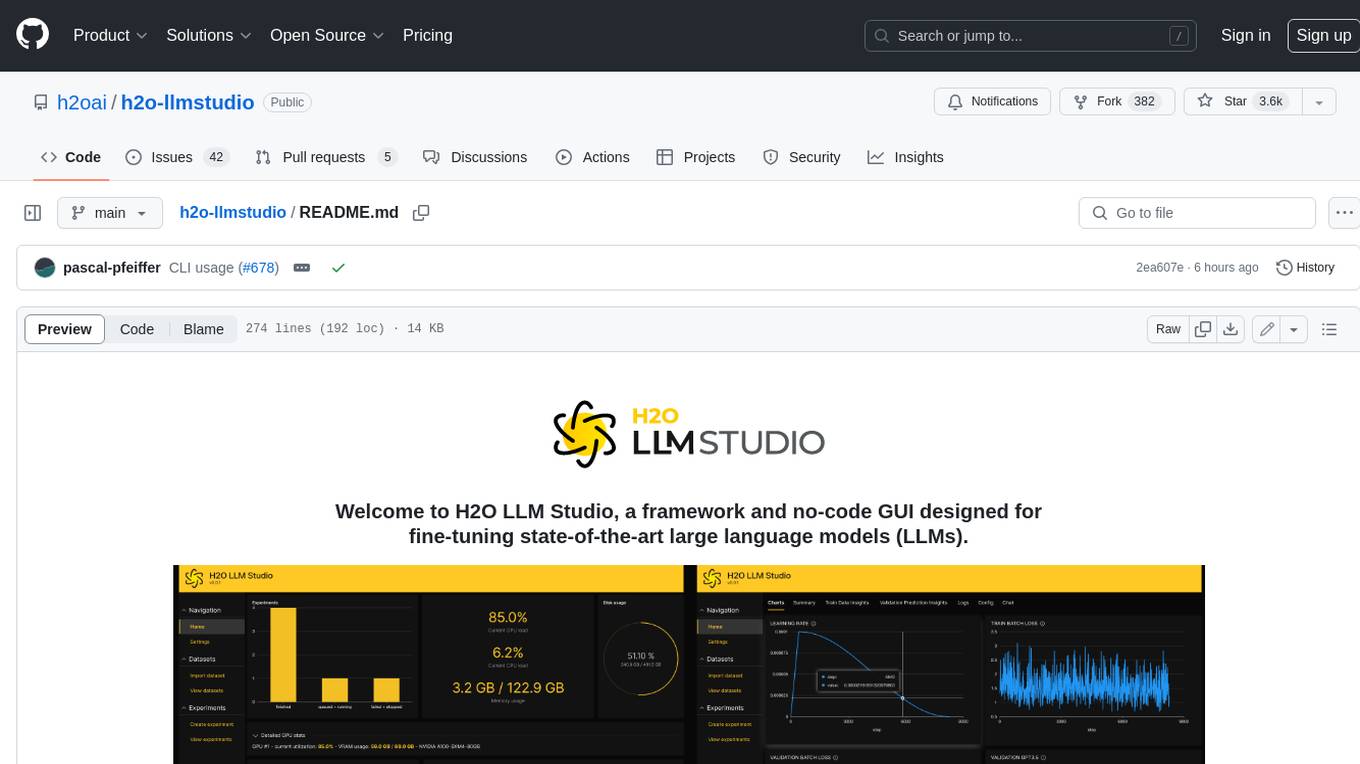
h2o-llmstudio
H2O LLM Studio is a framework and no-code GUI designed for fine-tuning state-of-the-art large language models (LLMs). With H2O LLM Studio, you can easily and effectively fine-tune LLMs without the need for any coding experience. The GUI is specially designed for large language models, and you can finetune any LLM using a large variety of hyperparameters. You can also use recent finetuning techniques such as Low-Rank Adaptation (LoRA) and 8-bit model training with a low memory footprint. Additionally, you can use Reinforcement Learning (RL) to finetune your model (experimental), use advanced evaluation metrics to judge generated answers by the model, track and compare your model performance visually, and easily export your model to the Hugging Face Hub and share it with the community.
MathCoder
MathCoder is a repository focused on enhancing mathematical reasoning by fine-tuning open-source language models to use code for modeling and deriving math equations. It introduces MathCodeInstruct dataset with solutions interleaving natural language, code, and execution results. The repository provides MathCoder models capable of generating code-based solutions for challenging math problems, achieving state-of-the-art scores on MATH and GSM8K datasets. It offers tools for model deployment, inference, and evaluation, along with a citation for referencing the work.
Awesome-Text2SQL
Awesome Text2SQL is a curated repository containing tutorials and resources for Large Language Models, Text2SQL, Text2DSL, Text2API, Text2Vis, and more. It provides guidelines on converting natural language questions into structured SQL queries, with a focus on NL2SQL. The repository includes information on various models, datasets, evaluation metrics, fine-tuning methods, libraries, and practice projects related to Text2SQL. It serves as a comprehensive resource for individuals interested in working with Text2SQL and related technologies.
For similar jobs
NanoLLM
NanoLLM is a tool designed for optimized local inference for Large Language Models (LLMs) using HuggingFace-like APIs. It supports quantization, vision/language models, multimodal agents, speech, vector DB, and RAG. The tool aims to provide efficient and effective processing for LLMs on local devices, enhancing performance and usability for various AI applications.
mslearn-ai-fundamentals
This repository contains materials for the Microsoft Learn AI Fundamentals module. It covers the basics of artificial intelligence, machine learning, and data science. The content includes hands-on labs, interactive learning modules, and assessments to help learners understand key concepts and techniques in AI. Whether you are new to AI or looking to expand your knowledge, this module provides a comprehensive introduction to the fundamentals of AI.

awesome-ai-tools
Awesome AI Tools is a curated list of popular tools and resources for artificial intelligence enthusiasts. It includes a wide range of tools such as machine learning libraries, deep learning frameworks, data visualization tools, and natural language processing resources. Whether you are a beginner or an experienced AI practitioner, this repository aims to provide you with a comprehensive collection of tools to enhance your AI projects and research. Explore the list to discover new tools, stay updated with the latest advancements in AI technology, and find the right resources to support your AI endeavors.
go2coding.github.io
The go2coding.github.io repository is a collection of resources for AI enthusiasts, providing information on AI products, open-source projects, AI learning websites, and AI learning frameworks. It aims to help users stay updated on industry trends, learn from community projects, access learning resources, and understand and choose AI frameworks. The repository also includes instructions for local and external deployment of the project as a static website, with details on domain registration, hosting services, uploading static web pages, configuring domain resolution, and a visual guide to the AI tool navigation website. Additionally, it offers a platform for AI knowledge exchange through a QQ group and promotes AI tools through a WeChat public account.
AI-Notes
AI-Notes is a repository dedicated to practical applications of artificial intelligence and deep learning. It covers concepts such as data mining, machine learning, natural language processing, and AI. The repository contains Jupyter Notebook examples for hands-on learning and experimentation. It explores the development stages of AI, from narrow artificial intelligence to general artificial intelligence and superintelligence. The content delves into machine learning algorithms, deep learning techniques, and the impact of AI on various industries like autonomous driving and healthcare. The repository aims to provide a comprehensive understanding of AI technologies and their real-world applications.
promptpanel
Prompt Panel is a tool designed to accelerate the adoption of AI agents by providing a platform where users can run large language models across any inference provider, create custom agent plugins, and use their own data safely. The tool allows users to break free from walled-gardens and have full control over their models, conversations, and logic. With Prompt Panel, users can pair their data with any language model, online or offline, and customize the system to meet their unique business needs without any restrictions.
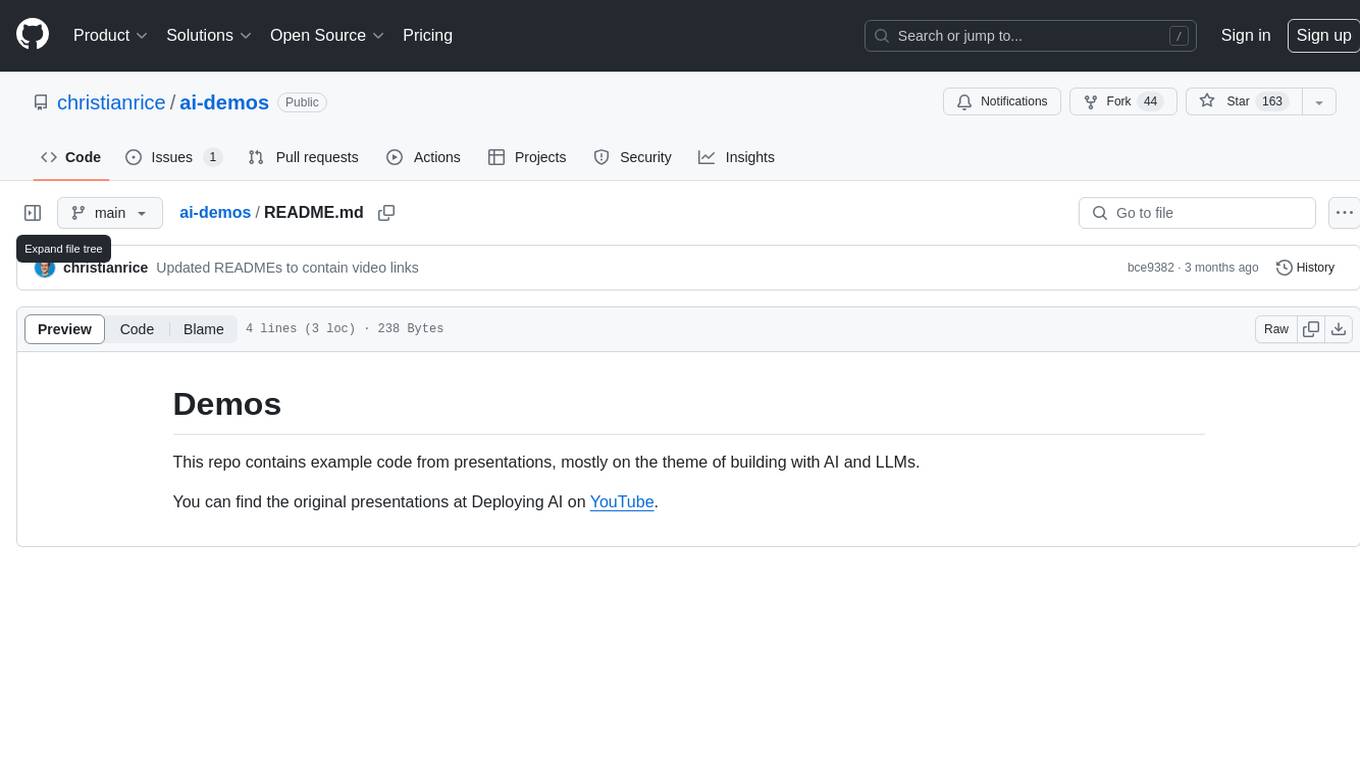
ai-demos
The 'ai-demos' repository is a collection of example code from presentations focusing on building with AI and LLMs. It serves as a resource for developers looking to explore practical applications of artificial intelligence in their projects. The code snippets showcase various techniques and approaches to leverage AI technologies effectively. The repository aims to inspire and educate developers on integrating AI solutions into their applications.
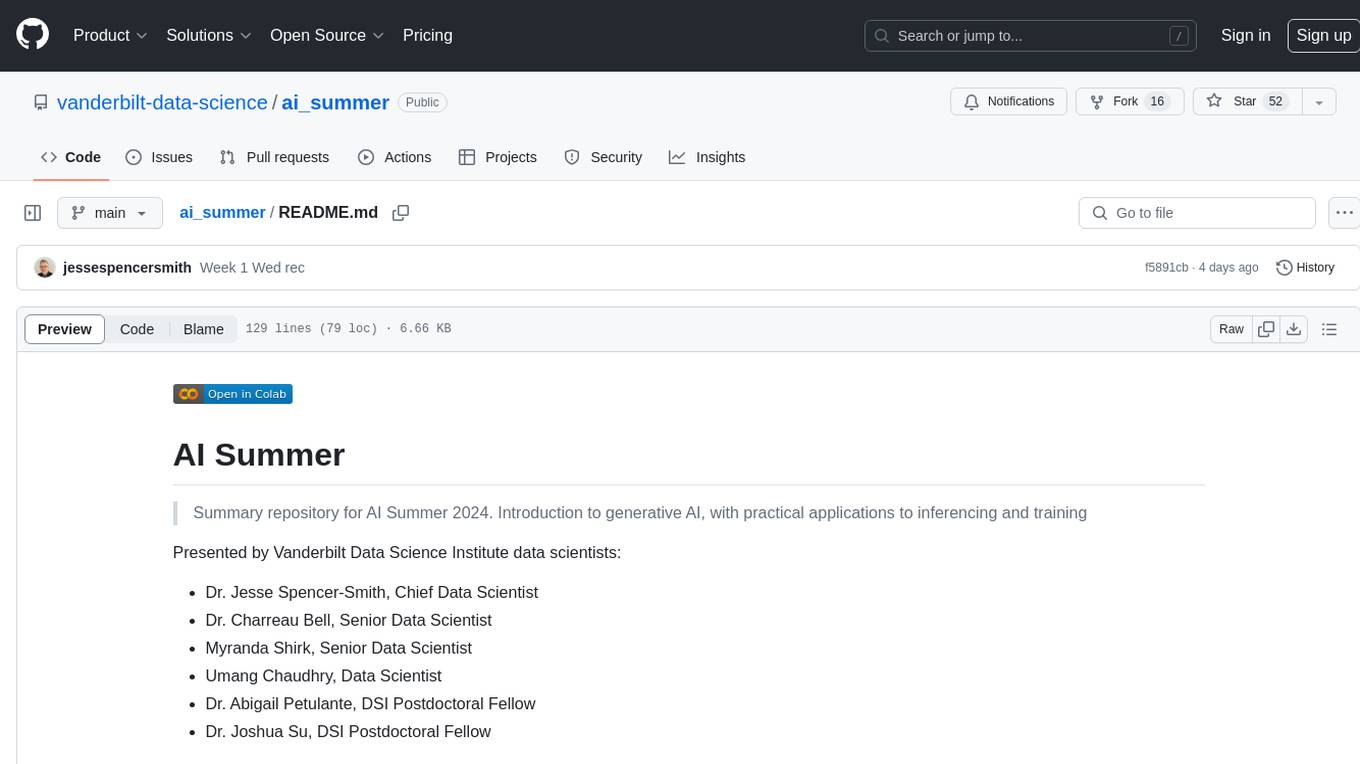
ai_summer
AI Summer is a repository focused on providing workshops and resources for developing foundational skills in generative AI models and transformer models. The repository offers practical applications for inferencing and training, with a specific emphasis on understanding and utilizing advanced AI chat models like BingGPT. Participants are encouraged to engage in interactive programming environments, decide on projects to work on, and actively participate in discussions and breakout rooms. The workshops cover topics such as generative AI models, retrieval-augmented generation, building AI solutions, and fine-tuning models. The goal is to equip individuals with the necessary skills to work with AI technologies effectively and securely, both locally and in the cloud.