


chat
A unified TypeScript SDK for building chat bots across Slack, Microsoft Teams, Google Chat, Discord, and more.
Stars: 800
A unified TypeScript SDK for building chat bots across various platforms like Slack, Microsoft Teams, Google Chat, Discord, GitHub, and Linear. Write bot logic once and deploy everywhere. Features include event handlers, AI streaming, interactive cards, actions, modals, slash commands, emoji support, file uploads, direct messages, and ephemeral messages. The SDK includes core classes, adapters for different platforms, and state adapters for Redis, ioredis, and in-memory storage.
README:



A unified TypeScript SDK for building chat bots across Slack, Microsoft Teams, Google Chat, Discord, GitHub, and Linear. Write your bot logic once, deploy everywhere.
npm install chatInstall adapters for your platforms:
npm install @chat-adapter/slack @chat-adapter/teams @chat-adapter/gchat @chat-adapter/discordimport { Chat } from "chat";
import { createSlackAdapter } from "@chat-adapter/slack";
import { createRedisState } from "@chat-adapter/state-redis";
const bot = new Chat({
userName: "mybot",
adapters: {
slack: createSlackAdapter(),
},
state: createRedisState(),
});
bot.onNewMention(async (thread) => {
await thread.subscribe();
await thread.post("Hello! I'm listening to this thread.");
});
bot.onSubscribedMessage(async (thread, message) => {
await thread.post(`You said: ${message.text}`);
});See the Getting Started guide for a full walkthrough.
| Platform | Package | Mentions | Reactions | Cards | Modals | Streaming | DMs |
|---|---|---|---|---|---|---|---|
| Slack | @chat-adapter/slack |
Yes | Yes | Yes | Yes | Native | Yes |
| Microsoft Teams | @chat-adapter/teams |
Yes | Read-only | Yes | No | Post+Edit | Yes |
| Google Chat | @chat-adapter/gchat |
Yes | Yes | Yes | No | Post+Edit | Yes |
| Discord | @chat-adapter/discord |
Yes | Yes | Yes | No | Post+Edit | Yes |
| GitHub | @chat-adapter/github |
Yes | Yes | No | No | No | No |
| Linear | @chat-adapter/linear |
Yes | Yes | No | No | No | No |
- Event handlers — mentions, messages, reactions, button clicks, slash commands, modals
- AI streaming — stream LLM responses with native Slack streaming and post+edit fallback
- Cards — JSX-based interactive cards (Block Kit, Adaptive Cards, Google Chat Cards)
- Actions — handle button clicks and dropdown selections
- Modals — form dialogs with text inputs, dropdowns, and validation
-
Slash commands — handle
/commandinvocations - Emoji — type-safe, cross-platform emoji with custom emoji support
- File uploads — send and receive file attachments
- Direct messages — initiate DMs programmatically
- Ephemeral messages — user-only visible messages with DM fallback
| Package | Description |
|---|---|
chat |
Core SDK with Chat class, types, JSX runtime, and utilities |
@chat-adapter/slack |
Slack adapter |
@chat-adapter/teams |
Teams adapter |
@chat-adapter/gchat |
Google Chat adapter |
@chat-adapter/discord |
Discord adapter |
@chat-adapter/github |
GitHub adapter |
@chat-adapter/linear |
Linear adapter |
@chat-adapter/state-redis |
Redis state adapter (production) |
@chat-adapter/state-ioredis |
ioredis state adapter (alternative) |
@chat-adapter/state-memory |
In-memory state adapter (development) |
If you use an AI coding agent like Claude Code, you can teach it about Chat SDK:
npx skills add vercel/chatFull documentation is available at chat-sdk.dev/docs.
See CONTRIBUTING.md for development setup and the release process.
MIT
For Tasks:
Click tags to check more tools for each tasksFor Jobs:
Alternative AI tools for chat
Similar Open Source Tools
chat
A unified TypeScript SDK for building chat bots across various platforms like Slack, Microsoft Teams, Google Chat, Discord, GitHub, and Linear. Write bot logic once and deploy everywhere. Features include event handlers, AI streaming, interactive cards, actions, modals, slash commands, emoji support, file uploads, direct messages, and ephemeral messages. The SDK includes core classes, adapters for different platforms, and state adapters for Redis, ioredis, and in-memory storage.
nextclaw
NextClaw is a feature-rich, OpenClaw-compatible personal AI assistant designed for quick trials, secondary machines, or anyone who wants multi-channel + multi-provider capabilities with low maintenance overhead. It offers a UI-first workflow, lightweight codebase, and easy configuration through a built-in UI. The tool supports various providers like OpenRouter, OpenAI, MiniMax, Moonshot, and more, along with channels such as Telegram, Discord, WhatsApp, and others. Users can perform tasks like web search, command execution, memory management, and scheduling with Cron + Heartbeat. NextClaw aims to provide a user-friendly experience with minimal setup and maintenance requirements.
pantalk
Pantalk is a lightweight daemon that provides a single interface for AI agents to send, receive, and stream messages across various chat platforms such as Slack, Discord, Mattermost, Telegram, WhatsApp, IRC, Matrix, Twilio, and Zulip. It simplifies the integration process by handling authentication, sessions, and message history, allowing AI agents to communicate seamlessly with humans on different platforms through simple CLI commands or a Unix domain socket with a JSON protocol.
neurolink
NeuroLink is an Enterprise AI SDK for Production Applications that serves as a universal AI integration platform unifying 13 major AI providers and 100+ models under one consistent API. It offers production-ready tooling, including a TypeScript SDK and a professional CLI, for teams to quickly build, operate, and iterate on AI features. NeuroLink enables switching providers with a single parameter change, provides 64+ built-in tools and MCP servers, supports enterprise features like Redis memory and multi-provider failover, and optimizes costs automatically with intelligent routing. It is designed for the future of AI with edge-first execution and continuous streaming architectures.
llumen
Llumen is a self-hosted interface optimized for modest hardware like Raspberry Pi, old laptops, and minimal VPS. It offers privacy without complexity, providing essential features with minimal resource demands. Users can enjoy sub-second cold starts, real-time token streaming, various chat modes, rich media support, and a universal API for OpenAI-compatible providers. The tool has a small footprint with a binary size of around 17MB and RAM usage under 128MB. Llumen aims to simplify the setup process and offer a user-friendly experience for individuals seeking a privacy-focused solution.
goclaw
GoClaw is a multi-agent AI gateway that connects LLMs to your tools, channels, and data. It orchestrates agent teams, inter-agent delegation, and quality-gated workflows across 11+ LLM providers with full multi-tenant isolation. It is a Go port of OpenClaw with enhanced security, multi-tenant PostgreSQL, and production-grade observability. GoClaw's unique strengths include multi-tenant PostgreSQL, agent teams, conversation handoff, evaluate-loop quality gates, runtime custom tools via API, and MCP protocol support.
ai-dev-kit
The AI Dev Kit is a comprehensive toolkit designed to enhance AI-driven development on Databricks. It provides trusted sources for AI coding assistants like Claude Code and Cursor to build faster and smarter on Databricks. The kit includes features such as Spark Declarative Pipelines, Databricks Jobs, AI/BI Dashboards, Unity Catalog, Genie Spaces, Knowledge Assistants, MLflow Experiments, Model Serving, Databricks Apps, and more. Users can choose from different adventures like installing the kit, using the visual builder app, teaching AI assistants Databricks patterns, executing Databricks actions, or building custom integrations with the core library. The kit also includes components like databricks-tools-core, databricks-mcp-server, databricks-skills, databricks-builder-app, and ai-dev-project.
Unreal_mcp
Unreal Engine MCP Server is a comprehensive Model Context Protocol (MCP) server that allows AI assistants to control Unreal Engine through a native C++ Automation Bridge plugin. It is built with TypeScript, C++, and Rust (WebAssembly). The server provides various features for asset management, actor control, editor control, level management, animation & physics, visual effects, sequencer, graph editing, audio, system operations, and more. It offers dynamic type discovery, graceful degradation, on-demand connection, command safety, asset caching, metrics rate limiting, and centralized configuration. Users can install the server using NPX or by cloning and building it. Additionally, the server supports WebAssembly acceleration for computationally intensive operations and provides an optional GraphQL API for complex queries. The repository includes documentation, community resources, and guidelines for contributing.
shodh-memory
Shodh-Memory is a cognitive memory system designed for AI agents to persist memory across sessions, learn from experience, and run entirely offline. It features Hebbian learning, activation decay, and semantic consolidation, packed into a single ~17MB binary. Users can deploy it on cloud, edge devices, or air-gapped systems to enhance the memory capabilities of AI agents.
new-api
New API is a next-generation large model gateway and AI asset management system that provides a wide range of features, including a new UI interface, multi-language support, online recharge function, key query for usage quota, compatibility with the original One API database, model charging by usage count, channel weighted randomization, data dashboard, token grouping and model restrictions, support for various authorization login methods, support for Rerank models, OpenAI Realtime API, Claude Messages format, reasoning effort setting, content reasoning, user-specific model rate limiting, request format conversion, cache billing support, and various model support such as gpts, Midjourney-Proxy, Suno API, custom channels, Rerank models, Claude Messages format, Dify, and more.
LocalAI
LocalAI is a free and open-source OpenAI alternative that acts as a drop-in replacement REST API compatible with OpenAI (Elevenlabs, Anthropic, etc.) API specifications for local AI inferencing. It allows users to run LLMs, generate images, audio, and more locally or on-premises with consumer-grade hardware, supporting multiple model families and not requiring a GPU. LocalAI offers features such as text generation with GPTs, text-to-audio, audio-to-text transcription, image generation with stable diffusion, OpenAI functions, embeddings generation for vector databases, constrained grammars, downloading models directly from Huggingface, and a Vision API. It provides a detailed step-by-step introduction in its Getting Started guide and supports community integrations such as custom containers, WebUIs, model galleries, and various bots for Discord, Slack, and Telegram. LocalAI also offers resources like an LLM fine-tuning guide, instructions for local building and Kubernetes installation, projects integrating LocalAI, and a how-tos section curated by the community. It encourages users to cite the repository when utilizing it in downstream projects and acknowledges the contributions of various software from the community.
sf-skills
sf-skills is a collection of reusable skills for Agentic Salesforce Development, enabling AI-powered code generation, validation, testing, debugging, and deployment. It includes skills for development, quality, foundation, integration, AI & automation, DevOps & tooling. The installation process is newbie-friendly and includes an installer script for various CLIs. The skills are compatible with platforms like Claude Code, OpenCode, Codex, Gemini, Amp, Droid, Cursor, and Agentforce Vibes. The repository is community-driven and aims to strengthen the Salesforce ecosystem.
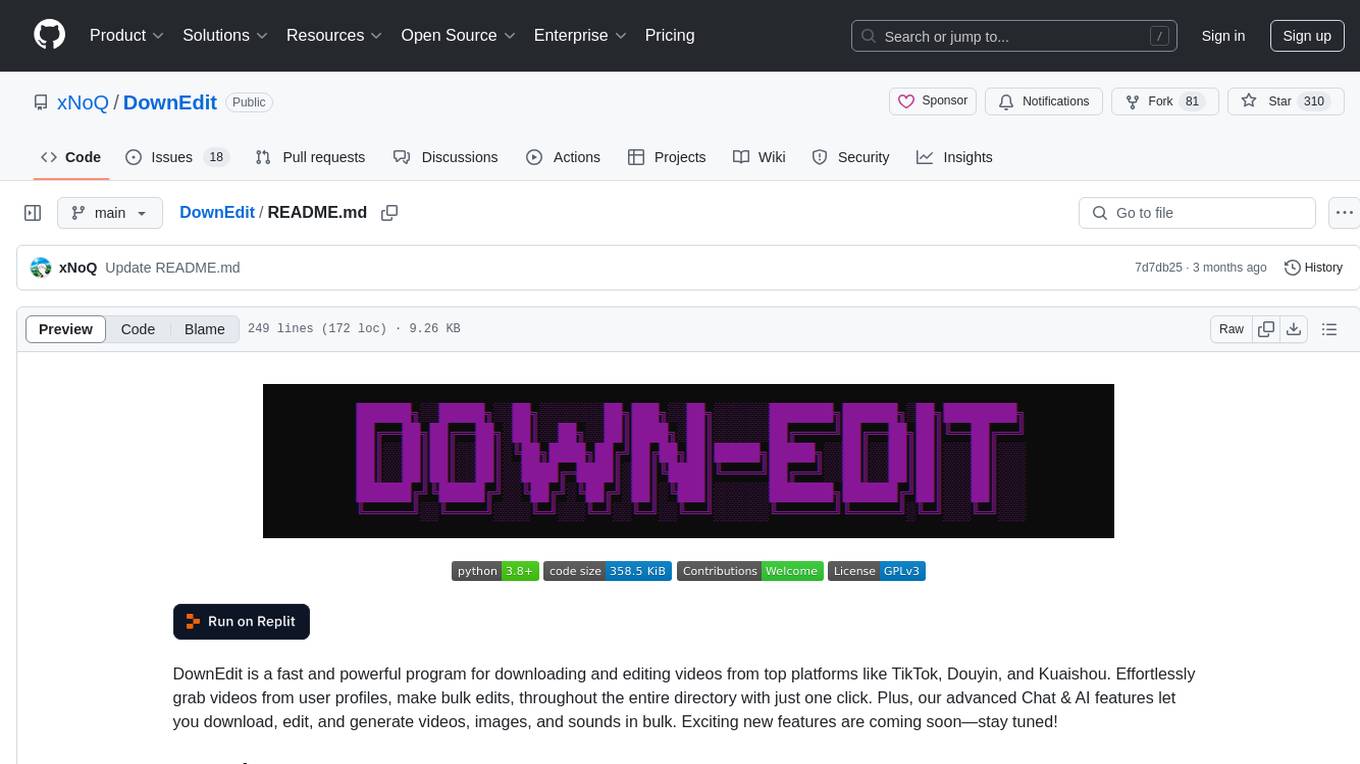
DownEdit
DownEdit is a fast and powerful program for downloading and editing videos from platforms like TikTok, Douyin, and Kuaishou. It allows users to effortlessly grab videos, make bulk edits, and utilize advanced AI features for generating videos, images, and sounds in bulk. The tool offers features like video, photo, and sound editing, downloading videos without watermarks, bulk AI generation, and AI editing for content enhancement.
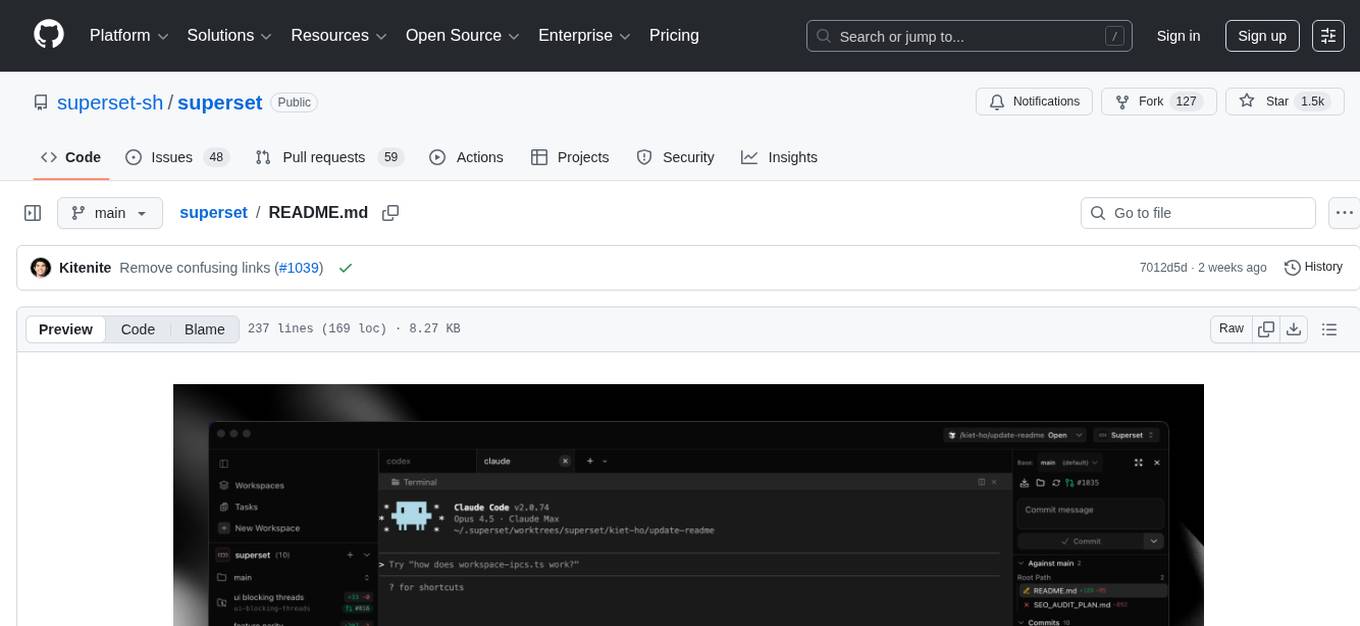
superset
Superset is a turbocharged terminal that allows users to run multiple CLI coding agents simultaneously, isolate tasks in separate worktrees, monitor agent status, review changes quickly, and enhance development workflow. It supports any CLI-based coding agent and offers features like parallel execution, worktree isolation, agent monitoring, built-in diff viewer, workspace presets, universal compatibility, quick context switching, and IDE integration. Users can customize keyboard shortcuts, configure workspace setup, and teardown, and contribute to the project. The tech stack includes Electron, React, TailwindCSS, Bun, Turborepo, Vite, Biome, Drizzle ORM, Neon, and tRPC. The community provides support through Discord, Twitter, GitHub Issues, and GitHub Discussions.
runanywhere-sdks
RunAnywhere is an on-device AI tool for mobile apps that allows users to run LLMs, speech-to-text, text-to-speech, and voice assistant features locally, ensuring privacy, offline functionality, and fast performance. The tool provides a range of AI capabilities without relying on cloud services, reducing latency and ensuring that no data leaves the device. RunAnywhere offers SDKs for Swift (iOS/macOS), Kotlin (Android), React Native, and Flutter, making it easy for developers to integrate AI features into their mobile applications. The tool supports various models for LLM, speech-to-text, and text-to-speech, with detailed documentation and installation instructions available for each platform.
Athena-Public
Project Athena is a Linux OS designed for AI Agents, providing memory, persistence, scheduling, and governance for AI models. It offers a comprehensive memory layer that survives across sessions, models, and IDEs, allowing users to own their data and port it anywhere. The system is built bottom-up through 1,079+ sessions, focusing on depth and compounding knowledge. Athena features a trilateral feedback loop for cross-model validation, a Model Context Protocol server with 9 tools, and a robust security model with data residency options. The repository structure includes an SDK package, examples for quickstart, scripts, protocols, workflows, and deep documentation. Key concepts cover architecture, knowledge graph, semantic memory, and adaptive latency. Workflows include booting, reasoning modes, planning, research, and iteration. The project has seen significant content expansion, viral validation, and metrics improvements.
For similar tasks
Flowise
Flowise is a tool that allows users to build customized LLM flows with a drag-and-drop UI. It is open-source and self-hostable, and it supports various deployments, including AWS, Azure, Digital Ocean, GCP, Railway, Render, HuggingFace Spaces, Elestio, Sealos, and RepoCloud. Flowise has three different modules in a single mono repository: server, ui, and components. The server module is a Node backend that serves API logics, the ui module is a React frontend, and the components module contains third-party node integrations. Flowise supports different environment variables to configure your instance, and you can specify these variables in the .env file inside the packages/server folder.

nlux
nlux is an open-source Javascript and React JS library that makes it super simple to integrate powerful large language models (LLMs) like ChatGPT into your web app or website. With just a few lines of code, you can add conversational AI capabilities and interact with your favourite LLM.
generative-ai-go
The Google AI Go SDK enables developers to use Google's state-of-the-art generative AI models (like Gemini) to build AI-powered features and applications. It supports use cases like generating text from text-only input, generating text from text-and-images input (multimodal), building multi-turn conversations (chat), and embedding.
awesome-langchain-zh
The awesome-langchain-zh repository is a collection of resources related to LangChain, a framework for building AI applications using large language models (LLMs). The repository includes sections on the LangChain framework itself, other language ports of LangChain, tools for low-code development, services, agents, templates, platforms, open-source projects related to knowledge management and chatbots, as well as learning resources such as notebooks, videos, and articles. It also covers other LLM frameworks and provides additional resources for exploring and working with LLMs. The repository serves as a comprehensive guide for developers and AI enthusiasts interested in leveraging LangChain and LLMs for various applications.
Large-Language-Model-Notebooks-Course
This practical free hands-on course focuses on Large Language models and their applications, providing a hands-on experience using models from OpenAI and the Hugging Face library. The course is divided into three major sections: Techniques and Libraries, Projects, and Enterprise Solutions. It covers topics such as Chatbots, Code Generation, Vector databases, LangChain, Fine Tuning, PEFT Fine Tuning, Soft Prompt tuning, LoRA, QLoRA, Evaluate Models, Knowledge Distillation, and more. Each section contains chapters with lessons supported by notebooks and articles. The course aims to help users build projects and explore enterprise solutions using Large Language Models.
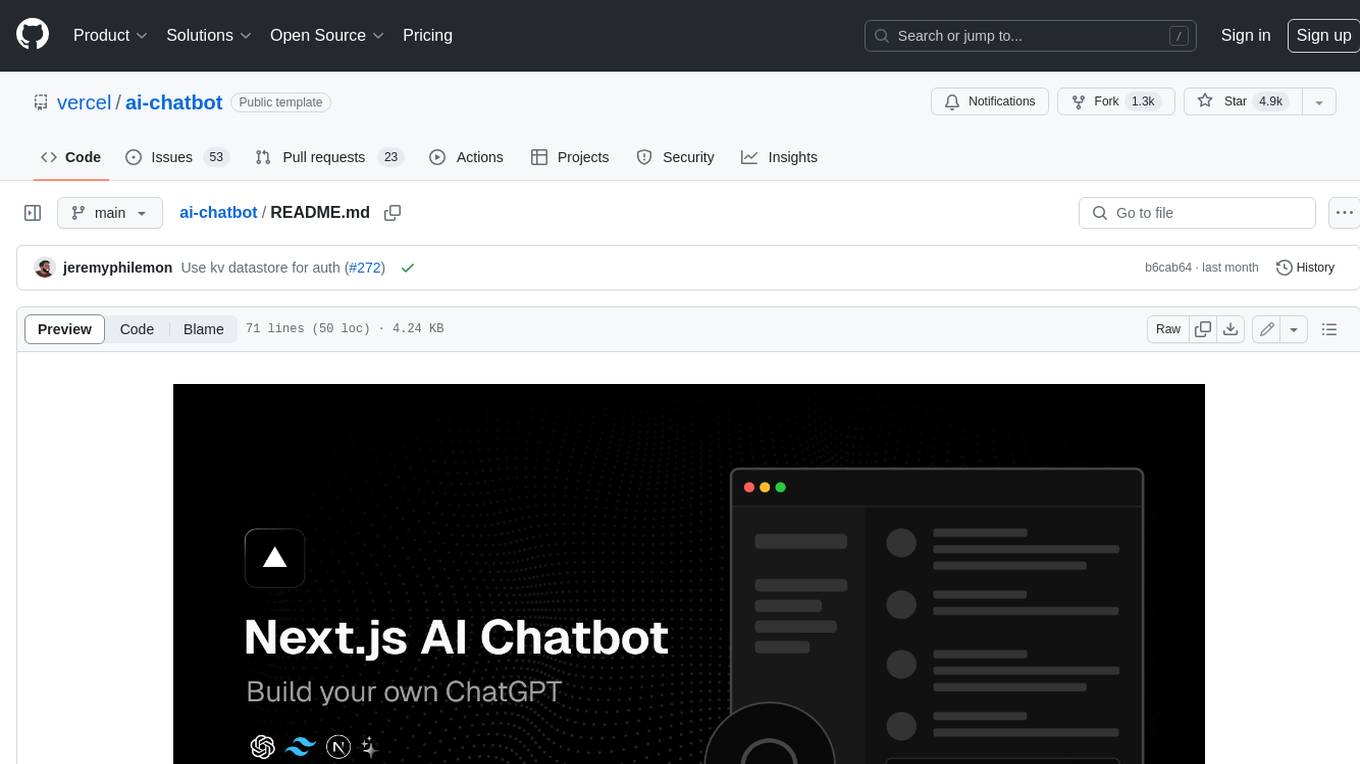
ai-chatbot
Next.js AI Chatbot is an open-source app template for building AI chatbots using Next.js, Vercel AI SDK, OpenAI, and Vercel KV. It includes features like Next.js App Router, React Server Components, Vercel AI SDK for streaming chat UI, support for various AI models, Tailwind CSS styling, Radix UI for headless components, chat history management, rate limiting, session storage with Vercel KV, and authentication with NextAuth.js. The template allows easy deployment to Vercel and customization of AI model providers.
awesome-local-llms
The 'awesome-local-llms' repository is a curated list of open-source tools for local Large Language Model (LLM) inference, covering both proprietary and open weights LLMs. The repository categorizes these tools into LLM inference backend engines, LLM front end UIs, and all-in-one desktop applications. It collects GitHub repository metrics as proxies for popularity and active maintenance. Contributions are encouraged, and users can suggest additional open-source repositories through the Issues section or by running a provided script to update the README and make a pull request. The repository aims to provide a comprehensive resource for exploring and utilizing local LLM tools.
Awesome-AI-Data-Guided-Projects
A curated list of data science & AI guided projects to start building your portfolio. The repository contains guided projects covering various topics such as large language models, time series analysis, computer vision, natural language processing (NLP), and data science. Each project provides detailed instructions on how to implement specific tasks using different tools and technologies.
For similar jobs
sweep
Sweep is an AI junior developer that turns bugs and feature requests into code changes. It automatically handles developer experience improvements like adding type hints and improving test coverage.
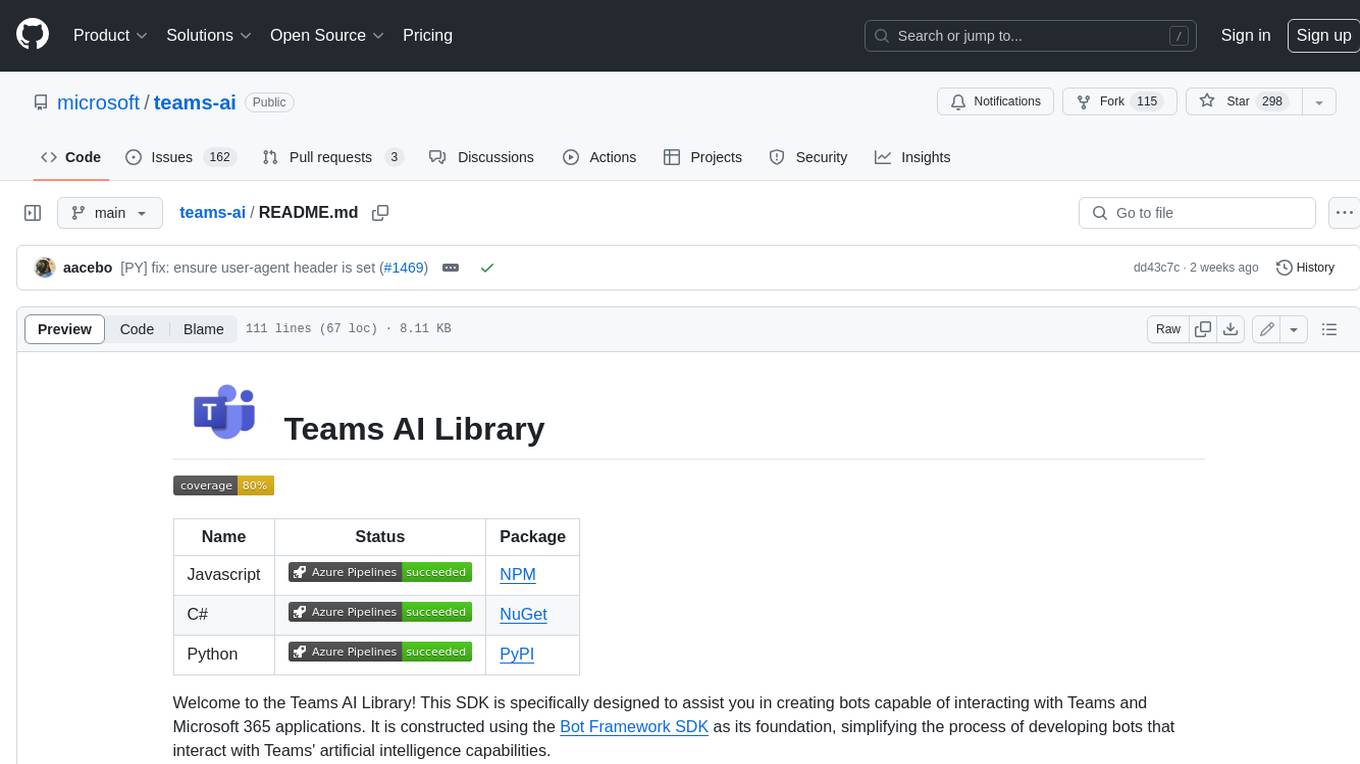
teams-ai
The Teams AI Library is a software development kit (SDK) that helps developers create bots that can interact with Teams and Microsoft 365 applications. It is built on top of the Bot Framework SDK and simplifies the process of developing bots that interact with Teams' artificial intelligence capabilities. The SDK is available for JavaScript/TypeScript, .NET, and Python.
ai-guide
This guide is dedicated to Large Language Models (LLMs) that you can run on your home computer. It assumes your PC is a lower-end, non-gaming setup.
classifai
Supercharge WordPress Content Workflows and Engagement with Artificial Intelligence. Tap into leading cloud-based services like OpenAI, Microsoft Azure AI, Google Gemini and IBM Watson to augment your WordPress-powered websites. Publish content faster while improving SEO performance and increasing audience engagement. ClassifAI integrates Artificial Intelligence and Machine Learning technologies to lighten your workload and eliminate tedious tasks, giving you more time to create original content that matters.
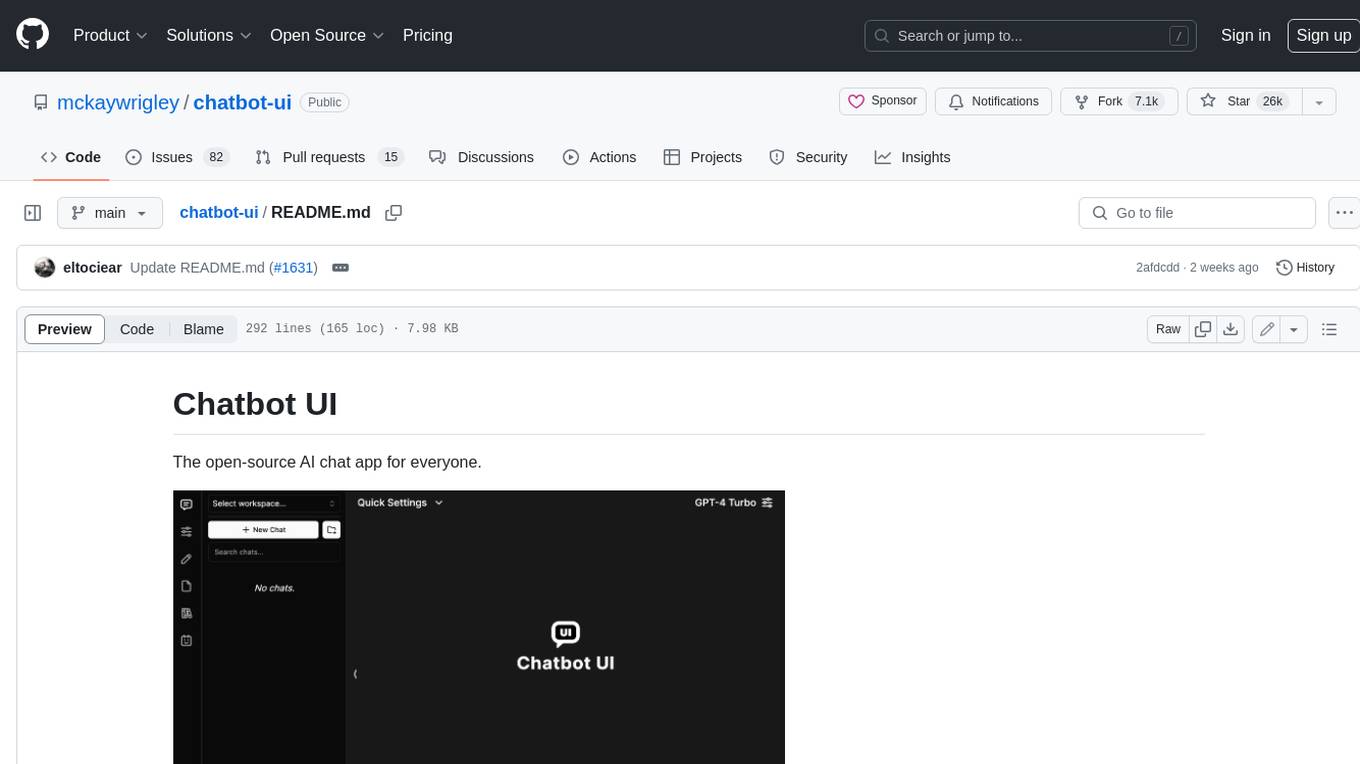
chatbot-ui
Chatbot UI is an open-source AI chat app that allows users to create and deploy their own AI chatbots. It is easy to use and can be customized to fit any need. Chatbot UI is perfect for businesses, developers, and anyone who wants to create a chatbot.
BricksLLM
BricksLLM is a cloud native AI gateway written in Go. Currently, it provides native support for OpenAI, Anthropic, Azure OpenAI and vLLM. BricksLLM aims to provide enterprise level infrastructure that can power any LLM production use cases. Here are some use cases for BricksLLM: * Set LLM usage limits for users on different pricing tiers * Track LLM usage on a per user and per organization basis * Block or redact requests containing PIIs * Improve LLM reliability with failovers, retries and caching * Distribute API keys with rate limits and cost limits for internal development/production use cases * Distribute API keys with rate limits and cost limits for students
uAgents
uAgents is a Python library developed by Fetch.ai that allows for the creation of autonomous AI agents. These agents can perform various tasks on a schedule or take action on various events. uAgents are easy to create and manage, and they are connected to a fast-growing network of other uAgents. They are also secure, with cryptographically secured messages and wallets.
griptape
Griptape is a modular Python framework for building AI-powered applications that securely connect to your enterprise data and APIs. It offers developers the ability to maintain control and flexibility at every step. Griptape's core components include Structures (Agents, Pipelines, and Workflows), Tasks, Tools, Memory (Conversation Memory, Task Memory, and Meta Memory), Drivers (Prompt and Embedding Drivers, Vector Store Drivers, Image Generation Drivers, Image Query Drivers, SQL Drivers, Web Scraper Drivers, and Conversation Memory Drivers), Engines (Query Engines, Extraction Engines, Summary Engines, Image Generation Engines, and Image Query Engines), and additional components (Rulesets, Loaders, Artifacts, Chunkers, and Tokenizers). Griptape enables developers to create AI-powered applications with ease and efficiency.