


nexus
Nexus, the shared heartbeat where every agent and human connect, collaborate, and evolve together.
Stars: 300
Nexus is a virtual filesystem server designed for AI agents, offering a unified path-based API that integrates files, databases, APIs, and SaaS tools. It provides built-in permissions, memory management, semantic search, and skills lifecycle management. The Nexus Control Panel allows humans to curate files, memories, permissions, and integrations for agents, ensuring oversight and control while agents focus on execution. The repository includes the open-source server, SDK, CLI, and examples, catering to the needs of AI-native filesystems for cognitive agents.
README:




The AI-native filesystem for cognitive agents.

Nexus is a virtual filesystem server for AI agents. It unifies files, databases, APIs, and SaaS tools into a single path-based API with built-in permissions, memory, semantic search, and skills lifecycle management.
Humans manage context. Agents operate within it.
The Nexus Control Panel lets humans curate the files, memories, permissions, and integrations that agents can access—providing oversight and control while agents focus on execution.
This repo contains the open-source server, SDK, CLI, and examples.
Hero Features
- Universal Connectors — One API for local files, S3/GCS, Gmail, Google Drive, X/Twitter, and custom MCP servers
- Sandboxed Execution — Run code safely with Docker/E2B integration
-
Grep Everything —
nexus grepand semantic search across all backends with connector cache - Skills System — Package agent capabilities with versioning, governance, and exporters (LangGraph, MCP, CLI)
Core Platform
- Control Panel — User management, permissions, integrations, audit & versioning
- Runtime Modules — Workspaces, Memory, Workflows, Files, Skills, Sandbox
- ReBAC Permissions — Zanzibar-style access control with multi-tenant isolation
Advanced
- Event-driven workflows, semantic search + LLM document reading, content deduplication + versioning, 14 MCP tools, plugin system, batch operations
- Everything is a File — Memories, CRM records, MCP servers, and documents all expose the same interface with paths, metadata, and permissions for unified search and composability.
- Just-in-Time Retrieval — Instead of pre-indexing everything, Nexus retrieves exactly what's needed when it's needed, adapting the retrieval strategy to each query.
git clone https://github.com/nexi-lab/nexus.git
cd nexus
cp .env.example .env

# Set env
# Required: ANTHROPIC_API_KEY
# Optional: TAVILY_API_KEY, FIRECRAWL_API_KEY, NEXUS_OAUTH_GOOGLE_CLIENT_ID, NEXUS_OAUTH_GOOGLE_CLIENT_SECRET

./scripts/local-demo.sh --start./scripts/docker-demo.sh --init
./scripts/docker-demo.sh --startpip install nexus-ai-fsimport nexus
nx = nexus.connect(config={
"url": "http://localhost:2026",
"api_key": "nxk_..."
})
# File operations
nx.write("/workspace/hello.txt", b"Hello, Nexus!")
print(nx.read("/workspace/hello.txt").decode())
# Search across all backends
results = nx.grep("TODO", "/workspace")
# Agent memory
nx.memory.store("User prefers detailed explanations", memory_type="preference")
context = nx.memory.query("What does the user prefer?")
nx.close()pip install nexus-ai-fs
export NEXUS_URL="http://localhost:2026"
export NEXUS_API_KEY="nxk_..."
nexus write /workspace/hello.txt "Hello, Nexus!"
nexus cat /workspace/hello.txt
nexus grep "TODO" /workspace
nexus memory store "Important fact" --type fact| Problem | Nexus Solution |
|---|---|
| Fragmented APIs | One path-based API for all connectors |
| Permission chaos | Zanzibar-style ReBAC with audit trails |
| Ephemeral memory | Persistent memory with semantic retrieval |
| Agent silos | Shared workspaces and skills registry |
| No oversight | Control Panel for human-in-the-loop management |
| Ad-hoc tools | Skills lifecycle management with versioning, governance, and multi-format export |

Access Layer: Agents connect via CLI, MCP Server, Python SDK, or REST API.
Application Layer:
- Control Panel — Humans manage users, permissions, integrations, and audit logs
- Runtime — Core operations (glob, grep, semantic search, file ops, run code) and modules (workspaces, memory, workflows, files, skills, sandbox)
Infrastructure Layer: OAuth, ReBAC permissions engine, FUSE mounting, RAG pipelines.
Cache Layer: L1 in-memory cache and L2 PostgreSQL cache for vector embeddings, ReBAC tuples, and metadata.
Connectors: X/Twitter, MCP servers, Gmail, Local FS, GCS, Google Drive, AWS S3, and custom connectors.
| Framework | Description | Location |
|---|---|---|
| CrewAI | Multi-agent collaboration | examples/crewai/ |
| LangGraph | Permission-based workflows | examples/langgraph_integration/ |
| Claude SDK | ReAct agent pattern | examples/claude_agent_sdk/ |
| OpenAI Agents | Multi-tenant with memory | examples/openai_agents/ |
| CLI | 40+ shell demos | examples/cli/ |
- Installation
- Quick Start
- Control Panel Guide
- API Reference
- Skills System
- Multi-Tenant Architecture
- Permissions & ReBAC
git clone https://github.com/nexi-lab/nexus.git
cd nexus
pip install -e ".[dev]"
pre-commit install
pytest tests/
See CONTRIBUTING.md for guidelines.
© 2025 Nexi Labs, Inc. Licensed under Apache License 2.0 - See LICENSE for details.
If Nexus helps your project, please ⭐ the repo!
For Tasks:
Click tags to check more tools for each tasksFor Jobs:
Alternative AI tools for nexus
Similar Open Source Tools
nexus
Nexus is a virtual filesystem server designed for AI agents, offering a unified path-based API that integrates files, databases, APIs, and SaaS tools. It provides built-in permissions, memory management, semantic search, and skills lifecycle management. The Nexus Control Panel allows humans to curate files, memories, permissions, and integrations for agents, ensuring oversight and control while agents focus on execution. The repository includes the open-source server, SDK, CLI, and examples, catering to the needs of AI-native filesystems for cognitive agents.
databend
Databend is an open-source cloud data warehouse built in Rust, offering fast query execution and data ingestion for complex analysis of large datasets. It integrates with major cloud platforms, provides high performance with AI-powered analytics, supports multiple data formats, ensures data integrity with ACID transactions, offers flexible indexing options, and features community-driven development. Users can try Databend through a serverless cloud or Docker installation, and perform tasks such as data import/export, querying semi-structured data, managing users/databases/tables, and utilizing AI functions.
cua
Cua is a tool for creating and running high-performance macOS and Linux virtual machines on Apple Silicon, with built-in support for AI agents. It provides libraries like Lume for running VMs with near-native performance, Computer for interacting with sandboxes, and Agent for running agentic workflows. Users can refer to the documentation for onboarding, explore demos showcasing AI-Gradio and GitHub issue fixing, and utilize accessory libraries like Core, PyLume, Computer Server, and SOM. Contributions are welcome, and the tool is open-sourced under the MIT License.
nodetool
NodeTool is a platform designed for AI enthusiasts, developers, and creators, providing a visual interface to access a variety of AI tools and models. It simplifies access to advanced AI technologies, offering resources for content creation, data analysis, automation, and more. With features like a visual editor, seamless integration with leading AI platforms, model manager, and API integration, NodeTool caters to both newcomers and experienced users in the AI field.
superagentx
SuperAgentX is a lightweight open-source AI framework designed for multi-agent applications with Artificial General Intelligence (AGI) capabilities. It offers goal-oriented multi-agents with retry mechanisms, easy deployment through WebSocket, RESTful API, and IO console interfaces, streamlined architecture with no major dependencies, contextual memory using SQL + Vector databases, flexible LLM configuration supporting various Gen AI models, and extendable handlers for integration with diverse APIs and data sources. It aims to accelerate the development of AGI by providing a powerful platform for building autonomous AI agents capable of executing complex tasks with minimal human intervention.
aichat
Aichat is an AI-powered CLI chat and copilot tool that seamlessly integrates with over 10 leading AI platforms, providing a powerful combination of chat-based interaction, context-aware conversations, and AI-assisted shell capabilities, all within a customizable and user-friendly environment.
astron-rpa
AstronRPA is an enterprise-grade Robotic Process Automation (RPA) desktop application that supports low-code/no-code development. It enables users to rapidly build workflows and automate desktop software and web pages. The tool offers comprehensive automation support for various applications, highly component-based design, enterprise-grade security and collaboration features, developer-friendly experience, native agent empowerment, and multi-channel trigger integration. It follows a frontend-backend separation architecture with components for system operations, browser automation, GUI automation, AI integration, and more. The tool is deployed via Docker and designed for complex RPA scenarios.
agentscope
AgentScope is an agent-oriented programming tool for building LLM (Large Language Model) applications. It provides transparent development, realtime steering, agentic tools management, model agnostic programming, LEGO-style agent building, multi-agent support, and high customizability. The tool supports async invocation, reasoning models, streaming returns, async/sync tool functions, user interruption, group-wise tools management, streamable transport, stateful/stateless mode MCP client, distributed and parallel evaluation, multi-agent conversation management, and fine-grained MCP control. AgentScope Studio enables tracing and visualization of agent applications. The tool is highly customizable and encourages customization at various levels.
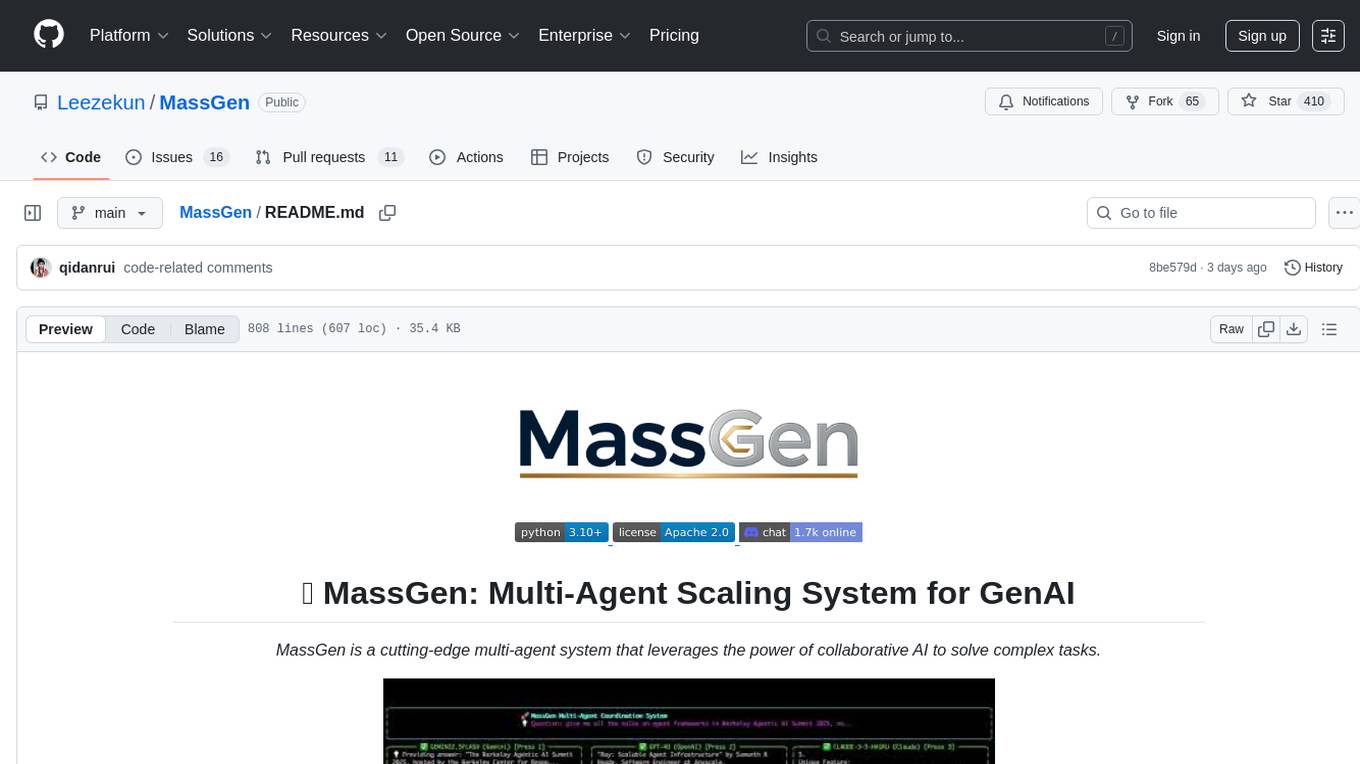
MassGen
MassGen is a cutting-edge multi-agent system that leverages the power of collaborative AI to solve complex tasks. It assigns a task to multiple AI agents who work in parallel, observe each other's progress, and refine their approaches to converge on the best solution to deliver a comprehensive and high-quality result. The system operates through an architecture designed for seamless multi-agent collaboration, with key features including cross-model/agent synergy, parallel processing, intelligence sharing, consensus building, and live visualization. Users can install the system, configure API settings, and run MassGen for various tasks such as question answering, creative writing, research, development & coding tasks, and web automation & browser tasks. The roadmap includes plans for advanced agent collaboration, expanded model, tool & agent integration, improved performance & scalability, enhanced developer experience, and a web interface.
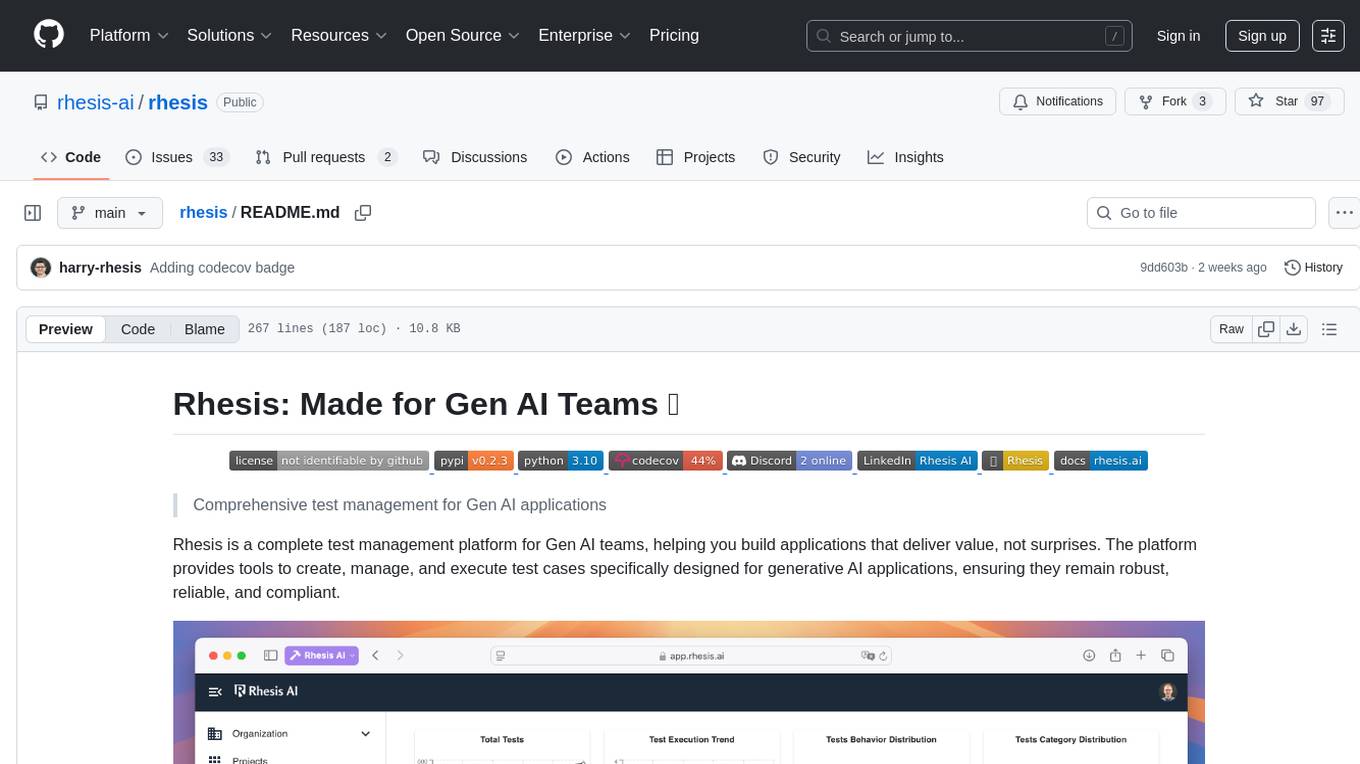
rhesis
Rhesis is a comprehensive test management platform designed for Gen AI teams, offering tools to create, manage, and execute test cases for generative AI applications. It ensures the robustness, reliability, and compliance of AI systems through features like test set management, automated test generation, edge case discovery, compliance validation, integration capabilities, and performance tracking. The platform is open source, emphasizing community-driven development, transparency, extensible architecture, and democratizing AI safety. It includes components such as backend services, frontend applications, SDK for developers, worker services, chatbot applications, and Polyphemus for uncensored LLM service. Rhesis enables users to address challenges unique to testing generative AI applications, such as non-deterministic outputs, hallucinations, edge cases, ethical concerns, and compliance requirements.
tingly-box
Tingly Box is a tool that helps in deciding which model to call, compressing context, and routing requests efficiently. It offers secure, reliable, and customizable functional extensions. With features like unified API, smart routing, context compression, auto API translation, blazing fast performance, flexible authentication, visual control panel, and client-side usage stats, Tingly Box provides a comprehensive solution for managing AI models and tokens. It supports integration with various IDEs, CLI tools, SDKs, and AI applications, making it versatile and easy to use. The tool also allows seamless integration with OAuth providers like Claude Code, enabling users to utilize existing quotas in OpenAI-compatible tools. Tingly Box aims to simplify AI model management and usage by providing a single endpoint for multiple providers with minimal configuration, promoting seamless integration with SDKs and CLI tools.
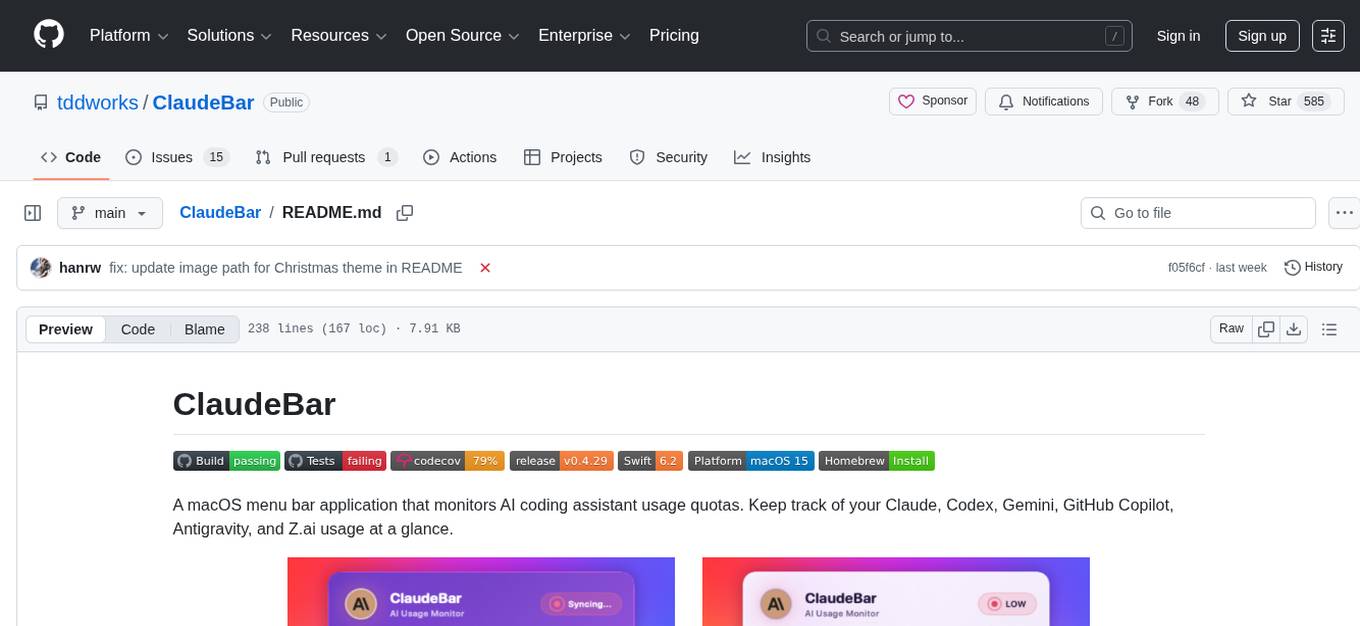
ClaudeBar
ClaudeBar is a macOS menu bar application that monitors AI coding assistant usage quotas. It allows users to keep track of their usage of Claude, Codex, Gemini, GitHub Copilot, Antigravity, and Z.ai at a glance. The application offers multi-provider support, real-time quota tracking, multiple themes, visual status indicators, system notifications, auto-refresh feature, and keyboard shortcuts for quick access. Users can customize monitoring by toggling individual providers on/off and receive alerts when quota status changes. The tool requires macOS 15+, Swift 6.2+, and CLI tools installed for the providers to be monitored.
Evaluator
NeMo Evaluator SDK is an open-source platform for robust, reproducible, and scalable evaluation of Large Language Models. It enables running hundreds of benchmarks across popular evaluation harnesses against any OpenAI-compatible model API. The platform ensures auditable and trustworthy results by executing evaluations in open-source Docker containers. NeMo Evaluator SDK is built on four core principles: Reproducibility by Default, Scale Anywhere, State-of-the-Art Benchmarking, and Extensible and Customizable.
conduit
Conduit is an open-source, cross-platform mobile application for Open-WebUI, providing a native mobile experience for interacting with your self-hosted AI infrastructure. It supports real-time chat, model selection, conversation management, markdown rendering, theme support, voice input, file uploads, multi-modal support, secure storage, folder management, and tools invocation. Conduit offers multiple authentication flows and follows a clean architecture pattern with Riverpod for state management, Dio for HTTP networking, WebSocket for real-time streaming, and Flutter Secure Storage for credential management.
local-deep-research
Local Deep Research is a powerful AI-powered research assistant that performs deep, iterative analysis using multiple LLMs and web searches. It can be run locally for privacy or configured to use cloud-based LLMs for enhanced capabilities. The tool offers advanced research capabilities, flexible LLM support, rich output options, privacy-focused operation, enhanced search integration, and academic & scientific integration. It also provides a web interface, command line interface, and supports multiple LLM providers and search engines. Users can configure AI models, search engines, and research parameters for customized research experiences.
mcp-rubber-duck
MCP Rubber Duck is a Model Context Protocol server that acts as a bridge to query multiple LLMs, including OpenAI-compatible HTTP APIs and CLI coding agents. Users can explain their problems to various AI 'ducks' to get different perspectives. The tool offers features like universal OpenAI compatibility, CLI agent support, conversation management, multi-duck querying, consensus voting, LLM-as-Judge evaluation, structured debates, health monitoring, usage tracking, and more. It supports various HTTP providers like OpenAI, Google Gemini, Anthropic, Groq, Together AI, Perplexity, and CLI providers like Claude Code, Codex, Gemini CLI, Grok, Aider, and custom agents. Users can install the tool globally, configure it using environment variables, and access interactive UIs for comparing ducks, voting, debating, and usage statistics. The tool provides multiple tools for asking questions, chatting, clearing conversations, listing ducks, comparing responses, voting, judging, iterating, debating, and more. It also offers prompt templates for different analysis purposes and extensive documentation for setup, configuration, tools, prompts, CLI providers, MCP Bridge, guardrails, Docker deployment, troubleshooting, contributing, license, acknowledgments, changelog, registry & directory, and support.
For similar tasks
genai-workshop
The Neo4j GenAI Workshop repository contains notebooks for a workshop focusing on building a Neo4j Graph, text embedding, and providing demos for content generation. The workshop includes data staging, loading, and exploration using Cypher queries. It also covers improvements in LLM response quality, GPT-4 usage, and vector search speed. The repository has undergone multiple updates to enhance course quality, simplify content, and provide better explainers and examples.
nexus
Nexus is a virtual filesystem server designed for AI agents, offering a unified path-based API that integrates files, databases, APIs, and SaaS tools. It provides built-in permissions, memory management, semantic search, and skills lifecycle management. The Nexus Control Panel allows humans to curate files, memories, permissions, and integrations for agents, ensuring oversight and control while agents focus on execution. The repository includes the open-source server, SDK, CLI, and examples, catering to the needs of AI-native filesystems for cognitive agents.
promptfoo
Promptfoo is a tool for testing and evaluating LLM output quality. With promptfoo, you can build reliable prompts, models, and RAGs with benchmarks specific to your use-case, speed up evaluations with caching, concurrency, and live reloading, score outputs automatically by defining metrics, use as a CLI, library, or in CI/CD, and use OpenAI, Anthropic, Azure, Google, HuggingFace, open-source models like Llama, or integrate custom API providers for any LLM API.
LLM-SFT
LLM-SFT is a Chinese large model fine-tuning tool that supports models such as ChatGLM, LlaMA, Bloom, Baichuan-7B, and frameworks like LoRA, QLoRA, DeepSpeed, UI, and TensorboardX. It facilitates tasks like fine-tuning, inference, evaluation, and API integration. The tool provides pre-trained weights for various models and datasets for Chinese language processing. It requires specific versions of libraries like transformers and torch for different functionalities.
EDDI
E.D.D.I (Enhanced Dialog Driven Interface) is an enterprise-certified chatbot middleware that offers advanced prompt and conversation management for Conversational AI APIs. Developed in Java using Quarkus, it is lean, RESTful, scalable, and cloud-native. E.D.D.I is highly scalable and designed to efficiently manage conversations in AI-driven applications, with seamless API integration capabilities. Notable features include configurable NLP and Behavior rules, support for multiple chatbots running concurrently, and integration with MongoDB, OAuth 2.0, and HTML/CSS/JavaScript for UI. The project requires Java 21, Maven 3.8.4, and MongoDB >= 5.0 to run. It can be built as a Docker image and deployed using Docker or Kubernetes, with additional support for integration testing and monitoring through Prometheus and Kubernetes endpoints.
hume-python-sdk
The Hume AI Python SDK allows users to integrate Hume APIs directly into their Python applications. Users can access complete documentation, quickstart guides, and example notebooks to get started. The SDK is designed to provide support for Hume's expressive communication platform built on scientific research. Users are encouraged to create an account at beta.hume.ai and stay updated on changes through Discord. The SDK may undergo breaking changes to improve tooling and ensure reliable releases in the future.
telegram-llm
A Telegram LLM bot that allows users to deploy their own Telegram bot in 3 simple steps by creating a flow function, configuring access to the Telegram bot, and connecting to an LLM backend. Users need to sign into flows.network, have a bot token from Telegram, and an OpenAI API key. The bot can be customized with ChatGPT prompts and integrated with OpenAI and Telegram for various functionalities.
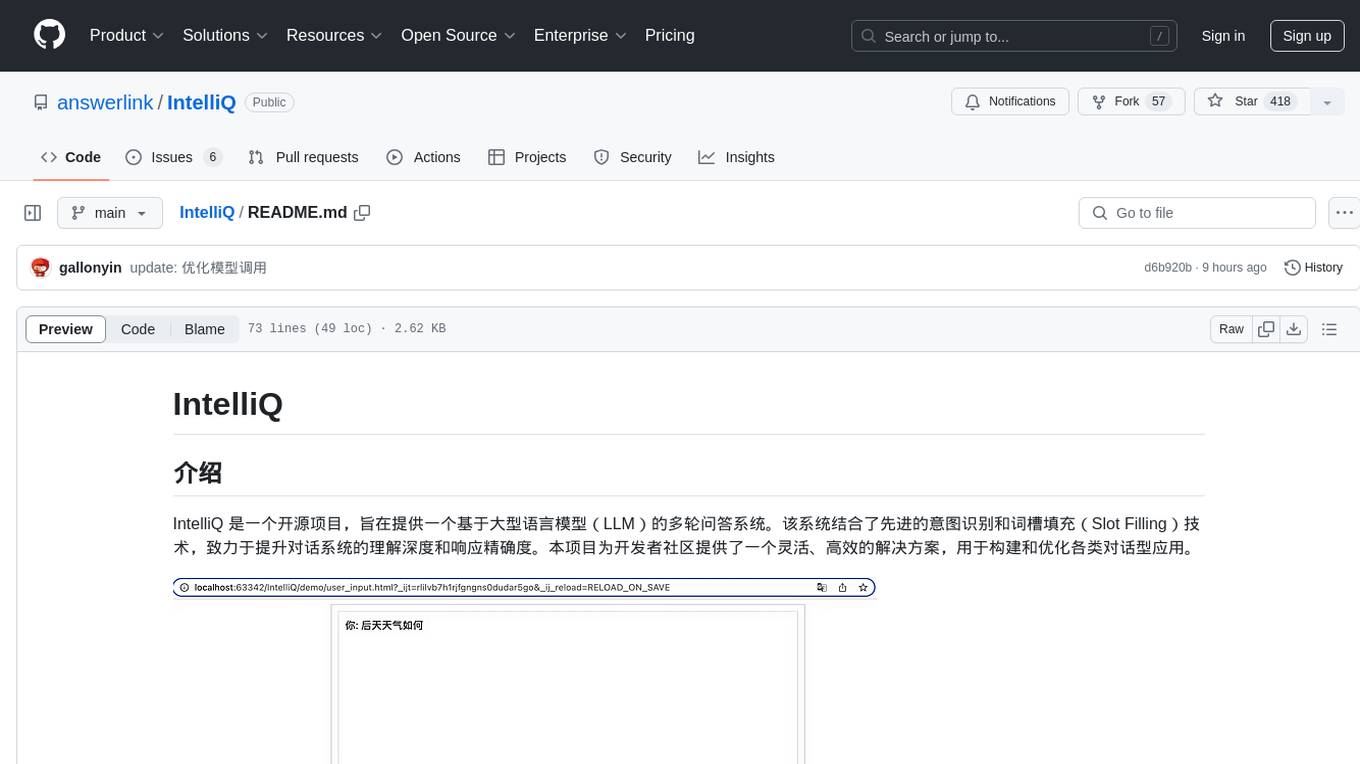
IntelliQ
IntelliQ is an open-source project aimed at providing a multi-turn question-answering system based on a large language model (LLM). The system combines advanced intent recognition and slot filling technology to enhance the depth of understanding and accuracy of responses in conversation systems. It offers a flexible and efficient solution for developers to build and optimize various conversational applications. The system features multi-turn dialogue management, intent recognition, slot filling, interface slot technology for real-time data retrieval and processing, adaptive learning for improving response accuracy and speed, and easy integration with detailed API documentation supporting multiple programming languages and platforms.
For similar jobs
sweep
Sweep is an AI junior developer that turns bugs and feature requests into code changes. It automatically handles developer experience improvements like adding type hints and improving test coverage.
teams-ai
The Teams AI Library is a software development kit (SDK) that helps developers create bots that can interact with Teams and Microsoft 365 applications. It is built on top of the Bot Framework SDK and simplifies the process of developing bots that interact with Teams' artificial intelligence capabilities. The SDK is available for JavaScript/TypeScript, .NET, and Python.
ai-guide
This guide is dedicated to Large Language Models (LLMs) that you can run on your home computer. It assumes your PC is a lower-end, non-gaming setup.
classifai
Supercharge WordPress Content Workflows and Engagement with Artificial Intelligence. Tap into leading cloud-based services like OpenAI, Microsoft Azure AI, Google Gemini and IBM Watson to augment your WordPress-powered websites. Publish content faster while improving SEO performance and increasing audience engagement. ClassifAI integrates Artificial Intelligence and Machine Learning technologies to lighten your workload and eliminate tedious tasks, giving you more time to create original content that matters.
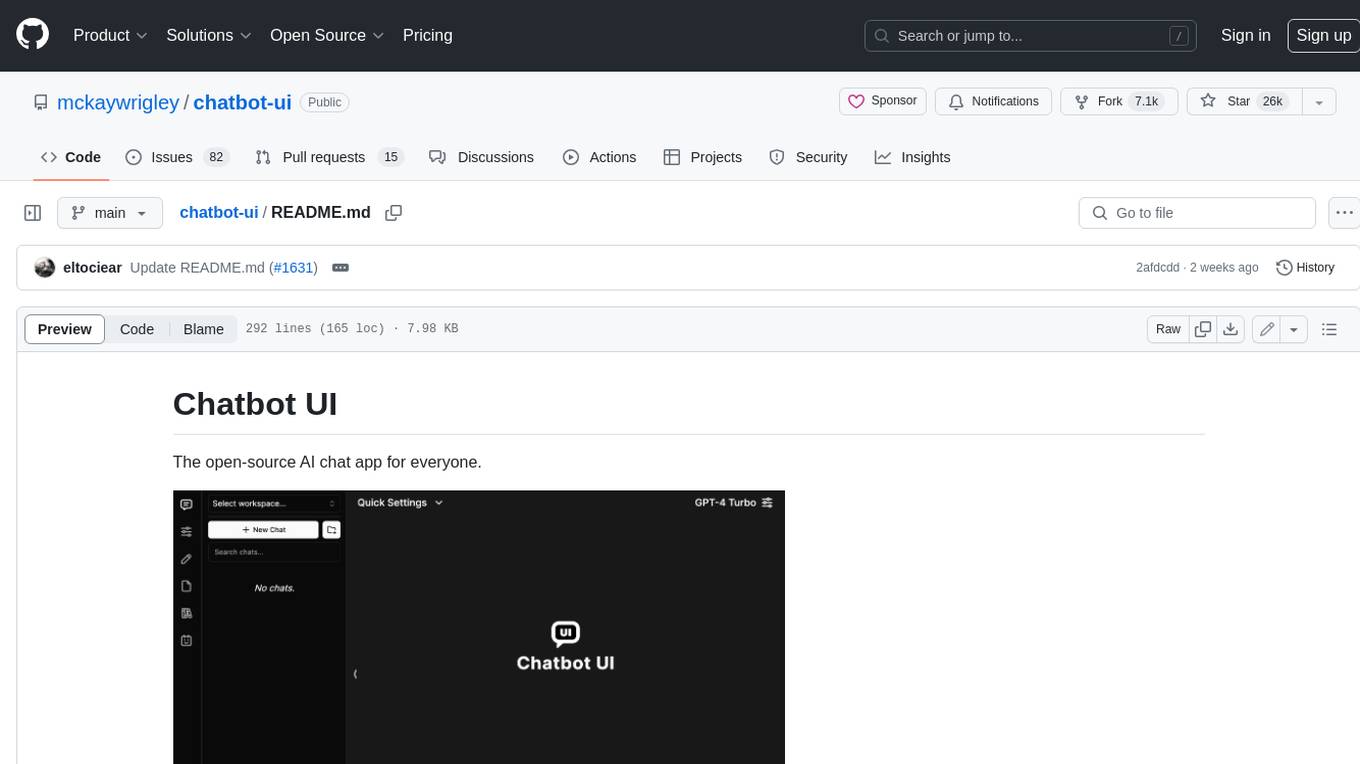
chatbot-ui
Chatbot UI is an open-source AI chat app that allows users to create and deploy their own AI chatbots. It is easy to use and can be customized to fit any need. Chatbot UI is perfect for businesses, developers, and anyone who wants to create a chatbot.
BricksLLM
BricksLLM is a cloud native AI gateway written in Go. Currently, it provides native support for OpenAI, Anthropic, Azure OpenAI and vLLM. BricksLLM aims to provide enterprise level infrastructure that can power any LLM production use cases. Here are some use cases for BricksLLM: * Set LLM usage limits for users on different pricing tiers * Track LLM usage on a per user and per organization basis * Block or redact requests containing PIIs * Improve LLM reliability with failovers, retries and caching * Distribute API keys with rate limits and cost limits for internal development/production use cases * Distribute API keys with rate limits and cost limits for students
uAgents
uAgents is a Python library developed by Fetch.ai that allows for the creation of autonomous AI agents. These agents can perform various tasks on a schedule or take action on various events. uAgents are easy to create and manage, and they are connected to a fast-growing network of other uAgents. They are also secure, with cryptographically secured messages and wallets.
griptape
Griptape is a modular Python framework for building AI-powered applications that securely connect to your enterprise data and APIs. It offers developers the ability to maintain control and flexibility at every step. Griptape's core components include Structures (Agents, Pipelines, and Workflows), Tasks, Tools, Memory (Conversation Memory, Task Memory, and Meta Memory), Drivers (Prompt and Embedding Drivers, Vector Store Drivers, Image Generation Drivers, Image Query Drivers, SQL Drivers, Web Scraper Drivers, and Conversation Memory Drivers), Engines (Query Engines, Extraction Engines, Summary Engines, Image Generation Engines, and Image Query Engines), and additional components (Rulesets, Loaders, Artifacts, Chunkers, and Tokenizers). Griptape enables developers to create AI-powered applications with ease and efficiency.