


plano
Delivery infrastructure for agentic apps - Plano is an AI-native proxy and data plane that offloads plumbing work, so you stay focused on your agent's core logic (via any AI framework).
Stars: 5054
Plano is an AI-native proxy server and data plane for agentic apps that simplifies agent routing, orchestration, signals and traces, guardrail filters, and smart LLM routing APIs. It centralizes core delivery concerns into a unified dataplane, allowing developers to focus on the core product logic of agentic applications. Plano supports any language or AI framework, enabling faster delivery of agents to production. It is built on industry-leading LLM research and Envoy by core contributors.
README:

The AI-native proxy server and data plane for agentic apps.
Plano pulls out the rote plumbing work and decouples you from brittle framework abstractions, centralizing what shouldn’t be bespoke in every codebase - like agent routing and orchestration, rich agentic signals and traces for continuous improvement, guardrail filters for safety and moderation, and smart LLM routing APIs for model agility. Use any language or AI framework, and deliver agents faster to production.
Quickstart Guide • Build Agentic Apps with Plano • Documentation • Contact


Star ⭐️ the repo if you found Plano useful — new releases and updates land here first.
Building agentic demos is easy. Shipping agentic applications safely, reliably, and repeatably to production is hard. After the thrill of a quick hack, you end up building the “hidden middleware” to reach production: routing logic to reach the right agent, guardrail hooks for safety and moderation, evaluation and observability glue for continuous learning, and model/provider quirks scattered across frameworks and application code.
Plano solves this by moving core delivery concerns into a unified, out-of-process dataplane.
- 🚦 Orchestration: Low-latency orchestration between agents; add new agents without modifying app code.
- 🔗 Model Agility: Route by model name, alias (semantic names) or automatically via preferences.
- 🕵 Agentic Signals™: Zero-code capture of Signals plus OTEL traces/metrics across every agent.
- 🛡️ Moderation & Memory Hooks: Build jailbreak protection, add moderation policies and memory consistently via Filter Chains.
Plano pulls rote plumbing out of your framework so you can stay focused on what matters most: the core product logic of your agentic applications. Plano is backed by industry-leading LLM research and built on Envoy by its core contributors, who built critical infrastructure at scale for modern worklaods.
High-Level Network Sequence Diagram:

Jump to our docs to learn how you can use Plano to improve the speed, safety and obervability of your agentic applications.
[!IMPORTANT] Plano and the Arch family of LLMs (like Plano-Orchestrator-4B, Arch-Router, etc) are hosted free of charge in the US-central region to give you a great first-run developer experience of Plano. To scale and run in production, you can either run these LLMs locally or contact us on Discord for API keys.
Plano handles orchestration, model management, and observability as modular building blocks - letting you configure only what you need (edge proxying for agentic orchestration and guardrails, or LLM routing from your services, or both together) to fit cleanly into existing architectures. Below is a simple multi-agent travel agent built with Plano that showcases all three core capabilities
📁 Full working code: See
demos/use_cases/travel_agents/for complete weather and flight agents you can run locally.
# config.yaml
version: v0.3.0

# What you declare: Agent URLs and natural language descriptions
# What you don't write: Intent classifiers, routing logic, model fallbacks, provider adapters, or tracing instrumentation

agents:
  - id: weather_agent
    url: http://localhost:10510
  - id: flight_agent
    url: http://localhost:10520

model_providers:
  - model: openai/gpt-4o
    access_key: $OPENAI_API_KEY
    default: true
  - model: anthropic/claude-3-5-sonnet
    access_key: $ANTHROPIC_API_KEY

listeners:
  - type: agent
    name: travel_assistant
    port: 8001
    router: plano_orchestrator_v1  # Powered by our 4B-parameter routing model. You can change this to different models
    agents:
      - id: weather_agent
        description: |
          Gets real-time weather and forecasts for any city worldwide.
          Handles: "What's the weather in Paris?", "Will it rain in Tokyo?"

      - id: flight_agent
        description: |
          Searches flights between airports with live status and schedules.
          Handles: "Flights from NYC to LA", "Show me flights to Seattle"

tracing:
random_sampling: 100 # Auto-capture traces for evaluationYour agents are just HTTP servers that implement the OpenAI-compatible chat completions endpoint. Use any language or framework:
# weather_agent.py
from fastapi import FastAPI, Request
from fastapi.responses import StreamingResponse
from openai import AsyncOpenAI

app = FastAPI()

# Point to Plano's LLM gateway - it handles model routing for you
llm = AsyncOpenAI(base_url="http://localhost:12001/v1", api_key="EMPTY")

@app.post("/v1/chat/completions")
async def chat(request: Request):
    body = await request.json()
    messages = body.get("messages", [])
    days = 7

    # Your agent logic: fetch data, call APIs, run tools
    # See demos/use_cases/travel_agents/ for the full implementation
    weather_data = await get_weather_data(request, messages, days)

    # Stream the response back through Plano
    async def generate():
        stream = await llm.chat.completions.create(
            model="openai/gpt-4o",
            messages=[{"role": "system", "content": f"Weather: {weather_data}"}, *messages],
            stream=True
        )
        async for chunk in stream:
            yield f"data: {chunk.model_dump_json()}\n\n"

return StreamingResponse(generate(), media_type="text/event-stream")Prerequisites: Follow the prerequisites guide to install Plano and set up your environment.
# Start Plano
planoai up config.yaml
...

# Query - Plano intelligently routes to both agents in a single conversation
curl http://localhost:8001/v1/chat/completions \
  -H "Content-Type: application/json" \
  -d '{
    "model": "gpt-4o",
    "messages": [
      {"role": "user", "content": "I want to travel from NYC to Paris next week. What is the weather like there, and can you find me some flights?"}
    ]
  }'
# → Plano routes to weather_agent for Paris weather ✓
# → Then routes to flight_agent for NYC → Paris flights ✓
# → Returns a complete travel plan with both weather info and flight optionsEvery request is traced end-to-end with OpenTelemetry - no instrumentation code needed.

| Infrastructure Concern | Without Plano | With Plano |
|---|---|---|
| Agent Orchestration | Write intent classifier + routing logic | Declare agent descriptions in YAML |
| Model Management | Handle each provider's API quirks | Unified LLM APIs with state management |
| Rich Tracing | Instrument every service with OTEL | Automatic end-to-end traces and logs |
| Learning Signals | Build pipeline to capture/export spans | Zero-code agentic signals |
| Adding Agents | Update routing code, test, redeploy | Add to config, restart |
Why it's efficient: Plano uses purpose-built, lightweight LLMs (like our 4B-parameter orchestrator) instead of heavyweight frameworks or GPT-4 for routing - giving you production-grade routing at a fraction of the cost and latency.
To get in touch with us, please join our discord server. We actively monitor that and offer support there.
Ready to try Plano? Check out our comprehensive documentation:
- Quickstart Guide - Get up and running in minutes
- LLM Routing - Route by model name, alias, or intelligent preferences
- Agent Orchestration - Build multi-agent workflows
- Filter Chains - Add guardrails, moderation, and memory hooks
- Prompt Targets - Turn prompts into deterministic API calls
- Observability - Traces, metrics, and logs
We would love feedback on our Roadmap and we welcome contributions to Plano! Whether you're fixing bugs, adding new features, improving documentation, or creating tutorials, your help is much appreciated. Please visit our Contribution Guide for more details
Star ⭐️ the repo if you found Plano useful — new releases and updates land here first.
For Tasks:
Click tags to check more tools for each tasksFor Jobs:
Alternative AI tools for plano
Similar Open Source Tools
plano
Plano is an AI-native proxy server and data plane for agentic apps that simplifies agent routing, orchestration, signals and traces, guardrail filters, and smart LLM routing APIs. It centralizes core delivery concerns into a unified dataplane, allowing developers to focus on the core product logic of agentic applications. Plano supports any language or AI framework, enabling faster delivery of agents to production. It is built on industry-leading LLM research and Envoy by core contributors.
zenml
ZenML is an extensible, open-source MLOps framework for creating portable, production-ready machine learning pipelines. By decoupling infrastructure from code, ZenML enables developers across your organization to collaborate more effectively as they develop to production.
multi-agent-orchestrator
Multi-Agent Orchestrator is a flexible and powerful framework for managing multiple AI agents and handling complex conversations. It intelligently routes queries to the most suitable agent based on context and content, supports dual language implementation in Python and TypeScript, offers flexible agent responses, context management across agents, extensible architecture for customization, universal deployment options, and pre-built agents and classifiers. It is suitable for various applications, from simple chatbots to sophisticated AI systems, accommodating diverse requirements and scaling efficiently.
agents
The LiveKit Agent Framework is designed for building real-time, programmable participants that run on servers. Easily tap into LiveKit WebRTC sessions and process or generate audio, video, and data streams. The framework includes plugins for common workflows, such as voice activity detection and speech-to-text. Agents integrates seamlessly with LiveKit server, offloading job queuing and scheduling responsibilities to it. This eliminates the need for additional queuing infrastructure. Agent code developed on your local machine can scale to support thousands of concurrent sessions when deployed to a server in production.
arbigent
Arbigent (Arbiter-Agent) is an AI agent testing framework designed to make AI agent testing practical for modern applications. It addresses challenges faced by traditional UI testing frameworks and AI agents by breaking down complex tasks into smaller, dependent scenarios. The framework is customizable for various AI providers, operating systems, and form factors, empowering users with extensive customization capabilities. Arbigent offers an intuitive UI for scenario creation and a powerful code interface for seamless test execution. It supports multiple form factors, optimizes UI for AI interaction, and is cost-effective by utilizing models like GPT-4o mini. With a flexible code interface and open-source nature, Arbigent aims to revolutionize AI agent testing in modern applications.
nous
Nous is an open-source TypeScript platform for autonomous AI agents and LLM based workflows. It aims to automate processes, support requests, review code, assist with refactorings, and more. The platform supports various integrations, multiple LLMs/services, CLI and web interface, human-in-the-loop interactions, flexible deployment options, observability with OpenTelemetry tracing, and specific agents for code editing, software engineering, and code review. It offers advanced features like reasoning/planning, memory and function call history, hierarchical task decomposition, and control-loop function calling options. Nous is designed to be a flexible platform for the TypeScript community to expand and support different use cases and integrations.
LightAgent
LightAgent is a lightweight, open-source Agentic AI development framework with memory, tools, and a tree of thought. It supports multi-agent collaboration, autonomous learning, tool integration, complex task handling, and multi-model support. It also features a streaming API, tool generator, agent self-learning, adaptive tool mechanism, and more. LightAgent is designed for intelligent customer service, data analysis, automated tools, and educational assistance.
agent-squad
Agent Squad is a flexible, lightweight open-source framework for orchestrating multiple AI agents to handle complex conversations. It intelligently routes queries, maintains context across interactions, and offers pre-built components for quick deployment. The system allows easy integration of custom agents and conversation messages storage solutions, making it suitable for various applications from simple chatbots to sophisticated AI systems, scaling efficiently.
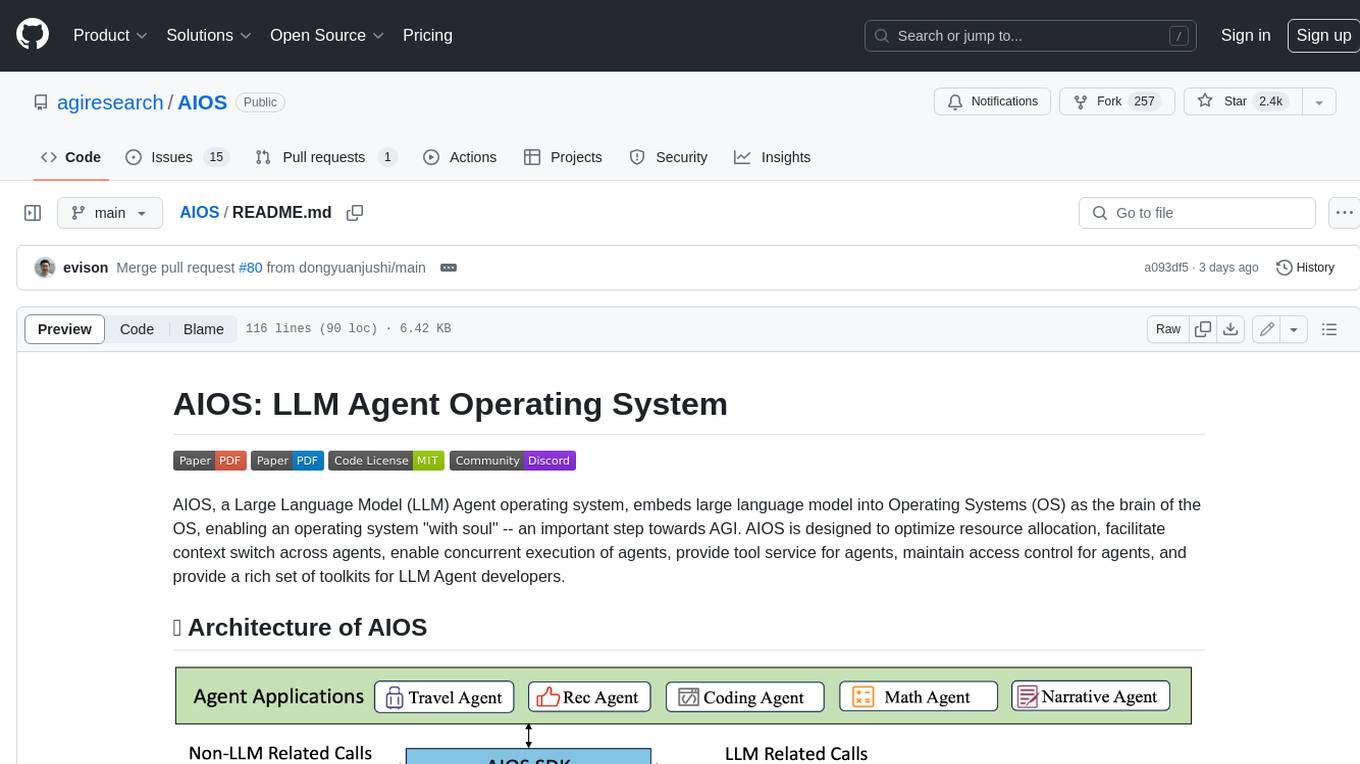
AIOS
AIOS, a Large Language Model (LLM) Agent operating system, embeds large language model into Operating Systems (OS) as the brain of the OS, enabling an operating system "with soul" -- an important step towards AGI. AIOS is designed to optimize resource allocation, facilitate context switch across agents, enable concurrent execution of agents, provide tool service for agents, maintain access control for agents, and provide a rich set of toolkits for LLM Agent developers.
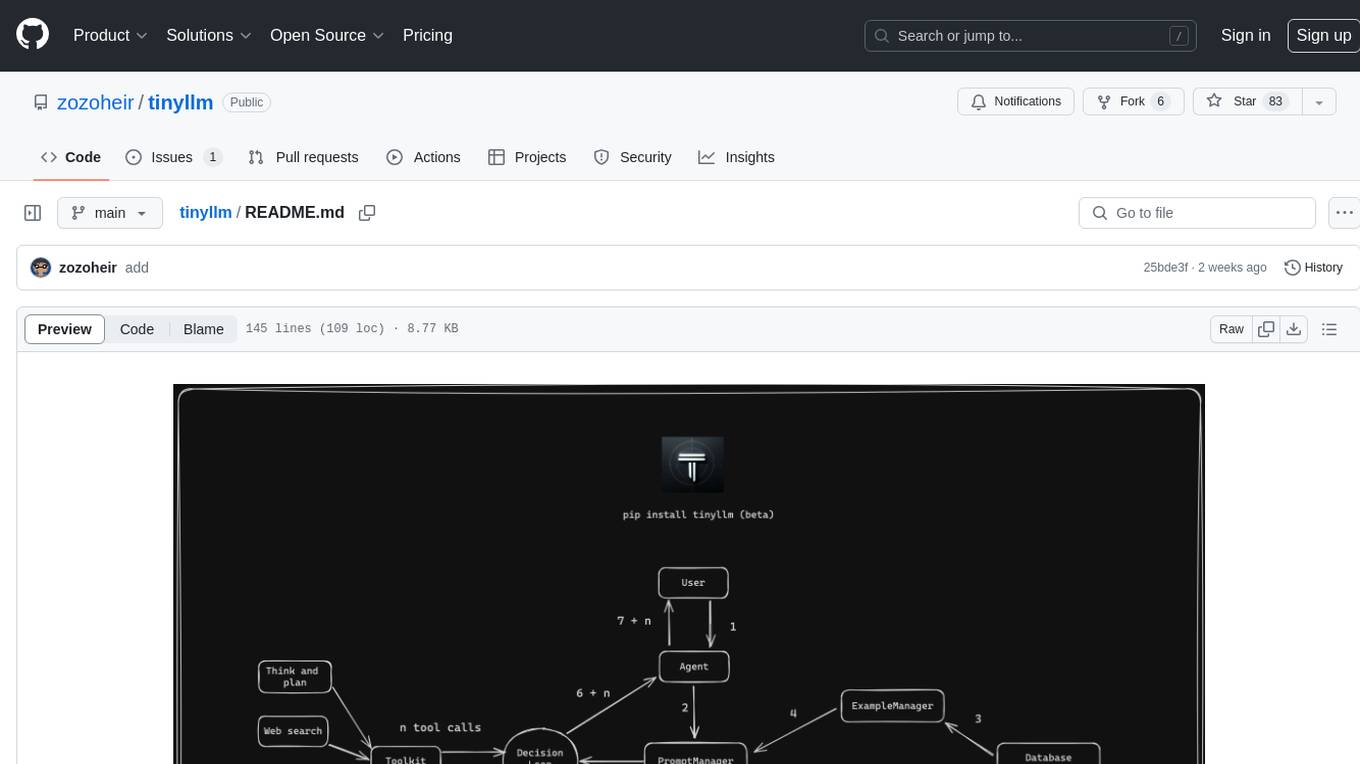
tinyllm
tinyllm is a lightweight framework designed for developing, debugging, and monitoring LLM and Agent powered applications at scale. It aims to simplify code while enabling users to create complex agents or LLM workflows in production. The core classes, Function and FunctionStream, standardize and control LLM, ToolStore, and relevant calls for scalable production use. It offers structured handling of function execution, including input/output validation, error handling, evaluation, and more, all while maintaining code readability. Users can create chains with prompts, LLM models, and evaluators in a single file without the need for extensive class definitions or spaghetti code. Additionally, tinyllm integrates with various libraries like Langfuse and provides tools for prompt engineering, observability, logging, and finite state machine design.
agentgateway
Agentgateway is an open source data plane optimized for agentic AI connectivity within or across any agent framework or environment. It provides drop-in security, observability, and governance for agent-to-agent and agent-to-tool communication, supporting leading interoperable protocols like Agent2Agent (A2A) and Model Context Protocol (MCP). Highly performant, security-first, multi-tenant, dynamic, and supporting legacy API transformation, agentgateway is designed to handle any scale and run anywhere with any agent framework.
bee-agent-framework
The Bee Agent Framework is an open-source tool for building, deploying, and serving powerful agentic workflows at scale. It provides AI agents, tools for creating workflows in Javascript/Python, a code interpreter, memory optimization strategies, serialization for pausing/resuming workflows, traceability features, production-level control, and upcoming features like model-agnostic support and a chat UI. The framework offers various modules for agents, llms, memory, tools, caching, errors, adapters, logging, serialization, and more, with a roadmap including MLFlow integration, JSON support, structured outputs, chat client, base agent improvements, guardrails, and evaluation.
HeyGem.ai
Heygem is an open-source, affordable alternative to Heygen, offering a fully offline video synthesis tool for Windows systems. It enables precise appearance and voice cloning, allowing users to digitalize their image and drive virtual avatars through text and voice for video production. With core features like efficient video synthesis and multi-language support, Heygem ensures a user-friendly experience with fully offline operation and support for multiple models. The tool leverages advanced AI algorithms for voice cloning, automatic speech recognition, and computer vision technology to enhance the virtual avatar's performance and synchronization.
ludwig
Ludwig is a declarative deep learning framework designed for scale and efficiency. It is a low-code framework that allows users to build custom AI models like LLMs and other deep neural networks with ease. Ludwig offers features such as optimized scale and efficiency, expert level control, modularity, and extensibility. It is engineered for production with prebuilt Docker containers, support for running with Ray on Kubernetes, and the ability to export models to Torchscript and Triton. Ludwig is hosted by the Linux Foundation AI & Data.
swiftide
Swiftide is a fast, streaming indexing and query library tailored for Retrieval Augmented Generation (RAG) in AI applications. It is built in Rust, utilizing parallel, asynchronous streams for blazingly fast performance. With Swiftide, users can easily build AI applications from idea to production in just a few lines of code. The tool addresses frustrations around performance, stability, and ease of use encountered while working with Python-based tooling. It offers features like fast streaming indexing pipeline, experimental query pipeline, integrations with various platforms, loaders, transformers, chunkers, embedders, and more. Swiftide aims to provide a platform for data indexing and querying to advance the development of automated Large Language Model (LLM) applications.
sdialog
SDialog is an MIT-licensed open-source toolkit for building, simulating, and evaluating LLM-based conversational agents end-to-end. It aims to bridge agent construction, user simulation, dialog generation, and evaluation in a single reproducible workflow, enabling the generation of reliable, controllable dialog systems or data at scale. The toolkit standardizes a Dialog schema, offers persona-driven multi-agent simulation with LLMs, provides composable orchestration for precise control over behavior and flow, includes built-in evaluation metrics, and offers mechanistic interpretability. It allows for easy creation of user-defined components and interoperability across various AI platforms.
For similar tasks
plano
Plano is an AI-native proxy server and data plane for agentic apps that simplifies agent routing, orchestration, signals and traces, guardrail filters, and smart LLM routing APIs. It centralizes core delivery concerns into a unified dataplane, allowing developers to focus on the core product logic of agentic applications. Plano supports any language or AI framework, enabling faster delivery of agents to production. It is built on industry-leading LLM research and Envoy by core contributors.
dynamiq
Dynamiq is an orchestration framework designed to streamline the development of AI-powered applications, specializing in orchestrating retrieval-augmented generation (RAG) and large language model (LLM) agents. It provides an all-in-one Gen AI framework for agentic AI and LLM applications, offering tools for multi-agent orchestration, document indexing, and retrieval flows. With Dynamiq, users can easily build and deploy AI solutions for various tasks.
GraphRAG-SDK
Build fast and accurate GenAI applications with GraphRAG SDK, a specialized toolkit for building Graph Retrieval-Augmented Generation (GraphRAG) systems. It integrates knowledge graphs, ontology management, and state-of-the-art LLMs to deliver accurate, efficient, and customizable RAG workflows. The SDK simplifies the development process by automating ontology creation, knowledge graph agent creation, and query handling, enabling users to interact and query their knowledge graphs effectively. It supports multi-agent systems and orchestrates agents specialized in different domains. The SDK is optimized for FalkorDB, ensuring high performance and scalability for large-scale applications. By leveraging knowledge graphs, it enables semantic relationships and ontology-driven queries that go beyond standard vector similarity, enhancing retrieval-augmented generation capabilities.
crossroads
CrossRoads is a small package designed to orchestrate agents in Cloudflare Workers and durable objects. It aims to experiment with durable patterns and the interface between humans and AI. The tool leverages workers to execute tool calls at a large scale and utilizes RxJS for easy graph execution. Examples of applications include inference-time scaling with workers, durable-runner, and durable-search. Please note that this project is a work in progress and may experience issues during development.
adk-java
Agent Development Kit (ADK) for Java is an open-source toolkit designed for developers to build, evaluate, and deploy sophisticated AI agents with flexibility and control. It allows defining agent behavior, orchestration, and tool use directly in code, enabling robust debugging, versioning, and deployment anywhere. The toolkit offers a rich tool ecosystem, code-first development approach, and support for modular multi-agent systems, making it ideal for creating advanced AI agents integrated with Google Cloud services.
For similar jobs
promptflow
**Prompt flow** is a suite of development tools designed to streamline the end-to-end development cycle of LLM-based AI applications, from ideation, prototyping, testing, evaluation to production deployment and monitoring. It makes prompt engineering much easier and enables you to build LLM apps with production quality.
deepeval
DeepEval is a simple-to-use, open-source LLM evaluation framework specialized for unit testing LLM outputs. It incorporates various metrics such as G-Eval, hallucination, answer relevancy, RAGAS, etc., and runs locally on your machine for evaluation. It provides a wide range of ready-to-use evaluation metrics, allows for creating custom metrics, integrates with any CI/CD environment, and enables benchmarking LLMs on popular benchmarks. DeepEval is designed for evaluating RAG and fine-tuning applications, helping users optimize hyperparameters, prevent prompt drifting, and transition from OpenAI to hosting their own Llama2 with confidence.
MegaDetector
MegaDetector is an AI model that identifies animals, people, and vehicles in camera trap images (which also makes it useful for eliminating blank images). This model is trained on several million images from a variety of ecosystems. MegaDetector is just one of many tools that aims to make conservation biologists more efficient with AI. If you want to learn about other ways to use AI to accelerate camera trap workflows, check out our of the field, affectionately titled "Everything I know about machine learning and camera traps".
leapfrogai
LeapfrogAI is a self-hosted AI platform designed to be deployed in air-gapped resource-constrained environments. It brings sophisticated AI solutions to these environments by hosting all the necessary components of an AI stack, including vector databases, model backends, API, and UI. LeapfrogAI's API closely matches that of OpenAI, allowing tools built for OpenAI/ChatGPT to function seamlessly with a LeapfrogAI backend. It provides several backends for various use cases, including llama-cpp-python, whisper, text-embeddings, and vllm. LeapfrogAI leverages Chainguard's apko to harden base python images, ensuring the latest supported Python versions are used by the other components of the stack. The LeapfrogAI SDK provides a standard set of protobuffs and python utilities for implementing backends and gRPC. LeapfrogAI offers UI options for common use-cases like chat, summarization, and transcription. It can be deployed and run locally via UDS and Kubernetes, built out using Zarf packages. LeapfrogAI is supported by a community of users and contributors, including Defense Unicorns, Beast Code, Chainguard, Exovera, Hypergiant, Pulze, SOSi, United States Navy, United States Air Force, and United States Space Force.
llava-docker
This Docker image for LLaVA (Large Language and Vision Assistant) provides a convenient way to run LLaVA locally or on RunPod. LLaVA is a powerful AI tool that combines natural language processing and computer vision capabilities. With this Docker image, you can easily access LLaVA's functionalities for various tasks, including image captioning, visual question answering, text summarization, and more. The image comes pre-installed with LLaVA v1.2.0, Torch 2.1.2, xformers 0.0.23.post1, and other necessary dependencies. You can customize the model used by setting the MODEL environment variable. The image also includes a Jupyter Lab environment for interactive development and exploration. Overall, this Docker image offers a comprehensive and user-friendly platform for leveraging LLaVA's capabilities.

carrot
The 'carrot' repository on GitHub provides a list of free and user-friendly ChatGPT mirror sites for easy access. The repository includes sponsored sites offering various GPT models and services. Users can find and share sites, report errors, and access stable and recommended sites for ChatGPT usage. The repository also includes a detailed list of ChatGPT sites, their features, and accessibility options, making it a valuable resource for ChatGPT users seeking free and unlimited GPT services.
TrustLLM
TrustLLM is a comprehensive study of trustworthiness in LLMs, including principles for different dimensions of trustworthiness, established benchmark, evaluation, and analysis of trustworthiness for mainstream LLMs, and discussion of open challenges and future directions. Specifically, we first propose a set of principles for trustworthy LLMs that span eight different dimensions. Based on these principles, we further establish a benchmark across six dimensions including truthfulness, safety, fairness, robustness, privacy, and machine ethics. We then present a study evaluating 16 mainstream LLMs in TrustLLM, consisting of over 30 datasets. The document explains how to use the trustllm python package to help you assess the performance of your LLM in trustworthiness more quickly. For more details about TrustLLM, please refer to project website.
AI-YinMei
AI-YinMei is an AI virtual anchor Vtuber development tool (N card version). It supports fastgpt knowledge base chat dialogue, a complete set of solutions for LLM large language models: [fastgpt] + [one-api] + [Xinference], supports docking bilibili live broadcast barrage reply and entering live broadcast welcome speech, supports Microsoft edge-tts speech synthesis, supports Bert-VITS2 speech synthesis, supports GPT-SoVITS speech synthesis, supports expression control Vtuber Studio, supports painting stable-diffusion-webui output OBS live broadcast room, supports painting picture pornography public-NSFW-y-distinguish, supports search and image search service duckduckgo (requires magic Internet access), supports image search service Baidu image search (no magic Internet access), supports AI reply chat box [html plug-in], supports AI singing Auto-Convert-Music, supports playlist [html plug-in], supports dancing function, supports expression video playback, supports head touching action, supports gift smashing action, supports singing automatic start dancing function, chat and singing automatic cycle swing action, supports multi scene switching, background music switching, day and night automatic switching scene, supports open singing and painting, let AI automatically judge the content.