


rookie_text2data
Dify插件 - 自然语言获取数据库数据
Stars: 95
A natural language to SQL plugin powered by large language models, supporting seamless database connection for zero-code SQL queries. The plugin is designed to facilitate communication and learning among users. It supports MySQL database and various large models for natural language processing. Users can quickly install the plugin, authorize a database address, import the plugin, select a model, and perform natural language SQL queries.
README:
Author: jaguarliuu Version: 0.1.0 Type: tool
A tool that converts natural language into secure and optimized SQL queries, supporting both MySQL and PostgreSQL databases.
We are truly grateful for the overwhelming interest in this experimental project. Your feedback is invaluable for improving this plugin. Join our WeChat group for discussions and collaboration opportunities!

- Native support for MySQL and PostgreSQL syntax differences
- Automatic SQL syntax adaptation based on database type (e.g., LIMIT vs FETCH FIRST)
- Mandatory result set limits (default LIMIT 100)
- DML operation prohibition (SELECT statements only)
- Field whitelist validation (based on database metadata)
- Least privilege principle for query execution
MySQL PostgreSQL
Compatible with all non-deep-thinking models
- ChatGLM-6B
- DeepSeek V3
- Qwen-max ...
- Import the rookie_text2data plugin
- Configure basic parameters:
| Parameter | Type | Required | Description | Multilingual Support |
|---|---|---|---|---|
| db_type | select | Yes | Database type (MySQL/PostgreSQL) | CN/EN/PT |
| host | string | Yes | Database host/IP address | CN/EN/PT |
| port | number | Yes | Database port (1-65535) | CN/EN/PT |
| db_name | string | Yes | Target database name | CN/EN/PT |
| table_name | string | No | Comma-separated table names (empty for all tables) | CN (format hints) |
| username | string | Yes | Database username | CN/EN/PT |
| password | secret-input | Yes | Database password | CN/EN/PT |
| model | model-selector | Yes | LLM model configuration | CN/EN/PT |
| query | string | Yes | Natural language query statement | CN/EN/PT |
- Select Model,We recommend using the Qwen-max model. Other models can be tested but deep-thinking models are unsupported.
- Generate SQL queries using natural language
- Import the rookie_execute_sql plugin
- Configure basic parameters:
| Parameter | Type | Required | Description | Multilingual Support |
|---|---|---|---|---|
| db_type | select | Yes | Database type (MySQL/PostgreSQL) | CN/EN/PT |
| host | string | Yes | Database host/IP address | CN/EN/PT |
| port | number | Yes | Database port (1-65535) | CN/EN/PT |
| db_name | string | Yes | Target database name | CN/EN/PT |
| sql | string | Yes | SQL query to execute | CN/EN/PT |
- Click "Execute" to run the SQL statement
For Tasks:
Click tags to check more tools for each tasksFor Jobs:
Alternative AI tools for rookie_text2data
Similar Open Source Tools
rookie_text2data
A natural language to SQL plugin powered by large language models, supporting seamless database connection for zero-code SQL queries. The plugin is designed to facilitate communication and learning among users. It supports MySQL database and various large models for natural language processing. Users can quickly install the plugin, authorize a database address, import the plugin, select a model, and perform natural language SQL queries.
rag-web-ui
RAG Web UI is an intelligent dialogue system based on RAG (Retrieval-Augmented Generation) technology. It helps enterprises and individuals build intelligent Q&A systems based on their own knowledge bases. By combining document retrieval and large language models, it delivers accurate and reliable knowledge-based question-answering services. The system is designed with features like intelligent document management, advanced dialogue engine, and a robust architecture. It supports multiple document formats, async document processing, multi-turn contextual dialogue, and reference citations in conversations. The architecture includes a backend stack with Python FastAPI, MySQL + ChromaDB, MinIO, Langchain, JWT + OAuth2 for authentication, and a frontend stack with Next.js, TypeScript, Tailwind CSS, Shadcn/UI, and Vercel AI SDK for AI integration. Performance optimization includes incremental document processing, streaming responses, vector database performance tuning, and distributed task processing. The project is licensed under the Apache-2.0 License and is intended for learning and sharing RAG knowledge only, not for commercial purposes.
spiceai
Spice is a portable runtime written in Rust that offers developers a unified SQL interface to materialize, accelerate, and query data from any database, data warehouse, or data lake. It connects, fuses, and delivers data to applications, machine-learning models, and AI-backends, functioning as an application-specific, tier-optimized Database CDN. Built with industry-leading technologies such as Apache DataFusion, Apache Arrow, Apache Arrow Flight, SQLite, and DuckDB. Spice makes it fast and easy to query data from one or more sources using SQL, co-locating a managed dataset with applications or machine learning models, and accelerating it with Arrow in-memory, SQLite/DuckDB, or attached PostgreSQL for fast, high-concurrency, low-latency queries.
unstract
Unstract is a no-code platform that enables users to launch APIs and ETL pipelines to structure unstructured documents. With Unstract, users can go beyond co-pilots by enabling machine-to-machine automation. Unstract's Prompt Studio provides a simple, no-code approach to creating prompts for LLMs, vector databases, embedding models, and text extractors. Users can then configure Prompt Studio projects as API deployments or ETL pipelines to automate critical business processes that involve complex documents. Unstract supports a wide range of LLM providers, vector databases, embeddings, text extractors, ETL sources, and ETL destinations, providing users with the flexibility to choose the best tools for their needs.
llava-docker
This Docker image for LLaVA (Large Language and Vision Assistant) provides a convenient way to run LLaVA locally or on RunPod. LLaVA is a powerful AI tool that combines natural language processing and computer vision capabilities. With this Docker image, you can easily access LLaVA's functionalities for various tasks, including image captioning, visual question answering, text summarization, and more. The image comes pre-installed with LLaVA v1.2.0, Torch 2.1.2, xformers 0.0.23.post1, and other necessary dependencies. You can customize the model used by setting the MODEL environment variable. The image also includes a Jupyter Lab environment for interactive development and exploration. Overall, this Docker image offers a comprehensive and user-friendly platform for leveraging LLaVA's capabilities.
hcaptcha-challenger
hCaptcha Challenger is a tool designed to gracefully face hCaptcha challenges using a multimodal large language model. It does not rely on Tampermonkey scripts or third-party anti-captcha services, instead implementing interfaces for 'AI vs AI' scenarios. The tool supports various challenge types such as image labeling, drag and drop, and advanced tasks like self-supervised challenges and Agentic Workflow. Users can access documentation in multiple languages and leverage resources for tasks like model training, dataset annotation, and model upgrading. The tool aims to enhance user experience in handling hCaptcha challenges with innovative AI capabilities.
tt-metal
TT-NN is a python & C++ Neural Network OP library. It provides a low-level programming model, TT-Metalium, enabling kernel development for Tenstorrent hardware.
nntrainer
NNtrainer is a software framework for training neural network models on devices with limited resources. It enables on-device fine-tuning of neural networks using user data for personalization. NNtrainer supports various machine learning algorithms and provides examples for tasks such as few-shot learning, ResNet, VGG, and product rating. It is optimized for embedded devices and utilizes CBLAS and CUBLAS for accelerated calculations. NNtrainer is open source and released under the Apache License version 2.0.
llumen
Llumen is a self-hosted interface optimized for modest hardware like Raspberry Pi, old laptops, and minimal VPS. It offers privacy without complexity, providing essential features with minimal resource demands. Users can enjoy sub-second cold starts, real-time token streaming, various chat modes, rich media support, and a universal API for OpenAI-compatible providers. The tool has a small footprint with a binary size of around 17MB and RAM usage under 128MB. Llumen aims to simplify the setup process and offer a user-friendly experience for individuals seeking a privacy-focused solution.
IIMS-By-AI
The Intelligent Information Management System (IIMS) is a comprehensive, multi-functional integrated platform designed to provide efficient and intelligent information management solutions. It includes core functions such as Electronic Educational Administration System (EAS) and Document Management System (DMS), with features like student record management, financial management, archive file upload, and conversation management. The system integrates AI advanced functions for conversation and knowledge base Q&A, model support for Ollama and OpenAI, and technical features like permission management, AI integration, data security, and streaming output support. Currently under active development, the system offers role-based access control, keyword extraction, and real-time response capabilities.
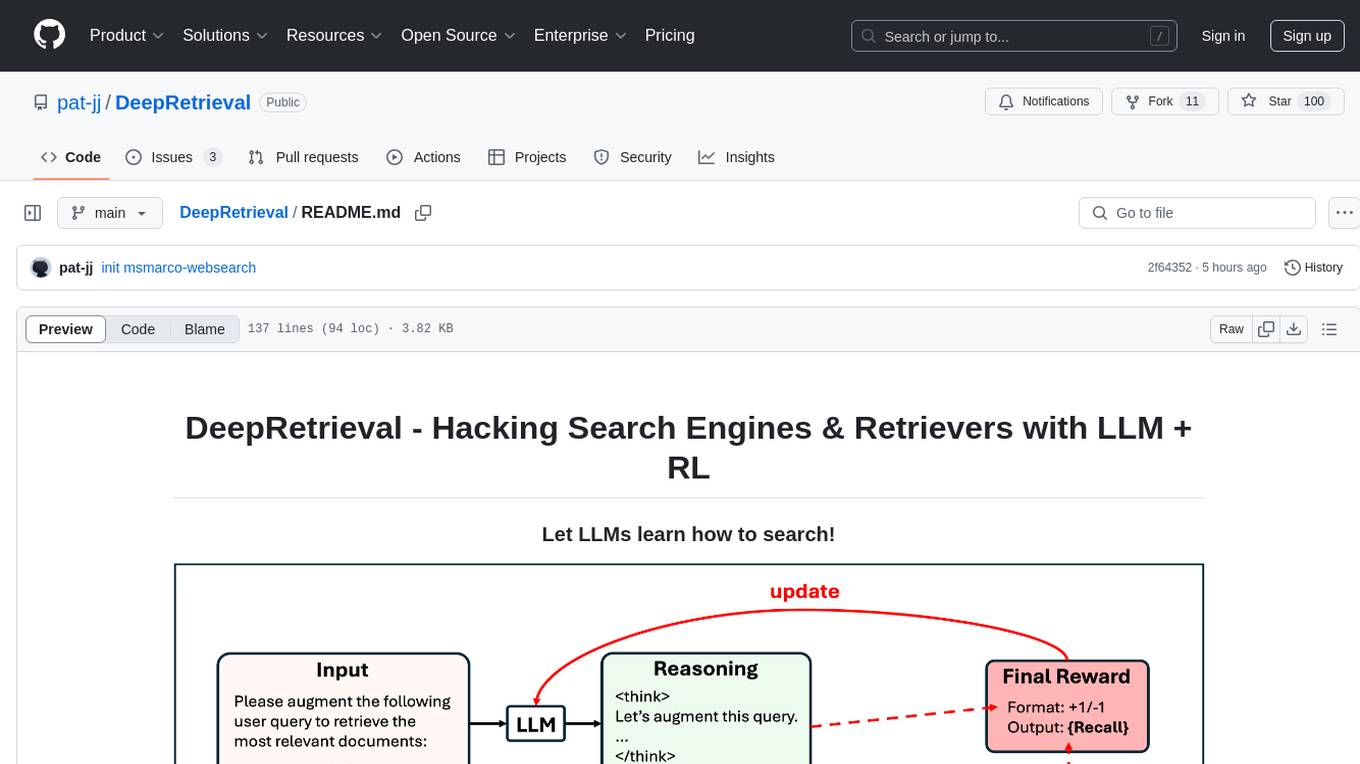
DeepRetrieval
DeepRetrieval is a tool designed to enhance search engines and retrievers using Large Language Models (LLMs) and Reinforcement Learning (RL). It allows LLMs to learn how to search effectively by integrating with search engine APIs and customizing reward functions. The tool provides functionalities for data preparation, training, evaluation, and monitoring search performance. DeepRetrieval aims to improve information retrieval tasks by leveraging advanced AI techniques.
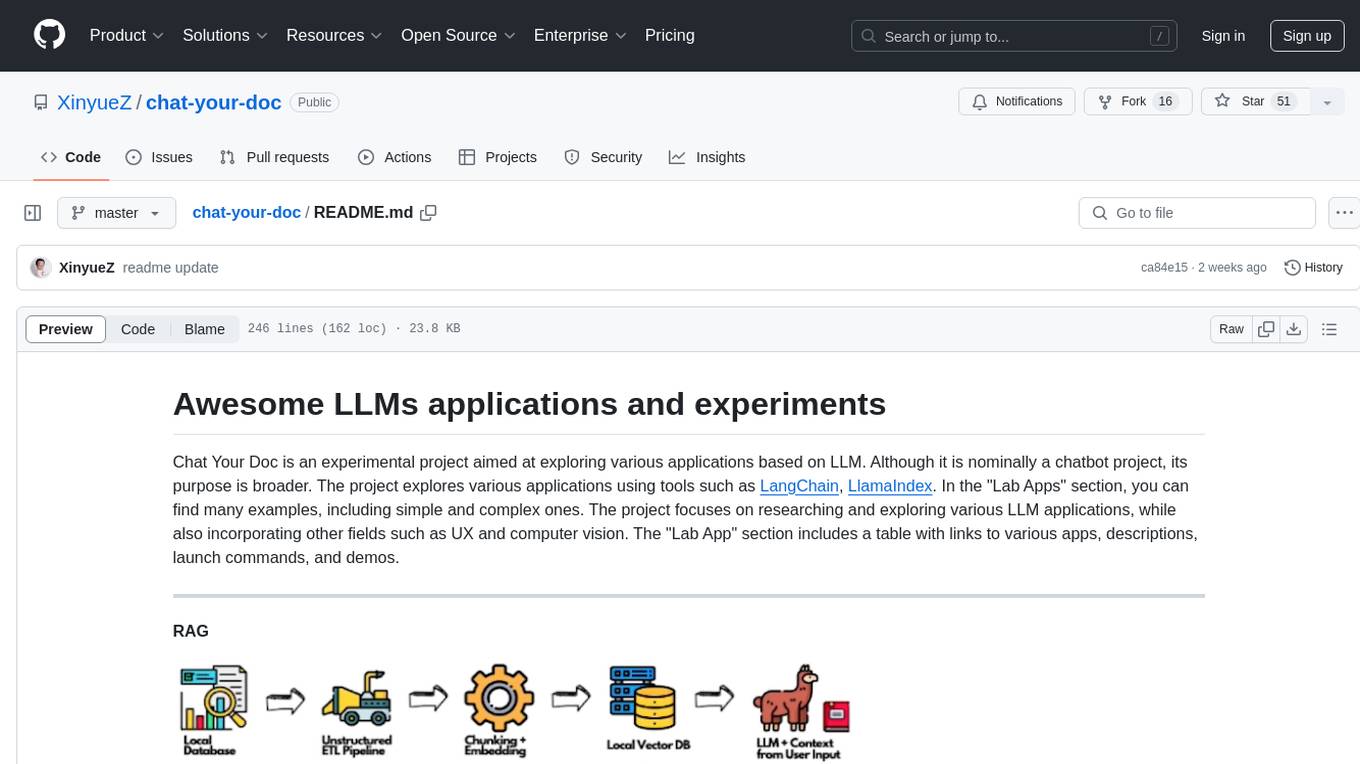
chat-your-doc
Chat Your Doc is an experimental project exploring various applications based on LLM technology. It goes beyond being just a chatbot project, focusing on researching LLM applications using tools like LangChain and LlamaIndex. The project delves into UX, computer vision, and offers a range of examples in the 'Lab Apps' section. It includes links to different apps, descriptions, launch commands, and demos, aiming to showcase the versatility and potential of LLM applications.
composio
Composio is a production-ready toolset for AI agents that enables users to integrate AI agents with various agentic tools effortlessly. It provides support for over 100 tools across different categories, including popular softwares like GitHub, Notion, Linear, Gmail, Slack, and more. Composio ensures managed authorization with support for six different authentication protocols, offering better agentic accuracy and ease of use. Users can easily extend Composio with additional tools, frameworks, and authorization protocols. The toolset is designed to be embeddable and pluggable, allowing for seamless integration and consistent user experience.
awesome-llm-webapps
This repository is a curated list of open-source, actively maintained web applications that leverage large language models (LLMs) for various use cases, including chatbots, natural language interfaces, assistants, and question answering systems. The projects are evaluated based on key criteria such as licensing, maintenance status, complexity, and features, to help users select the most suitable starting point for their LLM-based applications. The repository welcomes contributions and encourages users to submit projects that meet the criteria or suggest improvements to the existing list.
commands
Production-ready slash commands for Claude Code that accelerate development through intelligent automation and multi-agent orchestration. Contains 52 commands organized into workflows and tools categories. Workflows orchestrate complex tasks with multiple agents, while tools provide focused functionality for specific development tasks. Commands can be used with prefixes for organization or flattened for convenience. Best practices include using workflows for complex tasks and tools for specific scopes, chaining commands strategically, and providing detailed context for effective usage.
Topu-ai
TOPU Md is a simple WhatsApp user bot created by Topu Tech. It offers various features such as multi-device support, AI photo enhancement, downloader commands, hidden NSFW commands, logo commands, anime commands, economy menu, various games, and audio/video editor commands. Users can fork the repo, get a session ID by pairing code, and deploy on Heroku. The bot requires Node version 18.x or higher for optimal performance. Contributions to TOPU-MD are welcome, and the tool is safe for use on WhatsApp and Heroku. The tool is licensed under the MIT License and is designed to enhance the WhatsApp experience with diverse features.
For similar tasks
Awesome-Segment-Anything
Awesome-Segment-Anything is a powerful tool for segmenting and extracting information from various types of data. It provides a user-friendly interface to easily define segmentation rules and apply them to text, images, and other data formats. The tool supports both supervised and unsupervised segmentation methods, allowing users to customize the segmentation process based on their specific needs. With its versatile functionality and intuitive design, Awesome-Segment-Anything is ideal for data analysts, researchers, content creators, and anyone looking to efficiently extract valuable insights from complex datasets.
Time-LLM
Time-LLM is a reprogramming framework that repurposes large language models (LLMs) for time series forecasting. It allows users to treat time series analysis as a 'language task' and effectively leverage pre-trained LLMs for forecasting. The framework involves reprogramming time series data into text representations and providing declarative prompts to guide the LLM reasoning process. Time-LLM supports various backbone models such as Llama-7B, GPT-2, and BERT, offering flexibility in model selection. The tool provides a general framework for repurposing language models for time series forecasting tasks.
crewAI
CrewAI is a cutting-edge framework designed to orchestrate role-playing autonomous AI agents. By fostering collaborative intelligence, CrewAI empowers agents to work together seamlessly, tackling complex tasks. It enables AI agents to assume roles, share goals, and operate in a cohesive unit, much like a well-oiled crew. Whether you're building a smart assistant platform, an automated customer service ensemble, or a multi-agent research team, CrewAI provides the backbone for sophisticated multi-agent interactions. With features like role-based agent design, autonomous inter-agent delegation, flexible task management, and support for various LLMs, CrewAI offers a dynamic and adaptable solution for both development and production workflows.
Transformers_And_LLM_Are_What_You_Dont_Need
Transformers_And_LLM_Are_What_You_Dont_Need is a repository that explores the limitations of transformers in time series forecasting. It contains a collection of papers, articles, and theses discussing the effectiveness of transformers and LLMs in this domain. The repository aims to provide insights into why transformers may not be the best choice for time series forecasting tasks.
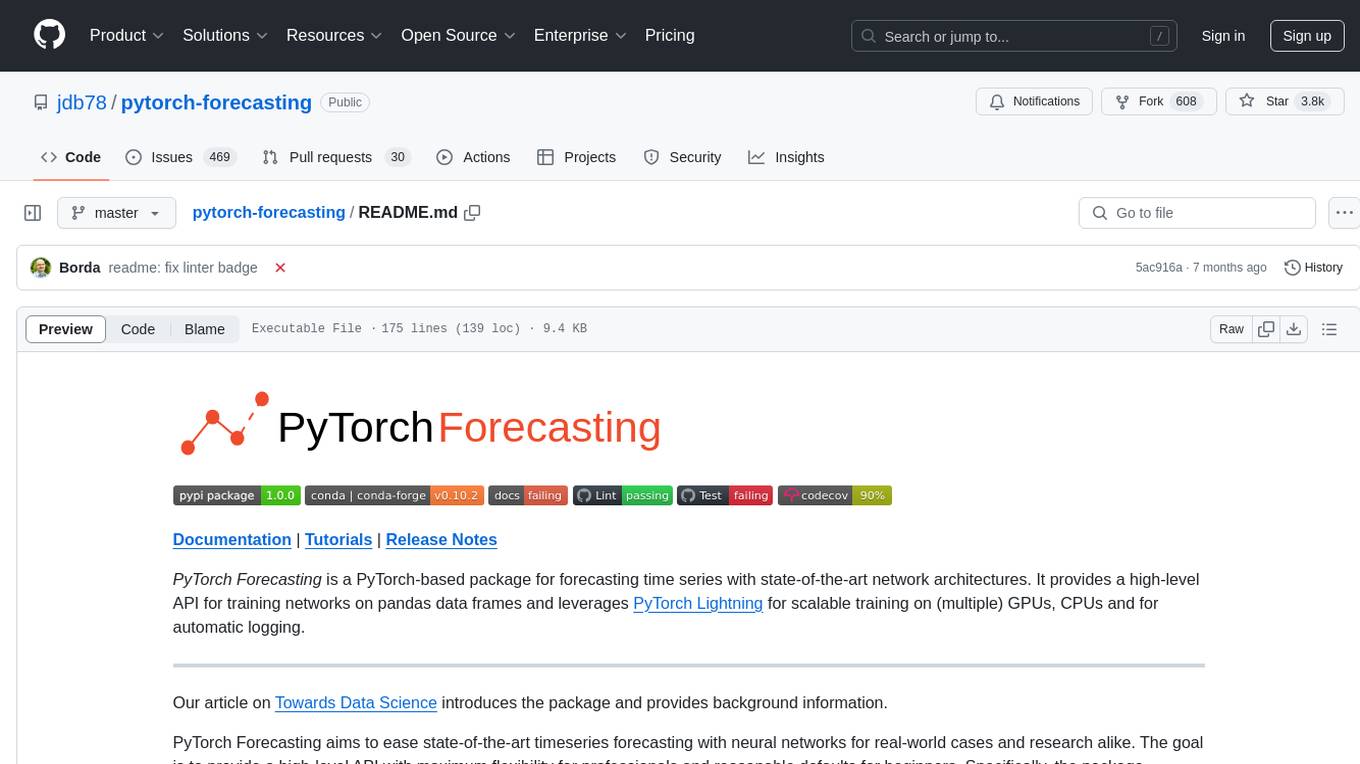
pytorch-forecasting
PyTorch Forecasting is a PyTorch-based package for time series forecasting with state-of-the-art network architectures. It offers a high-level API for training networks on pandas data frames and utilizes PyTorch Lightning for scalable training on GPUs and CPUs. The package aims to simplify time series forecasting with neural networks by providing a flexible API for professionals and default settings for beginners. It includes a timeseries dataset class, base model class, multiple neural network architectures, multi-horizon timeseries metrics, and hyperparameter tuning with optuna. PyTorch Forecasting is built on pytorch-lightning for easy training on various hardware configurations.
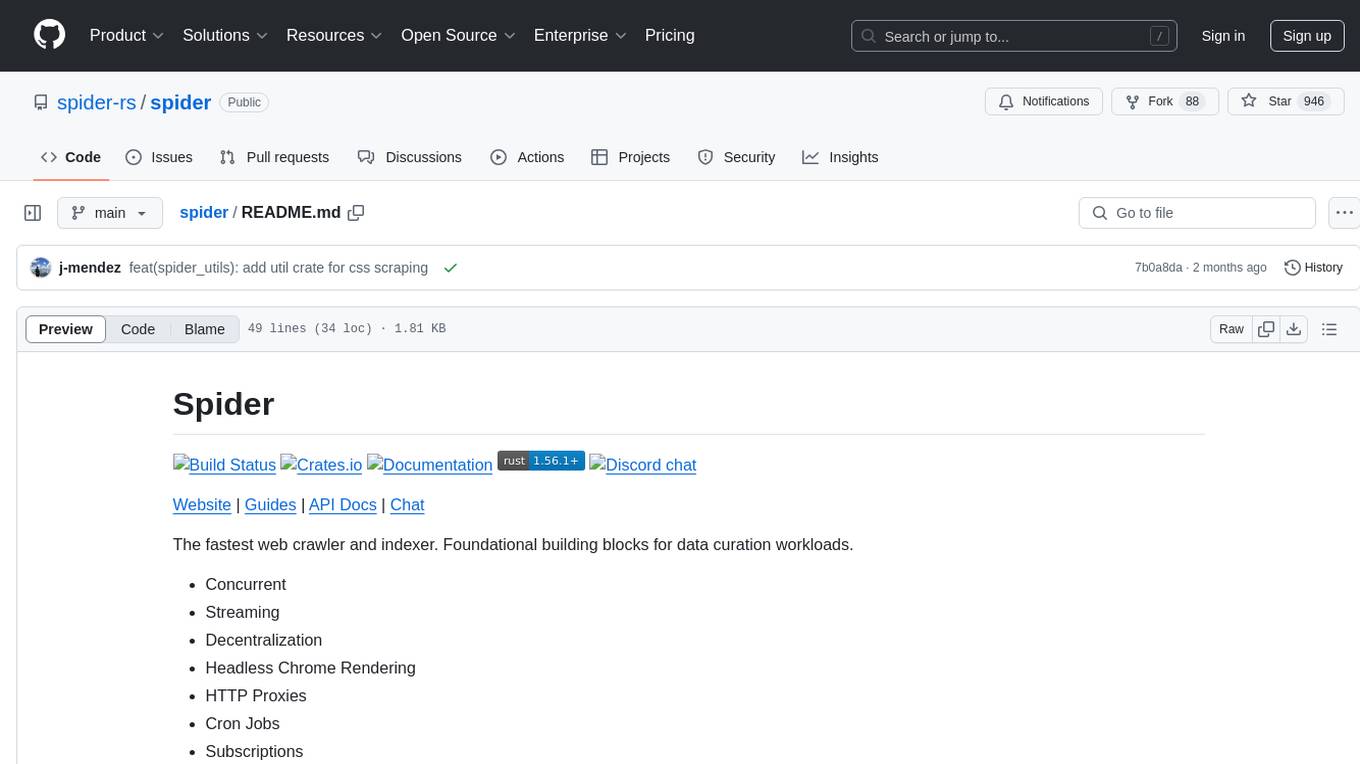
spider
Spider is a high-performance web crawler and indexer designed to handle data curation workloads efficiently. It offers features such as concurrency, streaming, decentralization, headless Chrome rendering, HTTP proxies, cron jobs, subscriptions, smart mode, blacklisting, whitelisting, budgeting depth, dynamic AI prompt scripting, CSS scraping, and more. Users can easily get started with the Spider Cloud hosted service or set up local installations with spider-cli. The tool supports integration with Node.js and Python for additional flexibility. With a focus on speed and scalability, Spider is ideal for extracting and organizing data from the web.
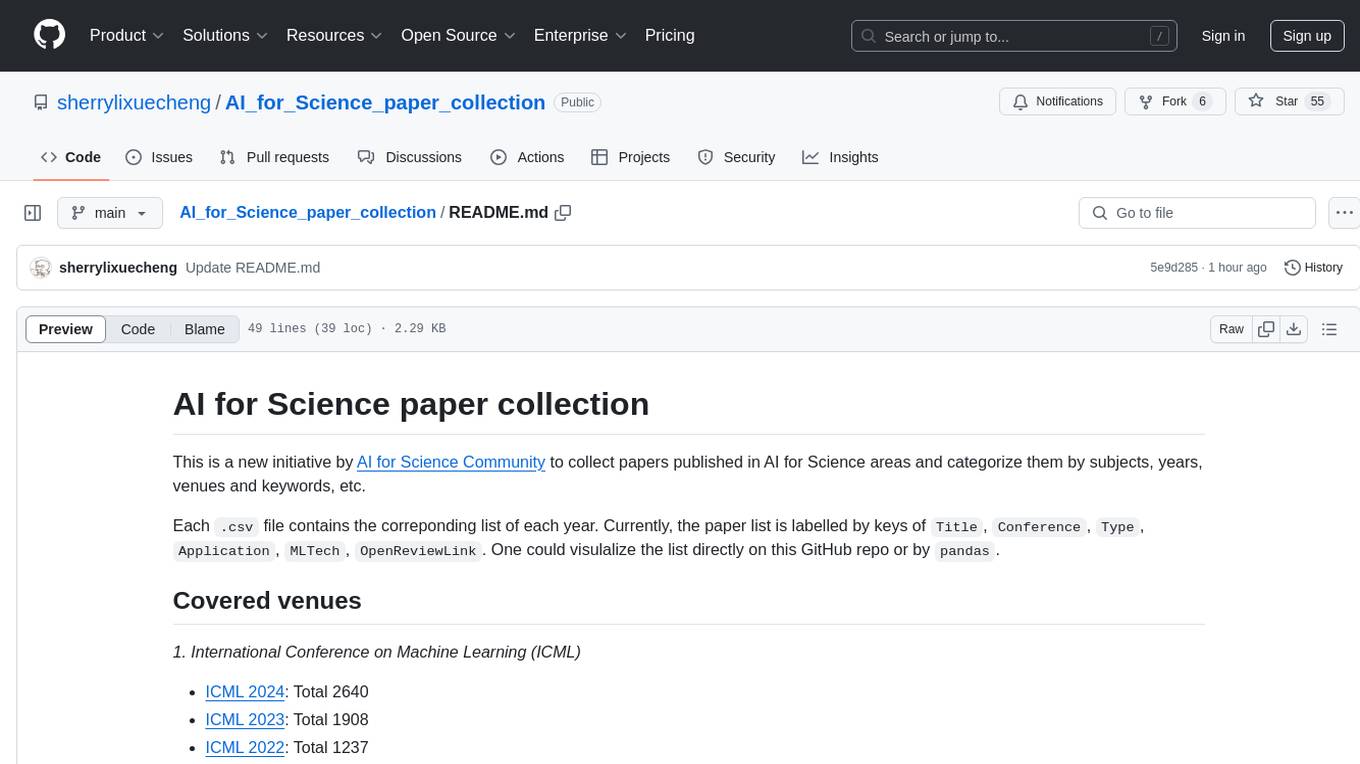
AI_for_Science_paper_collection
AI for Science paper collection is an initiative by AI for Science Community to collect and categorize papers in AI for Science areas by subjects, years, venues, and keywords. The repository contains `.csv` files with paper lists labeled by keys such as `Title`, `Conference`, `Type`, `Application`, `MLTech`, `OpenReviewLink`. It covers top conferences like ICML, NeurIPS, and ICLR. Volunteers can contribute by updating existing `.csv` files or adding new ones for uncovered conferences/years. The initiative aims to track the increasing trend of AI for Science papers and analyze trends in different applications.
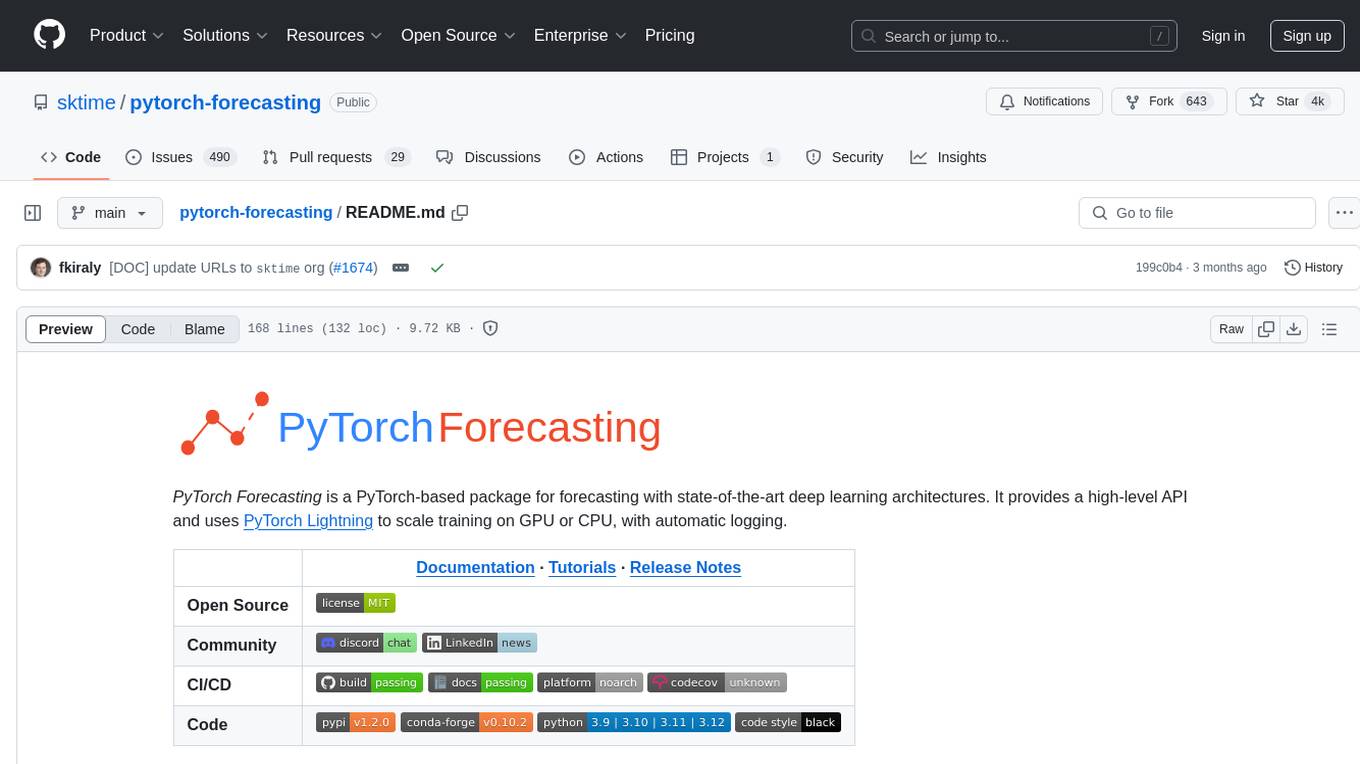
pytorch-forecasting
PyTorch Forecasting is a PyTorch-based package designed for state-of-the-art timeseries forecasting using deep learning architectures. It offers a high-level API and leverages PyTorch Lightning for efficient training on GPU or CPU with automatic logging. The package aims to simplify timeseries forecasting tasks by providing a flexible API for professionals and user-friendly defaults for beginners. It includes features such as a timeseries dataset class for handling data transformations, missing values, and subsampling, various neural network architectures optimized for real-world deployment, multi-horizon timeseries metrics, and hyperparameter tuning with optuna. Built on pytorch-lightning, it supports training on CPUs, single GPUs, and multiple GPUs out-of-the-box.
For similar jobs
sweep
Sweep is an AI junior developer that turns bugs and feature requests into code changes. It automatically handles developer experience improvements like adding type hints and improving test coverage.
teams-ai
The Teams AI Library is a software development kit (SDK) that helps developers create bots that can interact with Teams and Microsoft 365 applications. It is built on top of the Bot Framework SDK and simplifies the process of developing bots that interact with Teams' artificial intelligence capabilities. The SDK is available for JavaScript/TypeScript, .NET, and Python.
ai-guide
This guide is dedicated to Large Language Models (LLMs) that you can run on your home computer. It assumes your PC is a lower-end, non-gaming setup.
classifai
Supercharge WordPress Content Workflows and Engagement with Artificial Intelligence. Tap into leading cloud-based services like OpenAI, Microsoft Azure AI, Google Gemini and IBM Watson to augment your WordPress-powered websites. Publish content faster while improving SEO performance and increasing audience engagement. ClassifAI integrates Artificial Intelligence and Machine Learning technologies to lighten your workload and eliminate tedious tasks, giving you more time to create original content that matters.
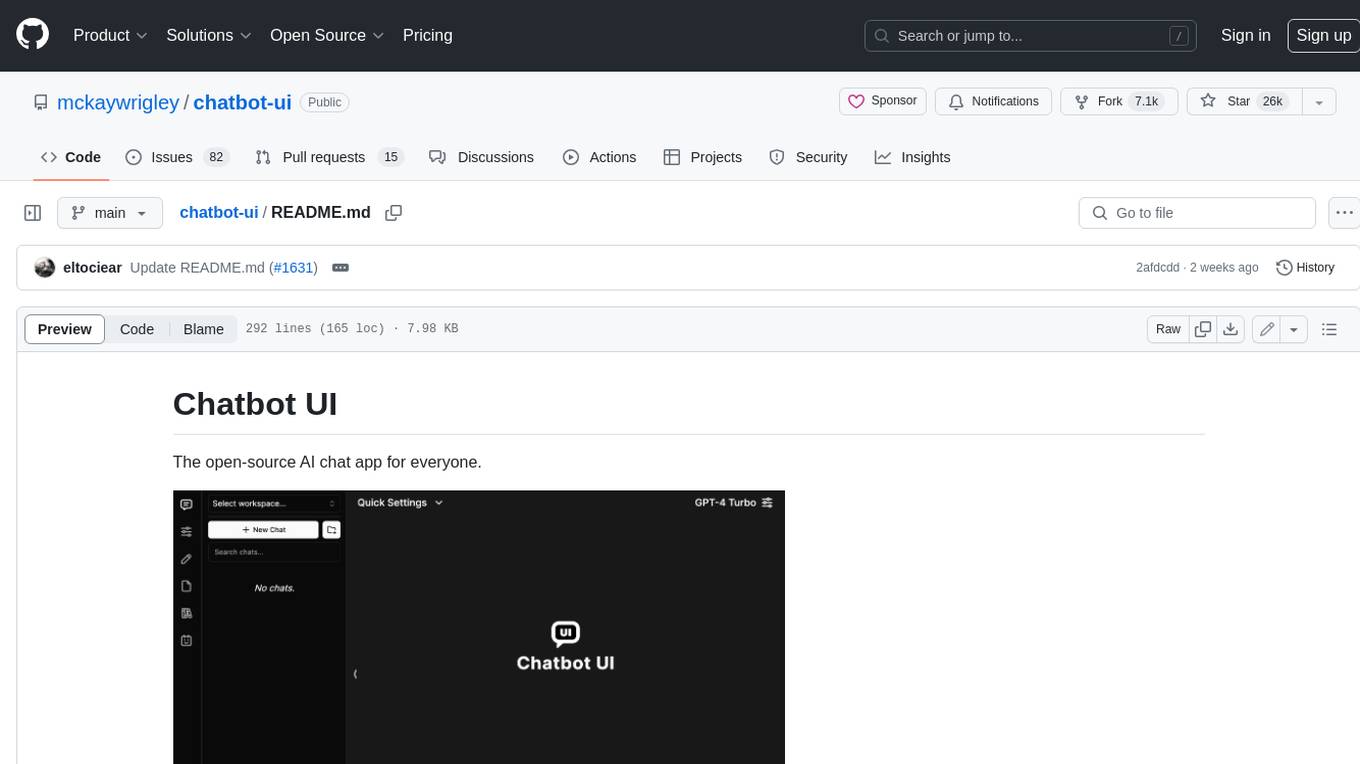
chatbot-ui
Chatbot UI is an open-source AI chat app that allows users to create and deploy their own AI chatbots. It is easy to use and can be customized to fit any need. Chatbot UI is perfect for businesses, developers, and anyone who wants to create a chatbot.
BricksLLM
BricksLLM is a cloud native AI gateway written in Go. Currently, it provides native support for OpenAI, Anthropic, Azure OpenAI and vLLM. BricksLLM aims to provide enterprise level infrastructure that can power any LLM production use cases. Here are some use cases for BricksLLM: * Set LLM usage limits for users on different pricing tiers * Track LLM usage on a per user and per organization basis * Block or redact requests containing PIIs * Improve LLM reliability with failovers, retries and caching * Distribute API keys with rate limits and cost limits for internal development/production use cases * Distribute API keys with rate limits and cost limits for students
uAgents
uAgents is a Python library developed by Fetch.ai that allows for the creation of autonomous AI agents. These agents can perform various tasks on a schedule or take action on various events. uAgents are easy to create and manage, and they are connected to a fast-growing network of other uAgents. They are also secure, with cryptographically secured messages and wallets.
griptape
Griptape is a modular Python framework for building AI-powered applications that securely connect to your enterprise data and APIs. It offers developers the ability to maintain control and flexibility at every step. Griptape's core components include Structures (Agents, Pipelines, and Workflows), Tasks, Tools, Memory (Conversation Memory, Task Memory, and Meta Memory), Drivers (Prompt and Embedding Drivers, Vector Store Drivers, Image Generation Drivers, Image Query Drivers, SQL Drivers, Web Scraper Drivers, and Conversation Memory Drivers), Engines (Query Engines, Extraction Engines, Summary Engines, Image Generation Engines, and Image Query Engines), and additional components (Rulesets, Loaders, Artifacts, Chunkers, and Tokenizers). Griptape enables developers to create AI-powered applications with ease and efficiency.