


pytorch-forecasting
Time series forecasting with PyTorch
Stars: 4049
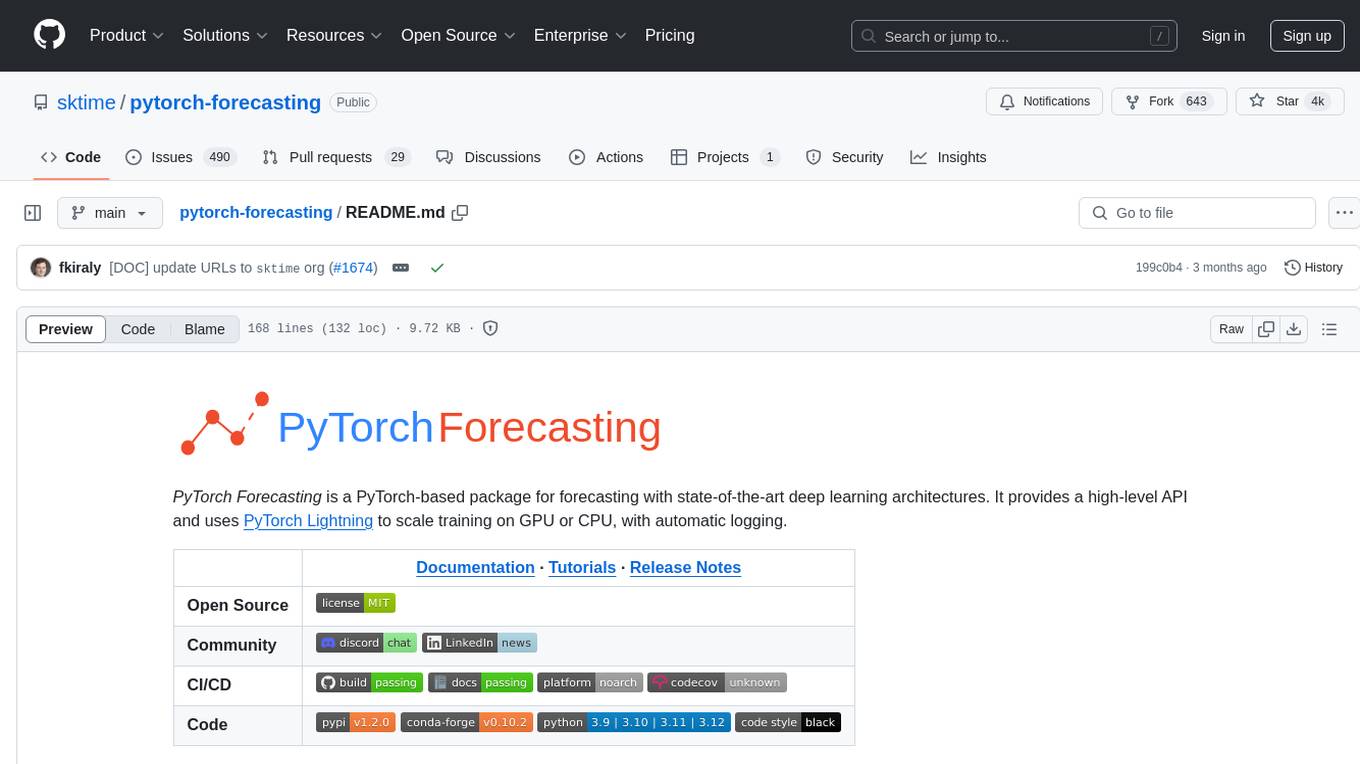
PyTorch Forecasting is a PyTorch-based package designed for state-of-the-art timeseries forecasting using deep learning architectures. It offers a high-level API and leverages PyTorch Lightning for efficient training on GPU or CPU with automatic logging. The package aims to simplify timeseries forecasting tasks by providing a flexible API for professionals and user-friendly defaults for beginners. It includes features such as a timeseries dataset class for handling data transformations, missing values, and subsampling, various neural network architectures optimized for real-world deployment, multi-horizon timeseries metrics, and hyperparameter tuning with optuna. Built on pytorch-lightning, it supports training on CPUs, single GPUs, and multiple GPUs out-of-the-box.
README:

PyTorch Forecasting is a PyTorch-based package for forecasting with state-of-the-art deep learning architectures. It provides a high-level API and uses PyTorch Lightning to scale training on GPU or CPU, with automatic logging.
| Documentation · Tutorials · Release Notes | |
|---|---|
| Open Source |  |
| Community |
 
|
| CI/CD |
   
|
| Code |
   
|
Our article on Towards Data Science introduces the package and provides background information.
PyTorch Forecasting aims to ease state-of-the-art timeseries forecasting with neural networks for real-world cases and research alike. The goal is to provide a high-level API with maximum flexibility for professionals and reasonable defaults for beginners. Specifically, the package provides
- A timeseries dataset class which abstracts handling variable transformations, missing values, randomized subsampling, multiple history lengths, etc.
- A base model class which provides basic training of timeseries models along with logging in tensorboard and generic visualizations such actual vs predictions and dependency plots
- Multiple neural network architectures for timeseries forecasting that have been enhanced for real-world deployment and come with in-built interpretation capabilities
- Multi-horizon timeseries metrics
- Hyperparameter tuning with optuna
The package is built on pytorch-lightning to allow training on CPUs, single and multiple GPUs out-of-the-box.
If you are working on windows, you need to first install PyTorch with
pip install torch -f https://download.pytorch.org/whl/torch_stable.html.
Otherwise, you can proceed with
pip install pytorch-forecasting
Alternatively, you can install the package via conda
conda install pytorch-forecasting pytorch -c pytorch>=1.7 -c conda-forge
PyTorch Forecasting is now installed from the conda-forge channel while PyTorch is install from the pytorch channel.
To use the MQF2 loss (multivariate quantile loss), also install
pip install pytorch-forecasting[mqf2]
Visit https://pytorch-forecasting.readthedocs.io to read the documentation with detailed tutorials.
The documentation provides a comparison of available models.
- Temporal Fusion Transformers for Interpretable Multi-horizon Time Series Forecasting which outperforms DeepAR by Amazon by 36-69% in benchmarks
- N-BEATS: Neural basis expansion analysis for interpretable time series forecasting which has (if used as ensemble) outperformed all other methods including ensembles of traditional statical methods in the M4 competition. The M4 competition is arguably the most important benchmark for univariate time series forecasting.
- N-HiTS: Neural Hierarchical Interpolation for Time Series Forecasting which supports covariates and has consistently beaten N-BEATS. It is also particularly well-suited for long-horizon forecasting.
- DeepAR: Probabilistic forecasting with autoregressive recurrent networks which is the one of the most popular forecasting algorithms and is often used as a baseline
- Simple standard networks for baselining: LSTM and GRU networks as well as a MLP on the decoder
- A baseline model that always predicts the latest known value
To implement new models or other custom components, see the How to implement new models tutorial. It covers basic as well as advanced architectures.
Networks can be trained with the PyTorch Lighning Trainer on pandas Dataframes which are first converted to a TimeSeriesDataSet.
# imports for training
import lightning.pytorch as pl
from lightning.pytorch.loggers import TensorBoardLogger
from lightning.pytorch.callbacks import EarlyStopping, LearningRateMonitor
# import dataset, network to train and metric to optimize
from pytorch_forecasting import TimeSeriesDataSet, TemporalFusionTransformer, QuantileLoss
from lightning.pytorch.tuner import Tuner

# load data: this is pandas dataframe with at least a column for
# * the target (what you want to predict)
# * the timeseries ID (which should be a unique string to identify each timeseries)
# * the time of the observation (which should be a monotonically increasing integer)
data = ...

# define the dataset, i.e. add metadata to pandas dataframe for the model to understand it
max_encoder_length = 36
max_prediction_length = 6
training_cutoff = "YYYY-MM-DD"  # day for cutoff

training = TimeSeriesDataSet(
    data[lambda x: x.date <= training_cutoff],
    time_idx= ...,  # column name of time of observation
    target= ...,  # column name of target to predict
    group_ids=[ ... ],  # column name(s) for timeseries IDs
    max_encoder_length=max_encoder_length,  # how much history to use
    max_prediction_length=max_prediction_length,  # how far to predict into future
    # covariates static for a timeseries ID
    static_categoricals=[ ... ],
    static_reals=[ ... ],
    # covariates known and unknown in the future to inform prediction
    time_varying_known_categoricals=[ ... ],
    time_varying_known_reals=[ ... ],
    time_varying_unknown_categoricals=[ ... ],
    time_varying_unknown_reals=[ ... ],
)

# create validation dataset using the same normalization techniques as for the training dataset
validation = TimeSeriesDataSet.from_dataset(training, data, min_prediction_idx=training.index.time.max() + 1, stop_randomization=True)

# convert datasets to dataloaders for training
batch_size = 128
train_dataloader = training.to_dataloader(train=True, batch_size=batch_size, num_workers=2)
val_dataloader = validation.to_dataloader(train=False, batch_size=batch_size, num_workers=2)

# create PyTorch Lighning Trainer with early stopping
early_stop_callback = EarlyStopping(monitor="val_loss", min_delta=1e-4, patience=1, verbose=False, mode="min")
lr_logger = LearningRateMonitor()
trainer = pl.Trainer(
    max_epochs=100,
    accelerator="auto",  # run on CPU, if on multiple GPUs, use strategy="ddp"
    gradient_clip_val=0.1,
    limit_train_batches=30,  # 30 batches per epoch
    callbacks=[lr_logger, early_stop_callback],
    logger=TensorBoardLogger("lightning_logs")
)

# define network to train - the architecture is mostly inferred from the dataset, so that only a few hyperparameters have to be set by the user
tft = TemporalFusionTransformer.from_dataset(
    # dataset
    training,
    # architecture hyperparameters
    hidden_size=32,
    attention_head_size=1,
    dropout=0.1,
    hidden_continuous_size=16,
    # loss metric to optimize
    loss=QuantileLoss(),
    # logging frequency
    log_interval=2,
    # optimizer parameters
    learning_rate=0.03,
    reduce_on_plateau_patience=4
)
print(f"Number of parameters in network: {tft.size()/1e3:.1f}k")

# find the optimal learning rate
res = Tuner(trainer).lr_find(
    tft, train_dataloaders=train_dataloader, val_dataloaders=val_dataloader, early_stop_threshold=1000.0, max_lr=0.3,
)
# and plot the result - always visually confirm that the suggested learning rate makes sense
print(f"suggested learning rate: {res.suggestion()}")
fig = res.plot(show=True, suggest=True)
fig.show()

# fit the model on the data - redefine the model with the correct learning rate if necessary
trainer.fit(
    tft, train_dataloaders=train_dataloader, val_dataloaders=val_dataloader,
)
For Tasks:
Click tags to check more tools for each tasksFor Jobs:
Alternative AI tools for pytorch-forecasting
Similar Open Source Tools
pytorch-forecasting
PyTorch Forecasting is a PyTorch-based package designed for state-of-the-art timeseries forecasting using deep learning architectures. It offers a high-level API and leverages PyTorch Lightning for efficient training on GPU or CPU with automatic logging. The package aims to simplify timeseries forecasting tasks by providing a flexible API for professionals and user-friendly defaults for beginners. It includes features such as a timeseries dataset class for handling data transformations, missing values, and subsampling, various neural network architectures optimized for real-world deployment, multi-horizon timeseries metrics, and hyperparameter tuning with optuna. Built on pytorch-lightning, it supports training on CPUs, single GPUs, and multiple GPUs out-of-the-box.
LightLLM
LightLLM is a lightweight library for linear and logistic regression models. It provides a simple and efficient way to train and deploy machine learning models for regression tasks. The library is designed to be easy to use and integrate into existing projects, making it suitable for both beginners and experienced data scientists. With LightLLM, users can quickly build and evaluate regression models using a variety of algorithms and hyperparameters. The library also supports feature engineering and model interpretation, allowing users to gain insights from their data and make informed decisions based on the model predictions.
MInference
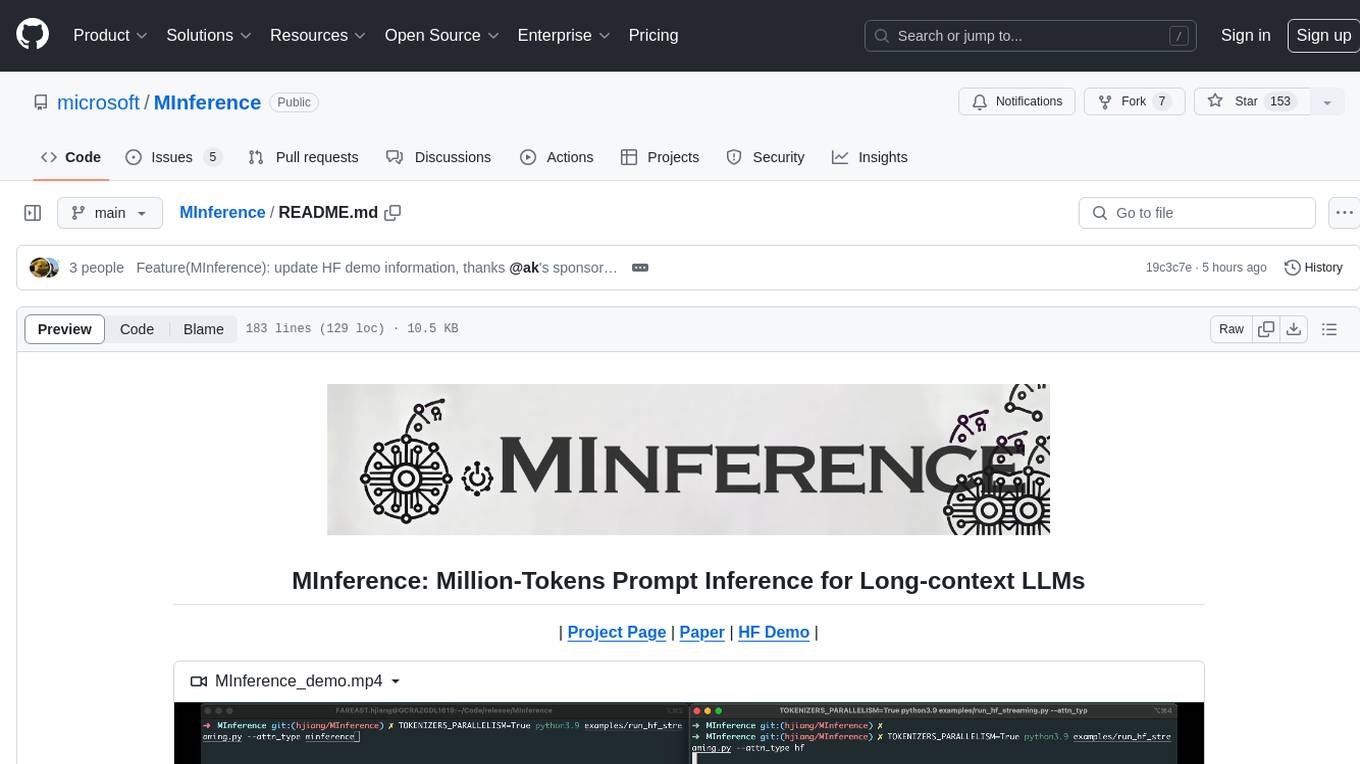
MInference is a tool designed to accelerate pre-filling for long-context Language Models (LLMs) by leveraging dynamic sparse attention. It achieves up to a 10x speedup for pre-filling on an A100 while maintaining accuracy. The tool supports various decoding LLMs, including LLaMA-style models and Phi models, and provides custom kernels for attention computation. MInference is useful for researchers and developers working with large-scale language models who aim to improve efficiency without compromising accuracy.
Reflection_Tuning
Reflection-Tuning is a project focused on improving the quality of instruction-tuning data through a reflection-based method. It introduces Selective Reflection-Tuning, where the student model can decide whether to accept the improvements made by the teacher model. The project aims to generate high-quality instruction-response pairs by defining specific criteria for the oracle model to follow and respond to. It also evaluates the efficacy and relevance of instruction-response pairs using the r-IFD metric. The project provides code for reflection and selection processes, along with data and model weights for both V1 and V2 methods.

cleanlab
Cleanlab helps you **clean** data and **lab** els by automatically detecting issues in a ML dataset. To facilitate **machine learning with messy, real-world data** , this data-centric AI package uses your _existing_ models to estimate dataset problems that can be fixed to train even _better_ models.
GDPO
GDPO is a reinforcement learning optimization method designed for multi-reward training. It resolves reward advantages collapse by decoupling reward normalization across individual rewards, enabling more faithful preference optimization. The implementation includes easy-to-use training scripts for tool calling and math reasoning tasks. GDPO consistently outperforms existing approaches in training convergence and downstream evaluation performance.
PowerInfer
PowerInfer is a high-speed Large Language Model (LLM) inference engine designed for local deployment on consumer-grade hardware, leveraging activation locality to optimize efficiency. It features a locality-centric design, hybrid CPU/GPU utilization, easy integration with popular ReLU-sparse models, and support for various platforms. PowerInfer achieves high speed with lower resource demands and is flexible for easy deployment and compatibility with existing models like Falcon-40B, Llama2 family, ProSparse Llama2 family, and Bamboo-7B.
MathCoder
MathCoder is a repository focused on enhancing mathematical reasoning by fine-tuning open-source language models to use code for modeling and deriving math equations. It introduces MathCodeInstruct dataset with solutions interleaving natural language, code, and execution results. The repository provides MathCoder models capable of generating code-based solutions for challenging math problems, achieving state-of-the-art scores on MATH and GSM8K datasets. It offers tools for model deployment, inference, and evaluation, along with a citation for referencing the work.
LightAgent
LightAgent is a lightweight, open-source active Agentic AI development framework with memory, tools, and a tree of thought. It supports multi-agent collaboration, autonomous learning, tool integration, complex goals, and multi-model support. It enables simpler self-learning agents, seamless integration with major chat frameworks, and quick tool generation. LightAgent also supports memory modules, tool integration, tree of thought planning, multi-agent collaboration, streaming API, agent self-learning, Langfuse log tracking, and agent assessment. It is compatible with various large models and offers features like intelligent customer service, data analysis, automated tools, and educational assistance.
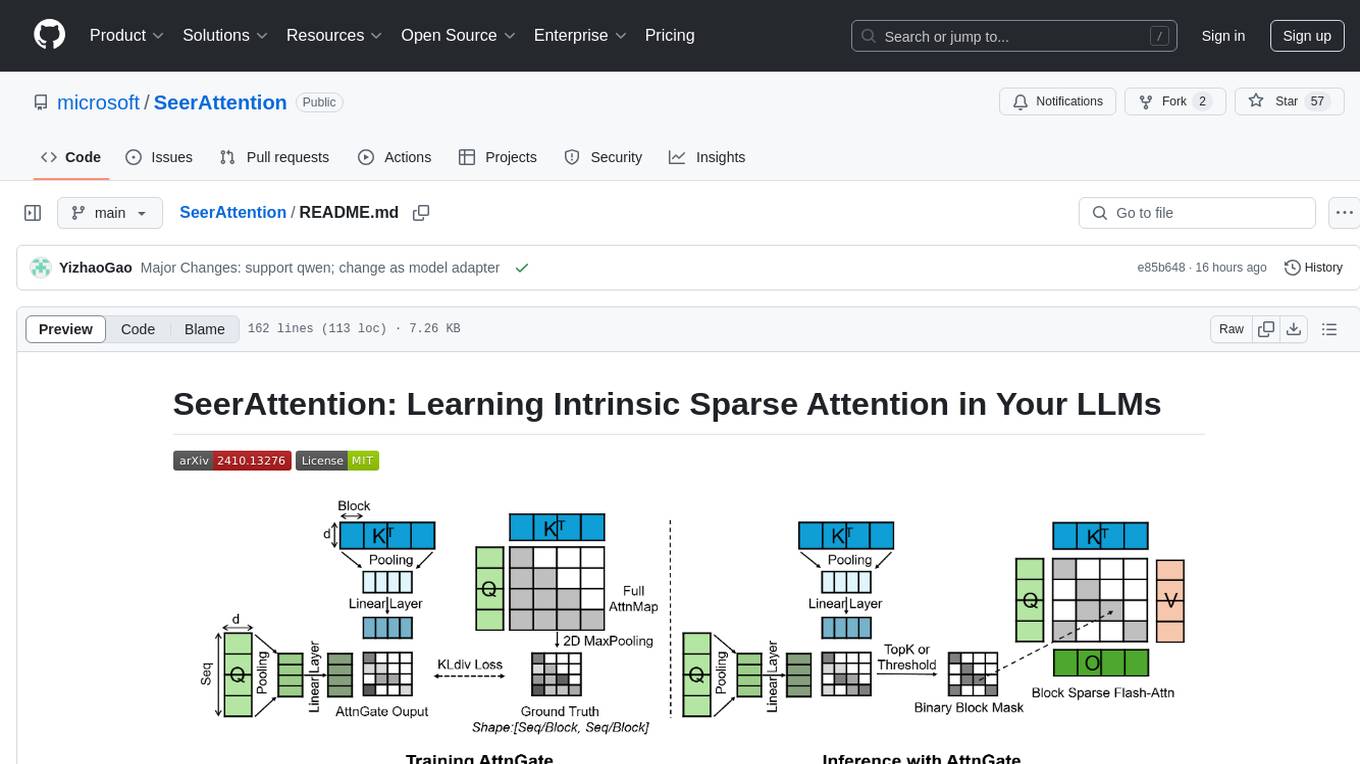
SeerAttention
SeerAttention is a novel trainable sparse attention mechanism that learns intrinsic sparsity patterns directly from LLMs through self-distillation at post-training time. It achieves faster inference while maintaining accuracy for long-context prefilling. The tool offers features such as trainable sparse attention, block-level sparsity, self-distillation, efficient kernel, and easy integration with existing transformer architectures. Users can quickly start using SeerAttention for inference with AttnGate Adapter and training attention gates with self-distillation. The tool provides efficient evaluation methods and encourages contributions from the community.
LightAgent
LightAgent is a lightweight, open-source Agentic AI development framework with memory, tools, and a tree of thought. It supports multi-agent collaboration, autonomous learning, tool integration, complex task handling, and multi-model support. It also features a streaming API, tool generator, agent self-learning, adaptive tool mechanism, and more. LightAgent is designed for intelligent customer service, data analysis, automated tools, and educational assistance.
Spatial-SSRL
Spatial-SSRL is a lightweight self-supervised RL framework designed to enhance LVLM spatial understanding. It optimizes Qwen2.5-VL-7B model, exhibiting stronger spatial intelligence across seven benchmarks. It is highly scalable, cost-effective, lightweight, and naturally verifiable. The framework supports five tasks using ordinary RGB and RGB-D images, inviting users to contribute with effective pretext tasks to enhance LVLM capabilities.
lerobot
LeRobot is a state-of-the-art AI library for real-world robotics in PyTorch. It aims to provide models, datasets, and tools to lower the barrier to entry to robotics, focusing on imitation learning and reinforcement learning. LeRobot offers pretrained models, datasets with human-collected demonstrations, and simulation environments. It plans to support real-world robotics on affordable and capable robots. The library hosts pretrained models and datasets on the Hugging Face community page.
RD-Agent
RD-Agent is a tool designed to automate critical aspects of industrial R&D processes, focusing on data-driven scenarios to streamline model and data development. It aims to propose new ideas ('R') and implement them ('D') automatically, leading to solutions of significant industrial value. The tool supports scenarios like Automated Quantitative Trading, Data Mining Agent, Research Copilot, and more, with a framework to push the boundaries of research in data science. Users can create a Conda environment, install the RDAgent package from PyPI, configure GPT model, and run various applications for tasks like quantitative trading, model evolution, medical prediction, and more. The tool is intended to enhance R&D processes and boost productivity in industrial settings.
AgentCPM
AgentCPM is a series of open-source LLM agents jointly developed by THUNLP, Renmin University of China, ModelBest, and the OpenBMB community. It addresses challenges faced by agents in real-world applications such as limited long-horizon capability, autonomy, and generalization. The team focuses on building deep research capabilities for agents, releasing AgentCPM-Explore, a deep-search LLM agent, and AgentCPM-Report, a deep-research LLM agent. AgentCPM-Explore is the first open-source agent model with 4B parameters to appear on widely used long-horizon agent benchmarks. AgentCPM-Report is built on the 8B-parameter base model MiniCPM4.1, autonomously generating long-form reports with extreme performance and minimal footprint, designed for high-privacy scenarios with offline and agile local deployment.
For similar tasks
Awesome-Segment-Anything
Awesome-Segment-Anything is a powerful tool for segmenting and extracting information from various types of data. It provides a user-friendly interface to easily define segmentation rules and apply them to text, images, and other data formats. The tool supports both supervised and unsupervised segmentation methods, allowing users to customize the segmentation process based on their specific needs. With its versatile functionality and intuitive design, Awesome-Segment-Anything is ideal for data analysts, researchers, content creators, and anyone looking to efficiently extract valuable insights from complex datasets.
Time-LLM
Time-LLM is a reprogramming framework that repurposes large language models (LLMs) for time series forecasting. It allows users to treat time series analysis as a 'language task' and effectively leverage pre-trained LLMs for forecasting. The framework involves reprogramming time series data into text representations and providing declarative prompts to guide the LLM reasoning process. Time-LLM supports various backbone models such as Llama-7B, GPT-2, and BERT, offering flexibility in model selection. The tool provides a general framework for repurposing language models for time series forecasting tasks.
crewAI
CrewAI is a cutting-edge framework designed to orchestrate role-playing autonomous AI agents. By fostering collaborative intelligence, CrewAI empowers agents to work together seamlessly, tackling complex tasks. It enables AI agents to assume roles, share goals, and operate in a cohesive unit, much like a well-oiled crew. Whether you're building a smart assistant platform, an automated customer service ensemble, or a multi-agent research team, CrewAI provides the backbone for sophisticated multi-agent interactions. With features like role-based agent design, autonomous inter-agent delegation, flexible task management, and support for various LLMs, CrewAI offers a dynamic and adaptable solution for both development and production workflows.
Transformers_And_LLM_Are_What_You_Dont_Need
Transformers_And_LLM_Are_What_You_Dont_Need is a repository that explores the limitations of transformers in time series forecasting. It contains a collection of papers, articles, and theses discussing the effectiveness of transformers and LLMs in this domain. The repository aims to provide insights into why transformers may not be the best choice for time series forecasting tasks.
pytorch-forecasting
PyTorch Forecasting is a PyTorch-based package for time series forecasting with state-of-the-art network architectures. It offers a high-level API for training networks on pandas data frames and utilizes PyTorch Lightning for scalable training on GPUs and CPUs. The package aims to simplify time series forecasting with neural networks by providing a flexible API for professionals and default settings for beginners. It includes a timeseries dataset class, base model class, multiple neural network architectures, multi-horizon timeseries metrics, and hyperparameter tuning with optuna. PyTorch Forecasting is built on pytorch-lightning for easy training on various hardware configurations.
spider
Spider is a high-performance web crawler and indexer designed to handle data curation workloads efficiently. It offers features such as concurrency, streaming, decentralization, headless Chrome rendering, HTTP proxies, cron jobs, subscriptions, smart mode, blacklisting, whitelisting, budgeting depth, dynamic AI prompt scripting, CSS scraping, and more. Users can easily get started with the Spider Cloud hosted service or set up local installations with spider-cli. The tool supports integration with Node.js and Python for additional flexibility. With a focus on speed and scalability, Spider is ideal for extracting and organizing data from the web.
AI_for_Science_paper_collection
AI for Science paper collection is an initiative by AI for Science Community to collect and categorize papers in AI for Science areas by subjects, years, venues, and keywords. The repository contains `.csv` files with paper lists labeled by keys such as `Title`, `Conference`, `Type`, `Application`, `MLTech`, `OpenReviewLink`. It covers top conferences like ICML, NeurIPS, and ICLR. Volunteers can contribute by updating existing `.csv` files or adding new ones for uncovered conferences/years. The initiative aims to track the increasing trend of AI for Science papers and analyze trends in different applications.
pytorch-forecasting
PyTorch Forecasting is a PyTorch-based package designed for state-of-the-art timeseries forecasting using deep learning architectures. It offers a high-level API and leverages PyTorch Lightning for efficient training on GPU or CPU with automatic logging. The package aims to simplify timeseries forecasting tasks by providing a flexible API for professionals and user-friendly defaults for beginners. It includes features such as a timeseries dataset class for handling data transformations, missing values, and subsampling, various neural network architectures optimized for real-world deployment, multi-horizon timeseries metrics, and hyperparameter tuning with optuna. Built on pytorch-lightning, it supports training on CPUs, single GPUs, and multiple GPUs out-of-the-box.
For similar jobs
sweep
Sweep is an AI junior developer that turns bugs and feature requests into code changes. It automatically handles developer experience improvements like adding type hints and improving test coverage.
teams-ai
The Teams AI Library is a software development kit (SDK) that helps developers create bots that can interact with Teams and Microsoft 365 applications. It is built on top of the Bot Framework SDK and simplifies the process of developing bots that interact with Teams' artificial intelligence capabilities. The SDK is available for JavaScript/TypeScript, .NET, and Python.
ai-guide
This guide is dedicated to Large Language Models (LLMs) that you can run on your home computer. It assumes your PC is a lower-end, non-gaming setup.
classifai
Supercharge WordPress Content Workflows and Engagement with Artificial Intelligence. Tap into leading cloud-based services like OpenAI, Microsoft Azure AI, Google Gemini and IBM Watson to augment your WordPress-powered websites. Publish content faster while improving SEO performance and increasing audience engagement. ClassifAI integrates Artificial Intelligence and Machine Learning technologies to lighten your workload and eliminate tedious tasks, giving you more time to create original content that matters.
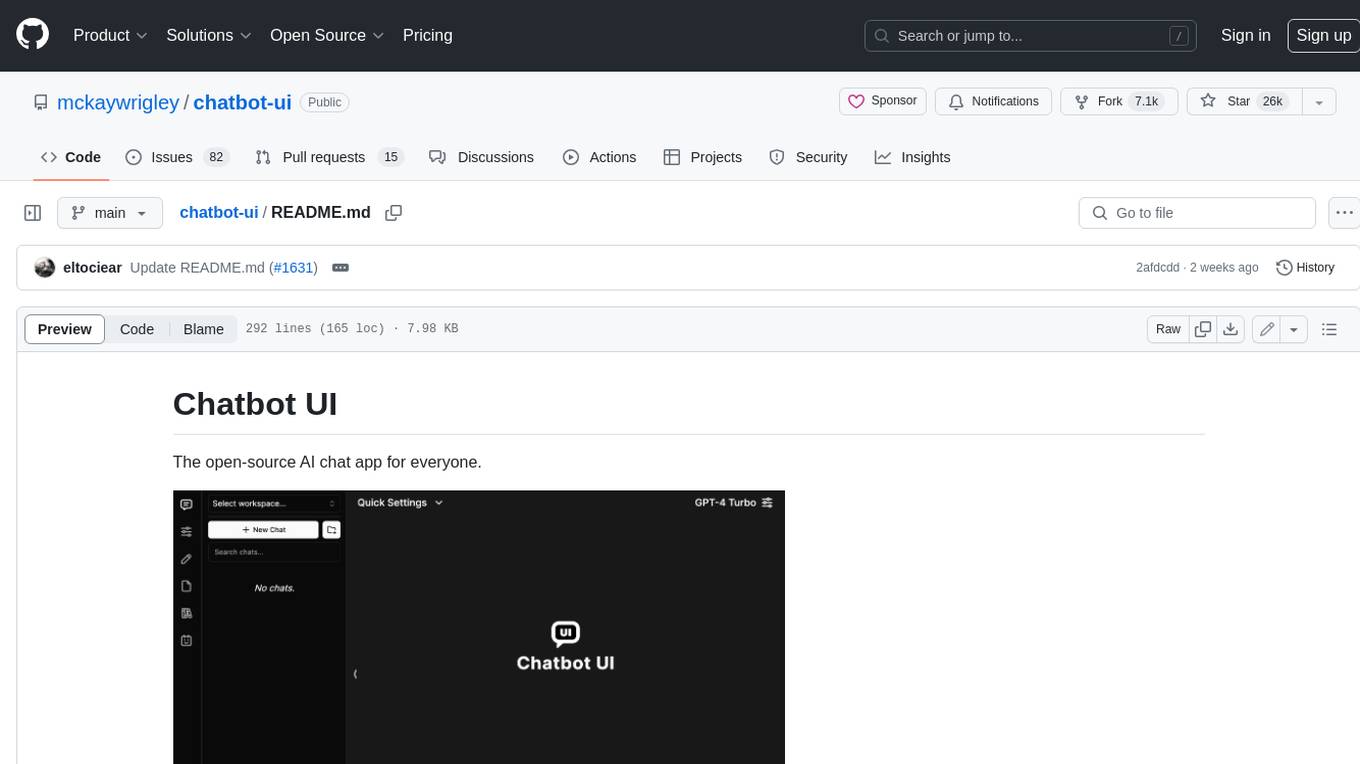
chatbot-ui
Chatbot UI is an open-source AI chat app that allows users to create and deploy their own AI chatbots. It is easy to use and can be customized to fit any need. Chatbot UI is perfect for businesses, developers, and anyone who wants to create a chatbot.
BricksLLM
BricksLLM is a cloud native AI gateway written in Go. Currently, it provides native support for OpenAI, Anthropic, Azure OpenAI and vLLM. BricksLLM aims to provide enterprise level infrastructure that can power any LLM production use cases. Here are some use cases for BricksLLM: * Set LLM usage limits for users on different pricing tiers * Track LLM usage on a per user and per organization basis * Block or redact requests containing PIIs * Improve LLM reliability with failovers, retries and caching * Distribute API keys with rate limits and cost limits for internal development/production use cases * Distribute API keys with rate limits and cost limits for students
uAgents
uAgents is a Python library developed by Fetch.ai that allows for the creation of autonomous AI agents. These agents can perform various tasks on a schedule or take action on various events. uAgents are easy to create and manage, and they are connected to a fast-growing network of other uAgents. They are also secure, with cryptographically secured messages and wallets.
griptape
Griptape is a modular Python framework for building AI-powered applications that securely connect to your enterprise data and APIs. It offers developers the ability to maintain control and flexibility at every step. Griptape's core components include Structures (Agents, Pipelines, and Workflows), Tasks, Tools, Memory (Conversation Memory, Task Memory, and Meta Memory), Drivers (Prompt and Embedding Drivers, Vector Store Drivers, Image Generation Drivers, Image Query Drivers, SQL Drivers, Web Scraper Drivers, and Conversation Memory Drivers), Engines (Query Engines, Extraction Engines, Summary Engines, Image Generation Engines, and Image Query Engines), and additional components (Rulesets, Loaders, Artifacts, Chunkers, and Tokenizers). Griptape enables developers to create AI-powered applications with ease and efficiency.