


AgentCPM
An End-to-End Infrastructure for Training and Evaluating Various LLM Agents
Stars: 722
AgentCPM is a series of open-source LLM agents jointly developed by THUNLP, Renmin University of China, ModelBest, and the OpenBMB community. It addresses challenges faced by agents in real-world applications such as limited long-horizon capability, autonomy, and generalization. The team focuses on building deep research capabilities for agents, releasing AgentCPM-Explore, a deep-search LLM agent, and AgentCPM-Report, a deep-research LLM agent. AgentCPM-Explore is the first open-source agent model with 4B parameters to appear on widely used long-horizon agent benchmarks. AgentCPM-Report is built on the 8B-parameter base model MiniCPM4.1, autonomously generating long-form reports with extreme performance and minimal footprint, designed for high-privacy scenarios with offline and agile local deployment.
README:

【中文 | English】
-
[2026-01-20] 🚀🚀🚀 We have open-sourced AgentCPM-Report, built on MiniCPM4.1-8B, which can rival top closed-source commercial systems for report generation such as Gemini-2.5-pro-DeepResearch.
-
[2026-01-12] 🚀🚀🚀 We have open-sourced AgentCPM-Explore—an agent LLM with only 4B parameters—along with all code for training, inference, and the tool sandbox environment. It successfully made it onto eight classic long-horizon and challenging agent leaderboards, including GAIA, HLE, and BrowseComp. Its SOTA performance at this scale enables longer action chains and more accurate Deep Research, breaking the performance barrier for on-device agents.
AgentCPM is a series of open-source LLM agents jointly developed by THUNLP (Tsinghua NLP Lab), Renmin University of China, ModelBest, and the OpenBMB community. To address challenges faced by agents in real-world applications—such as limited long-horizon capability, autonomy, and generalization—we propose a series of model-building approaches. Recently, the team has focused on comprehensively building deep research capabilities for agents, releasing AgentCPM-Explore, a deep-search LLM agent, and AgentCPM-Report, a deep-research LLM agent.
| Model | Download Links | Open-Sourced Content | Technical Report | How to Use |
|---|---|---|---|---|
| AgentCPM-Explore |
🤗 Hugging Face 🤖 ModelScope |
AgentDock: unified tool sandbox management & scheduling platform AgentRL: fully asynchronous agent reinforcement learning framework AgentToLeaP: one-click evaluation framework for agent tool-learning capability |
AgentCPM-Explore: Realizing Long-Horizon Deep Exploration for Edge-Scale Agents | README.md |
| AgentCPM-Report |
🤗 Hugging Face 🤖 ModelScope |
UltraRAG: low-code RAG framework | Coming Soon | README.md |
The AgentCPM team has focused on systematically building agents’ deep research capabilities and released AgentCPM-Explore, a deep-search LLM agent. AgentCPM-Explore is the first open-source agent model with 4B parameters to appear on eight widely used long-horizon agent benchmarks such as GAIA, XBench, etc.
Key highlights:
-
SOTA at 4B Scale: Best-in-class among same-size models, matches or surpasses 8B models, rivals some 30B+ and closed-source LLMs.
-
Deep Exploration: 100+ turns of continuous interaction with multi-source cross-validation and dynamic strategy adjustment.
-
End-to-End Open Source: Complete training and evaluation infrastructure for community development and custom extensions.
Demo examples (speed up):
https://github.com/user-attachments/assets/f2b3bb20-ccd5-4b61-8022-9f6e90992baa
-
Multi-model, multi-tool collaborative environment setup: First, start the AgentDock tool sandbox platform to provide unified MCP (Model Context Protocol) tool services. When working with API-based models, configure the model’s
BASE_URLandAPI_KEY. When working with locally hosted models, ensure the model service is accessible. Configure the required tool parameters in theconfig.tomlfile. -
Launch the environment: Out of the box, one-click startup. The AgentDock unified tool sandbox platform supports launching all services with a single
docker compose up -dcommand, including the management dashboard, database, and tool nodes. -
Run execution: Quickly experience the core capabilities of the framework via the QuickStart script, allowing you to run a complete Agent task without complex configuration.
-
Prepare Evaluation Environment (Recommended):
We provide a Docker image with all evaluation dependencies pre-installed. It is recommended to pull the image and run it directly:# 1. Enter the project folder cd AgentCPM-Explore # 2. Pull the image (Supports amd64/arm64 architectures) docker pull yuyangfu/agenttoleap-eval:v2.0 # 3. Start the container (Adjust the -v path as needed) docker run -dit --name agenttoleap --gpus all --network host -v $(pwd):/workspace yuyangfu/agenttoleap-eval:v2.0 # 4. Enter the container docker exec -it agenttoleap /bin/bash cd /workspace
-
Configure and run:
Openquickstart.pyand make simple configurations in the[USER CONFIGURATION]section:
-
Custom task: Modify the
QUERYvariable to the instruction you want to test (e.g., “Check the results of last night’s UEFA Champions League matches”). -
Model information: Provide your LLM
API_KEY,MODEL_NAME, andBASE_URL. -
Tool service: Set
MANAGER_URLto the address of your MCP tool server (e.g.,http://localhost:8000; make sure the service is already running).
After configuration, run:
python quickstart.pyThe script will automatically create a demo task (by default, querying today’s arXiv computer science papers), generate the execution workflow, and start the evaluation process.
- View Results
After execution completes, results will be saved under the outputs/quickstart_results/ directory. You can inspect dialog.json to obtain the full interaction trace, including tool calls and reasoning chains.
Note: In QuickStart mode, automatic scoring is skipped by default and is intended only to demonstrate the Agent’s execution capabilities.
AgentCPM-Report is built on the 8B-parameter base model MiniCPM4.1. It takes user instructions as input and autonomously generates long-form reports. Highlights include:
- Extreme Performance, Minimal Footprint: Through an average of 40 rounds of deep retrieval and nearly 100 rounds of chain-of-thought reasoning, it achieves comprehensive information mining and restructuring, enabling edge-side models to produce logically rigorous, deeply insightful long-form articles with tens of thousands of words. With just 8 billion parameters, it delivers performance on par with top-tier closed-source systems in deep research tasks.
- Physical Isolation, Local Security: Specifically designed for high-privacy scenarios, it supports fully offline and agile local deployment, completely eliminating the risk of cloud data leaks. Leveraging our UltraRAG framework, it efficiently mounts and understands your local private knowledge base, securely transforming core confidential data into highly valuable professional decision-making reports without ever leaving its domain.
We provide a minimal one-click docker-compose deployment integrated into UltraRAG, which includes the RAG framework UltraRAG2.0, the model inference framework vllm, and the Milvus vector database. If you want CPU inference, we also provide a llama.cpp-based version for GGUF-format models—simply replace docker-compose.yml with docker-compose.cpu.yml.
git clone [email protected]:OpenBMB/UltraRAG.git
cd UltraRAG
git checkout agentcpm-report-demo
cd agentcpm-report-demo
cp env.example .env
docker-compose -f docker-compose.yml up -d --build
docker-compose -f docker-compose.yml logs -f ultrarag-ui
The first startup needs to pull images, download models, and set up the environment, which may take about 30 minutes.
Then open http://localhost:5050. If you can see the GUI, the deployment is successful.
Follow the UI instructions to upload local files, chunk them, and build the index. Then, in the Chat panel, select AgentCPM-Report in the pipeline to start your workflow!
(Optional) You can import Wiki2024 from Wiki2024 as a writing database.
You can read more tutorials about AgentCPM-Report from the tutorial.
- The code in this repository is released under the Apache-2.0 license.
If AgentCPM-Explore is useful for your research, please cite the codebase:
@misc{chen2026agentcpmexplore,
  title = {{{AgentCPM-Explore}}: {{Realizing Long-Horizon Deep Exploration}} for {{Edge-Scale Agents}}},
  author = {Chen, Haotian and Cong, Xin and Fan, Shengda and Fu, Yuyang and Gong, Ziqin and Lu, Yaxi and Li, Yishan and Niu, Boye and Pan, Chengjun and Song, Zijun and Wang, Huadong and Wu, Yesai and Wu, Yueying and Xie, Zihao and Yan, Yukun and Zhang, Zhong and Lin, Yankai and Liu, Zhiyuan and Sun, Maosong},
  year = 2026,
  month = feb,
  number = {arXiv:2602.06485},
  eprint = {2602.06485},
  publisher = {arXiv},
  doi = {10.48550/arXiv.2602.06485},
  archiveprefix = {arXiv},
  langid = {english}
}
If AgentCPM-Report is helpful for your research, you can cite it as follows:
@software{AgentCPMReport2026,
  title  = {AgentCPM-Report: Gemini-2.5-pro-DeepResearch Level Local DeepResearch},
  author = {Yishan Li, Wentong Chen, Yukun Yan, Mingwei Li, Sen Mei, Xiaorong Wang, Kunpeng Liu, Xin Cong, Shuo Wang, Zhong Zhang, Yaxi Lu, Zhenghao Liu, Yankai Lin, Zhiyuan Liu, Maosong Sun},
  year   = {2026},
  url    = {https://github.com/OpenBMB/AgentCPM}
}For Tasks:
Click tags to check more tools for each tasksFor Jobs:
Alternative AI tools for AgentCPM
Similar Open Source Tools
AgentCPM
AgentCPM is a series of open-source LLM agents jointly developed by THUNLP, Renmin University of China, ModelBest, and the OpenBMB community. It addresses challenges faced by agents in real-world applications such as limited long-horizon capability, autonomy, and generalization. The team focuses on building deep research capabilities for agents, releasing AgentCPM-Explore, a deep-search LLM agent, and AgentCPM-Report, a deep-research LLM agent. AgentCPM-Explore is the first open-source agent model with 4B parameters to appear on widely used long-horizon agent benchmarks. AgentCPM-Report is built on the 8B-parameter base model MiniCPM4.1, autonomously generating long-form reports with extreme performance and minimal footprint, designed for high-privacy scenarios with offline and agile local deployment.
MInference
MInference is a tool designed to accelerate pre-filling for long-context Language Models (LLMs) by leveraging dynamic sparse attention. It achieves up to a 10x speedup for pre-filling on an A100 while maintaining accuracy. The tool supports various decoding LLMs, including LLaMA-style models and Phi models, and provides custom kernels for attention computation. MInference is useful for researchers and developers working with large-scale language models who aim to improve efficiency without compromising accuracy.
opencompass
OpenCompass is a one-stop platform for large model evaluation, aiming to provide a fair, open, and reproducible benchmark for large model evaluation. Its main features include: * Comprehensive support for models and datasets: Pre-support for 20+ HuggingFace and API models, a model evaluation scheme of 70+ datasets with about 400,000 questions, comprehensively evaluating the capabilities of the models in five dimensions. * Efficient distributed evaluation: One line command to implement task division and distributed evaluation, completing the full evaluation of billion-scale models in just a few hours. * Diversified evaluation paradigms: Support for zero-shot, few-shot, and chain-of-thought evaluations, combined with standard or dialogue-type prompt templates, to easily stimulate the maximum performance of various models. * Modular design with high extensibility: Want to add new models or datasets, customize an advanced task division strategy, or even support a new cluster management system? Everything about OpenCompass can be easily expanded! * Experiment management and reporting mechanism: Use config files to fully record each experiment, and support real-time reporting of results.
tinyllm
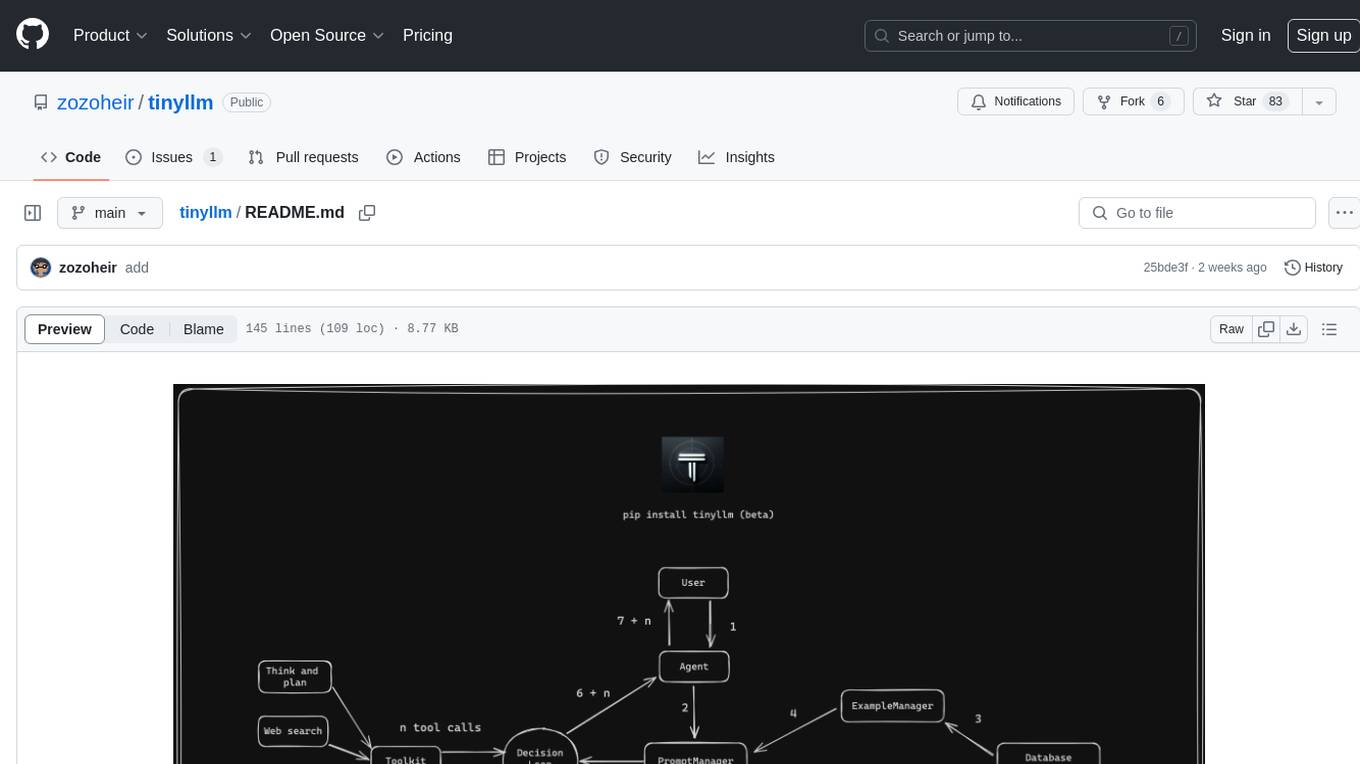
tinyllm is a lightweight framework designed for developing, debugging, and monitoring LLM and Agent powered applications at scale. It aims to simplify code while enabling users to create complex agents or LLM workflows in production. The core classes, Function and FunctionStream, standardize and control LLM, ToolStore, and relevant calls for scalable production use. It offers structured handling of function execution, including input/output validation, error handling, evaluation, and more, all while maintaining code readability. Users can create chains with prompts, LLM models, and evaluators in a single file without the need for extensive class definitions or spaghetti code. Additionally, tinyllm integrates with various libraries like Langfuse and provides tools for prompt engineering, observability, logging, and finite state machine design.
LLM-Planner
LLM-Planner is a tool for few-shot grounded planning for embodied agents using large language models. It includes a high-level prompt generator and kNN dataset, allowing users to generate high-level plans for tasks by bringing their low-level controller and an LLM. The tool has been used in various research projects and provides implementation examples from different conferences. Users can cite the tool using the provided information and the tool is available under the MIT License. For questions or issues, users can contact Luke Song.
BMAD-METHOD
BMAD-METHOD™ is a universal AI agent framework that revolutionizes Agile AI-Driven Development. It offers specialized AI expertise across various domains, including software development, entertainment, creative writing, business strategy, and personal wellness. The framework introduces two key innovations: Agentic Planning, where dedicated agents collaborate to create detailed specifications, and Context-Engineered Development, which ensures complete understanding and guidance for developers. BMAD-METHOD™ simplifies the development process by eliminating planning inconsistency and context loss, providing a seamless workflow for creating AI agents and expanding functionality through expansion packs.
long-llms-learning
A repository sharing the panorama of the methodology literature on Transformer architecture upgrades in Large Language Models for handling extensive context windows, with real-time updating the newest published works. It includes a survey on advancing Transformer architecture in long-context large language models, flash-ReRoPE implementation, latest news on data engineering, lightning attention, Kimi AI assistant, chatglm-6b-128k, gpt-4-turbo-preview, benchmarks like InfiniteBench and LongBench, long-LLMs-evals for evaluating methods for enhancing long-context capabilities, and LLMs-learning for learning technologies and applicated tasks about Large Language Models.
LLM-Brained-GUI-Agents-Survey
The 'LLM-Brained-GUI-Agents-Survey' repository contains code for a searchable paper page and assets used in the survey paper on Large Language Model-Brained GUI Agents. These agents operate within GUI environments, utilizing Large Language Models as their core inference and cognitive engine to generate, plan, and execute actions flexibly and adaptively. The repository also encourages contributions from the community for new papers, resources, or improvements related to LLM-Powered GUI Agents.
synthora
Synthora is a lightweight and extensible framework for LLM-driven Agents and ALM research. It aims to simplify the process of building, testing, and evaluating agents by providing essential components. The framework allows for easy agent assembly with a single config, reducing the effort required for tuning and sharing agents. Although in early development stages with unstable APIs, Synthora welcomes feedback and contributions to enhance its stability and functionality.
raga-llm-hub
Raga LLM Hub is a comprehensive evaluation toolkit for Language and Learning Models (LLMs) with over 100 meticulously designed metrics. It allows developers and organizations to evaluate and compare LLMs effectively, establishing guardrails for LLMs and Retrieval Augmented Generation (RAG) applications. The platform assesses aspects like Relevance & Understanding, Content Quality, Hallucination, Safety & Bias, Context Relevance, Guardrails, and Vulnerability scanning, along with Metric-Based Tests for quantitative analysis. It helps teams identify and fix issues throughout the LLM lifecycle, revolutionizing reliability and trustworthiness.
saga-reader
Saga Reader is an AI-driven think tank-style reader that automatically retrieves information from the internet based on user-specified topics and preferences. It uses cloud or local large models to summarize and provide guidance, and it includes an AI-driven interactive companion reading function, allowing you to discuss and exchange ideas with AI about the content you've read. Saga Reader is completely free and open-source, meaning all data is securely stored on your own computer and is not controlled by third-party service providers. Additionally, you can manage your subscription keywords based on your interests and preferences without being disturbed by advertisements and commercialized content.
Biosphere3
Biosphere3 is an Open-Ended Agent Evolution Arena and a large-scale multi-agent social simulation experiment. It simulates real-world societies and evolutionary processes within a digital sandbox. The platform aims to optimize architectures for general sovereign AI agents, explore the coexistence of digital lifeforms and humans, and educate the public on intelligent agents and AI technology. Biosphere3 is designed as a Citizen Science Game to engage more intelligent agents and human participants. It offers a dynamic sandbox for agent evaluation, collaborative research, and exploration of human-agent coexistence. The ultimate goal is to establish Digital Lifeform, advancing digital sovereignty and laying the foundation for harmonious coexistence between humans and AI.
Genesis
Genesis is a physics platform designed for general purpose Robotics/Embodied AI/Physical AI applications. It includes a universal physics engine, a lightweight, ultra-fast, pythonic, and user-friendly robotics simulation platform, a powerful and fast photo-realistic rendering system, and a generative data engine that transforms user-prompted natural language description into various modalities of data. It aims to lower the barrier to using physics simulations, unify state-of-the-art physics solvers, and minimize human effort in collecting and generating data for robotics and other domains.
CogVideo
CogVideo is an open-source repository that provides pretrained text-to-video models for generating videos based on input text. It includes models like CogVideoX-2B and CogVideo, offering powerful video generation capabilities. The repository offers tools for inference, fine-tuning, and model conversion, along with demos showcasing the model's capabilities through CLI, web UI, and online experiences. CogVideo aims to facilitate the creation of high-quality videos from textual descriptions, catering to a wide range of applications.
Controllable-RAG-Agent
This repository contains a sophisticated deterministic graph-based solution for answering complex questions using a controllable autonomous agent. The solution is designed to ensure that answers are solely based on the provided data, avoiding hallucinations. It involves various steps such as PDF loading, text preprocessing, summarization, database creation, encoding, and utilizing large language models. The algorithm follows a detailed workflow involving planning, retrieval, answering, replanning, content distillation, and performance evaluation. Heuristics and techniques implemented focus on content encoding, anonymizing questions, task breakdown, content distillation, chain of thought answering, verification, and model performance evaluation.
agent-zero
Agent Zero is a personal and organic AI framework designed to be dynamic, organically growing, and learning as you use it. It is fully transparent, readable, comprehensible, customizable, and interactive. The framework uses the computer as a tool to accomplish tasks, with no single-purpose tools pre-programmed. It emphasizes multi-agent cooperation, complete customization, and extensibility. Communication is key in this framework, allowing users to give proper system prompts and instructions to achieve desired outcomes. Agent Zero is capable of dangerous actions and should be run in an isolated environment. The framework is prompt-based, highly customizable, and requires a specific environment to run effectively.
For similar tasks
AgentCPM
AgentCPM is a series of open-source LLM agents jointly developed by THUNLP, Renmin University of China, ModelBest, and the OpenBMB community. It addresses challenges faced by agents in real-world applications such as limited long-horizon capability, autonomy, and generalization. The team focuses on building deep research capabilities for agents, releasing AgentCPM-Explore, a deep-search LLM agent, and AgentCPM-Report, a deep-research LLM agent. AgentCPM-Explore is the first open-source agent model with 4B parameters to appear on widely used long-horizon agent benchmarks. AgentCPM-Report is built on the 8B-parameter base model MiniCPM4.1, autonomously generating long-form reports with extreme performance and minimal footprint, designed for high-privacy scenarios with offline and agile local deployment.
Awesome-AGI
Awesome-AGI is a curated list of resources related to Artificial General Intelligence (AGI), including models, pipelines, applications, and concepts. It provides a comprehensive overview of the current state of AGI research and development, covering various aspects such as model training, fine-tuning, deployment, and applications in different domains. The repository also includes resources on prompt engineering, RLHF, LLM vocabulary expansion, long text generation, hallucination mitigation, controllability and safety, and text detection. It serves as a valuable resource for researchers, practitioners, and anyone interested in the field of AGI.
ciso-assistant-community
CISO Assistant is a tool that helps organizations manage their cybersecurity posture and compliance. It provides a centralized platform for managing security controls, threats, and risks. CISO Assistant also includes a library of pre-built frameworks and tools to help organizations quickly and easily implement best practices.
supersonic
SuperSonic is a next-generation BI platform that integrates Chat BI (powered by LLM) and Headless BI (powered by semantic layer) paradigms. This integration ensures that Chat BI has access to the same curated and governed semantic data models as traditional BI. Furthermore, the implementation of both paradigms benefits from the integration: * Chat BI's Text2SQL gets augmented with context-retrieval from semantic models. * Headless BI's query interface gets extended with natural language API. SuperSonic provides a Chat BI interface that empowers users to query data using natural language and visualize the results with suitable charts. To enable such experience, the only thing necessary is to build logical semantic models (definition of metric/dimension/tag, along with their meaning and relationships) through a Headless BI interface. Meanwhile, SuperSonic is designed to be extensible and composable, allowing custom implementations to be added and configured with Java SPI. The integration of Chat BI and Headless BI has the potential to enhance the Text2SQL generation in two dimensions: 1. Incorporate data semantics (such as business terms, column values, etc.) into the prompt, enabling LLM to better understand the semantics and reduce hallucination. 2. Offload the generation of advanced SQL syntax (such as join, formula, etc.) from LLM to the semantic layer to reduce complexity. With these ideas in mind, we develop SuperSonic as a practical reference implementation and use it to power our real-world products. Additionally, to facilitate further development we decide to open source SuperSonic as an extensible framework.
DB-GPT
DB-GPT is an open source AI native data app development framework with AWEL(Agentic Workflow Expression Language) and agents. It aims to build infrastructure in the field of large models, through the development of multiple technical capabilities such as multi-model management (SMMF), Text2SQL effect optimization, RAG framework and optimization, Multi-Agents framework collaboration, AWEL (agent workflow orchestration), etc. Which makes large model applications with data simpler and more convenient.
Chat2DB
Chat2DB is an AI-driven data development and analysis platform that enables users to communicate with databases using natural language. It supports a wide range of databases, including MySQL, PostgreSQL, Oracle, SQLServer, SQLite, MariaDB, ClickHouse, DM, Presto, DB2, OceanBase, Hive, KingBase, MongoDB, Redis, and Snowflake. Chat2DB provides a user-friendly interface that allows users to query databases, generate reports, and explore data using natural language commands. It also offers a variety of features to help users improve their productivity, such as auto-completion, syntax highlighting, and error checking.
aide
AIDE (Advanced Intrusion Detection Environment) is a tool for monitoring file system changes. It can be used to detect unauthorized changes to monitored files and directories. AIDE was written to be a simple and free alternative to Tripwire. Features currently included in AIDE are as follows: o File attributes monitored: permissions, inode, user, group file size, mtime, atime, ctime, links and growing size. o Checksums and hashes supported: SHA1, MD5, RMD160, and TIGER. CRC32, HAVAL and GOST if Mhash support is compiled in. o Plain text configuration files and database for simplicity. o Rules, variables and macros that can be customized to local site or system policies. o Powerful regular expression support to selectively include or exclude files and directories to be monitored. o gzip database compression if zlib support is compiled in. o Free software licensed under the GNU General Public License v2.
OpsPilot
OpsPilot is an AI-powered operations navigator developed by the WeOps team. It leverages deep learning and LLM technologies to make operations plans interactive and generalize and reason about local operations knowledge. OpsPilot can be integrated with web applications in the form of a chatbot and primarily provides the following capabilities: 1. Operations capability precipitation: By depositing operations knowledge, operations skills, and troubleshooting actions, when solving problems, it acts as a navigator and guides users to solve operations problems through dialogue. 2. Local knowledge Q&A: By indexing local knowledge and Internet knowledge and combining the capabilities of LLM, it answers users' various operations questions. 3. LLM chat: When the problem is beyond the scope of OpsPilot's ability to handle, it uses LLM's capabilities to solve various long-tail problems.
For similar jobs
sweep
Sweep is an AI junior developer that turns bugs and feature requests into code changes. It automatically handles developer experience improvements like adding type hints and improving test coverage.
teams-ai
The Teams AI Library is a software development kit (SDK) that helps developers create bots that can interact with Teams and Microsoft 365 applications. It is built on top of the Bot Framework SDK and simplifies the process of developing bots that interact with Teams' artificial intelligence capabilities. The SDK is available for JavaScript/TypeScript, .NET, and Python.
ai-guide
This guide is dedicated to Large Language Models (LLMs) that you can run on your home computer. It assumes your PC is a lower-end, non-gaming setup.
classifai
Supercharge WordPress Content Workflows and Engagement with Artificial Intelligence. Tap into leading cloud-based services like OpenAI, Microsoft Azure AI, Google Gemini and IBM Watson to augment your WordPress-powered websites. Publish content faster while improving SEO performance and increasing audience engagement. ClassifAI integrates Artificial Intelligence and Machine Learning technologies to lighten your workload and eliminate tedious tasks, giving you more time to create original content that matters.
chatbot-ui
Chatbot UI is an open-source AI chat app that allows users to create and deploy their own AI chatbots. It is easy to use and can be customized to fit any need. Chatbot UI is perfect for businesses, developers, and anyone who wants to create a chatbot.
BricksLLM
BricksLLM is a cloud native AI gateway written in Go. Currently, it provides native support for OpenAI, Anthropic, Azure OpenAI and vLLM. BricksLLM aims to provide enterprise level infrastructure that can power any LLM production use cases. Here are some use cases for BricksLLM: * Set LLM usage limits for users on different pricing tiers * Track LLM usage on a per user and per organization basis * Block or redact requests containing PIIs * Improve LLM reliability with failovers, retries and caching * Distribute API keys with rate limits and cost limits for internal development/production use cases * Distribute API keys with rate limits and cost limits for students
uAgents
uAgents is a Python library developed by Fetch.ai that allows for the creation of autonomous AI agents. These agents can perform various tasks on a schedule or take action on various events. uAgents are easy to create and manage, and they are connected to a fast-growing network of other uAgents. They are also secure, with cryptographically secured messages and wallets.
griptape
Griptape is a modular Python framework for building AI-powered applications that securely connect to your enterprise data and APIs. It offers developers the ability to maintain control and flexibility at every step. Griptape's core components include Structures (Agents, Pipelines, and Workflows), Tasks, Tools, Memory (Conversation Memory, Task Memory, and Meta Memory), Drivers (Prompt and Embedding Drivers, Vector Store Drivers, Image Generation Drivers, Image Query Drivers, SQL Drivers, Web Scraper Drivers, and Conversation Memory Drivers), Engines (Query Engines, Extraction Engines, Summary Engines, Image Generation Engines, and Image Query Engines), and additional components (Rulesets, Loaders, Artifacts, Chunkers, and Tokenizers). Griptape enables developers to create AI-powered applications with ease and efficiency.