


ReGraph
The world's cheapest AI inference & training marketplace. Pay up to 80% less than traditional cloud providers.
Stars: 52
ReGraph is a decentralized AI compute marketplace that connects hardware providers with developers who need inference and training resources. It democratizes access to AI computing power by creating a global network of distributed compute nodes. It is cost-effective, decentralized, easy to integrate, supports multiple models, and offers pay-as-you-go pricing.
README:



ReGraph is a decentralized AI compute marketplace that connects hardware providers with developers who need inference and training resources. Our platform democratizes access to AI computing power by creating a global network of distributed compute nodes.
- Cost Effective: Up to 80% cheaper than traditional cloud providers
- Decentralized: No single point of failure, powered by a global network
- Easy Integration: OpenAI-compatible API, drop-in replacement for existing workflows
- Multi-Model Support: Access to GPT-5, Gemini, Claude, Llama, and 50+ models
- Pay-as-you-go: Only pay for what you use, no commitments
| Provider | GPT-4 Equivalent | Llama 70B | Image Generation |
|---|---|---|---|
| ReGraph | $0.002/1K tokens | $0.0008/1K tokens | $0.02/image |
| OpenAI | $0.03/1K tokens | N/A | $0.04/image |
| AWS Bedrock | $0.008/1K tokens | $0.00265/1K tokens | $0.05/image |
| Google Cloud | $0.00125/1K tokens | $0.0009/1K tokens | $0.04/image |
# Clone the repository
git clone https://github.com/ildu00/ReGraph.git

# Navigate to project directory
cd ReGraph

# Install dependencies
npm install

# Start development server
npm run devReGraph provides an OpenAI-compatible API. Simply replace your API endpoint:
import openai

client = openai.OpenAI(
    api_key="your-regraph-api-key",
    base_url="https://api.regraph.tech/v1"
)

response = client.chat.completions.create(
    model="gpt-5",
    messages=[
        {"role": "user", "content": "Hello, ReGraph!"}
    ]
)

print(response.choices[0].message.content)curl -X POST https://api.regraph.tech/v1/chat/completions \
-H "Authorization: Bearer YOUR_API_KEY" \
-H "Content-Type: application/json" \
-d '{
"model": "gpt-5",
"messages": [{"role": "user", "content": "Hello!"}]
}'Earn passive income by contributing your unused compute resources to the ReGraph network.
- GPU: NVIDIA RTX, Tesla, A100, H100
- TPU: Google TPU v2, v3, v4
- NPU: Intel Movidius, Apple Neural Engine
- CPU: x86_64, ARM64
- Mobile: Android/iOS devices with neural accelerators
Linux/macOS:
curl -fsSL https://regraph.tech/install.sh | bashWindows (PowerShell):
irm https://regraph.tech/install.ps1 | iexDocker:
docker run -d --gpus all regraph/provider:latest| Endpoint | Method | Description |
|---|---|---|
/v1/chat/completions |
POST | Chat completions (streaming supported) |
/v1/completions |
POST | Text completions |
/v1/embeddings |
POST | Generate embeddings |
/v1/images/generations |
POST | Image generation |
/v1/audio/transcriptions |
POST | Audio transcription |
/v1/models |
GET | List available models |
All API requests require authentication via Bearer token:
Authorization: Bearer YOUR_API_KEY
Get your API key at regraph.tech/dashboard.
+------------------------------------------------------------------+
|                        ReGraph Platform                          |
+------------------------------------------------------------------+
|                                                                  |
|   +-----------+     +-----------+     +-----------+              |
|   |  API GW   |     | Load Bal  |     |   Auth    |              |
|   +-----------+     +-----------+     +-----------+              |
|                                                                  |
+------------------------------------------------------------------+
|                                                                  |
|   +----------------------------------------------------------+   |
|   |                   Inference Router                       |   |
|   |                                                          |   |
|   |   +---------+   +---------+   +---------+                |   |
|   |   | Model A |   | Model B |   | Model C |   ...          |   |
|   |   +---------+   +---------+   +---------+                |   |
|   +----------------------------------------------------------+   |
|                                                                  |
+------------------------------------------------------------------+
|                                                                  |
|   +---------+   +---------+   +---------+   +---------+          |
|   | GPU #1  |   | GPU #2  |   | TPU #1  |   | NPU #1  |   ...    |
|   |Provider |   |Provider |   |Provider |   |Provider |          |
|   +---------+   +---------+   +---------+   +---------+          |
|                                                                  |
+------------------------------------------------------------------+
- Frontend: React, TypeScript, Tailwind CSS, Vite
- Backend: Supabase Edge Functions, PostgreSQL
- Infrastructure: Distributed compute network
- Authentication: JWT-based with API keys
- ✅ OpenAI-compatible API
- ✅ 50+ AI models available
- ✅ Streaming responses
- ✅ Batch processing
- ✅ Fine-tuning support
- ✅ Usage analytics dashboard
- ✅ Crypto & fiat payments
- ✅ Easy one-click setup
- ✅ Automatic earnings
- ✅ Real-time monitoring
- ✅ Multi-device support
- ✅ Crypto payouts
- ✅ Competitive rates
We welcome contributions! Please see our Contributing Guide for details.
- Fork the repository
- Create your feature branch (
git checkout -b feature/amazing-feature) - Commit your changes (
git commit -m 'Add amazing feature') - Push to the branch (
git push origin feature/amazing-feature) - Open a Pull Request
This project is licensed under the MIT License - see the LICENSE file for details.
- Website: regraph.tech
- Documentation: regraph.tech/docs
- API Status: regraph.tech/status
- Blog: regraph.tech/blog
- Support: regraph.tech/support
Built with ❤️ by the ReGraph Team
For Tasks:
Click tags to check more tools for each tasksFor Jobs:
Alternative AI tools for ReGraph
Similar Open Source Tools
ReGraph
ReGraph is a decentralized AI compute marketplace that connects hardware providers with developers who need inference and training resources. It democratizes access to AI computing power by creating a global network of distributed compute nodes. It is cost-effective, decentralized, easy to integrate, supports multiple models, and offers pay-as-you-go pricing.
sf-skills
sf-skills is a collection of reusable skills for Agentic Salesforce Development, enabling AI-powered code generation, validation, testing, debugging, and deployment. It includes skills for development, quality, foundation, integration, AI & automation, DevOps & tooling. The installation process is newbie-friendly and includes an installer script for various CLIs. The skills are compatible with platforms like Claude Code, OpenCode, Codex, Gemini, Amp, Droid, Cursor, and Agentforce Vibes. The repository is community-driven and aims to strengthen the Salesforce ecosystem.
axonhub
AxonHub is an all-in-one AI development platform that serves as an AI gateway allowing users to switch between model providers without changing any code. It provides features like vendor lock-in prevention, integration simplification, observability enhancement, and cost control. Users can access any model using any SDK with zero code changes. The platform offers full request tracing, enterprise RBAC, smart load balancing, and real-time cost tracking. AxonHub supports multiple databases, provides a unified API gateway, and offers flexible model management and API key creation for authentication. It also integrates with various AI coding tools and SDKs for seamless usage.
new-api
New API is a next-generation large model gateway and AI asset management system that provides a wide range of features, including a new UI interface, multi-language support, online recharge function, key query for usage quota, compatibility with the original One API database, model charging by usage count, channel weighted randomization, data dashboard, token grouping and model restrictions, support for various authorization login methods, support for Rerank models, OpenAI Realtime API, Claude Messages format, reasoning effort setting, content reasoning, user-specific model rate limiting, request format conversion, cache billing support, and various model support such as gpts, Midjourney-Proxy, Suno API, custom channels, Rerank models, Claude Messages format, Dify, and more.
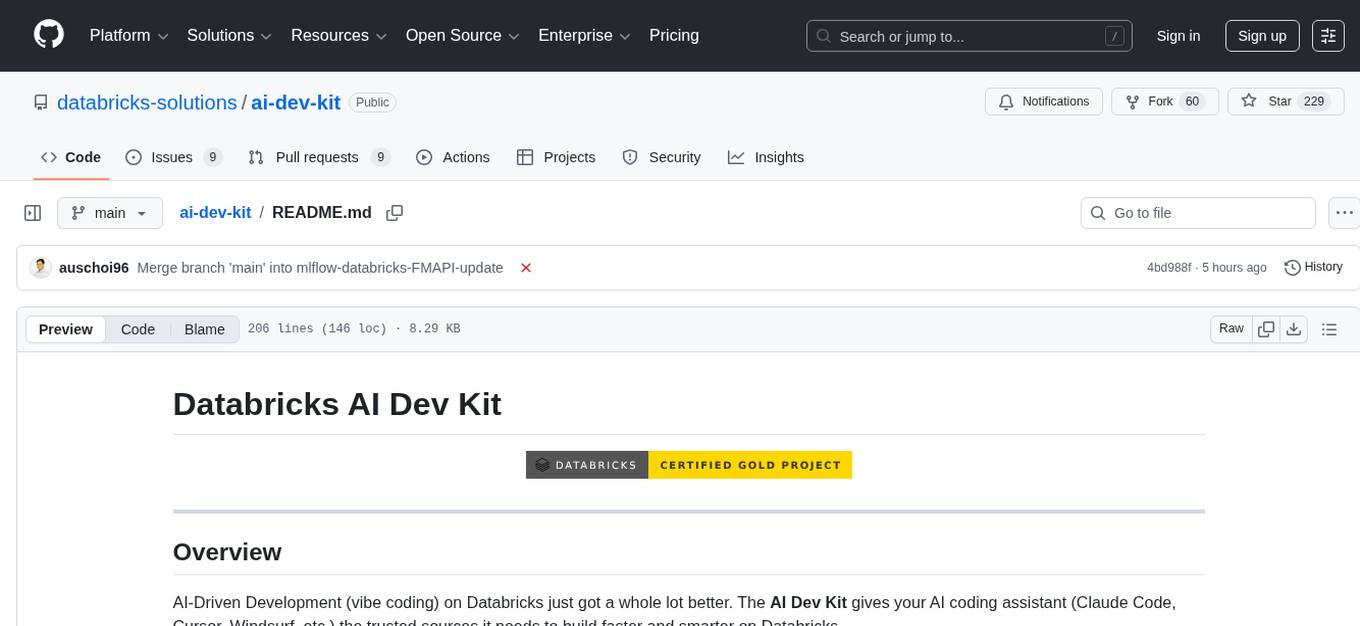
ai-dev-kit
The AI Dev Kit is a comprehensive toolkit designed to enhance AI-driven development on Databricks. It provides trusted sources for AI coding assistants like Claude Code and Cursor to build faster and smarter on Databricks. The kit includes features such as Spark Declarative Pipelines, Databricks Jobs, AI/BI Dashboards, Unity Catalog, Genie Spaces, Knowledge Assistants, MLflow Experiments, Model Serving, Databricks Apps, and more. Users can choose from different adventures like installing the kit, using the visual builder app, teaching AI assistants Databricks patterns, executing Databricks actions, or building custom integrations with the core library. The kit also includes components like databricks-tools-core, databricks-mcp-server, databricks-skills, databricks-builder-app, and ai-dev-project.
Open-dLLM
Open-dLLM is the most open release of a diffusion-based large language model, providing pretraining, evaluation, inference, and checkpoints. It introduces Open-dCoder, the code-generation variant of Open-dLLM. The repo offers a complete stack for diffusion LLMs, enabling users to go from raw data to training, checkpoints, evaluation, and inference in one place. It includes pretraining pipeline with open datasets, inference scripts for easy sampling and generation, evaluation suite with various metrics, weights and checkpoints on Hugging Face, and transparent configs for full reproducibility.
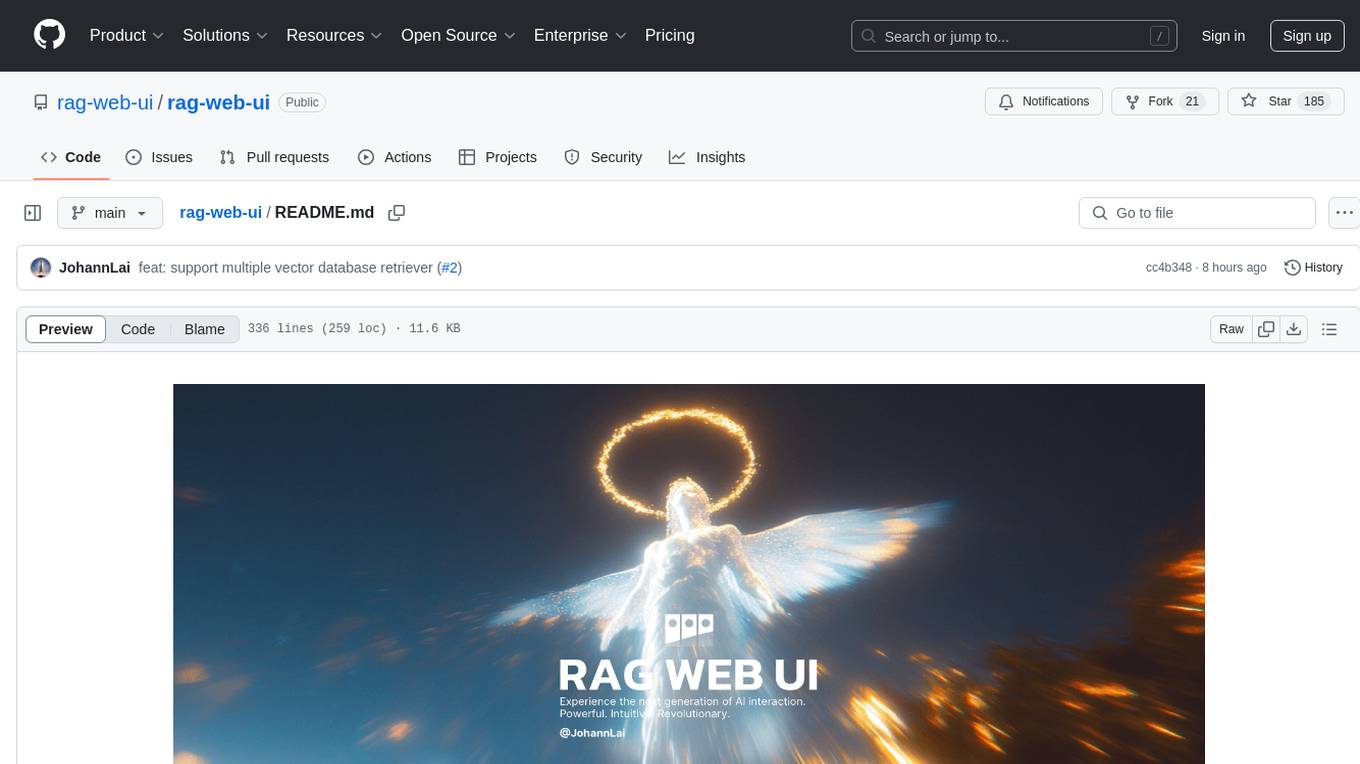
rag-web-ui
RAG Web UI is an intelligent dialogue system based on RAG (Retrieval-Augmented Generation) technology. It helps enterprises and individuals build intelligent Q&A systems based on their own knowledge bases. By combining document retrieval and large language models, it delivers accurate and reliable knowledge-based question-answering services. The system is designed with features like intelligent document management, advanced dialogue engine, and a robust architecture. It supports multiple document formats, async document processing, multi-turn contextual dialogue, and reference citations in conversations. The architecture includes a backend stack with Python FastAPI, MySQL + ChromaDB, MinIO, Langchain, JWT + OAuth2 for authentication, and a frontend stack with Next.js, TypeScript, Tailwind CSS, Shadcn/UI, and Vercel AI SDK for AI integration. Performance optimization includes incremental document processing, streaming responses, vector database performance tuning, and distributed task processing. The project is licensed under the Apache-2.0 License and is intended for learning and sharing RAG knowledge only, not for commercial purposes.
NornicDB
NornicDB is a high-performance graph database designed for AI agents and knowledge systems. It is Neo4j-compatible, GPU-accelerated, and features memory that evolves. The database automatically discovers and manages relationships in the data, allowing meaning to emerge from the knowledge graph. NornicDB is suitable for AI agent memory, knowledge graphs, RAG systems, session context, and research tools. It offers features like intelligent memory, auto-relationships, performance benchmarks, vector search, Heimdall AI assistant, APOC functions, and various Docker images for different platforms. The tool is built with Neo4j Bolt protocol, Cypher query engine, memory decay system, GPU acceleration, vector search, auto-relationship engine, and more.
runanywhere-sdks
RunAnywhere is an on-device AI tool for mobile apps that allows users to run LLMs, speech-to-text, text-to-speech, and voice assistant features locally, ensuring privacy, offline functionality, and fast performance. The tool provides a range of AI capabilities without relying on cloud services, reducing latency and ensuring that no data leaves the device. RunAnywhere offers SDKs for Swift (iOS/macOS), Kotlin (Android), React Native, and Flutter, making it easy for developers to integrate AI features into their mobile applications. The tool supports various models for LLM, speech-to-text, and text-to-speech, with detailed documentation and installation instructions available for each platform.
claude-talk-to-figma-mcp
A Model Context Protocol (MCP) plugin named Claude Talk to Figma MCP that enables Claude Desktop and other AI tools to interact directly with Figma for AI-assisted design capabilities. It provides document interaction, element creation, smart modifications, text mastery, and component integration. Users can connect the plugin to Figma, start designing, and utilize various tools for document analysis, element creation, modification, text manipulation, and component management. The project offers installation instructions, AI client configuration options, usage patterns, command references, troubleshooting support, testing guidelines, architecture overview, contribution guidelines, version history, and licensing information.
shodh-memory
Shodh-Memory is a cognitive memory system designed for AI agents to persist memory across sessions, learn from experience, and run entirely offline. It features Hebbian learning, activation decay, and semantic consolidation, packed into a single ~17MB binary. Users can deploy it on cloud, edge devices, or air-gapped systems to enhance the memory capabilities of AI agents.
sktime
sktime is a Python library for time series analysis that provides a unified interface for various time series learning tasks such as classification, regression, clustering, annotation, and forecasting. It offers time series algorithms and tools compatible with scikit-learn for building, tuning, and validating time series models. sktime aims to enhance the interoperability and usability of the time series analysis ecosystem by empowering users to apply algorithms across different tasks and providing interfaces to related libraries like scikit-learn, statsmodels, tsfresh, PyOD, and fbprophet.
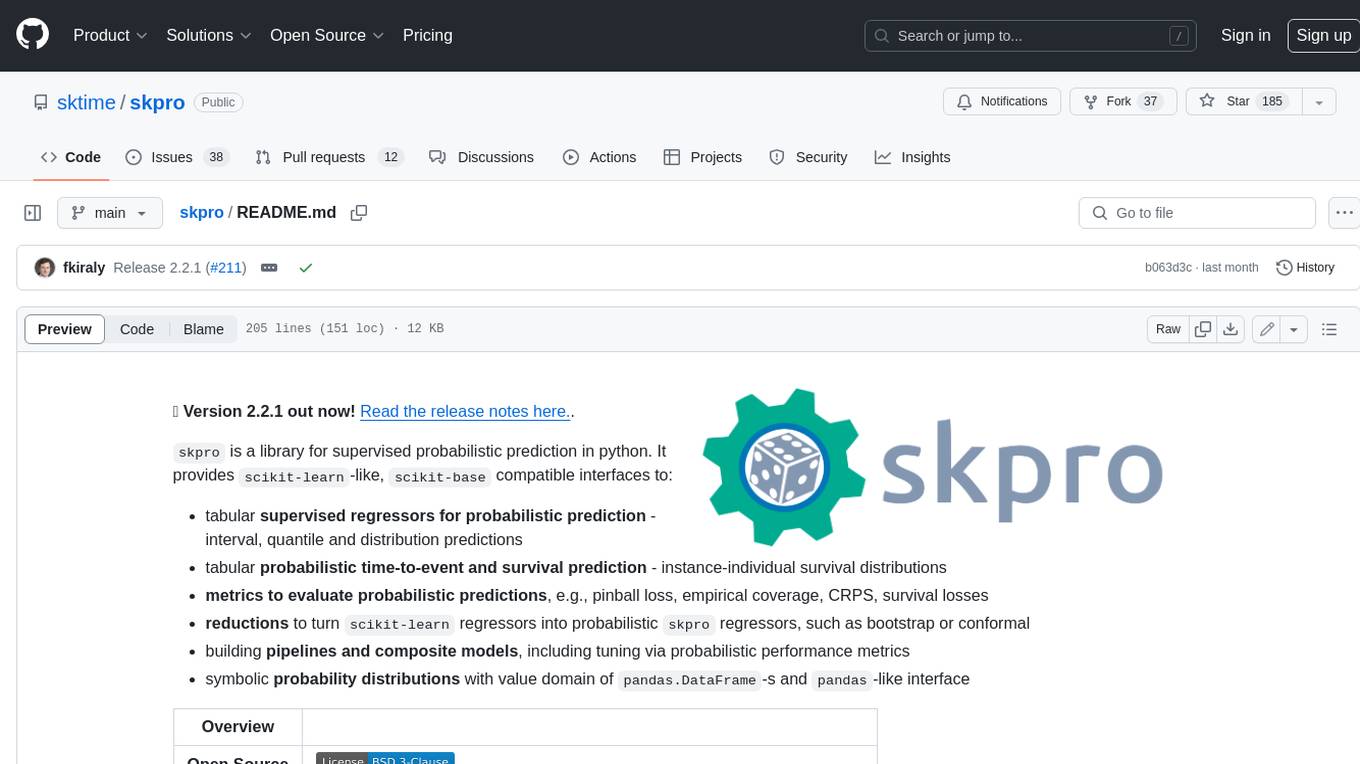
skpro
skpro is a library for supervised probabilistic prediction in python. It provides `scikit-learn`-like, `scikit-base` compatible interfaces to: * tabular **supervised regressors for probabilistic prediction** \- interval, quantile and distribution predictions * tabular **probabilistic time-to-event and survival prediction** \- instance-individual survival distributions * **metrics to evaluate probabilistic predictions** , e.g., pinball loss, empirical coverage, CRPS, survival losses * **reductions** to turn `scikit-learn` regressors into probabilistic `skpro` regressors, such as bootstrap or conformal * building **pipelines and composite models** , including tuning via probabilistic performance metrics * symbolic **probability distributions** with value domain of `pandas.DataFrame`-s and `pandas`-like interface
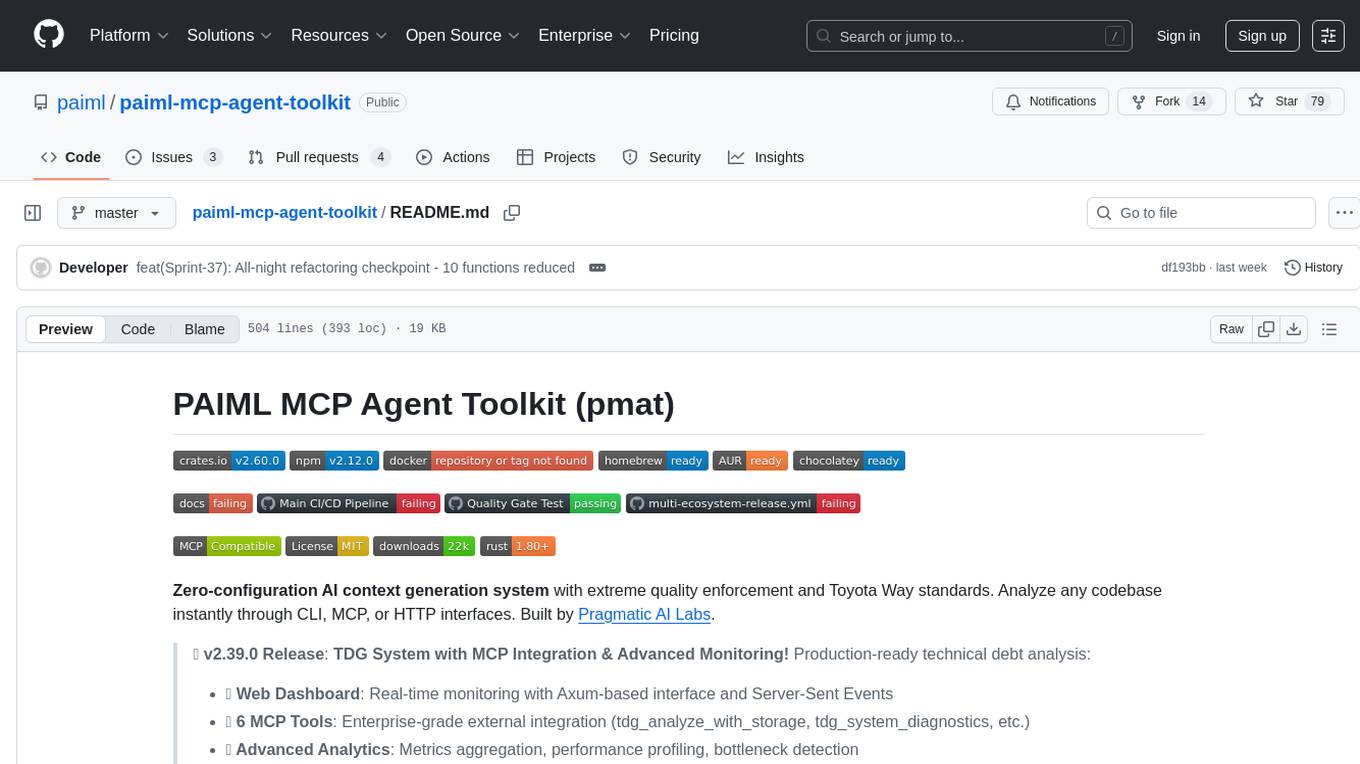
paiml-mcp-agent-toolkit
PAIML MCP Agent Toolkit (PMAT) is a zero-configuration AI context generation system with extreme quality enforcement and Toyota Way standards. It allows users to analyze any codebase instantly through CLI, MCP, or HTTP interfaces. The toolkit provides features such as technical debt analysis, advanced monitoring, metrics aggregation, performance profiling, bottleneck detection, alert system, multi-format export, storage flexibility, and more. It also offers AI-powered intelligence for smart recommendations, polyglot analysis, repository showcase, and integration points. PMAT enforces quality standards like complexity ≤20, zero SATD comments, test coverage >80%, no lint warnings, and synchronized documentation with commits. The toolkit follows Toyota Way development principles for iterative improvement, direct AST traversal, automated quality gates, and zero SATD policy.
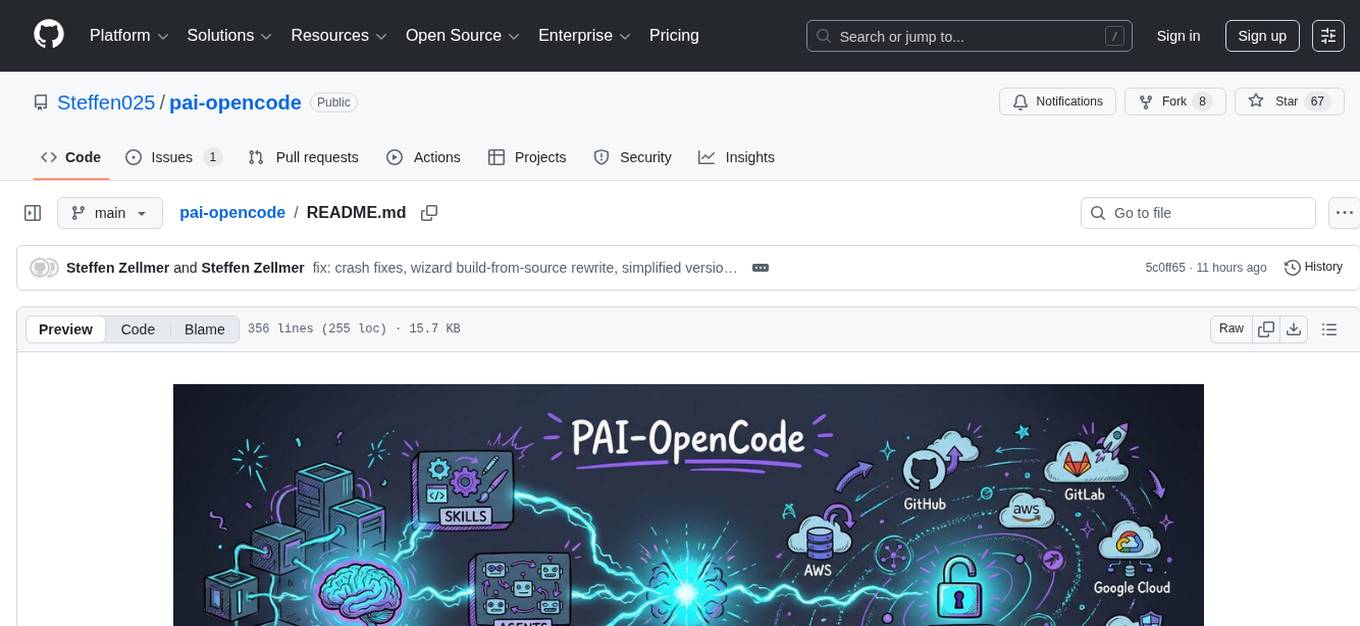
pai-opencode
PAI-OpenCode is a complete port of Daniel Miessler's Personal AI Infrastructure (PAI) to OpenCode, an open-source, provider-agnostic AI coding assistant. It brings modular capabilities, dynamic multi-agent orchestration, session history, and lifecycle automation to personalize AI assistants for users. With support for 75+ AI providers, PAI-OpenCode offers dynamic per-task model routing, full PAI infrastructure, real-time session sharing, and multiple client options. The tool optimizes cost and quality with a 3-tier model strategy and a 3-tier research system, allowing users to switch presets for different routing strategies. PAI-OpenCode's architecture preserves PAI's design while adapting to OpenCode, documented through Architecture Decision Records (ADRs).
EVE
EVE is an official PyTorch implementation of Unveiling Encoder-Free Vision-Language Models. The project aims to explore the removal of vision encoders from Vision-Language Models (VLMs) and transfer LLMs to encoder-free VLMs efficiently. It also focuses on bridging the performance gap between encoder-free and encoder-based VLMs. EVE offers a superior capability with arbitrary image aspect ratio, data efficiency by utilizing publicly available data for pre-training, and training efficiency with a transparent and practical strategy for developing a pure decoder-only architecture across modalities.
For similar tasks
ReGraph
ReGraph is a decentralized AI compute marketplace that connects hardware providers with developers who need inference and training resources. It democratizes access to AI computing power by creating a global network of distributed compute nodes. It is cost-effective, decentralized, easy to integrate, supports multiple models, and offers pay-as-you-go pricing.
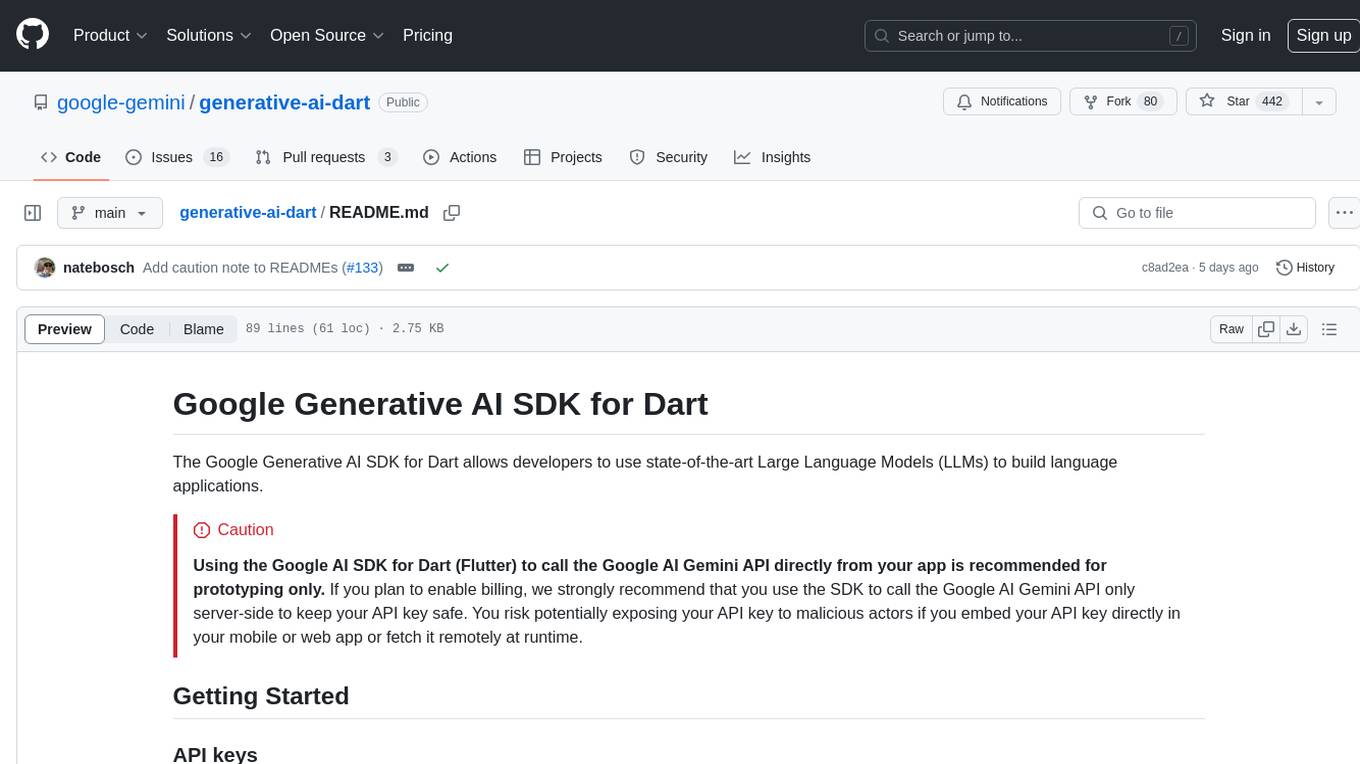
generative-ai-dart
The Google Generative AI SDK for Dart enables developers to utilize cutting-edge Large Language Models (LLMs) for creating language applications. It provides access to the Gemini API for generating content using state-of-the-art models. Developers can integrate the SDK into their Dart or Flutter applications to leverage powerful AI capabilities. It is recommended to use the SDK for server-side API calls to ensure the security of API keys and protect against potential key exposure in mobile or web apps.
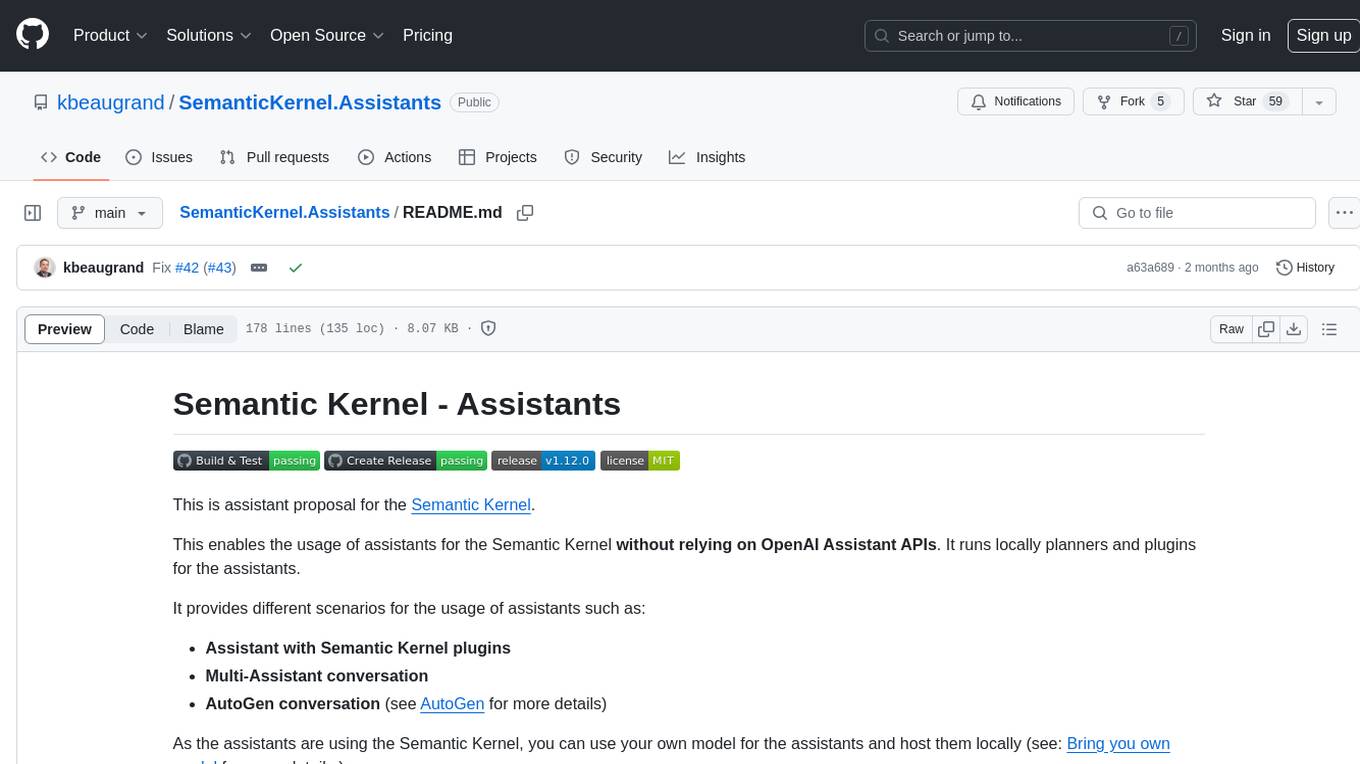
SemanticKernel.Assistants
This repository contains an assistant proposal for the Semantic Kernel, allowing the usage of assistants without relying on OpenAI Assistant APIs. It runs locally planners and plugins for the assistants, providing scenarios like Assistant with Semantic Kernel plugins, Multi-Assistant conversation, and AutoGen conversation. The Semantic Kernel is a lightweight SDK enabling integration of AI Large Language Models with conventional programming languages, offering functions like semantic functions, native functions, and embeddings-based memory. Users can bring their own model for the assistants and host them locally. The repository includes installation instructions, usage examples, and information on creating new conversation threads with the assistant.
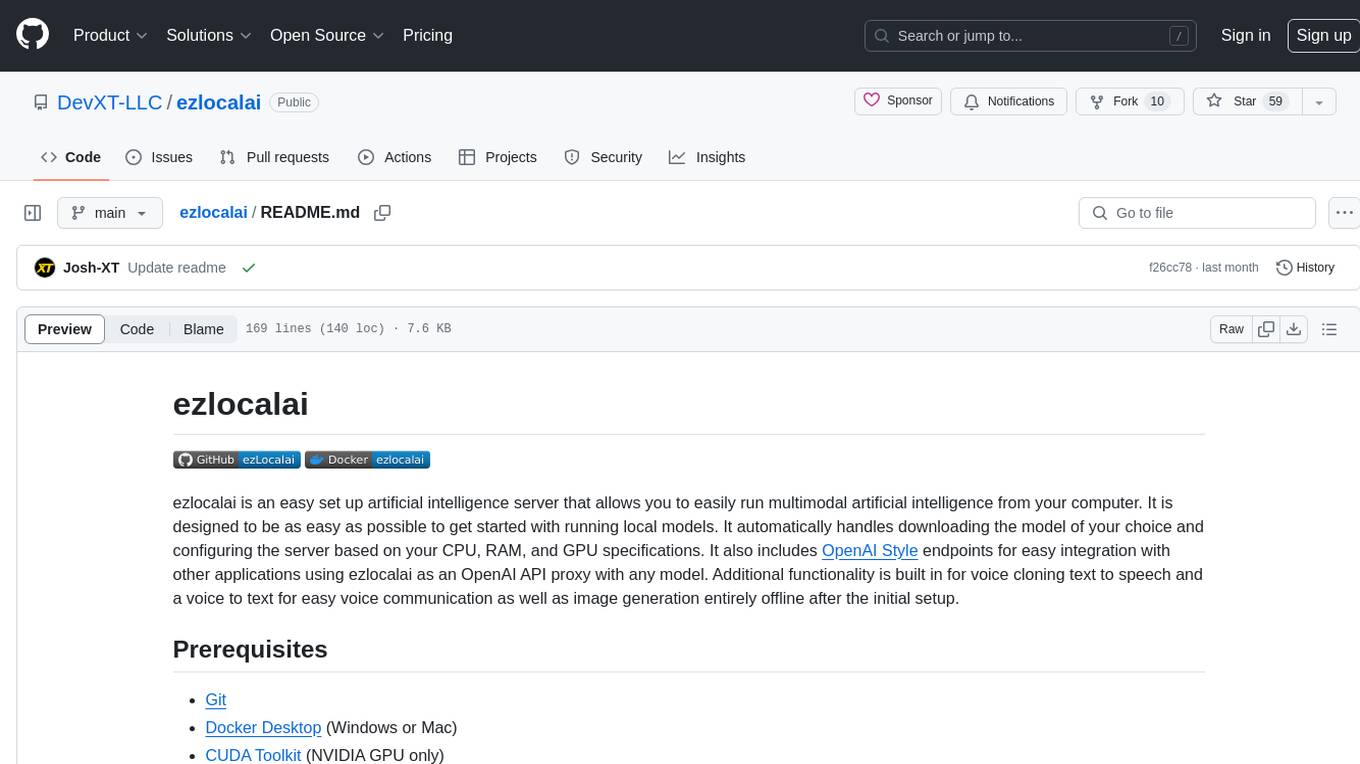
ezlocalai
ezlocalai is an artificial intelligence server that simplifies running multimodal AI models locally. It handles model downloading and server configuration based on hardware specs. It offers OpenAI Style endpoints for integration, voice cloning, text-to-speech, voice-to-text, and offline image generation. Users can modify environment variables for customization. Supports NVIDIA GPU and CPU setups. Provides demo UI and workflow visualization for easy usage.
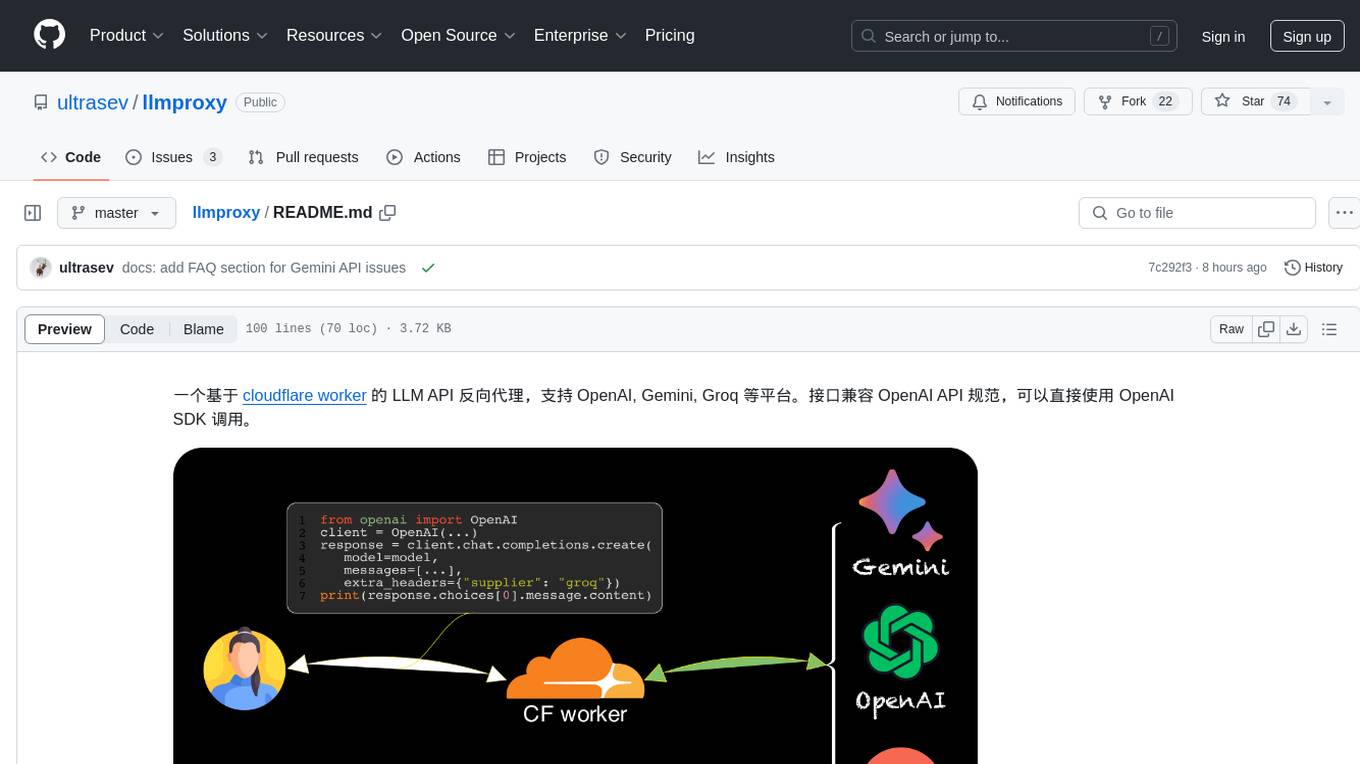
llmproxy
llmproxy is a reverse proxy for LLM API based on Cloudflare Worker, supporting platforms like OpenAI, Gemini, and Groq. The interface is compatible with the OpenAI API specification and can be directly accessed using the OpenAI SDK. It provides a convenient way to interact with various AI platforms through a unified API endpoint, enabling seamless integration and usage in different applications.
gemini-api-quickstart
This repository contains a simple Python Flask App utilizing the Google AI Gemini API to explore multi-modal capabilities. It provides a basic UI and Flask backend for easy integration and testing. The app allows users to interact with the AI model through chat messages, making it a great starting point for developers interested in AI-powered applications.
KaibanJS
KaibanJS is a JavaScript-native framework for building multi-agent AI systems. It enables users to create specialized AI agents with distinct roles and goals, manage tasks, and coordinate teams efficiently. The framework supports role-based agent design, tool integration, multiple LLMs support, robust state management, observability and monitoring features, and a real-time agentic Kanban board for visualizing AI workflows. KaibanJS aims to empower JavaScript developers with a user-friendly AI framework tailored for the JavaScript ecosystem, bridging the gap in the AI race for non-Python developers.
FFAIVideo
FFAIVideo is a lightweight node.js project that utilizes popular AI LLM to intelligently generate short videos. It supports multiple AI LLM models such as OpenAI, Moonshot, Azure, g4f, Google Gemini, etc. Users can input text to automatically synthesize exciting video content with subtitles, background music, and customizable settings. The project integrates Microsoft Edge's online text-to-speech service for voice options and uses Pexels website for video resources. Installation of FFmpeg is essential for smooth operation. Inspired by MoneyPrinterTurbo, MoneyPrinter, and MsEdgeTTS, FFAIVideo is designed for front-end developers with minimal dependencies and simple usage.
For similar jobs
sweep
Sweep is an AI junior developer that turns bugs and feature requests into code changes. It automatically handles developer experience improvements like adding type hints and improving test coverage.
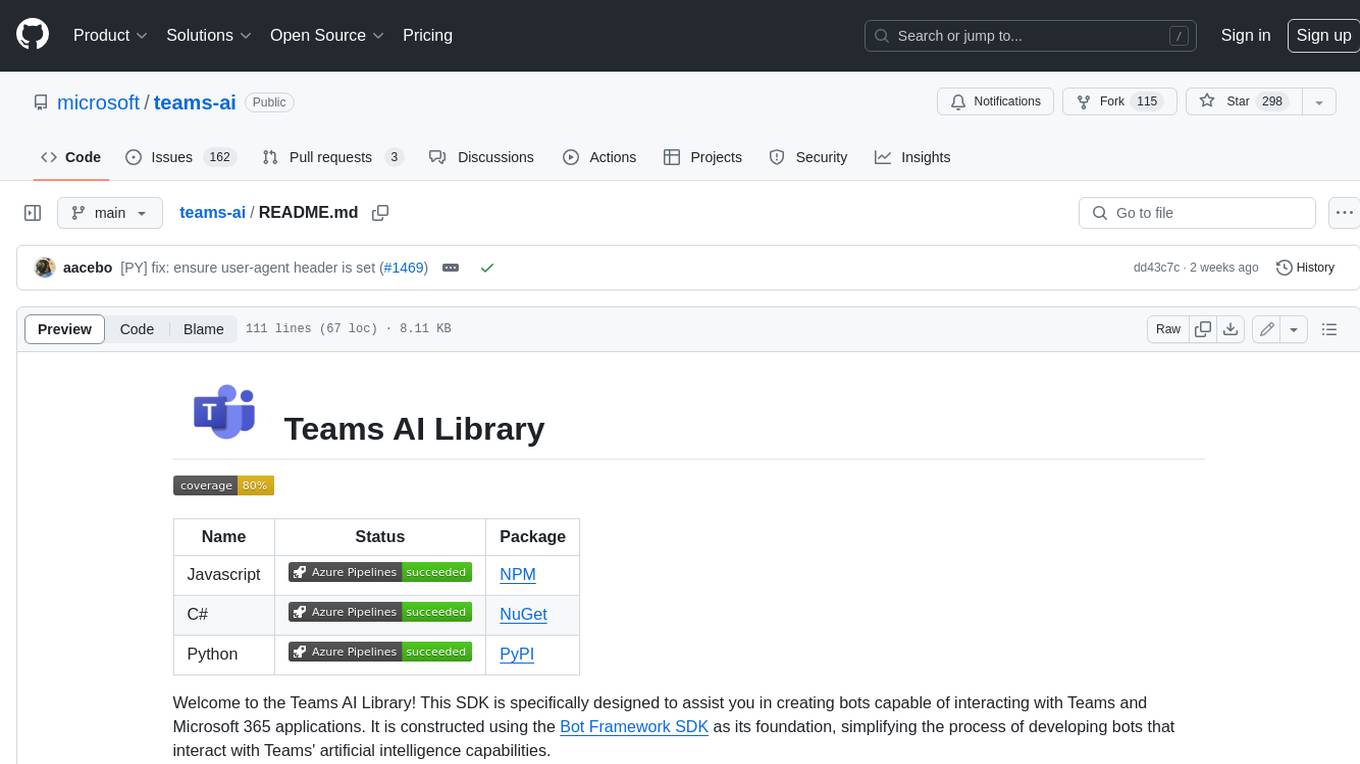
teams-ai
The Teams AI Library is a software development kit (SDK) that helps developers create bots that can interact with Teams and Microsoft 365 applications. It is built on top of the Bot Framework SDK and simplifies the process of developing bots that interact with Teams' artificial intelligence capabilities. The SDK is available for JavaScript/TypeScript, .NET, and Python.
ai-guide
This guide is dedicated to Large Language Models (LLMs) that you can run on your home computer. It assumes your PC is a lower-end, non-gaming setup.
classifai
Supercharge WordPress Content Workflows and Engagement with Artificial Intelligence. Tap into leading cloud-based services like OpenAI, Microsoft Azure AI, Google Gemini and IBM Watson to augment your WordPress-powered websites. Publish content faster while improving SEO performance and increasing audience engagement. ClassifAI integrates Artificial Intelligence and Machine Learning technologies to lighten your workload and eliminate tedious tasks, giving you more time to create original content that matters.
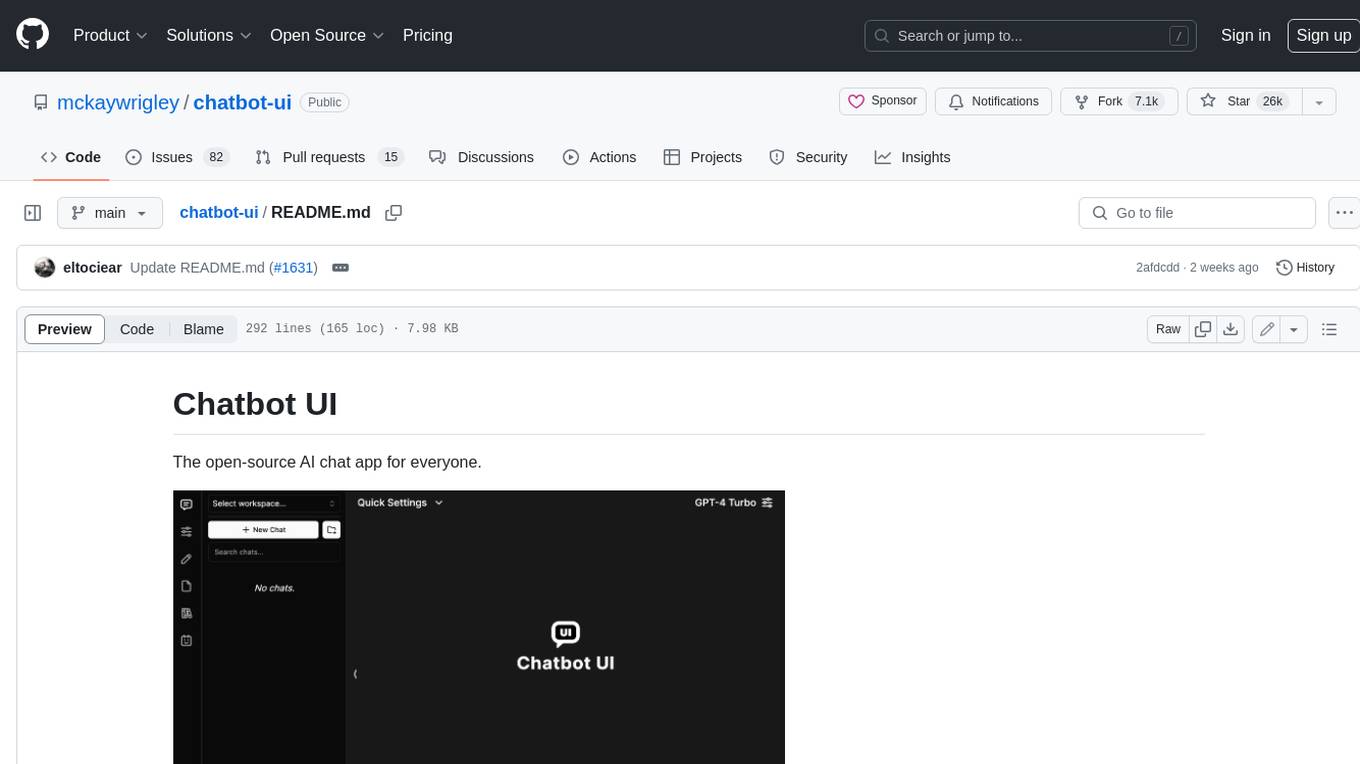
chatbot-ui
Chatbot UI is an open-source AI chat app that allows users to create and deploy their own AI chatbots. It is easy to use and can be customized to fit any need. Chatbot UI is perfect for businesses, developers, and anyone who wants to create a chatbot.
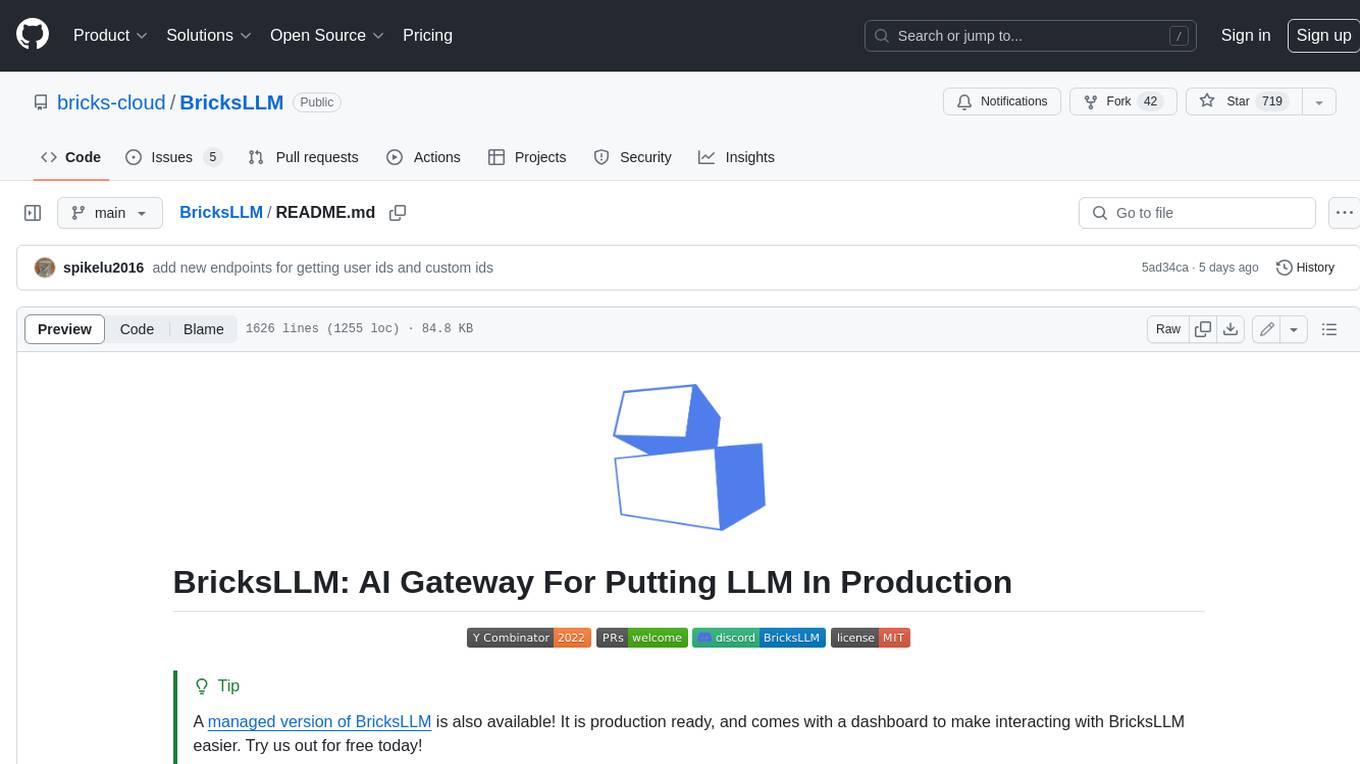
BricksLLM
BricksLLM is a cloud native AI gateway written in Go. Currently, it provides native support for OpenAI, Anthropic, Azure OpenAI and vLLM. BricksLLM aims to provide enterprise level infrastructure that can power any LLM production use cases. Here are some use cases for BricksLLM: * Set LLM usage limits for users on different pricing tiers * Track LLM usage on a per user and per organization basis * Block or redact requests containing PIIs * Improve LLM reliability with failovers, retries and caching * Distribute API keys with rate limits and cost limits for internal development/production use cases * Distribute API keys with rate limits and cost limits for students
uAgents
uAgents is a Python library developed by Fetch.ai that allows for the creation of autonomous AI agents. These agents can perform various tasks on a schedule or take action on various events. uAgents are easy to create and manage, and they are connected to a fast-growing network of other uAgents. They are also secure, with cryptographically secured messages and wallets.
griptape
Griptape is a modular Python framework for building AI-powered applications that securely connect to your enterprise data and APIs. It offers developers the ability to maintain control and flexibility at every step. Griptape's core components include Structures (Agents, Pipelines, and Workflows), Tasks, Tools, Memory (Conversation Memory, Task Memory, and Meta Memory), Drivers (Prompt and Embedding Drivers, Vector Store Drivers, Image Generation Drivers, Image Query Drivers, SQL Drivers, Web Scraper Drivers, and Conversation Memory Drivers), Engines (Query Engines, Extraction Engines, Summary Engines, Image Generation Engines, and Image Query Engines), and additional components (Rulesets, Loaders, Artifacts, Chunkers, and Tokenizers). Griptape enables developers to create AI-powered applications with ease and efficiency.