


NornicDB
NornicDB is a high-performance graph + vector database built for AI agents and knowledge systems. It speaks Neo4j's (Bolt + Cypher) and qdrant's (gRPC) languages so you can use Nornic with zero code changes, while adding intelligent features including a graphql endpoint, air-gapped embeddings, GPU accelerated search, and other intelligent features.
Stars: 129
NornicDB is a high-performance graph database designed for AI agents and knowledge systems. It is Neo4j-compatible, GPU-accelerated, and features memory that evolves. The database automatically discovers and manages relationships in the data, allowing meaning to emerge from the knowledge graph. NornicDB is suitable for AI agent memory, knowledge graphs, RAG systems, session context, and research tools. It offers features like intelligent memory, auto-relationships, performance benchmarks, vector search, Heimdall AI assistant, APOC functions, and various Docker images for different platforms. The tool is built with Neo4j Bolt protocol, Cypher query engine, memory decay system, GPU acceleration, vector search, auto-relationship engine, and more.
README:
The Graph Database That Learns
Neo4j-compatible • GPU-accelerated • Memory that evolves






Quick Start • Features • Docker • Docs • Contributors
# Apple Silicon (M1/M2/M3) with bge-m3 embedding model + heimdall
docker pull timothyswt/nornicdb-arm64-metal-bge-heimdall:latest
docker run -d -p 7474:7474 -p 7687:7687 -v nornicdb-data:/data \
  timothyswt/nornicdb-arm64-metal-bge-heimdall


# Apple Silicon (M1/M2/M3) with bge-m3 embedding model
docker pull timothyswt/nornicdb-arm64-metal-bge:latest
docker run -d -p 7474:7474 -p 7687:7687 -v nornicdb-data:/data \
  timothyswt/nornicdb-arm64-metal-bge

# Apple Silicon (M1/M2/M3) BYOM
docker pull timothyswt/nornicdb-arm64-metal:latest
docker run -d -p 7474:7474 -p 7687:7687 -v nornicdb-data:/data \
  timothyswt/nornicdb-arm64-metal

# Apple Silicon (M1/M2/M3) BYOM + no UI
docker pull timothyswt/nornicdb-arm64-metal-headless:latest
docker run -d -p 7474:7474 -p 7687:7687 -v nornicdb-data:/data \
  timothyswt/nornicdb-arm64-headless

# NVIDIA GPU (Windows/Linux) with bge-m3 embedding model + heimdall
docker pull timothyswt/nornicdb-amd64-cuda-bge-heimdall:latest
docker run --gpus all -d -p 7474:7474 -p 7687:7687 -v nornicdb-data:/data \
  timothyswt/nornicdb-amd64-cuda-bge-heimdall

# NVIDIA GPU (Windows/Linux) with bge-m3 embedding model
docker pull timothyswt/nornicdb-amd64-cuda-bge:latest
docker run --gpus all -d --gpus all -p 7474:7474 -p 7687:7687 -v nornicdb-data:/data \
  timothyswt/nornicdb-amd64-cuda-bge

# NVIDIA GPU (Windows/Linux) BYOM
docker pull timothyswt/nornicdb-amd64-cuda:latest
docker run --gpus all -d --gpus all -p 7474:7474 -p 7687:7687 -v nornicdb-data:/data \
  timothyswt/nornicdb-amd64-cuda

# CPU Only (Windows/Linux) BYOM
docker pull timothyswt/nornicdb-amd64-cpu:latest
docker run -d -p 7474:7474 -p 7687:7687 -v nornicdb-data:/data \
  timothyswt/nornicdb-amd64-cpu

# CPU Only (Windows/Linux) BYOM + no UI
docker pull timothyswt/nornicdb-amd64-cpu-headless:latest
docker run -d --gpus all -p 7474:7474 -p 7687:7687 -v nornicdb-data:/data \
  timothyswt/nornicdb-amd64-cpu-headless

docker pull timothyswt/nornicdb-amd64-vulkan:latest
docker run --gpus all -d -p 7474:7474 -p 7687:7687 -v nornicdb-data:/data \
  timothyswt/nornicdb-amd64-vulkan:latest

docker pull timothyswt/nornicdb-amd64-vulkan-bge:latest
docker run --gpus all -d -p 7474:7474 -p 7687:7687 -v nornicdb-data:/data \
  timothyswt/nornicdb-amd64-vulkan-bge:latest

docker pull timothyswt/nornicdb-amd64-vulkan-headless:latest
docker run --gpus all -d -p 7474:7474 -p 7687:7687 -v nornicdb-data:/data \
  timothyswt/nornicdb-amd64-vulkan-headless:latest
Open http://localhost:7474 — Admin UI with AI assistant ready to query your data.
Below are copy-pastable commands and prerequisites to build NornicDB for the supported targets (Docker images, local binaries, cross-compiles and Raspberry Pi). These instructions reflect the Makefile targets in this repository.
- Go 1.23+ (for builds and cross-compilation)
- Docker (for image builds)
- curl (for model downloads)
- GNU make
- For localllm / BGE (local embeddings): a working
llama.cppbuild — seescripts/build-llama.sh - For CUDA builds on Linux/Windows: NVIDIA drivers + CUDA Toolkit (12.x recommended)
- For Vulkan builds on Linux: Vulkan runtime & drivers for your GPU (AMD/NVIDIA/Intel)
- On macOS (Apple Silicon): Docker +
--platform linux/arm64is used for arm64 images (Metal GPU acceleration implemented in the image) - Optional:
ghCLI if you want to create GitHub releases
Model files:
- BGE:
models/bge-m3.gguf(Makefile targetmake download-bgewill download it) - Qwen:
models/qwen3-0.6b-instruct.gguf(Makefile targetmake download-qwenwill download it)
- Force no cache:
NO_CACHE=1 - Set registry (default
timothyswt):REGISTRY=yourdockerid - Set tag version (default
latest):VERSION=1.0.6
NornicDB is a high-performance graph database designed for AI agents and knowledge systems. It speaks Neo4j's language (Bolt protocol + Cypher) so you can switch with zero code changes, while adding intelligent features that traditional databases lack.
NornicDB automatically discovers and manages relationships in your data, weaving connections that let meaning emerge from your knowledge graph.
# Ready to go - includes embedding model
docker run -d --name nornicdb \
  -p 7474:7474 -p 7687:7687 \
  -v nornicdb-data:/data \
  timothyswt/nornicdb-arm64-metal-bge:latest  # Apple Silicon
# timothyswt/nornicdb-amd64-cuda-bge:latest # NVIDIA GPUgit clone https://github.com/orneryd/NornicDB.git
cd NornicDB
go build -o nornicdb ./cmd/nornicdb
./nornicdb serveUse any Neo4j driver — Python, JavaScript, Go, Java, .NET:
from neo4j import GraphDatabase

driver = GraphDatabase.driver("bolt://localhost:7687")
with driver.session() as session:
session.run("CREATE (n:Memory {content: 'Hello NornicDB'})")Drop-in replacement for Neo4j. Your existing code works unchanged.
- Bolt Protocol — Use official Neo4j drivers
- Cypher Queries — Full query language support
- Schema Management — Constraints, indexes, vector indexes
Memory that behaves like human cognition.
| Memory Tier | Half-Life | Use Case |
|---|---|---|
| Episodic | 7 days | Chat context, sessions |
| Semantic | 69 days | Facts, decisions |
| Procedural | 693 days | Skills, patterns |
// Find memories that are still strong
MATCH (m:Memory) WHERE m.decayScore > 0.5
RETURN m.title ORDER BY m.decayScore DESCNornicDB weaves connections automatically:
- Embedding Similarity — Related concepts link together
- Co-access Patterns — Frequently queried pairs connect
- Temporal Proximity — Same-session nodes associate
- Transitive Inference — A→B + B→C suggests A→C
LDBC Social Network Benchmark (M3 Max, 64GB):
| Query Type | NornicDB | Neo4j | Speedup |
|---|---|---|---|
| Message content lookup | 6,389 ops/sec | 518 ops/sec | 12x |
| Recent messages (friends) | 2,769 ops/sec | 108 ops/sec | 25x |
| Avg friends per city | 4,713 ops/sec | 91 ops/sec | 52x |
| Tag co-occurrence | 2,076 ops/sec | 65 ops/sec | 32x |
Northwind Benchmark (M3 Max vs Neo4j, same hardware):
| Operation | NornicDB | Neo4j | Speedup |
|---|---|---|---|
| Index lookup | 7,623 ops/sec | 2,143 ops/sec | 3.6x |
| Count nodes | 5,253 ops/sec | 798 ops/sec | 6.6x |
| Write: node | 5,578 ops/sec | 1,690 ops/sec | 3.3x |
| Write: edge | 6,626 ops/sec | 1,611 ops/sec | 4.1x |
Cross-Platform (CUDA on Windows i9-9900KF + RTX 2080 Ti):
| Operation | Throughput |
|---|---|
| Orders by customer | 4,252 ops/sec |
| Products out of stock | 4,174 ops/sec |
| Find category | 4,071 ops/sec |
Additional advantages:
- Memory footprint: 100-500 MB vs 1-4 GB for Neo4j
- Cold start: <1s vs 10-30s for Neo4j
See full benchmark results for detailed comparisons.
Native semantic search with GPU acceleration. NornicDB automatically indexes all node embeddings - no manual index creation required.
📖 Deep Dive: See Vector Search Guide for internal index architecture, user-defined indexes, and the embedding lookup order.
Option 1: Vector Array (Neo4j Compatible)
Provide your own embeddings - works identically to Neo4j:
// Query with a pre-computed embedding vector
CALL db.index.vector.queryNodes(
  'embeddings',            // Index name (created via createNodeIndex)
  10,                      // Number of results
  [0.1, 0.2, 0.3, ...]     // Your query vector
) YIELD node, score
RETURN node.content, score
Option 2: String Query (NornicDB Enhanced)
Let NornicDB handle embedding generation automatically:
// Query with natural language - NornicDB generates the embedding
CALL db.index.vector.queryNodes(
  'embeddings',              // Index name
  10,                        // Number of results
  'machine learning guide'   // Natural language query (auto-embedded)
) YIELD node, score
RETURN node.content, score
💡 Note: String queries require an embedder to be configured. When enabled, NornicDB automatically generates embeddings server-side using the configured model (Ollama, OpenAI, or local GGUF).
Option 3: REST API (Hybrid Search)
Use the REST endpoint for combined vector + BM25 search:
curl -X POST http://localhost:7474/nornicdb/search \
  -H "Content-Type: application/json" \
-d '{"query": "machine learning", "limit": 10}'Built-in AI that understands your database.
# Enable Heimdall
NORNICDB_HEIMDALL_ENABLED=true ./nornicdb serve
Natural Language Queries:
- "Get the database status"
- "Show me system metrics"
- "Run health check"
Plugin System:
- Create custom actions the AI can execute
- Lifecycle hooks (PrePrompt, PreExecute, PostExecute)
- Database event monitoring for autonomous actions
- Inline notifications with proper ordering
See Heimdall AI Assistant Guide and Plugin Development.
950+ built-in functions for text, math, collections, and more. Plus a plugin system for custom extensions.
// Text processing
RETURN apoc.text.camelCase('hello world')  // "helloWorld"
RETURN apoc.text.slugify('Hello World!')   // "hello-world"

// Machine learning
RETURN apoc.ml.sigmoid(0)                  // 0.5
RETURN apoc.ml.cosineSimilarity([1,0], [0,1])  // 0.0

// Collections
RETURN apoc.coll.sum([1, 2, 3, 4, 5])      // 15
Drop custom .so plugins into /app/plugins/ for automatic loading. See the APOC Plugin Guide.
All images available at Docker Hub.
| Image | Size | Description |
|---|---|---|
timothyswt/nornicdb-arm64-metal-bge-heimdall |
1.1 GB | Full - Embeddings + AI Assistant |
timothyswt/nornicdb-arm64-metal-bge |
586 MB | Standard - With BGE-M3 embeddings |
timothyswt/nornicdb-arm64-metal |
148 MB | Minimal - Core database, BYOM |
timothyswt/nornicdb-arm64-metal-headless |
148 MB | Headless - API only, no UI |
| Image | Size | Description |
|---|---|---|
timothyswt/nornicdb-amd64-cuda-bge |
~4.5 GB | GPU + Embeddings - CUDA + BGE-M3 |
timothyswt/nornicdb-amd64-cuda |
~3 GB | GPU - CUDA acceleration, BYOM |
timothyswt/nornicdb-amd64-cuda-headless |
~2.9 GB | GPU Headless - API only |
timothyswt/nornicdb-amd64-cpu |
~500 MB | CPU - No GPU required |
timothyswt/nornicdb-amd64-cpu-headless |
~500 MB | CPU Headless - API only |
BYOM = Bring Your Own Model (mount at /app/models)
# With your own model
docker run -d -p 7474:7474 -p 7687:7687 \
  -v /path/to/models:/app/models \
  timothyswt/nornicdb-arm64-metal:latest

# Headless mode (API only, no web UI)
docker run -d -p 7474:7474 -p 7687:7687 \
  -v nornicdb-data:/data \
timothyswt/nornicdb-arm64-metal-headless:latestFor embedded deployments, microservices, or API-only use cases, NornicDB supports headless mode which disables the web UI for a smaller binary and reduced attack surface.
Runtime flag:
nornicdb serve --headlessEnvironment variable:
NORNICDB_HEADLESS=true nornicdb serveBuild without UI (smaller binary):
# Native build
make build-headless

# Docker build
docker build --build-arg HEADLESS=true -f docker/Dockerfile.arm64-metal .# nornicdb.yaml
server:
bolt_port: 7687
http_port: 7474
data_dir: ./data
embeddings:
provider: local # or ollama, openai
model: bge-m3
dimensions: 1024
decay:
enabled: true
recalculate_interval: 1h
auto_links:
enabled: true
similarity_threshold: 0.82
# === Async Write Settings ===
# These control the async write-behind cache for better throughput
async_writes:
enabled: true # Enable async writes (default: true)
flush_interval: 50ms # How often to flush pending writes
max_node_cache_size: 50000 # Max nodes to buffer before forcing flush
max_edge_cache_size: 100000 # Max edges to buffer before forcing flush- AI Agent Memory — Persistent, queryable memory for LLM agents
- Knowledge Graphs — Auto-organizing knowledge bases
- RAG Systems — Vector + graph retrieval in one database
- Session Context — Decaying conversation history
- Research Tools — Connect papers, notes, and insights
| Guide | Description |
|---|---|
| Getting Started | Installation & quick start |
| API Reference | Cypher functions & procedures |
| User Guides | Complete examples & patterns |
| Performance | Benchmarks vs Neo4j |
| Neo4j Migration | Compatibility & feature parity |
| Architecture | System design & internals |
| Docker Guide | Build & deployment |
| Development | Contributing & development |
| Feature | Neo4j | NornicDB |
|---|---|---|
| Protocol | Bolt ✓ | Bolt ✓ |
| Query Language | Cypher ✓ | Cypher ✓ |
| Memory Decay | Manual | Automatic |
| Auto-Relationships | No | Built-in |
| Vector Search | Plugin | Native |
| GPU Acceleration | No | Metal/CUDA |
| Embedded Mode | No | Yes |
| License | GPL | MIT |
# Basic build
make build

# Headless (no UI)
make build-headless

# With local LLM support
make build-localllm# Download models for Heimdall builds (automatic if missing)
make download-models # BGE-M3 + qwen3-0.6b (~750MB)
make check-models # Verify models present
# ARM64 (Apple Silicon)
make build-arm64-metal # Base (BYOM)
make build-arm64-metal-bge # With BGE embeddings
make build-arm64-metal-bge-heimdall # With BGE + Heimdall AI
make build-arm64-metal-headless # Headless (no UI)
# AMD64 CUDA (NVIDIA GPU)
make build-amd64-cuda # Base (BYOM)
make build-amd64-cuda-bge # With BGE embeddings
make build-amd64-cuda-bge-heimdall # With BGE + Heimdall AI
make build-amd64-cuda-headless # Headless (no UI)
# AMD64 CPU-only
make build-amd64-cpu # Minimal
make build-amd64-cpu-headless # Minimal headless
# Build all variants for your architecture
make build-all
# Deploy to registry
make deploy-all # Build + push all variants# Build for other platforms from macOS
make cross-linux-amd64 # Linux x86_64
make cross-linux-arm64 # Linux ARM64
make cross-rpi # Raspberry Pi 4/5
make cross-windows # Windows (CPU-only)
make cross-all # All platforms- [x] Neo4j Bolt protocol
- [x] Cypher query engine (52 functions)
- [x] Memory decay system
- [x] GPU acceleration (Metal, CUDA)
- [x] Vector & full-text search
- [X] Auto-relationship engine
- [X] HNSW vector index
- [x] Metadata/Property Indexing
- [x] SIMD Implementation
- [x] Clustering support
Special thanks to everyone who helps make NornicDB better. See CONTRIBUTORS.md for a list of community contributors.
MIT License — Originally part of the Mimir project, now maintained as a standalone repository.
See NOTICES.md for third-party license information, including bundled AI models (BGE-M3, Qwen2.5) and dependencies.
Weaving your data's destiny
For Tasks:
Click tags to check more tools for each tasksFor Jobs:
Alternative AI tools for NornicDB
Similar Open Source Tools
NornicDB
NornicDB is a high-performance graph database designed for AI agents and knowledge systems. It is Neo4j-compatible, GPU-accelerated, and features memory that evolves. The database automatically discovers and manages relationships in the data, allowing meaning to emerge from the knowledge graph. NornicDB is suitable for AI agent memory, knowledge graphs, RAG systems, session context, and research tools. It offers features like intelligent memory, auto-relationships, performance benchmarks, vector search, Heimdall AI assistant, APOC functions, and various Docker images for different platforms. The tool is built with Neo4j Bolt protocol, Cypher query engine, memory decay system, GPU acceleration, vector search, auto-relationship engine, and more.
ai-dev-kit
The AI Dev Kit is a comprehensive toolkit designed to enhance AI-driven development on Databricks. It provides trusted sources for AI coding assistants like Claude Code and Cursor to build faster and smarter on Databricks. The kit includes features such as Spark Declarative Pipelines, Databricks Jobs, AI/BI Dashboards, Unity Catalog, Genie Spaces, Knowledge Assistants, MLflow Experiments, Model Serving, Databricks Apps, and more. Users can choose from different adventures like installing the kit, using the visual builder app, teaching AI assistants Databricks patterns, executing Databricks actions, or building custom integrations with the core library. The kit also includes components like databricks-tools-core, databricks-mcp-server, databricks-skills, databricks-builder-app, and ai-dev-project.
new-api
New API is a next-generation large model gateway and AI asset management system that provides a wide range of features, including a new UI interface, multi-language support, online recharge function, key query for usage quota, compatibility with the original One API database, model charging by usage count, channel weighted randomization, data dashboard, token grouping and model restrictions, support for various authorization login methods, support for Rerank models, OpenAI Realtime API, Claude Messages format, reasoning effort setting, content reasoning, user-specific model rate limiting, request format conversion, cache billing support, and various model support such as gpts, Midjourney-Proxy, Suno API, custom channels, Rerank models, Claude Messages format, Dify, and more.
sf-skills
sf-skills is a collection of reusable skills for Agentic Salesforce Development, enabling AI-powered code generation, validation, testing, debugging, and deployment. It includes skills for development, quality, foundation, integration, AI & automation, DevOps & tooling. The installation process is newbie-friendly and includes an installer script for various CLIs. The skills are compatible with platforms like Claude Code, OpenCode, Codex, Gemini, Amp, Droid, Cursor, and Agentforce Vibes. The repository is community-driven and aims to strengthen the Salesforce ecosystem.
paiml-mcp-agent-toolkit
PAIML MCP Agent Toolkit (PMAT) is a zero-configuration AI context generation system with extreme quality enforcement and Toyota Way standards. It allows users to analyze any codebase instantly through CLI, MCP, or HTTP interfaces. The toolkit provides features such as technical debt analysis, advanced monitoring, metrics aggregation, performance profiling, bottleneck detection, alert system, multi-format export, storage flexibility, and more. It also offers AI-powered intelligence for smart recommendations, polyglot analysis, repository showcase, and integration points. PMAT enforces quality standards like complexity ≤20, zero SATD comments, test coverage >80%, no lint warnings, and synchronized documentation with commits. The toolkit follows Toyota Way development principles for iterative improvement, direct AST traversal, automated quality gates, and zero SATD policy.
ReGraph
ReGraph is a decentralized AI compute marketplace that connects hardware providers with developers who need inference and training resources. It democratizes access to AI computing power by creating a global network of distributed compute nodes. It is cost-effective, decentralized, easy to integrate, supports multiple models, and offers pay-as-you-go pricing.
shodh-memory
Shodh-Memory is a cognitive memory system designed for AI agents to persist memory across sessions, learn from experience, and run entirely offline. It features Hebbian learning, activation decay, and semantic consolidation, packed into a single ~17MB binary. Users can deploy it on cloud, edge devices, or air-gapped systems to enhance the memory capabilities of AI agents.
GraphGen
GraphGen is a framework for synthetic data generation guided by knowledge graphs. It enhances supervised fine-tuning for large language models (LLMs) by generating synthetic data based on a fine-grained knowledge graph. The tool identifies knowledge gaps in LLMs, prioritizes generating QA pairs targeting high-value knowledge, incorporates multi-hop neighborhood sampling, and employs style-controlled generation to diversify QA data. Users can use LLaMA-Factory and xtuner for fine-tuning LLMs after data generation.
rwkv-qualcomm
This repository provides support for inference RWKV models on Qualcomm HTP (Hexagon Tensor Processor) using QNN SDK. It supports RWKV v5, v6, and experimentally v7 models, inference using Qualcomm CPU, GPU, or HTP as the backend, whole-model float16 inference, activation INT16 and weights INT8 quantized inference, and activation INT16 and weights INT4/INT8 mixed quantized inference. Users can convert model weights to QNN model library files, generate HTP context cache, and run inference on Qualcomm Snapdragon SM8650 with HTP v75. The project requires QNN SDK, AIMET toolkit, and specific hardware for verification.
roam-code
Roam is a tool that builds a semantic graph of your codebase and allows AI agents to query it with one shell command. It pre-indexes your codebase into a semantic graph stored in a local SQLite DB, providing architecture-level graph queries offline, cross-language, and compact. Roam understands functions, modules, tests coverage, and overall architecture structure. It is best suited for agent-assisted coding, large codebases, architecture governance, safe refactoring, and multi-repo projects. Roam is not suitable for real-time type checking, dynamic/runtime analysis, small scripts, or pure text search. It offers speed, dependency-awareness, LLM-optimized output, fully local operation, and CI readiness.
actor-core
Actor-core is a lightweight and flexible library for building actor-based concurrent applications in Java. It provides a simple API for creating and managing actors, as well as handling message passing between actors. With actor-core, developers can easily implement scalable and fault-tolerant systems using the actor model.
Open-dLLM
Open-dLLM is the most open release of a diffusion-based large language model, providing pretraining, evaluation, inference, and checkpoints. It introduces Open-dCoder, the code-generation variant of Open-dLLM. The repo offers a complete stack for diffusion LLMs, enabling users to go from raw data to training, checkpoints, evaluation, and inference in one place. It includes pretraining pipeline with open datasets, inference scripts for easy sampling and generation, evaluation suite with various metrics, weights and checkpoints on Hugging Face, and transparent configs for full reproducibility.
prism-insight
PRISM-INSIGHT is a comprehensive stock analysis and trading simulation system based on AI agents. It automatically captures daily surging stocks via Telegram channel, generates expert-level analyst reports, and performs trading simulations. The system utilizes OpenAI GPT-4.1 for in-depth stock analysis and GPT-5 for investment strategy simulation. It also interacts with users via Anthropic Claude for Telegram conversations. The system architecture includes AI analysis agents, stock tracking, PDF conversion, and Telegram bot functionalities. Users can customize criteria for identifying surging stocks, modify AI prompts, and adjust chart styles. The project is open-source under the MIT license, and all investment decisions based on the analysis are the responsibility of the user.
azure-agentic-infraops
Agentic InfraOps is a multi-agent orchestration system for Azure infrastructure development that transforms how you build Azure infrastructure with AI agents. It provides a structured 7-step workflow that coordinates specialized AI agents through a complete infrastructure development cycle: Requirements → Architecture → Design → Plan → Code → Deploy → Documentation. The system enforces Azure Well-Architected Framework (WAF) alignment and Azure Verified Modules (AVM) at every phase, combining the speed of AI coding with best practices in cloud engineering.
anylabeling
AnyLabeling is a tool for effortless data labeling with AI support from YOLO and Segment Anything. It combines features from LabelImg and Labelme with an improved UI and auto-labeling capabilities. Users can annotate images with polygons, rectangles, circles, lines, and points, as well as perform auto-labeling using YOLOv5 and Segment Anything. The tool also supports text detection, recognition, and Key Information Extraction (KIE) labeling, with multiple language options available such as English, Vietnamese, and Chinese.
nncase
nncase is a neural network compiler for AI accelerators that supports multiple inputs and outputs, static memory allocation, operators fusion and optimizations, float and quantized uint8 inference, post quantization from float model with calibration dataset, and flat model with zero copy loading. It can be installed via pip and supports TFLite, Caffe, and ONNX ops. Users can compile nncase from source using Ninja or make. The tool is suitable for tasks like image classification, object detection, image segmentation, pose estimation, and more.
For similar tasks
neo4j-generative-ai-google-cloud
This repo contains sample applications that show how to use Neo4j with the generative AI capabilities in Google Cloud Vertex AI. We explore how to leverage Google generative AI to build and consume a knowledge graph in Neo4j.
incubator-hugegraph-ai
hugegraph-ai aims to explore the integration of HugeGraph with artificial intelligence (AI) and provide comprehensive support for developers to leverage HugeGraph's AI capabilities in their projects. It includes modules for large language models, graph machine learning, and a Python client for HugeGraph. The project aims to address challenges like timeliness, hallucination, and cost-related issues by integrating graph systems with AI technologies.
LightRAG
LightRAG is a repository hosting the code for LightRAG, a system that supports seamless integration of custom knowledge graphs, Oracle Database 23ai, Neo4J for storage, and multiple file types. It includes features like entity deletion, batch insert, incremental insert, and graph visualization. LightRAG provides an API server implementation for RESTful API access to RAG operations, allowing users to interact with it through HTTP requests. The repository also includes evaluation scripts, code for reproducing results, and a comprehensive code structure.
graphiti
Graphiti is a framework for building and querying temporally-aware knowledge graphs, tailored for AI agents in dynamic environments. It continuously integrates user interactions, structured and unstructured data, and external information into a coherent, queryable graph. The framework supports incremental data updates, efficient retrieval, and precise historical queries without complete graph recomputation, making it suitable for developing interactive, context-aware AI applications.
sparql-llm
This project provides tools to enhance the capabilities of Large Language Models (LLMs) in generating SPARQL queries for specific endpoints. It includes reusable components, a chat web service, and an experimental MCP server. The system integrates Retrieval-Augmented Generation (RAG) and SPARQL query validation through endpoint schemas to ensure accurate query generation on large-scale knowledge graphs. Components can work independently or as part of a chat-based system requiring endpoint metadata. Features include metadata extraction, SPARQL query validation, deployable chat system, and live example chat system at chat.expasy.org.
NornicDB
NornicDB is a high-performance graph database designed for AI agents and knowledge systems. It is Neo4j-compatible, GPU-accelerated, and features memory that evolves. The database automatically discovers and manages relationships in the data, allowing meaning to emerge from the knowledge graph. NornicDB is suitable for AI agent memory, knowledge graphs, RAG systems, session context, and research tools. It offers features like intelligent memory, auto-relationships, performance benchmarks, vector search, Heimdall AI assistant, APOC functions, and various Docker images for different platforms. The tool is built with Neo4j Bolt protocol, Cypher query engine, memory decay system, GPU acceleration, vector search, auto-relationship engine, and more.
MyScaleDB
MyScaleDB is a SQL vector database optimized for AI applications, enabling developers to manage and process massive volumes of data efficiently. It offers fast and powerful vector search, filtered search, and SQL-vector join queries, making it fully SQL-compatible. MyScaleDB provides unmatched performance and scalability by leveraging cutting-edge OLAP database architecture and advanced vector algorithms. It is production-ready for AI applications, supporting structured data, text, vector, JSON, geospatial, and time-series data. MyScale Cloud offers fully-managed MyScaleDB with premium features on billion-scale data, making it cost-effective and simpler to use compared to specialized vector databases. Built on top of ClickHouse, MyScaleDB combines structured and vector search efficiently, ensuring high accuracy and performance in filtered search operations.
redis-vl-python
The Python Redis Vector Library (RedisVL) is a tailor-made client for AI applications leveraging Redis. It enhances applications with Redis' speed, flexibility, and reliability, incorporating capabilities like vector-based semantic search, full-text search, and geo-spatial search. The library bridges the gap between the emerging AI-native developer ecosystem and the capabilities of Redis by providing a lightweight, elegant, and intuitive interface. It abstracts the features of Redis into a grammar that is more aligned to the needs of today's AI/ML Engineers or Data Scientists.
For similar jobs
sweep
Sweep is an AI junior developer that turns bugs and feature requests into code changes. It automatically handles developer experience improvements like adding type hints and improving test coverage.
teams-ai
The Teams AI Library is a software development kit (SDK) that helps developers create bots that can interact with Teams and Microsoft 365 applications. It is built on top of the Bot Framework SDK and simplifies the process of developing bots that interact with Teams' artificial intelligence capabilities. The SDK is available for JavaScript/TypeScript, .NET, and Python.
ai-guide
This guide is dedicated to Large Language Models (LLMs) that you can run on your home computer. It assumes your PC is a lower-end, non-gaming setup.
classifai
Supercharge WordPress Content Workflows and Engagement with Artificial Intelligence. Tap into leading cloud-based services like OpenAI, Microsoft Azure AI, Google Gemini and IBM Watson to augment your WordPress-powered websites. Publish content faster while improving SEO performance and increasing audience engagement. ClassifAI integrates Artificial Intelligence and Machine Learning technologies to lighten your workload and eliminate tedious tasks, giving you more time to create original content that matters.
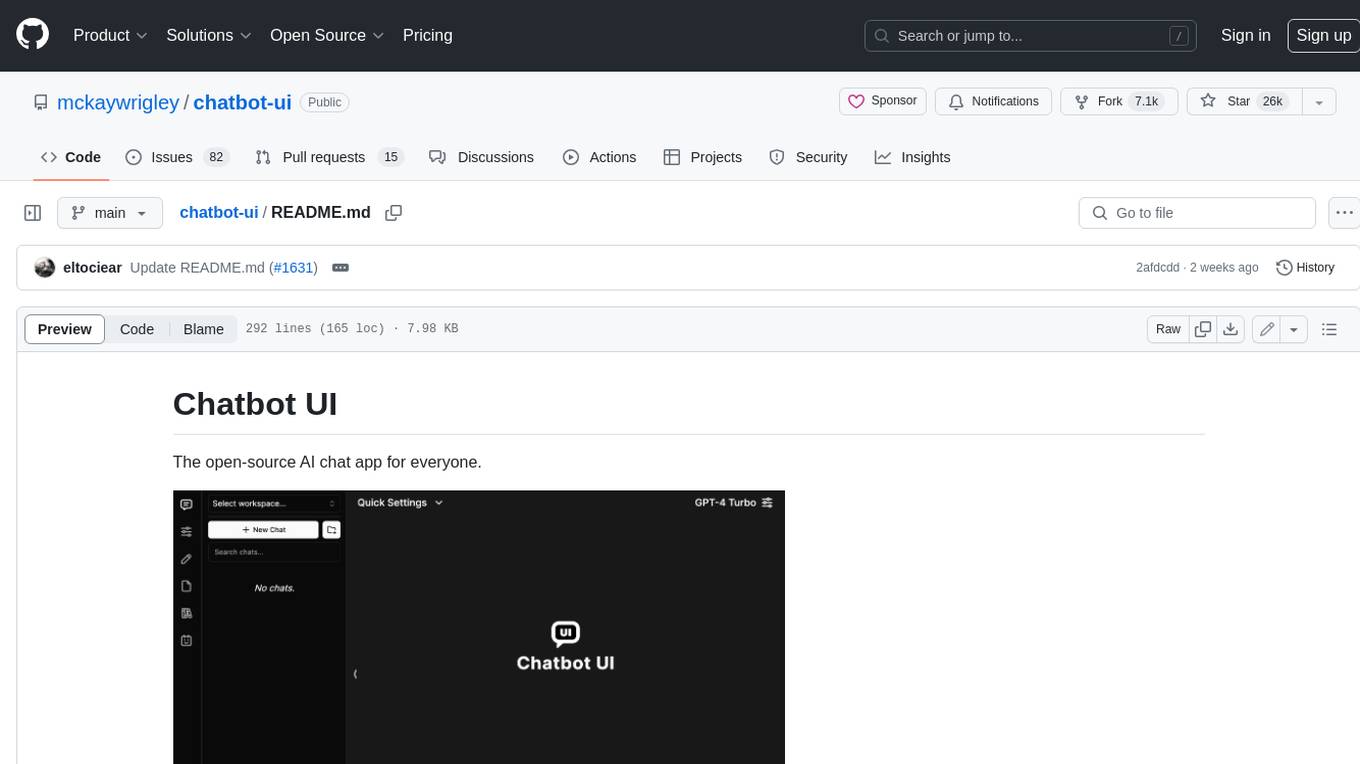
chatbot-ui
Chatbot UI is an open-source AI chat app that allows users to create and deploy their own AI chatbots. It is easy to use and can be customized to fit any need. Chatbot UI is perfect for businesses, developers, and anyone who wants to create a chatbot.
BricksLLM
BricksLLM is a cloud native AI gateway written in Go. Currently, it provides native support for OpenAI, Anthropic, Azure OpenAI and vLLM. BricksLLM aims to provide enterprise level infrastructure that can power any LLM production use cases. Here are some use cases for BricksLLM: * Set LLM usage limits for users on different pricing tiers * Track LLM usage on a per user and per organization basis * Block or redact requests containing PIIs * Improve LLM reliability with failovers, retries and caching * Distribute API keys with rate limits and cost limits for internal development/production use cases * Distribute API keys with rate limits and cost limits for students
uAgents
uAgents is a Python library developed by Fetch.ai that allows for the creation of autonomous AI agents. These agents can perform various tasks on a schedule or take action on various events. uAgents are easy to create and manage, and they are connected to a fast-growing network of other uAgents. They are also secure, with cryptographically secured messages and wallets.
griptape
Griptape is a modular Python framework for building AI-powered applications that securely connect to your enterprise data and APIs. It offers developers the ability to maintain control and flexibility at every step. Griptape's core components include Structures (Agents, Pipelines, and Workflows), Tasks, Tools, Memory (Conversation Memory, Task Memory, and Meta Memory), Drivers (Prompt and Embedding Drivers, Vector Store Drivers, Image Generation Drivers, Image Query Drivers, SQL Drivers, Web Scraper Drivers, and Conversation Memory Drivers), Engines (Query Engines, Extraction Engines, Summary Engines, Image Generation Engines, and Image Query Engines), and additional components (Rulesets, Loaders, Artifacts, Chunkers, and Tokenizers). Griptape enables developers to create AI-powered applications with ease and efficiency.