


navigator
Finish What You Start — Context engineering for Claude Code. Sessions last 20+ exchanges instead of crashing at 7.
Stars: 153
Navigator is a versatile tool for navigating through complex codebases efficiently. It provides a user-friendly interface to explore code files, search for specific functions or variables, and visualize code dependencies. With Navigator, developers can easily understand the structure of a project and quickly locate relevant code snippets. The tool supports various programming languages and offers customizable settings to enhance the coding experience. Whether you are working on a small project or a large codebase, Navigator can help you streamline your development process and improve code comprehension.
README:
Finish What You Start
Sessions that last. AI that learns. Features that ship.


Navigator is a Claude Code plugin that implements context engineering for AI-assisted development.
Instead of loading all your documentation upfront (and crashing at exchange 7), Navigator loads what you need, when you need it—keeping 94% of your context window available for actual work.
For developers using Claude Code who want sessions that finish features instead of crash mid-way.
You know the pattern:
Exchange 5:  Claude forgets your recent changes
Exchange 7:  Hallucinations start ("that function doesn't exist")
Exchange 8:  "Context limit reached"

Restart. Reload. Re-explain everything. Repeat.
You loaded 150k tokens of documentation "just in case."
You used 8k.
The rest? Noise drowning out signal.
Navigator implements context engineering—load what you need, when you need it.
| Metric | Without Navigator | With Navigator |
|---|---|---|
| Tokens loaded | 150,000 | 12,000 |
| Session length | 5-7 exchanges | 20+ exchanges |
| Context at end | 95% (crashed) | 35% (comfortable) |
| Token savings | — | 92% |
Result: Sessions that actually finish what they start.
Navigator v5.0 adds Theory of Mind—Claude learns you.
nav-profile: Remembers your preferences across sessions
"Remember I prefer concise explanations"
→ Applied in future sessions
→ Auto-learns from corrections
nav-diagnose: Catches collaboration drift
Same correction twice → Quality check triggered
"You're not getting this" → Re-anchoring prompt
Loop Mode (v5.1): Run until done
"Run until done: add user authentication"
→ Structured completion with progress tracking
→ Dual-condition exit (heuristics + explicit signal)
→ Stagnation detection prevents infinite loops
Knowledge Graph (v6.0): Project memory that persists
"What do we know about auth?"
→ Unified search across tasks, SOPs, system docs
→ Experiential memory: patterns, pitfalls, decisions
→ Auto-surfaces relevant context on session start
Navigator is a superset. Everything you'd expect, plus context engineering.
| Feature | Navigator | Others |
|---|---|---|
| Structured workflows | ✅ 27 skills | ✅ |
| Component generation | ✅ | ✅ |
| Test generation | ✅ | ✅ |
| Session longevity | 20+ exchanges | 5-7 exchanges |
| Token savings | 92% verified | None |
| Code simplification | ✅ | ❌ |
| Task Mode | ✅ | ❌ |
| Theory of Mind | ✅ | ❌ |
| Knowledge Graph | ✅ | ❌ |
| Loop mode | ✅ | ❌ |
| OpenTelemetry metrics | ✅ | ❌ |
| Figma MCP integration | ✅ | ❌ |
Same foundation. Superior context management.
Not estimates. Verified via OpenTelemetry.
╔══════════════════════════════════════════════════════╗
║          NAVIGATOR EFFICIENCY REPORT                 ║
╚══════════════════════════════════════════════════════╝

📊 TOKEN USAGE
━━━━━━━━━━━━━━━━━━━━━━━━━━━━━━━━━━━━━━━━━━━━━━━━━━━━
Your project documentation:     150,000 tokens
Loaded this session:             12,000 tokens
Tokens saved:                   138,000 tokens (92% ↓)

📈 SESSION METRICS
━━━━━━━━━━━━━━━━━━━━━━━━━━━━━━━━━━━━━━━━━━━━━━━━━━━━
Context usage:                        35% (excellent)
Efficiency score:                  94/100 (excellent)
Check yours: Run /nav:stats after installing.
# Claude Code plugin marketplace
/plugin marketplace add alekspetrov/navigator
/plugin install navigator

# Restart Claude Code"Initialize Navigator in this project""Start my Navigator session"That's it. Navigator handles the rest.
19 skills that auto-invoke on natural language:
"Start my Navigator session"              → Session with 92% savings
"Create a React component for profile"    → Component + tests + styles
"Add an API endpoint for posts"           → Endpoint + validation + tests
"Create context marker: checkpoint"       → 97% context compression
"Run until done: add dark mode"           → Loop mode completion
No commands to memorize. Skills detect intent and execute.
Your sessions crash because context management is broken by default.
Navigator fixes this with context engineering—the same principles Anthropic recommends.
92% token savings. 20+ exchange sessions. Verified metrics.
/plugin marketplace add alekspetrov/navigator
/plugin install navigator
Finish what you start.
Skill loads but prints docs instead of executing
/plugin update navigatorThen retry. Outdated plugin version.
MIT License - See LICENSE
For Tasks:
Click tags to check more tools for each tasksFor Jobs:
Alternative AI tools for navigator
Similar Open Source Tools
navigator
Navigator is a versatile tool for navigating through complex codebases efficiently. It provides a user-friendly interface to explore code files, search for specific functions or variables, and visualize code dependencies. With Navigator, developers can easily understand the structure of a project and quickly locate relevant code snippets. The tool supports various programming languages and offers customizable settings to enhance the coding experience. Whether you are working on a small project or a large codebase, Navigator can help you streamline your development process and improve code comprehension.
nanocoder
Nanocoder is a versatile code editor designed for beginners and experienced programmers alike. It provides a user-friendly interface with features such as syntax highlighting, code completion, and error checking. With Nanocoder, you can easily write and debug code in various programming languages, making it an ideal tool for learning, practicing, and developing software projects. Whether you are a student, hobbyist, or professional developer, Nanocoder offers a seamless coding experience to boost your productivity and creativity.
VectorCode
VectorCode is a code repository indexing tool that helps users write better prompts for coding LLMs by providing information about the code repository being worked on. It includes a neovim plugin and supports multiple embedding engines. The tool enhances completion results by providing project context and improves understanding of close-source or cutting edge projects.
langtest
Langtest is a tool designed for testing and analyzing programming languages. It provides a platform for users to write code snippets in various languages and run them to see the output. The tool supports multiple programming languages and offers features like syntax highlighting, code execution, and result comparison. Users can use Langtest to quickly test code snippets, compare language syntax, and evaluate language performance. It is a useful tool for students, developers, and language enthusiasts to experiment with different programming languages in a convenient and efficient manner.
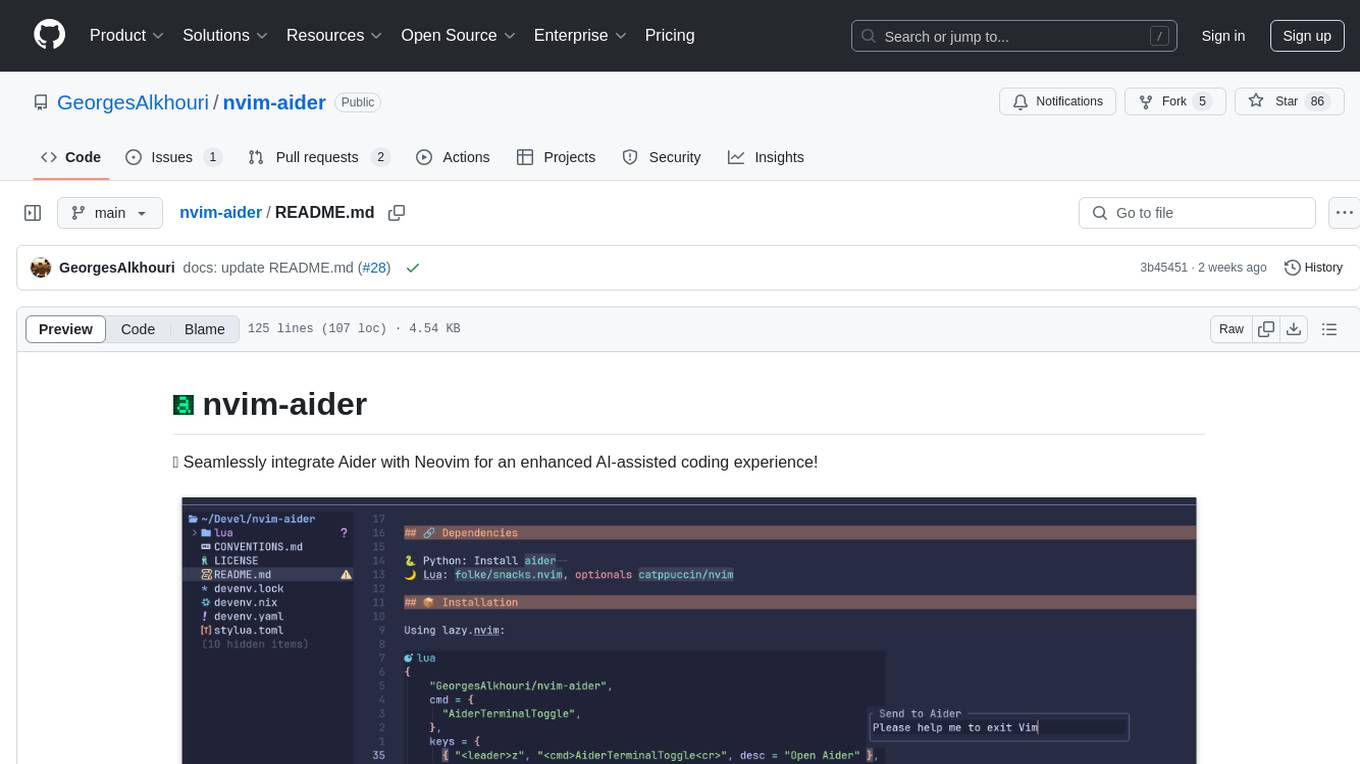
nvim-aider
Nvim-aider is a plugin for Neovim that provides additional functionality and key mappings to enhance the user's editing experience. It offers features such as code navigation, quick access to commonly used commands, and improved text manipulation tools. With Nvim-aider, users can streamline their workflow and increase productivity while working with Neovim.
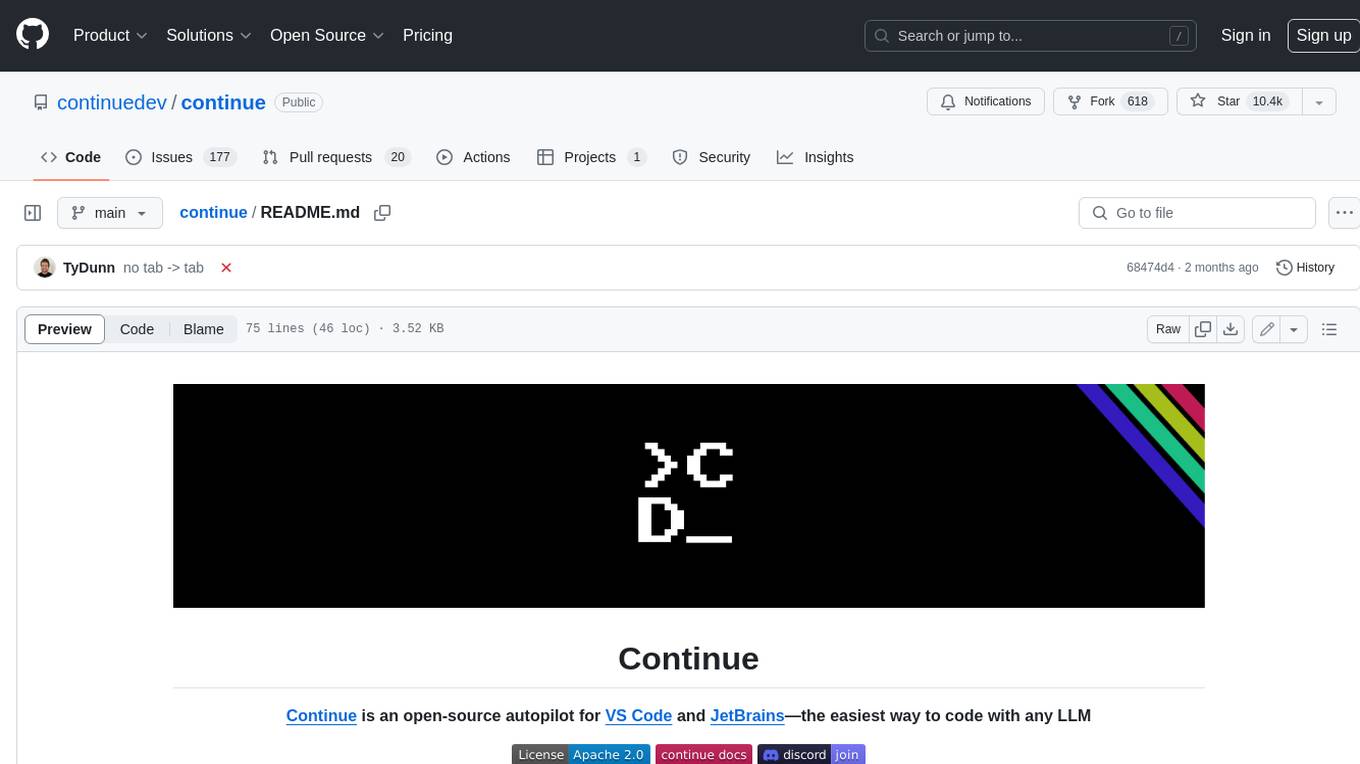
continue
Continue is an open-source autopilot for VS Code and JetBrains that allows you to code with any LLM. With Continue, you can ask coding questions, edit code in natural language, generate files from scratch, and more. Continue is easy to use and can help you save time and improve your coding skills.
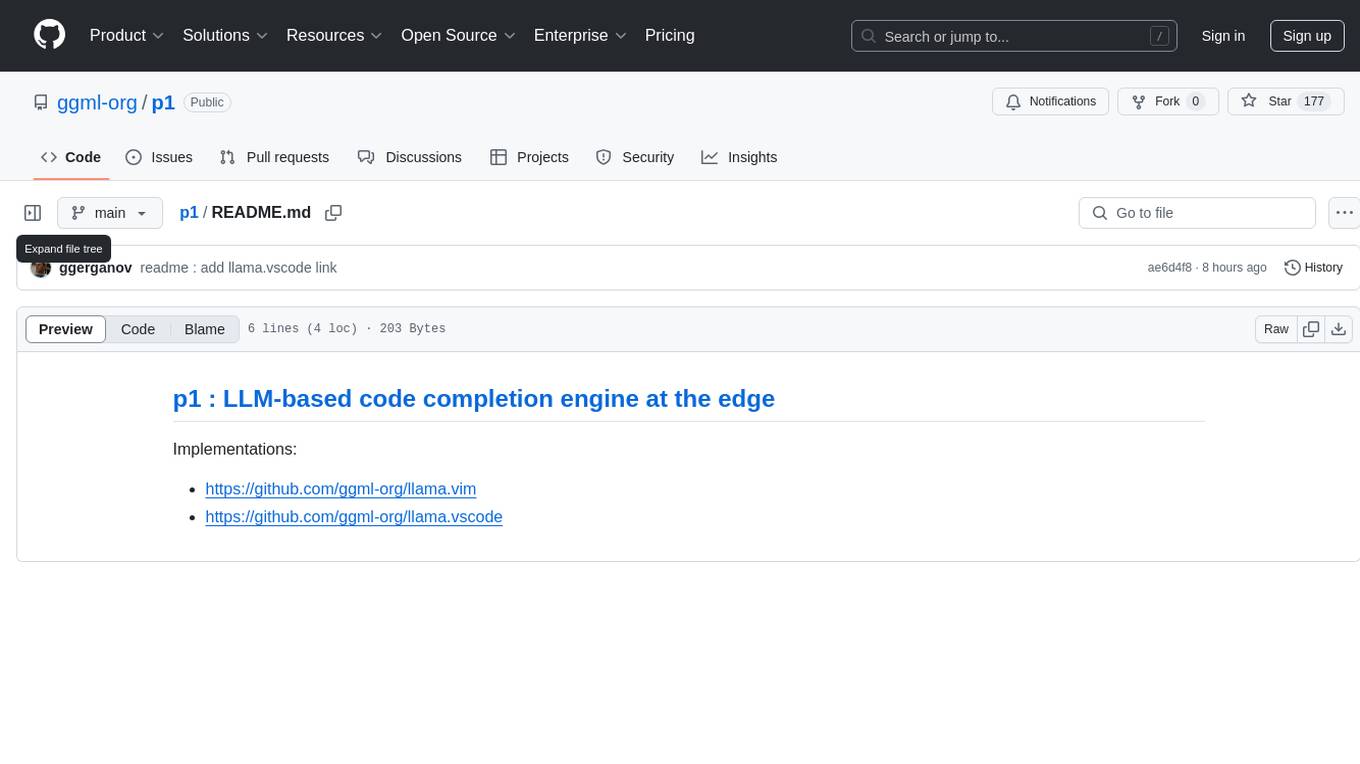
p1
p1 is a code completion engine based on Large Language Models (LLM) that operates at the edge. It provides intelligent code suggestions and completions to enhance the coding experience. The tool is designed to assist developers in writing code more efficiently by predicting and offering context-aware completions based on the code being written. With implementations available for popular code editors like Vim and Visual Studio Code, p1 aims to improve productivity and streamline the coding process for software developers.
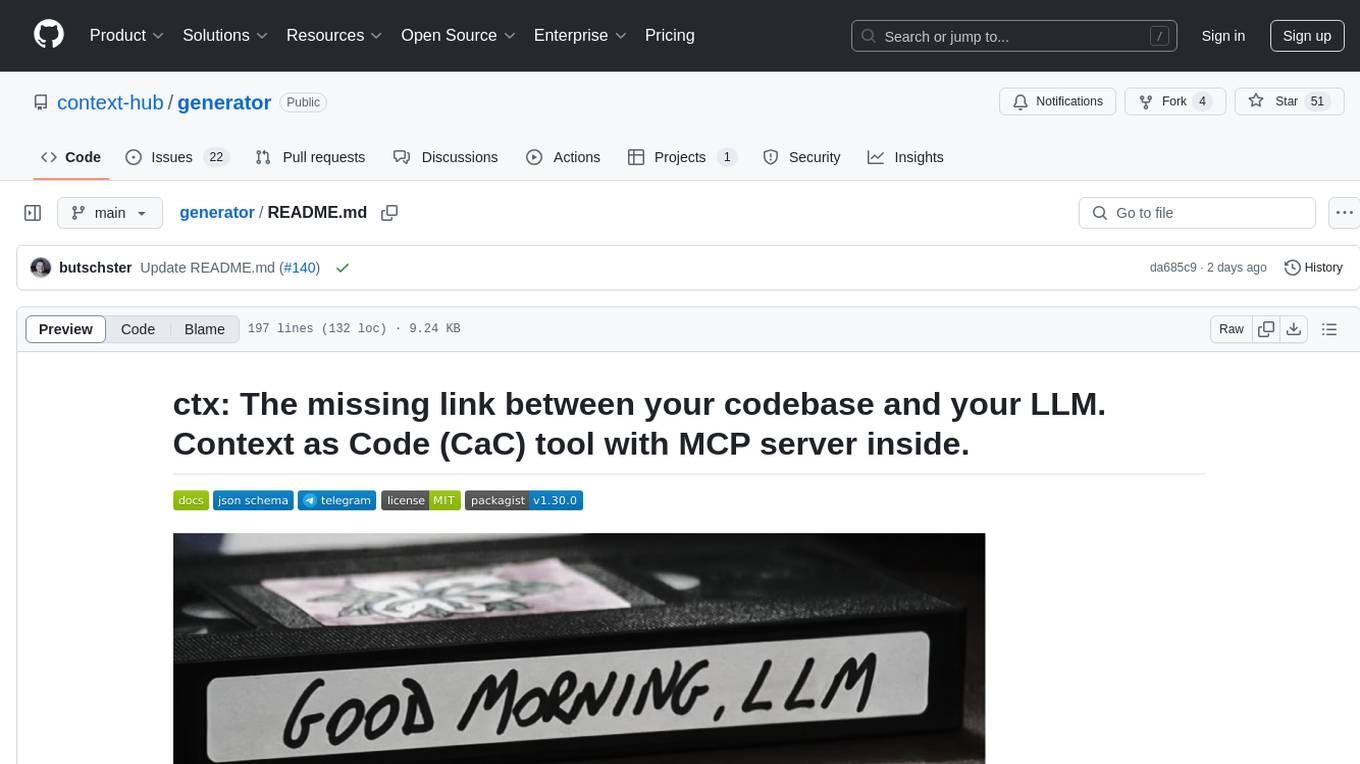
generator
ctx is a tool designed to automatically generate organized context files from code files, GitHub repositories, Git commits, web pages, and plain text. It aims to efficiently provide necessary context to AI language models like ChatGPT and Claude, enabling users to streamline code refactoring, multiple iteration development, documentation generation, and seamless AI integration. With ctx, users can create structured markdown documents, save context files, and serve context through an MCP server for real-time assistance. The tool simplifies the process of sharing project information with AI assistants, making AI conversations smarter and easier.
coderunner
Coderunner is a versatile tool designed for running code snippets in various programming languages. It provides an interactive environment for testing and debugging code without the need for a full-fledged IDE. With support for multiple languages and quick execution times, Coderunner is ideal for beginners learning to code, experienced developers prototyping algorithms, educators creating coding exercises, interview candidates practicing coding challenges, and professionals testing small code snippets.
promptl
Promptl is a versatile command-line tool designed to streamline the process of creating and managing prompts for user input in various programming projects. It offers a simple and efficient way to prompt users for information, validate their input, and handle different scenarios based on their responses. With Promptl, developers can easily integrate interactive prompts into their scripts, applications, and automation workflows, enhancing user experience and improving overall usability. The tool provides a range of customization options and features, making it suitable for a wide range of use cases across different programming languages and environments.
Awesome-Repo-Level-Code-Generation
This repository contains a collection of tools and scripts for generating code at the repository level. It provides a set of utilities to automate the process of creating and managing code across multiple files and directories. The tools included in this repository aim to improve code generation efficiency and maintainability by streamlining the development workflow. With a focus on enhancing productivity and reducing manual effort, this collection offers a variety of code generation options and customization features to suit different project requirements.
contextgem
Contextgem is a Ruby gem that provides a simple way to manage context-specific configurations in your Ruby applications. It allows you to define different configurations based on the context in which your application is running, such as development, testing, or production. This helps you keep your configuration settings organized and easily accessible, making it easier to maintain and update your application. With Contextgem, you can easily switch between different configurations without having to modify your code, making it a valuable tool for managing complex applications with multiple environments.
verl-tool
The verl-tool is a versatile command-line utility designed to streamline various tasks related to version control and code management. It provides a simple yet powerful interface for managing branches, merging changes, resolving conflicts, and more. With verl-tool, users can easily track changes, collaborate with team members, and ensure code quality throughout the development process. Whether you are a beginner or an experienced developer, verl-tool offers a seamless experience for version control operations.
tunacode
TunaCode CLI is an AI-powered coding assistant that provides a command-line interface for developers to enhance their coding experience. It offers features like model selection, parallel execution for faster file operations, and various commands for code management. The tool aims to improve coding efficiency and provide a seamless coding environment for developers.
pullfrog
Pullfrog is a versatile tool for managing and automating GitHub pull requests. It provides a simple and intuitive interface for developers to streamline their workflow and collaborate more efficiently. With Pullfrog, users can easily create, review, merge, and manage pull requests, all within a single platform. The tool offers features such as automated testing, code review, and notifications to help teams stay organized and productive. Whether you are a solo developer or part of a large team, Pullfrog can help you simplify the pull request process and improve code quality.
evalica
Evalica is a powerful tool for evaluating code quality and performance in software projects. It provides detailed insights and metrics to help developers identify areas for improvement and optimize their code. With support for multiple programming languages and frameworks, Evalica offers a comprehensive solution for code analysis and optimization. Whether you are a beginner looking to learn best practices or an experienced developer aiming to enhance your code quality, Evalica is the perfect tool for you.
For similar tasks
foundry-samples
The 'foundry-samples' repository serves as the main directory for official Azure AI Foundry documentation sample code and examples. It contains notebooks and code snippets for various developer tasks, offering both end-to-end examples and smaller snippets. The repository is open source, encouraging contributions and providing guidance on how to contribute.
coding-with-ai
Coding-with-ai is a curated collection of techniques and best practices for utilizing AI coding tools to achieve transformative results in coding projects. It bridges the gap between AI coding demos and daily coding reality by providing insights into specific patterns like memory files, test-driven regeneration, and parallel AI sessions. The repository offers guidance on setting up memory files, writing detailed specs, drafting solutions before using assistants, getting multiple options, choosing stable libraries, and triggering careful planning. It also covers UI prototyping, coding practices, debugging strategies, testing methodologies, and cross-stage techniques for efficient coding with AI tools.
octocode-mcp
Octocode is a methodology and platform that empowers AI assistants with the skills of a Senior Staff Engineer. It transforms how AI interacts with code by moving from 'guessing' based on training data to 'knowing' based on deep, evidence-based research. The ecosystem includes the Manifest for Research Driven Development, the MCP Server for code interaction, Agent Skills for extending AI capabilities, a CLI for managing agent capabilities, and comprehensive documentation covering installation, core concepts, tutorials, and reference materials.
navigator
Navigator is a versatile tool for navigating through complex codebases efficiently. It provides a user-friendly interface to explore code files, search for specific functions or variables, and visualize code dependencies. With Navigator, developers can easily understand the structure of a project and quickly locate relevant code snippets. The tool supports various programming languages and offers customizable settings to enhance the coding experience. Whether you are working on a small project or a large codebase, Navigator can help you streamline your development process and improve code comprehension.

only_train_once
Only Train Once (OTO) is an automatic, architecture-agnostic DNN training and compression framework that allows users to train a general DNN from scratch or a pretrained checkpoint to achieve high performance and slimmer architecture simultaneously in a one-shot manner without fine-tuning. The framework includes features for automatic structured pruning and erasing operators, as well as hybrid structured sparse optimizers for efficient model compression. OTO provides tools for pruning zero-invariant group partitioning, constructing pruned models, and visualizing pruning and erasing dependency graphs. It supports the HESSO optimizer and offers a sanity check for compliance testing on various DNNs. The repository also includes publications, installation instructions, quick start guides, and a roadmap for future enhancements and collaborations.
momentum-core
Momentum is an open-source behavioral auditor for backend code that helps developers generate powerful insights into their codebase. It analyzes code behavior, tests it at every git push, and ensures readiness for production. Momentum understands backend code, visualizes dependencies, identifies behaviors, generates test code, runs code in the local environment, and provides debugging solutions. It aims to improve code quality, streamline testing processes, and enhance developer productivity.
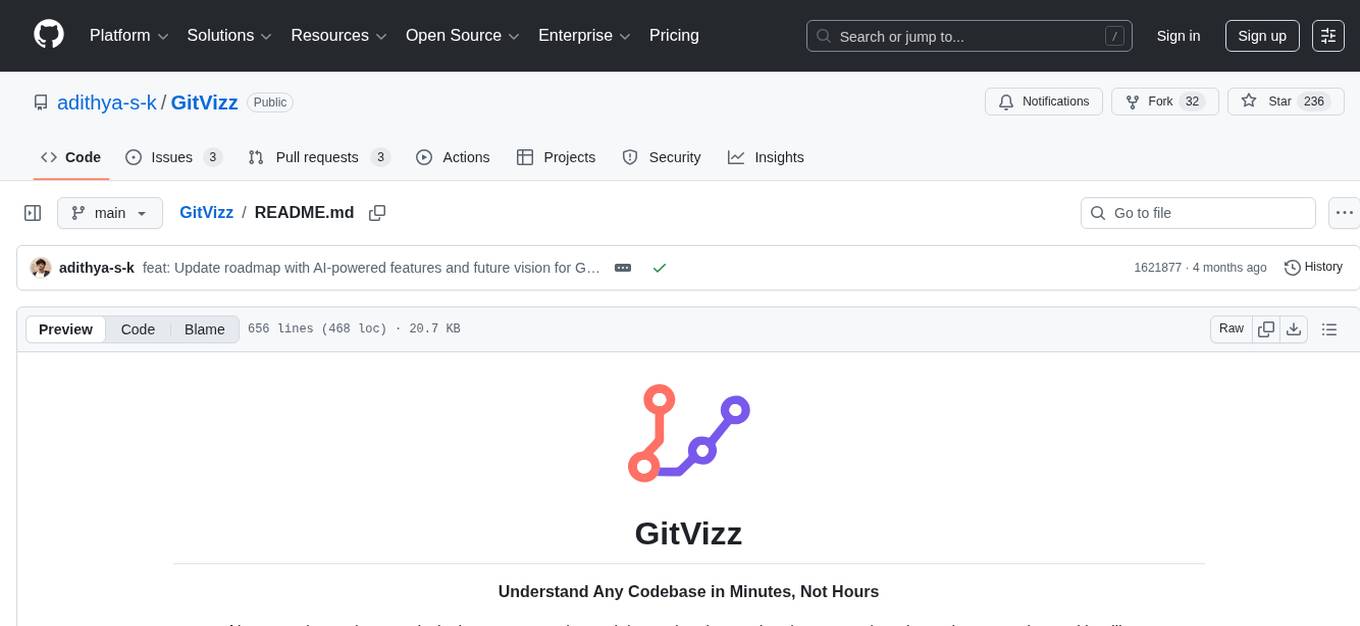
GitVizz
GitVizz is an AI-powered repository analysis tool that helps developers understand and navigate codebases quickly. It transforms complex code structures into interactive documentation, dependency graphs, and intelligent conversations. With features like interactive dependency graphs, AI-powered code conversations, advanced code visualization, and automatic documentation generation, GitVizz offers instant understanding and insights for any repository. The tool is built with modern technologies like Next.js, FastAPI, and OpenAI, making it scalable and efficient for analyzing large codebases. GitVizz also provides a standalone Python library for core code analysis and dependency graph generation, offering multi-language parsing, AST analysis, dependency graphs, visualizations, and extensibility for custom applications.
For similar jobs
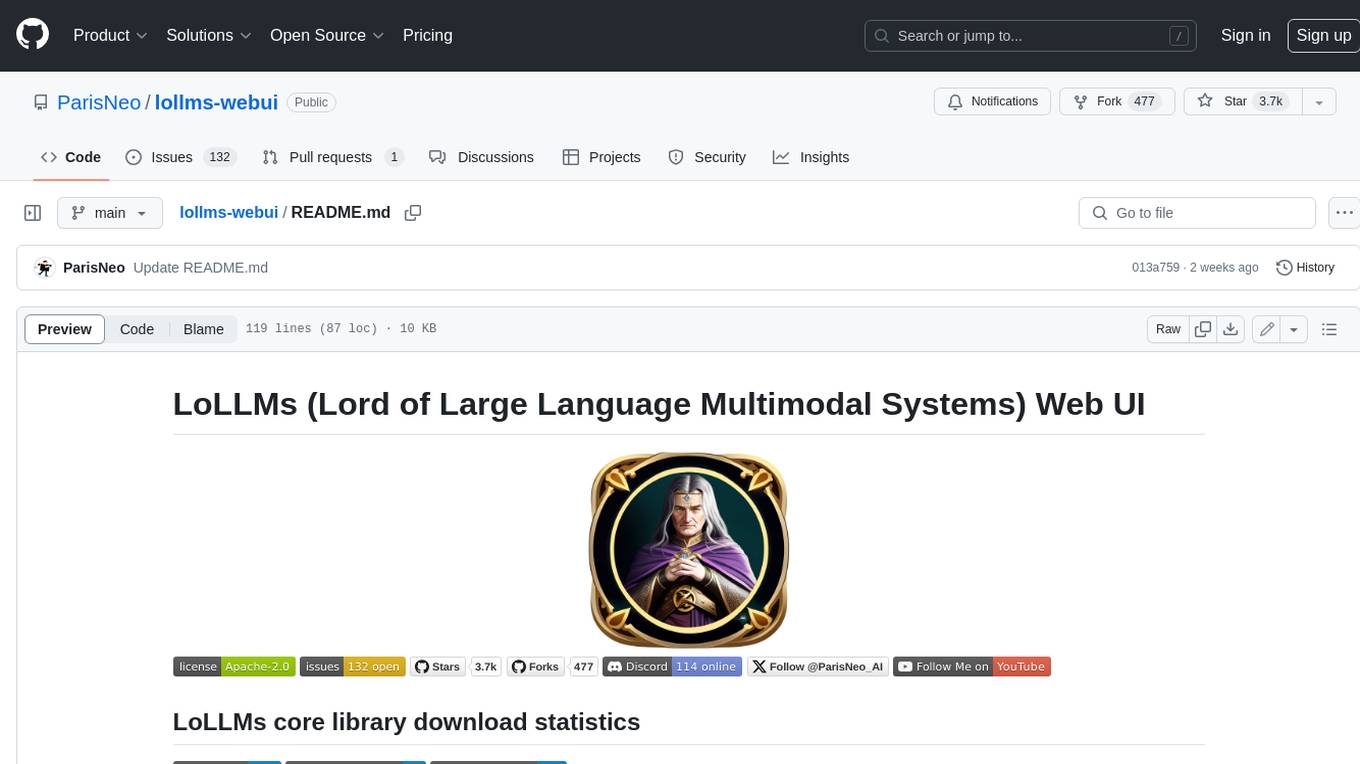
lollms-webui
LoLLMs WebUI (Lord of Large Language Multimodal Systems: One tool to rule them all) is a user-friendly interface to access and utilize various LLM (Large Language Models) and other AI models for a wide range of tasks. With over 500 AI expert conditionings across diverse domains and more than 2500 fine tuned models over multiple domains, LoLLMs WebUI provides an immediate resource for any problem, from car repair to coding assistance, legal matters, medical diagnosis, entertainment, and more. The easy-to-use UI with light and dark mode options, integration with GitHub repository, support for different personalities, and features like thumb up/down rating, copy, edit, and remove messages, local database storage, search, export, and delete multiple discussions, make LoLLMs WebUI a powerful and versatile tool.
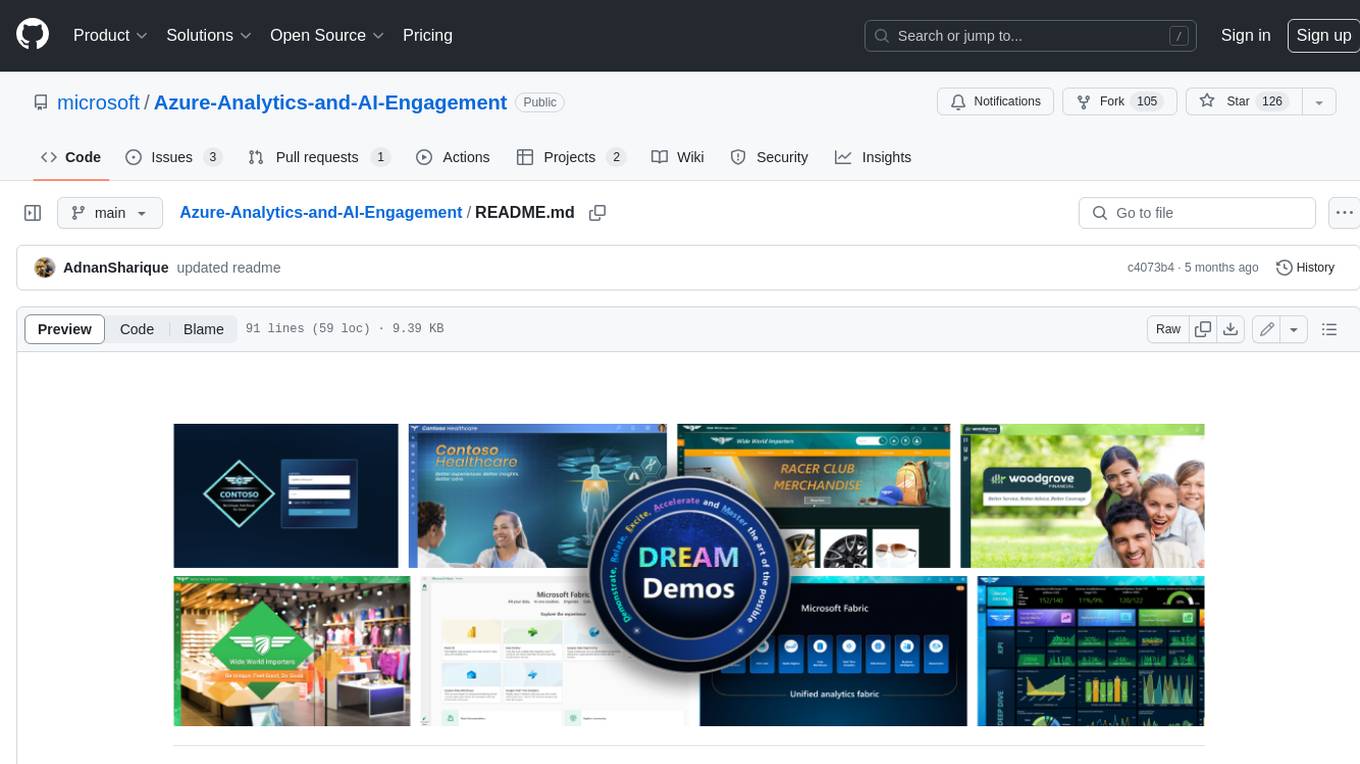
Azure-Analytics-and-AI-Engagement
The Azure-Analytics-and-AI-Engagement repository provides packaged Industry Scenario DREAM Demos with ARM templates (Containing a demo web application, Power BI reports, Synapse resources, AML Notebooks etc.) that can be deployed in a customer’s subscription using the CAPE tool within a matter of few hours. Partners can also deploy DREAM Demos in their own subscriptions using DPoC.
minio
MinIO is a High Performance Object Storage released under GNU Affero General Public License v3.0. It is API compatible with Amazon S3 cloud storage service. Use MinIO to build high performance infrastructure for machine learning, analytics and application data workloads.
mage-ai
Mage is an open-source data pipeline tool for transforming and integrating data. It offers an easy developer experience, engineering best practices built-in, and data as a first-class citizen. Mage makes it easy to build, preview, and launch data pipelines, and provides observability and scaling capabilities. It supports data integrations, streaming pipelines, and dbt integration.
AiTreasureBox
AiTreasureBox is a versatile AI tool that provides a collection of pre-trained models and algorithms for various machine learning tasks. It simplifies the process of implementing AI solutions by offering ready-to-use components that can be easily integrated into projects. With AiTreasureBox, users can quickly prototype and deploy AI applications without the need for extensive knowledge in machine learning or deep learning. The tool covers a wide range of tasks such as image classification, text generation, sentiment analysis, object detection, and more. It is designed to be user-friendly and accessible to both beginners and experienced developers, making AI development more efficient and accessible to a wider audience.
tidb
TiDB is an open-source distributed SQL database that supports Hybrid Transactional and Analytical Processing (HTAP) workloads. It is MySQL compatible and features horizontal scalability, strong consistency, and high availability.
airbyte
Airbyte is an open-source data integration platform that makes it easy to move data from any source to any destination. With Airbyte, you can build and manage data pipelines without writing any code. Airbyte provides a library of pre-built connectors that make it easy to connect to popular data sources and destinations. You can also create your own connectors using Airbyte's no-code Connector Builder or low-code CDK. Airbyte is used by data engineers and analysts at companies of all sizes to build and manage their data pipelines.
labelbox-python
Labelbox is a data-centric AI platform for enterprises to develop, optimize, and use AI to solve problems and power new products and services. Enterprises use Labelbox to curate data, generate high-quality human feedback data for computer vision and LLMs, evaluate model performance, and automate tasks by combining AI and human-centric workflows. The academic & research community uses Labelbox for cutting-edge AI research.