


evalica
Evalica, your favourite evaluation toolkit
Stars: 57
Evalica is a powerful tool for evaluating code quality and performance in software projects. It provides detailed insights and metrics to help developers identify areas for improvement and optimize their code. With support for multiple programming languages and frameworks, Evalica offers a comprehensive solution for code analysis and optimization. Whether you are a beginner looking to learn best practices or an experienced developer aiming to enhance your code quality, Evalica is the perfect tool for you.
README:






Evalica [ɛˈʋalit͡sa] (eh-vah-lee-tsah) is a Python library that transforms pairwise comparisons into ranked lists of items. It offers convenient high-performant Rust implementations of the corresponding methods via PyO3, and additionally provides naïve Python code for most of them. Evalica is fully compatible with NumPy arrays and pandas data frames.


The logo was created using Recraft.
Imagine that we would like to rank the different meals and have the following dataset of three comparisons produced by food experts.
| Item X | Item Y | Winner |
|---|---|---|
pizza |
burger |
x |
burger |
sushi |
y |
pizza |
sushi |
tie |
Given this hypothetical example, Evalica takes these three columns and computes the outcome of the given pairwise comparison according to the chosen model. Note that the first argument is the column Item X, the second argument is the column Item Y, and the third argument corresponds to the column Winner.
>>> from evalica import elo, Winner
>>> result = elo(
...     ['pizza', 'burger', 'pizza'],
...     ['burger', 'sushi', 'sushi'],
...     [Winner.X, Winner.Y, Winner.Draw],
... )
>>> result.scores
pizza     1014.972058
burger     970.647200
sushi     1014.380742
Name: elo, dtype: float64
As a result, we obtain Elo scores of our items. In this example, pizza was the most favoured item, sushi was the runner-up, and burger was the least preferred item.
| Item | Score |
|---|---|
pizza |
1014.97 |
burger |
970.65 |
sushi |
1014.38 |
Evalica also provides a simple command-line interface, allowing the use of these methods in shell scripts and for prototyping.
$ evalica -i food.csv bradley-terry
item,score,rank
Tacos,2.509025136024378,1
Sushi,1.1011561298265815,2
Burger,0.8549063627182466,3
Pasta,0.7403814336665869,4
Pizza,0.5718366915548537,5
Refer to the food.csv file as an input example.
Evalica has a built-in Gradio application that can be launched as python3 -m evalica.gradio. Please ensure that the library was installed as pip install evalica[gradio].
| Method | In Python | In Rust |
|---|---|---|
| Counting | ✅ | ✅ |
| Average Win Rate | ✅ | ✅ |
| Bradley–Terry | ✅ | ✅ |
| Elo | ✅ | ✅ |
| Eigenvalue | ✅ | ✅ |
| PageRank | ✅ | ✅ |
| Newman | ✅ | ✅ |
Evalica is a mixed Rust/Python project that uses PyO3, so it requires setting up the Maturin build system.
To set up the environment, we recommend using the uv package manager, as demonstrated in our test suite:
$ uv venv
$ uv pip install maturin
$ maturin develop --uv --extras dev,docs,gradio
In case uv is not available, you can use the following workaround:
$ python3 -m venv venv
$ source venv/bin/activate
$ pip install maturin
$ maturin develop --extras dev,docs,gradio
We welcome pull requests on GitHub: https://github.com/dustalov/evalica. To contribute, fork the repository, create a separate branch for your changes, and submit a pull request.
- Ustalov, D. Reliable, Reproducible, and Really Fast Leaderboards with Evalica. 2025. Proceedings of the 31st International Conference on Computational Linguistics: System Demonstrations. 46–53. arXiv: 2412.11314 [cs.CL].
@inproceedings{Ustalov:25,
  author    = {Ustalov, Dmitry},
  title     = {{Reliable, Reproducible, and Really Fast Leaderboards with Evalica}},
  year      = {2025},
  booktitle = {Proceedings of the 31st International Conference on Computational Linguistics: System Demonstrations},
  pages     = {46--53},
  address   = {Abu Dhabi, UAE},
  publisher = {Association for Computational Linguistics},
  eprint    = {2412.11314},
  eprinttype = {arxiv},
  eprintclass = {cs.CL},
  url       = {https://aclanthology.org/2025.coling-demos.6},
  language  = {english},
}
The code for replicating the experiments is available in the coling2025 directory.
Copyright (c) 2024–2025 Dmitry Ustalov. See LICENSE for details.
For Tasks:
Click tags to check more tools for each tasksFor Jobs:
Alternative AI tools for evalica
Similar Open Source Tools
evalica
Evalica is a powerful tool for evaluating code quality and performance in software projects. It provides detailed insights and metrics to help developers identify areas for improvement and optimize their code. With support for multiple programming languages and frameworks, Evalica offers a comprehensive solution for code analysis and optimization. Whether you are a beginner looking to learn best practices or an experienced developer aiming to enhance your code quality, Evalica is the perfect tool for you.
navigator
Navigator is a versatile tool for navigating through complex codebases efficiently. It provides a user-friendly interface to explore code files, search for specific functions or variables, and visualize code dependencies. With Navigator, developers can easily understand the structure of a project and quickly locate relevant code snippets. The tool supports various programming languages and offers customizable settings to enhance the coding experience. Whether you are working on a small project or a large codebase, Navigator can help you streamline your development process and improve code comprehension.
Companion
Companion is a software tool designed to provide support and enhance development. It offers various features and functionalities to assist users in their projects and tasks. The tool aims to be user-friendly and efficient, helping individuals and teams to streamline their workflow and improve productivity.
verl-tool
The verl-tool is a versatile command-line utility designed to streamline various tasks related to version control and code management. It provides a simple yet powerful interface for managing branches, merging changes, resolving conflicts, and more. With verl-tool, users can easily track changes, collaborate with team members, and ensure code quality throughout the development process. Whether you are a beginner or an experienced developer, verl-tool offers a seamless experience for version control operations.
trubrics-sdk
Trubrics-sdk is a software development kit designed to facilitate the integration of analytics features into applications. It provides a set of tools and functionalities that enable developers to easily incorporate analytics capabilities, such as data collection, analysis, and reporting, into their software products. The SDK streamlines the process of implementing analytics solutions, allowing developers to focus on building and enhancing their applications' functionality and user experience. By leveraging trubrics-sdk, developers can quickly and efficiently integrate robust analytics features, gaining valuable insights into user behavior and application performance.
lemonai
LemonAI is a versatile machine learning library designed to simplify the process of building and deploying AI models. It provides a wide range of tools and algorithms for data preprocessing, model training, and evaluation. With LemonAI, users can easily experiment with different machine learning techniques and optimize their models for various tasks. The library is well-documented and beginner-friendly, making it suitable for both novice and experienced data scientists. LemonAI aims to streamline the development of AI applications and empower users to create innovative solutions using state-of-the-art machine learning methods.
deepeval
DeepEval is a simple-to-use, open-source LLM evaluation framework specialized for unit testing LLM outputs. It incorporates various metrics such as G-Eval, hallucination, answer relevancy, RAGAS, etc., and runs locally on your machine for evaluation. It provides a wide range of ready-to-use evaluation metrics, allows for creating custom metrics, integrates with any CI/CD environment, and enables benchmarking LLMs on popular benchmarks. DeepEval is designed for evaluating RAG and fine-tuning applications, helping users optimize hyperparameters, prevent prompt drifting, and transition from OpenAI to hosting their own Llama2 with confidence.
pdr_ai_v2
pdr_ai_v2 is a Python library for implementing machine learning algorithms and models. It provides a wide range of tools and functionalities for data preprocessing, model training, evaluation, and deployment. The library is designed to be user-friendly and efficient, making it suitable for both beginners and experienced data scientists. With pdr_ai_v2, users can easily build and deploy machine learning models for various applications, such as classification, regression, clustering, and more.
Disciplined-AI-Software-Development
Disciplined AI Software Development is a comprehensive repository that provides guidelines and best practices for developing AI software in a disciplined manner. It covers topics such as project organization, code structure, documentation, testing, and deployment strategies to ensure the reliability, scalability, and maintainability of AI applications. The repository aims to help developers and teams navigate the complexities of AI development by offering practical advice and examples to follow.
p1
p1 is a code completion engine based on Large Language Models (LLM) that operates at the edge. It provides intelligent code suggestions and completions to enhance the coding experience. The tool is designed to assist developers in writing code more efficiently by predicting and offering context-aware completions based on the code being written. With implementations available for popular code editors like Vim and Visual Studio Code, p1 aims to improve productivity and streamline the coding process for software developers.
langtest
Langtest is a tool designed for testing and analyzing programming languages. It provides a platform for users to write code snippets in various languages and run them to see the output. The tool supports multiple programming languages and offers features like syntax highlighting, code execution, and result comparison. Users can use Langtest to quickly test code snippets, compare language syntax, and evaluate language performance. It is a useful tool for students, developers, and language enthusiasts to experiment with different programming languages in a convenient and efficient manner.
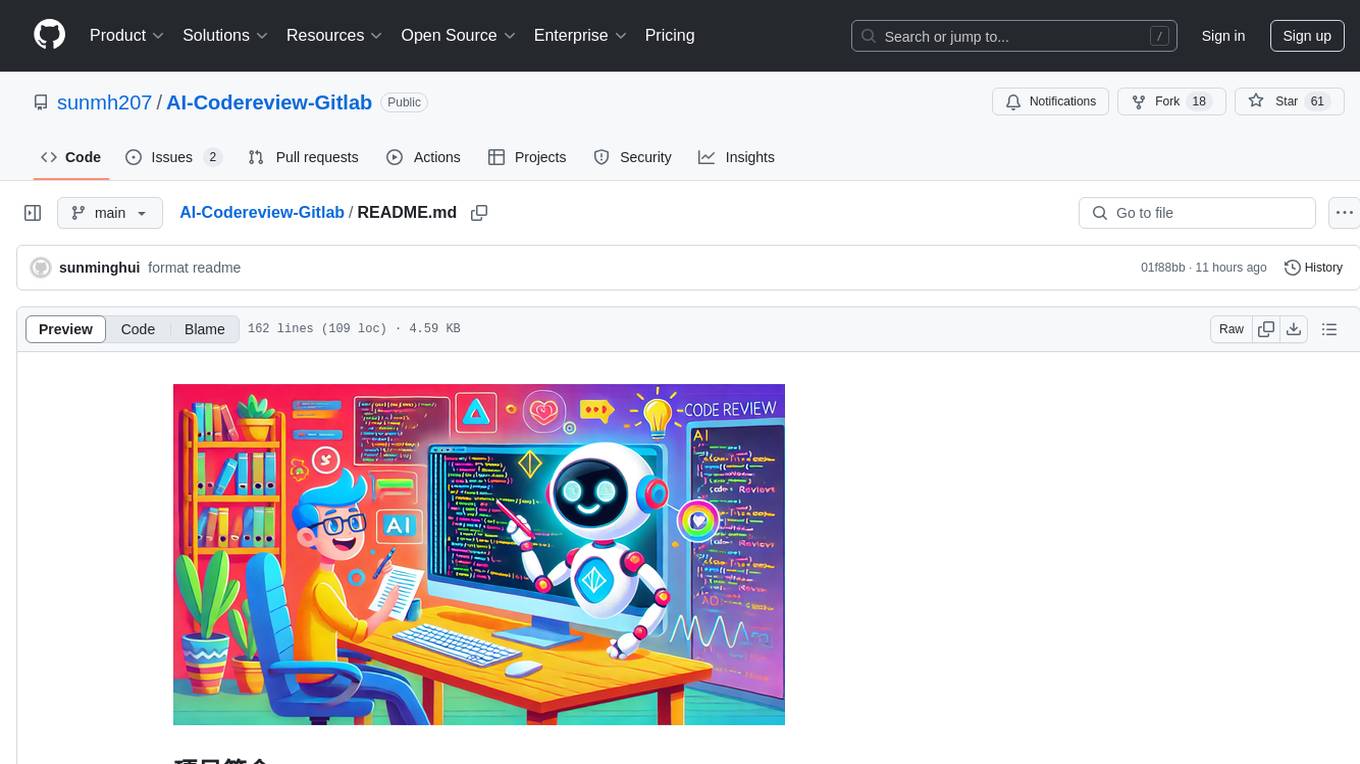
AI-Codereview-Gitlab
AI-Codereview-Gitlab is an automated code review tool based on large models, designed to help development teams conduct intelligent code reviews quickly during code merging or submission. It supports multiple large models including DeepSeek, ZhipuAI, OpenAI, and Ollama. The tool can automatically push review results to DingTalk, WeChat Work, and Feishu, generate daily reports based on GitLab commit records, and provide a visual dashboard to display code review records. The tool works by triggering webhook events on GitLab when users submit code, calling third-party large models to review the code, and recording the review results in corresponding Merge Requests or Commit Notes.
Automodel
Automodel is a Python library for automating the process of building and evaluating machine learning models. It provides a set of tools and utilities to streamline the model development workflow, from data preprocessing to model selection and evaluation. With Automodel, users can easily experiment with different algorithms, hyperparameters, and feature engineering techniques to find the best model for their dataset. The library is designed to be user-friendly and customizable, allowing users to define their own pipelines and workflows. Automodel is suitable for data scientists, machine learning engineers, and anyone looking to quickly build and test machine learning models without the need for manual intervention.
promptl
Promptl is a versatile command-line tool designed to streamline the process of creating and managing prompts for user input in various programming projects. It offers a simple and efficient way to prompt users for information, validate their input, and handle different scenarios based on their responses. With Promptl, developers can easily integrate interactive prompts into their scripts, applications, and automation workflows, enhancing user experience and improving overall usability. The tool provides a range of customization options and features, making it suitable for a wide range of use cases across different programming languages and environments.
crewAI-tools
This repository provides a guide for setting up tools for crewAI agents to enhance functionality. It offers steps to equip agents with ready-to-use tools and create custom ones. Tools are expected to return strings for generating responses. Users can create tools by subclassing BaseTool or using the tool decorator. Contributions are welcome to enrich the toolset, and guidelines are provided for contributing. The development setup includes installing dependencies, activating virtual environment, setting up pre-commit hooks, running tests, static type checking, packaging, and local installation. The goal is to empower AI solutions through advanced tooling.
BentoVLLM
BentoVLLM is an example project demonstrating how to serve and deploy open-source Large Language Models using vLLM, a high-throughput and memory-efficient inference engine. It provides a basis for advanced code customization, such as custom models, inference logic, or vLLM options. The project allows for simple LLM hosting with OpenAI compatible endpoints without the need to write any code. Users can interact with the server using Swagger UI or other methods, and the service can be deployed to BentoCloud for better management and scalability. Additionally, the repository includes integration examples for different LLM models and tools.
For similar tasks
evalica
Evalica is a powerful tool for evaluating code quality and performance in software projects. It provides detailed insights and metrics to help developers identify areas for improvement and optimize their code. With support for multiple programming languages and frameworks, Evalica offers a comprehensive solution for code analysis and optimization. Whether you are a beginner looking to learn best practices or an experienced developer aiming to enhance your code quality, Evalica is the perfect tool for you.
rageval
Rageval is an evaluation tool for Retrieval-augmented Generation (RAG) methods. It helps evaluate RAG systems by performing tasks such as query rewriting, document ranking, information compression, evidence verification, answer generation, and result validation. The tool provides metrics for answer correctness and answer groundedness, along with benchmark results for ASQA and ALCE datasets. Users can install and use Rageval to assess the performance of RAG models in question-answering tasks.
raga-llm-hub
Raga LLM Hub is a comprehensive evaluation toolkit for Language and Learning Models (LLMs) with over 100 meticulously designed metrics. It allows developers and organizations to evaluate and compare LLMs effectively, establishing guardrails for LLMs and Retrieval Augmented Generation (RAG) applications. The platform assesses aspects like Relevance & Understanding, Content Quality, Hallucination, Safety & Bias, Context Relevance, Guardrails, and Vulnerability scanning, along with Metric-Based Tests for quantitative analysis. It helps teams identify and fix issues throughout the LLM lifecycle, revolutionizing reliability and trustworthiness.
code-review-gpt
Code Review GPT uses Large Language Models to review code in your CI/CD pipeline. It helps streamline the code review process by providing feedback on code that may have issues or areas for improvement. It should pick up on common issues such as exposed secrets, slow or inefficient code, and unreadable code. It can also be run locally in your command line to review staged files. Code Review GPT is in alpha and should be used for fun only. It may provide useful feedback but please check any suggestions thoroughly.
digma
Digma is a Continuous Feedback platform that provides code-level insights related to performance, errors, and usage during development. It empowers developers to own their code all the way to production, improving code quality and preventing critical issues. Digma integrates with OpenTelemetry traces and metrics to generate insights in the IDE, helping developers analyze code scalability, bottlenecks, errors, and usage patterns.
ai-codereviewer
AI Code Reviewer is a GitHub Action that utilizes OpenAI's GPT-4 API to provide intelligent feedback and suggestions on pull requests. It helps enhance code quality and streamline the code review process by offering insightful comments and filtering out specified files. The tool is easy to set up and integrate into GitHub workflows.
sourcery
Sourcery is an automated code reviewer tool that provides instant feedback on pull requests, helping to speed up the code review process, improve code quality, and accelerate development velocity. It offers high-level feedback, line-by-line suggestions, and aims to mimic the type of code review one would expect from a colleague. Sourcery can also be used as an IDE coding assistant to understand existing code, add unit tests, optimize code, and improve code quality with instant suggestions. It is free for public repos/open source projects and offers a 14-day trial for private repos.
RTL-Coder
RTL-Coder is a tool designed to outperform GPT-3.5 in RTL code generation by providing a fully open-source dataset and a lightweight solution. It targets Verilog code generation and offers an automated flow to generate a large labeled dataset with over 27,000 diverse Verilog design problems and answers. The tool addresses the data availability challenge in IC design-related tasks and can be used for various applications beyond LLMs. The tool includes four RTL code generation models available on the HuggingFace platform, each with specific features and performance characteristics. Additionally, RTL-Coder introduces a new LLM training scheme based on code quality feedback to further enhance model performance and reduce GPU memory consumption.
For similar jobs
sourcegraph
Sourcegraph is a code search and navigation tool that helps developers read, write, and fix code in large, complex codebases. It provides features such as code search across all repositories and branches, code intelligence for navigation and refactoring, and the ability to fix and refactor code across multiple repositories at once.
pr-agent
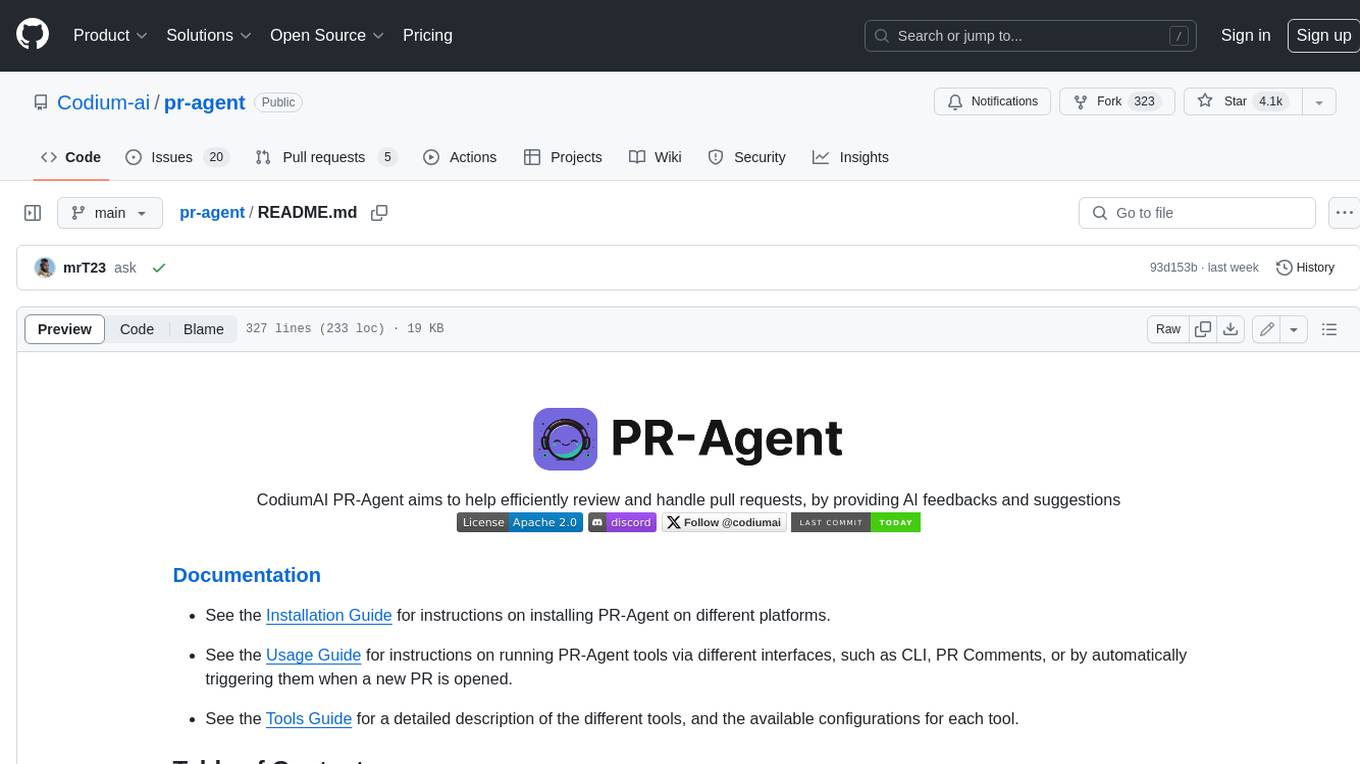
PR-Agent is a tool that helps to efficiently review and handle pull requests by providing AI feedbacks and suggestions. It supports various commands such as generating PR descriptions, providing code suggestions, answering questions about the PR, and updating the CHANGELOG.md file. PR-Agent can be used via CLI, GitHub Action, GitHub App, Docker, and supports multiple git providers and models. It emphasizes real-life practical usage, with each tool having a single GPT-4 call for quick and affordable responses. The PR Compression strategy enables effective handling of both short and long PRs, while the JSON prompting strategy allows for modular and customizable tools. PR-Agent Pro, the hosted version by CodiumAI, provides additional benefits such as full management, improved privacy, priority support, and extra features.
code-review-gpt
Code Review GPT uses Large Language Models to review code in your CI/CD pipeline. It helps streamline the code review process by providing feedback on code that may have issues or areas for improvement. It should pick up on common issues such as exposed secrets, slow or inefficient code, and unreadable code. It can also be run locally in your command line to review staged files. Code Review GPT is in alpha and should be used for fun only. It may provide useful feedback but please check any suggestions thoroughly.
DevoxxGenieIDEAPlugin
Devoxx Genie is a Java-based IntelliJ IDEA plugin that integrates with local and cloud-based LLM providers to aid in reviewing, testing, and explaining project code. It supports features like code highlighting, chat conversations, and adding files/code snippets to context. Users can modify REST endpoints and LLM parameters in settings, including support for cloud-based LLMs. The plugin requires IntelliJ version 2023.3.4 and JDK 17. Building and publishing the plugin is done using Gradle tasks. Users can select an LLM provider, choose code, and use commands like review, explain, or generate unit tests for code analysis.
code2prompt
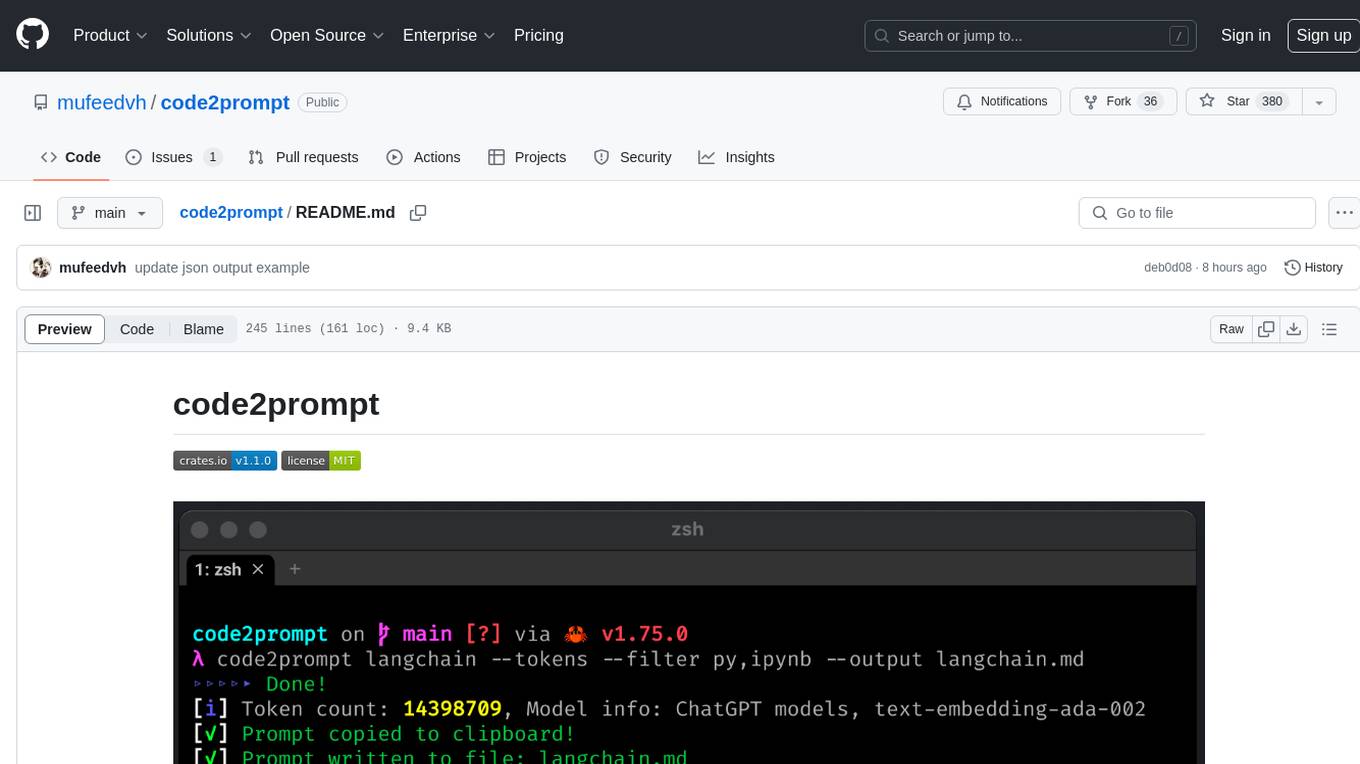
code2prompt is a command-line tool that converts your codebase into a single LLM prompt with a source tree, prompt templating, and token counting. It automates generating LLM prompts from codebases of any size, customizing prompt generation with Handlebars templates, respecting .gitignore, filtering and excluding files using glob patterns, displaying token count, including Git diff output, copying prompt to clipboard, saving prompt to an output file, excluding files and folders, adding line numbers to source code blocks, and more. It helps streamline the process of creating LLM prompts for code analysis, generation, and other tasks.
ai-codereviewer
AI Code Reviewer is a GitHub Action that utilizes OpenAI's GPT-4 API to provide intelligent feedback and suggestions on pull requests. It helps enhance code quality and streamline the code review process by offering insightful comments and filtering out specified files. The tool is easy to set up and integrate into GitHub workflows.
github-pr-summary
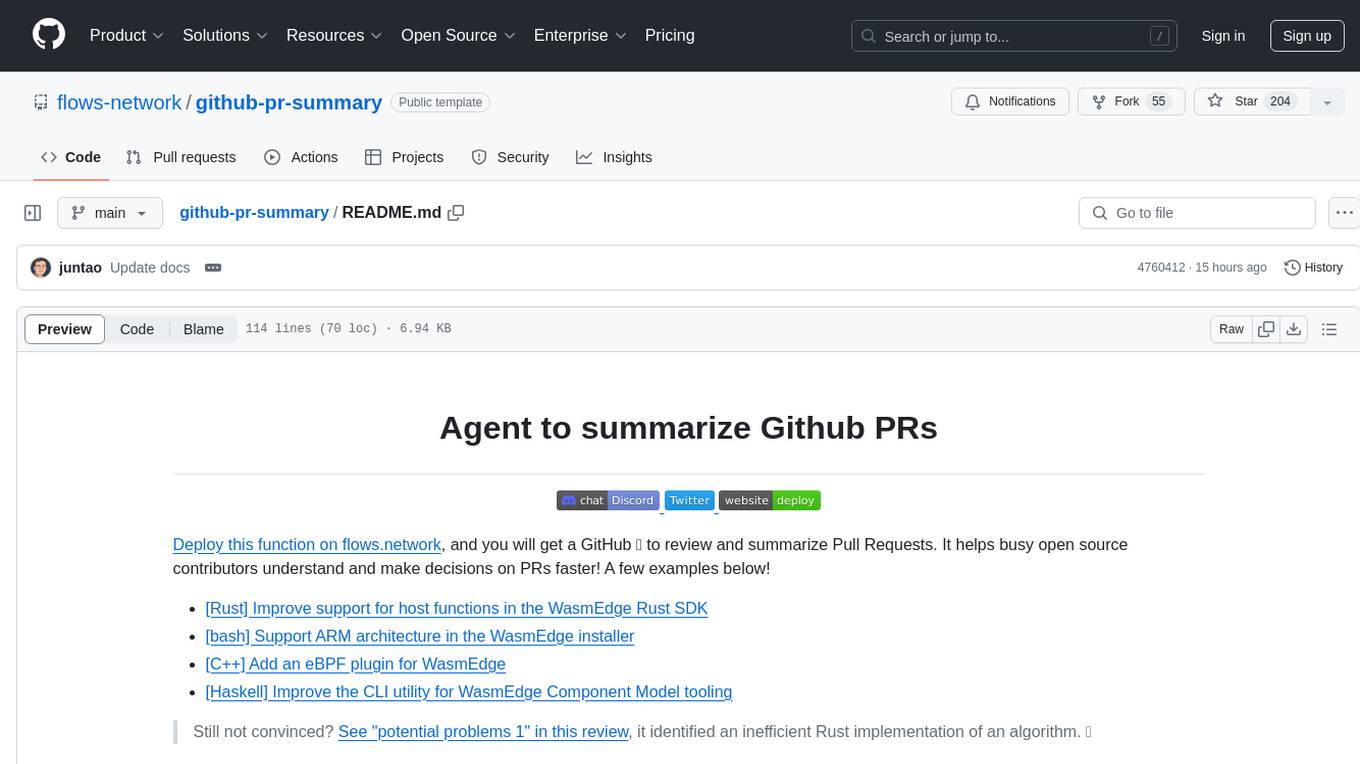
github-pr-summary is a bot designed to summarize GitHub Pull Requests, helping open source contributors make faster decisions. It automatically summarizes commits and changed files in PRs, triggered by new commits or a magic trigger phrase. Users can deploy their own code review bot in 3 steps: create a bot from their GitHub repo, configure it to review PRs, and connect to GitHub for access to the target repo. The bot runs on flows.network using Rust and WasmEdge Runtimes. It utilizes ChatGPT/4 to review and summarize PR content, posting the result back as a comment on the PR. The bot can be used on multiple repos by creating new flows and importing the source code repo, specifying the target repo using flow config. Users can also change the magic phrase to trigger a review from a PR comment.
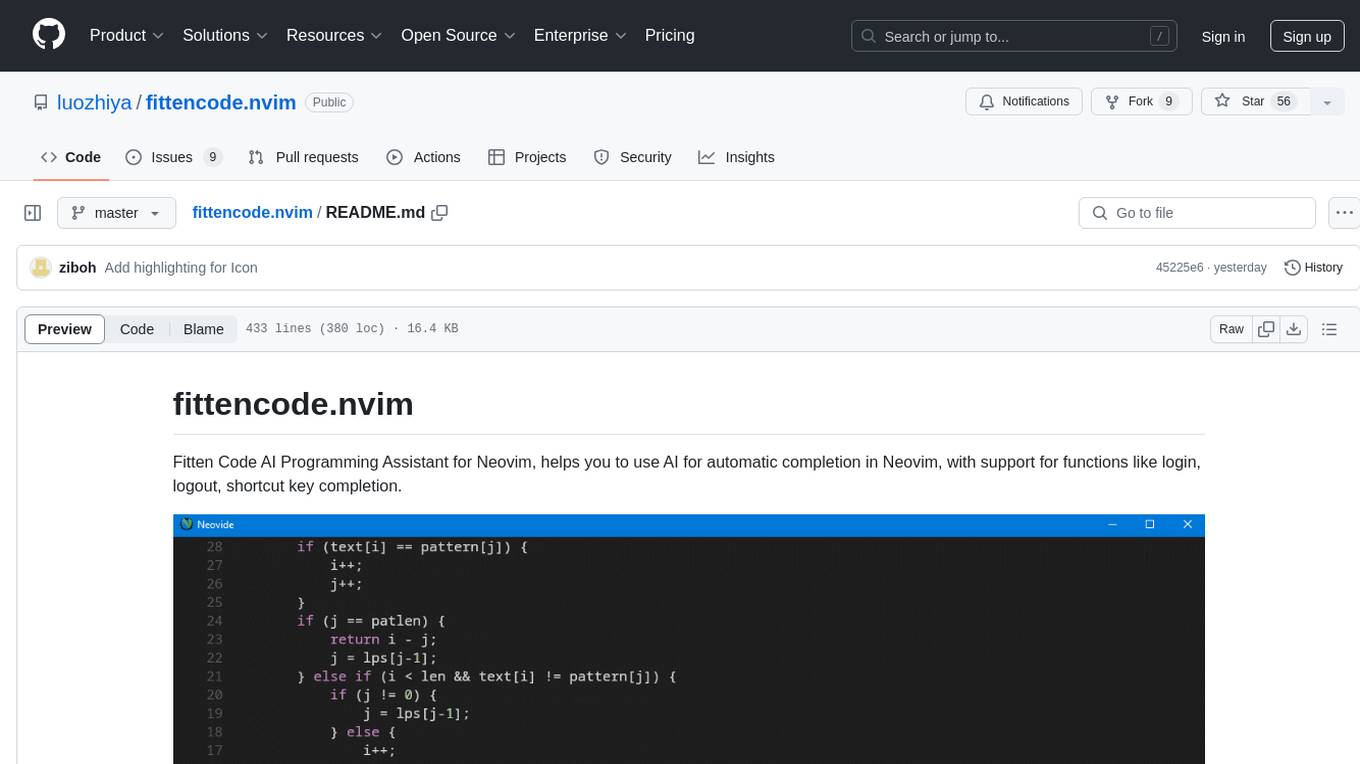
fittencode.nvim
Fitten Code AI Programming Assistant for Neovim provides fast completion using AI, asynchronous I/O, and support for various actions like document code, edit code, explain code, find bugs, generate unit test, implement features, optimize code, refactor code, start chat, and more. It offers features like accepting suggestions with Tab, accepting line with Ctrl + Down, accepting word with Ctrl + Right, undoing accepted text, automatic scrolling, and multiple HTTP/REST backends. It can run as a coc.nvim source or nvim-cmp source.