


foundry-samples
Embedded samples in Azure AI Foundry docs
Stars: 138
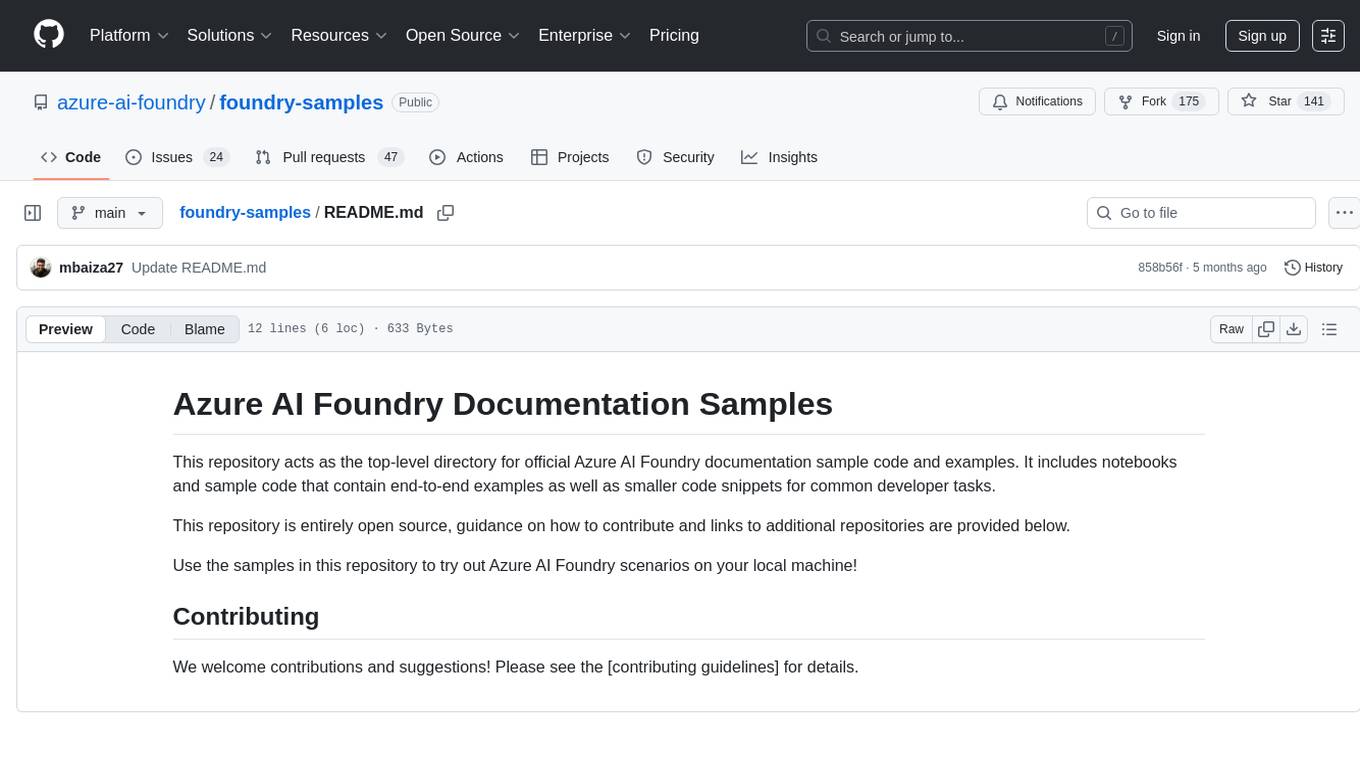
The 'foundry-samples' repository serves as the main directory for official Azure AI Foundry documentation sample code and examples. It contains notebooks and code snippets for various developer tasks, offering both end-to-end examples and smaller snippets. The repository is open source, encouraging contributions and providing guidance on how to contribute.
README:
This repository acts as the top-level directory for official Azure AI Foundry documentation sample code and examples. It includes notebooks and sample code that contain end-to-end examples as well as smaller code snippets for common developer tasks.
This repository is entirely open source, guidance on how to contribute and links to additional repositories are provided below.
Use the samples in this repository to try out Azure AI Foundry scenarios on your local machine!
We welcome contributions and suggestions! Please see the [contributing guidelines] for details.
For Tasks:
Click tags to check more tools for each tasksFor Jobs:
Alternative AI tools for foundry-samples
Similar Open Source Tools
foundry-samples
The 'foundry-samples' repository serves as the main directory for official Azure AI Foundry documentation sample code and examples. It contains notebooks and code snippets for various developer tasks, offering both end-to-end examples and smaller snippets. The repository is open source, encouraging contributions and providing guidance on how to contribute.
OpenAIWorkshop
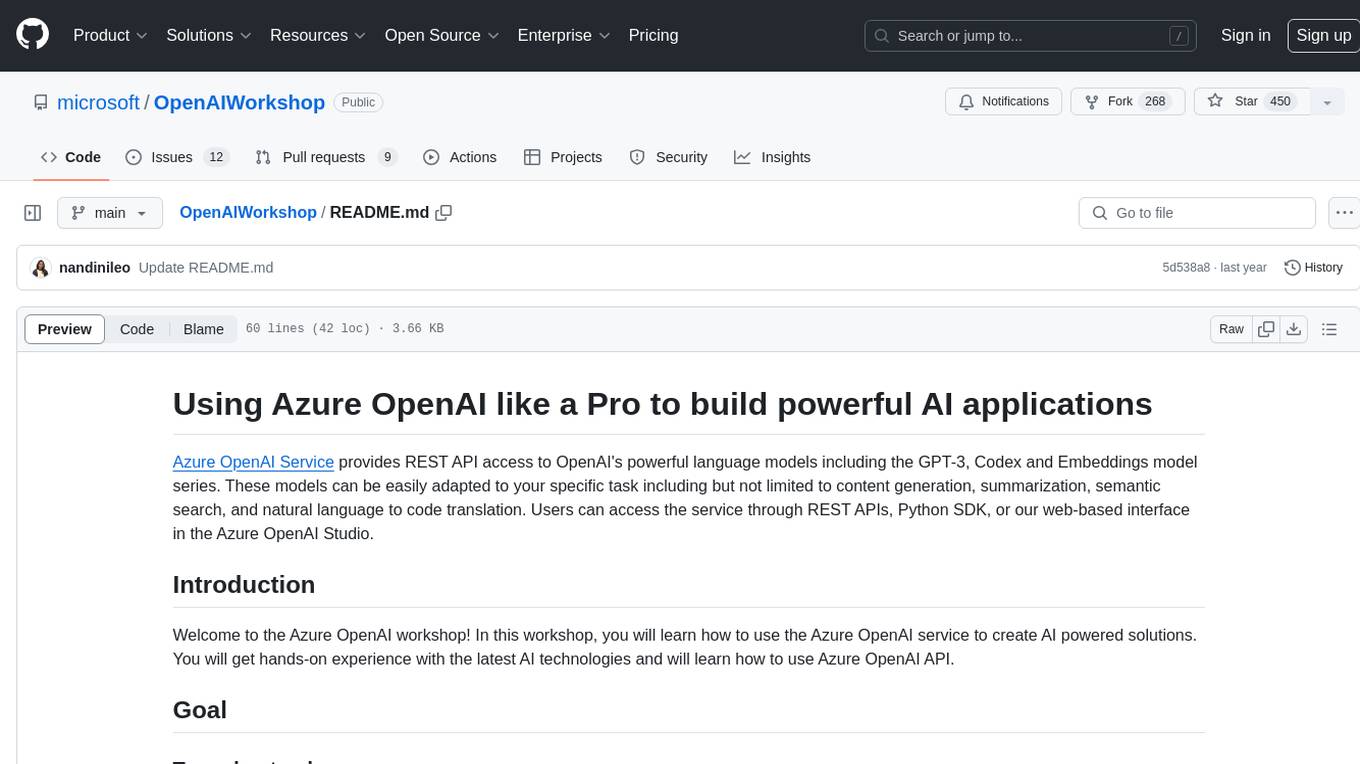
Azure OpenAI Service provides REST API access to OpenAI's powerful language models including GPT-3, Codex and Embeddings. Users can easily adapt models for content generation, summarization, semantic search, and natural language to code translation. The workshop covers basics, prompt engineering, common NLP tasks, generative tasks, conversational dialog, and learning methods. It guides users to build applications with PowerApp, query SQL data, create data pipelines, and work with proprietary datasets. Target audience includes Power Users, Software Engineers, Data Scientists, and AI architects and Managers.
GenAI-Showcase
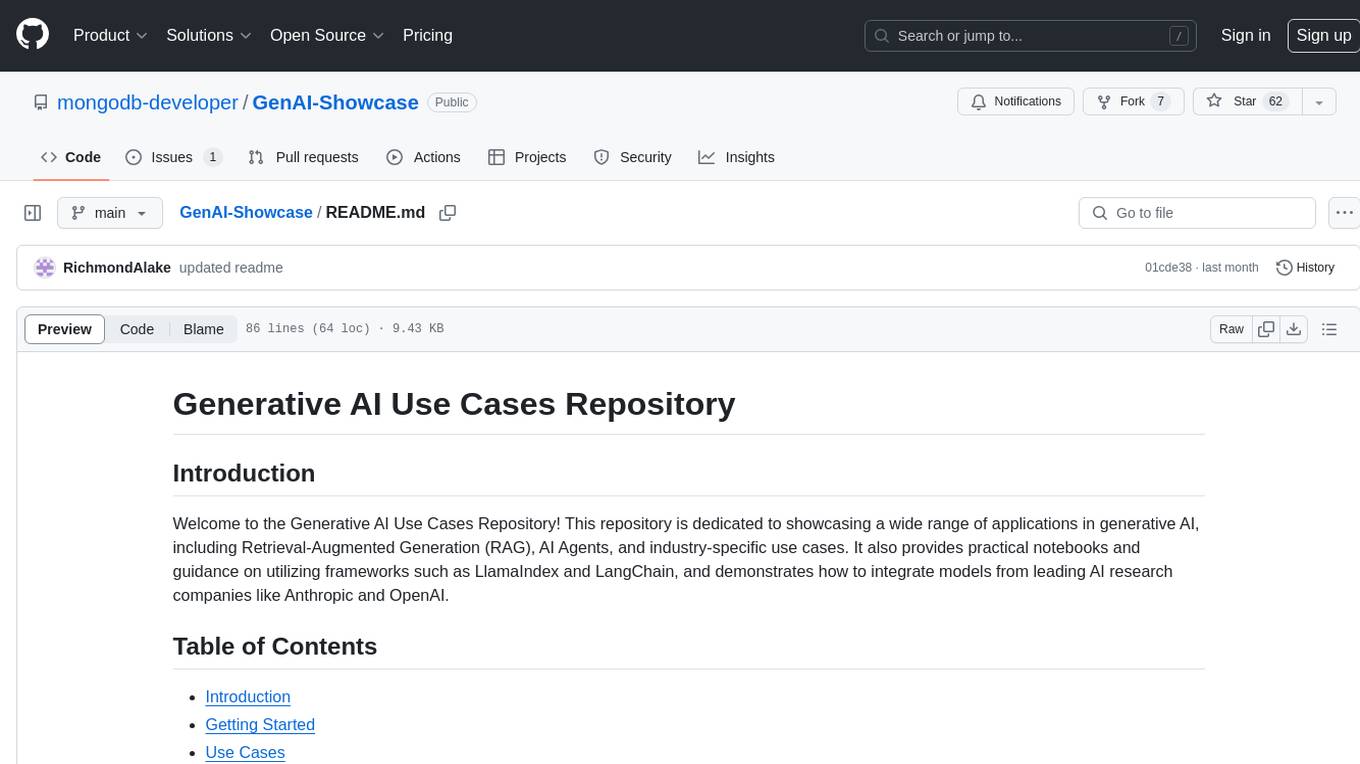
The Generative AI Use Cases Repository showcases a wide range of applications in generative AI, including Retrieval-Augmented Generation (RAG), AI Agents, and industry-specific use cases. It provides practical notebooks and guidance on utilizing frameworks such as LlamaIndex and LangChain, and demonstrates how to integrate models from leading AI research companies like Anthropic and OpenAI.
dstoolkit-text2sql-and-imageprocessing
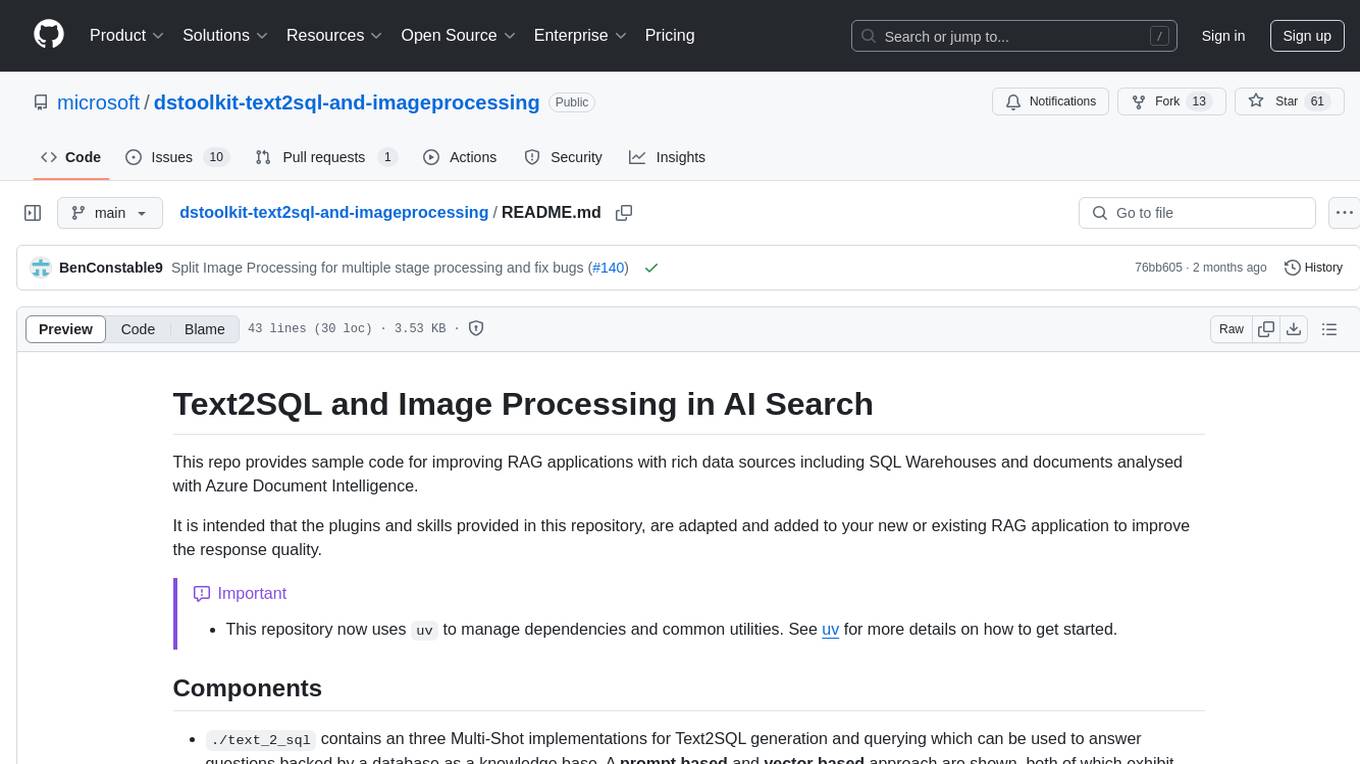
This repository provides sample code for improving RAG applications with rich data sources including SQL Warehouses and documents analysed with Azure Document Intelligence. It includes components for Text2SQL generation and querying, linking Azure Document Intelligence with AI Search for processing complex documents, and deploying AI search indexes. The plugins and skills aim to enhance response quality in RAG applications by accessing and pulling data from SQL tables, drawing insights from complex charts and images, and intelligently grouping similar sentences.
examples
This repository contains a collection of sample applications and Jupyter Notebooks for hands-on experience with Pinecone vector databases and common AI patterns, tools, and algorithms. It includes production-ready examples for review and support, as well as learning-optimized examples for exploring AI techniques and building applications. Users can contribute, provide feedback, and collaborate to improve the resource.
jentic-public-apis
The Jentic Public APIs repository aims to collate all knowledge about the world's APIs into a detailed, comprehensive, structured documentation catalog designed for use by AI. It focuses on standardized OpenAPI specifications, Arazzo workflows, associated tooling, evaluations, and RFCs for extensions to open formats. The project is in ALPHA stage and welcomes contributions to accelerate the effort of building an open knowledge foundation for AI agents.
MoonshotAI-Cookbook
The MoonshotAI-Cookbook provides example code and guides for accomplishing common tasks with the MoonshotAI API. To run these examples, you'll need an MoonshotAI account and associated API key. Most code examples are written in Python, though the concepts can be applied in any language.
azure-openai-dev-skills-orchestrator
An opinionated .NET framework, that is built on top of Semantic Kernel and Orleans, which helps creating and hosting event-driven AI Agents.
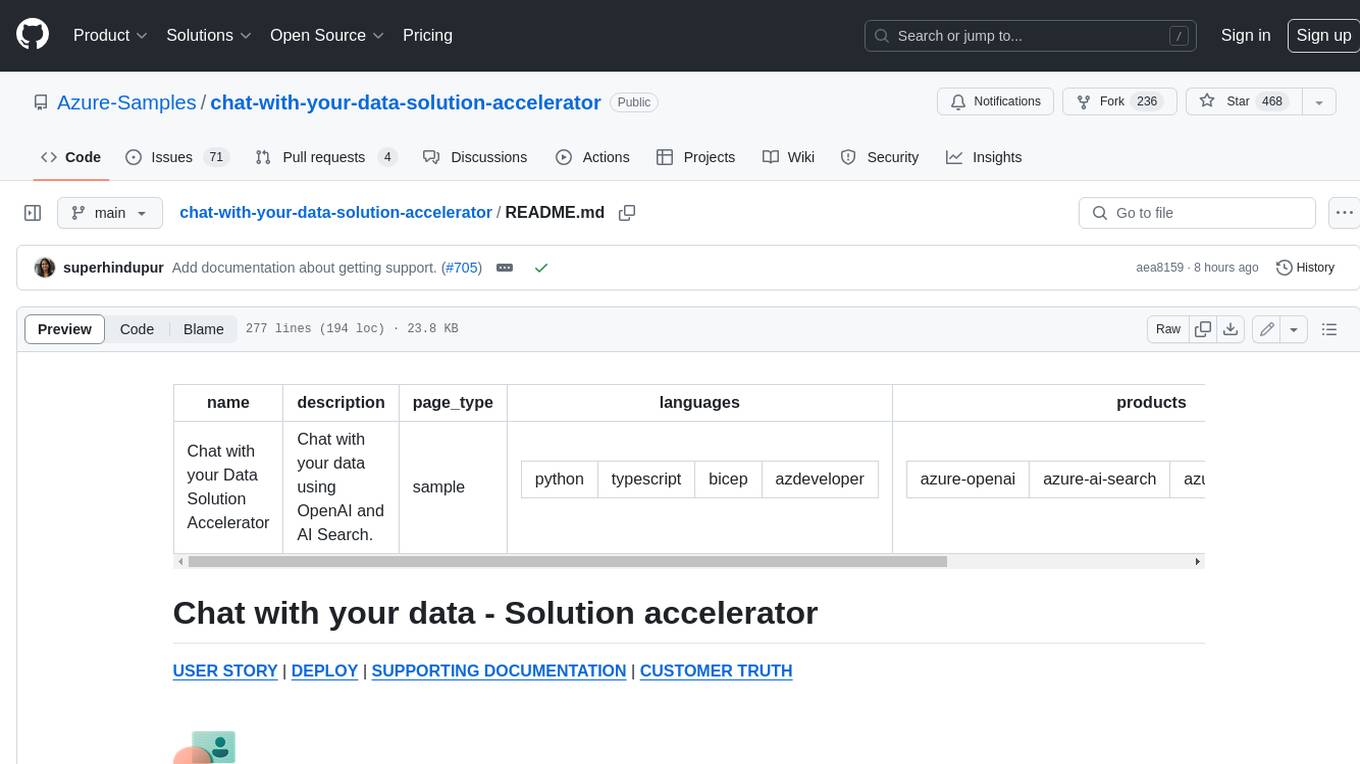
chat-with-your-data-solution-accelerator
Chat with your data using OpenAI and AI Search. This solution accelerator uses an Azure OpenAI GPT model and an Azure AI Search index generated from your data, which is integrated into a web application to provide a natural language interface, including speech-to-text functionality, for search queries. Users can drag and drop files, point to storage, and take care of technical setup to transform documents. There is a web app that users can create in their own subscription with security and authentication.
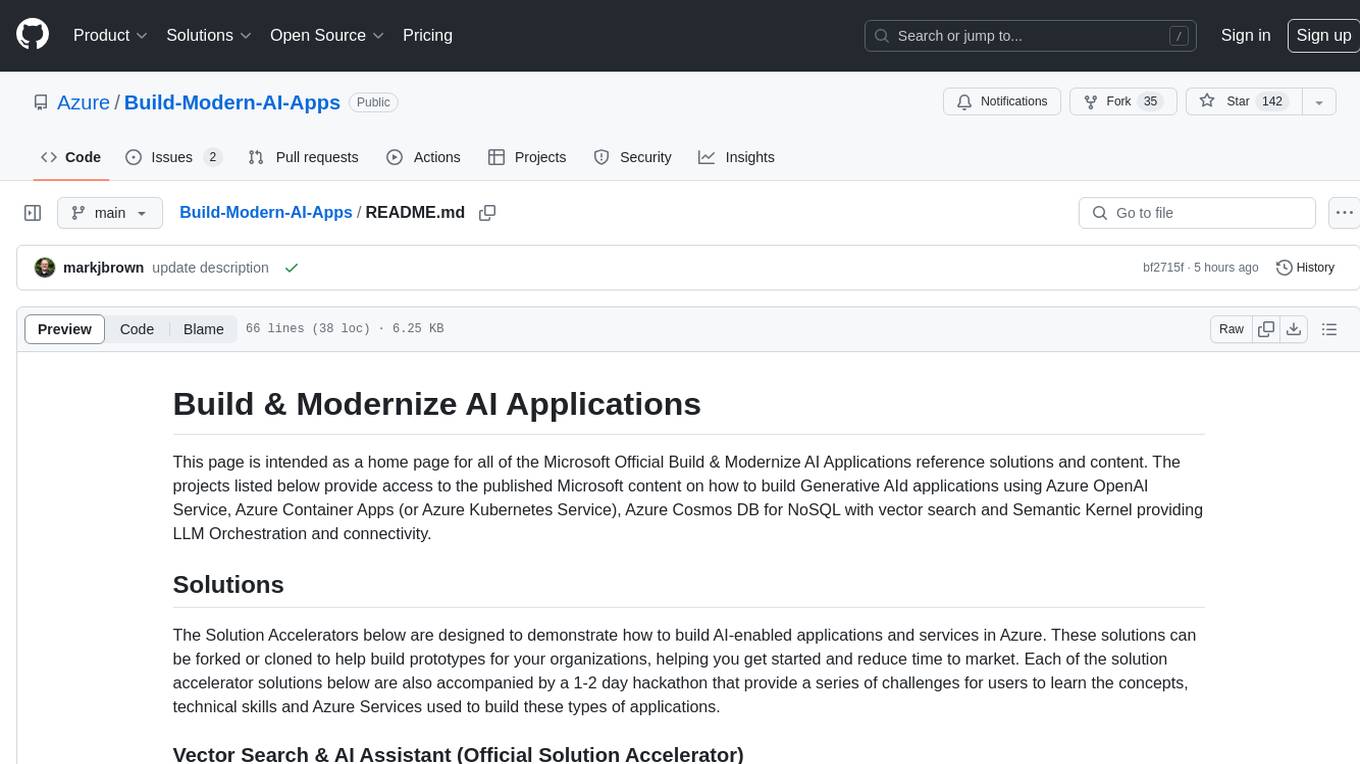
Build-Modern-AI-Apps
This repository serves as a hub for Microsoft Official Build & Modernize AI Applications reference solutions and content. It provides access to projects demonstrating how to build Generative AI applications using Azure services like Azure OpenAI, Azure Container Apps, Azure Kubernetes, and Azure Cosmos DB. The solutions include Vector Search & AI Assistant, Real-Time Payment and Transaction Processing, and Medical Claims Processing. Additionally, there are workshops like the Intelligent App Workshop for Microsoft Copilot Stack, focusing on infusing intelligence into traditional software systems using foundation models and design thinking.
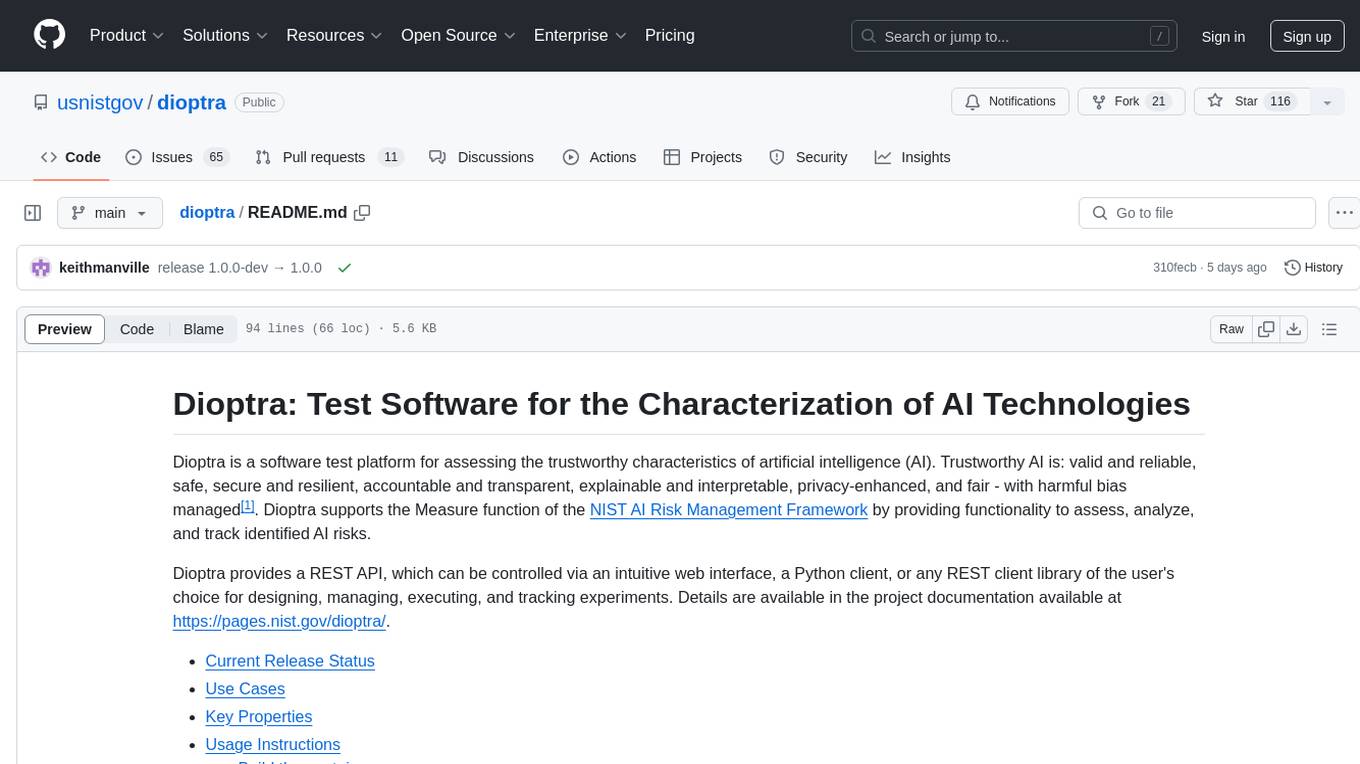
dioptra
Dioptra is a software test platform for assessing the trustworthy characteristics of artificial intelligence (AI). It supports the NIST AI Risk Management Framework by providing functionality to assess, analyze, and track identified AI risks. Dioptra provides a REST API and can be controlled via a web interface or Python client for designing, managing, executing, and tracking experiments. It aims to be reproducible, traceable, extensible, interoperable, modular, secure, interactive, shareable, and reusable.
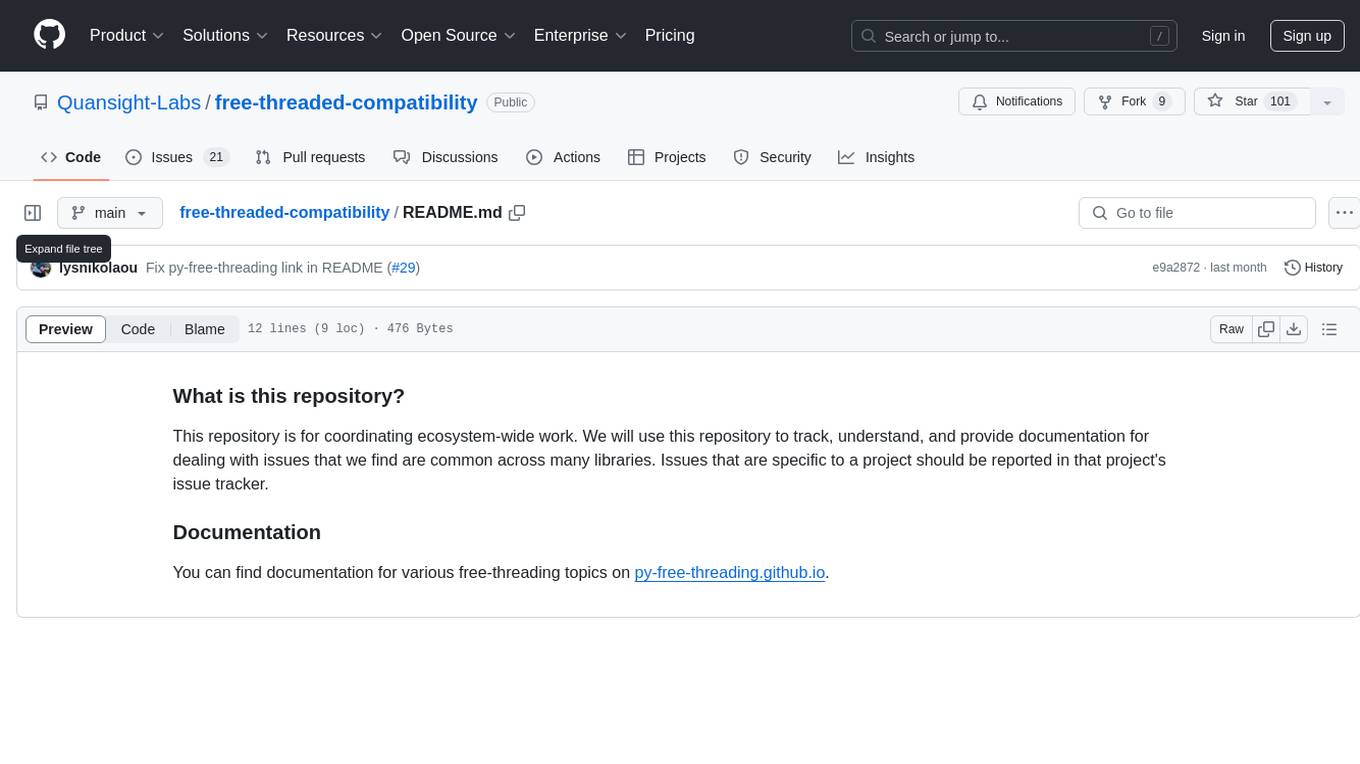
free-threaded-compatibility
This repository serves as a platform for coordinating ecosystem-wide work related to free-threading topics in Python. It aims to track, understand, and provide documentation for common issues across multiple libraries. Specific project-related issues should be reported in the respective project's issue tracker. For detailed documentation on free-threading topics, visit py-free-threading.github.io.
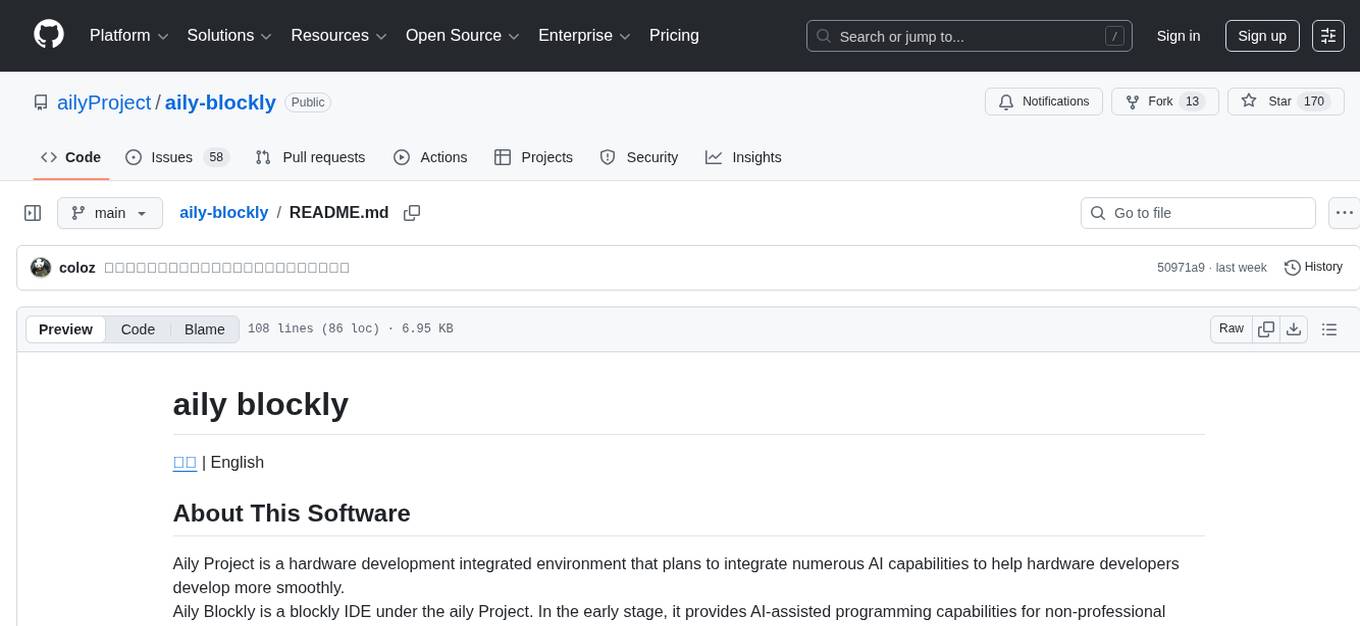
aily-blockly
Aily Blockly is a blockly IDE under the Aily Project, providing AI-assisted programming capabilities for non-professional users. It aims to integrate numerous AI capabilities to help hardware developers develop more smoothly, ultimately achieving natural language programming. The software offers features like Engineering Project Management, Library Manager, Serial Debug Tool, AI Project Generation, AI Code Generation, AI Library Conversion, Development Board Configuration Generation, and Lightning Compilation Tool. It is currently in the alpha stage, suitable for prototype verification and educational teaching.
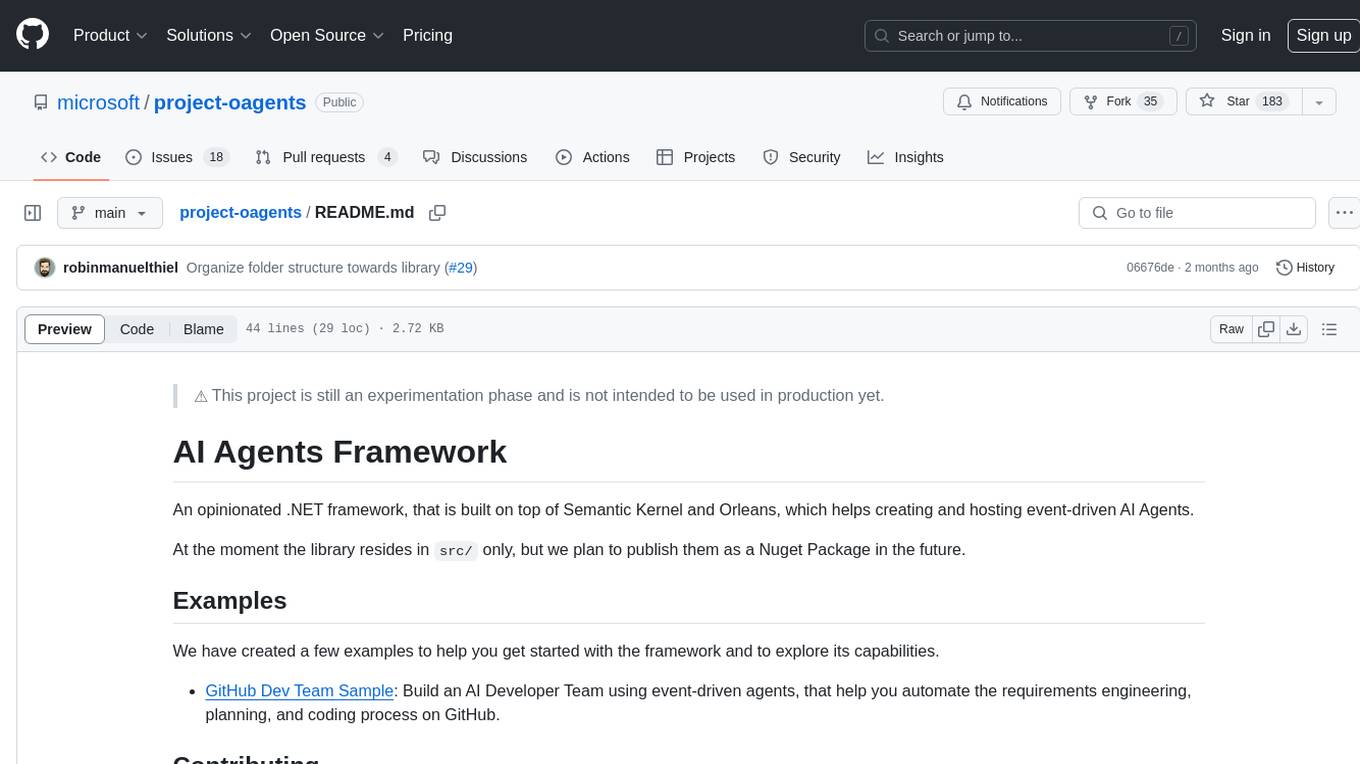
project-oagents
AI Agents Framework is a .NET framework built on Semantic Kernel and Orleans for creating and hosting event-driven AI Agents. It is currently in an experimental phase and not recommended for production use. The framework aims to automate requirements engineering, planning, and coding processes using event-driven agents.
semantic-kernel-docs
The Microsoft Semantic Kernel Documentation GitHub repository contains technical product documentation for Semantic Kernel. It serves as the home of technical content for Microsoft products and services. Contributors can learn how to make contributions by following the Docs contributor guide. The project follows the Microsoft Open Source Code of Conduct.
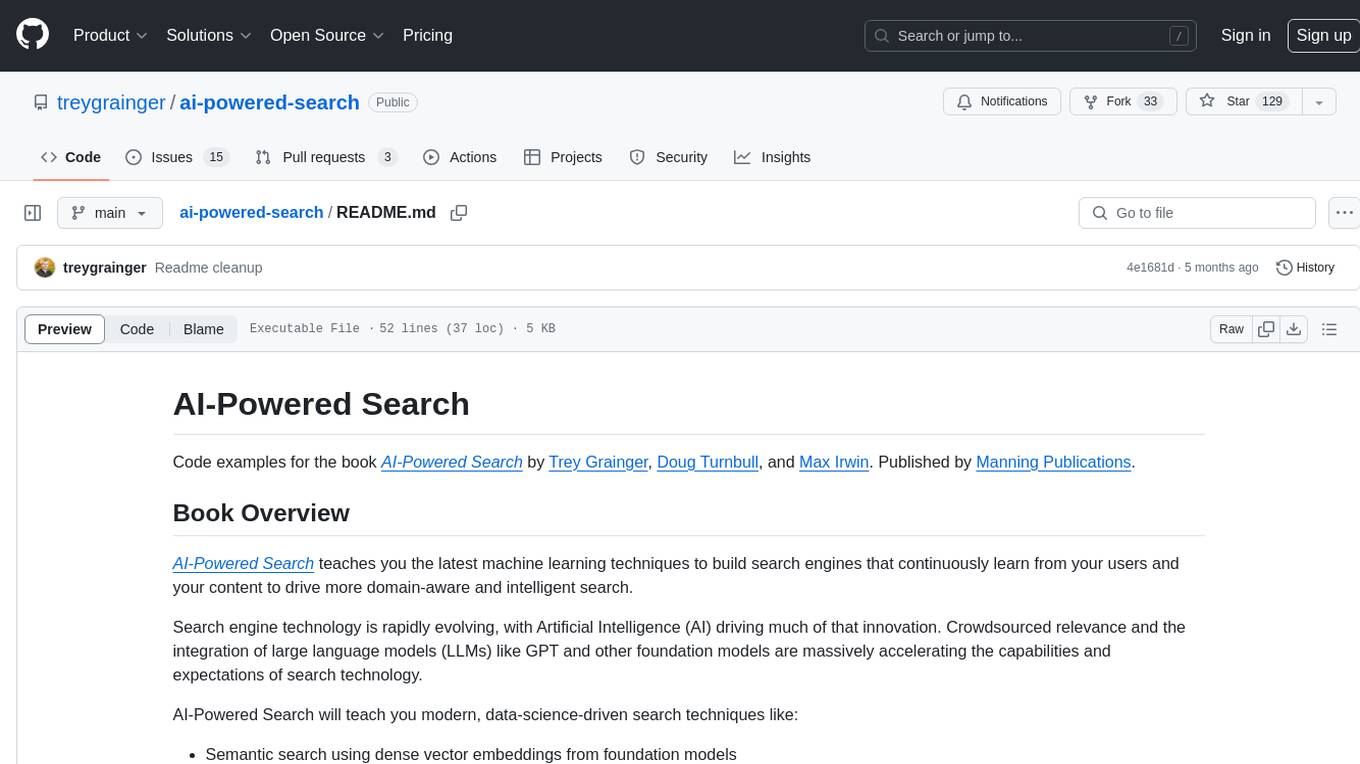
ai-powered-search
AI-Powered Search provides code examples for the book 'AI-Powered Search' by Trey Grainger, Doug Turnbull, and Max Irwin. The book teaches modern machine learning techniques for building search engines that continuously learn from users and content to deliver more intelligent and domain-aware search experiences. It covers semantic search, retrieval augmented generation, question answering, summarization, fine-tuning transformer-based models, personalized search, machine-learned ranking, click models, and more. The code examples are in Python, leveraging PySpark for data processing and Apache Solr as the default search engine. The repository is open source under the Apache License, Version 2.0.
For similar tasks
dcai-course
This repository serves as the website for the Introduction to Data-Centric AI class. It contains lab assignments and resources for the course. Users can contribute by opening issues or submitting pull requests. The website can be built locally using Docker and Jekyll. The design is based on Missing Semester. All contents, including source code, lecture notes, and videos, are licensed under CC BY-NC-SA 4.0.
aidoku-community-sources
Aidoku Sources is a repository containing public sources that can be directly installed through the Aidoku application. Users can add this source list to the Aidoku app to access additional content. Contributions to the repository are welcome, and it is licensed under either the Apache License, version 2.0, or the MIT license.
foundry-samples
The 'foundry-samples' repository serves as the main directory for official Azure AI Foundry documentation sample code and examples. It contains notebooks and code snippets for various developer tasks, offering both end-to-end examples and smaller snippets. The repository is open source, encouraging contributions and providing guidance on how to contribute.
lingoose
LinGoose is a modular Go framework designed for building AI/LLM applications. It offers the flexibility to import only the necessary modules, abstracts features for customization, and provides a comprehensive solution for developing AI/LLM applications from scratch. The framework simplifies the process of creating intelligent applications by allowing users to choose preferred implementations or create their own. LinGoose empowers developers to leverage its capabilities to streamline the development of cutting-edge AI and LLM projects.
spring-ai-alibaba-examples
This repository contains examples showcasing various uses of Spring AI Alibaba, from basic to advanced, and best practices for AI projects. It welcomes contributions related to Spring AI Alibaba usage examples, API usage, Spring AI usage examples, and best practices for AI projects. The project structure is designed to modularize functions for easy access and use.
brain4j
Brain4J is a lightweight, performant, and open-source machine learning framework for Java. Designed with portability and speed in mind, it is optimized for high performance and ideal for those looking to implement machine learning solutions in pure Java. The framework provides tools and functionalities to facilitate the development of machine learning models within Java applications, offering ease of use and efficiency.
Gym
Gym is a toolkit for developing and comparing reinforcement learning algorithms. It provides a wide variety of environments ranging from simple grid worlds to complex 3D environments, allowing researchers to easily test and benchmark their algorithms. With a user-friendly interface and extensive documentation, Gym is suitable for both beginners and experts in the field of reinforcement learning.
coding-with-ai
Coding-with-ai is a curated collection of techniques and best practices for utilizing AI coding tools to achieve transformative results in coding projects. It bridges the gap between AI coding demos and daily coding reality by providing insights into specific patterns like memory files, test-driven regeneration, and parallel AI sessions. The repository offers guidance on setting up memory files, writing detailed specs, drafting solutions before using assistants, getting multiple options, choosing stable libraries, and triggering careful planning. It also covers UI prototyping, coding practices, debugging strategies, testing methodologies, and cross-stage techniques for efficient coding with AI tools.
For similar jobs
weave
Weave is a toolkit for developing Generative AI applications, built by Weights & Biases. With Weave, you can log and debug language model inputs, outputs, and traces; build rigorous, apples-to-apples evaluations for language model use cases; and organize all the information generated across the LLM workflow, from experimentation to evaluations to production. Weave aims to bring rigor, best-practices, and composability to the inherently experimental process of developing Generative AI software, without introducing cognitive overhead.
LLMStack
LLMStack is a no-code platform for building generative AI agents, workflows, and chatbots. It allows users to connect their own data, internal tools, and GPT-powered models without any coding experience. LLMStack can be deployed to the cloud or on-premise and can be accessed via HTTP API or triggered from Slack or Discord.
VisionCraft
The VisionCraft API is a free API for using over 100 different AI models. From images to sound.
kaito
Kaito is an operator that automates the AI/ML inference model deployment in a Kubernetes cluster. It manages large model files using container images, avoids tuning deployment parameters to fit GPU hardware by providing preset configurations, auto-provisions GPU nodes based on model requirements, and hosts large model images in the public Microsoft Container Registry (MCR) if the license allows. Using Kaito, the workflow of onboarding large AI inference models in Kubernetes is largely simplified.
PyRIT
PyRIT is an open access automation framework designed to empower security professionals and ML engineers to red team foundation models and their applications. It automates AI Red Teaming tasks to allow operators to focus on more complicated and time-consuming tasks and can also identify security harms such as misuse (e.g., malware generation, jailbreaking), and privacy harms (e.g., identity theft). The goal is to allow researchers to have a baseline of how well their model and entire inference pipeline is doing against different harm categories and to be able to compare that baseline to future iterations of their model. This allows them to have empirical data on how well their model is doing today, and detect any degradation of performance based on future improvements.
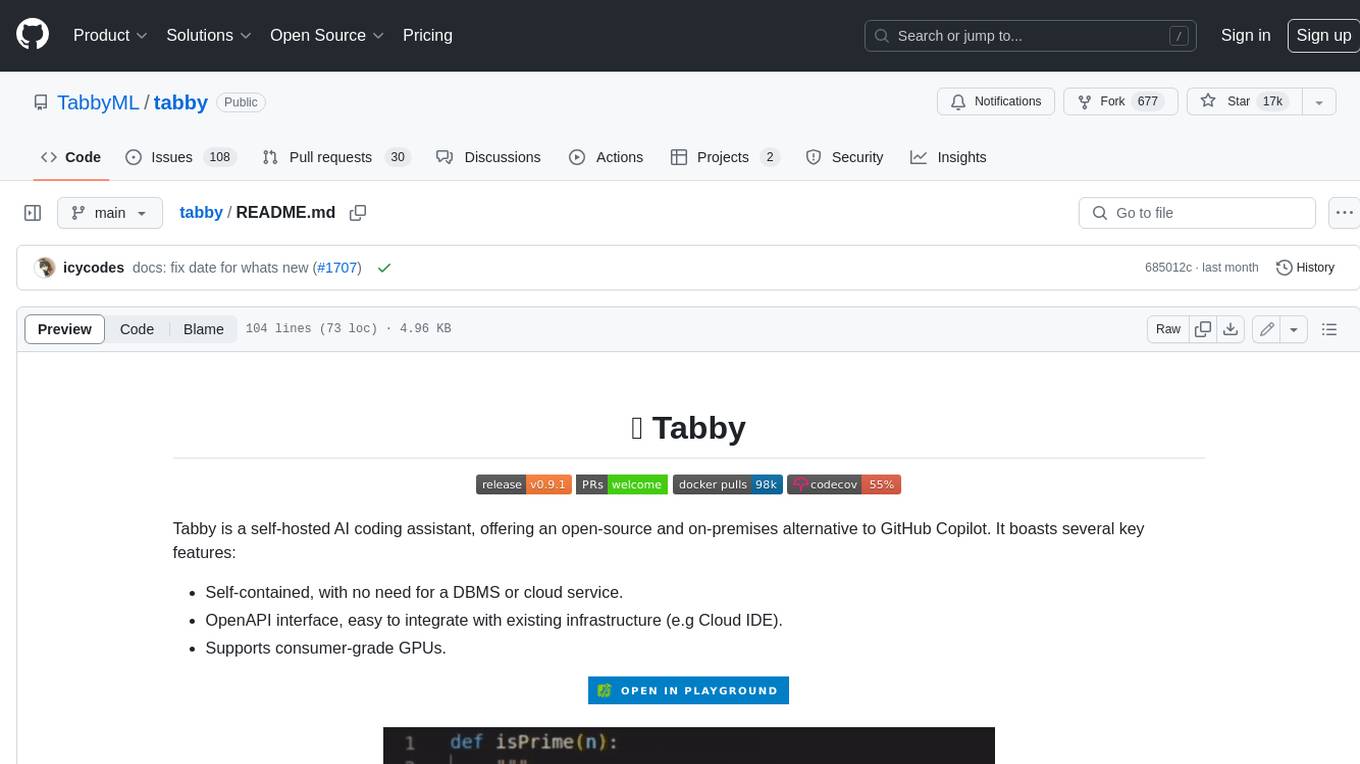
tabby
Tabby is a self-hosted AI coding assistant, offering an open-source and on-premises alternative to GitHub Copilot. It boasts several key features: * Self-contained, with no need for a DBMS or cloud service. * OpenAPI interface, easy to integrate with existing infrastructure (e.g Cloud IDE). * Supports consumer-grade GPUs.
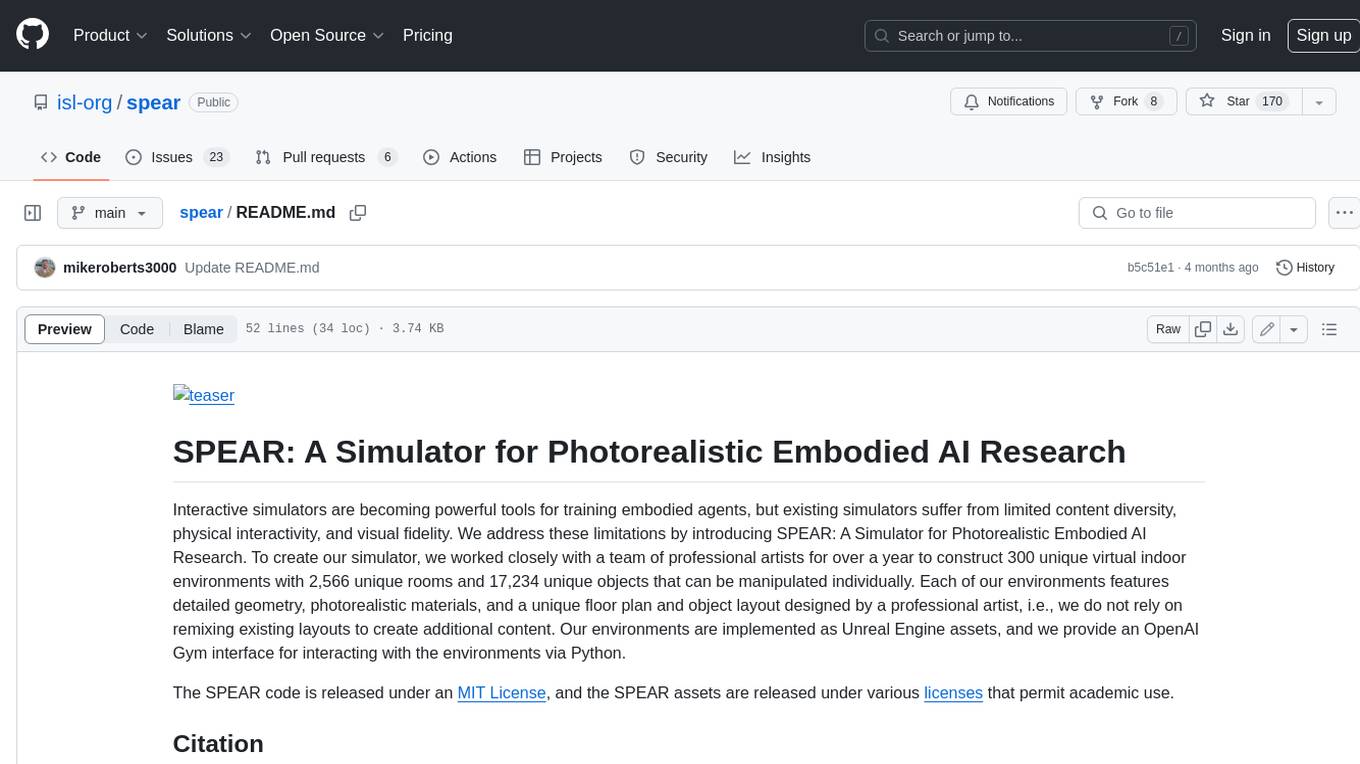
spear
SPEAR (Simulator for Photorealistic Embodied AI Research) is a powerful tool for training embodied agents. It features 300 unique virtual indoor environments with 2,566 unique rooms and 17,234 unique objects that can be manipulated individually. Each environment is designed by a professional artist and features detailed geometry, photorealistic materials, and a unique floor plan and object layout. SPEAR is implemented as Unreal Engine assets and provides an OpenAI Gym interface for interacting with the environments via Python.
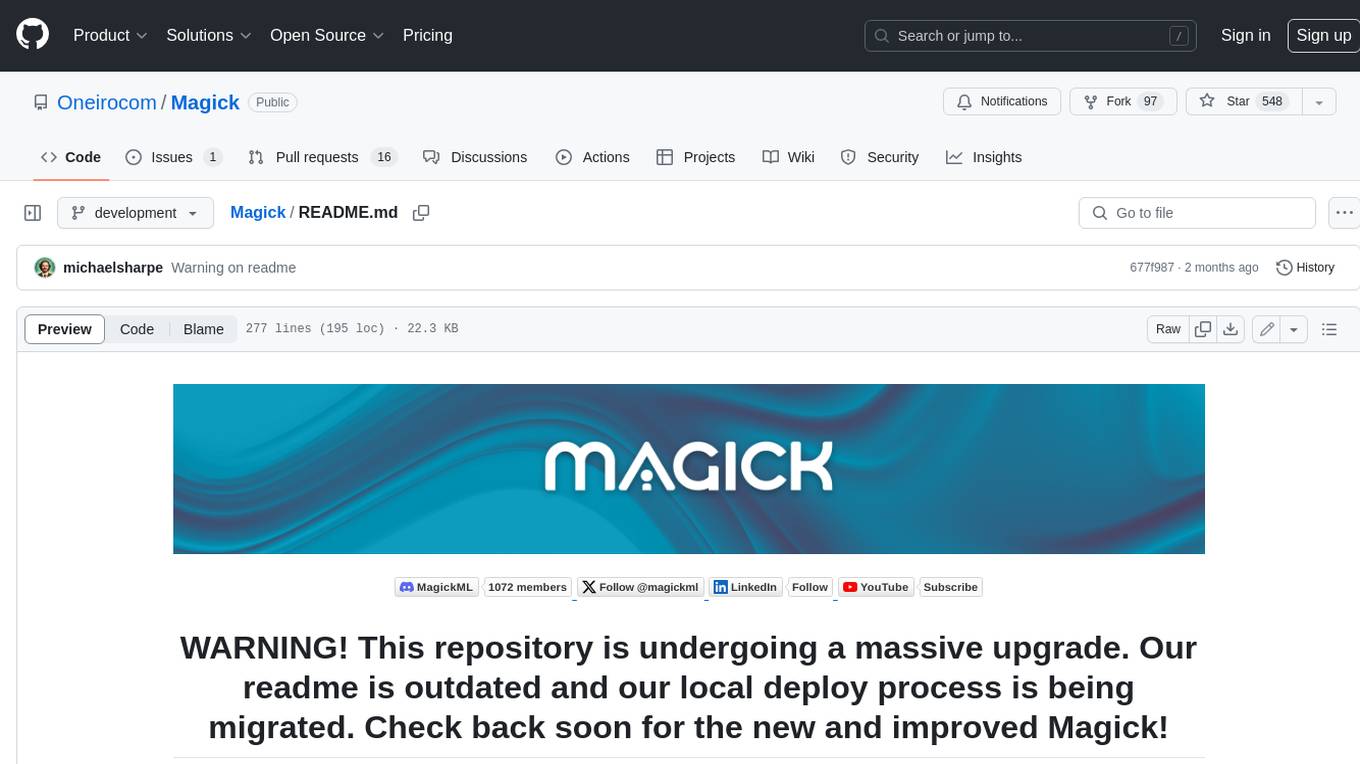
Magick
Magick is a groundbreaking visual AIDE (Artificial Intelligence Development Environment) for no-code data pipelines and multimodal agents. Magick can connect to other services and comes with nodes and templates well-suited for intelligent agents, chatbots, complex reasoning systems and realistic characters.