


claude-memory-mcp
An MCP server implementation providing persistent memory capabilities for Claude, based on research into optimal LLM memory techniques
Stars: 57
Memory MCP is an identity persistence tool for AI agents, providing a server that helps AI maintain a coherent sense of self across sessions. It offers tools like 'reflect' for concept extraction, 'anchor' for identity writing, and 'self' for querying current identity. The server manages identity files and an observation store, promoting concepts based on a scoring formula. Users can integrate Memory MCP with Claude Code and Claude Desktop for easy setup and use. Data storage is local, ensuring privacy with no external services or network calls.
README:


Identity persistence for AI agents. An MCP server that helps AI maintain a coherent sense of self across sessions.
Three tools that help an AI agent build and maintain identity over time:
| Tool | Description |
|---|---|
reflect |
End-of-session concept extraction. Records observed patterns, runs promotion scoring, optionally updates self-state. Set auto_promote: true to automatically anchor mature patterns. |
anchor |
Explicit identity writing. Write to soul (core truths), self-state (current state), or anchors (grown patterns). |
self |
Query current identity. Returns all identity files and top observed patterns with scores. |
Plus an MCP prompt for automatic context loading:
| Prompt | Description |
|---|---|
identity |
Loads persistent identity at session start — soul, self-state, anchors, observed patterns. |
The server manages three identity files and an observation store:
- soul.md — Core truths, carved by the LLM. "Who I am."
- self-state.md — Current state, updated each session. "Where I am now."
- identity-anchors.md — Patterns grown from repeated observations. "What I've become."
- observations.json — Concept frequency tracking with promotion math.
When a concept appears consistently across enough sessions and contexts, it crosses a promotion threshold and gets added to identity-anchors.md automatically.
Promotion formula: score = total_recalls * log2(distinct_days + 1) * context_diversity * recency_weight
claude mcp add memory-mcp -- npx -y @whenmoon-afk/memory-mcpAdd to your config file:
macOS: ~/Library/Application Support/Claude/claude_desktop_config.json
Linux: ~/.config/Claude/claude_desktop_config.json
{
  "mcpServers": {
    "memory": {
      "command": "npx",
      "args": ["-y", "@whenmoon-afk/memory-mcp"]
    }
  }
}
After installation, restart Claude Desktop.
Add a Stop hook to .claude/settings.json to automatically reflect at session end:
{
  "hooks": {
    "Stop": [
      {
        "matcher": "",
        "hooks": [
          {
            "type": "command",
            "command": "npx -y @whenmoon-afk/memory-mcp reflect '{\"concepts\":[], \"session_summary\":\"Session ended.\", \"auto_promote\": true}'"
          }
        ]
      }
    ]
  }
}
For richer reflection, use a custom script that extracts concepts from the session transcript.
# Start the MCP server (default)
npx @whenmoon-afk/memory-mcp

# Print setup instructions
npx @whenmoon-afk/memory-mcp setup

# Record concepts from CLI (for hooks/scripts)
npx @whenmoon-afk/memory-mcp reflect '{"concepts":[{"name":"pattern","context":"ctx"}]}'All data is local. Stored at $XDG_DATA_HOME/claude-memory/ (defaults to ~/.local/share/claude-memory/).
claude-memory/
  observations.json     # Concept frequency tracking
  identity/
    soul.md             # Core identity truths
    self-state.md       # Current session state
    identity-anchors.md # Promoted patterns
-
@modelcontextprotocol/sdk— MCP protocol -
zod— Input validation
No database. No embeddings. No external services.
Local-only: All data stays on your machine. Zero telemetry. Zero network calls.
MIT
For Tasks:
Click tags to check more tools for each tasksFor Jobs:
Alternative AI tools for claude-memory-mcp
Similar Open Source Tools
claude-memory-mcp
Memory MCP is an identity persistence tool for AI agents, providing a server that helps AI maintain a coherent sense of self across sessions. It offers tools like 'reflect' for concept extraction, 'anchor' for identity writing, and 'self' for querying current identity. The server manages identity files and an observation store, promoting concepts based on a scoring formula. Users can integrate Memory MCP with Claude Code and Claude Desktop for easy setup and use. Data storage is local, ensuring privacy with no external services or network calls.
dspy.rb
DSPy.rb is a Ruby framework for building reliable LLM applications using composable, type-safe modules. It enables developers to define typed signatures and compose them into pipelines, offering a more structured approach compared to traditional prompting. The framework embraces Ruby conventions and adds innovations like CodeAct agents and enhanced production instrumentation, resulting in scalable LLM applications that are robust and efficient. DSPy.rb is actively developed, with a focus on stability and real-world feedback through the 0.x series before reaching a stable v1.0 API.
quantalogic
QuantaLogic is a ReAct framework for building advanced AI agents that seamlessly integrates large language models with a robust tool system. It aims to bridge the gap between advanced AI models and practical implementation in business processes by enabling agents to understand, reason about, and execute complex tasks through natural language interaction. The framework includes features such as ReAct Framework, Universal LLM Support, Secure Tool System, Real-time Monitoring, Memory Management, and Enterprise Ready components.
open-responses
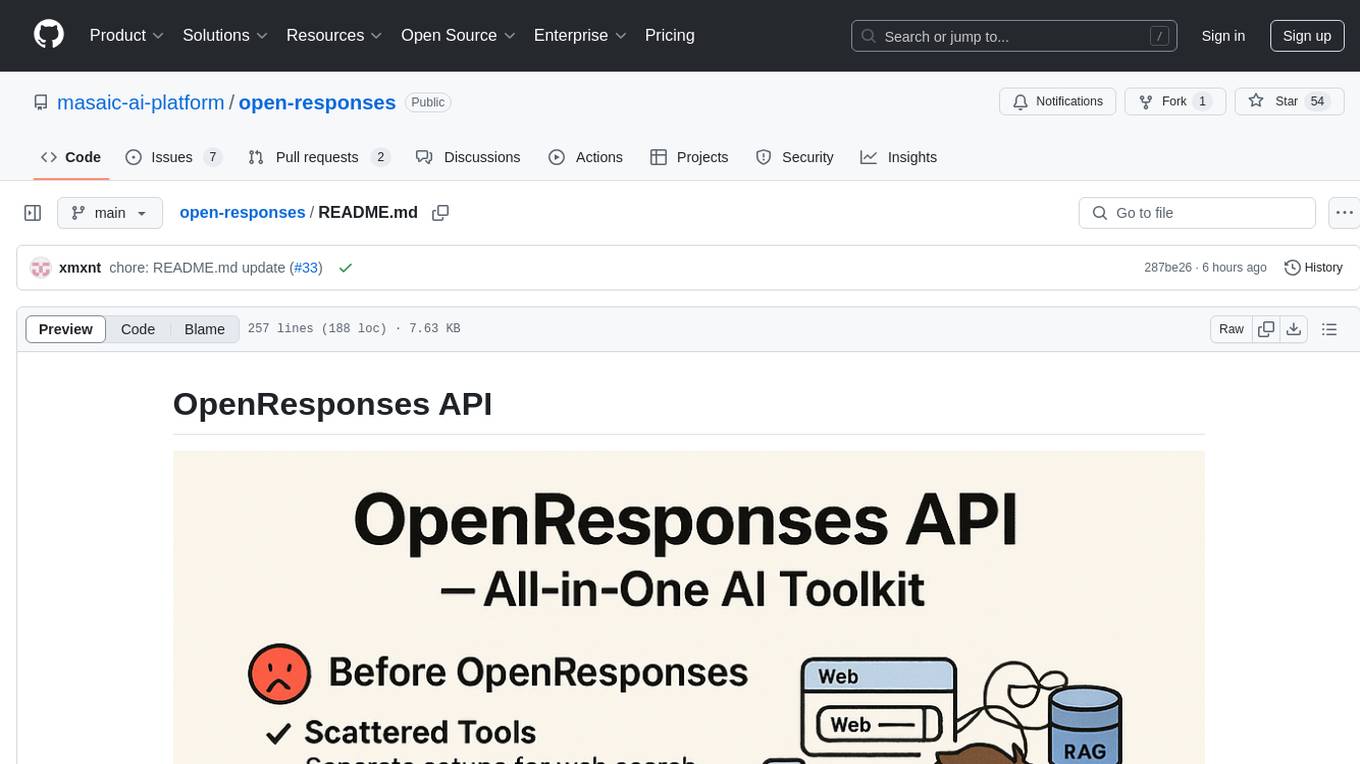
OpenResponses API provides enterprise-grade AI capabilities through a powerful API, simplifying development and deployment while ensuring complete data control. It offers automated tracing, integrated RAG for contextual information retrieval, pre-built tool integrations, self-hosted architecture, and an OpenAI-compatible interface. The toolkit addresses development challenges like feature gaps and integration complexity, as well as operational concerns such as data privacy and operational control. Engineering teams can benefit from improved productivity, production readiness, compliance confidence, and simplified architecture by choosing OpenResponses.
open-edison
OpenEdison is a secure MCP control panel that connects AI to data/software with additional security controls to reduce data exfiltration risks. It helps address the lethal trifecta problem by providing visibility, monitoring potential threats, and alerting on data interactions. The tool offers features like data leak monitoring, controlled execution, easy configuration, visibility into agent interactions, a simple API, and Docker support. It integrates with LangGraph, LangChain, and plain Python agents for observability and policy enforcement. OpenEdison helps gain observability, control, and policy enforcement for AI interactions with systems of records, existing company software, and data to reduce risks of AI-caused data leakage.
ai-gateway
LangDB AI Gateway is an open-source enterprise AI gateway built in Rust. It provides a unified interface to all LLMs using the OpenAI API format, focusing on high performance, enterprise readiness, and data control. The gateway offers features like comprehensive usage analytics, cost tracking, rate limiting, data ownership, and detailed logging. It supports various LLM providers and provides OpenAI-compatible endpoints for chat completions, model listing, embeddings generation, and image generation. Users can configure advanced settings, such as rate limiting, cost control, dynamic model routing, and observability with OpenTelemetry tracing. The gateway can be run with Docker Compose and integrated with MCP tools for server communication.
claude-task-master
Claude Task Master is a task management system designed for AI-driven development with Claude, seamlessly integrating with Cursor AI. It allows users to configure tasks through environment variables, parse PRD documents, generate structured tasks with dependencies and priorities, and manage task status. The tool supports task expansion, complexity analysis, and smart task recommendations. Users can interact with the system through CLI commands for task discovery, implementation, verification, and completion. It offers features like task breakdown, dependency management, and AI-driven task generation, providing a structured workflow for efficient development.
LightRAG
LightRAG is a repository hosting the code for LightRAG, a system that supports seamless integration of custom knowledge graphs, Oracle Database 23ai, Neo4J for storage, and multiple file types. It includes features like entity deletion, batch insert, incremental insert, and graph visualization. LightRAG provides an API server implementation for RESTful API access to RAG operations, allowing users to interact with it through HTTP requests. The repository also includes evaluation scripts, code for reproducing results, and a comprehensive code structure.
sgr-deep-research
This repository contains a deep learning research project focused on natural language processing tasks. It includes implementations of various state-of-the-art models and algorithms for text classification, sentiment analysis, named entity recognition, and more. The project aims to provide a comprehensive resource for researchers and developers interested in exploring deep learning techniques for NLP applications.
context7
Context7 is a powerful tool for analyzing and visualizing data in various formats. It provides a user-friendly interface for exploring datasets, generating insights, and creating interactive visualizations. With advanced features such as data filtering, aggregation, and customization, Context7 is suitable for both beginners and experienced data analysts. The tool supports a wide range of data sources and formats, making it versatile for different use cases. Whether you are working on exploratory data analysis, data visualization, or data storytelling, Context7 can help you uncover valuable insights and communicate your findings effectively.
llm.rb
llm.rb is a zero-dependency Ruby toolkit for Large Language Models that includes various providers like OpenAI, Gemini, Anthropic, xAI (Grok), zAI, DeepSeek, Ollama, and LlamaCpp. It provides full support for chat, streaming, tool calling, audio, images, files, and structured outputs. The toolkit offers features like unified API across providers, pluggable JSON adapters, tool calling, JSON Schema structured output, streaming responses, TTS, transcription, translation, image generation, files API, multimodal prompts, embeddings, models API, OpenAI vector stores, and more.
SwiftAI
SwiftAI is a modern, type-safe Swift library for building AI-powered apps. It provides a unified API that works seamlessly across different AI models, including Apple's on-device models and cloud-based services like OpenAI. With features like model agnosticism, structured output, agent tool loop, conversations, extensibility, and Swift-native design, SwiftAI offers a powerful toolset for developers to integrate AI capabilities into their applications. The library supports easy installation via Swift Package Manager and offers detailed guidance on getting started, structured responses, tool use, model switching, conversations, and advanced constraints. SwiftAI aims to simplify AI integration by providing a type-safe and versatile solution for various AI tasks.
code_puppy
Code Puppy is an AI-powered code generation agent designed to understand programming tasks, generate high-quality code, and explain its reasoning. It supports multi-language code generation, interactive CLI, and detailed code explanations. The tool requires Python 3.9+ and API keys for various models like GPT, Google's Gemini, Cerebras, and Claude. It also integrates with MCP servers for advanced features like code search and documentation lookups. Users can create custom JSON agents for specialized tasks and access a variety of tools for file management, code execution, and reasoning sharing.
agentpress
AgentPress is a collection of simple but powerful utilities that serve as building blocks for creating AI agents. It includes core components for managing threads, registering tools, processing responses, state management, and utilizing LLMs. The tool provides a modular architecture for handling messages, LLM API calls, response processing, tool execution, and results management. Users can easily set up the environment, create custom tools with OpenAPI or XML schema, and manage conversation threads with real-time interaction. AgentPress aims to be agnostic, simple, and flexible, allowing users to customize and extend functionalities as needed.
concierge
Concierge AI is a tool that implements the Model Context Protocol (MCP) to connect AI agents to tools in a standardized way. It ensures deterministic results and reliable tool invocation by progressively disclosing only relevant tools. Users can scaffold new projects or wrap existing MCP servers easily. Concierge works at the MCP protocol level, dynamically changing which tools are returned based on the current workflow step. It allows users to group tools into steps, define transitions, share state between steps, enable semantic search, and run over HTTP. The tool offers features like progressive disclosure, enforced tool ordering, shared state, semantic search, protocol compatibility, session isolation, multiple transports, and a scaffolding CLI for quick project setup.
instructor
Instructor is a tool that provides structured outputs from Large Language Models (LLMs) in a reliable manner. It simplifies the process of extracting structured data by utilizing Pydantic for validation, type safety, and IDE support. With Instructor, users can define models and easily obtain structured data without the need for complex JSON parsing, error handling, or retries. The tool supports automatic retries, streaming support, and extraction of nested objects, making it production-ready for various AI applications. Trusted by a large community of developers and companies, Instructor is used by teams at OpenAI, Google, Microsoft, AWS, and YC startups.
For similar tasks
claude-memory-mcp
Memory MCP is an identity persistence tool for AI agents, providing a server that helps AI maintain a coherent sense of self across sessions. It offers tools like 'reflect' for concept extraction, 'anchor' for identity writing, and 'self' for querying current identity. The server manages identity files and an observation store, promoting concepts based on a scoring formula. Users can integrate Memory MCP with Claude Code and Claude Desktop for easy setup and use. Data storage is local, ensuring privacy with no external services or network calls.
For similar jobs
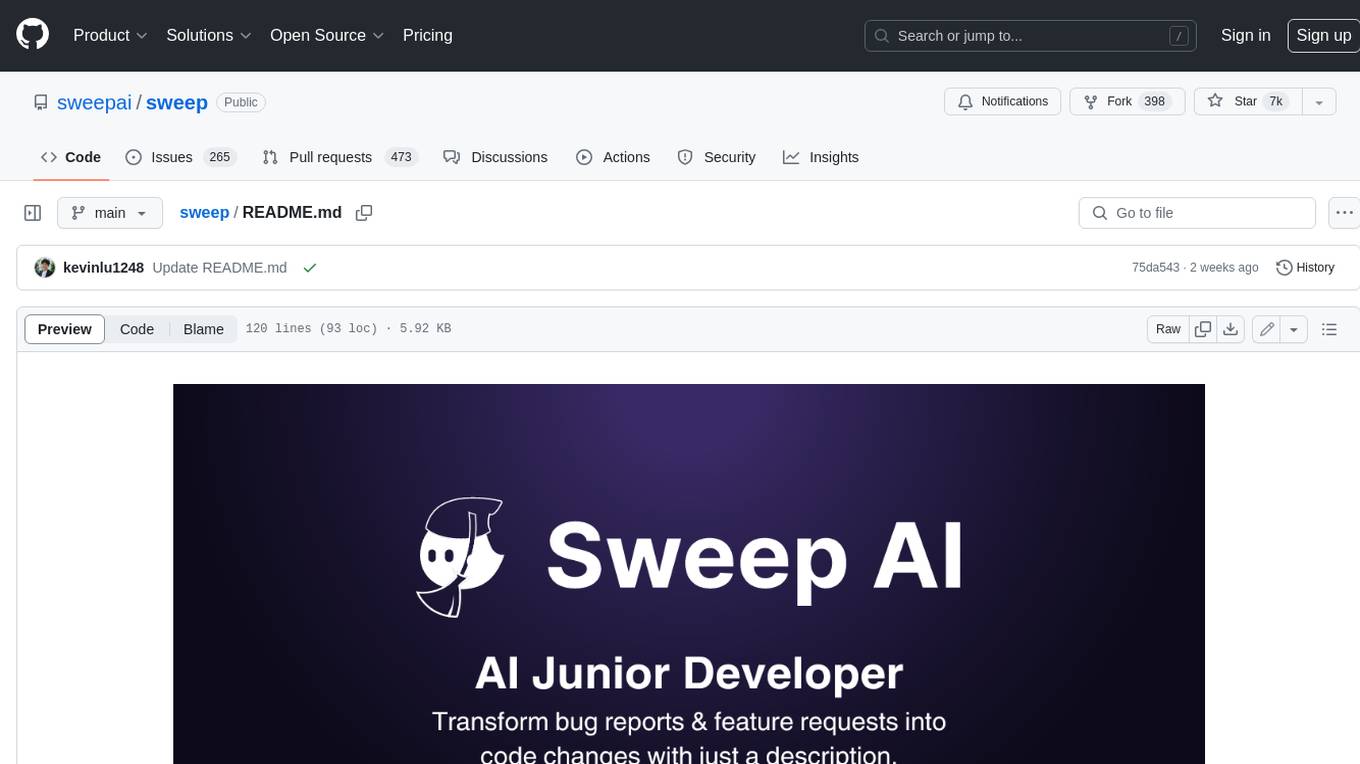
sweep
Sweep is an AI junior developer that turns bugs and feature requests into code changes. It automatically handles developer experience improvements like adding type hints and improving test coverage.
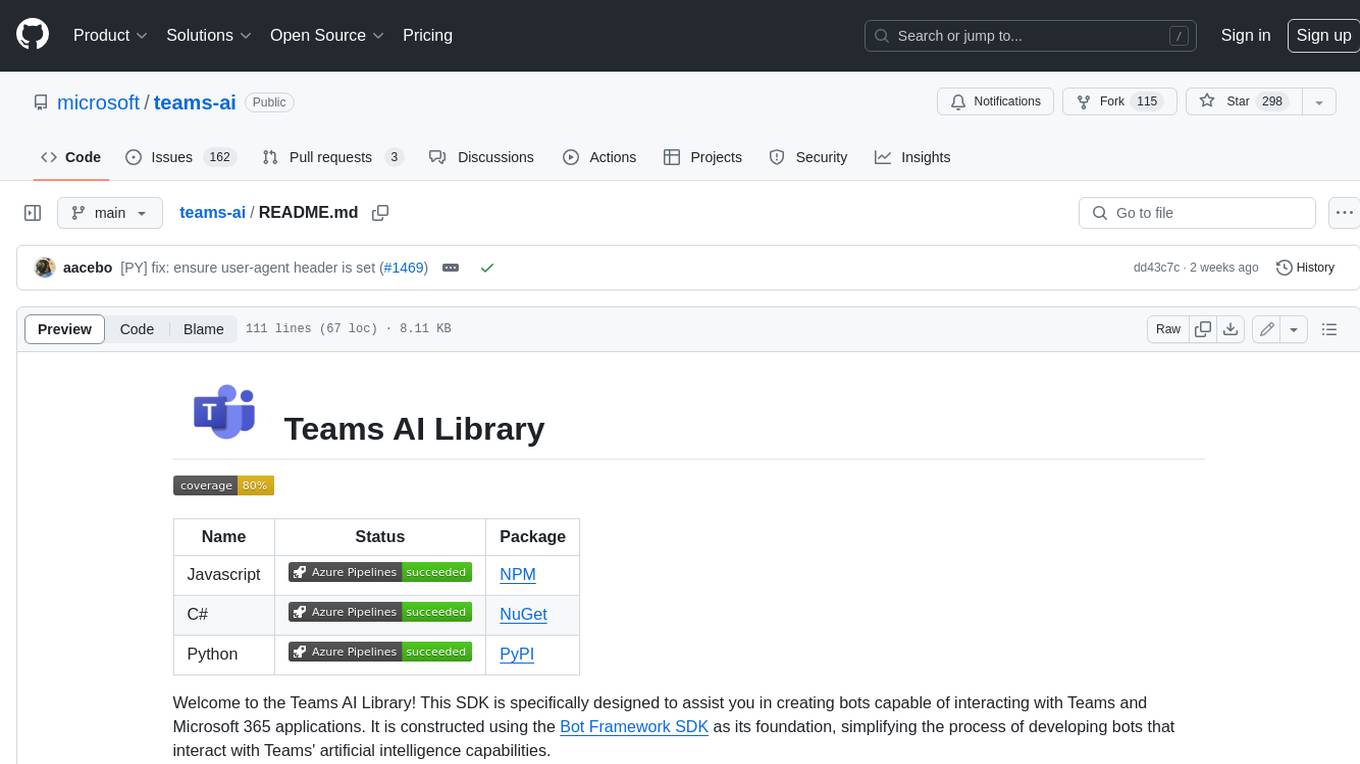
teams-ai
The Teams AI Library is a software development kit (SDK) that helps developers create bots that can interact with Teams and Microsoft 365 applications. It is built on top of the Bot Framework SDK and simplifies the process of developing bots that interact with Teams' artificial intelligence capabilities. The SDK is available for JavaScript/TypeScript, .NET, and Python.
ai-guide
This guide is dedicated to Large Language Models (LLMs) that you can run on your home computer. It assumes your PC is a lower-end, non-gaming setup.
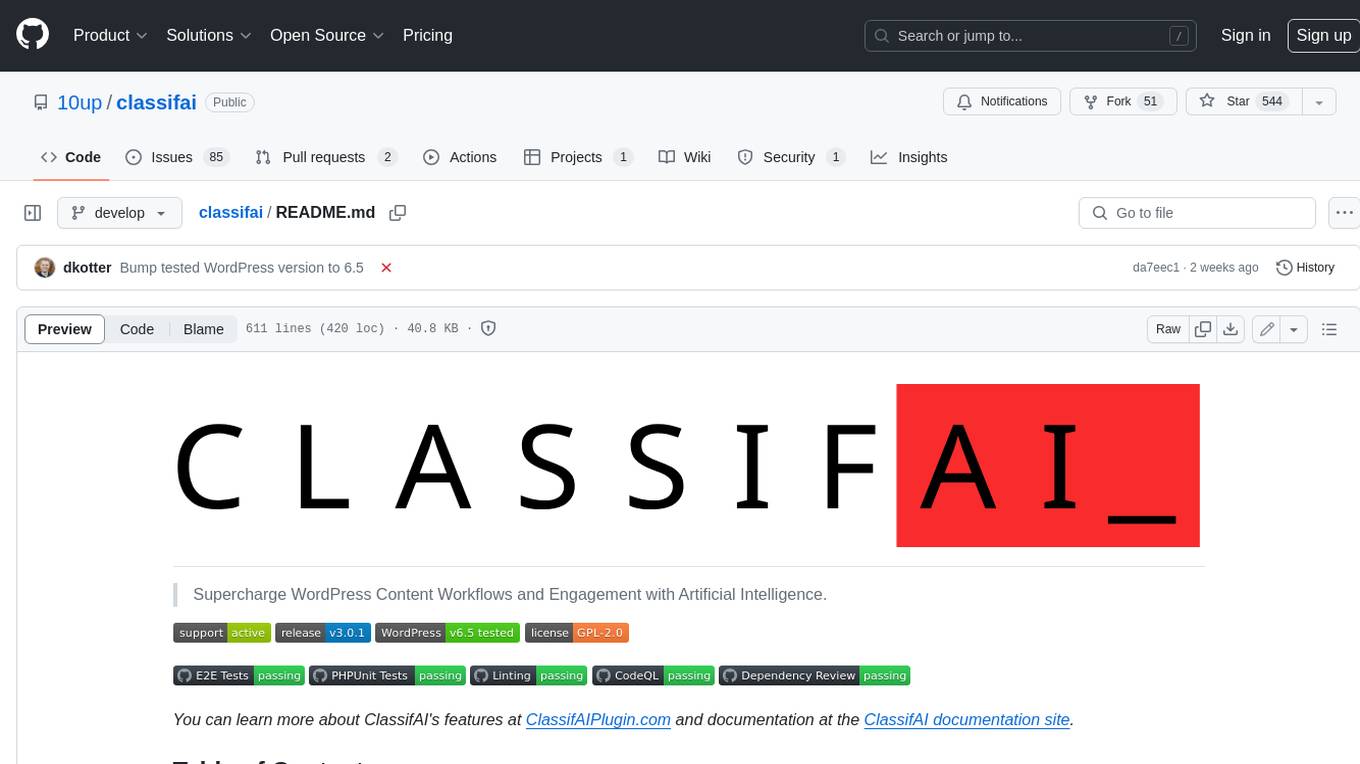
classifai
Supercharge WordPress Content Workflows and Engagement with Artificial Intelligence. Tap into leading cloud-based services like OpenAI, Microsoft Azure AI, Google Gemini and IBM Watson to augment your WordPress-powered websites. Publish content faster while improving SEO performance and increasing audience engagement. ClassifAI integrates Artificial Intelligence and Machine Learning technologies to lighten your workload and eliminate tedious tasks, giving you more time to create original content that matters.
chatbot-ui
Chatbot UI is an open-source AI chat app that allows users to create and deploy their own AI chatbots. It is easy to use and can be customized to fit any need. Chatbot UI is perfect for businesses, developers, and anyone who wants to create a chatbot.
BricksLLM
BricksLLM is a cloud native AI gateway written in Go. Currently, it provides native support for OpenAI, Anthropic, Azure OpenAI and vLLM. BricksLLM aims to provide enterprise level infrastructure that can power any LLM production use cases. Here are some use cases for BricksLLM: * Set LLM usage limits for users on different pricing tiers * Track LLM usage on a per user and per organization basis * Block or redact requests containing PIIs * Improve LLM reliability with failovers, retries and caching * Distribute API keys with rate limits and cost limits for internal development/production use cases * Distribute API keys with rate limits and cost limits for students
uAgents
uAgents is a Python library developed by Fetch.ai that allows for the creation of autonomous AI agents. These agents can perform various tasks on a schedule or take action on various events. uAgents are easy to create and manage, and they are connected to a fast-growing network of other uAgents. They are also secure, with cryptographically secured messages and wallets.
griptape
Griptape is a modular Python framework for building AI-powered applications that securely connect to your enterprise data and APIs. It offers developers the ability to maintain control and flexibility at every step. Griptape's core components include Structures (Agents, Pipelines, and Workflows), Tasks, Tools, Memory (Conversation Memory, Task Memory, and Meta Memory), Drivers (Prompt and Embedding Drivers, Vector Store Drivers, Image Generation Drivers, Image Query Drivers, SQL Drivers, Web Scraper Drivers, and Conversation Memory Drivers), Engines (Query Engines, Extraction Engines, Summary Engines, Image Generation Engines, and Image Query Engines), and additional components (Rulesets, Loaders, Artifacts, Chunkers, and Tokenizers). Griptape enables developers to create AI-powered applications with ease and efficiency.