


BharatMLStack
BharatMLStack is an open-source, end-to-end machine learning infrastructure stack built at Meesho to support real-time and batch ML workloads at Bharat scale
Stars: 617
BharatMLStack is a comprehensive, production-ready machine learning infrastructure platform designed to democratize ML capabilities across India and beyond. It provides a robust, scalable, and accessible ML stack empowering organizations to build, deploy, and manage machine learning solutions at massive scale. It includes core components like Horizon, Trufflebox UI, Online Feature Store, Go SDK, Python SDK, and Numerix, offering features such as control plane, ML management console, real-time features, mathematical compute engine, and more. The platform is production-ready, cloud agnostic, and offers observability through built-in monitoring and logging.
README:






BharatMLStack is a comprehensive, production-ready machine learning infrastructure platform designed to democratize ML capabilities across India and beyond. Our mission is to provide a robust, scalable, and accessible ML stack that empowers organizations to build, deploy, and manage machine learning solutions at massive scale.
- 🎯 Democratize Machine Learning: Make advanced ML infrastructure accessible to organizations of all sizes
- 🚀 Scale Without Limits: Built to handle millions of requests per second with enterprise-grade reliability
- 🇮🇳 Bharat-First Approach: Optimized for Indian market needs while maintaining global standards
- ⚡ Real-Time Intelligence: Enable instant decision-making with sub-millisecond feature serving
- 🔧 Developer-Friendly: Intuitive APIs and interfaces that accelerate ML development cycles
BharatMLStack is battle-tested in production environments, powering:
- 1M+ feature vector retrievals per second across distributed deployments
- Sub-10ms latency for real-time feature retrieval
- 99.99% uptime with auto-scaling and fault tolerance
- Petabyte-scale feature storage and processing
- Multi-region deployments with global load balancing
| Component | Version | Description |
|---|---|---|
| 🚀 Horizon | v1.0.0 |
Control Plane & Backend |
| 🎨 Trufflebox UI | v1.0.0 |
ML Management Console |
| 🗄️ Online Feature Store | v1.0.0 |
Real-Time Features |
| 🐹 Go SDK | v1.0.0 |
Go Client Library |
| 🐍 Python SDK | v1.0.1 |
Python Client Library |
| 🚀 Numerix | v1.0.0 |
Mathematical Compute Engine |
The central control plane for BharatMLStack components, serving as the backend for Trufflebox UI.
- Component orchestration: Manages and coordinates all BharatMLStack services
- API gateway: Unified interface for all MLOps and workflows
Modern web interface for managing ML models, features, and experiments. Currently it supports:
- Feature Registry: Centralized repository for feature definitions and metadata
- Feature Cataloging: Discovery and search capabilities for available features
- Online Feature Store Control System: Management interface for feature store operations
- Approval Flows: Workflow management for feature deployment and changes
High-performance feature store for real-time ML inference and training.
- Real-time serving: Sub-10ms feature retrieval at scale
- Streaming ingestion: Process millions of feature updates per second
- Feature Backward Compatible Versioning: Track and manage feature evolution
- Multi-source integration: Push from stream, batch and real-time sources
High-performance feature store for real-time ML inference and training.
- Matrix Operations: High-performance matrix computations and transformations
- gRPC API: Fast binary protocol for efficient data transfer
- Multi-format Support: String and byte-based matrix formats
- Optimized Performance: Built with Rust for maximum efficiency
- Scalable Architecture: Designed for distributed processing
- ✨ Production-Ready: Battle-tested components used in high-traffic production systems
- 🌐 Cloud Agnostic: Kubernetes-native, so deploy on the cloud you love
- 📊 Observability: Built-in monitoring, logging
🚀 Get started with BharatMLStack in minutes!
For comprehensive setup instructions, examples, and deployment guides, see our detailed Quick Start documentation:
- 🐳 Docker Setup: Complete stack deployment with Docker Compose
- 📊 Sample Data: Pre-configured examples to get you started
- 🔍 Health Checks: Verify your deployment is working
- 📝 Step-by-Step Tutorials: From installation to first feature operations
# Clone and start the complete stack
git clone https://github.com/Meesho/BharatMLStack.git
cd BharatMLStack/quick-start
ONFS_VERSION=<version> HORIZON_VERSION=<version> TRUFFLEBOX_VERSION=<version> NUMERIX_VERSION=<version> ./start.sh
Then follow the Quick Start Guide for detailed setup and usage instructions.
BharatMLStack follows a microservices architecture designed for scalability and maintainability. Several components are to be open-sourced

| Component | Documentation | Quick Start |
|---|---|---|
| Online Feature Store | Docs | Setup |
| Go SDK | Docs | Examples |
| Python SDK | Docs | Quickstart |
| User Guide | Docs | Setup |
| Numerix | Docs | Setup |
We welcome contributions from the community! Please see our Contributing Guide for details on how to get started.
- 💬 Discord: Join our community chat
- 🐛 Issues: Report bugs and request features on GitHub Issues
- 📧 Email: Contact us at [email protected]
BharatMLStack is open-source software licensed under the BharatMLStack Business Source License 1.1.
For Tasks:
Click tags to check more tools for each tasksFor Jobs:
Alternative AI tools for BharatMLStack
Similar Open Source Tools
BharatMLStack
BharatMLStack is a comprehensive, production-ready machine learning infrastructure platform designed to democratize ML capabilities across India and beyond. It provides a robust, scalable, and accessible ML stack empowering organizations to build, deploy, and manage machine learning solutions at massive scale. It includes core components like Horizon, Trufflebox UI, Online Feature Store, Go SDK, Python SDK, and Numerix, offering features such as control plane, ML management console, real-time features, mathematical compute engine, and more. The platform is production-ready, cloud agnostic, and offers observability through built-in monitoring and logging.
netdata
Netdata is an open-source, real-time infrastructure monitoring platform that provides instant insights, zero configuration deployment, ML-powered anomaly detection, efficient monitoring with minimal resource usage, and secure & distributed data storage. It offers real-time, per-second updates and clear insights at a glance. Netdata's origin story involves addressing the limitations of existing monitoring tools and led to a fundamental shift in infrastructure monitoring. It is recognized as the most energy-efficient tool for monitoring Docker-based systems according to a study by the University of Amsterdam.
atom
Atom is an open-source, self-hosted AI agent platform that allows users to automate workflows by interacting with AI agents. Users can speak or type requests, and Atom's specialty agents can plan, verify, and execute complex workflows across various tech stacks. Unlike SaaS alternatives, Atom runs entirely on the user's infrastructure, ensuring data privacy. The platform offers features such as voice interface, specialty agents for sales, marketing, and engineering, browser and device automation, universal memory and context, agent governance system, deep integrations, dynamic skills, and more. Atom is designed for business automation, multi-agent workflows, and enterprise governance.

EpicStaff
EpicStaff is a powerful project management tool designed to streamline team collaboration and task management. It provides a user-friendly interface for creating and assigning tasks, tracking progress, and communicating with team members in real-time. With features such as task prioritization, deadline reminders, and file sharing capabilities, EpicStaff helps teams stay organized and productive. Whether you're working on a small project or managing a large team, EpicStaff is the perfect solution to keep everyone on the same page and ensure project success.
Pulse
Pulse is a real-time monitoring tool designed for Proxmox, Docker, and Kubernetes infrastructure. It provides a unified dashboard to consolidate metrics, alerts, and AI-powered insights into a single interface. Suitable for homelabs, sysadmins, and MSPs, Pulse offers core monitoring features, AI-powered functionalities, multi-platform support, security and operations features, and community integrations. Pulse Pro unlocks advanced AI analysis and auto-fix capabilities. The tool is privacy-focused, secure by design, and offers detailed documentation for installation, configuration, security, troubleshooting, and more.
flow-like
Flow-Like is an enterprise-grade workflow operating system built upon Rust for uncompromising performance, efficiency, and code safety. It offers a modular frontend for apps, a rich set of events, a node catalog, a powerful no-code workflow IDE, and tools to manage teams, templates, and projects within organizations. With typed workflows, users can create complex, large-scale workflows with clear data origins, transformations, and contracts. Flow-Like is designed to automate any process through seamless integration of LLM, ML-based, and deterministic decision-making instances.
agentneo
AgentNeo is a Python package that provides functionalities for project, trace, dataset, experiment management. It allows users to authenticate, create projects, trace agents and LangGraph graphs, manage datasets, and run experiments with metrics. The tool aims to streamline AI project management and analysis by offering a comprehensive set of features.
Zettelgarden
Zettelgarden is a human-centric, open-source personal knowledge management system that helps users develop and maintain their understanding of the world. It focuses on creating and connecting atomic notes, thoughtful AI integration, and scalability from personal notes to company knowledge bases. The project is actively evolving, with features subject to change based on community feedback and development priorities.
rhesis
Rhesis is a comprehensive test management platform designed for Gen AI teams, offering tools to create, manage, and execute test cases for generative AI applications. It ensures the robustness, reliability, and compliance of AI systems through features like test set management, automated test generation, edge case discovery, compliance validation, integration capabilities, and performance tracking. The platform is open source, emphasizing community-driven development, transparency, extensible architecture, and democratizing AI safety. It includes components such as backend services, frontend applications, SDK for developers, worker services, chatbot applications, and Polyphemus for uncensored LLM service. Rhesis enables users to address challenges unique to testing generative AI applications, such as non-deterministic outputs, hallucinations, edge cases, ethical concerns, and compliance requirements.
MemMachine
MemMachine is an open-source long-term memory layer designed for AI agents and LLM-powered applications. It enables AI to learn, store, and recall information from past sessions, transforming stateless chatbots into personalized, context-aware assistants. With capabilities like episodic memory, profile memory, working memory, and agent memory persistence, MemMachine offers a developer-friendly API, flexible storage options, and seamless integration with various AI frameworks. It is suitable for developers, researchers, and teams needing persistent, cross-session memory for their LLM applications.
ComfyUI-Copilot
ComfyUI-Copilot is an intelligent assistant built on the Comfy-UI framework that simplifies and enhances the AI algorithm debugging and deployment process through natural language interactions. It offers intuitive node recommendations, workflow building aids, and model querying services to streamline development processes. With features like interactive Q&A bot, natural language node suggestions, smart workflow assistance, and model querying, ComfyUI-Copilot aims to lower the barriers to entry for beginners, boost development efficiency with AI-driven suggestions, and provide real-time assistance for developers.
aigne-hub
AIGNE Hub is a unified AI gateway that manages connections to multiple LLM and AIGC providers, eliminating the complexity of handling API keys, usage tracking, and billing across different AI services. It provides self-hosting capabilities, multi-provider management, unified security, usage analytics, flexible billing, and seamless integration with the AIGNE framework. The tool supports various AI providers and deployment scenarios, catering to both enterprise self-hosting and service provider modes. Users can easily deploy and configure AI providers, enable billing, and utilize core capabilities such as chat completions, image generation, embeddings, and RESTful APIs. AIGNE Hub ensures secure access, encrypted API key management, user permissions, and audit logging. Built with modern technologies like AIGNE Framework, Node.js, TypeScript, React, SQLite, and Blocklet for cloud-native deployment.
talkcody
TalkCody is a free, open-source AI coding agent designed for developers who value speed, cost, control, and privacy. It offers true freedom to use any AI model without vendor lock-in, maximum speed through unique four-level parallelism, and complete privacy as everything runs locally without leaving the user's machine. With professional-grade features like multimodal input support, MCP server compatibility, and a marketplace for agents and skills, TalkCody aims to enhance development productivity and flexibility.
learn-low-code-agentic-ai
This repository is dedicated to learning about Low-Code Full-Stack Agentic AI Development. It provides material for building modern AI-powered applications using a low-code full-stack approach. The main tools covered are UXPilot for UI/UX mockups, Lovable.dev for frontend applications, n8n for AI agents and workflows, Supabase for backend data storage, authentication, and vector search, and Model Context Protocol (MCP) for integration. The focus is on prompt and context engineering as the foundation for working with AI systems, enabling users to design, develop, and deploy AI-driven full-stack applications faster, smarter, and more reliably.
kserve
KServe provides a Kubernetes Custom Resource Definition for serving predictive and generative machine learning (ML) models. It encapsulates the complexity of autoscaling, networking, health checking, and server configuration to bring cutting edge serving features like GPU Autoscaling, Scale to Zero, and Canary Rollouts to ML deployments. KServe enables a simple, pluggable, and complete story for Production ML Serving including prediction, pre-processing, post-processing, and explainability. It is a standard, cloud agnostic Model Inference Platform for serving predictive and generative AI models on Kubernetes, built for highly scalable use cases.
astron-agent
Astron Agent is an enterprise-grade, commercial-friendly Agentic Workflow development platform that integrates AI workflow orchestration, model management, AI and MCP tool integration, RPA automation, and team collaboration features. It supports high-availability deployment, enabling organizations to rapidly build scalable, production-ready intelligent agent applications and establish their AI foundation for the future. The platform is stable, reliable, and business-friendly, with key features such as enterprise-grade high availability, intelligent RPA integration, ready-to-use tool ecosystem, and flexible large model support.
For similar tasks
katib
Katib is a Kubernetes-native project for automated machine learning (AutoML). Katib supports Hyperparameter Tuning, Early Stopping and Neural Architecture Search. Katib is the project which is agnostic to machine learning (ML) frameworks. It can tune hyperparameters of applications written in any language of the users’ choice and natively supports many ML frameworks, such as TensorFlow, Apache MXNet, PyTorch, XGBoost, and others. Katib can perform training jobs using any Kubernetes Custom Resources with out of the box support for Kubeflow Training Operator, Argo Workflows, Tekton Pipelines and many more.
cog
Cog is an open-source tool that lets you package machine learning models in a standard, production-ready container. You can deploy your packaged model to your own infrastructure, or to Replicate.
mosec
Mosec is a high-performance and flexible model serving framework for building ML model-enabled backend and microservices. It bridges the gap between any machine learning models you just trained and the efficient online service API. * **Highly performant** : web layer and task coordination built with Rust 🦀, which offers blazing speed in addition to efficient CPU utilization powered by async I/O * **Ease of use** : user interface purely in Python 🐍, by which users can serve their models in an ML framework-agnostic manner using the same code as they do for offline testing * **Dynamic batching** : aggregate requests from different users for batched inference and distribute results back * **Pipelined stages** : spawn multiple processes for pipelined stages to handle CPU/GPU/IO mixed workloads * **Cloud friendly** : designed to run in the cloud, with the model warmup, graceful shutdown, and Prometheus monitoring metrics, easily managed by Kubernetes or any container orchestration systems * **Do one thing well** : focus on the online serving part, users can pay attention to the model optimization and business logic
web-llm
WebLLM is a modular and customizable javascript package that directly brings language model chats directly onto web browsers with hardware acceleration. Everything runs inside the browser with no server support and is accelerated with WebGPU. WebLLM is fully compatible with OpenAI API. That is, you can use the same OpenAI API on any open source models locally, with functionalities including json-mode, function-calling, streaming, etc. We can bring a lot of fun opportunities to build AI assistants for everyone and enable privacy while enjoying GPU acceleration.
data-scientist-roadmap2024
The Data Scientist Roadmap2024 provides a comprehensive guide to mastering essential tools for data science success. It includes programming languages, machine learning libraries, cloud platforms, and concepts categorized by difficulty. The roadmap covers a wide range of topics from programming languages to machine learning techniques, data visualization tools, and DevOps/MLOps tools. It also includes web development frameworks and specific concepts like supervised and unsupervised learning, NLP, deep learning, reinforcement learning, and statistics. Additionally, it delves into DevOps tools like Airflow and MLFlow, data visualization tools like Tableau and Matplotlib, and other topics such as ETL processes, optimization algorithms, and financial modeling.
aibydoing-feedback
AI By Doing is a hands-on artificial intelligence tutorial series that aims to help beginners understand the principles of machine learning and deep learning while providing practical applications. The content covers various supervised and unsupervised learning algorithms, machine learning engineering, deep learning fundamentals, frameworks like TensorFlow and PyTorch, and applications in computer vision and natural language processing. The tutorials are written in Jupyter Notebook format, combining theory, mathematical derivations, and Python code implementations to facilitate learning and understanding.
runbooks
Runbooks is a repository that is no longer active. The project has been deprecated in favor of KubeAI, a platform designed to simplify the operationalization of AI on Kubernetes. For more information, please refer to the new repository at https://github.com/substratusai/kubeai.
Ultimate-Data-Science-Toolkit---From-Python-Basics-to-GenerativeAI
Ultimate Data Science Toolkit is a comprehensive repository covering Python basics to Generative AI. It includes modules on Python programming, data analysis, statistics, machine learning, MLOps, case studies, and deep learning. The repository provides detailed tutorials on various topics such as Python data structures, control statements, functions, modules, object-oriented programming, exception handling, file handling, web API, databases, list comprehension, lambda functions, Pandas, Numpy, data visualization, statistical analysis, supervised and unsupervised machine learning algorithms, model serialization, ML pipeline orchestration, case studies, and deep learning concepts like neural networks and autoencoders.
For similar jobs
llm-resource
llm-resource is a comprehensive collection of high-quality resources for Large Language Models (LLM). It covers various aspects of LLM including algorithms, training, fine-tuning, alignment, inference, data engineering, compression, evaluation, prompt engineering, AI frameworks, AI basics, AI infrastructure, AI compilers, LLM application development, LLM operations, AI systems, and practical implementations. The repository aims to gather and share valuable resources related to LLM for the community to benefit from.
LitServe
LitServe is a high-throughput serving engine designed for deploying AI models at scale. It generates an API endpoint for models, handles batching, streaming, and autoscaling across CPU/GPUs. LitServe is built for enterprise scale with a focus on minimal, hackable code-base without bloat. It supports various model types like LLMs, vision, time-series, and works with frameworks like PyTorch, JAX, Tensorflow, and more. The tool allows users to focus on model performance rather than serving boilerplate, providing full control and flexibility.
how-to-optim-algorithm-in-cuda
This repository documents how to optimize common algorithms based on CUDA. It includes subdirectories with code implementations for specific optimizations. The optimizations cover topics such as compiling PyTorch from source, NVIDIA's reduce optimization, OneFlow's elementwise template, fast atomic add for half data types, upsample nearest2d optimization in OneFlow, optimized indexing in PyTorch, OneFlow's softmax kernel, linear attention optimization, and more. The repository also includes learning resources related to deep learning frameworks, compilers, and optimization techniques.
aiac
AIAC is a library and command line tool to generate Infrastructure as Code (IaC) templates, configurations, utilities, queries, and more via LLM providers such as OpenAI, Amazon Bedrock, and Ollama. Users can define multiple 'backends' targeting different LLM providers and environments using a simple configuration file. The tool allows users to ask a model to generate templates for different scenarios and composes an appropriate request to the selected provider, storing the resulting code to a file and/or printing it to standard output.
ENOVA
ENOVA is an open-source service for Large Language Model (LLM) deployment, monitoring, injection, and auto-scaling. It addresses challenges in deploying stable serverless LLM services on GPU clusters with auto-scaling by deconstructing the LLM service execution process and providing configuration recommendations and performance detection. Users can build and deploy LLM with few command lines, recommend optimal computing resources, experience LLM performance, observe operating status, achieve load balancing, and more. ENOVA ensures stable operation, cost-effectiveness, efficiency, and strong scalability of LLM services.
jina
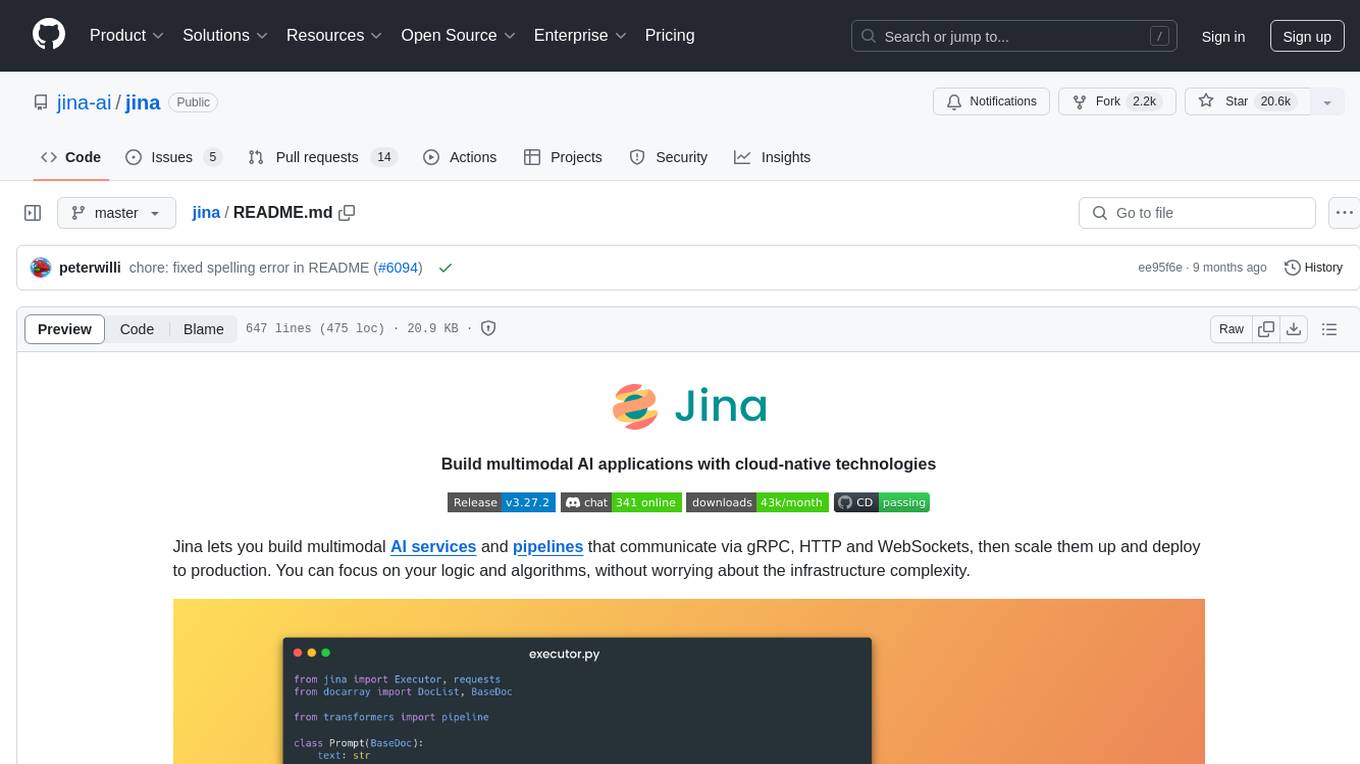
Jina is a tool that allows users to build multimodal AI services and pipelines using cloud-native technologies. It provides a Pythonic experience for serving ML models and transitioning from local deployment to advanced orchestration frameworks like Docker-Compose, Kubernetes, or Jina AI Cloud. Users can build and serve models for any data type and deep learning framework, design high-performance services with easy scaling, serve LLM models while streaming their output, integrate with Docker containers via Executor Hub, and host on CPU/GPU using Jina AI Cloud. Jina also offers advanced orchestration and scaling capabilities, a smooth transition to the cloud, and easy scalability and concurrency features for applications. Users can deploy to their own cloud or system with Kubernetes and Docker Compose integration, and even deploy to JCloud for autoscaling and monitoring.
vidur
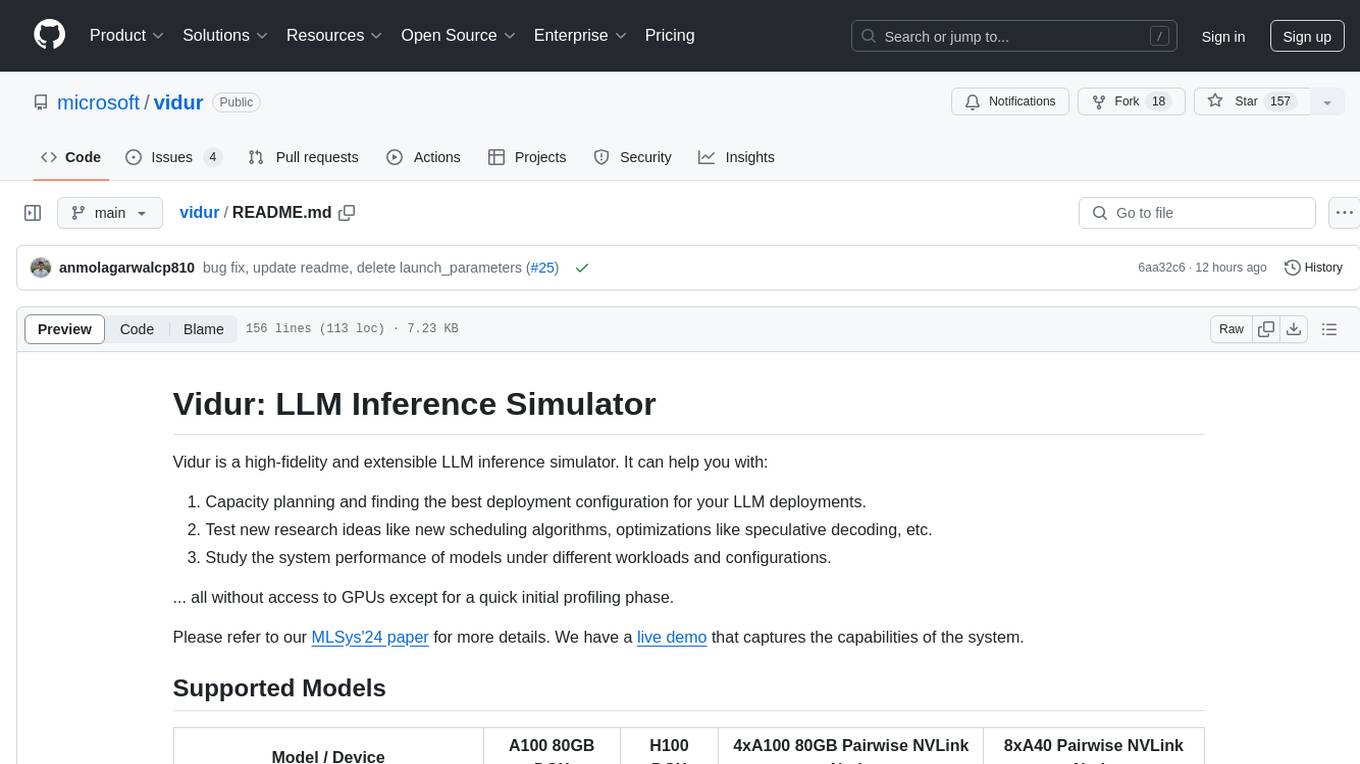
Vidur is a high-fidelity and extensible LLM inference simulator designed for capacity planning, deployment configuration optimization, testing new research ideas, and studying system performance of models under different workloads and configurations. It supports various models and devices, offers chrome trace exports, and can be set up using mamba, venv, or conda. Users can run the simulator with various parameters and monitor metrics using wandb. Contributions are welcome, subject to a Contributor License Agreement and adherence to the Microsoft Open Source Code of Conduct.
AI-System-School
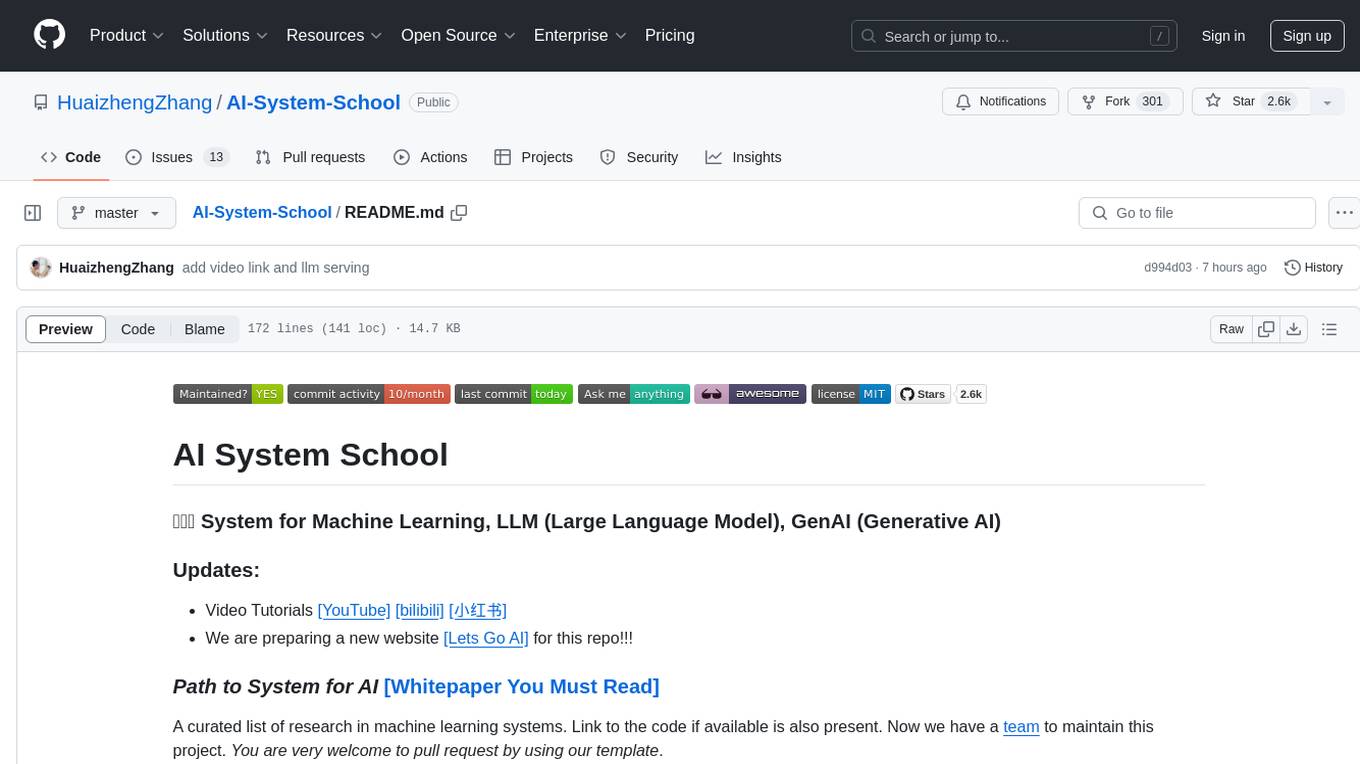
AI System School is a curated list of research in machine learning systems, focusing on ML/DL infra, LLM infra, domain-specific infra, ML/LLM conferences, and general resources. It provides resources such as data processing, training systems, video systems, autoML systems, and more. The repository aims to help users navigate the landscape of AI systems and machine learning infrastructure, offering insights into conferences, surveys, books, videos, courses, and blogs related to the field.