


MemMachine
Universal memory layer for AI Agents. It provides scalable, extensible, and interoperable memory storage and retrieval to streamline AI agent state management for next-generation autonomous systems.
Stars: 4447
MemMachine is an open-source long-term memory layer designed for AI agents and LLM-powered applications. It enables AI to learn, store, and recall information from past sessions, transforming stateless chatbots into personalized, context-aware assistants. With capabilities like episodic memory, profile memory, working memory, and agent memory persistence, MemMachine offers a developer-friendly API, flexible storage options, and seamless integration with various AI frameworks. It is suitable for developers, researchers, and teams needing persistent, cross-session memory for their LLM applications.
README:

The open-source memory layer for AI agents.
Stop building stateless agents. Give your AI persistent memory with just 5 lines of code.








MemMachine is an open-source long-term memory layer for AI agents and LLM-powered applications. It enables your AI to learn, store, and recall information from past sessions—transforming stateless chatbots into personalized, context-aware assistants.
- Episodic Memory: Graph-based conversational context that persists across sessions
- Profile Memory: Long-term user facts and preferences stored in SQL
- Working Memory: Short-term context for the current session
- Agent Memory Persistence: Memory that survives restarts, sessions, and even model changes
Get up and running in under 5 minutes:
Prerequisites: This code requires a running MemMachine Server.
Start a server locally or create a free account on the MemMachine Platform.
pip install memmachine-clientfrom memmachine import MemMachineClient
# Initialize the client
client = MemMachineClient(base_url="http://localhost:8080")
# Get or create a project
project = client.get_or_create_project(org_id="my_org", project_id="my_project")
# Create a memory instance for a user session
memory = project.memory(
group_id="default",
agent_id="travel_agent",
user_id="alice",
session_id="session_001"
)
# Add a memory
memory.add("I prefer aisle seats on flights", metadata={"category": "travel"})
# => [AddMemoryResult(uid='...')]
# Search memories
results = memory.search("What are my flight preferences?")
print(results.content.episodic_memory.long_term_memory.episodes[0].content)
# => "I prefer aisle seats on flights"For full installation options (Docker, self-hosted, cloud), visit the Quick Start Guide.
MemMachine works seamlessly with your favorite AI frameworks:
| Framework | Description |
|---|---|
| LangChain | Memory provider for LangChain agents |
| LangGraph | Stateful memory for LangGraph workflows |
| CrewAI | Persistent memory for CrewAI multi-agent systems |
| LlamaIndex | Memory integration for LlamaIndex applications |
| AWS Strands | Memory for AWS Strands Agent SDK |
| n8n | No-code workflow automation integration |
| Dify | Memory backend for Dify AI applications |
| FastGPT | Integration with FastGPT platform |
MemMachine includes a native Model Context Protocol (MCP) server for seamless integration with Claude Desktop, Cursor, and other MCP-compatible clients:
# Stdio mode (for Claude Desktop)
memmachine-mcp-stdio

# HTTP mode (for web clients)
memmachine-mcp-http
See the MCP documentation for setup instructions.
- Developers building AI agents, assistants, or autonomous workflows
- Researchers experimenting with agent architectures and cognitive models
- Teams who need persistent, cross-session memory for their LLM applications
- Multiple Memory Types: Working (short-term), Episodic (long-term conversational), and Profile (user facts) memory
- Developer-Friendly APIs: Python SDK, RESTful API, TypeScript SDK, and MCP server interfaces
- Flexible Storage: Graph database (Neo4j) for episodic memory, SQL for profiles
- LLM Agnostic: Works with OpenAI, Anthropic, Bedrock, Ollama, and any LLM provider
- Self-Hosted or Cloud: Run locally, in Docker, or use our managed service
For more information, refer to the API Reference Guide.
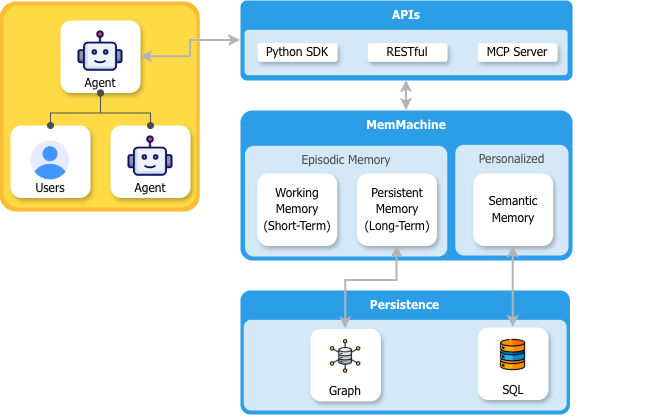
- Agents interact via the API Layer: Users interact with an agent, which connects to MemMachine through a RESTful API, Python SDK, or MCP Server.
- MemMachine manages memory: Processes interactions and stores them as Episodic Memory (conversational context) and Profile Memory (long-term user facts).
- Data is persisted: Episodic memory is stored in a graph database; profile memory is stored in SQL.
MemMachine's versatile memory architecture can be applied across any domain. Explore our examples to see memory-powered agents in action:
| Agent | Description |
|---|---|
| CRM Agent | Recalls client history and deal stages to help sales teams close faster |
| Healthcare Navigator | Remembers medical history and tracks treatment progress |
| Personal Finance Advisor | Stores portfolio preferences and risk tolerance for personalized insights |
| Writing Assistant | Learns your style guide and terminology for consistent content |
Are you using MemMachine in your project? We'd love to feature you!
- Share your project in GitHub Discussions → Showcase
- Drop a message in our Discord #showcase channel
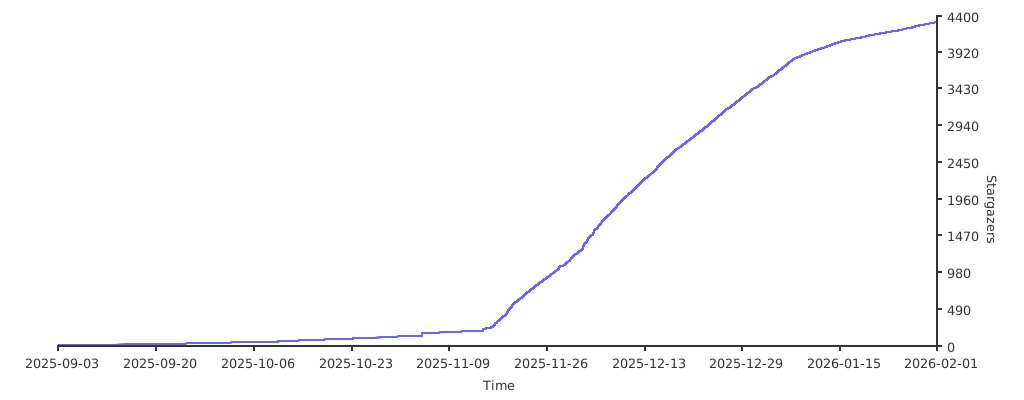
MemMachine is a growing community of builders and developers. Help us grow by clicking the ⭐ Star button above!
- Main Website – Learn about MemMachine
- Docs & API Reference – Full documentation
- Quick Start Guide – Get started in minutes
- Discord: Join our community for support, updates, and discussions: https://discord.gg/usydANvKqD
- Issues & Feature Requests: Use GitHub Issues
We welcome contributions! Please see our CONTRIBUTING.md for guidelines.
MemMachine is released under the Apache 2.0 License.
For Tasks:
Click tags to check more tools for each tasksFor Jobs:
Alternative AI tools for MemMachine
Similar Open Source Tools
MemMachine
MemMachine is an open-source long-term memory layer designed for AI agents and LLM-powered applications. It enables AI to learn, store, and recall information from past sessions, transforming stateless chatbots into personalized, context-aware assistants. With capabilities like episodic memory, profile memory, working memory, and agent memory persistence, MemMachine offers a developer-friendly API, flexible storage options, and seamless integration with various AI frameworks. It is suitable for developers, researchers, and teams needing persistent, cross-session memory for their LLM applications.
lancedb
LanceDB is an open-source database for vector-search built with persistent storage, which greatly simplifies retrieval, filtering, and management of embeddings. The key features of LanceDB include: Production-scale vector search with no servers to manage. Store, query, and filter vectors, metadata, and multi-modal data (text, images, videos, point clouds, and more). Support for vector similarity search, full-text search, and SQL. Native Python and Javascript/Typescript support. Zero-copy, automatic versioning, manage versions of your data without needing extra infrastructure. GPU support in building vector index(*). Ecosystem integrations with LangChain 🦜️🔗, LlamaIndex 🦙, Apache-Arrow, Pandas, Polars, DuckDB, and more on the way. LanceDB's core is written in Rust 🦀 and is built using Lance, an open-source columnar format designed for performant ML workloads.
EvoAgentX
EvoAgentX is an open-source framework for building, evaluating, and evolving LLM-based agents or agentic workflows in an automated, modular, and goal-driven manner. It enables developers and researchers to move beyond static prompt chaining or manual workflow orchestration by introducing a self-evolving agent ecosystem. The framework includes features such as agent workflow autoconstruction, built-in evaluation, self-evolution engine, plug-and-play compatibility, comprehensive built-in tools, memory module support, and human-in-the-loop interactions.
MemOS
MemOS is an operating system for Large Language Models (LLMs) that enhances them with long-term memory capabilities. It allows LLMs to store, retrieve, and manage information, enabling more context-aware, consistent, and personalized interactions. MemOS provides Memory-Augmented Generation (MAG) with a unified API for memory operations, a Modular Memory Architecture (MemCube) for easy integration and management of different memory types, and multiple memory types including Textual Memory, Activation Memory, and Parametric Memory. It is extensible, allowing users to customize memory modules, data sources, and LLM integrations. MemOS demonstrates significant improvements over baseline memory solutions in multiple reasoning tasks, with a notable improvement in temporal reasoning accuracy compared to the OpenAI baseline.
sandboxed.sh
sandboxed.sh is a self-hosted cloud orchestrator for AI coding agents that provides isolated Linux workspaces with Claude Code, OpenCode & Amp runtimes. It allows users to hand off entire development cycles, run multi-day operations unattended, and keep sensitive data local by analyzing data against scientific literature. The tool features dual runtime support, mission control for remote agent management, isolated workspaces, a git-backed library, MCP registry, and multi-platform support with a web dashboard and iOS app.
AionUi
AionUi is a user interface library for building modern and responsive web applications. It provides a set of customizable components and styles to create visually appealing user interfaces. With AionUi, developers can easily design and implement interactive web interfaces that are both functional and aesthetically pleasing. The library is built using the latest web technologies and follows best practices for performance and accessibility. Whether you are working on a personal project or a professional application, AionUi can help you streamline the UI development process and deliver a seamless user experience.
memU
MemU is an open-source memory framework designed for AI companions, offering high accuracy, fast retrieval, and cost-effectiveness. It serves as an intelligent 'memory folder' that adapts to various AI companion scenarios. With MemU, users can create AI companions that remember them, learn their preferences, and evolve through interactions. The framework provides advanced retrieval strategies, 24/7 support, and is specialized for AI companions. MemU offers cloud, enterprise, and self-hosting options, with features like memory organization, interconnected knowledge graph, continuous self-improvement, and adaptive forgetting mechanism. It boasts high memory accuracy, fast retrieval, and low cost, making it suitable for building intelligent agents with persistent memory capabilities.
netdata
Netdata is an open-source, real-time infrastructure monitoring platform that provides instant insights, zero configuration deployment, ML-powered anomaly detection, efficient monitoring with minimal resource usage, and secure & distributed data storage. It offers real-time, per-second updates and clear insights at a glance. Netdata's origin story involves addressing the limitations of existing monitoring tools and led to a fundamental shift in infrastructure monitoring. It is recognized as the most energy-efficient tool for monitoring Docker-based systems according to a study by the University of Amsterdam.
natively-cluely-ai-assistant
Natively is a free, open-source, privacy-first AI assistant designed to help users in real time during meetings, interviews, presentations, and conversations. Unlike traditional AI tools that work after the conversation, Natively operates while the conversation is happening. It runs as an invisible, always-on-top desktop overlay, listens when prompted, observes the screen content, and provides instant, context-aware assistance. The tool is fully transparent, customizable, and grants users complete control over local vs cloud AI, data, and credentials.
ComfyUI-Copilot
ComfyUI-Copilot is an intelligent assistant built on the Comfy-UI framework that simplifies and enhances the AI algorithm debugging and deployment process through natural language interactions. It offers intuitive node recommendations, workflow building aids, and model querying services to streamline development processes. With features like interactive Q&A bot, natural language node suggestions, smart workflow assistance, and model querying, ComfyUI-Copilot aims to lower the barriers to entry for beginners, boost development efficiency with AI-driven suggestions, and provide real-time assistance for developers.
AgC
AgC is an open-core platform designed for deploying, running, and orchestrating AI agents at scale. It treats agents as first-class compute units, providing a modular, observable, cloud-neutral, and production-ready environment. Open Agentic Compute empowers developers and organizations to run agents like cloud-native workloads without lock-in.
chatbox
Chatbox is a desktop client for ChatGPT, Claude, and other LLMs, providing features like local data storage, multiple LLM provider support, image generation, enhanced prompting, keyboard shortcuts, and more. It offers a user-friendly interface with dark theme, team collaboration, cross-platform availability, web version access, iOS & Android apps, multilingual support, and ongoing feature enhancements. Developed for prompt and API debugging, it has gained popularity for daily chatting and professional role-playing with AI assistance.
chatbox
Chatbox is a desktop client for ChatGPT, Claude, and other LLMs, providing a user-friendly interface for AI copilot assistance on Windows, Mac, and Linux. It offers features like local data storage, multiple LLM provider support, image generation with Dall-E-3, enhanced prompting, keyboard shortcuts, and more. Users can collaborate, access the tool on various platforms, and enjoy multilingual support. Chatbox is constantly evolving with new features to enhance the user experience.
LynxHub
LynxHub is a platform that allows users to seamlessly install, configure, launch, and manage all their AI interfaces from a single, intuitive dashboard. It offers features like AI interface management, arguments manager, custom run commands, pre-launch actions, extension management, in-app tools like terminal and web browser, AI information dashboard, Discord integration, and additional features like theme options and favorite interface pinning. The platform supports modular design for custom AI modules and upcoming extensions system for complete customization. LynxHub aims to streamline AI workflow and enhance user experience with a user-friendly interface and comprehensive functionalities.
GMTalker
GMTalker is an interactive digital human rendered by Unreal Engine, developed by the Media Intelligence Team at Bright Laboratory. The system integrates speech recognition, speech synthesis, natural language understanding, and lip-sync animation driving. It supports rapid deployment on Windows with only 2GB of VRAM required. The project showcases two 3D cartoon digital human avatars suitable for presentations, expansions, and commercial integration.
neuropilot
NeuroPilot is an open-source AI-powered education platform that transforms study materials into interactive learning resources. It provides tools like contextual chat, smart notes, flashcards, quizzes, and AI podcasts. Supported by various AI models and embedding providers, it offers features like WebSocket streaming, JSON or vector database support, file-based storage, and configurable multi-provider setup for LLMs and TTS engines. The technology stack includes Node.js, TypeScript, Vite, React, TailwindCSS, JSON database, multiple LLM providers, and Docker for deployment. Users can contribute to the project by integrating AI models, adding mobile app support, improving performance, enhancing accessibility features, and creating documentation and tutorials.
For similar tasks
MemMachine
MemMachine is an open-source long-term memory layer designed for AI agents and LLM-powered applications. It enables AI to learn, store, and recall information from past sessions, transforming stateless chatbots into personalized, context-aware assistants. With capabilities like episodic memory, profile memory, working memory, and agent memory persistence, MemMachine offers a developer-friendly API, flexible storage options, and seamless integration with various AI frameworks. It is suitable for developers, researchers, and teams needing persistent, cross-session memory for their LLM applications.
For similar jobs
promptflow
**Prompt flow** is a suite of development tools designed to streamline the end-to-end development cycle of LLM-based AI applications, from ideation, prototyping, testing, evaluation to production deployment and monitoring. It makes prompt engineering much easier and enables you to build LLM apps with production quality.
deepeval
DeepEval is a simple-to-use, open-source LLM evaluation framework specialized for unit testing LLM outputs. It incorporates various metrics such as G-Eval, hallucination, answer relevancy, RAGAS, etc., and runs locally on your machine for evaluation. It provides a wide range of ready-to-use evaluation metrics, allows for creating custom metrics, integrates with any CI/CD environment, and enables benchmarking LLMs on popular benchmarks. DeepEval is designed for evaluating RAG and fine-tuning applications, helping users optimize hyperparameters, prevent prompt drifting, and transition from OpenAI to hosting their own Llama2 with confidence.
MegaDetector
MegaDetector is an AI model that identifies animals, people, and vehicles in camera trap images (which also makes it useful for eliminating blank images). This model is trained on several million images from a variety of ecosystems. MegaDetector is just one of many tools that aims to make conservation biologists more efficient with AI. If you want to learn about other ways to use AI to accelerate camera trap workflows, check out our of the field, affectionately titled "Everything I know about machine learning and camera traps".
leapfrogai
LeapfrogAI is a self-hosted AI platform designed to be deployed in air-gapped resource-constrained environments. It brings sophisticated AI solutions to these environments by hosting all the necessary components of an AI stack, including vector databases, model backends, API, and UI. LeapfrogAI's API closely matches that of OpenAI, allowing tools built for OpenAI/ChatGPT to function seamlessly with a LeapfrogAI backend. It provides several backends for various use cases, including llama-cpp-python, whisper, text-embeddings, and vllm. LeapfrogAI leverages Chainguard's apko to harden base python images, ensuring the latest supported Python versions are used by the other components of the stack. The LeapfrogAI SDK provides a standard set of protobuffs and python utilities for implementing backends and gRPC. LeapfrogAI offers UI options for common use-cases like chat, summarization, and transcription. It can be deployed and run locally via UDS and Kubernetes, built out using Zarf packages. LeapfrogAI is supported by a community of users and contributors, including Defense Unicorns, Beast Code, Chainguard, Exovera, Hypergiant, Pulze, SOSi, United States Navy, United States Air Force, and United States Space Force.
llava-docker
This Docker image for LLaVA (Large Language and Vision Assistant) provides a convenient way to run LLaVA locally or on RunPod. LLaVA is a powerful AI tool that combines natural language processing and computer vision capabilities. With this Docker image, you can easily access LLaVA's functionalities for various tasks, including image captioning, visual question answering, text summarization, and more. The image comes pre-installed with LLaVA v1.2.0, Torch 2.1.2, xformers 0.0.23.post1, and other necessary dependencies. You can customize the model used by setting the MODEL environment variable. The image also includes a Jupyter Lab environment for interactive development and exploration. Overall, this Docker image offers a comprehensive and user-friendly platform for leveraging LLaVA's capabilities.

carrot
The 'carrot' repository on GitHub provides a list of free and user-friendly ChatGPT mirror sites for easy access. The repository includes sponsored sites offering various GPT models and services. Users can find and share sites, report errors, and access stable and recommended sites for ChatGPT usage. The repository also includes a detailed list of ChatGPT sites, their features, and accessibility options, making it a valuable resource for ChatGPT users seeking free and unlimited GPT services.
TrustLLM
TrustLLM is a comprehensive study of trustworthiness in LLMs, including principles for different dimensions of trustworthiness, established benchmark, evaluation, and analysis of trustworthiness for mainstream LLMs, and discussion of open challenges and future directions. Specifically, we first propose a set of principles for trustworthy LLMs that span eight different dimensions. Based on these principles, we further establish a benchmark across six dimensions including truthfulness, safety, fairness, robustness, privacy, and machine ethics. We then present a study evaluating 16 mainstream LLMs in TrustLLM, consisting of over 30 datasets. The document explains how to use the trustllm python package to help you assess the performance of your LLM in trustworthiness more quickly. For more details about TrustLLM, please refer to project website.
AI-YinMei
AI-YinMei is an AI virtual anchor Vtuber development tool (N card version). It supports fastgpt knowledge base chat dialogue, a complete set of solutions for LLM large language models: [fastgpt] + [one-api] + [Xinference], supports docking bilibili live broadcast barrage reply and entering live broadcast welcome speech, supports Microsoft edge-tts speech synthesis, supports Bert-VITS2 speech synthesis, supports GPT-SoVITS speech synthesis, supports expression control Vtuber Studio, supports painting stable-diffusion-webui output OBS live broadcast room, supports painting picture pornography public-NSFW-y-distinguish, supports search and image search service duckduckgo (requires magic Internet access), supports image search service Baidu image search (no magic Internet access), supports AI reply chat box [html plug-in], supports AI singing Auto-Convert-Music, supports playlist [html plug-in], supports dancing function, supports expression video playback, supports head touching action, supports gift smashing action, supports singing automatic start dancing function, chat and singing automatic cycle swing action, supports multi scene switching, background music switching, day and night automatic switching scene, supports open singing and painting, let AI automatically judge the content.