


atom
Atom Agent, automate your workflows by talking to an AI — and let it remember, search, and handle tasks like a real assistant
Stars: 695
Atom is an open-source, self-hosted AI agent platform that allows users to automate workflows by interacting with AI agents. Users can speak or type requests, and Atom's specialty agents can plan, verify, and execute complex workflows across various tech stacks. Unlike SaaS alternatives, Atom runs entirely on the user's infrastructure, ensuring data privacy. The platform offers features such as voice interface, specialty agents for sales, marketing, and engineering, browser and device automation, universal memory and context, agent governance system, deep integrations, dynamic skills, and more. Atom is designed for business automation, multi-agent workflows, and enterprise governance.
README:
Developer Note: For technical setup and architecture, see docs/DEVELOPMENT.md.
Automate your workflows by talking to an AI — and let it remember, search, and handle tasks like a real assistant.


Atom is an open-source, self-hosted AI agent platform that combines visual workflow builders with intelligent LLM-based agents.
Just speak or type your request, and Atom's specialty agents will plan, verify, and execute complex workflows across your entire tech stack.
Key Difference: Unlike SaaS alternatives, Atom runs entirely on your infrastructure. Your data never leaves your environment.
Comparing alternatives? See Atom vs OpenClaw for a detailed feature comparison with other open-source AI automation platforms.
| Aspect | Atom | OpenClaw |
|---|---|---|
| Best For | Business automation, multi-agent workflows, enterprise governance | Personal productivity, messaging-based workflows |
| Agent Model | Multi-agent system with specialty agents | Single-agent runtime |
| Governance | ✅ 4-tier maturity (Student → Autonomous) with audit trails | ❌ No maturity levels |
| Memory | ✅ Episodic memory with graduation validation | ✅ Persistent Markdown files |
| Integrations | 46+ business (CRM, support, dev tools) | 50+ personal (smart home, media, messaging) |
| Architecture | Python + FastAPI + PostgreSQL/SQLite | Node.js + local filesystem |
| Real-Time Visibility | ✅ Canvas, operation tracking, error resolution | ❌ No operation visibility |
| Setup | Docker Compose (~15-30 min) | Single script (~10-30 min) |
| Primary Focus | Business process automation with safety guardrails | Personal assistant with rapid experimentation |
- Build complex workflows using just your voice
- Natural language understanding — no proprietary syntax to learn
- Real-time feedback as Atom visualizes its reasoning
- Sales Agent: CRM pipelines, lead scoring, outreach
- Marketing Agent: Campaigns, social posting, analytics
- Engineering Agent: PR notifications, deployments, incidents
- Governance: Agents progress from "Student" to "Autonomous" as they gain trust
- Rich interactive presentations (charts, forms, markdown)
- Real-time operation visibility: See exactly what agents are doing in plain English
- Multi-view orchestration (browser, terminal, canvas)
- Smart error resolution with actionable suggestions
- Complete transparency and governance integration
- Browser automation via CDP (web scraping, form filling)
- Device control (camera, location, notifications, terminal)
- Governance-first: all actions require appropriate maturity level
- Capability Recall: Agents remember your connected services
- Unified Index: Search emails, docs, tickets, and Slack instantly
- Knowledge Graph: Understands relationships, not just keywords
- Episodic Memory: Agents learn from past experiences with automatic segmentation
- Graduation Validation: Promote agents only when they demonstrate reliable performance
- Privacy First: API keys and PII automatically encrypted
- Agents progress from 'Student' → 'Autonomous' based on performance
- Maturity-based routing: Student agents blocked from automated triggers
- AI-powered training: Personalized learning scenarios with duration estimation
- Sensitive actions require approval until confidence is high
- Every action logged, timestamped, and traceable
- Real-time supervision for learning agents
- 46+ pre-built integrations: Slack, Gmail, HubSpot, Salesforce, etc.
- 9 fully implemented messaging platforms: Slack, Discord, Teams, WhatsApp, Telegram, Google Chat, Signal, Facebook Messenger, LINE
- Proactive messaging, scheduled messages, and condition monitoring
- Use
/run,/workflow,/agentsfrom your favorite chat app
Platform Guide → | Messaging Features →
- Agents build new tools on-the-fly
- Skill Runner UI to test and execute agent skills
- Real-time streaming execution
Fastest way (Docker):
git clone https://github.com/rush86999/atom.git
cd atom
docker-compose up -d
Access at: http://localhost:3000
| Department | Scenario |
|---|---|
| Sales | New lead in HubSpot → Research company → Score lead → Slack the account executive |
| Finance | PDF invoice in Gmail → Extract data → Match against QuickBooks → Flag discrepancies |
| Support | Zendesk ticket arrives → Analyze sentiment → Route urgent issues → Draft response |
| HR | New employee in BambooHR → Provision Google account → Invite to Slack → Schedule orientation |
- Self-Hosted Only: Your data never leaves your environment
- BYOK: Bring your own OpenAI, Anthropic, Gemini, or DeepSeek keys
- Encrypted Storage: Sensitive data encrypted at-rest (Fernet)
- Audit Logs: Every agent action logged and traceable
- Human-in-the-Loop: Configurable approval policies
✅ Complete backend (FastAPI) + frontend (Next.js) + desktop app (Tauri) ✅ 46+ pre-built integrations ✅ Multi-platform communication bridge (12+ platforms) ✅ Agent governance and maturity system ✅ Episodic memory and graduation framework ✅ Memory and knowledge graph ✅ Voice interface ✅ Docker deployment
- Experience-based learning: Agents automatically segment, store, and retrieve past experiences
- Hybrid storage architecture: PostgreSQL (hot data) + LanceDB (cold archives) for efficient scaling
- Four retrieval modes: Temporal (time-based), Semantic (vector search), Sequential (full episodes), Contextual (hybrid)
- Graduation validation: Assess agent readiness using episodic memory before maturity promotions
- Constitutional compliance: Track intervention rates and validate against governance rules
- Use cases: MedScribe (clinical documentation), Brennan.ca (pricing validation), workflow optimization
- Full Documentation →
- Maturity-based routing: Prevents STUDENT agents from automated triggers
- AI training proposals: Personalized learning with duration estimation
- Real-time supervision: Monitor SUPERVISED agents with intervention controls
- Action proposals: INTERN agents require human approval before execution
- Confidence boosting: Performance-based maturity progression
- Full Documentation →
- Real-time operation tracking with plain English explanations
- Multi-view orchestration (browser, terminal, canvas)
- Smart error resolution with learning feedback
- Interactive permission/decision requests
- Auto-recording: Autonomous agents automatically record sessions for governance
- AI-powered review: Analyzes recordings to update agent confidence
- Learning loop: Successful/failed patterns feed into world model
- Confidence scoring: Approved actions increase confidence, failures decrease it
- Full audit trail for compliance
- Development Guide - Technical setup and architecture
- Episodic Memory - Experience-based learning system
- Agent Graduation Guide - Promotion validation framework
- Student Agent Training - Maturity-based routing system
- Canvas Implementation - Canvas system details
- Agent Governance - Maturity levels and approvals
- Recording System - Recording and playback
- Review Integration - Governance & learning
- Atom vs OpenClaw - Feature comparison
We welcome contributions! See CONTRIBUTING.md for guidelines.
- Documentation: See docs/INDEX.md for complete documentation index
- Developer Guide: See docs/DEVELOPMENT.md for setup and deployment
- Implementation History: See docs/IMPLEMENTATION_HISTORY.md for recent changes
- Issues: GitHub Issues
- License: AGPL v3 - See LICENSE.md
Built with ActivePieces | LangChain | FastAPI | Next.js
Experience the future of self-hosted AI automation.
⭐ Star us on GitHub — it helps!
For Tasks:
Click tags to check more tools for each tasksFor Jobs:
Alternative AI tools for atom
Similar Open Source Tools
For similar tasks
nlp-llms-resources
The 'nlp-llms-resources' repository is a comprehensive resource list for Natural Language Processing (NLP) and Large Language Models (LLMs). It covers a wide range of topics including traditional NLP datasets, data acquisition, libraries for NLP, neural networks, sentiment analysis, optical character recognition, information extraction, semantics, topic modeling, multilingual NLP, domain-specific LLMs, vector databases, ethics, costing, books, courses, surveys, aggregators, newsletters, papers, conferences, and societies. The repository provides valuable information and resources for individuals interested in NLP and LLMs.
adata
AData is a free and open-source A-share database that focuses on transaction-related data. It provides comprehensive data on stocks, including basic information, market data, and sentiment analysis. AData is designed to be easy to use and integrate with other applications, making it a valuable tool for quantitative trading and AI training.

PIXIU
PIXIU is a project designed to support the development, fine-tuning, and evaluation of Large Language Models (LLMs) in the financial domain. It includes components like FinBen, a Financial Language Understanding and Prediction Evaluation Benchmark, FIT, a Financial Instruction Dataset, and FinMA, a Financial Large Language Model. The project provides open resources, multi-task and multi-modal financial data, and diverse financial tasks for training and evaluation. It aims to encourage open research and transparency in the financial NLP field.
hezar
Hezar is an all-in-one AI library designed specifically for the Persian community. It brings together various AI models and tools, making it easy to use AI with just a few lines of code. The library seamlessly integrates with Hugging Face Hub, offering a developer-friendly interface and task-based model interface. In addition to models, Hezar provides tools like word embeddings, tokenizers, feature extractors, and more. It also includes supplementary ML tools for deployment, benchmarking, and optimization.
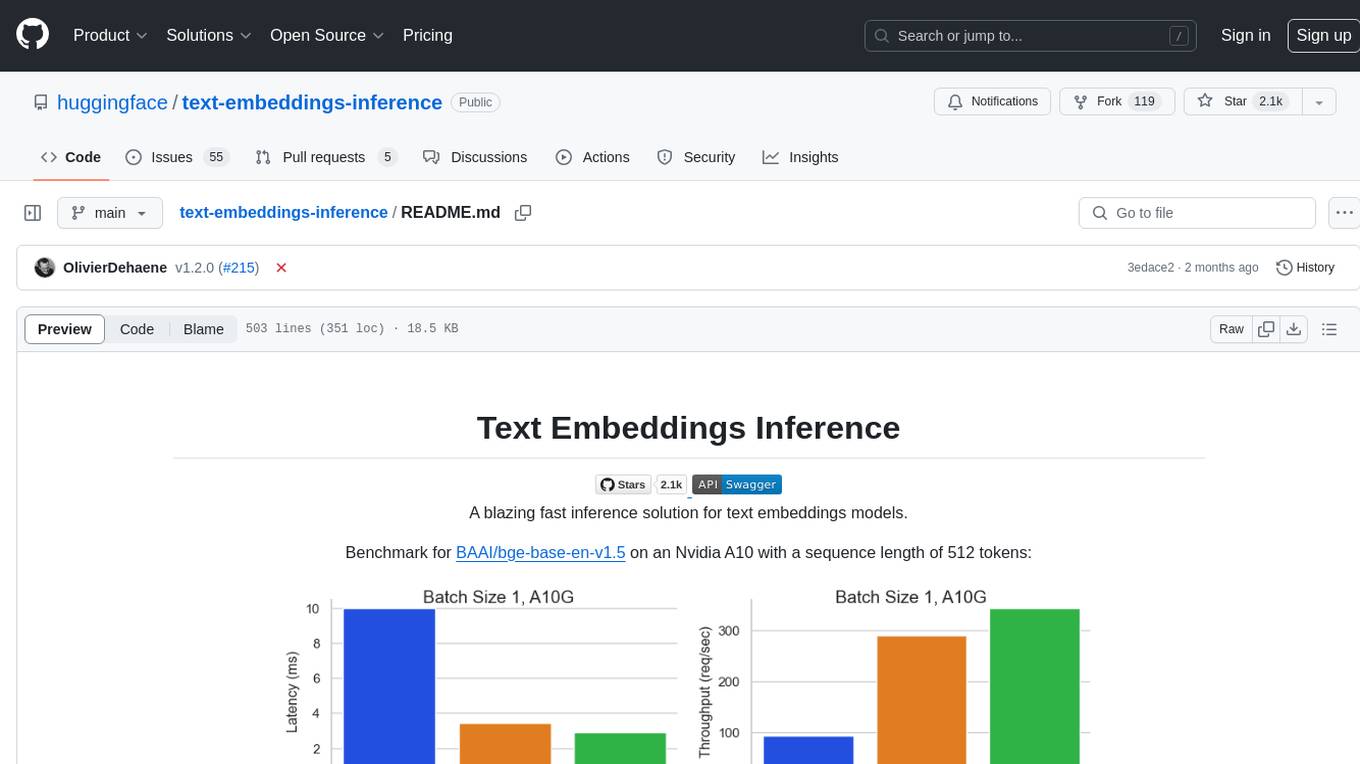
text-embeddings-inference
Text Embeddings Inference (TEI) is a toolkit for deploying and serving open source text embeddings and sequence classification models. TEI enables high-performance extraction for popular models like FlagEmbedding, Ember, GTE, and E5. It implements features such as no model graph compilation step, Metal support for local execution on Macs, small docker images with fast boot times, token-based dynamic batching, optimized transformers code for inference using Flash Attention, Candle, and cuBLASLt, Safetensors weight loading, and production-ready features like distributed tracing with Open Telemetry and Prometheus metrics.
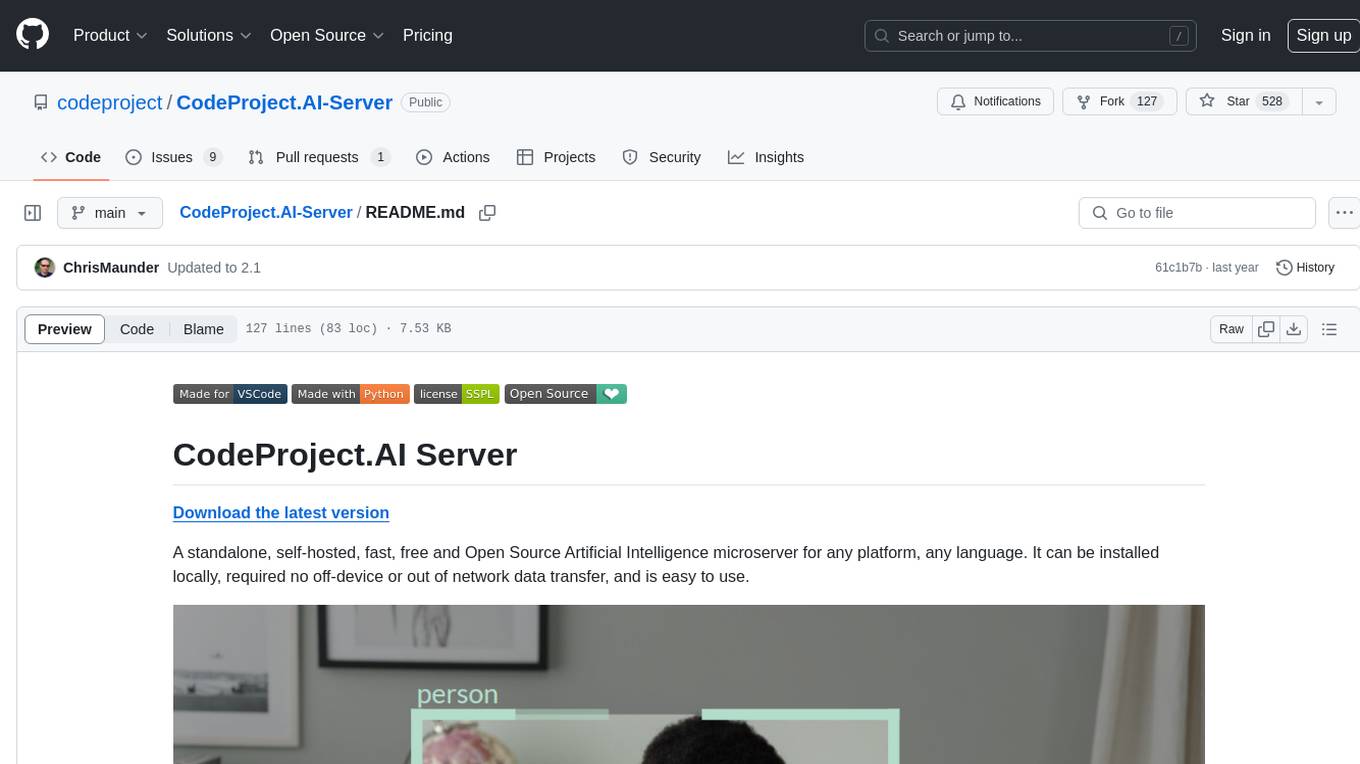
CodeProject.AI-Server
CodeProject.AI Server is a standalone, self-hosted, fast, free, and open-source Artificial Intelligence microserver designed for any platform and language. It can be installed locally without the need for off-device or out-of-network data transfer, providing an easy-to-use solution for developers interested in AI programming. The server includes a HTTP REST API server, backend analysis services, and the source code, enabling users to perform various AI tasks locally without relying on external services or cloud computing. Current capabilities include object detection, face detection, scene recognition, sentiment analysis, and more, with ongoing feature expansions planned. The project aims to promote AI development, simplify AI implementation, focus on core use-cases, and leverage the expertise of the developer community.
spark-nlp
Spark NLP is a state-of-the-art Natural Language Processing library built on top of Apache Spark. It provides simple, performant, and accurate NLP annotations for machine learning pipelines that scale easily in a distributed environment. Spark NLP comes with 36000+ pretrained pipelines and models in more than 200+ languages. It offers tasks such as Tokenization, Word Segmentation, Part-of-Speech Tagging, Named Entity Recognition, Dependency Parsing, Spell Checking, Text Classification, Sentiment Analysis, Token Classification, Machine Translation, Summarization, Question Answering, Table Question Answering, Text Generation, Image Classification, Image to Text (captioning), Automatic Speech Recognition, Zero-Shot Learning, and many more NLP tasks. Spark NLP is the only open-source NLP library in production that offers state-of-the-art transformers such as BERT, CamemBERT, ALBERT, ELECTRA, XLNet, DistilBERT, RoBERTa, DeBERTa, XLM-RoBERTa, Longformer, ELMO, Universal Sentence Encoder, Llama-2, M2M100, BART, Instructor, E5, Google T5, MarianMT, OpenAI GPT2, Vision Transformers (ViT), OpenAI Whisper, and many more not only to Python and R, but also to JVM ecosystem (Java, Scala, and Kotlin) at scale by extending Apache Spark natively.
scikit-llm
Scikit-LLM is a tool that seamlessly integrates powerful language models like ChatGPT into scikit-learn for enhanced text analysis tasks. It allows users to leverage large language models for various text analysis applications within the familiar scikit-learn framework. The tool simplifies the process of incorporating advanced language processing capabilities into machine learning pipelines, enabling users to benefit from the latest advancements in natural language processing.
For similar jobs
promptflow
**Prompt flow** is a suite of development tools designed to streamline the end-to-end development cycle of LLM-based AI applications, from ideation, prototyping, testing, evaluation to production deployment and monitoring. It makes prompt engineering much easier and enables you to build LLM apps with production quality.
deepeval
DeepEval is a simple-to-use, open-source LLM evaluation framework specialized for unit testing LLM outputs. It incorporates various metrics such as G-Eval, hallucination, answer relevancy, RAGAS, etc., and runs locally on your machine for evaluation. It provides a wide range of ready-to-use evaluation metrics, allows for creating custom metrics, integrates with any CI/CD environment, and enables benchmarking LLMs on popular benchmarks. DeepEval is designed for evaluating RAG and fine-tuning applications, helping users optimize hyperparameters, prevent prompt drifting, and transition from OpenAI to hosting their own Llama2 with confidence.
MegaDetector
MegaDetector is an AI model that identifies animals, people, and vehicles in camera trap images (which also makes it useful for eliminating blank images). This model is trained on several million images from a variety of ecosystems. MegaDetector is just one of many tools that aims to make conservation biologists more efficient with AI. If you want to learn about other ways to use AI to accelerate camera trap workflows, check out our of the field, affectionately titled "Everything I know about machine learning and camera traps".
leapfrogai
LeapfrogAI is a self-hosted AI platform designed to be deployed in air-gapped resource-constrained environments. It brings sophisticated AI solutions to these environments by hosting all the necessary components of an AI stack, including vector databases, model backends, API, and UI. LeapfrogAI's API closely matches that of OpenAI, allowing tools built for OpenAI/ChatGPT to function seamlessly with a LeapfrogAI backend. It provides several backends for various use cases, including llama-cpp-python, whisper, text-embeddings, and vllm. LeapfrogAI leverages Chainguard's apko to harden base python images, ensuring the latest supported Python versions are used by the other components of the stack. The LeapfrogAI SDK provides a standard set of protobuffs and python utilities for implementing backends and gRPC. LeapfrogAI offers UI options for common use-cases like chat, summarization, and transcription. It can be deployed and run locally via UDS and Kubernetes, built out using Zarf packages. LeapfrogAI is supported by a community of users and contributors, including Defense Unicorns, Beast Code, Chainguard, Exovera, Hypergiant, Pulze, SOSi, United States Navy, United States Air Force, and United States Space Force.
llava-docker
This Docker image for LLaVA (Large Language and Vision Assistant) provides a convenient way to run LLaVA locally or on RunPod. LLaVA is a powerful AI tool that combines natural language processing and computer vision capabilities. With this Docker image, you can easily access LLaVA's functionalities for various tasks, including image captioning, visual question answering, text summarization, and more. The image comes pre-installed with LLaVA v1.2.0, Torch 2.1.2, xformers 0.0.23.post1, and other necessary dependencies. You can customize the model used by setting the MODEL environment variable. The image also includes a Jupyter Lab environment for interactive development and exploration. Overall, this Docker image offers a comprehensive and user-friendly platform for leveraging LLaVA's capabilities.

carrot
The 'carrot' repository on GitHub provides a list of free and user-friendly ChatGPT mirror sites for easy access. The repository includes sponsored sites offering various GPT models and services. Users can find and share sites, report errors, and access stable and recommended sites for ChatGPT usage. The repository also includes a detailed list of ChatGPT sites, their features, and accessibility options, making it a valuable resource for ChatGPT users seeking free and unlimited GPT services.
TrustLLM
TrustLLM is a comprehensive study of trustworthiness in LLMs, including principles for different dimensions of trustworthiness, established benchmark, evaluation, and analysis of trustworthiness for mainstream LLMs, and discussion of open challenges and future directions. Specifically, we first propose a set of principles for trustworthy LLMs that span eight different dimensions. Based on these principles, we further establish a benchmark across six dimensions including truthfulness, safety, fairness, robustness, privacy, and machine ethics. We then present a study evaluating 16 mainstream LLMs in TrustLLM, consisting of over 30 datasets. The document explains how to use the trustllm python package to help you assess the performance of your LLM in trustworthiness more quickly. For more details about TrustLLM, please refer to project website.
AI-YinMei
AI-YinMei is an AI virtual anchor Vtuber development tool (N card version). It supports fastgpt knowledge base chat dialogue, a complete set of solutions for LLM large language models: [fastgpt] + [one-api] + [Xinference], supports docking bilibili live broadcast barrage reply and entering live broadcast welcome speech, supports Microsoft edge-tts speech synthesis, supports Bert-VITS2 speech synthesis, supports GPT-SoVITS speech synthesis, supports expression control Vtuber Studio, supports painting stable-diffusion-webui output OBS live broadcast room, supports painting picture pornography public-NSFW-y-distinguish, supports search and image search service duckduckgo (requires magic Internet access), supports image search service Baidu image search (no magic Internet access), supports AI reply chat box [html plug-in], supports AI singing Auto-Convert-Music, supports playlist [html plug-in], supports dancing function, supports expression video playback, supports head touching action, supports gift smashing action, supports singing automatic start dancing function, chat and singing automatic cycle swing action, supports multi scene switching, background music switching, day and night automatic switching scene, supports open singing and painting, let AI automatically judge the content.