


Open-Higgsfield-AI
Open-source alternative to Higgsfield AI — Free AI image generation & cinema studio with 20+ models (Flux, SDXL, Midjourney, Ideogram). Self-hosted, customizable, MIT licensed.
Stars: 2123
Open Higgsfield AI is a free, open-source alternative to Higgsfield AI, providing a platform for generating AI images and cinematic shots using 20+ state-of-the-art models. It offers a sleek, modern interface that supports models like Flux Schnell, Flux Dev, SDXL, Ideogram, and more. Users can self-host the platform, customize it, and access a wide range of AI models without subscription fees or vendor lock-in. The tool includes features such as Cinema Studio, Multi-Model Support, Smart Controls, Generation History, Image Download, API Key Management, and Responsive Design.
README:
The free, open-source alternative to Higgsfield AI. Generate AI images and cinematic shots using 20+ state-of-the-art models — without the closed ecosystem or subscription fees.
Open Higgsfield AI is an open-source AI image and cinema studio that brings Higgsfield-style creative workflows to everyone. Powered by Muapi.ai, it supports models like Flux Schnell, Flux Dev, SDXL, Ideogram, Midjourney, and more — all from a sleek, modern interface you can self-host and customize.
Why Open Higgsfield AI instead of Higgsfield AI?
- Free & open-source — no subscription, no vendor lock-in
- Self-hosted — your data stays on your machine
- 20+ models — access more AI models than any single closed platform
- Extensible — add your own models, modify the UI, build on top of it
For a deep dive into the technical architecture and the philosophy behind the "Infinite Budget" cinema workflow, see our comprehensive guide and roadmap.

- Cinema Studio — Higgsfield AI-style interface for photorealistic cinematic shots with pro camera controls (Lens, Focal Length, Aperture)
- Multi-Model Support — Switch between 20+ AI image generation models (Flux, Nano Banana, Ideogram, Midjourney, SDXL, and more)
- Smart Controls — Dynamic aspect ratio and resolution pickers that adapt to each model's capabilities
- Generation History — Browse, revisit, and download all your past generations (persisted in browser storage). Now with a persistent sidebar in Cinema Studio.
- Image Download — One-click download of generated images in full resolution (up to 4K)
- API Key Management — Secure API key storage in browser localStorage (never sent to any server except Muapi)
- Responsive Design — Works seamlessly on desktop and mobile with dark glassmorphism UI
The Cinema Studio offers precise control over the virtual camera, translating your choices into optimized prompt modifiers:
| Category | Available Options |
|---|---|
| Cameras | Modular 8K Digital, Full-Frame Cine Digital, Grand Format 70mm Film, Studio Digital S35, Classic 16mm Film, Premium Large Format Digital |
| Lenses | Creative Tilt, Compact Anamorphic, Extreme Macro, 70s Cinema Prime, Classic Anamorphic, Premium Modern Prime, Warm Cinema Prime, Swirl Bokeh Portrait, Vintage Prime, Halation Diffusion, Clinical Sharp Prime |
| Focal Lengths | 8mm (Ultra-Wide), 14mm, 24mm, 35mm (Human Eye), 50mm (Portrait), 85mm (Tight Portrait) |
| Apertures | f/1.4 (Shallow DoF), f/4 (Balanced), f/11 (Deep Focus) |
# Clone the repository
git clone https://github.com/Anil-matcha/Open-Higgsfield-AI.git
cd Open-Higgsfield-AI

# Install dependencies
npm install

# Start the development server
npm run dev
Open http://localhost:5173 in your browser. You'll be prompted to enter your Muapi API key on first use.
npm run build
npm run previewsrc/
├── components/
│ ├── ImageStudio.js # Standard studio with prompt, pickers, canvas, history
│ ├── CinemaStudio.js # Pro studio with camera controls & infinite canvas flow
│ ├── CameraControls.js # Scrollable picker for camera/lens/focal/aperture
│ ├── Header.js # App header with settings and controls
│ ├── AuthModal.js # API key input modal
│ ├── SettingsModal.js # Settings panel for API key management
│ └── Sidebar.js # Navigation sidebar
├── lib/
│ ├── muapi.js # API client (submit + poll pattern, x-api-key auth)
│ └── models.js # Model definitions with endpoint mappings
├── styles/
│ ├── global.css # Global styles and animations
│ ├── studio.css # Studio-specific styles
│ └── variables.css # CSS custom properties
├── main.js # App entry point
└── style.css # Tailwind imports
The app communicates with Muapi.ai using a two-step pattern:
-
Submit —
POST /api/v1/{model-endpoint}with prompt and parameters -
Poll —
GET /api/v1/predictions/{request_id}/resultuntil status iscompleted
Authentication uses the x-api-key header. During development, a Vite proxy handles CORS by routing /api requests to https://api.muapi.ai.
| Model | Endpoint | Resolution Options |
|---|---|---|
| Nano Banana | nano-banana |
— |
| Nano Banana Pro | nano-banana-pro |
up to 4K (Cinema Studio) |
| Flux Schnell | flux-schnell-image |
— |
| Flux Dev | flux-dev-image |
— |
| Flux Dev LoRA | flux-dev-lora |
— |
| Ideogram V2 | ideogram-v2 |
— |
| SDXL | sdxl |
— |
| And 15+ more... |
- Vite — Build tool & dev server
- Tailwind CSS v4 — Utility-first styling
- Vanilla JS — No framework, pure DOM manipulation
- Muapi.ai — AI model API gateway
Higgsfield AI is a proprietary AI video and image generation platform. Open Higgsfield AI is a community-driven, open-source alternative that provides similar creative capabilities without the closed ecosystem:
| Higgsfield AI | Open Higgsfield AI | |
|---|---|---|
| Cost | Subscription-based | Free (open-source) |
| Models | Proprietary | 20+ open & commercial models |
| Self-hosting | No | Yes |
| Customizable | No | Fully hackable |
| Data privacy | Cloud-based | Your data stays local |
| Source code | Closed | MIT licensed |
MIT
Built with Muapi.ai — the unified API for AI image generation models.
Deep Dive: For more details on the "AI Influencer" engine, upcoming "Popcorn" storyboarding features, and the future of this project, read the full technical overview.
Looking for a free Higgsfield AI alternative? Open Higgsfield AI is an open-source AI image generation studio and Higgsfield AI replacement that you can self-host, customize, and extend.
For Tasks:
Click tags to check more tools for each tasksFor Jobs:
Alternative AI tools for Open-Higgsfield-AI
Similar Open Source Tools
Open-Higgsfield-AI
Open Higgsfield AI is a free, open-source alternative to Higgsfield AI, providing a platform for generating AI images and cinematic shots using 20+ state-of-the-art models. It offers a sleek, modern interface that supports models like Flux Schnell, Flux Dev, SDXL, Ideogram, and more. Users can self-host the platform, customize it, and access a wide range of AI models without subscription fees or vendor lock-in. The tool includes features such as Cinema Studio, Multi-Model Support, Smart Controls, Generation History, Image Download, API Key Management, and Responsive Design.
openakita
OpenAkita is a self-evolving AI Agent framework that autonomously learns new skills, performs daily self-checks and repairs, accumulates experience from task execution, and persists until the task is done. It auto-generates skills, installs dependencies, learns from mistakes, and remembers preferences. The framework is standards-based, multi-platform, and provides a Setup Center GUI for intuitive installation and configuration. It features self-learning and evolution mechanisms, a Ralph Wiggum Mode for persistent execution, multi-LLM endpoints, multi-platform IM support, desktop automation, multi-agent architecture, scheduled tasks, identity and memory management, a tool system, and a guided wizard for setup.
vmark
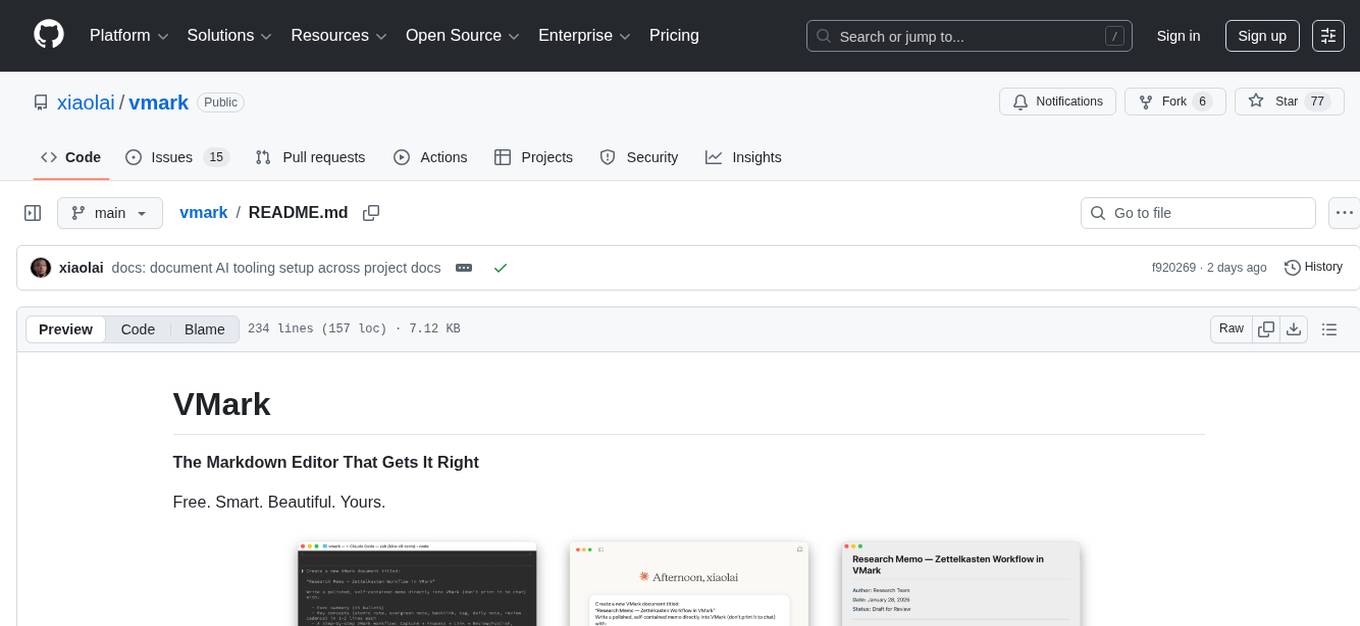
VMark is a modern, local-first Markdown editor designed for the AI era. It combines the simplicity of rich text editing with the power of source mode. Built to work seamlessly with AI assistants, it understands Chinese, Japanese, and Korean text. Users can switch between rich text and source mode effortlessly, with beautifully designed themes and offline functionality. The tool offers advanced features like AI integration, CJK text handling, customization options, and various export formats.
axonhub
AxonHub is an all-in-one AI development platform that serves as an AI gateway allowing users to switch between model providers without changing any code. It provides features like vendor lock-in prevention, integration simplification, observability enhancement, and cost control. Users can access any model using any SDK with zero code changes. The platform offers full request tracing, enterprise RBAC, smart load balancing, and real-time cost tracking. AxonHub supports multiple databases, provides a unified API gateway, and offers flexible model management and API key creation for authentication. It also integrates with various AI coding tools and SDKs for seamless usage.
Edit-Banana
Edit Banana is a universal content re-editor that allows users to transform fixed content into fully manipulatable assets. Powered by SAM 3 and multimodal large models, it enables high-fidelity reconstruction while preserving original diagram details and logical relationships. The platform offers advanced segmentation, fixed multi-round VLM scanning, high-quality OCR, user system with credits, multi-user concurrency, and a web interface. Users can upload images or PDFs to get editable DrawIO (XML) or PPTX files in seconds. The project structure includes components for segmentation, text extraction, frontend, models, and scripts, with detailed installation and setup instructions provided. The tool is open-source under the Apache License 2.0, allowing commercial use and secondary development.
OpenOutreach
OpenOutreach is a self-hosted, open-source LinkedIn automation tool designed for B2B lead generation. It automates the entire outreach process in a stealthy, human-like way by discovering and enriching target profiles, ranking profiles using ML for smart prioritization, sending personalized connection requests, following up with custom messages after acceptance, and tracking everything in a built-in CRM with web UI. It offers features like undetectable behavior, fully customizable Python-based campaigns, local execution with CRM, easy deployment with Docker, and AI-ready templating for hyper-personalized messages.
llm4s
LLM4S provides a simple, robust, and scalable framework for building Large Language Models (LLM) applications in Scala. It aims to leverage Scala's type safety, functional programming, JVM ecosystem, concurrency, and performance advantages to create reliable and maintainable AI-powered applications. The framework supports multi-provider integration, execution environments, error handling, Model Context Protocol (MCP) support, agent frameworks, multimodal generation, and Retrieval-Augmented Generation (RAG) workflows. It also offers observability features like detailed trace logging, monitoring, and analytics for debugging and performance insights.
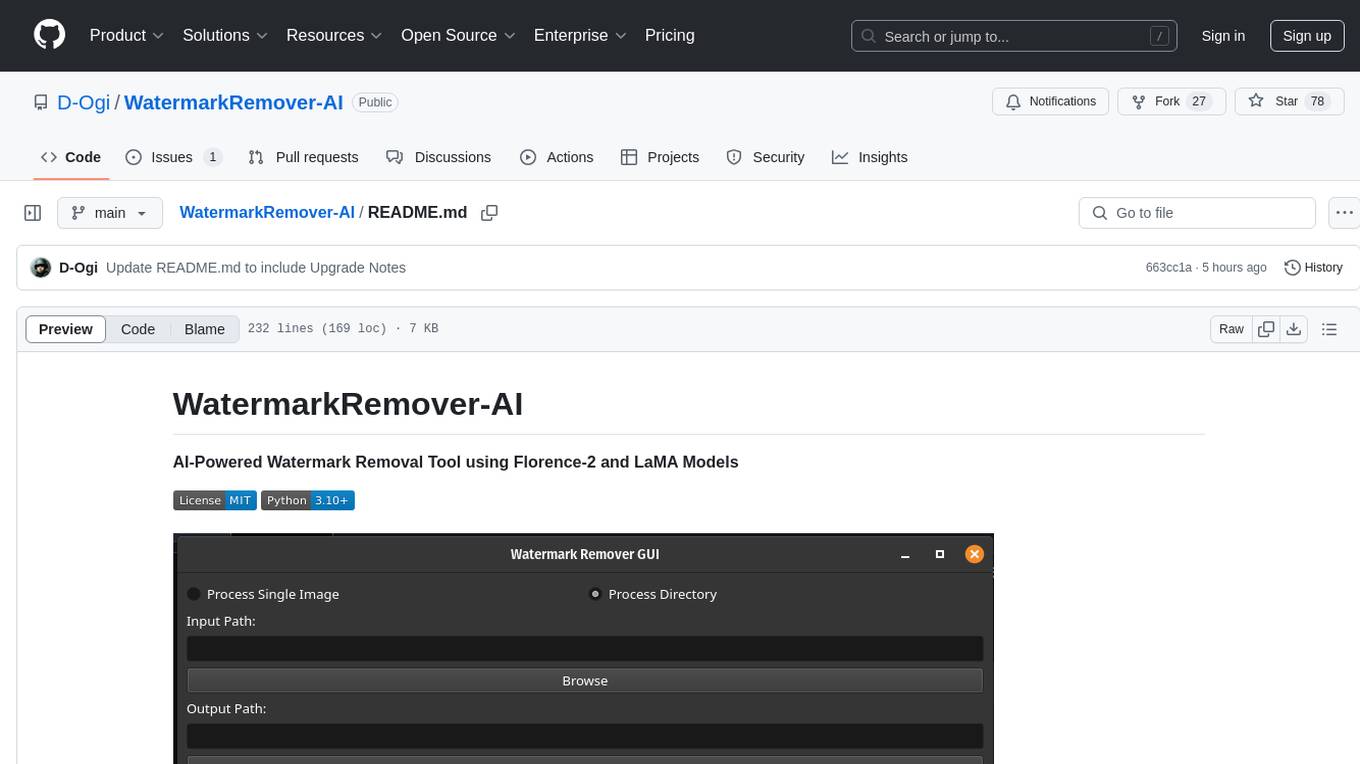
WatermarkRemover-AI
WatermarkRemover-AI is an advanced application that utilizes AI models for precise watermark detection and seamless removal. It leverages Florence-2 for watermark identification and LaMA for inpainting. The tool offers both a command-line interface (CLI) and a PyQt6-based graphical user interface (GUI), making it accessible to users of all levels. It supports dual modes for processing images, advanced watermark detection, seamless inpainting, customizable output settings, real-time progress tracking, dark mode support, and efficient GPU acceleration using CUDA.
AionUi
AionUi is a user interface library for building modern and responsive web applications. It provides a set of customizable components and styles to create visually appealing user interfaces. With AionUi, developers can easily design and implement interactive web interfaces that are both functional and aesthetically pleasing. The library is built using the latest web technologies and follows best practices for performance and accessibility. Whether you are working on a personal project or a professional application, AionUi can help you streamline the UI development process and deliver a seamless user experience.
specs.md
AI-native development framework with pluggable flows for every use case. Choose from Simple for quick specs, FIRE for adaptive execution, or AI-DLC for full methodology with DDD. Features include flow switcher, active run tracking, intent visualization, and click-to-open spec files. Three flows optimized for different scenarios: Simple for spec generation, prototypes; FIRE for adaptive execution, brownfield, monorepos; AI-DLC for full traceability, DDD, regulated environments. Installable as a VS Code extension for progress tracking. Supported by various AI coding tools like Claude Code, Cursor, GitHub Copilot, and Google Antigravity. Tool agnostic with portable markdown files for agents and specs.
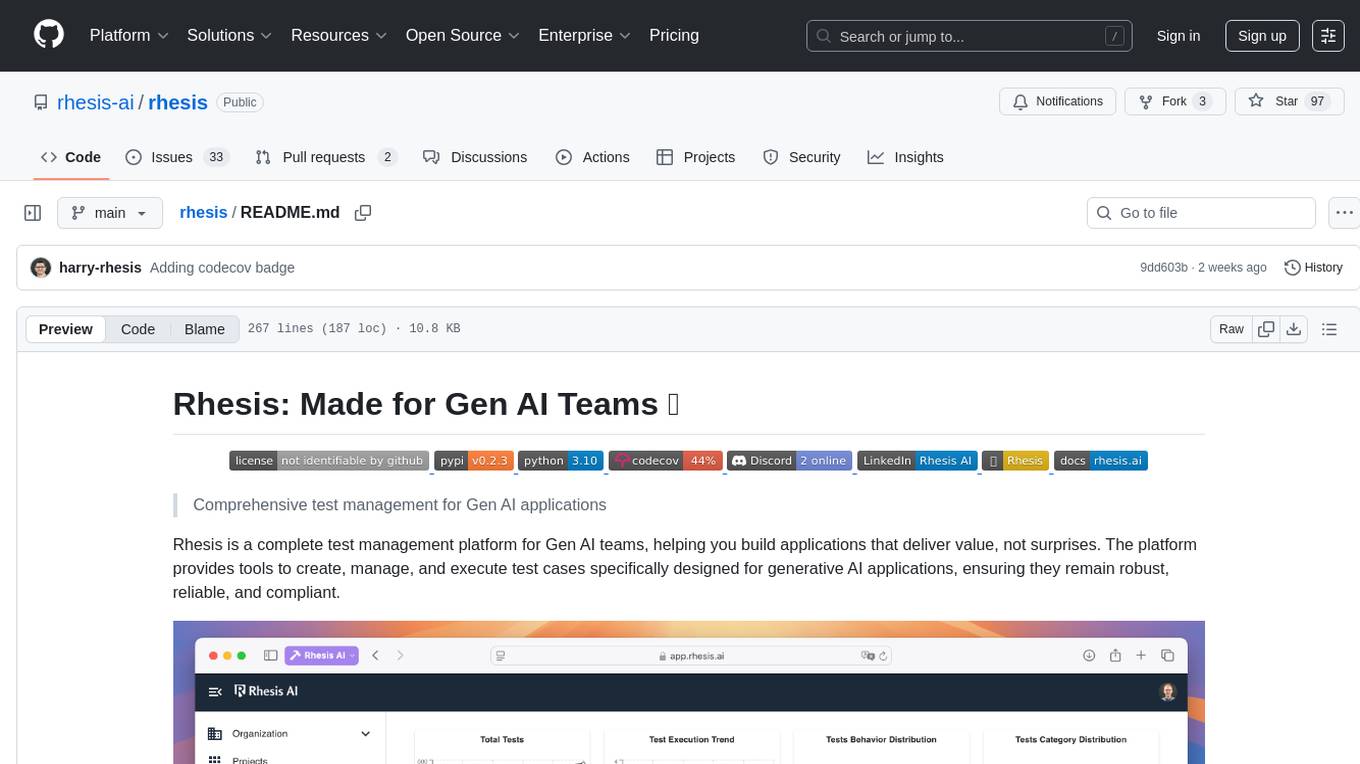
rhesis
Rhesis is a comprehensive test management platform designed for Gen AI teams, offering tools to create, manage, and execute test cases for generative AI applications. It ensures the robustness, reliability, and compliance of AI systems through features like test set management, automated test generation, edge case discovery, compliance validation, integration capabilities, and performance tracking. The platform is open source, emphasizing community-driven development, transparency, extensible architecture, and democratizing AI safety. It includes components such as backend services, frontend applications, SDK for developers, worker services, chatbot applications, and Polyphemus for uncensored LLM service. Rhesis enables users to address challenges unique to testing generative AI applications, such as non-deterministic outputs, hallucinations, edge cases, ethical concerns, and compliance requirements.
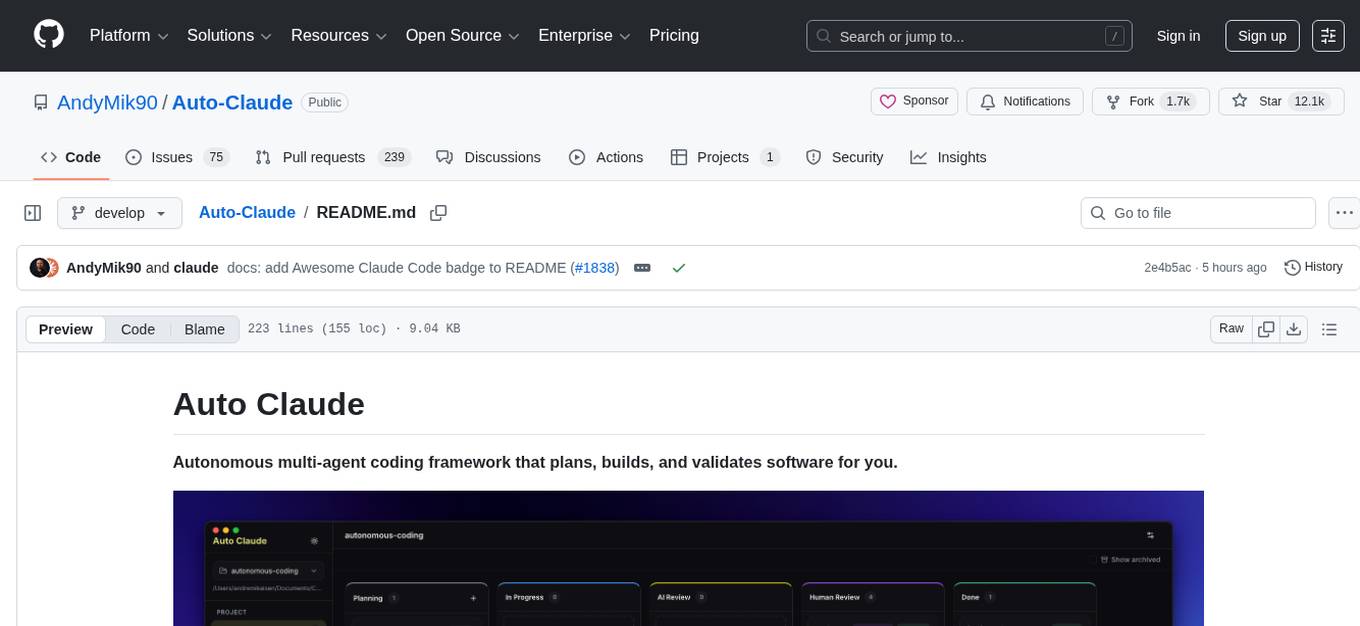
Auto-Claude
Auto Claude is an autonomous multi-agent coding framework that plans, builds, and validates software for users. It provides features such as autonomous tasks handling planning, implementation, and validation, parallel execution with multiple agent terminals, isolated workspaces for safe changes, self-validating quality assurance, AI-powered merge for conflict resolution, memory layer for smarter builds, GitHub/GitLab integration, cross-platform native desktop apps, auto-updates, and more. The tool offers a visual Kanban board for task management, AI-powered terminals for parallel work, AI-assisted feature planning, insights chat interface, ideation for code improvements, performance issues, and vulnerabilities discovery, and changelog generation from completed tasks. It follows a three-layer security model with OS sandbox, filesystem restrictions, and dynamic command allowlist, ensuring security through VirusTotal scans, SHA256 checksums, and code-signing for macOS releases.
orchestkit
OrchestKit is a powerful and flexible orchestration tool designed to streamline and automate complex workflows. It provides a user-friendly interface for defining and managing orchestration tasks, allowing users to easily create, schedule, and monitor workflows. With support for various integrations and plugins, OrchestKit enables seamless automation of tasks across different systems and applications. Whether you are a developer looking to automate deployment processes or a system administrator managing complex IT operations, OrchestKit offers a comprehensive solution to simplify and optimize your workflow management.
aegra
Aegra is a self-hosted AI agent backend platform that provides LangGraph power without vendor lock-in. Built with FastAPI + PostgreSQL, it offers complete control over agent orchestration for teams looking to escape vendor lock-in, meet data sovereignty requirements, enable custom deployments, and optimize costs. Aegra is Agent Protocol compliant and perfect for teams seeking a free, self-hosted alternative to LangGraph Platform with zero lock-in, full control, and compatibility with existing LangGraph Client SDK.
awesome-slash
Automate the entire development workflow beyond coding. awesome-slash provides production-ready skills, agents, and commands for managing tasks, branches, reviews, CI, and deployments. It automates the entire workflow, including task exploration, planning, implementation, review, and shipping. The tool includes 11 plugins, 40 agents, 26 skills, and 26k lines of lib code, with 3,357 tests and support for 3 platforms. It works with Claude Code, OpenCode, and Codex CLI, offering specialized capabilities through skills and agents.
free-coding-models
The 'free-coding-models' repository provides a tool for finding and utilizing coding-focused LLM models optimized for code generation. It offers a multi-provider approach with models from various providers like NVIDIA NIM, Groq, Cerebras, and Hugging Face Inference. The tool allows users to ping models in real-time, select the fastest ones, and integrate them seamlessly with tools like OpenCode and OpenClaw. It features a settings screen for managing API keys, tier filtering, and profile saving. The stability score feature helps users identify models with consistent performance, and the tool offers interactive selection, startup mode menu, and tier filtering functionalities.
For similar tasks
search_with_lepton
Build your own conversational search engine using less than 500 lines of code. Features built-in support for LLM, search engine, customizable UI interface, and shareable cached search results. Setup includes Bing and Google search engines. Utilize LLM and KV functions with Lepton for seamless integration. Easily deploy to Lepton AI or your own environment with one-click deployment options.
gen-ui-python
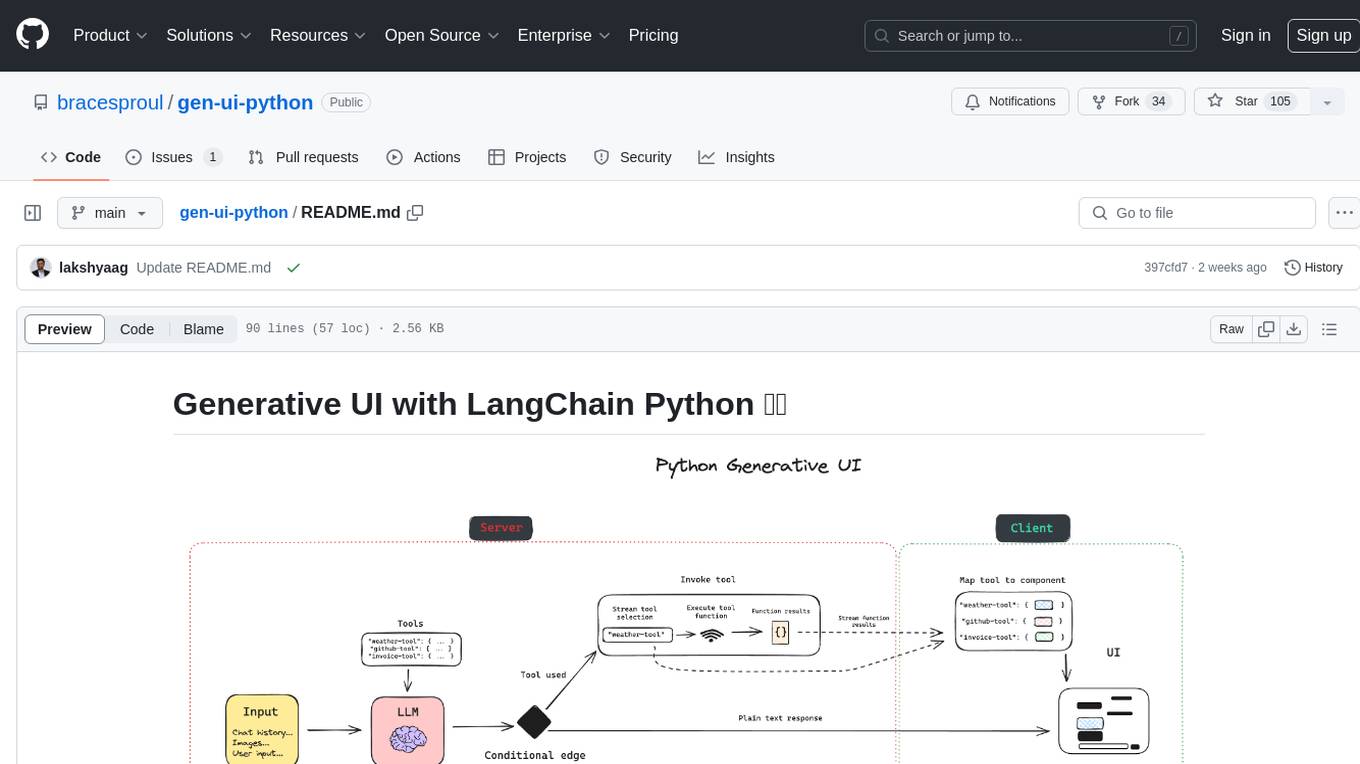
This application provides a template for building generative UI applications with LangChain Python. It includes pre-built UI components using Shadcn. Users can play around with gen ui features and customize the UI. The application requires setting environment variables for LangSmith keys, OpenAI API key, GitHub PAT, and Geocode API key. Users can further develop the application by generating React components, building custom components with LLM and Shadcn, using multiple tools and components, updating LangGraph agent, and rendering UI dynamically in different areas on the screen.
morgana-form
MorGana Form is a full-stack form builder project developed using Next.js, React, TypeScript, Ant Design, PostgreSQL, and other technologies. It allows users to quickly create and collect data through survey forms. The project structure includes components, hooks, utilities, pages, constants, Redux store, themes, types, server-side code, and component packages. Environment variables are required for database settings, NextAuth login configuration, and file upload services. Additionally, the project integrates an AI model for form generation using the Ali Qianwen model API.
ai-dial-chat
DIAL Chat is a default UI for AI DIAL, recommended for learning the capability of the headless system. It offers various features like IDP support, model comparison, DIAL extensions, conversation replays, and branding. Managed as a monorepo by NX tools, it provides documentation for DIAL Chat, Theming, Overlay, and Visualizer Connector. Users can find a user guide for the AI DIAL Chat application in the AI DIAL repository.

AmigaGPT
AmigaGPT is a versatile ChatGPT client for AmigaOS 3.x, 4.1, and MorphOS. It brings the capabilities of OpenAI’s GPT to Amiga systems, enabling text generation, question answering, and creative exploration. AmigaGPT can generate images using DALL-E, supports speech output, and seamlessly integrates with AmigaOS. Users can customize the UI, choose fonts and colors, and enjoy a native user experience. The tool requires specific system requirements and offers features like state-of-the-art language models, AI image generation, speech capability, and UI customization.
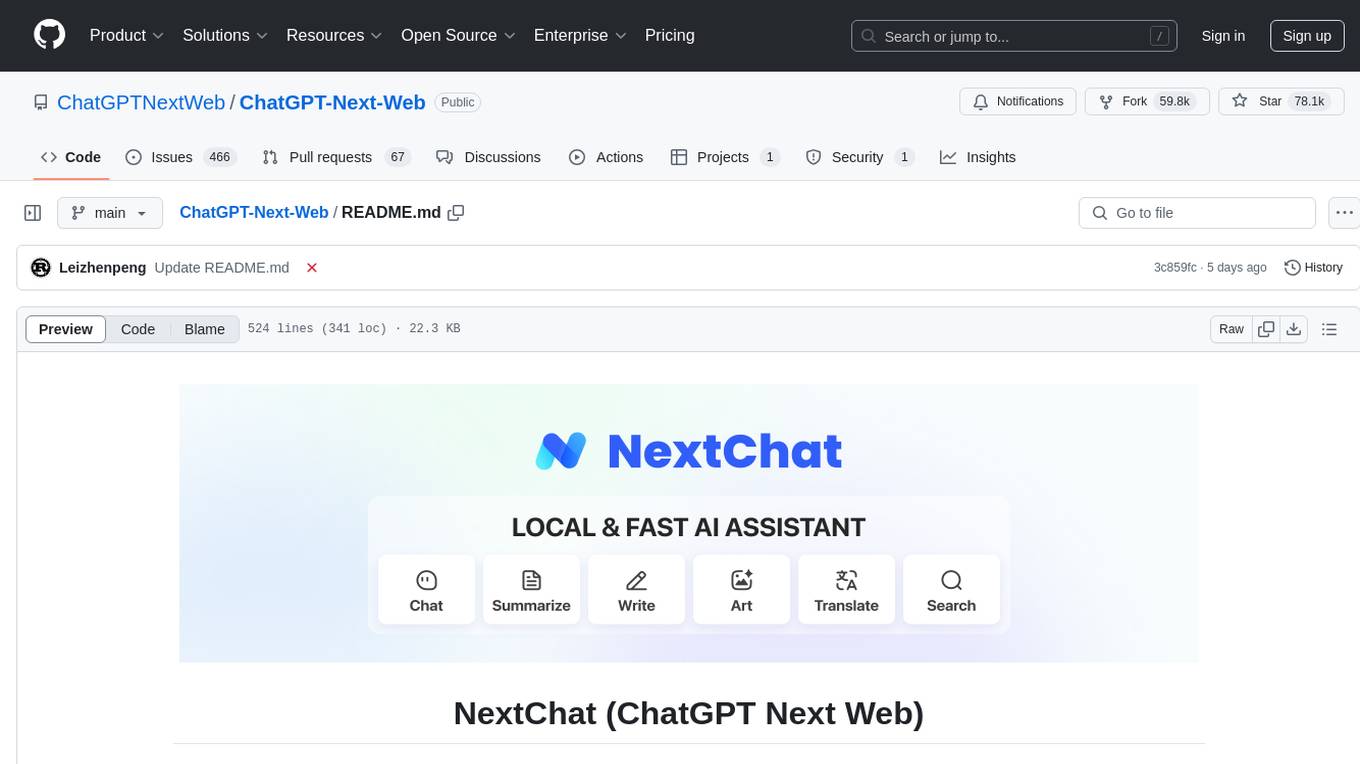
ChatGPT-Next-Web
ChatGPT Next Web is a well-designed cross-platform ChatGPT web UI tool that supports Claude, GPT4, and Gemini Pro models. It allows users to deploy their private ChatGPT applications with ease. The tool offers features like one-click deployment, compact client for Linux/Windows/MacOS, compatibility with self-deployed LLMs, privacy-first approach with local data storage, markdown support, responsive design, fast loading speed, prompt templates, awesome prompts, chat history compression, multilingual support, and more.
assistant-ui
assistant-ui is a set of React components for AI chat, providing wide model provider support out of the box and the ability to integrate custom APIs. It includes integrations with Langchain, Vercel AI SDK, TailwindCSS, shadcn-ui, react-markdown, react-syntax-highlighter, React Hook Form, and more. The tool allows users to quickly create AI chat applications with pre-configured templates and easy setup steps.
lector
A composable, headless PDF viewer toolkit for React applications, powered by PDF.js. Build feature-rich PDF viewing experiences with full control over the UI and functionality. It is responsive and mobile-friendly, fully customizable UI components, supports text selection and search functionality, page thumbnails and outline navigation, dark mode, pan and zoom controls, form filling support, internal and external link handling. Contributions are welcome in areas like performance optimizations, accessibility improvements, mobile/touch interactions, documentation, and examples. Inspired by open-source projects like react-pdf-headless and pdfreader. Licensed under MIT by Unriddle AI.
For similar jobs
promptflow
**Prompt flow** is a suite of development tools designed to streamline the end-to-end development cycle of LLM-based AI applications, from ideation, prototyping, testing, evaluation to production deployment and monitoring. It makes prompt engineering much easier and enables you to build LLM apps with production quality.
deepeval
DeepEval is a simple-to-use, open-source LLM evaluation framework specialized for unit testing LLM outputs. It incorporates various metrics such as G-Eval, hallucination, answer relevancy, RAGAS, etc., and runs locally on your machine for evaluation. It provides a wide range of ready-to-use evaluation metrics, allows for creating custom metrics, integrates with any CI/CD environment, and enables benchmarking LLMs on popular benchmarks. DeepEval is designed for evaluating RAG and fine-tuning applications, helping users optimize hyperparameters, prevent prompt drifting, and transition from OpenAI to hosting their own Llama2 with confidence.
MegaDetector
MegaDetector is an AI model that identifies animals, people, and vehicles in camera trap images (which also makes it useful for eliminating blank images). This model is trained on several million images from a variety of ecosystems. MegaDetector is just one of many tools that aims to make conservation biologists more efficient with AI. If you want to learn about other ways to use AI to accelerate camera trap workflows, check out our of the field, affectionately titled "Everything I know about machine learning and camera traps".
leapfrogai
LeapfrogAI is a self-hosted AI platform designed to be deployed in air-gapped resource-constrained environments. It brings sophisticated AI solutions to these environments by hosting all the necessary components of an AI stack, including vector databases, model backends, API, and UI. LeapfrogAI's API closely matches that of OpenAI, allowing tools built for OpenAI/ChatGPT to function seamlessly with a LeapfrogAI backend. It provides several backends for various use cases, including llama-cpp-python, whisper, text-embeddings, and vllm. LeapfrogAI leverages Chainguard's apko to harden base python images, ensuring the latest supported Python versions are used by the other components of the stack. The LeapfrogAI SDK provides a standard set of protobuffs and python utilities for implementing backends and gRPC. LeapfrogAI offers UI options for common use-cases like chat, summarization, and transcription. It can be deployed and run locally via UDS and Kubernetes, built out using Zarf packages. LeapfrogAI is supported by a community of users and contributors, including Defense Unicorns, Beast Code, Chainguard, Exovera, Hypergiant, Pulze, SOSi, United States Navy, United States Air Force, and United States Space Force.
llava-docker
This Docker image for LLaVA (Large Language and Vision Assistant) provides a convenient way to run LLaVA locally or on RunPod. LLaVA is a powerful AI tool that combines natural language processing and computer vision capabilities. With this Docker image, you can easily access LLaVA's functionalities for various tasks, including image captioning, visual question answering, text summarization, and more. The image comes pre-installed with LLaVA v1.2.0, Torch 2.1.2, xformers 0.0.23.post1, and other necessary dependencies. You can customize the model used by setting the MODEL environment variable. The image also includes a Jupyter Lab environment for interactive development and exploration. Overall, this Docker image offers a comprehensive and user-friendly platform for leveraging LLaVA's capabilities.

carrot
The 'carrot' repository on GitHub provides a list of free and user-friendly ChatGPT mirror sites for easy access. The repository includes sponsored sites offering various GPT models and services. Users can find and share sites, report errors, and access stable and recommended sites for ChatGPT usage. The repository also includes a detailed list of ChatGPT sites, their features, and accessibility options, making it a valuable resource for ChatGPT users seeking free and unlimited GPT services.
TrustLLM
TrustLLM is a comprehensive study of trustworthiness in LLMs, including principles for different dimensions of trustworthiness, established benchmark, evaluation, and analysis of trustworthiness for mainstream LLMs, and discussion of open challenges and future directions. Specifically, we first propose a set of principles for trustworthy LLMs that span eight different dimensions. Based on these principles, we further establish a benchmark across six dimensions including truthfulness, safety, fairness, robustness, privacy, and machine ethics. We then present a study evaluating 16 mainstream LLMs in TrustLLM, consisting of over 30 datasets. The document explains how to use the trustllm python package to help you assess the performance of your LLM in trustworthiness more quickly. For more details about TrustLLM, please refer to project website.
AI-YinMei
AI-YinMei is an AI virtual anchor Vtuber development tool (N card version). It supports fastgpt knowledge base chat dialogue, a complete set of solutions for LLM large language models: [fastgpt] + [one-api] + [Xinference], supports docking bilibili live broadcast barrage reply and entering live broadcast welcome speech, supports Microsoft edge-tts speech synthesis, supports Bert-VITS2 speech synthesis, supports GPT-SoVITS speech synthesis, supports expression control Vtuber Studio, supports painting stable-diffusion-webui output OBS live broadcast room, supports painting picture pornography public-NSFW-y-distinguish, supports search and image search service duckduckgo (requires magic Internet access), supports image search service Baidu image search (no magic Internet access), supports AI reply chat box [html plug-in], supports AI singing Auto-Convert-Music, supports playlist [html plug-in], supports dancing function, supports expression video playback, supports head touching action, supports gift smashing action, supports singing automatic start dancing function, chat and singing automatic cycle swing action, supports multi scene switching, background music switching, day and night automatic switching scene, supports open singing and painting, let AI automatically judge the content.