


ai-video-search-engine
None
Stars: 542
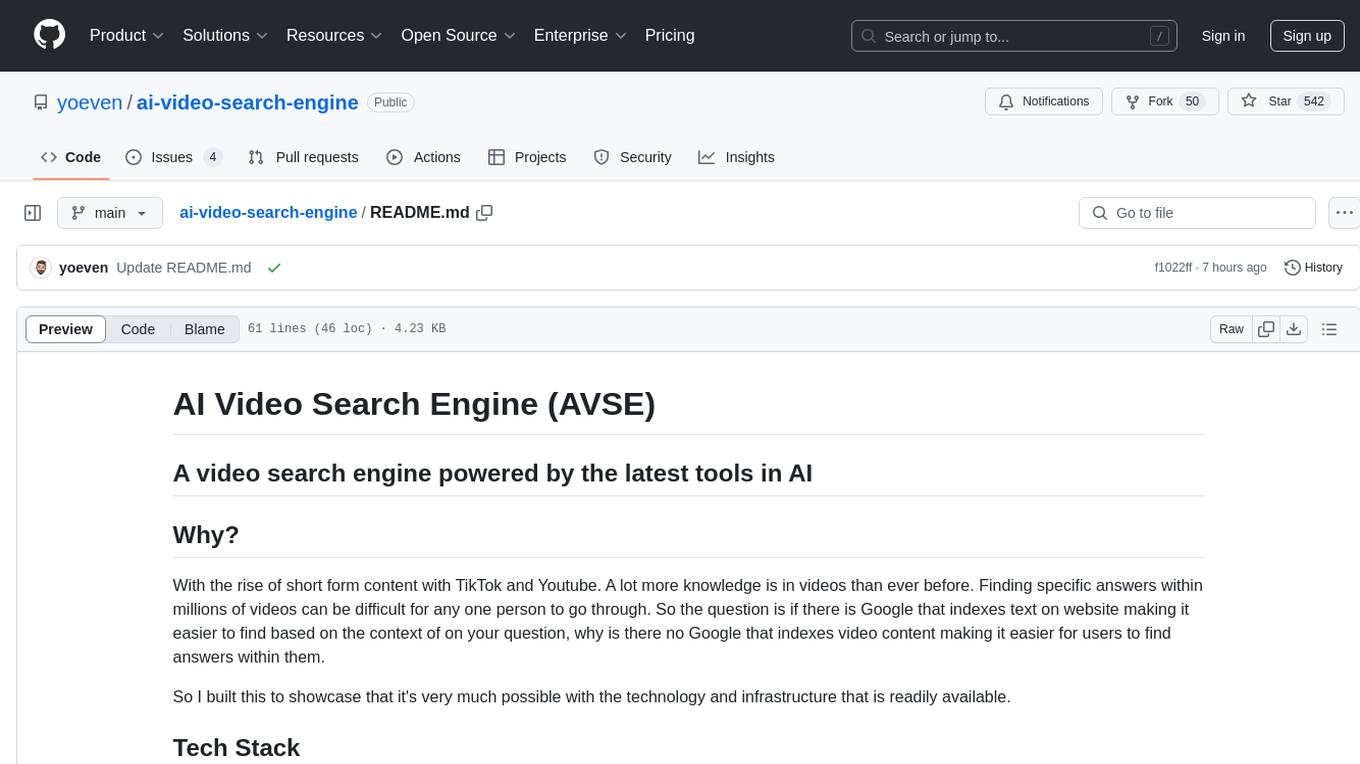
AI Video Search Engine (AVSE) is a video search engine powered by the latest tools in AI. It allows users to search for specific answers within millions of videos by indexing video content. The tool extracts video transcription, elements like thumbnail and description, and generates vector embeddings using AI models. Users can search for relevant results based on questions, view timestamped transcripts, and get video summaries. AVSE requires a paid Supabase & Fly.io account for hosting and can handle millions of videos with the current setup.
README:
With the rise of short form content with TikTok and Youtube. A lot more knowledge is in videos than ever before. Finding specific answers within millions of videos can be difficult for any one person to go through. So the question is if there is Google that indexes text on website making it easier to find based on the context of on your question, why is there no Google that indexes video content making it easier for users to find answers within them.
So I built this to showcase that it's very much possible with the technology and infrastructure that is readily available.
- Supabase (PostgreSQL, PG_Vector, Auth)
- Hasura (GraphQL layer, permissions)
- Fly (Hosting of Hasura)
- JigsawStack (Summary AI, Prompt engine AI, Embedding model)
- Vercel (NextJS hosting, Serverless functions)
Note: The previous version used a smaller embedding model that only supports english but can be easily ran in your serverless function. Check out archive/v1 branch for the older version.
- Video transcription is extracted from youtube video
- Other elements of the video like thumbnail, description, title and more is extracted
- Transcription and other data is passed to JigsawStack's multimodal embedding model to generate vector embedding of all content
- Transcriptions is chunked along with timestamp based on https://huggingface.co/Supabase/gte-small dimension size
- Stored in PostgresDB (Supabase) with use of pg_vector extension and indexing
- Vector cosine search across the db based on question to return the relevant results
- Each video in the result will perform a second search to find related chunks of video to the question
- The chunks will be mapped back to the timestamped transcript to play the relevant clip of the video
- Transcription of video will be sent to JigsawStack API for summary in both point form and text
- Chat sessions are temporary and aren't stored which is managed by JigsawStack's Prompt Engine API
- You'll need a paid Supabase & Fly.io account if you're planning to index thousands to millions of videos
-
admin/config/fly.tomlConsist of configs needed to deploy Hasura to fly -
admin/migrationMigration dump you can use to recreate the schema through Hasura CLI -
hasura init migration --endpoint <hasuraurl.fly.app> --admin-secret <admin_secret>To update migration folder inadmin -
admin/indexChannelVideos.tsScript to index large number of videos locally with youtube channels -
.env.exampleKeys needed to run to project -
admin/reindex.tscan be used to re-generate the vector embedding for a different embedding model for all video indexes stored
Doesn't youtube do this?
- Not really, Youtube doesn't search the transcribed audio of the video but instead relies on the written content of the uploader such as title, description, tags. While all the audio content goes un-indexed.
How's this stack gonna handle millions of videos?
- It can handle millions but maybe not billions/trillions with this current setup. Which requires more replicas, instances and especially $
What happened to the previous version
- The previous version used
gte-smallembedding model which had a pretty small context length and only supports English with a lower retrieval score. You can find the older version in a brancharchive/v1. The current version uses a newer model with support for over 75+ languages and has a larger context size of 8000+ allowing for smaller embedding outputs and a smaller database.
How can I get v1 embeddings
- We've dumped the enitre DB snapshot of the index and index_embedding table from v1 here: https://huggingface.co/datasets/yoeven/ai-video-searchengine-archive
- Add TikTok as a video source
- Improve query speed significantly
For Tasks:
Click tags to check more tools for each tasksFor Jobs:
Alternative AI tools for ai-video-search-engine
Similar Open Source Tools
ai-video-search-engine
AI Video Search Engine (AVSE) is a video search engine powered by the latest tools in AI. It allows users to search for specific answers within millions of videos by indexing video content. The tool extracts video transcription, elements like thumbnail and description, and generates vector embeddings using AI models. Users can search for relevant results based on questions, view timestamped transcripts, and get video summaries. AVSE requires a paid Supabase & Fly.io account for hosting and can handle millions of videos with the current setup.
second-brain-agent
The Second Brain AI Agent Project is a tool designed to empower personal knowledge management by automatically indexing markdown files and links, providing a smart search engine powered by OpenAI, integrating seamlessly with different note-taking methods, and enhancing productivity by accessing information efficiently. The system is built on LangChain framework and ChromaDB vector store, utilizing a pipeline to process markdown files and extract text and links for indexing. It employs a Retrieval-augmented generation (RAG) process to provide context for asking questions to the large language model. The tool is beneficial for professionals, students, researchers, and creatives looking to streamline workflows, improve study sessions, delve deep into research, and organize thoughts and ideas effortlessly.
vigenair
ViGenAiR is a tool that harnesses the power of Generative AI models on Google Cloud Platform to automatically transform long-form Video Ads into shorter variants, targeting different audiences. It generates video, image, and text assets for Demand Gen and YouTube video campaigns. Users can steer the model towards generating desired videos, conduct A/B testing, and benefit from various creative features. The tool offers benefits like diverse inventory, compelling video ads, creative excellence, user control, and performance insights. ViGenAiR works by analyzing video content, splitting it into coherent segments, and generating variants following Google's best practices for effective ads.
llmap
LLMap is a CLI code search tool designed to automatically find context in large codebases by evaluating the relevance of each source file using DeepSeek-V3 and DeepSeek-R1. It optimizes analysis by performing multi-stage analysis and caching results for faster searches. Currently supports Java and Python files, with potential for extension to other languages. Install with 'pip install llmap-ai' and use with a DeepSeek API key to search for specific context in code.
roam-extension-live-ai-assistant
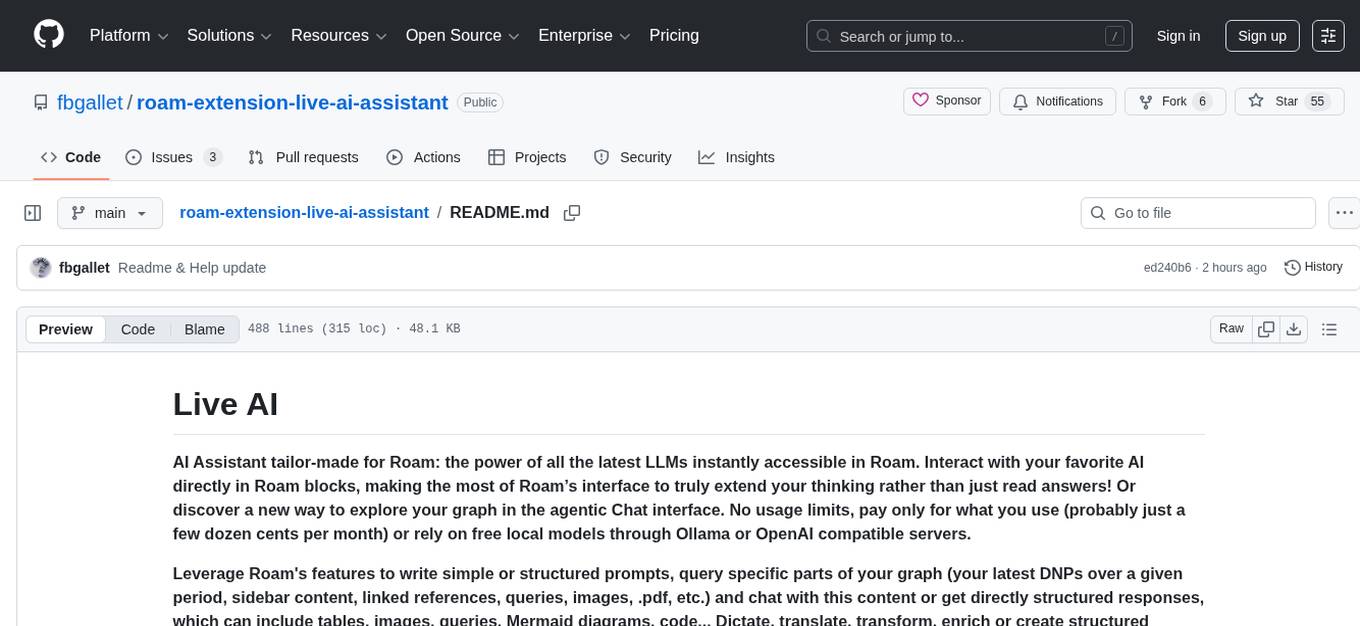
Live AI is an AI Assistant tailor-made for Roam, providing access to the latest LLMs directly in Roam blocks. Users can interact with AI to extend their thinking, explore their graph, and chat with structured responses. The tool leverages Roam's features to write prompts, query graph parts, and chat with content. Users can dictate, translate, transform, and enrich content easily. Live AI supports various tasks like audio and video analysis, PDF reading, image generation, and web search. The tool offers features like Chat panel, Live AI context menu, and Ask Your Graph agent for versatile usage. Users can control privacy levels, compare AI models, create custom prompts, and apply styles for response formatting. Security concerns are addressed by allowing users to control data sent to LLMs.
bao
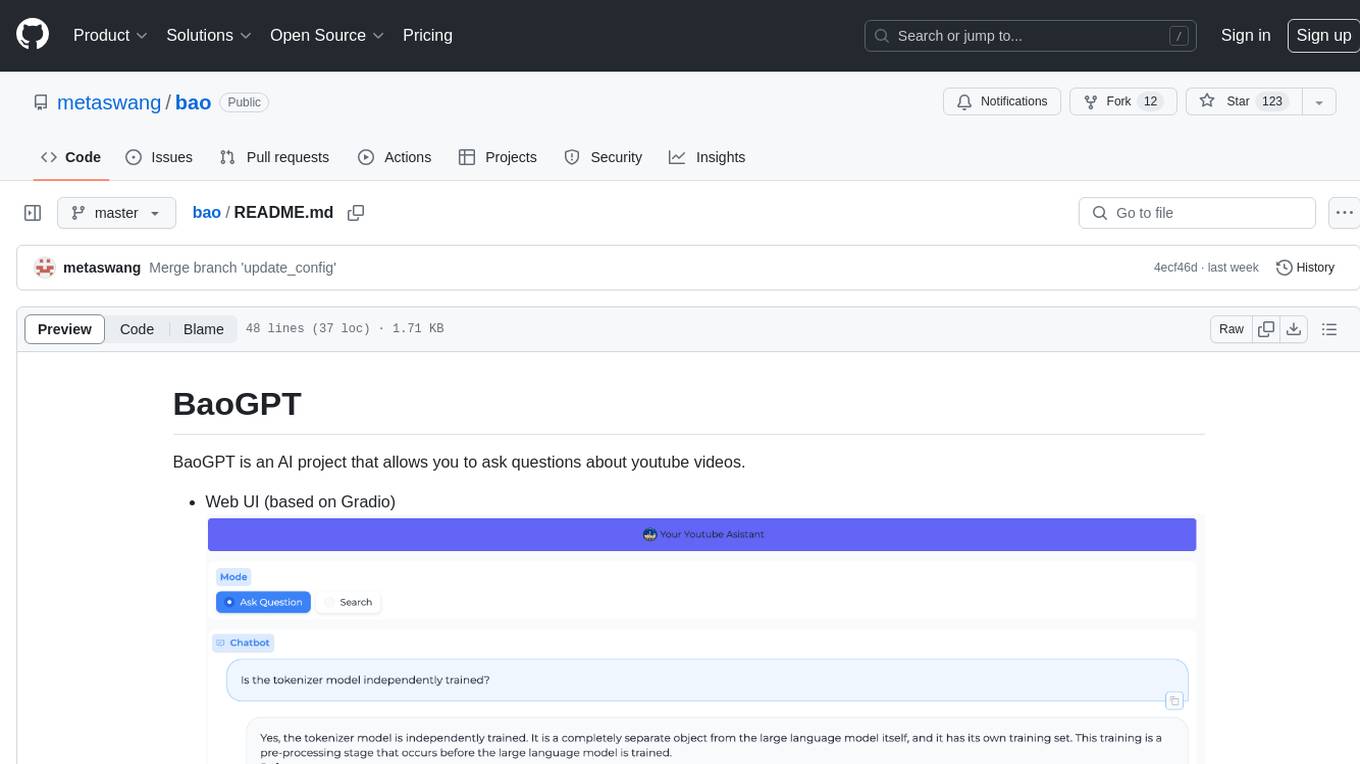
BaoGPT is an AI project designed to facilitate asking questions about YouTube videos. It features a web UI based on Gradio and Discord integration. The tool utilizes a pipeline that routes input questions to either a greeting-like branch or a query & answer branch. The query analysis is performed by the LLM, which extracts attributes as filters and optimizes and rewrites questions for better vector retrieval in the vector DB. The tool then retrieves top-k candidates for grading and outputs final relative documents after grading. Lastly, the LLM performs summarization based on the reranking output, providing answers and attaching sources to the user.
ultimate-rvc
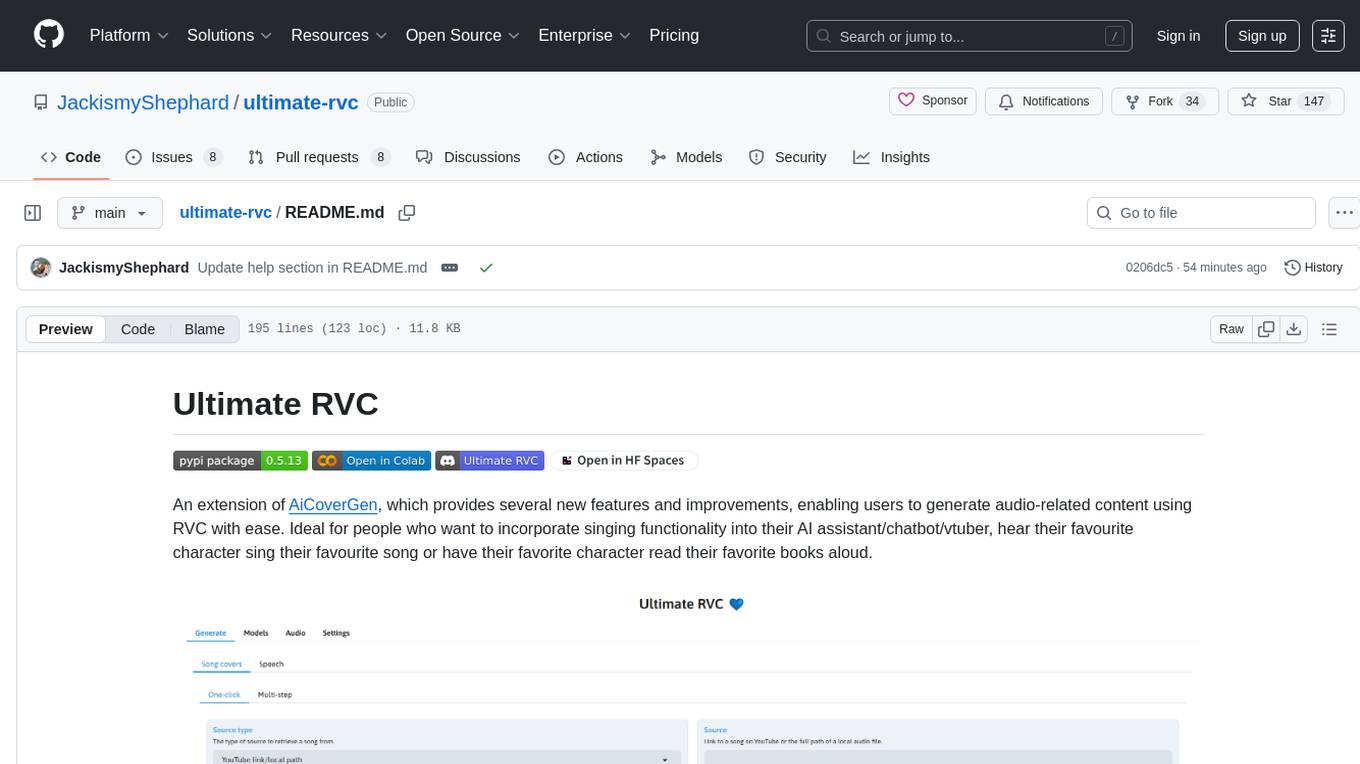
Ultimate RVC is an extension of AiCoverGen, offering new features and improvements for generating audio content using RVC. It is designed for users looking to integrate singing functionality into AI assistants/chatbots/vtubers, create character voices for songs or books, and train voice models. The tool provides easy setup, voice conversion enhancements, TTS functionality, voice model training suite, caching system, UI improvements, and support for custom configurations. It is available for local and Google Colab use, with a PyPI package for easy access. The tool also offers CLI usage and customization through environment variables.
nanoPerplexityAI
nanoPerplexityAI is an open-source implementation of a large language model service that fetches information from Google. It involves a simple architecture where the user query is checked by the language model, reformulated for Google search, and an answer is generated and saved in a markdown file. The tool requires minimal setup and is designed for easy visualization of answers.
chronon
Chronon is a platform that simplifies and improves ML workflows by providing a central place to define features, ensuring point-in-time correctness for backfills, simplifying orchestration for batch and streaming pipelines, offering easy endpoints for feature fetching, and guaranteeing and measuring consistency. It offers benefits over other approaches by enabling the use of a broad set of data for training, handling large aggregations and other computationally intensive transformations, and abstracting away the infrastructure complexity of data plumbing.

ComfyUI-TopazVideoAI
ComfyUI-TopazVideoAI is a tool designed to facilitate the usage of TopazVideoAI for creating short AI-generated videos. Users can connect this node between video output and video save to enhance the quality of videos. The tool requires a licensed installation of TopazVideoAI and provides instructions for setting up environment variables and paths. It is recommended to use upscale factors of 2 or 4 to avoid errors. The tool encodes and decodes videos as image batches, which may result in longer processing times compared to the TopazVideoAI GUI. Common errors include 'No such filter: 'tvai_up'' which can be resolved by ensuring the correct ffmpeg path and removing conflicting ffmpeg installations.
recognize
Recognize is a smart media tagging tool for Nextcloud that automatically categorizes photos and music by recognizing faces, animals, landscapes, food, vehicles, buildings, landmarks, monuments, music genres, and human actions in videos. It uses pre-trained models for object detection, landmark recognition, face comparison, music genre classification, and video classification. The tool ensures privacy by processing images locally without sending data to cloud providers. However, it cannot process end-to-end encrypted files. Recognize is rated positively for ethical AI practices in terms of open-source software, freely available models, and training data transparency, except for music genre recognition due to limited access to training data.
Powerpointer-For-Local-LLMs
PowerPointer For Local LLMs is a PowerPoint generator that uses python-pptx and local llm's via the Oobabooga Text Generation WebUI api to create beautiful and informative presentations. It runs locally on your computer, eliminating privacy concerns. The tool allows users to select from 7 designs, make placeholders for images, and easily customize presentations within PowerPoint. Users provide information for the PowerPoint, which is then used to generate text using optimized prompts and the text generation webui api. The generated text is converted into a PowerPoint presentation using the python-pptx library.
lumigator
Lumigator is an open-source platform developed by Mozilla.ai to help users select the most suitable language model for their specific needs. It supports the evaluation of summarization tasks using sequence-to-sequence models such as BART and BERT, as well as causal models like GPT and Mistral. The platform aims to make model selection transparent, efficient, and empowering by providing a framework for comparing LLMs using task-specific metrics to evaluate how well a model fits a project's needs. Lumigator is in the early stages of development and plans to expand support to additional machine learning tasks and use cases in the future.
feedgen
FeedGen is an open-source tool that uses Google Cloud's state-of-the-art Large Language Models (LLMs) to improve product titles, generate more comprehensive descriptions, and fill missing attributes in product feeds. It helps merchants and advertisers surface and fix quality issues in their feeds using Generative AI in a simple and configurable way. The tool relies on GCP's Vertex AI API to provide both zero-shot and few-shot inference capabilities on GCP's foundational LLMs. With few-shot prompting, users can customize the model's responses towards their own data, achieving higher quality and more consistent output. FeedGen is an Apps Script based application that runs as an HTML sidebar in Google Sheets, allowing users to optimize their feeds with ease.
pyOllaMx
PyOllaMx is a chatbot application that serves as a gateway to both Ollama and Apple MlX models. It allows users to chat with these models through a native MacOS interface, eliminating the need for external applications like Bing or Chat-GPT. The tool provides a versatile and user-friendly experience for interacting with different models, enabling tasks such as model discovery, model management, chatting, and web searching. PyOllaMx simplifies the workflow for users who want to leverage Ollama and MlX models on their Mac devices.
lovelaice
Lovelaice is an AI-powered assistant for your terminal and editor. It can run bash commands, search the Internet, answer general and technical questions, complete text files, chat casually, execute code in various languages, and more. Lovelaice is configurable with API keys and LLM models, and can be used for a wide range of tasks requiring bash commands or coding assistance. It is designed to be versatile, interactive, and helpful for daily tasks and projects.
For similar tasks
ai-video-search-engine
AI Video Search Engine (AVSE) is a video search engine powered by the latest tools in AI. It allows users to search for specific answers within millions of videos by indexing video content. The tool extracts video transcription, elements like thumbnail and description, and generates vector embeddings using AI models. Users can search for relevant results based on questions, view timestamped transcripts, and get video summaries. AVSE requires a paid Supabase & Fly.io account for hosting and can handle millions of videos with the current setup.
MaterialSearch
MaterialSearch is a tool for searching local images and videos using natural language. It provides functionalities such as text search for images, image search for images, text search for videos (providing matching video clips), image search for videos (searching for the segment in a video through a screenshot), image-text similarity calculation, and Pexels video search. The tool can be deployed through the source code or Docker image, and it supports GPU acceleration. Users can configure the tool through environment variables or a .env file. The tool is still under development, and configurations may change frequently. Users can report issues or suggest improvements through issues or pull requests.
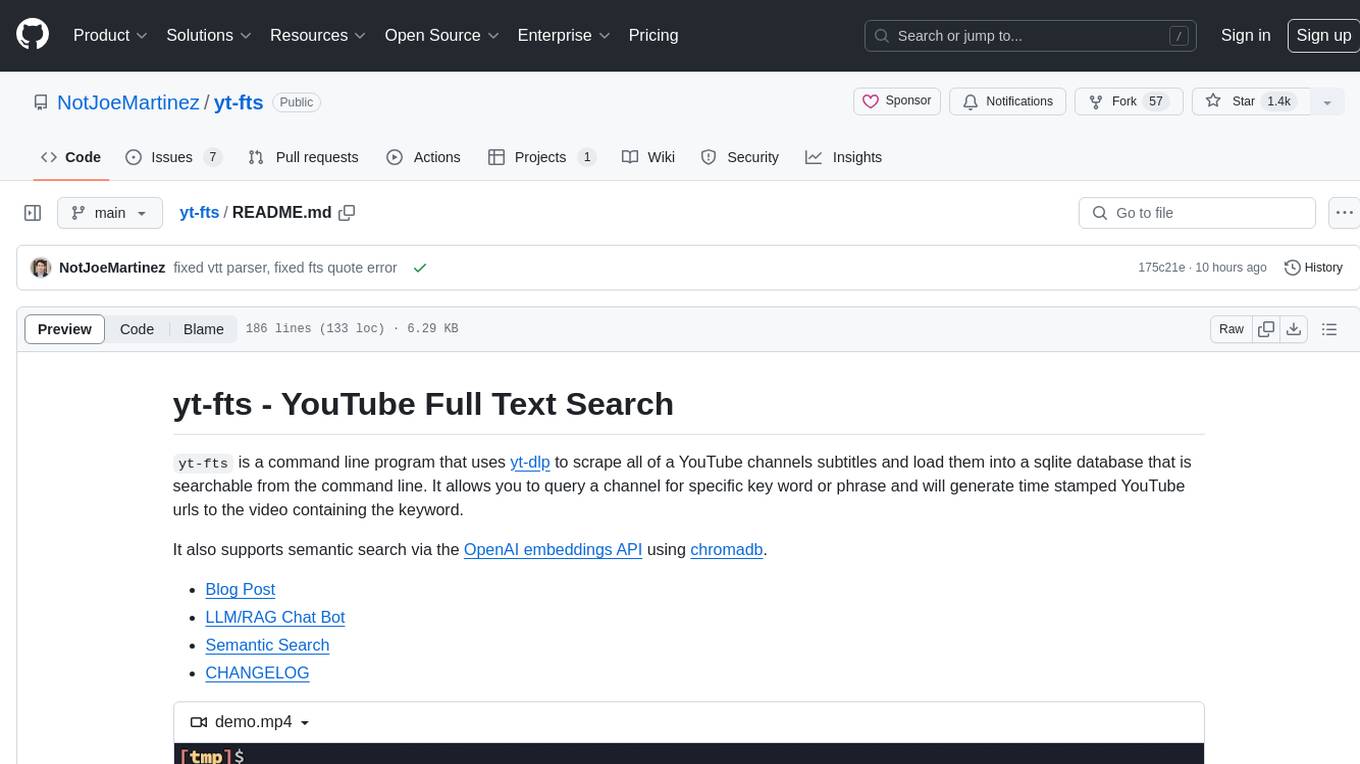
yt-fts
yt-fts is a command line program that uses yt-dlp to scrape all of a YouTube channels subtitles and load them into a sqlite database for full text search. It allows users to query a channel for specific keywords or phrases and generates time stamped YouTube URLs to the videos containing the keyword. Additionally, it supports semantic search via the OpenAI embeddings API using chromadb.
quickvid
QuickVid is an open-source video summarization tool that uses AI to generate summaries of YouTube videos. It is built with Whisper, GPT, LangChain, and Supabase. QuickVid can be used to save time and get the essence of any YouTube video with intelligent summarization.

auto-news
Auto-News is an automatic news aggregator tool that utilizes Large Language Models (LLM) to pull information from various sources such as Tweets, RSS feeds, YouTube videos, web articles, Reddit, and journal notes. The tool aims to help users efficiently read and filter content based on personal interests, providing a unified reading experience and organizing information effectively. It features feed aggregation with summarization, transcript generation for videos and articles, noise reduction, task organization, and deep dive topic exploration. The tool supports multiple LLM backends, offers weekly top-k aggregations, and can be deployed on Linux/MacOS using docker-compose or Kubernetes.
SummaryYou
Summary You is a tool that utilizes AI to summarize YouTube videos, articles, images, and documents. Users can set the length of the summary and have the option to listen to the summaries. The tool also includes a history section, intelligent paywall detection, OLED-Dark Mode, and a user-friendly Material Design 3 style UI with dynamic color themes. It uses GPT-3.5 OpenAI/Mixtral 8x7B Groq for summarization. The backend is implemented in Python with Chaquopy, and some UI designs and codes are borrowed from Seal Material color utilities.
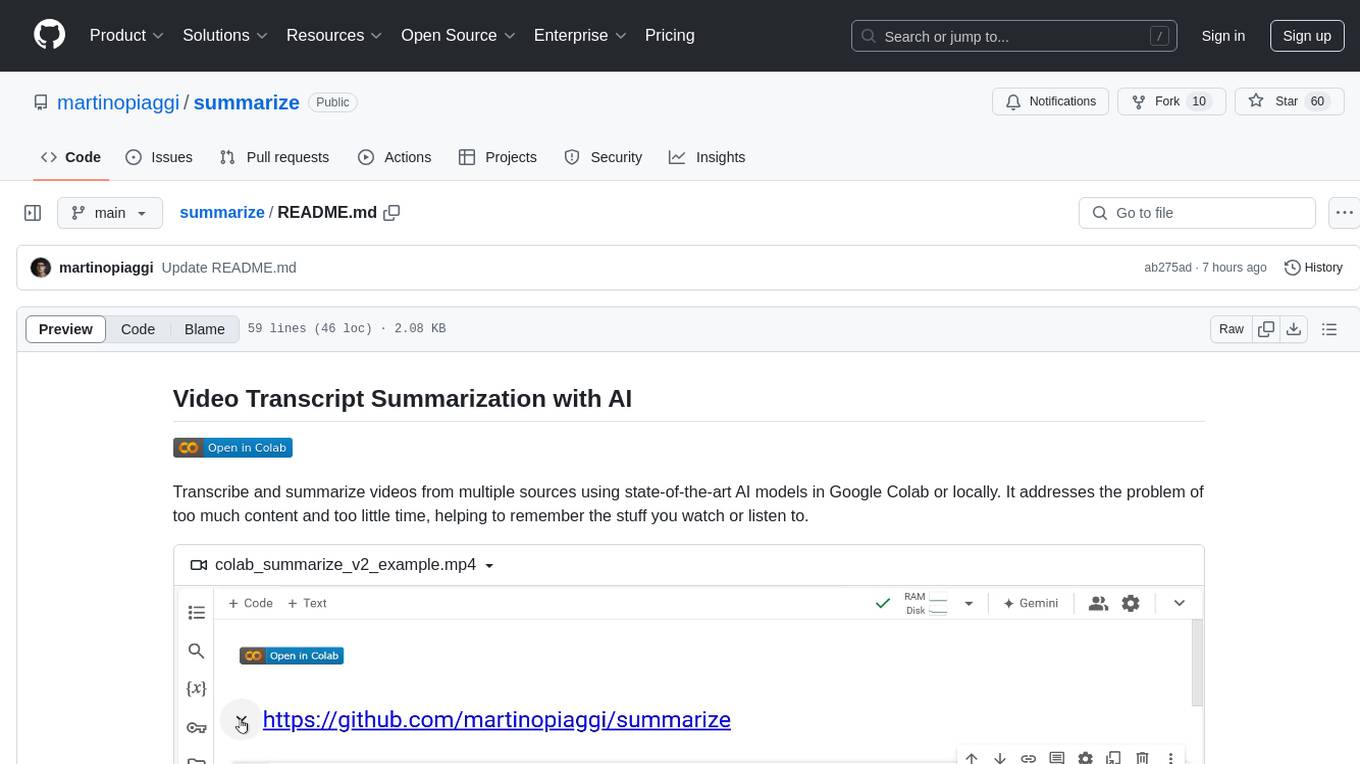
summarize
The 'summarize' tool is designed to transcribe and summarize videos from various sources using AI models. It helps users efficiently summarize lengthy videos, take notes, and extract key insights by providing timestamps, original transcripts, and support for auto-generated captions. Users can utilize different AI models via Groq, OpenAI, or custom local models to generate grammatically correct video transcripts and extract wisdom from video content. The tool simplifies the process of summarizing video content, making it easier to remember and reference important information.
asktube
AskTube is an AI-powered YouTube video summarizer and QA assistant that utilizes Retrieval Augmented Generation (RAG) technology. It offers a comprehensive solution with Q&A functionality and aims to provide a user-friendly experience for local machine usage. The project integrates various technologies including Python, JS, Sanic, Peewee, Pytubefix, Sentence Transformers, Sqlite, Chroma, and NuxtJs/DaisyUI. AskTube supports multiple providers for analysis, AI services, and speech-to-text conversion. The tool is designed to extract data from YouTube URLs, store embedding chapter subtitles, and facilitate interactive Q&A sessions with enriched questions. It is not intended for production use but rather for end-users on their local machines.
For similar jobs
sweep
Sweep is an AI junior developer that turns bugs and feature requests into code changes. It automatically handles developer experience improvements like adding type hints and improving test coverage.
teams-ai
The Teams AI Library is a software development kit (SDK) that helps developers create bots that can interact with Teams and Microsoft 365 applications. It is built on top of the Bot Framework SDK and simplifies the process of developing bots that interact with Teams' artificial intelligence capabilities. The SDK is available for JavaScript/TypeScript, .NET, and Python.
ai-guide
This guide is dedicated to Large Language Models (LLMs) that you can run on your home computer. It assumes your PC is a lower-end, non-gaming setup.
classifai
Supercharge WordPress Content Workflows and Engagement with Artificial Intelligence. Tap into leading cloud-based services like OpenAI, Microsoft Azure AI, Google Gemini and IBM Watson to augment your WordPress-powered websites. Publish content faster while improving SEO performance and increasing audience engagement. ClassifAI integrates Artificial Intelligence and Machine Learning technologies to lighten your workload and eliminate tedious tasks, giving you more time to create original content that matters.
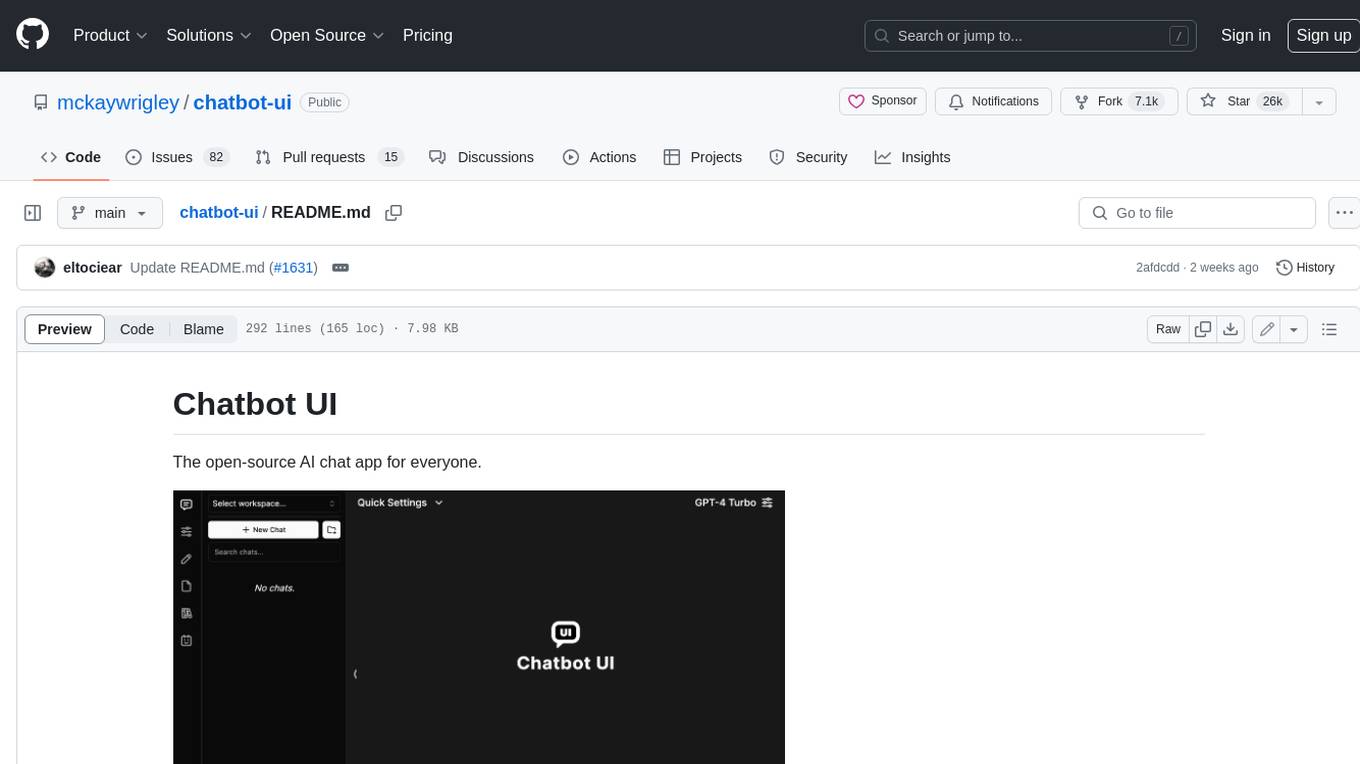
chatbot-ui
Chatbot UI is an open-source AI chat app that allows users to create and deploy their own AI chatbots. It is easy to use and can be customized to fit any need. Chatbot UI is perfect for businesses, developers, and anyone who wants to create a chatbot.
BricksLLM
BricksLLM is a cloud native AI gateway written in Go. Currently, it provides native support for OpenAI, Anthropic, Azure OpenAI and vLLM. BricksLLM aims to provide enterprise level infrastructure that can power any LLM production use cases. Here are some use cases for BricksLLM: * Set LLM usage limits for users on different pricing tiers * Track LLM usage on a per user and per organization basis * Block or redact requests containing PIIs * Improve LLM reliability with failovers, retries and caching * Distribute API keys with rate limits and cost limits for internal development/production use cases * Distribute API keys with rate limits and cost limits for students
uAgents
uAgents is a Python library developed by Fetch.ai that allows for the creation of autonomous AI agents. These agents can perform various tasks on a schedule or take action on various events. uAgents are easy to create and manage, and they are connected to a fast-growing network of other uAgents. They are also secure, with cryptographically secured messages and wallets.
griptape
Griptape is a modular Python framework for building AI-powered applications that securely connect to your enterprise data and APIs. It offers developers the ability to maintain control and flexibility at every step. Griptape's core components include Structures (Agents, Pipelines, and Workflows), Tasks, Tools, Memory (Conversation Memory, Task Memory, and Meta Memory), Drivers (Prompt and Embedding Drivers, Vector Store Drivers, Image Generation Drivers, Image Query Drivers, SQL Drivers, Web Scraper Drivers, and Conversation Memory Drivers), Engines (Query Engines, Extraction Engines, Summary Engines, Image Generation Engines, and Image Query Engines), and additional components (Rulesets, Loaders, Artifacts, Chunkers, and Tokenizers). Griptape enables developers to create AI-powered applications with ease and efficiency.