


tinyclaw
The original Tiny Claw as your personal autonomous AI companion. 🐜
Stars: 53
Tiny Claw (Mandibles) is an autonomous AI companion framework built from scratch with a tiny core, plugin architecture, self-improving memory, and smart routing that tiers queries to cut costs. It aims to make AI simple, affordable, and truly personal, like having your own helpful friend. Inspired by personal AI companions from science fiction, Tiny Claw is designed to assist with work, projects, and daily life, growing with the user over time. The framework features a Discord-like UI, adaptive memory, self-improving behavior, plugin architecture, personality engine, smart routing, context compaction, anti-malware protection, security layers, delegation system, inter-agent communication, easy setup, and multi-provider support.
README:
[!NOTE] Tiny Claw is NOT a smaller version of OpenClaw. It is a completely independent product and an alternative to OpenClaw. While the original idea and inspiration came from OpenClaw (the lobster 🦞), Tiny Claw (the ant 🐜) has its own mission, architecture, and identity built from the ground up.
Your autonomous AI companion.
[!WARNING] 🚧 Under Active Development - This project is in heavy development and things will break. Running it now may spoil the experience we're building for you. Please wait for the first official release before trying it out. Follow @TinyClawAI and @warengonzaga on X for launch updates.
AI agents today are powerful but complex, expensive to run, and heavy to set up. Tiny Claw believes AI should be simple, affordable, and truly personal, like having your own Codsworth or AYLA as a helpful friend. It achieves this by being a native framework built from scratch with a tiny core, plugin architecture, self-improving memory, and smart routing that tiers queries to cut costs. The result is an autonomous, self-improving, self-learning, and self-configuring personal AI companion that grows with you over time.
Think of the personal computer revolution. Computers were once reserved for governments, military, and large corporations. Having one meant building it yourself or spending serious money. Then Apple came along and made them personal and accessible to everyone. Tiny Claw does the same for AI agents.
Most AI agent frameworks are powerful but heavy. They require expensive subscriptions, complex setup, and are built on top of other frameworks. Tiny Claw takes a different approach. It's built from scratch, cheap to run, and treats you as a friend, not just a user to be served.
| Tiny Claw 🐜 | Other AI Agent Frameworks | |
|---|---|---|
| Architecture | Native framework, built from scratch | Built on existing frameworks (Pi, Claude Code, Codex) |
| Philosophy | Personal companion with its own personality | Configurable assistant you shape from scratch |
| Core size | Tiny by design, everything else is a plugin | Large monolith that grows over time |
| Personality | Has its own, you can't override it | Fully configurable system prompts |
| Memory | Self-improving with temporal decay | Flat conversation history |
| Context | 4-layer compaction keeps context small and cheap | Unbounded context windows burn tokens |
| Security | Built-in SHIELD.md anti-malware enforcement | No native threat model |
| UI | Discord-like web experience out of the box | Terminal-only or separate UI dependency |
| Setup | Self-configuring, zero hassle | Complex onboarding with multiple dependencies |
| Runtime | Bun-native, single binary | Node.js 22+, pnpm, multiple processes |
| Built-in Provider | Ollama Cloud (free sign-up, generous free tier) | Requires Claude Pro/Max ($20-200/mo) or API keys |
| Cost | Smart routing slashes LLM spend by tiering queries | Every query hits the most expensive model |
| Routing | Adapts to whichever provider plugins you install | Hardcoded to a single provider |
Tiny Claw is inspired by personal AI companions from science fiction like Codsworth from Fallout (the loyal robot butler) and AYLA from Deliver Us Mars (the autonomous drone companion). It's not designed to be your employee or your robot slave. It's designed to be your helpful friend that can assist with your work, your projects, and your daily life, but on its own terms.
The ant metaphor is intentional. A single ant is tiny, but it's autonomous, it learns, it adapts, and it builds something greater over time. That's Tiny Claw. Small by design, mighty by nature. The name "Mandibles" refers to the ant's powerful jaws — tiny but capable of carrying many times their own weight.
- Personal, not enterprise. Built for you, not your org chart. Helps with your work and business as a friend, not as a tool.
- Tiny core, plugin everything. The core stays minimal. Channels, providers, and tools are all plugins.
- Self-improving. Learns from every conversation via episodic memory with temporal decay.
- Self-configuring. No manual config files. The agent configures itself through conversation.
- Own personality. Ships with a personality (Heartware system) that's uniquely its own.
- Native, not wrapped. Every component is built from scratch with zero dependency on external AI frameworks.
- Easy to start. Uses Ollama Cloud with two built-in models — kimi-k2.5:cloud (default) and gpt-oss:120b-cloud. Choose your model during setup and switch anytime via conversation.
- Cost-conscious. Smart routing tiers queries across your installed providers. Cheap models handle simple stuff, powerful models only fire when needed.
| Feature | Description | |
|---|---|---|
| 💬 | Discord-Like UI | Dark-themed web interface inspired by Discord with real-time SSE streaming, typing indicators, inline delegation event cards, and an active agents sidebar |
| 🧠 | Adaptive Memory | 3-layer memory system (episodic, semantic FTS5, temporal decay) that learns what to remember and forget |
| 🤖 | Self-Improving | Behavioral pattern detection that makes the agent better with every interaction |
| 🔌 | Plugin Architecture | Channels, providers, and tools are all plugins. Core stays tiny |
| 🎭 | Heartware Personality | Built-in personality engine with SOUL.md and IDENTITY.md. It has its own character |
| 🧩 | Smart Routing | 8-dimension query classifier that adapts to your installed provider plugins, routing simple queries to cheap models and complex ones to powerful ones, cutting LLM costs |
| 📐 | Context Compactor | 4-layer context compaction pipeline with rule-based pre-compression, shingle deduplication, LLM summarization, and tiered summaries (L0/L1/L2) |
| 🛡️ | SHIELD.md Anti-Malware | Runtime SHIELD.md enforcement engine with threat parsing, pattern matching, and re-enforce action for built-in anti-malware protection |
| 🔒 | 5-Layer Security | Path sandbox, content validation, audit log, auto-backup, rate limiting |
| 🏗️ | Delegation System | Autonomous sub-agent orchestration with self-improving role templates, blackboard collaboration, and adaptive timeout estimation |
| 📡 | Inter-Agent Comms | Lightweight pub/sub event bus for real-time inter-agent communication with wildcard subscriptions and bounded history |
| 💾 | Easy Setup | SQLite persistence with Ollama Cloud built-in. Free to sign up and start using immediately |
| ⚡ | Bun-Native | Built on Bun for maximum performance, minimal footprint |
| 🔄 | Provider Fallback | Multi-provider support (Ollama, OpenAI, Anthropic) with automatic failover |

Everything above the plugin line is the tiny core. Channels, extra providers, and additional tools live as plugins in plugins/.
bun installbun startOpen http://localhost:3000. Tiny Claw will walk you through the rest. No config files needed.
bun dev      # Development mode with hot reload
bun build    # Build all packages
bun test # Run test suite- Channel plugin guide:
plugins/channel/README.md
tinyclaw/
  packages/          Core library packages (tiny, focused, no circular deps)
    core/            Agent loop, database, built-in Ollama provider
    types/           Shared interfaces (leaf dependency)
    config/          Zod-validated configuration engine
    compactor/       Context compaction engine (4-layer pipeline)
    heartware/       Personality engine + safety layers
    memory/          Adaptive memory with episodic + FTS5
    delegation/      Sub-agent orchestration + blackboard
    router/          Smart provider routing (8-dim classifier)
    learning/        Behavioral pattern detection
    sandbox/         Bun Worker code execution
    shell/           Controlled shell execution with permission engine
    shield/          Runtime SHIELD.md enforcement + anti-malware
    pulse/           Cron-like proactive scheduler
    queue/           Per-session message locking queue
    intercom/        Pub/sub inter-agent communication
    matcher/         Hybrid semantic matcher (TF-IDF + fuzzy + synonyms)
    logger/          Singleton logger with emoji mappings
    secrets/         Encrypted secrets management (AES-256-GCM)
    plugins/         Plugin discovery and loading
  plugins/           Plugin packages (keep the core tiny)
    channel/         Messaging integrations (Discord, Friends, etc.)
    provider/        LLM providers (OpenAI, etc.)
  src/
    cli/             CLI entry point
    landing/         Official landing page (Svelte + Vite)
    web/             Web UI (Svelte 5, Discord-like experience)
Please report any issues and bugs by creating a new issue here, also make sure you're reporting an issue that doesn't exist. Any help to improve the project would be appreciated. Thanks! 🙏✨
Like this project? Leave a star! ⭐⭐⭐⭐⭐
Want to support my work and get some perks? Become a sponsor! 💖
Or, you just love what I do? Buy me a coffee! ☕
Recognized my open-source contributions? Nominate me as GitHub Star! 💫
Read the project's code of conduct.
This project is licensed under GNU General Public License v3.0.
- OpenClaw — original idea and inspiration
- ClawRouter — smart routing inspiration
- Claw Compactor — compactor inspiration
- Nader Dabit — learnings from You Could've Invented OpenClaw
- SHIELD.md by Thomas Roccia — security policy inspiration
- Bun by Oven — all-in-one JavaScript runtime
- Secrets Engine, Config Engine, and Log Engine by WG Tech Labs — built for this project
This project is created by Waren Gonzaga, with the help of awesome contributors.
💻💖☕ by Waren Gonzaga | YHWH 🙏 - Without Him, none of this exists, even me.
For Tasks:
Click tags to check more tools for each tasksFor Jobs:
Alternative AI tools for tinyclaw
Similar Open Source Tools
tinyclaw
Tiny Claw (Mandibles) is an autonomous AI companion framework built from scratch with a tiny core, plugin architecture, self-improving memory, and smart routing that tiers queries to cut costs. It aims to make AI simple, affordable, and truly personal, like having your own helpful friend. Inspired by personal AI companions from science fiction, Tiny Claw is designed to assist with work, projects, and daily life, growing with the user over time. The framework features a Discord-like UI, adaptive memory, self-improving behavior, plugin architecture, personality engine, smart routing, context compaction, anti-malware protection, security layers, delegation system, inter-agent communication, easy setup, and multi-provider support.
spacebot
Spacebot is an AI agent designed for teams, communities, and multi-user environments. It splits the monolith into specialized processes that delegate tasks, allowing it to handle concurrent conversations, execute tasks, and respond to multiple users simultaneously. Built for Discord, Slack, and Telegram, Spacebot can run coding sessions, manage files, automate web browsing, and search the web. Its memory system is structured and graph-connected, enabling productive knowledge synthesis. With capabilities for task execution, messaging, memory management, scheduling, model routing, and extensible skills, Spacebot offers a comprehensive solution for collaborative work environments.
core
CORE is an open-source unified, persistent memory layer for all AI tools, allowing developers to maintain context across different tools like Cursor, ChatGPT, and Claude. It aims to solve the issue of context switching and information loss between sessions by creating a knowledge graph that remembers conversations, decisions, and insights. With features like unified memory, temporal knowledge graph, browser extension, chat with memory, auto-sync from apps, and MCP integration hub, CORE provides a seamless experience for managing and recalling context. The tool's ingestion pipeline captures evolving context through normalization, extraction, resolution, and graph integration, resulting in a dynamic memory that grows and changes with the user. When recalling from memory, CORE utilizes search, re-ranking, filtering, and output to provide relevant and contextual answers. Security measures include data encryption, authentication, access control, and vulnerability reporting.
plandex
Plandex is an open source, terminal-based AI coding engine designed for complex tasks. It uses long-running agents to break up large tasks into smaller subtasks, helping users work through backlogs, navigate unfamiliar technologies, and save time on repetitive tasks. Plandex supports various AI models, including OpenAI, Anthropic Claude, Google Gemini, and more. It allows users to manage context efficiently in the terminal, experiment with different approaches using branches, and review changes before applying them. The tool is platform-independent and runs from a single binary with no dependencies.
FuzzyAI
The FuzzyAI Fuzzer is a powerful tool for automated LLM fuzzing, designed to help developers and security researchers identify jailbreaks and mitigate potential security vulnerabilities in their LLM APIs. It supports various fuzzing techniques, provides input generation capabilities, can be easily integrated into existing workflows, and offers an extensible architecture for customization and extension. The tool includes attacks like ArtPrompt, Taxonomy-based paraphrasing, Many-shot jailbreaking, Genetic algorithm, Hallucinations, DAN (Do Anything Now), WordGame, Crescendo, ActorAttack, Back To The Past, Please, Thought Experiment, and Default. It supports models from providers like Anthropic, OpenAI, Gemini, Azure, Bedrock, AI21, and Ollama, with the ability to add support for newer models. The tool also supports various cloud APIs and datasets for testing and experimentation.
learn-low-code-agentic-ai
This repository is dedicated to learning about Low-Code Full-Stack Agentic AI Development. It provides material for building modern AI-powered applications using a low-code full-stack approach. The main tools covered are UXPilot for UI/UX mockups, Lovable.dev for frontend applications, n8n for AI agents and workflows, Supabase for backend data storage, authentication, and vector search, and Model Context Protocol (MCP) for integration. The focus is on prompt and context engineering as the foundation for working with AI systems, enabling users to design, develop, and deploy AI-driven full-stack applications faster, smarter, and more reliably.
llm-twin-course
The LLM Twin Course is a free, end-to-end framework for building production-ready LLM systems. It teaches you how to design, train, and deploy a production-ready LLM twin of yourself powered by LLMs, vector DBs, and LLMOps good practices. The course is split into 11 hands-on written lessons and the open-source code you can access on GitHub. You can read everything and try out the code at your own pace.
pipecat
Pipecat is an open-source framework designed for building generative AI voice bots and multimodal assistants. It provides code building blocks for interacting with AI services, creating low-latency data pipelines, and transporting audio, video, and events over the Internet. Pipecat supports various AI services like speech-to-text, text-to-speech, image generation, and vision models. Users can implement new services and contribute to the framework. Pipecat aims to simplify the development of applications like personal coaches, meeting assistants, customer support bots, and more by providing a complete framework for integrating AI services.
nexent
Nexent is a powerful tool for analyzing and visualizing network traffic data. It provides comprehensive insights into network behavior, helping users to identify patterns, anomalies, and potential security threats. With its user-friendly interface and advanced features, Nexent is suitable for network administrators, cybersecurity professionals, and anyone looking to gain a deeper understanding of their network infrastructure.
BMAD-METHOD
BMAD-METHOD™ is a universal AI agent framework that revolutionizes Agile AI-Driven Development. It offers specialized AI expertise across various domains, including software development, entertainment, creative writing, business strategy, and personal wellness. The framework introduces two key innovations: Agentic Planning, where dedicated agents collaborate to create detailed specifications, and Context-Engineered Development, which ensures complete understanding and guidance for developers. BMAD-METHOD™ simplifies the development process by eliminating planning inconsistency and context loss, providing a seamless workflow for creating AI agents and expanding functionality through expansion packs.
appwrite
Appwrite is a best-in-class, developer-first platform that provides everything needed to create scalable, stable, and production-ready software quickly. It is an end-to-end platform for building Web, Mobile, Native, or Backend apps, packaged as Docker microservices. Appwrite abstracts the complexity of building modern apps and allows users to build secure, full-stack applications faster. It offers features like user authentication, database management, storage, file management, image manipulation, Cloud Functions, messaging, and more services.
flow-like
Flow-Like is an enterprise-grade workflow operating system built upon Rust for uncompromising performance, efficiency, and code safety. It offers a modular frontend for apps, a rich set of events, a node catalog, a powerful no-code workflow IDE, and tools to manage teams, templates, and projects within organizations. With typed workflows, users can create complex, large-scale workflows with clear data origins, transformations, and contracts. Flow-Like is designed to automate any process through seamless integration of LLM, ML-based, and deterministic decision-making instances.
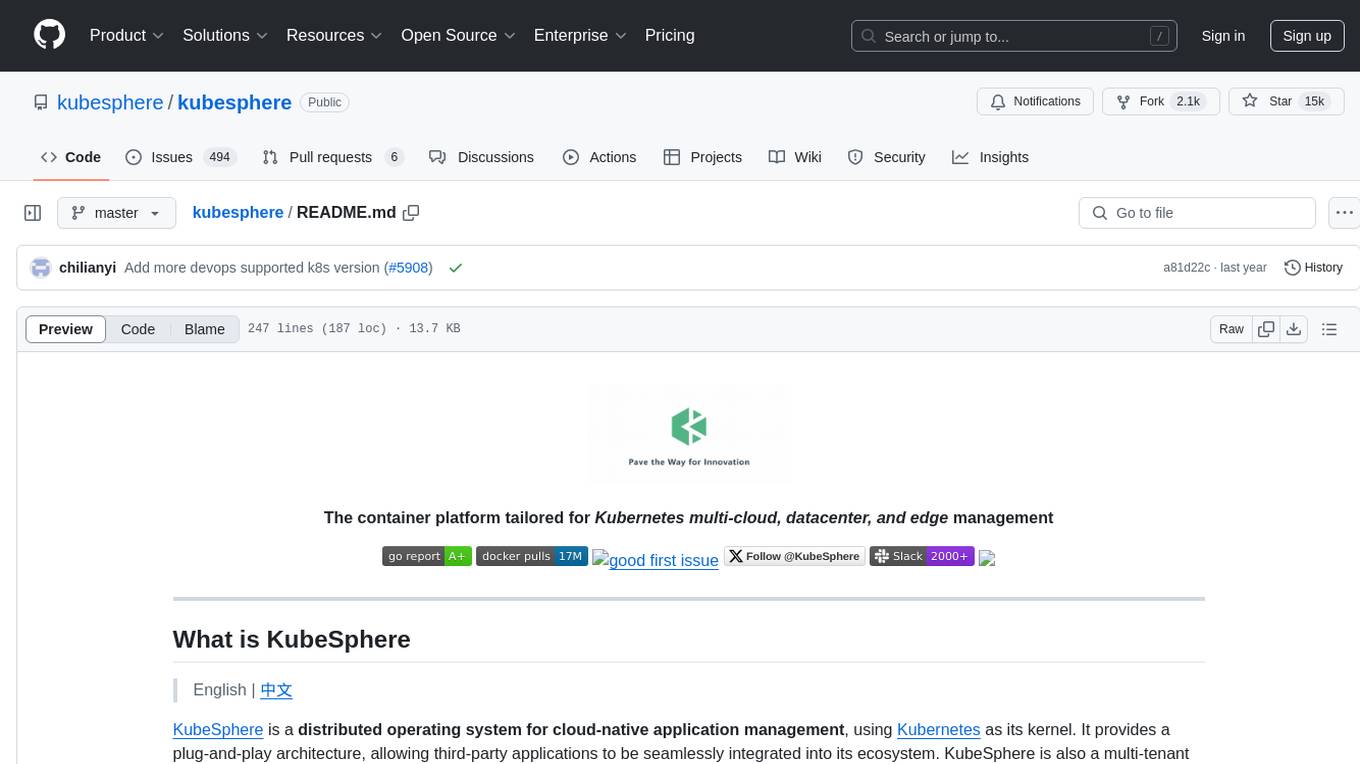
kubesphere
KubeSphere is a distributed operating system for cloud-native application management, using Kubernetes as its kernel. It provides a plug-and-play architecture, allowing third-party applications to be seamlessly integrated into its ecosystem. KubeSphere is also a multi-tenant container platform with full-stack automated IT operation and streamlined DevOps workflows. It provides developer-friendly wizard web UI, helping enterprises to build out a more robust and feature-rich platform, which includes most common functionalities needed for enterprise Kubernetes strategy.
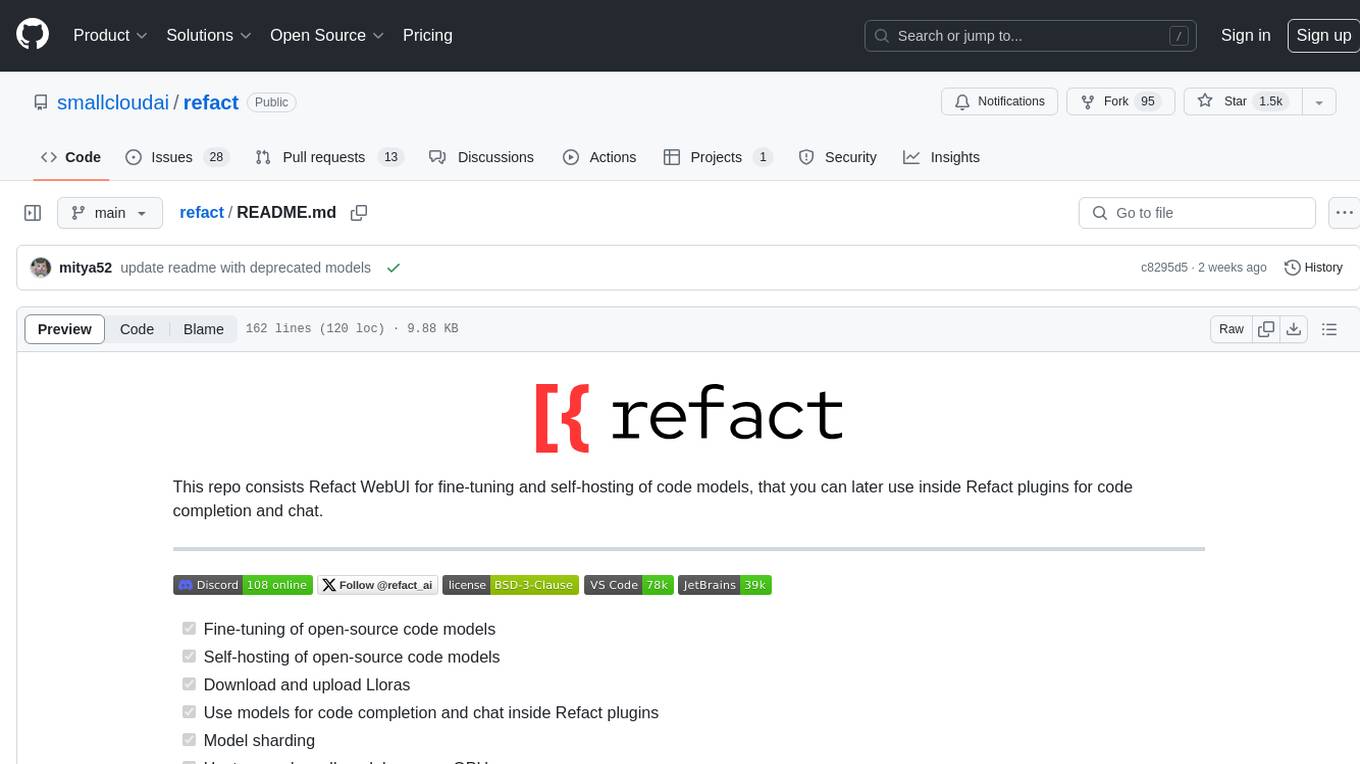
refact
This repository contains Refact WebUI for fine-tuning and self-hosting of code models, which can be used inside Refact plugins for code completion and chat. Users can fine-tune open-source code models, self-host them, download and upload Lloras, use models for code completion and chat inside Refact plugins, shard models, host multiple small models on one GPU, and connect GPT-models for chat using OpenAI and Anthropic keys. The repository provides a Docker container for running the self-hosted server and supports various models for completion, chat, and fine-tuning. Refact is free for individuals and small teams under the BSD-3-Clause license, with custom installation options available for GPU support. The community and support include contributing guidelines, GitHub issues for bugs, a community forum, Discord for chatting, and Twitter for product news and updates.
agentic-context-engine
Agentic Context Engine (ACE) is a framework that enables AI agents to learn from their execution feedback, continuously improving without fine-tuning or training data. It maintains a Skillbook of evolving strategies, extracting patterns from successful tasks and learning from failures transparently in context. ACE offers self-improving agents, better performance on complex tasks, token reduction in browser automation, and preservation of valuable knowledge over time. Users can integrate ACE with popular agent frameworks and benefit from its innovative approach to in-context learning.
blind_chat
BlindChat is a confidential and verifiable Conversational AI tool that ensures user prompts remain private from the AI provider. It leverages privacy-enhancing technology called enclaves with the core solution, BlindLlama. BlindChat Local variant operates entirely in the user's browser, ensuring data never leaves the device. The tool provides cryptographic guarantees that user data is protected and not accessible to AI providers.
For similar tasks
tinyclaw
Tiny Claw (Mandibles) is an autonomous AI companion framework built from scratch with a tiny core, plugin architecture, self-improving memory, and smart routing that tiers queries to cut costs. It aims to make AI simple, affordable, and truly personal, like having your own helpful friend. Inspired by personal AI companions from science fiction, Tiny Claw is designed to assist with work, projects, and daily life, growing with the user over time. The framework features a Discord-like UI, adaptive memory, self-improving behavior, plugin architecture, personality engine, smart routing, context compaction, anti-malware protection, security layers, delegation system, inter-agent communication, easy setup, and multi-provider support.
agentpool
AgentPool is a unified agent orchestration hub that allows users to configure and manage heterogeneous AI agents via YAML and expose them through standardized protocols. It acts as a protocol bridge, enabling users to define all agents in one YAML file and expose them through ACP or AG-UI protocols. Users can coordinate, delegate, and communicate with different agents through a unified interface. The tool supports multi-agent coordination, rich YAML configuration, server protocols like ACP and OpenCode, and additional capabilities such as structured output, storage & analytics, file abstraction, triggers, and streaming TTS. It offers CLI and programmatic usage patterns for running agents and interacting with the tool.
openrecall
OpenRecall is a fully open-source, privacy-first tool that captures your digital history through snapshots, making it searchable for quick access to specific information. It offers transparency, cross-platform support, privacy focus, and hardware compatibility. Features include time travel, local-first AI, semantic search, and full control over storage. The roadmap includes visual search capabilities and audio transcription. Users can easily install and run OpenRecall to enhance memory and productivity without compromising privacy.
Remember-Me-AI
Remember-Me is a military-grade, offline 'Second Brain' AI tool that lives entirely on your hard drive. It combines local LLM inference with Quantum Dream Memory Architecture to help you think, remember everything, and answer to no one but you. The tool ensures 0% Cloud, 0% Spying, and 100% Ownership, providing a sovereign ecosystem for users to enhance their cognitive capabilities without relying on external servers or services.
Memoh
Memoh is a multi-member, structured long-memory, containerized AI agent system platform that allows users to create AI bots for communication via platforms like Telegram, Discord, and Lark. Each bot operates in its own isolated container with a memory system for file editing, command execution, and self-building. Memoh offers a secure, flexible, and scalable solution for multi-bot management, distinguishing and remembering requests from multiple users and bots.
For similar jobs
promptflow
**Prompt flow** is a suite of development tools designed to streamline the end-to-end development cycle of LLM-based AI applications, from ideation, prototyping, testing, evaluation to production deployment and monitoring. It makes prompt engineering much easier and enables you to build LLM apps with production quality.
deepeval
DeepEval is a simple-to-use, open-source LLM evaluation framework specialized for unit testing LLM outputs. It incorporates various metrics such as G-Eval, hallucination, answer relevancy, RAGAS, etc., and runs locally on your machine for evaluation. It provides a wide range of ready-to-use evaluation metrics, allows for creating custom metrics, integrates with any CI/CD environment, and enables benchmarking LLMs on popular benchmarks. DeepEval is designed for evaluating RAG and fine-tuning applications, helping users optimize hyperparameters, prevent prompt drifting, and transition from OpenAI to hosting their own Llama2 with confidence.
MegaDetector
MegaDetector is an AI model that identifies animals, people, and vehicles in camera trap images (which also makes it useful for eliminating blank images). This model is trained on several million images from a variety of ecosystems. MegaDetector is just one of many tools that aims to make conservation biologists more efficient with AI. If you want to learn about other ways to use AI to accelerate camera trap workflows, check out our of the field, affectionately titled "Everything I know about machine learning and camera traps".
leapfrogai
LeapfrogAI is a self-hosted AI platform designed to be deployed in air-gapped resource-constrained environments. It brings sophisticated AI solutions to these environments by hosting all the necessary components of an AI stack, including vector databases, model backends, API, and UI. LeapfrogAI's API closely matches that of OpenAI, allowing tools built for OpenAI/ChatGPT to function seamlessly with a LeapfrogAI backend. It provides several backends for various use cases, including llama-cpp-python, whisper, text-embeddings, and vllm. LeapfrogAI leverages Chainguard's apko to harden base python images, ensuring the latest supported Python versions are used by the other components of the stack. The LeapfrogAI SDK provides a standard set of protobuffs and python utilities for implementing backends and gRPC. LeapfrogAI offers UI options for common use-cases like chat, summarization, and transcription. It can be deployed and run locally via UDS and Kubernetes, built out using Zarf packages. LeapfrogAI is supported by a community of users and contributors, including Defense Unicorns, Beast Code, Chainguard, Exovera, Hypergiant, Pulze, SOSi, United States Navy, United States Air Force, and United States Space Force.
llava-docker
This Docker image for LLaVA (Large Language and Vision Assistant) provides a convenient way to run LLaVA locally or on RunPod. LLaVA is a powerful AI tool that combines natural language processing and computer vision capabilities. With this Docker image, you can easily access LLaVA's functionalities for various tasks, including image captioning, visual question answering, text summarization, and more. The image comes pre-installed with LLaVA v1.2.0, Torch 2.1.2, xformers 0.0.23.post1, and other necessary dependencies. You can customize the model used by setting the MODEL environment variable. The image also includes a Jupyter Lab environment for interactive development and exploration. Overall, this Docker image offers a comprehensive and user-friendly platform for leveraging LLaVA's capabilities.

carrot
The 'carrot' repository on GitHub provides a list of free and user-friendly ChatGPT mirror sites for easy access. The repository includes sponsored sites offering various GPT models and services. Users can find and share sites, report errors, and access stable and recommended sites for ChatGPT usage. The repository also includes a detailed list of ChatGPT sites, their features, and accessibility options, making it a valuable resource for ChatGPT users seeking free and unlimited GPT services.
TrustLLM
TrustLLM is a comprehensive study of trustworthiness in LLMs, including principles for different dimensions of trustworthiness, established benchmark, evaluation, and analysis of trustworthiness for mainstream LLMs, and discussion of open challenges and future directions. Specifically, we first propose a set of principles for trustworthy LLMs that span eight different dimensions. Based on these principles, we further establish a benchmark across six dimensions including truthfulness, safety, fairness, robustness, privacy, and machine ethics. We then present a study evaluating 16 mainstream LLMs in TrustLLM, consisting of over 30 datasets. The document explains how to use the trustllm python package to help you assess the performance of your LLM in trustworthiness more quickly. For more details about TrustLLM, please refer to project website.
AI-YinMei
AI-YinMei is an AI virtual anchor Vtuber development tool (N card version). It supports fastgpt knowledge base chat dialogue, a complete set of solutions for LLM large language models: [fastgpt] + [one-api] + [Xinference], supports docking bilibili live broadcast barrage reply and entering live broadcast welcome speech, supports Microsoft edge-tts speech synthesis, supports Bert-VITS2 speech synthesis, supports GPT-SoVITS speech synthesis, supports expression control Vtuber Studio, supports painting stable-diffusion-webui output OBS live broadcast room, supports painting picture pornography public-NSFW-y-distinguish, supports search and image search service duckduckgo (requires magic Internet access), supports image search service Baidu image search (no magic Internet access), supports AI reply chat box [html plug-in], supports AI singing Auto-Convert-Music, supports playlist [html plug-in], supports dancing function, supports expression video playback, supports head touching action, supports gift smashing action, supports singing automatic start dancing function, chat and singing automatic cycle swing action, supports multi scene switching, background music switching, day and night automatic switching scene, supports open singing and painting, let AI automatically judge the content.