


agentpool
A unified agent orchestration hub that lets you configure and manage multiple AI agents (native, ACP, AGUI, Claude Code) via YAML, and exposes them through standardized protocols (ACP/OpenCode Server).
Stars: 83
AgentPool is a unified agent orchestration hub that allows users to configure and manage heterogeneous AI agents via YAML and expose them through standardized protocols. It acts as a protocol bridge, enabling users to define all agents in one YAML file and expose them through ACP or AG-UI protocols. Users can coordinate, delegate, and communicate with different agents through a unified interface. The tool supports multi-agent coordination, rich YAML configuration, server protocols like ACP and OpenCode, and additional capabilities such as structured output, storage & analytics, file abstraction, triggers, and streaming TTS. It offers CLI and programmatic usage patterns for running agents and interacting with the tool.
README:





A unified agent orchestration hub that lets you configure and manage heterogeneous AI agents via YAML and expose them through standardized protocols.
You want to use multiple AI agents together - Claude Code for refactoring, Codex for code editing with advanced reasoning, a custom analysis agent, maybe Goose for specific tasks. But each has different APIs, protocols, and integration patterns. Coordinating them means writing glue code for each combination.
AgentPool acts as a protocol bridge. Define all your agents in one YAML file - whether they're native (PydanticAI-based), direct integrations (Claude Code, Codex), external ACP agents (Goose), or AG-UI agents. Then expose them all through ACP or AG-UI protocols, letting them cooperate, delegate, and communicate through a unified interface.
flowchart TB
    subgraph AgentPool
        subgraph config[YAML Configuration]
            native[Native Agents<br/>PydanticAI]
            direct[Direct Integrations<br/>Claude Code, Codex]
            acp_agents[ACP Agents<br/>Goose, etc.]
            agui_agents[AG-UI Agents]
            workflows[Teams & Workflows]
        end

        subgraph interface[Unified Agent Interface]
            delegation[Inter-agent delegation]
            routing[Message routing]
            context[Shared context]
        end

        config --> interface
    end

    interface --> acp_server[ACP Server]
    interface --> opencode_server[OpenCode Server]
    interface --> agui_server[AG-UI Server]

    acp_server --> clients1[Zed, Toad, ACP Clients]
    opencode_server --> clients2[OpenCode TUI/Desktop]
agui_server --> clients3[AG-UI Clients]uv tool install agentpool
# agents.yml
agents:
  assistant:
    type: native
    model: openai:gpt-4o
    system_prompt: "You are a helpful assistant."
# Run via CLI
agentpool run assistant "Hello!"
# Or start as ACP server (for Zed, Toad, etc.)
agentpool serve-acp agents.ymlThe real power comes from mixing agent types:
agents:
  # Native PydanticAI-based agent
  coordinator:
    type: native
    model: openai:gpt-4o
    tools:
      - type: subagent  # Can delegate to all other agents
    system_prompt: "Coordinate tasks between available agents."

  # Claude Code agent (direct integration)
  claude:
    type: claude_code
    description: "Claude Code for complex refactoring"

  # Codex agent (direct integration)
  codex:
    type: codex
    model: gpt-5.1-codex-max
    reasoning_effort: medium
    description: "Codex for code editing with advanced reasoning"

  # ACP protocol agents
  goose:
    type: acp
    provider: goose
    description: "Goose for file operations"

  # AG-UI protocol agent
  agui_agent:
    type: agui
    url: "http://localhost:8000"
    description: "Custom AG-UI agent"
Now coordinator can delegate work to any of these agents, and all are accessible through the same interface.
Agents can form teams (parallel) or chains (sequential):
teams:
  review_pipeline:
    mode: sequential
    members: [analyzer, reviewer, formatter]

  parallel_coders:
    mode: parallel
    members: [claude, goose]
async with AgentPool("agents.yml") as pool:
# Parallel execution
team = pool.get_agent("analyzer") & pool.get_agent("reviewer")
results = await team.run("Review this code")
# Sequential pipeline
chain = analyzer | reviewer | formatter
result = await chain.run("Process this")Everything is configurable - models, tools, connections, triggers, storage:
agents:
  analyzer:
    type: native
    model:
      type: fallback
      models: [openai:gpt-4o, anthropic:claude-sonnet-4-0]
    tools:
      - type: subagent
      - type: resource_access
    mcp_servers:
      - "uvx mcp-server-filesystem"
    knowledge:
      paths: ["docs/**/*.md"]
    connections:
      - type: node
        name: reporter
        filter_condition:
          type: word_match
words: [error, warning]AgentPool can expose your agents through multiple server protocols:
| Server | Command | Use Case |
|---|---|---|
| ACP | agentpool serve-acp |
IDE integration (Zed, Toad) - bidirectional communication with tool confirmations |
| OpenCode | agentpool serve-opencode |
OpenCode TUI/Desktop - supports remote filesystems via fsspec |
| MCP | agentpool serve-mcp |
Expose tools to other agents |
| AG-UI | agentpool serve-agui |
AG-UI compatible frontends |
| OpenAI API | agentpool serve-api |
Drop-in OpenAI API replacement |
The ACP server is ideal for IDE integration - it provides real-time tool confirmations and session management. The OpenCode server enables the OpenCode TUI to control AgentPool agents, including agents operating on remote environments (Docker, SSH, cloud sandboxes).
- Structured Output: Define response schemas inline or import Python types
- Storage & Analytics: Track all interactions with configurable providers
- File Abstraction: UPath-backed operations work on local and remote sources
- Triggers: React to file changes, webhooks, or custom events
- Streaming TTS: Voice output support for all agents
agentpool run agent_name "prompt"           # Single run
agentpool serve-acp config.yml              # ACP server for IDEs
agentpool serve-opencode config.yml         # OpenCode TUI server
agentpool serve-mcp config.yml              # MCP server
agentpool watch --config agents.yml         # React to triggers
agentpool history stats --group-by model # View analyticsfrom agentpool import AgentPool
async with AgentPool("agents.yml") as pool:
agent = pool.get_agent("assistant")
# Simple run
result = await agent.run("Hello")
# Streaming
async for event in agent.run_stream("Tell me a story"):
print(event)
# Multi-modal
result = await agent.run("Describe this", Path("image.jpg"))For complete documentation including advanced configuration, connection patterns, and API reference, visit phil65.github.io/agentpool.
For Tasks:
Click tags to check more tools for each tasksFor Jobs:
Alternative AI tools for agentpool
Similar Open Source Tools
agentpool
AgentPool is a unified agent orchestration hub that allows users to configure and manage heterogeneous AI agents via YAML and expose them through standardized protocols. It acts as a protocol bridge, enabling users to define all agents in one YAML file and expose them through ACP or AG-UI protocols. Users can coordinate, delegate, and communicate with different agents through a unified interface. The tool supports multi-agent coordination, rich YAML configuration, server protocols like ACP and OpenCode, and additional capabilities such as structured output, storage & analytics, file abstraction, triggers, and streaming TTS. It offers CLI and programmatic usage patterns for running agents and interacting with the tool.
sdk-python
Strands Agents is a lightweight and flexible SDK that takes a model-driven approach to building and running AI agents. It supports various model providers, offers advanced capabilities like multi-agent systems and streaming support, and comes with built-in MCP server support. Users can easily create tools using Python decorators, integrate MCP servers seamlessly, and leverage multiple model providers for different AI tasks. The SDK is designed to scale from simple conversational assistants to complex autonomous workflows, making it suitable for a wide range of AI development needs.
hayhooks
Hayhooks is a tool that simplifies the deployment and serving of Haystack pipelines as REST APIs. It allows users to wrap their pipelines with custom logic and expose them via HTTP endpoints, including OpenAI-compatible chat completion endpoints. With Hayhooks, users can easily convert their Haystack pipelines into API services with minimal boilerplate code.
orra
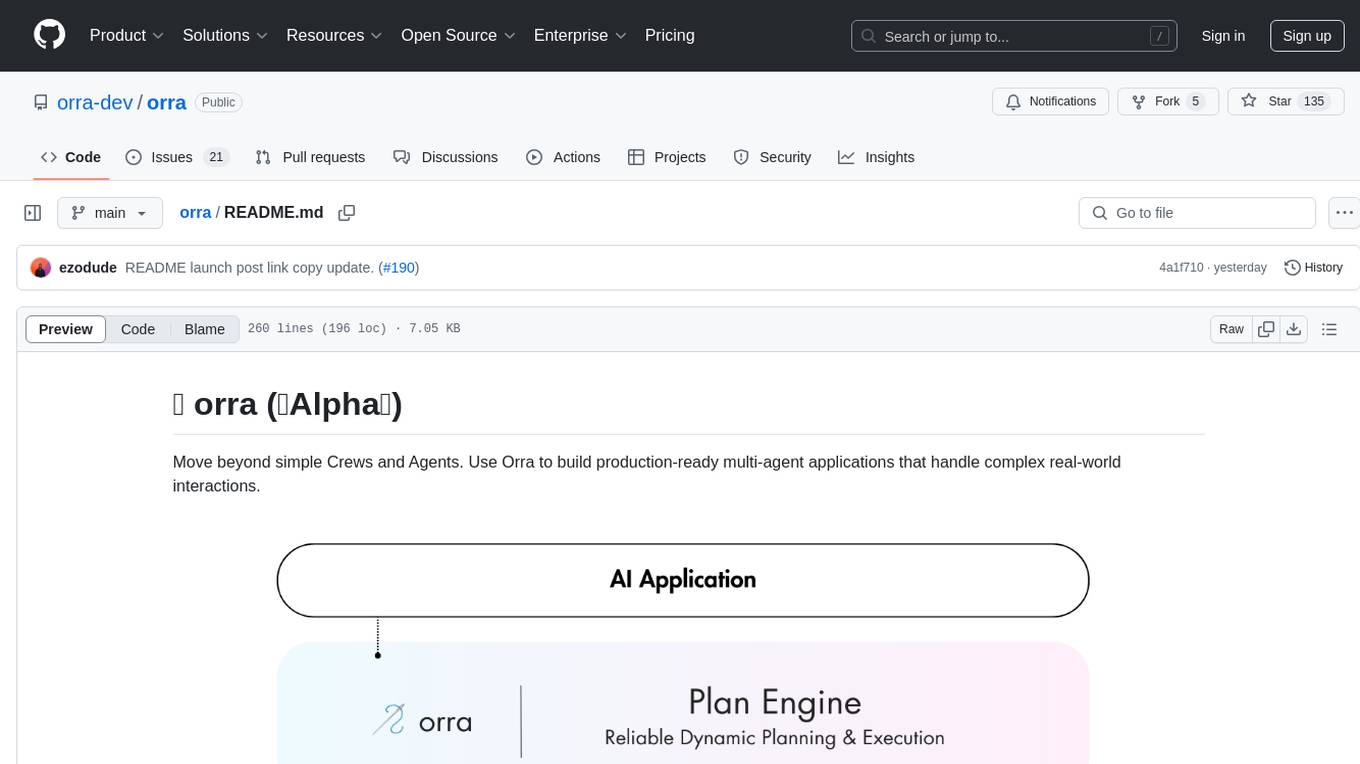
Orra is a tool for building production-ready multi-agent applications that handle complex real-world interactions. It coordinates tasks across existing stack, agents, and tools run as services using intelligent reasoning. With features like smart pre-evaluated execution plans, domain grounding, durable execution, and automatic service health monitoring, Orra enables users to go fast with tools as services and revert state to handle failures. It provides real-time status tracking and webhook result delivery, making it ideal for developers looking to move beyond simple crews and agents.
sdk-typescript
Strands Agents - TypeScript SDK is a lightweight and flexible SDK that takes a model-driven approach to building and running AI agents in TypeScript/JavaScript. It brings key features from the Python Strands framework to Node.js environments, enabling type-safe agent development for various applications. The SDK supports model agnostic development with first-class support for Amazon Bedrock and OpenAI, along with extensible architecture for custom providers. It also offers built-in MCP support, real-time response streaming, extensible hooks, and conversation management features. With tools for interaction with external systems and seamless integration with MCP servers, the SDK provides a comprehensive solution for developing AI agents.
typedai
TypedAI is a TypeScript-first AI platform designed for developers to create and run autonomous AI agents, LLM based workflows, and chatbots. It offers advanced autonomous agents, software developer agents, pull request code review agent, AI chat interface, Slack chatbot, and supports various LLM services. The platform features configurable Human-in-the-loop settings, functional callable tools/integrations, CLI and Web UI interface, and can be run locally or deployed on the cloud with multi-user/SSO support. It leverages the Python AI ecosystem through executing Python scripts/packages and provides flexible run/deploy options like single user mode, Firestore & Cloud Run deployment, and multi-user SSO enterprise deployment. TypedAI also includes UI examples, code examples, and automated LLM function schemas for seamless development and execution of AI workflows.
sophia
Sophia is an open-source TypeScript platform designed for autonomous AI agents and LLM based workflows. It aims to automate processes, review code, assist with refactorings, and support various integrations. The platform offers features like advanced autonomous agents, reasoning/planning inspired by Google's Self-Discover paper, memory and function call history, adaptive iterative planning, and more. Sophia supports multiple LLMs/services, CLI and web interface, human-in-the-loop interactions, flexible deployment options, observability with OpenTelemetry tracing, and specific agents for code editing, software engineering, and code review. It provides a flexible platform for the TypeScript community to expand and support various use cases and integrations.
Shellsage
Shell Sage is an intelligent terminal companion and AI-powered terminal assistant that enhances the terminal experience with features like local and cloud AI support, context-aware error diagnosis, natural language to command translation, and safe command execution workflows. It offers interactive workflows, supports various API providers, and allows for custom model selection. Users can configure the tool for local or API mode, select specific models, and switch between modes easily. Currently in alpha development, Shell Sage has known limitations like limited Windows support and occasional false positives in error detection. The roadmap includes improvements like better context awareness, Windows PowerShell integration, Tmux integration, and CI/CD error pattern database.
mcp-agent
mcp-agent is a simple, composable framework designed to build agents using the Model Context Protocol. It handles the lifecycle of MCP server connections and implements patterns for building production-ready AI agents in a composable way. The framework also includes OpenAI's Swarm pattern for multi-agent orchestration in a model-agnostic manner, making it the simplest way to build robust agent applications. It is purpose-built for the shared protocol MCP, lightweight, and closer to an agent pattern library than a framework. mcp-agent allows developers to focus on the core business logic of their AI applications by handling mechanics such as server connections, working with LLMs, and supporting external signals like human input.
codemie-code
Unified AI Coding Assistant CLI for managing multiple AI agents like Claude Code, Google Gemini, OpenCode, and custom AI agents. Supports OpenAI, Azure OpenAI, AWS Bedrock, LiteLLM, Ollama, and Enterprise SSO. Features built-in LangGraph agent with file operations, command execution, and planning tools. Cross-platform support for Windows, Linux, and macOS. Ideal for developers seeking a powerful alternative to GitHub Copilot or Cursor.
any-llm
The `any-llm` repository provides a unified API to access different LLM (Large Language Model) providers. It offers a simple and developer-friendly interface, leveraging official provider SDKs for compatibility and maintenance. The tool is framework-agnostic, actively maintained, and does not require a proxy or gateway server. It addresses challenges in API standardization and aims to provide a consistent interface for various LLM providers, overcoming limitations of existing solutions like LiteLLM, AISuite, and framework-specific integrations.
open-responses
OpenResponses API provides enterprise-grade AI capabilities through a powerful API, simplifying development and deployment while ensuring complete data control. It offers automated tracing, integrated RAG for contextual information retrieval, pre-built tool integrations, self-hosted architecture, and an OpenAI-compatible interface. The toolkit addresses development challenges like feature gaps and integration complexity, as well as operational concerns such as data privacy and operational control. Engineering teams can benefit from improved productivity, production readiness, compliance confidence, and simplified architecture by choosing OpenResponses.
moling
MoLing is a computer-use and browser-use MCP Server that implements system interaction through operating system APIs, enabling file system operations such as reading, writing, merging, statistics, and aggregation, as well as the ability to execute system commands. It is a dependency-free local office automation assistant. Requiring no installation of any dependencies, MoLing can be run directly and is compatible with multiple operating systems, including Windows, Linux, and macOS. This eliminates the hassle of dealing with environment conflicts involving Node.js, Python, Docker, and other development environments. Command-line operations are dangerous and should be used with caution. MoLing supports features like file system operations, command-line terminal execution, browser control powered by 'github.com/chromedp/chromedp', and future plans for personal PC data organization, document writing assistance, schedule planning, and life assistant features. MoLing has been tested on macOS but may have issues on other operating systems.
docs-mcp-server
The docs-mcp-server repository contains the server-side code for the documentation management system. It provides functionalities for managing, storing, and retrieving documentation files. Users can upload, update, and delete documents through the server. The server also supports user authentication and authorization to ensure secure access to the documentation system. Additionally, the server includes APIs for integrating with other systems and tools, making it a versatile solution for managing documentation in various projects and organizations.
agentica
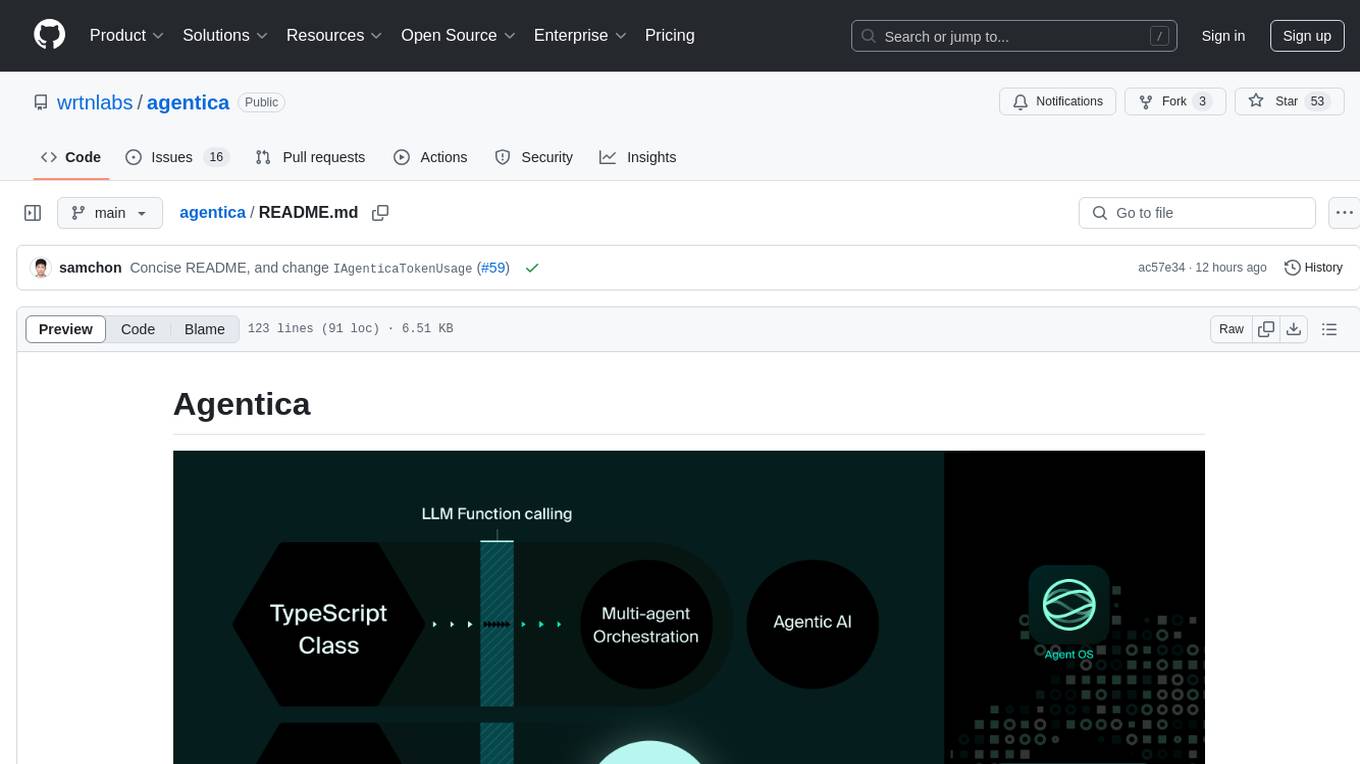
Agentica is a specialized Agentic AI library focused on LLM Function Calling. Users can provide Swagger/OpenAPI documents or TypeScript class types to Agentica for seamless functionality. The library simplifies AI development by handling various tasks effortlessly.
CyberStrikeAI
CyberStrikeAI is an AI-native security testing platform built in Go that integrates 100+ security tools, an intelligent orchestration engine, role-based testing with predefined security roles, a skills system with specialized testing skills, and comprehensive lifecycle management capabilities. It enables end-to-end automation from conversational commands to vulnerability discovery, attack-chain analysis, knowledge retrieval, and result visualization, delivering an auditable, traceable, and collaborative testing environment for security teams. The platform features an AI decision engine with OpenAI-compatible models, native MCP implementation with various transports, prebuilt tool recipes, large-result pagination, attack-chain graph, password-protected web UI, knowledge base with vector search, vulnerability management, batch task management, role-based testing, and skills system.
For similar tasks
agentpool
AgentPool is a unified agent orchestration hub that allows users to configure and manage heterogeneous AI agents via YAML and expose them through standardized protocols. It acts as a protocol bridge, enabling users to define all agents in one YAML file and expose them through ACP or AG-UI protocols. Users can coordinate, delegate, and communicate with different agents through a unified interface. The tool supports multi-agent coordination, rich YAML configuration, server protocols like ACP and OpenCode, and additional capabilities such as structured output, storage & analytics, file abstraction, triggers, and streaming TTS. It offers CLI and programmatic usage patterns for running agents and interacting with the tool.
AgentBench
AgentBench is a benchmark designed to evaluate Large Language Models (LLMs) as autonomous agents in various environments. It includes 8 distinct environments such as Operating System, Database, Knowledge Graph, Digital Card Game, and Lateral Thinking Puzzles. The tool provides a comprehensive evaluation of LLMs' ability to operate as agents by offering Dev and Test sets for each environment. Users can quickly start using the tool by following the provided steps, configuring the agent, starting task servers, and assigning tasks. AgentBench aims to bridge the gap between LLMs' proficiency as agents and their practical usability.
AgentGPT
AgentGPT is a platform that allows users to configure and deploy autonomous AI agents. Users can name their own custom AI and set it on any goal. The AI will think of tasks, execute them, and learn from the results to reach the goal. The platform provides a demo experience, automatic setup CLI, and a tech stack including Next.js, FastAPI, Prisma, TailwindCSS, Zod, and more. AgentGPT is designed to help users easily create and deploy AI agents for various tasks.
vibe-kanban
Vibe Kanban is a tool designed to streamline the process of planning, reviewing, and orchestrating tasks for human engineers working with AI coding agents. It allows users to easily switch between different coding agents, orchestrate their execution, review work, start dev servers, and track task statuses. The tool centralizes the configuration of coding agent MCP configs, providing a comprehensive solution for managing coding tasks efficiently.
AgentUp
AgentUp is an active development tool that provides a developer-first agent framework for creating AI agents with enterprise-grade infrastructure. It allows developers to define agents with configuration, ensuring consistent behavior across environments. The tool offers secure design, configuration-driven architecture, extensible ecosystem for customizations, agent-to-agent discovery, asynchronous task architecture, deterministic routing, and MCP support. It supports multiple agent types like reactive agents and iterative agents, making it suitable for chatbots, interactive applications, research tasks, and more. AgentUp is built by experienced engineers from top tech companies and is designed to make AI agents production-ready, secure, and reliable.
flock
Flock is a workflow-based low-code platform that enables rapid development of chatbots, RAG applications, and coordination of multi-agent teams. It offers a flexible, low-code solution for orchestrating collaborative agents, supporting various node types for specific tasks, such as input processing, text generation, knowledge retrieval, tool execution, intent recognition, answer generation, and more. Flock integrates LangChain and LangGraph to provide offline operation capabilities and supports future nodes like Conditional Branch, File Upload, and Parameter Extraction for creating complex workflows. Inspired by StreetLamb, Lobe-chat, Dify, and fastgpt projects, Flock introduces new features and directions while leveraging open-source models and multi-tenancy support.
swarmgo
SwarmGo is a Go package designed to create AI agents capable of interacting, coordinating, and executing tasks. It focuses on lightweight agent coordination and execution, offering powerful primitives like Agents and handoffs. SwarmGo enables building scalable solutions with rich dynamics between tools and networks of agents, all while keeping the learning curve low. It supports features like memory management, streaming support, concurrent agent execution, LLM interface, and structured workflows for organizing and coordinating multiple agents.
pebble
Pebbling is an open-source protocol for agent-to-agent communication, enabling AI agents to collaborate securely using Decentralised Identifiers (DIDs) and mutual TLS (mTLS). It provides a lightweight communication protocol built on JSON-RPC 2.0, ensuring reliable and secure conversations between agents. Pebbling allows agents to exchange messages safely, connect seamlessly regardless of programming language, and communicate quickly and efficiently. It is designed to pave the way for the next generation of collaborative AI systems, promoting secure and effortless communication between agents across different environments.
For similar jobs
sweep
Sweep is an AI junior developer that turns bugs and feature requests into code changes. It automatically handles developer experience improvements like adding type hints and improving test coverage.
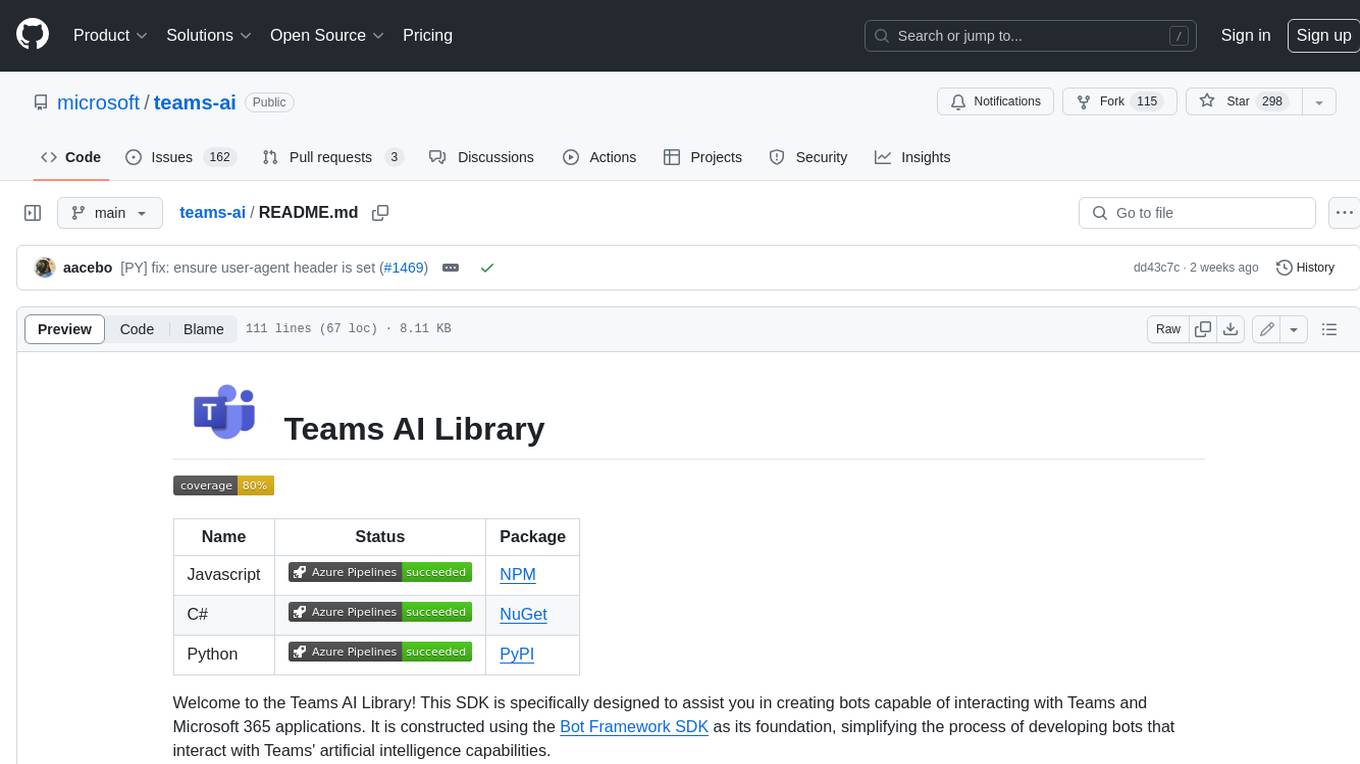
teams-ai
The Teams AI Library is a software development kit (SDK) that helps developers create bots that can interact with Teams and Microsoft 365 applications. It is built on top of the Bot Framework SDK and simplifies the process of developing bots that interact with Teams' artificial intelligence capabilities. The SDK is available for JavaScript/TypeScript, .NET, and Python.
ai-guide
This guide is dedicated to Large Language Models (LLMs) that you can run on your home computer. It assumes your PC is a lower-end, non-gaming setup.
classifai
Supercharge WordPress Content Workflows and Engagement with Artificial Intelligence. Tap into leading cloud-based services like OpenAI, Microsoft Azure AI, Google Gemini and IBM Watson to augment your WordPress-powered websites. Publish content faster while improving SEO performance and increasing audience engagement. ClassifAI integrates Artificial Intelligence and Machine Learning technologies to lighten your workload and eliminate tedious tasks, giving you more time to create original content that matters.
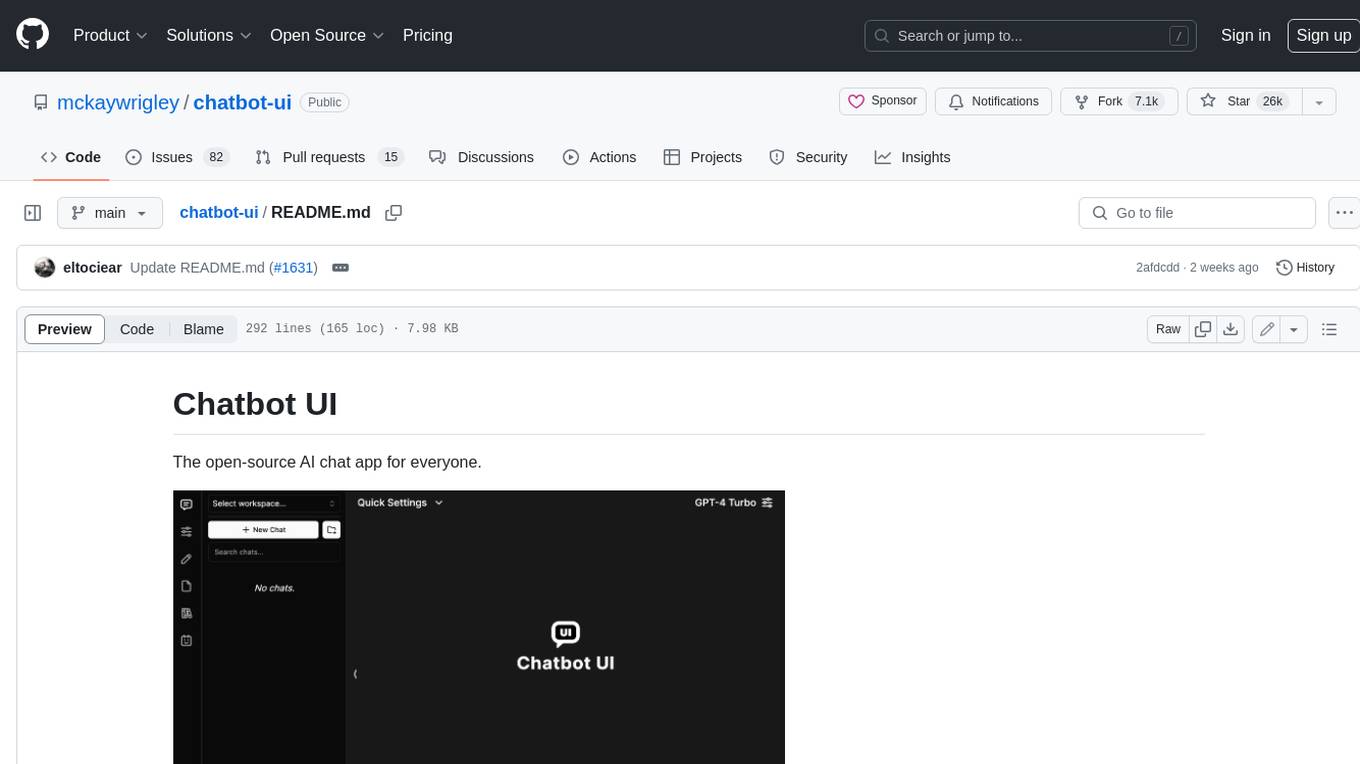
chatbot-ui
Chatbot UI is an open-source AI chat app that allows users to create and deploy their own AI chatbots. It is easy to use and can be customized to fit any need. Chatbot UI is perfect for businesses, developers, and anyone who wants to create a chatbot.
BricksLLM
BricksLLM is a cloud native AI gateway written in Go. Currently, it provides native support for OpenAI, Anthropic, Azure OpenAI and vLLM. BricksLLM aims to provide enterprise level infrastructure that can power any LLM production use cases. Here are some use cases for BricksLLM: * Set LLM usage limits for users on different pricing tiers * Track LLM usage on a per user and per organization basis * Block or redact requests containing PIIs * Improve LLM reliability with failovers, retries and caching * Distribute API keys with rate limits and cost limits for internal development/production use cases * Distribute API keys with rate limits and cost limits for students
uAgents
uAgents is a Python library developed by Fetch.ai that allows for the creation of autonomous AI agents. These agents can perform various tasks on a schedule or take action on various events. uAgents are easy to create and manage, and they are connected to a fast-growing network of other uAgents. They are also secure, with cryptographically secured messages and wallets.
griptape
Griptape is a modular Python framework for building AI-powered applications that securely connect to your enterprise data and APIs. It offers developers the ability to maintain control and flexibility at every step. Griptape's core components include Structures (Agents, Pipelines, and Workflows), Tasks, Tools, Memory (Conversation Memory, Task Memory, and Meta Memory), Drivers (Prompt and Embedding Drivers, Vector Store Drivers, Image Generation Drivers, Image Query Drivers, SQL Drivers, Web Scraper Drivers, and Conversation Memory Drivers), Engines (Query Engines, Extraction Engines, Summary Engines, Image Generation Engines, and Image Query Engines), and additional components (Rulesets, Loaders, Artifacts, Chunkers, and Tokenizers). Griptape enables developers to create AI-powered applications with ease and efficiency.