


agentic-context-engine
🧠 Make your agents learn from experience.
Stars: 1861
Agentic Context Engine (ACE) is a framework that enables AI agents to learn from their execution feedback, continuously improving without fine-tuning or training data. It maintains a Skillbook of evolving strategies, extracting patterns from successful tasks and learning from failures transparently in context. ACE offers self-improving agents, better performance on complex tasks, token reduction in browser automation, and preservation of valuable knowledge over time. Users can integrate ACE with popular agent frameworks and benefit from its innovative approach to in-context learning.
README:







AI agents that get smarter with every task
⭐ Star this repo if you find it useful!
ACE enables AI agents to learn from their execution feedback—what works, what doesn't—and continuously improve. No fine-tuning, no training data, just automatic in-context learning.
The framework maintains a Skillbook: a living document of strategies that evolves with each task. When your agent succeeds, ACE extracts patterns. When it fails, ACE learns what to avoid. All learning happens transparently in context.
- Self-Improving: Agents autonomously get smarter with each task
- 20-35% Better Performance: Proven improvements on complex tasks
- 49% Token Reduction: Demonstrated in browser automation benchmarks
- No Context Collapse: Preserves valuable knowledge over time
- Direct your favorite coding agent (Cursor, Claude Code, Codex, etc) to Quick Start Guide
- Prompt away!
pip install ace-framework
export OPENAI_API_KEY="your-api-key"
from ace import ACELiteLLM

agent = ACELiteLLM(model="gpt-4o-mini")

answer = agent.ask("What does Kayba's ACE framework do?")
print(answer)  # "ACE allows AI agents to remember and learn from experience!"
Done! Your agent learns automatically from each interaction.
→ Quick Start Guide | → Setup Guide
Claude Code with Learning → Quick Start
Run coding tasks with Claude Code while ACE learns patterns from each execution, building expertise over time for your specific codebase and workflows.
The Skillbook acts as an evolving system prompt that automatically improves based on execution feedback—no manual prompt engineering required.
Wrap your existing agent (browser-use, LangChain, custom) with ACE learning. Your agent executes tasks normally while ACE analyzes results and builds a skillbook of effective strategies.
Create new agents with built-in learning for customer support, data extraction, code generation, research, content creation, and task automation.
A challenge where LLMs often hallucinate that a seahorse emoji exists (it doesn't).

In this example:
- The agent incorrectly outputs a horse emoji
- ACE reflects on the mistake without external feedback
- On the second attempt, the agent correctly realizes there is no seahorse emoji
Online Shopping Demo: ACE vs baseline agent shopping for 5 grocery items.

In this example:
- ACE learns to navigate the website over 10 attempts
- Performance stabilizes and step count decreases by 29.8%
- Token costs reduce 49.0% for base agent and 42.6% including ACE overhead
→ Try it yourself & see all demos
In this example, Claude Code is enhanced with ACE and self-reflects after each execution while translating the ACE library from Python to TypeScript.
Python → TypeScript Translation:
| Metric | Result |
|---|---|
| Duration | ~4 hours |
| Commits | 119 |
| Lines written | ~14k |
| Outcome | Zero build errors, all tests passing |
| API cost | ~$1.5 (Sonnet for learning) |
ACE integrates with popular agent frameworks:
| Integration | ACE Class | Use Case |
|---|---|---|
| LiteLLM | ACELiteLLM |
Simple self-improving agent |
| LangChain | ACELangChain |
Wrap LangChain chains/agents |
| browser-use | ACEAgent |
Browser automation |
| Claude Code | ACEClaudeCode |
Claude Code CLI |
| Opik | OpikIntegration |
Production monitoring and cost tracking |
→ Integration Guide | → Examples
Based on the ACE research framework from Stanford & SambaNova.
ACE uses three specialized roles that work together:
- Agent - Creates a plan using learned skills and executes the task
- Reflector - Analyzes what worked and what didn't after execution
- SkillManager - Updates the skillbook with new strategies based on reflection
Important: The three ACE roles are different specialized prompts using the same language model, not separate models.
ACE teaches your agent and internalizes:
- Successes → Extract patterns that work
- Failures → Learn what to avoid
- Tool usage → Discover which tools work best for which tasks
- Edge cases → Remember rare scenarios and how to handle them
The magic happens in the Skillbook—a living document of skills that evolves with experience. Key innovation: All learning happens in context through incremental updates—no fine-tuning, no training data, and complete transparency into what your agent learned.
---
config:
  look: neo
  theme: neutral
---
flowchart LR
    Skillbook[("`**Skillbook**<br>(Evolving Context)<br><br>•Strategy Skills<br> Helpful skills <br> Harmful patterns <br> Neutral observations`")]
    Start(["**Query** <br>User prompt or question"]) --> Agent["**Agent** <br>Executes task using skillbook"]
    Agent --> Reflector
    Skillbook -. Provides Context .-> Agent
    Environment["**Task Environment**<br>Evaluates answer<br>Provides feedback"] -- Feedback+ <br>Optional Ground Truth --> Reflector
    Reflector["**Reflector**<br>Analyzes and provides feedback what was helpful/harmful"]
    Reflector --> SkillManager["**SkillManager**<br>Produces improvement updates"]
    SkillManager --> UpdateOps["**Merger** <br>Updates the skillbook with updates"]
    UpdateOps -- Incremental<br>Updates --> Skillbook
    Agent <--> Environment
- Quick Start Guide - Get running in 5 minutes
- Setup Guide - Installation, configuration, providers
- Integration Guide - Add ACE to existing agents
- API Reference - Complete API documentation
- Complete Guide to ACE - Deep dive into concepts
- Prompt Engineering - Advanced prompt techniques
- Agentic System Prompting - Automatically generate prompt improvements from past traces
- Examples - Ready-to-run code examples
- Benchmarks - Evaluate ACE performance
- Changelog - Recent changes
We love contributions! Check out our Contributing Guide to get started.
Based on the ACE paper and inspired by Dynamic Cheatsheet.
If you use ACE in your research, please cite:
@article{zhang2024ace,title={Agentic Context Engineering},author={Zhang et al.},journal={arXiv:2510.04618},year={2024}}
⭐ Star this repo if you find it useful!
Built with ❤️ by Kayba and the open-source community.
For Tasks:
Click tags to check more tools for each tasksFor Jobs:
Alternative AI tools for agentic-context-engine
Similar Open Source Tools
agentic-context-engine
Agentic Context Engine (ACE) is a framework that enables AI agents to learn from their execution feedback, continuously improving without fine-tuning or training data. It maintains a Skillbook of evolving strategies, extracting patterns from successful tasks and learning from failures transparently in context. ACE offers self-improving agents, better performance on complex tasks, token reduction in browser automation, and preservation of valuable knowledge over time. Users can integrate ACE with popular agent frameworks and benefit from its innovative approach to in-context learning.
EvoAgentX
EvoAgentX is an open-source framework for building, evaluating, and evolving LLM-based agents or agentic workflows in an automated, modular, and goal-driven manner. It enables developers and researchers to move beyond static prompt chaining or manual workflow orchestration by introducing a self-evolving agent ecosystem. The framework includes features such as agent workflow autoconstruction, built-in evaluation, self-evolution engine, plug-and-play compatibility, comprehensive built-in tools, memory module support, and human-in-the-loop interactions.
memU
MemU is an open-source memory framework designed for AI companions, offering high accuracy, fast retrieval, and cost-effectiveness. It serves as an intelligent 'memory folder' that adapts to various AI companion scenarios. With MemU, users can create AI companions that remember them, learn their preferences, and evolve through interactions. The framework provides advanced retrieval strategies, 24/7 support, and is specialized for AI companions. MemU offers cloud, enterprise, and self-hosting options, with features like memory organization, interconnected knowledge graph, continuous self-improvement, and adaptive forgetting mechanism. It boasts high memory accuracy, fast retrieval, and low cost, making it suitable for building intelligent agents with persistent memory capabilities.
awesome-slash
Automate the entire development workflow beyond coding. awesome-slash provides production-ready skills, agents, and commands for managing tasks, branches, reviews, CI, and deployments. It automates the entire workflow, including task exploration, planning, implementation, review, and shipping. The tool includes 11 plugins, 40 agents, 26 skills, and 26k lines of lib code, with 3,357 tests and support for 3 platforms. It works with Claude Code, OpenCode, and Codex CLI, offering specialized capabilities through skills and agents.
openrl
OpenRL is an open-source general reinforcement learning research framework that supports training for various tasks such as single-agent, multi-agent, offline RL, self-play, and natural language. Developed based on PyTorch, the goal of OpenRL is to provide a simple-to-use, flexible, efficient and sustainable platform for the reinforcement learning research community. It supports a universal interface for all tasks/environments, single-agent and multi-agent tasks, offline RL training with expert dataset, self-play training, reinforcement learning training for natural language tasks, DeepSpeed, Arena for evaluation, importing models and datasets from Hugging Face, user-defined environments, models, and datasets, gymnasium environments, callbacks, visualization tools, unit testing, and code coverage testing. It also supports various algorithms like PPO, DQN, SAC, and environments like Gymnasium, MuJoCo, Atari, and more.
superduperdb
SuperDuperDB is a Python framework for integrating AI models, APIs, and vector search engines directly with your existing databases, including hosting of your own models, streaming inference and scalable model training/fine-tuning. Build, deploy and manage any AI application without the need for complex pipelines, infrastructure as well as specialized vector databases, and moving our data there, by integrating AI at your data's source: - Generative AI, LLMs, RAG, vector search - Standard machine learning use-cases (classification, segmentation, regression, forecasting recommendation etc.) - Custom AI use-cases involving specialized models - Even the most complex applications/workflows in which different models work together SuperDuperDB is **not** a database. Think `db = superduper(db)`: SuperDuperDB transforms your databases into an intelligent platform that allows you to leverage the full AI and Python ecosystem. A single development and deployment environment for all your AI applications in one place, fully scalable and easy to manage.
EnvScaler
EnvScaler is an automated, scalable framework that creates tool-interactive environments for training LLM agents. It consists of SkelBuilder for environment description mining and quality inspection, ScenGenerator for synthesizing multiple environment scenarios, and modules for supervised fine-tuning and reinforcement learning. The tool provides data, models, and evaluation guides for users to build, generate scenarios, collect training data, train models, and evaluate performance. Users can interact with environments, build environments from scratch, and improve LLMs' task-solving abilities in complex environments.
dotclaude
A sophisticated multi-agent configuration system for Claude Code that provides specialized agents and command templates to accelerate code review, refactoring, security audits, tech-lead-guidance, and UX evaluations. It offers essential commands, directory structure details, agent system overview, command templates, usage patterns, collaboration philosophy, sync management, advanced usage guidelines, and FAQ. The tool aims to streamline development workflows, enhance code quality, and facilitate collaboration between developers and AI agents.
pollinations
pollinations.ai is an open-source generative AI platform based in Berlin, empowering community projects with accessible text, image, video, and audio generation APIs. It offers a unified API endpoint for various AI generation needs, including text, images, audio, and video. The platform provides features like image generation using models such as Flux, GPT Image, Seedream, and Kontext, video generation with Seedance and Veo, and audio generation with text-to-speech and speech-to-text capabilities. Users can access the platform through a web interface or API, and authentication is managed through API keys. The platform is community-driven, transparent, and ethical, aiming to make AI technology open, accessible, and interconnected while fostering innovation and responsible development.
UI-TARS-desktop
UI-TARS-desktop is a desktop application that provides a native GUI Agent based on the UI-TARS model. It offers features such as natural language control powered by Vision-Language Model, screenshot and visual recognition support, precise mouse and keyboard control, cross-platform support (Windows/MacOS/Browser), real-time feedback and status display, and private and secure fully local processing. The application aims to enhance the user's computer experience, introduce new browser operation features, and support the advanced UI-TARS-1.5 model for improved performance and precise control.
PromptX
PromptX is a leading AI agent context platform that revolutionizes interaction design, enabling AI agents to become industry experts. It offers core capabilities such as an AI role creation platform, intelligent tool development platform, and cognitive memory system. PromptX allows users to easily discover experts, summon them for assistance, and engage in professional dialogues through natural conversations. The platform's core philosophy emphasizes treating AI as a person, enabling users to communicate naturally without the need for complex commands. With Nuwa Creation Workshop, users can design custom AI roles using meta-prompt technology, transforming abstract needs into concrete executable AI expert roles in just minutes.
MemMachine
MemMachine is an open-source long-term memory layer designed for AI agents and LLM-powered applications. It enables AI to learn, store, and recall information from past sessions, transforming stateless chatbots into personalized, context-aware assistants. With capabilities like episodic memory, profile memory, working memory, and agent memory persistence, MemMachine offers a developer-friendly API, flexible storage options, and seamless integration with various AI frameworks. It is suitable for developers, researchers, and teams needing persistent, cross-session memory for their LLM applications.
eidolon
Eidolon is an open-source agent services framework that helps developers design and deploy agent-based services. It simplifies agent deployment, facilitates agent-to-agent communication, and enables painless component customization and upgrades. Eidolon's modular architecture allows developers to easily swap out components, such as language models, reinforcement learning implementations, tools, and more. This flexibility minimizes vendor lock-in and reduces the effort required to upgrade agent components. As the AI landscape rapidly evolves, Eidolon empowers developers to adapt their agents to meet changing requirements.
openlit
OpenLIT is an OpenTelemetry-native GenAI and LLM Application Observability tool. It's designed to make the integration process of observability into GenAI projects as easy as pie – literally, with just **a single line of code**. Whether you're working with popular LLM Libraries such as OpenAI and HuggingFace or leveraging vector databases like ChromaDB, OpenLIT ensures your applications are monitored seamlessly, providing critical insights to improve performance and reliability.
spaCy
spaCy is an industrial-strength Natural Language Processing (NLP) library in Python and Cython. It incorporates the latest research and is designed for real-world applications. The library offers pretrained pipelines supporting 70+ languages, with advanced neural network models for tasks such as tagging, parsing, named entity recognition, and text classification. It also facilitates multi-task learning with pretrained transformers like BERT, along with a production-ready training system and streamlined model packaging, deployment, and workflow management. spaCy is commercial open-source software released under the MIT license.
project-blog
Welcome to the Blog Script Project, a collaborative platform for developers and writers to create, manage, and share content. With features like Markdown support, submodule integration, customizable templates, project contribution workflow, global visibility, community discussions, SEO optimization, and role-based dashboard, Blog Script enhances collaboration and visibility for your work. You can contribute by adding new projects, improving existing projects, updating documentation, fixing bugs, optimizing, and ensuring code readability. Follow the contribution guidelines to star the repository, find tasks, fork the repository, make changes, add screenshots, submit a pull request, and contribute to the open-source community. Additionally, you can add your project as a submodule by following the provided guidelines. Join us, contribute, and grow together!
For similar tasks
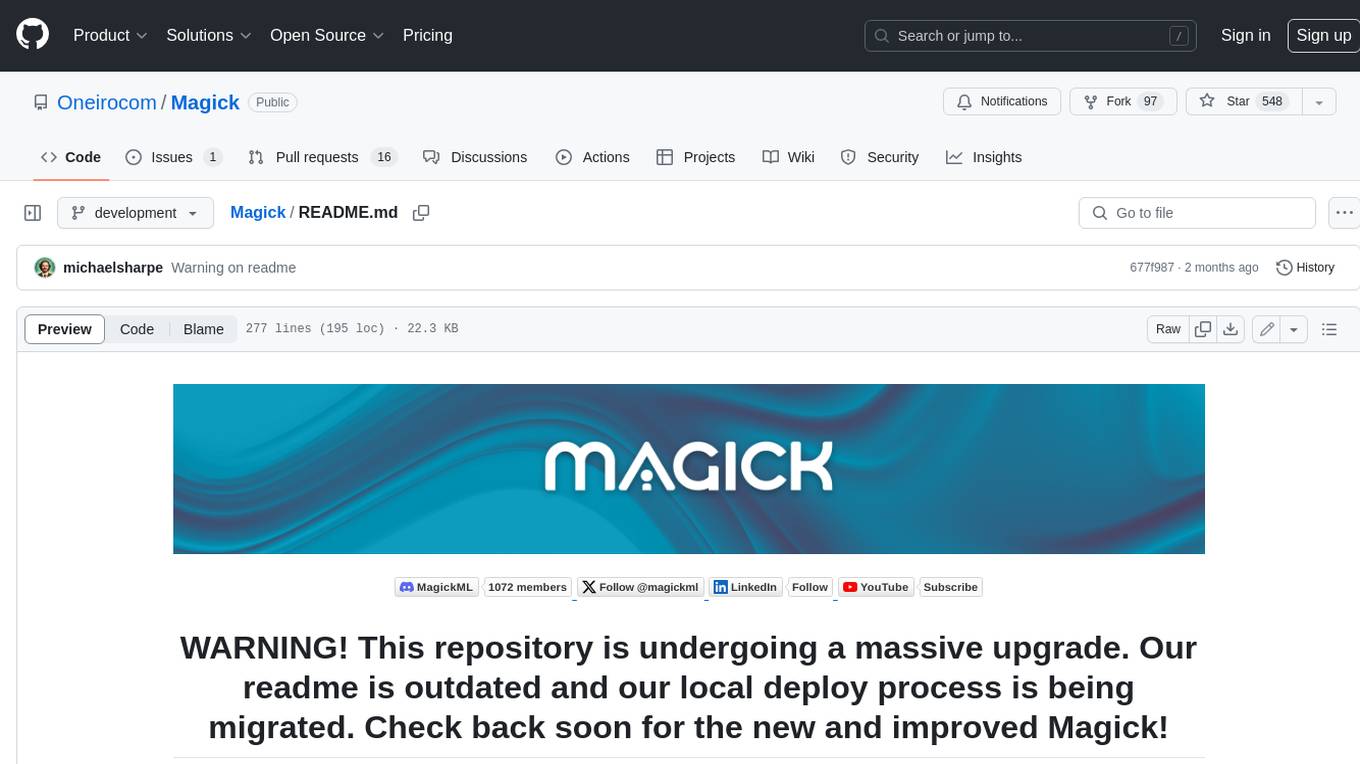
Magick
Magick is a groundbreaking visual AIDE (Artificial Intelligence Development Environment) for no-code data pipelines and multimodal agents. Magick can connect to other services and comes with nodes and templates well-suited for intelligent agents, chatbots, complex reasoning systems and realistic characters.
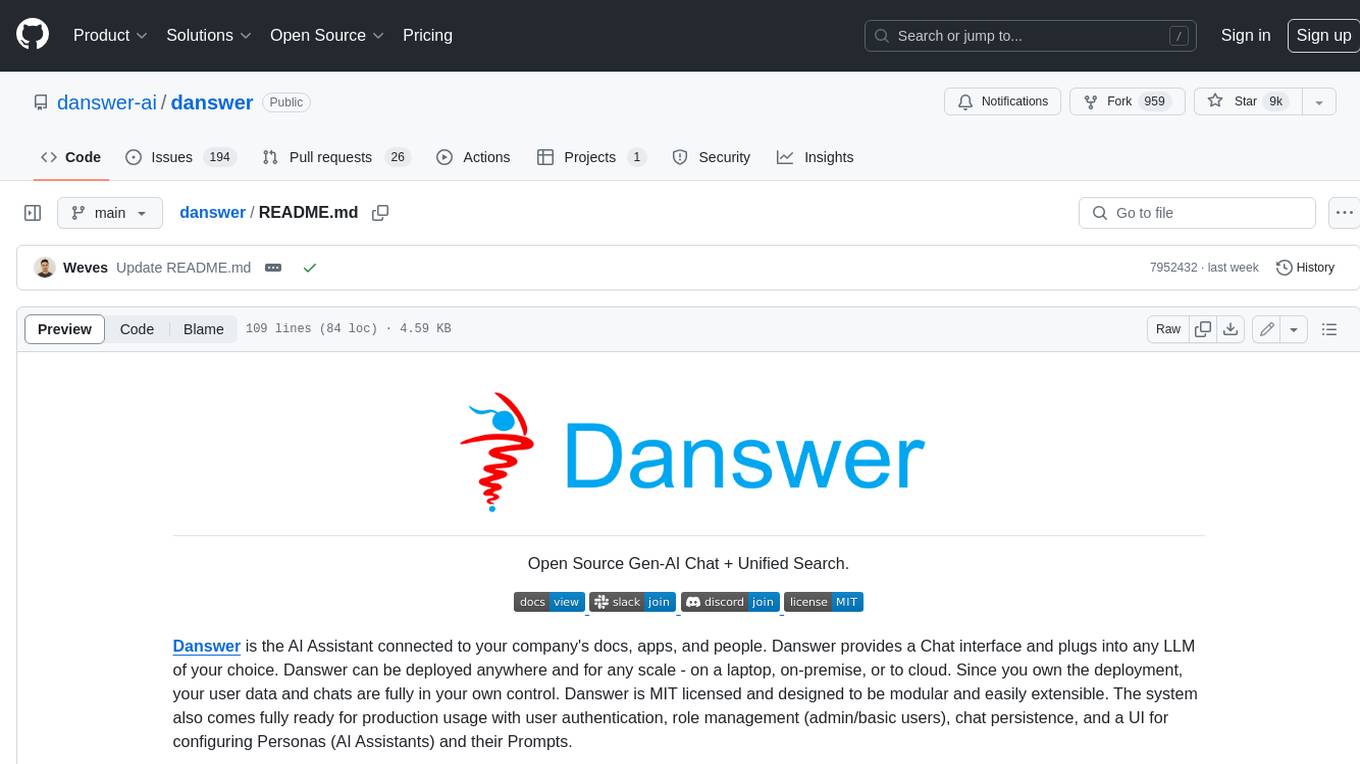
danswer
Danswer is an open-source Gen-AI Chat and Unified Search tool that connects to your company's docs, apps, and people. It provides a Chat interface and plugs into any LLM of your choice. Danswer can be deployed anywhere and for any scale - on a laptop, on-premise, or to cloud. Since you own the deployment, your user data and chats are fully in your own control. Danswer is MIT licensed and designed to be modular and easily extensible. The system also comes fully ready for production usage with user authentication, role management (admin/basic users), chat persistence, and a UI for configuring Personas (AI Assistants) and their Prompts. Danswer also serves as a Unified Search across all common workplace tools such as Slack, Google Drive, Confluence, etc. By combining LLMs and team specific knowledge, Danswer becomes a subject matter expert for the team. Imagine ChatGPT if it had access to your team's unique knowledge! It enables questions such as "A customer wants feature X, is this already supported?" or "Where's the pull request for feature Y?"
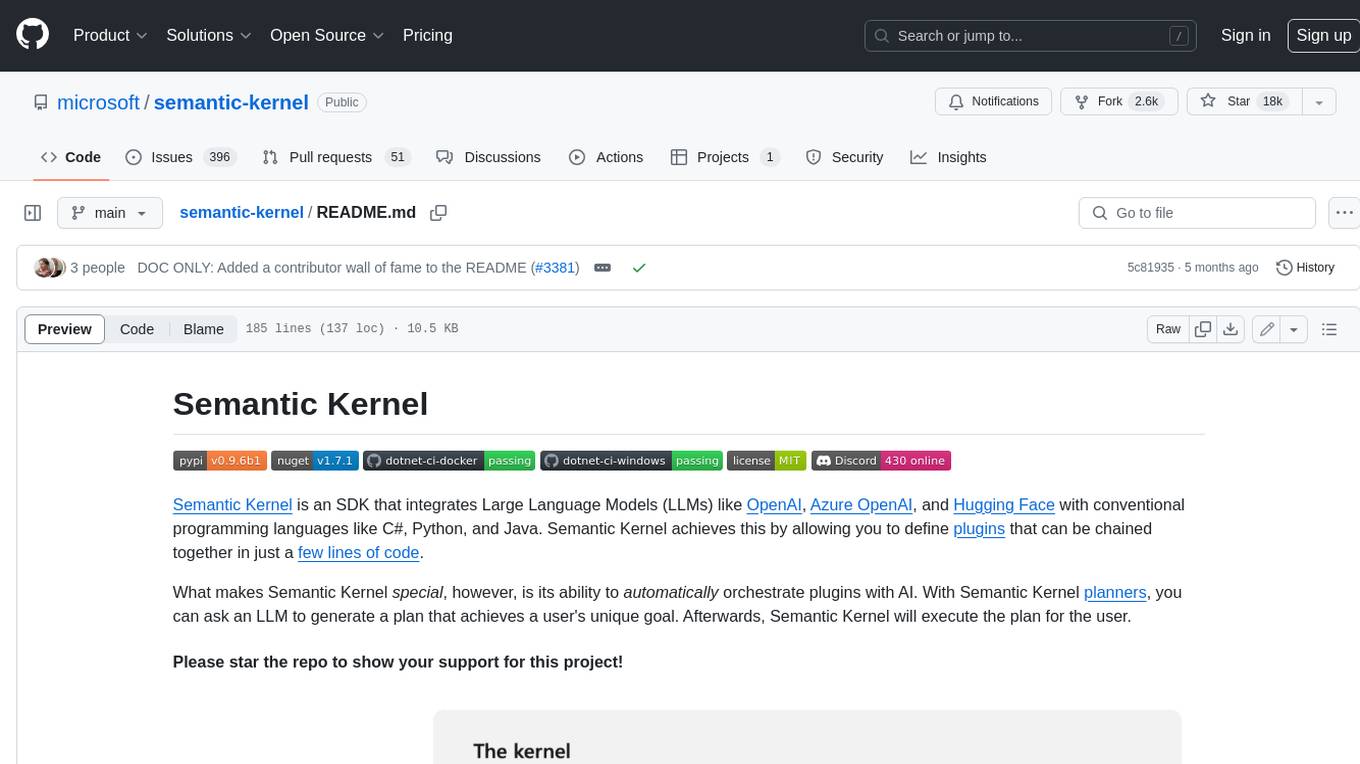
semantic-kernel
Semantic Kernel is an SDK that integrates Large Language Models (LLMs) like OpenAI, Azure OpenAI, and Hugging Face with conventional programming languages like C#, Python, and Java. Semantic Kernel achieves this by allowing you to define plugins that can be chained together in just a few lines of code. What makes Semantic Kernel _special_ , however, is its ability to _automatically_ orchestrate plugins with AI. With Semantic Kernel planners, you can ask an LLM to generate a plan that achieves a user's unique goal. Afterwards, Semantic Kernel will execute the plan for the user.
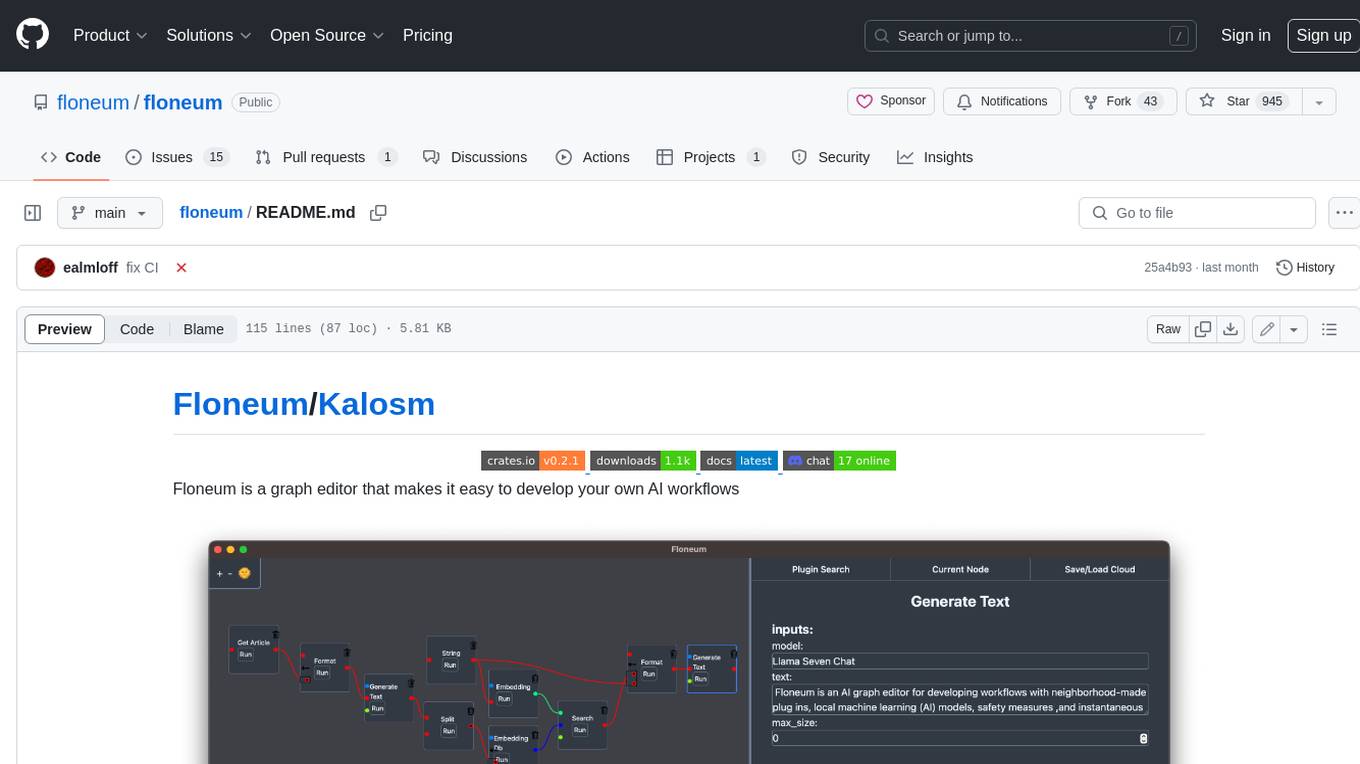
floneum
Floneum is a graph editor that makes it easy to develop your own AI workflows. It uses large language models (LLMs) to run AI models locally, without any external dependencies or even a GPU. This makes it easy to use LLMs with your own data, without worrying about privacy. Floneum also has a plugin system that allows you to improve the performance of LLMs and make them work better for your specific use case. Plugins can be used in any language that supports web assembly, and they can control the output of LLMs with a process similar to JSONformer or guidance.
mindsdb
MindsDB is a platform for customizing AI from enterprise data. You can create, serve, and fine-tune models in real-time from your database, vector store, and application data. MindsDB "enhances" SQL syntax with AI capabilities to make it accessible for developers worldwide. With MindsDB’s nearly 200 integrations, any developer can create AI customized for their purpose, faster and more securely. Their AI systems will constantly improve themselves — using companies’ own data, in real-time.
aiscript
AiScript is a lightweight scripting language that runs on JavaScript. It supports arrays, objects, and functions as first-class citizens, and is easy to write without the need for semicolons or commas. AiScript runs in a secure sandbox environment, preventing infinite loops from freezing the host. It also allows for easy provision of variables and functions from the host.
activepieces
Activepieces is an open source replacement for Zapier, designed to be extensible through a type-safe pieces framework written in Typescript. It features a user-friendly Workflow Builder with support for Branches, Loops, and Drag and Drop. Activepieces integrates with Google Sheets, OpenAI, Discord, and RSS, along with 80+ other integrations. The list of supported integrations continues to grow rapidly, thanks to valuable contributions from the community. Activepieces is an open ecosystem; all piece source code is available in the repository, and they are versioned and published directly to npmjs.com upon contributions. If you cannot find a specific piece on the pieces roadmap, please submit a request by visiting the following link: Request Piece Alternatively, if you are a developer, you can quickly build your own piece using our TypeScript framework. For guidance, please refer to the following guide: Contributor's Guide
superagent-js
Superagent is an open source framework that enables any developer to integrate production ready AI Assistants into any application in a matter of minutes.
For similar jobs
sweep
Sweep is an AI junior developer that turns bugs and feature requests into code changes. It automatically handles developer experience improvements like adding type hints and improving test coverage.
teams-ai
The Teams AI Library is a software development kit (SDK) that helps developers create bots that can interact with Teams and Microsoft 365 applications. It is built on top of the Bot Framework SDK and simplifies the process of developing bots that interact with Teams' artificial intelligence capabilities. The SDK is available for JavaScript/TypeScript, .NET, and Python.
ai-guide
This guide is dedicated to Large Language Models (LLMs) that you can run on your home computer. It assumes your PC is a lower-end, non-gaming setup.
classifai
Supercharge WordPress Content Workflows and Engagement with Artificial Intelligence. Tap into leading cloud-based services like OpenAI, Microsoft Azure AI, Google Gemini and IBM Watson to augment your WordPress-powered websites. Publish content faster while improving SEO performance and increasing audience engagement. ClassifAI integrates Artificial Intelligence and Machine Learning technologies to lighten your workload and eliminate tedious tasks, giving you more time to create original content that matters.
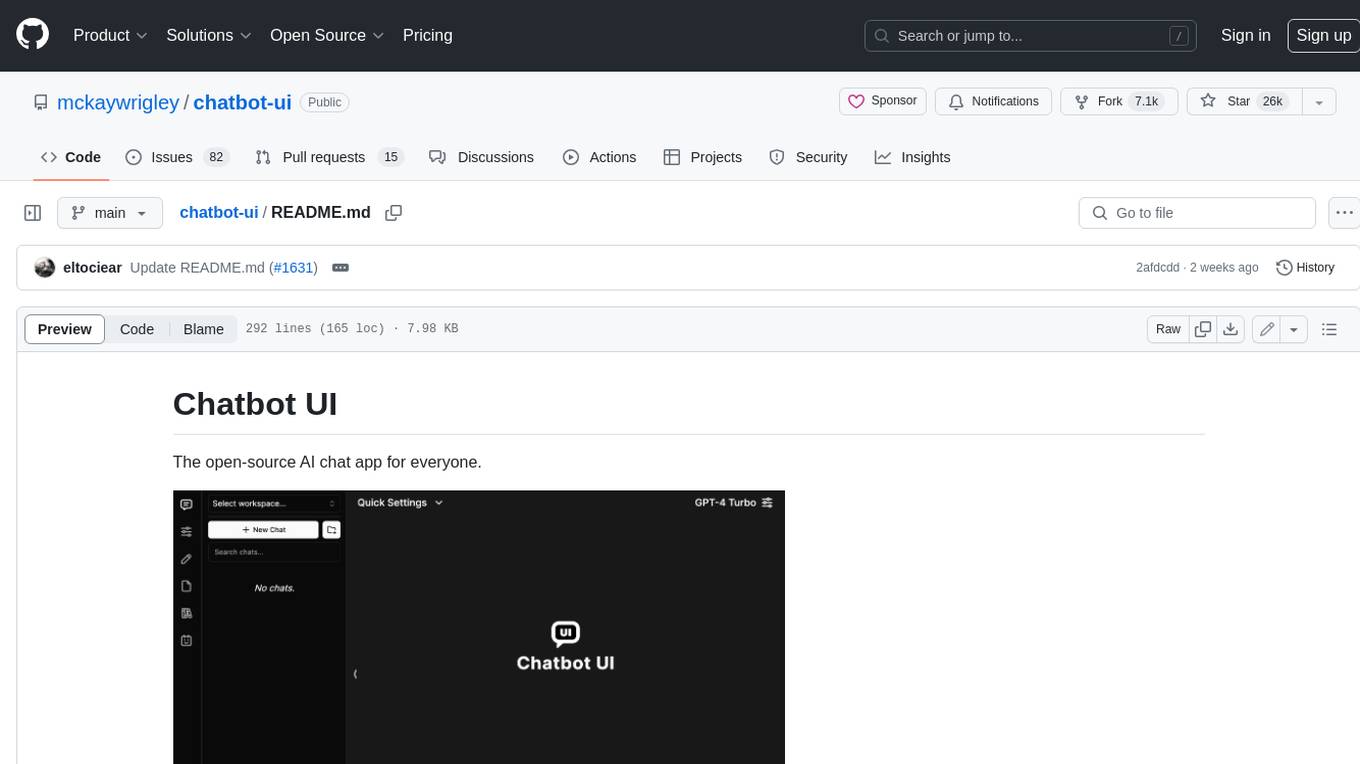
chatbot-ui
Chatbot UI is an open-source AI chat app that allows users to create and deploy their own AI chatbots. It is easy to use and can be customized to fit any need. Chatbot UI is perfect for businesses, developers, and anyone who wants to create a chatbot.
BricksLLM
BricksLLM is a cloud native AI gateway written in Go. Currently, it provides native support for OpenAI, Anthropic, Azure OpenAI and vLLM. BricksLLM aims to provide enterprise level infrastructure that can power any LLM production use cases. Here are some use cases for BricksLLM: * Set LLM usage limits for users on different pricing tiers * Track LLM usage on a per user and per organization basis * Block or redact requests containing PIIs * Improve LLM reliability with failovers, retries and caching * Distribute API keys with rate limits and cost limits for internal development/production use cases * Distribute API keys with rate limits and cost limits for students
uAgents
uAgents is a Python library developed by Fetch.ai that allows for the creation of autonomous AI agents. These agents can perform various tasks on a schedule or take action on various events. uAgents are easy to create and manage, and they are connected to a fast-growing network of other uAgents. They are also secure, with cryptographically secured messages and wallets.
griptape
Griptape is a modular Python framework for building AI-powered applications that securely connect to your enterprise data and APIs. It offers developers the ability to maintain control and flexibility at every step. Griptape's core components include Structures (Agents, Pipelines, and Workflows), Tasks, Tools, Memory (Conversation Memory, Task Memory, and Meta Memory), Drivers (Prompt and Embedding Drivers, Vector Store Drivers, Image Generation Drivers, Image Query Drivers, SQL Drivers, Web Scraper Drivers, and Conversation Memory Drivers), Engines (Query Engines, Extraction Engines, Summary Engines, Image Generation Engines, and Image Query Engines), and additional components (Rulesets, Loaders, Artifacts, Chunkers, and Tokenizers). Griptape enables developers to create AI-powered applications with ease and efficiency.