


EnvScaler
The official implementation of "EnvScaler: Scaling Tool-Interactive Environments for LLM Agent via Programmatic Synthesis".
Stars: 92
EnvScaler is an automated, scalable framework that creates tool-interactive environments for training LLM agents. It consists of SkelBuilder for environment description mining and quality inspection, ScenGenerator for synthesizing multiple environment scenarios, and modules for supervised fine-tuning and reinforcement learning. The tool provides data, models, and evaluation guides for users to build, generate scenarios, collect training data, train models, and evaluate performance. Users can interact with environments, build environments from scratch, and improve LLMs' task-solving abilities in complex environments.
README:







To locally run the demo that interacting with Envs:
cd interact_with_env
python app.py
To locally run the demo that builing Envs from scratch:
cd skel_builder
python env_build_demo.pyWe provide EnvScaler’s data and models (after SFT+RL) as follows:
| Data | Link |
|---|---|
| 191 Env Metadata | 🤗 HuggingFace |
| 4.7K SFT Scenario | 🤗 HuggingFace |
| 2.5K RL Scenario | 🤗 HuggingFace |
| 9K SFT Trajectory | 🤗 HuggingFace |
| Model | Link |
|---|---|
| EnvScaler-Qwen3-1.7B | 🤗 HuggingFace |
| EnvScaler-Qwen3-4B | 🤗 HuggingFace |
| EnvScaler-Qwen3-8B | 🤗 HuggingFace |
- 🎬 Demo
- 📦 Dataset & Models
- 👀 Overview
- 📊 Results
- 📁 Project Structure
- 🚀 Quick Start
- 📚 Citation
- 📞 Contact
EnvScaler is an automated, scalable framework that realizes executable, stateful, tool-interactive environments via programmatic synthesis, for training LLM agents.

Overview of EnvScaler.
SkelBuilder is the first stage of EnvScaler. It (1) mines potential Env descriptions from existing open-source textual tasks; (2) plans the corresponding state schema and business rules, and generates a fully-functional Python class whose methods expose tool interfaces; (3) performs a dual-agent loop for Env quality inspection (one agent invokes tools, the other checks code, return values, and state changes), guaranteeing quality and consistency.

Framework of SkelBuilder.
ScenGenerator is the second stage for synthesizing multiple Env scenarios. Given an Env skeleton, it first prompts LLMs to generate an initial state/database, then creates a challenging task that can be solved from that state. Finally, it decomposes the task into checklists, and converts each checkpoint into a Python Boolean function over the final state of the Env, providing rule-based, verifiable reward signals.

Framework of ScenGenerator.
With EnvScaler, we synthesized 191 environments and about 7K scenarios, and applied them to Supervised Fine-Tuning (SFT) and Reinforcement Learning (RL) for Qwen3 series models. Results on three benchmarks show that EnvScaler significantly improves LLMs' ability to solve tasks in complex environments involving multiturn, multi-tool interactions.

Statistics of 191 synthesized environments.

Performance comparison.
EnvScaler/
├── skel_builder/              # Stage 1: Env Skeleton Construction
├── scen_generator/            # Stage 2: Scenario Generation
├── interact_with_env/         # Agent-Env Interaction
├── sft/                       # Supervised Fine-Tuning (SFT)
├── rl/                        # Reinforcement Learning (RL)
└── evaluation/                # Evaluation Guide
💡 Tip: We provide detailed documentation under each module.
- skel_builder/ – Env skeleton construction framework that automatically generates executable environment classes from existing tasks.
- scen_generator/ – Scenario generation framework that produces state data, task scenarios, and checkpoint functions for an Env skeleton.
- interact_with_env/ – Agent-Env interaction module supporting (1) collecting training data by interacting with synthesized Envs and (2) benchmark evaluation.
- sft/ – Supervised fine-tuning implementation based on LlamaFactory.
- rl/ – Reinforcement learning implementation based on the ROLL framework.
- evaluation/ – Evaluation guide including BFCL, TauBench, and ACEBench.
git clone https://github.com/RUC-NLPIR/EnvScaler
cd EnvScalerpip install -r requirements.txt💡 Note: Basic dependencies are included in
requirements.txt. If you need SFT or RL training, please install extra dependencies following the corresponding sub-project documentation:
- SFT training: refer to sft/README.md to install LlamaFactory
- RL training: refer to rl/README.md to install the ROLL framework
Create a .env file in the project root and configure your OpenAI API key:
# .env
OPENAI_API_KEY=your-openai-api-key-here
OPENAI_BASE_URL=https://api.openai.com/v1 You can deploy a local model with an OpenAI-compatible inference framework such as vLLM.
Deploy a model with vLLM:
vllm serve your-model-path \
    --host 0.0.0.0 \
    --port 8000 \
    --trust-remote-code
⚠️ Important: Ensure the deployed model service supports Function Calling (FC) interface, see vLLM OpenAI-Compatible Server docs for details.
Run the demo to verify your setup:
# Environment interaction demo
cd interact_with_env
python app.py

# Environment interaction Debug
cd interact_with_env
python run_main_debug.py

# Environment building demo
cd skel_builder
python env_build_demo.pyNow you can use each module of EnvScaler independently:
- Build environments: refer to skel_builder/README.md
- Generate scenarios: refer to scen_generator/README.md
- Collect training data: refer to interact_with_env/README.md
- Model training: refer to sft/README.md and rl/README.md
- Evaluation: refer to evaluation/README.md
If you find our work helpful, please consider citing it. We greatly appreciate your support.
@article{song2026envscaler,
  title={EnvScaler: Scaling Tool-Interactive Environments for LLM Agent via Programmatic Synthesis},
  author={Song, Xiaoshuai and Chang, Haofei and Dong, Guanting and Zhu, Yutao and Dou, Zhicheng and Wen, Ji-Rong},
  journal={arXiv preprint arXiv:2601.05808},
  year={2026}
}For any questions or feedback, please reach out to us at [email protected].
For Tasks:
Click tags to check more tools for each tasksFor Jobs:
Alternative AI tools for EnvScaler
Similar Open Source Tools
EnvScaler
EnvScaler is an automated, scalable framework that creates tool-interactive environments for training LLM agents. It consists of SkelBuilder for environment description mining and quality inspection, ScenGenerator for synthesizing multiple environment scenarios, and modules for supervised fine-tuning and reinforcement learning. The tool provides data, models, and evaluation guides for users to build, generate scenarios, collect training data, train models, and evaluate performance. Users can interact with environments, build environments from scratch, and improve LLMs' task-solving abilities in complex environments.
bumblecore
BumbleCore is a hands-on large language model training framework that allows complete control over every training detail. It provides manual training loop, customizable model architecture, and support for mainstream open-source models. The framework follows core principles of transparency, flexibility, and efficiency. BumbleCore is suitable for deep learning researchers, algorithm engineers, learners, and enterprise teams looking for customization and control over model training processes.
EvoAgentX
EvoAgentX is an open-source framework for building, evaluating, and evolving LLM-based agents or agentic workflows in an automated, modular, and goal-driven manner. It enables developers and researchers to move beyond static prompt chaining or manual workflow orchestration by introducing a self-evolving agent ecosystem. The framework includes features such as agent workflow autoconstruction, built-in evaluation, self-evolution engine, plug-and-play compatibility, comprehensive built-in tools, memory module support, and human-in-the-loop interactions.
agentscope
AgentScope is an agent-oriented programming tool for building LLM (Large Language Model) applications. It provides transparent development, realtime steering, agentic tools management, model agnostic programming, LEGO-style agent building, multi-agent support, and high customizability. The tool supports async invocation, reasoning models, streaming returns, async/sync tool functions, user interruption, group-wise tools management, streamable transport, stateful/stateless mode MCP client, distributed and parallel evaluation, multi-agent conversation management, and fine-grained MCP control. AgentScope Studio enables tracing and visualization of agent applications. The tool is highly customizable and encourages customization at various levels.
openrl
OpenRL is an open-source general reinforcement learning research framework that supports training for various tasks such as single-agent, multi-agent, offline RL, self-play, and natural language. Developed based on PyTorch, the goal of OpenRL is to provide a simple-to-use, flexible, efficient and sustainable platform for the reinforcement learning research community. It supports a universal interface for all tasks/environments, single-agent and multi-agent tasks, offline RL training with expert dataset, self-play training, reinforcement learning training for natural language tasks, DeepSpeed, Arena for evaluation, importing models and datasets from Hugging Face, user-defined environments, models, and datasets, gymnasium environments, callbacks, visualization tools, unit testing, and code coverage testing. It also supports various algorithms like PPO, DQN, SAC, and environments like Gymnasium, MuJoCo, Atari, and more.
agentic-context-engine
Agentic Context Engine (ACE) is a framework that enables AI agents to learn from their execution feedback, continuously improving without fine-tuning or training data. It maintains a Skillbook of evolving strategies, extracting patterns from successful tasks and learning from failures transparently in context. ACE offers self-improving agents, better performance on complex tasks, token reduction in browser automation, and preservation of valuable knowledge over time. Users can integrate ACE with popular agent frameworks and benefit from its innovative approach to in-context learning.
superagentx
SuperAgentX is a lightweight open-source AI framework designed for multi-agent applications with Artificial General Intelligence (AGI) capabilities. It offers goal-oriented multi-agents with retry mechanisms, easy deployment through WebSocket, RESTful API, and IO console interfaces, streamlined architecture with no major dependencies, contextual memory using SQL + Vector databases, flexible LLM configuration supporting various Gen AI models, and extendable handlers for integration with diverse APIs and data sources. It aims to accelerate the development of AGI by providing a powerful platform for building autonomous AI agents capable of executing complex tasks with minimal human intervention.
semantic-router
The Semantic Router is an intelligent routing tool that utilizes a Mixture-of-Models (MoM) approach to direct OpenAI API requests to the most suitable models based on semantic understanding. It enhances inference accuracy by selecting models tailored to different types of tasks. The tool also automatically selects relevant tools based on the prompt to improve tool selection accuracy. Additionally, it includes features for enterprise security such as PII detection and prompt guard to protect user privacy and prevent misbehavior. The tool implements similarity caching to reduce latency. The comprehensive documentation covers setup instructions, architecture guides, and API references.
dotclaude
A sophisticated multi-agent configuration system for Claude Code that provides specialized agents and command templates to accelerate code review, refactoring, security audits, tech-lead-guidance, and UX evaluations. It offers essential commands, directory structure details, agent system overview, command templates, usage patterns, collaboration philosophy, sync management, advanced usage guidelines, and FAQ. The tool aims to streamline development workflows, enhance code quality, and facilitate collaboration between developers and AI agents.
MemMachine
MemMachine is an open-source long-term memory layer designed for AI agents and LLM-powered applications. It enables AI to learn, store, and recall information from past sessions, transforming stateless chatbots into personalized, context-aware assistants. With capabilities like episodic memory, profile memory, working memory, and agent memory persistence, MemMachine offers a developer-friendly API, flexible storage options, and seamless integration with various AI frameworks. It is suitable for developers, researchers, and teams needing persistent, cross-session memory for their LLM applications.
GPT4Point
GPT4Point is a unified framework for point-language understanding and generation. It aligns 3D point clouds with language, providing a comprehensive solution for tasks such as 3D captioning and controlled 3D generation. The project includes an automated point-language dataset annotation engine, a novel object-level point cloud benchmark, and a 3D multi-modality model. Users can train and evaluate models using the provided code and datasets, with a focus on improving models' understanding capabilities and facilitating the generation of 3D objects.
awesome-slash
Automate the entire development workflow beyond coding. awesome-slash provides production-ready skills, agents, and commands for managing tasks, branches, reviews, CI, and deployments. It automates the entire workflow, including task exploration, planning, implementation, review, and shipping. The tool includes 11 plugins, 40 agents, 26 skills, and 26k lines of lib code, with 3,357 tests and support for 3 platforms. It works with Claude Code, OpenCode, and Codex CLI, offering specialized capabilities through skills and agents.
shards
Shards is a high-performance, multi-platform, type-safe programming language designed for visual development. It is a dataflow visual programming language that enables building full-fledged apps and games without traditional coding. Shards features automatic type checking, optimized shard implementations for high performance, and an intuitive visual workflow for beginners. The language allows seamless round-trip engineering between code and visual models, empowering users to create multi-platform apps easily. Shards also powers an upcoming AI-powered game creation system, enabling real-time collaboration and game development in a low to no-code environment.
Edit-Banana
Edit Banana is a universal content re-editor that allows users to transform fixed content into fully manipulatable assets. Powered by SAM 3 and multimodal large models, it enables high-fidelity reconstruction while preserving original diagram details and logical relationships. The platform offers advanced segmentation, fixed multi-round VLM scanning, high-quality OCR, user system with credits, multi-user concurrency, and a web interface. Users can upload images or PDFs to get editable DrawIO (XML) or PPTX files in seconds. The project structure includes components for segmentation, text extraction, frontend, models, and scripts, with detailed installation and setup instructions provided. The tool is open-source under the Apache License 2.0, allowing commercial use and secondary development.
ComfyUI-Copilot
ComfyUI-Copilot is an intelligent assistant built on the Comfy-UI framework that simplifies and enhances the AI algorithm debugging and deployment process through natural language interactions. It offers intuitive node recommendations, workflow building aids, and model querying services to streamline development processes. With features like interactive Q&A bot, natural language node suggestions, smart workflow assistance, and model querying, ComfyUI-Copilot aims to lower the barriers to entry for beginners, boost development efficiency with AI-driven suggestions, and provide real-time assistance for developers.
GPTSwarm
GPTSwarm is a graph-based framework for LLM-based agents that enables the creation of LLM-based agents from graphs and facilitates the customized and automatic self-organization of agent swarms with self-improvement capabilities. The library includes components for domain-specific operations, graph-related functions, LLM backend selection, memory management, and optimization algorithms to enhance agent performance and swarm efficiency. Users can quickly run predefined swarms or utilize tools like the file analyzer. GPTSwarm supports local LM inference via LM Studio, allowing users to run with a local LLM model. The framework has been accepted by ICML2024 and offers advanced features for experimentation and customization.
For similar tasks
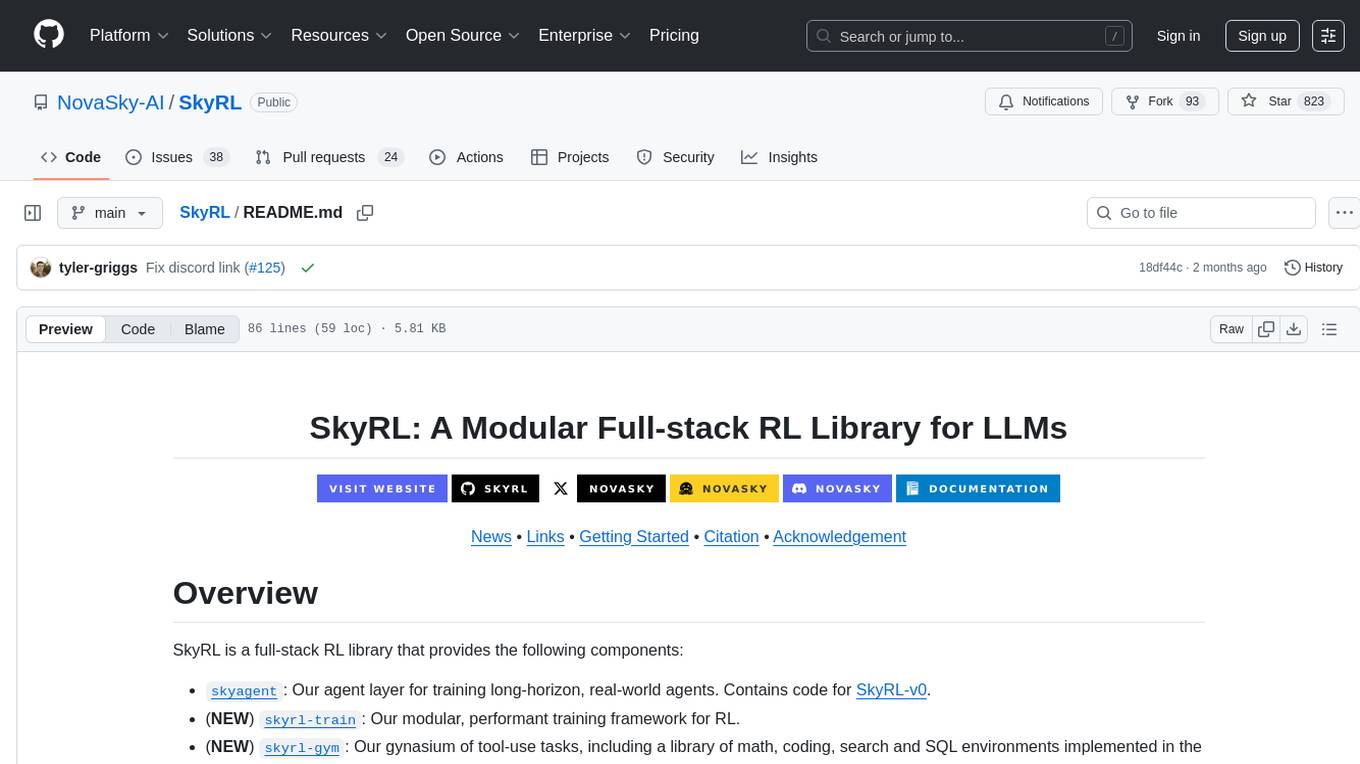
SkyRL
SkyRL is a full-stack RL library that provides components such as 'skyagent' for training long-horizon, real-world agents, 'skyrl-train' for modular RL training, and 'skyrl-gym' for a variety of tool-use tasks. It offers a library of math, coding, search, and SQL environments implemented in the Gymnasium API, optimized for multi-turn tool use LLMs on long-horizon, real-environment tasks.
EnvScaler
EnvScaler is an automated, scalable framework that creates tool-interactive environments for training LLM agents. It consists of SkelBuilder for environment description mining and quality inspection, ScenGenerator for synthesizing multiple environment scenarios, and modules for supervised fine-tuning and reinforcement learning. The tool provides data, models, and evaluation guides for users to build, generate scenarios, collect training data, train models, and evaluate performance. Users can interact with environments, build environments from scratch, and improve LLMs' task-solving abilities in complex environments.
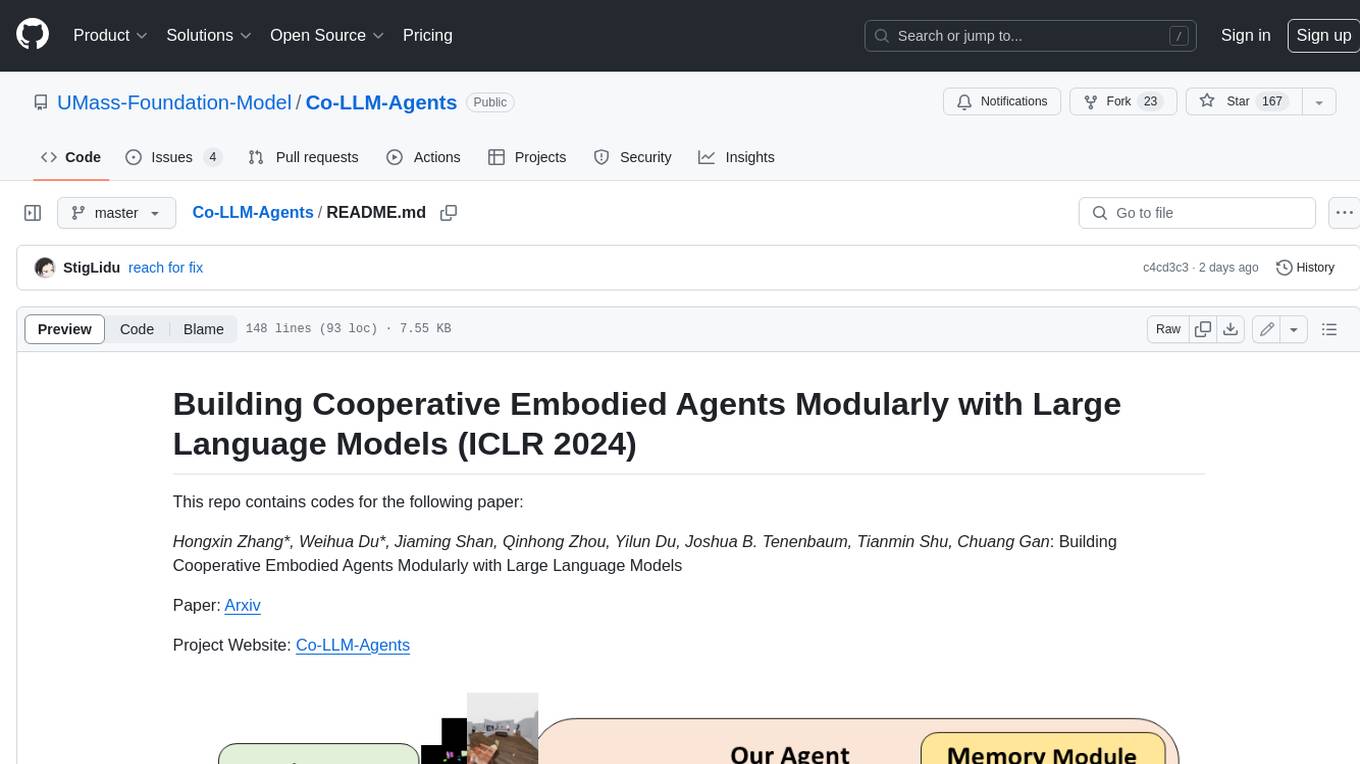
Co-LLM-Agents
This repository contains code for building cooperative embodied agents modularly with large language models. The agents are trained to perform tasks in two different environments: ThreeDWorld Multi-Agent Transport (TDW-MAT) and Communicative Watch-And-Help (C-WAH). TDW-MAT is a multi-agent environment where agents must transport objects to a goal position using containers. C-WAH is an extension of the Watch-And-Help challenge, which enables agents to send messages to each other. The code in this repository can be used to train agents to perform tasks in both of these environments.
GPT4Point
GPT4Point is a unified framework for point-language understanding and generation. It aligns 3D point clouds with language, providing a comprehensive solution for tasks such as 3D captioning and controlled 3D generation. The project includes an automated point-language dataset annotation engine, a novel object-level point cloud benchmark, and a 3D multi-modality model. Users can train and evaluate models using the provided code and datasets, with a focus on improving models' understanding capabilities and facilitating the generation of 3D objects.
asreview
The ASReview project implements active learning for systematic reviews, utilizing AI-aided pipelines to assist in finding relevant texts for search tasks. It accelerates the screening of textual data with minimal human input, saving time and increasing output quality. The software offers three modes: Oracle for interactive screening, Exploration for teaching purposes, and Simulation for evaluating active learning models. ASReview LAB is designed to support decision-making in any discipline or industry by improving efficiency and transparency in screening large amounts of textual data.
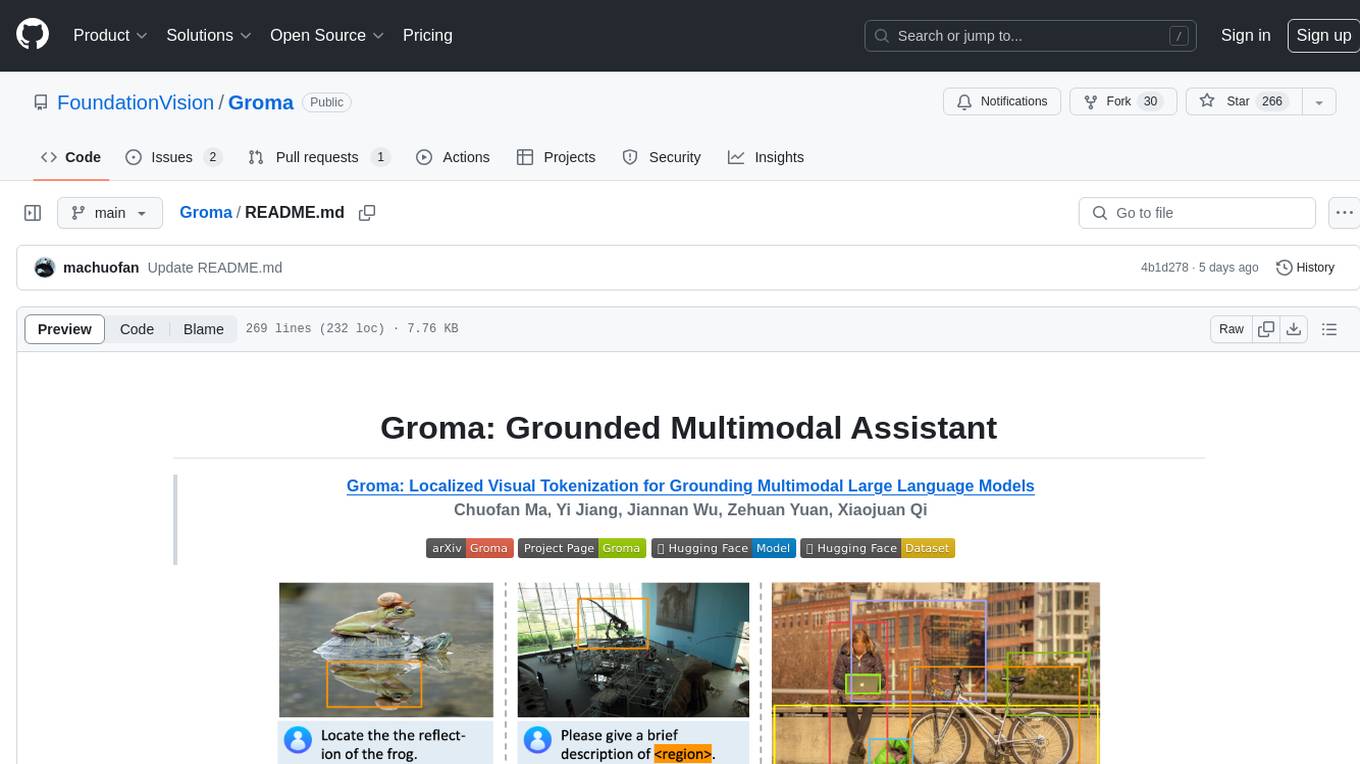
Groma
Groma is a grounded multimodal assistant that excels in region understanding and visual grounding. It can process user-defined region inputs and generate contextually grounded long-form responses. The tool presents a unique paradigm for multimodal large language models, focusing on visual tokenization for localization. Groma achieves state-of-the-art performance in referring expression comprehension benchmarks. The tool provides pretrained model weights and instructions for data preparation, training, inference, and evaluation. Users can customize training by starting from intermediate checkpoints. Groma is designed to handle tasks related to detection pretraining, alignment pretraining, instruction finetuning, instruction following, and more.
amber-train
Amber is the first model in the LLM360 family, an initiative for comprehensive and fully open-sourced LLMs. It is a 7B English language model with the LLaMA architecture. The model type is a language model with the same architecture as LLaMA-7B. It is licensed under Apache 2.0. The resources available include training code, data preparation, metrics, and fully processed Amber pretraining data. The model has been trained on various datasets like Arxiv, Book, C4, Refined-Web, StarCoder, StackExchange, and Wikipedia. The hyperparameters include a total of 6.7B parameters, hidden size of 4096, intermediate size of 11008, 32 attention heads, 32 hidden layers, RMSNorm ε of 1e^-6, max sequence length of 2048, and a vocabulary size of 32000.
kan-gpt
The KAN-GPT repository is a PyTorch implementation of Generative Pre-trained Transformers (GPTs) using Kolmogorov-Arnold Networks (KANs) for language modeling. It provides a model for generating text based on prompts, with a focus on improving performance compared to traditional MLP-GPT models. The repository includes scripts for training the model, downloading datasets, and evaluating model performance. Development tasks include integrating with other libraries, testing, and documentation.
For similar jobs
weave
Weave is a toolkit for developing Generative AI applications, built by Weights & Biases. With Weave, you can log and debug language model inputs, outputs, and traces; build rigorous, apples-to-apples evaluations for language model use cases; and organize all the information generated across the LLM workflow, from experimentation to evaluations to production. Weave aims to bring rigor, best-practices, and composability to the inherently experimental process of developing Generative AI software, without introducing cognitive overhead.
LLMStack
LLMStack is a no-code platform for building generative AI agents, workflows, and chatbots. It allows users to connect their own data, internal tools, and GPT-powered models without any coding experience. LLMStack can be deployed to the cloud or on-premise and can be accessed via HTTP API or triggered from Slack or Discord.
VisionCraft
The VisionCraft API is a free API for using over 100 different AI models. From images to sound.
kaito
Kaito is an operator that automates the AI/ML inference model deployment in a Kubernetes cluster. It manages large model files using container images, avoids tuning deployment parameters to fit GPU hardware by providing preset configurations, auto-provisions GPU nodes based on model requirements, and hosts large model images in the public Microsoft Container Registry (MCR) if the license allows. Using Kaito, the workflow of onboarding large AI inference models in Kubernetes is largely simplified.
PyRIT
PyRIT is an open access automation framework designed to empower security professionals and ML engineers to red team foundation models and their applications. It automates AI Red Teaming tasks to allow operators to focus on more complicated and time-consuming tasks and can also identify security harms such as misuse (e.g., malware generation, jailbreaking), and privacy harms (e.g., identity theft). The goal is to allow researchers to have a baseline of how well their model and entire inference pipeline is doing against different harm categories and to be able to compare that baseline to future iterations of their model. This allows them to have empirical data on how well their model is doing today, and detect any degradation of performance based on future improvements.
tabby
Tabby is a self-hosted AI coding assistant, offering an open-source and on-premises alternative to GitHub Copilot. It boasts several key features: * Self-contained, with no need for a DBMS or cloud service. * OpenAPI interface, easy to integrate with existing infrastructure (e.g Cloud IDE). * Supports consumer-grade GPUs.
spear
SPEAR (Simulator for Photorealistic Embodied AI Research) is a powerful tool for training embodied agents. It features 300 unique virtual indoor environments with 2,566 unique rooms and 17,234 unique objects that can be manipulated individually. Each environment is designed by a professional artist and features detailed geometry, photorealistic materials, and a unique floor plan and object layout. SPEAR is implemented as Unreal Engine assets and provides an OpenAI Gym interface for interacting with the environments via Python.
Magick
Magick is a groundbreaking visual AIDE (Artificial Intelligence Development Environment) for no-code data pipelines and multimodal agents. Magick can connect to other services and comes with nodes and templates well-suited for intelligent agents, chatbots, complex reasoning systems and realistic characters.