


agent-skills
Agent Skills to help developers using AI agents with Supabase
Stars: 1296
Agent Skills is a repository containing folders of instructions, scripts, and resources that AI agents like Claude Code, Cursor, Github Copilot, etc., can use to perform tasks accurately and efficiently. It provides skills in a structured format to help developers with tasks such as Postgres performance optimization, schema design, query optimization, and more. Users can easily install these skills and the agents will utilize them when relevant tasks are detected.
README:

Agent Skills to help developers using AI agents with Supabase. Agent Skills are folders of instructions, scripts, and resources that agents like Claude Code, Cursor, Github Copilot, etc... can discover and use to do things more accurately and efficiently.
The skills in this repo follow the Agent Skills format.
npx skills add supabase/agent-skillsYou can also install the skills in this repo as Claude Code plugins
/plugin marketplace add supabase/agent-skills
/plugin install postgres-best-practices@supabase-agent-skillssupabase-postgres-best-practices
Postgres performance optimization guidelines from Supabase. Contains references across 8 categories, prioritized by impact.
Use when:
- Writing SQL queries or designing schemas
- Implementing indexes or query optimization
- Reviewing database performance issues
- Configuring connection pooling or scaling
- Working with Row-Level Security (RLS)
Categories covered:
- Query Performance (Critical)
- Connection Management (Critical)
- Schema Design (High)
- Concurrency & Locking (Medium-High)
- Security & RLS (Medium-High)
- Data Access Patterns (Medium)
- Monitoring & Diagnostics (Low-Medium)
- Advanced Features (Low)
Skills are automatically available once installed. The agent will use them when relevant tasks are detected.
Examples:
Optimize this Postgres query
Review my schema for performance issues
Help me add proper indexes to this table
Each skill follows the Agent Skills Open Standard:
-
SKILL.md- Required skill manifest with frontmatter (name, description, metadata) -
AGENTS.md- Compiled references document (generated) -
references/- Individual reference files
For Tasks:
Click tags to check more tools for each tasksFor Jobs:
Alternative AI tools for agent-skills
Similar Open Source Tools
agent-skills
Agent Skills is a repository containing folders of instructions, scripts, and resources that AI agents like Claude Code, Cursor, Github Copilot, etc., can use to perform tasks accurately and efficiently. It provides skills in a structured format to help developers with tasks such as Postgres performance optimization, schema design, query optimization, and more. Users can easily install these skills and the agents will utilize them when relevant tasks are detected.
Upsonic
Upsonic offers a cutting-edge enterprise-ready framework for orchestrating LLM calls, agents, and computer use to complete tasks cost-effectively. It provides reliable systems, scalability, and a task-oriented structure for real-world cases. Key features include production-ready scalability, task-centric design, MCP server support, tool-calling server, computer use integration, and easy addition of custom tools. The framework supports client-server architecture and allows seamless deployment on AWS, GCP, or locally using Docker.
poml
POML (Prompt Orchestration Markup Language) is a novel markup language designed to bring structure, maintainability, and versatility to advanced prompt engineering for Large Language Models (LLMs). It addresses common challenges in prompt development, such as lack of structure, complex data integration, format sensitivity, and inadequate tooling. POML provides a systematic way to organize prompt components, integrate diverse data types seamlessly, and manage presentation variations, empowering developers to create more sophisticated and reliable LLM applications.
LazyLLM
LazyLLM is a low-code development tool for building complex AI applications with multiple agents. It assists developers in building AI applications at a low cost and continuously optimizing their performance. The tool provides a convenient workflow for application development and offers standard processes and tools for various stages of application development. Users can quickly prototype applications with LazyLLM, analyze bad cases with scenario task data, and iteratively optimize key components to enhance the overall application performance. LazyLLM aims to simplify the AI application development process and provide flexibility for both beginners and experts to create high-quality applications.
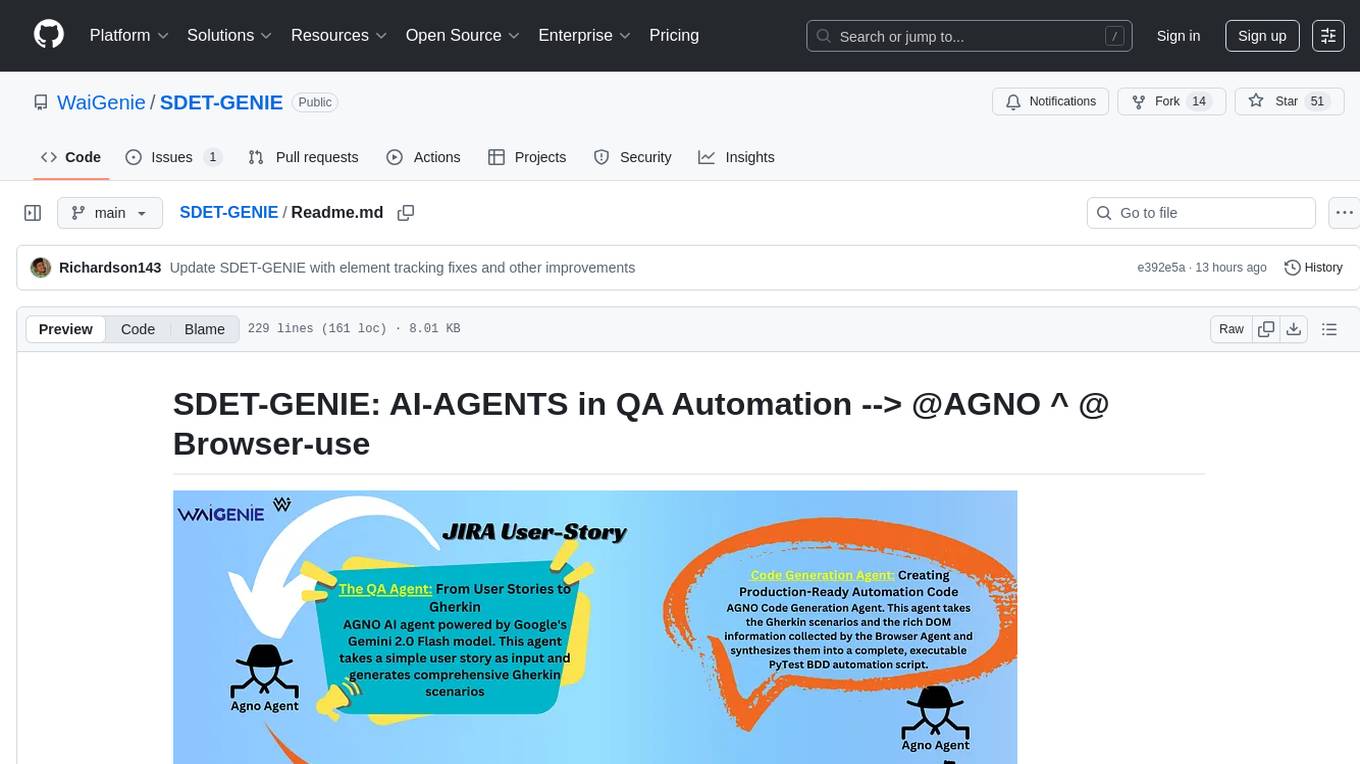
SDET-GENIE
SDET-GENIE is a cutting-edge, AI-powered Quality Assurance (QA) automation framework that revolutionizes the software testing process. Leveraging a suite of specialized AI agents, SDET-GENIE transforms rough user stories into comprehensive, executable test automation code through a seamless end-to-end process. The framework integrates five powerful AI agents working in sequence: User Story Enhancement Agent, Manual Test Case Agent, Gherkin Scenario Agent, Browser Agent, and Code Generation Agent. It supports multiple testing frameworks and provides advanced browser automation capabilities with AI features.
cosdata
Cosdata is a cutting-edge AI data platform designed to power the next generation search pipelines. It features immutability, version control, and excels in semantic search, structured knowledge graphs, hybrid search capabilities, real-time search at scale, and ML pipeline integration. The platform is customizable, scalable, efficient, enterprise-grade, easy to use, and can manage multi-modal data. It offers high performance, indexing, low latency, and high requests per second. Cosdata is designed to meet the demands of modern search applications, empowering businesses to harness the full potential of their data.
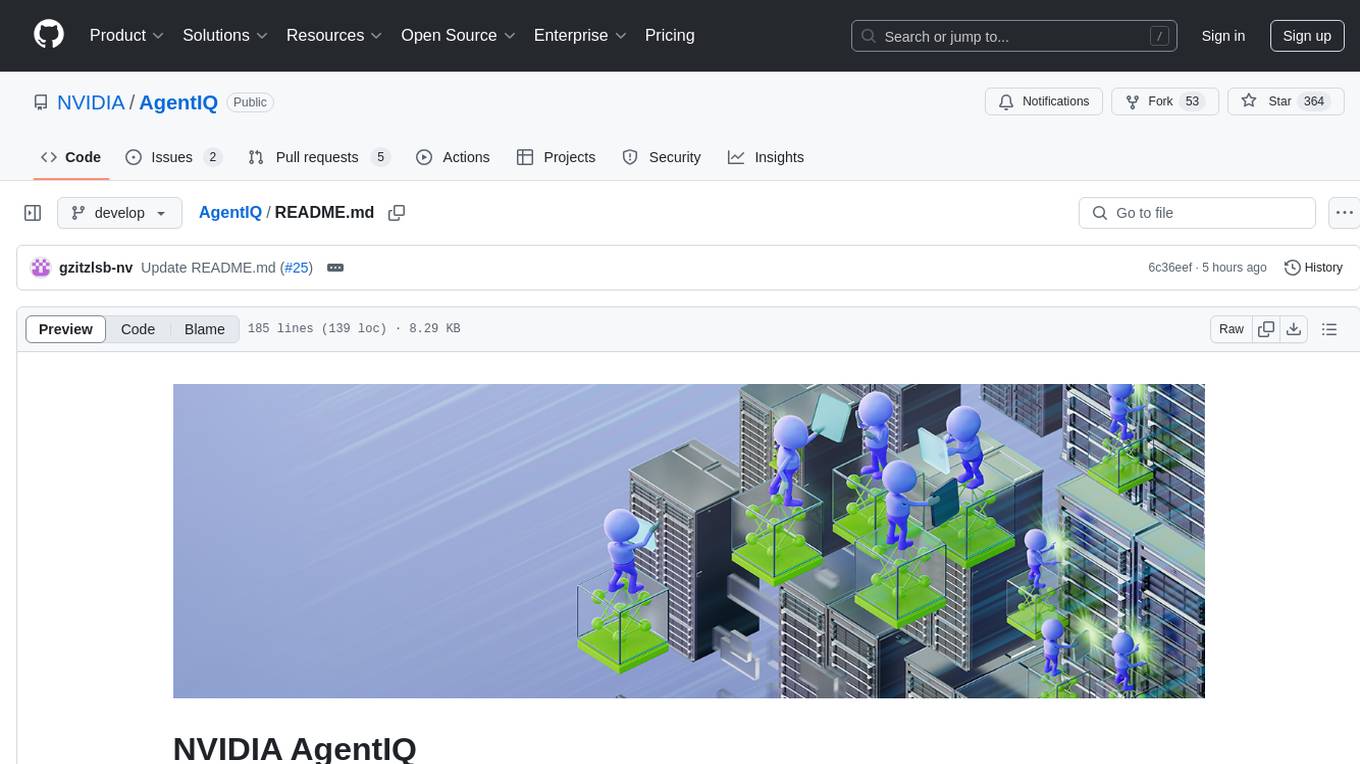
AgentIQ
AgentIQ is a flexible library designed to seamlessly integrate enterprise agents with various data sources and tools. It enables true composability by treating agents, tools, and workflows as simple function calls. With features like framework agnosticism, reusability, rapid development, profiling, observability, evaluation system, user interface, and MCP compatibility, AgentIQ empowers developers to move quickly, experiment freely, and ensure reliability across agent-driven projects.
bytechef
ByteChef is an open-source, low-code, extendable API integration and workflow automation platform. It provides an intuitive UI Workflow Editor, event-driven & scheduled workflows, multiple flow controls, built-in code editor supporting Java, JavaScript, Python, and Ruby, rich component ecosystem, extendable with custom connectors, AI-ready with built-in AI components, developer-ready to expose workflows as APIs, version control friendly, self-hosted, scalable, and resilient. It allows users to build and visualize workflows, automate tasks across SaaS apps, internal APIs, and databases, and handle millions of workflows with high availability and fault tolerance.
fast-wiki
FastWiki is an enterprise-level artificial intelligence customer service management system. It is a high-performance knowledge base system designed for large-scale information retrieval and intelligent search. Leveraging Microsoft's Semantic Kernel for deep learning and natural language processing, combined with .NET 8 and React framework, it provides an efficient, user-friendly, and scalable intelligent vector search platform. The system aims to offer an intelligent search solution that can understand and process complex queries, assisting users in quickly and accurately obtaining the needed information.
MemoryBear
MemoryBear is a next-generation AI memory system developed by RedBear AI, focusing on overcoming limitations in knowledge storage and multi-agent collaboration. It empowers AI with human-like memory capabilities, enabling deep knowledge understanding and cognitive collaboration. The system addresses challenges such as knowledge forgetting, memory gaps in multi-agent collaboration, and semantic ambiguity during reasoning. MemoryBear's core features include memory extraction engine, graph storage, hybrid search, memory forgetting engine, self-reflection engine, and FastAPI services. It offers a standardized service architecture for efficient integration and invocation across applications.

DevDocs
DevDocs is a platform designed to simplify the process of digesting technical documentation for software engineers and developers. It automates the extraction and conversion of web content into markdown format, making it easier for users to access and understand the information. By crawling through child pages of a given URL, DevDocs provides a streamlined approach to gathering relevant data and integrating it into various tools for software development. The tool aims to save time and effort by eliminating the need for manual research and content extraction, ultimately enhancing productivity and efficiency in the development process.
llm-on-ray
LLM-on-Ray is a comprehensive solution for building, customizing, and deploying Large Language Models (LLMs). It simplifies complex processes into manageable steps by leveraging the power of Ray for distributed computing. The tool supports pretraining, finetuning, and serving LLMs across various hardware setups, incorporating industry and Intel optimizations for performance. It offers modular workflows with intuitive configurations, robust fault tolerance, and scalability. Additionally, it provides an Interactive Web UI for enhanced usability, including a chatbot application for testing and refining models.
ai-data-analysis-MulitAgent
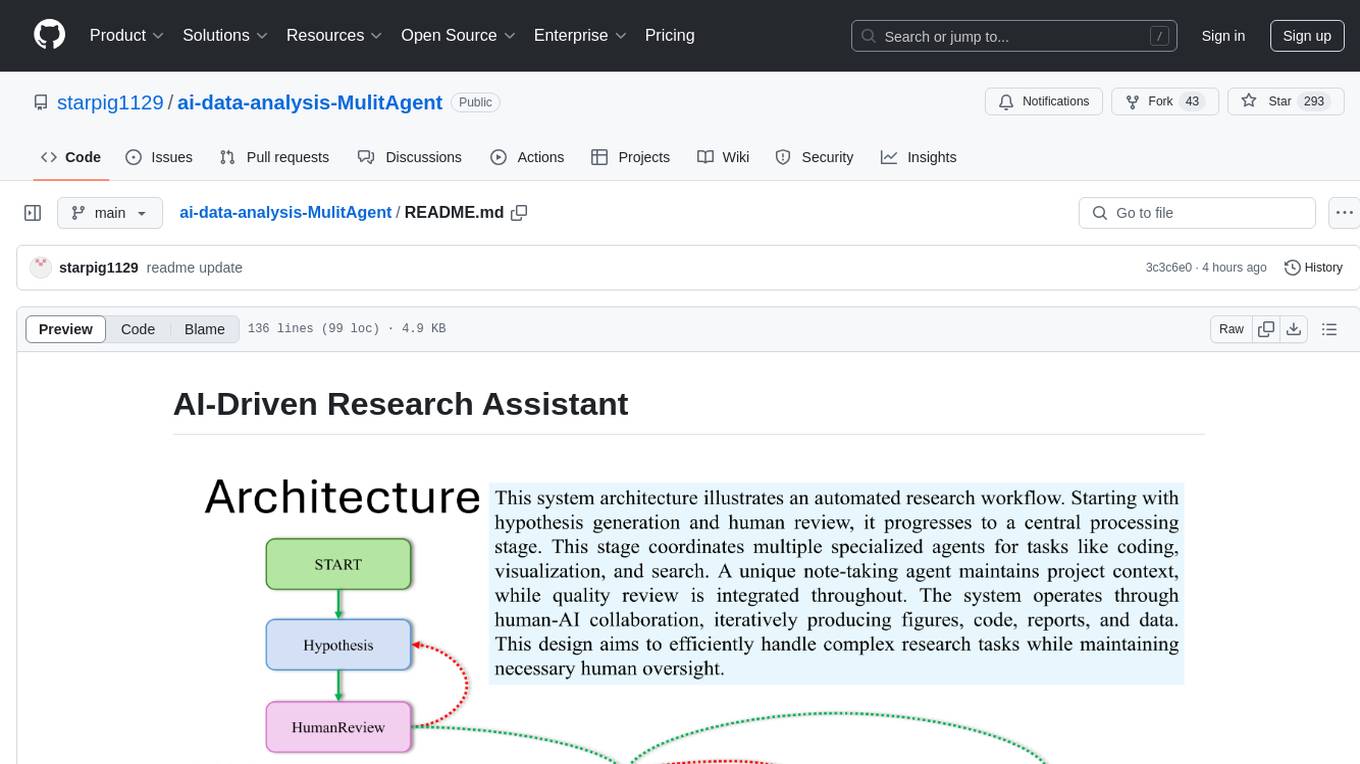
AI-Driven Research Assistant is an advanced AI-powered system utilizing specialized agents for data analysis, visualization, and report generation. It integrates LangChain, OpenAI's GPT models, and LangGraph for complex research processes. Key features include hypothesis generation, data processing, web search, code generation, and report writing. The system's unique Note Taker agent maintains project state, reducing overhead and improving context retention. System requirements include Python 3.10+ and Jupyter Notebook environment. Installation involves cloning the repository, setting up a Conda virtual environment, installing dependencies, and configuring environment variables. Usage instructions include setting data, running Jupyter Notebook, customizing research tasks, and viewing results. Main components include agents for hypothesis generation, process supervision, visualization, code writing, search, report writing, quality review, and note-taking. Workflow involves hypothesis generation, processing, quality review, and revision. Customization is possible by modifying agent creation and workflow definition. Current issues include OpenAI errors, NoteTaker efficiency, runtime optimization, and refiner improvement. Contributions via pull requests are welcome under the MIT License.
video-search-and-summarization
The NVIDIA AI Blueprint for Video Search and Summarization is a repository showcasing video search and summarization agent with NVIDIA NIM microservices. It enables industries to make better decisions faster by providing insightful, accurate, and interactive video analytics AI agents. These agents can perform tasks like video summarization and visual question-answering, unlocking new application possibilities. The repository includes software components like NIM microservices, ingestion pipeline, and CA-RAG module, offering a comprehensive solution for analyzing and summarizing large volumes of video data. The target audience includes video analysts, IT engineers, and GenAI developers who can benefit from the blueprint's 1-click deployment steps, easy-to-manage configurations, and customization options. The repository structure overview includes directories for deployment, source code, and training notebooks, along with documentation for detailed instructions. Hardware requirements vary based on deployment topology and dependencies like VLM and LLM, with different deployment methods such as Launchable Deployment, Docker Compose Deployment, and Helm Chart Deployment provided for various use cases.
easydist
EasyDist is an automated parallelization system and infrastructure designed for multiple ecosystems. It offers usability by making parallelizing training or inference code effortless with just a single line of change. It ensures ecological compatibility by serving as a centralized source of truth for SPMD rules at the operator-level for various machine learning frameworks. EasyDist decouples auto-parallel algorithms from specific frameworks and IRs, allowing for the development and benchmarking of different auto-parallel algorithms in a flexible manner. The architecture includes MetaOp, MetaIR, and the ShardCombine Algorithm for SPMD sharding rules without manual annotations.
For similar tasks
agent-skills
Agent Skills is a repository containing folders of instructions, scripts, and resources that AI agents like Claude Code, Cursor, Github Copilot, etc., can use to perform tasks accurately and efficiently. It provides skills in a structured format to help developers with tasks such as Postgres performance optimization, schema design, query optimization, and more. Users can easily install these skills and the agents will utilize them when relevant tasks are detected.
laravel-slower
Laravel Slower is a powerful package designed for Laravel developers to optimize the performance of their applications by identifying slow database queries and providing AI-driven suggestions for optimal indexing strategies and performance improvements. It offers actionable insights for debugging and monitoring database interactions, enhancing efficiency and scalability.
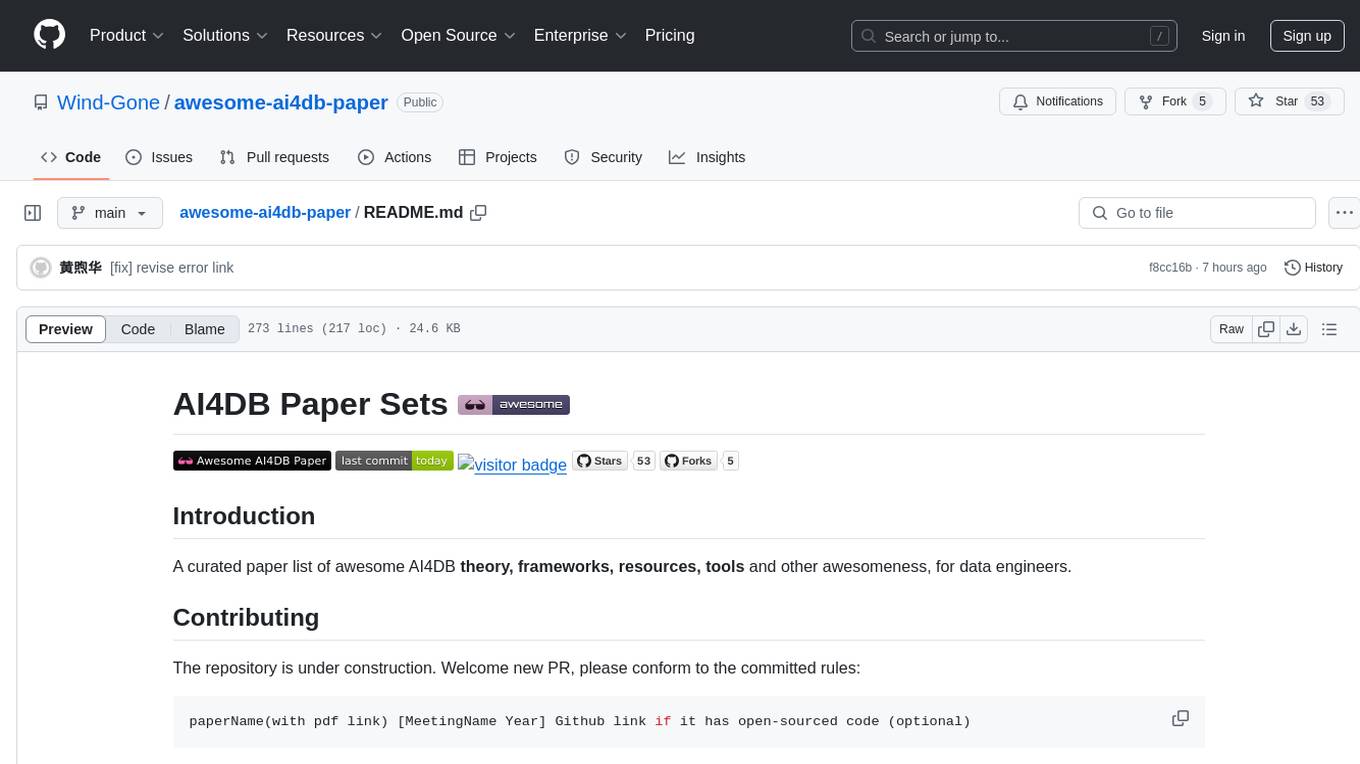
awesome-ai4db-paper
The 'awesome-ai4db-paper' repository is a curated paper list focusing on AI for database (AI4DB) theory, frameworks, resources, and tools for data engineers. It includes a collection of research papers related to learning-based query optimization, training data set preparation, cardinality estimation, query-driven approaches, data-driven techniques, hybrid methods, pretraining models, plan hints, cost models, SQL embedding, join order optimization, query rewriting, end-to-end systems, text-to-SQL conversion, traditional database technologies, storage solutions, learning-based index design, and a learning-based configuration advisor. The repository aims to provide a comprehensive resource for individuals interested in AI applications in the field of database management.
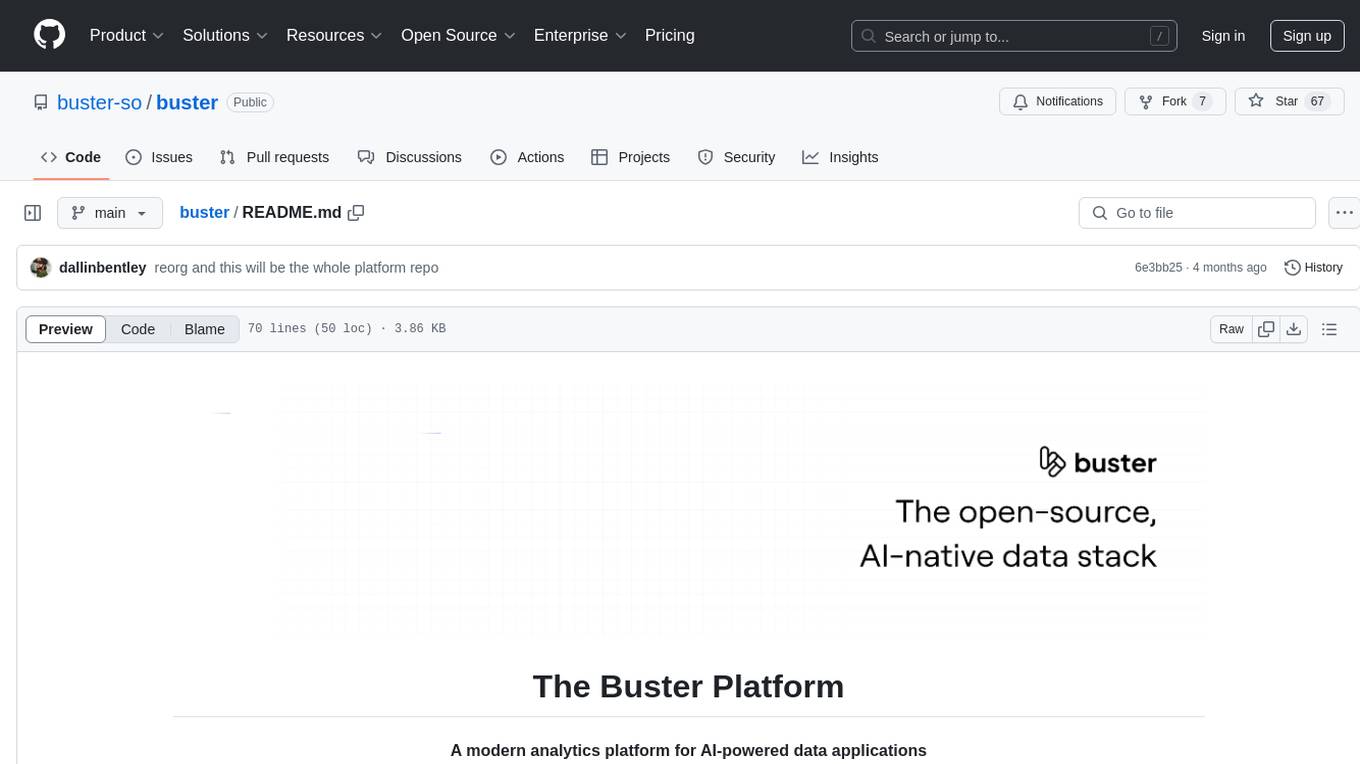
buster
Buster is a modern analytics platform designed with AI in mind, focusing on self-serve experiences powered by Large Language Models. It addresses pain points in existing tools by advocating for AI-centric app development, cost-effective data warehousing, improved CI/CD processes, and empowering data teams to create powerful, user-friendly data experiences. The platform aims to revolutionize AI analytics by enabling data teams to build deep integrations and own their entire analytics stack.
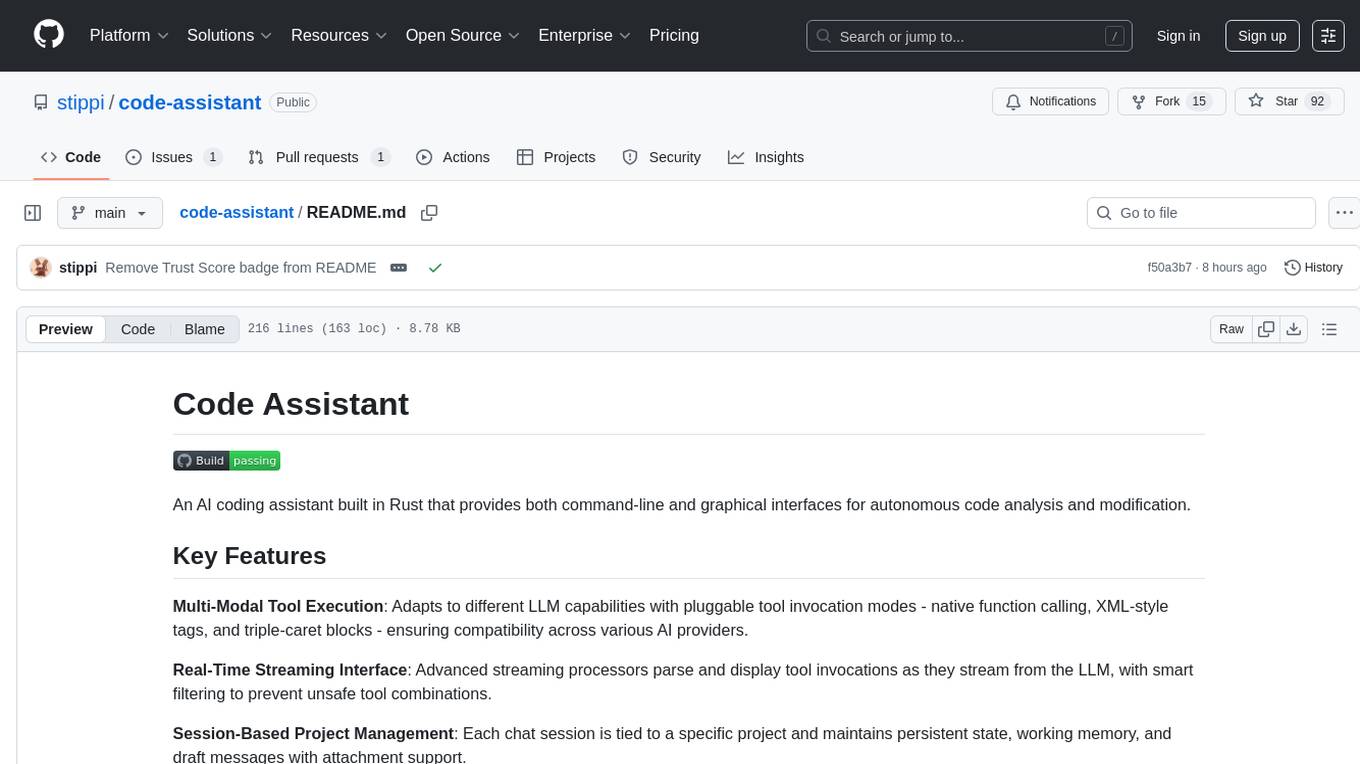
code-assistant
Code Assistant is an AI coding tool built in Rust that offers command-line and graphical interfaces for autonomous code analysis and modification. It supports multi-modal tool execution, real-time streaming interface, session-based project management, multiple interface options, and intelligent project exploration. The tool provides auto-loaded repository guidance and allows for project configuration with format-on-save feature. Users can interact with the tool in GUI, terminal, or MCP server mode, and configure LLM providers for advanced options. The architecture highlights adaptive tool syntax, smart tool filtering, and multi-threaded streaming for efficient performance. Contributions are welcome, and the roadmap includes features like block replacing in changed files, compact tool use failures, UI improvements, memory tools, security enhancements, fuzzy matching search blocks, editing user messages, and selecting in messages.
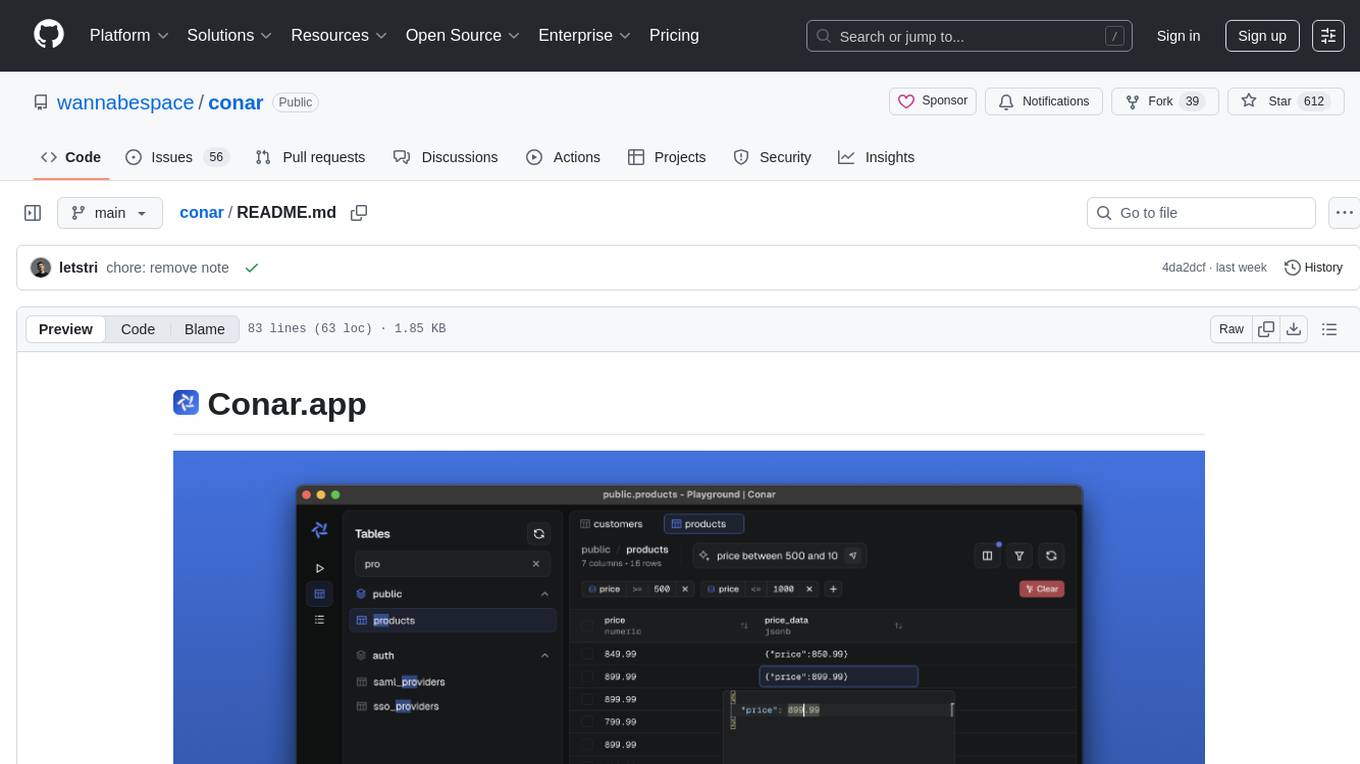
conar
Conar is an AI-powered open-source project designed to simplify database interactions. It is built for PostgreSQL with plans to support other databases in the future. Users can securely store their connections in the cloud and leverage AI assistance to write and optimize SQL queries. The project emphasizes security, multi-database support, and AI-powered features to enhance the database management experience. Conar is developed using React with TypeScript, Electron, and various other technologies to provide a comprehensive solution for database management.
llxprt-code
LLxprt Code is an AI-powered coding assistant that works with any LLM provider, offering a command-line interface for querying and editing codebases, generating applications, and automating development workflows. It supports various subscriptions, provider flexibility, top open models, local model support, and a privacy-first approach. Users can interact with LLxprt Code in both interactive and non-interactive modes, leveraging features like subscription OAuth, multi-account failover, load balancer profiles, and extensive provider support. The tool also allows for the creation of advanced subagents for specialized tasks and integrates with the Zed editor for in-editor chat and code selection.
For similar jobs
sweep
Sweep is an AI junior developer that turns bugs and feature requests into code changes. It automatically handles developer experience improvements like adding type hints and improving test coverage.
teams-ai
The Teams AI Library is a software development kit (SDK) that helps developers create bots that can interact with Teams and Microsoft 365 applications. It is built on top of the Bot Framework SDK and simplifies the process of developing bots that interact with Teams' artificial intelligence capabilities. The SDK is available for JavaScript/TypeScript, .NET, and Python.
ai-guide
This guide is dedicated to Large Language Models (LLMs) that you can run on your home computer. It assumes your PC is a lower-end, non-gaming setup.
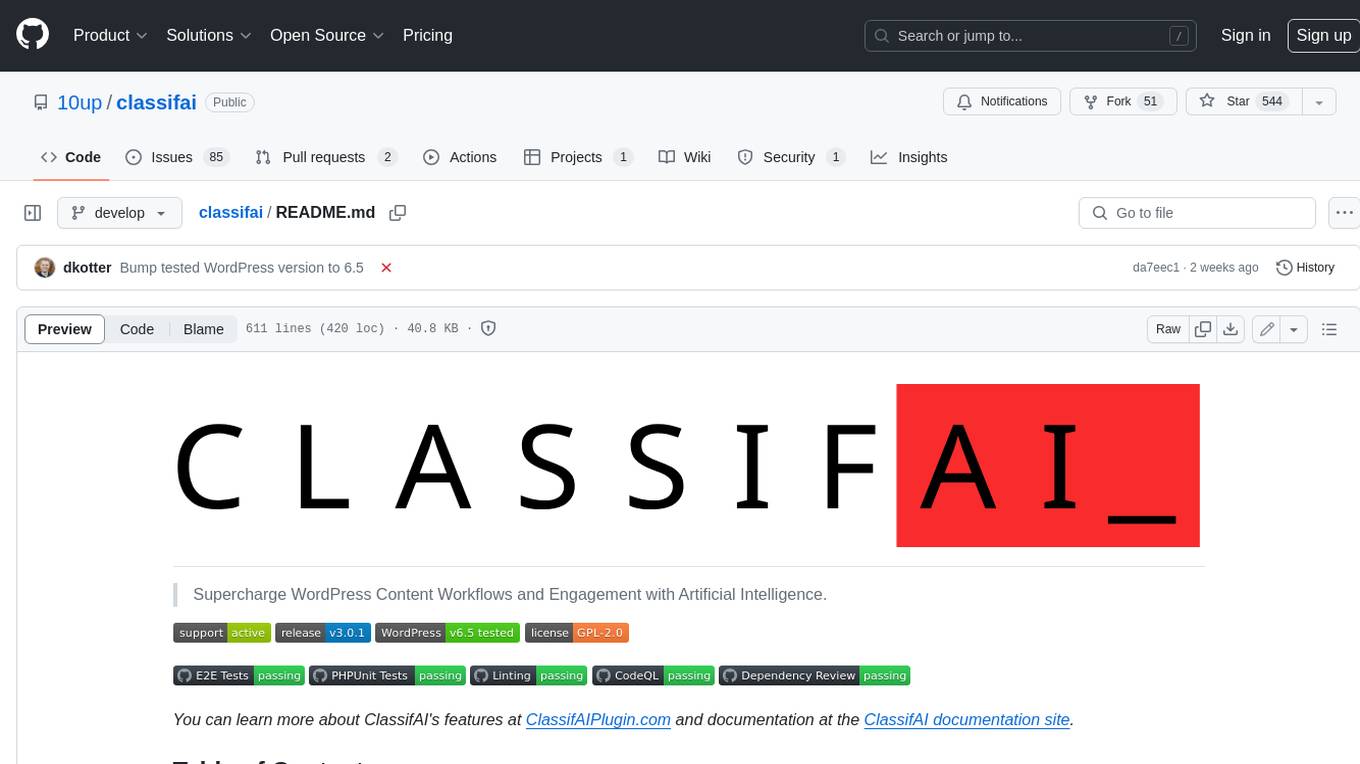
classifai
Supercharge WordPress Content Workflows and Engagement with Artificial Intelligence. Tap into leading cloud-based services like OpenAI, Microsoft Azure AI, Google Gemini and IBM Watson to augment your WordPress-powered websites. Publish content faster while improving SEO performance and increasing audience engagement. ClassifAI integrates Artificial Intelligence and Machine Learning technologies to lighten your workload and eliminate tedious tasks, giving you more time to create original content that matters.
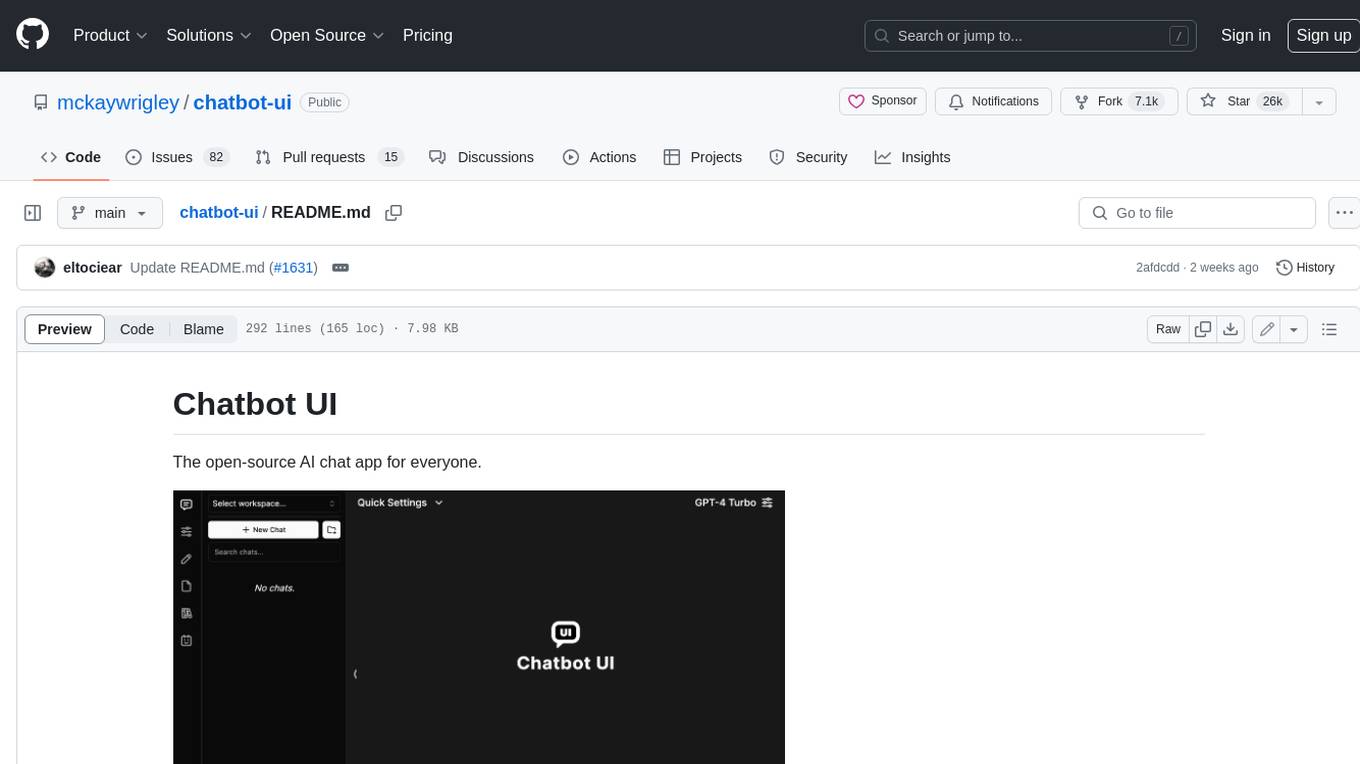
chatbot-ui
Chatbot UI is an open-source AI chat app that allows users to create and deploy their own AI chatbots. It is easy to use and can be customized to fit any need. Chatbot UI is perfect for businesses, developers, and anyone who wants to create a chatbot.
BricksLLM
BricksLLM is a cloud native AI gateway written in Go. Currently, it provides native support for OpenAI, Anthropic, Azure OpenAI and vLLM. BricksLLM aims to provide enterprise level infrastructure that can power any LLM production use cases. Here are some use cases for BricksLLM: * Set LLM usage limits for users on different pricing tiers * Track LLM usage on a per user and per organization basis * Block or redact requests containing PIIs * Improve LLM reliability with failovers, retries and caching * Distribute API keys with rate limits and cost limits for internal development/production use cases * Distribute API keys with rate limits and cost limits for students
uAgents
uAgents is a Python library developed by Fetch.ai that allows for the creation of autonomous AI agents. These agents can perform various tasks on a schedule or take action on various events. uAgents are easy to create and manage, and they are connected to a fast-growing network of other uAgents. They are also secure, with cryptographically secured messages and wallets.
griptape
Griptape is a modular Python framework for building AI-powered applications that securely connect to your enterprise data and APIs. It offers developers the ability to maintain control and flexibility at every step. Griptape's core components include Structures (Agents, Pipelines, and Workflows), Tasks, Tools, Memory (Conversation Memory, Task Memory, and Meta Memory), Drivers (Prompt and Embedding Drivers, Vector Store Drivers, Image Generation Drivers, Image Query Drivers, SQL Drivers, Web Scraper Drivers, and Conversation Memory Drivers), Engines (Query Engines, Extraction Engines, Summary Engines, Image Generation Engines, and Image Query Engines), and additional components (Rulesets, Loaders, Artifacts, Chunkers, and Tokenizers). Griptape enables developers to create AI-powered applications with ease and efficiency.