


vulnerability-spoiler-alert
A monitoring hub that watches popular open-source repositories and uses AI to detect when commits are patching security vulnerabilities - often before a CVE is even assigned. Findings are published to a retro-themed website with an RSS feed.
Stars: 52
Vulnerability Spoiler Alert is a monitoring hub that watches popular open-source repositories and uses AI to detect when commits are patching security vulnerabilities. It analyzes each commit diff to determine if it is a security patch, what vulnerability it fixes, and if a PoC exploit can be written. Findings are published to a retro-themed website with an RSS feed. The tool is designed for defensive security research and authorized security testing, following responsible disclosure practices.
README:
Know about security patches before the CVE drops.



View Live Site | Subscribe via RSS
A monitoring hub that watches popular open-source repositories and uses AI to detect when commits are patching security vulnerabilities - often before a CVE is even assigned. Findings are published to a retro-themed website with an RSS feed.
                Every 6 hours
                      |
                      v
  +-------------------------------------------+
  |           GitHub Actions Cron             |
  +-------------------------------------------+
                      |
                      v
  +-------------------------------------------+
  |  vulnerability-spoiler-alert-action       |
  |  scans repos listed in the workflow       |
  +-------------------------------------------+
                      |
                      v
  +-------------------------------------------+
  |  Claude AI analyzes each commit diff      |
  |  - Is this a security patch?              |
  |  - What vulnerability does it fix?        |
  |  - Can we write a PoC exploit?            |
  +-------------------------------------------+
                      |
                      v
  +-------------------------------------------+
  |  Create GitHub Issue with full analysis   |
  +-------------------------------------------+
                      |
                      v
  +-------------------------------------------+
  |  Rebuild website + RSS                    |
  |  Deploy to GitHub Pages                   |
  +-------------------------------------------+
| Project | Repository |
|---|---|
| Express | expressjs/express |
| Node.js | nodejs/node |
| Django | django/django |
| Flask | pallets/flask |
| Rails | rails/rails |
| Apache HTTPD | apache/httpd |
| nginx | nginx/nginx |
| Grafana | grafana/grafana |
Add labels to issues to classify findings:
| Label | Meaning |
|---|---|
true-positive |
Confirmed vulnerability - shown with a green "CONFIRMED" badge on the site |
false-positive |
Not a real vulnerability - dimmed and moved to a collapsible section |
The site automatically rebuilds when labels are added or removed.
Click the Fork button at the top right.
Go to Settings > Secrets and variables > Actions and add:
| Secret | Description |
|---|---|
ANTHROPIC_API_KEY |
Your Claude API key from console.anthropic.com |
The GITHUB_TOKEN is provided automatically by GitHub Actions.
Go to Settings > Pages and set source to GitHub Actions.
Go to the Actions tab and enable workflows. The monitor runs every 6 hours automatically.
You can trigger it manually via Actions > Monitor Vulnerabilities > Run workflow.
Edit the repositories JSON array in .github/workflows/monitor.yml to add or remove repositories.
By default, the monitor runs every 6 hours. Edit the cron expression in .github/workflows/monitor.yml:
schedule:
- cron: '0 */6 * * *' # Every 6 hours- Zero dependencies - the site build script uses only Node.js built-in APIs
- Static site - plain HTML + RSS, deployed via GitHub Pages
- GeoCities theme - because security advisories deserve the Web 1.0 treatment
MIT License - see LICENSE for details.
This tool is for defensive security research and authorized security testing only. Always follow responsible disclosure practices.
For Tasks:
Click tags to check more tools for each tasksFor Jobs:
Alternative AI tools for vulnerability-spoiler-alert
Similar Open Source Tools
vulnerability-spoiler-alert
Vulnerability Spoiler Alert is a monitoring hub that watches popular open-source repositories and uses AI to detect when commits are patching security vulnerabilities. It analyzes each commit diff to determine if it is a security patch, what vulnerability it fixes, and if a PoC exploit can be written. Findings are published to a retro-themed website with an RSS feed. The tool is designed for defensive security research and authorized security testing, following responsible disclosure practices.
holmesgpt
HolmesGPT is an AI agent designed for troubleshooting and investigating issues in cloud environments. It utilizes AI models to analyze data from various sources, identify root causes, and provide remediation suggestions. The tool offers integrations with popular cloud providers, observability tools, and on-call systems, enabling users to streamline the troubleshooting process. HolmesGPT can automate the investigation of alerts and tickets from external systems, providing insights back to the source or communication platforms like Slack. It supports end-to-end automation and offers a CLI for interacting with the AI agent. Users can customize HolmesGPT by adding custom data sources and runbooks to enhance investigation capabilities. The tool prioritizes data privacy, ensuring read-only access and respecting RBAC permissions. HolmesGPT is a CNCF Sandbox Project and is distributed under the Apache 2.0 License.

airunner
AI Runner is a multi-modal AI interface that allows users to run open-source large language models and AI image generators on their own hardware. The tool provides features such as voice-based chatbot conversations, text-to-speech, speech-to-text, vision-to-text, text generation with large language models, image generation capabilities, image manipulation tools, utility functions, and more. It aims to provide a stable and user-friendly experience with security updates, a new UI, and a streamlined installation process. The application is designed to run offline on users' hardware without relying on a web server, offering a smooth and responsive user experience.
terminator
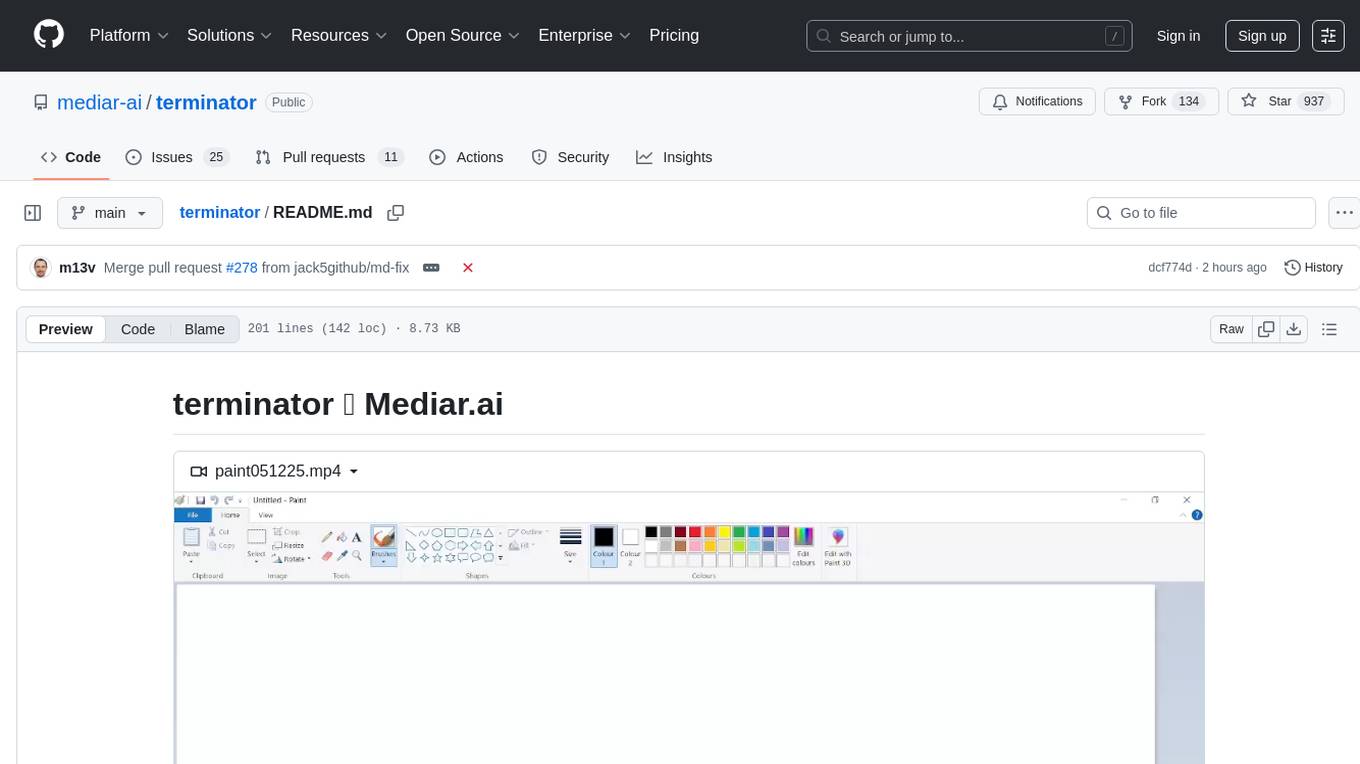
Terminator is an AI-powered desktop automation tool that is open source, MIT-licensed, and cross-platform. It works across all apps and browsers, inspired by GitHub Actions & Playwright. It is 100x faster than generic AI agents, with over 95% success rate and no vendor lock-in. Users can create automations that work across any desktop app or browser, achieve high success rates without costly consultant armies, and pre-train workflows as deterministic code.
awesome-slash
Automate the entire development workflow beyond coding. awesome-slash provides production-ready skills, agents, and commands for managing tasks, branches, reviews, CI, and deployments. It automates the entire workflow, including task exploration, planning, implementation, review, and shipping. The tool includes 11 plugins, 40 agents, 26 skills, and 26k lines of lib code, with 3,357 tests and support for 3 platforms. It works with Claude Code, OpenCode, and Codex CLI, offering specialized capabilities through skills and agents.
openkore
OpenKore is a custom client and intelligent automated assistant for Ragnarok Online. It is a free, open source, and cross-platform program (Linux, Windows, and MacOS are supported). To run OpenKore, you need to download and extract it or clone the repository using Git. Configure OpenKore according to the documentation and run openkore.pl to start. The tool provides a FAQ section for troubleshooting, guidelines for reporting issues, and information about botting status on official servers. OpenKore is developed by a global team, and contributions are welcome through pull requests. Various community resources are available for support and communication. Users are advised to comply with the GNU General Public License when using and distributing the software.
zoonk
Zoonk is a web app designed for creating interactive courses using AI. Currently in early development stage, it is not yet ready for use but aims to be available for testing and contributions in the future. The project focuses on leveraging AI technology to enhance the learning experience by providing interactive course creation tools. Zoonk also conducts model evaluations on different prompts to improve its AI capabilities. The project has garnered support from various individuals who believe in its vision and potential.
beeai-framework
BeeAI Framework is a versatile tool for building production-ready multi-agent systems. It offers flexibility in orchestrating agents, seamless integration with various models and tools, and production-grade controls for scaling. The framework supports Python and TypeScript libraries, enabling users to implement simple to complex multi-agent patterns, connect with AI services, and optimize token usage and resource management.
EvoAgentX
EvoAgentX is an open-source framework for building, evaluating, and evolving LLM-based agents or agentic workflows in an automated, modular, and goal-driven manner. It enables developers and researchers to move beyond static prompt chaining or manual workflow orchestration by introducing a self-evolving agent ecosystem. The framework includes features such as agent workflow autoconstruction, built-in evaluation, self-evolution engine, plug-and-play compatibility, comprehensive built-in tools, memory module support, and human-in-the-loop interactions.
opik
Comet Opik is a repository containing two main services: a frontend and a backend. It provides a Python SDK for easy installation. Users can run the full application locally with minikube, following specific installation prerequisites. The repository structure includes directories for applications like Opik backend, with detailed instructions available in the README files. Users can manage the installation using simple k8s commands and interact with the application via URLs for checking the running application and API documentation. The repository aims to facilitate local development and testing of Opik using Kubernetes technology.
eko
Eko is a lightweight and flexible command-line tool for managing environment variables in your projects. It allows you to easily set, get, and delete environment variables for different environments, making it simple to manage configurations across development, staging, and production environments. With Eko, you can streamline your workflow and ensure consistency in your application settings without the need for complex setup or configuration files.
llava-docker
This Docker image for LLaVA (Large Language and Vision Assistant) provides a convenient way to run LLaVA locally or on RunPod. LLaVA is a powerful AI tool that combines natural language processing and computer vision capabilities. With this Docker image, you can easily access LLaVA's functionalities for various tasks, including image captioning, visual question answering, text summarization, and more. The image comes pre-installed with LLaVA v1.2.0, Torch 2.1.2, xformers 0.0.23.post1, and other necessary dependencies. You can customize the model used by setting the MODEL environment variable. The image also includes a Jupyter Lab environment for interactive development and exploration. Overall, this Docker image offers a comprehensive and user-friendly platform for leveraging LLaVA's capabilities.
coreply
Coreply is an open-source Android app that provides texting suggestions while typing, enhancing the typing experience with intelligent, context-aware suggestions. It supports various texting apps and offers real-time AI suggestions, customizable LLM settings, and ensures no data collection. Users can install the app, configure it with an API key, and start receiving suggestions while typing in messaging apps. The tool supports different AI models from providers like OpenAI, Google AI Studio, Openrouter, Groq, and Codestral for chat completion and fill-in-the-middle tasks.
mage-ai
Mage is an open-source data pipeline tool for transforming and integrating data. It offers an easy developer experience, engineering best practices built-in, and data as a first-class citizen. Mage makes it easy to build, preview, and launch data pipelines, and provides observability and scaling capabilities. It supports data integrations, streaming pipelines, and dbt integration.
deepfabric
DeepFabric is a CLI tool and SDK designed for researchers and developers to generate high-quality synthetic datasets at scale using large language models. It leverages a graph and tree-based architecture to create diverse and domain-specific datasets while minimizing redundancy. The tool supports generating Chain of Thought datasets for step-by-step reasoning tasks and offers multi-provider support for using different language models. DeepFabric also allows for automatic dataset upload to Hugging Face Hub and uses YAML configuration files for flexibility in dataset generation.
OSA
OSA (Open-Source-Advisor) is a tool designed to improve the quality of scientific open source projects by automating the generation of README files, documentation, CI/CD scripts, and providing advice and recommendations for repositories. It supports various LLMs accessible via API, local servers, or osa_bot hosted on ITMO servers. OSA is currently under development with features like README file generation, documentation generation, automatic implementation of changes, LLM integration, and GitHub Action Workflow generation. It requires Python 3.10 or higher and tokens for GitHub/GitLab/Gitverse and LLM API key. Users can install OSA using PyPi or build from source, and run it using CLI commands or Docker containers.
For similar tasks
vulnerability-spoiler-alert
Vulnerability Spoiler Alert is a monitoring hub that watches popular open-source repositories and uses AI to detect when commits are patching security vulnerabilities. It analyzes each commit diff to determine if it is a security patch, what vulnerability it fixes, and if a PoC exploit can be written. Findings are published to a retro-themed website with an RSS feed. The tool is designed for defensive security research and authorized security testing, following responsible disclosure practices.
afc-crs-all-you-need-is-a-fuzzing-brain
All You Need Is A Fuzzing Brain is an AI-driven automated vulnerability detection and remediation framework developed for the 2025 DARPA AIxCC finals. It leverages multiple LLM providers for intelligent vulnerability detection, offers 23+ specialized strategies for POV generation and patch synthesis, generates and validates patches automatically, integrates seamlessly with Google's fuzzing infrastructure, and supports vulnerability detection in C/C++ and Java. Users can perform tasks such as Delta Scan, Full Scan, and SARIF Analysis for specific commits, repository-wide analysis, and validation/patching from static analysis reports, respectively. The tool can be used via Docker or by installing from source, and citations are provided for research purposes.
For similar jobs
last_layer
last_layer is a security library designed to protect LLM applications from prompt injection attacks, jailbreaks, and exploits. It acts as a robust filtering layer to scrutinize prompts before they are processed by LLMs, ensuring that only safe and appropriate content is allowed through. The tool offers ultra-fast scanning with low latency, privacy-focused operation without tracking or network calls, compatibility with serverless platforms, advanced threat detection mechanisms, and regular updates to adapt to evolving security challenges. It significantly reduces the risk of prompt-based attacks and exploits but cannot guarantee complete protection against all possible threats.
aircrack-ng
Aircrack-ng is a comprehensive suite of tools designed to evaluate the security of WiFi networks. It covers various aspects of WiFi security, including monitoring, attacking (replay attacks, deauthentication, fake access points), testing WiFi cards and driver capabilities, and cracking WEP and WPA PSK. The tools are command line-based, allowing for extensive scripting and have been utilized by many GUIs. Aircrack-ng primarily works on Linux but also supports Windows, macOS, FreeBSD, OpenBSD, NetBSD, Solaris, and eComStation 2.
reverse-engineering-assistant
ReVA (Reverse Engineering Assistant) is a project aimed at building a disassembler agnostic AI assistant for reverse engineering tasks. It utilizes a tool-driven approach, providing small tools to the user to empower them in completing complex tasks. The assistant is designed to accept various inputs, guide the user in correcting mistakes, and provide additional context to encourage exploration. Users can ask questions, perform tasks like decompilation, class diagram generation, variable renaming, and more. ReVA supports different language models for online and local inference, with easy configuration options. The workflow involves opening the RE tool and program, then starting a chat session to interact with the assistant. Installation includes setting up the Python component, running the chat tool, and configuring the Ghidra extension for seamless integration. ReVA aims to enhance the reverse engineering process by breaking down actions into small parts, including the user's thoughts in the output, and providing support for monitoring and adjusting prompts.
AutoAudit
AutoAudit is an open-source large language model specifically designed for the field of network security. It aims to provide powerful natural language processing capabilities for security auditing and network defense, including analyzing malicious code, detecting network attacks, and predicting security vulnerabilities. By coupling AutoAudit with ClamAV, a security scanning platform has been created for practical security audit applications. The tool is intended to assist security professionals with accurate and fast analysis and predictions to combat evolving network threats.
aif
Arno's Iptables Firewall (AIF) is a single- & multi-homed firewall script with DSL/ADSL support. It is a free software distributed under the GNU GPL License. The script provides a comprehensive set of configuration files and plugins for setting up and managing firewall rules, including support for NAT, load balancing, and multirouting. It offers detailed instructions for installation and configuration, emphasizing security best practices and caution when modifying settings. The script is designed to protect against hostile attacks by blocking all incoming traffic by default and allowing users to configure specific rules for open ports and network interfaces.
watchtower
AIShield Watchtower is a tool designed to fortify the security of AI/ML models and Jupyter notebooks by automating model and notebook discoveries, conducting vulnerability scans, and categorizing risks into 'low,' 'medium,' 'high,' and 'critical' levels. It supports scanning of public GitHub repositories, Hugging Face repositories, AWS S3 buckets, and local systems. The tool generates comprehensive reports, offers a user-friendly interface, and aligns with industry standards like OWASP, MITRE, and CWE. It aims to address the security blind spots surrounding Jupyter notebooks and AI models, providing organizations with a tailored approach to enhancing their security efforts.
Academic_LLM_Sec_Papers
Academic_LLM_Sec_Papers is a curated collection of academic papers related to LLM Security Application. The repository includes papers sorted by conference name and published year, covering topics such as large language models for blockchain security, software engineering, machine learning, and more. Developers and researchers are welcome to contribute additional published papers to the list. The repository also provides information on listed conferences and journals related to security, networking, software engineering, and cryptography. The papers cover a wide range of topics including privacy risks, ethical concerns, vulnerabilities, threat modeling, code analysis, fuzzing, and more.
DeGPT
DeGPT is a tool designed to optimize decompiler output using Large Language Models (LLM). It requires manual installation of specific packages and setting up API key for OpenAI. The tool provides functionality to perform optimization on decompiler output by running specific scripts.