


zoonk
Learn anything with step-by-step activities
Stars: 94
Zoonk is a web app designed for creating interactive courses using AI. Currently in early development stage, it is not yet ready for use but aims to be available for testing and contributions in the future. The project focuses on leveraging AI technology to enhance the learning experience by providing interactive course creation tools. Zoonk also conducts model evaluations on different prompts to improve its AI capabilities. The project has garnered support from various individuals who believe in its vision and potential.
README:
Learn anything with step-by-step activities.
Waitlist
[!CAUTION]
This project is still in early development and not ready for use. There will be breaking changes before stable that won't be backwards compatible. Star this repository or follow us on social media to stay updated.
| Feature | Not Started | In Progress | Beta | Stable |
|---|---|---|---|---|
| Learn Anything (Catalog) | 🔨 | |||
| Personalized Lessons | 📆 | |||
| Editor | 🔨 | |||
| Teams | 📆 | |||
| Schools | 📆 | |||
| White-Label (Creators) | 📆 | |||
| iOS App | 📆 | |||
| Android App | 📆 | |||
| API | 🔨 |
- Node.js v24
- pnpm v10
- PostgreSQL v17
We recommend using mise to manage your Node.js and pnpm versions.
-
pnpm installto install dependencies for all apps and packages - Check out the @zoonk/db package README for database setup instructions
- Check out the main app README for app-specific setup instructions
-
pnpm devto start the development server -
pnpm buildto create a production build -
pnpm lintto run linting -
pnpm typecheckto run TypeScript type checking -
pnpm knipto check for unused code -
pnpm testto run tests with Vitest -
pnpm e2eto run end-to-end tests with Playwright
-
main: Public web app (
zoonk.com) -
admin: Dashboard for managing users and organizations (
admin.zoonk.com) -
api: Centralized API and authentication UI (
api.zoonk.com) -
editor: Visual editor for building courses and activities (
editor.zoonk.com) - evals: Local-only tool for evaluating AI-generated content
- ai: AI prompts, tasks, and helpers for content generation
- auth: Shared Better Auth setup and plugins
- core: Shared server utilities
- db: Prisma schema and client
- e2e: Shared Playwright config and test fixtures
- error-reporter: Error reporting utilities
- eslint-plugin: Custom ESLint rules
- mailer: Email-sending utilities
- next: Shared Next.js utilities
- testing: Shared testing utilities
- tsconfig: Shared TypeScript config
- ui: Shared React components, patterns, hooks, and styles
- utils: Shared utilities and helpers
You can use lingo.dev to manage translations for this project. Run pnpm i18n from the root directory to translate missing keys.
This is optional. If using lingo.dev, make sure to set the LINGODOTDEV_API_KEY environment variable in your local .env file.
We're using Vercel's Remote Caching to speed up our Turborepo tasks. To enable remote caching, authenticate the Turborepo CLI with your Vercel account:
pnpm turbo loginThen, link to the remote cache:
pnpm turbo linkSee everyone who has supported this project.
For Tasks:
Click tags to check more tools for each tasksFor Jobs:
Alternative AI tools for zoonk
Similar Open Source Tools
zoonk
Zoonk is a web app designed for creating interactive courses using AI. Currently in early development stage, it is not yet ready for use but aims to be available for testing and contributions in the future. The project focuses on leveraging AI technology to enhance the learning experience by providing interactive course creation tools. Zoonk also conducts model evaluations on different prompts to improve its AI capabilities. The project has garnered support from various individuals who believe in its vision and potential.
SimpleAICV_pytorch_training_examples
SimpleAICV_pytorch_training_examples is a repository that provides simple training and testing examples for various computer vision tasks such as image classification, object detection, semantic segmentation, instance segmentation, knowledge distillation, contrastive learning, masked image modeling, OCR text detection, OCR text recognition, human matting, salient object detection, interactive segmentation, image inpainting, and diffusion model tasks. The repository includes support for multiple datasets and networks, along with instructions on how to prepare datasets, train and test models, and use gradio demos. It also offers pretrained models and experiment records for download from huggingface or Baidu-Netdisk. The repository requires specific environments and package installations to run effectively.
beeai-framework
BeeAI Framework is a versatile tool for building production-ready multi-agent systems. It offers flexibility in orchestrating agents, seamless integration with various models and tools, and production-grade controls for scaling. The framework supports Python and TypeScript libraries, enabling users to implement simple to complex multi-agent patterns, connect with AI services, and optimize token usage and resource management.
superduperdb
SuperDuperDB is a Python framework for integrating AI models, APIs, and vector search engines directly with your existing databases, including hosting of your own models, streaming inference and scalable model training/fine-tuning. Build, deploy and manage any AI application without the need for complex pipelines, infrastructure as well as specialized vector databases, and moving our data there, by integrating AI at your data's source: - Generative AI, LLMs, RAG, vector search - Standard machine learning use-cases (classification, segmentation, regression, forecasting recommendation etc.) - Custom AI use-cases involving specialized models - Even the most complex applications/workflows in which different models work together SuperDuperDB is **not** a database. Think `db = superduper(db)`: SuperDuperDB transforms your databases into an intelligent platform that allows you to leverage the full AI and Python ecosystem. A single development and deployment environment for all your AI applications in one place, fully scalable and easy to manage.
opik
Comet Opik is a repository containing two main services: a frontend and a backend. It provides a Python SDK for easy installation. Users can run the full application locally with minikube, following specific installation prerequisites. The repository structure includes directories for applications like Opik backend, with detailed instructions available in the README files. Users can manage the installation using simple k8s commands and interact with the application via URLs for checking the running application and API documentation. The repository aims to facilitate local development and testing of Opik using Kubernetes technology.
openlit
OpenLIT is an OpenTelemetry-native GenAI and LLM Application Observability tool. It's designed to make the integration process of observability into GenAI projects as easy as pie – literally, with just **a single line of code**. Whether you're working with popular LLM Libraries such as OpenAI and HuggingFace or leveraging vector databases like ChromaDB, OpenLIT ensures your applications are monitored seamlessly, providing critical insights to improve performance and reliability.
FFAIVideo
FFAIVideo is a lightweight node.js project that utilizes popular AI LLM to intelligently generate short videos. It supports multiple AI LLM models such as OpenAI, Moonshot, Azure, g4f, Google Gemini, etc. Users can input text to automatically synthesize exciting video content with subtitles, background music, and customizable settings. The project integrates Microsoft Edge's online text-to-speech service for voice options and uses Pexels website for video resources. Installation of FFmpeg is essential for smooth operation. Inspired by MoneyPrinterTurbo, MoneyPrinter, and MsEdgeTTS, FFAIVideo is designed for front-end developers with minimal dependencies and simple usage.
mage-ai
Mage is an open-source data pipeline tool for transforming and integrating data. It offers an easy developer experience, engineering best practices built-in, and data as a first-class citizen. Mage makes it easy to build, preview, and launch data pipelines, and provides observability and scaling capabilities. It supports data integrations, streaming pipelines, and dbt integration.
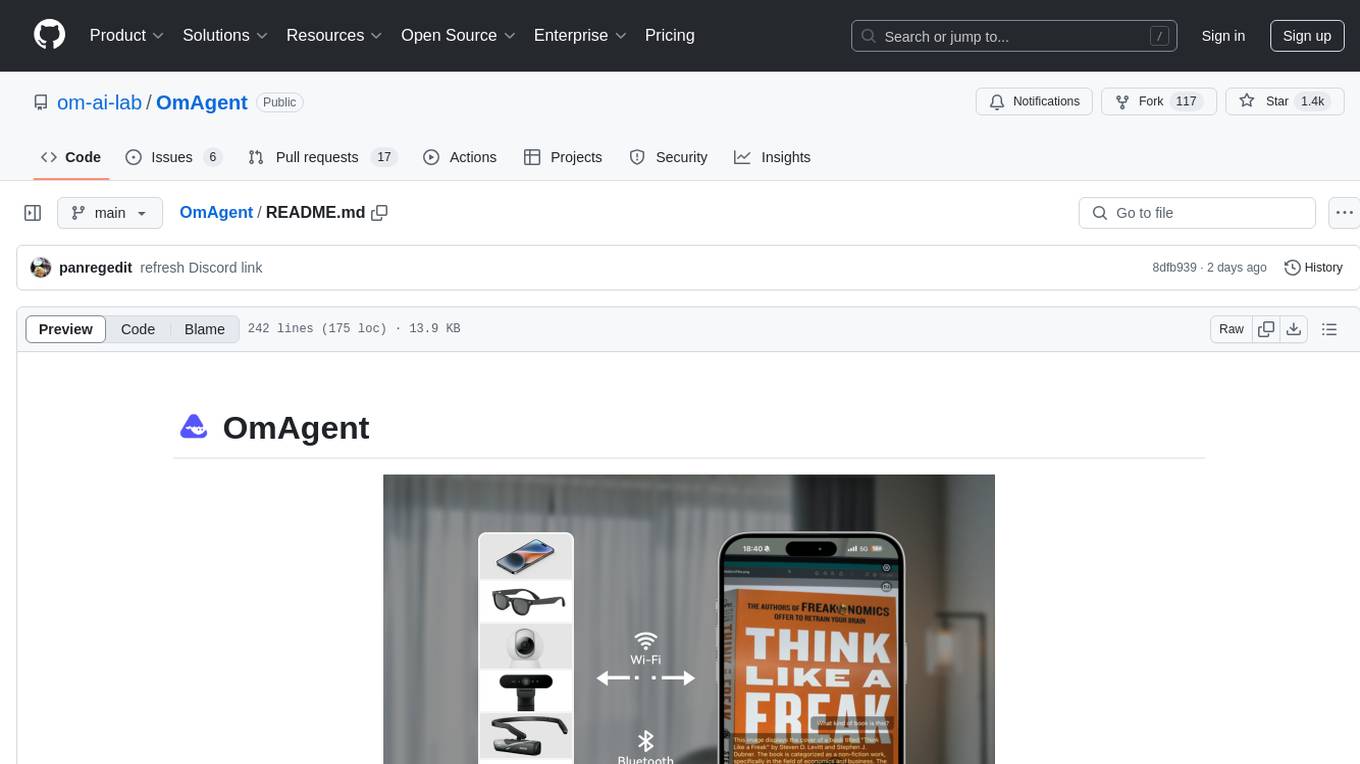
OmAgent
OmAgent is an open-source agent framework designed to streamline the development of on-device multimodal agents. It enables agents to empower various hardware devices, integrates speed-optimized SOTA multimodal models, provides SOTA multimodal agent algorithms, and focuses on optimizing the end-to-end computing pipeline for real-time user interaction experience. Key features include easy connection to diverse devices, scalability, flexibility, and workflow orchestration. The architecture emphasizes graph-based workflow orchestration, native multimodality, and device-centricity, allowing developers to create bespoke intelligent agent programs.
thinc
Thinc is a lightweight deep learning library that offers an elegant, type-checked, functional-programming API for composing models, with support for layers defined in other frameworks such as PyTorch, TensorFlow and MXNet. You can use Thinc as an interface layer, a standalone toolkit or a flexible way to develop new models.
inference
Xorbits Inference (Xinference) is a powerful and versatile library designed to serve language, speech recognition, and multimodal models. With Xorbits Inference, you can effortlessly deploy and serve your or state-of-the-art built-in models using just a single command. Whether you are a researcher, developer, or data scientist, Xorbits Inference empowers you to unleash the full potential of cutting-edge AI models.
llm-graph-builder
Knowledge Graph Builder App is a tool designed to convert PDF documents into a structured knowledge graph stored in Neo4j. It utilizes OpenAI's GPT/Diffbot LLM to extract nodes, relationships, and properties from PDF text content. Users can upload files from local machine or S3 bucket, choose LLM model, and create a knowledge graph. The app integrates with Neo4j for easy visualization and querying of extracted information.
torchtune
Torchtune is a PyTorch-native library for easily authoring, fine-tuning, and experimenting with LLMs. It provides native-PyTorch implementations of popular LLMs using composable and modular building blocks, easy-to-use and hackable training recipes for popular fine-tuning techniques, YAML configs for easily configuring training, evaluation, quantization, or inference recipes, and built-in support for many popular dataset formats and prompt templates to help you quickly get started with training.
outspeed
Outspeed is a PyTorch-inspired SDK for building real-time AI applications on voice and video input. It offers low-latency processing of streaming audio and video, an intuitive API familiar to PyTorch users, flexible integration of custom AI models, and tools for data preprocessing and model deployment. Ideal for developing voice assistants, video analytics, and other real-time AI applications processing audio-visual data.
unoplat-code-confluence
Unoplat-CodeConfluence is a universal code context engine that aims to extract, understand, and provide precise code context across repositories tied through domains. It combines deterministic code grammar with state-of-the-art LLM pipelines to achieve human-like understanding of codebases in minutes. The tool offers smart summarization, graph-based embedding, enhanced onboarding, graph-based intelligence, deep dependency insights, and seamless integration with existing development tools and workflows. It provides a precise context API for knowledge engine and AI coding assistants, enabling reliable code understanding through bottom-up code summarization, graph-based querying, and deep package and dependency analysis.
keras-llm-robot
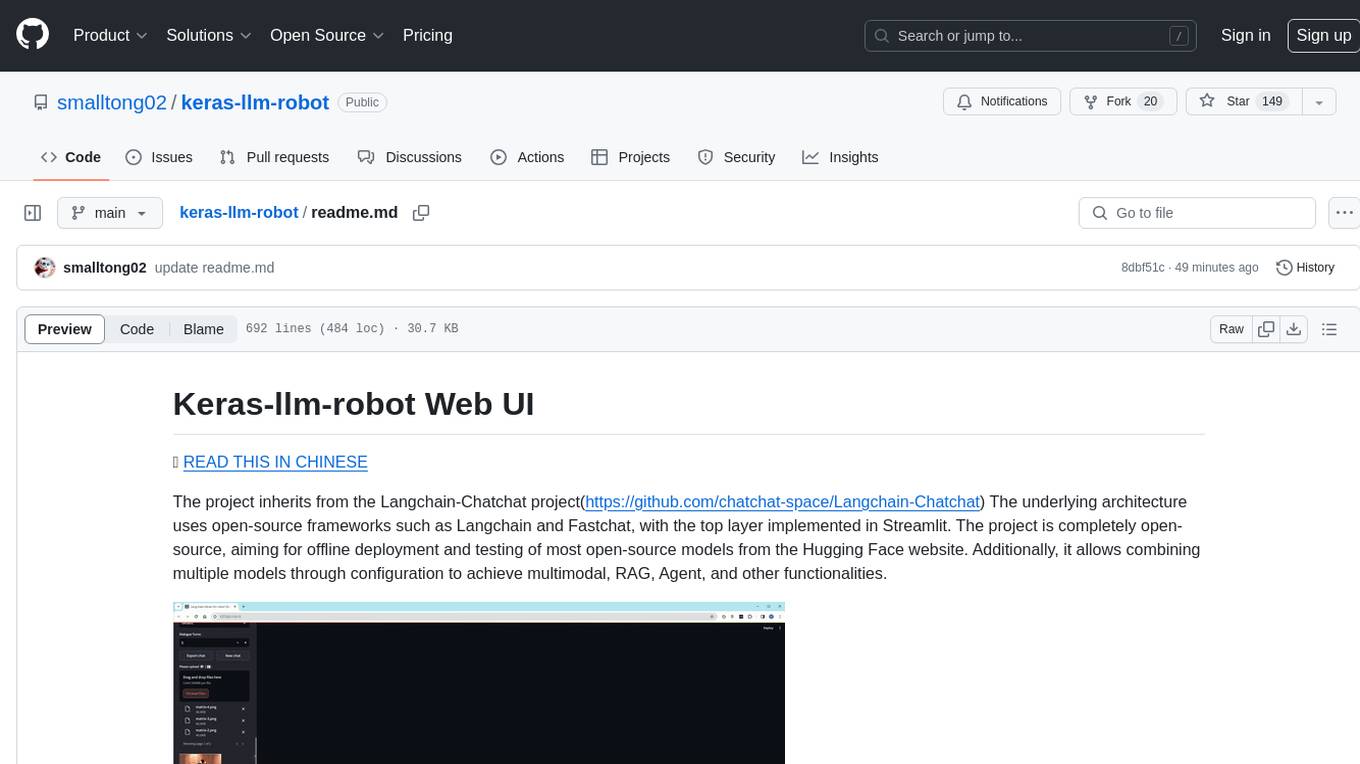
The Keras-llm-robot Web UI project is an open-source tool designed for offline deployment and testing of various open-source models from the Hugging Face website. It allows users to combine multiple models through configuration to achieve functionalities like multimodal, RAG, Agent, and more. The project consists of three main interfaces: chat interface for language models, configuration interface for loading models, and tools & agent interface for auxiliary models. Users can interact with the language model through text, voice, and image inputs, and the tool supports features like model loading, quantization, fine-tuning, role-playing, code interpretation, speech recognition, image recognition, network search engine, and function calling.
For similar tasks
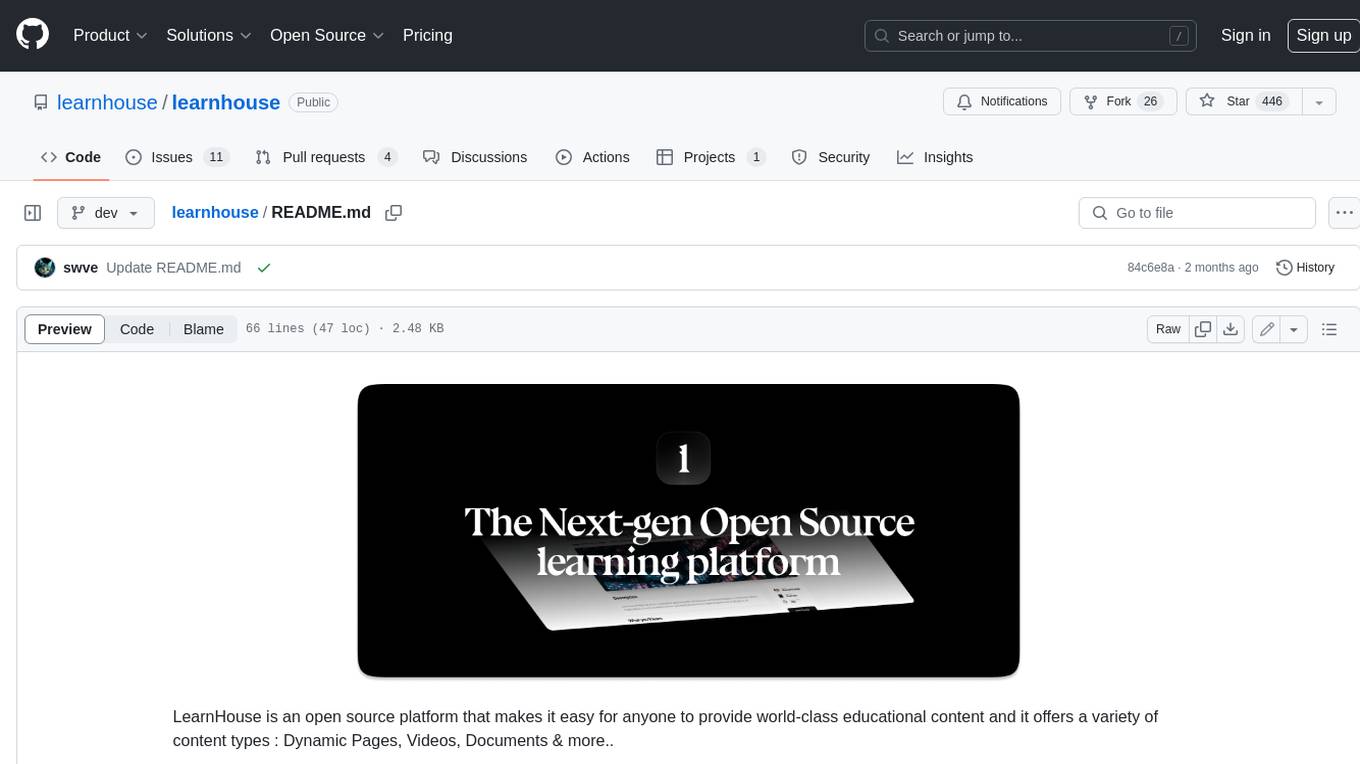
learnhouse
LearnHouse is an open-source platform that allows anyone to easily provide world-class educational content. It supports various content types, including dynamic pages, videos, and documents. The platform is still in early development and should not be used in production environments. However, it offers several features, such as dynamic Notion-like pages, ease of use, multi-organization support, support for uploading videos and documents, course collections, user management, quizzes, course progress tracking, and an AI-powered assistant for teachers and students. LearnHouse is built using various open-source projects, including Next.js, TailwindCSS, Radix UI, Tiptap, FastAPI, YJS, PostgreSQL, LangChain, and React.
PromptChains
ChatGPT Queue Prompts is a collection of prompt chains designed to enhance interactions with large language models like ChatGPT. These prompt chains help build context for the AI before performing specific tasks, improving performance. Users can copy and paste prompt chains into the ChatGPT Queue extension to process prompts in sequence. The repository includes example prompt chains for tasks like conducting AI company research, building SEO optimized blog posts, creating courses, revising resumes, enriching leads for CRM, personal finance document creation, workout and nutrition plans, marketing plans, and more.
zoonk
Zoonk is a web app designed for creating interactive courses using AI. Currently in early development stage, it is not yet ready for use but aims to be available for testing and contributions in the future. The project focuses on leveraging AI technology to enhance the learning experience by providing interactive course creation tools. Zoonk also conducts model evaluations on different prompts to improve its AI capabilities. The project has garnered support from various individuals who believe in its vision and potential.
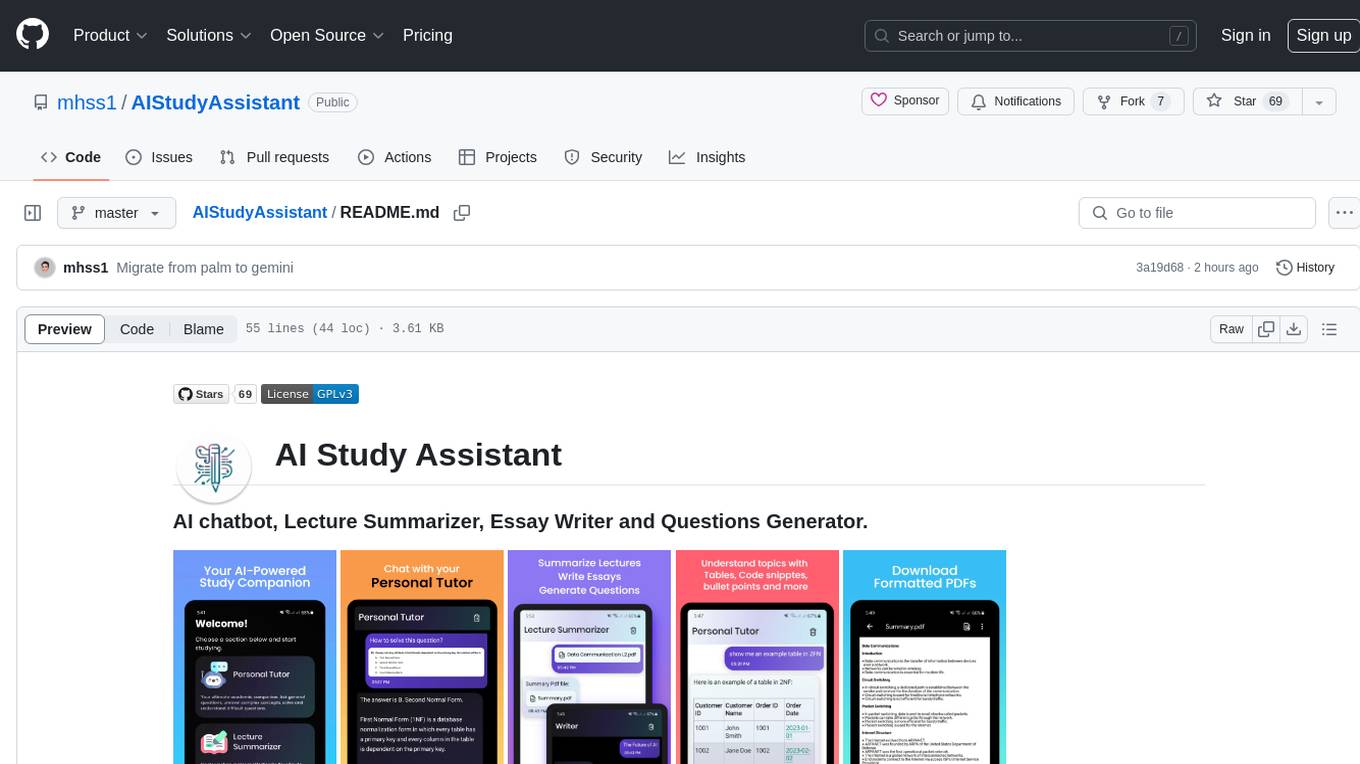
AIStudyAssistant
AI Study Assistant is an app designed to enhance learning experience and boost academic performance. It serves as a personal tutor, lecture summarizer, writer, and question generator powered by Google PaLM 2. Features include interacting with an AI chatbot, summarizing lectures, generating essays, and creating practice questions. The app is built using 100% Kotlin, Jetpack Compose, Clean Architecture, and MVVM design pattern, with technologies like Ktor, Room DB, Hilt, and Kotlin coroutines. AI Study Assistant aims to provide comprehensive AI-powered assistance for students in various academic tasks.
anki_packager
anki_packager is an intelligent tool for generating high-quality Anki flashcards for English vocabulary. It integrates multiple curated dictionaries, provides automated learning experiences, supports various features like Google TTS pronunciation and AI models for word summarization and story generation, offers convenient data import from other sources, ensures a good command-line interface, and can be run using Docker. Each flashcard includes detailed learning resources such as definitions, tenses, AI-generated roots for mnemonic aids, phrases, example sentences, word differentiations, and English explanations with AI-generated stories.
wordsea
WordSea is a SvelteKit web application that aims to enhance English vocabulary learning by utilizing mnemonic techniques to associate words with visual representations. It addresses the challenge of memorizing abstract concepts by generating definition-based visualizations using LLMs and Text-to-Image models. The visualizations are combined with word definitions, IPA pronunciation, audio recordings, and derivative information to create comprehensive word cards.
labelbox-python
Labelbox is a data-centric AI platform for enterprises to develop, optimize, and use AI to solve problems and power new products and services. Enterprises use Labelbox to curate data, generate high-quality human feedback data for computer vision and LLMs, evaluate model performance, and automate tasks by combining AI and human-centric workflows. The academic & research community uses Labelbox for cutting-edge AI research.
promptfoo
Promptfoo is a tool for testing and evaluating LLM output quality. With promptfoo, you can build reliable prompts, models, and RAGs with benchmarks specific to your use-case, speed up evaluations with caching, concurrency, and live reloading, score outputs automatically by defining metrics, use as a CLI, library, or in CI/CD, and use OpenAI, Anthropic, Azure, Google, HuggingFace, open-source models like Llama, or integrate custom API providers for any LLM API.
For similar jobs
sweep
Sweep is an AI junior developer that turns bugs and feature requests into code changes. It automatically handles developer experience improvements like adding type hints and improving test coverage.
teams-ai
The Teams AI Library is a software development kit (SDK) that helps developers create bots that can interact with Teams and Microsoft 365 applications. It is built on top of the Bot Framework SDK and simplifies the process of developing bots that interact with Teams' artificial intelligence capabilities. The SDK is available for JavaScript/TypeScript, .NET, and Python.
ai-guide
This guide is dedicated to Large Language Models (LLMs) that you can run on your home computer. It assumes your PC is a lower-end, non-gaming setup.
classifai
Supercharge WordPress Content Workflows and Engagement with Artificial Intelligence. Tap into leading cloud-based services like OpenAI, Microsoft Azure AI, Google Gemini and IBM Watson to augment your WordPress-powered websites. Publish content faster while improving SEO performance and increasing audience engagement. ClassifAI integrates Artificial Intelligence and Machine Learning technologies to lighten your workload and eliminate tedious tasks, giving you more time to create original content that matters.
chatbot-ui
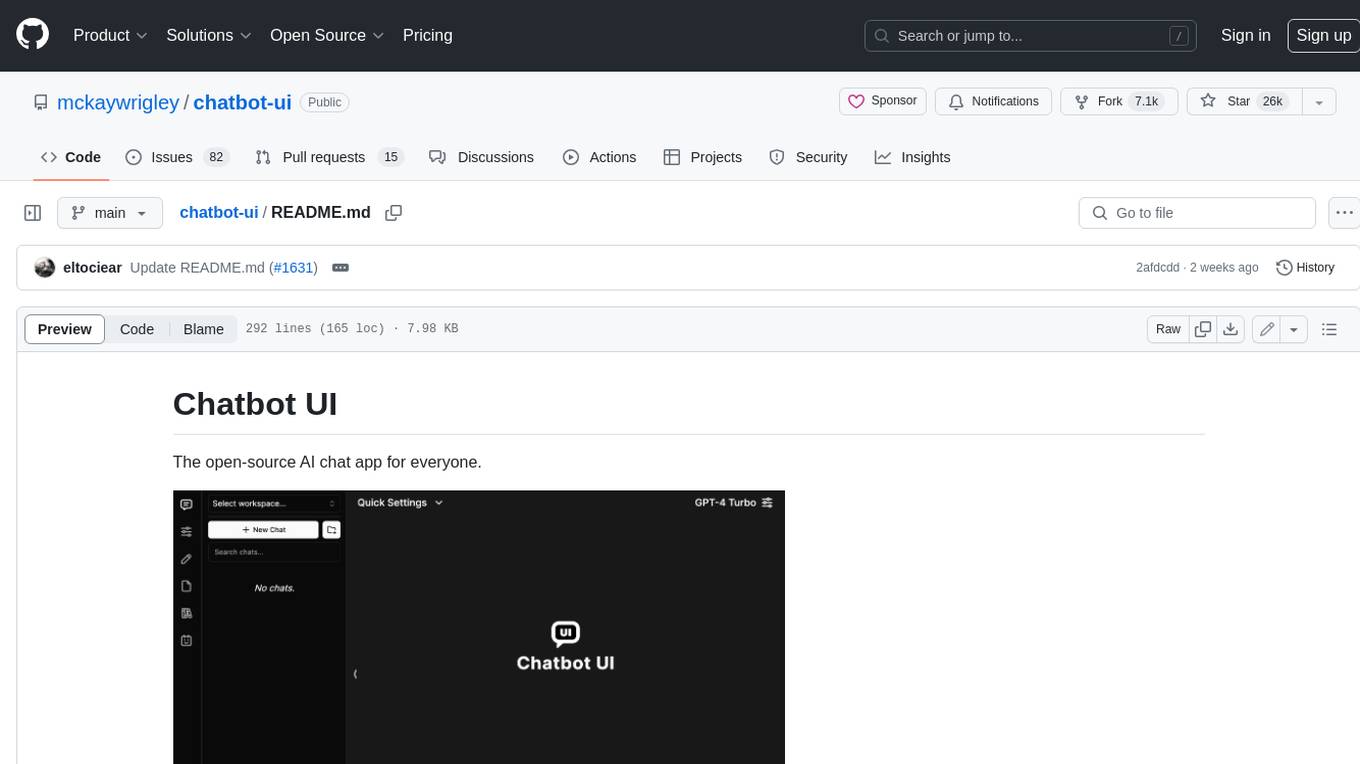
Chatbot UI is an open-source AI chat app that allows users to create and deploy their own AI chatbots. It is easy to use and can be customized to fit any need. Chatbot UI is perfect for businesses, developers, and anyone who wants to create a chatbot.
BricksLLM
BricksLLM is a cloud native AI gateway written in Go. Currently, it provides native support for OpenAI, Anthropic, Azure OpenAI and vLLM. BricksLLM aims to provide enterprise level infrastructure that can power any LLM production use cases. Here are some use cases for BricksLLM: * Set LLM usage limits for users on different pricing tiers * Track LLM usage on a per user and per organization basis * Block or redact requests containing PIIs * Improve LLM reliability with failovers, retries and caching * Distribute API keys with rate limits and cost limits for internal development/production use cases * Distribute API keys with rate limits and cost limits for students
uAgents
uAgents is a Python library developed by Fetch.ai that allows for the creation of autonomous AI agents. These agents can perform various tasks on a schedule or take action on various events. uAgents are easy to create and manage, and they are connected to a fast-growing network of other uAgents. They are also secure, with cryptographically secured messages and wallets.
griptape
Griptape is a modular Python framework for building AI-powered applications that securely connect to your enterprise data and APIs. It offers developers the ability to maintain control and flexibility at every step. Griptape's core components include Structures (Agents, Pipelines, and Workflows), Tasks, Tools, Memory (Conversation Memory, Task Memory, and Meta Memory), Drivers (Prompt and Embedding Drivers, Vector Store Drivers, Image Generation Drivers, Image Query Drivers, SQL Drivers, Web Scraper Drivers, and Conversation Memory Drivers), Engines (Query Engines, Extraction Engines, Summary Engines, Image Generation Engines, and Image Query Engines), and additional components (Rulesets, Loaders, Artifacts, Chunkers, and Tokenizers). Griptape enables developers to create AI-powered applications with ease and efficiency.