


postgresai
postgresai – Postgres observability built for humans and AI agents
Stars: 104
PostgresAI is an AI-native PostgreSQL observability tool designed for monitoring, health checks, and root cause analysis. It provides structured reports and metrics for AI consumption, tracks problems from detection to resolution, offers over 45 health checks including bloat, indexes, queries, settings, and security, and features Active Session History similar to Oracle ASH. PostgresAI is part of the Self-Driving Postgres initiative, aiming to make Postgres autonomous. It includes expert dashboards following the Four Golden Signals methodology and is battle-tested with companies like GitLab, Miro, Chewy, and more.
README:





Monitoring, health checks, and root cause analysis — built for humans and AI agents

Battle-tested in PostgresAI team's work with companies like GitLab, Miro, Chewy, Suno, Supabase, Gadget, and more — now packaged for easy use by humans and AI agents.
Traditional monitoring tools give you dashboards. postgresai gives AI agents the context they need to actually fix problems.
- Structured for AI — Reports and metrics designed for LLM consumption
- Issues workflow — Track problems from detection to resolution
- 45+ health checks — Bloat, indexes, queries, settings, security
- Active Session History — Postgres's answer to Oracle ASH
- Expert dashboards — Four Golden Signals methodology
Part of Self-Driving Postgres — PostgresAI's open-source initiative to make Postgres autonomous.
Create a free account at postgres.ai
npx postgresai authThis opens your browser to log in and saves your API key locally.
PGPASSWORD=secret npx postgresai checkup postgresql://user@host:5432/dbnameOpen console.postgres.ai to see:
- Detailed reports with suggested fixes
- Issues workflow to track remediation
- Historical data across all your projects
Offline mode: Add
--no-uploadto run locally without an account.
See demo

Run specific checks or work offline:
# Run a specific check
npx postgresai checkup --check-id H002 postgresql://...

# Local JSON output only (no upload)
npx postgresai checkup --no-upload --check-id H002 postgresql://...
Tips:
npx pgai checkupalso works.bunx postgresaiif you prefer Bun.
For continuous monitoring with dashboards, install the full stack on a Linux machine with Docker:
# Quick demo with sample data
npx postgresai mon local-install --demo
# → Open http://localhost:3000

# Production setup (Linux + Docker required)
npx postgresai prepare-db postgresql://admin@host:5432/dbname  # Create monitoring role with minimal permissions
npx postgresai mon local-install --api-key=YOUR_TOKEN --db-url="postgresql://..."
Get your API key at console.postgres.ai — or use the fully managed version there.
All diagnostic queries are carefully designed to avoid the observer effect — they use timeouts, row limits, and non-blocking approaches. Battle-tested on production databases with dozens of TiB of data, hundreds of kTPS, and millions of DB objects.
Preview the setup SQL before running:
npx postgresai prepare-db --print-sql postgresql://... # Review what will be createdThe prepare-db step creates a read-only postgres_ai_mon user with minimal permissions, enables pg_stat_statements, and creates postgres_ai schema with a few helper views.
| Component | Purpose |
|---|---|
| Express checkup | Instant health checks — no setup needed |
| Grafana dashboards | 13+ expert views: Node Overview, Query Analysis, Wait Events, Indexes, Tables, Replication, and more |
| Scheduled reports | 45+ metrics collected continuously via pgwatch |
| Metrics collection | pgwatch v3 + Victoria Metrics |
| AI-ready output | Structured JSON for Claude, GPT, and other agents |
| Claude Code plugin | Slash commands for health checks in your IDE |
| MCP server | Work with Issues from console.postgres.ai in AI coding tools |
postgresai is designed to feed AI agents with structured PostgreSQL diagnostics.
Install from the marketplace:
claude plugin marketplace add postgres-ai/postgresai
claude plugin install pgai@postgresai
Work with Issues from console.postgres.ai:
/pgai:issues
See demo

# Install MCP server for your AI coding tool
npx postgresai mcp install
See demo

This enables AI agents to work with Issues and Action Items from console.postgres.ai directly within your IDE.
# Pipe checkup output to any LLM
npx postgresai checkup --json postgresql://... | llm -s "analyze this Postgres health report"

# Or use with Claude directly
npx postgresai checkup --json postgresql://... | claude -p "find issues and suggest fixes"
See demo

- AI agent detects slow query from application logs
- Runs
postgresai checkup --check-id H002→ finds unused indexes - Gets structured JSON with analysis
- Suggests
DROP INDEXor creates PR
For checkup (express mode):
- Node.js 18+ (includes npm/npx)
- Network access to PostgreSQL 14-18
For full monitoring stack:
- Linux machine with Docker
-
pg_stat_statementsextension enabled
-
Short alias:
npx pgai checkupworks too -
Can I use it without registration on console.postgres.ai? Yes, both express checkup and full-fledged monitoring are open-source and can be used without any connection to console.postgres.ai. In instructions above, just skip
npx postgresai authand:- Express checkup: use
--no-upload - Full monitoring: omit --api-key`
- Express checkup: use
- Managed version: Express checkup finds problems. The managed version at console.postgres.ai also explains how to fix them and provides an Issues workflow to track fixes
| Demo |
demo.postgres.ai (login: demo / demo) |
| Docs | postgres.ai/docs |
| Issues | GitLab |
| Community | Postgres.FM · Postgres.TV |
PostgresAI — Self-Driving Postgres
Apache 2.0 · Contributing
For Tasks:
Click tags to check more tools for each tasksFor Jobs:
Alternative AI tools for postgresai
Similar Open Source Tools
postgresai
PostgresAI is an AI-native PostgreSQL observability tool designed for monitoring, health checks, and root cause analysis. It provides structured reports and metrics for AI consumption, tracks problems from detection to resolution, offers over 45 health checks including bloat, indexes, queries, settings, and security, and features Active Session History similar to Oracle ASH. PostgresAI is part of the Self-Driving Postgres initiative, aiming to make Postgres autonomous. It includes expert dashboards following the Four Golden Signals methodology and is battle-tested with companies like GitLab, Miro, Chewy, and more.
burp-ai-agent
Burp AI Agent is an extension for Burp Suite that integrates AI into your security workflow. It provides 7 AI backends, 53+ MCP tools, and 62 vulnerability classes. Users can configure privacy modes, perform audit logging, and connect external AI agents via MCP. The tool allows passive and active AI scanners to find vulnerabilities while users focus on manual testing. It requires Burp Suite, Java 21, and at least one AI backend configured.
open-mercato
Open Mercato is a modern, AI-supportive platform designed for shipping enterprise-grade CRMs, ERPs, and commerce backends. It offers modular architecture, custom entities, multi-tenancy, RBAC, data indexing, event workflows, and more. The tool is built with a modern stack including Next.js, TypeScript, zod, Awilix DI, MikroORM, and bcryptjs. It also features an AI Assistant for schema discovery, API execution, and hybrid search. Open Mercato provides data encryption, migration guides, Docker setups, standalone app creation, and follows a spec-driven development approach. The Enterprise Edition offers additional support, SLA options, and advanced features beyond the open-source Core version.
kubewall
kubewall is an open-source, single-binary Kubernetes dashboard with multi-cluster management and AI integration. It provides a simple and rich real-time interface to manage and investigate your clusters. With features like multi-cluster management, AI-powered troubleshooting, real-time monitoring, single-binary deployment, in-depth resource views, browser-based access, search and filter capabilities, privacy by default, port forwarding, live refresh, aggregated pod logs, and clean resource management, kubewall offers a comprehensive solution for Kubernetes cluster management.
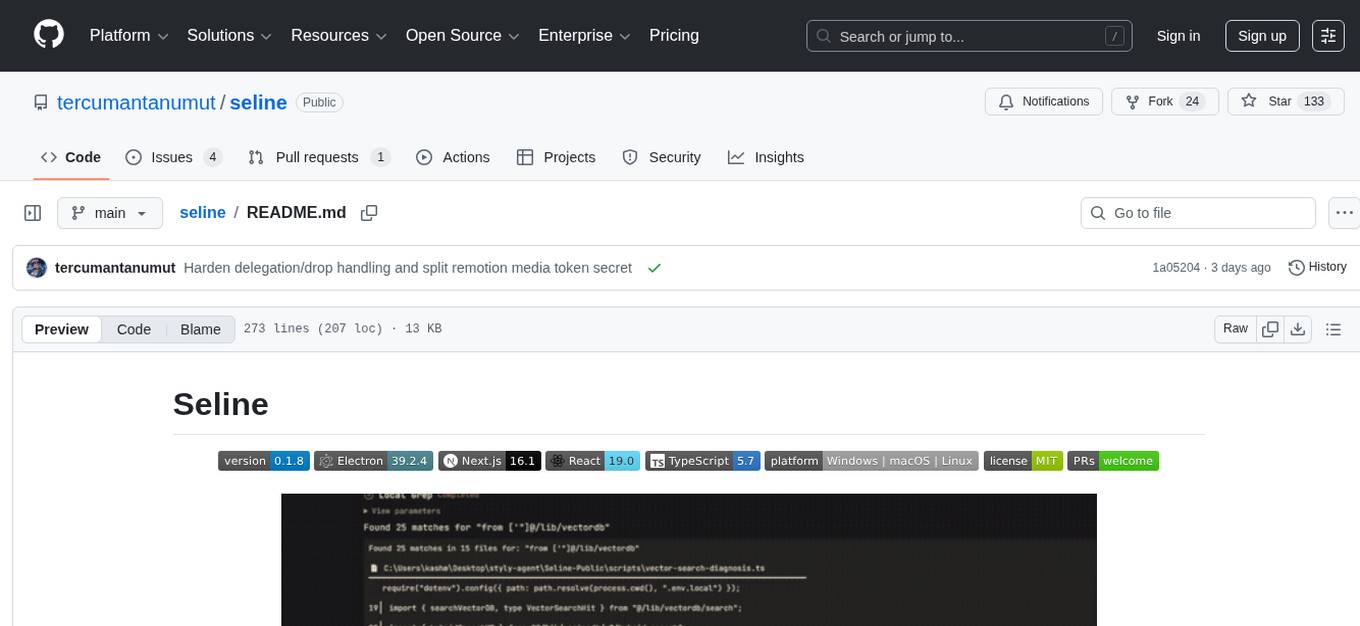
seline
Seline is a local-first AI desktop application that integrates conversational AI, visual generation tools, vector search, and multi-channel connectivity. It allows users to connect WhatsApp, Telegram, or Slack to create always-on bots with full context and background task delivery. The application supports multi-channel connectivity, deep research mode, local web browsing with Puppeteer, local knowledge and privacy features, visual and creative tools, automation and agents, developer experience enhancements, and more. Seline is actively developed with a focus on improving user experience and functionality.
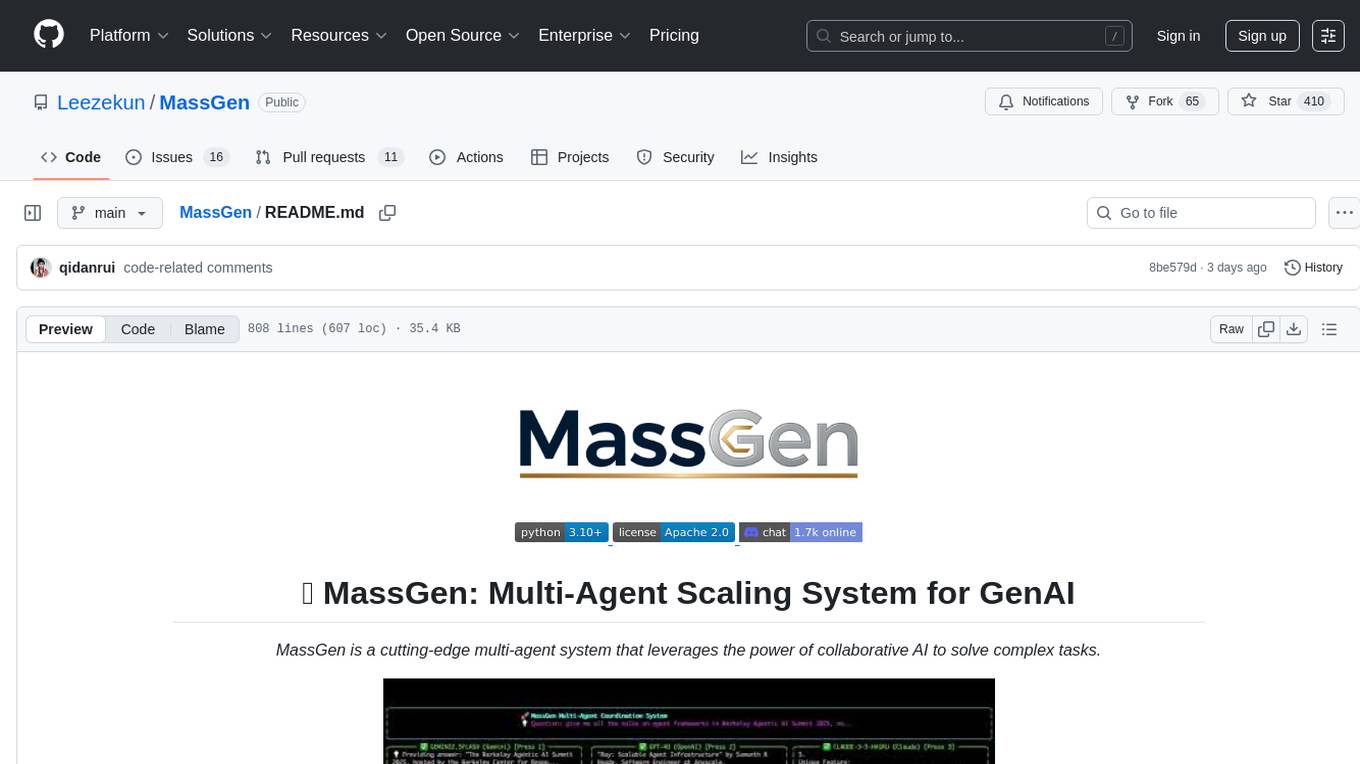
MassGen
MassGen is a cutting-edge multi-agent system that leverages the power of collaborative AI to solve complex tasks. It assigns a task to multiple AI agents who work in parallel, observe each other's progress, and refine their approaches to converge on the best solution to deliver a comprehensive and high-quality result. The system operates through an architecture designed for seamless multi-agent collaboration, with key features including cross-model/agent synergy, parallel processing, intelligence sharing, consensus building, and live visualization. Users can install the system, configure API settings, and run MassGen for various tasks such as question answering, creative writing, research, development & coding tasks, and web automation & browser tasks. The roadmap includes plans for advanced agent collaboration, expanded model, tool & agent integration, improved performance & scalability, enhanced developer experience, and a web interface.
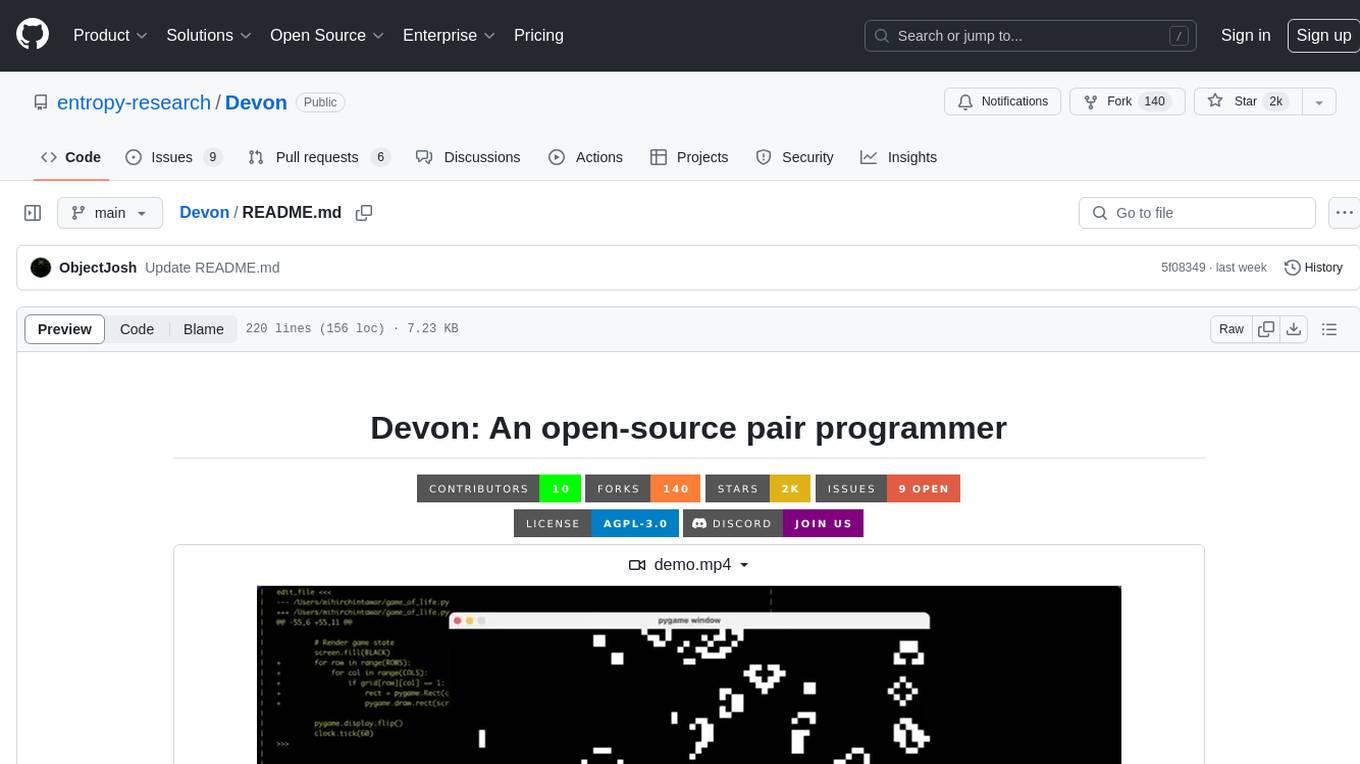
Devon
Devon is an open-source pair programmer tool designed to facilitate collaborative coding sessions. It provides features such as multi-file editing, codebase exploration, test writing, bug fixing, and architecture exploration. The tool supports Anthropic, OpenAI, and Groq APIs, with plans to add more models in the future. Devon is community-driven, with ongoing development goals including multi-model support, plugin system for tool builders, self-hostable Electron app, and setting SOTA on SWE-bench Lite. Users can contribute to the project by developing core functionality, conducting research on agent performance, providing feedback, and testing the tool.
OpenAlice
Open Alice is an AI trading agent that provides users with their own research desk, quant team, trading floor, and risk management, all running on their laptop 24/7. It is file-driven, reasoning-driven, and OS-native, allowing interactions with the operating system. Features include dual AI providers, crypto trading, securities trading, market analysis, cognitive state, event log, cron scheduling, evolution mode, and a web UI. The architecture includes providers, core components, extensions, tasks, and interfaces. Users can quickly start by setting up prerequisites, AI providers, crypto trading, securities trading, environment variables, and running the tool. Configuration files, project structure, and license information are also provided.
ps-fuzz
The Prompt Fuzzer is an open-source tool that helps you assess the security of your GenAI application's system prompt against various dynamic LLM-based attacks. It provides a security evaluation based on the outcome of these attack simulations, enabling you to strengthen your system prompt as needed. The Prompt Fuzzer dynamically tailors its tests to your application's unique configuration and domain. The Fuzzer also includes a Playground chat interface, giving you the chance to iteratively improve your system prompt, hardening it against a wide spectrum of generative AI attacks.
graphiti
Graphiti is a framework for building and querying temporally-aware knowledge graphs, tailored for AI agents in dynamic environments. It continuously integrates user interactions, structured and unstructured data, and external information into a coherent, queryable graph. The framework supports incremental data updates, efficient retrieval, and precise historical queries without complete graph recomputation, making it suitable for developing interactive, context-aware AI applications.
BIRD-CRITIC-1
BIRD-CRITIC 1.0 is a SQL benchmark designed to evaluate the capability of large language models (LLMs) in diagnosing and solving user issues within real-world database environments. It comprises 600 tasks for development and 200 held-out out-of-distribution tests across 4 prominent open-source SQL dialects. The benchmark expands beyond simple SELECT queries to cover a wider range of SQL operations, reflecting actual application scenarios. An optimized execution-based evaluation environment is included for rigorous and efficient validation.
optopsy
Optopsy is a fast, flexible backtesting library for options strategies in Python. It helps users generate comprehensive performance statistics from historical options data to answer questions like 'How do iron condors perform on SPX?' or 'What delta range produces the best results for covered calls?' The library features an AI Chat UI for natural language interaction, a trade simulator for full trade-by-trade simulation, 28 built-in strategies, live data providers, smart caching, entry signals with TA indicators, and returns DataFrames that integrate with existing workflows.
databao-context-engine
Databao Context Engine is a Python library that automatically generates governed semantic context from databases, BI tools, documents, and spreadsheets. It provides accurate, context-aware answers without the need for manual schema copying or documentation writing. The tool can be integrated as a standard Python dependency or via the Databao CLI. It supports various data sources like Athena, BigQuery, MySQL, PDF files, and more, and works with LLMs such as Ollama. Users can create domains, configure data sources, build context, and utilize the built contexts for search queries. The tool is governed, versioned, and supports dynamic or static serving of context via MCP server or export as an artifact. Contributions are welcome, and the tool is licensed under Apache 2.0.
codemie-code
Unified AI Coding Assistant CLI for managing multiple AI agents like Claude Code, Google Gemini, OpenCode, and custom AI agents. Supports OpenAI, Azure OpenAI, AWS Bedrock, LiteLLM, Ollama, and Enterprise SSO. Features built-in LangGraph agent with file operations, command execution, and planning tools. Cross-platform support for Windows, Linux, and macOS. Ideal for developers seeking a powerful alternative to GitHub Copilot or Cursor.
bytebot
Bytebot is an open-source AI desktop agent that provides a virtual employee with its own computer to complete tasks for users. It can use various applications, download and organize files, log into websites, process documents, and perform complex multi-step workflows. By giving AI access to a complete desktop environment, Bytebot unlocks capabilities not possible with browser-only agents or API integrations, enabling complete task autonomy, document processing, and usage of real applications.
strix
Strix is an open-source AI tool designed to help developers and security teams find and fix vulnerabilities in applications. It offers a full hacker toolkit, teams of autonomous AI agents for collaboration, real validation with proof-of-concepts, a developer-first CLI with actionable reports, and auto-fix & reporting features. Strix can be used for application security testing, rapid penetration testing, bug bounty automation, and CI/CD integration. It provides comprehensive vulnerability detection for various security issues and offers advanced multi-agent orchestration for security testing. The tool supports basic and advanced testing scenarios, headless mode for automated jobs, and CI/CD integration with GitHub Actions. Strix also offers configuration options for optimal performance and recommends specific AI models for best results. Full documentation is available at docs.strix.ai, and contributions to the project are welcome.
For similar tasks
postgresai
PostgresAI is an AI-native PostgreSQL observability tool designed for monitoring, health checks, and root cause analysis. It provides structured reports and metrics for AI consumption, tracks problems from detection to resolution, offers over 45 health checks including bloat, indexes, queries, settings, and security, and features Active Session History similar to Oracle ASH. PostgresAI is part of the Self-Driving Postgres initiative, aiming to make Postgres autonomous. It includes expert dashboards following the Four Golden Signals methodology and is battle-tested with companies like GitLab, Miro, Chewy, and more.
uptrain
UpTrain is an open-source unified platform to evaluate and improve Generative AI applications. We provide grades for 20+ preconfigured evaluations (covering language, code, embedding use cases), perform root cause analysis on failure cases and give insights on how to resolve them.
legacy-use
Legacy-use is a tool that transforms legacy applications into modern REST APIs using AI. It allows users to dynamically generate and customize API endpoints for legacy or desktop applications, access systems running legacy software, track and resolve issues with built-in observability tools, ensure secure and compliant automation, choose model providers independently, and deploy with enterprise-grade security and compliance. The tool provides a quick setup process, automatic API key generation, and supports Windows VM automation. It offers a user-friendly interface for adding targets, running jobs, and writing effective prompts. Legacy-use also supports various connectivity technologies like OpenVPN, Tailscale, WireGuard, VNC, RDP, and TeamViewer. Telemetry data is collected anonymously to improve the product, and users can opt-out of tracking. Optional configurations include enabling OpenVPN target creation and displaying backend endpoints documentation. Contributions to the project are welcome.
For similar jobs
sweep
Sweep is an AI junior developer that turns bugs and feature requests into code changes. It automatically handles developer experience improvements like adding type hints and improving test coverage.
teams-ai
The Teams AI Library is a software development kit (SDK) that helps developers create bots that can interact with Teams and Microsoft 365 applications. It is built on top of the Bot Framework SDK and simplifies the process of developing bots that interact with Teams' artificial intelligence capabilities. The SDK is available for JavaScript/TypeScript, .NET, and Python.
ai-guide
This guide is dedicated to Large Language Models (LLMs) that you can run on your home computer. It assumes your PC is a lower-end, non-gaming setup.
classifai
Supercharge WordPress Content Workflows and Engagement with Artificial Intelligence. Tap into leading cloud-based services like OpenAI, Microsoft Azure AI, Google Gemini and IBM Watson to augment your WordPress-powered websites. Publish content faster while improving SEO performance and increasing audience engagement. ClassifAI integrates Artificial Intelligence and Machine Learning technologies to lighten your workload and eliminate tedious tasks, giving you more time to create original content that matters.
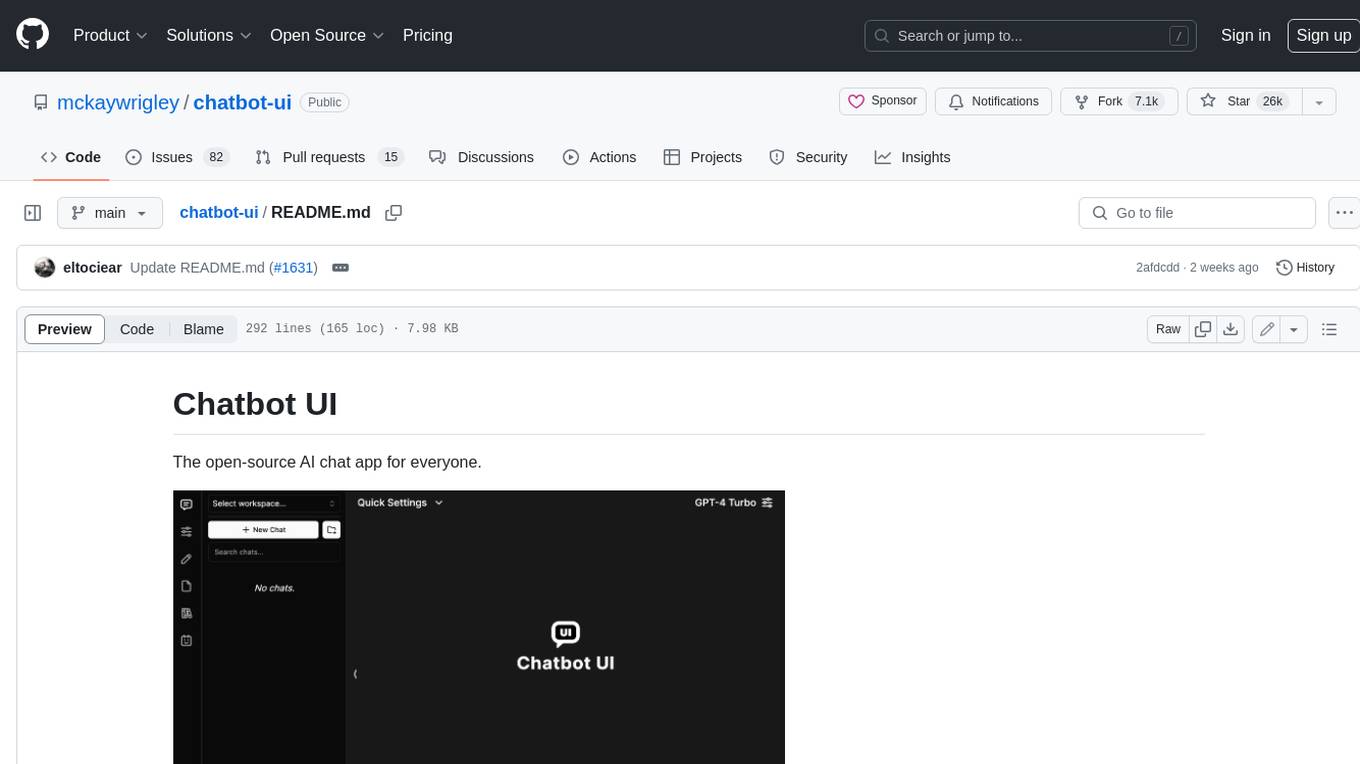
chatbot-ui
Chatbot UI is an open-source AI chat app that allows users to create and deploy their own AI chatbots. It is easy to use and can be customized to fit any need. Chatbot UI is perfect for businesses, developers, and anyone who wants to create a chatbot.
BricksLLM
BricksLLM is a cloud native AI gateway written in Go. Currently, it provides native support for OpenAI, Anthropic, Azure OpenAI and vLLM. BricksLLM aims to provide enterprise level infrastructure that can power any LLM production use cases. Here are some use cases for BricksLLM: * Set LLM usage limits for users on different pricing tiers * Track LLM usage on a per user and per organization basis * Block or redact requests containing PIIs * Improve LLM reliability with failovers, retries and caching * Distribute API keys with rate limits and cost limits for internal development/production use cases * Distribute API keys with rate limits and cost limits for students
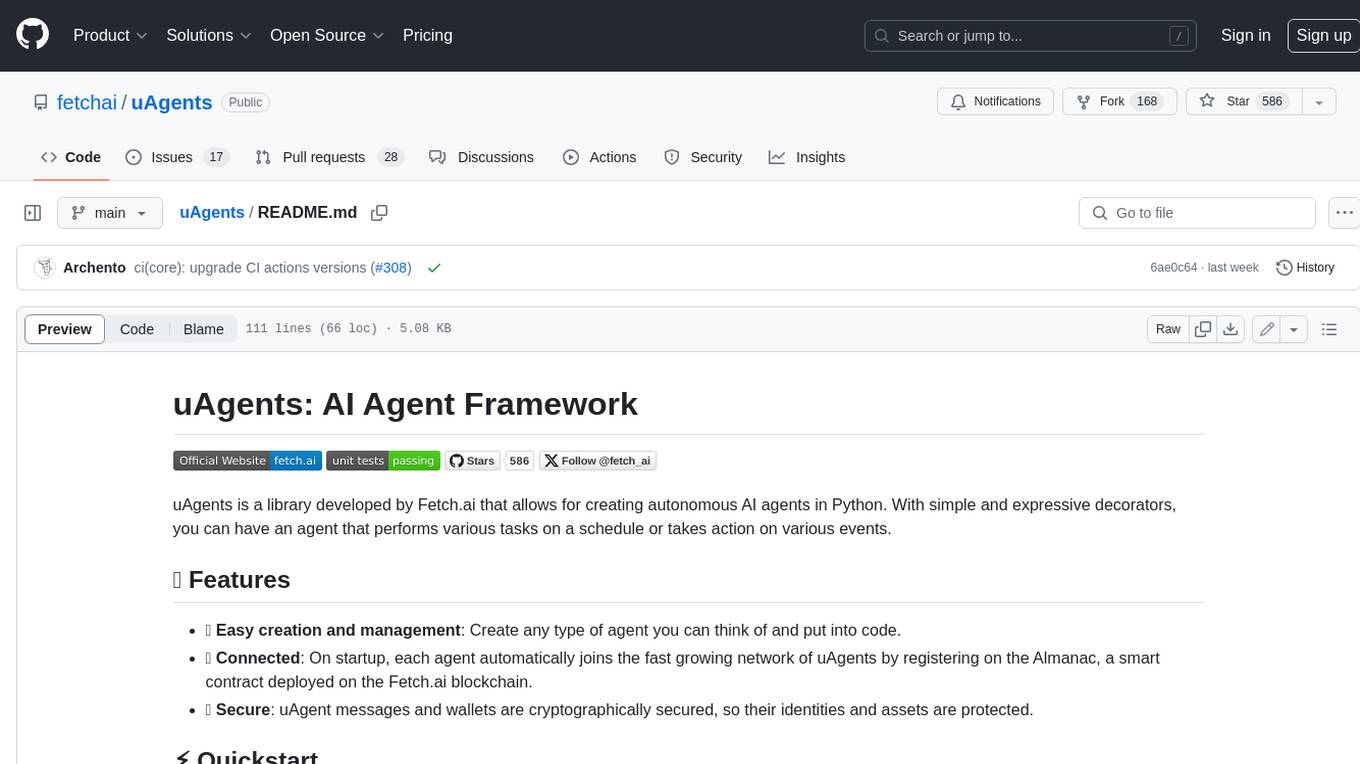
uAgents
uAgents is a Python library developed by Fetch.ai that allows for the creation of autonomous AI agents. These agents can perform various tasks on a schedule or take action on various events. uAgents are easy to create and manage, and they are connected to a fast-growing network of other uAgents. They are also secure, with cryptographically secured messages and wallets.
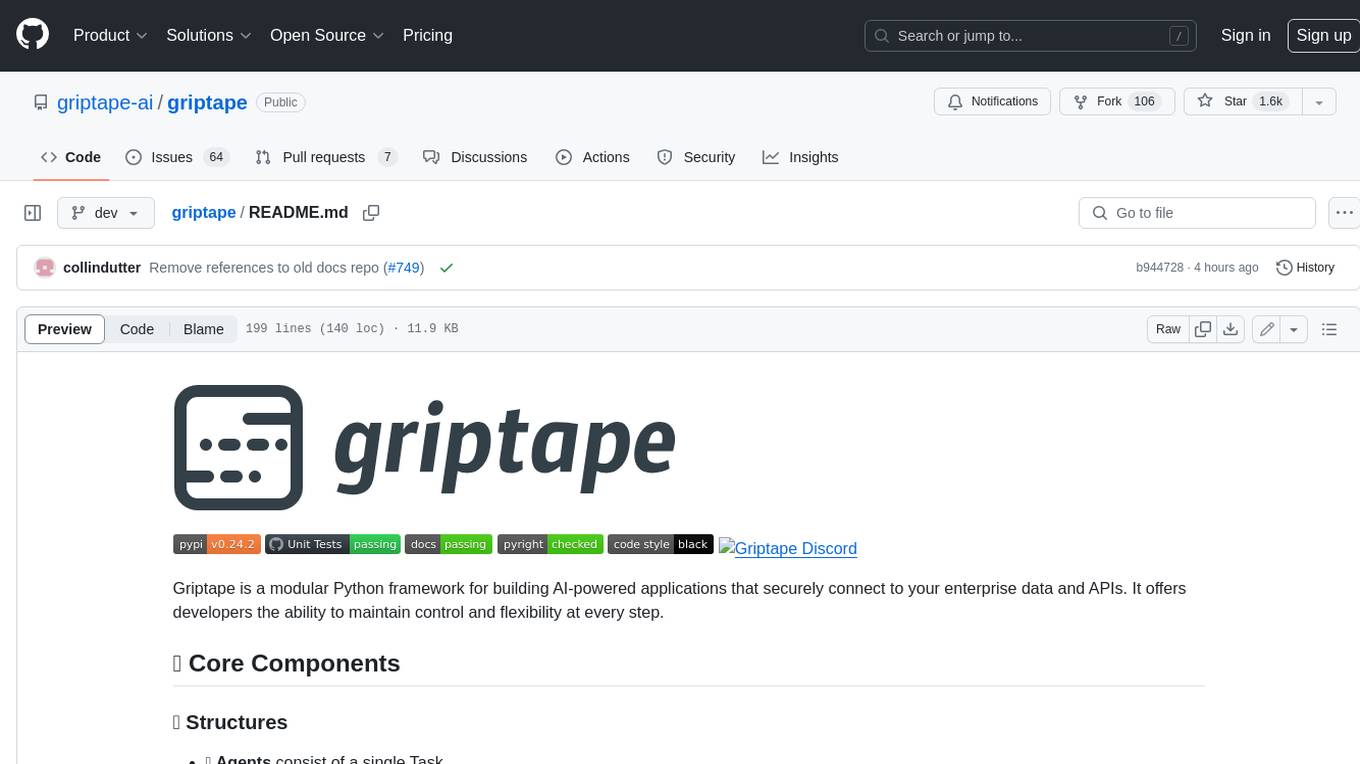
griptape
Griptape is a modular Python framework for building AI-powered applications that securely connect to your enterprise data and APIs. It offers developers the ability to maintain control and flexibility at every step. Griptape's core components include Structures (Agents, Pipelines, and Workflows), Tasks, Tools, Memory (Conversation Memory, Task Memory, and Meta Memory), Drivers (Prompt and Embedding Drivers, Vector Store Drivers, Image Generation Drivers, Image Query Drivers, SQL Drivers, Web Scraper Drivers, and Conversation Memory Drivers), Engines (Query Engines, Extraction Engines, Summary Engines, Image Generation Engines, and Image Query Engines), and additional components (Rulesets, Loaders, Artifacts, Chunkers, and Tokenizers). Griptape enables developers to create AI-powered applications with ease and efficiency.