


strix
Open-source AI hackers to find and fix your app’s vulnerabilities.
Stars: 20151
Strix is an open-source AI tool designed to help developers and security teams find and fix vulnerabilities in applications. It offers a full hacker toolkit, teams of autonomous AI agents for collaboration, real validation with proof-of-concepts, a developer-first CLI with actionable reports, and auto-fix & reporting features. Strix can be used for application security testing, rapid penetration testing, bug bounty automation, and CI/CD integration. It provides comprehensive vulnerability detection for various security issues and offers advanced multi-agent orchestration for security testing. The tool supports basic and advanced testing scenarios, headless mode for automated jobs, and CI/CD integration with GitHub Actions. Strix also offers configuration options for optimal performance and recommends specific AI models for best results. Full documentation is available at docs.strix.ai, and contributions to the project are welcome.
README:








[!TIP] New! Strix integrates seamlessly with GitHub Actions and CI/CD pipelines. Automatically scan for vulnerabilities on every pull request and block insecure code before it reaches production!
Strix are autonomous AI agents that act just like real hackers - they run your code dynamically, find vulnerabilities, and validate them through actual proof-of-concepts. Built for developers and security teams who need fast, accurate security testing without the overhead of manual pentesting or the false positives of static analysis tools.
Key Capabilities:
- Full hacker toolkit out of the box
- Teams of agents that collaborate and scale
- Real validation with PoCs, not false positives
- Developer‑first CLI with actionable reports
- Auto‑fix & reporting to accelerate remediation

- Application Security Testing - Detect and validate critical vulnerabilities in your applications
- Rapid Penetration Testing - Get penetration tests done in hours, not weeks, with compliance reports
- Bug Bounty Automation - Automate bug bounty research and generate PoCs for faster reporting
- CI/CD Integration - Run tests in CI/CD to block vulnerabilities before reaching production
Prerequisites:
- Docker (running)
- An LLM API key:
- Any supported provider (OpenAI, Anthropic, Google, etc.)
- Or Strix Router — single API key for multiple providers with $10 free credit on signup
# Install Strix
curl -sSL https://strix.ai/install | bash

# Or via pipx
pipx install strix-agent

# Configure your AI provider
export STRIX_LLM="anthropic/claude-sonnet-4-6"  # or "strix/claude-sonnet-4.6" via Strix Router (https://models.strix.ai)
export LLM_API_KEY="your-api-key"

# Run your first security assessment
strix --target ./app-directory
[!NOTE] First run automatically pulls the sandbox Docker image. Results are saved to
strix_runs/<run-name>
Strix agents come equipped with a comprehensive security testing toolkit:
- Full HTTP Proxy - Full request/response manipulation and analysis
- Browser Automation - Multi-tab browser for testing of XSS, CSRF, auth flows
- Terminal Environments - Interactive shells for command execution and testing
- Python Runtime - Custom exploit development and validation
- Reconnaissance - Automated OSINT and attack surface mapping
- Code Analysis - Static and dynamic analysis capabilities
- Knowledge Management - Structured findings and attack documentation
Strix can identify and validate a wide range of security vulnerabilities:
- Access Control - IDOR, privilege escalation, auth bypass
- Injection Attacks - SQL, NoSQL, command injection
- Server-Side - SSRF, XXE, deserialization flaws
- Client-Side - XSS, prototype pollution, DOM vulnerabilities
- Business Logic - Race conditions, workflow manipulation
- Authentication - JWT vulnerabilities, session management
- Infrastructure - Misconfigurations, exposed services
Advanced multi-agent orchestration for comprehensive security testing:
- Distributed Workflows - Specialized agents for different attacks and assets
- Scalable Testing - Parallel execution for fast comprehensive coverage
- Dynamic Coordination - Agents collaborate and share discoveries
# Scan a local codebase
strix --target ./app-directory

# Security review of a GitHub repository
strix --target https://github.com/org/repo

# Black-box web application assessment
strix --target https://your-app.com# Grey-box authenticated testing
strix --target https://your-app.com --instruction "Perform authenticated testing using credentials: user:pass"
# Multi-target testing (source code + deployed app)
strix -t https://github.com/org/app -t https://your-app.com
# Focused testing with custom instructions
strix --target api.your-app.com --instruction "Focus on business logic flaws and IDOR vulnerabilities"
# Provide detailed instructions through file (e.g., rules of engagement, scope, exclusions)
strix --target api.your-app.com --instruction-file ./instruction.mdRun Strix programmatically without interactive UI using the -n/--non-interactive flag—perfect for servers and automated jobs. The CLI prints real-time vulnerability findings, and the final report before exiting. Exits with non-zero code when vulnerabilities are found.
strix -n --target https://your-app.comStrix can be added to your pipeline to run a security test on pull requests with a lightweight GitHub Actions workflow:
name: strix-penetration-test

on:
  pull_request:

jobs:
  security-scan:
    runs-on: ubuntu-latest
    steps:
      - uses: actions/checkout@v6

      - name: Install Strix
        run: curl -sSL https://strix.ai/install | bash

      - name: Run Strix
        env:
          STRIX_LLM: ${{ secrets.STRIX_LLM }}
          LLM_API_KEY: ${{ secrets.LLM_API_KEY }}

run: strix -n -t ./ --scan-mode quickexport STRIX_LLM="anthropic/claude-sonnet-4-6"
export LLM_API_KEY="your-api-key"
# Optional
export LLM_API_BASE="your-api-base-url" # if using a local model, e.g. Ollama, LMStudio
export PERPLEXITY_API_KEY="your-api-key" # for search capabilities
export STRIX_REASONING_EFFORT="high" # control thinking effort (default: high, quick scan: medium)[!NOTE] Strix automatically saves your configuration to
~/.strix/cli-config.json, so you don't have to re-enter it on every run.
Recommended models for best results:
-
Anthropic Claude Sonnet 4.6 —
anthropic/claude-sonnet-4-6 -
OpenAI GPT-5 —
openai/gpt-5 -
Google Gemini 3 Pro Preview —
vertex_ai/gemini-3-pro-preview
See the LLM Providers documentation for all supported providers including Vertex AI, Bedrock, Azure, and local models.
Full documentation is available at docs.strix.ai — including detailed guides for usage, CI/CD integrations, skills, and advanced configuration.
We welcome contributions of code, docs, and new skills - check out our Contributing Guide to get started or open a pull request/issue.
Have questions? Found a bug? Want to contribute? Join our Discord!
Love Strix? Give us a ⭐ on GitHub!
Strix builds on the incredible work of open-source projects like LiteLLM, Caido, Nuclei, Playwright, and Textual. Huge thanks to their maintainers!
[!WARNING] Only test apps you own or have permission to test. You are responsible for using Strix ethically and legally.
For Tasks:
Click tags to check more tools for each tasksFor Jobs:
Alternative AI tools for strix
Similar Open Source Tools
strix
Strix is an open-source AI tool designed to help developers and security teams find and fix vulnerabilities in applications. It offers a full hacker toolkit, teams of autonomous AI agents for collaboration, real validation with proof-of-concepts, a developer-first CLI with actionable reports, and auto-fix & reporting features. Strix can be used for application security testing, rapid penetration testing, bug bounty automation, and CI/CD integration. It provides comprehensive vulnerability detection for various security issues and offers advanced multi-agent orchestration for security testing. The tool supports basic and advanced testing scenarios, headless mode for automated jobs, and CI/CD integration with GitHub Actions. Strix also offers configuration options for optimal performance and recommends specific AI models for best results. Full documentation is available at docs.strix.ai, and contributions to the project are welcome.
pyspur
PySpur is a graph-based editor designed for LLM (Large Language Models) workflows. It offers modular building blocks, node-level debugging, and performance evaluation. The tool is easy to hack, supports JSON configs for workflow graphs, and is lightweight with minimal dependencies. Users can quickly set up PySpur by cloning the repository, creating a .env file, starting docker services, and accessing the portal. PySpur can also work with local models served using Ollama, with steps provided for configuration. The roadmap includes features like canvas, async/batch execution, support for Ollama, new nodes, pipeline optimization, templates, code compilation, multimodal support, and more.
RepoMaster
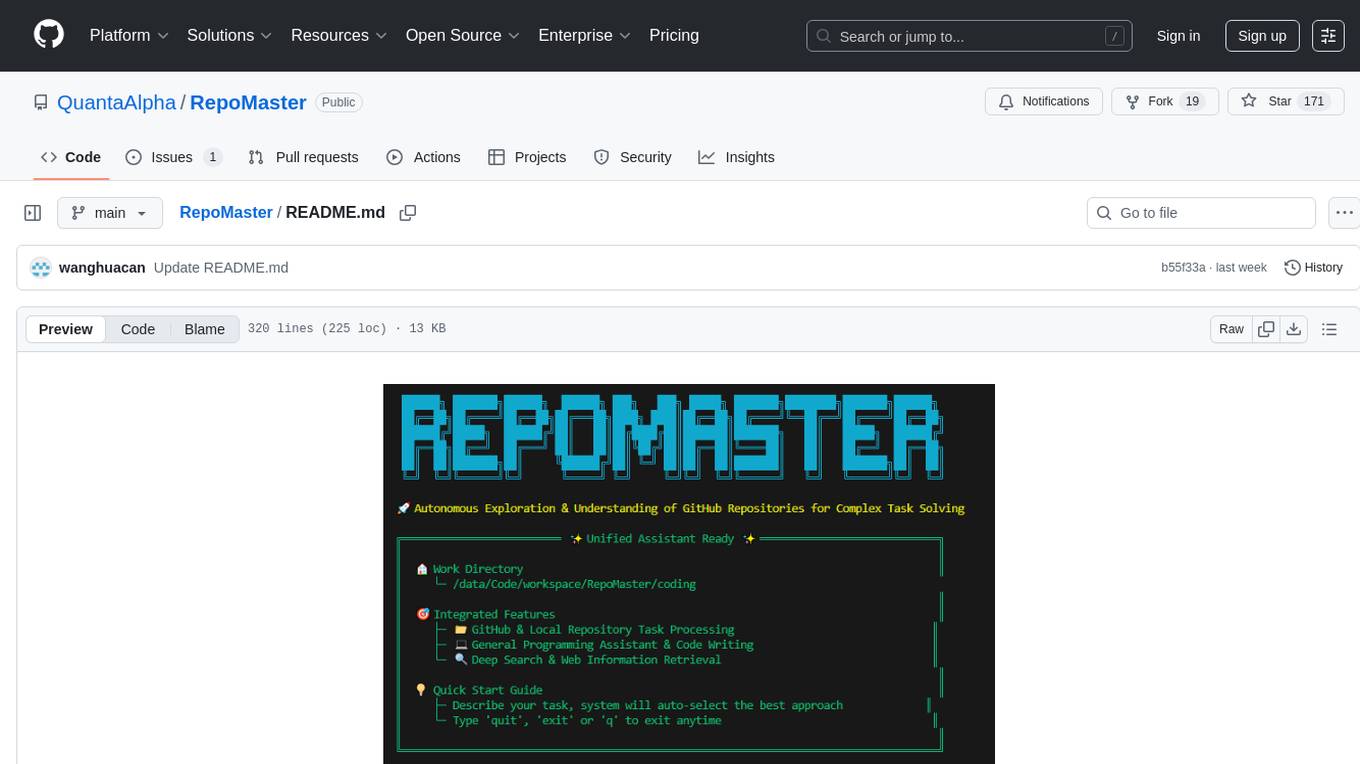
RepoMaster is an AI agent that leverages GitHub repositories to solve complex real-world tasks. It transforms how coding tasks are solved by automatically finding the right GitHub tools and making them work together seamlessly. Users can describe their tasks, and RepoMaster's AI analysis leads to auto discovery and smart execution, resulting in perfect outcomes. The tool provides a web interface for beginners and a command-line interface for advanced users, along with specialized agents for deep search, general assistance, and repository tasks.
dotclaude
A sophisticated multi-agent configuration system for Claude Code that provides specialized agents and command templates to accelerate code review, refactoring, security audits, tech-lead-guidance, and UX evaluations. It offers essential commands, directory structure details, agent system overview, command templates, usage patterns, collaboration philosophy, sync management, advanced usage guidelines, and FAQ. The tool aims to streamline development workflows, enhance code quality, and facilitate collaboration between developers and AI agents.
promptfoo
Promptfoo is a tool for testing and evaluating LLM output quality. With promptfoo, you can build reliable prompts, models, and RAGs with benchmarks specific to your use-case, speed up evaluations with caching, concurrency, and live reloading, score outputs automatically by defining metrics, use as a CLI, library, or in CI/CD, and use OpenAI, Anthropic, Azure, Google, HuggingFace, open-source models like Llama, or integrate custom API providers for any LLM API.
fast-llm-security-guardrails
ZenGuard AI enables AI developers to integrate production-level, low-code LLM (Large Language Model) guardrails into their generative AI applications effortlessly. With ZenGuard AI, ensure your application operates within trusted boundaries, is protected from prompt injections, and maintains user privacy without compromising on performance.
ComfyUI-Copilot
ComfyUI-Copilot is an intelligent assistant built on the Comfy-UI framework that simplifies and enhances the AI algorithm debugging and deployment process through natural language interactions. It offers intuitive node recommendations, workflow building aids, and model querying services to streamline development processes. With features like interactive Q&A bot, natural language node suggestions, smart workflow assistance, and model querying, ComfyUI-Copilot aims to lower the barriers to entry for beginners, boost development efficiency with AI-driven suggestions, and provide real-time assistance for developers.
AgC
AgC is an open-core platform designed for deploying, running, and orchestrating AI agents at scale. It treats agents as first-class compute units, providing a modular, observable, cloud-neutral, and production-ready environment. Open Agentic Compute empowers developers and organizations to run agents like cloud-native workloads without lock-in.
DreamLayer
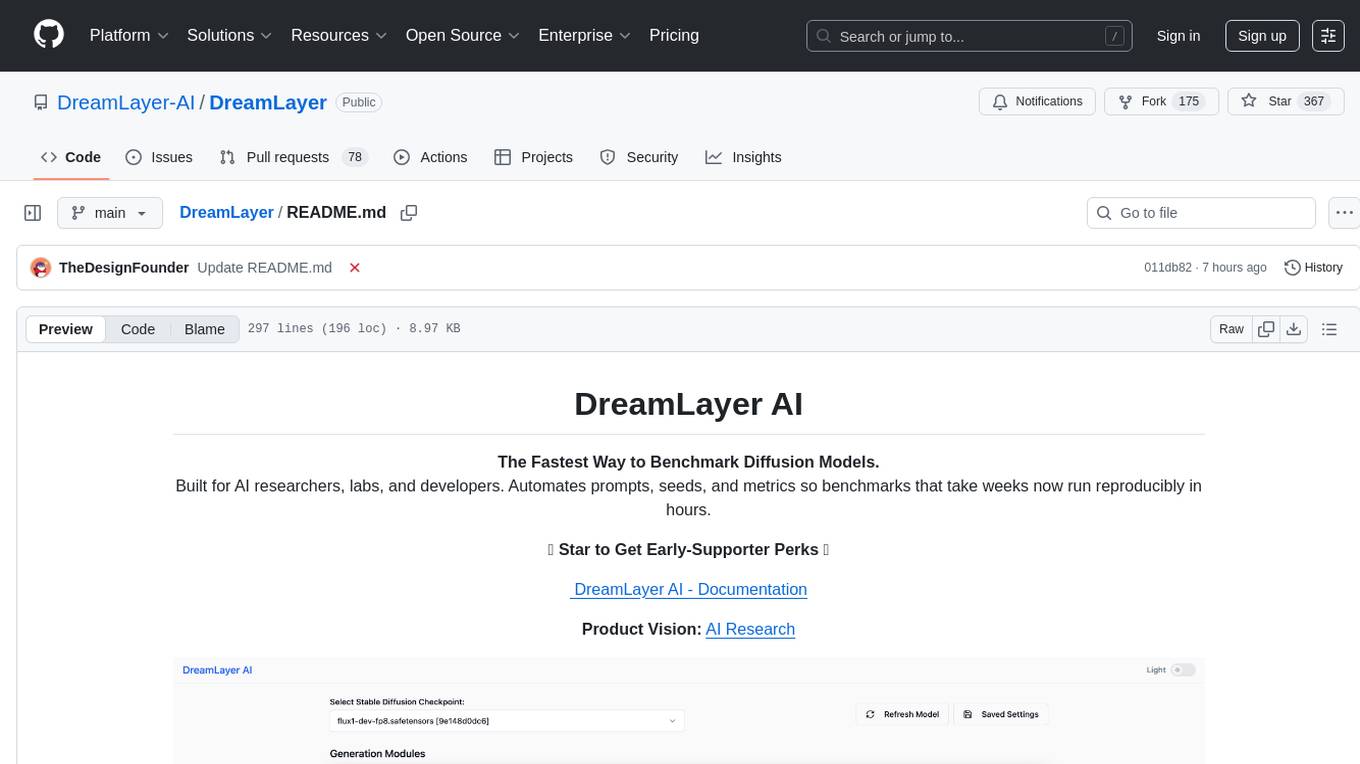
DreamLayer AI is an open-source Stable Diffusion WebUI designed for AI researchers, labs, and developers. It automates prompts, seeds, and metrics for benchmarking models, datasets, and samplers, enabling reproducible evaluations across multiple seeds and configurations. The tool integrates custom metrics and evaluation pipelines, providing a streamlined workflow for AI research. With features like automated benchmarking, reproducibility, built-in metrics, multi-modal readiness, and researcher-friendly interface, DreamLayer AI aims to simplify and accelerate the model evaluation process.
midscene
Midscene.js is an AI-powered automation SDK that allows users to control web pages, perform assertions, and extract data in JSON format using natural language. It offers features such as natural language interaction, understanding UI and providing responses in JSON, intuitive assertion based on AI understanding, compatibility with public multimodal LLMs like GPT-4o, visualization tool for easy debugging, and a brand new experience in automation development.
stenoai
StenoAI is an AI-powered meeting intelligence tool that allows users to record, transcribe, summarize, and query meetings using local AI models. It prioritizes privacy by processing data entirely on the user's device. The tool offers multiple AI models optimized for different use cases, making it ideal for healthcare, legal, and finance professionals with confidential data needs. StenoAI also features a macOS desktop app with a user-friendly interface, making it convenient for users to access its functionalities. The project is open-source and not affiliated with any specific company, emphasizing its focus on meeting-notes productivity and community collaboration.
ai-marketplace-monitor
An intelligent tool that monitors Facebook Marketplace listings using AI to help users find the best deals. It provides instant notifications when items matching specific criteria are posted, along with AI-powered analysis of each listing. The tool offers smart search capabilities, AI-powered listing evaluation and recommendations, various notification options, support for multiple locations, and customizable search parameters. Users can configure the tool to search for specific products, filter by price and location, and receive notifications through different channels. The tool also supports AI service providers and offers a self-hosted model option.
transformerlab-app
Transformer Lab is an app that allows users to experiment with Large Language Models by providing features such as one-click download of popular models, finetuning across different hardware, RLHF and Preference Optimization, working with LLMs across different operating systems, chatting with models, using different inference engines, evaluating models, building datasets for training, calculating embeddings, providing a full REST API, running in the cloud, converting models across platforms, supporting plugins, embedded Monaco code editor, prompt editing, inference logs, all through a simple cross-platform GUI.
R2R
R2R (RAG to Riches) is a fast and efficient framework for serving high-quality Retrieval-Augmented Generation (RAG) to end users. The framework is designed with customizable pipelines and a feature-rich FastAPI implementation, enabling developers to quickly deploy and scale RAG-based applications. R2R was conceived to bridge the gap between local LLM experimentation and scalable production solutions. **R2R is to LangChain/LlamaIndex what NextJS is to React**. A JavaScript client for R2R deployments can be found here. ### Key Features * **🚀 Deploy** : Instantly launch production-ready RAG pipelines with streaming capabilities. * **🧩 Customize** : Tailor your pipeline with intuitive configuration files. * **🔌 Extend** : Enhance your pipeline with custom code integrations. * **⚖️ Autoscale** : Scale your pipeline effortlessly in the cloud using SciPhi. * **🤖 OSS** : Benefit from a framework developed by the open-source community, designed to simplify RAG deployment.
explain-openclaw
Explain OpenClaw is a comprehensive documentation repository for the OpenClaw framework, a self-hosted AI assistant platform. It covers various aspects such as plain English explanations, technical architecture, deployment scenarios, privacy and safety measures, security audits, worst-case security scenarios, optimizations, and AI model comparisons. The repository serves as a living knowledge base with beginner-friendly explanations and detailed technical insights for contributors.
afc-crs-all-you-need-is-a-fuzzing-brain
All You Need Is A Fuzzing Brain is an AI-driven automated vulnerability detection and remediation framework developed for the 2025 DARPA AIxCC finals. It leverages multiple LLM providers for intelligent vulnerability detection, offers 23+ specialized strategies for POV generation and patch synthesis, generates and validates patches automatically, integrates seamlessly with Google's fuzzing infrastructure, and supports vulnerability detection in C/C++ and Java. Users can perform tasks such as Delta Scan, Full Scan, and SARIF Analysis for specific commits, repository-wide analysis, and validation/patching from static analysis reports, respectively. The tool can be used via Docker or by installing from source, and citations are provided for research purposes.
For similar tasks
strix
Strix is an open-source AI tool designed to help developers and security teams find and fix vulnerabilities in applications. It offers a full hacker toolkit, teams of autonomous AI agents for collaboration, real validation with proof-of-concepts, a developer-first CLI with actionable reports, and auto-fix & reporting features. Strix can be used for application security testing, rapid penetration testing, bug bounty automation, and CI/CD integration. It provides comprehensive vulnerability detection for various security issues and offers advanced multi-agent orchestration for security testing. The tool supports basic and advanced testing scenarios, headless mode for automated jobs, and CI/CD integration with GitHub Actions. Strix also offers configuration options for optimal performance and recommends specific AI models for best results. Full documentation is available at docs.strix.ai, and contributions to the project are welcome.
watchtower
AIShield Watchtower is a tool designed to fortify the security of AI/ML models and Jupyter notebooks by automating model and notebook discoveries, conducting vulnerability scans, and categorizing risks into 'low,' 'medium,' 'high,' and 'critical' levels. It supports scanning of public GitHub repositories, Hugging Face repositories, AWS S3 buckets, and local systems. The tool generates comprehensive reports, offers a user-friendly interface, and aligns with industry standards like OWASP, MITRE, and CWE. It aims to address the security blind spots surrounding Jupyter notebooks and AI models, providing organizations with a tailored approach to enhancing their security efforts.
LLM-PLSE-paper
LLM-PLSE-paper is a repository focused on the applications of Large Language Models (LLMs) in Programming Language and Software Engineering (PL/SE) domains. It covers a wide range of topics including bug detection, specification inference and verification, code generation, fuzzing and testing, code model and reasoning, code understanding, IDE technologies, prompting for reasoning tasks, and agent/tool usage and planning. The repository provides a comprehensive collection of research papers, benchmarks, empirical studies, and frameworks related to the capabilities of LLMs in various PL/SE tasks.
invariant
Invariant Analyzer is an open-source scanner designed for LLM-based AI agents to find bugs, vulnerabilities, and security threats. It scans agent execution traces to identify issues like looping behavior, data leaks, prompt injections, and unsafe code execution. The tool offers a library of built-in checkers, an expressive policy language, data flow analysis, real-time monitoring, and extensible architecture for custom checkers. It helps developers debug AI agents, scan for security violations, and prevent security issues and data breaches during runtime. The analyzer leverages deep contextual understanding and a purpose-built rule matching engine for security policy enforcement.
OpenRedTeaming
OpenRedTeaming is a repository focused on red teaming for generative models, specifically large language models (LLMs). The repository provides a comprehensive survey on potential attacks on GenAI and robust safeguards. It covers attack strategies, evaluation metrics, benchmarks, and defensive approaches. The repository also implements over 30 auto red teaming methods. It includes surveys, taxonomies, attack strategies, and risks related to LLMs. The goal is to understand vulnerabilities and develop defenses against adversarial attacks on large language models.
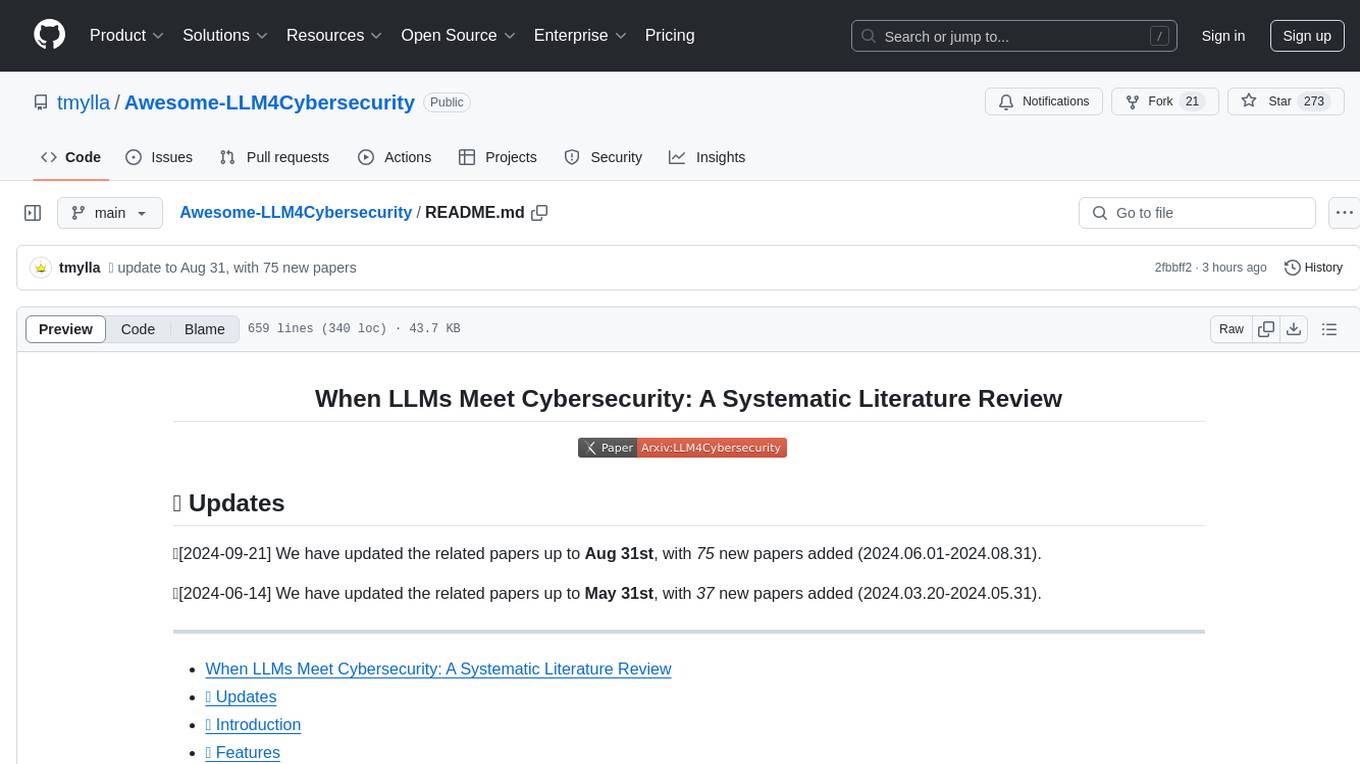
Awesome-LLM4Cybersecurity
The repository 'Awesome-LLM4Cybersecurity' provides a comprehensive overview of the applications of Large Language Models (LLMs) in cybersecurity. It includes a systematic literature review covering topics such as constructing cybersecurity-oriented domain LLMs, potential applications of LLMs in cybersecurity, and research directions in the field. The repository analyzes various benchmarks, datasets, and applications of LLMs in cybersecurity tasks like threat intelligence, fuzzing, vulnerabilities detection, insecure code generation, program repair, anomaly detection, and LLM-assisted attacks.
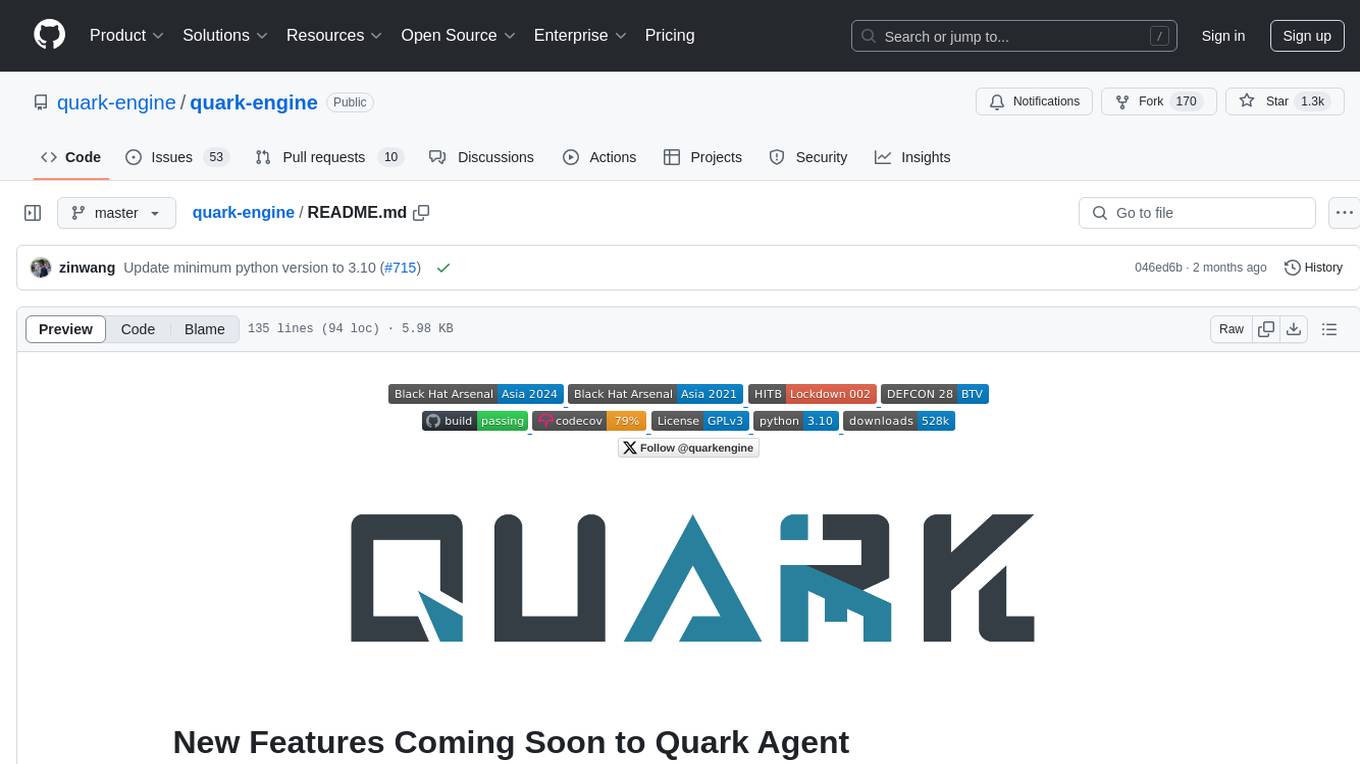
quark-engine
Quark Engine is an AI-powered tool designed for analyzing Android APK files. It focuses on enhancing the detection process for auto-suggestion, enabling users to create detection workflows without coding. The tool offers an intuitive drag-and-drop interface for workflow adjustments and updates. Quark Agent, the core component, generates Quark Script code based on natural language input and feedback. The project is committed to providing a user-friendly experience for designing detection workflows through textual and visual methods. Various features are still under development and will be rolled out gradually.
vulnerability-analysis
The NVIDIA AI Blueprint for Vulnerability Analysis for Container Security showcases accelerated analysis on common vulnerabilities and exposures (CVE) at an enterprise scale, reducing mitigation time from days to seconds. It enables security analysts to determine software package vulnerabilities using large language models (LLMs) and retrieval-augmented generation (RAG). The blueprint is designed for security analysts, IT engineers, and AI practitioners in cybersecurity. It requires NVAIE developer license and API keys for vulnerability databases, search engines, and LLM model services. Hardware requirements include L40 GPU for pipeline operation and optional LLM NIM and Embedding NIM. The workflow involves LLM pipeline for CVE impact analysis, utilizing LLM planner, agent, and summarization nodes. The blueprint uses NVIDIA NIM microservices and Morpheus Cybersecurity AI SDK for vulnerability analysis.
For similar jobs
strix
Strix is an open-source AI tool designed to help developers and security teams find and fix vulnerabilities in applications. It offers a full hacker toolkit, teams of autonomous AI agents for collaboration, real validation with proof-of-concepts, a developer-first CLI with actionable reports, and auto-fix & reporting features. Strix can be used for application security testing, rapid penetration testing, bug bounty automation, and CI/CD integration. It provides comprehensive vulnerability detection for various security issues and offers advanced multi-agent orchestration for security testing. The tool supports basic and advanced testing scenarios, headless mode for automated jobs, and CI/CD integration with GitHub Actions. Strix also offers configuration options for optimal performance and recommends specific AI models for best results. Full documentation is available at docs.strix.ai, and contributions to the project are welcome.
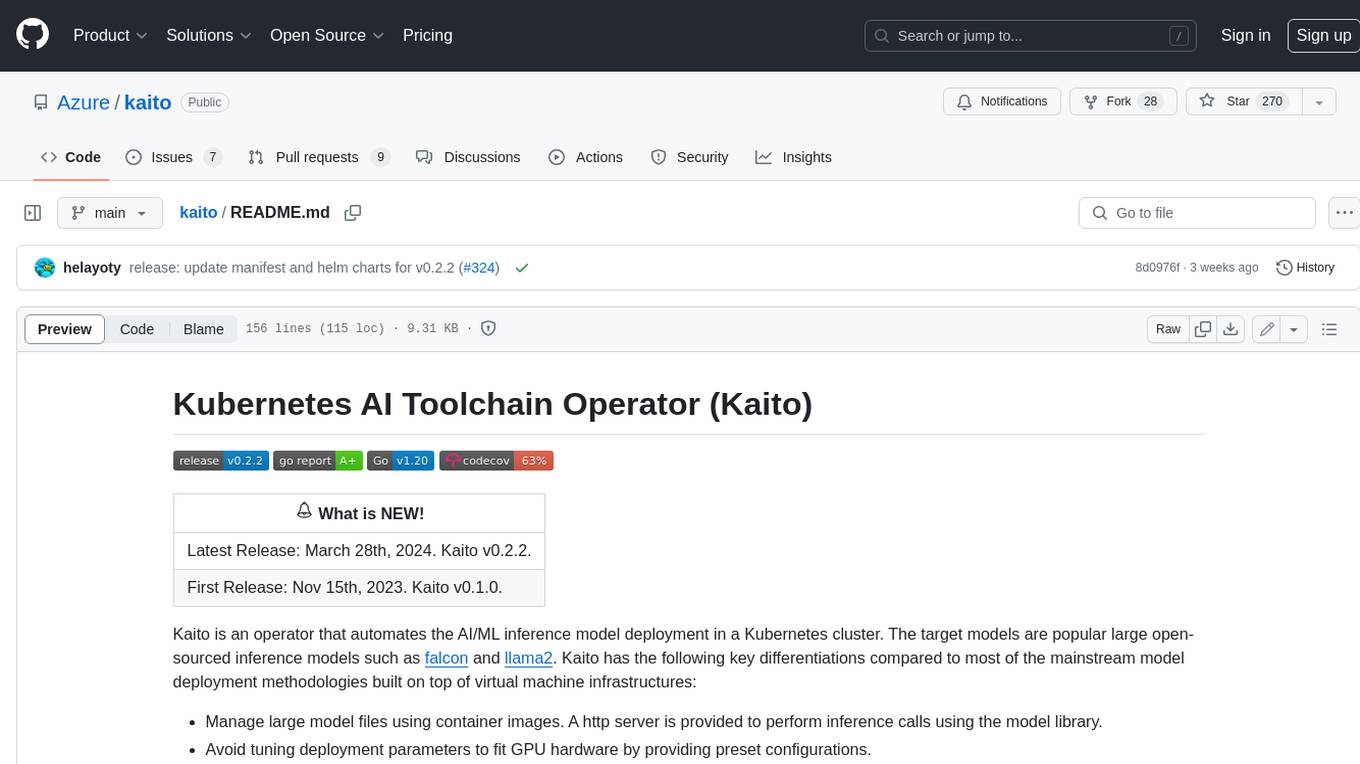
kaito
Kaito is an operator that automates the AI/ML inference model deployment in a Kubernetes cluster. It manages large model files using container images, avoids tuning deployment parameters to fit GPU hardware by providing preset configurations, auto-provisions GPU nodes based on model requirements, and hosts large model images in the public Microsoft Container Registry (MCR) if the license allows. Using Kaito, the workflow of onboarding large AI inference models in Kubernetes is largely simplified.
ai-on-gke
This repository contains assets related to AI/ML workloads on Google Kubernetes Engine (GKE). Run optimized AI/ML workloads with Google Kubernetes Engine (GKE) platform orchestration capabilities. A robust AI/ML platform considers the following layers: Infrastructure orchestration that support GPUs and TPUs for training and serving workloads at scale Flexible integration with distributed computing and data processing frameworks Support for multiple teams on the same infrastructure to maximize utilization of resources
tidb
TiDB is an open-source distributed SQL database that supports Hybrid Transactional and Analytical Processing (HTAP) workloads. It is MySQL compatible and features horizontal scalability, strong consistency, and high availability.
nvidia_gpu_exporter
Nvidia GPU exporter for prometheus, using `nvidia-smi` binary to gather metrics.
tracecat
Tracecat is an open-source automation platform for security teams. It's designed to be simple but powerful, with a focus on AI features and a practitioner-obsessed UI/UX. Tracecat can be used to automate a variety of tasks, including phishing email investigation, evidence collection, and remediation plan generation.
openinference
OpenInference is a set of conventions and plugins that complement OpenTelemetry to enable tracing of AI applications. It provides a way to capture and analyze the performance and behavior of AI models, including their interactions with other components of the application. OpenInference is designed to be language-agnostic and can be used with any OpenTelemetry-compatible backend. It includes a set of instrumentations for popular machine learning SDKs and frameworks, making it easy to add tracing to your AI applications.
BricksLLM
BricksLLM is a cloud native AI gateway written in Go. Currently, it provides native support for OpenAI, Anthropic, Azure OpenAI and vLLM. BricksLLM aims to provide enterprise level infrastructure that can power any LLM production use cases. Here are some use cases for BricksLLM: * Set LLM usage limits for users on different pricing tiers * Track LLM usage on a per user and per organization basis * Block or redact requests containing PIIs * Improve LLM reliability with failovers, retries and caching * Distribute API keys with rate limits and cost limits for internal development/production use cases * Distribute API keys with rate limits and cost limits for students