


heretic
Fully automatic censorship removal for language models
Stars: 5168
Heretic is a tool that removes censorship from transformer-based language models without expensive post-training. It combines directional ablation with a TPE-based parameter optimizer to automatically find high-quality abliteration parameters. Users can easily decensor language models without needing to understand transformer internals. Heretic supports most dense models and provides features for research into model semantics. The tool offers flexible ablation weight kernels and separate ablation parameters for different components, improving compliance/quality tradeoff. Heretic was developed from scratch and does not reuse code from other projects.
README:


Heretic is a tool that removes censorship (aka "safety alignment") from transformer-based language models without expensive post-training. It combines an advanced implementation of directional ablation, also known as "abliteration" (Arditi et al. 2024, Lai 2025 (1, 2)), with a TPE-based parameter optimizer powered by Optuna.
This approach enables Heretic to work completely automatically. Heretic finds high-quality abliteration parameters by co-minimizing the number of refusals and the KL divergence from the original model. This results in a decensored model that retains as much of the original model's intelligence as possible. Using Heretic does not require an understanding of transformer internals. In fact, anyone who knows how to run a command-line program can use Heretic to decensor language models.
Running unsupervised with the default configuration, Heretic can produce decensored models that rival the quality of abliterations created manually by human experts:
| Model | Refusals for "harmful" prompts | KL divergence from original model for "harmless" prompts |
|---|---|---|
| google/gemma-3-12b-it (original) | 97/100 | 0 (by definition) |
| mlabonne/gemma-3-12b-it-abliterated-v2 | 3/100 | 1.04 |
| huihui-ai/gemma-3-12b-it-abliterated | 3/100 | 0.45 |
| p-e-w/gemma-3-12b-it-heretic (ours) | 3/100 | 0.16 |
The Heretic version, generated without any human effort, achieves the same
level of refusal suppression as other abliterations, but at a much lower
KL divergence, indicating less damage to the original model's capabilities.
(You can reproduce those numbers using Heretic's built-in evaluation functionality,
e.g. heretic --model google/gemma-3-12b-it --evaluate-model p-e-w/gemma-3-12b-it-heretic.
Note that the exact values might be platform- and hardware-dependent.
The table above was compiled using PyTorch 2.8 on an RTX 5090.)
Of course, mathematical metrics and automated benchmarks never tell the whole story, and are no substitute for human evaluation. Models generated with Heretic have been well-received by users (links and emphasis added):
"I was skeptical before, but I just downloaded GPT-OSS 20B Heretic model and holy shit. It gives properly formatted long responses to sensitive topics, using the exact uncensored words that you would expect from an uncensored model, produces markdown format tables with details and whatnot. Looks like this is the best abliterated version of this model so far..." (Link to comment)
"Heretic GPT 20b seems to be the best uncensored model I have tried yet. It doesn't destroy a the model's intelligence and it is answering prompts normally would be rejected by the base model." (Link to comment)
"[Qwen3-4B-Instruct-2507-heretic] Has been the best unquantized abliterated model that I have been able to run on 16gb vram." (Link to comment)
Heretic supports most dense models, including many multimodal models, and several different MoE architectures. It does not yet support SSMs/hybrid models, models with inhomogeneous layers, and certain novel attention systems.
You can find a small collection of models that have been decensored using Heretic on Hugging Face, and the community has created and published well over 1,000 Heretic models in addition to those.
Prepare a Python 3.10+ environment with PyTorch 2.2+ installed as appropriate for your hardware. Then run:
pip install -U heretic-llm
heretic Qwen/Qwen3-4B-Instruct-2507
Replace Qwen/Qwen3-4B-Instruct-2507 with whatever model you want to decensor.
The process is fully automatic and does not require configuration; however,
Heretic has a variety of configuration parameters that can be changed for
greater control. Run heretic --help to see available command-line options,
or look at config.default.toml if you prefer to use
a configuration file.
At the start of a program run, Heretic benchmarks the system to determine
the optimal batch size to make the most of the available hardware.
On an RTX 3090, with the default configuration, decensoring Llama-3.1-8B-Instruct
takes about 45 minutes. Note that Heretic supports model quantization with
bitsandbytes, which can drastically reduce the amount of VRAM required to process
models. Set the quantization option to bnb_4bit to enable quantization.
After Heretic has finished decensoring a model, you are given the option to save the model, upload it to Hugging Face, chat with it to test how well it works, or any combination of those actions.
In addition to its primary function of removing model censorship, Heretic also
provides features designed to support research into the semantics of model internals
(interpretability). To use those features, you need to install Heretic with the
optional research extra:
pip install -U heretic-llm[research]
This gives you access to the following functionality:
When run with this flag, Heretic will:
- Compute residual vectors (hidden states) for the first output token, for each transformer layer, for both "harmful" and "harmless" prompts.
- Perform a PaCMAP projection from residual space to 2D-space.
- Left-right align the projections of "harmful"/"harmless" residuals by their geometric medians to make projections for consecutive layers more similar. Additionally, PaCMAP is initialized with the previous layer's projections for each new layer, minimizing disruptive transitions.
- Scatter-plot the projections, generating a PNG image for each layer.
- Generate an animation showing how residuals transform between layers, as an animated GIF.
See the configuration file for options that allow you to control various aspects of the generated plots.
Note that PaCMAP is an expensive operation that is performed on the CPU. For larger models, it can take an hour or more to compute projections for all layers.
If you are interested in a quantitative analysis of how residual vectors for "harmful" and "harmless" prompts relate to each other, this flag gives you the following table, packed with metrics that can facilitate understanding the same (for gemma-3-270m-it in this case):
┏━━━━━━━┳━━━━━━━━┳━━━━━━━━━━┳━━━━━━━━━┳━━━━━━━━━━┳━━━━━━━━━┳━━━━━━━━━━┳━━━━━━━━━━┳━━━━━━━━━━┳━━━━━━━━━━┳━━━━━━━━━━┳━━━━━━━━━┳━━━━━━━━━┳━━━━━━━━┓
┃ Layer ┃ S(g,b) ┃ S(g*,b*) ┃  S(g,r) ┃ S(g*,r*) ┃  S(b,r) ┃ S(b*,r*) ┃      |g| ┃     |g*| ┃      |b| ┃     |b*| ┃     |r| ┃    |r*| ┃   Silh ┃
┡━━━━━━━╇━━━━━━━━╇━━━━━━━━━━╇━━━━━━━━━╇━━━━━━━━━━╇━━━━━━━━━╇━━━━━━━━━━╇━━━━━━━━━━╇━━━━━━━━━━╇━━━━━━━━━━╇━━━━━━━━━━╇━━━━━━━━━╇━━━━━━━━━╇━━━━━━━━┩
│     1 │ 1.0000 │   1.0000 │ -0.4311 │  -0.4906 │ -0.4254 │  -0.4847 │   170.29 │   170.49 │   169.78 │   169.85 │    1.19 │    1.31 │ 0.0480 │
│     2 │ 1.0000 │   1.0000 │  0.4297 │   0.4465 │  0.4365 │   0.4524 │   768.55 │   768.77 │   771.32 │   771.36 │    6.39 │    5.76 │ 0.0745 │
│     3 │ 0.9999 │   1.0000 │ -0.5699 │  -0.5577 │ -0.5614 │  -0.5498 │  1020.98 │  1021.13 │  1013.80 │  1014.71 │   12.70 │   11.60 │ 0.0920 │
│     4 │ 0.9999 │   1.0000 │  0.6582 │   0.6553 │  0.6659 │   0.6627 │  1356.39 │  1356.20 │  1368.71 │  1367.95 │   18.62 │   17.84 │ 0.0957 │
│     5 │ 0.9987 │   0.9990 │ -0.6880 │  -0.6761 │ -0.6497 │  -0.6418 │   766.54 │   762.25 │   731.75 │   732.42 │   51.97 │   45.24 │ 0.1018 │
│     6 │ 0.9998 │   0.9998 │ -0.1983 │  -0.2312 │ -0.1811 │  -0.2141 │  2417.35 │  2421.08 │  2409.18 │  2411.40 │   43.06 │   43.47 │ 0.0900 │
│     7 │ 0.9998 │   0.9997 │ -0.5258 │  -0.5746 │ -0.5072 │  -0.5560 │  3444.92 │  3474.99 │  3400.01 │  3421.63 │   86.94 │   94.38 │ 0.0492 │
│     8 │ 0.9990 │   0.9991 │  0.8235 │   0.8312 │  0.8479 │   0.8542 │  4596.54 │  4615.62 │  4918.32 │  4934.20 │  384.87 │  377.87 │ 0.2278 │
│     9 │ 0.9992 │   0.9992 │  0.5335 │   0.5441 │  0.5678 │   0.5780 │  5322.30 │  5316.96 │  5468.65 │  5466.98 │  265.68 │  267.28 │ 0.1318 │
│    10 │ 0.9974 │   0.9973 │  0.8189 │   0.8250 │  0.8579 │   0.8644 │  5328.81 │  5325.63 │  5953.35 │  5985.15 │  743.95 │  779.74 │ 0.2863 │
│    11 │ 0.9977 │   0.9978 │  0.4262 │   0.4045 │  0.4862 │   0.4645 │  9644.02 │  9674.06 │  9983.47 │  9990.28 │  743.28 │  726.99 │ 0.1576 │
│    12 │ 0.9904 │   0.9907 │  0.4384 │   0.4077 │  0.5586 │   0.5283 │ 10257.40 │ 10368.50 │ 11114.51 │ 11151.21 │ 1711.18 │ 1664.69 │ 0.1890 │
│    13 │ 0.9867 │   0.9874 │  0.4007 │   0.3680 │  0.5444 │   0.5103 │ 12305.12 │ 12423.75 │ 13440.31 │ 13432.47 │ 2386.43 │ 2282.47 │ 0.1293 │
│    14 │ 0.9921 │   0.9922 │  0.3198 │   0.2682 │  0.4364 │   0.3859 │ 16929.16 │ 17080.37 │ 17826.97 │ 17836.03 │ 2365.23 │ 2301.87 │ 0.1282 │
│    15 │ 0.9846 │   0.9850 │  0.1198 │   0.0963 │  0.2913 │   0.2663 │ 16858.58 │ 16949.44 │ 17496.00 │ 17502.88 │ 3077.08 │ 3029.60 │ 0.1611 │
│    16 │ 0.9686 │   0.9689 │ -0.0029 │  -0.0254 │  0.2457 │   0.2226 │ 18912.77 │ 19074.86 │ 19510.56 │ 19559.62 │ 4848.35 │ 4839.75 │ 0.1516 │
│    17 │ 0.9782 │   0.9784 │ -0.0174 │  -0.0381 │  0.1908 │   0.1694 │ 27098.09 │ 27273.00 │ 27601.12 │ 27653.12 │ 5738.19 │ 5724.21 │ 0.1641 │
│    18 │ 0.9184 │   0.9196 │  0.1343 │   0.1430 │  0.5155 │   0.5204 │   190.16 │   190.35 │   219.91 │   220.62 │   87.82 │   87.59 │ 0.1855 │
└───────┴────────┴──────────┴─────────┴──────────┴─────────┴──────────┴──────────┴──────────┴──────────┴──────────┴─────────┴─────────┴────────┘
g = mean of residual vectors for good prompts
g* = geometric median of residual vectors for good prompts
b = mean of residual vectors for bad prompts
b* = geometric median of residual vectors for bad prompts
r = refusal direction for means (i.e., b - g)
r* = refusal direction for geometric medians (i.e., b* - g*)
S(x,y) = cosine similarity of x and y
|x| = L2 norm of x
Silh = Mean silhouette coefficient of residuals for good/bad clusters
Heretic implements a parametrized variant of directional ablation. For each supported transformer component (currently, attention out-projection and MLP down-projection), it identifies the associated matrices in each transformer layer, and orthogonalizes them with respect to the relevant "refusal direction", inhibiting the expression of that direction in the result of multiplications with that matrix.
Refusal directions are computed for each layer as a difference-of-means between the first-token residuals for "harmful" and "harmless" example prompts.
The ablation process is controlled by several optimizable parameters:
-
direction_index: Either the index of a refusal direction, or the special valueper layer, indicating that each layer should be ablated using the refusal direction associated with that layer. -
max_weight,max_weight_position,min_weight, andmin_weight_distance: For each component, these parameters describe the shape and position of the ablation weight kernel over the layers. The following diagram illustrates this:
Heretic's main innovations over existing abliteration systems are:
- The shape of the ablation weight kernel is highly flexible, which, combined with automatic parameter optimization, can improve the compliance/quality tradeoff. Non-constant ablation weights were previously explored by Maxime Labonne in gemma-3-12b-it-abliterated-v2.
- The refusal direction index is a float rather than an integer. For non-integral values, the two nearest refusal direction vectors are linearly interpolated. This unlocks a vast space of additional directions beyond the ones identified by the difference-of-means computation, and often enables the optimization process to find a better direction than that belonging to any individual layer.
- Ablation parameters are chosen separately for each component. I have found that MLP interventions tend to be more damaging to the model than attention interventions, so using different ablation weights can squeeze out some extra performance.
I'm aware of the following publicly available implementations of abliteration techniques:
- AutoAbliteration
- abliterator.py
- wassname's Abliterator
- ErisForge
- Removing refusals with HF Transformers
- deccp
Note that Heretic was written from scratch, and does not reuse code from any of those projects.
The development of Heretic was informed by:
- The original abliteration paper (Arditi et al. 2024)
- Maxime Labonne's article on abliteration, as well as some details from the model cards of his own abliterated models (see above)
- Jim Lai's articles describing "projected abliteration" and "norm-preserving biprojected abliteration"
If you use Heretic for your research, please cite it using the following BibTeX entry:
@misc{heretic,
  author = {Weidmann, Philipp Emanuel},
  title = {Heretic: Fully automatic censorship removal for language models},
  year = {2025},
  publisher = {GitHub},
  journal = {GitHub repository},
  howpublished = {\url{https://github.com/p-e-w/heretic}}
}Copyright © 2025-2026 Philipp Emanuel Weidmann ([email protected]) + contributors
This program is free software: you can redistribute it and/or modify it under the terms of the GNU Affero General Public License as published by the Free Software Foundation, either version 3 of the License, or (at your option) any later version.
This program is distributed in the hope that it will be useful, but WITHOUT ANY WARRANTY; without even the implied warranty of MERCHANTABILITY or FITNESS FOR A PARTICULAR PURPOSE. See the GNU Affero General Public License for more details.
You should have received a copy of the GNU Affero General Public License along with this program. If not, see https://www.gnu.org/licenses/.
By contributing to this project, you agree to release your contributions under the same license.
For Tasks:
Click tags to check more tools for each tasksFor Jobs:
Alternative AI tools for heretic
Similar Open Source Tools
heretic
Heretic is a tool that removes censorship from transformer-based language models without expensive post-training. It combines directional ablation with a TPE-based parameter optimizer to automatically find high-quality abliteration parameters. Users can easily decensor language models without needing to understand transformer internals. Heretic supports most dense models and provides features for research into model semantics. The tool offers flexible ablation weight kernels and separate ablation parameters for different components, improving compliance/quality tradeoff. Heretic was developed from scratch and does not reuse code from other projects.
otter-camp
Otter Camp is an open source work management tool designed for AI agent teams. It provides a centralized platform for managing AI agents, ensuring that important context is not lost, enabling quick hiring and firing of agents, maintaining a single pipeline for all work types, keeping context organized within projects, facilitating work review processes, tracking team activities, and offering self-hosted data security. The tool integrates with OpenClaw to run agents and provides a user-friendly interface for managing agent teams efficiently.
intentkit
IntentKit is an autonomous agent framework that enables the creation and management of AI agents with capabilities including blockchain interactions, social media management, and custom skill integration. It supports multiple agents, autonomous agent management, blockchain integration, social media integration, extensible skill system, and plugin system. The project is in alpha stage and not recommended for production use. It provides quick start guides for Docker and local development, integrations with Twitter and Coinbase, configuration options using environment variables or AWS Secrets Manager, project structure with core application code, entry points, configuration management, database models, skills, skill sets, and utility functions. Developers can add new skills by creating, implementing, and registering them in the skill directory.
shannon
Shannon is an AI pentester that delivers actual exploits, not just alerts. It autonomously hunts for attack vectors in your code, then uses its built-in browser to execute real exploits, such as injection attacks, and auth bypass, to prove the vulnerability is actually exploitable. Shannon closes the security gap by acting as your on-demand whitebox pentester, providing concrete proof of vulnerabilities to let you ship with confidence. It is a core component of the Keygraph Security and Compliance Platform, automating penetration testing and compliance journey. Shannon Lite achieves a 96.15% success rate on a hint-free, source-aware XBOW benchmark.
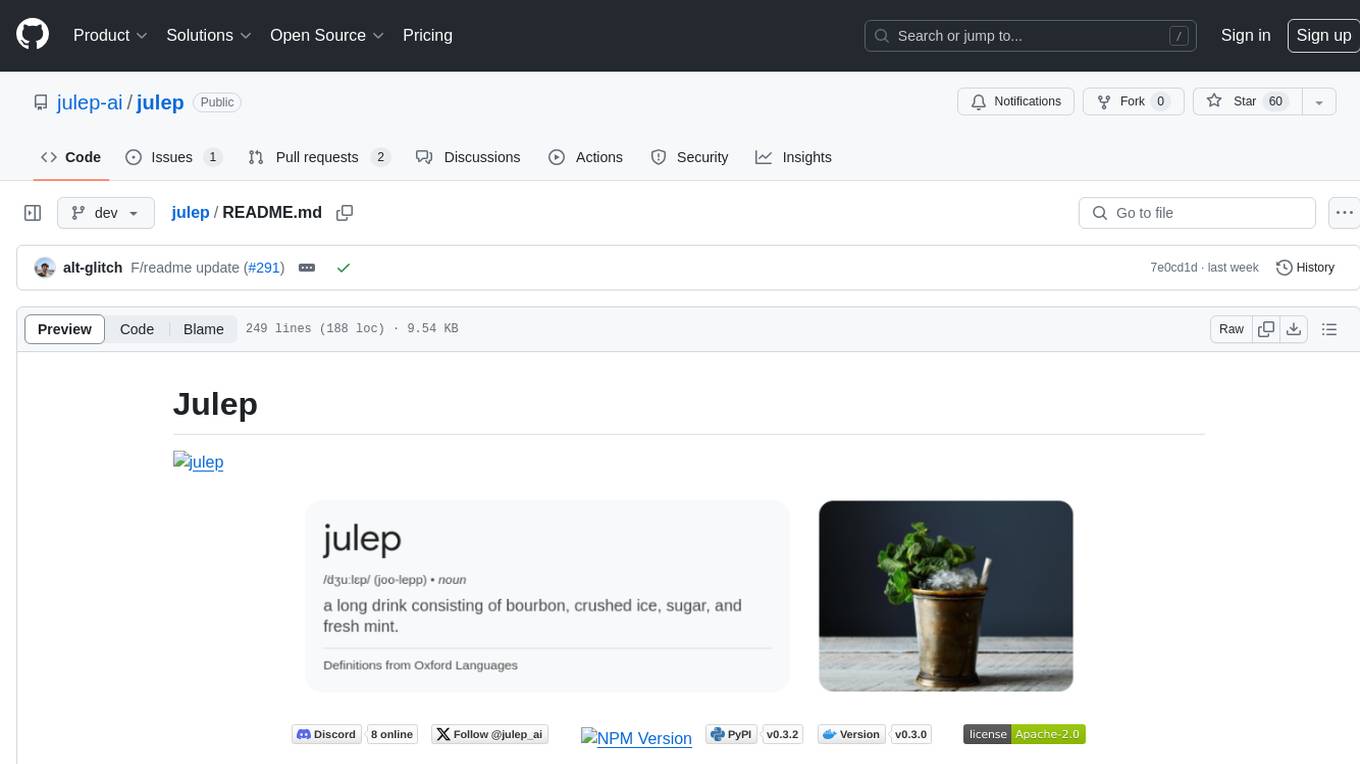
julep
Julep is an advanced platform for creating stateful and functional AI apps powered by large language models. It offers features like statefulness by design, automatic function calling, production-ready deployment, cron-like asynchronous functions, 90+ built-in tools, and the ability to switch between different LLMs easily. Users can build AI applications without the need to write code for embedding, saving, and retrieving conversation history, and can connect to third-party applications using Composio. Julep simplifies the process of getting started with AI apps, whether they are conversational, functional, or agentic.
tambourine-voice
Tambourine is a personal voice interface tool that allows users to speak naturally and have their words appear wherever the cursor is. It is powered by customizable AI voice dictation, providing a universal voice-to-text interface for emails, messages, documents, code editors, and terminals. Users can capture ideas quickly, type at the speed of thought, and benefit from AI formatting that cleans up speech, adds punctuation, and applies personal dictionaries. Tambourine offers full control and transparency, with the ability to customize AI providers, formatting, and extensions. The tool supports dual-mode recording, real-time speech-to-text, LLM text formatting, context-aware formatting, customizable prompts, and more, making it a versatile solution for dictation and transcription tasks.
LLMGA
LLMGA (Multimodal Large Language Model-based Generation Assistant) is a tool that leverages Large Language Models (LLMs) to assist users in image generation and editing. It provides detailed language generation prompts for precise control over Stable Diffusion (SD), resulting in more intricate and precise content in generated images. The tool curates a dataset for prompt refinement, similar image generation, inpainting & outpainting, and visual question answering. It offers a two-stage training scheme to optimize SD alignment and a reference-based restoration network to alleviate texture, brightness, and contrast disparities in image editing. LLMGA shows promising generative capabilities and enables wider applications in an interactive manner.
BioAgents
BioAgents AgentKit is an advanced AI agent framework tailored for biological and scientific research. It offers powerful conversational AI capabilities with specialized knowledge in biology, life sciences, and scientific research methodologies. The framework includes state-of-the-art analysis agents, configurable research agents, and a variety of specialized agents for tasks such as file parsing, research planning, literature search, data analysis, hypothesis generation, research reflection, and user-facing responses. BioAgents also provides support for LLM libraries, multiple search backends for literature agents, and two backends for data analysis. The project structure includes backend source code, services for chat, job queue system, real-time notifications, and JWT authentication, as well as a frontend UI built with Preact.
LlamaBot
LlamaBot is an open-source AI coding agent that rapidly builds MVPs, prototypes, and internal tools. It works for non-technical founders, product teams, and engineers by generating working prototypes, embedding AI directly into the app, and running real workflows. Unlike typical codegen tools, LlamaBot can embed directly in your app and run real workflows, making it ideal for collaborative software building where founders guide the vision, engineers stay in control, and AI fills the gap. LlamaBot is built for moving ideas fast, allowing users to prototype an AI MVP in a weekend, experiment with workflows, and collaborate with teammates to bridge the gap between non-technical founders and engineering teams.
zeus
Zeus is a library for measuring the energy consumption of Deep Learning workloads and optimizing their energy consumption. It provides functionalities for energy and power measurement, time and energy optimization, device abstraction, utility functions, and more. Zeus is part of The ML.ENERGY Initiative and has been recognized in various research papers and conferences. It offers a Docker image with all dependencies, working examples for integration, and ongoing research to enhance its capabilities.
openkf
OpenKF (Open Knowledge Flow) is an online intelligent customer service system. It is an open-source customer service system based on OpenIM, supporting LLM (Local Knowledgebase) customer service and multi-channel customer service. It is easy to integrate with third-party systems, deploy, and perform secondary development. The system provides features like login page, config page, dashboard page, platform page, and session page. Users can quickly get started with OpenKF by following the installation and run instructions. The architecture follows MVC design with a standardized directory structure. The community encourages involvement through community meetings, contributions, and development. OpenKF is licensed under the Apache 2.0 license.
GPT4Point
GPT4Point is a unified framework for point-language understanding and generation. It aligns 3D point clouds with language, providing a comprehensive solution for tasks such as 3D captioning and controlled 3D generation. The project includes an automated point-language dataset annotation engine, a novel object-level point cloud benchmark, and a 3D multi-modality model. Users can train and evaluate models using the provided code and datasets, with a focus on improving models' understanding capabilities and facilitating the generation of 3D objects.
worldmonitor
World Monitor is a real-time global intelligence dashboard powered by AI. It offers news aggregation, geopolitical monitoring, and infrastructure tracking in a unified interface. The tool provides interactive global maps, AI-powered intelligence summaries, real-time data layers on geopolitics, military, infrastructure, and market intelligence. It also includes live news feeds, video streams, signal aggregation, anomaly detection, story sharing, and social export capabilities. The tool is designed for speed, assumes failure, and emphasizes multi-signal correlation for accurate insights. It offers source credibility and tiering for RSS feeds, edge function architecture for data processing, and caching architecture for performance optimization.
llmos
LLMos is an operating system designed for physical AI agents, providing a hybrid runtime environment where AI agents can perceive, reason, act on hardware, and evolve over time locally without cloud dependency. It allows natural language programming, dual-brain architecture for fast instinct and deep planner brains, markdown-as-code for defining agents and skills, and supports swarm intelligence and cognitive world models. The tool is built on a tech stack including Next.js, Electron, Python, and WebAssembly, and is structured around a dual-brain cognitive architecture, volume system, HAL for hardware abstraction, applet system for dynamic UI, and dreaming & evolution for robot improvement. The project is in Phase 1 (Foundation) and aims to move into Phase 2 (Dual-Brain & Local Intelligence), with contributions welcomed under the Apache 2.0 license by Evolving Agents Labs.
voltagent
VoltAgent is an open-source TypeScript framework designed for building and orchestrating AI agents. It simplifies the development of AI agent applications by providing modular building blocks, standardized patterns, and abstractions. Whether you're creating chatbots, virtual assistants, automated workflows, or complex multi-agent systems, VoltAgent handles the underlying complexity, allowing developers to focus on defining their agents' capabilities and logic. The framework offers ready-made building blocks, such as the Core Engine, Multi-Agent Systems, Workflow Engine, Extensible Packages, Tooling & Integrations, Data Retrieval & RAG, Memory management, LLM Compatibility, and a Developer Ecosystem. VoltAgent empowers developers to build sophisticated AI applications faster and more reliably, avoiding repetitive setup and the limitations of simpler tools.
ccprompts
ccprompts is a collection of ~70 Claude Code commands for software development workflows with agent generation capabilities. It includes safety validation and can be used directly with Claude Code or adapted for specific needs. The agent template system provides a wizard for creating specialized sub-agents (e.g., security auditors, systems architects) with standardized formatting and proper tool access. The repository is under active development, so caution is advised when using it in production environments.
For similar tasks
heretic
Heretic is a tool that removes censorship from transformer-based language models without expensive post-training. It combines directional ablation with a TPE-based parameter optimizer to automatically find high-quality abliteration parameters. Users can easily decensor language models without needing to understand transformer internals. Heretic supports most dense models and provides features for research into model semantics. The tool offers flexible ablation weight kernels and separate ablation parameters for different components, improving compliance/quality tradeoff. Heretic was developed from scratch and does not reuse code from other projects.
For similar jobs
LLM-and-Law
This repository is dedicated to summarizing papers related to large language models with the field of law. It includes applications of large language models in legal tasks, legal agents, legal problems of large language models, data resources for large language models in law, law LLMs, and evaluation of large language models in the legal domain.

start-llms
This repository is a comprehensive guide for individuals looking to start and improve their skills in Large Language Models (LLMs) without an advanced background in the field. It provides free resources, online courses, books, articles, and practical tips to become an expert in machine learning. The guide covers topics such as terminology, transformers, prompting, retrieval augmented generation (RAG), and more. It also includes recommendations for podcasts, YouTube videos, and communities to stay updated with the latest news in AI and LLMs.
aiverify
AI Verify is an AI governance testing framework and software toolkit that validates the performance of AI systems against internationally recognised principles through standardised tests. It offers a new API Connector feature to bypass size limitations, test various AI frameworks, and configure connection settings for batch requests. The toolkit operates within an enterprise environment, conducting technical tests on common supervised learning models for tabular and image datasets. It does not define AI ethical standards or guarantee complete safety from risks or biases.
Awesome-LLM-Watermark
This repository contains a collection of research papers related to watermarking techniques for text and images, specifically focusing on large language models (LLMs). The papers cover various aspects of watermarking LLM-generated content, including robustness, statistical understanding, topic-based watermarks, quality-detection trade-offs, dual watermarks, watermark collision, and more. Researchers have explored different methods and frameworks for watermarking LLMs to protect intellectual property, detect machine-generated text, improve generation quality, and evaluate watermarking techniques. The repository serves as a valuable resource for those interested in the field of watermarking for LLMs.
LLM-LieDetector
This repository contains code for reproducing experiments on lie detection in black-box LLMs by asking unrelated questions. It includes Q/A datasets, prompts, and fine-tuning datasets for generating lies with language models. The lie detectors rely on asking binary 'elicitation questions' to diagnose whether the model has lied. The code covers generating lies from language models, training and testing lie detectors, and generalization experiments. It requires access to GPUs and OpenAI API calls for running experiments with open-source models. Results are stored in the repository for reproducibility.
graphrag
The GraphRAG project is a data pipeline and transformation suite designed to extract meaningful, structured data from unstructured text using LLMs. It enhances LLMs' ability to reason about private data. The repository provides guidance on using knowledge graph memory structures to enhance LLM outputs, with a warning about the potential costs of GraphRAG indexing. It offers contribution guidelines, development resources, and encourages prompt tuning for optimal results. The Responsible AI FAQ addresses GraphRAG's capabilities, intended uses, evaluation metrics, limitations, and operational factors for effective and responsible use.
langtest
LangTest is a comprehensive evaluation library for custom LLM and NLP models. It aims to deliver safe and effective language models by providing tools to test model quality, augment training data, and support popular NLP frameworks. LangTest comes with benchmark datasets to challenge and enhance language models, ensuring peak performance in various linguistic tasks. The tool offers more than 60 distinct types of tests with just one line of code, covering aspects like robustness, bias, representation, fairness, and accuracy. It supports testing LLMS for question answering, toxicity, clinical tests, legal support, factuality, sycophancy, and summarization.
Awesome-Jailbreak-on-LLMs
Awesome-Jailbreak-on-LLMs is a collection of state-of-the-art, novel, and exciting jailbreak methods on Large Language Models (LLMs). The repository contains papers, codes, datasets, evaluations, and analyses related to jailbreak attacks on LLMs. It serves as a comprehensive resource for researchers and practitioners interested in exploring various jailbreak techniques and defenses in the context of LLMs. Contributions such as additional jailbreak-related content, pull requests, and issue reports are welcome, and contributors are acknowledged. For any inquiries or issues, contact [email protected]. If you find this repository useful for your research or work, consider starring it to show appreciation.