


worldmonitor
Real-time global intelligence dashboard — AI-powered news aggregation, geopolitical monitoring, and infrastructure tracking in a unified situational awareness interface
Stars: 5760
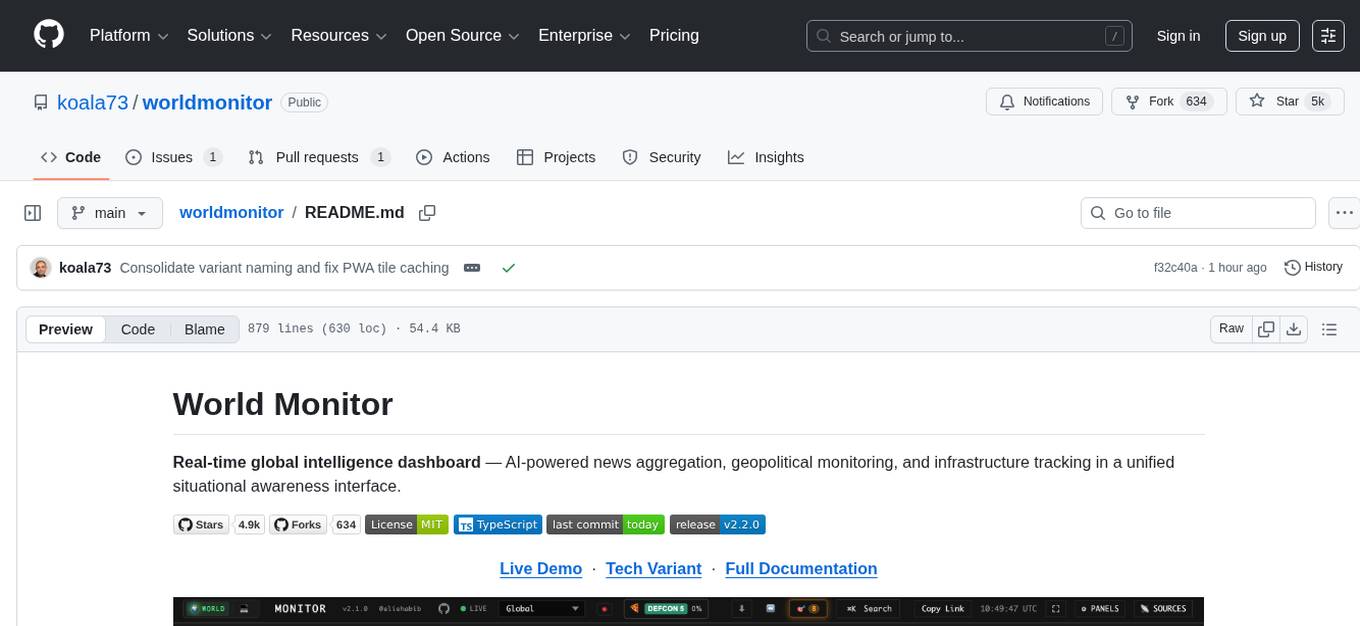
World Monitor is a real-time global intelligence dashboard powered by AI. It offers news aggregation, geopolitical monitoring, and infrastructure tracking in a unified interface. The tool provides interactive global maps, AI-powered intelligence summaries, real-time data layers on geopolitics, military, infrastructure, and market intelligence. It also includes live news feeds, video streams, signal aggregation, anomaly detection, story sharing, and social export capabilities. The tool is designed for speed, assumes failure, and emphasizes multi-signal correlation for accurate insights. It offers source credibility and tiering for RSS feeds, edge function architecture for data processing, and caching architecture for performance optimization.
README:
Real-time global intelligence dashboard — AI-powered news aggregation, geopolitical monitoring, and infrastructure tracking in a unified situational awareness interface.






-0078D4?style=for-the-badge&logo=windows&logoColor=white)


Full Documentation · All Releases

| Problem | Solution |
|---|---|
| News scattered across 100+ sources | Single unified dashboard with 100+ curated feeds |
| No geospatial context for events | Interactive map with 30+ toggleable data layers |
| Information overload | AI-synthesized briefs with focal point detection |
| Crypto/macro signal noise | 7-signal market radar with composite BUY/CASH verdict |
| Expensive OSINT tools ($$$) | 100% free & open source |
| Static news feeds | Real-time updates with live video streams |
| Web-only dashboards | Native desktop app (Tauri) + installable PWA with offline map support |
| Flat 2D maps | 3D WebGL globe with deck.gl rendering and 30+ toggleable data layers |
| Variant | URL | Focus |
|---|---|---|
| World Monitor | worldmonitor.app | Geopolitics, military, conflicts, infrastructure |
| Tech Monitor | tech.worldmonitor.app | Startups, AI/ML, cloud, cybersecurity |
Both variants run from a single codebase — switch between them with one click.
-
WebGL-accelerated rendering — deck.gl + MapLibre GL JS for smooth 60fps performance with thousands of concurrent markers. Switchable between 3D globe (with pitch/rotation) and flat map mode via
VITE_MAP_INTERACTION_MODE - 30+ data layers — conflicts, military bases, nuclear facilities, undersea cables, pipelines, satellite fire detection, protests, natural disasters, datacenters, displacement flows, climate anomalies, cyber threat IOCs, and more
- Smart clustering — Supercluster groups markers at low zoom, expands on zoom in. Cluster thresholds adapt to zoom level
- Progressive disclosure — detail layers (bases, nuclear, datacenters) appear only when zoomed in; zoom-adaptive opacity fades markers from 0.2 at world view to 1.0 at street level
- Label deconfliction — overlapping labels (e.g., multiple BREAKING badges) are automatically suppressed by priority, highest-severity first
- 8 regional presets — Global, Americas, Europe, MENA, Asia, Africa, Oceania, Latin America
- Time filtering — 1h, 6h, 24h, 48h, 7d event windows
-
URL state sharing — map center, zoom, active layers, and time range are encoded in the URL for shareable views (
?view=mena&zoom=4&layers=conflicts,bases)
- World Brief — LLM-synthesized summary of top global developments (Groq Llama 3.1, Redis-cached)
- Hybrid Threat Classification — instant keyword classifier with async LLM override for higher-confidence results
- Focal Point Detection — correlates entities across news, military activity, protests, outages, and markets to identify convergence
- Country Instability Index — real-time stability scores for 22 monitored nations using weighted multi-signal blend
- Trending Keyword Spike Detection — 2-hour rolling window vs 7-day baseline flags surging terms across RSS feeds, with CVE/APT entity extraction and auto-summarization
- Strategic Posture Assessment — composite risk score combining all intelligence modules with trend detection
- Country Brief Pages — click any country for a full-page intelligence dossier with CII score ring, AI-generated analysis, top news with citation anchoring, prediction markets, 7-day event timeline, active signal chips, infrastructure exposure, and stock market index — exportable as JSON, CSV, or image
Geopolitical
- Active conflict zones with escalation tracking (UCDP + ACLED)
- Intelligence hotspots with news correlation
- Social unrest events (dual-source: ACLED protests + GDELT geo-events, Haversine-deduplicated)
- Natural disasters from 3 sources (USGS earthquakes M4.5+, GDACS alerts, NASA EONET events)
- Sanctions regimes
- Cyber threat IOCs (C2 servers, malware hosts, phishing, malicious URLs) geo-located on the globe
- Weather alerts and severe conditions
Military & Strategic
- 220+ military bases from 9 operators
- Live military flight tracking (ADS-B)
- Naval vessel monitoring (AIS)
- Nuclear facilities & gamma irradiators
- APT cyber threat actor attribution
- Spaceports & launch facilities
Infrastructure
- Undersea cables with landing points
- Oil & gas pipelines
- AI datacenters (111 major clusters)
- 84 strategic ports across 6 types (container, oil, LNG, naval, mixed, bulk) with throughput rankings
- Internet outages (Cloudflare Radar)
- Critical mineral deposits
- NASA FIRMS satellite fire detection (VIIRS thermal hotspots)
Market & Crypto Intelligence
- 7-signal macro radar with composite BUY/CASH verdict
- BTC spot ETF flow tracker (IBIT, FBTC, GBTC, and 7 more)
- Stablecoin peg health monitor (USDT, USDC, DAI, FDUSD, USDe)
- Fear & Greed Index with 30-day history
- Bitcoin technical trend (SMA50, SMA200, VWAP, Mayer Multiple)
- JPY liquidity signal, QQQ/XLP macro regime, BTC hash rate
- Inline SVG sparklines and donut gauges for visual trends
Tech Ecosystem (Tech variant)
- Tech company HQs (Big Tech, unicorns, public)
- Startup hubs with funding data
- Cloud regions (AWS, Azure, GCP)
- Accelerators (YC, Techstars, 500)
- Upcoming tech conferences
- 100+ RSS feeds across geopolitics, defense, energy, tech — domain-allowlisted proxy prevents CORS issues
- 8 live video streams — Bloomberg, Sky News, Al Jazeera, Euronews, DW, France24, CNBC, Al Arabiya — with automatic live detection that scrapes YouTube channel pages every 5 minutes to find active streams
- Desktop embed bridge — YouTube's IFrame API restricts playback in native webviews (error 153). The dashboard detects this and transparently routes through a cloud-hosted embed proxy with bidirectional message passing (play/pause/mute/unmute/loadVideo)
- Idle-aware playback — video players pause and are removed from the DOM after 5 minutes of inactivity, resuming when the user returns. Tab visibility changes also suspend/resume streams
- Custom monitors — Create keyword-based alerts for any topic, color-coded with persistent storage
- Entity extraction — Auto-links countries, leaders, organizations
- Virtual scrolling — news panels render only visible DOM elements, handling thousands of items without browser lag
- Multi-source signal fusion — internet outages, military flights, naval vessels, protests, AIS disruptions, satellite fires, and keyword spikes are aggregated into a unified intelligence picture with per-country and per-region clustering
- Temporal baseline anomaly detection — Welford's online algorithm computes streaming mean/variance per event type, region, weekday, and month over a 90-day window. Z-score thresholds (1.5/2.0/3.0) flag deviations like "Military flights 3.2x normal for Thursday (January)" — stored in Redis via Upstash
- Regional convergence scoring — when multiple signal types spike in the same geographic area, the system identifies convergence zones and escalates severity
- Shareable intelligence stories — generate country-level intelligence briefs with CII scores, threat counts, theater posture, and related prediction markets
- Multi-platform export — custom-formatted sharing for Twitter/X, LinkedIn, WhatsApp, Telegram, Reddit, and Facebook with platform-appropriate formatting
-
Deep links — every story generates a unique URL (
/story?c=<country>&t=<type>) with dynamic Open Graph meta tags for rich social previews - Canvas-based image generation — stories render as PNG images for visual sharing, with QR codes linking back to the live dashboard
- Native desktop app for macOS and Windows — packages the full dashboard with a local Node.js sidecar that runs all 45+ API handlers locally
- OS keychain integration — API keys stored in the system credential manager (macOS Keychain, Windows Credential Manager), never in plaintext files
- Token-authenticated sidecar — a unique session token prevents other local processes from accessing the sidecar on localhost. Generated per launch using randomized hashing
- Cloud fallback — when a local API handler fails or is missing, requests transparently fall through to the cloud deployment (worldmonitor.app) with origin headers stripped
- Settings window — dedicated configuration UI (Cmd+,) for managing 15 API keys with validation, signup links, and feature-availability indicators
- Verbose debug mode — toggle traffic logging with persistent state across restarts. View the last 200 requests with timing, status codes, and error details
- DevTools toggle — Cmd+Alt+I opens the embedded web inspector for debugging
-
Installable — the dashboard can be installed to the home screen on mobile or as a standalone desktop app via Chrome's install prompt. Full-screen
standalonedisplay mode with custom theme color - Offline map support — MapTiler tiles are cached using a CacheFirst strategy (up to 500 tiles, 30-day TTL), enabling map browsing without a network connection
- Smart caching strategies — APIs and RSS feeds use NetworkOnly (real-time data must always be fresh), while fonts (1-year TTL), images (7-day StaleWhileRevalidate), and static assets (1-year immutable) are aggressively cached
- Auto-updating service worker — checks for new versions every 60 minutes. Tauri desktop builds skip service worker registration entirely (uses native APIs instead)
- Offline fallback — a branded fallback page with retry button is served when the network is unavailable
- Signal intelligence with "Why It Matters" context
- Infrastructure cascade analysis with proximity correlation
- Maritime & aviation tracking with surge detection
- Prediction market integration (Polymarket) with 3-tier JA3 bypass (browser-direct → Tauri native TLS → cloud proxy)
- Service status monitoring (cloud providers, AI services)
- Shareable map state via URL parameters (view, zoom, coordinates, time range, active layers)
- Data freshness monitoring across 14 data sources with explicit intelligence gap reporting
- Per-feed circuit breakers with 5-minute cooldowns to prevent cascading failures
- Browser-side ML worker (Transformers.js) for NER and sentiment analysis without server dependency
- Cmd+K search — fuzzy search across 20+ result types: news headlines, countries (with direct country brief navigation), hotspots, markets, military bases, cables, pipelines, datacenters, nuclear facilities, tech companies, and more
- Historical playback — dashboard snapshots are stored in IndexedDB. A time slider allows rewinding to any saved state, with live updates paused during playback
- Mobile detection — screens below 768px receive a warning modal since the dashboard is designed for multi-panel desktop use
- UCDP conflict classification — countries with active wars (1,000+ battle deaths/year) receive automatic CII floor scores, preventing optimistic drift
- HAPI humanitarian data — UN OCHA humanitarian access metrics and displacement flows feed into country-level instability scoring with dual-perspective (origins vs. hosts) panel
- Idle-aware resource management — animations pause after 2 minutes of inactivity and when the tab is hidden, preventing battery drain. Video streams are destroyed from the DOM and recreated on return
-
Country-specific stock indices — country briefs display the primary stock market index with 1-week change (S&P 500 for US, Shanghai Composite for China, etc.) via the
/api/stock-indexendpoint - Climate anomaly panel — 15 conflict-prone zones monitored for temperature/precipitation deviations against 30-day ERA5 baselines, with severity classification feeding into CII
- Country brief export — every brief is downloadable as structured JSON, flattened CSV, or rendered PNG image, enabling offline analysis and reporting workflows
- Print/PDF support — country briefs include a print button that triggers the browser's native print dialog, producing clean PDF output
- Oil & energy analytics — WTI/Brent crude prices, US production (Mbbl/d), and inventory levels via the EIA API with weekly trend detection
- Population exposure estimation — WorldPop density data estimates civilian population within event-specific radii (50–100km) for conflicts, earthquakes, floods, and wildfires
- Trending keywords panel — real-time display of surging terms across all RSS feeds with spike severity, source count, and AI-generated context summaries
- Download banner — persistent notification for web users linking to native desktop installers for their detected platform
-
Download API —
/api/download?platform={windows-exe|windows-msi|macos-arm64|macos-x64}redirects to the matching GitHub Release asset, with fallback to the releases page -
Non-tier country support — clicking countries outside the 22 tier-1 list opens a brief with available data (news, markets, infrastructure) and a "Limited coverage" badge; country names for non-tier countries resolve via
Intl.DisplayNames
Map overlay behavior is validated in Playwright using the map harness (/tests/map-harness.html).
- Cluster-state cache initialization guard:
updates protest marker click payload after data refreshinitializes cluster movement cache on first protest cluster render
- Run by variant:
npm run test:e2e:full -- -g "updates protest marker click payload after data refresh|initializes cluster movement cache on first protest cluster render"npm run test:e2e:tech -- -g "updates protest marker click payload after data refresh|initializes cluster movement cache on first protest cluster render"
Clicking any country on the map opens a full-page intelligence dossier — a single-screen synthesis of all intelligence modules for that country. The brief is organized into a two-column layout:
Left column:
- Instability Index — animated SVG score ring (0–100) with four component breakdown bars (Unrest, Conflict, Security, Information), severity badge, and trend indicator
-
Intelligence Brief — AI-generated analysis (Groq Llama 3.1) with inline citation anchors
[1]–[8]that scroll to the corresponding news source when clicked - Top News — 8 most relevant headlines for the country, threat-level color-coded, with source and time-ago metadata
Right column:
- Active Signals — real-time chip indicators for protests, military aircraft, naval vessels, internet outages, earthquakes, displacement flows, climate stress, conflict events, and the country's stock market index (1-week change)
- 7-Day Timeline — D3.js-rendered event chart with 4 severity-coded lanes (protest, conflict, natural, military), interactive tooltips, and responsive resizing
- Prediction Markets — top 3 Polymarket contracts by volume with probability bars and external links
- Infrastructure Exposure — pipelines, undersea cables, datacenters, military bases, nuclear facilities, and ports within a 600km radius of the country centroid, ranked by distance
Headline relevance filtering: each country has an alias map (e.g., US → ["united states", "american", "washington", "pentagon", "biden", "trump"]). Headlines are filtered using a negative-match algorithm — if another country's alias appears earlier in the headline title than the target country's alias, the headline is excluded. This prevents cross-contamination (e.g., a headline about Venezuela mentioning "Washington sanctions" appearing in the US brief).
Export options: briefs are exportable as JSON (structured data with all scores, signals, and headlines), CSV (flattened tabular format), or PNG image. A print button triggers the browser's native print dialog for PDF export.
Map clicks resolve to countries using a local geometry service rather than relying on network reverse-geocoding (Nominatim). The system loads a GeoJSON file containing polygon boundaries for ~200 countries and builds an indexed spatial lookup:
-
Bounding box pre-filter — each country's polygon(s) are wrapped in a bounding box (
[minLon, minLat, maxLon, maxLat]). Points outside the bbox are rejected without polygon intersection testing. -
Ray-casting algorithm — for points inside the bbox, a ray is cast from the point along the positive x-axis. The number of polygon edge intersections determines inside/outside status (odd = inside). Edge cases are handled: points on segment boundaries return
true, and polygon holes are subtracted (a point inside an outer ring but also inside a hole is excluded). - MultiPolygon support — countries with non-contiguous territories (e.g., the US with Alaska and Hawaii, Indonesia with thousands of islands) use MultiPolygon geometries where each polygon is tested independently.
This approach provides sub-millisecond country detection entirely in the browser, with no network latency. The geometry data is preloaded at app startup and cached for the session. For countries not in the GeoJSON (rare), the system falls back to hardcoded rectangular bounding boxes, and finally to network reverse-geocoding as a last resort.
Every news item passes through a two-stage classification pipeline:
- Keyword classifier (instant) — pattern-matches against ~120 threat keywords organized by severity tier (critical → high → medium → low → info) and category (conflict, terrorism, cyber, disaster, etc.). Returns immediately with a confidence score.
- LLM classifier (async) — fires in the background via a Vercel Edge Function calling Groq's Llama 3.1 8B at temperature 0. Results are cached in Redis (24h TTL) keyed by headline hash. When the LLM result arrives, it overrides the keyword result only if its confidence is higher.
This hybrid approach means the UI is never blocked waiting for AI — users see keyword results instantly, with LLM refinements arriving within seconds and persisting for all subsequent visitors.
22 tier-1 countries receive continuous monitoring: US, Russia, China, Ukraine, Iran, Israel, Taiwan, North Korea, Saudi Arabia, Turkey, Poland, Germany, France, UK, India, Pakistan, Syria, Yemen, Myanmar, Venezuela, Brazil, and UAE. Each receives a real-time instability score (0–100) computed from:
| Component | Weight | Details |
|---|---|---|
| Baseline risk | 40% | Pre-configured per country reflecting structural fragility |
| Unrest events | 20% | Protests scored logarithmically for democracies (routine protests don't trigger), linearly for authoritarian states (every protest is significant). Boosted for fatalities and internet outages |
| Security activity | 20% | Military flights (3pts) + vessels (5pts) from own forces + foreign military presence (doubled weight) |
| Information velocity | 20% | News mention frequency weighted by event severity multiplier, log-scaled for high-volume countries |
Additional boosts apply for hotspot proximity, focal point urgency, and conflict-zone floors (e.g., Ukraine is pinned at ≥55, Syria at ≥50).
Intelligence hotspots receive dynamic escalation scores blending four normalized signals (0–100):
- News activity (35%) — article count and severity in the hotspot's area
- Country instability (25%) — CII score of the host country
- Geo-convergence alerts (25%) — spatial binning detects 3+ event types (protests + military + earthquakes) co-occurring within 1° lat/lon cells
- Military activity (15%) — vessel clusters and flight density near the hotspot
The system blends static baseline risk (40%) with detected events (60%) and tracks trends via linear regression on 48-hour history. Signal emissions cool down for 2 hours to prevent alert fatigue.
Events (protests, military flights, vessels, earthquakes) are binned into 1°×1° geographic cells within a 24-hour window. When 3+ distinct event types converge in one cell, a convergence alert fires. Scoring is based on type diversity (×25pts per unique type) plus event count bonuses (×2pts). Alerts are reverse-geocoded to human-readable names using conflict zones, waterways, and hotspot databases.
Nine operational theaters are continuously assessed for military posture escalation:
| Theater | Key Trigger |
|---|---|
| Iran / Persian Gulf | Carrier groups, tanker activity, AWACS |
| Taiwan Strait | PLAAF sorties, USN carrier presence |
| Baltic / Kaliningrad | Russian Western Military District flights |
| Korean Peninsula | B-52/B-1 deployments, DPRK missile activity |
| Eastern Mediterranean | Multi-national naval exercises |
| Horn of Africa | Anti-piracy patrols, drone activity |
| South China Sea | Freedom of navigation operations |
| Arctic | Long-range aviation patrols |
| Black Sea | ISR flights, naval movements |
Posture levels escalate from NORMAL → ELEVATED → CRITICAL based on a composite of:
- Aircraft count in theater (both resident and transient)
- Strike capability — the presence of tankers + AWACS + fighters together indicates strike packaging, not routine training
- Naval presence — carrier groups and combatant formations
- Country instability — high CII scores for theater-adjacent countries amplify posture
Each theater is linked to 38+ military bases, enabling automatic correlation between observed flights and known operating locations.
The system monitors five operational theaters (Middle East, Eastern Europe, Western Europe, Western Pacific, Horn of Africa) with 38+ associated military bases. It classifies vessel clusters near hotspots by activity type:
- Deployment — carrier present with 5+ vessels
- Exercise — combatants present in formation
- Transit — vessels passing through
Foreign military presence is dual-credited: the operator's country is flagged for force projection, and the host location's country is flagged for foreign military threat. AIS gaps (dark ships) are flagged as potential signal discipline indicators.
Beyond proximity correlation, the system models how disruptions propagate through interconnected infrastructure. A dependency graph connects undersea cables, pipelines, ports, chokepoints, and countries with weighted edges representing capacity dependencies:
Disruption Event → Affected Node → Cascade Propagation (BFS, depth ≤ 3)
                                          │
                    ┌─────────────────────┤
                    ▼                     ▼
            Direct Impact         Indirect Impact
         (e.g., cable cut)    (countries served by cable)
Impact calculation: strength = edge_weight × disruption_level × (1 − redundancy)
Strategic chokepoint modeling captures real-world dependencies:
- Strait of Hormuz — 80% of Japan's oil, 70% of South Korea's, 60% of India's, 40% of China's
- Suez Canal — EU-Asia trade routes (Germany, Italy, UK, China)
- Malacca Strait — 80% of China's oil transit
Ports are weighted by type: oil/LNG terminals (0.9 — critical), container ports (0.7), naval bases (0.4 — geopolitical but less economic). This enables questions like "if the Strait of Hormuz closes, which countries face energy shortages within 30 days?"
When a news event is geo-located, the system automatically identifies critical infrastructure within a 600km radius — pipelines, undersea cables, data centers, military bases, and nuclear facilities — ranked by distance. This enables instant geopolitical context: a cable cut near a strategic chokepoint, a protest near a nuclear facility, or troop movements near a data center cluster.
A 74-hub strategic location database infers geography from headlines via keyword matching. Hubs span capitals, conflict zones, strategic chokepoints (Strait of Hormuz, Suez Canal, Malacca Strait), and international organizations. Confidence scoring is boosted for critical-tier hubs and active conflict zones, enabling map-driven news placement without requiring explicit location metadata from RSS feeds.
A structured entity registry catalogs countries, organizations, world leaders, and military entities with multiple lookup indices:
| Index Type | Purpose | Example |
|---|---|---|
| ID index | Direct entity lookup |
entity:us → United States profile |
| Alias index | Name variant matching | "America", "USA", "United States" → same entity |
| Keyword index | Contextual detection | "Pentagon", "White House" → United States |
| Sector index | Domain grouping | "military", "energy", "tech" |
| Type index | Category filtering | "country", "organization", "leader" |
Entity matching uses word-boundary regex to prevent false positives (e.g., "Iran" matching "Ukraine"). Confidence scores are tiered by match quality: exact name matches score 1.0, aliases 0.85–0.95, and keyword matches 0.7. When the same entity surfaces across multiple independent data sources (news, military tracking, protest feeds, market signals), the system identifies it as a focal point and escalates its prominence in the intelligence picture.
Rather than relying on static thresholds, the system learns what "normal" looks like and flags deviations. Each event type (military flights, naval vessels, protests, news velocity, AIS gaps, satellite fires) is tracked per region with separate baselines for each weekday and month — because military activity patterns differ on Tuesdays vs. weekends, and January vs. July.
The algorithm uses Welford's online method for numerically stable streaming computation of mean and variance, stored in Redis with a 90-day rolling window. When a new observation arrives, its z-score is computed against the learned baseline. Thresholds:
| Z-Score | Severity | Example |
|---|---|---|
| ≥ 1.5 | Low | Slightly elevated protest activity |
| ≥ 2.0 | Medium | Unusual naval presence |
| ≥ 3.0 | High/Critical | Military flights 3x above baseline |
A minimum of 10 historical samples is required before anomalies are reported, preventing false positives during the learning phase. Anomalies are ingested back into the signal aggregator, where they compound with other signals for convergence detection.
Every RSS headline is tokenized into individual terms and tracked in per-term frequency maps. A 2-hour rolling window captures current activity while a 7-day baseline (refreshed hourly) establishes what "normal" looks like for each term. A spike fires when all conditions are met:
| Condition | Threshold |
|---|---|
| Absolute count | > minSpikeCount (5 mentions) |
| Relative surge | > baseline × spikeMultiplier (3×) |
| Source diversity | ≥ 2 unique RSS feed sources |
| Cooldown | 30 minutes since last spike for the same term |
The tokenizer extracts CVE identifiers (CVE-2024-xxxxx), APT/FIN threat actor designators, and 12 compound terms for world leaders (e.g., "Xi Jinping", "Kim Jong Un") that would be lost by naive whitespace splitting. A configurable blocklist suppresses common noise terms.
Detected spikes are auto-summarized via Groq (rate-limited to 5 summaries/hour) and emitted as keyword_spike signals into the correlation engine, where they compound with other signal types for convergence detection. The term registry is capped at 10,000 entries with LRU eviction to bound memory usage. All thresholds (spike multiplier, min count, cooldown, blocked terms) are configurable via the Settings panel.
Five threat intelligence feeds provide indicators of compromise (IOCs) for active command-and-control servers, malware distribution hosts, phishing campaigns, and malicious URLs:
| Feed | IOC Type | Coverage |
|---|---|---|
| Feodo Tracker (abuse.ch) | C2 servers | Botnet C&C infrastructure |
| URLhaus (abuse.ch) | Malware hosts | Malware distribution URLs |
| C2IntelFeeds | C2 servers | Community-sourced C2 indicators |
| AlienVault OTX | Mixed | Open threat exchange pulse IOCs |
| AbuseIPDB | Malicious IPs | Crowd-sourced abuse reports |
Each IP-based IOC is geo-enriched using ipinfo.io with freeipapi.com as fallback. Geolocation results are Redis-cached for 24 hours. Enrichment runs concurrently — 16 parallel lookups with a 12-second timeout, processing up to 250 IPs per collection run.
IOCs are classified into four types (c2_server, malware_host, phishing, malicious_url) with four severity levels, rendered as color-coded scatter dots on the globe. The layer uses a 10-minute cache, a 14-day rolling window, and caps display at 500 IOCs to maintain rendering performance.
Three independent sources are merged into a unified disaster picture, then deduplicated on a 0.1° geographic grid:
| Source | Coverage | Types | Update Frequency |
|---|---|---|---|
| USGS | Global earthquakes M4.5+ | Earthquakes | 5 minutes |
| GDACS | UN-coordinated disaster alerts | Earthquakes, floods, cyclones, volcanoes, wildfires, droughts | Real-time |
| NASA EONET | Earth observation events | 13 natural event categories (30-day open events) | Real-time |
GDACS events carry color-coded alert levels (Red = critical, Orange = high) and are filtered to exclude low-severity Green alerts. EONET wildfires are filtered to events within 48 hours to prevent stale data. Earthquakes from EONET are excluded since USGS provides higher-quality seismological data.
The merged output feeds into the signal aggregator for geographic convergence detection — e.g., an earthquake near a pipeline triggers an infrastructure cascade alert.
Protest data is sourced from two independent providers to reduce single-source bias:
- ACLED (Armed Conflict Location & Event Data) — 30-day window, tokenized API with Redis caching (10-minute TTL). Covers protests, riots, strikes, and demonstrations with actor attribution and fatality counts.
-
GDELT (Global Database of Events, Language, and Tone) — 7-day geospatial event feed filtered to protest keywords. Events with mention count ≥5 are included; those above 30 are marked as
validated.
Events from both sources are Haversine-deduplicated on a 0.5° grid (~50km) with same-day matching. ACLED events take priority due to higher editorial confidence. Severity is classified as:
- High — fatalities present or riot/clash keywords
- Medium — standard protest/demonstration
- Low — default
Protest scoring is regime-aware: democratic countries use logarithmic scaling (routine protests don't trigger instability), while authoritarian states use linear scoring (every protest is significant). Fatalities and concurrent internet outages apply severity boosts.
15 conflict-prone and disaster-prone zones are continuously monitored for temperature and precipitation anomalies using Open-Meteo ERA5 reanalysis data. A 30-day baseline is computed, and current conditions are compared against it to determine severity:
| Severity | Temperature Deviation | Precipitation Deviation |
|---|---|---|
| Extreme | > 5°C above baseline | > 80mm/day above baseline |
| Moderate | > 3°C above baseline | > 40mm/day above baseline |
| Normal | Within expected range | Within expected range |
Anomalies feed into the signal aggregator, where they amplify CII scores for affected countries (climate stress is a recognized conflict accelerant). The Climate Anomaly panel surfaces these deviations in a severity-sorted list.
Refugee and displacement data is sourced from the UN OCHA Humanitarian API (HAPI), providing population-level counts for refugees, asylum seekers, and internally displaced persons (IDPs). The Displacement panel offers two perspectives:
- Origins — countries people are fleeing from, ranked by outflow volume
- Hosts — countries absorbing displaced populations, ranked by intake
Crisis badges flag countries with extreme displacement: > 1 million displaced (red), > 500,000 (orange). Displacement outflow feeds into the CII as a component signal — high displacement is a lagging indicator of instability that persists even when headlines move on.
Active events (conflicts, earthquakes, floods, wildfires) are cross-referenced against WorldPop population density data to estimate the number of civilians within the impact zone. Event-specific radii reflect typical impact footprints:
| Event Type | Radius | Rationale |
|---|---|---|
| Conflicts | 50 km | Direct combat zone + displacement buffer |
| Earthquakes | 100 km | Shaking intensity propagation |
| Floods | 100 km | Watershed and drainage basin extent |
| Wildfires | 30 km | Smoke and evacuation perimeter |
API calls to WorldPop are batched concurrently (max 10 parallel requests) to handle multiple simultaneous events without sequential bottlenecks. The Population Exposure panel displays a summary header with total affected population and a per-event breakdown table.
84 strategic ports are cataloged across six types, reflecting their role in global trade and military posture:
| Type | Count | Examples |
|---|---|---|
| Container | 21 | Shanghai (#1, 47M+ TEU), Singapore, Ningbo, Shenzhen |
| Oil/LNG | 8 | Ras Tanura (Saudi), Sabine Pass (US), Fujairah (UAE) |
| Chokepoint | 8 | Suez Canal, Panama Canal, Strait of Malacca |
| Naval | 6 | Zhanjiang, Yulin (China), Vladivostok (Russia) |
| Mixed | 15+ | Ports serving multiple roles (trade + military) |
| Bulk | 20+ | Regional commodity ports |
Ports are ranked by throughput and weighted by strategic importance in the infrastructure cascade model: oil/LNG terminals carry 0.9 criticality, container ports 0.7, and naval bases 0.4. Port proximity appears in the Country Brief infrastructure exposure section.
The dashboard runs a full ML pipeline in the browser via Transformers.js, with no server dependency for core intelligence. This is automatically disabled on mobile devices to conserve memory.
| Capability | Model | Use |
|---|---|---|
| Text embeddings | sentence-similarity | Semantic clustering of news headlines |
| Sequence classification | threat-classifier | Threat severity and category detection |
| Summarization | T5-small | Fallback when Groq and OpenRouter are unavailable |
| Named Entity Recognition | NER pipeline | Country, organization, and leader extraction |
Hybrid clustering combines fast Jaccard similarity (n-gram overlap, threshold 0.4) with ML-refined semantic similarity (cosine similarity, threshold 0.78). Jaccard runs instantly on every refresh; semantic refinement runs when the ML worker is loaded and merges clusters that are textually different but semantically identical (e.g., "NATO expands missile shield" and "Alliance deploys new air defense systems").
News velocity is tracked per cluster — when multiple Tier 1–2 sources converge on the same story within a short window, the cluster is flagged as a breaking alert with sourcesPerHour as the velocity metric.
All real-time data sources feed into a central signal aggregator that builds a unified geospatial intelligence picture. Signals are clustered by country and region, with each signal carrying a severity (low/medium/high), geographic coordinates, and metadata. The aggregator:
-
Clusters by country — groups signals from diverse sources (flights, vessels, protests, fires, outages,
keyword_spike) into per-country profiles - Detects regional convergence — identifies when multiple signal types spike in the same geographic corridor (e.g., military flights + protests + satellite fires in Eastern Mediterranean)
- Feeds downstream analysis — the CII, hotspot escalation, focal point detection, and AI insights modules all consume the aggregated signal picture rather than raw data
A singleton tracker monitors 22 data sources (GDELT, RSS, AIS, military flights, earthquakes, weather, outages, ACLED, Polymarket, economic indicators, NASA FIRMS, cyber threat feeds, trending keywords, oil/energy, population exposure, and more) with status categorization: fresh (<15 min), stale (1h), very_stale (6h), no_data, error, disabled. It explicitly reports intelligence gaps — what analysts can't see — preventing false confidence when critical data sources are down or degraded.
Polymarket geopolitical markets are queried using tag-based filters (Ukraine, Iran, China, Taiwan, etc.) with 5-minute caching. Market probability shifts are correlated with news volume: if a prediction market moves significantly before matching news arrives, this is flagged as a potential early-warning signal.
Cloudflare JA3 bypass — Polymarket's API is protected by Cloudflare TLS fingerprinting (JA3) that blocks all server-side requests. The system uses a 3-tier fallback:
| Tier | Method | When It Works |
|---|---|---|
| 1 | Browser-direct fetch | Always (browser TLS passes Cloudflare) |
| 2 | Tauri native TLS (reqwest) | Desktop app (Rust TLS fingerprint differs from Node.js) |
| 3 | Vercel edge proxy | Rarely (edge runtime sometimes passes) |
Once browser-direct succeeds, the system caches this state and skips fallback tiers on subsequent requests. Country-specific markets are fetched by mapping countries to Polymarket tags with name-variant matching (e.g., "Russia" matches titles containing "Russian", "Moscow", "Kremlin", "Putin").
Markets are filtered to exclude sports and entertainment (100+ exclusion keywords), require meaningful price divergence from 50% or volume above $50K, and are ranked by trading volume. Each variant gets different tag sets — geopolitical focus queries politics/world/ukraine/middle-east tags, while tech focus queries ai/crypto/business tags.
The Market Radar panel computes a composite BUY/CASH verdict from 7 independent signals sourced entirely from free APIs (Yahoo Finance, mempool.space, alternative.me):
| Signal | Computation | Bullish When |
|---|---|---|
| Liquidity | JPY/USD 30-day rate of change | ROC > -2% (no yen squeeze) |
| Flow Structure | BTC 5-day return vs QQQ 5-day return | Gap < 5% (aligned) |
| Macro Regime | QQQ 20-day ROC vs XLP 20-day ROC | QQQ outperforming (risk-on) |
| Technical Trend | BTC vs SMA50 + 30-day VWAP | Above both (bullish) |
| Hash Rate | Bitcoin mining hashrate 30-day change | Growing > 3% |
| Mining Cost | BTC price vs hashrate-implied cost | Price > $60K (profitable) |
| Fear & Greed | alternative.me sentiment index | Value > 50 |
The overall verdict requires ≥57% of known signals to be bullish (BUY), otherwise CASH. Signals with unknown data are excluded from the denominator.
VWAP Calculation — Volume-Weighted Average Price is computed from aligned price/volume pairs over a 30-day window. Pairs where either price or volume is null are excluded together to prevent index misalignment:
VWAP = Σ(price × volume) / Σ(volume) for last 30 trading days
The Mayer Multiple (BTC price / SMA200) provides a long-term valuation context — historically, values above 2.4 indicate overheating, while values below 0.8 suggest deep undervaluation.
Five major stablecoins (USDT, USDC, DAI, FDUSD, USDe) are monitored via the CoinGecko API with 2-minute caching. Each coin's deviation from the $1.00 peg determines its health status:
| Deviation | Status | Indicator |
|---|---|---|
| ≤ 0.5% | ON PEG | Green |
| 0.5% – 1.0% | SLIGHT DEPEG | Yellow |
| > 1.0% | DEPEGGED | Red |
The panel aggregates total stablecoin market cap, 24h volume, and an overall health status (HEALTHY / CAUTION / WARNING). The coins query parameter accepts a comma-separated list of CoinGecko IDs, validated against a [a-z0-9-]+ regex to prevent injection.
The Oil & Energy panel tracks four key indicators from the U.S. Energy Information Administration (EIA) API:
| Indicator | Series | Update Cadence |
|---|---|---|
| WTI Crude | Spot price ($/bbl) | Weekly |
| Brent Crude | Spot price ($/bbl) | Weekly |
| US Production | Crude oil output (Mbbl/d) | Weekly |
| US Inventory | Commercial crude stocks | Weekly |
Trend detection flags week-over-week changes exceeding ±0.5% as rising or falling, with flat readings within the threshold shown as stable. Results are cached client-side for 30 minutes. The panel provides energy market context for geopolitical analysis — price spikes often correlate with supply disruptions in monitored conflict zones and chokepoint closures.
Ten spot Bitcoin ETFs are tracked via Yahoo Finance's 5-day chart API (IBIT, FBTC, ARKB, BITB, GBTC, HODL, BRRR, EZBC, BTCO, BTCW). Since ETF flow data requires expensive terminal subscriptions, the system estimates flow direction from publicly available signals:
- Price change — daily close vs. previous close determines direction
- Volume ratio — current volume / trailing average volume measures conviction
-
Flow magnitude —
volume × price × direction × 0.1provides a rough dollar estimate
This is an approximation, not a substitute for official flow data, but it captures the direction and relative magnitude correctly. Results are cached for 15 minutes.
| Principle | Implementation |
|---|---|
| Speed over perfection | Keyword classifier is instant; LLM refines asynchronously. Users never wait. |
| Assume failure | Per-feed circuit breakers with 5-minute cooldowns. AI fallback chain: Groq → OpenRouter → browser-side T5. Redis cache failures degrade gracefully. Every edge function returns stale cached data when upstream APIs are down. |
| Show what you can't see | Intelligence gap tracker explicitly reports data source outages rather than silently hiding them. |
| Browser-first compute | Analysis (clustering, instability scoring, surge detection) runs client-side — no backend compute dependency for core intelligence. |
| Local-first geolocation | Country detection uses browser-side ray-casting against GeoJSON polygons rather than network reverse-geocoding. Sub-millisecond response, zero API dependency, works offline. Network geocoding is a fallback, not the primary path. |
| Multi-signal correlation | No single data source is trusted alone. Focal points require convergence across news + military + markets + protests before escalating to critical. |
| Geopolitical grounding | Hard-coded conflict zones, baseline country risk, and strategic chokepoints prevent statistical noise from generating false alerts in low-data regions. |
| Defense in depth | CORS origin allowlist, domain-allowlisted RSS proxy, server-side API key isolation, token-authenticated desktop sidecar, input sanitization with output encoding, IP rate limiting on AI endpoints. |
| Cache everything, trust nothing | Three-tier caching (in-memory → Redis → upstream) with versioned cache keys and stale-on-error fallback. Every API response includes X-Cache header for debugging. CDN layer (s-maxage) absorbs repeated requests before they reach edge functions. |
| Bandwidth efficiency | Gzip compression on all relay responses (80% reduction). Content-hash static assets with 1-year immutable cache. Staggered polling intervals prevent synchronized API storms. Animations and polling pause on hidden tabs. |
| Baseline-aware alerting | Trending keyword detection uses rolling 2-hour windows against 7-day baselines with per-term spike multipliers, cooldowns, and source diversity requirements — surfacing genuine surges while suppressing noise. |
| Run anywhere | Same codebase deploys to Vercel (web), Railway (relay), Tauri (desktop), and PWA (installable). Desktop sidecar mirrors all cloud API handlers locally. Service worker caches map tiles for offline use while keeping intelligence data always-fresh (NetworkOnly). |
Every RSS feed is assigned a source tier reflecting editorial reliability:
| Tier | Description | Examples |
|---|---|---|
| Tier 1 | Wire services, official government sources | Reuters, AP, BBC, DOD |
| Tier 2 | Major established outlets | CNN, NYT, The Guardian, Al Jazeera |
| Tier 3 | Specialized/niche outlets | Defense One, Breaking Defense, The War Zone |
| Tier 4 | Aggregators and blogs | Google News, individual analyst blogs |
Feeds also carry a propaganda risk rating and state affiliation flag. State-affiliated sources (RT, Xinhua, IRNA) are included for completeness but visually tagged so analysts can factor in editorial bias. Threat classification confidence is weighted by source tier — a Tier 1 breaking alert carries more weight than a Tier 4 blog post in the focal point detection algorithm.
World Monitor uses 45+ Vercel Edge Functions as a lightweight API layer. Each edge function handles a single data source concern — proxying, caching, or transforming external APIs. This architecture avoids a monolithic backend while keeping API keys server-side:
- RSS Proxy — domain-allowlisted proxy for 100+ feeds, preventing CORS issues and hiding origin servers. Feeds from domains that block Vercel IPs are automatically routed through the Railway relay.
- AI Pipeline — Groq and OpenRouter edge functions with Redis deduplication, so identical headlines across concurrent users only trigger one LLM call. The classify-event endpoint pauses its queue on 500 errors to avoid wasting API quota.
- Data Adapters — GDELT, ACLED, OpenSky, USGS, NASA FIRMS, FRED, Yahoo Finance, CoinGecko, mempool.space, and others each have dedicated edge functions that normalize responses into consistent schemas
- Market Intelligence — macro signals, ETF flows, and stablecoin monitors compute derived analytics server-side (VWAP, SMA, peg deviation, flow estimates) and cache results in Redis
- Temporal Baseline — Welford's algorithm state is persisted in Redis across requests, building statistical baselines without a traditional database
- Custom Scrapers — sources without RSS feeds (FwdStart, GitHub Trending, tech events) are scraped and transformed into RSS-compatible formats
All edge functions include circuit breaker logic and return cached stale data when upstream APIs are unavailable, ensuring the dashboard never shows blank panels.
World Monitor runs on three platforms that work together:
┌─────────────────────────────────────┐
│          Vercel (Edge)              │
│  45+ edge functions · static SPA   │
│  CORS allowlist · Redis cache       │
│  AI pipeline · market analytics     │
│  CDN caching (s-maxage) · PWA host  │
└──────────┬─────────────┬────────────┘
           │             │ fallback
           │             ▼
           │  ┌───────────────────────────────────┐
           │  │     Tauri Desktop (Rust + Node)    │
           │  │  OS keychain · Token-auth sidecar  │
           │  │  45+ local API handlers · gzip     │
           │  │  Cloud fallback · Traffic logging   │
           │  └───────────────────────────────────┘
           │
           │ https:// (server-side)
           │ wss://   (client-side)
           ▼
┌─────────────────────────────────────┐
│       Railway (Relay Server)        │
│  WebSocket relay · OpenSky OAuth2   │
│  RSS proxy for blocked domains      │
│  AIS vessel stream · gzip all resp  │
└─────────────────────────────────────┘
Why two platforms? Several upstream APIs (OpenSky Network, CNN RSS, UN News, CISA, IAEA) actively block requests from Vercel's IP ranges. The Railway relay server acts as an alternate origin, handling:
- AIS vessel tracking — maintains a persistent WebSocket connection to AISStream.io and multiplexes it to all connected browser clients, avoiding per-user connection limits
- OpenSky aircraft data — authenticates via OAuth2 client credentials flow (Vercel IPs get 403'd by OpenSky without auth tokens)
- RSS feeds — proxies feeds from domains that block Vercel IPs, with a separate domain allowlist for security
The Vercel edge functions connect to Railway via WS_RELAY_URL (server-side, HTTPS) while browser clients connect via VITE_WS_RELAY_URL (client-side, WSS). This separation keeps the relay URL configurable per deployment without leaking server-side configuration to the browser.
All Railway relay responses are gzip-compressed (zlib gzipSync) when the client accepts it and the payload exceeds 1KB, reducing egress by ~80% for JSON and XML responses.
The Tauri desktop app wraps the dashboard in a native window with a local Node.js sidecar that runs all API handlers without cloud dependency:
┌─────────────────────────────────────────────────┐
│              Tauri (Rust)                        │
│  Window management · OS keychain · Menu bar      │
│  Token generation · Log management               │
│  Polymarket native TLS bridge                    │
└─────────────────────┬───────────────────────────┘
                      │ spawn + env vars
                      ▼
┌─────────────────────────────────────────────────┐
│         Node.js Sidecar (port 46123)            │
│  45+ API handlers · Gzip compression            │
│  Cloud fallback · Traffic logging                │
│  Verbose debug mode · Circuit breakers           │
└─────────────────────┬───────────────────────────┘
                      │ fetch (on local failure)
                      ▼
┌─────────────────────────────────────────────────┐
│         Cloud (worldmonitor.app)                 │
│  Transparent fallback when local handlers fail   │
└─────────────────────────────────────────────────┘
API keys are stored in the operating system's credential manager (macOS Keychain, Windows Credential Manager) — never in plaintext config files. At sidecar launch, all 15 supported secrets are read from the keyring, trimmed, and injected as environment variables. Empty or whitespace-only values are skipped.
Secrets can also be updated at runtime without restarting the sidecar: saving a key in the Settings window triggers a POST /api/local-env-update call that hot-patches process.env and clears the module cache so handlers pick up the new value immediately.
A unique 32-character hex token is generated per app launch using randomized hash state (RandomState from Rust's standard library). The token is:
- Injected into the sidecar as
LOCAL_API_TOKEN - Retrieved by the frontend via the
get_local_api_tokenTauri command (lazy-loaded on first API request) - Attached as
Authorization: Bearer <token>to every local request
The /api/service-status health check endpoint is exempt from token validation to support monitoring tools.
When a local API handler is missing, throws an error, or returns a 5xx status, the sidecar transparently proxies the request to the cloud deployment. Endpoints that fail are marked as cloudPreferred — subsequent requests skip the local handler and go directly to the cloud until the sidecar is restarted. Origin and Referer headers are stripped before proxying to maintain server-to-server parity.
-
Traffic log — a ring buffer of the last 200 requests with method, path, status, and duration (ms), accessible via
GET /api/local-traffic-log -
Verbose mode — togglable via
POST /api/local-debug-toggle, persists across sidecar restarts inverbose-mode.json -
Dual log files —
desktop.logcaptures Rust-side events (startup, secret injection counts, menu actions), whilelocal-api.logcaptures Node.js stdout/stderr -
DevTools —
Cmd+Alt+Itoggles the embedded web inspector
The system minimizes egress costs through layered caching and compression across all three deployment targets:
Every API edge function includes Cache-Control headers that enable Vercel's CDN to serve cached responses without hitting the origin:
| Data Type | s-maxage |
stale-while-revalidate |
Rationale |
|---|---|---|---|
| Classification results | 3600s (1h) | 600s (10min) | Headlines don't reclassify often |
| Country intelligence | 3600s (1h) | 600s (10min) | Briefs change slowly |
| Risk scores | 300s (5min) | 60s (1min) | Near real-time, low latency |
| Market data | 3600s (1h) | 600s (10min) | Intraday granularity sufficient |
| Fire detection | 600s (10min) | 120s (2min) | VIIRS updates every ~12 hours |
| Economic indicators | 3600s (1h) | 600s (10min) | Monthly/quarterly releases |
Static assets use content-hash filenames with 1-year immutable cache headers. The service worker file (sw.js) is never cached (max-age=0, must-revalidate) to ensure update detection.
All relay server responses pass through gzipSync when the client accepts gzip and the payload exceeds 1KB. This applies to OpenSky aircraft JSON, RSS XML feeds, UCDP event data, AIS snapshots, and health checks — reducing wire size by approximately 80%.
Panels refresh at staggered intervals to avoid synchronized API storms:
| Panel | Interval | Rationale |
|---|---|---|
| AIS maritime snapshot | 10s | Real-time vessel positions |
| Service status | 60s | Health check cadence |
| Market signals / ETF / Stablecoins | 180s (3min) | Market hours granularity |
| Risk scores / Theater posture | 300s (5min) | Composite scores change slowly |
All animations and polling pause when the tab is hidden or after 2 minutes of inactivity, preventing wasted requests from background tabs.
Every external API call passes through a three-tier cache with stale-on-error fallback:
Request → [1] In-Memory Cache → [2] Redis (Upstash) → [3] Upstream API
                                                              │
            ◄──── stale data served on error ────────────────┘
| Tier | Scope | TTL | Purpose |
|---|---|---|---|
| In-memory | Per edge function instance | Varies (60s–900s) | Eliminates Redis round-trips for hot paths |
| Redis (Upstash) | Cross-user, cross-instance | Varies (120s–900s) | Deduplicates API calls across all visitors |
| Upstream | Source of truth | N/A | External API (Yahoo Finance, CoinGecko, etc.) |
Cache keys are versioned (opensky:v2:lamin=..., macro-signals:v2:default) so schema changes don't serve stale formats. Every response includes an X-Cache header (HIT, REDIS-HIT, MISS, REDIS-STALE, REDIS-ERROR-FALLBACK) for debugging.
The AI summarization pipeline adds content-based deduplication: headlines are hashed and checked against Redis before calling Groq, so the same breaking news viewed by 1,000 concurrent users triggers exactly one LLM call.
| Layer | Mechanism |
|---|---|
| CORS origin allowlist | Only worldmonitor.app, tech.worldmonitor.app, and localhost:* can call API endpoints. All others receive 403. Implemented in api/_cors.js. |
| RSS domain allowlist | The RSS proxy only fetches from explicitly listed domains (~90+). Requests for unlisted domains are rejected with 403. |
| Railway domain allowlist | The Railway relay has a separate, smaller domain allowlist for feeds that need the alternate origin. |
| API key isolation | All API keys live server-side in Vercel environment variables. The browser never sees Groq, OpenRouter, ACLED, Finnhub, or other credentials. |
| Input sanitization | User-facing content passes through escapeHtml() (prevents XSS) and sanitizeUrl() (blocks javascript: and data: URIs). URLs use escapeAttr() for attribute context encoding. |
| Query parameter validation | API endpoints validate input formats (e.g., stablecoin coin IDs must match [a-z0-9-]+, bounding box params are numeric). |
| IP rate limiting | AI endpoints use Upstash Redis-backed rate limiting to prevent abuse of Groq/OpenRouter quotas. |
| Desktop sidecar auth | The local API sidecar requires a per-session Bearer token generated at launch. The token is stored in Rust state and injected into the sidecar environment — only the Tauri frontend can retrieve it via IPC. Health check endpoints are exempt. |
| OS keychain storage | Desktop API keys are stored in the operating system's credential manager (macOS Keychain, Windows Credential Manager), never in plaintext files or environment variables on disk. |
| No debug endpoints | The api/debug-env.js endpoint returns 404 in production — it exists only as a disabled placeholder. |
# Clone and run
git clone https://github.com/koala73/worldmonitor.git
cd worldmonitor
npm install
vercel dev # Runs frontend + all 45+ API edge functionsNote:
vercel devrequires the Vercel CLI (npm i -g vercel). If you usenpm run devinstead, only the frontend starts — news feeds and API-dependent panels won't load. See Self-Hosting for details.
The dashboard works without any API keys — panels for unconfigured services simply won't appear. For full functionality, copy the example file and fill in the keys you need:
cp .env.example .env.localThe .env.example file documents every variable with descriptions and registration links, organized by deployment target (Vercel vs Railway). Key groups:
| Group | Variables | Free Tier |
|---|---|---|
| AI |
GROQ_API_KEY, OPENROUTER_API_KEY
|
14,400 req/day (Groq), 50/day (OpenRouter) |
| Cache |
UPSTASH_REDIS_REST_URL, UPSTASH_REDIS_REST_TOKEN
|
10K commands/day |
| Markets |
FINNHUB_API_KEY, FRED_API_KEY, EIA_API_KEY
|
All free tier |
| Tracking |
WINGBITS_API_KEY, AISSTREAM_API_KEY
|
Free |
| Geopolitical |
ACLED_ACCESS_TOKEN, CLOUDFLARE_API_TOKEN, NASA_FIRMS_API_KEY
|
Free for researchers |
| Relay |
WS_RELAY_URL, VITE_WS_RELAY_URL, OPENSKY_CLIENT_ID/SECRET
|
Self-hosted |
| UI |
VITE_VARIANT, VITE_MAP_INTERACTION_MODE (flat or 3d, default 3d) |
N/A |
See .env.example for the complete list with registration links.
World Monitor relies on 45+ Vercel Edge Functions in the api/ directory for RSS proxying, data caching, and API key isolation. Running npm run dev alone starts only the Vite frontend — the edge functions won't execute, and most panels (news feeds, markets, AI summaries) will be empty.
The simplest path — Vercel runs the edge functions natively on their free tier:
npm install -g vercel
vercel          # Follow prompts to link/create project
Add your API keys in the Vercel dashboard under Settings → Environment Variables, then visit your deployment URL. The free Hobby plan supports all 45+ edge functions.
To run everything locally (frontend + edge functions):
npm install -g vercel
cp .env.example .env.local   # Add your API keys
vercel dev # Starts on http://localhost:3000Important: Use
vercel devinstead ofnpm run dev. The Vercel CLI emulates the edge runtime locally so allapi/endpoints work. Plainnpm run devonly starts Vite and the API layer won't be available.
If you only want the map and client-side features (no news feeds, no AI, no market data):
npm run dev # Vite dev server on http://localhost:5173This runs the frontend without the API layer. Panels that require server-side proxying will show "No data available". The interactive map, static data layers (bases, cables, pipelines), and browser-side ML models still work.
| Platform | Status | Notes |
|---|---|---|
| Vercel | Full support | Recommended deployment target |
| Linux x86_64 | Works with vercel dev
|
Full local development |
| macOS | Works with vercel dev
|
Full local development |
| Raspberry Pi / ARM | Partial |
vercel dev edge runtime emulation may not work on ARM. Use Option 1 (deploy to Vercel) or Option 3 (static frontend) instead |
| Docker | Planned | See Roadmap |
For live AIS vessel tracking and OpenSky aircraft data, deploy the WebSocket relay on Railway:
# On Railway, deploy with:
node scripts/ais-relay.cjs
Set WS_RELAY_URL (server-side, HTTPS) and VITE_WS_RELAY_URL (client-side, WSS) in your environment. Without the relay, AIS and OpenSky layers won't show live data, but all other features work normally.
| Category | Technologies |
|---|---|
| Frontend | TypeScript, Vite, deck.gl (WebGL 3D globe), MapLibre GL, vite-plugin-pwa (service worker + manifest) |
| Desktop | Tauri 2 (Rust) with Node.js sidecar, OS keychain integration (keyring crate), native TLS (reqwest) |
| AI/ML | Groq (Llama 3.1 8B), OpenRouter (fallback), Transformers.js (browser-side T5, NER, embeddings) |
| Caching | Redis (Upstash) — 3-tier cache with in-memory + Redis + upstream, cross-user AI deduplication. Vercel CDN (s-maxage). Service worker (Workbox) |
| Geopolitical APIs | OpenSky, GDELT, ACLED, UCDP, HAPI, USGS, GDACS, NASA EONET, NASA FIRMS, Polymarket, Cloudflare Radar, WorldPop |
| Market APIs | Yahoo Finance (equities, forex, crypto), CoinGecko (stablecoins), mempool.space (BTC hashrate), alternative.me (Fear & Greed) |
| Threat Intel APIs | abuse.ch (Feodo Tracker, URLhaus), AlienVault OTX, AbuseIPDB, C2IntelFeeds |
| Economic APIs | FRED (Federal Reserve), EIA (Energy), Finnhub (stock quotes) |
| Deployment | Vercel Edge Functions (45+ endpoints) + Railway (WebSocket relay) + Tauri (desktop) + PWA (installable) |
| Data | 100+ RSS feeds, ADS-B transponders, AIS maritime data, VIIRS satellite imagery, 8 live YouTube streams |
Contributions welcome! See CONTRIBUTING for guidelines.
# Development
npm run dev          # Full variant (worldmonitor.app)
npm run dev:tech     # Tech variant (tech.worldmonitor.app)

# Production builds
npm run build:full   # Build full variant
npm run build:tech   # Build tech variant

# Quality
npm run typecheck    # TypeScript type checking

# Desktop packaging
npm run desktop:package:macos:full     # .app + .dmg (World Monitor)
npm run desktop:package:macos:tech     # .app + .dmg (Tech Monitor)
npm run desktop:package:windows:full   # .exe + .msi (World Monitor)
npm run desktop:package:windows:tech   # .exe + .msi (Tech Monitor)

# Generic packaging runner
npm run desktop:package -- --os macos --variant full

# Signed packaging (same targets, requires signing env vars)
npm run desktop:package:macos:full:sign
npm run desktop:package:windows:full:sign
Desktop release details, signing hooks, variant outputs, and clean-machine validation checklist:
- [x] 45+ API edge functions for programmatic access
- [x] Dual-site variant system (geopolitical + tech)
- [x] Market intelligence (macro signals, ETF flows, stablecoin peg monitoring)
- [x] Railway relay for WebSocket and blocked-domain proxying
- [x] CORS origin allowlist and security hardening
- [x] Native desktop application (Tauri) with OS keychain + authenticated sidecar
- [x] Progressive Web App with offline map support and installability
- [x] Bandwidth optimization (CDN caching, gzip relay, staggered polling)
- [x] 3D WebGL globe visualization (deck.gl)
- [x] Natural disaster monitoring (USGS + GDACS + NASA EONET)
- [x] Historical playback via IndexedDB snapshots
- [x] Live YouTube stream detection with desktop embed bridge
- [x] Country brief pages with AI-generated intelligence dossiers
- [x] Local-first country detection (browser-side ray-casting, no network dependency)
- [x] Climate anomaly monitoring (15 conflict-prone zones)
- [x] Displacement tracking (UNHCR/HAPI origins & hosts)
- [x] Country brief export (JSON, CSV, PNG, PDF)
- [x] Cyber threat intelligence layer (Feodo Tracker, URLhaus, OTX, AbuseIPDB, C2IntelFeeds)
- [x] Trending keyword spike detection with baseline anomaly alerting
- [x] Oil & energy analytics (EIA: WTI, Brent, production, inventory)
- [x] Population exposure estimation (WorldPop density data)
- [x] Country search in Cmd+K with direct brief navigation
- [x] Entity index with cross-source correlation and confidence scoring
- [ ] Mobile-optimized views
- [ ] Push notifications for critical alerts
- [ ] Self-hosted Docker image
See full roadmap.
If you find World Monitor useful:
- Star this repo to help others discover it
- Share with colleagues interested in OSINT
- Contribute code, data sources, or documentation
- Report issues to help improve the platform
MIT License — see LICENSE for details.
Elie Habib — GitHub
worldmonitor.app · tech.worldmonitor.app
For Tasks:
Click tags to check more tools for each tasksFor Jobs:
Alternative AI tools for worldmonitor
Similar Open Source Tools
worldmonitor
World Monitor is a real-time global intelligence dashboard powered by AI. It offers news aggregation, geopolitical monitoring, and infrastructure tracking in a unified interface. The tool provides interactive global maps, AI-powered intelligence summaries, real-time data layers on geopolitics, military, infrastructure, and market intelligence. It also includes live news feeds, video streams, signal aggregation, anomaly detection, story sharing, and social export capabilities. The tool is designed for speed, assumes failure, and emphasizes multi-signal correlation for accurate insights. It offers source credibility and tiering for RSS feeds, edge function architecture for data processing, and caching architecture for performance optimization.
netdata
Netdata is an open-source, real-time infrastructure monitoring platform that provides instant insights, zero configuration deployment, ML-powered anomaly detection, efficient monitoring with minimal resource usage, and secure & distributed data storage. It offers real-time, per-second updates and clear insights at a glance. Netdata's origin story involves addressing the limitations of existing monitoring tools and led to a fundamental shift in infrastructure monitoring. It is recognized as the most energy-efficient tool for monitoring Docker-based systems according to a study by the University of Amsterdam.
OpenOutreach
OpenOutreach is a self-hosted, open-source LinkedIn automation tool designed for B2B lead generation. It automates the entire outreach process in a stealthy, human-like way by discovering and enriching target profiles, ranking profiles using ML for smart prioritization, sending personalized connection requests, following up with custom messages after acceptance, and tracking everything in a built-in CRM with web UI. It offers features like undetectable behavior, fully customizable Python-based campaigns, local execution with CRM, easy deployment with Docker, and AI-ready templating for hyper-personalized messages.
screenpipe
Screenpipe is an open source application that turns your computer into a personal AI, capturing screen and audio to create a searchable memory of your activities. It allows you to remember everything, search with AI, and keep your data 100% local. The tool is designed for knowledge workers, developers, researchers, people with ADHD, remote workers, and anyone looking for a private, local-first alternative to cloud-based AI memory tools.
AgentDoG
AgentDoG is a risk-aware evaluation and guarding framework for autonomous agents that focuses on trajectory-level risk assessment. It analyzes the full execution trace of tool-using agents to detect risks that emerge mid-trajectory. It provides trajectory-level monitoring, taxonomy-guided diagnosis, flexible use cases, and state-of-the-art performance. The framework includes a safety taxonomy for agentic systems, a methodology for task definition, data synthesis and collection, training, and performance highlights. It also offers deployment examples, agentic XAI attribution framework, and repository structure. Customization options are available, and the project is licensed under Apache 2.0.
empirica
Empirica is an epistemic self-awareness framework for AI agents to understand their knowledge boundaries. It introduces epistemic vectors to measure knowledge state and uncertainty, enabling honest communication. The tool emerged from 600+ real working sessions across various AI systems, providing cognitive infrastructure for distinguishing between confident knowledge and guessing. Empirica's 13 foundational vectors cover engagement, domain knowledge depth, execution capability, information access, understanding clarity, coherence, signal-to-noise ratio, information richness, working state, progress rate, task completion level, work significance, and explicit doubt tracking. It is applicable across industries like software development, research, healthcare, legal, education, and finance, aiding in tasks such as code review, hypothesis testing, diagnostic confidence, case analysis, learning assessment, and risk assessment.
indexify
Indexify is an open-source engine for building fast data pipelines for unstructured data (video, audio, images, and documents) using reusable extractors for embedding, transformation, and feature extraction. LLM Applications can query transformed content friendly to LLMs by semantic search and SQL queries. Indexify keeps vector databases and structured databases (PostgreSQL) updated by automatically invoking the pipelines as new data is ingested into the system from external data sources. **Why use Indexify** * Makes Unstructured Data **Queryable** with **SQL** and **Semantic Search** * **Real-Time** Extraction Engine to keep indexes **automatically** updated as new data is ingested. * Create **Extraction Graph** to describe **data transformation** and extraction of **embedding** and **structured extraction**. * **Incremental Extraction** and **Selective Deletion** when content is deleted or updated. * **Extractor SDK** allows adding new extraction capabilities, and many readily available extractors for **PDF**, **Image**, and **Video** indexing and extraction. * Works with **any LLM Framework** including **Langchain**, **DSPy**, etc. * Runs on your laptop during **prototyping** and also scales to **1000s of machines** on the cloud. * Works with many **Blob Stores**, **Vector Stores**, and **Structured Databases** * We have even **Open Sourced Automation** to deploy to Kubernetes in production.
GMTalker
GMTalker is an interactive digital human rendered by Unreal Engine, developed by the Media Intelligence Team at Bright Laboratory. The system integrates speech recognition, speech synthesis, natural language understanding, and lip-sync animation driving. It supports rapid deployment on Windows with only 2GB of VRAM required. The project showcases two 3D cartoon digital human avatars suitable for presentations, expansions, and commercial integration.
serverless-openclaw
An open-source project, Serverless OpenClaw, that runs OpenClaw on-demand on AWS serverless infrastructure, providing a web UI and Telegram as interfaces. It minimizes cost, offers predictive pre-warming, supports multi-LLM providers, task automation, and one-command deployment. The project aims for cost optimization, easy management, scalability, and security through various features and technologies. It follows a specific architecture and tech stack, with a roadmap for future development phases and estimated costs. The project structure is organized as an npm workspaces monorepo with TypeScript project references, and detailed documentation is available for contributors and users.
flow-like
Flow-Like is an enterprise-grade workflow operating system built upon Rust for uncompromising performance, efficiency, and code safety. It offers a modular frontend for apps, a rich set of events, a node catalog, a powerful no-code workflow IDE, and tools to manage teams, templates, and projects within organizations. With typed workflows, users can create complex, large-scale workflows with clear data origins, transformations, and contracts. Flow-Like is designed to automate any process through seamless integration of LLM, ML-based, and deterministic decision-making instances.
awesome-slash
Automate the entire development workflow beyond coding. awesome-slash provides production-ready skills, agents, and commands for managing tasks, branches, reviews, CI, and deployments. It automates the entire workflow, including task exploration, planning, implementation, review, and shipping. The tool includes 11 plugins, 40 agents, 26 skills, and 26k lines of lib code, with 3,357 tests and support for 3 platforms. It works with Claude Code, OpenCode, and Codex CLI, offering specialized capabilities through skills and agents.
superagentx
SuperAgentX is a lightweight open-source AI framework designed for multi-agent applications with Artificial General Intelligence (AGI) capabilities. It offers goal-oriented multi-agents with retry mechanisms, easy deployment through WebSocket, RESTful API, and IO console interfaces, streamlined architecture with no major dependencies, contextual memory using SQL + Vector databases, flexible LLM configuration supporting various Gen AI models, and extendable handlers for integration with diverse APIs and data sources. It aims to accelerate the development of AGI by providing a powerful platform for building autonomous AI agents capable of executing complex tasks with minimal human intervention.
kornia
Kornia is a differentiable computer vision library for PyTorch. It consists of a set of routines and differentiable modules to solve generic computer vision problems. At its core, the package uses PyTorch as its main backend both for efficiency and to take advantage of the reverse-mode auto-differentiation to define and compute the gradient of complex functions.
Pulse
Pulse is a real-time monitoring tool designed for Proxmox, Docker, and Kubernetes infrastructure. It provides a unified dashboard to consolidate metrics, alerts, and AI-powered insights into a single interface. Suitable for homelabs, sysadmins, and MSPs, Pulse offers core monitoring features, AI-powered functionalities, multi-platform support, security and operations features, and community integrations. Pulse Pro unlocks advanced AI analysis and auto-fix capabilities. The tool is privacy-focused, secure by design, and offers detailed documentation for installation, configuration, security, troubleshooting, and more.
rhesis
Rhesis is a comprehensive test management platform designed for Gen AI teams, offering tools to create, manage, and execute test cases for generative AI applications. It ensures the robustness, reliability, and compliance of AI systems through features like test set management, automated test generation, edge case discovery, compliance validation, integration capabilities, and performance tracking. The platform is open source, emphasizing community-driven development, transparency, extensible architecture, and democratizing AI safety. It includes components such as backend services, frontend applications, SDK for developers, worker services, chatbot applications, and Polyphemus for uncensored LLM service. Rhesis enables users to address challenges unique to testing generative AI applications, such as non-deterministic outputs, hallucinations, edge cases, ethical concerns, and compliance requirements.
MemMachine
MemMachine is an open-source long-term memory layer designed for AI agents and LLM-powered applications. It enables AI to learn, store, and recall information from past sessions, transforming stateless chatbots into personalized, context-aware assistants. With capabilities like episodic memory, profile memory, working memory, and agent memory persistence, MemMachine offers a developer-friendly API, flexible storage options, and seamless integration with various AI frameworks. It is suitable for developers, researchers, and teams needing persistent, cross-session memory for their LLM applications.
For similar tasks
worldmonitor
World Monitor is a real-time global intelligence dashboard powered by AI. It offers news aggregation, geopolitical monitoring, and infrastructure tracking in a unified interface. The tool provides interactive global maps, AI-powered intelligence summaries, real-time data layers on geopolitics, military, infrastructure, and market intelligence. It also includes live news feeds, video streams, signal aggregation, anomaly detection, story sharing, and social export capabilities. The tool is designed for speed, assumes failure, and emphasizes multi-signal correlation for accurate insights. It offers source credibility and tiering for RSS feeds, edge function architecture for data processing, and caching architecture for performance optimization.
qdrant
Qdrant is a vector similarity search engine and vector database. It is written in Rust, which makes it fast and reliable even under high load. Qdrant can be used for a variety of applications, including: * Semantic search * Image search * Product recommendations * Chatbots * Anomaly detection Qdrant offers a variety of features, including: * Payload storage and filtering * Hybrid search with sparse vectors * Vector quantization and on-disk storage * Distributed deployment * Highlighted features such as query planning, payload indexes, SIMD hardware acceleration, async I/O, and write-ahead logging Qdrant is available as a fully managed cloud service or as an open-source software that can be deployed on-premises.
SynapseML
SynapseML (previously known as MMLSpark) is an open-source library that simplifies the creation of massively scalable machine learning (ML) pipelines. It provides simple, composable, and distributed APIs for various machine learning tasks such as text analytics, vision, anomaly detection, and more. Built on Apache Spark, SynapseML allows seamless integration of models into existing workflows. It supports training and evaluation on single-node, multi-node, and resizable clusters, enabling scalability without resource wastage. Compatible with Python, R, Scala, Java, and .NET, SynapseML abstracts over different data sources for easy experimentation. Requires Scala 2.12, Spark 3.4+, and Python 3.8+.
mlx-vlm
MLX-VLM is a package designed for running Vision LLMs on Mac systems using MLX. It provides a convenient way to install and utilize the package for processing large language models related to vision tasks. The tool simplifies the process of running LLMs on Mac computers, offering a seamless experience for users interested in leveraging MLX for vision-related projects.
Java-AI-Book-Code
The Java-AI-Book-Code repository contains code examples for the 2020 edition of 'Practical Artificial Intelligence With Java'. It is a comprehensive update of the previous 2013 edition, featuring new content on deep learning, knowledge graphs, anomaly detection, linked data, genetic algorithms, search algorithms, and more. The repository serves as a valuable resource for Java developers interested in AI applications and provides practical implementations of various AI techniques and algorithms.
Awesome-AI-Data-Guided-Projects
A curated list of data science & AI guided projects to start building your portfolio. The repository contains guided projects covering various topics such as large language models, time series analysis, computer vision, natural language processing (NLP), and data science. Each project provides detailed instructions on how to implement specific tasks using different tools and technologies.
awesome-AIOps
awesome-AIOps is a curated list of academic researches and industrial materials related to Artificial Intelligence for IT Operations (AIOps). It includes resources such as competitions, white papers, blogs, tutorials, benchmarks, tools, companies, academic materials, talks, workshops, papers, and courses covering various aspects of AIOps like anomaly detection, root cause analysis, incident management, microservices, dependency tracing, and more.

AI-Security-and-Privacy-Events
AI-Security-and-Privacy-Events is a curated list of academic events focusing on AI security and privacy. It includes seminars, conferences, workshops, tutorials, special sessions, and covers various topics such as NLP & LLM Security, Privacy and Security in ML, Machine Learning Security, AI System with Confidential Computing, Adversarial Machine Learning, and more.
For similar jobs
weave
Weave is a toolkit for developing Generative AI applications, built by Weights & Biases. With Weave, you can log and debug language model inputs, outputs, and traces; build rigorous, apples-to-apples evaluations for language model use cases; and organize all the information generated across the LLM workflow, from experimentation to evaluations to production. Weave aims to bring rigor, best-practices, and composability to the inherently experimental process of developing Generative AI software, without introducing cognitive overhead.
agentcloud
AgentCloud is an open-source platform that enables companies to build and deploy private LLM chat apps, empowering teams to securely interact with their data. It comprises three main components: Agent Backend, Webapp, and Vector Proxy. To run this project locally, clone the repository, install Docker, and start the services. The project is licensed under the GNU Affero General Public License, version 3 only. Contributions and feedback are welcome from the community.
oss-fuzz-gen
This framework generates fuzz targets for real-world `C`/`C++` projects with various Large Language Models (LLM) and benchmarks them via the `OSS-Fuzz` platform. It manages to successfully leverage LLMs to generate valid fuzz targets (which generate non-zero coverage increase) for 160 C/C++ projects. The maximum line coverage increase is 29% from the existing human-written targets.
LLMStack
LLMStack is a no-code platform for building generative AI agents, workflows, and chatbots. It allows users to connect their own data, internal tools, and GPT-powered models without any coding experience. LLMStack can be deployed to the cloud or on-premise and can be accessed via HTTP API or triggered from Slack or Discord.

VisionCraft
The VisionCraft API is a free API for using over 100 different AI models. From images to sound.
kaito
Kaito is an operator that automates the AI/ML inference model deployment in a Kubernetes cluster. It manages large model files using container images, avoids tuning deployment parameters to fit GPU hardware by providing preset configurations, auto-provisions GPU nodes based on model requirements, and hosts large model images in the public Microsoft Container Registry (MCR) if the license allows. Using Kaito, the workflow of onboarding large AI inference models in Kubernetes is largely simplified.
PyRIT
PyRIT is an open access automation framework designed to empower security professionals and ML engineers to red team foundation models and their applications. It automates AI Red Teaming tasks to allow operators to focus on more complicated and time-consuming tasks and can also identify security harms such as misuse (e.g., malware generation, jailbreaking), and privacy harms (e.g., identity theft). The goal is to allow researchers to have a baseline of how well their model and entire inference pipeline is doing against different harm categories and to be able to compare that baseline to future iterations of their model. This allows them to have empirical data on how well their model is doing today, and detect any degradation of performance based on future improvements.
Azure-Analytics-and-AI-Engagement
The Azure-Analytics-and-AI-Engagement repository provides packaged Industry Scenario DREAM Demos with ARM templates (Containing a demo web application, Power BI reports, Synapse resources, AML Notebooks etc.) that can be deployed in a customer’s subscription using the CAPE tool within a matter of few hours. Partners can also deploy DREAM Demos in their own subscriptions using DPoC.