


serverless-openclaw
Run OpenClaw AI agent on-demand on AWS serverless infrastructure with Web UI and Telegram interfaces. Cost target ~$1/month.
Stars: 63
An open-source project, Serverless OpenClaw, that runs OpenClaw on-demand on AWS serverless infrastructure, providing a web UI and Telegram as interfaces. It minimizes cost, offers predictive pre-warming, supports multi-LLM providers, task automation, and one-command deployment. The project aims for cost optimization, easy management, scalability, and security through various features and technologies. It follows a specific architecture and tech stack, with a roadmap for future development phases and estimated costs. The project structure is organized as an npm workspaces monorepo with TypeScript project references, and detailed documentation is available for contributors and users.
README:


⚠️ Alpha — Development in ProgressThis project is in an early alpha stage and has not been fully tested in production environments. It involves LLM API calls, which can incur unexpected costs and may expose security risks if misconfigured. Use for development and testing purposes only. The authors are not responsible for any costs or damages arising from its use.
An open-source project that runs OpenClaw on-demand on AWS serverless infrastructure, providing a web UI and Telegram as interfaces.
Inspired by the architecture of Cloudflare MoltWorker, this project delivers an independent serverless solution optimized for the AWS ecosystem.
- Serverless On-demand Execution: Minimizes cost (~$1/month) by running containers only when requested, powered by ECS Fargate Spot
- Predictive Pre-Warming: Optional EventBridge-scheduled container pre-warming eliminates cold start during active hours (0s first response)
- Web Chat UI: Real-time chat interface built with React SPA (hosted on S3 + CloudFront)
- Telegram Bot Integration: Chat with the AI agent from anywhere via Telegram, with Web-Telegram identity linking for container sharing
- Multi-LLM Support: Choose your preferred LLM provider — Claude, GPT, DeepSeek, and more
- Task Automation: Automate various tasks through OpenClaw skills
-
One-command Deployment: Deploy the entire infrastructure with a single
cdk deploy
- Operate at under $1-2/month for personal use (~$0.23 within Free Tier)
- 70% compute cost reduction with ECS Fargate Spot
- Eliminate $18-25/month fixed costs by using API Gateway instead of ALB
- Zero idle costs with automatic container termination during inactivity
- Deploy/update the entire infrastructure with a single
cdk deploycommand - No server management required — all components are serverless or managed services
- OpenClaw version updates handled by changing the Docker image tag
- No separate monitoring infrastructure needed thanks to CloudWatch-based logging
- Easily adjust Fargate task specifications (vCPU, memory) via CDK configuration
- Multi-channel extensible Gateway architecture (Telegram, Discord, Slack, etc.)
- Feature extensibility through custom Skills
- Automatic traffic scaling with DynamoDB on-demand mode
- AWS Cognito-based JWT authentication — token verification applied to all API requests
- HTTPS enforced (CloudFront + API Gateway)
- Secrets managed via SSM Parameter Store SecureString
- Least-privilege IAM roles applied to Fargate containers
- Telegram webhook protected with secret token verification to prevent spoofing
- Public subnet + multi-layer defense (Security Group + Bridge token authentication + TLS + localhost binding)
graph TB
    User[User]

    subgraph "Interface"
        WebUI[React SPA\nS3 + CloudFront]
        TGBot[Telegram Bot]
    end

    subgraph "API Layer"
        APIGW[API Gateway\nWebSocket + REST]
        Lambda_GW[Gateway Lambda\nRouting/Auth/Container Management]
    end

    subgraph "Authentication"
        Cognito[AWS Cognito\nUser Pool]
    end

    subgraph "Compute"
        Fargate[ECS Fargate Task\nOpenClaw Container]
    end

    subgraph "Storage"
        DynamoDB[(DynamoDB\nConversation History/Settings)]
        S3[(S3\nFiles/Backups)]
    end

    User --> WebUI
    User --> TGBot
    WebUI --> APIGW
    TGBot --> Lambda_GW
    APIGW --> Lambda_GW
    Lambda_GW --> Cognito
    Lambda_GW --> Fargate
    Fargate --> DynamoDB
Fargate --> S3| Layer | Technology |
|---|---|
| IaC | AWS CDK (TypeScript) |
| API | API Gateway (WebSocket + REST) |
| Gateway | Lambda (Node.js/TypeScript) |
| Runtime | ECS Fargate |
| Frontend | React + Vite + TypeScript |
| Auth | AWS Cognito |
| DB | DynamoDB |
| File Storage | S3 |
| Monitoring | CloudWatch |
| Messenger | Telegram Bot API |
- On-demand deployment of OpenClaw containers on AWS
- Web chat UI + Telegram bot integration
- AI conversation/chat + task automation
- Cognito authentication + data persistence
- Browser automation (headless Chromium)
- Custom Skills development support
- Settings management UI
- CloudWatch alerts + cost dashboard
- EventBridge-based scheduled task execution
- Additional messenger support (Discord, Slack)
Extreme cost optimization applied with the Fargate Spot + API Gateway combination. (Assuming 2 hours of daily usage)
| Category | Monthly Cost |
|---|---|
| Within Free Tier (12 months) | ~$0.27/month |
| After Free Tier expires | ~$1.11/month |
Key: Fargate Spot (~70% discount vs On-Demand) + API Gateway ($18-25/month savings vs ALB)
Detailed analysis: Cost Optimization Document
Skills are provided that automatically load project context in Claude Code during development.
| Skill | Invocation | Description |
|---|---|---|
| context | Auto-loaded | Project overview, tech stack, key decisions |
| implement | /implement 1-3 |
Guide for specific implementation steps (goals, deliverables, verification criteria) |
| architecture | /architecture |
Network, data model, CDK stack reference |
| security | /security |
Security checklist (Bridge defense, IDOR, secrets) |
| cost | /cost |
Cost target verification (prohibited resources, checklist) |
serverless-openclaw/
├── packages/
│   ├── shared/      # Shared types, constants
│   ├── cdk/         # AWS CDK infrastructure definitions
│   ├── gateway/     # Lambda functions (API Gateway handlers)
│   ├── container/   # Fargate container (Bridge server)
│   └── web/         # React SPA (Vite)
├── docs/            # Design documents
└── references/      # Reference projects (MoltWorker, etc.)
Organized as an npm workspaces monorepo with TypeScript project references.
npm install          # Install dependencies
cp .env.example .env # Configure AWS profile (edit .env)
npm run build        # TypeScript build
npm run lint         # ESLint check
npm run format       # Prettier formatting
npm run test         # Unit tests (198 tests)
npm run test:e2e     # E2E tests (CDK synth, 28 tests)
AWS deployment: Deployment Guide | Local development details: Development Guide
- PRD (Product Requirements Document)
- Architecture Design
- Detailed Design & Implementation Plan
- Cost Optimization Analysis
- Deployment Guide
- Development Guide
- Project Progress Plan
- User Guide (Quick Start)
Contributions are welcome! Please read the guidelines below before submitting.
- Bug fixes and small improvements — Submit a Pull Request directly
- Major features or architecture changes — Open a GitHub Issue first to discuss the approach
- Questions — Open a GitHub Discussion
- Fork the repository and create a feature branch from
main - Run the full build and test suite locally:
npm run build && npm run lint && npm run test && npm run test:e2e
- Keep each PR focused on a single change
- Provide a clear description of what changed and why
- Ensure all CI checks pass
git clone https://github.com/<your-fork>/serverless-openclaw.git
cd serverless-openclaw
npm install
cp .env.example .env   # Configure AWS profile
npm run build
npm run test            # Unit tests (99 tests)
npm run test:e2e        # E2E tests (24 tests)
For detailed local development instructions, see the Development Guide.
- TypeScript strict mode with ES2022 target
-
.jsextension required in all import paths - ESLint + Prettier enforced via Git hooks (pre-commit)
- TDD required — write tests before implementation (except
packages/web)
AI-generated code is welcome. When submitting AI-assisted PRs:
- Indicate in the PR title or description that AI tools were used
- Document the testing level (untested / lightly tested / fully tested)
- Confirm that you understand what the code does
If you discover a security vulnerability, please do not open a public issue. Instead, report it via GitHub's private vulnerability reporting feature or contact the maintainers directly.
A complete report should include: severity level, affected components, reproduction steps, and suggested fixes.
MIT License
For Tasks:
Click tags to check more tools for each tasksFor Jobs:
Alternative AI tools for serverless-openclaw
Similar Open Source Tools
serverless-openclaw
An open-source project, Serverless OpenClaw, that runs OpenClaw on-demand on AWS serverless infrastructure, providing a web UI and Telegram as interfaces. It minimizes cost, offers predictive pre-warming, supports multi-LLM providers, task automation, and one-command deployment. The project aims for cost optimization, easy management, scalability, and security through various features and technologies. It follows a specific architecture and tech stack, with a roadmap for future development phases and estimated costs. The project structure is organized as an npm workspaces monorepo with TypeScript project references, and detailed documentation is available for contributors and users.
astron-rpa
AstronRPA is an enterprise-grade Robotic Process Automation (RPA) desktop application that supports low-code/no-code development. It enables users to rapidly build workflows and automate desktop software and web pages. The tool offers comprehensive automation support for various applications, highly component-based design, enterprise-grade security and collaboration features, developer-friendly experience, native agent empowerment, and multi-channel trigger integration. It follows a frontend-backend separation architecture with components for system operations, browser automation, GUI automation, AI integration, and more. The tool is deployed via Docker and designed for complex RPA scenarios.
llamafarm
LlamaFarm is a comprehensive AI framework that empowers users to build powerful AI applications locally, with full control over costs and deployment options. It provides modular components for RAG systems, vector databases, model management, prompt engineering, and fine-tuning. Users can create differentiated AI products without needing extensive ML expertise, using simple CLI commands and YAML configs. The framework supports local-first development, production-ready components, strategy-based configuration, and deployment anywhere from laptops to the cloud.
OpenOutreach
OpenOutreach is a self-hosted, open-source LinkedIn automation tool designed for B2B lead generation. It automates the entire outreach process in a stealthy, human-like way by discovering and enriching target profiles, ranking profiles using ML for smart prioritization, sending personalized connection requests, following up with custom messages after acceptance, and tracking everything in a built-in CRM with web UI. It offers features like undetectable behavior, fully customizable Python-based campaigns, local execution with CRM, easy deployment with Docker, and AI-ready templating for hyper-personalized messages.
EnvScaler
EnvScaler is an automated, scalable framework that creates tool-interactive environments for training LLM agents. It consists of SkelBuilder for environment description mining and quality inspection, ScenGenerator for synthesizing multiple environment scenarios, and modules for supervised fine-tuning and reinforcement learning. The tool provides data, models, and evaluation guides for users to build, generate scenarios, collect training data, train models, and evaluate performance. Users can interact with environments, build environments from scratch, and improve LLMs' task-solving abilities in complex environments.
sandboxed.sh
sandboxed.sh is a self-hosted cloud orchestrator for AI coding agents that provides isolated Linux workspaces with Claude Code, OpenCode & Amp runtimes. It allows users to hand off entire development cycles, run multi-day operations unattended, and keep sensitive data local by analyzing data against scientific literature. The tool features dual runtime support, mission control for remote agent management, isolated workspaces, a git-backed library, MCP registry, and multi-platform support with a web dashboard and iOS app.
GMTalker
GMTalker is an interactive digital human rendered by Unreal Engine, developed by the Media Intelligence Team at Bright Laboratory. The system integrates speech recognition, speech synthesis, natural language understanding, and lip-sync animation driving. It supports rapid deployment on Windows with only 2GB of VRAM required. The project showcases two 3D cartoon digital human avatars suitable for presentations, expansions, and commercial integration.
InsForge
InsForge is a backend development platform designed for AI coding agents and AI code editors. It serves as a semantic layer that enables agents to interact with backend primitives such as databases, authentication, storage, and functions in a meaningful way. The platform allows agents to fetch backend context, configure primitives, and inspect backend state through structured schemas. InsForge facilitates backend context engineering for AI coding agents to understand, operate, and monitor backend systems effectively.
indexify
Indexify is an open-source engine for building fast data pipelines for unstructured data (video, audio, images, and documents) using reusable extractors for embedding, transformation, and feature extraction. LLM Applications can query transformed content friendly to LLMs by semantic search and SQL queries. Indexify keeps vector databases and structured databases (PostgreSQL) updated by automatically invoking the pipelines as new data is ingested into the system from external data sources. **Why use Indexify** * Makes Unstructured Data **Queryable** with **SQL** and **Semantic Search** * **Real-Time** Extraction Engine to keep indexes **automatically** updated as new data is ingested. * Create **Extraction Graph** to describe **data transformation** and extraction of **embedding** and **structured extraction**. * **Incremental Extraction** and **Selective Deletion** when content is deleted or updated. * **Extractor SDK** allows adding new extraction capabilities, and many readily available extractors for **PDF**, **Image**, and **Video** indexing and extraction. * Works with **any LLM Framework** including **Langchain**, **DSPy**, etc. * Runs on your laptop during **prototyping** and also scales to **1000s of machines** on the cloud. * Works with many **Blob Stores**, **Vector Stores**, and **Structured Databases** * We have even **Open Sourced Automation** to deploy to Kubernetes in production.
AgC
AgC is an open-core platform designed for deploying, running, and orchestrating AI agents at scale. It treats agents as first-class compute units, providing a modular, observable, cloud-neutral, and production-ready environment. Open Agentic Compute empowers developers and organizations to run agents like cloud-native workloads without lock-in.
ClaudeBar
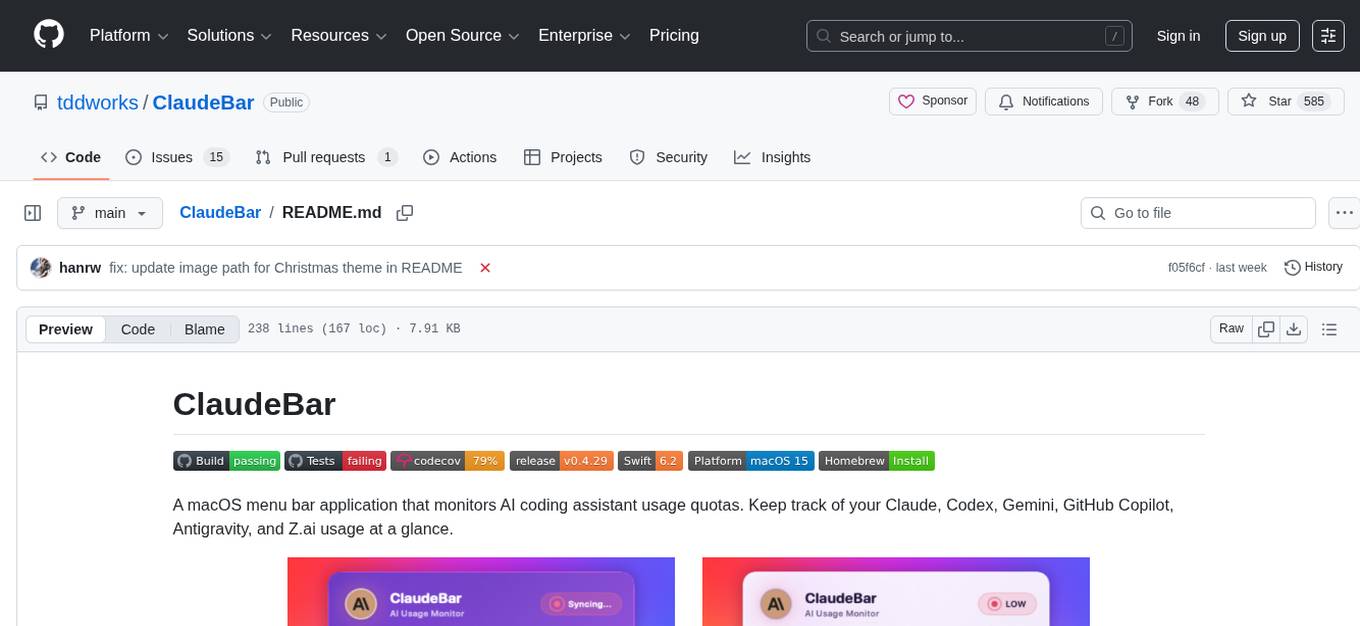
ClaudeBar is a macOS menu bar application that monitors AI coding assistant usage quotas. It allows users to keep track of their usage of Claude, Codex, Gemini, GitHub Copilot, Antigravity, and Z.ai at a glance. The application offers multi-provider support, real-time quota tracking, multiple themes, visual status indicators, system notifications, auto-refresh feature, and keyboard shortcuts for quick access. Users can customize monitoring by toggling individual providers on/off and receive alerts when quota status changes. The tool requires macOS 15+, Swift 6.2+, and CLI tools installed for the providers to be monitored.
superagentx
SuperAgentX is a lightweight open-source AI framework designed for multi-agent applications with Artificial General Intelligence (AGI) capabilities. It offers goal-oriented multi-agents with retry mechanisms, easy deployment through WebSocket, RESTful API, and IO console interfaces, streamlined architecture with no major dependencies, contextual memory using SQL + Vector databases, flexible LLM configuration supporting various Gen AI models, and extendable handlers for integration with diverse APIs and data sources. It aims to accelerate the development of AGI by providing a powerful platform for building autonomous AI agents capable of executing complex tasks with minimal human intervention.
MemMachine
MemMachine is an open-source long-term memory layer designed for AI agents and LLM-powered applications. It enables AI to learn, store, and recall information from past sessions, transforming stateless chatbots into personalized, context-aware assistants. With capabilities like episodic memory, profile memory, working memory, and agent memory persistence, MemMachine offers a developer-friendly API, flexible storage options, and seamless integration with various AI frameworks. It is suitable for developers, researchers, and teams needing persistent, cross-session memory for their LLM applications.
bifrost
Bifrost is a high-performance AI gateway that unifies access to multiple providers through a single OpenAI-compatible API. It offers features like automatic failover, load balancing, semantic caching, and enterprise-grade functionalities. Users can deploy Bifrost in seconds with zero configuration, benefiting from its core infrastructure, advanced features, enterprise and security capabilities, and developer experience. The repository structure is modular, allowing for maximum flexibility. Bifrost is designed for quick setup, easy configuration, and seamless integration with various AI models and tools.
LMeterX
LMeterX is a professional large language model performance testing platform that supports model inference services based on large model inference frameworks and cloud services. It provides an intuitive Web interface for creating and managing test tasks, monitoring testing processes, and obtaining detailed performance analysis reports to support model deployment and optimization.
tingly-box
Tingly Box is a tool that helps in deciding which model to call, compressing context, and routing requests efficiently. It offers secure, reliable, and customizable functional extensions. With features like unified API, smart routing, context compression, auto API translation, blazing fast performance, flexible authentication, visual control panel, and client-side usage stats, Tingly Box provides a comprehensive solution for managing AI models and tokens. It supports integration with various IDEs, CLI tools, SDKs, and AI applications, making it versatile and easy to use. The tool also allows seamless integration with OAuth providers like Claude Code, enabling users to utilize existing quotas in OpenAI-compatible tools. Tingly Box aims to simplify AI model management and usage by providing a single endpoint for multiple providers with minimal configuration, promoting seamless integration with SDKs and CLI tools.
For similar tasks
Magick
Magick is a groundbreaking visual AIDE (Artificial Intelligence Development Environment) for no-code data pipelines and multimodal agents. Magick can connect to other services and comes with nodes and templates well-suited for intelligent agents, chatbots, complex reasoning systems and realistic characters.
danswer
Danswer is an open-source Gen-AI Chat and Unified Search tool that connects to your company's docs, apps, and people. It provides a Chat interface and plugs into any LLM of your choice. Danswer can be deployed anywhere and for any scale - on a laptop, on-premise, or to cloud. Since you own the deployment, your user data and chats are fully in your own control. Danswer is MIT licensed and designed to be modular and easily extensible. The system also comes fully ready for production usage with user authentication, role management (admin/basic users), chat persistence, and a UI for configuring Personas (AI Assistants) and their Prompts. Danswer also serves as a Unified Search across all common workplace tools such as Slack, Google Drive, Confluence, etc. By combining LLMs and team specific knowledge, Danswer becomes a subject matter expert for the team. Imagine ChatGPT if it had access to your team's unique knowledge! It enables questions such as "A customer wants feature X, is this already supported?" or "Where's the pull request for feature Y?"
semantic-kernel
Semantic Kernel is an SDK that integrates Large Language Models (LLMs) like OpenAI, Azure OpenAI, and Hugging Face with conventional programming languages like C#, Python, and Java. Semantic Kernel achieves this by allowing you to define plugins that can be chained together in just a few lines of code. What makes Semantic Kernel _special_ , however, is its ability to _automatically_ orchestrate plugins with AI. With Semantic Kernel planners, you can ask an LLM to generate a plan that achieves a user's unique goal. Afterwards, Semantic Kernel will execute the plan for the user.
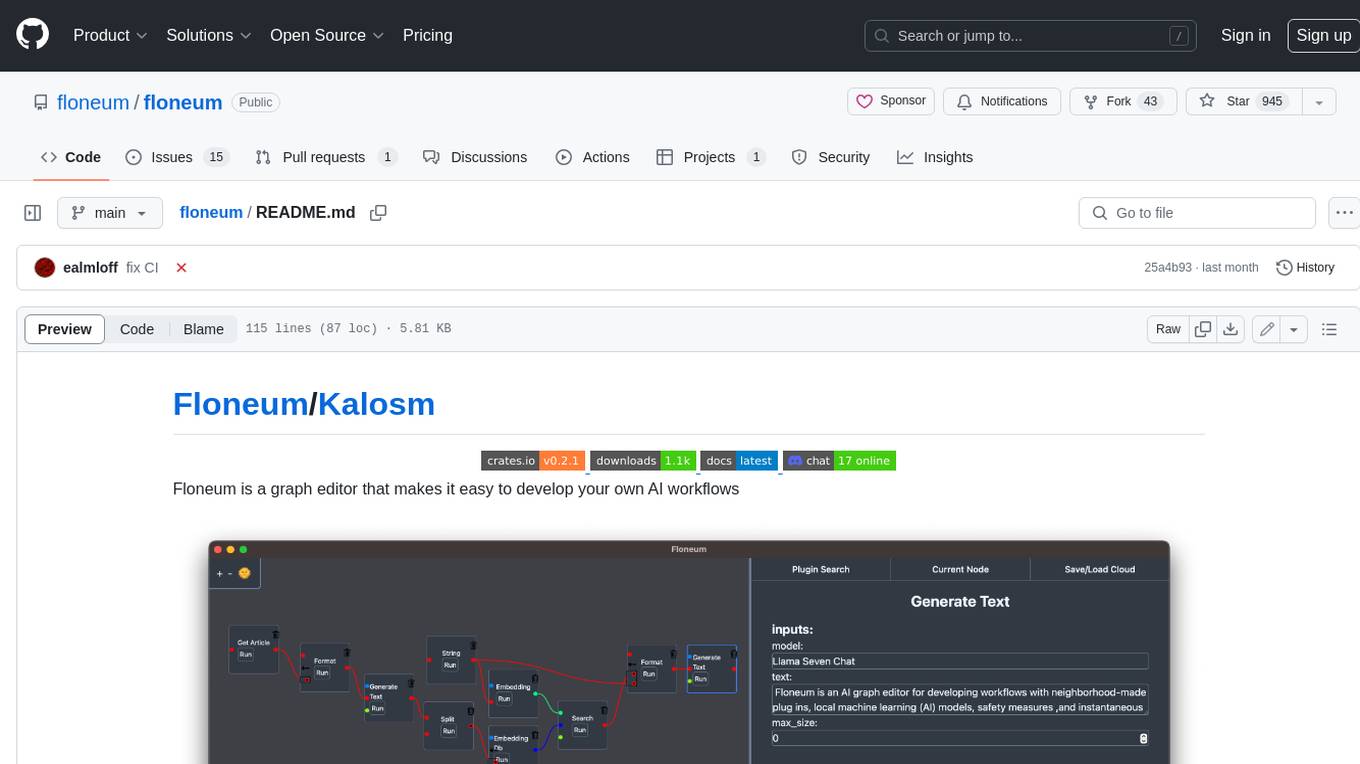
floneum
Floneum is a graph editor that makes it easy to develop your own AI workflows. It uses large language models (LLMs) to run AI models locally, without any external dependencies or even a GPU. This makes it easy to use LLMs with your own data, without worrying about privacy. Floneum also has a plugin system that allows you to improve the performance of LLMs and make them work better for your specific use case. Plugins can be used in any language that supports web assembly, and they can control the output of LLMs with a process similar to JSONformer or guidance.
mindsdb
MindsDB is a platform for customizing AI from enterprise data. You can create, serve, and fine-tune models in real-time from your database, vector store, and application data. MindsDB "enhances" SQL syntax with AI capabilities to make it accessible for developers worldwide. With MindsDB’s nearly 200 integrations, any developer can create AI customized for their purpose, faster and more securely. Their AI systems will constantly improve themselves — using companies’ own data, in real-time.
aiscript
AiScript is a lightweight scripting language that runs on JavaScript. It supports arrays, objects, and functions as first-class citizens, and is easy to write without the need for semicolons or commas. AiScript runs in a secure sandbox environment, preventing infinite loops from freezing the host. It also allows for easy provision of variables and functions from the host.
activepieces
Activepieces is an open source replacement for Zapier, designed to be extensible through a type-safe pieces framework written in Typescript. It features a user-friendly Workflow Builder with support for Branches, Loops, and Drag and Drop. Activepieces integrates with Google Sheets, OpenAI, Discord, and RSS, along with 80+ other integrations. The list of supported integrations continues to grow rapidly, thanks to valuable contributions from the community. Activepieces is an open ecosystem; all piece source code is available in the repository, and they are versioned and published directly to npmjs.com upon contributions. If you cannot find a specific piece on the pieces roadmap, please submit a request by visiting the following link: Request Piece Alternatively, if you are a developer, you can quickly build your own piece using our TypeScript framework. For guidance, please refer to the following guide: Contributor's Guide
superagent-js
Superagent is an open source framework that enables any developer to integrate production ready AI Assistants into any application in a matter of minutes.
For similar jobs
aioboto3
aioboto3 is an async AWS SDK for Python that allows users to use near enough all of the boto3 client commands in an async manner just by prefixing the command with `await`. It combines the great work of boto3 and aiobotocore, enabling users to use higher level APIs provided by boto3 in an asynchronous manner. The package provides support for various AWS services such as DynamoDB, S3, Kinesis, SSM Parameter Store, and Athena. It also offers features like client-side encryption using KMS-Managed master keys and supports asyncifying `get_presigned_url`. The library closely mimics the usage of boto3 and is mainly developed to be used in async microservices.
aiobotocore
aiobotocore is an async client for Amazon services using botocore and aiohttp/asyncio. It provides a mostly full-featured asynchronous version of botocore, allowing users to interact with various AWS services asynchronously. The library supports operations such as uploading objects to S3, getting object properties, listing objects, and deleting objects. It also offers context manager examples for managing resources efficiently. aiobotocore supports multiple AWS services like S3, DynamoDB, SNS, SQS, CloudFormation, and Kinesis, with basic methods tested for each service. Users can run tests using moto for mocked tests or against personal Amazon keys. Additionally, the tool enables type checking and code completion for better development experience.
aws-mcp
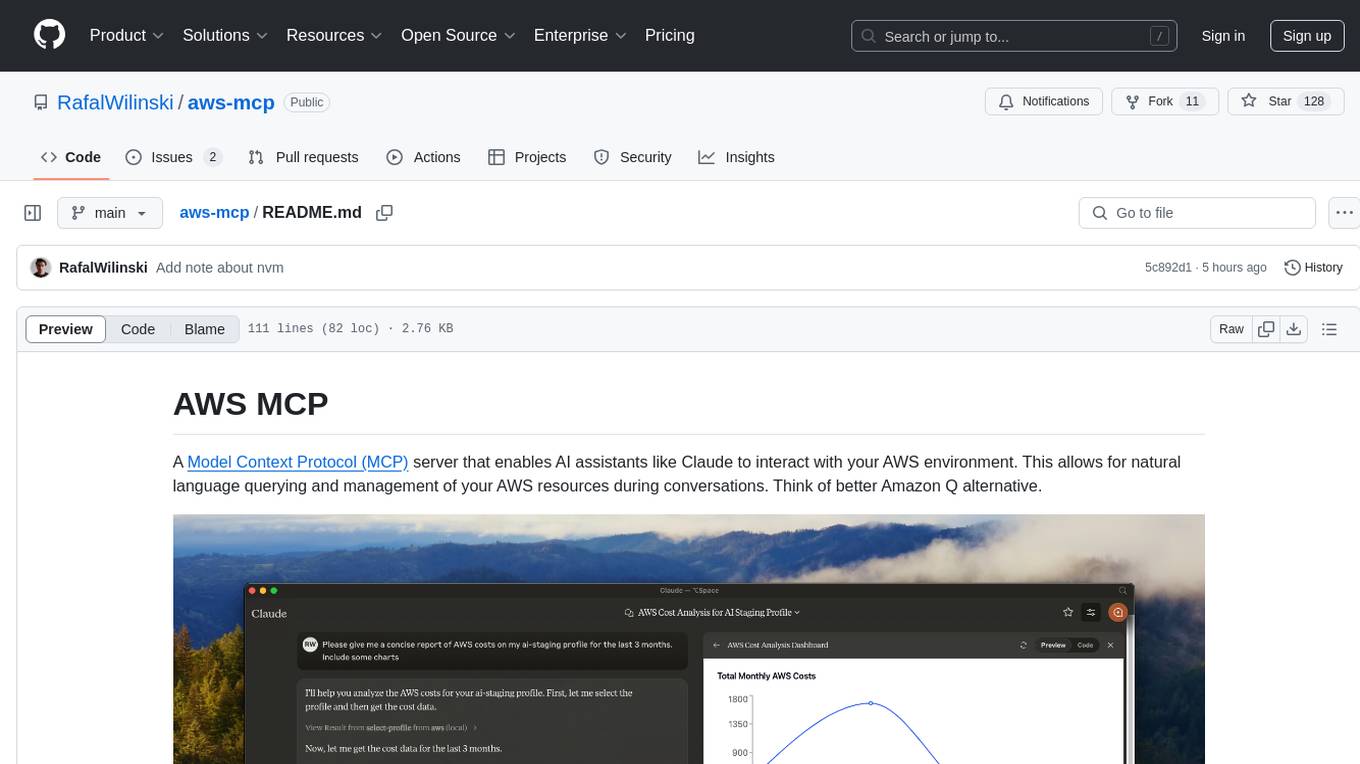
AWS MCP is a Model Context Protocol (MCP) server that facilitates interactions between AI assistants and AWS environments. It allows for natural language querying and management of AWS resources during conversations. The server supports multiple AWS profiles, SSO authentication, multi-region operations, and secure credential handling. Users can locally execute commands with their AWS credentials, enhancing the conversational experience with AWS resources.
serverless-openclaw
An open-source project, Serverless OpenClaw, that runs OpenClaw on-demand on AWS serverless infrastructure, providing a web UI and Telegram as interfaces. It minimizes cost, offers predictive pre-warming, supports multi-LLM providers, task automation, and one-command deployment. The project aims for cost optimization, easy management, scalability, and security through various features and technologies. It follows a specific architecture and tech stack, with a roadmap for future development phases and estimated costs. The project structure is organized as an npm workspaces monorepo with TypeScript project references, and detailed documentation is available for contributors and users.

AirGo
AirGo is a front and rear end separation, multi user, multi protocol proxy service management system, simple and easy to use. It supports vless, vmess, shadowsocks, and hysteria2.
mosec
Mosec is a high-performance and flexible model serving framework for building ML model-enabled backend and microservices. It bridges the gap between any machine learning models you just trained and the efficient online service API. * **Highly performant** : web layer and task coordination built with Rust 🦀, which offers blazing speed in addition to efficient CPU utilization powered by async I/O * **Ease of use** : user interface purely in Python 🐍, by which users can serve their models in an ML framework-agnostic manner using the same code as they do for offline testing * **Dynamic batching** : aggregate requests from different users for batched inference and distribute results back * **Pipelined stages** : spawn multiple processes for pipelined stages to handle CPU/GPU/IO mixed workloads * **Cloud friendly** : designed to run in the cloud, with the model warmup, graceful shutdown, and Prometheus monitoring metrics, easily managed by Kubernetes or any container orchestration systems * **Do one thing well** : focus on the online serving part, users can pay attention to the model optimization and business logic
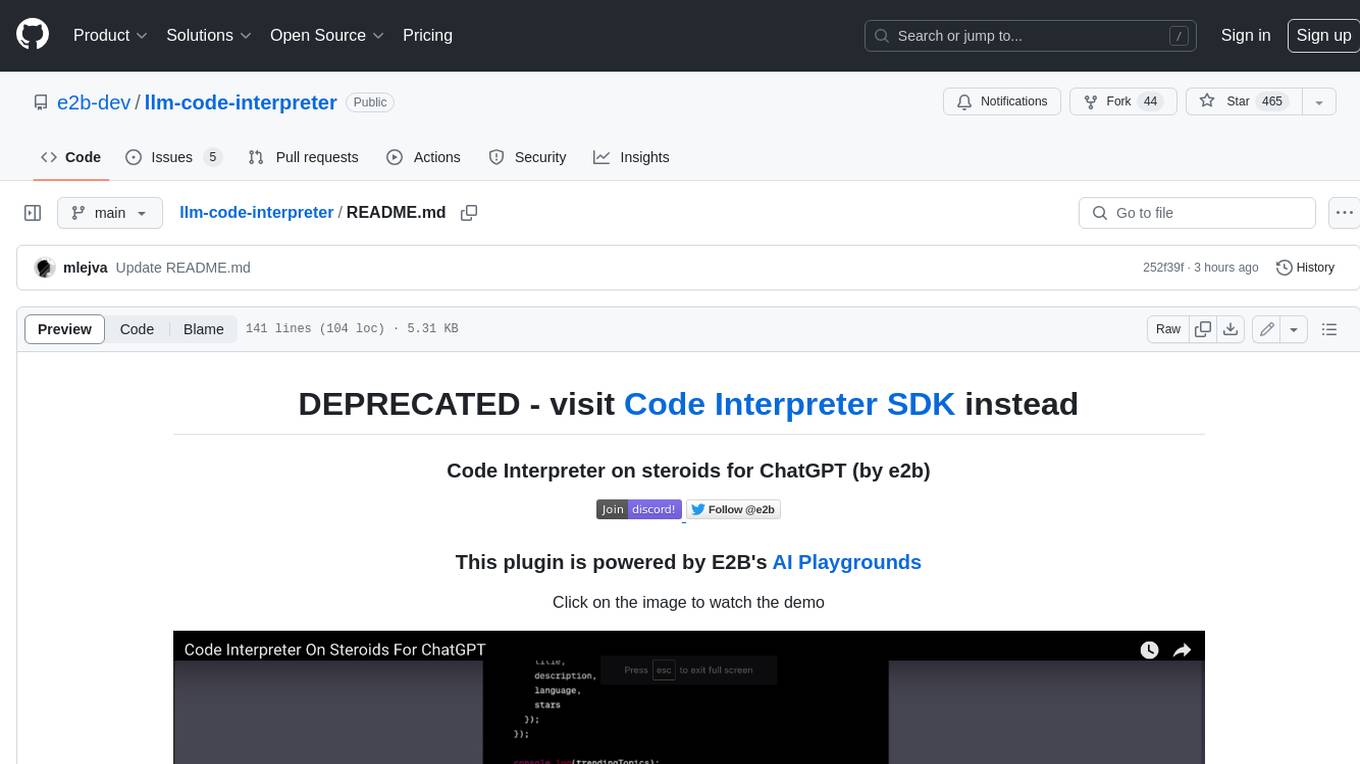
llm-code-interpreter
The 'llm-code-interpreter' repository is a deprecated plugin that provides a code interpreter on steroids for ChatGPT by E2B. It gives ChatGPT access to a sandboxed cloud environment with capabilities like running any code, accessing Linux OS, installing programs, using filesystem, running processes, and accessing the internet. The plugin exposes commands to run shell commands, read files, and write files, enabling various possibilities such as running different languages, installing programs, starting servers, deploying websites, and more. It is powered by the E2B API and is designed for agents to freely experiment within a sandboxed environment.

pezzo
Pezzo is a fully cloud-native and open-source LLMOps platform that allows users to observe and monitor AI operations, troubleshoot issues, save costs and latency, collaborate, manage prompts, and deliver AI changes instantly. It supports various clients for prompt management, observability, and caching. Users can run the full Pezzo stack locally using Docker Compose, with prerequisites including Node.js 18+, Docker, and a GraphQL Language Feature Support VSCode Extension. Contributions are welcome, and the source code is available under the Apache 2.0 License.